"A Romance of Baluchistan" (continued 3)
Reading edition
Now, the said Political was a staff corps man who had seen some service, and, moreover a very energetic and zealous official; consequently, he allowed the fugitive no more start than he could help, with the result that the latter had no time to collect any following so as to afford him the satisfaction of selling his life dearly. So day and night fled Umar Khan; but turn and double as he would, the avenging force pressed him hard, for the Levy sowars were men of the country, and knew all the twists and turns of the mountains as well as he did; and their commander was a seasoned campaigner, and as hard as nails. However, fortune favoured him, and the hunted man succeeded in reaching a place of refuge and of safety—as he thought.
As he thought! For, persistent as bloodhounds, that avenging band held steadily upon his track. Finally they came up with him. Umar Khan was in a tent asleep. Stealthily the pursuers drew up in crescent formation, and their commander summoned Umar to come forth. For a moment there was dead silence. Then swift as thought, a rifle muzzle was poked through the flap of the tent. A loud report, and a bullet sang past the official’s ear. The latter, more than ever bent on securing his prisoner alive, reiterated the summons, with the alternative in the event of noncompliance, of ordering a volley to be fired into the tent. The reply came as before, in the shape of another bullet, which this time killed the horse of one of the sowars. The order was given to fire.
The rattle and smoke of the volley rolled away—and lo! the sides of the tent were riddled like a sieve. There was a moment or two of silence, and again the officer challenged any who might be left alive to come forth. There emerged from the tent door, a figure clad in the full voluminous draperies and close veil of an Afghan woman.
She did not even look at the troop. She fled away over the plain as fast as her legs could carry her, uttering shrill screams. Those who looked on were filled with wild amaze. How could any living thing have escaped that volley? A movement made to pursue her was simultaneously checked, and then the Political Agent and some of the sowars entered the tent, but cautiously.
Their caution in this instance was unnecessary. One human being alone was in that tent—lying on the ground in a pool of blood. Such rude furniture and utensils as there were had been riddled, and the ground itself ploughed up with bullets. The human figure was limp and lifeless, and—it was that of another woman.
An idea struck the official. He leaped outside the tent; his gaze directed at the fast fleeing figure, now some distance away. He—and those present—saw it drag out a horse from among the rocks and stones of a dry nullah, and, flinging off the female attire, spring upon the animal’s back. Then darting forth a hand with defiant gesture, and hurling back a final curse and menace, the fugitive—a wiry, muscular male—flogged his steed into a furious gallop, and was speedily out of range of the hurried volley sent after him.
The officer stared, and, we fear, cursed. The Levy sowars stared, and certainly invoked Allah and his Prophet; while laughing at both, yet storing up deeper vengeance for the slaughter of one of his most faithful wives—who had shared and aided his flight, and eventually laid down her life for him—fled Umar Khan far over the plains of Afghanistan—further and further into that welcome land of refuge.
There lay the rub. They dare not pursue him further. Already a violation of international law had been committed in carrying the pursuit thus far. Well might the official feel foolish. That their bird should be allowed to skip off right under their very noses in the garb of the supposed female whom they had so very humanely spared was enough to make him feel foolish. But he was destined to feel more so subsequently, when an acrid representation from the Amir of Kâbul entailed upon him a Departmental wigging, although but a technical one. After all, a man may be too zealous.
After that Umar Khan disappeared for a while. The Amir of Kâbul, when mildly requested to hand him over, declined crustily, on the ground that an armed force had pursued a fugitive over his border without so much as a by-your-leave. If the English attempted to police his country and failed, he was not going to step in where they left off.
So the years went by, and Umar Khan was lost sight of and forgotten. Then, suddenly, he reappeared in his old haunts.
Changes of administration had supervened. The Government did not care to bother itself over a man who had been a desperate outlaw under its predecessors, as long as he behaved himself and showed a disposition to amend the error of his ways. Moreover, he was a member of one of the most powerful and turbulent tribes in Baluchistan. The Sirkâr concluded to let sleeping dogs lie. So it shut its eyes, and Umar Khan was left in peace.
In peace? Yes, so far as he was concerned. But he fixed his dwelling among the wildest and most impracticable of mountain deserts—always ensuring for himself a safe retreat—and thence he began to prey upon all and any who had the wherewithal to pay up smartly for further immunity.
Then complaints began to reach Shâlalai. Peaceable banyas had been plundered of all the gains they had made during a travelling trade. Merchants on a larger scale trading with Kâbul had been relieved on a proportionate scale, or even held to ransom. Umar Khan adopted a method of his own for putting a stop to the complaints of such. It was the method best expressed by the saw, “Dead men tell no tales”—and by way of doing the thing thoroughly, he seized the whole of the plunder instead of merely the half as heretofore, but took care that the owner should not be on hand to lay any complaint. And leaving out many other unchronicled misdeeds, we think we have said enough to establish our opening statement, viz: that Umar Khan was a Baluchi who bore a very bad record indeed.
He was not a sirdar, nor even a malik. He was, in fact, a nobody, who—as not unfrequently happens among barbarian races—had raised himself to a sort of sinister eminence by a daring fearlessness and a combination of shrewdness and luck in evading the consequences of his countless acts of aggression. Added to this, his enforced outlawry and the exploits, half mythical, wherewith rumour credited him during that period, had thrown a kind of halo around him in the eyes of his wild, predatory fellow-tribesmen. Nominally he lived under and was responsible to the Sirdar Yar Hussain Khan, who was chief over a large section of the powerful Marri tribe; actually he was responsible to nobody in the wide world. His own particular following was made up of all the “tough” characters of the tribe, which is saying much, for the Marris bore the reputation of numbering in their midst some very “tough” characters.
The saw relative to the endowment of anybody with a sufficiency of rope was beginning to hold good in the matter of Umar Khan. Things were going badly with him. He had been obliged to be more than liberal with his ill-gotten gains in order to retain the adherence of his following, and the shoe was beginning to pinch. Then his tribal chief had given him a hint to sit tight; in short, had given him two alternatives—either to behave himself or clear out.
He had about concluded to embrace the latter of these—and the motive which had led him up to this conclusion was dual—and akin to that which tells with like effect upon men far more civilised than the Baluchi ex-outlaw. Umar Khan was hard up; likewise he was hipped. He was perfectly sick of sitting still. Times were too peaceful altogether. So he sold what few possessions he had left, and with the proceeds laid in a stock of Snider rifles and ammunition.
Umar Khan sat in his village at sunrise. It was the hour of prayer, and several of the faithful, dotted about, were devoutly prostrating themselves, in the most approved fashion; indeed Umar himself had only just finished the performance of his devotions, for your Moslem is a logician in such matters, and has no idea of heaping up great damnation to himself by committing two sins instead of one, as would be the case were he to omit the prescribed devotion simply because he had just cut somebody’s throat. The low, flat, mud-walled houses were in keeping with the surroundings—looking indeed as if they had but been dumped down and left to dry, like other piles of earth and stones which had rolled down the arid slopes and remained where they fell. A flock of black goats and fat-tailed sheep, mingled together, was scattered over the plain, though where they could find sustenance in such a desert, Heaven alone knew. Camels, too, were stalking around, also making what seemed an ironical attempt at browsing.
The sun had just risen beyond the far off limit of the desert plain, tinging blood-red the line of jagged peaks shooting skyward behind the village. Umar Khan sat in gloomy silence, smoking a narghileh, and, like most Orientals, indulging in much expectoration. His grim, hawk-like face, with the shaggy hanging brows meeting over his hooked nose, looked more cruel and repulsive than ever, as he stroked his beard, or pulled at the long black tresses, which hung down on each side of his face. Then he looked up. A fellow-tribesman was coming towards him. Umar Khan’s glance now lit up with animation. The man came to him and sat down. Their talk was short, but the ex-outlaw’s expression of countenance grew positively radiant, as the new arrival went on unfolding his tidings.
Umar Khan rose and ordered his best horse to be saddled. As he rose, it might have been noticed that he suffered from a slight limp. Then taking with him seven other spirits more wicked than himself—if that were possible—he rode forth.
For many hours they fared onward, avoiding the more frequented ways, and travelling over precipitous mountain path and through wild tangi, by routes well known to themselves, halting at convenient places to rest and water their horses. All had rifles, as well as their curved tulwars, and this savage band of hook-nosed, scowling copper-coloured ruffians, armed to the teeth, looked about as forbidding, even terror striking a crew as the peaceable wayfarer would not wish to meet—say half way through a tangi where there was precious little room to pass each other.
The sun was now considerably past the meridian, and at length the band, at a word from Ihalil Mohammed—the man who had brought the news which had led to this undertaking—halted amid some rock overlooking a broad high-road.
Far away along its dusty length a speck appeared, growing larger as it drew rapidly nearer, until it took the shape of a vehicle, containing but one man, and he the driver. It was an ordinary “gharri,” or hackney cab. To meet this Ihalil and four others now rode down.
“Salaam, brother,” they exclaimed, drawing up across the road.
“Salaam, Sirdar sahib,” returned the driver, in tremulous tones, turning pale at the sight of these fierce armed figures barring his way. The man was an ordinary specimen of the low caste Hindu, and as such held in utter contempt by these stalwart sons of the desert, and in repulsion as a heathen and an idolater.
“Who art thou, brother; and whither faring?” queried Ihalil.
The man replied, in quaking tones, that he was but a poor “gharri-wallah” hired to meet a certain holy mûllah who was travelling from Shâlalai to a village away far out in the desert. He was to bring him on a stage of his journey, and expected to meet him not far from that point.
“Good. Now turn thine old box on wheels out of the road and follow to where we shall lead thee,” commanded Ihalil.
The poor wretch dared not so much as hesitate, and presently the rickety old rattle trap was drawn up behind the rocks. At sight of the rest of the band the miserable Hindu gave himself up for dead.
“Salaam, Sirdar sahib,” he faltered, cowering before the grim stare of Umar Khan.
The latter then questioned him, in process of which one of the freebooters stole up behind, his tulwar raised. The badly scared “gharri-wallah,” his eyes starting from his head, had no attention to spare from the threatening scowl and searching questions of Umar Khan; and of danger from behind was utterly unconscious. Then, at a nod from Umar Khan, down came the tulwar upon the neck of the doomed Hindu.
It was badly aimed and did not sever the head, but cut far and deep into the neck and shoulder. The miserable wretch fell to the ground, deluged with a great spout of blood, but yet wailing dismally in agony and terror. In a moment two more tulwars swung through the air, and the sufferings of the murdered man—literally cut to pieces—were over, though his limbs still beat the ground in convulsive struggles.
Umar Khan spat in derision, while the other barbarians laughed like demons over this atrocious deed. The murderers wiped their swords on the garments of their victim, and examined the keenly-ground edges solicitously, lest they should be in any way notched or turned. But now their attention was diverted. Another speck was growing larger and larger on the road, this time advancing from the direction in which their late victim had been proceeding. Drawing nearer it soon took shape. Another “gharri” similar to the one whose driver they had slaughtered.
The whole band rode down to meet it. Besides the driver it contained another man.
“Peace, my sons,” said the latter as they drew up.
“And on you peace,” returned Umar Khan. “But first—for this dog. Hold—Alight, both of ye.”
There was that about the aspect of these armed brigands that would admit of no hesitation. Both obeyed. This driver, too, was a low caste Hindu. His “fare” was an old man, white-bearded, and wearing a green turban.
No sooner were both fairly out of the “gharri,” than Ihalil Mohammed rode at the Hindu and cut him down. Others fell upon him with their tulwars, and the miserable wretch, like his fellow-craftsman, was literally hewn to pieces then and there. With savage shouts the murderers waved their bloodstained weapons aloft, curvetting their steeds around the survivor.
The latter turned pale. Quick as thought, however, he had drawn a volume of the Korân from beneath his garments, and placed it upon his head.
“La illah il Allah”—he began.
”—Mohammed er rasool Allah,” (Note 2) chorused the blood thirsty savages, as though in one fierce war shout, turning to hack once more at the mangled carcase of the miserable Hindu.
“Hearken, my father,” said Umar Khan, pointing his rifle at the traveller. “A true believer is safe at the hands of other believers. But, father, delay not to deliver over the seven hundred rupees which are in thy sash.”
The other turned paler still.
“Seven hundred rupees?” he exclaimed, holding up his hands. “What should a poor mûllah do with such a sum?”
“Thou hast said it, my father. What indeed?” sneered Umar Khan. “What indeed, save as alms for the poor, and the debtors and the insolvent, as enjoins the holy Korân? And such thou seest before thee. Wherefore we will receive them, father, and pray the blessing of Allah, and a rich place in the seventh heaven for thee and thine.”
“Do ye not fear God, O impious ones, that ye would rob His servant?” said the mûllah, waxing wroth in his desperation.
“We fear nobody,” returned Umar Khan, with an evil sneer. “Yet, my father, delay not any longer, lest this gun should go off by accident.”
“Wah—wah!” sighed the mûllah. “Be content my children—it may be ye are poorer than I. Receive this packet, and the blessing of a servant of the Prophet go with it. And now I will proceed upon my way.”
“Wait but a few moments,” replied Umar Khan, receiving the bag which the other tendered him, and which he immediately handed to Ihalil with one word—“Count!”
“It may not be, for the hour of evening prayer draws near. Peace be with you, my children.” And he made as though to move on.
“We will say it together then,” replied Umar Khan, barring the way. “What is this? Two hundred and fifty rupees? Two more packets hast thou forgotten, my father, and—delay not, for the hour of evening prayer draws near.”
There was a grim, fell significance in the speaker’s tone and countenance. The mûllah no longer hesitated. With almost trembling alacrity he drew forth the remaining bags, which being counted, were found to contain the exact sum named.
“We give thee five rupees as an alms, my father,” said Umar Khan, tendering him that amount. Gloomily the mûllah pocketed it. “And surely God is good to thee, that in these days thou hast been able to relieve the necessities of Umar Khan.”
A start of surprise came over the face of the other, at the mention of the name of the dreaded ex-outlaw. He had more than a shrewd suspicion that but for his sacred office he would be now even as his Hindu driver—which went far to console him for the loss of his substance.
“Wah—wah!” he moaned, sitting down by the roadside. “My hard earned substance which should comfort my old age—all gone! all gone!”
“The faithful will provide for thine old age, my father. And now, peace be with thee, for we may not tarry here. But,”—sinking his voice to a bloodcurdling whisper—“it is well to give alms in secret, for he who should boast too loud of having bestowed them upon Umar Khan, not even the holy sanctuary of Mecca would avail to shelter him.”
“Blaspheme not, my son,” cried the mûllah, affecting great horror, and putting his fingers to his ears—though, as a matter of fact, the warning was one which he thoroughly understood.
They left him seated there by the roadside, despondent over his loss. They left the two mangled bodies of their victims to the birds and beasts of prey, and gave vent to their glee as they dashed off, in shouts and blood thirsty witticisms. They were in high good humour, those jovial souls. They had slain a couple of human beings—that was to keep their hands in. They had robbed another of seven hundred rupees—that would replenish the wasted exchequer for a time; and now they cantered off to see if they could not do a little more in both lines—and the goal for which they were heading was the Kachîn valley.
Umar Khan had burnt his boats behind him.
Note 1. To lend additional terror to capital punishment in the eyes of Moslems on the northern border, the dead bodies of those executed for fanatical murder were sometimes burned.
Note 2. “God is the God of gods—Mohammed the Prophet of God.”—The Moslem confession of faith.
Chapter Thirteen.
Experimental.
The days had gone by, and now Campian was installed in the forest bungalow. Colonel Jermyn’s invitation had gone forth, but the missive which would have counteracted it had not, so here he was.
Not without some deliberation had he decided on accepting it. He had thought himself safe; had reckoned he had safely parted with all illusions, as conducive only to disturbance and anxiety, and the greatest of all illusions was Vivien Wymer. But the sudden and unlooked for reappearance of the latter had reopened a wound. Yet why? She was the same as before. She had failed him once. She had sacrificed him to others once, and would of course do so again unhesitatingly. Why not? There was no such thing as love as they two had once looked at it—had once imagined it. A mere illusion; pleasant while it lasted, painful when its illusoriness became evident. But then the wrench, though painful, even agonising, was over—and in its effect salutary. Five years make a difference in a man’s life. He had not been young then; he was older now. Sensibility was blunted. The capacity for self-torment was no longer his.
Love, the ever endurable! He had believed in that once. He was no misogynist, even now. His experience of the other sex had been considerable. He was ready to accord the members thereof the possession of many delightful qualities. As friends they were staunch, as companions unrivalled. Life unbrightened by feminine presence and feminine influences would be a dull affair. But as exponents of Love, the ever endurable, they were a failure; and exactly as he came to appreciate this did he come to appreciate the other sex the more because he had ceased to expect too much.
His experiences had been many and varied, and took in all types of the softer sex, and he had found them wonderfully similar. The fire and passion of to-day became chill and indifference a year hence. Then Vivien Wymer had come into his life, and lo, all was changed. Here was a glorious exception to the rather soulless rule. She met his every want; she appealed to him as he could never have believed any woman could, and by some strange, magnetic instinct, his own personality appealed to hers. They seemed made for each other—and yet—he had been sacrificed. Not even there was he to be all in all—to be first and everything.
They had seen each other again once since that chance meeting in the markhôr cave. The colonel and his niece had ridden over to Upward’s camp to tiffin, and it was on that occasion that the hearty old soldier had pressed him to come and pay them a visit. He had not even glanced at Vivien, striving to read to what extent she would second the invitation, but had accepted on the spot, yet not without a mental reservation.
For there was one point which he desired to debate within himself, and that was the very one which had occurred to Vivien. How could they two be together under the same roof, in close, daily intercourse as mere acquaintances, they two who had been so much to each other? How could they bear the strain, how keep up the rôle?
Then when his meditations had reached this point, a strange exultant thrill seemed to disturb the balance of his clearer judgment. Why should the rôle be kept up? After being parted for five years, they had met again—nay, more—had been thrown together again in this strange, wild country, that in former times had been to either of them no more than a mere geographical name. Both were unchanged. There was a softening in Vivien’s voice, when off her guard, as on the last occasion of their meeting, which seemed to point to the fact that she was. For himself—well, he had grown older, wiser—and, he imagined, harder. Still, the wound did seem to be reopening. Why, the whole was almost as though Fate had gone out of her way to bring they two together again.
Yes, he had grown harder. Love, the ever endurable! Ridiculous! She had sacrificed him before, and would do so again if occasion arose. If she did not do so it would be because occasion had not arisen, and this consideration constituted a state of potential unreliability, which was not reassuring. The idea even served to re-awaken much of the old bitterness and rankling resentment, and he decided that it would be an interesting, if coldblooded, study in character to observe how Vivien herself would come out under such an ordeal as the close, intimate intercourse which life beneath the same roof could not but involve.
Once there, he had no cause to regret his decision. The colonel was a fine old soldier of the very best type. Most of his life had been spent in India, and he was full of anecdote and reminiscence. He had served through the Mutiny, and in several frontier disturbances, and his knowledge of the country and its natives was intelligent and exhaustive. He had been a sportsman, too, in his time—and, in short, was a man whom it was a pleasure to talk with. He and Campian took to each other immensely, and the two would sit together under the verandah of an evening, smoking their cheroots and exchanging ideas, while Vivien discoursed music through the open doors, upon a cottage piano which had been lugged up, at some risk to its tuning and general anatomy, on board the hideous necessary camel.
Decidedly it was very close quarters, indeed, this party of three, isolated there in that remote forest bungalow, away among the chaotic, piled up mountain deserts of wild Baluchistan; but there was no element of monotony about it; indeed, how could there be when to two out of the three life thus represented an ordeal that meant so much, that might mean indeed so much more. Yet it spoke volumes for the self control of both that no suspicion should have entered the mind of the third that they had ever beheld each other elsewhere, and under very near circumstances. Their intercourse was free and unrestrained, but it was the easy intercourse of two people who had ideas in common and liked each other’s society, and totally devoid of any symptom of covering a warmer feeling. They would frequently take rides or walks together through the juniper forest, or to some point overlooking a new or wider view of the great chaotic mountain waste, and it spoke volumes for their self control that no allusion was ever made to the past. They would not have been human if occasionally some undercurrent of feeling had not now and then come unguardedly near the surface, but only to be instantly repressed. It was as though both were engaged in a diplomatic game requiring a high degree of skill, and in which each was watching the next move of the other with a jealous eye.
Once, in course of their rides together, the two were threading a tangi, and the sense of being shut within those high rock walls moved Vivien to broach the subject of the adventure which had so nearly ended in tragedy for her companion and his.
“It must have been a dreadful experience,” she said, looking up at the cliffs overhead.
“Yes. It was awkward. I’ve no use for a repetition of it.”
His tone was discouraging, as though he would fain have changed the subject. But she seemed to cling to it.
“I think that was a splendid feat,” she went on, looking straight at him. “I wish I knew what it was like never to be afraid.”
“So do I—most heartily. But I simply don’t believe in the existence of that enviable state; if you can talk of the existence of a negative, that is.”
“But you do know what it is. Were you ever afraid of anything in your life?”
The very words Nesta had used. Then he had not taken them in a complimentary sense. He had thought the remark a foolish one. Now coming from this woman, who had idealised him—who did still—with her wide luminous eyes turned full upon his face, and that unguarded softening which had again crept into her tone, there was a subtle flattery in it which was delicious, but enervating. As a matter of fact he really thought nothing of the feat, beyond what a lucky thing it was they should have been able to save both their lives. He answered so shortly as to seem ungracious.
“Very much and very often. I would rather run away than fight any day. Fact.”
“I don’t believe you.”
“No? People don’t, I find. Some day I may do that very thing—then when everybody is howling me down I can always turn round and say—‘I told you so, and you wouldn’t believe me.’”
“But do you want them to believe you?”
“Why, of course. You don’t know me at all, Vivien, even now.” Then, as if to hurry away from a dangerous slip. “By the by, I never can understand the insane way in which even civilised and thinking people elect to deify what they call courage or pluck. There is no such thing really. It is purely a matter of opportunity or temperament—in short, sheer accident. To get out of a tight place a man has got to do something. While doing it he has no time to think. If he had, in nine cases out of ten he’d run away.”
“Yes? And what about when he has to go into a tight place?”
“Why, then he’s got to go. And as a matter of fact it is funk that drives him in. The opprobrium and possibly material penalty, he would incur by backing out constitute the more formidable alternative of the two. So of the two evils man, being essentially a self preserving animal, instinctively chooses the least.”
“Plausible, but not convincing,” returned Vivien, with a laugh. “And is there not something of what they call a ‘crank’ underlying that philosophy?”
“‘They’ are apt to say that of any application of the principles of common sense,”—“as I have so often told you before,” he was nearly adding.
“Was Miss Cheriton very much scared that day? She says she’ll never get over it as long as she lives.”
“Poor little girl. It must have been a ghastly experience. She behaved very well; was no more scared than any other woman would have been, and a good deal less so than some.”
“What a pretty girl she is.”
“Very—of her type.”
Vivien was conscious of two emotions—swift, simultaneous as a lightning flash; first a pang over the readiness with which he endorsed her remark, then a heartbeat of relief, for those three words constituted a whole saving clause.
“You must have seen a great deal of her?”
No sooner uttered than Vivien would have given anything to recall the remark. What construction would he put upon it other than jealousy of this blue-eyed, golden-haired girl, who had several years of youth the advantage over herself?
“That depended upon circumstances. Nesta Cheriton has a great penchant for the British Army, and the British Army thoroughly reciprocates the predilection. While the British Army was represented at Chirria Bach I saw not much of her, over and above the occasions when one had to meet in ordinary life. While it was unrepresented she seemed to make herself equally happy in going chikór shooting with me. On the whole, I rather like the little girl. She is bright and amusing, and acts, I suppose, as a passing tonic to one’s jaded and middle-aged spirits.”
His tone had been that of absolute and unaffected ease, and now it occurred to him suddenly, and for the first time, that Vivien was putting him through something of a catechism. The moral dissection which he had promised himself in risking a sojourn beneath the same roof with her had already begun, and this was only a phase of it. At such times the old feeling of rankling bitterness would come upon him, and with it a wave of desolation and heart-emptiness. Why had she failed him—she his destined counterpart? Why had she proved so weak under a not very strong ordeal? He had indeed become hard, when he could go through day after day in closest companionship with her, and yet keep on the mask, never once be betrayed into letting down his guard.
One consideration had acted as a salutary cold douche in the event of the smouldering fires of his nature rising too near their restraining rock crust. One day Vivien was telling him all about her uncle and how she came to be keeping house for him. She had done so since her aunt’s death, and supposed she would go on doing so. He was such a dear old man, she said—so thoughtful and kind and unselfish, and he had no one to look after him but her. All of which her listener, even from his short opportunity of observation, was inclined to endorse; but the sting lay in the concluding consideration, for it recalled that other time. In it had lain the pretext for sacrificing him to an imaginary duty. He was not going to risk a repetition of what he had then undergone. The iron entered deeper and deeper.
Once an incident occurred which nearly availed to shatter and melt it. Vivien had gone into his room during his absence, as she frequently did, to see if there was not some little touch she could add to its comfort or attractiveness. An object on his table caught her attention. She picked it up and examined it, and her eyes filled. Yet it was only an old tobacco pouch, and a very worn and weather-beaten one at that—so worn and frayed that hardly more than a few threads of the original embroidery still hung to the cover. Then she did an extraordinary thing. Instead of replacing it she took it away with her. That night she sat up late, and lo, in the course of the day, going into his room Campian found that the old battered pouch for which he had hunted high and low was replaced by a beautiful new one, the embroidery of which was a perfect work of art.
“Why did you take so much trouble?” he said when next they met. “You could not have known I had lost the other.”
“Is that why we were so glum last night?” she returned, a glad light, struggling with a mischievous one, in her eyes. “Never mind. This is a much better one.”
“I loved that one. I would give a great deal to recover it, as you ought to know.”
“Wait a moment.” She left him and returned almost immediately.
“Here it is—or what is left of it. Now—? What will you give?”
She held it out to him—then drew it back. Her eyes were raised to his. Her voice was soft and caressing as ever he had heard it in the old days. Just one of those trivial accidents bringing about the most crucial moment in two lives—when, as usual, the most trivial of causes availed utterly to mar its effect. That most trivial of causes was the voice of Colonel Jermyn, followed by the entrance of its jolly possessor.
“Here’s the dâk just come from Upward. They’re all going back to Shâlalai the day after to-morrow Campian, and want to know if you’ve had enough of us yet. If you have they say they are leaving early and you’d better be down at the camp to-morrow night. If you haven’t—why—all the better for us.”
“The point is whether you haven’t had enough of me, Colonel.” But while he made the laughing remark his glance travelled round to Vivien’s face. It was one of those moments when her guard was down. The interruption had come so inopportunely. Decidedly the study he had promised himself was bearing rich results.
“Pooh! Of course we haven’t. Why, you’ve only just come. Besides, you can get to Shâlalai at any time. That’s settled then. But I have an idea. We might go down to Mehriâb station and see them off. There are some things I am getting up, and that idiot of a Babu in charge can’t send an intelligent answer to any question I write him. It’s not a bad sort of ride down there, and we’ll kill two birds with one stone. What do you say, Viv?”
“I beg to second it, Uncle Edward. The idea is an extremely good one.”
To him who watched it, while not seeming to, there was an entire revelation in Vivien’s face during that momentary lifting of the veil. She was as anxious to prolong the time as—he was. Yes, that is what it amounted to. The experiment, from its coldblooded side, seemed to have failed.
“We shall be up here some weeks longer, Campian”—went on the Colonel—“but of course if you have to go, it is easy enough to get to Shâlalai. Meanwhile my boy, as long as you can make yourself happy here we are only too glad.”
“Oh, I can do that all right, Colonel. And I’m not tied to time in any way either.”
Again that relieved look on Vivien’s face. Some weeks! What might not be the result of those weeks was the thought that was in the minds of both of them? What might not transpire within those weeks? Ah, if they had only known.
“By the way there’s another item of kubbar in Upward’s letter,” went on the Colonel, fumbling for that missive. “A budmâsh named Umar Khan has started out on a Ghazi expedition down Sukkâf way. He and several others rode out along the road and cut down a couple of poor devils of gharri-wallahs. Killed ’em dead as a door nail. There was a mûllah in one of the gharris, and they plundered him. He got out a Korân and put it on his head—singing out that he was a mûllah. ‘Mûllah or not,’ says Umar Khan—‘hand out those seven hundred rupees you’ve got on board.’ And he had to hand them out. Sacrilegious scamps—ha, ha! But if he hadn’t been a mûllah they’d have cut him up too. Well these budmâshes will have to swing for it. They’ll soon be run to earth. Nice country this, eh, Campian?”
“Rather. It seems to me only half conquered, and not that.”
“Yes. It’s run at a loss entirely. A mere buffer State. We hold it on the principle of grabbing as much as we can and sticking to it, all the world over—and in this particular instance putting as much as we can between the Russians and India.”
“And what if Umar Khan is not speedily run to earth?”
“Oh, then he’ll knock around a bit and make things generally unpleasant. Do a little dacoity from time to time. But we are bound to bone him in the long run.”
“There’s an uncommonly queer closeness in the air this evening,” said the Colonel as they were sitting out under the verandah a little later. “As if there was a storm of sorts working up. Yet there’s no sign of thundercloud anywhere. Don’t you notice it, Vivien?”
“I think so. It has a dispiriting effect on one, as if something was going to happen.”
The sun had gone down in a lurid haze, which was not cloud, and the jagged peaks of the opposite range were suffused in a hot, vaporous afterglow, while the dark depth of juniper forest in the deep, narrow valley seemed very far down indeed. What little air there was came in warm puffs.
“We all seem rather chûp this evening,” said the Colonel. “Viv, how would it be to play us something lively to wake us up?”
She rose and went inside. Campian could still see her as she sat at the piano, rattling off Gilbert and Sullivan at their liveliest. He could continue the very favourite occupation in which he had been indulging—that of simply watching her—noting every movement, the turn of the head, the droop of the eyelids, the sweet and perfect grace which characterised her most trivial act. This woman was simply perfect in his sight—his ideal. Yet to all outward intent they were on the easy, friendly terms of two people who merely liked each other and no more.
“Come and have a ‘peg,’ Campian,” said the Colonel presently.
“No thanks—not just now.”
“Well, I’m going to,” and away he went to the dining room.
Then Campian, sitting there, was conscious of a very strange and startling phenomenon. There was a feeling as though the world were falling away from beneath his feet, together with a dull rumble. There was a clatter of glass and table ornaments in the drawing room, and he could see Vivien sway and nearly fall from the music-stool. He sprang to his feet to rush to her aid, and seemed hardly able to preserve his own balance. Both staggering they met in the doorway.
“Oh, Howard, what is it?” she cried, seizing in both of hers the hand which he had stretched out to help her.
“Quick. Come outside,” was all he said. They were able to walk now, and he drew her outside the verandah, right into the open. Then again came that cavernous rumble, and the earth fairly reeled beneath their feet.
“That’s what all this heaviness in the air has been about,” he said, as the ground felt firm again. “A shock of earthquake.”
“Is it over? Will there be any more?” she gasped, her white face and dilated eyes turned up to his. She still held his hands, in her sudden terror, casting all considerations of conventionality to the winds.
“I don’t think so,” he answered, a very tremble of tenderness in his voice as he strove to reassure her. “These shocks generally go in twos or threes, like waves. And even if there are any more we are all right outside.”
Here the humorous element asserted itself, in the shape of Colonel Jermyn choking and coughing in the verandah. In his hand he held a tall tumbler, nearly empty.
“Look at this, Campian,” he cried. “A man can’t even have a ‘peg’ in his own house without the whole world rising up against it. Flinging it in his face, and half choking him, by George.”
“Some awful big teetotaler must have gone below, Colonel, to raise racket enough to knock your ‘peg’ out of your hand. I hope you’ll take warning and forswear ‘pegs.’”
“Ha, ha! Well, Viv? Badly scared, child?”
She laughed, but the colour had not yet come back to her cheeks.
“I predicted something was going to happen, didn’t I?” she said.
“And it has happened—and now there’s another thing going to happen, and that is dinner, so we’d better go inside and begin to think about it. What? Is it safe? Of course, though, my dear, I don’t wonder at it if you were a little scared. It’s an experience that is apt to be alarming at first.”
The while the speaker was chuckling to himself. He had been a witness both by ear and eye to the foregoing scene, having overheard Vivien’s alarmed apostrophe.
“So? It has come to that, has it?” he was saying to himself. “‘Howard,’ indeed? But how dark they’ve kept it. Well, well. They’re both of them old enough to look after themselves. ‘Howard,’ indeed!” and the jolly Colonel chuckled to himself, as with kindly eyes he watched the pair that evening, reading their easy unrestrained intercourse in an entirely new light.
Chapter Fourteen.
The Tragedy at Mehriâb.
Mehriâb station, on the Shâlalai line of railway, was situated amid about as wild, desolate and depressing surroundings as the human mind could possibly conceive.
A narrow treeless plain—along which the track lay, straight as a wall—shut in by towering arid mountains, rising to a great height, cleft here and there by a chasm overhung by beetling cliffs—black, frowning and forbidding. At the lower end of the plain rose sad-hued mud humps, streaked with gypsum. There was nothing to relieve the eye, no speck of vivid green standing out from the parched aridity prevailing; but on the other hand all was on a vast scale, and the little station and rest-house looked but a tiny toy planted there beneath the stupendous sweep of those towering hills.
In the latter of the buildings aforesaid, a tolerably lively party was assembled, discussing tiffin, or rather having just finished discussion of the same. It had been done picnic fashion, and the room was littered with plates, and knives and forks, and lunch baskets, and paper, and all the accompaniments of an itinerant repast.
“Have another ‘peg,’ Campian,” Upward was saying. “No? Sure? You will, Colonel? That’s right. We’ve plenty of time. No hurry whatever. Hazel, don’t kick up such a row, or you’ll have to go outside. Miss Wymer, don’t let them bother you. What was I saying just now?”
He took up the thread of what he had been saying, and in a moment he and the Colonel were deep in reminiscences of shikàr. Vivien and Nesta had risen and were strolling outside, and there Campian joined them. The dâk bungalow extended its accommodation to travelling natives, for whom there was a department opposite. Camels—some standing, some kneeling, but all snarling—filled the open space in front of this, and wild looking Baluchis in their great white turbans and loose garments were squatting around in groups, placidly chatting, or standing alone in melancholy silence.
“Look at this!” said Campian. “It makes quite a picture, taken against the background of that loop-holed mud wall, with the great sweep of mountain rising behind.”
Several camels, some ready laden, some not, were kneeling. On one a man was adjusting its load. He was a tall, shaggy, hook-nosed black bearded ruffian, who from time to time cast a sidelong, malevolent glance at the lookers on as he continued his work. In business-like manner he proceeded to adjust each bale and package, then when all was complete, he lifted from the ground a Snider carbine and hung it by its ring to a hook on the high wooden pack saddle. Then he took up his curved sword; but this he secured to the broad sabretache over his shoulder.
“Isn’t that a picture in itself?” went on Campian. “Why, adequately reproduced it would bring back the whole scene—the roaring of the camels, the midday glow, the burning heat of this arid hole. I wonder who they are by the way”—for others who had similarly accoutred their camels were jerking the animals up, and preparing for the start.
Vivien turned to Bhallu Khan who was just behind, and translated his answer.
“He says they are Brahuis from the Bolân side, going further in.”
“Why are they all armed like that? Don’t they trust their own people?”
“He says they may have heard that Umar Khan is on the warpath, and they are not of his tribe. Nobody knows who anybody is who is not of his tribe—meaning that he doesn’t trust them.”
It was something of a contrast to turn from these scowling, brigandish looking wayfarers, to the beaming, benevolent, handsome countenance of the old forest guard. They strolled around a little more, then voted it too hot, and returned to the welcome coolness of the dâk bungalow.
Campian, always analytical, was conscious of a change, or rather was it a development? Now that they were together—in a crowd—as he put it to himself, there was a certain feeling of proprietary right that seemed to assert itself in his relations with Vivien. It was something akin to the feeling which was over him in the old time when they moved about together. And yet, why? Well, the close intimate intercourse of the last ten days or so had not been without its effect. Not without an inward thrill either, could he recognise that this intercourse had but begun. They were returning together, and to be candid with himself that hot stifling arid afternoon here on one of the wildest spots on earth’s surface, he could not but recognise that this elation was very real, very exhilarating indeed.
“I think we’d better stroll quietly up to the station,” said Upward, as they re-entered. “We may as well have plenty of time to get all this luggage weighed and put right.” Then relapsing into the vernacular: “Khola, you know what goes in and what has to be weighed.”
“Ha, Huzoor,” assented the bearer.
“Then get away on ahead and do it.”
The rest-house was about half a mile distant from the station. On the way to the latter Campian found himself riding beside Nesta Cheriton.
“You don’t seem elated over the prospect of returning to Shâlalai,” he said. “Five thousand of the British Army—horse, foot, and artillery! Just think what that represents in the shape of its heroic leaders, Nessita—and yet you are just as chûp as if you were coming away from it all.”
“Oh, don’t bother—just at the last, too,” retorted the girl, almost petulantly. “Besides—that joke is becoming rather stale.”
“Is it? So it is. So sorry. What about that other joke—is it stale too? The one time you ever took anybody seriously. Won’t you tell me now, Nessie?”
“No, I won’t,” she said, this time quite petulantly. “Come along. We are a long way behind.”
“Then you will tell me when next we meet, in Shâlalai in a week or two.”
“No, I won’t. And look here—I don’t want to hear any more about it.” Then, with apparent inconsequence—“It was mean of you to desert us like that. You might just as well have put off your stay up there until now.”
They had reached the station and were in the crowd again by now. And there was somewhat of a crowd on the platform. Long-haired Baluchis, all wearing their curved swords, stood about in threes and fours; chattering Hindus with their womenkind, squatting around upon their bundles and packages; a native policeman in Khaki uniform armed with a Snider rifle—with which he probably could not have hit the traditional haystack—and the joint party with their servants and two or three of the forest guard, constituted quite a crowd on the ordinarily deserted platform; for the arrival of the train—of which there was but one daily each way—was something of an event.
Having arranged for the luggage and tickets, Upward was chatting with the stationmaster—a particularly civil, but very ugly Babu from down country—as to the state of the country. The man grinned all over his pockmarked countenance. What would the Sahib have? A Government berth was not one to throw up because it was now and then dangerous, and so many only too eager to jump into it. Umar Khan was not likely to trouble him. Why should he? No defences? No. There was an iron door to the waiting room, loop-holed, but the policeman was the only man armed. Upward proceeded to inspect the said iron door.
“Look at this, Colonel,” he said. “Just look, and tell me if ever you saw anything more idiotic in all your life. Here’s a thick iron door, carefully set up for an emergency, loop-holed and all, but the window is utterly unprotected. Just look at it. And there’s no one armed enough to fire through either, except one policeman, who’d be cut down on the first outbreak of disturbance.”
“You’re right, Upward. Why, the window is as open as any English drawing room window. There’s a loft though, and an iron ladder. Well, you’d be hard put to it if you were reduced to that.”
“Rather. That’s how we British do things. I’ll answer for it the Russians wouldn’t. Why, every one of these stations ought to be a young fort in itself. It would be if the Russians had this line. And they’ll have it too, one of these days at this rate.”
And now a vehement ringing of the bell announced the train. On it came, looking, as it slowed down, like a long black centipede, in contrast to the open vastness of Nature; the engine with its cup shaped chimney, vomiting white smoke, its pointed cow-catcher seeming as a living head of the monster. The chattering Hindus were loading up their bundles and hastening to follow; heads of all sorts and colours protruded from the windows, but Mehriâb was not a station where passengers often alighted, so none got out now. The Upwards were busy looking after their multifold luggage—and good-byes were being exchanged.
“Now, Ernest, get in,” called out Mrs Upward. “We are just off.”
“No hurry. Where’s Tinkles? Got her on board?”
“Yes, here she is,” answered Hazel—hoisting up the little terrier to the window, from which point of vantage it proceeded to snarl valorously at a wretched pariah cur, slinking along the platform.
“All right. Well, good-bye, Colonel. Good-bye, Miss Wymer. Campian, old chap, I suppose we’ll see you at Shâlalai in a week or two. Ta-ta.”
The train rumbled slowly away, quickening its pace. Our trio stood looking after it, Vivien responding to the frantic waving of handkerchiefs from Lily and Hazel.
The train had just disappeared within a deep rift which cut it off from the Mehriâb valley like a door. The station master had retired within his office. The Colonel and his niece were in the waiting room collecting their things. Campian, standing outside on the platform, was shielding a match to light a cheroot, when—Heavens! What did this mean?
A band of savage looking horsemen came clattering up—ten or a dozen, perhaps—advancing from the open country the other side of the line. They seemed to have sprung out of the earth itself, so sudden was their appearance. All brandished rifles. They dashed straight for the station, springing from their horses at the end of the platform. Then they opened fire on the armed policeman, who was immediately shot dead. The stationmaster ran outside to see what the disturbance was about. He received a couple of bullets the moment he showed himself, and fell, still groaning. Three coolies walking unsuspectingly along the line were the next. A volley laid them low. Then, with wild yells, expressive of mingled fanaticism and blood thirst, the savage Ghazis rushed along the platform waving their naked swords, and looking for more victims. They slashed the wretched Babu to pieces where he lay—and then seeing that their other victims were not quite dead—rushed upon them, and cut and hacked until there seemed not a semblance of humanity left. Whirling their dripping weapons on high in the bright sun, they looked heavenward, and yelled again in sheer mania as they tore back on to the platform.
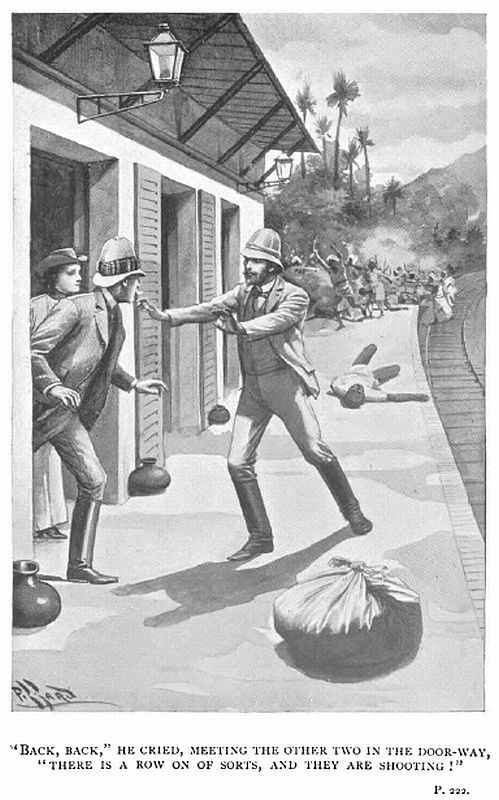
The whole of this appalling tragedy had been enacted in a mere flash of time; with such lightning celerity indeed, that Campian, standing outside, could hardly realise that it had actually happened. It was a fortunate thing that three or four tall Marris, standing together in a group, happened to be between him and the assassins or he would have received the first volley. Quick to profit by the circumstance, he sprang within the waiting room.
“Back, back,” he cried, meeting the other two in the doorway. “There’s a row on, of sorts, and they are shooting. Help me with the door, Colonel.”
It was a fortunate circumstance that Upward had called their attention to this means of defence, and that they had all looked at it, and partly tried it. Now it swung to without a hitch—and no sooner had it done so than four of those without flung themselves against it with a savage howl. These were the Marris who had unconsciously been the means of saving Campian’s life—and realising that fact, promptly decided to join their Ghazi countrymen, and repair if possible the error. And, indeed, the same held good of the others on the platform. They were there by accident, but, being there, their innate savagery and fanaticism blazed up in response to the maddening slogan of the Ghazis, with whom, almost to a man, they decided to make common cause. If ever a sharp and vivid contrast was to be witnessed it was here. The peaceful, prosaic, commonplace railway station platform of a few moments ago, was now a very hell of raging shaggy demons, yelling with fury and fanatical hate, rolling their eyes around in search of more victims, as they splashed and slipped in the blood of those they had already massacred.
Then someone brought news that there were more coolies, hiding for their lives behind a wood pile a little way up the line. With howls of delight, a dozen barbarians started to find some fresh victims, and the defenceless wretches were butchered as they grovelled on the ground and shrieked for mercy.
Those left on the platform now got an inspiration. They had killed the Babu in charge, but there would be others. Fired with this idea, they rushed into the station master’s office. Nobody! Into an inner room. Still nobody. They were about to turn and leave, when one, more knowing than the rest, noticed that a large chest was standing rather far out from the wall, and that a shower of dust was still falling from the top of it. He looked behind. Just as he suspected. A man was crouching there, and now quickly they hauled him forth. It was the Eurasian telegraph and ticket clerk, who had hoped to hide away and escape. His yellow face was pale with terror, and he shook in every limb at the sight of those fierce faces and blood dripping tulwars. One of the latter was about to descend upon his head, when somebody in authority intervened, and the murderous blade was lowered.
“The money—where is it?” said this man in Hindustani. “Give us over the rupees.”
“You shall have them, Sirdar sahib. Don’t let them kill me!” he pleaded, frantic with fear. Then he began fumbling for the safe keys. In his terror he could not find them.
“Hurry up, thou son of a pig and a dog!” urged the one who seemed to be the leader; “else will I have thee slain inch by inch, not all at once.”
The wretched Eurasian went nearly mad with fear at this threat, but just then, by good luck, he found the keys. His hand, however, shook so much he could hardly open the safe. When he did so, it was found to contain less than they had expected.
“Where is the remainder, thou son of Shaitân? Quick, lest we flay thee alive, or broil thee on red-hot coals,” growled the leader.
Frantic with fear, the miserable wretch fumbled wildly everywhere. A few loose rupees, and a bag or two containing no great sum were found, but no more.
“And is that all, food for the Evil One? Is that all?”
“Quite all, Sirdar sahib.”
“Good.” And, with the word, the barbarian raised his rifle and shot the other dead.
Chapter Fifteen.
Hard Terms.
Meanwhile those in the waiting room were doing all they could to make good their position, and that was not much. Their first attempt at forcing an entrance having failed, the four Marris had rushed among their countrymen who had firearms, striving to bring them against the door in force, or rake the room with a volley through the window, but their attention at the time was taken up with other matters, which afforded the beleaguered ones a brief respite.
“Non-combatants up here,” said Campian, pointing to the ladder and the trap door which has been mentioned. “Isn’t that the order, Colonel?”
“Yes, certainly. Up you go, Vivien.”
But Vivien refused to stir.
“I can do something at close quarters, too,” she said, drawing her revolver.
“Give it to me. I’ve not got mine with me. Now—go upstairs.”
“I may be of use here. Here’s the pistol, though,” handing it over.
“Will you obey orders, Viv? What sort of a soldier’s niece are you?”
“Do go,” said Campian, looking at her. “Well, I will, then.”
As she ascended the iron ladder Campian followed her up, under pretext of aiding her. In reality he managed so he should serve to screen her from any shot that might be fired, for the ladder was in full view of the window.
“I know why you came up behind me,” she whispered as she gained the loft. “It was to shield me in case they fired.”
Then, before he had time to begin his descent, she bent her head and kissed him, full on the lips.
Not a word did he speak as he went down that ladder again. The blood thrilled and tingled through his frame. Not all the fury of fanaticism which spurred the Ghazis on to mania could surpass the exaltation of fearlessness which was upon him as he tried to treasure up the warm sweetness of that kiss—and after five years!
“Campian, confound it! We have only a dozen shots among us,” growled the Colonel. “What an ass I am to go about without a pistol.”
“We can do a lot with a dozen shots. And Der’ Ali has his tulwar.”
Der’ Ali was the Colonel’s bearer, who had been within at the time of the onslaught. He had been a trooper in his master’s old regiment, and they had seen service together on more than one occasion. What had become of the two syces and the forest guard, who were outside, they did not then know, for then the whole volume of the savage fanatics came surging up to the door. In their frenzy they fired wild shots at the solid iron plates.
“Tell them, Der’ Ali,” growled Colonel Jermyn, in Hindustani, “that they had better clear out and leave us alone. The Sirkâr will hang every man Jack of their tribe if they interfere with us. And the first man in here we’ll shoot dead; and the rest of them to follow.”
The bearer, who understood Baluchi well, rendered this, not minimising the resource and resolution of those within as he did so. A wild yell greeted his words. Then one, more frenzied or enterprising than the rest, pushed his rifle through the window, and the smashing of glass mingled with the report as he blazed into the room. But those within were up to that move. The window being on a line with the door, they had only to flatten themselves against the wall, and the bullet smashed harmless.
Then there was a rush on the window. Two men crashed through, badly cut by the glass. Before they could recover themselves they were shot dead. Even Campian’s wretched stores revolver did its work on this occasion. That halted the rest—for the moment.
Only for the moment. By a rapid movement, crawling beneath the level of the window sill, several managed to discharge their rifles well into the room. Narrowly the bullets missed the defenders.
“Look here. This is getting hot,” growled the Colonel. “Let’s give them one more volley and go into the loft. There one of us can hold the place for ever against the crowd.”
Campian had his doubts about the strategical wisdom of this. However, just then there was another rush through the window, and this time his revolver jammed. Outside were thirty furious Ghazis, urging each other on with wild fanatical yells. If they two were cut down what of Vivien? That decided him. She could hold that trap door against the crowd.
“All right, Colonel. Up you go. I and Der’ Ali will hold the window.”
“You and Der’ Ali be damned,” growled the staunch old veteran. “Obey orders, sir.”
“No, no. You forget I’m only a civilian, and not under orders. And—you must be with Vivien.”
No time was this for conventionalities, but even then the old man remembered the evening of the earthquake. “Well, I’ll cover your retreat from the ladder,” he said, and up he went.
Campian, by a wrench, brought the cylinder of his weapon round. Then, sighting the head of a Ghazi thrust prominently forward, he let go. It was a miss, but a near one. Under cover of it both he and the bearer gained the loft. A strange silence reigned. The assailants seemed to have drawn off.
It was a breathing space, and surely these needed it. The excitement and energetic action brought a relapse. So sudden was the change from a quiet ordinary leave taking to this hell of combat and bloodshed, that it told upon the nerves more than upon the physical resources. Then, too, they could sum up their position. Here they were beyond all possibility of relief. It was only three o’clock in the afternoon. No train would be due at Mehriâb until eleven the next morning. Meanwhile these bloodthirsty barbarians would stick at nothing to reach their victims. These were cut off from human aid as entirely, to all intents and purposes, as though thousands of miles within the interior of Africa instead of in the heart of a theoretically peaceful country, over which waved the British flag.
“If only the telegraph clerk had been able to send a wire,” said the Colonel. “But even if the poor devil wasn’t cut down at the start, he’d have been in too big a scare to be able to put his dots and dashes together.”
Suddenly, with an appalling clatter, two or three logs were hurled through the window on to the floor of the waiting room below. Then some more, followed by a splash of liquid and a tin can. But the throwers did not show.
“By the Lord, they are going to try burning us out,” said Campian, in a low tone, watching the while for an enemy to show himself.
Then came more logs. They were old sleepers which had been piled up beside the line, and were as dry as lucifer matches. On to them came a great heap of tattered paper—the return forms and books found in the station offices. The assailants could load up a great pyre thus without incurring the slightest risk to themselves—could set it alight, too. That was what came of the British way of doing things—a heavily armoured and loop-holed door, and, alongside of it, an open and entirely unprotected window. Truly Upward had been right when he conjectured the Russians would have had a different way. No nation under the sun is more wedded to shortsightedness and red tape than that which is traditionally supposed to rule the waves.
Now indeed a feeling of blank despair came into the hearts of at any rate two out of the four as they watched these preparations. Vivien, fortunately, could not see them, for with splendid patience she sat quite still, and refrained from hampering her defenders, even with useless questions. The reek of paraffin rose up strong and sickening. The assailants had flung another can of it upon the pile of combustibles. All this they could do without exposing themselves in the least.
“Heavens I are we to be roasted or smoked in a hole?” growled the Colonel. “Cannot we cut our way through?”
Campian said nothing. His thoughts were too bitter. He had some belief that these barbarians would not harm Vivien. But death had never been less welcome than at that moment.
“Could we not propose terms to them, Colonel? Offer a big ransom, say?”
“Nothing like trying. Der’ Ali, ask the budmâshes how many rupees they want to clear out and leave us alone.”
The bearer, who spoke Baluchi well, did as he was told. The reply came sharp and decided. “Not any.”
“Try again, Der’ Ali. Tell the fools they’ll be none the better for killing us, and we’ll promise to do nothing towards having them caught. In fact, promise them anything.”
Then Der’ Ali, who was no fool, put the offer before them in its most tempting light. Everyone knew the Colonel Sahib. His word had never been broken, why should it be this time? The rupees would make them rich men for life, and would be paid with all secrecy. A Moslem himself, Der’ Ali quoted the Korân voluminously. It was not for themselves that they feared death, it was on account of the mem-sahib, for if they were slain what would become of her? And what said the Holy Korân? “If ye be kind towards women, and fear to wrong them, God is well acquainted with what ye do.”
For a time there was silence. The suspense of the beleaguered ones was terrible. Then the reply came.
“If the Colonel Sahib would give his promise to pay over the sum of five thousand rupees to an accredited messenger at a certain spot in eight days’ time he and the mem-sahib and their servant should be spared. But the other sahib must come down and deliver himself into their hands.”
“That’s all right,” said Campian cheerfully, when this had been rendered. “They want me as a hostage. Things are looking up. When they finger the rhino they’ll turn me adrift again, and meanwhile I shall see something of the inner life of the wily Baluch.”
“Tell them we’ll double the sum if they let all four of us go,” said the Colonel.
Der’ Ali put this, but the reply of the leader was again prompt and decided. It was in the negative. The other sahib must come and deliver himself into their hands.
“The question is, can we trust them?” said the Colonel. “Will they keep to their conditions in any case? Once we are out of this we are at their mercy.”
“Are we less so here?” said Campian. “A match put to that nice little pile and we shall be smoked or roasted in no time. No. Strike while the iron’s hot, say I. Der’ Ali, make them swear by all that they hold sacred to keep faith with us, and then I’ll come down.”
“Who is your leader, brothers?” called out the bearer.
“I, Ihalil Mohammed Khan,” returned the same deep voice that had before spoken.
Then Der’ Ali put to him the most binding oath he could call to mind, and Ihalil accepted it without hesitation. He bound himself by all the virtues of the Prophet, by the Korân, and by the holy Caaba, faithfully to observe the conditions he had laid down—in short, he almost swore too much.
“Say we accept, Der’ Ali. I’m coming down.”
“God bless you, my boy,” said the Colonel, as he wrung the other’s hand in farewell. “If it was only ourselves, I’d say let’s all hang together. But for Vivien’s sake. There, good-bye.”
“Rather—so long, we’ll say,” was the cheerful reply. “I’ll show up again in a few days.”
Vivien said nothing. A silent pressure of the hands was the extent to which she could trust herself.
For all his assumed cheerfulness it was a critical moment for Campian, as once more he stood upon the floor of the waiting room, and, stumbling over the heaped-up combustibles, stepped outside into the full glare of daylight. His nerves were at their highest tension. The chances that he would be cut to pieces or not the moment he showed his face were about even. As in a flash, that question as to whether he was ever afraid of anything darted through his mind. At that moment he was conscious of feeling most horribly and unheroically afraid.
No one would have thought it to look at him, though—certainly not those into whose midst he now stepped.
“Salaam, brothers!” he said in Hindustani, with a glance at the ring of shaggy scowling faces which hemmed him in.
The salute was sullenly returned, and then Ihalil, beckoning him to follow, led the way down the platform, surrounded by the whole party. They passed the body of the murdered policeman and that of the stationmaster, and at these some of the barbarians turned to spit, with muttered curses; and the platform, smeared and splattered with blood, was like the floor of a slaughter-house. Even the dirty white garments of the murderers were splashed with it.
Out through the gate at the end of the platform they went. Heavens, was the whole thing a dream—a nightmare? Why, it was less than an hour ago they had entered that gate all so light hearted and unthinking. He remembered the badinage he had been exchanging with Nesta as they passed in through it—and more than one reference as to meeting in Shâlalai in a week or two. Now—who could say whether he would meet anybody again—in a week or two or ever? And then his sight fell upon that which caused him well nigh to give up hope.
In the shade before the station master’s private quarters, a man was squatting—a wild, fierce-looking Baluchi. Before him the whole party now halted, treating him as with the deference due to a leader. But one glance at the grim, cruel face and eagle beak, and shaggy knotted brows, sufficed. In him Campian recognised the man who had scowled so demoniacally upon him in the retinue of the Marri sirdar—the man he had wounded and lamed for life when set upon by the Ghazis in the Kachîn valley. And this man was no other than the celebrated outlaw Umar Khan, and now, he was his prisoner.
And at that very moment it occurred to those left behind in the loft that any sort of stipulation as to the said prisoner being returned unharmed on the payment of the sum agreed upon had been entirely left out of the covenant.
Chapter Sixteen.
At Shâlalai.
“By Jove, but it is good to be back again!” said Upward, in tones of intense satisfaction as he sat down to tiffin in his bungalow at Shâlalai. “The garden is looking splendid, and then all the greenery in the different compounds after those beastly stones and junipers—I’m sick of the whole circus. Only a year or two more, thank goodness.”
“Yes, it is always nice to be at home again,” assented his wife. “Nesta must be sick of roughing it, too.”
“Well, I won’t say that,” answered the girl. “I’ll only agree that I am rather glad to be back again.”
“So they will be at the club this afternoon,” laughed Upward. “By the way, why don’t those children come in? They are always late. It’s a perfect nuisance.”
A wrangle of voices, and the children did come in. Racket in hand, they were disputing vehemently as to the rights and wrongs of a game they had been obliged to break off in the middle of.
“Wonder how long Campian will stick at Jermyn’s? I believe the old chap’s getting a bit smashed there.”
“Nonsense, Ernest,” laughed his wife. “You’re always thinking someone or other must be getting ‘smashed.’”
“Why shouldn’t he? She’s a deuced fine girl that niece of Jermyn’s—and then just think what a lot they’ll see of each other. What do you think about it, Miss Cheriton?”
“Oh, I don’t know. I’ve never thought about it.”
“Too black,” put in Lily the irrepressible. “If he could run the gauntlet of Nesta all this time, I don’t think he’s likely to go smash there.”
“Of course you’re an authority on such matters, Lily,” laughed her mother. “Ernest, you see now what notions you put into the children’s heads.”
“I don’t want any tiffin,” pronounced Hazel. “I only want to get at those nectarines. They just are good. Bother camp! I like it much better here.”
The large, lofty, cool room in which they were was hung around with trophies of the chase, all spoils of their owner’s unerring rifle. One end of the room was hung with the skin of an immense tiger, draped, as it were, from ceiling to floor, the other with that of a somewhat smaller one, which had clawed a native out of a tree and killed him before Upward could get in a shot. Hard by was a finely marked panther-skin whose erewhile wearer had badly mauled Upward himself! Panther and jungle cat and cheetul and others were all represented, and with horns of the blackbuck and sambur, tastefully disposed, produced an effect that was picturesque and unique. It served another purpose, too, as Upward used to say in his dry way. It gave people something to talk about when they came to tiffin and dinner. It was sure to set them comparing notes, or swearing they had seen or shot much bigger ones, and so forth. At any rate, it kept them going.
The bungalow was surrounded on three sides by a garden of which Upward was justly proud, for it was all of his own making. In front a trim lawn, bright with flower beds, and beyond this a tennis court, of which his neighbours did him the favour to make constant use. They likewise did him the favour to plant their bicycles, dogs, and other impedimenta, about his flower beds, or against the great crimson and purple convolvulus blossoms entwining his summer-house, whereat he fumed inwardly, but suffered in silence, from a misplaced good nature; and, after all, it was a little way they had in Shâlalai. Peaches and nectarines and plums attained a high degree of excellence in their own department, likewise every kind of green vegetable—and the verandah was green and cool with all sorts of ferns.
“I wonder none of the garrison have been up, Miss Cheriton,” he went on. “They can’t have got wind that you’re back. What’s that? Some of them already?” For Tinkles, suddenly leaping from her chair, darted out into the hall, barking shrilly and making a prodigious fuss. At the same time steps were heard on the verandah.
“That’s Fleming,” said Upward, recognising the voice—then going out into the hall. “Come in here, old chap. Well, what’s the news?”
“There is some news, but—Hallo! Excuse me, Mrs Upward. Didn’t know you were at tiffin.”
“It’s all right. We’re just done. Get into that chair and have a ‘peg’—and then we can hear the kubbur.”
“Well, it’s not very definite as yet,” replied Fleming, subsiding into the chair indicated. “Thanks, Upward—only a small one, I’ve just had one at the club. They say—By the bye, didn’t you come in from Mehriâb yesterday?”
“Yes, of course. But why?”
“Was it all right?”
“Was what all right?”
“Why, the look of things?”
“We didn’t see anything out of the ordinary. Jermyn and his niece and Campian came down with us to see us off. There was nothing wrong then. But why? What do they suspect?”
“Dunlop had occasion to wire officially to the stationmaster at Mehriâb yesterday afternoon and could get no reply. He kept on wiring, but it was no good.”
“Maybe some budmâsh has been playing gooseberry with the wire.”
“Cutting it? No. The communication is quite all right with the stations next to Mehriâb on either side.”
“It was all right yesterday at Mehriâb, for I sent a couple of wires myself,” said Upward. “Perhaps the telegraph clerk is taken ill.”
“It might be that of course. But there’s a rumour flying around the bazaar this morning that Umar Khan has been raiding up the Kachîn valley. What if he has stuck up Mehriâb station to plunder the safe?”
Upward whistled.
“Yes—that might be,” he said. “Only I wish he had done it while we were all there. I had two rifles and a shot gun and a six shooter. I think among us all—myself and Campian and old Jermyn and my two foresters—we’d have given Mr Umar Khan very particular what for. But what should bring him up to those parts? He was supposed to be making the other way when he cut up those two ‘gharri-wallahs.’”
“I don’t know. It’s only bazaar rumour, mind.”
“Now I think of it,” went on Upward, “there did seem rather more than usual of the evil-looking soors hanging about the platform. They’d all got tulwars too. By Jove—what if they were only waiting till the train had left to break out, and Ghazi the whole show? Oh, Lord! That puts things in a new light. There were enough of them to do it too.”
Fleming looked grave. “Then what about your friend and the Jermyns?” he said.
“Heavens, yes. Perhaps the soors waited until they had gone. Hallo, Miss Cheriton. What’s the matter?”
For Nesta had gone as pale as death—looking as if she would faint dead away.
“It’s nothing. I shall be all right again in a minute. Why do you suggest such horrible things?” she broke off quite angrily. “It is enough to upset one.”
Both men looked foolish—and all stared. The outburst was so unlike her.
“Let’s go and see if we can get at something definite,” said Upward, jumping up. “Did you drive here, Fleming?”
“No—biked.”
“All right I’ll jump on mine and we’ll spin round to McIvor’s. He may have got kubbur of sorts—but these Politicals are so dashed close.”
A three minutes’ spin along the level military road brought the two men to the Acting Political’s. That official looked grave at sight of Upward. He guessed his errand—and at once handed him a telegram.
“This is the latest,” he said.
It was a long message, but the substance of it was that on the arrival of the train due at Mehriâb that morning at eleven, not a living soul was in sight, nor was any signal down. The engine-driver slowed down and advanced cautiously, when the fact of the massacre became apparent. Then they had been signalled by Colonel Jermyn and his niece, who were in a great state of horror and distress, and reported that their guest had been taken away as prisoner by the Ghazis. They and the Colonel’s bearer were taken on to the next station beyond Mehriâb, whence they would return to Shâlalai by the afternoon train.
“What’s going to be done about it?” said Upward.
“We’ve started a strong body of Police after them, and two troops of Sindh Horse are to follow,” said the Political.
“Yes, and then they’ll cut Campian’s throat. In fact I wonder they didn’t already. It looks as if they wanted him ransomed, and if so—by George—the way to do for him is to start dusting a lot of Police after them.”
The Political was a man of few words. He shrugged his shoulders, and observed that the matter did not rest with him. He could give them all the information he had at his disposal, but that was all.
“This wants thinking out, Fleming,” said Upward, as they were spinning along on their bicycles again. “What can be done? What the devil can be done? As sure as they run those Ghazis close—then, goodnight to Campian. But Jermyn will be here this evening—then we shall get at the whole story.”
The evening train arrived in due course, bringing with it the three survivors of the outbreak. The Ghazis had kept faith with them, and had retired, leaving them without further molestation. But the whole night had to be got through, and a very trying one it was, for they were not without fear lest some of the people in the neighbourhood, becoming affected with the contagion of bloodshedding, should come and complete what the Ghazis had left undone. Fortunately there was the dâk bungalow for them to retire to—and they were thus enabled to escape from the immediate proximity of the ghastly slaughter-house scenes which the platform, and indeed the railway station generally, presented. No further alarm however had come their way, and they had been picked up by the morning train, as detailed in the telegram.
They had come away, of course, with scarcely any luggage, but Upward’s bungalow was elastic, and therein they were promptly installed. Vivien, now that the tension was relaxed, succumbed to a nervous reaction that prostrated her for days—and which, indeed, was not entirely due to the horrors she had gone through. The Colonel was loud on Campian’s praises. But for him they would never have got out of the mess, by Jove, he declared. The fellow’s coolness in venturing among those cut-throats was splendid—and so on. When he got back again in a week or two he would have some experiences, and he seemed the sort of fellow who was partial to experiences. Thus the Colonel. But Upward, listening, was not so easy in his mind. He hoped Campian would be back among them in a week or two, but—Heavens! what if he were not? The Marris were a savage lot, and these particular ones were a combination of Ghazi and brigand. He felt uneasy—most infernally uneasy—in which predicament he did two things—he sent for Bhallu Khan, and consulted long and oft with the authorities.
The latter were not so eager to fall in with his views as he considered they ought to be. It might be true, as he said, that aggressive action against Umar Khan would imperil the life of the hostage, but on the other hand, were they to sit supine for eight days, while that notorious ruffian raided and plundered and murdered at will all over the country.
The knot of the difficulty however was cut, as is frequently the case, by circumstances. Each movement against him, undertaken with great promptitude and spirit, resulted in failure, whereat Upward, and others interested in the fate of the hostage rejoiced. It was not likely that such a ruthless barbarian as Umar Khan was known to be, would allow his prisoner to be taken out of his hands alive—no, not for a moment—whereas having kept faith so far he might do so until the end, especially if a handsome baksheesh was added to the stipulated sum. After that, the sooner he was caught and hanged the better.
Meanwhile the affair caused great excitement in the outlying parts, and not a little scare. Outlying shooting parties deemed it advisable to return and some of the railway employés on the lonely stations along the line—natives or Eurasians mostly—resigned their posts in panic, fearing lest a similar fate should overtake themselves. On the arrival of Bhallu Khan some news was gleaned, but not much. The Ghazis had hung about the Kachîn valley for a day or two, and had looted the forest bungalow—refraining, however, from firing it. Then they seemed to have disappeared entirely, and if he had any sort of inkling of their probable destination, Bhallu Khan, a Baluchi himself, could not or would not reveal it.
Chapter Seventeen.
In the Enemy’s Hand.
For a while the scowling barbarian contemplated Campian from under his shaggy brows. Then he gave an order to his followers. There stepped forward a man. This fellow had a villainous cast of countenance and a squint. He was of mixed blood, being a cross between Baluch and Punjâbi. He had been at one time a chuprassi in a Government office, and talked English fairly well.
“Chief say—you know who he is?” he began.
“Can’t say I do.”
“Chief say—you ever see him before?”
“Can’t be sure of that either. Yet, I have an idea I saw him once while having a friendly talk with the Sirdar Yar Hussain Khan.”
At mention of the Sirdar’s name, a faint show of interest seemed to come into the saturnine features of those around. Then the interpreter went on:
“Dis chief—he Umar Khan.”
The interest wherewith he would have received this announcement was dashed with a feeling as of the last glimmer of hope extinguished. It was bad enough to know that he was in the power of a revengeful barbarian with every motive for nourishing a deadly grudge against himself, but that this man should turn out to be the famous outlaw, whose savage and cruel nature was a matter of notoriety—well, he felt as good as dead already.
Now he recognised that Umar Khan’s object in leading the Ghazi outbreak was not merely that of indiscriminate bloodshed, or even plunder. It was to get possession of himself—for the purpose of wreaking some deadly vengeance which he shuddered to contemplate—and well he might.
“Tell Umar Khan,” he said, “that the money we have promised him will be punctually paid—and that when I am back among my friends again in Shâlalai I will add to it another two thousand rupees.”
The outlaw chief received the rendering of this with a contemptuous grunt, and continued to glare none the less vindictively upon his prisoner. Then he gave certain orders, in the result of which those who had horses prepared to mount them, the remainder following on foot; for those Marris who had been surprised into participating in the massacre had now decided to cast in their lot with Umar Khan. A steed was also provided for Campian, but over and above being an inferior beast, a check rein, held by one of his custodians, was passed through the bit.
Before they set forth, however, the leader issued another order, and in the result there stepped out from the stationmaster’s house two men. To his surprise the hostage recognised in these Bhallu Khan and the other forest guard. So these were the traitors? These had brought this crew of cut-throat murderers down upon them—and would share in the spoil. Such was his first thought, but he had never made a greater mistake in his life; the fact being that the two foresters were as innocent of complicity as he himself. They had been squatting outside the station after bidding farewell to their official superior. As fellow countrymen and fellow believers, the Ghazis had refrained from putting them to the sword, but had ordered them to remain within the outbuilding while the work of blood and plunder proceeded—and neither to come forth nor to look forth on pain of death. Now they were released. But first Umar Khan treated them to a long harangue, to which they listened with profound attention.
Campian—hailing the man who had acted as interpreter—told him to ask the chief if he might write a line to the Colonel Sahib and send it by the foresters. A curt refusal was returned, and he was ordered to mount.
As the band receded over the plain, from its midst he could see the white figures of the two foresters moving along the platform—but no others. Yes—he could. He could make out Vivien’s figure. He thought he knew what was in her mind as she strained her glance over that amount of space, if haply she might distinguish him in that throng of retreating forms—and it seemed to him that their very souls went forth to each other and met in blissful reconciliation. Then all was shut from his gaze. The band was entering the black portal of a great tangi.
The sight of its smooth rock walls brought back the recollection of that other day, and the result was, on the whole, a cheering one. Then how sore had been his strait. He had come through it, however. Why not again?
At sundown they halted, and spreading their chuddas and putting off their shoes, the whole band proceeded to perform their devotions in most approved fashion. Behind them lay the mangled remains of their unoffending and defenceless victims, slaughtered in cold blood; but then these were heathens and infidels, and to slay such was a meritorious act. So these sons of the desert and the mountain prayed in the direction of Mecca with enhanced faith and fervour.
Throughout half the night they travelled onward. Onward and upward, for they seemed to be ascending higher and higher among the jagged mountain crests. The wind blew piercingly cold, and Campian shivered. They threw him an old poshteen or fur-lined coat, and this he was glad to pull round him in spite of qualms lest it should already be more or less thickly populated. Soon after midnight they halted, and building a large fire under an overhanging rock, lay down beside it. Campian, worn out with fatigue and the reaction after the day’s excitement, went into a heavy dreamless sleep.
He was awakened by a push. It seemed as though he had been asleep but five minutes, whereas in point of fact it must have been nearly midday, so high in the heavens was the sun. He looked forth. Piles of mountains in chaotic masses heaved up around; all stones and slag; no trees, no herbage worthy of the name. One of the Baluchis handed him a bowl of rice, cold and insipid, and a chunk of mahogany looking substance, which smelt abominably rancid—and which he turned from with loathing. It was in fact a hunk of dried and salted goat flesh. Having got outside the first article of diet, he remembered ruefully how he had been cheerful over the prospect of seeing something of the inner life of the lively Baluchi, but this, as a beginning, was decidedly discouraging.
This appeared to be a favourite halting place, judging from the old marks of fires everywhere around, and a better hiding place it seemed hard to imagine, such an eyrie was it, perched up here out of reach, where one might pass below again and again and never suspect its existence. The band seemed in no hurry, resting there the entire day. Part of this the hostage turned to account by trying to win over the good offices of the squint-eyed cross-breed.
This worthy, who rejoiced in the name of Buktiar Khan, was not indisposed to talk. He too was promised a largesse when the prisoner should be set at liberty.
“What you do to dis chief?” he said, in reply to this.
“Eh? I don’t quite follow.”
“Dis chief, he hate you very much. What you do to him?”
“Oh, I see,” and the prisoner’s heart sank. His chances of escaping death—and that in some ghastly and barbarous form—looked slighter and slighter. “I never harmed him, that I know of for certain. I never harmed anyone except in fair fight. If he has suffered any injury from me it must be in that way. Tell him, Buktiar, if you get the opportunity, and if you don’t, make the opportunity—that a man with the name for bravery and dash that he has made does not bear a grudge over injuries received in fair and open fight. You understand?”
“I un’stand—when you slow speak. Baluchi, he very cross man. You strike him, he strike you. You kill him, his one brother, two brother, kill you, if not dis year, then next year.”
A rude interruption there and then occurred to bear out the other’s words. Campian, who was seated on the ground at the time, felt himself seized from behind and flung violently on his back. Half-a-dozen sinewy ruffians had laid hold of him, and he was powerless to move. Bending over him was the savage face of Umar Khan, stamped with the same expression of diabolical malignity as it had worn when he had first beheld it.
“O dog,” began the outlaw, pushing his now helpless prisoner with his foot, “dost guess what I am going to do with thee?”
“Put an end to me, I suppose,” answered Campian wearily, when this had been rendered. “But it doesn’t seem fair. I yielded myself up on the understanding that I should only be detained until the five thousand rupees were paid. And now I have promised you two thousand more. What do you gain by my death?”
Buktiar duly translated this, and the Baluchi answered:
“What do I gain? Revenge—blood for blood. But hearken. I had intended to strike off thy head, but thou shalt have thy life. Yet if Umar Khan must walk lame for the remainder of his life, why should the dog whose bite rendered him lame walk straight? Answer that, dog—pig—answer that,” growled the barbarian, grinding his teeth, and working himself up into a frenzy of vindictive rage. “Tell him what I said just now, Buktiar—that a brave man never bears malice for wounds received in fair fight,” was the answer.