III LIFE IN LEYDEN—ADIEU TO PLYMOUTH—THE VOYAGE TO THE WEST
Reading edition
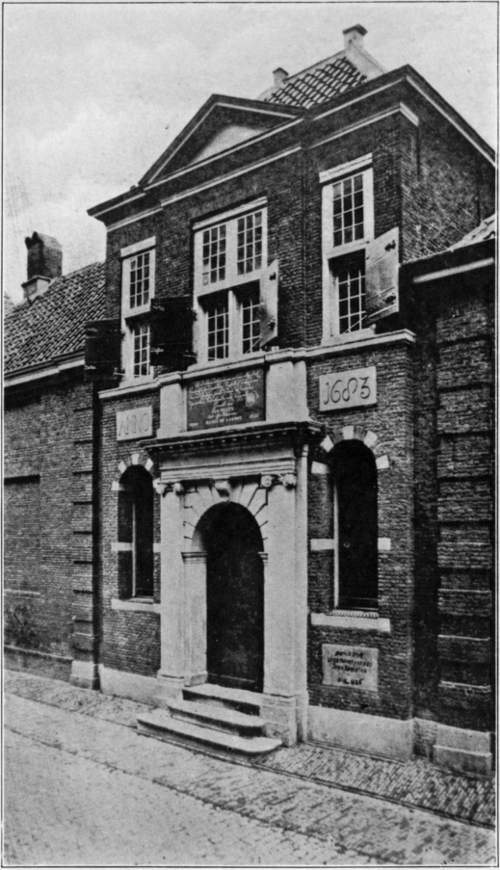
Photograph by W. P. Demmenie, Leyden John Robinson's House, Leyden, where the Pilgrim Fathers Worshipped
III LIFE IN LEYDEN—ADIEU TO PLYMOUTH—THE VOYAGE TO THE WEST
Then to the new-found World explored their way, That so a Church, unforced, uncalled to brook Ritual restraints, within some sheltering nook Her Lord might worship and His Word obey In Freedom.—Wordsworth.
The first stage of the pilgrimage from the Old England to the New was now accomplished. Before the end of 1608 the whole body of the fugitives had assembled at Amsterdam. Two Separatist communities were already there, one from London, of which Francis Johnson was pastor and Henry Ainsworth teacher, and the other from Gainsborough under John Smyth. But these brethren were torn with dissensions, and the Scrooby Pilgrims, seeking peace, moved on to Leyden, where, by permission of the authorities, they settled early in 1609. Here they embarked upon a prosperous period of church life, and after awhile purchased a large dwelling, standing near the belfry tower of St. Peter's Church, which in 1611 served as pastor's residence and meeting-house, while in the rear of it were built a score of cottages for the use of their poor.
Eleven quiet years were spent in Holland. Governor Bradford says they continued "in a comfortable condition, enjoying much sweet and delightful society and spiritual comfort," and that they "lived together in love and peace all their days," without any difference or disturbance "but such as was easily healed in love."
The conditions of life were stern and hard, but they bore all cheerfully. With patient industry they worked at various handicrafts, fighting poverty and gaining friends. William Bradford was a fustian worker when, in 1613, at the age of twenty-three, he married Dorothy May of Wisbech; the marriage register which thus describes him is preserved in the Puiboeken at Amsterdam. Brewster, who was chief elder to John Robinson, now sole pastor of the congregation since Richard Clyfton had remained behind at Amsterdam, at first earned a livelihood by giving lessons in English to the students at the University. Then, in conjunction with Thomas Brewer, a Puritan from Kent, he set up a printing press, and they produced books in defence of their principles, such as were banned in England. Similar literature, emanating from the Netherlands, had excited the wrath of King James, who still possessed sufficient influence with the States of Holland to enable him to reach offending authors there. This James attempted to do in the case of Elder Brewster through Sir Dudley Carleton, then English ambassador at the Hague. The result was ludicrous failure.
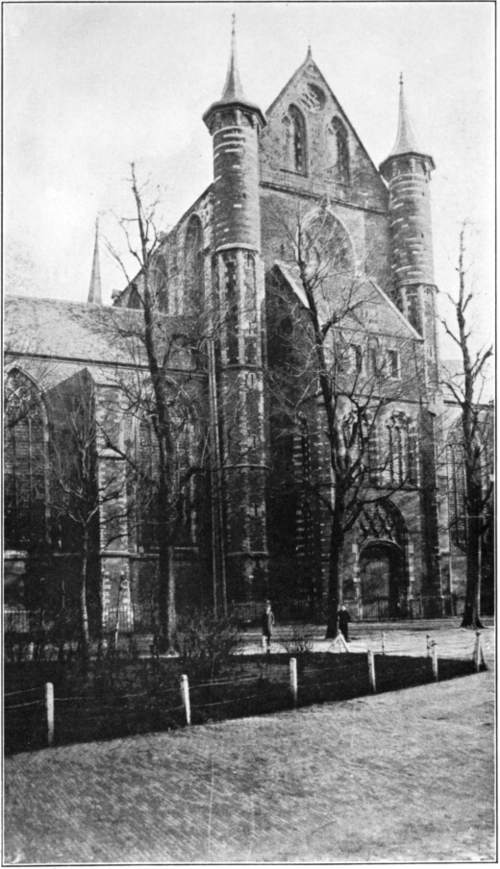
St. Peter's Church, Leyden
Brewster quitted Leyden for a time and went to London, not as was thought to elude the vigilance of the Ambassador, but to arrange with shipmasters for a voyage to the West, which the Pilgrims had begun to think about. While Brewster was being sought by the Bishop of London's pursuivants, Sir Dudley Carleton, unaware of the hunt proceeding in London, was actively searching for him at Leyden, and at last triumphantly informed Secretary Naunton that he had caught his man. But as it turned out, the bailiff charged with the arrest, "being a dull, drunken fellow," had seized Brewer instead of Brewster! The prisoner was nevertheless detained, and after some ado consented to submit himself for examination in England, on conditions which were observed. Nothing came of it however. Brewster returned free and unmolested and Brewer remained in Leyden for some years, when, venturing back to England, he was thrown into prison and kept there until released by the Long Parliament fourteen years later.
Events were meanwhile shaping the destiny of the little Pilgrim community. Holland, though a welcome temporary asylum, was no permanent place for these English exiles, and their thoughts turned before long towards a settlement in North America. By good fortune this was a country then being opened up, and it appeared as a veritable Land of Promise to these refugees in search of a new home.
The first attempt to found an English colony on the mainland of North America was made in 1584, when Sir Walter Raleigh took possession of the country and named it Virginia in honour of his Queen. Nothing came of this venture, but in 1607 a company of one hundred and five men from England, sailing in three small ships, had landed on the peninsula of Jamestown in Chesapeake Bay, and the first permanent settlement was established.
The chief of this Virginian enterprise was the redoubtable John Smith, a Lincolnshire man, the first of those sons of empire to go out from the East to the West. Strange that this pioneer in the wilderness, who gave to New England its name, should have come from a country which was to contribute so much to the peopling of the New England States. It is upon record that in 1619 Smith, who was then unemployed at home, volunteered to lead out the Pilgrims to North Virginia, but nothing came of the offer.
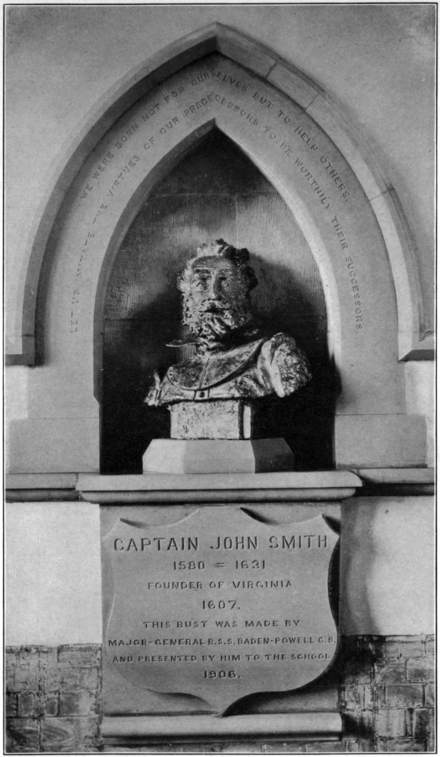
Photograph by James, Louth Bust of Captain John Smith Presented by General Baden-Powell to the Louth Grammar School
The Leyden brethren in their hour of need turned to the Virginia Company, and the negotiations for a settlement in the chartered territory were not altogether unsatisfactory. The obstacle was their religion. On the Council of the Company they had good friends; but its charter not only enforced conformity, but provided stringent measures of church government. Yet, though the Pilgrims could obtain no formal grant of freedom of worship, the presumption that they would not be disturbed was so strong that they accepted the conditions and were about to embark when the Merchant Adventurers in London with whom they were associated secured powers from the Plymouth Company, and they decided to sail for New England instead of for Virginia.
Arrangements were not completed without "many quirimonies and complaints;" but the exiles were saddled with such substantial difficulties as want of capital and means of transport, and the bargaining was all in favour of the merchants who were to finance and equip the expedition. At length the compact was made and preparations for the voyage were pushed forward, and the eventful day arrived when the Pilgrims were to make the long, lone journey across the seas.
Pastor Robinson and a portion of his flock were to stay behind at Leyden until the first detachment had secured a lodgment on the American continent; and those about to sail, the majority of the little community, went on board the Speedwell, a vessel of sixty tons. The Pilgrims embarked included such stout-hearted pioneers as Brewster and Bradford, John Carver, Edward Winslow, Isaac Allerton, Samuel Fuller, and John Howland, all "pious and godly men;" also Captain Miles Standish, who, though not a member of the congregation then or afterwards, was a valiant soldier whose military experience and well-tried sword would, it was suspected, prove of service in a country where "salvages" were known to exist in large numbers and might have to be encountered with the arm of flesh.
That was a touching scene and one which stands out boldly in the history of the movement when, on a bright sunny morning in July, 1620, the Pilgrim Fathers knelt on the seashore at Delfshaven and Mr. Robinson, his hands uplifted and his voice broken with emotion, gave them his blessing. Affecting also was the parting of the emigrants with those they were leaving behind. They had need of all their courage and patience.
They sailed with British cheers and a sounding volley fired as salute, and made a brave enough show on quitting land; but troubles dogged them on the waters. Delays and disappointments soon set in. The Speedwell brought them to Southampton, where, anchored off the West Key, they found the Mayflower of London, a bark of one hundred and eighty tons burden, Captain Thomas Jones, and several passengers, some of them merchants' craftsmen.
Here some anxious days were spent in patching up the compact with the Adventurers, and while the vessels lay detained letters written by Robinson arrived from Leyden, one for John Carver conveying the pastoral promise—never, alas! redeemed—to join them later, and the other, full of wise counsel and encouragement, addressed to the whole company, to whom it was read aloud and "had good acceptance with all and after-fruit with many."
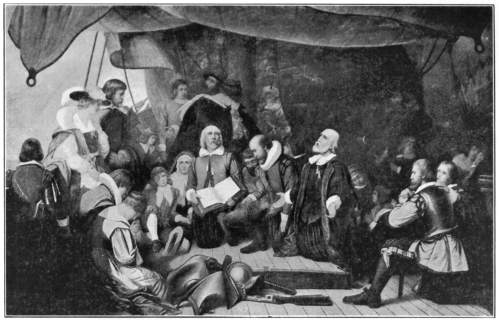
Photograph by A. S. Burbank, Plymouth From the Painting by Weir The Embarkation of the Pilgrims
With ninety people in the Mayflower and thirty in the Speedwell, and a governor and assistants appointed for each company, the two vessels dropped down Southampton water on August 15[3]; but they were scarcely in the Channel when the smaller craft began to leak, and they had to run into Dartmouth and overhaul her. The repairs occupied eight days. At the end of that time the ships again stood out to sea; but, when nearly three hundred miles past the Land's End, Reynolds, master of the Speedwell, reported that the pinnace was still leaking badly, and could only be kept afloat by the aid of the pumps. So there was nothing for it but to turn back a second time, and the vessels now put into Plymouth, the Pilgrims landing at the Old Barbican.
At Plymouth the Speedwell was abandoned and sent back to London to the Merchant Adventurers, and with her went eighteen persons who had turned faint-hearted, among them Robert Cushman, a chief promoter of the emigration, and his family. Finally, after much kindness and hospitality extended to them by the Plymouth people, of whom they carried a grateful remembrance across the Atlantic, the Pilgrim Fathers said adieu, and all crowded on board the Mayflower, which, with its load of passengers, numbering one hundred and two souls, followed by many a cheering shout and fervent "God-speed" from the shore, set sail alone on September 16 on its dreary voyage to the West. The weighing of the anchor of that little ship changed the ultimate destiny of half the English-speaking race!
We have to remember that a trip like this in such a vessel as the Mayflower, crowded for the most part with helpless people, was a hazardous undertaking. The dangers of the deep were dreaded in those days for all-sufficient reasons, and here was a tiny craft, heavily submerged, making a winter voyage on a stormy ocean to a destination almost unknown. It must have required the strongest resolution, both of passengers and crew, to face the perils of the venture; the step was a desperate one, but, urged on by circumstances and an indomitable spirit, they took it unfalteringly, having first done what they could to make the lumbering little ship seaworthy.
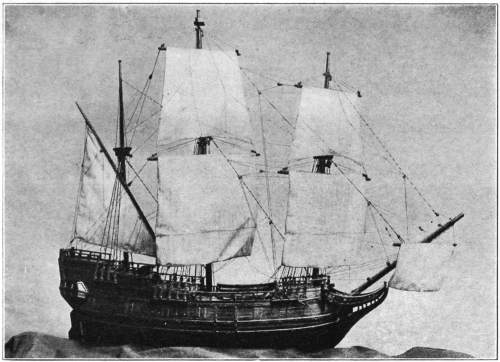
Courtesy of the Smithsonian Institution Model of the Mayflower
The weather was cold and tempestuous, and the passage unexpectedly long. Half way across the Atlantic the voyagers incurred the penalty of those early delays, which now left them still at sea in the bad season. Caught by the equinoctial gales, they were sadly buffeted about, driven hither and thither by boisterous winds, tossed like a toy on the face of great rolling, breaking billows, the decks swept, masts and timbers creaking, the rigging rattling in the hard northern blast. One of the violent seas which struck them, unshipped a large beam in the body of the vessel, but by strenuous labour it was got into position again, and the carpenters caulked the seams which the pitching had opened in the sides and deck. Once that sturdy colonist of later years, John Howland, venturing above the gratings, was washed overboard, but by a lucky chance he caught a coil of rope trailing over the bulwark in the sea, and was hauled back into the ship. A birth and a death at intervals were also events of the passage. It was not until two whole months had been spent on the troubled ocean that glad cries at last welcomed the sight of land, and very soon after, on November 21, sixty-seven days out from Plymouth, the Mayflower rounded Cape Cod and dropped anchor in the placid waters of what came to be Provincetown Harbour.
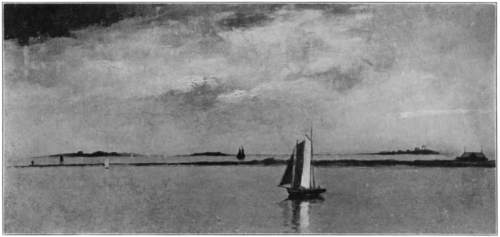
Copyright, 1890, by A. S. Burbank, Plymouth Plymouth Harbour, as seen from Cole's Hill