II THE ARREST AT BOSTON AND FLIGHT TO HOLLAND
Reading edition
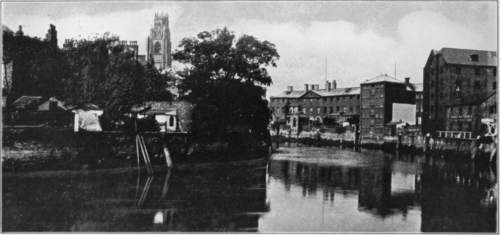
Photograph by Hackford, Boston The River Witham, Boston
II THE ARREST AT BOSTON AND FLIGHT TO HOLLAND
Well worthy to be magnified are they Who, with sad hearts, of friends and country took A last farewell, their loved abodes forsook, And hallowed ground in which their fathers lay. Wordsworth.
Great things were destined to result from that none too joyous jaunt of Elder Brewster's when, late in 1607, charged by the Scrooby community to find them a way out of England, he went down to Boston and chartered a ship. William Bradford was of the Boston party. Everything was quietly done. In all likelihood the intending emigrants never entered the town, but gathered at some convenient spot on the Witham tidal estuary where the rushing Ægir hissed.
Whether the Dutch skipper was dissatisfied with the fare promised him, or he feared detection and punishment, cannot be told. Yet, when the fugitives were all on board his vessel, and appeared about to sail, they were arrested by minions of the law. Bitter must have been their disappointment; stern, we may be sure, their remonstrance. But they could do nothing more than upbraid the treacherous Dutchman. They were not kept long in doubt as to their fate. Put back into open boats, their captors "rifled and ransacked them, searching them to their shirts for money, yea, even the women further than became modesty, and then carried them back into the town, and made them a spectacle and wonder to the multitude who came flocking on all sides to behold them." A goodly sight for this curious Boston mob. "Being thus first by the catchpole officers rifled and stripped of their money, books, and much other goods," proceeds the account, with an honest contempt for the writings of the law, "they were presented to the magistrates, and messengers were sent to inform the Lords of the Council of them; and so they were committed to ward."
The basement cells in which the prisoners were placed had been in use at that time for about sixty years, for "in 1552 it was ordered that the kitchens under the Town Hall and the chambers over them should be prepared for a prison and a dwelling-house for one of the sergeants." There must have been more cells formerly. Two of them now remain. They are entered by a step some eighteen inches high; are about six feet broad by seven feet long; and in lieu of doors they are made secure by a barred iron gate.
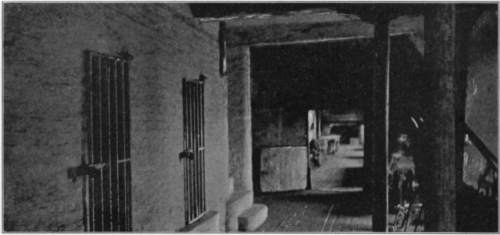
Photograph by Hackford, Boston The Pilgrim Cells, Guildhall, Boston, showing the Kitchen Beyond
Into these dens the captives were thrust. Short of a dungeon underground, no place of confinement could have been more depressing. Only the heavy whitewashed gate, scarce wide enough to allow a man to enter, admits the light and air; and the interior of each cell is dark as night. We can imagine the misery of men fated to inhabit for long such abodes of gloom; it must have been extreme. They look as if they might have served as coal cellars for feeding the great open fireplaces which, with their spits and jacks and winding-chains, still stand there in the long open kitchen much as they did when they cooked the last mayoral banquet or May Day dinner for the old Bostonians.
A curious winding stair (partly left with its post), terminating at a trapdoor in the court-room floor, was the way by which prisoners ascended and descended on their passage to and from the Court above.
Now these justices who had the dealing with the Pilgrim Fathers were humane men, and were not without a feeling of sympathy for the unhappy captives. It is therefore reasonable to suppose that during some portion of this time, when their presence was not required by the Court, they may have found them better quarters than the Guildhall cells. There was a roomy ramshackle pile near the church in the market-place, half shop, half jail, of irregular shape, with long low roof, which in 1584 was "made strong" as regards the prison part, though in 1603—four years before the date under notice—it was so insecure that an individual detained there was "ordered to have irons placed upon him for his more safe keeping," with a watchman to look after him! And thirty years later the jail, "and the prison therein called Little-Ease," were repaired.
We know what "Little-Ease" means well enough; and so did many a wretched occupant of these barbarous places. The Bishop of Lincoln, in the old persecuting days, had at his palace at Woburn "a cell in his prison called Little-Ease," so named because it was so small that those confined in it could neither stand upright nor lie at length. Other bishops possessed similar means of bodily correction and spiritual persuasion.
This was worse than the Guildhall cells, with all their gloomy horror; and if the magistrates entertained their unwilling guests at the town jail, we may rest satisfied they did not eat the bread of adversity and drink the water of affliction in Little-Ease, but in some more spacious apartment. We have no evidence that they did so entertain them, and the traditional lodging-place of these intercepted Pilgrims is the Guildhall and nowhere else. It is probable, all the same, that a good part of their captivity was spent in the town prison.
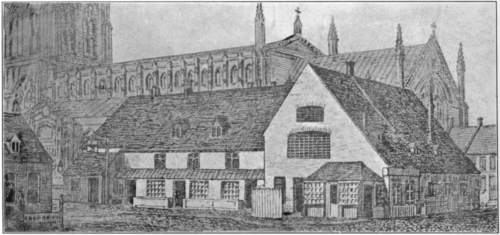
From a Drawing by the late William Brand, F. S. A. Old Town Gaol, Market-place, Boston
Although the magistrates, from Mayor John Mayson downward, felt for the sufferers and doubtless ameliorated their condition as far as they could, it was not until after a month's imprisonment that the greater part were dismissed and sent back, baffled, plundered, and heart-broken, to the places they had so lately left, there to endure the scoffs of their neighbours and the rigours of ecclesiastical discipline.
Seven of the principal men, treated as ring-leaders, were kept in prison and bound over to the assizes. Apparently nothing further was done with them. Brewster is said to have been the chief sufferer both in person and pocket. He had eluded a warrant by leaving for Boston, and we know this was in September, because on the fifteenth of that month the messenger charged to apprehend Brewster and another man, one Richard Jackson of Scrooby, certified to the Ecclesiastical Court at York "that he cannot find them, nor understand where they are." On the thirtieth of September also the first payment is recorded to Brewster's successor as postmaster at Scrooby.
How the imprisoned Separatists fared, there is nothing to show. No assize record exists. The Privy Council Register, which could have thrown light on the matter, was destroyed in the Whitehall fire of 1618; and the Boston Corporation records, which doubtless contained some entry on the subject that would have been of the greatest interest now, are also disappointing, as the leaves for the period, the first of a volume, have disappeared.
Eventually the prisoners were all liberated. That dreary wait of many weeks was a weariness of the spirit and of the flesh. Patiently they bore the separation, and by and by they met to make more plans. Next spring they agreed with another Dutchman to take them on board at a lonely point on the northern coast of Lincolnshire, between Grimsby and Hull, "where was a large common, a good way distant from any town." This spot has been located as Immingham, the site of the new Grimsby docks.
The women, with the children and their goods, came to the Humber by boat down the Trent from Gainsborough; the men travelled forty miles across country from Scrooby. Both parties got to the rendezvous before the ship, and the boat was run into a creek. This was unfortunate, as when the captain came on the scene next morning the boat was high and dry, left on the mud by the fallen tide, and there was nothing for it but to wait for high water at midday.
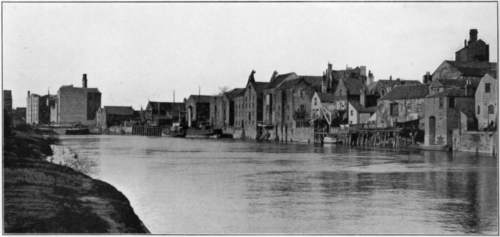
Photograph by Bocklehurst, Gainsborough Trentside, Gainsborough
Meanwhile the Dutchman set about taking the men on board in the ship's skiff, but when one boatload had been embarked he saw to his dismay, out on the hills in hot pursuit, "a great company, both horse and foot, with bills and guns and other weapons," for "the country was raised to take them." So the laconic historian says, "he swore his country's oath—Sacramente," and heaving up his anchor sailed straight away with the people he had got. Their feelings may be imagined; and their plight was aggravated by a violent storm, which drove them out of their course and tossed them about for a fortnight, until even the sailors gave up hope and abandoned themselves to despair. But the ship reached port, at last, and all were saved.
The scene ashore meantime had been scarcely less distressing than that at sea. Some of the men left behind made good their escape; the rest tarried with the forsaken portion of the party. The women were broken-hearted. Some wept and cried for their husbands, carried away in the unkindly prudent Dutchman's ship. Some were distracted with apprehension; and others looked with tearful eyes into the faces of the helpless little ones that clung about them, crying with fear and quaking with cold.
The men with the bills and guns arrested them; but, though they hurried their prisoners from place to place, no Justice could be found to send women to gaol for no other crime than wanting to go with their husbands. We know not what befell them. The most likely suggestion is that "they took divers ways, and were received into various houses by kind-hearted country folk." Yet this we do know. They rallied somewhere at a later day, and John Robinson and William Brewster, and other principal members of the devoted sect, including Richard Clyfton, "were of the last, and stayed to help the weakest over before them;" and Bradford tells us with a sigh of satisfaction that "notwithstanding all these storms of opposition, they all gatt over at length, some at one time and some at another, and some in one place and some in another, and mette togeather againe according to their desires, with no small rejoycing"—to take part in the wonderful movement, begun by the Pilgrims and continued by the Puritans, that gave to a new land a new nation. Thus, wrote Richard Monckton Milnes, in some verses dated "The Hall, Bawtry, May 30th, 1854"—
Thus, to men cast in that heroic mould Came Empire, such as Spaniard never knew— Such Empire as beseems the just and true; And at the last, almost unsought, came gold.
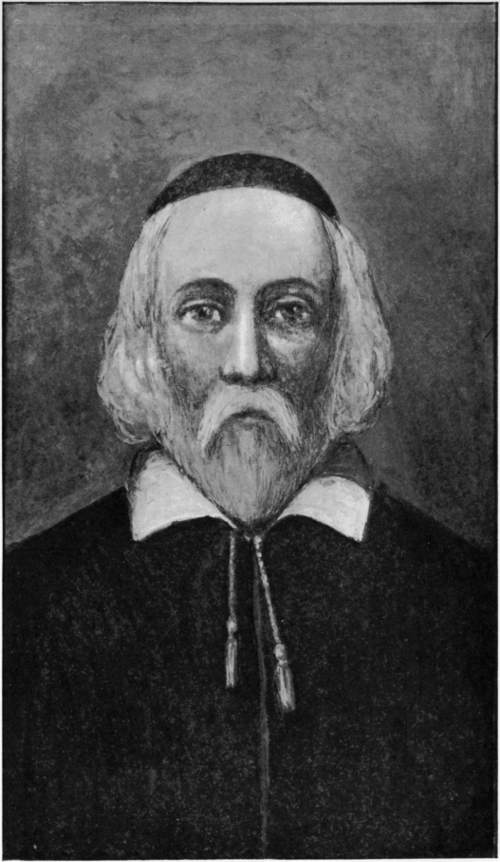
Copyright, 1904, by A. S. Burbank, Plymouth Elder William Brewster