Front matter (continued 3)
Reading edition
"Sir Ralph," quoth one of these grave personages, as he sat solemnly stroking his beard by the pallet where the young man still lay, "if one richer in the experience of years than thou art may be permitted to advise thee, I would show thee how useless a waste of life and blood would be any attempt of thine, unaided, to rescue thy fair lady from her direful plight."
"Marry, but have I not learned that lesson already!" ejaculated Ralph irritably; "but whither then to get aid? for get aid I must. This emprise is of more worth to me than a dozen lives! Speak you on behalf of your kind, Gilbert the Clothier, the other traders and craftsmen of the town? Are ye ready to strike a blow against this tyrant?"
"I crave thy pardon, Sir Knight, but we are men of peace, unused to warlike weapons, and we have much to lose. With one swoop Fulke de Breauté could burn about our ears all the amassed gain of a lifetime!"
Ralph shrugged his shoulders impatiently.
"'Tis vain to speak to barn-door fowls of the liberty of the hawk's flight!" replied Ralph, somewhat ungraciously. "But, Sir Merchant, if the only weapons ye can use be your tools and your measuring-yards, yet methinks ye have store of wisdom in your heads, in full measure above us who spend all our wits upon our sinews!" he added laughingly. "Prithee, counsel me."
"There are none in all the county round, in these days when so many of our gentlefolks are impoverished with the wars and disturbances of these last years, who can hope to lift a spear successfully against this rich Frenchman," the merchant began. "We must e'en seek aid further afield. Anon I had word brought me that the churchmen brook ill that the learned brother of Martin de Pateshulle and Thomas de Muleton lies in the keeping of the enemy of the Church, and are minded to stir in this matter with the king."
"The king!" exclaimed Ralph, half raising himself. "That is in good sooth good news!"
"The king holds a council shortly at Northampton, as ye know," Gilbert went on, "and it is there they purport to lay our case before him and his barons and bishops assembled."
"I will to Northampton, then," cried Ralph eagerly. "Certes, I was even purposing to go thither ere this unlucky scratch detained me. I sought the king's favour to give me some command in this army which is about to inarch for the north."
"Better turn your lance-point nearer home, Sir Knight," the merchant replied. "There will be work enow and glory enow to be gotten for all who list in pulling down this robber Frenchman's stronghold!"
"I will to Northampton as soon as this leech who holds me in his clutches gives me leave to buckle on my armour again," Ralph added.
And so it came about that, not many days later, our hero rode over to Northampton, where he found the king in council with the bishops, abbots, barons, and justices.
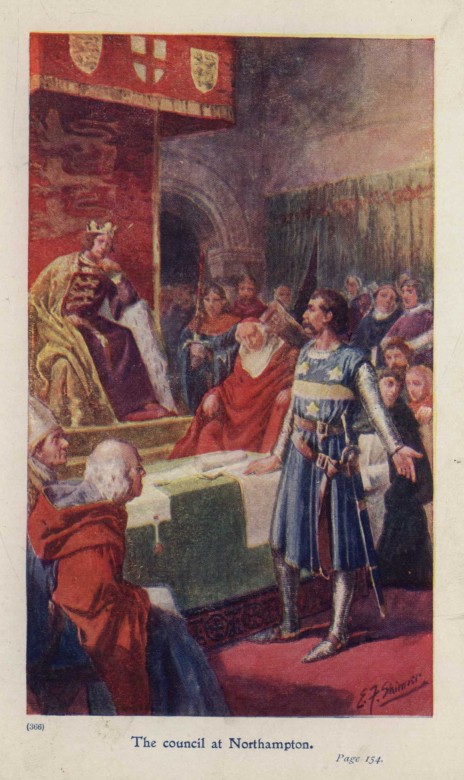
The council at Northampton.
The youthful Henry III. was at this time only seventeen years old, though he had been declared to be of age two years before. His trusted guardian and adviser, Hubert de Burgh, was, however, still with him, and was present at the council. The old chronicler tells how, while the monarch and his advisers were thus assembled, deliberating on the affairs of state, news was brought of the raid upon the judges, and of the capture of Henry de Braybrooke by William de Breauté.
Here was an unbearable insult to the royal supremacy. The attention of the council was instantly turned from the banks of the Tweed to those of the Ouse.
In the storm of indignation which was aroused by the Robber Baron's latest misdeed the voice of the Church made itself heard. The judges of the land were at that period mostly ecclesiastics. Could they put up with this indignity to their learned brother? Was not Fulke also a destroyer of abbeys and churches? Had he not pulled down St. Paul's Church at Bedford? and had not that impious raid upon St. Alban's Abbey been but poorly atoned for by the discipline in the chapter-house? Had any restitution been made?
Further, doubtless, the great barons called to their master's council--they whose sires had forced his father to sign Magna Charta on the field of Runnymede, and who had spilt their blood for the liberties of England--had somewhat to say against this French upstart, De Breauté, this bastard soldier of fortune, who had ensconced himself in a fortress where one of the old Norman families had been established ever since the days of the Conqueror.
Prelate and lord both agreed that the most pressing question of the day was the overthrow of this robber chief.
When Ralph rode into the ancient town of Northampton, now crowded with the magnates of the land, he had no difficulty in finding men of position and weight who were willing to introduce him, as a scion of the De Beauchamp family, to the council.
Henry and his advisers, in earnest discussion over this business of Bedford, were not sorry to find one who was well acquainted with the castle and its fortifications. Accordingly, when Ralph was presented to the council, he was received by the young king with much cordiality. Henry III., though one of the few weak-minded monarchs of the strong Plantagenet line, was still so young that his character could hardly be said to be yet formed, and any mistakes he might make were naturally set down to his youth and inexperience. This affair of Bedford Castle, however, was an undertaking in which he exhibited all the promptitude and energy of his predecessors upon the throne. He resolved to attend the siege in person, and ordered his council to suspend all other business and direct their attention solely to the means of carrying it out.
The council of war, or committee, to whom were confided the necessary preparations, took Ralph into their confidence. They were presided over by no less a personage than Hubert de Burgh himself, who summoned the young knight to appear before them in the chamber in Northampton Castle, where they held their conclave.
Ralph's feelings, as he found himself in the presence of one so renowned, formerly the governor of Dover Castle, and the custodian in Brittany of King John's luckless nephew Arthur, and the late guardian of the king, were those of some shyness. He was a plain, country-born youth, unused to courts and dignitaries, and even of late years a landless, penniless knight, one of an outcast family. But the great justiciary's manner reassured him.
"Sir Ralph," he said, "we understand that thou wast brought up in Bedford Castle, and art well acquainted with all its parts."
"Certes, noble Hugh," replied Ralph, "always excepting those portions where Fulke de Breauté may have made alterations and additions during the last few years."
"Well answered, and with a caution exceeding thy years, Sir Knight. Say on--what alterations?"
"By my faith, I can scarcely tell! But he hath pulled down and well-nigh destroyed the church of St. Paul, and the stones thereof have been used in the castle walls."
"For new work, mean you, or for the strengthening of old work?" inquired the justiciary.
"That cannot I rightly say," answered Ralph, "for since my uncle was driven forth, or rather surrendered to Fulke acting in his sovereign's name, I have not set foot within the castle walls."
But he added beneath his breath: "Would I were within at this moment!"
De Burgh overheard him, and with some surprise.
"So shalt thou be, and that shortly, and with stout men-at-arms at thy back, an I mistake not. But for the nonce we must learn more about these walls. How sayest thou the castle lieth?"
"Along the banks of the Ouse, and on the north side of the stream."
"And its defences--what be they? All say that the keep was indeed built by thy ancestor Pain de Beauchamp, and is strong and not easily to be assaulted."
"The keep is indeed strong and well built," Ralph replied, "and round it run a high wall and a deep moat. On the west side only might an attack be made with any hope of victory, for there lie the bailey yards, the gate-house, and the barbican. Moreover, between the outer and the inner bailey there standeth a tower, which we call the old tower, the like of which, I have heard tell, is not to be found in many castles, and which commands the bridge."
As he spoke Ralph made a sort of rough drawing.
"Here," he said, "is the keep, upon a lofty mound. On this side only is an entrance possible. We must e'en break through all the outer defences, and pass on from west to east. But it will be no light emprise."
A gleam of pleasure came over the face of the veteran.
"By the bones of St. Thomas," he exclaimed, "thou showest no mean knowledge or skill, fair sir. Where hast thou learned the art of war?"
"I have oft heard my uncle tell the story of how King Stephen besieged the castle when our ancestor Milo de Beauchamp held it for the Empress Matilda, nigh upon a hundred years ago," modestly answered Ralph. "He even contended that it was so strong that no attack could prevail, and that had it been better victualled it would never have surrendered. And then, noble knight, if I may make so bold as to remind thee, there is that sad passage in the history of our house which hath been seared into the memory of my boyhood--I mean when my uncle, Sir William, surrendered to this same Fulke, who came in the name of our late king, who was indeed the enemy of our house. Ofttimes hath my uncle gone over that tale with me, and hath showed me how he might yet have held the castle had he possessed better stores and more men."
The end of this interview was that Ralph, in consideration of the valuable information he had proved himself willing and able to bestow, was admitted to all the deliberations of the council, and was listened to with attention. Neither his uncle William de Beauchamp, nor his kinsman at Eaton Socon, had come to Northampton; the latter by reason of his age, and the former on account of his sullen despair, and perhaps also hindered by a latent distrust of the house of Plantagenet, which had dealt so ill with him. Thus it happened that Ralph represented, as it were, the De Beauchamp family.
He was given plenty to do in the way of hastening preparations, moreover, and as his heart was in the work, for Aliva's sake, he was busy both night and day.
His duties brought him into frequent communications with a personage who was much to the front when any question of a siege was on hand--namely, John de Standen, the chief of the miners. Ralph soon discovered that John had considerable knowledge of Bedford Castle and its fortifications. This puzzled him not a little at the time, and it was not till later on that he solved the mystery.
When the chief of the miners and his assistants had determined what supplies of material were necessary for the siege, royal writs were issued for their production. Timber was required for the manufacture of the bombarding engines or petraria, which were to fling great stones at the castle, and ox or horse hides were needed for the protection of these machines. Thousands of quarrels were ordered for the cross-bows and dart-throwing engines. Iron was ordered in great quantities, to be worked up on the spot, and pickaxes and other tools were not forgotten.
Moreover, writs were issued to the sheriffs of Hertford, Oxford, Cambridge, Huntingdon, Northampton, Warwick, Leicester, Rutland, Essex, Suffolk, Norfolk, Lincoln, and Middlesex, directing them to send two men from each plough-land (the usual division of land in those days) to work the aforementioned engines. Then the feeding of these men had to be attended to. One Peter Buyam, a Burgundian merchant, was ordered to purchase one hundred and eight casks of wine at St. Botolph's fair, at forty-three shillings and four-pence a cask.
From St. Briavels in Gloucestershire, the native place of John de Standen, were brought thirty assistant miners. But carpenters, saddlers, and leather-workers, to shape the shields for the engines, were found nearer at hand by the sheriffs of the counties of Northampton and Bedford, as were also the men who were to fashion the stones to be discharged from the petraria. The whole of the midlands was astir over the siege of Bedford Castle.
Neither was the Church inactive. To show their horror at the outrages of the wicked Fulke, the assembled prelates and abbots forthwith granted the king a subsidy of half a mark for each of their plough-lands, and also sent, for each hide of land held by them, two men to work the engines, taking care, however, to obtain an acknowledgment from the king that this was a special grant. The priory of Newenham, which had been founded by the De Beauchamps, furnished the stones for the bombardment, and the abbey of St. Alban's naturally took a deep interest in the proceedings, which are fully chronicled in the records of the house.
No sooner, however, was it known that a Bedfordshire maiden, the Lady Aliva de Pateshulle, was a prisoner of the foreign interloper, than all the men of the county rose to assist in the undertaking. Even our stalwart friend the Benedictine lay-brother, as soon as--thanks to the care of Lady Mabel--he had recovered at Eaton Socon from the dastardly wound inflicted by Bertram de Concours, found his way to the headquarters of preparations.
Martin de Pateshulle, also, as one of those justices whose writs had been so rudely repudiated by Fulke, was summoned to the council. This worthy ecclesiastic, who was none the worse for his overthrow by William de Breauté's horsemen, was much concerned over the fate of his niece.
In him Ralph, tortured by anxiety which he was striving to drown in work, found a friend and ready sympathizer.
"My son," said the archdeacon one day at the close of a long sitting of the council of war, "thou toilest in this business both as a servant of Holy Church and as a gallant knight for the rescue of fair lady."
Ralph sighed.
"Indeed, venerable father, it is only when my whole heart is busy with my work that it finds peace. I am torn with doubts and fears concerning her whom I love. Could I but have one word, one token from her! Could I but hear something of her, were it even ill news! But this silence, it ofttimes is more than I can bear."
John de Standen, still busy at the table over a rough sketch, looked up at these words.
"Sir Knight," he said, "thou meanest what thou sayest? Hast a stout heart? Canst bear ill news?"
Ralph sprang from his seat, and gripped the king's miner by the arm till he winced.
"Speak, man, I conjure thee! Thou hast heard aught?"
"Speech is just what is forbidden to me," replied John. "My lips are sealed. All the message I have for thee is: 'Haste, or it may be too late!' Ask me no more."
CHAPTER XVIII.
HEARD UNDERGROUND.
On the twenty-second of June 1224, the king arrived at Bedford, and the siege of the castle commenced almost immediately. Outside the town, on the Northampton road, pavilions were pitched for himself, for Hubert de Burgh the justiciary, and other great officers, while the troops and their officers, Ralph de Beauchamp among them, were quartered in rude shelters near the castle, or billeted upon the townsfolk, that they might be ready to repel any sortie which the besieged might make with a view of burning the engines of war. Close to these latter were encamped the men who worked them, together with the miners, carpenters, and other artificers ready for their respective turn of duty.
Before any hostile movement was commenced, however, the king, in due form, summoned the castle to surrender. An ecclesiastic was detailed for the purpose; for priests in those days often performed strange functions.
It was but an empty form, for no one expected that the king's command would be obeyed. Moreover, Sir Fulke de Breauté himself was not in the castle. With the astute craftiness which pervaded all his actions, he had gone away some little while before, leaving his brother in command. He took himself off into Wales, where he joined the Earl of Chester, who, though siding for some time with the king, had left him, in conjunction with some other barons, under somewhat suspicious circumstances.
As was to be expected, William de Breauté made answer to the archdeacon--for such was the office of the king's messenger--that he had received no orders from his brother to surrender the castle, and that he certainly should not do so without authority from him. So the siege was begun without delay.
The method of taking a castle in those days was much the same as that which continued in vogue till, long afterwards, stone walls gave place to earthworks. The walls were first battered by stones thrown from the petraria, and when a breach had been made a storming-party rushed in. The only change consequent upon the introduction of gunpowder was that cannon then took the place of the stone-throwing engines.
The machines were placed one or two on each side of the castle, and they must have been of considerable size and strength, as one of them projected stones right across the river. The men who worked them were protected against the quarrels, arrows, and other missiles directed at them from the walls, by screens made of ox and horse hides. Two lofty erections, which towered far above the fortifications of the castle, were manned by slingers and cross-bowmen, who thence shot down upon the garrison on the walls and in the baileys below them.
Close up against the face of the wall itself was pushed a movable screen, called the "cat," the object of which was to protect John de Standen and his men as they carried on their work of undermining the walls.
Ralph was ordered by his superior officer, a grim old baron who had been one of those assembled at Runnymede when John signed the charter, but who now supported his son, to pay special attention to the mining operations. To Ralph and John de Standen attached himself one who could hardly be called a soldier, though he exhibited all the courage and zeal which are the necessary qualities of a man of war. This was the young lay-brother from St. Alban's. He was received as a sort of volunteer, and was granted permission to serve in the mining work, for his religious vows, he said, forbade him to carry sword or spear. This young man proved, however, a valuable assistant.
A kind of friendly rivalry went on between the two branches of warfare into which the besiegers were divided. Those who had charge of the engines favoured the notion of pounding the walls till they battered them down. The sappers and miners, however, built their hopes of reducing the fortress upon their methods of burrowing underneath it. But before these latter were able to push on far with their works, the besiegers above ground gained two important advantages. They carried by assault the barbican or outer defence of the gate, and with but a loss of four or five men. By this means they were able to rush the gate itself, and in a second assault forced their way into the outer bailey or yard, the first one on the west side.
Here were the store-houses, and here also were kept the horses and live stock which the besieged took care to have always within the castle walls. Forage, grain, and such like bulky articles as could not be removed into the keep were likewise stored in the yard. All these fell into the hands of the besiegers, who removed the arms, the horses, and the pigs, and burned the buildings which contained the corn and hay. The besieged retreated within the inner wall, which defended the lesser bailey.
But between the upper and lower bailey there stood--a rather unusual feature in a Norman castle--a strong building known by the name of the "old tower." It had probably something to do with fortifications which at an earlier date protected the bridge across the Ouse, before the castle precincts were prolonged westwards. Here the besieged gathered in strength and made an obstinate stand.
The assistance of John de Standen and his men was now necessary. The other defences, the barbican and the wall of the outer bailey, had been carried by assault, the soldiers climbing the walls and forcing their way within. But the wall which separated the two baileys, protected as it was by the old tower, proved a more formidable obstacle. The king's troops intrenched themselves in the outer bailey, and the cat was wheeled into position ready for the operations of the miners.
These latter worked with a will. Ere long they were able to report to Ralph de Beauchamp, as their superior officer, that the foundations of the old tower were undermined, and that the building would fall directly the stays and struts with which they had propped it up should be removed.
So Ralph went down into the mine with John de Standen, that he in his turn might report to his superiors that the underground work was indeed finished, and that the soldiers might be held in readiness to storm the inner bailey.
With some professional pride the king's miner conducted the knight through the dark passages he had burrowed, explaining as he went the manner in which the supports should be removed directly he received the signal to do so.
They were just beneath the old tower, and John de Standen was enlarging on the excellent arrangements which he had made for the overthrow of the building, when, to their intense astonishment, a woman's voice was heard speaking in the vault overhead.
"By my faith," cried John de Standen, "but I wot not that we had dug so close to the lower vault of the tower. Methinks I must be out of my reckoning, Sir Knight, or mayhap your recollection of the place plays you false."
"In good sooth we are close beneath the tower," replied Ralph. "How thinkest thou, good John? Has the enemy countermined, or are they about to break in upon our works?"
Before John de Standen could vouchsafe an opinion, the voice again was heard from above.
"Ho, royal miners, are ye below?"
"We be miners sure enow," called John de Standen in reply. "But who be ye above there?--They cannot be for Sir Fulke," he added in a lower tone to Ralph, "or they would not let us hear them. Methinks, too, the voice is that of a woman or a boy."
"I am for the king and his miners," spoke the voice again. "But tell me, prithee, is your master, John de Standen, with thee?"
"I, John de Standen, myself am here, and speak; and with me is no one save Sir Ralph de Beauchamp," replied the miner. "But speak; who art thou? Woman or boy; no man, I trow?"
"Now fie upon thee, John de Standen," said the unseen speaker, "that thou knowest not the voice of Beatrice Mertoun."
"Beshrew me, Beatrice, if I can know thy voice, an it be thou, if it come to me through these plaguy paving-stones," cried De Standen. "Moreover, why askest thou, hearing me speak, if I am John de Standen?"
"Marry," exclaimed Beatrice, "in the night all cats are gray. All men's voices sound the same. But mind thee, John, how oft thou hast sworn that thou wouldest know my voice anywhere."
John de Standen felt he was getting the worst of the argument. He changed the subject.
"And prithee, fair Beatrice, what art doing above us?"
"Hush! not so loud," she answered. "I have but a few moments. The guard watch closely the vault ever since that machine of thine was dragged up against the tower. I marvel much that they have not heard the noise of thy workers, and broken in upon thee. But for many days have I too watched, hoping to get a word with thee, for I have a message to send to a knight. But stay--didst not say one Sir Ralph de Beauchamp was with thee?"
"In good sooth I am here," replied Sir Ralph, both amused and puzzled by this unexpected and remarkable meeting between the king's miner and a lady who seemed an old acquaintance, if nothing nearer. "I am here, lady fair, whosoever thou art, for methinks a fair face must e'en suit so sweet a voice."
"She is the waiting-woman of the Lady Margaret de Ripariis, and a mighty comely damsel withal," explained the bold miner.
"Now a truce to fair speeches! I have somewhat to say to Sir Ralph that ill brooks delay. The Lady Aliva, who is prisoner here--
"The Lady Aliva! I know it well!" shouted Ralph, forgetful of the caution to speak softly. "But tell me quick, I pray thee, is she safe? is she well?"
"Safe as yet," replied Beatrice. "But there is mischief brewing against her. Say, did I not see thee carried away wounded from before the castle gate not many weeks since? They brought thy helmet into the castle. I showed it to the Lady Aliva, and she knew it for thine by the crest. And then darkness seized her mind, for not long after came Fulke de Breauté to her, and told her that thou wast slain!"
"The lying scoundrel!" cried Ralph hotly. "Could I but meet him, he would see I am yet alive!"
"Ere he quitted the castle he came oft to her with suit of marriage for his brother," Beatrice went on, lying down upon the stone floor above and speaking with her mouth to an open joint she had discovered between two of the paving slabs. "Canst hear me, Sir Knight? The guards approach; I must tell thee in few words, for I hear the warders relieved not many posts away. William de Breauté came himself to the lady to plead his suit. But she hates him. She told him so to his face."
"She told him so on his face!" muttered Ralph.
"But the chapel hath been prepared," continued the waiting-woman, "and that traitor priest, Bertram de Concours, was ready. They dragged the lady thither by force. Sir Fulke and William de Breauté were waiting. What might have happened I know not, but my Lady Margaret stepped forward, and shamed the shameless man into respect for a lady."
"And all this while she was faithful to me, though believing me dead!" exclaimed Ralph, half to himself.
"But Sir Fulke, ere he left for the marches of Wales, swore a great oath he would find her wedded ere he return, or else--And William de Breauté, he apeth the fine French gentleman. He maketh sweet speeches, and vows that when the king's troops be driven back, and the care of the castle be passed from him, he will return to bask once more in the sunlight of his lady's eyes! Faugh! the smooth-tongued villain! He has sung the same song to me, but not to my honour. But hist! they come!"
A sound, as of the trampling of armed men, penetrated to those below. Then the eager listeners there caught some words in a rough man's voice.
"Pardie! pretty maiden, what doest here? Must pay forfeit with a kiss ere thou depart!"
Then there was the sound of a struggle and a scream, and John de Standen shook his fist in mute rage at the floor above him.
CHAPTER XIX.
FEARS AND HOPES.
William de Beauchamp, the taciturn and melancholy, had not attended the council at Northampton. But he could not well absent himself when an attack was made upon the castle which once had been his; and for his own benefit, for the king had promised to reinstate him as soon as the Robber Baron should have been driven out. He had been given a command in the royal force, and found himself in the anomalous position of besieging his own castle.
But the march of events did not, as might well have been imagined, raise his drooping spirits. He was, indeed, more dismal than ever, having got a fixed idea in his head that he should never come to his own again. Though he had escaped unhurt from the two first assaults, by which the barbican and the outer bailey had been won, he was well aware that yet more serious struggles were before the besiegers ere they might hope to win the inner bailey and the keep. These assaults, he had made up his mind, he should not survive, and in his gloomiest, most funereal manner, called Ralph to him at the close of a summer's evening, when they were resting from duty in the house of Gilbert the Clothier, where they were quartered, and prepared to deliver to him what he supposed to be his last wishes and dispositions.
"Nephew Ralph," he began, in his most lugubrious tones, "thou hast been as a son to me, since my only son was cut off in early childhood."
"True, uncle much revered by me," replied Ralph, puzzled at this solemn address. "I know not quite if I have been a good son to thee, but thou hast, in good sooth, given me all the father's care I have ever known."
"And now, Nephew Ralph," William de Beauchamp continued, "I am about to confide to thee a very precious and holy message. Thou hast heard tell of the Lady Margaret de Ripariis?"
"Ay, certes," replied Ralph.
"And now that my time is at hand, and that the sands of my life are--"
"Thy time is at hand! By my faith, uncle, what mean these words?"
"Thou wottest that ere long we attack the old tower and the inner bailey," the uncle proceeded, in a tragic manner.
"I have but just come from the old tower, where John de Standen hath showed me how nigh is its overthrow."
"Hark ye, nephew. I shall fall then; I know it of a certainty. I have seen in a dream that I shall not survive the assault. I shall ne'er again set eyes on the Lady Margaret, now for many years the unhappy wife of Fulke de Breauté. Once, when we were young and she was fair, we plighted our troth, and I have never forgotten it, though a cruel fate tore us asunder. My wife, who was ne'er to me as the first love of my youth the Lady Margaret, hath been dead these many years; and had the time come for the end of the miserable Fulke, I would fain have offered myself again to my once affianced bride. But I die before him. I feel it. For us there is no hope."
Ralph began to perceive the gloomy forebodings that had seized his uncle, and tried, but in vain, to reassure him, pointing out how much danger he had already escaped, and bidding him hope for the best.
"For eight long years thou hast pined an exile from the halls of thine ancestors, uncle. But to-day our star is again in the ascendant, and fortune smiles once more upon the De Beauchamps."
William shook his head sadly.
"It may not be, nephew. But bear thou to the Lady Margaret my last words of unalterable affection for the love of my youth."
"Nay, uncle, thou shalt bear them thyself, when Fulke shall have gone to the perdition reserved for him! But cease these dark meditations, and list awhile to a sprightly wooing I overheard 'twixt one of those within the castle, and no less a person than the king's miner, in the old tower, this very noontide."
And to turn his uncle's thoughts, Ralph proceeded to relate the strange meeting between John de Standen and Beatrice.
But at the very hour these two talked thus together in Master Gilbert's guest-chamber, the subject of their conversation, the Lady Margaret, sat with her waiting-woman in the deep window of the lady's bower.
The latter was brimming over with eagerness to impart to Aliva the good news she had just ascertained as to Ralph's safety, but deemed it prudent to confide it first to her mistress.
"By'r Lady, mistress mine, I vow I heard him, though I cannot say I saw him, and he is whole and in good heart."
"The saints be praised!" ejaculated Lady Margaret. "It hath grieved me sore that this sweet maiden should be thus held prisoner by my evil-disposed brother, and yet sadder am I to think that she should have been told her knight was slain."
"And such a knight, lady! Fair spoken, and of good courage. I heard it in the ring of his voice, as he hasted to ask after her welfare, how much he loveth her."
"Thou knewest that he was the Lady Aliva's knight, then, Beatrice?"
"Ever since the affair of the helmet, lady. My Lady Aliva could not contain herself then, when she knew him wounded, and told me all. She is as true to him as the pole-star to the north, or as I to--"
"I know it, Beatrice, and it would be a deadly sin, and one I will stand out against as long as I draw breath, were she to be forced to wed William. The lying wretch! he will stick at naught to gain his end. To tell Aliva Sir Ralph was dead! Alas, alas! But peace, Beatrice; here she comes. I will tell her the news."
Inwardly chafing at being deprived of the pleasure of imparting such delightful information, Beatrice retreated behind the chair of her mistress as Aliva entered.
The weary weeks the latter had spent as a prisoner since that fatal morning when she was hurried into the castle, and the intense mental anguish she had endured since the helmet of the wounded knight had been handed to her on the ramparts that same evening, had left their traces on Aliva's pale cheek. The listless attitude in which she sank upon a stone seat, and gazed with mournful eyes out into the fast-falling summer twilight, contrasted strangely with the natural vigour and vivacity of the brave horsewoman who had led William de Breauté such a chase over the Ouse marshes. Something akin to despair had crushed her soul since Sir Fulke had brought her the news of Sir Ralph's death.
"Daughter," began Lady Margaret, tenderly drawing the fair head which leaned so wearily upon the thin hand down upon her knee, "I have somewhat to say to thee. This suit of my husband's brother--methinks Sir Fulke knew, as well as thou and I, how vain it was to urge it while thy true knight yet lived--"
"It were ever vain, lady, were Ralph alive or dead. Death would be sweeter to me than marriage with William de Breauté," replied Aliva mournfully.
"He hath used treachery once to gain his end; what if he hath also used deceit of words?" Lady Margaret went on. "Other De Beauchamps than thy knight bear the crest thou sawest on the casque."
"Ah, lady," moaned Aliva, "beguile me not with vain hopes. Did not Beatrice here see him fall?"
"In good sooth! But, lady, I saw him not die."
"Mind you how the townsfolk bore him off with much care? Perchance Hubert of Provence aimed not o'er true with his quarrel--"
"He is but a sorry wight in many things, lady," put in Beatrice scornfully.
"And the leeches are possessed of marvellous skill, as thou well knowest, and Sir Ralph is young and strong--"
"Was young and strong, you mean, lady. O prithee, peace! Open not thus afresh a wound which bleeds, ay, and will bleed for ever!"
"My lady means what she says, and naught else," interrupted Beatrice, unable to restrain herself any longer. "He is young and strong, or beshrew me for a deaf old crone, for I trow his voice was strong enough this noontide!"
"His voice!" exclaimed Aliva, raising herself eagerly, and a faint colour overspreading her pallid cheek. "O Beatrice, mock me not!"
"Thou mockest thyself, daughter," said Lady Margaret, smiling. "Take heart o' grace. Beatrice speaks true; she hath heard him not many hours since."
And Beatrice, coming forward and falling at her lady's knees, poured forth her wonderful tale in a torrent of words.
When she paused for lack of breath, Aliva rose, like one waking from a dream, and clutched Beatrice's arm.
"Beatrice, an thou lovest me, take me to this chink in the vault of the old tower. Haste thee, haste thee! Let me hear him speak again."
"Alas, lady! but this very evening William de Breauté hath ordered that all women keep within the keep, as the enemy presseth us round so close."
A merry laugh as of old, the first which had rung from her since she had been a prisoner, and the first to which the lady's bower had re-echoed for many a day, burst from Aliva's lips. With the violent revulsion of feeling born of her youth and high mettle, she waved her hand scornfully and laughed again.
"William de Breauté! Oh, he may command and order, in good sooth, if it please him. What for him now, or for his commands! Methinks his time comes apace, and Ralph de Beauchamp will be master here. My Ralph--to think they had dared to tell me that he was slain!"
And then she fell to bidding Beatrice tell her story all over again.
"Pretty Beatrice, an could I, I would give thee a lapful of gold nobles for this news thou hast brought. It is to me worth a king's ransom. I feel like one risen from the dead. But I trow, Mistress Beatrice," she added archly, "that thou hast had thy reward, in that the bold miner was also below. But tell me once more the very words Sir Ralph spake."
"Nay, nay, maidens," put in Lady Margaret; "it is already night, and joy oft wearies as much as grief. Let us now to rest while we may. The strife will begin again at dawn."
"Lady," cried Aliva, embracing the elder woman with tenderness, "go thou and rest if thou canst. I could not close my eyes for very joy.--Go, Beatrice, and leave me here a while alone, that I may think it all o'er again. Go to thy dreams of mines and miners!"
Left to herself, Aliva sat down in the deep window-seat where Lady Margaret had sat when Sir Fulke related to her a less pleasant vision of the night than that which probably haunted the couch of Beatrice--a dream which now seemed in fair way of coming true. The short July darkness had fallen. Across the river the petraria were at rest, and in the silence of the night Aliva only
"Heard the sound, and could almost tell
The sullen words of the sentinel,
As his measured step on the stone below
Clanked as he paced it to and fro."
Aliva gazed out into the beautiful balmy night, and a peace to which she had long been a stranger stole in upon her heart. The world was at rest, and it seemed sad to think that in a few short hours, when the darkness should be over, man would be once more at his cruel work of war. But the stars, shining deep in the purple overhead and reflected in the placid stream below, seemed to her stars of hope.
"It is the hour when lovers' vows
Seem sweet in every whispered word,
And gentle winds and waters near
Make music to the lonely ear."
As she gazed she thought she heard her name called softly from out of the gloom below.
"Aliva!" said a voice, "Aliva!"
CHAPTER XX.
LOVE LAUGHS AT LOCKSMITHS.
When the interview with his uncle had ended and Ralph's endeavours to cheer the latter's gloom had in a measure succeeded, the young knight went off to make his report upon John de Standen's operations to his superiors. Evening was falling fast ere he found himself free, and then it suddenly came into his mind to pay a kind of unofficial visit to the sentries on the south side of the river, and see if they were on the alert. Perhaps, also, he was impelled by an uncontrollable desire to gaze from as close a point as was possible on that stern keep, where he had that noontide learned from Beatrice Mertoun that his lady-love lingered in much doubt and distress.
He crossed the bridge and walked along the river-bank, giving the required password to each post, and adding a few syllables of caution. In so doing, he told himself he was but fulfilling the object of his nocturnal ramble. Ere long he found himself facing the huge keep, rising on the opposite shore of the river black against the northern sky.
Ralph knew every window of the southern face of the keep, and well-nigh every stone. He perceived a light in one of the large openings of the upper story. He knew that window well. It was that of the lady's bower, which had been his cousin's apartment in the old days, and was probably now occupied by the Lady Margaret.
Dark though the night was, the young man's eyesight was keen, and as he gazed at that window, a crowd of tender thoughts flooding his heart, he saw in the opening two figures in dark profile against the light behind them.
Seized by an uncontrollable impulse, Ralph hastily doffed his armour, and, clad only in the soft leathern dress which knights wore beneath their harness, dropped into the stream so quietly as to be unperceived by the nearest sentry on the river-bank.
Starting from a well-known old pollard willow, Ralph breasted the stream manfully, making, as nearly as the sweep of the current and the darkness of the night would allow him, for certain iron stanchions which he remembered he had fixed, when a boy, into the castle wall.
To his great joy he found they had not been removed. He caught hold of the lowest, which was near the water's edge, and quickly scaled the wall. When he reached the top he looked eagerly down and around.
No one was near. William de Breauté, whose garrison was but scanty, had judged that no attack would be made upon the river side of the castle, except by boat, and accordingly had contented himself with posting sentries at each end of the long river-wall, concentrating his principal strength on the landward side of the castle.
Ralph slid down the other side of the wall, and cautiously crossed the open space which separated him from the huge mound on which stood the keep. He was still unperceived; so, climbing the steep side of the mound, he crouched down against the lofty wall, immediately beneath the lighted window.
Were those two figures still there?
Twice he softly called Aliva by name, and then, to his intense rapture, sweet as an angel's voice from heaven to him, came the words from above,--
"Ralph! Ralph! can it be thou?"
"Stone walls do not a prison make,
Nor iron bars a cage."
Love laughs at locksmiths. In this case it made light, too, of some forty perpendicular feet of massive stone wall. After five weary months of uncertainty, all doubts, mistrusts, and tortures of anxiety were swept away in a breath, as these two heard, each one once more, the loved voice neither had expected ever to hear again; and old Father Ouse, rippling sluggishly on between the willows through the dark summer night, had never listened to warmer raptures, to more passionate protestations of love.
But some one else was listening too.
In the thickness of the wall, at the south-east corner of the keep, on the same floor as the great hall, was the small chapel of the castle. It was a tiny apartment, affording room for but few worshipping besides those attending on the ministrations of the priest. Behind a round arched arcading in a stone gallery were accommodated the ladies and the household of the lord's family; but the bulk of the congregation would have to stand in a sort of antechapel opening out of the great hall, and join in the mass from that position.
Up and down the narrow space in front of the altar--freshly repaired and cleaned for the bridal of Aliva and De Breauté--paced restlessly at midnight Bertram de Concours. His thoughts were not pleasant ones. The freshly-appointed chaplain of Bedford Castle had conceived that his new position would be one which would lead him to power and authority, and probably give him an opportunity to triumph over those whom he considered his enemies, the ecclesiastical superiors who had dishonoured and disowned him. But now, instead of rising to power with the De Breauté family, he found his new patrons in sore distress. He was well aware that the two assaults which had already been made on the castle had been completely successful, and that all the outer defences had been taken. He gleaned, from the talk of De Breauté and his under-officers, that if the walls were really undermined, and a fresh attack should be made with the same vigour, nothing could avert the fall of the castle.
For the fate of De Breauté and his men Bertram de Concours cared nothing, but in the event of his own capture he clearly foresaw for himself condemnation in the ecclesiastical court. The sentence would be perpetual imprisonment in the cell of some stringent order, where offending priests were subjected to even more severe discipline than that voluntarily assumed by the most austere monks themselves.
"Fool that I was," he muttered to himself, "to have thrown in my lot with these French upstarts! Why did I not see this maiden safe to her father's house, and so have won me the eternal gratitude of this love-sick knight, and what is more, the favour of his family?"
As he moved restlessly to and fro, he paused, and opening the rude shutter which closed the narrow window on the south, looked out into the silent summer night. The calm freshness seemed to mock the consuming uneasiness in his mind.
But as he gazed he heard voices. He leaned out and listened intently.
Yes, he was not mistaken: a voice there was above him--a woman's--answering to a man's below in the darkness.
"Escape, my Ralph, ere dawn break! There are watchers at each end of the long wall, and they will certes espy thee if thou lingerest till it grows light. How it came that thou crossedst the glacis, and scaledst the keep mound unseen, I cannot tell. May the saints bear thee safe across the river!"
And then another female voice went on,--
"And take my message to thy revered uncle, bold young Sir Knight. Tell him that Margaret de Ripariis has but lived these long years in sorrow and mourning for the false step into which she was both forced and betrayed, and that she hath ever held his memory dear."
Then a man's voice answered from below,--
"Fare thee well, my heart's darling, Aliva!--My Lady Margaret, I salute thee. Forget not the signal. When the last assault comes--as come full soon it must--and we attack this mighty keep, hang your scarves from the windows of the chamber to which ye retreat, and I will come and convey ye both away in safety."
Then Bertram heard the speaker cautiously feeling his way among the loose stones which lay at the foot of the keep.
He drew a short, sharp breath, and clinched his teeth.
"By the mass," he exclaimed, "though naught can undo my folly in the past, yet I will have vengeance now! Ho, warder, ho!" he cried, hurrying from the chapel into the hall, and shouting to the sentry on duty at the entrance; "ho! quick to the window, and take thy aim at yon figure hastening down to the river wall. 'Tis the young knight De Beauchamp. It grows light enow for thee to see thy mark."
At that moment William de Breauté entered the hall from the turret staircase in the corner. He had been taking a few hours' sleep in one of the upper chambers, and was now about to sally out on his early morning rounds, fearing an attack when his guards were weary and drowsy.
"How sayest thou, Sir Chaplain?" he exclaimed; "Ralph de Beauchamp here--beneath the castle wall! 'Tis not possible!"
"Nay, Sir William, not so impossible," replied the priest. "I trow he hath been drawn across the Ouse by a lodestar within these walls. From the chapel window I heard him e'en now hold converse with the Lady Aliva at a window above."
With a furious volley of French oaths William de Breauté rushed wildly out of the hall, calling upon all the sentries near to stop or kill Sir Ralph.
It was a maddening race. From the upper window the girl watched it in agony. The cross-bow bolts flew thick and fast around Ralph as he hurried to the wall. Some shattered themselves against the stones as he scaled it.
For a brief moment he stood out clearly upon the summit against the gray dawn, an easy mark for the archers. Then, without waiting to descend by the iron stanchions, he took a desperate plunge into the stream.
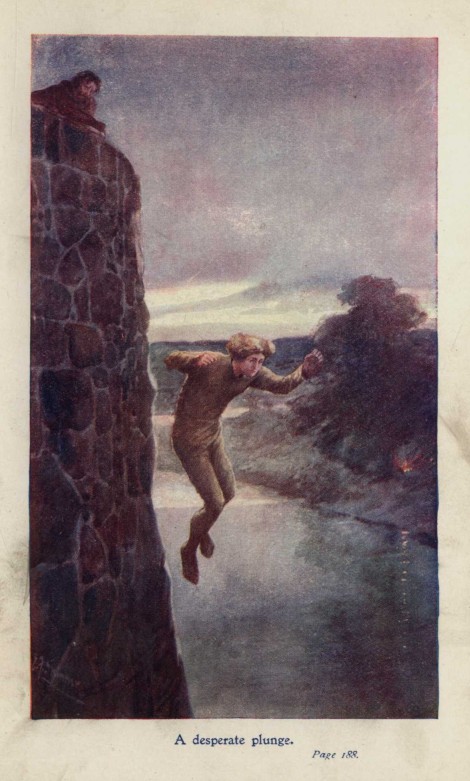
A desperate plunge.
Aliva saw him rise to the surface, and watched him swimming with all his might to the opposite bank.
But as he leaped from the top of the wall she saw another figure reach it, and she recognized the pursuer to be William de Breauté.
He held in his hand a ready-strung cross-bow which he had snatched from one of the warders.
Aliva saw him take aim and loose the shaft.
The figure of the swimmer half rose in the water, and then disappeared from view beneath its surface.
With a faint cry Aliva fell back swooning into the arms of Lady Margaret.
CHAPTER XXI.
THE CASTLE FALLS.
The unfortunate Lady Aliva was in despair.
The cup of happiness had been rudely dashed from her lips. After all her perils and anxieties of the last few weeks, her lover had been suddenly restored to her; once more she had heard his voice, had listened to his vows and caressing words, but only to see him slain, as she imagined, by his rival before her very eyes. From the summit of unexpected joy she was plunged into a depth of misery tenfold harder to bear than that which had gone before. All hope seemed over.
But within some twenty-four hours she was rudely awakened from her grief by the horrible din of the assault, which at dawn of day commenced against the old tower and the inner bailey.
"Hark how the hall, resounding to the strain,
Shakes with the martial music's novel din!
The heralds of a warrior's haughty reign,
High-crested banners wave thy walls within.
Of changing sentinels, the distant hum,
The mirth of feasts, the clang of burnished arms,
The braying trumpets, and the hoarser drum
Unite in concert with increased alarms."
"The wall is rent, the ruins yawn,
And, with to-morrow's earliest dawn,
O'er the disjointed mass shall vault
The foremost of the fierce assault."
The storm of war reached nearer to the ladies in the keep than it had ever yet done. Through the crack of the closely-shuttered windows they could watch the fray below, and catch the sound of angry voices borne up to them, and mingling with the crash of falling masonry.
The Lady Margaret, whose shattered nerves could ill bear such tumult, betook herself to the little chapel in the angle of the wall, and passed the time upon her knees in prayer. But Aliva and Beatrice, impelled by the curiosity of youth, could not forbear to see what was to be seen.
The point of interest was the old tower. The girls knew it to be undermined, and watched anxiously to see it totter to its fall.
"I see a mass of soldiers gathering under the outer wall and halting as if for a signal," cried Aliva.
"The tower will soon fall, and these are ready to rush in," said Beatrice.
"But how falls it?" asked Aliva. "Thou art in the miner's secrets; tell, prithee."
"They tie ropes to the great wooden beams and props on which John hath supported the foundations. At a safe distance stand men ready to pull them away; and then--ah, our Lady have them in her keeping!"
And as she spoke a sound was heard, a rumbling as of thunder, followed by a cloud of blinding dust, which obscured everything--court-yard, men, and masonry. There was a fearful crash, and the girls shrank with terror and looked at each other.
"Oh, this is horrible!" whispered Aliva, hiding her face.
"My lady, my lady, I can see! The tower is down--it is a heap of rubble; and they come, they come! O lady, you are saved!"
"Saved!" said Aliva with a sad smile, shaking her head; "what boots it now? What wish have I for aught but death?"
"Death, lady? and in the moment of victory? Oh, speak not so! See the king's men, how they hurry, they scramble, they pour through the breach! 'Tis a noble sight. Forward, forward! Down with the Breauté!" shouted the excited waiting-woman, opening the shutter wide and craning out her neck.
"Beatrice, have a care. They will let fly a bolt at thee, and what will say the master miner? Thou hast some one to live for!"
"If I die for it, I must look!" protested Beatrice. "Oh, the king's men, how they fall! Alas, alas! William de Breauté hath well posted his men in all the best places for defence! But on they come--they waver not! By my halidom, there comes a gallant band, though small! How fast that knight leads them across the inner bailey! They make for the steps of the door of the keep. But how thick the arrows fly! William must have lined every loophole in the donjon and in the hall with men!"
"But how the royal men-at-arms pour in! De Breauté is far outnumbered--his men fly--they fall back--they seek to gain the steps," gasped Aliva, looking over Beatrice's shoulder.
"Gallantly done, gallantly done! That little close band follows them hard up the steps. Well led, Sir Knight! (Hold my hand, prithee, lady, lest I fall out and break my neck! I must see.) But our men make a stand upon the steps; that is to gain time to close the door. The swords are at it now--I hear the ringing. Ah me! it is Sir William himself defends the steps. He raises his sword; he will smite that bold knight who leads them! He has smitten--By our Lady, 'twas a near thing! Who was that parried the stroke with his staff? I see! a man in monkish dress. And now the knight falls--he rolls down the steps--his armour is heavy--he strives in vain to rise, but alack, alack!"
"What seest thou? speak, Beatrice!"
"The poor brother, lady, he who saved the knight--he has fallen. Oh, he moves not! Alack, he is slain!"
"They are all falling back; what means it, Beatrice?"
"I cannot see, lady; the wooden porch over the steps hinders me. But the knight has risen--he is unhurt--he calls his men back."
"They retreat--they retreat?"
"Meseemeth Sir William and his men have shut to the door, lady," replied Beatrice, drawing in her head; and as the two girls stared blankly in each other's faces, the Lady Margaret, pallid and haggard, entered the apartment.
"Daughters," she exclaimed, "the king's men have won the inner bailey; the old tower is down; we now only hold the keep!"
That evening sore disappointment reigned in the camp of the besiegers. Had they but been able to reach the door ere it was closed, the keep would have been theirs; but as it was, they were compelled to draw off after considerable loss from the storm of arrows which rained upon them from the loopholes.
All had to be begun over again. John de Standen and his men once more set to work. The cat was wheeled up close to the walls of the keep, and the digging recommenced. This time the task was more laborious and difficult than ever. The foundations were strongly laid. The work of Pain de Beauchamp was built to last, and the besieged did all they could to hinder the operations. It was not till the fourteenth of August that De Standen could report that his work was ready.
Late that afternoon the fourth and last attack commenced. The miners sprung a huge fissure in the wall of the keep. Simultaneously another agent was set to work--fire. A light was set to the wooden porch over the steps.
The work was finished. The flames, caught the woodwork within, and broke out in some of the apartments. Through fire and smoke the besiegers stormed the breach, the besieged fighting desperately, and only yielding step by step.
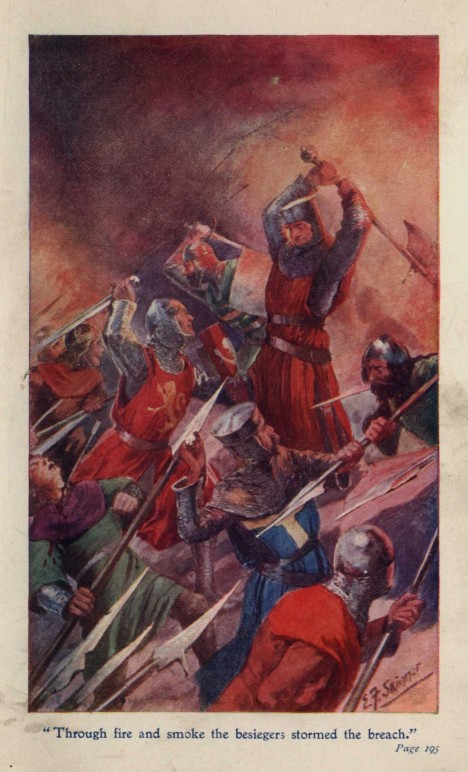
"Through fire and smoke the besiegers stormed the breach."
At last, however, William de Breauté was forced to acknowledge himself beaten.
"My brother cannot say I did not do my utmost," he gasped to one of his officers as they leaned exhausted against the pillar of the turret stair.
"Yield thee, now yield thee, William de Breauté!" cried a voice through the din.
"I yield me to the king's mercy," began the Frenchman, "but not to thee," he added, as the tall form and gloomy visage of William de Beauchamp loomed down upon through the smoke. "To a De Beauchamp? never!"
His men had ceased to offer any resistance, and stood with spears and swords point downwards and cross-bows unstrung. William looked around.
"My Lord Lisle of Rougemount, I surrender to you, rescue or no rescue."
The baron thus addressed seized De Breauté's outstretched sword, and signalled to his men. They closed round the prisoner and his immediate attendants, and prepared to march them off to the dungeon.
But as they crossed the great hall they met a young knight, followed by two or three men-at-arms, hurrying towards the turret stair.
"Ho, nephew!" exclaimed Sir William de Beauchamp, pointing to Lord Lisle's prisoner with the nearest approach to a smile of which his lugubrious features were capable; "see here! He hath tried long enough how it feels to sit in our great hall; we go now to give him a taste of our dungeon."
William de Breauté turned his head, and for the first time, and for a few moments only, found himself face to face with his rival, Ralph de Beauchamp. He cast upon him a look in which malignant hatred was mingled with the haggard despair of frustrated hopes.
"Dog!" he ejaculated, "methought thou liedst safe at the bottom of thy muddy Ouse!"
"Not so safe as thou wilt shortly lie in our donjon vaults," retorted Ralph, scarcely deigning to glance at him. "I can dive, man."
The guards led on.
To engage in such open rebellion against Henry was a somewhat different matter to joining in the confederation of barons against the tyranny and injustice of King John, as William de Beauchamp had done: and as William de Breauté and his men were led away down the steep stairs to the gloomy cells beneath the keep, they felt that their doom was sealed.
CHAPTER XXII.
RALPH TO THE RESCUE.
As William de Breauté was being marched to his fate, Ralph hurried up the winding turret stair, half choked by the blinding smoke which poured from the burning wood-work, and much impeded in his impetuous course by the chain of soldiers engaged in passing up water to extinguish the conflagration.
Even in the heat and din of the final assault his keen lover's eye had found time to look for and to note the signal promised by Aliva. High up from one of the windows hung her scarf. But when Ralph and his men had toiled thither they found the room empty.
Ralph experienced a painful tightening of the heart. Whither had the bird flown?
But it was the smoke which had driven the ladies from their apartment, and Ralph, exploring higher still, up a rude stone stair, found them collected on the flat wooden roof covering the inner space between the lofty parapets and the four corner turrets.
Aliva, standing out tall and slim against the August twilight, was assisting Beatrice Mertoun to support the Lady Margaret, who was quite overcome with all that was taking place.
Ralph fell on his knee before Aliva, and kissed her hand with a rapture too deep for words. But Aliva bent over him, and throwing up his visor, kissed his face.
A voice sounded behind them. "Tut, children! this is neither time nor place to tarry to make love.--Ladies, haste you, and get you gone to a place of safety. We have conquered our enemies, but not yet subdued the fire.--Lady Margaret, permit that I assist thee down these stairs.--Nephew Ralph, bring the Lady Aliva."
And the whole party, guided by De Beauchamp, hurried down into the hall, and thence into the débris and confusion which reigned in the bailey yards. The fast-falling darkness added to the weirdness of the scene--the ruins, the dead and dying, the shouts and cries of the victors, the crackling of the flames, and the crash of the charred beams as they fell.
Somehow or other in the tumult Ralph and Aliva got separated from the rest, and found themselves, when once clear of the fortifications, obliged for a few moments to stand aside on the river-bank to let a company of men-at-arms pass by with wounded and prisoners.
Suddenly, from behind some dark corner, a figure rushed at them in the gloom, and fell on his knees before Aliva. She started violently, and Ralph drew his sword.
"Misericorde, misericorde! for the love of Heaven and our Lady!" whined a familiar voice, that of Bertram de Concours. "Fair lady, as you hope for mercy, show some to me, and mind you how I succoured you in the chapel, when De Breauté and his men might have--ah!"
He never finished. A trampling of armed feet was heard behind, and he turned his head to see a guard advancing upon him.
"Better a watery grave than a living tomb!" he shrieked, and, before Ralph could stop him, plunged into the stream.
"Plague take the traitor priest! We have lost him," growled the veteran man-at-arms in command.
"Old Ouse will have naught of such foul spawn, I trow," corrected Ralph. "There are but two feet of water 'neath this bank at harvest-time. Fish him out; he sticketh in the mud, and is set fast.--But come, sweet Aliva," he added, turning to the maiden at his side; "let us hasten. The Lady Margaret hath without doubt ere now gained the house of good Master Gilbert the Clothier, who bade me offer thee his hospitality."
Aliva moved on, clinging to her lover's arm. Behind them, into the darkness, the guard marched off the bedraggled priest. As regards the latter's ultimate fate the chronicler is silent, beyond relating the fact that he was committed for trial in the court of the archbishop, and doubtless the ambitious Bertram de Concours fretted away the remainder of his days a prisoner in the cell of some austere order. But the little episode had awakened another memory in Aliva's breast.
"My Ralph," she exclaimed, "and what of the other, the Benedictine lay-brother, the Bletsoe youth, who did in all truth and fidelity succour me and strive to bring me aid?"
Sir Ralph looked down on the fair face resting on his arm, and then up to the purple sky of the summer night--
"The azure gloom,
When the deep skies assume
Hues which have words, and speak to ye of heaven."
"God rest his soul!" he answered, in a low voice. "I owe it to his strong arm and ready wit, as he parried with his mace the blow De Breauté aimed at me, that I am here to-night with thee."
Ralph only waited to see the ladies safely bestowed in the worthy burgess's abode ere he hurried back again to the castle. There was no rest for him that night. Not the least onerous part of a commander's duty in those rough times was to restore order and discipline among his men after the capture of a fortress which had held out against them. It was a melancholy sight to the young knight this sacking and firing of his ancestral castle, the home of his boyhood. It stood there with ruined walls and a huge rift in the side of the great keep like a lightning-stricken oak.
And morning light brought more work. Hubert de Burgh, the king's justiciary, opened a court of justice in his sovereign's name, and before it were brought William de Breauté and eighty of his men.
Late in the afternoon Beatrice Mertoun, devoured with curiosity as to what was happening, and chafing at her restraint in Master Gilbert's house, persuaded one of Lady Margaret's women to come with her towards the castle, intending, under cover of the twilight, to secure such of their possessions as the fire and the plunderers should have spared. But they returned quicker than they went, and empty-handed, driven back by horror; for in the bailey yard they came suddenly upon a rude gallows on which, grim and stark in the dim twilight, hung William de Breauté and seventy-three of his men.
CHAPTER XXIII.
A TÊTE-À-TÊTE RIDE TO ELSTOW ABBEY.
Contrary to his dream and to the gloomy forebodings which he had been hugging to himself after the manner of certain dismal natures which delight to make themselves miserable, William de Beauchamp, as we have seen, escaped unscathed from the assaults on the castle. But lest his melancholy should lack food, as it were, fate had another blow in store for him. No sooner had the castle of Bedford been captured than the royal mandate went forth that it should be destroyed.
Henry III., young though he was, was too well aware of the difficulties which his father had experienced with his barons not to be convinced that his best policy lay in curbing their power. Now the chief strength of a medieval noble lay in his castle. In the taking of Bedford an excellent opportunity seemed ready to Henry's hand for getting rid of one of the most important and substantial fortresses in his kingdom.
He was, moreover, completely in his rights in so doing. King John had granted the castle to Fulke de Breauté as a reward for his services, more especially in turning out the De Beauchamps. But now that De Breauté had rebelled against John's successor, deprivation brought the castle once more into royal hands. What came absolutely to the king, the king could destroy.
This determination was a severe blow to William de Beauchamp. He was grievously hurt when he learned that the destruction of his ancestral home was definitely settled, but he was unable to take any steps to preserve it. It was, however, intimated to him that the site of the castle would be granted to him, together with certain of the lands and manors thereunto appertaining, after the fortress itself had been pulled down. No occupier or owner of a house could then proceed to fortify or crenellate--that is, erect defensive parapets--without the royal license; and William de Beauchamp was informed that though he might build within the castle precincts as suitable a dwelling as he pleased, on no account would such permission be granted.
So he had no choice in the matter, but found himself under the painful necessity of silently beholding the mighty keep where he had been born, and in which all his early days had been spent, destroyed before his very eyes.
The work of destruction, however, was no easy one. Securely and solidly had Pain de Beauchamp erected his fortress, less than a century and a half before. It was necessary to employ John de Standen and his men again. For many a long day after the king and his justiciary, and the barons, ecclesiastics, soldiers and labourers who had been gathered together for the siege had dispersed, the crash of falling masonry was to be heard. Mines had to be dug and the walls overthrown, just as though the siege were still proceeding, with the important difference that the miners could work unmolested by attacks, and with no need of the protecting "cat."
John de Standen seemed in no wise to regret that the work of demolition detained him so long at Bedford. In the midst of his duties he contrived to find many opportunities for visits to Master Gilbert's house, where Beatrice Mertoun was also detained in attendance upon her mistress, who was prostrated by illness consequent on the anxieties she had undergone during the siege. Aliva de Pateshulle also stayed with the Lady Margaret, loath to leave her and return to Bletsoe till she should be quite recovered; for she felt she owed the lady a debt of gratitude for her care of her during her imprisonment, and also for interposing on her behalf with Fulke and his brother, which she could never sufficiently repay.
The consequence was that the king's miner did not appear surprised to run against Sir Ralph de Beauchamp issuing one evening from the ladies' temporary abode.
"By my troth, Sir Knight," exclaimed John de Standen, with a merry laugh, "methinks we come both on the same errand here. You seek the lady; I seek the maid. But it is easier work than when we had to break through stone walls and swim broad rivers to get speech of them."
"Certes, bold miner. Meseemeth I have now discovered whence thou gottest that close knowledge of Bedford Castle which stood thee in such good stead at the Council of Northampton. I warrant me thou wast oft enow within its walls ere thou breakedst through in the breach not many days since, and I doubt not thou hast paid many a visit to fair Mistress Beatrice when no paving-stones came between ye. But thy siege is over now, bold miner. Thou hast won thy bride. I have yet to win the fortress of De Pateshulle the sire," he added, with a sigh.
"If the lord of Bletsoe be what I take him for," the miner responded consolingly, "he will not say nay for his daughter to such a knight as Sir Ralph hath proved himself in this tough work."
"I hope from my heart thou speakest true," replied Ralph; "but naught hindereth thy bridal?"
"Nay, certes. Beatrice is an orphan with no friend but her lady, who took charge of her when she was but a child. And as it would seem the Lady Margaret purposeth to betake her to a nunnery, she is quite ready to hand over the maiden to one who asks no less than to burden himself with her!" laughed the miner.
And so it turned out. One bright September morning, not long after the fall of the castle, and when John de Standen had completed his work of destruction, he and Beatrice were married in the chapel of St. Thomas-at-bridge, the little edifice where she had occasionally been allowed to attend mass with her mistress when Sir Fulke was in a more benign mood than usual. The ceremony was graced by the presence of Lady Margaret and Sir Ralph, but Lady Aliva had already returned to her father's house.
When the marriage was over the Lady Margaret prepared to start for Elstow. In her present forlorn condition, the forsaken wife of an outlawed and fugitive baron dispossessed of all his lands, homeless and sickly, the unfortunate lady had implored shelter within the abbey walls, and not in vain. But short as was the distance from Bedford, in the present shattered condition of her nerves it was impossible for her to take the journey alone. Sir Ralph had offered to be her escort, but at the last moment he was detained by some duty in connection with the destruction of the castle which was really John de Standen's business, but which the worthy miner's marriage had hindered him from seeing to.
Ralph found an unexpected substitute. When the Lady Margaret emerged from Master Gilbert's hospitable door to mount her palfrey, she beheld to her surprise Sir William de Beauchamp waiting to assist her.
"I crave thy pardon, lady, if I intrude upon thee. But to my nephew and me it beseemed ill-fitting that Margaret de Ripariis should arrive unattended at the gates of Elstow. I beseech thee, grant me the melancholy joy of escorting thee thither."
It was many years since William de Beauchamp and his once affianced bride had found themselves alone together. During the days of Fulke's power there had been no meetings between De Breauté's and De Beauchamps. It was only once during the confusion of the capture of the castle that the two quondam lovers had set eyes on each other. As they somewhat silently started on their tête-à-tête ride, the groom in charge of the sumpter mule lagging a little distance behind, they had ample time to observe in each other the changes wrought by time.
"How strange it seemeth to miss the sight of the great keep, rising proud and stately to the north across the river!" began the lady, turning her head as they were crossing the bridge.
"Alack, lady, what a change! Was ever luckless man doomed to see such a destruction of his own, and not be able to lift a hand or to utter a word?"
"But I am told that thou purposest to build thyself a fair dwelling between the inner and outer baileys, with a goodly hall and large apartments."
"Alack! what boots a fair dwelling and a goodly hall to one whose whole life has been marred--a solitary man whose years creep on--who finds himself alone?"
"Alone!" murmured Lady Margaret. "Free, unshackled by a bondage worse than death, not trembling lest a hateful tyrant return at any moment and claim his rights. 'Twere good to be so alone!"
"Alack, lady," said Sir William, "can naught be done to aid thee? Will not Holy Church loose this unholy bondage, forced upon thee unwillingly by the king's command?"
"Alas, no, Sir Knight! On that score have I sought advice of the venerable archdeacon and other ecclesiastics, but they offer me no hope. Therefore I go hide me in a nunnery, lest Sir Fulke return. We must e'en each bear our fate. We each have our woes. Thou hast lost thy castle."
"Is thy memory so short, lady, that thou sayest it is only my castle I have lost, most miserable of men that I am? Hast forgotten the days--"
"When I came to Bedford Castle with my father and his train to the great tourney," interrupted Lady Margaret, wishing to turn the conversation, and reining in her palfrey that she might turn round to survey the ruins, "'twas a noble sight. How the banners waved from the pavilions on the tilt-ground, and the trumpets blared, and the horses pranced! How like silver ran old Ouse that merry summer's morning, when I sat 'neath the canopy--"
"The Queen of Beauty, fair lady, and rightly so! And how your bright eyes dazzled a certain youth on whom you had deigned to bestow your favour to wear on his crest, and who ill deserved such an honour!"
"But who acquitted himself right gallantly. I can see him still! But all is changed: the castle is no more; we are not what we were; only the old river runs the same. But come, Sir Knight; the reverend mother waits me."
"Lady, it grieveth me sore that the way 'twixt Bedford and Elstow is so short. See how near loometh the abbey tower."
"To me it riseth like the beacon of a port to the weary, wind-driven mariner. Would I could find rest within its walls for aye!"
"Say not so, lady; it sounds to my heart like a funeral knell."
"No fear, Sir Knight; as long as Sir Fulke draws breath no cloister may receive me. The reverend mother tells me that so long as my vows to him are unloosed by death, I can ne'er plight any others; so long as I am his wife, I cannot become the spouse of Christ."
"Alack, lady, how woful a fate is mine! I, too, once plighted vows. Dost recall them, lady? Nay, I received others in return. I can hear them yet. Vows they were, not less sacred than those made to priest before altar. Yet here I stand alone, like some wind-swept oak on the hill-side, bowed before the blast."
"Yet the helpless ivy would fain twine round the proud lord of the woods," replied the lady, somewhat coyly. "Be thou sure, Sir Knight, my heart grieveth sore for thee. I promise thee that thou shalt have my prayers."
And shortly afterwards the pair parted at the abbey gate.
CHAPTER XXIV.
"DE MORTUIS."
"O God, that it were possible, after long years of pain,
To find the arms of my true love around me once again!"
"The walls where hung the warriors' shining casques
Are green with moss and mould;
The blind worm coils where queens have slept, nor asks
For shelter from the cold."
Three years had passed since John de Standen pulled down the stronghold of the De Beauchamps. William de Beauchamp, making the best of the necessity which was forced upon him, set to work to erect himself a house between the inner and outer bailey. It still went by the name of the castle. Unfortunately no plan or description of this building has been handed down to us. It only existed for about twice as long as its predecessor, the Norman keep of Pain de Beauchamp. Camden, writing in the reign of Queen Elizabeth, describes it as a stately ruin overhanging the Ouse; and an old map of about the same time shows that these ruins occupied a pleasant position a little back from the river, and looking south. As it was strictly an unfortified mansion, we may opine that it was much such a building as that which we have described at Bletsoe, consisting of a large, long hall, with private apartments at one end one story high, but larger and built of stone.
In one of these apartments, one afternoon in the summer of 1227, sat Aliva de Pateshulle, now Aliva de Beauchamp, with her baby-boy upon her knee. She was looking out of the round, arched window, which was somewhat larger than the shuttered apertures in the old keep. The house was intended for a comfortable dwelling, and not for a place of defence. The walls were not half the thickness of those which had enclosed her prison of three years before, though built of identically the same stones. The rooms, too, were lighter, larger, and more habitable. The science of domestic architecture was beginning.
Aliva herself was also a more fully developed specimen of beautiful young womanhood. The angularity of her tall figure had disappeared, and there was more ripeness and fulness about her cheeks and mouth. But her large gray eyes remained unchanged. Her beautiful fair hair, perhaps a shade darker than it had been when it hung down over her shoulders that morning in the garden at Bletsoe, was partly covered with the ugly wimple, the matronly head-dress of the period, which had replaced the maidenly fillet.
Aliva was gazing from the window, which commanded a view of the river, and was apparently watching for the approach of some one from the entrance to the west. Presently she waved her hand in that direction, and holding up the boy to the window, bade him look down at his father.
Ralph entered the house, crossed the large hall, and made his way to his wife's apartment. He also had somewhat altered in three years. His massive frame had filled out, and with his large limbs more covered with flesh and muscle, he looked even more like a young giant than he had done that eve of the Assumption when he had fought his way into the keep.
He strode into the room, his face lighting up with a smile as his little son clambered down from his mother's knee and toddled to meet him. He lifted the boy up and kissed him. Then he kissed his wife; and she, returning his embrace, began forthwith with feminine curiosity,--
"Well, sweetheart mine, what news?"
Ralph was in his riding-dress. He had come in from a journey, and this was why Aliva was watching for him so anxiously from the window. The country had, indeed, much quieted down since the siege of Bedford Castle and the ejection of the De Breauté marauders. During the period which elapsed between the revolt against King John and the wars of the barons, which troubled the latter end of his successor's reign, there intervened a period of peace. Nevertheless, Aliva was always glad to see her husband safe home again.
"And so, Ralph mine, if thou hast news, prithee tell it me. Here naught has passed out of the common. The boy and I have played together, and awaited the home-coming of father."
"My business for which I set forth is ended," began Ralph; "but, marry, 'twas dull work! 'Tis ill to deal with scriveners and such like folk! But as I rode through St. Alban's I bethought me of turning in to the abbey gate, and making my obeisance to the reverend father abbot. Thou knowest that a De Beauchamp is ever welcome in a house of Holy Church."
"Ah, St. Alban's!" cried Aliva; "and, prithee, didst give my message relating to the incised stone to the memory of my protector, who was slain at the siege, the bold young lay-brother of Bletsoe?"
"Ay, verily I did," replied Ralph. "And the father abbot was well pleased to learn that one of their house, who fell in fighting for Holy Church (for thus, thou knowest, these priests always speak of the siege), should sleep in our fair church of St. Paul at Bedford. He hath given me an inscription to have writ on the slab. He saith it should be cut in letters as is cut the inscription to Muriel Colt on the north of the high altar. But hearken, wife," he added, sitting down beside her; "I have other news for thee."
"And good news, prithee?"
"Heaven forfend that I should speak hastily or harshly of a dead enemy!" continued Ralph gravely. "Sir Fulke is no more. The reverend father hath instructed me that I may say, an if I will, 'Rest his soul in peace.' For it seemeth he died free from the censure of Holy Church."
Aliva received the news in silence. Her thoughts flew back to those few terrible weeks when she was an unwilling guest in Fulke's castle. Then she replied,--
"I, too, would say, 'God rest his soul.' As thou knowest, I scarce saw him here, for he fled to Wales when he heard that the council had determined to attack the castle. But his brother--"
She paused, for even now she could not make the least allusion to William de Breauté without a shudder.
"Tell me all thou hast heard," she added.
"I will give the tale in few words," Ralph answered. "Thou mindest how, after he had submitted himself to our lord the king in Bedford here, he was given, as an enemy of Holy Church, into the safe-keeping of my Lord Eustace, the Bishop of London."
"Ay," put in Aliva. "Some time since, when I went to Elstow to visit Lady Margaret, the reverend mother told me how she had restored the sword into the hands of the figure of St. Paul in the abbey church, as soon as it was told her that the holy apostle had the destroyer of St. Paul's Church safe in the keeping of the Bishop of St. Paul's in London."
"But see here," Ralph went on. "The good father has had writ out for me a copy of the entry of Sir Fulke's history, as recorded by the scribe of the monastery to be laid in the scriptorium. I will e'en read it to thee, if I have not forgot the Latin the old chaplain taught me when I was a boy."
And Ralph read out the following history, which is still preserved to us in the chronicles of St. Alban's:--
"Fulke, after that he was pardoned at London, and because he was marked with the cross, was allowed to depart for Rome. After crossing the sea he applied for a passport at Fiscamp, and was detained by the bailiffs of France. At last, the following Easter, after that he had been released from prison, he went to Rome, and sent very piteous letters to the king, asking that his wife and his lands might be restored to him."
"Alack! The poor Lady Margaret!" put in Aliva, with a sigh.
"Whereupon the king, with his barons," read on Ralph, "sent word to our lord the Pope of the treachery of Fulke; and the latter, having had his refusal, set off for Troyes; and after staying there a year, was sent out of France, because he would not pay homage to the king. He went to Rome, and again, with much entreaty, begged that his wife and his patrimony might be restored to him; and on his return from that city, burdened with debt, he died at St. Cyriac."
"His wife would ne'er have returned to him!" ejaculated Aliva indignantly.
"Neither had he any patrimony here, either in the castle or in the manors," added Ralph. "Were they not wrested from my uncle and from others, and given to him as a reward for his evil services to our late king John? And hark ye, my Aliva, the father abbot showed me also, written by his learned scribe, the whole account of the siege of the castle; and he saith that, in after ages, the history of Bedford will be known ever as it is known now. Perchance our names are mentioned, but I read not that portion of the chronicle."
His wife scarcely heeded. She was thinking of the present, and not of the future. Woman-like, her mind was running on match-making.
"Does the Lady Margaret know of Sir Fulke's death?" she asked.
"I trow not," answered Ralph. "The news hath but even now reached England, and hath but just been set down by the abbey scribe at the end of his history of the siege. But doubtless news will be sent to Earl William de Warenne, who, as thou knowest, has charge of the lands and possessions which were hers ere she married, and which have been restored to her."
"Then she is free!" mused Aliva.
"Ay, free, poor lady. The priests decided, when she sought to be released, that there had been no impediment of canon law to her marriage, and that it could not, even if it had been in a manner forced, and the bride unwilling, be dissolved by the authority of the Church. Death hath loosed her bonds."
There was a stirring of the heavy curtain which hung in the doorway of the apartment. But so engrossed were the two speakers that no one noticed it but the child, who, after looking towards it, began to toddle uncertainly in that direction.
"She is free," repeated Aliva thoughtfully. "Her husband is dead, and she hath not yet bound herself by the vows of a religious life, even did she wish it, which, often as I have talked with her these three years past since she hath sought shelter at Elstow, I doubt much."
"True, wife; if any one should know the Lady Margaret's mind, it should be thou, who art to her as a daughter. But beshrew me if I wot what thou art driving at, sweetheart."
Aliva sprang up, and throwing her arms round her husband's neck, exclaimed, with an arch smile,--
"How oft dunder-headed men are where love is concerned! Ralph, we shall see the Lady Margaret the châtelaine of Bedford again!"
And then a most extraordinary thing occurred. Behind, in the doorway, they heard a joyful laugh.
There stood their uncle, Sir William, who never within the memory of either of them had been known even to smile.
He advanced hurriedly into the room, and catching up his great-nephew in his arms, kissed his little flaxen head, and laughed again.
THE END.
* * * * * * * *
Nelson's "Royal" Libraries.
THE TWO SHILLING SERIES.
IN TAUNTON TOWN. E. Everett-Green. IN THE LAND OF THE MOOSE. Achilles Daunt. TREFOIL. Margaret P. Macdonald. WENZEL'S INHERITANCE. Annie Lucas. VERA'S TRUST. Evelyn Everett-Green. FOR THE FAITH. Evelyn Everett-Green. ALISON WALSH. Constance Evelyn. BLIND LOYALTY. E. L. Haverfield. DOROTHY ARDEN. J. M. Callwell. FALLEN FORTUNES. Evelyn Everett-Green. FOR HER SAKE. Gordon Roy. JACK MACKENZIE. Gordon Stables, M.D. IN PALACE AND FAUBOURG. C. J. G. ISABEL'S SECRET; or, A Sister's Love. IVANHOE. Sir Walter Scott. KENILWORTH. Sir Walter Scott. LEONIE. Annie Lucas. OLIVE ROSCOE. Evelyn Everett-Green. QUEECHY. Miss Wetherell. SCHÖNBERG-COTTA FAMILY. Mrs. Charles. "SISTER." Evelyn Everett-Green. THE CITY AND THE CASTLE. Annie Lucas. THE CZAR. Deborah Alcock. THE HEIRESS OF WYLMINGTON. E. Everett-Green. THE SIGN OF THE RED CROSS. E. Everett-Green. THE SPANISH BROTHERS. Deborah Alcock. THE TRIPLE ALLIANCE. Harold Avery. THE UNCHARTED ISLAND. Skelton Kuppord. THE WIDE, WIDE WORLD. Miss Wetherell. THE BRITISH LEGION. Herbert Hayens. THE SWISS FAMILY ROBINSON. SALE'S SHARPSHOOTERS. Harold Avery. A TRUSTY REBEL. Mrs. H. Clarke. BEGGARS OF THE SEA. Tom Bevan. HAVELOK THE DANE. C. W. Whistler.
Nelson's "Royal" Libraries.
THE EIGHTEENPENCE SERIES.
SECRET CHAMBER AT CHAD. E. Everett-Green. SONS OF FREEDOM. Fred Whishaw. SONS OF THE VIKINGS. John Gunn. STORY OF MADGE HILTON. Agnes C. Maitland. IN LIONLAND. M. Douglas. MARGIE AT THE HARBOUR LIGHT. E. A. Rand. ADA AND GERTY. Louisa M. Gray. AFAR IN THE FOREST. W. H. G. Kingston. A GOODLY HERITAGE. K. M. Eady. BORIS THE BEAR HUNTER. Fred Whishaw. "DARLING." M. H. Cornwall Legh. DULCIE'S LITTLE BROTHER. E. Everett-Green. ESTHER'S CHARGE. E. Everett-Green. EVER HEAVENWARD. Mrs. Prentiss. FOR THE QUEEN'S SAKE. E. Everett-Green. GUY POWER'S WATCHWORD. J. T. Hopkins. IN THE ROCKY MOUNTAINS. W. H. G. Kingston. IN THE WARS OF THE ROSES. E. Everett-Green. LIONEL HARCOURT, THE ETONIAN. G. E. Wyatt. MOLLY'S HEROINE. "Fleur de Lys." NORSELAND TALES. H. H. Boyesen. ON ANGEL'S WINGS. Hon. Mrs. Greene. ONE SUMMER BY THE SEA. J. M. Callwell. PARTNERS. H. F. Gethen. ROBINETTA. L. E. Tiddeman. SALOME. Mrs. Marshall. THE LORD OF DYNEVOR. E. Everett-Green. THE YOUNG HUGUENOTS. "Fleur de Lys." THE YOUNG RAJAH. W. H. G. Kingston. WINNING THE VICTORY. E. Everett-Green. TRUE TO THE LAST. E. Everett-Green. WON IN WARFARE. C. R. Kenyon.
Nelson's "Royal" Libraries.
THE SHILLING SERIES.
ACADEMY BOYS IN CAMP. S. F. Spear. ALL'S WELL THAT ENDS WELL. Miss Gaye. ESTHER REID. Pansy. TIMOTHY TATTERS. J. M. Callwell. AMPTHILL TOWERS. A. J. Foster. IVY AND OAK. ARCHIE DIGBY. G. E. Wyatt. AS WE SWEEP THROUGH THE DEEP. Gordon Stables, M.D. AT THE BLACK ROCKS. Edward Rand. AUNT SALLY. Constance Milman. CYRIL'S PROMISE. A Temperance Tale. W. J. Lacey. GEORGIE MERTON. Florence Harrington. GREY HOUSE ON THE HILL. Hon. Mrs. Greene. HUDSON BAY. R. M. Ballantyne. JUBILEE HALL. Hon. Mrs. Greene. LOST SQUIRE OF INGLEWOOD. Dr. Jackson. MARK MARKSEN'S SECRET. Jessie Armstrong. MARTIN RATTLER. R. M. Ballantyne. RHODA'S REFORM. M. A. Paull. SHENAC. The Story of a Highland Family in Canada. SIR AYLMER'S HEIR. E. Everett-Green. SOLDIERS OF THE QUEEN. Harold Avery. THE CORAL ISLAND. R. M. Ballantyne. THE DOG CRUSOE. R. M. Ballantyne. THE GOLDEN HOUSE. Mrs. Woods Baker. THE GORILLA HUNTERS. R. M. Ballantyne. THE ROBBER BARON. A. J. Foster. THE WILLOUGHBY BOYS. Emily C. Hartley. UNGAVA. R. M. Ballantyne. WORLD OF ICE. R. M. Ballantyne. YOUNG FUR TRADERS. R. M. Ballantyne. MARTIN'S INHERITANCE. OUR SEA-COAST HEROES. Achilles Daunt. GIBRALTAR AND ITS SIEGES. THE SECRET CAVE. Emilie Searchfield. LIZZIE HEPBURN. VANDRAD THE VIKING. J. Storer Clouston.
..vspace:: 3
AT ONE SHILLING AND SIXPENCE.
LIBRARY OF TRAVEL AND ADVENTURE.
A Selection of Stories, etc.: Mainly for Boys. Uniformly Bound and Finely Illustrated.
IN SAVAGE AFRICA. Verney Lovett Cameron, R.N.
An adventurous journey from the Gold Coast to Zanzibar.
TWIN CASTAWAYS, THE. Harcourt Burrage.
A tale of peril on the sea.
ADVENTURERS ALL! K. M. Eady.
A story of a contraband cargo graphically told.
ALIVE IN THE JUNGLE. Eleanor Stredder.
A fascinating story of a child stolen by a wolf and reared in its lair.
CABIN IN THE CLEARING, THE. Edward S. Ellis.
CASTAWAYS, THE. Captain Mayne Reid.
This book by a favourite author is crammed full of incident.
LOST IN THE BACKWOODS. Miss Traill.
This story abounds in pulsating adventures and romantic incidents.
WITH STANLEY ON THE CONGO. M. Douglas.
A most interesting and well-written account of Stanley's explorations on the great river.
LOST IN THE WILDS OF CANADA. Eleanor Stredder.
An excellent story of "Wild West" life, full of incident.
THREE TRAPPERS, THE. Achilles Daunt.
A Canadian story by a son of the land.
THROUGH FOREST AND FIRE. Edward S. Ellis.
A story of life in a lonely settlement of the United States.
"THE" BOOKS FOR BOYS.
AT TWO SHILLINGS.
By W. H. G. KINGSTON.
"The best writer for boys who ever lived."
DICK CHEVELEY. W. H. G. Kingston.
A stirring tale of a plucky boy who "ran away to sea."
IN THE EASTERN SEAS. W. H. G. Kingston.
The scenes of this book are laid in the Malay Archipelago.
IN THE WILDS OF AFRICA. W. H. G. Kingston.
The adventures of a shipwrecked party on the coast of Africa.
IN THE WILDS OF FLORIDA. W. H. G. Kingston.
A bustling story of warfare between Red Men and Palefaces.
MY FIRST VOYAGE TO SOUTHERN SEAS. W. H. G. Kingston.
A tale of adventure at sea and in Cape Colony, Ceylon, etc.
OLD JACK. W. H. G. Kingston.
An old sailor's account of his many and varied adventures.
ON THE BANKS OF THE AMAZON. W. H. G. Kingston.
A boy's journal of adventures in the wilds of South America.
SAVED FROM THE SEA. W. H. G. Kingston.
The adventures of a young sailor and three shipwrecked companions.
SOUTH SEA WHALER, THE. W. H. G. Kingston.
A story of mutiny and shipwreck in the South Seas.
TWICE LOST. W. H. G. Kingston.
A story of shipwreck and travel in Australia.
TWO SUPERCARGOES, THE. W. H. G. Kingston.
An adventurous story full of "thrills."
VOYAGE ROUND THE WORLD. W. H. G. Kingston.
A young sailor's account of his adventures by land and sea.
WANDERERS, THE. W. H. G. Kingston.