Front matter (continued 2)
Reading edition
"'Twould be good sport, by my troth!" ejaculated William, "though methinks it is no easy emprise! To seize the king's justices! 'Tis a bold swoop, brother."
"Tush!" replied Fulke scornfully; "there speaks no brother of mine! I trow a De Breauté, bastard from a little Norman village, had ne'er sat in the seigneur's parlour of this, one of the fairest of English castles, had he piped in that strain. Take another draught, brother," he added, pushing the flagon across.
"In good sooth, this English wine warms the blood in this cursed land of fogs," apologized William, draining his horn. "But I must have some of your best varlets at my back, Fulke--fellows who know the country, and plenty of them."
"Trust me, I will let fly my best trained hawks for such game as this, man! These reverend justices shall have a fair retinue to Bedford--a noble train! Take heart o' grace. Think thee of thy vengeance. It is a De Pateshulle that is the booty!"
"Ha! a De Pateshulle!" exclaimed William, screwing up his courage still further by another drink. Then he added sulkily, "Would it were the niece and not the uncle!"
Fulke smiled grimly.
"And why not?" he asked quietly.
William, half stupified as he was fast becoming, saw the development of a new plot.
"Pardie! That proud maiden here! Helpless--a prisoner! Niece snared with the uncle! Ha, ha!" he cried, his eyes rolling excitedly. "Ha, my lady! who would say me nay a second time? Not you, by St. Denis, I warrant me!" and he laughed wildly. "Travel they together, say you? Father Martin to Bletsoe--the haughty lady to Dunstable; nay, beshrew me, it is Father Martin to Dunstable, and--"
Here he fell forward on the table and burst into a maudlin giggle. Sir Fulke rose, pushed the wine-flagon out of his reach, and called to two varlets from the hall to carry his brother off to bed.
CHAPTER VIII.
JUSTICE IN BONDS.
A few mornings later the two worshipful justices of the king, Thomas de Muleton and Henry de Braybrooke, were riding together through the central part of the county, a few miles south of Bedford. They had been engaged at Northampton in making preliminary arrangements for the great council which the king proposed to hold there in the summer, and having concluded that part of the business, were now journeying towards Dunstable to clear off certain matters which had been left unfinished, as their time there previously had been entirely taken up with examining the many suits brought before them against Fulke de Breauté.
They had entered the county from Northamptonshire by the ford through the Ouse at Turvey, and were riding leisurely along on their stout palfreys, with their serving-men jogging behind them, and discussed as they went grave legal questions and learned points of law.
For about eight miles after passing the ford, they took their way along the boundary-line between the counties of Bedford and Buckingham, in a southerly direction. Then turning eastward, they reached the amphitheatre of hills which encloses the vale of Bedford on the south-west. Passing the village of Cranfield and its Norman church, still in part existing, they rode under the old fortifications and earth-works of Brogborough--old even at that time--until at noon they reached the castle of Rougemount, standing on a red sandy hill (whence its name, corrupted in modern pronunciation and spelling into Ridgmount) and commanding the country to the north.
Here they were expected by the lord of the castle, the Baron Lisle, who had invited them to rest upon their journey and partake of his mid-day meal. Here also they had arranged to meet their colleague, Archdeacon Martin de Pateshulle, with whom they proposed to travel on to Dunstable.
As soon as the retreat at Elstow was over, the archdeacon had promised to come direct to Rougemount, but Lord Lisle had awaited him in vain. So when the other justices made their appearance, their host commanded the repast to be served, without any further waiting for the absent guest, whose non-arrival was unexplained.
Lord Lisle had exerted himself to provide a suitable entertainment for guests of such high degree as the lords justices of the king.
"'Twas now the merry hour of noon,
And in the lofty arched hall
Was spread the gorgeous festival.
Steward and squire, with heedful haste,
Marshalled the rank of every guest;
Pages with ready blade were there,
The mighty meal to carve and share.
O'er capon, heronshaw, and crane,
And princely peacock's gilded train,
And o'er the boar-head, garnished brave,
And cygnet......
The priest had spoke his benison."
At the high table sat the host, his distinguished visitors on either hand. Some of the notables of the neighbourhood were also present, among whom was the lord abbot of the abbey of Woburn hard by. The head of the Cistercian house, founded not a century before by Hugh de Bolebec, had already come to hold a high position in the county.
Thronging the hall and the castle-yard was a crowd of servants and retainers, who had accompanied their masters, many of them strangers not only to one another, but to the servants belonging to the castle. In those days any festivities at a great castle were attended by a motley crowd of hangers-on, such as beggars, travelling minstrels, and the like, who seemed to scent from afar the preparations for the banquet.
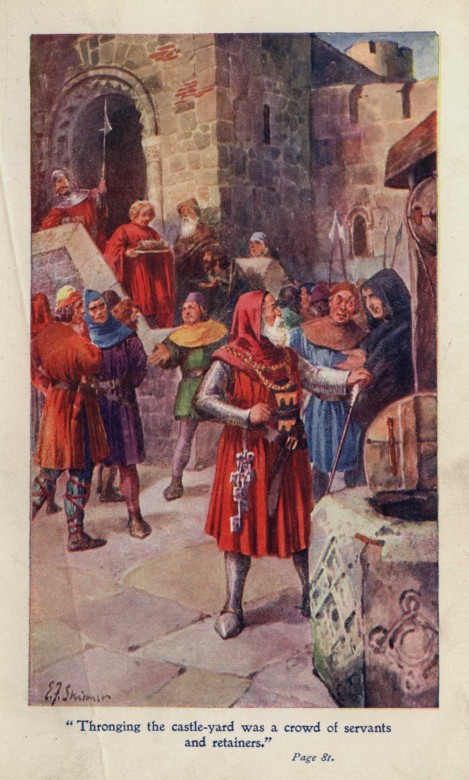
"Thronging the castle-yard was a crowd of servants and retainers."
On this occasion, however, these gentry were somewhat disappointed to find that the expected guests were to be grave judges and churchmen. The beggars, indeed, ranged themselves into position to ask for alms in the name of religion, but the minstrels and the jugglers felt themselves de trop. Finding their entertainments unacceptable to the guests, they betook themselves to an audience of grooms and varlets in the castle-yard.
The ancient seneschal of the castle, moving through the various groups, his keys of office jingling at his side, remarked a swarthy man of considerable height and size, who was evidently not connected with the Saxon peasants around him. He was wrapped in a long, large cloak.
"So ho, friend! and whence comest thou?" asked the seneschal.
The nondescript stranger answered him in French; not in the Norman-French which his interlocutor could easily have followed, but in a dialect imperfectly known to the worthy head of the household of Lord Lisle.
"I come from distant lands, noble seneschal. I chant love-lays to fair ladies' ears."
"We have e'en no ladies here anon," replied the functionary gruffly, "naught but abbots and justices. So get thee gone!"
At the mention of the word "justices" a momentary gleam of satisfaction passed over the swarthy face of the stranger.
"Justices, good my lord seneschal?" he repeated.
"Yea, justices," retorted the seneschal, not noting the look. "Art deaf, man? My lord the king's justices who travel towards Dunstable. Did you jongleurs expect a bevy of giddy damsels and young gallants?"
The burden of his duties had made Lord Lisle's officer somewhat testy.
"But perchance, with your good leave, I may sing to my lords the justices' serving-men a song of fair France; or a love chansonnette will I teach them, wherewith to tingle the ears of their Saxon gills?"
"As you will, man," answered the seneschal with a shrug, turning away, "an you find fools to listen to such trash!"
"Thanks for your leave, good sir," the stranger called after him, with a queer twinkle in his dark eye. Then he turned to one of De Braybrooke's men, staring open-mouthed and stolid at the strange dialect and stranger countenance. "Wilt list to a song, friend? It hath a refrain will ring in thy ears and cheer thee on thy long journey."
"A long journey! Gramercy, a mole might see as how thou art a stranger in these parts. A long journey to Dunstable, forsooth!"
"And is it not far?"
"Nine miles as the crow flies, I trows, and but eke some ten the way we ride, through the woodland, by way of Eversholt," replied the varlet, with a snigger of contempt.
"Aver--aver--sole," repeated the dark stranger, mispronouncing the name. "This English tongue cracks the jaw!"
"Marry, he stammereth like a cuckoo at hay-harvest," jeered the other. "Say it plain, man--Eversholt."
"Gather your fellows together while I go fetch my rebec I left at the gate-house, and, pardie, you shall see what you shall see, and hear what you shall hear," retorted the stranger imperturbably. But as he strode across the yard, the serving-man, had he not been so busily engaged mimicking the Frenchman's accent to his companions, might have noticed an armed heel glitter beneath the folds of his cloak.
The day was wearing on ere the justices could tear themselves away from Lord Lisle's hospitable board and once more proceed on their journey.
Southwards, beyond Rougemount, the country becomes more wooded. In the higher parts of Woburn Park old timber trees even now show where once the forest extended round the famous Cistercian abbey. In the midst of this district stands a village, whose name, Eversholt--the holt, or wood, of the efer or wild boar--still hands down the characteristics of the neighbourhood.
Into this wood, in the waning afternoon, rode, unsuspectingly, the two justices, engaged in a warm discussion over some quibble of the law.
"Now, by my troth, brother Thomas," De Braybrooke was saying, "all our jurisconsults are agreed that if the judge be free to act--"
He stopped short, and never finished his sentence, for he was "free to act" no longer.
With a fierce cry of "A De Breauté! a De Breauté!" armed men rushed down from either side of the road upon the hapless representatives of the law, and surrounded them ere they could recover from their stupefaction.
"Let the varlets go free!" cried William de Breauté. "We have no need of grooms!" he added, as he saw his men seizing the bridles of the servants' horses as well as those of their masters.
It was a lucky cry for Thomas de Muleton, for it led to his escape. By some mistake, the men who held his horse, not distinguishing in the confusion between master and man, released their hold, and his servants, closing round him, hurried him back along the woodland bridle-path towards Rougemount.
Too late De Breauté saw the error. But De Muleton and his men had put spurs to their horses, and he and his men-at-arms were all dismounted, their horses tethered to the trees, or held by some of the band. Pursuit was out of the question, even had the marauders dared to follow up their prey to the very walls of Rougemount Castle.
William de Breauté's rage knew no bounds when he became aware that but one of the desired prisoners had been secured. Swearing roundly at his men for their blunder, he struck the unfortunate serving-man who had been detained instead of his master a blow with the flat of his sword which nearly knocked him off his horse, and allowed him to ride away after his fellows.
"Pardie!" he swore. "We trouble not ourselves with dogs that can pay no ransom. Get you gone!"
Disgusted with the less than half success of his scheme, he ordered his men to remount, and the party rode off rapidly towards Bedford, the hapless Henry de Braybrooke well guarded in their midst. De Breauté's rage was a little softened, however, when he learned that he had not missed two of his prey--that Martin de Pateshulle had not been of the party, though as to his whereabouts De Braybrooke could give no information.
CHAPTER IX.
AN UNEXPECTED MEETING.
The troop of horsemen made their way out of the wood, and soon afterwards, riding down the romantic glen of Millbrook, reached the Bedford valley. They were now on the road to Elstow, and nearing Bedford itself; but as they approached the town, an incident occurred which changed the direction of De Breauté's route.
The cavalcade were hurrying along, as their leader was anxious to get his prisoners safe into the castle ere the town-folk should be aware of their capture. For although the burgesses of Bedford had by this time been sufficiently cowed by the Robber Baron and his men, and were by no means unaccustomed to seeing prisoners swept off into the "devil's nest," as they called his castle, yet it was more satisfactory that the impounding should be done without any fuss or disturbance.
So through the little village of Elstow clattered the horsemen, their arms and accoutrements ringing as they went. The village people recognized with a shudder the soldiers from Bedford Castle. They were mostly retainers of the abbey, and they crossed themselves devoutly and uttered a prayer as the enemies and spoilers of the church rode by. They scarcely noted the unfortunate judge who was being jolted along in their midst at a pace so different from that at which he usually travelled, and who
"Little thought when he set out
Of running such a rig."
Increasing their pace, the hurrying troop scattered the wayfarers right and left. The inhabitants fled into their houses; the peasants dragged their beasts and carts into the ditches. All knew that there could be the servants of but one man who would ride through the country in this fashion.
But as they passed the abbey gate, De Breauté and his men, in their headlong career, charged full tilt into a small party of riders just turning out of the archway.
This knot of travellers seemed in no wise disposed to give De Breauté's horsemen more than their fair share of the road, and did not draw aside into the hedge, after the manner of the peasants. The two foremost of the little company were an elderly and dignified ecclesiastic, and a young and graceful lady whose wimple and riding-hood concealed her face. The old priest, encumbered with his ecclesiastical habit, was unable to resist the impetus with which the armed party bore down upon the defenceless travellers. Too late, he drew rein aside; but the ponderous war-horse of the foremost man-at-arms struck his palfrey full on the flank, and rolled both horse and rider to the ground.
The mass of horsemen, rushing in wedge shape, separated the priest from his companion, and the latter was forced to the opposite side of the road. She was either quicker, more skilful, or better mounted than was the elderly ecclesiastic; for not only did she turn her horse aside just at the right moment and avoid an imminent collision, but putting him at the boundary hedge which bordered the road, cleared it in a style which showed her to possess the hand and seat of a first-rate horsewoman.
The unexpected encounter caused a sudden and confused halt to De Breauté's party, and their leader was able to give a by no means pleased look at those who, by no fault of their own, but by reason of the furious onrush of his own men, had unintentionally impeded his progress. But when once he had glanced at the bold horsewoman escaping by her leap from the confused throng, he hardly deigned to notice the prostrate priest striving to extricate himself from his dangerous position. For as her horse cleared the obstacle, the riding-hood, which concealed the features of the rider, fell back upon her shoulders, and revealed to his astonished gaze the lovely face of Aliva de Pateshulle.
In a moment his brother's orders were all forgotten. Even had he recognized Martin de Pateshulle in the dismounted horseman, it is not likely he would have paused to capture him. But shouting to two of his men to follow him, he turned quickly round, and putting spurs to his horse, rode after the retreating figure at the top of his speed.
His leaderless party pulled themselves together, so to speak, and gazed after the pursued and the pursuer till they vanished round the corner of the abbey walls. They gave vent to a few coarse jests over their master's disappearance, and then the senior among them took upon himself the command of the party. He turned to the unlucky priest, whom his servants had now raised from under his fallen steed. Martin de Pateshulle--for it was he--had evidently been severely injured, and lay prostrate in his attendants' arms. In reply to the soldier's questions they told that their master was the Archdeacon of Northampton, and the lady his niece. Had they mentioned his name, it is possible the trooper might have recognized that of one of the justices they had sallied out to seize. But as it was, deeply imbued with a soldier's notion of implicit obedience to orders before all things, he thought only of conveying the prisoner he had already made with all speed to Bedford. Even Henry de Braybrooke, whom his guard had removed to a little distance from the scene of the accident, could only learn that it was an old priest who had been injured, ere he was again hurried off in the direction of the Robber Baron's castle.
Meanwhile, the grooms who had picked up the archdeacon proceeded to carry him, moaning with pain, back to the abbey they had just left. In vain the unhappy priest conjured them to leave him to his fate, and to hasten after his niece, as soon as he realized that she was being pursued by De Breauté.
With one exception, none seemed inclined to obey their master, protesting that it was their first duty to see his injuries attended to within the abbey walls.
That exception was our fat friend Dicky Dumpling, who had been of the party, in attendance on his young mistress. He, too, had been rolled over; but no sooner had he picked himself up out of the mire and learned that she had fled, than his distress was great.
"Alack! alack!" he cried. "Chased by that young French popinjay, say you? Oh, woe the day! He came a-wooing her that day the gallant Sir Ralph rode over, and he departed with his beauty marred, the serving-maid doth say--but women have such long tongues! Oh, my hapless young lady! I must after her to her succour!"
"Thou Dickon!" gasped one of his fellows,--"with thy feather weight, to say nothing of that good dinner of beef and ale in the porter's lodge."
"And thy nag's good browse in the abbey stables," put in another. "Think you he is a match for the knight's war-horse?"
"Alack! alack!" moaned worthy Dicky; "my heart misgives me sore. But bring me my horse, lads, and find me my cap. With good St. Dunstan's aid I will do my best. Give me a leg up, lads, and Dobbin and I will after her as long as there is a breath left in our bodies!"
CHAPTER X.
THROUGH OUSE MARSHES.
The Lady Aliva had gone to the retreat at Elstow with a heavy heart. In the first place, she had dismissed the man whom she loved with all her soul without giving him to understand that she would remain true to him; indeed, she even doubted within herself whether the words she had used to him might not, in fact, have implied the exact opposite. Then, further, her conduct to her father had given her pain. She confessed to herself that in that scene in the hall she had acted as an undutiful daughter, and even, at the conclusion of it, with want of maidenly reserve and self-respect.
Thus it was that with all true sorrow of repentance she had knelt in the abbey church. When the Lady Margaret and the abbess came upon her in the dusk bending before the high altar, she was indeed, as the abbess had intimated, praying not for strength to face the troublesome world again, but for grace to take the vows of the Benedictine rule.
It has already been shown how she had made known her wish to the lady abbess, and had obtained leave to wear for the time the habit of a novice. But her desire for the profession of a religious life had been combated, strange to say, by two persons who in any other case would have thought it their duty to strengthen it.
These two were the lady abbess herself and the archdeacon her uncle; and when she had learned Aliva's story, the Lady Margaret added her objections to theirs. All these three elders deemed it unadvisable for so young a girl--she was only eighteen--to think of monastic vows, and held out hopes that the course of true love might yet run smoothly. The archdeacon himself had always been a supporter of Ralph de Beauchamp's suit, and the two ladies joined with him in comforting the distressed damsel with plans for the future happiness of Ralph and herself.
With regard to the unlucky incident in the hall which had so abruptly terminated the other suitor's visit, Aliva made a clean breast of the whole matter. The ladies even went so far as to justify her conduct; and the archdeacon, speaking as a spiritual father, considered it sufficiently condoned by the exhortation he administered on the duty of maidenly reserve and the virtue of checking anger.
So when the retreat was ended, Aliva's plans were discussed in real earnest, and a determination arrived at. The good archdeacon decided to give up his projected journey to Dunstable, leaving his learned friends to finish their business by themselves, and to accompany his niece to Bletsoe. There he hoped to convince his brother of the injustice of repressing Ralph de Beauchamp's suit.
The pros and cons of this discussion occupied all the early part of the day, and it was accordingly late in the afternoon when Aliva, after an affectionate parting with the two elder ladies, set off towards home, accompanied by her uncle and his two serving-men, and by Dicky Dumpling, who had brought over her riding-horse that morning.
Of the untoward event that befell the little party as they passed out of the abbey gateway we are already aware, and we must now take up the story of Aliva's flight and De Breauté's pursuit.
After a short spurt across country, she turned her horse back again into the road, that she might take in the situation and see what had become of her uncle. But she could see nothing in the distance save a confused group of horsemen. Between herself and that group, however, she was soon aware that a rider, William de Breauté, was following her at the top of his speed.
Now, had he been alone, it is not improbable that the courageous maiden, who had already faced him once, would boldly have awaited his arrival; but close at his heels came two of his men, and Aliva felt that there was nothing for it but a flight towards home.
The road to Bedford was quite cut off from her by the advancing horsemen, but she knew that at some distance further west there was a bridge across the Ouse at Bromham, and she determined to try to escape in that direction.
It was a desperate chance. Her horse was a mere palfrey, while De Breauté and his men were mounted on some of the best horses to be found in the stables of Bedford Castle.
She hurried through the little village of Kempston on the river-bank, for she knew it would prove no safe asylum. The approach of De Breauté's men always struck terror into the peasants of the villages around Bedford. They gazed open-mouthed after the flying maiden, and then slunk back into their huts as the mail-clad soldiers came clattering after her in pursuit.
Only upon her own wit and readiness could Aliva depend in this terrible race. She was less acquainted with this side of the Ouse valley than with the other, in which she had been accustomed to ride and hawk since childhood. But she knew that between Kempston and Bromham lay a stretch of marshy ground intersected by broad ditches, and into these marshes she resolved to ride with the hope of baffling her pursuers. She thought it not unlikely that in the ground which would bear the weight of herself and her palfrey the armed men and huge horses might be bogged.
Her conjecture proved not incorrect, and for a time the distance increased between herself and her pursuers. But the spring afternoon was now closing in, and in the failing twilight it was difficult to select the best track through the marshy ground. Once or twice Aliva had actually to return upon her path, and the men behind gained an advantage, as they watched her movements and avoided the impassable places. Moreover, her lightly-built horse, not much more than a pony, was beginning to tire. He had cleared one or two of the ditches with difficulty, and now, as he attempted to jump one of considerable breadth, a rotten take-off sent him floundering into the middle of it.
Aliva scrambled quickly from the saddle, and threw herself on the bank. But unfortunately it was the nearer one. For a minute or two she stood vainly trying to reach the reins, and calling to her palfrey to approach her.
But her pursuers were drawing on apace. The foremost was not De Breauté himself, but one of his men, who sprang from his horse and seized Aliva by the hood which hung loosely from her shoulders.
"Let go thy hold, varlet!" shouted De Breauté, in the rear. Even in his madness he could not bear to see her thus roughly handled by a rude soldier.
But Aliva was free ere he spoke. She unclasped the buckle which fastened her hood and mantle round her neck, and as the man fell back with the garments in his hand, flung herself into the muddy dike.
The water reached nearly to her waist, and with difficulty she struggled through. As she passed her horse, standing half bogged in the middle, she seized the reins and drew them over his head. By good chance a stunted willow overhung the further bank. She made a snatch at it, caught it, and with a supreme effort gained firm ground.
With the purchase afforded by the tree, Aliva was now able to get a tight hold of her horse's head, and encouraging him with her voice, she induced him to follow her example, and to struggle up the bank.
The two soldiers, meanwhile, watched her manoeuvres from the further side in some perplexity. Their lord's order to release her had been peremptory, and it was now apparent that she was escaping them again. Their lord himself, at some little distance, dismounted, his horse dangerously engulfed in a bog, was in as much uncertainty as they were.
When he had first started off in his wild chase of Aliva, he had indeed no fixed intention with regard to her, except perhaps to carry her off to Bedford along with Henry de Braybrooke; and now that he had pursued her thus far from Elstow, and held her, as it were, in his grasp, he was still undecided.
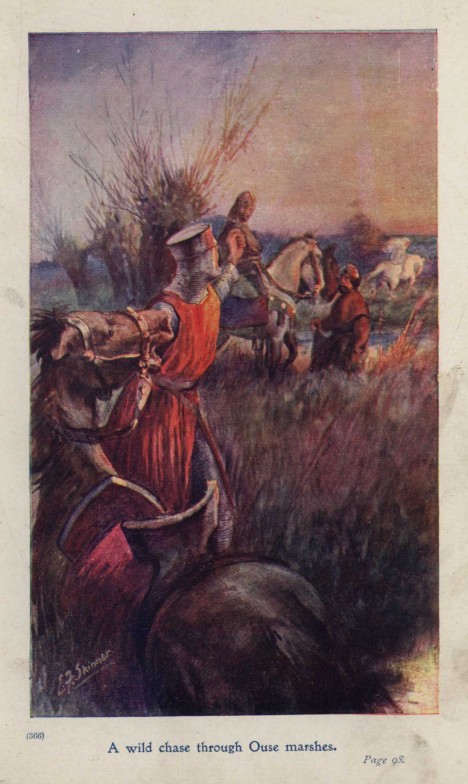
A wild chase through Ouse marshes.
Any brutal violence was far from his thoughts; for had he not forbidden his man to lay a hand upon her? A marriage was what he contemplated, though indeed it might be a forced marriage, like that of his brother Fulke with the Lady Margaret.
But no sooner did he perceive that the draggled girl was remounting her tired palfrey than he called to his men, standing stupidly looking at her from the nearer side of the ditch.
"Here, varlets, quick! Plague take you and these English morasses! Why came ye not to my help sooner? Saw ye not how I am well-nigh smothered in this cursed bog?"
It took some little time for the men-at-arms to free their master and his floundering steed. They dragged him out in as deplorable condition as that in which Aliva found herself, and by that time both he and they had had enough of the Ouse marshes.
Not that De Breauté was by any means inclined to give up the chase. He could see the hapless horsewoman he was pursuing far ahead and entering the little village of Bromham, and he followed her along firmer ground at some distance from the river.
The long, many-arched bridge which still stretches over the flat meadows at Bromham was furnished at the western end in those days with a small wayside chapel, the ruins of which can still be traced in the mill-house. Aliva rode slowly into the village, and wearily approached the foot of the bridge. As she cast an anxious glance over her shoulder, she saw that her pursuers had now reached hard ground, and were gaining on her rapidly.
Her little palfrey was dead beat. The struggle in the dike had completely exhausted him, and he no longer answered to his mistress's voice or to the touch of her riding-wand. As he reached the first cottage at Bromham, he stumbled and rolled heavily from side to side.
Aliva was off his back in a moment. A rustic stood by, gazing in astonishment at the young lady's condition--drenched and hoodless, her fair hair streaming over her shoulders.
But Aliva's first thought was for her horse.
"Prithee, friend," she cried to the peasant, "take my palfrey and tend him. You shall be well rewarded. I am the daughter of the lord of Bletsoe, and if I come not to claim him myself, take him to Bletsoe Castle when he has recovered."
She hurried on. How to escape now she knew not. But suddenly, as she approached the bridge, she perceived a haven of refuge. The chapel door stood open, and the poor hunted girl stepped into the welcome sanctuary.
CHAPTER XI.
BREATHING-TIME.
As Aliva entered the little chapel on the bridge, she saw, in the uncertain twilight, two figures kneeling before the altar. One was that of a stalwart young man in the garb of a lay-brother of the Benedictine order, and the other that of an elderly woman in the dress of a peasant.
Both rose from their knees, disturbed by the hurried entrance of Aliva, and were surprised to see before them a lady of the upper classes so damp and bedraggled and hoodless. The heart of the woman was touched.
"Lack-a-day, lady!" she exclaimed; "hast thou been in Ouse water?" she added, with a slight shudder.
"I have come here for rest," replied Aliva, not wishing to reveal her story to peasant strangers. "I have indeed, as you say, suffered somewhat by mishap in a stream, and I have lost my horse."
As she spoke, the sound of her voice, and a closer scrutiny of her features, increased the astonishment of the two listeners.
"Gramercy on us!" cried the woman; "if this is not our lady from Bletsoe!"
Aliva looked more narrowly at her, and then at the lay-brother.
"Our Lady be praised!" she murmured faintly; "I find friends. Are you not the wife of Goodman Hodges; and is this not your son, the lay-brother from St. Alban's?"
Mother and son both made a deep obeisance, and Aliva continued:--
"My friends, I am in sore plight. But I know ye to be faithful to your lord, and I trow ye will aid his daughter. I have ridden far and fast, at peril of my life, to escape De Breauté and his men, who even now follow hard upon my track. But I trust I am safe in this holy house, and with--"
But here exhausted nature gave way, and the brave girl, now that she found herself in comparative safety, fell senseless on the chapel floor.
Mistress Hodges, though but a peasant, was a woman of resource and energy.
"Alack, alack! she will die of chill in this cold chapel," she exclaimed. "Son, we must bear her hence!"
"But what if De Breauté's men be without, mother?" replied the cautious lay-brother.
"In good sooth, you speak true," replied the woman, casting an anxious gaze round the chapel, while she supported the head of the unconscious Aliva in her arms. Then she noticed a gleam of light shining through a half-open door on the south side of the altar.
"See, my son," she exclaimed, "whither that door leads. There may be help near at hand."
The lay-brother opened the door and looked into the apartment within.
"'Tis a sacristy, or priest's room," he replied, with his knowledge of ecclesiastical arrangements. "There is no one within," he added, glancing hastily around, "and there is a fire on the hearth, and a settle with cushions."
The mother and son lifted up Aliva's senseless form, and carrying her into the sacristy, laid her on the couch.
"Go thou now," said the Mistress Hodges, "and guard the chapel door, and I will see to the young lady. Praise be to our Lady, with warmth and care I shall yet bring her round."
The young man shut the door of the sacristy behind him, and crossing the chapel to the entrance, closed the heavy door and drew its strong oaken bar across it. He then took up his position against it, keeping a careful and patient watch.
The woman, left alone with Aliva, proceeded to treat her with maternal care; for had not the young lady herself once tended her when the fever ravaged the peasants' huts round Bletsoe Manor House?
She removed her wet garments and chafed her cold hands and feet. As she undressed her, she found, fastened round her waist, a wallet containing a small flask of cordial and some food, with which the good abbess of Elstow had provided Aliva for her journey. Mistress Hodges poured some of the wine down Aliva's throat, and she revived.
Delighted that her efforts had so far succeeded, the good woman redoubled her care. She even stripped herself of some of her rough but warm clothing, and wrapped it round Aliva, as she lay on the settle. Then she busied herself in drying and cleaning the soiled and dripping garments, for fortunately, in this room prepared for the priest who served the chapel, there was a good store of firewood.
Aliva lay watching her feebly, with the half-dazed gaze of returning consciousness.
"Thanks to our Lady and the blessed saints," she murmured at last in such weak voice, "that I have happed on you, good mother; else methinks the cold of this chapel might have finished the work the stream began."
"The saints forfend!" ejaculated the worthy woman. "But, lady," she added, her curiosity getting the upper hand, "might I crave your pardon, and ask how comes it that you are in a woful plight? They said in the village you had gone to the retreat at Elstow, which the venerable archdeacon--"
"Ah!" cried Aliva, "selfish wretch that I am, I had well-nigh forgotten him in my own trouble! Know you, good mother, that it was even as he and I were leaving the abbey of Elstow, on our return home, that this fierce company of De Breauté and his men rode down upon us. They scattered us as a hawk scattereth a flight of doves. I escaped by the lucky chance that my good genet can be stopped by no fence or dike in all this countryside. When I last saw my uncle, he was surrounded and closed in upon by the horsemen. I wot not what became of him."
"Alack, alack!" said Mistress Hodges, shaking her head. "These be evil days now in the which we live, when that terrible Frenchman from over the seas, Sir Fulke de Breauté (may the foul fiend fly off with him!), spares neither the ministers of Holy Church nor defenceless damsels--"
"Indeed, it would seem as if De Breauté had a grudge against me," Aliva could not help interposing, with a half smile. "He owes me somewhat, by my faith. He asked for my hand; he cannot say he did not get it. How like to a drowned water-rat he looked, coated with our good honest English mud! A pretty dance I led him, I trow," she added, with a ripple of laughter. "He'll ne'er forgive me."
Mistress Hodges grinned good-humouredly, pleased to see the lady's spirits rising again.
"In good sooth, lady, but young knights find it hard to forgive fair ladies who will have none of them when they come a-wooing."
The conversation was becoming too personal. Aliva flushed slightly, and tried to turn it.
"And now, prithee goody, it seems to me that I too may well ask, how comes it that you and your son come so far from Bletsoe this evening?"
The smile faded from the woman's face.
"I am on a weary errand, fair lady," she replied. "I have come thus far in company with my son, who is on his journey back to the abbey of St. Alban, where he is a lay-brother. I have come but to say a prayer with him, in this the wayfarer's chapel, to good St. Nicolas, who protects all travellers. Alas! he will return to St. Alban's; he says it is his duty. I have dissuaded him sore with tears and prayers, but it is of none avail. In these bad times there is no peace even in the religious houses, nothing but wars and rumours of wars."
"Certes, I did hear from Dicky Dumpling--(ah, poor Dickon! how fares it with him, I wonder? He presented a broad surface to the horsemen's charge)--that your son had barely 'scaped with his life from that fearful St. Vincent's Eve at St. Alban's!"
"Gramercy, lady," replied the woman, wiping her eyes, "'twas a hairbreadth 'scape, in good sooth! But, thanks to our Lady and the good St. Benedict--who, my son says, preserved the humblest of his servants to serve him further--he got off scot-free from the fire and the sword, yea, and the water too!"
"The water! how mean you?" asked Aliva.
"Marry, lady, he was weary and worn, and he mistook the ford at Milton as he was fleeing homewards. The Ouse was in full flood, and but for that noble knight Sir Ralph de Beauchamp, whom the saints preserve--"
"Sir Ralph de Beauchamp!" murmured Aliva, now deeply interested. "Ah," she added, with a blush, "I mind me how soaked he was with water!"
"Ay, a fair gallant he is," the other proceeded. "He thought naught of riding boldly into the Ouse at full stream, and saving my poor lad in the very nick of time, when he was being swept down the river like a truss of hay in a midsummer flood!"
Aliva lay listening, her large eyes fixed dreamily on the speaker.
"It sounds like a bold deed, and a truly marvellous turn of luck for your son. Tell on, good mother, I prithee. I would fain hear more of the fishing out of the worthy lay-brother--thine only son, too--tell on," added the astute maiden, playing on maternal feeling.
Mistress Hodges' tongue was unloosed by the evident interest the young lady of the manor evinced. His recent dangers and escapes had made the lay-brother somewhat of a hero in the village of Bletsoe. His mother was nothing loath to fight his battles over again, and prattled on with maternal pride for some time ere she perceived that her fair charge had sunk into a sound and healthful slumber, lulled by the account of her lover's daring.
Meanwhile De Breauté and his men had hurried up. They passed Aliva's riderless palfrey.
"Ah, pardie! the fair hare has run to ground, and cannot be far distant.--Lady, thy pride is nigh unto a fall," murmured William to himself, chuckling.
But the rustic in charge of the horse was either naturally or intentionally stupid. De Breauté could make nothing of him.
Riding eagerly to the bridge-foot, he scanned its length. But he saw no sign of Aliva's retreating figure in the fast-falling twilight, and heard no sound save the swirl of the rushing river as it swept beneath the arches.
Had she escaped him?
Leaving one of his men to guard the bridge, he proceeded to search the cottages round. But from the trembling peasants he could only gather that they had indeed seen a lady, in soiled and damp clothing, pass down the village.
But as he was thus cross-questioning and searching, he was approached by a personage clad in ecclesiastical garb. He was a coarse-looking individual, the expression of whose features showed a mixture of greed and cunning.
"William de Breauté," he asked, "thou seekest a bird? Shall I show thee the nest where that bird is hidden?"
"If thou meanest that thou canst tell whither the lady has escaped who but now made her way through the village," replied De Breauté, not much relishing the tone of familiarity in which he was addressed, "thou shalt be well rewarded if thou dost direct me thither. And understand," he added, trying to speak with dignity, "no harm is intended to the lady. It is simply needful for her own protection that I conduct her to my brother's castle at Bedford."
"Ay, in good sooth, all are in safe keeping there!" muttered the priest with a sneer, not brooking haughty patronage from a soldier of fortune. "But, perchance, my secret will remain with me, and she will not take the road to Bedford."
William de Breauté saw that he was not going the right way to work, and altered his tone. He had a shrewd guess that a bribe would both be expected and received.
"Certes, reverend father," he replied, "but I mean a reward to Holy Church in the person of one of her ministers."
"Knightly sir," answered the priest, "we understand each other. I am but a minister, as you rightly say, and humblest, you would more rightly have said, of Holy Church. Whatever her ministers receive, it is really the Church who receiveth and benefiteth."
And if winking were the fashion in the thirteenth century, doubtless he winked at De Breauté as he spoke.
"Follow me," he added.
And he led him to the door of the chapel on the bridge.
CHAPTER XII.
AT THE CASTLE OF EATON SOCON.
While Aliva de Pateshulle lay in a dreamy state listening to the praises of her lover, the said lover was far away on the other side of Bedford, in anything but such a complacent frame of mind.
Since the day Aliva had escaped from him up the turret stairs he had not seen her, and she had left him in much perplexity as to whether she intended to obey her father or to follow her own inclinations.
But on one point his mind was made up. Ralph was determined to be off to the Scottish war. In any case a soldier's life or perhaps a soldier's death was still before him, and in his youthful imagination he saw himself performing deeds of daring against the northerners, and dying heroically in the moment of victory, leaving Aliva to mourn for his loss and regret her own cruelty.
To carry out these plans, however, it was necessary, in the first instance, that he should interview his uncle, William de Beauchamp, for it was by the latter's influence, as he had told Aliva, that Ralph hoped to obtain a command in the royal army.
Since they had been wrongfully deprived of their castle, Bedford was no longer a home to the De Beauchamps. The usual gathering-place of the family now was at Eaton Socon, some twelve miles further down the river. The castle there has as completely disappeared as that of Bedford, but a huge mound on the banks of the Ouse marks the site of the stronghold. Here was established a younger branch of the De Beauchamps, and here William de Beauchamp met Ralph and his kinsmen, to discuss the position of the family, and to consult as to the best means of overthrowing the robber chief at Bedford.
"Beshrew me, Nephew Ralph," said his uncle, "if I wot what to make of this talk of thine of fighting against the northern savages, when savages far worse hold the castle of thy fathers."
Ralph had been holding forth to his seniors upon the duty of a young knight taking up his country's quarrels and joining his sovereign's army.
"Ay," rejoined the lord of Eaton Socon, an elderly man, "were I but of thy age and strength, with my gilded spurs newly girt upon my heels, I would never throw myself away on this mad Scottish scheme--craving his majesty's pardon, if indeed so be that our young king favours it--whilst there lacked not an excuse for the placing myself at the head of bold men who would rally to the cry of 'A De Beauchamp! a De Beauchamp!'"
"And, Cousin Ralph," whispered one of his uncle's married daughters, for some of the ladies of the family were present, "they tell me there is one in Bedford Castle with whom thou wouldest fain splinter lances, were he but worthy to meet thee in knightly combat!"
Something of William de Breauté's visit to Bletsoe, and of his reception there by Aliva, had evidently leaked out.
Ralph shook his head dismally. For the time being he was that most unhappy individual, a wet blanket to all around him, a despondent lover.
"Come now, coz," continued the Lady Mabel, "if our reverend elders will dismiss us from attendance at this table, we young folk will out on to the castle walls and take a turn. Kinsfolk do not often gather together in these days, at least in our family, and thou knowest I have not forgotten old times in Bedford Castle, even though I have formed new ties. Blood is thicker than water."
It was early afternoon. The mid-day meal, which took place at the then fashionably late hour of noon, was just over. Ralph could not refuse the invitation of his fair cousin, who had been to him as a sister in his boyhood. So, with due obeisance to the others, the pair quitted the hall, leaving their elders deep in talk over old times, and the departed glories of the house of Beauchamp, and the days of Hugo, the Conqueror's favourite.
In truth, Ralph was not sorry to have a confidant to whom he could confide his troubles. For the last few weeks both he and his uncle William had been but melancholy guests at Eaton Socon, despite the efforts of their cheery old kinsman to rouse them. William de Beauchamp was naturally a taciturn, reserved man, and the loss of his affianced bride, followed by the loss of his ancestral castle and domains, had further increased the gloom of his character. His uncle's depression, of course, added to Ralph's low spirits.
"And now, fair coz," said Lady Mabel, linking her arm in Ralph's, as they passed up a flight of stone steps leading to a walk on the top of the encircling wall behind the battlements, "thou art to talk to me of somewhat else than this Scottish war, or even the battering down of Bedford Castle about the ears of that dear friend of our family, Fulke de Breauté. Nay, seek not to deny it. I can see by thy face that thou hast somewhat to tell me, and perchance I have somewhat to tell thee."
"I have naught to say, sweet cousin, but what I have already spoken of in the hall. But yet so be--"
"I knew it!" interrupted the lady; "so it ever is with men. First they will tell naught--those were thy very words--and then with the same breath they go on to say much. They are parlous, like my favourite sleuth-hound, my lord's morning gift, who at times from mere wantonness refuseth to feed from my hand, and then when I make a show to turn away, cannot fawn on me enough. Had I but said to thee, Let us speak of the land of the Picts and Scots, and of the honour that, forsooth, will never be found there by Norman knights, thou wouldest straightway have spoken on what lies nearest thy heart nimbly enough. Now, thou art hesitating; thou leavest me to lay the scent, and then thou wilt follow. Yet, I gage, thou wouldest fain speak of the fair damsel of Bletsoe?"
Ralph flushed, and the lady smiled.
"Tell me," she added, "when thou last didst set eyes on thy lady-love?"
The ice was broken. Ralph thawed rapidly, and related to the Lady Mabel his meeting with the Lady Aliva on the morrow of St. Vincent's Day, and of her sudden flight from him.
"And, in good sooth," ejaculated the lively lady, with a shrug of her fair shoulders, "in this slough of despondency hast thou remained ever since! Not so should I have done had I been in thy shoes, cousin. Thou a bold lover, Ralph, thy charger at hand! The fair damsel should have been on the croup of thy saddle ere she could reach the turret stair. Then hadst thou brought her hither to me, I would have guarded her safety and honour till priest and chapel were ready, which would not have been long waiting, I trow."
"But, cousin," Ralph put in gloomily, "thou hast forgotten: she spake to me unawares, as she confessed, and unmindful of her father's command that she should wed with a De Breauté. Nay, it boots not here of carrying off a bride. Rather let me carry off my wretched self to the war. I spake to her of winning glory for her sake, but now, methinks, I would rather win death."
And folding his arms the young man leaned over the parapet of the castle wall, and gazed dejectedly into the shining Ouse below him, as if he would fain cast himself headlong into the stream.
But Lady Mabel answered with such a ripply laugh that Ralph turned round to her, now really offended at the light manner with which she met his tragic mood.
"And what thinkest thou, Ralph, that William de Breauté will go a-wooing to Bletsoe Manor again?"
Ralph's face assumed such an angry look, as he ground out something between his teeth about "wooing" and "Bletsoe Manor," that the Lady Mabel drew back, half frightened at the storm she had aroused.
"William de Breauté, in good truth, came to Bletsoe!" he ejaculated; "but when, and how? Tell me all, tell me the worst, cousin, for the love of Heaven!"
"Thou knewest not that he went thither?" she asked, puzzled.
"I know naught of it," replied Ralph sulkily.
"And that he hath gained the hand of the Lady Aliva?" she continued.
Ralph turned upon her, furious. But the Lady Mabel laughed louder than before.
"Certes he did. But upon his face!" she added.
Her cousin looked bewildered.
"Where hast thou been, and what hast thou heard these weeks last past?" Lady Mabel went on.
"Thou knowest!" replied Ralph, still offended. "Here I have been at Eaton Castle with thy father. I have heard no news;" and he heaved a sigh, and turning away, looked out vacantly again over the Ouse valley.
"Ay, moping like a pair of owls at noontide, had I not come hither to bear ye company," Lady Mabel continued, "till, perchance, ye had been driven to make two holes for yourselves in the stream yonder. By my troth," she added, with very little of the reverence for elders which was such a characteristic of the age, "I intend to stir my father into life again ere I leave Eaton; and as for thee, Cousin Ralph," touching him lightly on the shoulder, "I command thee to be of good cheer, and no longer to look down on that vile cold water as though thou lovest it!"
Ralph turned to her again, though still sulky under her apparently meaningless gaiety.
"Now hearken to me, Ralph, and I will tell thee much of the Lady Aliva that thou wottest not of."
And Lady Mabel went on to relate the story of the second suitor's visit to Bletsoe, and of his reception, which had not penetrated to Ralph's ears, shut up hermit-fashion at Eaton.
As she continued, the light gradually broke in on Ralph's mind, and the gloom vanished from his face; and when she described the blow inflicted by Aliva upon William de Breauté, his eyes positively sparkled with delight.
Scarcely had the Lady Mabel finished her recital ere her hearer had rushed from her. Such broken exclamations as "My brave girl!" "Still my own!" escaping from him, he ran headlong down the steps, across the bailey yard, and abruptly disturbed his elders' conversation round the board in the hall.
Hardly giving himself time to pay the usual salutation of respect which the period demanded from juniors to elders of their house, he broke in upon them with these words:--
"By thy leave, my revered uncle, and with thine, my noble kinsman, I leave thy castle at once, tarrying but to give thee my best thanks for thy hospitality of the last few weeks."
In a moment, ere De Beauchamp could recover from his surprise, Ralph was out of the hall again, and shouting eagerly in the yard for his groom, his squire, or any one, to assist him in getting ready his horse.
Meanwhile the guests streamed out of the hall behind him, headed by their host and William de Beauchamp. Lady Mabel, who had followed her cousin in his headlong career as fast as she was able, rushed to her father.
"Stay him not!" she exclaimed; "rather bid the varlets hasten to help him. 'Tis no demon hath gotten possession of him--unless, in good sooth, love may be termed a demon. Speed him on his way, and I will tell whither he goes, and wherefore."
Lady Mabel's laughing face dispersed any fears which might have been entertained for Ralph's sanity, and a moment or two later, the latter, who had hastily girded on his armour, emerged into the yard as his groom brought round his horse.
"Adieu, fair cousin!" he exclaimed. "Thou hast indeed removed a burden from my heart!" he added, placing his foot in the stirrup.
At that moment a man hurried into the castle-yard through the outer bailey, and made his way through the group of serving-men and grooms gathered round the hall door.
It was a young lay-brother in the garb of a Benedictine. His long frock was girt up round his loins, as though he had been running violently. He was muddy and wayworn, and one side of his face was smeared with blood, flowing apparently from a wound in the head, hastily bound up with a bandage.
Tottering and reeling from exhaustion, the Benedictine pushed his way up to Ralph, his eyes staring wildly and starting from his head.
"Sir Ralph," he cried, "the Lady Aliva hath been carried captive to Bedford Castle!"
And then he fell senseless into the arms of the nearest bystander.
CHAPTER XIII.
THE BIRD IN THE CAGE.
When William de Breauté and the priest reached the door of the chapel on Bromham Bridge, the latter simply pointed to it, saying,--
"There is the bird in the cage. But the key of the cage is in the keeping of the Church."
After this parabolic remark, he led De Breauté away again to a small hostelry, where they entered a private room. De Breauté perceived that the priest had a proposal to make, but waited for him to begin.
"Thou spakest anon of guerdon to Holy Church for helping thee on with thy plans in hand," the priest commenced.
"Ay, in good sooth," said De Breauté, seeing that the ecclesiastic meant business; "or a reward to her servants," he added. "Speak! what wouldst thou--money, lands, wealth?"
Fixing his cunning dark eyes on his companion's face, the latter answered in one word,--
"Power!"
"Ah, pardie! and what have I to do with the advancement of churchmen?" said De Breauté, with a shrug. "Our name is in no good odour with Mother Church at this time, forsooth!"
The priest smiled sardonically.
"Certes, I have no wish that your brother Fulke should recommend me for high office among the Benedictines of St. Alban's, for example."
The news of Fulke's penance and pardon had already spread far and wide among the churchmen of that neighbourhood.
"At St. Alban's, pardie!" laughed De Breauté, as he recollected his brother's account of the scene in the chapter-house, and of the manner in which he had, for the second time as it were, defrauded the abbey coffers.
But the priest suddenly changed the tone of banter in which he had hitherto addressed De Breauté, and the sarcastic expression of his face gave place to one of bitter anger.
"Hearken, Sir Knight," he exclaimed. "Once I stood high in my order. Brother Bertram was honoured, respected, rising, among the brethren of St. ----. But I care not to tell a layman the reason of my fall. Suffice it that I fell, and that I was expelled my order. I, of more noble blood than all the other brethren together--I, more than half a Norman--here have I been for the last three years, ministering to Saxon swine who grovel in their hovels round yon bridge chapel; a mere mass-priest, offering prayers to St. Nicolas that travellers may pass safe, that sordid merchants may keep their chattels safe from roadside robbers! A fair portion, forsooth, for one who might have commanded men, been honoured, famed, obeyed!"
De Breauté shrugged his shoulders again.
"Marry, Sir Priest, but by my troth I see not how I am to help thee! What power can I give thee, save the command of a party of men-at-arms?"
"Sir De Breauté," replied the other, "your chapel is unserved. No priest passes 'neath the castle portcullis."
"Ay, and you speak true."
"Hark ye," continued the priest, "the castle of Bedford will be still more famous ere long. The star of the De Breautés riseth fast. The fault thy brother hath committed against Holy Church hath been pardoned, and what matter a few Saxon churls, if the Norman nobles but own him their peer?"
"Marry, Sir Priest, and I thank you heartily. I am, in good sooth, glad to hear that my family are so in fortune's way. But how mattereth that to thee?"
"When the De Breautés rise and are ennobled, all who serve them will rise too. The chaplain of Bedford Castle shall be no mean priest then. As one of the secular clergy I would then lord it over the regulars, and show the order that expelled me, Bertram de Concours, that they must needs bow before one who stands well with a rich and powerful Norman baron."
"If, then, the chaplaincy of the castle is all thou dearest, I can safely promise it shall be thine," replied De Breauté, laughing in his sleeve at the price the other had named. "But, certes, we must have the chapel swept out and the altar repaired. By my troth, there will be much ado with my sister and her women when they hear there will be mass sung again at home," he added, with a cynical laugh. "But say on now, Sir Priest or Sir Chaplain, as I may well call thee, how about the present work on hand?"
"Leave that to me," returned the other. "The Church shall open her doors, and the bird will hop out. See thou to it that thou secure her when she is beyond my care."
"And how so?" said William.
"Marry, that is your affair," replied the priest. "Mine ends at the chapel door."
"Pardie! shall I swing her up to my saddle-bow and be off with her? By St. Hubert, I might have done so this evening had I not bidden my varlets loose her. A curse on my hesitation! But counsel me, prithee."
"If it is my counsel you wish, I will not deny it. Methinks the damsel should be conveyed through the streets of Bedford town otherwise than swinging to a saddle like a market-wife's butter-basket. But, Sir Knight, thou knowest far better than I how to treat a fair lady."
"I have it!" exclaimed De Breauté. "There is the horse-litter of my sister, in the which she sometimes is graciously permitted to go abroad, when her ailments allow her not to mount her palfrey. She is ever sickly, the woman. I will send to Bedford for it. Nay, I would go myself, could I trust my men to guard."
"Go thyself, if thou art so minded," replied the priest. "I will so far stand, on my part, to my pledge, that I will answer for it that the bird be not uncaged till I hear from thee. Do not thou show thyself in the matter at all. Seest thou not that in that case thou canst anon tell the fair one a pretty tale, of how thou callest thy men off from chasing her, even as thou didst in the marshes, and that they captured her without thy knowledge or consent? See," he continued, "here is this small crucifix. Send it to me. When I receive it back from thy hands, I shall know that all is ready--that the litter waits anon." And as he spoke, the priest handed the soldier a small metal emblem of redemption, the pledge of his nefarious doings. "See, also, that the Lady Margaret's women prepare a suitable lodging for the lady. Thou wouldst, certes, see her well attended? I have thy knightly word that she is in honour treated, or I loose her not? Withdraw, then, thy men from guard here, and send others more seemly to escort a lady. I plight my word that, as I hope to be chaplain of thy brother's castle, I loose her not till I receive thy pledge."
"But," objected De Breauté, "how am I to warrant me she will be conveyed--"
"Leave that to me," said the treacherous priest. "If she be not placed of her own free will in the litter, I shall not have done my share of the work--that thou mayest hold sure. Have only a care, however, that naught about the horses or the litter proclaimeth it to be from De Breauté's stables."
So saying he passed out of the room. De Breauté followed him. Calling to the man who was not on guard to bring him his horse, and then to come after him with his fellow, De Breauté rode off to Bedford, some two miles distant from Bromham Bridge.
CHAPTER XIV.
THE SANCTUARY VIOLATED.
"The key is in the keeping of the Church."
At the actual moment when Father Bertram, at the beginning of the interview recorded in the last chapter, uttered these words, the door of the chapel was literally in the Church's charge, in the person of the stout lay-brother, who, hearing footsteps and voices without, now stood with his broad shoulders leaning against the oak. He could hear but little of the conversation through the thick door, but he guessed it had to do with his lady, and concluded that De Breauté had tracked her to her hiding-place.
For a time he remained uncertain how to act. Churchman as he was, it seemed almost impossible to him that any one, even a brutal soldier, should dare to violate the sanctuary of the chapel; but yet he feared that those without were plotting to carry off the Lady Aliva.
At length, when all was quiet again outside, he crossed the little building, and knocked gently at the door of the sacristy. It was opened by his mother, who laid her finger upon her lips as a sign to him to keep silence.
"My lady sleeps," she whispered, and shut the door again. Evidently no advice was to be had from her.
Uncertain whither to turn for aid, he recrossed the chapel, and, for the first time since Aliva had sought refuge in it, unbarred the door and looked out.
It was now past midnight. The village was sunk in silence, and no one was to be seen about. His first idea was to make his way towards Bedford, and he passed half across the bridge over the dark river. Then he fancied he heard the sound of a horse's hoof echoing from a distance through the stillness of the night. Though he knew it not, it was the sound of De Breauté spurring towards Bedford.
But another sight close at hand called off his attention. Through the gloom he became distinctly aware of a tall, armed figure leaning against the parapet of the bridge.
"Gramercy!" he said to himself, stopping short; "here is one of the soldiers on guard! There can be no escape this way. St. Benedict aid us!"
Of course, unaware that in a few minutes the man would be withdrawn, the lay-brother retraced his steps. Next he met the other man-at-arms leading the horses toward his comrade, and his heart sank within him at what he imagined were further measures to guard the Bedford road. He passed the soldier unchallenged in the dark, and then a little further met a man coming towards the chapel.
It was the priest, straight from his conclave with De Breauté.
Bertram de Concours approached the lay-brother.
"A brother servant in the ministry of Holy Church, an I mistake not," said he.
"Nay, reverend father," returned the Benedictine, "but a lay-brother I, of the holy house of Alban."
"And I," returned the other, "am but the unworthy priest who serves the altar of St. Nicolas in yonder chapel. But the chapel," he continued, eying the lay-brother closely, "is occupied by other than its priest to-night. A lady hath sought sanctuary there. She must be guarded, watched, tended."
The Benedictine was puzzled. The voice sounded to him like the voice of him whom he had heard talking with De Breauté without the chapel door. Should he ask his advice and help? He was the priest of the chapel; surely he was to be trusted.
"Tended she hath been by my mother," he answered, "and I myself have watched and guarded the chapel door. But she must remove hence. It is not fit that our fair lady of Bletsoe should remain in this plight, tended by peasants only. She must to her father's house."
Bertram saw his opportunity.
"Sooth, thou speakest truly, brother," he said. "I would fain despatch her thither. Not that I quite make out her case," he continued craftily. "My people do tell me that yester evening a lady came into the village in sore plight, and leading a steed well-nigh ridden to death, and thou sayest she is the Lady de Pateshulle. She should to Bletsoe. But can she walk?"
"Walk, father! nay, in good sooth. For all my mother's care she is so weary with her ride that she even now sleeps. Besides, do ladies such as she tramp the country roads like a churl's wench? And her palfrey cannot carry her!"
"She should be carried thither in a litter," replied Bertram de Concours; "but whither shall we fetch one? A messenger must forthwith to Bletsoe, and acquaint the noble house of De Pateshulle with its lady's need, and that at once."
The bait was thrown out by which he hoped to remove the lay-brother out of the way. The fish rose.
"I am thy messenger, father," responded the Benedictine with eagerness. "I will myself to Bletsoe, and devise means to transport my lady thither in safety and comfort."
"By my faith, brother," exclaimed Bertram, in simulated gratitude, "thou hast well spoken. A burden is lifted from my heart. Haste thee, and see that help is here by dawn. But tarry a moment," he continued, still weaving his treacherous web; "we must to the chapel and let the lady know that aid is at hand, and that she will shortly be quit of this dangerous and unpleasant position."
The two men entered the chapel. The old woman was still watching by the sleeping girl, but hearing steps, she came out of the sacristy.
"Tell thy mother to warn her charge that she may expect to journey shortly," said the priest.
"But my lady still sleeps softly," objected the good woman.
"Then let her know when she awakens that thy son hath gone to Bletsoe for aid, and that help she shall have shortly, and means of travelling hence," said Father Bertram.
Mistress Hodges returned to the sacristy.
"My lady is awakened," she said. "She heard your voices. Ye should have spoken more softly. She needs yet rest."
"Go thou then to the door," said Bertram to the lay-brother. "She knows thy voice, but I am a stranger. Tell her what thou purposest to do."
The Benedictine did as he was bid. Standing at the half-open door, he announced in a few words that he was off to Bletsoe for help.
Aliva, barely aroused, sank back again into slumber, murmuring words of thanks to her messenger.
"And now haste thee on thy road," said the priest to the lay-brother; "I myself will watch the chapel door."
The latter set off. He did not again attempt to cross the bridge, still guarded as he imagined by De Breauté and his men, or he would now have found it clear of sentinels. He made his way along the right bank of the river to the ford at Milton in the dark quietness of the small hours that precede the dawn. But ere he reached the spot which had so well-nigh proved fatal to him some few weeks before, the birds had begun to twitter in the brushwood and the sedge, and on the eastern horizon
"Lightly and brightly breaks away
The morning from her mantle gray."
In the uncertain light he became aware that a horseman was in front of him, trying apparently to force a wearied steed through the ford. As he approached, a clearer view revealed the rider to be none other than Dicky Dumpling, the fat porter.
"Soho, soho, Dickon! And whither so early, or so late, as you will?"
Thus apostrophized, Dicky turned his horse and recognized the lay-brother.
"St. Dunstan be praised! Here is a friend from Bletsoe. O brother, there is ill news--a sore mishap! Our Lady Aliva is chased, and carried captive too, for aught I know, by that devil in man's shape, Fulke de Breauté, or his brother. The livelong night have I sought her on the road 'twixt here and Elstow, over marsh and bank, up hill and down dale. Not a bite or a sup--"
"Peace, Dicky, and cheer thy heart. Thy lady is safe."
"Safe, thou sayest? Oh, the saints be praised!--safe?"
"As safe as Holy Church can make her," replied the other. "She hath found refuge in the chapel on Bromham Bridge."
Dumpling gave a vast sigh of satisfaction, and his face once more assumed its usual jolly expression.
"That was it then! Beshrew me for a fool! I found her palfrey in Bromham village, and though I asked up and down among the folks, no one could tell me aught of the lady. Even the women, whose tongues go fast enow, like the clapper of a bell at vespers time, when they are not wanted, had nothing to say. Gramercy! safe in the chapel! But you, brother, what doest here?"
"On an errand thou canst well relieve me of. Four legs are better than two. Thy Dobbin has still enow strength left in him to carry him back to his manger. So haste thee, good Dickon, with all speed thou mayest, and bid them at Bletsoe Castle send quickly a litter for my lady to bear her home. She is weary and weak. I, meantime, will return to her. Somehow it mislikes me leaving her alone with priests and women, when those devil's servants, the Breauté varlets, are about. And 'twill cheer her heart to hear good news of thee, for she misdoubted some mishap to thee also."
"I fall not lightly, brother," replied Dicky. "The armed men came with the rush of a battering-ram. But thanks to St. Dunstan and the muddy roads, I got off scathless.--And now, Dobbin--to our oats, Dobbin, to our oats; and to our lady's aid."
The lay-brother, much relieved in his mind, hurriedly retraced his steps. It was broad daylight as he once more approached the chapel, and while yet at a distance he plainly perceived a little crowd gathered at the door.
A horse-litter, consisting of a kind of curtained couch resting on two poles, borne by two stout horses, was in waiting. On the foremost horse rode a groom. Another mounted man stood by, leading a spare saddle-horse.
As the lay-brother drew nearer, he saw three figures issue from the chapel, and recognized the Lady Aliva, his mother, and Father Bertram.
Struck with astonishment that the desired conveyance should have appeared so speedily, the Benedictine halted in the middle of the road. Then the truth flashed upon him.
It was impossible that the litter could have come from Bletsoe. There must be treachery afoot.
A glance at the De Breauté livery worn by the mounted groom confirmed his suspicion.
Without a moment's hesitation he rushed forward, exclaiming in warning tones,--
"Mother! my lady! Stay, stay! for God's sake stay!" and as he spoke he stretched out a detaining hand towards the litter.
But ere he could grasp it, the priest, who had been assisting Aliva into the conveyance, turned sharply round, and with the key of the chapel door, which he still held in his hand, dealt the Benedictine a heavy blow on the head.
Then he shouted to the postillion to hurry off, and himself jumping on to the spare saddle-horse, followed the litter towards Bedford, leaving the lay-brother senseless and bleeding on the road, his mother bending over him.
CHAPTER XV.
RALPH RAPS AT THE CASTLE GATE.
At the moment when the Benedictine lay-brother, haggard and wounded, rushed into the yard of Eaton Castle, Ralph de Beauchamp was on the point of starting for Bletsoe, reassured as to Aliva by his cousin's account of the reception the former had given to William de Breauté. The single sentence uttered by the Benedictine ere he fell senseless to the ground came as a terrible reaction. His impulse had been to ride off rapidly to Bletsoe and urge his suit with Aliva and her father; and now, at one fell swoop, came the news that she was prisoner in the hands of his rival, her discarded and insulted lover. Overcome with the shock of the news, following so soon upon his late rapture, he rode out of the castle yard, after commending the messenger to the care of the by-standers. He was almost reeling in his saddle with mental agony.
When the lay-brother, left senseless at the door of the bridge chapel, had been restored to consciousness by his mother's care, his first thought was for the young lady so treacherously kidnapped.
Despite his mother's entreaties, he made his way into Bedford, his bleeding head roughly bandaged; and soon learned that the horse-litter of Margaret de Ripariis had passed through the town into the castle in the early morning. But who might be within it no one could tell.
Then the Benedictine hastened to tell the townsfolk of this new outrage on the part of the De Breautés, and endeavoured, but in vain, to stir them to action. They had lived too long under the tyranny of the Robber Baron to have courage enough to attempt to throw off his yoke.
Baffled and disheartened, the brave young fellow now determined to seek Ralph de Beauchamp. The latter's devotion to the Lady Aliva was too well known among the dependents of the De Pateshulles for the Benedictine to think for a moment that he should implore his aid in vain.
Once outside the castle wall, Sir Ralph turned his horse's head towards Bedford. What he intended to do there, alone and unaided, he perhaps had scarcely considered. An irresistible impulse drew him to the spot where she whom he loved was imprisoned.
Bedford is some twelve miles from Eaton Socon, and when Ralph arrived there he found the burghers much exercised in their minds over the event of that morning. They had hardly recovered from the shock of seeing Henry de Braybrooke, but the evening before, hurried through the streets as a prisoner, ere this fresh outrage had followed. Not that it was by any means strange to see luckless women carried off to the castle--as, for instance, after the St. Alban's raid; but never yet had the Robber Baron dared to treat a member of one of the noble families of the county in this fashion.
But though the Bedford burgesses were duly impressed with the enormity of Fulke de Breauté's doings, they were loath to take any steps to put a stop to them. And indeed Ralph himself was obliged to confess that any attempt to climb those lofty stone walls, or to throw themselves on to the spears of the armed men who kept watch and ward night and day at the castle gate, would have been utter madness. The only hope was that, now that one of the king's justices was actually a prisoner, the royal forces might be sent to extirpate this nest of robbers.
"Ah, Sir Knight," quoth one of the fathers of the town to Ralph, as he gravely shook his head, "our goodly town has indeed grievously suffered since thy noble family and thy renowned uncle were driven away. In the old days the castle was a protection and a great benefit to us. But now--alas, fair sir! thou knowest as well as we do what we suffer. We can scarce call our souls our own."
"Ay," put in one of the clergy of the town, who formed one of the group which had gathered round young De Beauchamp, "see our fair church of St. Paul. It hath stood here since the days of the Saxon Bedicanford. And now, alas! how forlorn and shorn it standeth, even as a widow in her weeds mourning for her lord! Thus hath she stood since the day the impious Fulke did wickedly break down the carved work of our Zion with axes and hammers, and carry off her stones to strengthen yon great castle which towers above us. In the chancel resteth thy ancestor Simon, he who finished the good work begun by his mother, the Lady Roisia--to wit, the priory at Newenham for the canons of St. Paul's. In good sooth, Sir Knight, thy house and Holy Church have both good reason to curse these French intruders."
Ralph turned dejectedly away from priests and burghers. The loss of his family possessions hardly weighed with him, compared with the loss of her who was more precious to him than spoils wrested from the Church. He rode slowly and deliberately to the castle gate.
The sentinels on duty stood at attention, ready to resist an attack should a single horseman be so foolhardy as to ride against their uplifted spears.
Ralph looked upwards at the stern walls frowning down upon him, and shook his sword at them in futile rage.
As he did so two figures appeared above the battlement of the barbican. They were the Robber Baron and his brother, who had been informed that Sir Ralph de Beauchamp had ridden up to the castle.
Fulke made the knight a mocking gesture of salutation.
"Sir Ralph," he said, "it grieves me sore that I cannot bid thee enter within these walls, and proffer thee the hospitality which is suitable to thy rank. But we entertain guests already."
So saying, he turned round and shoved forward the disconsolate-looking judge, Henry de Braybrooke.
"Our worthy guest here," he continued, "has not yet thought proper to cancel those writs which he and his brethren were pleased to issue from their court at Dunstable. In consequence, he hath been forced to partake of the somewhat meagre hospitality of bread and water in the dungeon-vault beneath the keep. It may perchance be even necessary to resort to yet more painful measures."
"Sir Ralph de Beauchamp," called out the plucky little judge, trying to lean over the battlements, "I prithee, convey to the king, my royal master, that his servant will never consent to any reversal of judgments given in concert with the learned Thomas de Muleton and the learned Martin de Pateshulle, at the bidding of the unlearned--
"Peace!" cried De Breauté, pushing the little man back violently; "I brought thee not hither to speak, but to be seen.--Soho, warder! take the justice back again to the dungeon, and see that his supper be somewhat more scanty than was his dinner. Those who bend not must starve."
And the warder led away the little justice, remonstrating and quoting legal Latin anent wrongful imprisonment and detention.
Fulke de Breauté again looked over the parapet.
"Yet another prisoner have I here, Sir Ralph," he said; "but she is entertained in the lady's bower, as befits a damsel who is shortly to be the bride of the brother to the lord of the castle. Even now our new chaplain, Bertram de Concours, he who anon served the chapel on Bromham Bridge, prepares our long-disused chapel for the marriage rites."
Ralph could bear it no longer. He gnashed his teeth, and whirling his sword round his head in impotent fury, flung it at the speaker. The good blade shivered in two against the stone wall, and Fulke resumed his banter.
"Little boots it sending thy sword where thou thyself darest not follow," said he; "but methinks thou hast tarried long enow beneath our walls. Get thee gone ere thy churlishness be returned with usury."
Ralph sprang from his horse. Unarmed though he was, he made for the gate, as if he would tear it down with his bare hands.
Fulke coolly signed to the sentinel who stood at his post over the gate-house, with cross-bow ready strung and quarrel fitted in the slot. The man took aim and released his string. The missile struck Ralph in a spot where his hastily-donned armour was imperfectly fastened, and he fell wounded to the ground.
At the same moment two female figures reached the western end of the walk which ran along the top of the long wall bordering the river side of the castle, at right angles to the gate-house.
One of them, a damsel of inquisitive disposition, hearing the twang of the cross-bow, sprang on to the parapet to see what was happening. From the angle she could look down upon the level space outside the gate.
"What see you, Beatrice, that you watch so closely?" inquired a girl's voice from the wall beneath the former's vantage-ground.
"My lady," exclaimed Beatrice Mertoun, "the archer hath struck some knight below, for I see the townsfolk carrying off a wounded man clad in armour. His helmet hath rolled from his head. What curly hair! How pale he looks, alas, poor youth! Ah, I see my lord pointing to the helmet. There goes a man from the wicket-gate. He has picked it up; he is bringing it in. Marry, how the burghers shrank back when he appeared! Methought they were like to drop the wounded man. But no; they have borne him off."
"I wot not what this may mean," said Lady Aliva; for she was the speaker from below. "There is no attack on the castle? There come no more armed men?"
"Nay, none but the wounded one," replied Beatrice. "But stay, my lady; I will to the gate-house. Perchance I may learn somewhat."
Impelled by curiosity, the girl made her way down from the wall, and quickly crossed the yard.
Fulke, when the helmet had been brought him, glanced at it and then threw it contemptuously on one side. Then, when the burghers carrying Ralph had disappeared into a neighbouring house, he turned away and went to another part of the castle.
No sooner had he vanished than Beatrice Mertoun, standing below, called up in her most bewitching tones to the archer who had shot the quarrel.
"Ho, Hubert--Hubert of Provence! Wilt do me a favour?"
The man-at-arms was one of her most ardent admirers. He looked down on the pretty upturned face.
"A thousand, Mistress Beatrice! You have but to ask, pardie."
"Then throw me down yon helmet your lord cast away anon."
The man hesitated. He glanced round; but Sir Fulke was out of sight. Beatrice pouted deliciously.
"I said not a thousand, but one favour, Hubert. By my troth, Arnoul or Denis would have given it me in a trice. Methinks you set less store on my words than--"
"Be not so cruel, fair one," exclaimed the admiring archer. "I obey your slightest wish. Here!"
The helmet fell at her feet. Beatrice picked it up, and then, without so much as a look at the archer, ran back with it to Aliva.
"See, my lady," she cried, "thou canst read these riddles of the heralds."
Aliva recognized on the helmet the crest of the De Beauchamps.
CHAPTER XVI.
WITHIN THE CASTLE WALLS.
The Lady Aliva had been carried off to Bedford in a half-unconscious state; for though she had awoke from her sleep refreshed and restored--thanks to the kind care of Mistress Hodges--the treacherous priest had so arranged that nothing should hinder him from carrying out his part of the shameful contract.
After the departure of the lay-brother he returned to the chapel.
"Daughter," he said to Aliva, through the half-open door of the sacristy, "thou hast done well in seeking the protection of Mother Church, and I, the humble minister of this altar, will see that thou art well guarded if thou remainest here."
"Thanks, reverend father," replied the maiden; "but a short time since, towards dawn of day, methinks (but I have slept since), this faithful woman's son offered to set off to my father's house at Bletsoe and warn the household there of my whereabouts."
"Thy messenger will be yet some time ere he returneth," answered the priest, "and if thou art minded to depart at once, we needs must find some other means of conveyance for thee, lady. I have looked round about since it grew light, and thy pursuers have departed," he added, revolving in his mind how best to induce Aliva to enter the horse-litter from Bedford, which he guessed would by now not be far off.
"Thanks for the hospitality of this holy sanctuary," Aliva replied, "but I would fain depart as speedily as may be," she added, not caring to occupy the sacristy of a chapel as her apartment any longer than was necessary, and with an indefinable dislike, if not distrust, of the speaker.
"So be it, lady," Bertram hastened to answer. "I will myself to Bedford. Doubtless from some of the burghers can I procure a conveyance suited to thy rank. Moreover, thou art doubtless weak in body, and I have taken upon myself to order food to be brought thee."
So saying he moved to the door and beckoned to some one without. A woman from the village entered, bringing such food and wine as the hostelry could supply.
"Thou mayest eat yonder in the sacristy, my daughter, for it is not consecrated to holy purposes."
He followed the woman into the priest's room and then dismissed her. This left him alone for a few moments, for Aliva had entered the chapel to kneel down before the rude altar, and offer up a heartfelt thanksgiving for her preservation.
Father Bertram took a small vial from within his robe and poured some drops from it into the wine-flask.
He had not studied the art of drug-concocting in the infirmary of his late monastery in vain.
Then he passed out of the chapel, saying that he was going to Bedford.
Aliva rose from her knees and went into the sacristy and found the food awaiting her. But she could not swallow, famished though she was, the rough village fare copiously seasoned with garlic.
"Alack!" exclaimed Goody Hodges. "But thou wilt die of weakness. See the wine-flask, lady! Drink, if thou canst not stomach the food."
Aliva did as she advised; and when the priest shortly returned, having brought the litter which he had found waiting on the bridge, and having received back again the pledge of the crucifix, he found the maiden in a half-unconscious state.
"Alack, alack! father, she hath swooned again!" cried the deluded peasant woman.
"She is overwrought with her hardships," replied the priest. "We must get her home with all speed. I have found a litter on the road, and it is in readiness. Help me to bear her to it."
The fresh morning air outside the chapel door partially revived Aliva. Opening her eyes she moaned,--
"Where am I? where are you taking me?"
"Home, daughter, to Bletsoe. Let me lay you in the litter!" exclaimed Bertram hurriedly, and rudely pushing back Dame Hodges, who had stopped short when she too recognized the De Breauté livery, and saw that she had been deceived.
Aliva sank back languidly on the cushions, and her eyes closed again. She was deaf to a well-known voice imploring her to stay, and unaware of the lay-brother's gallant attempt to detain her.
When she recovered her senses again, the litter was jolting fearfully, for the horses were going at the top of their speed. Bertram rightly conjectured that Aliva had taken but little of the drugged wine, and was alarmed lest its numbing influence should wear off ere his captive was safely secured. So he urged the postillion along, galloping by his side.
With returning consciousness Aliva drew aside the curtains of the litter and looked out. They were certainly not on the road to Bletsoe; she saw that at once. They were swinging through streets, and curious burgesses came to their house doors, marvelling what brought the litter of the Lady Margaret out so early.
While she was doubting whether she should cry for help or fling herself from the litter, it turned under an echoing gateway, and stopped in a courtyard before the entrance of a castle keep.
A girl of about her own age came down the steps.
"Lady, please to alight and follow me to the apartment prepared for you."
Aliva descended from the litter and looked around her, bewildered. A group of men-at-arms were drawn up at a respectful distance, and the grooms who had brought her stood silent by their horses. The priest had vanished as soon as he had seen her safe into the castle.
Aliva turned to the girl beside her.
"Where am I?" she murmured, still half dazed. "Is this not Bedford Castle? There has been treachery--treachery by that ill-looking priest! This is more of De Breauté's doings, damsel."
"Nay, lady, I can tell thee naught, save that my lord Sir Fulke bade me prepare a lodging in the keep for a lady who was to arrive in my lady's litter. Thy chamber is ready on the floor above the great hall, next to my lady's bower. Prithee, let me lead thee thither."
Aliva felt somewhat reassured by this reception. At least she found herself in the care of women.
Silently she allowed her conductress to show her the way across the hall and up a turret stair to her apartment, where she sank wearily on a couch.
The pretty waiting-woman bustled about, offering the unhappy girl various attentions. She brought her articles of dress from her mistress's coffer, and assisted Aliva to remove her travel-stained garments and clothe herself in becoming attire.
The latter eyed her curiously.
"And who art thou, maiden?" she inquired.
"My name is Beatrice Mertoun. I am the waiting-woman of the Lady Margaret, the wife of Sir Fulke. And thou, lady, if I might make so bold?"
"I am Aliva de Pateshulle from Bletsoe," returned Aliva.
"From Bletsoe!" echoed Beatrice. "Methought I remembered your face and figure as one of the nuns at Elstow when I attended my mistress to the retreat there. We returned but yesterday. But thou art no nun--no sister of an abbey?"
"Nay," replied Aliva, "but I wore the habit of a novice as a penitent during the retreat. Doubtless," she added, sighing, "this trouble which hath come upon me is the reward of my sins."
"Fair lady," said Beatrice gently, "you look sad;" and she came and knelt down at her feet.
"Sad!" exclaimed Aliva, raising herself on her elbow and gazing down at the waiting-maid with horror-stricken face; "I am miserable--betrayed--undone! Ah, I see it all now--this foul plot! William de Breauté hath encompassed my ruin!"
"William de Breauté!" cried Beatrice. "It is he who is at the bottom of this, forsooth! By my halidom, I see daylight now! I overheard him speaking of you with his brother--and then the chapel, repaired and cleaned. That was what Sir Fulke meant as he watched the men at work and said in jesting mood that from his own experience an unwilling bride was all the sweeter for the trouble of snaring and catching her, and William de Breauté answered that for his part he cared not for a ripe plum that fell into one's mouth without the picking."
"The chapel--an unwilling bride!" gasped poor Aliva. "The Lady Margaret was such! I see it all, alas! Does my father know of this? Does he give his consent?"
"Alas, fair lady, I know naught! It pains me to see thee in such grief, and in good sooth I mind me well of the stories I have heard of the unwilling wooing, the hasty bridal of my mistress. But, lady, cheer thee. Thou art weary and mazed. Rest here awhile, and talk no more, and I will watch by thee."
The bright spring afternoon was already waning when, some hours after the events related above, the two maidens walked out upon the south wall of the castle. Beatrice had persuaded Aliva to come thither, hoping that the fresh air might revive her drooping spirits; and Sir Fulke had given permission that his prisoner might repair thither when she pleased, though the precincts of the castle were forbidden.
As they paced up and down the terrace the fertile brain of Mistress Beatrice, already a warm partisan of the fair young prisoner, began to weave plans of escape.
"Canst swim, fair lady?" she inquired. "'Twould be naught to leap into Ouse water from yon turret! Or, better still, that thy knight (she took it for granted that Aliva had a knight) should bring hither a skiff some dark night, beneath the walls!"
At that moment they heard the twang of an archer's bow sounding from the gate-house hard by.
CHAPTER XVII.
THE KING IN COUNCIL.
For some time Ralph lay in a precarious state in the house of one of the burgesses of Bedford. The bolt from the cross-bow had given him a nasty wound, which it required all the skill of the leech to heal. Moreover, he lay fretting and fuming at the thought that his Aliva was a prisoner in the hands of his enemy, and his mental anxiety seriously interfered with his bodily recovery.
As he got better, however, he received visits from many of the principal townspeople, who were much attached to the house of De Beauchamp, and full of pity for the young knight.