Hendrik Willem van Loon,
Reading edition
ILLUSTRATED
GARDEN CITY NEW YORK
DOUBLEDAY, PAGE & COMPANY
1915
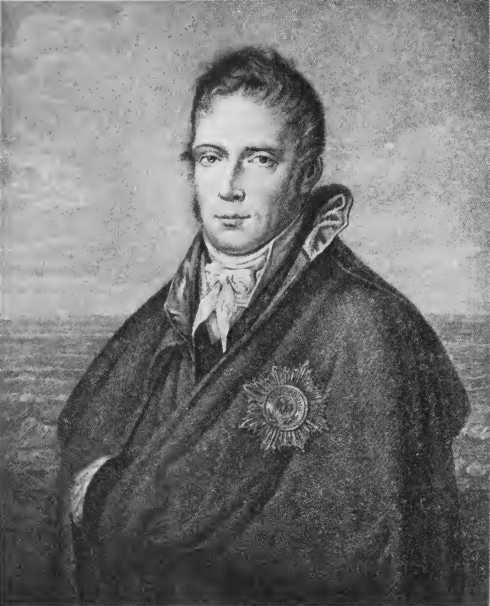
William I
DEDICATION
This little book, telling the story of our national usurpation by a foreign enemy during the beginning of the nineteenth century, appears at a moment when our nearest neighbours are suffering the same fate which befell us more than a hundred years ago.
I dedicate my work to the five soldiers of the Belgian army who saved my life near Waerloos.
I hope that their grandchildren may read a story of national revival which will be as complete and happy as that of our own land.
Brussels, Belgium,
Christmas night, 1914.
APOLOGIA
And for those other faults of barbarism, Doric dialect, extemporanean style, tautologies, apish imitation, a rhapsody of rags gathered together from several dung-hills, excrements of authors, toys and fopperies confusedly tumbled out, without art, invention, judgment, wit, learning, harsh, raw, rude, fantastical, absurd, insolent, indiscreet, ill-composed, indigested, vain, scurrile, idle, dull, and dry, I confess all ('tis partly affected); thou canst not think worse of me than I do of myself.
So that as a river runs, sometimes precipitate and swift, then dull and slow; now direct, then per ambages; now deep, then shallow; now muddy, then clear; now broad, then narrow; doth my style flow: now serious, then light; now comical, then satirical; now more elaborate, then remiss, as the present subject required or as at that time I was affected. And if thou vouchsafe to read this treatise, it shall seem no otherwise to thee than the way to an ordinary traveller, sometimes fair, sometimes foul, here champaign, there enclosed; barren in one place, better soil in another.
—Anatomy of Melancholy.—Burton.
FOREWORD
This foreword is an afterthought. It was written when the first proofs of the book had gone back to the printer. And this is how it took its origin:
A few days ago I received a copy of a Dutch historical magazine containing a violent attack upon one of my former books. The reviewer, who evidently neither had taken the time to read my book nor had taken the trouble to understand what I was trying to say, accused me among other things of a haughty contempt for my forefathers during their time of decline. Haughty contempt, indeed! Nay, Brother of the Acrid Pen, was it not the truth which hurt thee so unexpectedly rather than my scornful irony?
There are those who claim that reviews do not matter. There are those who, when their work is talked about with supercilious ignorance, claim that an author ought to forget what has been said about his work. Pious wish! The writer who really cares for his work can no more forget an undeserved insult to the product of his brain than he can forgive a harsh word given unmerited to one of his children. The thing rankles. And in my desire to see a pleasant face, to talk this hurt away, as soon as I arrived this morning in New York I went to see a friend. He has an office downtown. It overlooks the harbour. From its window one beholds the Old World entering the new one by way of the Ellis Island ferryboat.
It was early and I had to wait. Over the water there hung a low, thin mist. Sea-gulls, very white against the gray sky, were circling about. And then suddenly, in the distance, there appeared a dark form coming sliding slowly through the fog. And through a window, opened to get over the suffocating effect of the steam-heat, there sounded the vibrating tones of a hoarse steam-whistle—a sound which brought back to me my earliest years spent among ships and craft of all sorts, and queer noises of water and wind and steam. And then, after a minute, I recognized by its green and white funnel that it was one of our own ships which was coming up the harbour.
And at that instant everything upon which I had been brooding became so clear to me that I took to the nearest typewriter, and there, in front of that same open window, I sit and write what I have understood but a moment ago.
Once, we have been a very great people. We have had a slow decline and we have had a fall which we caused by our own mistakes and during which we showed the worst sides of our character. But now all this has changed. And at the present moment we have a better claim to a place on the honour-list of nations than the mere fact that once upon a time, some three centuries ago, our ancestors did valiant deeds.
For, more important, because more difficult of accomplishment, there stands this one supreme fact: we have come back.
What I shall have to tell you in the following pages, if you are inclined to regard it as such, will read like a mockery of one's own people.
But who is there that has studied the events of those years between 1795-1815 who did not feel the utter indignation, the terrible shame, of so much cowardice, of such hopeless vacillation in the hour of need, of such indifference to civic duties? Who has ever tried to understand the events of the year of Restoration who does not know that there was very little glory connected with an event which the self-contented contemporary delighted to compare to the great days of the struggle against Spanish tyranny? And who that has studied the history of the early nineteenth century does not know how for two whole generations after the Napoleonic wars our country was no better than a negative power, tolerated because so inoffensive? And who, when he compares what was one hundred years ago with what is to-day, can fail to see what a miracle of human energy here has happened? I have no statistics at hand to tell you about our shipping, our imports and exports, or to show you the very favourable place which the next to the smallest among the nations occupies. Nor can I, without looking it up, write down for your benefit what we have invented, have written, have painted. Nor is it my desire to show you in detail how the old neglected inheritance of the East India Company has been transformed into a colonial empire where not only the intruding Hollander but where the native, too, has a free chance to develop and to prosper.
But what I can say and will say with all emphasis is this: Look where you will, in whatever quarter of the globe you desire, and you will find Holland again upholding her old traditions for efficiency, energy, and tenacity of purpose.
Pay a visit to the Hollander at home and you will find that he is trying to solve with the same ancient industry of research the eternal problems of nature, while with the utmost spirit of modern times he attempts to reconstruct the relationship between those who have and those who have not, until a basis mutually more beneficial shall have been established. Then you will see how upon all sides there has been a return to a renewed interest in life and to a desire to do cheerfully those tasks which the country has been set to do.
And then you will understand how the year 1913, proud of what has been achieved, though not content that the goal has been reached, can well afford to tell the truth about the year 1813. For after a century and a half of decline Holland once more has aspired to be great in everything in which a small nation can be great.
New York, N.Y., October 31, 1913.
CONTENTS APOLOGIA FOREWORD DRAMATIS PERSONÆ PROLOGUE THE LAST DAYS OF THE OLD ORDER THE REVOLUTION THE COST OF REVOLUTION THE PROVISIONAL THE OPENING CEREMONIES PIETER PAULUS NATIONAL ASSEMBLY NO. I AT WORK NATIONAL ASSEMBLY NO. II AT WORK GLORY ABROAD COUP D'ÉTAT NO. I THE CONSTITUTIONAL COUP D'ÉTAT NO. II CONSTITUTION NO. II AT WORK MORE GLORY ABROAD CONSTITUTION NO. III THE THIRD CONSTITUTION AT WORK ECONOMIC CONDITION SOCIAL LIFE PEACE SCHIMMELPENNINCK KING LOUIS OF HOLLAND THE DEPARTMENT FORMERLY CALLED HOLLAND LIBERATION THE RESTORATION WILLIAM I A COMPARISON OF THE FOUR CONSTITUTIONS OF HOLLAND BIBLIOGRAPHY
LIST OF ILLUSTRATIONS HALF-TONES William I Frontispiece The Estates of Holland Flight of William V Krayenhoff Warship entering the Port of Amsterdam Daendels French troops entering Amsterdam Capetown captured by the English Pieter Paulus The National Assembly The speaker of the Assembly welcoming the French minister Invasion of the British Dutch troops rushing to the defence of the coast Armed bark of the year 1801 The executive council of the East India Company Dutch ships frozen in the ice Batavia—the fashionable quarter A country place Skating on the River Maas at Rotterdam Trades: Printer, Bookbinder, Diamond Cutter, The Mint Schimmelpenninck Schimmelpenninck arrives at The Hague Louis Napoleon Napoleon visits Amsterdam Departure of Gardes D'Honneur from Amsterdam Gysbert Karel van Hogendorp Proclamation of the new government Arrival of William I in Scheveningen Lieutenant Van Speyck blows up his ship King William II Line maps in text on pages 17, 25, 94, 207, 216, 217, 252
DRAMATIS PERSONÆ
DRAMATIS PERSONÆ (in order of their appearance).
CURTAIN: December, 1795.
William V: Last hereditary Stadholder, futile, well-meaning, but without any conception of the events which during the latter half of the eighteenth century brought about the new order of things. Unable to institute the highly necessary centralization of the country and emancipate the middle classes, which for the last three centuries have been cut totally out of all political power. He is driven out by the French Revolution more than by his own discontented countrymen. Dies, forgotten, on his country estates in Germany.
The Patriots: Mildly revolutionary party, since the middle of the eighteenth century working for a more centralized and somewhat more representative government. Belong almost without exception to the professional and higher middle classes. Represented in the new Batavian Assemblies mostly under the name of Unionists.
The Regents: The old plutocratic oligarchy. Disappear with the triumph of the Patriots. Continue opposition to the centralizing process, but for all intents and purposes they have played their little rôle when the old republic ceases to be.
The Federalists: Combine all the opposition elements in the new Batavian Republic which work to maintain the old decentralization.
Daendels: Lawyer, cart-tail orator, professional exile. Fallen hero of the Patriotic struggles; flees to Belgium when the Prussians in 1787 restore William V to his old dignities. Returns in 1795 as quite a hero and a French major-general. Later with French help organizes a number of coups d'état which finally remove the opposing Federalists and give the power to the Unionists. A capable man in many ways. An enthusiast who spared others as little as he did himself.
Krayenhoff: Doctor, physicist, experiments in new medical theories with same cheer he does in the new science of politics. Able and efficient in everything he undertakes. Too much of a man of principle and honesty to make much of a career during revolutionary days.
Pieter Paulus: The sort of man who twenty years before might have saved the Republic if only the Stadholder had known how to avail himself of such a simple citizen possessed of so much common sense. Trained thoroughly in the intricate working of the Republic's government. Scrupulously honest. So evidently the One and Only Man to lead the new Batavian Republic that he was killed immediately by overwork.
Schimmelpenninck: Lawyer, man of unselfish patriotism, honest, careful, no sense of humour, but a very sober sense of the practically possible. No lover of extremes, but in no way blind to the impossibility of maintaining the old, outworn system of government. Tries at his own private inconvenience to save the country, but when he fails keeps the everlasting respect of both his enemies and those who were supposed to be his friends.
France, or, rather, the French Revolution, regards the Republic in the same way in which a poor man looks upon a rich man with a beefsteak. Being possessed of a strong club, it hits the rich man on the head, grabs his steak, his clothes, everything he possesses, and then makes him turn about and fight his former friends.
Liberty, Equality, and Fraternity: Trademark patented by the French Republic between the years 1790 and 1809. The goods covered by this trademark soon greatly deteriorate and finally cover a rank imitation of the original article.
Napoleon Bonaparte: Chief salesman of the above article for the territory abroad. Further references unnecessary. Gets a controlling hold of the firm in which at first he was a subordinate. Removes the article which made him successful from the market and introduces a new brand, covered merely with a big N. Firm fails in 1815. The involuntary customers pay the deficit.
England: Chief enemy of above. In self-defence against the Franco-Dutch combination, it takes all of the Republic's outlying territories.
Louis Napoleon: Second brother of Napoleon Bonaparte. Only gentleman of the family. Made King of Holland in anticipation of a complete French annexation. Makes an honest but useless attempt to prevent this annexation. Wife (Napoleon's stepdaughter) no good. Son, Napoleon III, Emperor of the French.
Le Brun, Duke of Plaisance: Governor of the annexed Republic. Makes the very best of a rather odious job. Far superior to the corps of brigands who were his subordinates.
Van Hogendorp: Incarnation of the better elements of the old order; supporter of William V, although very much aware of the uselessness of that prince. Has seen a little more of the world than most of his contemporaries. During the Batavian Republic and annexation refuses to have anything to do with what he considers an illegitimate form of government. Man of great strength who, practically alone, arranges the Revolution of 1813, which drives out the French before the European allies can conquer the Republic.
William I: First constitutional King of Holland, oldest son of William V, has learned a good deal abroad, but only during the last ten years of his exile. Personally a man of the Old Régime, but with too excellent a business sense not to see that the times have changed. Rather too much a business man and too little a statesman. Excellent organizer. In many ways too energetic. Pity he did not live a hundred years later.
Of the real people we shall see very little. A small minority, very small indeed, will try to make a noise like Jacobins. But their little comedy is abruptly ended by the great French stage manager every time he thinks that such rowdy acting is no longer suitable. Unfortunately for themselves, they began their particular acting three years later than Paris, and, fortunately for the rest of us, the sort of plays written around the guillotine were no longer popular in France when the managers in Holland wished to introduce them. The majority of the people, however, gradually impoverished by eternal taxation, without the old revenues from the colonies, with their sons enlisted and serving a bad cause in foreign armies—the majority takes to a disastrous way of vegetating at home, takes to leading an introspective and non-constructive religious life, finally despairing of everything save paternal despotism.
In the country everything becomes Frenchified. The fashions are the fashions of Paris (two years late). Furniture, books, literature, everything except an old-fashioned and narrow orthodoxy becomes a true but clumsy copy of the French.
The other actors in our little play are foreigners: Sansculottes, French soldiers of all arms, British and Russian invaders, captives from all of the Lord's countries, French customs officers, French policemen, French spies, adventurers of every sort and nationality; French bands playing the "Carmagnole" and "Marseillaise," ad infinitum and ad nauseam.
Finally Cossacks, Russian Infantry, Blücher Hussars, followed by a sudden and wild crowd of citizens waving orange colours. And then, once more for many years, dull, pious citizens, taking no interest in anything but their own respectability, looking at the world from behind closed curtains, so terribly hit by adversity that they no longer dare to be active. Until this generation gradually takes the road to the welcome cemetery, the curtains are pulled up, the windows are opened, and a fresh spirit of energy and enterprise is allowed to blow through the old edifice, and the old fear of living is replaced by the desire to take an active part in the work of the greater world.
The Rise of the Dutch Kingdom
PROLOGUE
And now—behold the scene changes.
The old Republic of the United Netherlands, once the stronghold of an incipient liberty, the asylum to which for many centuries fled all those who were persecuted—this same republic will be regarded by the disciples of the great French Revolution as another Bastille of usurped power, as the incarnation of all despotic principles, and will soon be demolished by its own eager citizens. The ruins will be carted away as so much waste material, unworthy of being used in the great New Temple now to be constructed to the truly divine principles of Liberty, Fraternity, and Equality. The old Stadholder, last representative of the illustrious House of Orange, alternately the Father of his Country and the Beast of the Book of Revelation, will flee for his life and will spend the rest of his days in England or Germany, nobody knows and nobody cares where. Their High and Mightinesses of the Estates, proud little potentates once accustomed to full sovereign honours, refusing to receive the most important communication unless provided with their full and correct titles, these same High and Mightinesses will have to content themselves with the even greater honour of being called Citizen Representatives. Their ancient meeting hall, too sacred to allow the keeping of official records of their meetings, will be the sight of the town and will be patronized by the loafers to whom the rights of men mean a Maypole, the tricolor, free gin, and a brass band. Why go on with a minute recital? The end of the world has come. The days of tyranny, of indignity to the sovereign sanctity of the individual, are over. Regents, coal-heavers, patriots, fish peddlers, officers and soldiers, soon they are all to be of the same human clay. The vote of one is as good as that of the other. Wherefore, in the name of Equality, give them all a chance and see what will come of it. If a constitution does not suit at the first attempt, use it to feed a patriotic bonfire. After all, what else is it but some woodpulp and printer's ink? If the parliament of to-day does not please the voters of to-morrow, dissolve it, close it with the help of gendarmes. If the members resist, call out the reserves or borrow some soldiers from the great sister republic, which is now teaching her blessed creed to all the world. They (the soldiers) are there for the asking (and for the paying). They are a little out at the elbows, very much out in regard to shoes, and they have not seen a real piece of money for many a weary month, but for a square meal and a handful of paper greenbacks they will dismiss a parliament, rob a museum, or levy taxes, with the utmost fidelity to their orders and with strict discipline to their master's commands.
Then, if constitutions and parliaments have failed in an equal degree, humbly beg for a king from among that remarkable family the father of which was a little pettifogging lawyer in a third-rate Italian city, and the members of which now rule one half of the European continent.
After the rights of men, the rights of a single man.
In the great melting pot of the Bonapartistic empire all Hollanders at last become equal in the real sense of the word. They all have the same chance at promotion, at riches, and the pursuit of happiness. Devotion to the master, and devotion to him alone, will bring recognition from the new divinity who issues orders signed with a single gigantic N. Old Republic of the United Netherlands, enlightened Republic of the Free Batavian Proconsulate, Kingdom of Holland, it's all the same to the man who regards this little land as so much mud, deposited by his own, his French, rivers.
Vainly and desperately the bankrupt little Kingdom of Brother Louis has struggled to maintain a semblance of independence.
A piece of paper, a big splotchy N, and the whole comedy is over.
The High and Mightinesses, the Citizen Representatives, First Consul, Royal Majesty, all the big and little political wirepullers of fifteen years of unstable government, are swept away, are told to hold their peace, and to contribute money and men, money and men, more money and men, to carry the glory of the capital N to the uttermost corners of the world. Never mind about their government, their language, the remembrance of the old days of glorious renown. The old days are over for good. The language has no right to exist save as a patois for rustic yokels. As for the government, gold-laced adventurers, former barkeepers, and prize-fighters, now bearers of historic titles, will be sent to look after that. They come with an army of followers, tax-gatherers, policemen, and spies. They execute their duties in the most approved Napoleonic fashion. There is war in Spain and there is war in Russia. There is murder to be done in Portugal, and there is plunder to be gathered in Germany. The Hollander does not care for this sort of work. Never mind his private likes and dislikes! Hang a few, shoot a few, and the rest will march fast enough! And so, up and down the Spanish peninsula, up but not down the Russian steppes, the Hollander who cared too much for trade to bother about politics is forced to march for the glory of that letter N. Amsterdam is reduced from the richest city in Europe to a forgotten nest, where the grass grows on the streets and where half of the population is kept alive by public charity. What matters it? His Majesty has reviewed the new Polish and Lithuanian regiments and is highly contented with their appearance. The British have taken all the colonies, and the people eat grass for bread and drink chiccory for coffee. Who cares? His Majesty has bought a new goat cart for the King of Rome, his august son, and is tremendously pleased with the new acquisition. The country is bankrupt. Such a simple matter! Some more paper, another scrawly N, and the State debt is reduced by two thirds. A hundred thousand families are ruined, but his Majesty sleeps as well as ever and indeed never felt better in his life. Until this capital letter goes the way of all big and small letters of the historical alphabet, and is put away in Clio's box of enormities for all time—
And then, O patient reader, who wonders what all this rhetoric is leading to, what shall we then have to tell you?
How out of the ruin of untried schemes, the terrible failures, the heartbreaking miseries of these two decades of honest enthusiasm and dishonest exploitation, there arose a new State, built upon a firmer ground than ever before, ready and willing to take upon itself the burden and the duties of a modern community, and showing in the next century that nothing is lost as long as the spirit of hopefulness and cheerful work and the firm belief in one's own destiny are allowed to survive material ruin. Amen.
I
THE LAST DAYS OF THE OLD ORDER
DECEMBER, 1795
It is the year of grace 1795, and the eighth of the glorious French Revolution. For almost a century there has been friction between the different parts of the population. A new generation has grown up in an atmosphere of endless political debate—finally of mere political scandal. But now the days of idle discussions are over. More than forty years before, manifestly in the year 1745, the intelligent middle classes began their agitation for a share in the government, a government which during the days of great commercial prosperity has fallen entirely into the hands of the capitalistic classes. In this struggle, reasonable enough in itself, they have looked for guidance to the House of Orange.
Alas! those princes who so often have led the people, who have made this nation what it is, whose name has come to stand for the very land of which they are the hired executives—these princes now no longer are in direct touch with the basic part of the nation. This time they have failed to see their manifest duty. Left to their own devices, the reformers, the Patriots as they are commonly called, have fallen into bad hands. They have mistaken mere rhetoric for action. They have allowed themselves to be advised by hot-headed young men, raw boys, filled with undigested philosophies borrowed from their better-instructed neighbours. As their allies they have taken experienced politicians who were willing to use this party of enthusiasts for their own selfish purposes. More through the mistakes of their enemies than through the virtue of their own partisans, the Patriots have gained a victory in the Chambers of the old Estates, where the clumsy machinery of the republican government, outworn and ill-fitted for modern demands, rolls on like some forgotten water-wheel in an ancient forest.
This victory, however, has been won too easily to be of any value to the conqueror. The Patriots, believing themselves safe behind their wall of mere words, have gone out of their way to insult the hereditary Stadholder. What is worse, they have given offence to his wife, the sister of the King of Prussia. Ten years before, in the last English war, through a policy of criminal ignorance, they risked their country's last bit of naval strength in an uneven quarrel. This time (we mean the year 1787) they bring upon themselves the military strength of the best-drilled country of the western world. In less than one week the Prussians have blown together this card-house of the Dutch Patriots. Their few untrained soldiers have fled without firing a single shot. Stadholder William once more drives in state to his ancestral palace in the woods, and again his clumsy fingers try to unravel the perplexing maze of this antiquated government—with the same result as before. He cannot do it. Truth is, that the old government is hopelessly beyond repair. Demolition and complete reconstruction alone will save the country from anarchy. But where is the man with the courage and the tenacity of purpose to undertake this gigantic task? Certainly it is not William, to whom a new cockade on the cap of his soldiers is of vastly more importance than a reform of the legislative power. Nor can anything be hoped from old Van den Spiegel, the Raadpensionaris, a man nearing the seventies, who desires more the rest of his comfortable Zeeland estate than the hopeless management of an impossible government. There is, of course, the Princess Wilhelmina, the wife of William, a woman possessed of all the strength and executive ability of her great-uncle Frederick, the late King of Prussia. But just now she is regarded as the arch-traitress, the Jezebel of the country. Alone she can do nothing, and among the gold-laced brethren who doze in the princely anterooms there is not a man of even mediocre ability.
For a short while a young man, trained abroad, capable observer, shrewd in the judgment of his fellow-men, and willing to make personal sacrifices for his principles, has supported her with vigorous counsel. But he, too, has given up the hopeless task of inciting the Stadholder to deeds of energy, and we shall not hear the name of Gysbrecht Karel van Hogendorp until twenty years later, when in the quiet of his study he shall prepare the first draft of the constitution of the new Kingdom of the Netherlands and shall make ready for the revolution which must overthrow the French yoke.
In Rotterdam, leading the uneventful life of a civilian director of the almost defunct Admiralty, there is Pieter Paulus, who for a moment promised to play the rôle of a Dutch Mirabeau. He, too, however, found no elements with which he could do any constructive work. He has retired to his books and vouchers, trying to solve the puzzle of how to pay captains and sailors out of an empty treasury.
A country of a million and a half of people, a country which for more than a century has led the destinies of Europe, cannot be devoid of capable men in so short a time? Then—where are they? Most of them are still within the boundaries of the old republic. But disheartened by the disgrace of foreign invasion, by the muddling of Patriot and regent, they sulk at home and await the things that are bound to come. Many citizens, some say 40,000, but probably less than 30,000, have fled the country and are exiled abroad. They fill the little Belgian cities along the Dutch frontier. They live from hand to mouth. They petition the government in Paris, they solicit help from the government in London, they will appeal to everybody who may have anything to give, be he friend or enemy. When support is not forthcoming—and usually the petitioned party turns a deaf ear—they run up a bill at the little political club where their credit is good, until the steward himself shall go into bankruptcy. Then they renew their old appeals, until finally they receive a few grudging guilders, and as barroom politicians they await the day of vengeance and a return to the fraternal fleshpots.
Meanwhile in The Hague, where, as of old, the Stadholder plays at being a little monarch, what is being done? Nothing!
The year 1789 comes and brings the beginning of the great French Revolution. The government of the republic thinks of the frightful things that might have happened if the Patriots, instead of the Prussians, had been successful in 1787, and it draws the lines of reaction tighter than before. At the same time a new business depression sets in. Large banking houses fail. The West India Company of glorious memory is dissolved and put into the receiver's hands.
Two years more and France declares war upon the republic and upon England. The unwilling people are urged to fight, but refuse. Town after town is surrendered without the firing of a single shot. It was the dissension in the French camp—it was the treason of Dumouriez—which this time saved the country, not the bravery of its soldiers. And the moment the French had reorganized their forces, the cause of the Stadholder was lost. In the years 1794 and 1795 new attacks followed. Driven into a corner, with a vague feeling that this time it meant the end of things, the defence showed a little more courage than before. Of organization, however, there was not a vestige. In between useless fortifications, insufficiently manned and badly defended, the French Revolutionary armies walked straight to the well-filled coffers of rich Amsterdam.
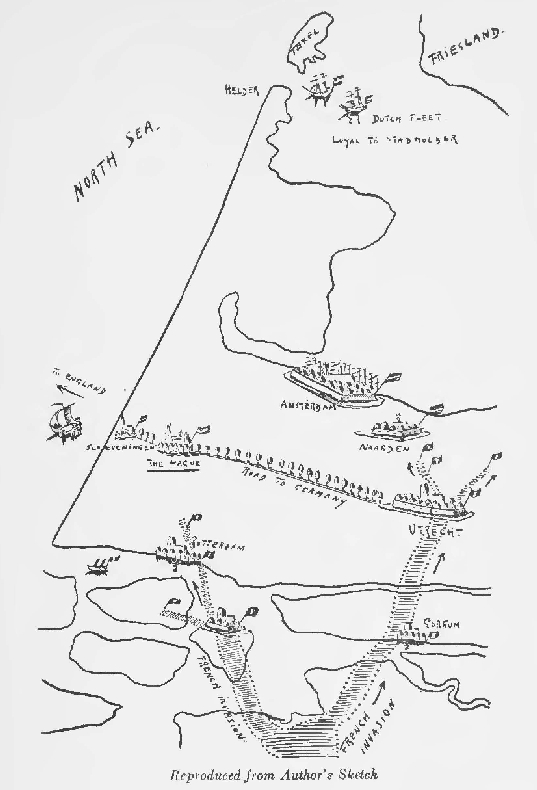
It was midwinter. The rivers were frozen. How often had the ice served the invader as a welcome road into this impassable country! And just how often had not divine Providence interfered with a timely thaw and had changed the victorious inroad into a disastrous rout? It had happened time and again during the rebellion against Spain. It had happened in the year 1672 when the cowardly neglect of a Dutch commander alone had saved the army of Louis XIV from total annihilation.
Again, in this year of grace 1795, the people expected a miracle. But miracles do not come to those who are not prepared to help themselves. The frost continued. For two weeks the thermometer did not rise above the freezing point. The Maas and the Waal, large rivers which were seldom frozen over, became solid banks of ice. Wherever the French troops crossed them they were welcomed as deliverers. The country, honeycombed with treason, overrun with hungry exiles hastening home to a bed with clean linen, and a well-filled pantry, hailed the ragged sansculottes as the bringers of a new day of light.
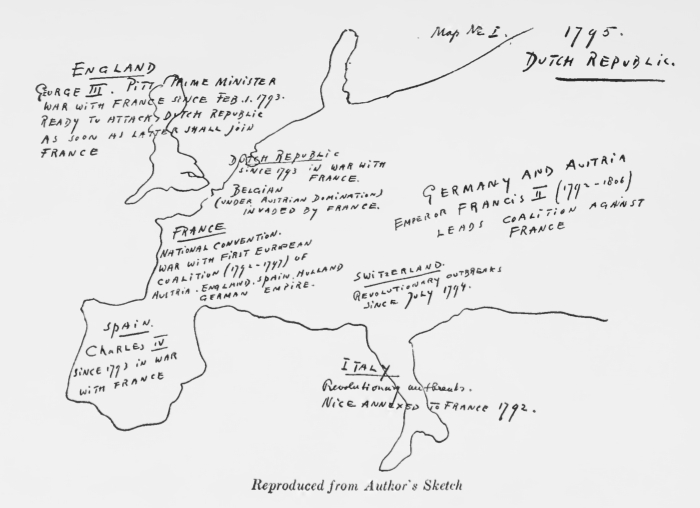
1795. Dutch Republic—Reproduced from Author's Sketch
William, among his turnip-gardens and his little bodyguard, surrounded by his trivial court, wondered what the end was going to be. When first he entered upon the struggle with the Patriots it was the head of old King Charles which had haunted him in his dreams. Now he had fresh visions of another but similar episode. Two years before his good brother, the Citizen Capet, had climbed the scaffold for his last view of his rebellious subjects. Since then all that was highest and finest and noblest in the French capital had trundled down the road which led to the Place de la Concorde.
William was not of the stock of which heroes and martyrs are made. What was to become of him when the French should reach The Hague? The advance guard of the invading army was now in Utrecht. One day's distance for good cavalry separated the revolutionary soldiers from the Dutch capital.
The jewels and other valuables of the princely family had been sent away three months before, and were safely stored in the Castle of Brunswick. The personal belongings of the august household had been packed and were ready for immediate transportation. All running accounts had been settled and closed. What ready money there was left had been carefully collected and had been put up for convenient use by the fugitives. Remained the all-important question, "Where would they go?" Evidently no one at the court seems to have known. There still was a large British auxiliary army in the eastern provinces of the republic; but at the first approach of the French troops, the British soldiers had hastily crossed Gelderland and Overysel and had fled eastward toward Germany, a disorganized mob, burning and plundering as they went along to make up for the hardships of this terrible winter. Close at their heels followed the French army, strengthened by Dutch volunteers, guided by young Daendels, who knew his native province of Gelderland as he did the home town of Hattum. This time the young Patriot came as the conquering hero, and by the capture of the fortification of Heusden he cut off the road which connected the province of Holland with Germany.
To the north, to Helder, the road was still open. And the fleet, assembled near Texel, was entirely dependable. But before William could make up his mind to go northward it was too late. The sudden surrender of Utrecht, the march of the French upon Amsterdam, cut off this second road, too. There remained but one way: to take ship in Scheveningen and flee to England. The only vessels now available were small fishing smacks, not unlike in form and rigging to the craft of the early vikings. The idea was far from inviting. The ships were bad sailers at all times. In winter they were positively dangerous. Now, however, these little vessels were all that was left, and to Scheveningen went the long row of carts, loaded with the goods of the small family and their half-dozen retainers, who were willing to follow them into exile. The end had come. The only question now was how to leave the stage with a semblance of dignity. William was passive to all that happened around him, accepting his fate with religious resignation. The Princess, a very grand lady, who would have smiled on her way to the scaffold, kept up an appearance of cheerful contempt.
Their two sons—William, the later King of Holland, and Frederick, who was to die four years later at the head of an Austrian army—vaguely attempted to create some military enthusiasm among the people; offered to blow themselves up in the last fortification. But what with ten thousand disorganized soldiers around them clamouring for food, for shoes, and for coats, it was no occasion for heroics. Why make sacrifices where nothing was to be gained? Despair and despondency, a shrugging of the shoulders and a protest, "What is the use?" met their appeal to the ancient courage and patriotism. Old Van den Spiegel, the last of the Raadpensionares, came nobly up to the best that was ever expected of his high office. He stuck to his duty until the very last. Day and night he worked. When too sick to go about he had himself carried on a litter into the meeting hall of the Estates. There he continued to lead the country's affairs and to give sound counsel until the moment the French entered The Hague and threw him into prison.
The Estates of Holland
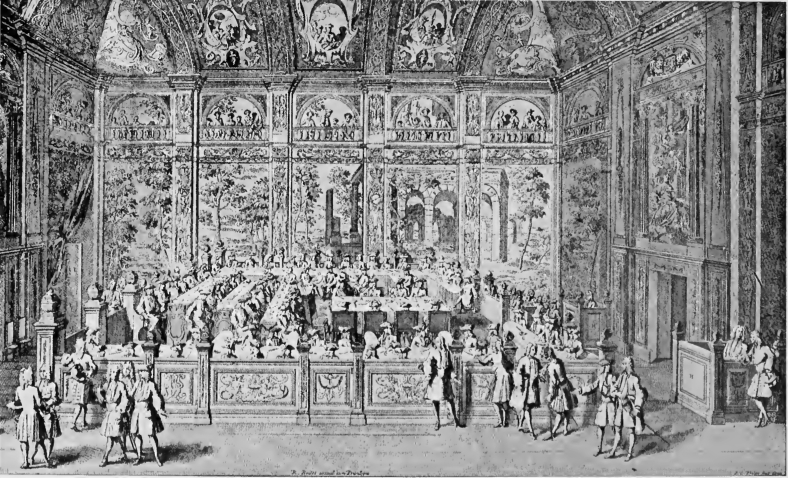
On January the 17th the definite news of the surrender of Utrecht, of the imminent attack upon Amsterdam, and the approach of the French, had reached The Hague. It was a cold and sombre day. The people in a desultory curiosity flocked around the Stadholder's palace and the rooms of the Estates. A special mission had been sent to Paris several days before to offer the Committee of Public Safety a Dutch proposal of peace. The delegates, however, who had met with the opposition of the exiled Patriots who infested the French capital, had not made any headway, and for a long time they had been unable to send any news. The ordinary means of communication were cut off. The canal-boats could no longer run on account of the ice, and travel by land was slow. Any moment, however, their answer might be expected. But the 17th came and the 17th went by and not a word was heard from Paris. That night, in their ancient hall, in the dim light of flickering candles, the Estates General met to discuss whether the country could still be saved. Van den Spiegel was carried into the hall and reported upon the hopeless state of affairs. A committee of members was then appointed to inquire of his Highness whether he knew of a possible way out of the danger which was threatening the fatherland. Late that night the Prince received the deputies. A prolonged discussion took place. His Highness, alas! knew of no way out of the present difficulties. Unless the thaw should suddenly set in, unless the people should suddenly and spontaneously take up arms, unless Providence should directly intercede, the country was lost.
The next morning came, and still the frost continued, and not a single word of hopeful news. Panic seized the Estates. In all haste they sent two of their members to travel east, go find the commander of the invading army, and offer peace at any price. For when the French had attacked the republic they had proclaimed loudly that their war was upon the Stadholder as the tyrannous head of the nation, but not upon the nation itself. If that were the case, the Estates reasoned, let the nation sacrifice its ruler and escape further consequences. Wherefore, in their articles of capitulation, they did not mention the Stadholder. And from his side, William, who did not court martyrdom, declared nobly that he "did not wish to stand between the country's happiness and a continuation of the present struggle, and that he was quite ready to offer up his own interest and leave the land." In a lengthy letter to the Estates General he explained his point of view, took leave of his country, and recommended the rest to God.
During the night from Saturday to Sunday, January 17-18, 1795, the western storm which had been raging for almost a week subsided. An icy wind made the chance for flight to the English coast a possibility. Early in the morning the Princess Wilhelmina and her daughter-in-law, with a two-year-old baby, prepared for flight. Inside the palace, in the Hall of Audience, a room newly furnished at the occasion of her wedding, the Princess took leave of her few remaining friends. Many had already fled. Others, now that the French were within striking distance of the residence, preferred to be indisposed and stayed at home. Silently the Princess wished a farewell to her old companions. Outside the gate there was a larger assembly. Tradespeople grown gray in deep respect for their benefactors, simple folk whose political creed was contained in the one phrase "the House of Orange," Patriots wishing to see the last voyage of this proud woman, stood on both sides of the court's entrance. Nothing was said. It was no occasion for political manifestations. The two women and the baby, with a few servants following, slowly drove to Scheveningen. Without a moment's hesitation they were embarked, and at nine o'clock of the morning of this frightfully cold day they set sail for England. There, sick and miserable, they landed the next afternoon.
Flight of William V
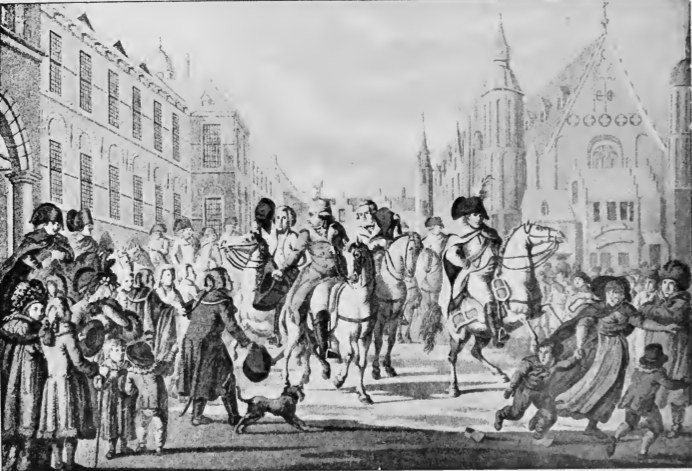
At eleven o'clock the Prince heard that his wife had left in safety. The little palace in which he had built and rebuilt more than any of his ancestors was practically deserted. Outside, through force of habit, the sentinels of the Life Guard still trudged up and down and presented arms to the foreign ambassadors who drove up to take leave. The members of the Estates, in so far as they did not belong to the opposition, came in for a personal handshake and a farewell.
Poor William, innocent victim of his own want of ability, during these last scenes almost becomes a sympathetic figure. He tried to read a farewell message, but, overcome by emotion, he could not finish. A courtier took the paper and, with tears running down his face, read the last passages.
At half-past one the court carriages drove up for the final journey. By this time the whole city had made the best of this holiday and had walked out toward the road to Scheveningen.
Slowly, as if it meant a funeral, the long procession of carriages and carts wound its way over the famous road, once the wonder of its age, and now lined with curious folk, gazing on in silence, asking themselves what would happen next. In Scheveningen the shore was black with people; and everywhere that same ominous quiet as if some great disaster were about to happen. At two o'clock everything was ready for the departure. The Prince, with the young Duke of Hesse-Darmstadt and four gentlemen in waiting and his private physician, embarked in the largest ship. The other members of their suite were divided among some twenty little vessels, all loaded to the brim with trunks, satchels, bales of clothes, everything, in most terrible confusion. The situation was uncomfortable. To ride at anchor in the surf of the North Sea is no pleasure. And still the sign of departure was not given. Hoping against hope, the Stadholder expected to hear from the French authorities. At half-past four one of the members of the secret committee on foreign affairs of the Estates came galloping down to Scheveningen. News had been received from the French. It was unfavourable. The war was to continue until the Stadholder should have been eliminated.
line map
The native fishermen—and they should have known what they were talking about—declared that every hour longer on this dangerous coast meant a greater risk. At any moment a boat manned with French troops might leave Rotterdam and intercept the fugitives. Furthermore, the sea was full of ice. The wind, which now was favourable, might change and blow the ice on the shore. They all advised his Highness to give the order to depart without further delay.
Whereupon William, in the cramped quarters of this smelly craft, in a sprawling hand, wrote his last official document. It reads like the excuses of a pouting child. "Really"—so he tells the Raadpensionaris—"really, since the French refuse an armistice, since there is no chance of reaching one or the other of the Dutch ports, really now, you cannot expect me to remain here aimlessly floating up and down in the sea forever." And then comes some talk of reaching Plymouth, where there "are a number of Dutch men-of-war, and of a speedy return to some Dutch province and to his good town of The Hague." All very nice and very commonplace and dilatory until the very end.
At five o'clock the ship carrying the Prince hoisted her sails. Before midnight William was well upon the high sea and out of all danger. The next morning, sick and miserable, he landed in Harwich. There the fishermen were paid off. Each captain received three hundred and fifty guilders. Then William wished them Godspeed and drove off to Yarmouth to meet his wife. It was the last time he saw so many of his countrymen. From now on he saw only a few individuals, exiles like himself, who visited him at his little court of Hampton and later at Brunswick, mostly asking for help which he was unable to give.
Exit at the age of forty-seven, William V, last hereditary Stadholder of the United Netherlands—a sad figure, intending to do the best, succeeding only in doing the worst; victim of his own weakness and of conditions that destroyed the strongest and the most capable. In the quiet atmosphere of trifling details and petty etiquette of a third-rate German princedom he ended his days. At his funeral he received all the honours and pomp to which his exalted rank entitled him. But he never returned to his own country.
Of all the members of the House of Orange William V is the only one whose grave is abroad.
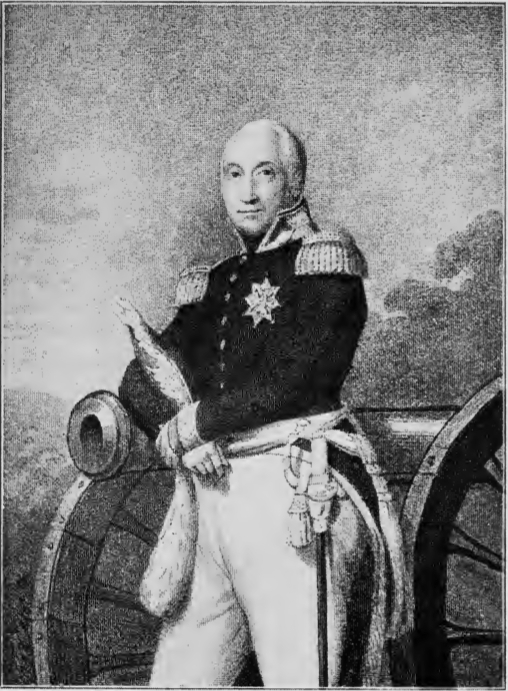
Krayenhoff
II
THE REVOLUTION
ÇA IRA.
Indeed and it will.
While William is still bobbing up and down on the uncomfortable North Sea, the republic, left without a Stadholder, left without the whole superstructure of its ancient government, is wildly and hilariously dancing around a high pole. On top of this pole is a hat adorned with a tricoloured sash. At the foot of the pole stands a board upon which is painted "Liberty, Fraternity, Equality." The music for the festivities is provided by the drums and fifes of the French soldiers. The melody that is being played is the "Marseillaise." Soon the Hollanders shall provide the music themselves to the tune of some 40,000,000 guilders a year. And they shall dance a gay little two-step across every battlefield of Europe.
The worst of the revolution of 1795, from our point of view, was its absolute sincerity and its great honesty of purpose. The modern immigrant approaching the shores of the promised land in total ignorance of what he is about to discover, but with a deep conviction that soon all will be well, is no more naïve and simple in his unwarranted optimism that was the good patriot who during the first months of the year 1796 welcomed the bedraggled French sansculottes as his very dear deliverers and put his best guestroom at the disposal of some Parisan tough in red, white, and blue pantaloons. Verily the millennium had come. Never, until within our own days of amateur sociology and of self-searching and devotion to the woes of our humbler brethren, has there been such conscientious desire to lift the world bodily out of its wicked old groove and put it upon a newer and better road. Whether this hysterical joy, this unselfish ecstasy, about a new life was founded upon a sound and tangible basis few people knew and fewer cared. The sacred fire burned in their breasts and that was enough.
It was no time for a minute analogy of inner sentiments. The world was all astir with great events ... allons enfants de la Patrie, and the devil take the hindmost.
Meanwhile, since in all enthusiasm, genuine or otherwise, there must be some method; since the music of brass bands does not fill empty stomachs, but a baker has to bake bread; since, to come to our point, the old order of things had been destroyed, but no state can continue without some sort of order—meanwhile, what was the exact status of this good land?
The French, as we have said before, had not made war upon the nation but upon the head thereof. Exit the head; remains the nation. What was the position of the latter toward their noble deliverers? This was a question which had to be decided at once. The moment the French soldiers should overrun the entire country and should become conquerors, the republic was liable to be treated as so much vanquished territory. The republic knew of other countries which had suffered a like fate and did not aspire to follow their example. Wherefore it became imperatively necessary to "do something." But what?
In The Hague, as a last nucleus of the old government, there remained a number of the members of the General Estates, deliberating without purpose, waiting without hope for some indication of the future French policy. Wait on, Your High and Mightinesses, wait until your fellow-members, who are now suing for peace, shall return with their tales of insult and contempt, to tell you their stories of an overbearing revolutionary general and of ill-clad ruffians, who are living on the fat of the land and refuse insolently to receive the honourable missionaries of the Most High Estates.
Of real work, however, of governing, meeting, discussing, voting, there will be no more for you to do. You may continue to lead an humble existence until a year later, but for the moment all your former executive power is centred in a body of which you have never heard before—in the Revolutionary Committee of Amsterdam.
The Revolutionary Committee in Amsterdam, what was it, whence did it come, what did it aspire to do? Its name was more formidable than its appearance. There were none of the approved revolutionary paraphernalia, no unshaven faces, nor unkempt hair. The soiled linen, once the distinguishing mark of every true Progressive, was not tolerated in this honourable company. It is true that wigs were discarded for man's own natural hair, but otherwise the leaders of this self-appointed revolutionary executive organ were law-abiding citizens, who patronized the barber regularly, who believed in the ancestral doctrine of the Saturday evening, and who had nothing in common with the prototypes of the French revolution but their belief in the same trinity of Liberty, Equality, and Fraternity, with perhaps a little less stress upon the Equality clause.
No, the Revolutionary Committee which stepped so nobly forward at this critical moment was composed of highly respectable and representative citizens, members of the best families. They acted because nobody else acted, but not out of a desire for personal glory. The army of personal glorifiers was to have its innings at a later date.
Now, let us try to tell what this committee did and how the old order of things was changed into a new one. After all, it was a very simple affair. A modern newspaper correspondent would have thought it just about good for two thousand words.
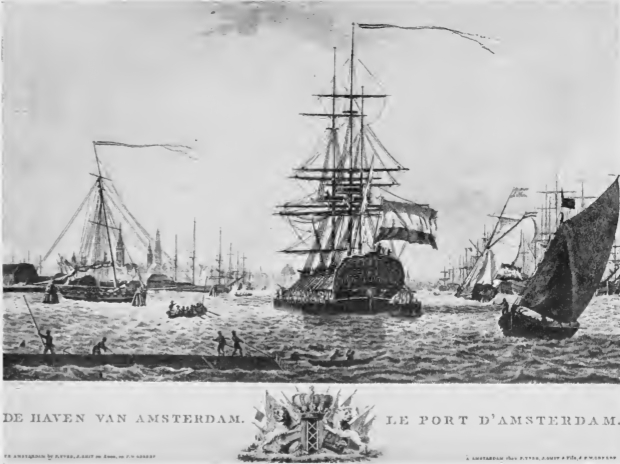
Warship Entering the Port of Amsterdam
On Friday, the 16th of January, the day on which the French took the town of Utrecht, a certain Wiselius, amateur author, writer of innumerable epics and lyrics, but otherwise an inoffensive lawyer and a member of the secret Patriotic Club, went to his office and composed an "Appeal to the People." In this appeal the people were called upon to "throw off the yoke of tyranny and to liberate themselves." On the morning of the 17th this proclamation, hastily printed, was spread throughout the town and was eagerly read by the aforementioned people who were waiting for something to happen. During the afternoon of the same day this amount of floating literature received a sudden and most unexpected addition. General Daendels, the man of the hour, commander of a battalion of Batavian exiles, while pushing on toward Amsterdam, had discovered a print-shop in the little village of Leerdam, and, in rivalry with Wiselius, he had set himself down to contrive another "Appeal to the People." After a two hours' walk, his circulars had reached the capital and had breathed the genuine and unmistakable revolutionary atmosphere into the good town of Amsterdam. Here is a sample: "Batavians, the representatives of the French people demand of the Dutch nation that it shall free itself forthwith from slavery. They do not wish to come to the low countries as conquerors. They do not wish to force upon the old Dutch Republic the assignats which conquered territory must accept. (A fine bait, for this paper was money as valuable as Confederate greenbacks.) They come hither driven solely by the love of Liberty, Fraternity, and Equality, and they want to make the republic a friend and ally of France—an ally proud of her independence and her free sovereignty." When the Amsterdam Revolutionary Committee noticed the commotion made by these two proclamations, especially by the second one, it decided to act at once. Among the initiated inner circle the word was passed around that early the next morning, at the stroke of nine, a "Revolution" would take place. But before the arrival of the momentous hour many unexpected things happened. Let us try and explain them in due order.
On the afternoon of the 17th General Daendels had received a visit from an old friend, who was called Dr. Krayenhoff—an interesting type, possible only in the curious eighteenth century. Originally destined for the study of jurisprudence, he had drifted into medicine, had taken up the new plaything called electricity, and as an electrical specialist had made quite a reputation. From popular lectures upon electricity and the natural sciences in general he had drifted into politics, had easily become a leading member of the progressive part of the Patriots, and on account of his recognized executive ability had soon found himself one of the leaders of the party. He was a man of pleasant manners, rare personal courage, the combination of scientific, political, and military man which so often during the revolutionary days seemed destined to play a leading rôle. His former fellow-student, Daendels, who had been away from the country for more than eight years, had eagerly welcomed this ambulant source of information, and had asked Krayenhoff what chances of success the revolution would have in Amsterdam. The two old friends had a lengthy conversation, the result of which was that Krayenhoff declared himself willing to return to Amsterdam to carry an official message from Daendels to the town government and see what could be done. The town government was known to consist of weak brethren, and a little pressure and some threatening words might do a lot. There was only one obstacle to the plan of Daendels to march directly upon the capital. The strong fortification of Nieuwersluis was still in the hands of the troops of the old government. These might like to fight and block the way. But the commander of this post showed himself a man of excellent common sense. When Citizen Krayenhoff, on his way north, passed by this well-armed stronghold, the commander came out to meet him, and not only declared his eager intention of abandoning the fort but obligingly offered Mr. Krayenhoff a few of his buglers to act as parliamentaries on his expedition to Amsterdam.
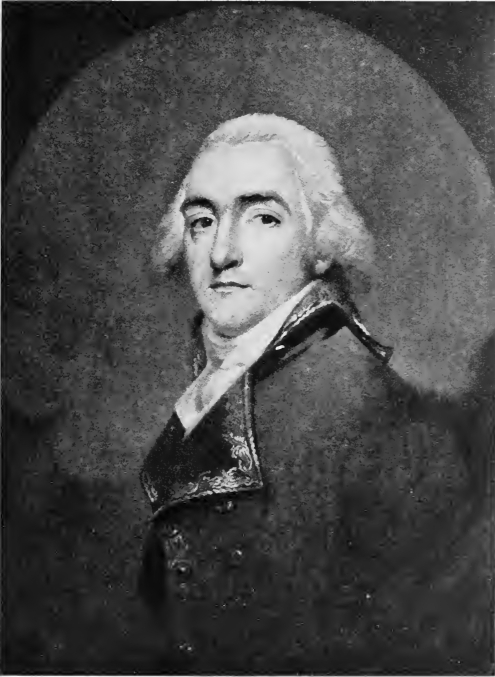
Daendels
Accordingly, on the morning of the 18th of January, Krayenhoff and his buglers appeared before the walls of the town, and in the name of the Franco-Batavian General Daendels proceeded to deliver their highly important message to their Mightinesses the burgomasters and aldermen. The message solemnly promised that there would be no shedding of blood, no destroying of property, no violence to the person; but it insisted in very precise terms upon an immediate revolution. All things would happen in order and with decency, but revolution there must be.
This summons to the town government was the sign for the Patriotic Club to make its first public appearance. Six of the most influential leaders of the party, headed by Rutger Jan Schimmelpenninck, incarnation of civic virtue and prudence, quietly walked to the town hall, where in the name of the people they demanded that the town government be delivered into their own hands. They assured the much frightened worthies of the town hall of their great personal esteem, and repeated the solemn promise that no violence of any sort would occur unless the militia be called out against them.
French troops entering Amsterdam
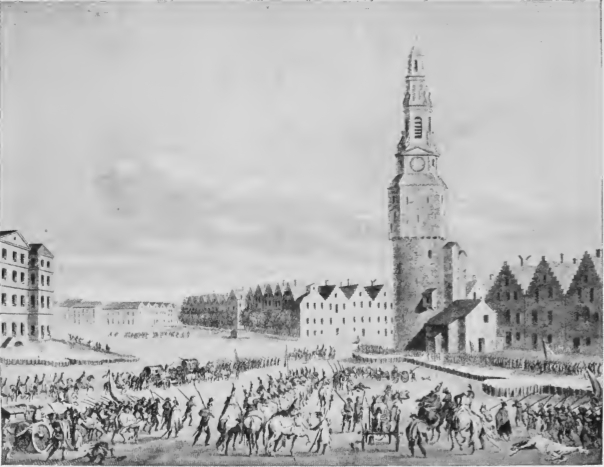
The gentlemen of city hall assured the Revolutionary Committee that violence was the very last thing which they had in mind. But of course this whole proceeding was very sudden. Would the honourable Revolutionary Committee kindly return at nine of that same evening, and then they would find everything arranged to their complete satisfaction. Ita que acta. At half-past nine of the same evening the Revolutionary Committee returned to the town hall and found everything as desired. Krayenhoff, who was made military commander of the city, climbed on the stoop of the building and by the light of a torch held by one of his new soldiers he read to the assembled multitude a solemn proclamation which informed all present that a revolution had taken place, and that early the next morning the official exchange of the high government would take place. After which the assembled multitude discreetly applauded and went home and to bed. The Revolutionary Committee, however, made ready for a night of literary activity and retired to the well-known inn, the Cherry Tree, to do a lot of writing. Soon paper and ink covered the tables and the work of composing proclamations was in full swing; but ere many hours had passed, who should walk in but our old friend Major-General Daendels. That afternoon while making a tour of inspection with a few French Hussars he had found the city gates of Amsterdam wide open and unguarded. Glad of the chance to sleep in a real bed, he had entered the town, had asked for the best hotel, and behold! our hero had been directed to the self-same Cherry Tree. His Hussars were made comfortable in the stable and he himself was asked to light a pipe and join his brethren in their arduous task of providing the literary background for a revolution.
The next morning, fresh and early, the French detachment drove up to form a guard of honour for the plain citizens who within another hour would be the official rulers of the city. When the clock of the New Church struck the hour of ten, the representatives of the people of Amsterdam entered the famous hall, where the town government had met in extraordinary session. Both parties exhibited the most perfect manners. The Patriots were received with the utmost politeness. They, from their side, assumed an attitude of much-distracted bailiffs who have come to perform a necessary but highly uncongenial duty. They assured the honourable town council again and again that no harm would befall them. But since (early the night before) "the Batavian people had resumed the exercise of their ancient sovereign rights," the old self-instituted authorities had been automatically removed and had returned to that class of private citizens from which several centuries before their ancestors had one day risen. The burgomaster and aldermen could not deny this fundamental piece of historical logic. They gathered up their papers, made a polite bow, and disappeared. The people assembled in the open place in front of the city hall paid no attention. Henceforth the regents could only have an interest as a historical curiosity. A new time had come. It was established upstairs, on the first floor, and another proclamation had been written. This first official document of the new era was then read from the balcony of the hall to the people below:
"Liberty, Fraternity, Equality. Fellow-Batavians: The old order of things has ceased to be. The new order of things will start with the following list of provisional representatives of the people of Amsterdam. (Follows a list of twenty-one names.) People of the Batavian Republic, what say ye?"
The people, patient audience in all such political entertainments, said what was expected of them. The twenty-one new dignitaries, thus duly installed, then took their seats upon the unfamiliar green cushions of the aldermanic chairs and went over to the order of the day. The former subjects, present citizens, still assembled in the streets, went home to tell the folks that there had been a revolution, and that, on the 20th of January of the first year of the Batavian liberty, the good town of Amsterdam had thrown off the yoke of tyranny and the people had become free. And at ten o'clock curfew rang and everybody went to sleep.
III
THE COST OF REVOLUTION
This little historic comic opera which we are trying to compose has a great many "leitmotiven." The revolutionary ones are all of foreign make and importation. There is but one genuinely Dutch tune, the old "Wilhelmus of Nassau." But this we shall not hear for many, many years, until it shall be played by a full orchestra, with an extra addition of warlike bugles and the roaring of many cannon.
For the moment, while the overture is still being performed, we hear only a mumble of discordant and cacophonous Parisian street tunes. One melody, however, we shall soon begin to notice uppermost. It is the "Marseillaise," and it announces the approach of the taxpayer. For twenty years to come, whatever the general nature of our music, whenever we hear the strains of this inspiring tune, the villain of our opera will obey their summons and will make his rounds to collect from rich and poor with touching impartiality.
On Sunday, the 18th, the Stadholder left the country. On Monday, the 19th, the provisional representatives of the people of Amsterdam made their little bow to the people from the stoop of the town hall.
On the same day the French recognized the Batavian Republic officially. On Wednesday, the 21st, Amsterdam called upon fourteen other free cities to send delegates to discuss the ways and means of establishing a new government for the aforementioned republic. And on that same day the representatives of the French Republic unpacked their meagre trunks in the palace of the old Stadholder and demanded an amount of supplies for the French army which would have kept the Dutch army in food and clothes and arms for half a dozen years.
The provisional authorities demurred. The bill was much too high. "But surely," the French delegates said, "surely you must comply with our wishes. We have marched all the way from Paris to this land of frogs to deliver you from a terrible tyrant. You can not expect us to starve." Of course not, and the supplies were forthcoming.
On the 26th of the same month, of January, the different provisional delegates from the provisional representative bodies of the different cities of Holland met in The Hague and sent word to the provincial Estates that their meeting hall was needed for different and better purposes. And when the old Estates had moved out the provisional citizens constituted themselves into an executive and legislative body, to be known as the "Provisional Representatives of the People of Holland."
The French authorities, snugly installed in the other wing of the palace where the provisionals met, were asked for their official approval. This they condescended to nod across the courtyard. Then the new representatives set to work. Pieter Paulus, our old friend of the Rotterdam Admiralty, was elected speaker, an office for which he was most eminently fitted. In his opening speech he touched all the strings of the revolutionary harp—peace, quiet, security, equality, safety, justice, humanity, fairness to all. Those were a few of the basic principles upon which the everlasting Temple of Civic Righteousness was to be constructed. After which the provisional meeting set to work, and in very short order abolished the office of Stadholder, the Raadpensionaris, the nobility, absolved every one from the old oath of allegiance, recalled the peace missionaries who were still supposed to be looking for the French authorities, and ended up with a solemn declaration of the Rights of Men and a promise immediately to convoke a national assembly. The other provinces followed Holland's example. In less than two weeks' time the entire country had dismissed its old Estates and had provided itself with a new set of rulers. The new machinery, as long as there was nothing to do but to demolish the ruins of the old republic, worked beautifully; but when the last stones had been carted away, then there was a very different story to tell.
Three weeks after the Stadholder had fled, provisional delegates to the Estates General (the name had been retained for convenience sake) met in The Hague. They adopted the Declaration of the Rights of Men as their ethical constitution, abolished for the whole country what the provisional provincial Estates had already abolished for each individual part, changed the five different admiralties into one single navy department, changed the Council of State into a committee-on-the general-affairs-of-the-Alliances-on-Land, and vested this committee with the short name with power to make preparations for the calling together of a National Assembly for the framing of a constitution.
And then—allons enfants de la Patrie—and here were those same citizens of the dilapidated uniform who had called but a moment before, and they had a little account which they would like to see settled. For now that the provisional delegates of the new republic were so conveniently together, would they not kindly oblige with a prompt payment? Poor Batavian Republic, while your provisional representatives are making speeches, while your people are eagerly trying to rid themselves of titles, honours, coats-of-arms, fancy wigs, and short trousers, while the entire Batavian Republic is stewing in a most delightful feeling of brotherly love, the good brethren in Paris are coldly calculating just how much they can take away from the republic without absolutely ruining her as a dividend-producing community.
The French national convention, in matters of a monetary nature, took no chances. It sent two of its best financial experts to Holland to make a close and first-hand inspection of all possible Dutch assets, and to study the relation between revenue and expenditure and to discover just how much bleeding this rich old organism could stand. On the 7th of February these two experts, the Citizens Ramel and Cochon (most fitting name), arrived in The Hague. In less than two weeks they were ready with their report. They certainly knew their business. "Do not kill the goose which lays the golden egg" was the tenor of their message to the French convention. "Let Holland prosper commercially, and then you shall be able to take a large sum every year for an unlimited number of years. But show some clemency for the present. Whatever there used to be of value in the republic has been sent abroad many months ago and now lies hidden in safety vaults in Hamburg and London. Reëstablish confidence. The rich will come back; their property will come back; dividends will come back. Then go in and take as much as the Dutch capital can stand."
Such was the gist of their advice, but it was very ill received by the triumvirate which conducted the foreign policy of the French Republic. They knew little of economics, but much about the pressing needs of the large armies which were fighting for the cause of Fraternity and Liberty. Money was needed in Italy and money was needed in Germany, and the republic must provide it. And to Citizen Paulus and his provisional assembly there went a summons for one hundred million guilders to be paid in cash within three months, and for a 3 per cent. loan of a same amount to be taken up by the Dutch bankers before the year should be over. Incidentally a vast tract of territory in the southern part of the republic was demanded to be used for French military purposes.
Here was a bit of constructive statesmanship for the month-old provisional government. Twenty-five thousand hungry French soldiers garrisoned in their home cities and a peremptory demand for two millions and several hundred square miles of land. Forward and backward the discussion ran. The republic was willing to open her colonies to French trade, to conclude an offensive and defensive treaty with France, to reorganize her fleet and use it against England. Not a cent less than a hundred millions, answered Paris.
The republic must not be driven to extremes, or France will lose all the influence which it has obtained so far.
"Go ahead," said Paris, "and get rid of us. The moment we shall recall our troops, the Prussians will come to reëstablish your little Stadholder the way they did in 1787. Our retreating army shall plunder all it can, and the rest will be left to the tender mercies of the Prussian's Hussars. Get rid of us and see what is to become of your Batavian Republic."
The Provisionals, recognizing the truth of this statement, fearing another restoration, asked time for deliberation. Then they offered to pay sixty millions and cede a vast tract of territory. "One hundred millions in cash and the same amount in a loan," said Paris, "and not a cent less."
Pieter Paulus (if only he had not died so young) worked hard and faithfully to try and avert this outrage. At times, as when he declared that "it were better to submit to the terms of a conqueror than to agree to such monstrous demands on the part of a professed friend," he rose to a certain heroism. But he stood alone, and his obstinate fight only resulted in a slight modification of some of the minor terms. One hundred millions in cash it was, and one hundred millions in cash it remained.
On the 16th of May, 1796, the treaty of The Hague was concluded between the French and the Batavian republics. The French guaranteed the independence and the liberty of the Batavian Republic and also guaranteed the abolition of the Stadholdership. Until the conclusion of a general European peace there should exist an offensive and defensive treaty between the two countries. Against England this treaty would be binding forever. Flushing must receive a French garrison. A number of small cities in the Dutch part of Flanders must become French. The colonies must be opened to French trade. The Dutch must equip and maintain a French army of 25,000 men, and fifty million guilders must be paid outright, with another fifty million to come in regular rates.
The Batavian Republic now could make up a little trial balance. This was the result:
Credit: the expulsion of one Stadholder and the establishment of a free republic; 2,365,000 guilders' worth of worthless paper money imported by the French soldiers. Debit: 50,000,000 in spot cash and 50,000,000 in future notes; 40,000,000 for French requisitions; 50,000,000 lost through passed English dividends, lost colonies, ruined trade. Total gain—Q.E.D.
IV
THE PROVISIONAL
The provisional representatives of the people of Holland, the provisional representatives of the people of Zeeland, the provisional representatives of all the nine provinces (for the old generalities had been proclaimed into provinces), the provisional municipalities and provisional committees on the provisional revolution—the names indicate sufficiently the provisionally of the whole undertaking.
Curiously enough (but the contemporary of course could not know this) the Provisional government worked more and to a better effect than the permanent form of government by which it was followed. It had one great advantage: there was such an insistent demand for immediate action that there was a correspondingly small chance for idle talking. The professional orators, the silver-tongued rhetoricians, had their innings at a later date. For the moment only men of deeds were wanted, and the best elements of the Patriotic party cheerfully stepped forward to do their duty.
Pieter Paulus, by right of his ability, was the official and unofficial head. He remained at The Hague and ran the national Provisional government, while Citizen Schimmelpenninck stayed in Amsterdam and kept that important dynamo of democratic power running smoothly. Both leaders had their troubles, but not from foreign enemies. It is true that the young Prince of Orange was contemplating a wild filibustering scheme and had called for volunteers to compose an army of invasion. The half-pay officers of the former régime had hastened to his colours. But very few soldiers were willing to risk their lives for such an unpopular cause, and with an army composed of two soldiers for each officer no great military operations were possible. Wherefore the plan fell through in a most lamentable way, and the Prince of Orange as a claimant to the Dutch Government disappeared from further view until many years later.
The great bugaboo of the Provisional government and its moderate members was the radical brethren of the very same Patriotic party. These good people had starved abroad for many years. At the first opportunity they had hastened back to the ancestral hearth-stone. And now they presented enormous claims for damages for the losses which eight years before they had suffered at the hands of the Orangeists. But instead of receiving the hoped-for bounties these faithful democrats were snubbed on all sides. The climax was reached when the Batavian Government offered to pay them twenty-five guilders each (the price of a ticket from Paris to Amsterdam) and let it go at that. The professional exiles roared indignation, repaired to the nearest coffee-house, and instantly formed a number of clubs which were to see that no further deviations from the genuine path of revolutionary virtue be permitted. And very broadly they hinted that a short session of Madame Guillotine might do no end of good in this complacent and ungrateful Dutch community.
Let it be said to the everlasting honour of the Provisionals that no such thing occurred. Nobody was decapitated, no palaces and country houses were delivered to the tender mercies of the Jacobin Patriots.
The possessions of the Stadholder, which yielded 700,000 livres a year, were taken over by the republic and administered for its own benefit. The regents were permitted to exist, very, very quietly, and were not interfered with in any way. Yea, even when old Van den Spiegel and William's great friend Count Bentinck were brought to trial for malfeasance committed while in office they were immediately set free. And the citizen who conducted the investigation, Valckenaer by name and a most ardent Jacobin by profession, openly confessed that there had been no case against these two dignitaries, that the charges against them had been like spinach: "Looks like a lot when it is fresh, but does not make much of a dish when it gets boiled down."
No, the members of the Provisional were good Patriots and good democrats, but with all due respect for the doctrine of equality they did not aspire to that particular form of equality which is established by the revolutionary razor.
But after the question of the more turbulent members of their party had been decided, there was another problem of the greatest importance. Where, in the name of all the depleted treasuries, could the money be found with which to pay the French deliverers, the current expenses of this costly provisional government, the added sums necessary for the war with the enemies of France? The high sea was closed to Dutch trade, the colonies did not produce a penny's worth of revenue, Dutch industries were dead and buried under unpayable debts. Not a cent was coming in from anywhere; but whole streams of valuable guilders were flowing out of the country to everywhere.
The final solution of the problem was as simple as it was disastrous. The Batavian Republic began to live on the capital of the Dutch Republic. In some provinces the Provisional government confiscated all gold and silver with the exception of the plate used in the church service. But this little sum was gobbled up by the hungry treasury before a month was over. Then voluntary 5 per cent. loans were tried. They were not taken up. An extraordinary tax of 6 per cent. was levied upon all revenue. The money covered the running expenses for three weeks; and all the time those twenty-five thousand Frenchmen, who had to be clothed and fed, ate and ate and ate as if they had never seen a square meal before, which probably was the truth.
There was only one way out of the difficulty: The credit of the prodigal son, who for two centuries had regularly paid his bills, is apt to be good. The republic could loan as much as it wanted to, and it now abused this privilege. Loans were taken to pay dividends upon other loans, until finally a system was developed of loans within loans upon other loans which ultimately must ruin even the soundest of financial constitutions.
Meanwhile it poured assignats. All attempts to stop this unwelcome shower at its source were met with the most absolute refusal of the French Government. "What! dishonour our pretty greenbacks with their fine mottoes, and accepted everywhere as the true badges of good revolutionary faith?" They could not hear of such a thing. And they printed assignats, and the counterfeiters printed assignats, and every private citizen whose children owned a little private printing press and whose oldest boy knew the rudiments of drawing printed assignats, until the shower caused a deluge, which in due time swamped the whole financial district and brought about that horror of horrors—a national bankruptcy.
Enters No. 3 upon the program of the Provisional's difficulties: the army and the navy.
Daendels had obtained permission to leave the French service and had assumed command of the Dutch troops. A strange conglomeration of troops, by the way, not unlike the mercenary armies of the Middle Ages: regiments composed of every nationality—Swiss grenadiers and Saxon cavalry, Scotch life guards and Mecklenburg chasseurs, a few Dutch engineers and some Waldeck infantry; the officers partly Dutch, but mostly foreign; the higher officers mostly in exile; the lower ones awaiting the day when their friend the Prince should return. Surely before this army could be reorganized into a national army of 24,000 well-equipped men, hot-blooded Daendels would have a chance to exercise that swift temper of his. For after a year of drilling there was not even a single company that could be depended upon in a regular skirmish in time of war.
With the fleet the government did not experience such very great difficulties. The fifteen millions necessary for reorganization had been quickly collected, and Paulus a specialist on this subject, had gone to work with a will. The old officers and men had either left the service, or had surrendered their ships to the English as the allies of their commander-in-chief, the Stadholder. But there were enough sailors in the country to man the ships. Such of the old ships as had remained in Dutch harbours were rebaptized with more appropriate names—the William the Silent became the Brutus, the Estates General was renamed the George Washington, and the Princess Wilhelmina was delicately changed to the Fury—and twenty-four new ships of the line and twenty-four frigates were planned for immediate construction.
Capetown captured by the English
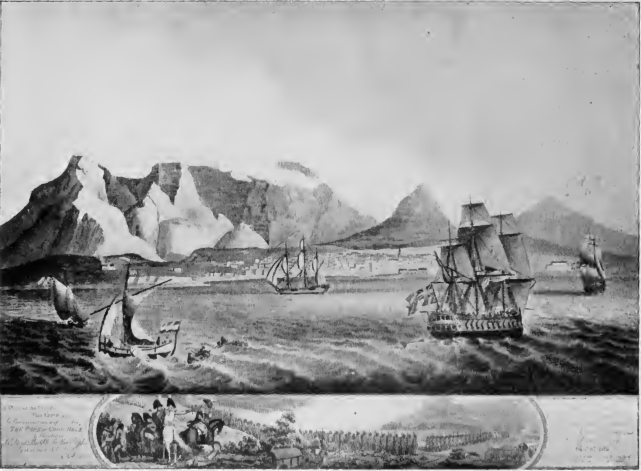
After half a year Admiral de Winter (former second lieutenant of the navy and French general of infantry) was ready to leave Texel with the first Batavian fleet. He sailed from Texel with a couple of ships, and after having been beaten by an English squadron off the coast of Norway, he returned to Texel with a few ships less. Two special squadrons were then equipped and ordered to proceed to the West and East Indian Colonies; but before they left the republic news was received of the conquest of these colonies by the British, and the auxiliary squadrons were given up as useless.
Now all these puzzling questions facing untrained politicians took so much of their time that nothing was apparently done toward the great goal of this entire revolution—the establishment of a national assembly to draw up a constitution and put the country upon a definite legitimate basis.
The country began to show a certain restlessness. The old Orangeists smiled. "They knew what all this desultory business meant. Provisional, indeed? Provisional for all times." The more extreme Patriots, who knew how sedition of this sort was preached all over the land, showed signs of irritation. "It was not good that the opposition could say such things. Something must be done and be done at once. Would the Provisional kindly hurry?"
But when the Provisional did not hurry, and when nothing was done toward a materialization of the much-heralded constitution, the Jacobins bethought themselves of what they had learned in their Parisian boarding school and decided to start a lobby—a revolutionary lobby, if you please; not a peaceful one which works in the dark and follows the evil paths of free cigars and free meals and free theatre tickets. No, a lobby with a recognized standing, a clubhouse visible to all, and rules and by-laws and a well-trained army of retainers to be drawn upon whenever noise and threats could influence the passing of a particular bill.
On the 26th of August, 1795, there assembled in The Hague more than sixty representatives from different provincial patriotic clubs. The purpose of the meeting was "to obtain a national assembly for the formation of a constitution based upon the immovable rights of men—Liberty and Equality—and having as its direct purpose the absolute unity of this good land." Here at last was a program which sounded like something definite—"the absolute unity of this land."
All the revolutionary doings of the last six months, the patriotic turbulences of the past generation, were not as extreme, as anti-nationalistic in their outspoken tendencies, as was this one sentence: "The absolute unity of this land." It meant "Finis" to all the exaggerated provincialism of the old republic. It meant an end to all that for many centuries had been held most sacred by the average Hollander. It meant that little potentates would no longer be little potentates, but insignificant members of a large central government. It meant that the little petty rights and honours for which whole families had worked during centuries would pale before the lustre of the central government in the capital. It meant that all High and Mightinesses would be thrown into one general melting-pot to be changed into fellow citizens of one undivided country. It meant the disappearance of that most delightful of all vices, the small-town prejudice. And all those who had anything to lose, from the highest regent down to the lowest village lamplighter, made ready to offer silent but stubborn resistance. To give up your money and your possessions was one thing, but to be deprived of all your little prerogatives was positively unbearable. And not a single problem with which the Provisional, or afterward the national assembly, had to deal, caused as many difficulties as the unyielding opposition of all respectable citizens to the essentially outlandish plan of a single and undivided country.
As a matter of fact, the unity was finally forced upon the country by a very small minority. The Dutch Jacobins were noisy, they were ill-mannered, and on the whole they were not very sympathetic. (Jacobins rarely are except on the stage.) But one thing they did, and they did it well. By hook and by crook, by bullying, and upon several occasions by direct threats of violence, they cut the Gordian knot of provincialism and established a single nation and a union where formerly disorganization and political chaos had existed. For when their first proposal of the 26th of August was not at once welcomed by the Provisional, the revolutionary lobbyists declared themselves to be a permanent Supervisory Committee, and as the "Central Assembly" (of the representatives from among the democratic clubs of the Batavian Republic) they remained in The Hague agitating for their ideas until at last something of positive value had been accomplished.
The Estates General could refuse to receive communications from this self-appointed advisory body, the Estates of a number of provinces could threaten its members with arrest, but here they were and here they stayed (in an excellent hotel, by the way, which still exists and is now known as the Vieux Doelen), sitting as an unofficial little parliament, and fighting with all legitimate and illegitimate means for the fulfilment of their self-imposed task. And one year and one month after the glorious revolution which we have tried to describe in our previous chapters, the provisional assembly, under the influence of these ardent Patriots and their gallery crowd, decided to call together a "national assembly to draw up a constitution and to take the first steps toward changing the fatherland into a united country."
And this is the way they went about it: The national assembly should be elected by all Hollanders who were twenty years of age. They must be neither paupers nor heretics upon the point of the people's sovereignty. For the purpose of the first election, the provinces were to be divided into districts of 15,000 men each, subdivided into sub-districts of 500. The sub-districts, voting secretly and by majority of votes, were to elect one elector and one substitute elector. The elector must be twenty-five years of age, not a pauper, and a citizen of four years' standing. Thirty electors then were to elect one representative and two substitute representatives. These must be thirty years of age and were to represent the people in the national assembly. Their pay was to be four dollars a day and mileage. The national convention was to be an executive and legislative body after the fashion of the Estates General during those old days when no Stadholder had been appointed. Within two weeks after its first meeting the national assembly must appoint a suitable commission of twenty-one members (seven from Holland, one from Drenthe, and two from each of the other provinces). Said commission, within six months of date, must draw up a constitution. This constitution then must at once be submitted to the convention for its approval, and within a year it must be brought before the people for their final referendum.
The elections actually took place in the last part of February of the year 1796. They took place in perfect order and with great dignity. The system was not exactly simple, but it was something new, and it was rather fun to study out the complicated details and then walk to the polls and exercise your first rights as a full-fledged citizen.
On the 1st of March more than half of the representatives, duly elected, assembled in The Hague, ready to go to work.
A year had now gone by since the provisional government had been started—a year which had little to show for itself except an ever-increasing number of debts and an ever-decreasing amount of revenue. The time had come for the direct representatives of the sovereign people to indicate the new course which inevitably must bring to the country the definite benefits of its glorious but expensive revolution.
Exit the provisional assembly and enter the national assembly.
V
SOLEMN OPENING OF THE NATIONAL ASSEMBLY
THE OPENING CEREMONIES
On the morning of the 1st of March, 1796, the ever-curious people of The Hague had a legitimate reason for taking an extra holiday. For two weeks carpenters, plumbers, and whitewashers, followed by paperhangers and upholsterers, had been at work in the former palace of the Stadholder. They had hammered and papered until the former ballroom of Prince William V had been changed into a meeting room for the new national assembly. It was an oblong room eighty by thirty-two feet, and extremely high. The members were to sit on benches behind tables covered with the obligatory green baize. Their benches were built in long rows, four deep, constructed along three sides of the hall and facing the windows which gave on the courtyard. The centre part of the fourth wall, between the big windows, was taken up by a sort of revolutionary throne, which was to be occupied by the Speaker and his secretaries. The chair of the Speaker was a ponderous affair, embellished with wooden statues representing Liberty and Fraternity. The gallery for the people, one of the most important parts of a modern assembly hall, gave room for three hundred citizens. The principle of equality, however, had not been carried to such an extreme as in the French assemblies. There was a separate gallery for the use of the diplomats and the better class of citizens. Unfortunately there were but few diplomats left to avail themselves of this opportunity to listen to Batavian rhetoric. Practically all of the foreign ministers had left The Hague soon after the Prince had departed.
The members of the assembly, after the French fashion, were not to speak from their seats, but when they wished to address their colleagues and the nation they mounted a special little pulpit standing on the right of the Speaker's throne and resembling (or trying to resemble) a classical rostrum.
Now let us tell what the good people of The Hague were to see on this memorable 1st of March. All in all there were ninety-six representatives in town, and they came from seven provinces.
Friesland and Zeeland, neither of which liked the idea of this assembly, which was forced upon them by a revolutionary committee, had purposely delayed their elections—had not even commenced with the preliminaries of the first election. The other provinces, however, especially Drenthe and the former Generalities, which for the first time in their history acted as independent bodies, had been eager to go to work, and at eleven o'clock of this 1st of March their representatives and their substitutes, in their Sunday best, came walking to their new quarters. Slowly they gathered, until at the stroke of noon just ninety members were present. Punctually at that moment a delegation appeared from across the way, from the Estates General. They were to be the godfathers of the new assembly. Nine members of the old Estates General, escorted by a guard of honour from among the assembly, filed into the hall and took special seats in front of the Speaker's chair. One of them then read the names of the assemblymen whose credentials had been examined and had been passed upon favourably. The new members then drew lots for their seats. This ceremony was to be repeated every two weeks and was to prevent the formation of a Mountain and a Plain and other dangerous geographical substances fatal to an undisturbed political cosmos. The substitute representatives took their seats on benches behind their masters. Then the chairman of the delegation from across the way read a solemn declaration, which took the place of the former oath of allegiance, and the representatives expressed their fidelity to this patriotic pledge. The chairman ended this part of the ceremony with a fine outburst of rhetoric in which the Spanish tyranny, King Philip the second, Alva, the dangerous ambition of William of Nassau, and the spirit of liberty of the Batavian people passed in review before his delighted hearers. And having dispatched the odious tyrant, William V, across the high seas, he referred to the blessings that were now to flow over the country, and thanked the gentlemen for their kind attention.
The next subject on the program was the election of a Speaker. At the first vote Pieter Paulus, with 88 votes against 2, was elected Speaker of the Assembly. The chief delegate from the Estates General, in his quality of best man at this occasion, put a tricoloured sash across the shoulders of Mr. Paulus and conducted him to the Speaker's chair. Profound silence. The galleries, crowded to the last seat, held their breath. The ministers from the French Republic and the United States of America, who, with the diplomatic representatives of Denmark and Portugal, were the only official foreigners present, looked at their watches that they might inform their home governments at what moment exactly the new little sister republic had started upon her career.
It was twelve o'clock when Citizen Paulus arose and with a firm voice declared: "In the name of the people of the Netherlands, which has duly delegated us to our present functions, I declare this meeting to be the Representative Assembly of the People of the Netherlands."
Tremendous applause. A band hidden in a corner struck up a revolutionary hymn. Outside a bugle call announced unto the multitudes that the new régime had been officially established. The soldiers presented arms. The populace hastened to embrace the soldiers and to give vent to such expressions of civic joy as were fashionable at that moment. The national flag, the old red, white, and blue with an additional Goddess of Liberty, was hoisted on the highest available spot, which happened to be a little observatory where the children of the Stadholder in happier days had learned to read the wonders of the high heavens. The appearance of this flag was the appointed signal for those who had not been able to find room in the small courtyard, and they now burst forth into cheers. Finally the cannon, well placed outside the city limits (to avoid accidents to careless patriotic infants), boomed forth their message, and those who possessed a private blunderbuss fired it to their hearts' content. Ere long dispatch riders hastened to all parts of the country and told the glorious news.
The committee from the Estates General, however, did not wait for this part of the celebration. As soon as Paulus had begun his inaugural address (a quiet and dignified document, much to the point) they had unobservedly slipped out of the assembly and had returned to their own meeting hall across the yard. And here, while outside in the streets the people went into frantic joy about the new Batavian liberty, their High and Mightinesses, who for so many centuries had conducted the destinies of their own country and who so often had decided the fate of Europe, who had appointed governors of a colonial empire stretching over many continents, and who, chiefly through their own mistakes, had lost their power—here, their High and Mightinesses met for the very last time. The committee which had attended the opening of the Representative Assembly of the People of the Netherlands reported upon what they had done, what they had seen, and what they had heard. Then with a few fitting words their speaker closed the meeting. Slowly their High and Mightinesses packed up their papers and dispersed. Outside the town prepared for illumination.
Pieter Paulus
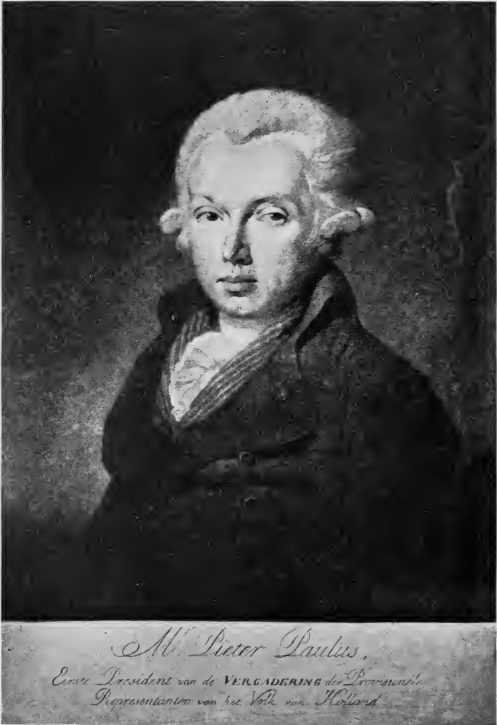
VI
PIETER PAULUS
A year before, the French Revolution had come suddenly, and boldly it had struck its brutal bayonet into the industrious ants' nest of the Dutch Republic. There had been great hurrying to save life and property. After a while order had been reëstablished. And then to its intense surprise, at first with unbelieving astonishment, later with ill-concealed vexation, the political entymologists of the French Revolution had discovered that in this little country they had hit upon an entirely new variety of national fabric. Against all the rules of well-conducted republics, every little ant and every small combination of ants worked only for its own little selfish ends, disregarded its neighbours, fought most desperately for every small advantage to its own, bit at those who came near, stole the eggs of those who were not looking—in a word, while outwardly the little heap of earth seemed to cover a well-conducted colony of formicidæ, inwardly it appeared to be an ill-conducted, quarrelsome congregation of very selfish little individuals. And with profound common sense, the French, after their first surprise was over, said: "Brethren, this will never do. Really you must change all this. We will give you a chance to build a new nest, a very superior one. You can upholster it just as you please. You can put in all the extra outside and inside ornaments which you may care to have around you. But you must stop this insane quarrelling among yourselves, this biting at each other, this spoiling of each other's pleasure. In one word, you have got to turn this chaotic establishment of yours into a well-regulated, centralized commonwealth such as is now being constructed by all modern nations."