Hendrik Willem van Loon, (continued 3)
Reading edition
The sovereign people were flattered with a persistency and a lack of delicacy which would have incensed even the worst and most astute of tyrants. The masses, however, did not notice it, and bought the complimentary pictures with great pride in their own virtue. Posterity has thought differently about it, and whereas the prints of the seventeenth and the eighteenth centuries are carefully collected, the prints of the Batavian Republic are usually left as food to the industrious domestic mouse.
But aside from these merely ideal considerations (for a nation may be great and prosperous and yet lack entirely in artistic perception) the ordinary daily life of the community suffered a worse blow than it experienced through the loss of the colonies. During the old commercial days there had been a great many slippery customers who had managed to make their living in very questionable ways. On the whole, however, the leading merchants had maintained a fairly high standard of commercial integrity from which no one dared to avert too openly. Now, in the year 1795, all this changed. The new men were not bound to these iron rules of conduct. A good many of the old unwritten rules and regulations of trade were thrown overboard as being antiquated. Army contractors and questionable speculators entered into the field of Dutch politics and introduced the dangerous standards of people who have managed to get rich overnight. Nobody likes to see his neighbour eating a better dinner than he can afford himself. If a purveyor of army shoes could suddenly keep a carriage and pair and yet be respected by the men with whom he associated, why, the people asked, should we criticise his methods? He is not punished by social contempt. He is treated with great respect because he can entertain in such a very handsome way. And soon the young boy next door tried the same trick of speculation and began to feel a deep contempt for the old-fashioned and slow ways of his immediate ancestors.
Trades
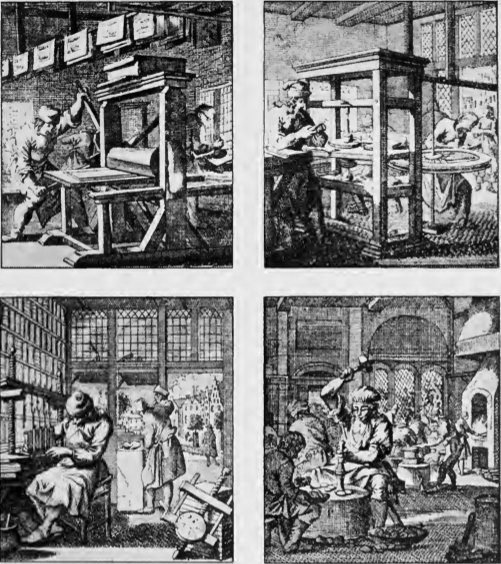
The better element of the community in the general disorganization which followed the revolution found itself deserted, laughed at for its high standards, looked at with the pathetic interest which enterprising young men feel for old fogies who are behind the times. "The poor old people simply would not look facts in the face. Why insist on living in Utopia? Utopia was such a very dreary place." Until, finally, these excellent people either succumbed, which was very rare, or retired from active life, and within the circle of their own home waited for better days and more ideal times. And the general tone of Batavian society was indicated by a class to whom riches meant an indulgence in all the material things of which they had dreamed during their former days of poverty. Easy come, easy go—in money matters as well as in morals. The new class of rich people, living without any restraint, followed its own inclinations, but obeyed no set rules of conduct. The sudden influx of ten thousand French officers, and Heaven knows how many foreign soldiers, also brought a dangerous element into a single community.
It is true that the discipline of the French soldiers had been exemplary, but the men trained in the happy-go-lucky school of the Paris which had followed the puritanical days of the sainted Maximilian Robespierre did not assist in establishing a deeper respect for good morals. The old days of parsimonious living and respect for one's betters were gone forever. Under the new dispensation no one was anybody else's better, and everybody lived as well as his purse or his credit allowed him to.
During the first years of the republic a number of men had suddenly grown rich. These vulgar personages threw their money out of the windows in the form of empty champagne bottles. Outside of their house of mirth a motley congregation of hungry people hovered. They drank what was left in the discarded bottles; they feasted on the remains of the uneaten pastry; they dreamed of the golden days when luck should turn and they should be inside with the worshippers of the fleshpots. The best part of the nation, however, disgusted with these vulgar doings, retired from all active life. It preferred a dull existence of simple honesty to a roisterous feast on the brink of a moral and financial abyss. And quietly the good people waited for the great change that was certain to come, when the nation once more should return to a sound mode of living, and when the resplendent adventurers of the moment should have been relegated back into that obscurity from which they never ought to have emerged.
XIX
PEACE
What can we say of the next five years—of the five years during which the Batavian Republic lived under her third constitution and outwardly exercised all the functions of a normal, independent state? Very little, indeed. Of course there is material enough. There rarely was a time when so much ink was wasted on decrees and bills and pamphlets discussing the decrees. Everything of any importance was referred to the voters, and therefore had to be printed. But of what value is all this material? Some day it may be used for a learned doctor's thesis. To the general historical reader it is without any interest. In name the republic was still a free commonwealth. In practice —we have repeatedly stated this before—it was a French province. The First Consul ruled her and gave his orders either through the Batavian minister in Paris or the French minister in The Hague. That such orders were ever disobeyed we do not find recorded. At times there was a little grumbling, but even if the noise thereof ever penetrated to Paris it was dismissed as the silly complaint of a lot of tradespeople who were always kicking. That was part of their business. The best answer to their remonstrances was an increase in the taxes—5 per cent. on this, 3 per cent. more on that, 20 per cent. on another article. Income, windows, light, air, newspapers, bread, tobacco, cheese—there was not an item that did not contribute toward making Napoleon's rule a success. For five years the republic, with its twelve executive gentlemen, ambled along. The better elements no longer appeared either in the assembly or in the colleges of the voters. The government gradually was left entirely to professional politicians of the lowest sort. The legislative body at once reflected this attitude of the more intelligent people to abstain from participation in the political life of their country.
It is true that the peace of Amiens made a momentary end to the French wars and brought about peace between England and the republic. But before the Dutch ships had been able to reach the Indian island war had again broken out, the colonies were once more captured by the British, and the Dutch coast was again blockaded. Bound to France by its disastrous treaty of 1796, the republic must follow the fate of the great sister republic. The people (we are now in 1803) had since the beginning of the revolution produced 600,000,000 guilders in taxes. They tried to convince the First Consul that they could not go on doing this forever. He, however, was able to suggest quite a wonderful remedy for their difficulties. The Batavian Republic must strengthen her fleet until she could defeat England and take back the colonies which that perfidious country had stolen. Very well! But the fleet could not be improved without further millions, and so the republic moved in a vicious circle which led to nowhere in particular but cost money all along that eternal line.
For a change, and to remind them of their duty, the Consul sent urgent demands for honorary dotations, for extraordinary dotations, for special dotations, or whatever names he chose to give to those official thefts.
The Exchange upon such occasions would fly into a panic. Couriers would race madly along the roads between The Hague and Paris. But invariably the end of all this commotion was a new command for the republic to pay up and be very quick about it, too. Continually during those five years do we hear Napoleon's warning: "If the republic refuses to pay, and refuses to obey my orders in general, I shall turn it into a French department."
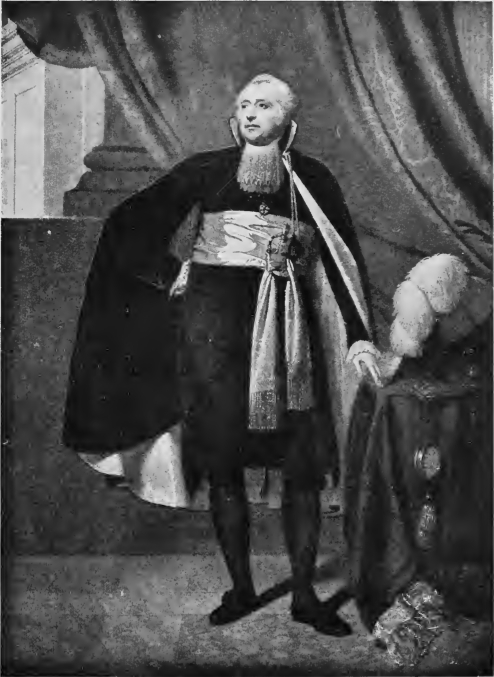
Schimmelpenninck, very moderate in his views, not too enthusiastic about the Batavian form of government, and rather in favour of the American system, during those very difficult days represented his country in Paris as its diplomatic agent. He had to carry the brunt of those wordy battles about the increased taxes. Napoleon may not have been able to speak French grammatically; but he certainly did have at his command a varied and choice collection of Parisian and Corsican Billingsgate. Continually in his correspondence with the Batavian Republic the Consul flew into a rage, called everybody very unpolite names, insulted the persons and the families of the members of the executive, told everybody indiscriminately what he thought of them or what he would do to their worthless persons. The browbeaten executives could do nothing but bow very low, accept the insults in an humble spirit, and express their invariable loyalty to the man who called them a bunch of sneaking grafters devoid of honour, energy, and patriotism.
This policy after a while had a very bad influence upon the Batavian Government. People lost all hope for the future. All desire to start upon new enterprises was killed. What was the use? The fruits of one's industry were taken away for the benefit of the French armies. And any day might be the last. The Consul might have had a bad night, he might be out of temper, and "finis" then for the Republic of the Free Batavians.
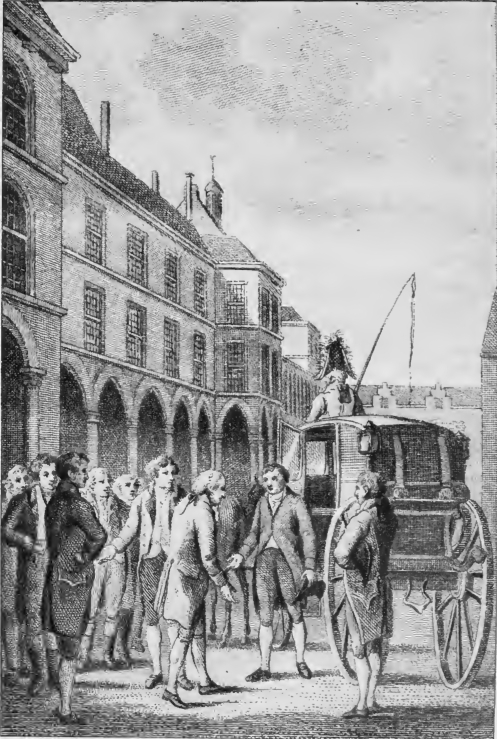
The year 1805 came, and with it a demand for 15,000,000 guilders to be given as a loan, returnable in four years. Fortunately it was before the battle of Jena had shown the weakness of Prussia, and Napoleon did not dare to attack the republic too openly. But he had made up his mind that the present weak form of government could not continue. The large executive must be abolished, and a single man, be he a French general or a member of the House of Bonaparte, must be made the head of the republic. The republic alone seemed unable to walk. Napoleon would give her somebody for her support. Unfortunately there was no general available, and all the consular brethren were engaged elsewhere. For lack of a Frenchman a Hollander must take the job. There was only one Hollander whom the Consul (the Emperor since a few months) could trust and for whom he had some personal liking. That was the Batavian minister, Schimmelpenninck. The latter, however, had no ambitions of this sort and refused the offer to become Proconsul of the Republic. He pleaded ill health, a weakening eyesight. Napoleon refused to listen to his excuses. If Schimmelpenninck were unwilling to accept, then France must annex the republic. Whereupon the Batavian minister, inspired by the unselfish interest which he took in his fatherland, agreed to accept the difficult position. He sadly drove to The Hague along the heavy roads of a very severe winter, and he informed the twelve citizens of the executive body what the Emperor intended to do with him and with them and with the Batavian Republic. The executive must resign at once. As an executive body it had proved itself to be too large and too ineffective. As a legislative body it had done nothing of any importance. It must go. A new constitution (a fourth one, if you please), more centralized and more after the French pattern, must be adopted.
The executive, mild as lambs, approved of everything, said yea and amen to all the proposals of the Emperor. It informed the legislative body of the contemplated changes and advised the legislators that the appointment of Schimmelpenninck as Proconsul was the only way out of the difficulty. The legislative body, just to keep up appearances, deliberated for six whole days. Then it expressed its full approval of everything the Emperor proposed to do with them and for them. The new constitution, made in Paris, was forwarded to The Hague by parcels post, was put into type, and was brought before the electorate. The voters by this time did not care what happened or who governed them so long as they themselves were only left in peace. And when the time came for them to express their opinion 139 men out of a total of 350,000, took the trouble to say no, while less than one-twenty-fifth of the voting part of the population took the trouble of expressing an affirmative opinion. Out of every hundred voters, ninety-six stayed quietly at home. It saved trouble.
Schimmelpenninck
XX
SCHIMMELPENNINCK
Schimmelpenninck made himself no false ideals about his high office, which placed him, a simple man, in the palace of the Noordeinde (the present royal palace of the kings of the Netherlands), which surrounded him with a lifeguard of 1,500 men, gave him the title of Raadpensionaris, encompassed him with an iron circle of regal etiquette, and provided him with many things which were quite as much against the essential character of the Hollanders as against his own personal tastes.
For himself, the new Raadpensionaris asked for very little. He was careful not to appoint a single one of his relatives to any public office, and tried in the most impartial way to gather all the more able elements of every party around himself. He appointed his cabinet and selected his advisers from the unionists and the federalists, but most of all from among the moderates.
The Raadpensionaris in this new commonwealth of Napoleon's making was a complete autocrat. Provisions had been made for a legislative body of nineteen men, to be appointed by the different provinces; but this legislature, which was to meet twice a year and had resumed the old title of their High and Mightinesses, the Estates General, amounted to nothing at all. At the very best it was an official gallery which applauded the acts of the Raadpensionaris.
This dignitary and his ministers worked meanwhile with the greatest energy. A most capable man was appointed to be secretary of the treasury. He actually managed to reduce the deficit by several millions, and began to take steps to put the country upon a sound financial basis. Napoleon, however, did not fancy the idea of the republic getting out of debt too completely. If anything were to be done in this line he proposed an immediate reduction of the public debt. In the end, so he reasoned, such a reduction would be a benefit. At the present moment, as far as the Emperor could make out, the people through their taxes paid the money which at the end of the year came back to them through their investments in public funds. Reduce the national debt and you will reduce taxation. But however much his Majesty might advocate his pet plans, the commercial soul of the republic refused to listen to these proposals of such dangerous financial sleight-of-hand and the people rather suffered a high taxation than submit to an open confession of inability to manage their own treasury.
The army, for which the Raadpensionaris personally had very little love, was developed into a small but very efficient corps. This had to be done. Unless the army were well looked after, Napoleon threatened to introduce conscription in the republic, and to avert this national calamity people were willing to make further sacrifices and support an army consisting of volunteers. The navy, too, was put into good shape. A new man was at work in this department, a certain Verhuell, an ardent revolutionist, and the Hollander who seems to have had the greatest influence over the Emperor. During all the events between 1800 and 1812 Verhuell acted as the unofficial intermediary between the republic and the Emperor. He was a good sailor. In a number of engagements with the British his ships ably held their own water. But the Dutch fleet alone was far too small to tackle England, and the French fleet was soon lost sight of through the battle of Trafalgar.
Came the year 1806 and the defeat of the coalition. Ulm and Austerlitz were not only disasters to the Austrians; they had their effect upon the republic. Napoleon, complete master of the European continent, parcelled out its territory in new states and created new kingdoms and duchies without any regard to the personal wishes of the subjects of these artificial nations.
The Batavian Republic had been spared through the sentimentality of the French revolutionists. For several years it had been left alone because Napoleon still had to respect the wishes of Prussia and Austria. Now Prussia and Austria had been reduced to third-class powers, and the Emperor could treat the republic as he wished to. He sent for his Dutch man Friday, Verhuell, and talked about his plans. "Had the admiral noticed that during the war with the European coalition the French armies in the republic had been under command of his Majesty's brother, the Prince Louis Napoleon?" Mr. Verhuell had noticed the presence of the young member of the House of Bonaparte. So had everybody else. "Did Mr. Verhuell know what this presence meant?" Mr. Verhuell could guess. So could everybody else. Very well! Mr. Verhuell could go to The Hague and inform his fellow-citizens that they might choose between asking for the Prince Louis Bonaparte as their king or becoming a French department. With this cheerful message Mr. Verhuell repaired to The Hague, just a year after the Raadpensionaris had travelled that same road to assume the consulship of the republic. The Batavians were obliged to accept their fate with Christian resignation. Opposition of ten thousand Dutch recruits against half a million well-trained French soldiers was impossible. Furthermore, it is a doubtful question whether the people would have fought for their independence. There had been too many years full of disaster. The spirit of the people had been broken. They were now willing to accept anything. The only question to decide was how to get through this new comedy with some semblance of the old dignity. Schimmelpenninck, who was a very constitutional person, called together the grand council, consisting of the legislative body, the council of state, and a number of high dignitaries, and proposed that the new plan be submitted to the voters. The grand council voted him down directly. As it was, there had been too many elections already. The people must be left out of this affair. No good would come from their interference, anyway.
Schimmelpenninck arrives at The Hague
And forthwith the council resorted to the old Dutch expedient of procrastination. It sent a delegation to Paris to see the Emperor. Meanwhile, something might turn up. It did turn up—in the form of an ultimatum from his Majesty. He refused to receive the delegation, but sent word by Verhuell that the republic was given just eight days in which to repair to Paris and ask the Emperor for the favour of his brother as their king. If they were a day late the country would be turned into a French department.
On the 3rd of May, 1806, the grand council in The Hague agreed to all the French demands. The ex-bishop of Autun, the Rev. Mr. Talleyrand, had been appointed by Napoleon to draw up a constitution for the new kingdom. That was easy enough. After two weeks he could send the finished article to the grand council for its approval. The council approved; but Schimmelpenninck denounced the whole proceeding as being unconstitutional, and refused to sign the document. The council signed it over his head, and returned the paper to Paris. Then Schimmelpenninck protested to the French minister, and told him that he could not possibly justify the actions of the council. The minister said that he was sorry, but that nothing could be done about it, since the document was back in Paris. Whereupon Schimmelpenninck resigned and retired to his country place, declining all further participation in his country's political affairs. He lived until the year 1825, long enough to see his beloved land regain its independence and finally benefit by many of the reforms which he himself had helped to bring about.
The Speaker of the legislative body was selected to succeed the Raadpensionaris. Together with his colleagues of the grand council he now had the dishonour of arranging the last details of the farce which had been ordered by Paris.
On the 5th of June, of the year 1806, the Emperor Napoleon graciously deigned to receive a deputation from among the Batavian people who had come to Paris to ask his Majesty to present them with a king. The reason for this request, according to the delegates themselves, was the weakness of their country, which did not allow them to defend themselves against their enemies.
His Majesty, from a high tower of condescension, agreed to honour the petitioners with a favourable reply. His Majesty's own brother would be appointed king of the Batavians.
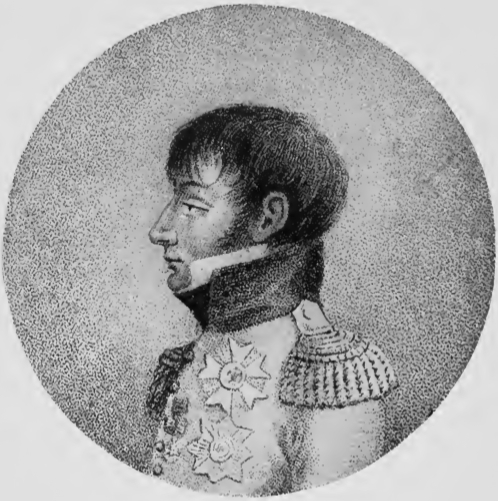
The new king, an amiable man, but not in the least desirous to be made king of Holland (having such difficulties in governing his own wife that he could not well bother about the additional duties of an entire kingdom), was then asked to step forward. He humbly listened to his brother's admonition never to "cease being a Frenchman," and answered that he would accept the crown and do his best, "since his Majesty had been pleased to order it so." That was all. The Batavian delegation was dismissed. The new king retired, to go to his unhappy home; but before he left the hall M. Talleyrand called him back and handed him a copy of the constitution of his new kingdom. Would his Majesty kindly peruse the document at his own leisure and make such suggestions as might occur to him? His Majesty took the document. He was sure that it was all right. His brother had approved of it. A few days later Louis packed his wife and his children in the royal coach and slowly rolled to his new domains. The people in the cities through which he passed gazed at this ready-made monarch with a dull curiosity. They wondered what this experiment would bring them.
Louis Napoleon
XXI
KING LOUIS OF HOLLAND
The new king was twenty-eight years old, not especially good looking, kind-hearted, not specially clever, a little vain (as who would not be who was made a king overnight), filled with the best of intentions toward his new subjects, and none too fond of his brother. The difference between the two Bonapartes was great. Louis was a gentleman, Napoleon tried to be.
The wife of the new king, whose morals were diametrically opposed to her looks (she was very handsome), was a stepdaughter of the Emperor. She hated her new country and its unelegant inhabitants. She was thoroughly indifferent about her husband's fortunes, and she spent most of her time in Paris and far away from her husband's court.
The new king made a tour of inspection of his possessions, and then settled down to rule. First of all, he tried to learn a little Dutch and to understand something of the history of his adopted country. These attempts were not brilliantly successful, but the patient people heard of them and were happy. "At last," so they said, "we have a nice, good man to be our king, and his brother will leave us alone."
The regents, meanwhile, who had been invisible as long as they were governed by one of their own people, now began to appear out of their hiding-places. They accepted this new imported Majesty with much better grace than they had received plain Mr. Schimmelpenninck. The son of an obscure lawyer and notary public in a little semi-barbarous island, of royal blood by the grace of his brother, could command the respect which had been refused the member of an old and honourable Dutch family. The palace of his Majesty King Louis became the centre to which flocked all those who desired to become groom of the bedchamber or assistant master of the horse. Louis was not averse to gold lace, and encouraged these high aspirations, created nobles, gave orders, and filled his brother's heart with amusement, mixed with contemptible scorn, by the creation of Dutch marshals. A few among the old families, notably our former friend Van Hogendorp, preferred obscurity to the reflected splendour of a Bonapartistic throne. But they were the exceptions, not the rule.
The new constitution which King Louis had brought along with him somewhere in his luggage was unpacked and was put into practice. It proved to be a concise little document, written with Napoleonic brevity. It contained only seventy-nine articles. All power was invested in the king, who was assisted by a cabinet consisting of a council of state and a number of ministers. The legislative chamber of thirty-eight members was to convene once a year for two months, and, like its predecessors, it could only veto or accept bills. It could not propose or amend the laws.
Schimmelpenninck was offered the speakership of the assembly for life, but he refused. Van Hogendorp was offered a seat in the council of state, but he declined. The members of the council and the ministers were then elected from among the able men belonging to the different parties. They were called upon to forget all former partisanship and to unite in one common cause, the resurrection of the poverty-stricken fatherland.
Theoretically, King Louis was much in favour of rigid economy. In practice, however, he proved to be a very costly monarch. It is true that he gave the people their money's worth. There were parades and elaborate coaches and gorgeous uniforms and fine outriders and all the other paraphernalia so dear to the heart of the gaping multitude. But soon the restlessness of a man who is miserably unhappy at home, and who will give anything for diversion, took hold of the poor king. He began to dislike his palace in The Hague, and moved to the house in the woods. Then he moved to Haarlem. Then he discovered that Haarlem was not central enough, and he moved to Utrecht. But Utrecht was too small and too dull, and he tried Amsterdam. Now all this moving on a regal scale cost enormous sums of money. Besides that, the king wished to furnish his palaces with costly furniture, hang splendid tapestries upon the walls, surround himself with fine works of art.
But these thousands were insignificant compared to the millions which were being spent upon the army and the navy. Verhuell, the man after Napoleon's heart, had received orders to make the navy into a good one. He had obeyed his orders promptly, but it had cost a pretty penny. And the army, now that Napoleon was fighting everybody on the European continent, had to be kept up to an ever-increasing standard of efficiency. The revenues, on the other hand, fell below the disheartening average of former years. For Holland, as a dependency of France, had to obey the absurd rules against English goods with which Napoleon hoped to starve Great Britain into submission.
Together with King Louis there had appeared in the republic a veritable army of French spies. They were under orders to prevent smuggling, and to see that the laws against British goods be strictly enforced. Rotterdam and several cities which had prolonged their economic existence through wholesale smuggling were now ruined. Every year it became more difficult to raise the extraordinary taxes for the army and navy. The secretary of the treasury at his first audience with King Louis had been able to inform the monarch that the state of the country's finances was as follows: In cash, 205,000 guilders. Deficit on this year's debt, 35,000,000. The secretary of the treasury thereafter became a nightmare to the poor king. Every month he appeared with a more doleful story. Every so many weeks he approached the king with new and involved plans to bring about some improvements in the finances of the kingdom. Louis, who shared his brother's dislike for economics, was terribly bored. At last, in self-defence, he dismissed his minister of finances, the very capable Gogel, who had begun life as a clerk in a bookstore and had worked his way up through sheer ability. The new secretary of the treasury was less of a persistent bore, but the economic condition of the country grew worse instead of better.
1807. Kingdom of Holland.
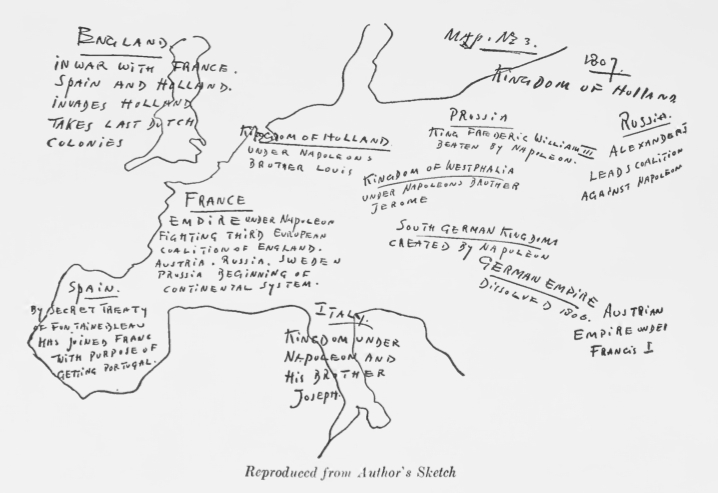
What more can we say of the rule of this well-meaning monarch? He was the receiver appointed in a bankrupt business. It was a wonder that he could maintain himself for four whole years. He was not a man who made friends easily. A rapidly developing sense of his own dignity gradually isolated him from those men who meant well with the king and the country. He tried to improve the arts and sciences by founding an academy. But painters and poets cannot be made to order, and his academy did not flourish.
Agriculture and commerce were encouraged by the construction of a number of excellent roads and the making of several important polders. But with all foreign markets, except the French, closed to them, the products of the farmer and the manufacturer could not be exported. The good intentions were all there, but the adverse circumstances were too powerful. The king was tender-hearted. When there was a national calamity, a fire, or an inundation, the king might be seen on the nearest dike trying to fish people out of the flood. But with Christian charity alone a nation cannot be made prosperous.
The king tried to get rid of the French influence. His wife, who intrigued against him with her cousin, the French minister, opposed his independent plans. The king then tried to get rid of his wife; but brother Napoleon, who contemplated divorcing his own wife, in order to marry into a better family, did not like the idea of two separations in the family at the same time, and Louis was obliged to stay married. He then tried to get rid of the French minister, but Napoleon supported his envoy and refused to recall so devoted and useful a servant.
It was England which finally spoiled King Louis' last chances. After a long preparation, during which Napoleon had frequently taken occasion to warn his brother, the English fleet crossed the North Sea and attacked the Dutch island of Walcheren preparatory to an assault upon Antwerp, Napoleon's great naval base. The strong town of Flushing, after a bombardment which incidentally destroyed every house in that city, was taken by the British forces, and the advance against Antwerp was begun. The French, however, had been able to make full preparations for defence. Bernadotte had inundated the country surrounding the Belgian fortress, and the British were obliged to stay where they were, on the Zeeland Islands. As usual, Holland paid the expenses. When finally the malarial fever had driven the English out of the country, the plundered provinces had to be kept alive by public charity.
Napoleon was furious. His pet scheme, the glorious harbour of Antwerp, had almost fallen into English hands. Why had not his brother taken measures to prevent such a thing? "Holland was merely a British dependency where the English deposited of their wares in perfect safety. The Emperor's own brother was an ally of England. Why does he not equip an army strong enough to resist such British aggressions? The Kingdom of Holland says that it is too poor to pay more for an army. Lies, all lies. Holland is rich. It is the richest nation on the continent. But every time the pockets of their High and Mightinesses are touched they make a terrible noise and plead poverty. Don't listen to their complaints. Make them pay! Do you hear? Make them pay!" And so on, and so on. There exists an entire correspondence to this effect. Louis answered as best he could. The Emperor was not satisfied. He sent for his brother to come to Paris. Louis went. When he arrived, Napoleon scolded him openly before his entire court, before the new wife which his armies had obtained for him in Vienna. The humiliation was great, but still Louis refused to resign and deliver the country of which he had grown fond to the tender mercies of his august brother. Even when, in March of the year 1810, Napoleon, by a sudden decree, annexed part of the south of the kingdom, Louis refused to give in and depart. For a while he contemplated armed resistance to the French armies. Krayenhoff worked on a plan for the inundation of Amsterdam. A number of generals who were suspected of French sentiments were dismissed. The idea, however, was given up as altogether too impossible. The Dutch ministers would not follow their king. The council of state refused to give him money for such purposes. And Napoleon gathered a large army and began to move his troops in the direction of Amsterdam.
Louis, despairing of everything for the future of himself and his country, would not continue to rule under such circumstances. On the 1st of July, 1810, he abdicated in favour of his small son. The child, just seven years old, was to be king under the guardianship of his mother, the admiral, Verhuell, and a number of the leading members of the cabinet.
On the night of the 2nd of June Louis, under the incognito of a Count of Leu, left his palace in Haarlem and departed forever from his kingdom. In the year 1846 he died in Livorno. Six years later his son ascended the French throne as Napoleon III.
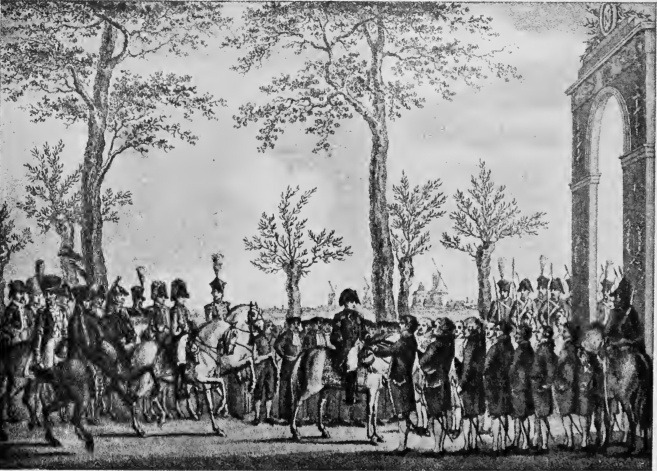
News of the abdication reached Paris at the very moment that the troops of Napoleon took possession of Amsterdam. One week later, on the 9th of July, Napoleon signed the decree of annexation. The little bit of mud deposited upon the shores of the North Sea by the French rivers, and for some years known as the Dutch Republic, ceased to be an independent state and became a minor French province.
Napoleon visits Amsterdam
XXII
THE DEPARTMENT FORMERLY CALLED HOLLAND
For the next three years the Hollanders went to the French school. The teachers were severe masters, but the pupils learned a lot. The Batavian Republic, and even the kingdom of Louis Napoleon, had been but continuations of the old partisan struggles of the former republics. The new state of affairs wiped the slate clean. The government came into the hands of French superiors who trained the lower Dutch officials in the new methods of governmental administration, who insisted upon running the state as they would a business firm, and to whom the petty considerations of former partisanship meant absolutely nothing. Uniform laws for the entire country, which the different assemblies had not been able to institute, were drawn up and were enforced upon all Hollanders with equal severity. The old system of jurisprudence, different for every little province, town, or village, was replaced by one single system. The Code Napoleon became the law for all.
The old trouble with the armed forces which had put the republic under the obligation of hiring mercenaries was now done away with. The new conscription took in all able-bodied citizens, put them all in the same uniform, and gave them all the same chance to serve their country and be killed for its glory.
1811. Holland annexed by France.
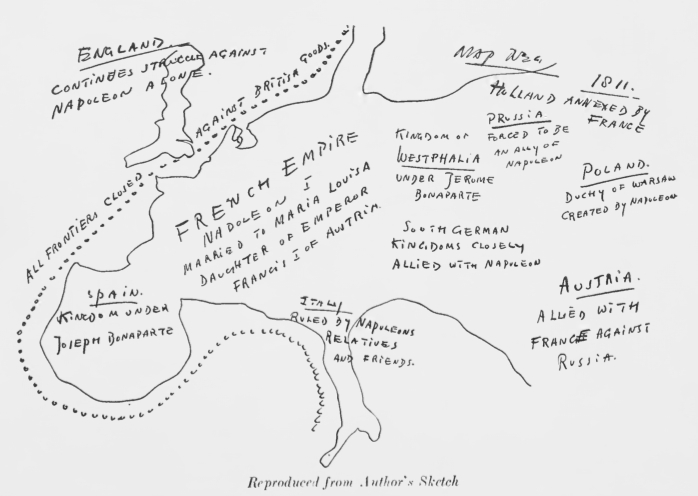
Reproduced from Author's Sketch.
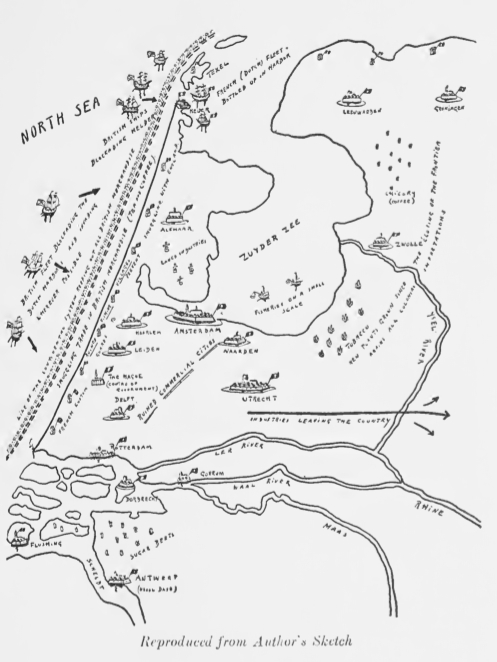
But, best of all, that old atmosphere in which a man from one village had looked upon his nearest neighbour from another village as his worst enemy was at last cleared away. A man might have been an Orangeist or a federalist or a Jacobin, he might have believed in the supreme right of the state or the divine right of his own family—before the new ruler this made no difference. Napoleon asked no questions about the past. He insisted upon duties toward the future. Before that capital N all men became equal, because they all were inferiors. Promotion could be won only by ability and through faithful service. Family influence no longer counted. Humble names were suddenly elevated if their possessors showed themselves worthy of the Emperor's confidence. The whole country was thrown into one gigantic melting-pot of foreign make and stirred by a foreign master without any respect for the separate ingredients out of which he was trying to brew his one and indivisible French Empire.
The new French province was arbitrarily divided into departments. The old provincial names and frontiers were discontinued. Each little department was called after some river or brook which happened to flow through it. At its head came a prefect, invariably a Frenchman. A French governor-general resided in The Hague to exercise the supreme command.
Fortunately the first governor-general, the French General Lebrun, Duke of Plaisance, was a decent old man who did his best to make the sudden change from Hollander into Frenchman as little painful to the subject as possible. And his subjects, if they did not actually love the old gentleman, always treated him with respect and deference. But the same thing cannot be said of a majority of the French prefects. They were insolent adventurers who had fought their way up from among the ranks, but who had neither understanding nor affection for the despised Hollanders over whom they were called to rule.
A large French army came to Holland and French garrisons were placed in all of the more important cities. Churches and hospitals were hastily turned into barracks, and the soldiers made themselves entirely at home. French customs officers were placed in all the villages along the coast. They watched all harbours. A French soldier sailed on every fishing smack to prevent smuggling. The entire village was responsible for his safe return. French police spies made their entry into Dutch society and kept a control over all Dutch families. The French language was officially introduced into all schools, theatres, and newspapers. The universities, except the one in Leiden, were abolished or changed into secondary schools. What gradually made the French rule so unpopular, and what finally made it so universally hated, was not the introduction of an entirely new form of government. The political innovations were hailed by the thinking part of the nation with considerable joy. Foreign influence brought about improvements which the people themselves, with their age-old political prejudices, could not have instituted. It was not the ever-increasing severity of the taxes nor the unpleasant presence of a large French army which made the people regard Napoleon as the incarnation of Antichrist. The opposition to everything French began the moment Napoleon started to interfere with those undefinable parts of daily life which we call the national character, or, still shorter, the "nationality." Napoleon, himself an Italian ruling over Frenchmen, does not seem to have understood this sentiment at all. Under different circumstances he would just as happily have made his career in Russia or in China. His failures in every country date from the moment when he attacked the nationality of his enemies. The Dutch or the Spanish or the German child could be made to speak French in school, but the soldiers of the Emperor could not force the mother of the child to teach it French when first it began to prattle. The Dutch citizen could be forced to read a newspaper printed in French and to attend a church where the sermon was preached in French, but he could not be made to think in that language. Dutch nationality, driven violently from the public places, hid itself in the home, and there entrenched itself behind impregnable barriers. At home the nation suffered, and in the proscribed language talked of the future and the better times which must certainly follow. For when the year 1812 came the nation had reached a depth of misery so very low that things simply could not be worse. The most despondent pessimist by the very hopeless condition of affairs was turned into an optimist. Trade and commerce were gone; smuggling was impossible; factories stood empty and deserted; no dividends were paid. By imperial decree the national debt had been reduced to one third of its actual size. Families whose income had been three thousand guilders now received one thousand. Those who had had one thousand became paupers. One fourth of the people of Amsterdam were kept alive by public charities, until finally the charities themselves had no more to give, and had to go into bankruptcy. Another fourth of the population, while not absolutely dependent, received partial support. The other half of the people were obliged to give up everything that was not absolutely necessary for just simple existence. They dismissed their servants, they sold their horses, they refrained from buying books and articles of luxury.
Departure of Gardes d'Honneur from Amsterdam
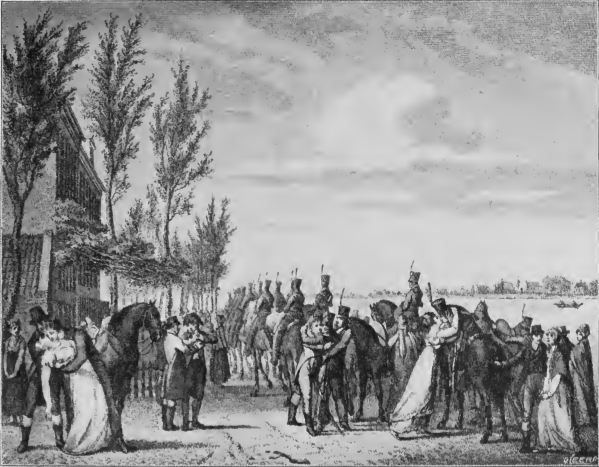
Then came the sudden blow of the conscription. First of all, the young men of twenty-one years of age were taken into the army. Then the conscription was extended upward and downward. Finally, those who had celebrated their nineteenth birthday in the year 1788 were forced to take up arms. The few boys who drew a high lot and were free if they belonged to the higher classes were honoured with a patent of a sub-altern in his Majesty's personal bodyguard. If they were poor they were used for some extra duty, as hospital soldiers, or were enlisted under some flimsy pretext. In short, there was no way of escape. After a while there was not a family in the land, be it rich or poor, whose sons or brothers were not serving the Emperor in his armies, and in far-away countries were risking their lives for a cause as vile as any that has ever been fought for.
Came the year 1812 and the preparations for the expedition against Russia. Fifteen thousand Dutch troops were divided among the French armies as hussars, infantry, artillery, or engineers. They were not allowed to form one Dutch contingent for fear of possible mutiny. As a minor part of the enormous army of invasion they marched across the Russian plains. A few of the men managed to desert and to join the English troops or the irregular bands which were beginning to operate in Germany. The others were frozen to death or were killed in battle. The Fourth Dutch Hussars charged a Russian battery and was reduced to forty-six men. This was at the beginning of September. A month later the Third Grenadiers was decimated until only forty men were left. Of the four regiments of infantry of the line only one came back as such. The others, shot to pieces, reduced by cold and starvation, gradually wandered home as part of that endless stream of starving men who early in 1813 began to beg for bread along the roads of eastern Prussia. Of the Second Lancers only two men ever saw their fatherland again. The Thirty-third Light Infantry was practically annihilated, until only twenty-five men survived, and they as prisoners in Russia. Of two hundred Hollanders serving in the One Hundred and Twenty-fourth Infantry not a single one ever returned.
It was a terrible story, but it did not affect the Emperor. His answer to the catastrophe was a demand for more troops. The sailors were taken from the fleet. Young boys and old men were mustered into the army. Here and there Dutch farmers, first robbed of their money, then of their possessions, finally deprived of their sons, resisted, took pitchforks and killed a few gendarmes. Immediate reprisals followed. The culprits were stood against the nearest trees and shot, the sons were marched off to the army, and the farms were confiscated.
One hundred years ago, at the moment we are writing this chapter, on the 18th of November, 1813, old man Bluecher, cursing and swearing at the Corsican blackguard, whirled his cavalry against the left flank of the French army, smashed it to pieces, and changed Napoleon's victory of Leipzig into a defeat. After a week the first news of the Emperor's defeat reached the republic. Officially it was not announced until some months later. Even then it made little impression. The people were too dejected to rejoice. They had heard of such defeats before, and invariably the announcement had been followed by a masterstroke on the part of the terrible Emperor and a rehabilitation of his military prestige. Here and there in the universities and in the schools some teachers began to whisper that the days of slavery might be soon over. But nobody dared to listen. Only a fool or a college professor could believe in the final victory of the allies.
It was now near the middle of November. Most of the French troops had been called to the frontiers. A few regiments of custom-house men had been left behind, and a few companies of either very old or very young men. It was a dangerous moment. In the east the allies were rapidly approaching the Dutch frontiers. The possession of the Dutch harbours would mean direct communication with England and an open road to the British goods and the British money of which the allies were in such desperate need. That Holland on this occasion was not conquered by the allies as French territory was entirely due to the energy of one man, bravely supported by a small number of able friends.
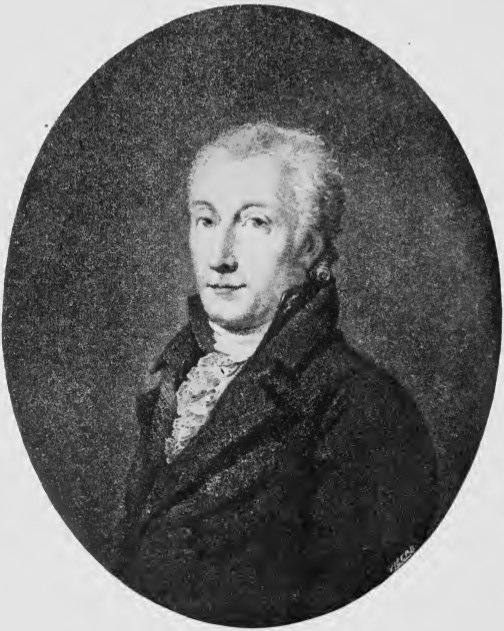
Gysbert Karel Van Hogendorp
XXIII
LIBERATION
The name of Van Hogendorp has been frequently mentioned before. First of all as the adviser of the Princess Wilhelmina during her attempt to cause some spontaneous enthusiasm for her husband, who had been driven out of his province of Holland by the Patriots. After the year 1795 we have been able to call attention repeatedly to the conduct of this excellent gentleman, who was most obstinate in his fidelity to his given word and refused to consider himself freed from the oath of allegiance which he once had sworn to the Stadholder. He simply refused all overtures from the side of the revolution, and later from King Louis, and lived a forgotten existence in a big and dignified house. He had a brother, Charles, who thought him to be altogether too idealistic, and who had accepted a position under the Emperor and was at this time a well-known general. For the rest, and outside of his own family, Van Hogendorp for many years did not associate intimately with a great number of people. The last years had been very dangerous to those who engaged conspicuously in social life. French spies might have wondered why Mr. So and So was so very fond of the company of his neighbour, and some fine night both gentlemen might have been lifted out of their beds, their correspondence confiscated, and for weeks or even months they might have been kept in jail. It was one of the measures of the Emperor himself which directly drove a number of prominent Dutch families into a closer union. The creation of the so-called Guards of Honour meant that all the boys of the higher classes, who formerly had been often allowed to send substitutes, now had to enter the army personally. There had been very great opposition. The police had had to interfere and had been obliged to drag many of the recruits to the barracks. Arrests had been made and fines had been imposed, and out of sheer misery many families who had not been intimate before now came to know each other more closely. It was among those unfortunate people that Van Hogendorp first seems to have looked for associates and confederates in his plans for a revolution against the French Government. Of course, of a revolution which even in the smallest degree shall resemble the rebellion against Spain, we shall see nothing. Everything in Holland during those years was on a small scale. The nation was old and weakened and tottered around with difficulty. Not for a moment must we imagine a situation where enthusiastic Patriots rush to the standard of rebellion. All in all we shall see perhaps a dozen men who are willing to take the slightest personal risk and who by sheer force of their character shall compel the rest of the nation to follow their example. It was a revolution in spite of the Dutch people, not through them.
It is not merely for convenience sake that we take Van Hogendorp as the centre. He was really the man of imagination who, long before the French had been beaten, understood that this Napoleonic empire, built upon violence and deceit, could not survive—must inevitably perish, and that soon the time would come for his own country to regain its independence. He had studied the situation with such care that he was able to time his uprising very precisely. When the news came of the battle of Leipzig, Van Hogendorp was engaged upon a rough draft of a new constitution for the benefit of the independent republic which he felt must soon materialize.
Now the expected had happened. Napoleon had been beaten and was in full flight. The allies were marching upon the French and Dutch frontiers. The next weeks would decide everything. It was a period of the greatest confusion. The Emperor, engaged in creating new armies out of almost impossible material, had no time to give orders to his outposts. The French army in the department formerly called Holland must help itself. The result of this ignorance about the general affairs in France and Germany was a hopeless diversity in false rumours. Every single hour, almost, the prefects in the provinces and the governor-general in The Hague were surprised by some new and terrible story. One moment a report was spread throughout the town that the Emperor was dead. The next day it was contradicted: the Emperor had merely gone crazy. The next day he was in his right mind again, but had been taken prisoner by the Cossacks, and the French had crossed the Rhine. After a while, however, some definite orders came from Paris. The French army must concentrate and try to defend the frontiers of France. Here was news indeed. On the evening of the 14th of November, 1813, the French troops in Amsterdam were packed in a number of boats and rowed away in a southern direction. Amsterdam was without a garrison. Immediately there followed a terrific explosion. The poor people, after so many years of misery and hunger, after so many months in which they had tasted neither coffee nor sugar, not to speak of tobacco, burst forth to take their revenge. The French soldiers were gone. The only visible sign of the hated foreign domination was the little wooden houses which up to that day had been occupied by the French douaniers. Half an hour after the last Frenchman had disappeared the air was red with the flames of those buildings, and the infuriated populace was dancing a wild gallop of joy around the cheerful bonfire.
But right here we come to one of the saddest parts of the year 1813. These insurgents, rebels, hoodlums, or whatever you wish to call them, received no support from above. The old spirit of the regents was still too strong. The higher classes saw this wild carousal, but instead of guiding it into an organized movement to be used against the French, they were terribly scared, thinking only of danger to their own property, and decided to stop the violent outbreak before further harm could be done. With promises of the splendid things that might happen to-morrow they got the people back into their slums. Then they quickly organized a volunteer police corps and made ready to keep the people in their proper place, and actually prevent further outbreaks. That the time had come to throw off the French yoke does not seem to have been apparent to the majority of the former regents, who hastened back to the town hall the moment the French burgomasters had left. They were scared, and they refused to budge. The French flag was kept flying on the public buildings. Napoleon might come back, and the regents were not going to be caught standing on a patriotic barricade waving Orange banners. The fame for the first open outbreak goes to the poor people of Amsterdam. But the old conservative classes of the city prevented the town from actually becoming the leader of this great movement for Holland's independence. Late in the evening of the 16th of November the news of the burning of the French custom-houses in Amsterdam reached The Hague. A few hours before the French governor had left the residence and had gone to Utrecht to be nearer the centre of the country. But several French troops and policemen had been left behind to keep order. At three o'clock of the night of the 17th, while the town was asleep, Van Hogendorp sent a messenger to the Dutch commander of the civic militia. The commander came, but regretted to report that his militia had been left entirely without arms by the French authorities, who suspected them of treason. The mayor was then appealed to. He was told of the danger that might occur should the common people attack the French troops. The militia must have arms to keep order. The mayor, who was a Hollander, readily gave the required permission. Just before sunrise the town guards were assembled in front of the old palace of the Stadholders. They were given arms and were told to keep themselves in readiness. That was the moment for which Van Hogendorp had waited.
With a large orange-coloured bow upon his hat, General Leopold van Limburg Stirum, the friend and chief fellow-conspirator of Van Hogendorp, suddenly appeared upon the public street. Slowly, with a crowd of admiring citizens behind him, he walked to the place where the militia waited. There he read a proclamation which Van Hogendorp had prepared beforehand:
"Holland is free. Long live the House of Orange. The French rule has come to an end. The sea is open, commerce revives, the past is forgotten. All old partisanship has ceased to be, and everything has been forgiven."
Proclamation of the new Government
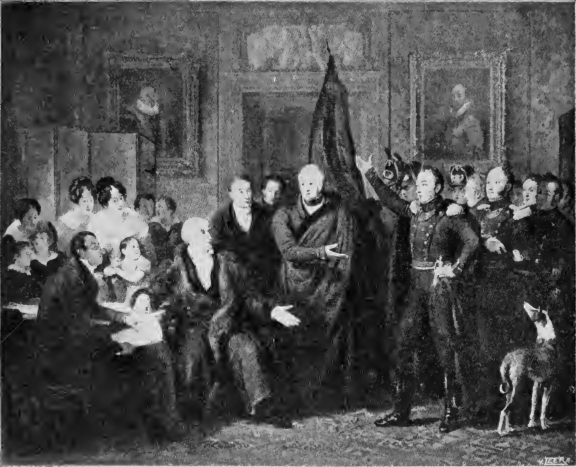
Then the proclamation went on to indicate the new form of government. There would be founded a state in which all men of some importance would be able to take part, under the high leadership of the Prince of Orange. The militia listened with approval, then with beating drums and waving the Orange colours, which had not been seen for almost a generation, the soldiers marched through the excited town directly to the city hall. The old flag of the republic was hoisted on the tower of the church nearby. Within an hour the news of this wonderful event had spread throughout the town. On all sides, from doors and windows and upon roofs, the old red, white, and blue colours mixed with orange appeared. Orange ribbons, still disseminating a smell of the moth-chest in which they had lain hidden for so many years, appeared upon hats and around sleeves, were waved on canes, and put around the collars of the domestic canines. Spontaneous parades of orange-covered citizens began to wander through the streets.
The House of Van Hogendorp became the centre of all activity. In the afternoon of the same day Van Hogendorp and a number of his friends assumed the Provisional government, to handle the affairs of the state until the Prince of Orange should come to assume the highest leadership.
So far, the conspirators had been successful. The French soldiers showed no desire to oppose this popular movement, but they were still present in their barracks and constituted an element of grave danger. But in the afternoon the fisherfolk of Scheveningen, ultra-Orangeists, began to hear of the great doings in The Hague and enthusiastically made up their minds to join. And when the influx of this proverbially hard-fisted tribe became known to the French they decided that their number of five hundred was not sufficient to suppress the popular excitement. Hastily they packed their belongings and marched away in the direction of Utrecht. But before they had been gone half an hour, some two hundred Prussian grenadiers deserted and returned to The Hague, where they were received with open arms, and where they joined the populace with loud hoorays for the Prince of Orange and the hospitable Dutch nation.
Mere shouting, however, although a very necessary part of a revolution, has never yet brought about a victory. It was necessary to do some more substantial work than to cause a popular outbreak of enthusiasm. There must be order and a foundation upon which the new authorities should be able to construct a stable form of government. Van Hogendorp, therefore, took the next necessary step and hastily called upon all the former regents who could be reached to come and deliberate with him upon the establishment of a legitimate provisional form of government. Right there his difficulties began. The regents refused to come. They, like their brethren in Amsterdam, were afraid. Napoleon was invincible. They knew it. He was certain to regain the lost ground, and then he would come and take his revenge. And as far as they were concerned, the regents intended to stay at home. Only a few of them dared to come forward.
Amsterdam at this first meeting was represented by one man. His name was Falck. He was a homo novus, but by far the most capable of those who appeared at the house of Van Hogendorp, and he was at once selected to be the secretary of the meeting. Falck understood that such a poor beginning was worse than no revolution at all. The country must not return to the old bad conditions. The former regents had shown their lack of interest. A meeting must be called together of men from among all parties. Accordingly, on the 20th of November, a general meeting of notabilities from among all the former political parties was called together. It was not much more successful than the first one. The people distrusted it profoundly. They thought that there was to be a repetition of the old Estates General and that the conservative elements would again be in the majority. What was worse, the members of this informal convention had no confidence in themselves. Half a dozen were willing to go ahead. The others hesitated. They wanted to proceed slowly until they should know what would happen to the allies and what would become of Napoleon. The country had no army, it had no money, it had no credit.
In vain did Van Hogendorp talk to each member individually, in vain did he and his friends try every possible means of personal persuasion. The conservative elements were still too strong. The regents preached against more revolution. The French had been bad enough, but they did not wish to come once more under the domination of their own common people.
In this emergency all sorts of desperate remedies were resorted to. A British merchantman appeared before the coast near Scheveningen. At once Van Hogendorp sent word to the captain and asked him to put on his full uniform as a British militia officer and with a few of his men parade the streets of The Hague and Rotterdam. In this way the report would become current that a British auxiliary squadron had appeared before the coast. The captain did his best, and put on all his spangles. He did some good, but not so very much. Next, the leaders in The Hague asked for volunteers to form a Dutch army. Six hundred and thirty men answered the summons. Badly equipped and armed, they were marched to Amsterdam, where they were joined by a company of militia under the ever-active Falck. They arrived just in time. The next day the first advance guard of the army of the allies, a company of Cossacks, appeared before the gates of the town, and it was by the merest piece of luck that Amsterdam could welcome them as friends and need not open her gates to them as conquerors.
But withal, the situation was most precarious. In the north Verhuell held the fleet and threatened the Dutch coast. In the south all the principal cities were in French hands. In the centre of the country the French had fortified themselves considerably and even made frequent sallies upon the territory of the rebels, which cost the latter considerably in men and money. Finally, in the far east, Bluecher was preparing to invade the republic and make her territory the scene of his battles. For a moment it seemed that all the trouble had been for no purpose. Only one thing could save the situation. The Prince of Orange must come, must inspire the people with greater diligence for the good cause, and must take command of the disorganized forces.
Question: Where is the Prince? Nobody knew. He might be in England, but then, again, he might be with the allies somewhere along the Rhine. Messengers had been sent to London and to Frankfort. Those who went to Frankfort did not find the Prince, but they found the commanders of the allies and had the good sense to tell a fine yarn—how Holland had freed itself, and how the French had been ignominiously driven out. As a matter of fact, the Prince was in England, and in London, on the 21st of November, he heard how his arrival was eagerly awaited and how he must cross the North Sea at once. Five days later, well provided with men and money, he left the British coast on the frigate Warrior. An easterly wind, which nineteen years before had driven his father safely across the waters, delayed his voyage. For four whole days his ship tacked against this breeze. One British ship with 300 marines landed on the Dutch coast on the 27th, but nothing was heard of the Prince. The anxiety in Holland grew.
The fisher fleet of Scheveningen was sent out cruising in front of the coast to try to get in touch with the British fleet. But the days came and the days went by and no news was reported which might appease the general anxiety. Finally, on the morning of the 30th of November, the rumour spread suddenly through The Hague that the British fleet had been sighted. The Prince was coming! Then the people went forth to meet their old beloved Prince of Orange. Everything else was now forgotten. Along the same road where almost twenty years before they had gone to bid farewell to the father whom they had driven away, they now went to hail the son as their saviour.
At noon of Friday, the 30th, the Warrior came in sight. The same fisherman who eighteen years before had taken William to the ship which was to conduct him into his exile was now chosen to carry the new sovereign through the surf. With orange ribbons on his horses, with his coat covered with the same faithful colour, the old man drove through the waves. At four o'clock of the afternoon a sloop carrying the Prince left the British man-of-war. Half an hour later William landed.
Arrival of William I in Scheveningen
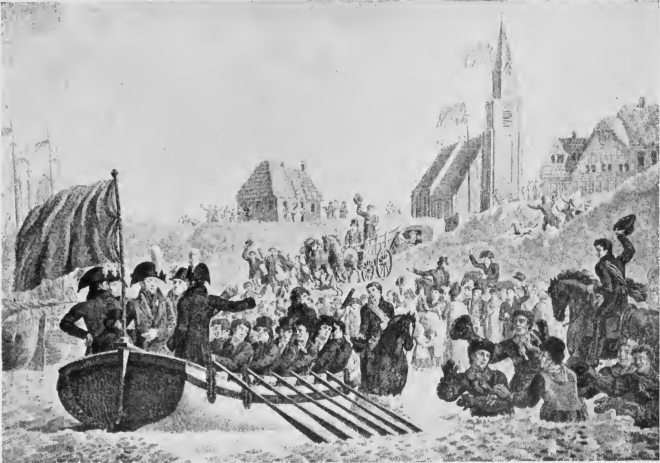
The shore once more was black with people. The old road to The Hague was again lined with thousands of people. Little boys had climbed up into trees. Small children were lifted high by their mothers that they might get a glimpse of the hallowed person of a member of the House of Orange. A few people, from sheer excitement, shrieked their welcome. They were at once commanded to be silent. The moment was too solemn for such an expression of personal feeling. Here a nation in utter despair welcomed the one person upon whom it had fixed its hope of salvation. In this way did the House of Orange come back into its own—with a promise of a new and happier future—after the terrible days of foreign domination and national ruin.
XXIV
THE RESTORATION
Van Hogendorp did not witness this triumphal entry. He was sick and had to keep to his room. Thither the Prince drove at once, and together the old man and the young man had a prolonged conference.
What was to be the exact position of the Prince, and what form of government must be adopted by the country? On the road from Scheveningen the cry of "Long live the King!" had been occasionally heard. Was William to be a king or was he merely to continue the office of Stadholder which his fathers had held? Van Hogendorp's first plan to revive the old oligarchic republic had failed at once. The regents had played their rôle for all time. They had showed that they could not come back. They had lost those abilities which for several centuries had kept them at the head of affairs. The plan of Falck to create a government on the half and half principle—half regent, half Patriot—had not been a success, either. The Patriots as a party had been too directly responsible for the mistakes of the last twenty years to be longer popular as a ruling class. A new system must be found which could unite all the best elements of the entire country. Surely here was a difficult task to be performed.
The country to which Prince William was restored consisted at that moment of exactly two provinces. The army numbered 1,350 infantry and 200 cavalry. The available cash counted just a little under 300,000 guilders. The only thing that was plentiful was the national debt. To start a new nation and a new government upon such a slender basis was the agreeable task which awaited the Prince, and yet, after all, the solution of the problem proved to be more simple than had been expected. The old administrative machinery of the Napoleonic empire was bodily taken over into the new state and was continued under the command of the Prince. The higher French dignitaries disappeared and their places were taken by Hollanders trained in the Napoleonic school. The army of well-drilled lower officials was retained in its posts. Except for the fact that Dutch was once more made the official language, there was little change in the internal form of government. The modern edifice of state which had been constructed by Napoleon for the unwilling Hollanders was cleaned of all Frenchmen and all French influence, but the building itself was not touched, and after the original architect had moved out, the impoverished Dutch state continued to live in it with the utmost satisfaction.
But now came the question of the title and the position of the new head of the household. Was it possible to place the state, which for so many years had recognized an outlandish adventurer as its emperor, under the leadership of a mere Stadholder? Was it fair that the Prince of Orange should rule in his own country as a mere Stadholder where the country had just recognized a member of a foreign family as its legitimate king? The higher classes might have their doubts and might spend their days in clever academic disputations; the mass of the people, however, instinctively felt that the only right way out of the difficulty was to make the son of the last Stadholder the first king of the resurrected nation.
Before this popular demand, William, who himself in many ways was conservative, and might have preferred to return merely as Stadholder, had to give way. With much show of popular approbation he set to work to reorganize the country as its sovereign ruler and no longer as the subordinate executive of its parliament.
The first task of the sovereign, when on the 6th of December he took the government into his own hands, was to abolish the most unpopular of the old French taxes. The government monopoly of tobacco was at once suppressed and joyous clouds of smoke spread heavenward. The press was freed from the supervision of the police, under which it had so severely suffered. The law which confiscated the goods of political prisoners and which had been so greatly abused by the French authorities disappeared, to the general satisfaction of the former victims. The clergy, which for many years had received no salary at all and had been supported by public charity, saw itself reinstated in its old revenues. But the time had not yet come in which William could devote himself exclusively to internal problems. The question of the moment was the military one. The French still occupied many Dutch fortifications. They must first of all be driven out. For this purpose the three thousand odd men were not sufficient. But no further volunteers announced themselves.
The first two weeks of enthusiasm had been followed by the old apathy. Neither men nor money was forthcoming. Everything was once more left to an allwise Providence and to the allies. During eighteen years the people had paid taxes. Now they kept their money at home. For almost ten years their sons had been in the army. They were not going to send them to be slaughtered for yet another king. The allies might do the fighting if they liked. And it was impossible to get Dutch soldiers. Not until the old government had begun to enforce the former French law upon the conscription was it possible to lay the foundations of a national army. After a year 45,000 infantrymen and 5,000 cavalrymen were ready to join the allies. Then, however, they were no longer needed. Napoleon was drilling his hundred rustics on the Island of Elba, and the Congress of Vienna had started upon that round of dinners and gayeties which was to decide the future destinies of the European continent.
After the army came the question of a constitution. This problem was settled in the following way: A committee of fourteen members was appointed to make a constitution. These fourteen gentlemen represented all the old parties. A concept-constitution, drawn up by Van Hogendorp long before the revolution took place, was to be the basis for their discussions. On the 2nd of March this committee presented the sovereign with a constitution which made him practically autocratic. There was to be a sort of parliament of fifty-five members elected by the provincial estates. But except for the futile right of veto and the exceptional right of proposing an occasional bill, this parliament could exercise no control over the executive or the finances. This was exactly what most people wanted. They had had enough and to spare of popular government. They were quite willing to leave everything to an able king who would know best what was good for them.
On all sides the men of 1813 were surrounded by the ruins of the failures of their inexperienced political schemes. The most energetic leaders among them were dead or had been forced out of politics long ago. Of the younger generation all over Europe the best elements had been shot to pieces for the benefit of the Emperor Napoleon. The people that remained when this scourge left Europe were the less active ones, the less energetic ones, those who by nature were most fit to be humble subjects.
On the 29th of March six hundred of the most prominent men of the country were called together at Amsterdam to examine the new constitution and to express their opinion upon the document. Only four hundred and forty-eight appeared. They accepted the constitution between breakfast and luncheon. They did not care to go into details. Nobody cared. People wanted to be left in peace. Political housekeeping had been too much trouble. They went to board with their new king, gave him a million and a half a year, and told him to look after all details of the management, but under no circumstances to bother them. And the new king, whose nature at bottom was most autocratic, assumed this new duty with the greatest pleasure and prepared to show his subjects how well fitted he was for such a worthy task.
XXV
WILLIAM I
On the 20th of July, 1814, Russia, Austria, and Prussia, together with England, agreed to recognize and support the new Kingdom of Holland and to add to the territory of the old republic the former Austrian possessions in Belgium. This meant the revival of a state which greatly resembled the old Burgundian Kingdom. The allies did not found this new country out of any sentimental love for the Dutch people. England wanted to have a sentinel in Europe against another French outbreak, and therefore the northern frontier of France must be guarded by a strong nation. To further strengthen this country England returned most of the colonies which during the last eighteen years had been captured by her fleet. But before the new kingdom could start upon its career General Bonaparte had tired of the monotony of his island principality and had started upon his well-known trip to Waterloo. The new Dutch army upon this occasion fought well and at Quatre Bras rendered valuable services.
Kingdom of the Netherlands
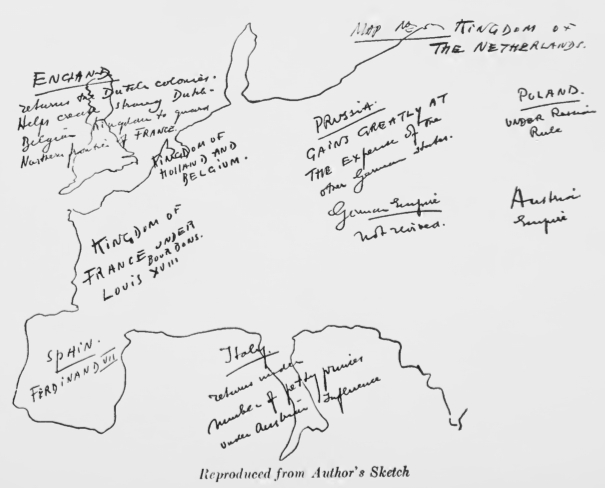
General Bonaparte was dispatched to St. Helena, a fate which of late has inspired many sentimental folk to the point of writing books, and the Kingdom of Holland-Belgium could begin its independent existence in all seriousness. King William, in this new country, remained the absolute ruler. Instead of one there were to be two chambers in his new domains. But the executive and legislative power was all vested in the hands of his Majesty. He, on the whole, made use of them for the very best purposes. In a material way he attempted every possible remedy for the poverty of the country. As far as dollars and cents go he was an excellent king. Canals were dug all over the country; commerce was encouraged in every possible way; the colonies were exploited with energy; factories were built with and without support of the state, and the mineral riches of Belgium were fully developed. A plan for a Panama, or, rather, a Nicaraguan Canal was seriously discussed. And yet William failed. The task to which he had been called was an impossible one. Belgium and Holland had nothing in common but their mutual dislike of each other. Protestant Holland, proud of its history, had no sympathy for Catholic Belgium, where the Middle Ages had peacefully continued while the rest of the world had moved forward. Catholic Belgium returned these uncordial sentiments most heartily, and with the worst of prejudices awaited the things which must be inflicted upon it by a Protestant king.
A man of such pronounced views as King William was certain to have many and sincere enemies. Furthermore, the French part of Belgium, following the example of its esteemed neighbours, enjoyed a noisy opposition to the powers that were as a sort of inspiring political picnic. But the real difficulties of William's reign began when he got into a quarrel with the Catholic Church. This well-organized institution, which will provide all things to all men, under all conditions and circumstances, was directly responsible for the ultimate break between the two countries. We are not discussing the Church as an establishment for the propagation of a certain sort of religious ethics; but we must regretfully state that the entrance of the Church upon the field of practical politics has invariably been followed by trouble in the most all-around sense of the word.
William as King of the Netherlands felt his responsibility and felt it heavily. He and He Only (make it capitals) was the head of the nation. And when it appeared that the Bishop of Rome or the Bishop of Liège or any other bishop aspired to the rôle of the power above the throne he found in William a most determined and most sincere enemy. The Church, assured of her power in a country which for so many centuries had been under her absolute influence, became very aggressive, and her leaders became very bold. William promptly landed the boldest among the bishops in jail. And that was the beginning of a quarrel which lasted until Catholics and Liberals, water and fire, had been forced to make common cause against their mutual enemy and started a secret revolution against William's rule, which broke forth in the open in the year 1830.
Lieutenant Van Speyck blows up his ship
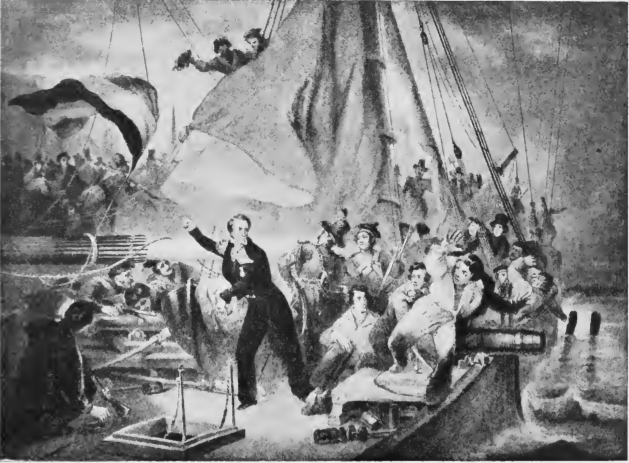
The northern part of the country, for the first time in almost thirty years, began to take an interest in politics and commenced showing hopeful signs of life. And when in February, 1831, the commander of a small Dutch gunboat, Lieutenant van Speyck, blew his ship and all his sailors into the kingdom of brave men rather than surrender to the Belgian rabble which had climbed on board his disabled craft, such an unexpected enthusiasm broke loose that it took Holland just ten days in which to reconquer most of the rebellious provinces.
This, however, was not to the liking of France. In the first place, France was under the influence of a strong Catholic reaction and felt compelled to help the suffering brethren in Belgium. In the second place, France did not like the idea of a sentinel of England and hastened to recognize and support the Prince of Saxe-Coburg, who was called upon to mount the newly founded throne of the independent state of Belgium.
A large French army marched north to oppose a further advance of the Hollanders. William had to give up all idea of reuniting the two countries. Since when, divorced from their incompatible companions, the two nations have gone their different ways in excellent friendship and have established great mutual respect and understanding.
To King William, however, who had devoted his time and strength quite as much to Belgium as to Holland, the separation came as a terrible blow. William was one of those sovereigns who take a cup of coffee and a bun at five in the morning and then set to work to do everything for everybody. He could not understand that mere devotion to duty was not sufficient to make all his subjects love him. Perhaps he had not always shown great tact in dealing with religious matters. But, then, look at his material results. The Prince, who seventeen years before had been hailed as the saviour of his country, now began to suffer under the undeserved slights of his discontented citizens and was made a subject for attacks which were wholly unwarranted. That the conditions in the kingdom were in many ways quite unsatisfactory, is true; but it was not so entirely the fault of the king as his contemporaries were so eager to believe. They themselves had at first given him too much power. They had without examination accepted a constitution which allowed their parliament no control over monetary matters. The result of this state of affairs had been a wholesale system of thefts and graft. The king knew nothing of this, could not have known it. There were private individuals who thought that they could prove it, but the ministers of state were not responsible to the parliament, and there was no legitimate way of bringing these unsound conditions to the attention of the sovereign.
And so the discontented elements started upon a campaign of calumny and of silent disapproval, until finally William, who strongly felt that he had done his duty to the best of his ability, became so thoroughly disgusted with the ingratitude of his subjects that he resigned in favour of his son, who, as William II, came to the throne in 1840. William then left the country and never returned.
King William II
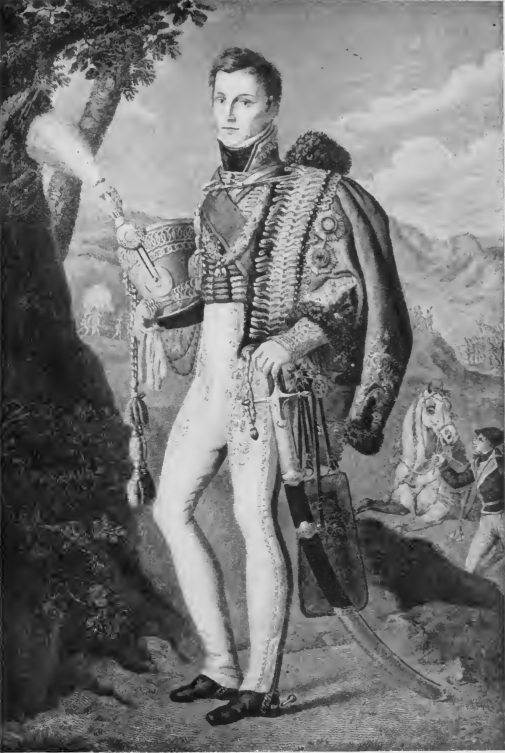
What must we say of William II? We are not trying to write a detailed history of the Kingdom of the Netherlands. This little book merely tries to fill out the mysterious and unexplored space between the end of the old Dutch Republic and the modern kingdom. Even these twenty years it does not try to describe too minutely, because on the whole (except for the people themselves) the period was so absolutely uninteresting to the outside world that we would not be warranted in asking the attention of the intelligent reader for more than a limited number of pages. William II was a good king in that he was a constitutional king. The year 1848 did not see the erection of barricades in the quiet Dutch cities. If the people, or, rather, the few liberals who had begun to develop out of the mass of indifferent material—if these gentlemen wanted another and a more liberal constitution very badly, they could have it as far as William II was concerned. And without revolution or undue noise the absolute kingdom which the men of 1813 had constructed to keep the men of 1795 in check was quietly changed into an absolutely constitutional monarchy after the British pattern, with responsible ministers and a parliament ruled by the different political parties. The budget now became a public institution, openly discussed every year by the whole people through their chosen representatives and their newspapers.
The king in this way became the hereditary president of a constitutional republic. There can be no doubt that the system was personally disagreeable to William II as well as to his son William III, who succeeded him in 1849. But neither of them for a moment thought of deviating from the narrow road which alone guaranteed safety to themselves and to their subjects. However much they may have liked or disliked certain individuals who as the result of a change in party had to be appointed to be ministers of the government, they never allowed their own personal feelings to interfere with the provisions of the constitution to which at their ascension to the throne they had sworn allegiance. This policy they continued with such excellent success that whatever strength the socialistic party or the other parties of economic discontent may at present be able to develop, those who would actually like to see the monarchy changed into a republic are so very rare and form such an insignificant part of the total population that a continuation of the present system seems assured for an indefinite length of time, which is saying a great deal in our day of democratic unrest.
As we write these final words a hundred years have gone by since the days of the French domination and of the many revolutionary upheavals; the nation of the year 1813, broken down under the hopeless feeling of failure, and the people, despairing of the future and indifferent to everything of the present which did not touch their bread and butter, have disappeared. One after the other they travelled the road to those open air cemeteries which they had so much detested as a revolutionary innovation, their ancestors all slept under their own church-pews, and their place was taken by younger blood.
But it was not until the year 1870 that we could notice a more hopeful attitude in the point of view of the Dutch nation. Then, at last, it recovered from the blows of the first twelve years of the century. Then it regained the courage of its own individual convictions and once more was ready to take up the burden of nationality. Once more the low countries aspired to that place among the nations to which their favourable geographical position, the thrift of their population, and the enterprise of their leading merchants so fully entitled them. The revival, when it came, was along all lines. Scholarship in many branches of learning compared very favourably with the best days of the old republic. The arts revived and brought back glimpses of the seventeenth century. Social legislation gave the country an honourable place among those states which earnestly endeavour to mitigate the disadvantages of our present capitalistic development and by direct interference of the legislature aim for a higher type of society in which the many shall not spend their lives in a daily drudgery for the benefit of the few.
The feeling that colonies were merely an agreeable asset to the merchants of the country and called for no special obligations upon their part gradually gave way to the modern view that the colonies are a trust which for many a year to come must stay in the hands of European men before they shall be able to render them to the natives for a rule of their own people. Finally that most awful and most despondent of all sentimental meditations, that "we have been a great country once," that "we have had our time," has begun to make place for the conviction that at this very moment no other nation of such a small area and insignificant number of people is capable of performing such valuable service in so many fields of human endeavour as is the modern Dutch nation.
The failure of the men of 1795, who dreamed their honest but ineffectual dream of a prosperous and united fatherland, the apparent failure of the first Dutch king who in the true belief of his own direct responsibility still belonged to a bygone age, have at last made place for a healthy and modern state capable of normal development.
Out of the ruins of the old divided republic—a selfish commercial body—there has risen, after a hundred years of experimenting and suffering, a new and honourable country—a single nation, not merely an indifferent confederacy of independent little sovereignties—a civic body managing its own household affairs without interference from abroad and without disastrous partisanship at home—a people who again dare to see visions beyond the direct interests of their daily bread, and who are given the fullest scope for the pursuit of prosperity and individual happiness under a government of their own choice and under the gracious leadership of her Majesty Queen Wilhelmina.
Brussels. Christmas, 1914.
THE END
A COMPARISON OF THE FOUR CONSTITUTIONS OF HOLLAND
CONSTITUTION OF 1798CONSTITUTION OF 1801
The Representative Assembly: A Council of State (Executive
The highest power in the State,Council, in Dutch: Staatsbewind)
to which all other governmentalconsisting of twelve members.
bodies are responsible. A Legislative Assembly.
The Executive Council of five National Syndicate consisting
directors.of three judicial officers to
The Representative Assemblycontrol all officials of the State
has the right of legislation,State and all departments of the
of making alliances and treaties,government.
of declaring war, of discussingThe Legislative Assembly
accepting the yearly budget,discusses all laws proposed by the
of appointing the directors ofCouncil of State. It discusses and
the Executive Council. It cangives its final approval to all
grant pensions and has the righttreaties (except certain articles
of pardon, and will decide inof such treaties). It has to give
all such questions which are notits approval to any declaration of
explicitly provided for by thewar. It discusses and approves the
constitution.annual budget.
The Executive Council must The Council of State
see to the strict execution of(Staatsbewind) makes up the annual
of all the laws of thebudget and proposes new laws to
Representative Assembly. Itthe Legislative Assembly. It sees
makes up a yearly budget whichto the execution of the laws which
must be submitted to thethe Legislative body has accepted.
Representative Assembly. It hasIt declares war (after it has
the right to appoint diplomaticobtained the approval of the
and consular representatives.Legislative Assembly). It is the
It negotiates treaties andhighest power in all affairs of
alliances, subject, however, toarmy and navy, and it has the
approval of the Representativeright of appointment of the
body.principal state officers. The
The Representative AssemblyThe Legislative Assembly
shall consist of one member forconsists of one single chamber of
every 20,000 inhabitants. Everythirty-five members.
year the Representative bodyThe members of the Legislative
shall be divided into a secondAssembly are for the first time to
chamber of thirty members andbe appointed by the Council of
a first chamber containing allState. Afterward their election
the others. (There werewill be regulated by law.
ninety-four members in all.)To be entitled to vote one must
The Representative Assembly isbe either a Hollander who has
to be elected in the followinglived in the country for one year
way: The country shall be dividedor a foreigner who has lived in
into ninety-four districts ofthe country for six whole years.
20,000 people each. TheseThe declaration of abhorrence of
districts are again dividedthe Stadholder, aristocracy, etc.,
into forty sub-districtsis no longer insisted upon. A
(grondvergadering) of 500 peoplesingle promise to "remain faithful
Stadholder, aristocracy, etc.,to the constitution" is now
each. Each subdistrict elects onesufficient.
candidate and one elector. If theThe Council of State is composed
same candidate was elected inof twelve members. The first seven
twenty-one sub-districts hemembers are appointed by "the
became a Representative.present Executive Council" (this
Otherwise forty electors choosemeant the three authors of the
a Representative from among theconstitution of the year 1810).
three candidates who had theThese seven were to appoint their
largest number of votes.five colleagues. Each year one of
Each year one third of thethe twelve members was supposed to
members of the Representativeresign. A vacancy was filled as
Assembly must resign, and afollows: The departmental circles
new election for their placesproposed four people. Out of those
must be held.four the Legislative Assembly
To be entitled to vote oneelected two. From among those two
must be either a Hollander whothe Council of State then selected
during the last two years hastheir new colleague.
lived in the country or aThe agents are replaced by
foreigner who has resided insmall advisory councils of three
the republic during the last tenmembers. They are responsible
years. The voter must be ableto the Council of State.
to read and write the DutchThe Legislative Assembly meets
language, and must have passedtwice a year: April 15 to June 1,
the age of twenty. To qualifyand October 15 to December 15.
as a voter one must swear aThe Council of State, however, can
solemn oath to the effect thatcall together the Legislative
one abhors the Stadholder,Assembly as often as it pleases.
anarchy, aristocracy, andThe Council of State proposes
federalism, and that one neverall laws. Twelve members of the
shall vote for any person whoseLegislative Assembly appointed by
opinions upon these subjects arethis body discuss the laws. The
not entirely above suspicion.Legislative Assembly then accepts
The Executive Council isthe law or vetoes it. No further
appointed by the Representativediscussion allowed in the
Assembly, but the members of theLegislative Assembly.
Council may not be members of theThe country is divided into
Executive. The first chambereight departments. The provincial
proposes three candidates. Thefrontiers of the old republic are
second chamber elects the memberreëstablished. Drenthe comes to
from among those three. Each yearOverysel and Brabant becomes the
one new member of the Council isnew, the eighth, department.
to be elected. After hisLocal government remains as
resignation he is not reëligiblebefore, but each city is allowed
until five years later.greater liberty in civic affairs,
The Executive Council appointsprovided the city does not try to
eight agents to act as heads ofchange the original idea of a
different departments (asdemocratic, representative
ministers more or less). Thesegovernment. The cities in this
agents are responsible andway regain a great deal of their
subordinate to the Council.old autonomy. The old interstate
The Representative Assemblytariff scheme of the former
meets the whole year round.republic is not allowed. But
New laws are proposed in andotherwise the cities regain most
discussed by the first chamber.of their former power.
Then they are submitted to the
second chamber, which has the
right of approval or veto, but
not the right of discussion.
The Executive Council must see
to the execution of these laws.
The country is divided into
eight departments with new names:
The department of the Eems, of
the Old Ysel, of the Rhine, of
the Amstel, of Texel, of the
Delf, of the Dommel, and of the
Scheldt and Maas. Their former
boundaries are given up and
arbitrary boundaries are made.
Each department is divided into
seven circles and the circles are
divided into communes.
Each department has a local
governmental body somewhat
resembling the old Provential
Estates. Each circle is
represented in this by one
member. These seven members are
elected by the voters. The
officials of the commune are
elected in the same way. These
local, departmental, and civic
bodies are responsible to the
Executive Council.
CONSTITUTION OF 1805CONSTITUTION OF 1806
A Raadpensionaris.A King.
A Legislative Assembly. (TheA Legislative Assembly.
old title of their High andThe King is assisted by a
Mightinesses is revived for theCouncil of State of thirteen
members of this body.)members, to be appointed by
The Raadpensionaris ishimself.
assisted by an advisory CouncilThe Legislative body has the
of State of five to nine members,same rights as in the year 1801.
to be selected by himself.The King has the same executive
The powers of the Legislativepower as the Raadpensionaris, but
body remain the same.may "upon certain occasions act
The Raadpensionaris has alldirectly without consulting the
the executive and legislativeLegislative body at all."
power of the Council of StateThe Legislative body consists of
(Staatsbewind) of 1801, but hethirty-eight members. Holland
has at his disposal a secretappoints seventeen. The other
budget to be used "for the gooddepartments two or four; Drenth,
of the country" at his ownone. When a department increases
discretion.in territory the number of
The Legislative Assemblyrepresentatives may be increased,
consists of nineteen members:too.
Holland sends seven; ZeelandFor the first time nineteen new
sends one; Utrecht sends one; allmembers proposed by the
the other departments send twoLegislative body itself and
members.confirmed by the King were added
The first Legislative Assemblyto the old Legislative Assembly of
is to be appointed by thethe year 1805.
Raadpensionaris. Afterward theThe next year (1807) the King
departmental government proposesappointed the new members from
four names. The Raadpensionarisamong a list of candidates, half
selects two out of the four andof which list was proposed by the
returns the names to theLegislative Assembly, the other
departmental government, whichhalf of which was made up by a
then votes for one of those two.number of notabilities who were
Qualifications for franchiseselected by the King from a list
remain the same as in 1801.of names proposed by departmental
The Raadpensionaris isofficers.
appointed by the LegislativeThe Constitution refers the
Assembly for a period of fivequestion of the qualifications for
years. The Constitution of 1805the franchise to the future. As a
lasted only for a year. The onlymatter of fact the franchise was
Raadpensionaris waspractically abolished after the
Schimmelpenninck.institution of the kingdom.
The Raadpensionaris appointsThe King appoints four
five secretaries of State and asecretaries of State (Ministers).
Council of Finance, consistingThe Legislative body meets at
of three advisory members.the pleasure of the King. It is
The Legislative Assembly meetssupposed to meet regularly during
twice a year for a period of sixtwo months of the year.
weeks: April 15 to June 1, andThe King proposes the laws. The