VII. The Flock.
Reading edition
Dyer’s poem of “The Fleece,” though little read now-a-days, has found warm admirers among the great poets of England. Akenside once remarked that he should regulate his opinion of the public taste by the reception of “The Fleece;” for if it were not to succeed, “he should think it no longer reasonable to expect fame from excellence.” And Mr. Wordsworth appears to have been very much of the same opinion:
“Bard of 'The Fleece,’ whose skillful genius made
That work a living landscape, fair and bright,
* * * * *
Though party Fame hath many a chaplet culled
For worthless brows, while in the pensive shade
Of cold neglect she leaves thy head ungraced,
Yet pure and powerful minds, hearts meek and still,
A grateful few shall love thy modest lay,
Long as the shepherd’s bleating flock shall stray
O’er naked Snowdon’s wide aerial waste—
Long as the thrush shall pipe on Grongar Hill.”
120Dyer is one of those writers whose higher efforts have been little heeded, while his lesser works have been much liked. “Grongar Hill” and “The Country Walk” have been always read with pleasure, while the “Ruins of Rome” and “The Fleece” lie on the shelf unopened. The saucy critic, who on hearing, shortly after the publication of “The Fleece,” that Dyer was growing old, exclaimed, “He will be buried in woolen!” has proved at least a true seer. The world never forgives a man of approved talent, who, having once fixed its attention agreeably, fails in some higher and later aim. The game of authorship is, in this sense, like many other games, where, if the last throw is a blank, you lose all that has been previously won from the pool of fame and fortune. The public has very little patience. But, on the other hand, we can not always adhere implicitly to the opinion of some wiser judge, though he be of the higher court, who may desire to revoke the earlier general decision. The literary man usually makes up his mind regarding a book upon very different grounds from the general reader; the public decides rapidly, from first impressions, from general views; it has neither time nor ability to waste on analysis; the critic delights in looking very closely at his subject, and his enjoyment of perfection of detail is often too great. The public is, no doubt, the best judge of the interest of a work, since it considers little else. The man of letters holds the best gauge of talent; he appreciates more justly excellency of workmanship and accuracy of finish. But a really great book is not written for one class only—it should satisfy the best of all classes; it must have more than one kind of merit—it must possess interest for the careless reader, skill and good workmanship for the critic, power and inspiration to strike the spark from kindred genius. There is quite a large class of poetical works especially, which, while they meet with more or less approbation from the critic, fail to please generally; they lack interest; the writer has had talent enough to introduce much that is good, or, perhaps, even admirable passages, at intervals; but he has not been endowed 121with the genius which grasps, and controls, and shapes, and vivifies every subject which it handles. Among this class may be placed “The Fleece.” The writer, John Dyer, was a Welshman of respectable parentage, born in 1700, who first studied law, then became a painter, and finally took orders in the Church of England. The extract we have given from “The Fleece” scarcely does justice to the merits of the poem, but we have selected it from its predictions regarding our own country; not only do Virginia and Massachusetts appear on the scene, but even California figures in these verses, written more than a hundred years ago.
ON A RURAL IMAGE OF PAN.
FROM THE GREEK OF PLATO.
Sleep, ye rude winds! Be every murmur dead
On yonder oak-crowned promontory’s head!
Be still, ye bleating flocks—your shepherd calls.
Hang silent on your rocks, ye waterfalls!
Pan on his oaten pipe awakes the strains,
And fills with dulcet sounds the pastoral plains.
Lured by his notes, the nymphs their bowers forsake,
From every fountain, running stream, and lake,
From every hill and ancient grove around,
And to symphonious measures strike the ground.
Translation of J. H. Merivale.
PASTORAL SCENE FROM “THE ARCADIA.”
There were hills which garnished their proud heights with stately trees; humble valleys whose base estate seemed comforted with the refreshing of silver rivers; meadows enameled with all sorts of eye-pleasing flowers; thickets which, being lined with most pleasant shade, were witnessed so by the cheerful disposition of many well-tuned birds; each pasture stored with sheep feeding with sober security, while the pretty lambs, with bleating oratory, craved the dam’s comfort; here a shepherd’s boy piping, as though he should never be old; there a young shepherdess knitting, and withal singing, and it seemed that her voice comforted her hands to work, and her hands kept time to her voice-music.
Sir Philip Sidney, 1554–1586.
122
FROM THE “FAITHFUL SHEPHERDESS.”
Shepherds all, and maidens fair,
Fold your flocks up, for the air
'Gins to thicken, and the sun
Already his great course hath run.
See the dew-drops, how they kiss
Every little flower that is
Hanging on their velvet heads,
Like a rope of crystal beads;
See the heavy clouds low-falling,
And bright Hesperus down calling
The dead night from underground;
At whose rising, mists unsound,
Damps and vapors fly apace,
Hovering o’er the wanton face
Of those pastures where they come,
Striking dead both bud and bloom.
Therefore, from such danger lock
Every one his loved flock;
And let your dogs lie loose without,
Lest the wolf come as a scout
From the mountain, and, ere day,
Bear a lamb or kid away;
Or the crafty, thievish foe
Break upon your simple flocks.
To secure yourself from these,
Be not too secure in ease;
Let one eye his watches keep,
While the other eye doth sleep;
So you shall good shepherds prove,
And for ever hold the love
Of our great God. Sweetest slumbers,
And soft silence, fall in numbers
On your eyelids! so farewell!
Thus I end my evening knell!
John Fletcher, 1576–1625.
THE SHEPHERD’S LIFE.
Thrice, oh thrice happy, shepherd’s life and state,
When courts are happiness’ unhappy pawns!
His cottage low, and safely humble gate
Shuts out proud Fortune, with her scorns and fawns;
123No feared treason breaks his quiet sleep:
Singing all day, his flocks he learns to keep;
Himself as innocent as are his simple sheep.
No Serian worms he knows, that with their thread
Draw out their silken lives; nor silken pride:
His lambs’ warm fleece well fits his little need,
Not in that proud Sidonian tincture dyed:
No empty hopes, no courtly fears him fright;
Nor begging wants his middle fortune bite:
But sweet content exiles both misery and spite.
Instead of music and base flattering tongues,
Which wait to first salute my Lord’s uprise;
The cheerful lark wakes him with early songs,
And birds’ sweet whistling notes unlock his eyes:
In country plays is all the strife he uses,
Or sing, or dance unto the rural Muses;
And, but in music’s sports, all difference refuses.
His certain life, that never can deceive him,
Is full of thousand sweets and rich content:
The smooth-leaved beeches in the field receive him
With coolest shades, till noon-tide’s rage is spent:
His life is neither tost in boist’rous seas
Of troublous world, nor lost in slothful ease;
Pleas’d and full bless’d he lives, when he his God can please.
His bed of wool yields safe and quiet sleeps,
While by his side his faithful spouse hath place:
His little son into his bosom creeps,
The lively picture of his father’s face:
Never his humble house or state torment him;
Less he could like, if less his God had sent him;
And when he dies, green turfs with grassy tomb content him.
Phineas Fletcher, 1584–1650.
THE SHEPHERD’S ADDRESS TO HIS MUSE.
Good Muse, rocke me aslepe
With some swete harmony:
This wearie eyes is not to kepe
Thy wary company.
124Sweete Love, begone a while,
Thou seest my heavinesse;
Beautie is borne but to beguyle
My harte of happinesse.
See how my little flocke,
That lovde to feede on highe,
Doe headlonge tumble downe the rocke,
And in the valley dye.
The bushes and the trees,
That were so freshe and greene,
Doe all their daintie colors leese,
And not a leafe is seene.
The blacke bird and the thrushe,
That made the woodes to ringe,
With all the rest, are now at hushe,
And not a note they singe.
Swete Philomele, the birde
That hath the heavenly throte,
Doth nowe, alas! not once afforde
Recordinge of a note.
The flowers have had a frost,
The herbes have lost their savoure;
And Phillada the faire hath lost
For me her wonted favour.
Thus all these careful sights
So kill me in conceit,
That now to hope upon delights
It is but mere deceite.
And therefore my sweete muse,
That knoweth what helpe is best,
Doe nowe thy heavenlie cunning use
To sett my harte at rest.
And in a dream bewraie
What fate shall be my friende;
Whether my life shall still decaye,
Or when my sorrowes ende.
Nicholas Breton, about 1570.
125
PHILLIDA AND CORYDON.[9]
In the merrie moneth of Maye,
In a morne by break of daye,
With a troope of damsells playing,
Forth I yode forsooth a maying;
Where anon by a wood side,
Where as May was in his pride,
I espied all alone
Phillida and Corydon.
Much adoe there was, God wot;
He wold love, and she wold not.
She sayde never man was trewe;
He sayes none was false to you.
He sayde hee had lovde her longe:
She sayes love should have no wronge.
Corydon wold kisse her then:
She sayes maids must kisse no men,
Tyll they doe for good and all.
When she made the shepperde call
All the heavens to wytnes truthe,
Never lov’d a truer youthe.
Then with many a prettie othe,
Yea, and naye, and faithe and trothe;
Such as seelie shepperdes use
When they will not love abuse;
126Love that had bene long deluded
Was with kisses swete concluded;
And Phillida with garlands gaye
Was made the ladye of the Maye.
N. Breton.
SHEARING TIME.
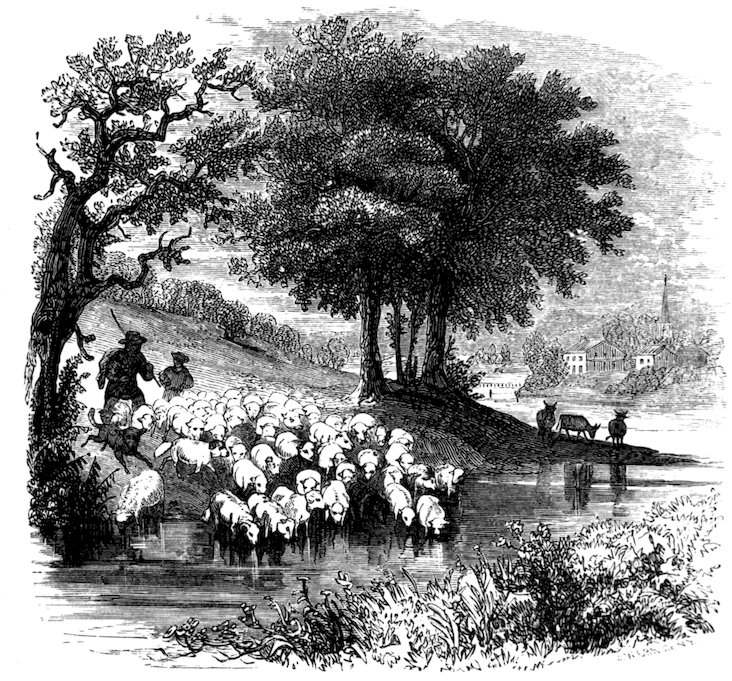
FROM “THE FLEECE.”
If verdant elder spreads
Her silver flowers; if humble daisies yield
To yellow crowfoot and luxuriant grass,
Gay shearing-time approaches. First, howe’er,
Drive to the double fold, upon the brim
Of a clear river; gently drive the flock,
And plunge them one by one into the flood.
Plunged in the flood, not long the struggler sinks,
With his white flakes, that glisten through the tide;
The sturdy rustic, in the middle wave
Awaits to seize him rising; one arm bears
His lifted head above the limpid stream,
While the full, clammy fleece the other laves
Around, laborious with repeated toil,
And then resigns him to the sunny bank,
Where, bleating loud, he shakes his dripping locks.
Now to the other hemisphere, my muse!
A new world found, extend thy daring wing.
Be thou the first of the harmonious nine
From high Parnassus, the unwearied toils
Of industry and valor, in that world
Triumphant, to reward with tuneful song.
Happy the voyage o’er the Atlantic brine,
By active Raleigh made, and great the joy
When he discern’d, above the foaming surge,
A rising coast, for future colonies,
Opening her bays, and figuring her capes,
E’en from the northern tropic to the pole.
No land gives more employment for the loom,
Or kindlier feeds the indigent; no land
With more variety of wealth rewards
The hand of labor: thither, from the wrongs
Of lawless rule, the free-born spirit flies;
127Thither affliction, thither poverty,
And arts and sciences; thrice happy clime,
Which Britain makes th’ asylum of mankind.
But joy superior far his bosom warms,
Who views those shores in every culture dressed;
With habitations gay, and numerous towns
On hill and valley; and his countrymen
Formed into various states, powerful and rich,
In regions far remote; who from our looms
Take largely for themselves, and for those tribes
Of Indians, ancient tenants of the land,
In amity conjoin’d, of civil life
The comforts taught, and various new desires
Which kindle arts, and occupy the poor,
And spread Britannia’s flocks o’er every dale.
Ye, who the shuttle cast along the loom,
The silkworm’s thread inweaving with the fleece,
Pray for the culture of the Georgian track,
Nor slight the green savannas and the plains
Of Carolina, where thick woods arise
Of mulberries, and in whose watered fields
Upsprings the verdant blade of thirsty rice.
Where are the happy regions which afford
More implements of commerce and of wealth?
Fertile Virginia, like a vigorous bough,
Which overshades some crystal river, spreads
Her wealthy cultivations wide around,
And, more than many a spacious realm, rewards
The fleecy shuttle: to her growing marts
The Iroquese, Cheroquese, and Oubaches come,
And quit their feathery ornaments uncouth
For woolly garments; and the cheers of life—
The cheers, but not the vices, learn to taste.
Blush, Europeans! whom the circling cup
Of luxury intoxicates; ye routs,
Who, for your crimes, have fled your native land;
And ye voluptuous idle, who in vain
Seek easy habitations, void of care:
The sons of Nature with astonishment
And detestation mark your evil deeds,
And view, no longer aw’d, your nerveless arms,
Unfit to cultivate Ohio’s banks.
See the bold emigrants of Acadie
And Massachuset, happy in those arts
That join the politics of trade and war,
Bearing the palm in either; they appear
Better exemplars; and that hardy crew
Who, on the frozen beach of Newfoundland,
Hang their white fish amid the parching winds;
The kindly fleece, in webs of Duffield woof,
Their limbs, benumb’d, infold with cheerly warmth;
And frieze of Cambria, worn by those who seek
Through gulfs and dales of Hudson’s winding bay
The beaver’s fur, though oft they seek in vain;
While Winter’s frosty rigor checks approach
E’en in the fiftieth latitude. Say why
(If ye, the travel’d sons of commerce, know),
Wherefore lie bound their rivers, lakes, and dales
Half the sun’s annual course in chains of ice,
While the Rhine’s fertile shore, and Gallic realms,
By the same zone encircled, long enjoy
Warm beams of Phœbus, and, supine, behold
Their plains and hillocks blush with clustering vines?
Must it be ever thus? or may the hand
Of mighty labor drain their gusty lakes,
Enlarge the brightening sky, and, peopling, warm
The opening valleys and the yellowing plains?
Or, rather, shall we burst strong Darien’s chain,
Steer our bold fleets between the cloven rocks,
And through the great Pacific every joy
Of civil life diffuse? Are not her isles
Numerous and large? Have they not harbors calm,
Inhabitants, and manners? Haply, too,
Peculiar sciences, and other forms
Of trade, and useful products, to exchange
For woolly vestures? * * *
* * * * *
A day will come, if not too deep we drink
The cup which luxury, on careless wealth,
Pernicious gift! bestows. A day will come,
When, through new channels sailing, we shall clothe
The Californian coast, and all the realms
That stretch from Anian’s straits to proud Japan.
Dyer’s Fleece, 1700–1758.
128
A FAYRE AND HAPPY MILK-MAID.
Is a countrey wench, that is so farre from making her selfe beautifull by art, that one looke of hers is able to put all face physicke out of countenance. She knowes a faire looke is but a dumbe orator to commend 129virtue, therefore minds it not. All her excellencies stand in her so silently, as if they had stolne upon her without her knowledge. The lining of her apparall (which is her selfe) is farre better than outsides of tisseu; for though she be not arraied in the spoile of the silke-worme, shee is deckt in innocency, a farre better wearing. She doth not, with lying long abed, spoile both her complexion and conditions. Nature hath taught her too immoderate sleepe is rust to the soule; she rises, therefore, with chaunticleare, her dame’s cock, and at night makes the lambe her curfew. In milking a cow, a-straining the teats through her fingers, it seems that so sweete a milk-presse makes the milk the whiter or sweeter; for never came almond glove, or aromatique oyntment on her palme to taint it. The golden eares of corne fall and kisse her feet when she reapes them, as if they wisht to be bound, and led prisoners by the same hand that fell’d them. Her breath is her own, which scents all the yeare long of June, like a new-made hay-cocke. She makes her hand hard with labour, and her heart soft with pity; and when winter evenings fall early (sitting at her mery wheele) she sings a defiance to the giddy wheele of fortune. She doth all things with so sweet a grace, it seems ignorance will not suffer her to do ill, being her mind is to doe well. She bestowes her yeare’s wages at next faire; and in chusing her garments, counts no bravery i’ the world like decency. The garden and bee-hive are all her physick and chyrurgerye, and shee lives the longer for’t. She dares goe alone, and unfold sheepe i’ the night, and feares no manner of ill, because she meanes none; yet to say truth, she is never alone, for she is still accompanied with old songs, honest thoughts, and prayers, but short ones; yet they have their efficacy, in that they are not pauled with ensuing idle cogitations. Lastly: her dreams are so chaste, that she dare tell them; only a Fridaie’s dream is all her superstition: that shee conceales for feare of anger. Thus lives she, and all her care is that she may die in the spring-time, to have store of flowers stucke upon her winding-sheet.
Sir Thomas Overbury, 1581–1613.
SHEEP-PASTURES.
The Teviot takes its course through wide valleys of smooth, extended pasturage, sloping down to it in all directions, and in general forming beautiful lines, though otherwise void of all those circumstances, and that variety of objects, particularly of wood, which give beauty to landscape. In some parts these valleys are also contracted, but in a different manner from those of the Esk. The same breadth of feature is still preserved which we had in the more open parts, only it is here brought nearer to the eye. Though the lofty skreens rush down precipitately to the river, and contract the valleys, you see plainly they are the parts of 130a large-featured country, and in a style of landscape very different from those little irriguous valleys which we had left.
The downy sides of all these valleys are covered with sheep, which often appear to hang upon immense green walls. So steep is the descent in some parts, that the eye from the bottom scarce distinguishes the slope from a perpendicular. Several of these mountainous slopes (for some of them are very lofty) are finely tinted with mosses of different hues, which give them a very rich surface. This, however, is probably the garb which nature wears only in the summer months. She has a variety of dresses for all seasons, and all so becoming, that when she deposits one, and assumes another, she is always adorned with beauties peculiar to herself.
Gilpin’s “Highlands of Scotland.”
THE SPINNER’S SONG.
Turn, busy wheel, turn, busy wheel,
And pile upon the circling reel
A thread as fine and free
As that the insect artist weaves,
In autumn mornings, 'midst the leaves,
Of yon old apple-tree,
The moss-grown apple-tree,
The dewy, filmy apple-tree!
Turn, busy wheel, turn swiftly round,
And blend with my wild song thy sound
Of peaceful industry;
Such sound as loads the summer breeze,
When, gathering their sweet store, the bees
Crowd yon broad linden-tree,
The flowery, shadowy linden-tree!
Mary R. Mitford.
SONG FOR THE SPINNING-WHEEL.
FOUNDED UPON A BELIEF PREVALENT AMONG THE PASTORAL VALES OF WESTMORELAND.
Swiftly turn the murmuring wheel!
Night has brought the welcome hour,
When the weary fingers feel
Help as if from fairy power;
Dewy night o’ershades the ground,
Turn the swift wheel round and round.
131Now beneath the starry sky
Rest the widely-scattered sheep;
Ply the pleasant labor, ply,
For the spindle, while they sleep,
With a motion smooth and fine,
Gathers up a trustier line.
Short-lived likings may be bred
By a glance of feeble eyes;
But true love is like the thread
Which the kindly wool supplies,
When the flocks are all at rest,
Sleeping on the mountain’s breast.
William Wordsworth.
WURTHA.
Through the autumn mists so red
Shot the slim and golden stocks
Of the ripe corn; Wurtha said,
“Let us cut them for our flocks.”
Answered I, “When morning leaves
Her bright footprints on the sea,
As I cut and bind the sheaves,
Wurtha, thou shalt glean for me.”
“Nay; the full moon shines so bright,
All along the vale below,
I could count our flocks to-night;
Haco, let us rise and go;
For when bright the risen morn
Leaves her footprints on the sea,
Thou may’st cut and bind the corn,
But I can not glean for thee.”
And as I my reed so light
Blowing sat, her fears to calm,
Said she, “Haco, yesternight,
In my dream, I missed a lamb;
And as down the misty vale
Went I pining for the lost,
Something shadowy and pale
And phantom-like my pathway crossed—
Saying, 'In a chilly bed,
Low and dark, but full of peace,
132For your coming, softly spread,
Is the dead lamb’s snowy fleece.’”
Passed the sweetest of all eves—
Morn was breaking for our flocks;
“Let us go and bind the sheaves,
All the slim and golden stocks;
Wake, my Wurtha, wake”—but still
Were her lips as still could be,
And her folded hands too chill
Ever more to glean for me.
Alice Carey.
TO MEADOWS.
Ye have been fresh and green,
Ye have been filled with flowers;
And ye the walks have been
Where maids have spent their hours.
Ye have beheld where they
With wicker arks did come,
To kiss and bear away
The richer cowslips home.
You’ve heard them sweetly sing,
And seen them in a round;
Each virgin, like the spring,
With honeysuckles crowned.
But now we see none here
Whose silvery feet did tread,
And with disheveled hair
Adorned this smoother mead.
Like unthrifts, having spent
Your stock, and needy grown,
You’re left here to lament
Your poor estates alone.
Robert Herrick, 1591.
FRENCH SONG.
Dear the felicity,
Gentle, and fair, and sweet,
Love and simplicity,
When tender shepherds meet:
133Better than store of gold,
Silver and gems untold,
Manners refined and cold,
Which to our lords belong!
We, when our toil is past,
Softest delight can taste,
While summer’s beauties last,
Dance, feast, and jocund song;
And in our hearts a joy
No envy can destroy.
Translated by Louisa Costello. Martial D’Auvergne, 1440–1508.
134