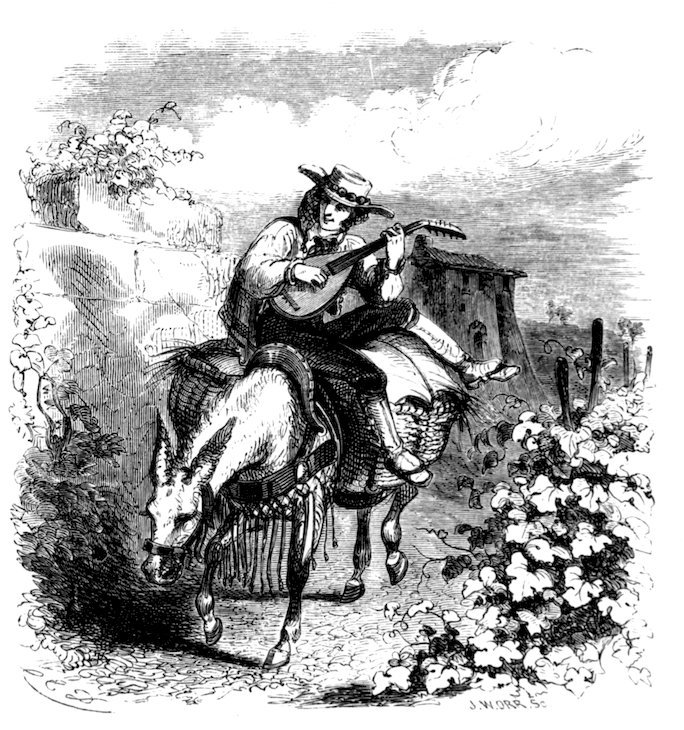
A FARM SCENE IN PORTUGAL.
Reading edition
FROM A LETTER OF W. BECKFORD, ESQ.
October 19, 1797.
The valley of Collares affords me a source of perpetual amusement. I have discovered a variety of paths which lead through chestnut copses and orchards to irregular green spots, where self-sown bays and citronbushes 409hang wild over the rocky margin of a little river, and drop their fruit and blossoms into the stream. You may ride for miles along the banks of this delightful water, catching endless perspectives of flowery thickets, between the stems of poplar and walnut. The scenery is truly Elysian, and exactly such as poets assign for the resort of happy spirits. The mossy fragments of rocks, grotesque pollards, and rustic bridges you meet with at every step, recall Savoy and Switzerland to the imagination; but the exotic cast of the vegetation, the vivid green of the citron, the golden fruitage of the orange, the blossoming myrtle, and the rich fragrance of a turf embroidered with the brightest-colored and most aromatic flowers, allow me, without a stretch of fancy, to believe myself in the garden of the Hesperides, and to expect the dragon under every tree. I by no means like the thought of abandoning these smiling regions, and have been twenty times on the point, this very day, of revoking the orders I have given for my journey. Whatever objections I may have had to Portugal seem to vanish since I have determined to leave it; for such is the perversity of human nature, that objects appear the most estimable precisely at the moment when we are going to leave them.
There was this morning a mild radiance in the sunbeams, and a balsamic serenity in the air, which infused that voluptuous listlessness—that desire of remaining imparadised in one delightful spot, which, in classical fictions, was supposed to render those who had tasted of the lotus, forgetful of friends and of every tie. My feelings were not dissimilar; I loathed the idea of moving away.
Though I had entered these beautiful orchards soon after sunrise, the clocks of some distant conventual churches had chimed hour after hour, before I could prevail upon myself to quit the spreading odoriferous baytrees under which I had been lying. If shades so cool and fragrant invited to repose, I must observe, that never were paths better calculated to tempt the laziest of beings to a walk, than those that opened on all sides, and are formed of a smooth, dry sand, bound firmly together, composing a surface as hard as gravel. These level paths wind about among a labyrinth of light, elegant fruit-trees: almond, plum, and cherry, something like the groves of Tongo-Taboo, as represented in Cook’s voyages; and to increase the resemblance, neat, clean fences and low, open sheds, thatched with reeds, appear at intervals, breaking the horizontal line of the perspective. I had now lingered and loitered away pretty nearly the whole morning, and though, as far as scenery could authorize and climate inspire, I might fancy myself an inhabitant of Polynesia, I could not pretend to be sufficiently ethereal to exist without nourishment. In plain English, I was extremely hungry. The pears, quinces, and oranges, which dangled above my head, although fair to the eye, were neither so juicy nor so gratifying to the palate, as might have been expected from their promising appearance.
410Being considerably
“More than a mile within the wood,”
and not recollecting by which clue of a path I could get out of it, I remained at least half an hour deliberating which way to turn myself. The sheds and inclosures I have mentioned were put together with care, and even nicety, it is true, but seemed to have no other inhabitants than flocks of bantams, strutting about and destroying the eggs and hopes of many an insect family. These glistening fowls, like their brethren described in Anson’s voyages, as ruminating the profound solitudes of the island of Tinian, appeared to have no master. At length, just as I was beginning to wish myself very heartily in a less romantic region, I heard the loud, though not unmusical tones of a powerful female voice, echoing through the arched green avenues; presently a stout, ruddy young peasant, very picturesquely attired in brown and scarlet, came hoydening along, driving a mule before her laden with two enormous panniers of grapes. To ask for a share of this luxurious load, and to compliment the fair driver, was instantaneous on my part—but to no purpose. I was answered by a sly wink: “We all belong to Senhor José Dias, whose coreal (farm-yard) is half a league distant. There, Senhor, if you follow that road and don’t puzzle yourself by a straying to the right or left, you will soon reach it, and the bailiff, I dare say, will be proud to give you as many grapes as you please. Good-morning; happy days to you! I must mind my business.”
Seating herself between the tantalizing panniers, she was gone in an instant, and I had the good luck to arrive at the wicket of a rude, dry well, winding up several bushy slopes in a wild, irregular manner. If the outside of this inclosure was rough and unpromising, the interior presented a most cheerful scene of rural opulence: droves of cows and goats milking; ovens, out of which huge savory cakes of bread had just been taken; ranges of bee-hives and long pillared sheds, entirely tapestried with purple and yellow muscadine grapes half candied, which were hung up to dry. A very good-natured, classical-looking magister pecorum, followed by two well-disciplined, though savage-eyed dogs, whom the least glance of their master prevented from barking, gave me a hearty welcome, and with genuine hospitality not only allowed me the free range of his domain, but set whatever it produced in the greatest perfection before me. A contest took place between two or three curly-haired, chubby-faced children, who should be first to bring me walnuts fresh from the shell, bowls of milk, and cream cheeses, made after the best of fashions, that of the province of Alemtejo.
William Beckford.
411
FROM “THE LUSIAD.”
With graceful pride three hills of softest green
Rear their fair bosoms o’er the sylvan scene;
Their sides embroider’d boast the rich array
Of flowery shrubs in all the pride of May;
The purple lotus and the snowy thorn,
And yellow pod-flowers every slope adorn.
From the green summits of the leafy hills
Descend with murmuring lapse three limpid rills;
Beneath the rose-trees loitering slow they glide,
Now tumbles o’er some rock their crystal pride;
Sonorous now they roll adown the glade,
Now plaintive tinkle in the secret shade;
Now from the darkling grove, beneath the beam
Of ruddy morn, like melted silver stream,
Edging the painted margins of the bowers,
And breathing liquid freshness on the flowers.
Here bright reflected in the pool below
The vermil apples tremble on the bough;
Where o’er the yellow sands the waters sleep,
The primrosed banks inverted, dew-drops weep;
Where murmuring o’er the pebbles purls the stream,
The silver trouts in playful curvings gleam.
Long thus and various every riv’let strays,
Till closing now their long meand’ring maze,
Where in a sinking vale the mountains end,
Form’d in a crystal lake the waters blend;
Fring’d was the border with a woodland shade,
In every leaf of various green array’d,
Each yellow-ting’d, each mingling tint between
The dark ash verdure and the silvery green.
The trees now bending forward, slowly shake
Their lofty honors o’er the crystal lake;
Now from the flood the graceful boughs retire,
With coy reserve, and now again admire
Their various liveries by the summer dress’d,
Smooth-gloss’d and soften’d in the mirror’s breast.
So by her glass the wishful virgin strays,
And oft retiring steals the lingering gaze.
* * * * *
Wild forest-trees the mountain sides array’d:
With curling foliage and romantic shade;
412Here spreads the poplar, to Alcides dear;
And dear to Phœbus, ever verdant here,
The laurel joins the bowers for ever green,
The myrtle bowers belov’d of beauty’s queen.
To Jove the oak his wide-spread branches rears;
And high to heaven the fragrant cedar bears;
Where through the glades appear the cavern’d rocks,
The lofty pine-tree waves her sable locks;
Sacred to Cybele, the whispering pine
Loves the wild grottoes where the white cliffs shine;
Here towers the cypress, preacher to the wise,
Less’ning, from earth, her spiral honors rise,
Till, as a spear-point rear’d, the topmost spray
Points to the Eden of eternal day.
Translation of W. J. Mickle. Luis de Camoens, 1517–1579.
PARADISE.
FROM THE ITALIAN OF DANTE.
Longing already to search in and round
The heavenly forest, dense and living-green,
Which to the eyes tempered the new-born day,
Withouten more delay I left the bank,
Crossing the level country slowly, slowly,
Over the soil, that everywhere breathed fragrance.
A gently breathing air, that no mutation
Had in itself, smote me upon the forehead—
No heavier blow than of a pleasant breeze;
Whereat the tremulous branches readily
Did all of them bow downward toward that side
Where its first shadow casts the Holy Mountain;
Yet not from their upright direction bent,
So that the little birds upon their tops
Should cease the practice of their tuneful art;
But, with full-throated joy, the hours of prime
Singing received they in the midst of foliage,
That made monotonous burden to their rhymes;
Even as from branch to branch it gathering swells
Through the pine forests on the shore of Chiassi
When Æolus unlooses the sirocco.
Already my slow steps had led me on
Into the ancient wood so far, that I
Could see no more the place where I had entered;
413And, lo! my farther course cut off a river,
Which, toward the left hand, with its little waves,
Bent down the grass that on its margin sprang.
All waters that on earth most limpid are,
Would seem to have within themselves some mixture,
Compared with that, which nothing doth conceal,
Although it moves with a brown, brown current,
Under the shade perpetual, that never
Ray of sun let in, nor of the moon.
Translation of H. W. Longfellow. Dante Alighieri, 1265–1321.
NATURE TEACHING IMMORTALITY.
Nature, thy daughter, ever-changing birth
Of thee, the great Immutable, to man
Speaks wisdom; is his oracle supreme;
And he who most consults her is most wise.
Look nature through, ’tis revolution all.
All change, no death. Day follows night, and night
The dying day; stars rise, and set, and rise;
Earth takes th’ example. See the summer gay,
With her green chaplet, and ambrosial flow’rs,
Droops into pallid autumn; winter gray,
Horrid with frost, and turbulent with storm,
Blows autumn and his golden fruits away,
Then melts into the spring; soft spring, with breath
Favonian, from warm chambers of the south,
Recalls the first. All to re-flourish fades,
As in a wheel all sinks to reascend;
Emblems of man, who passes, not expires.
With this minute distinction, emblems just,
Nature revolves, but man advances; both
Eternal, that a circle, this a line;
That gravitates, this soars. Th’ aspiring soul,
Ardent and tremulous, like flame ascends,
Zeal and humility her wings, to heaven.
The world of matter, with its various forms,
All dies into new life. Life, born from death,
Rolls the vast mass, and shall for ever roll.
No single atom, once in being lost,
With change of counsel charges the Most High.
Matter immortal, and shall spirit die?
Above the nobler shall less noble rise?
Shall man alone, for whom all else revives,
414Now resurrection know! shall man alone,
Imperial man! be sown in barren ground,
Less privileg’d than grain on which he feeds?
Is man, in whom alone is power to prize
The bliss of being, or with previous pain
Deplore its period, by the spleen of fate,
Severely doom’d, death’s single unredeem’d?
Edward Young, 1681–1765.
415