Front matter
Reading edition
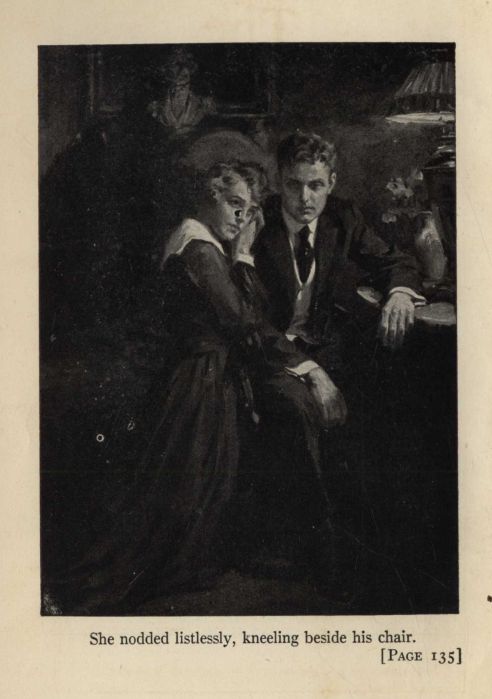
She nodded listlessly, kneeling beside his chair. (Page 135)
The Restless Sex
By ROBERT W. CHAMBERS
AUTHOR OF "Barbarians," "The Dark Star," "The Girl Philippa," "Who Goes There," Etc.
With Frontispiece By W. D. STEVENS
A. L. BURT COMPANY Publishers New York
Published by arrangement with D. APPLETON & COMPANY
Copyright, 1918, by
ROBERT W. CHAMBERS Copyright, 1917, 1918, by The International Magazine Company
Printed in the United States of America
To MILDRED SISSON
THE RESTLESS SEX
PREFACE
Created complete, equipped for sporadic multiplication and later for auto-fertilization, the restless sex, intensely bored by the process of procreation, presently invented an auxiliary and labeled him [male symbol].
A fool proceeding, for the inherited mania for invention obsessed him and he began to invent gods. The only kind of gods that his imagination could conceive were various varieties of supermen, stronger, more cruel, craftier than he. And with these he continued to derive satisfaction by scaring himself.
But the restless sex remained restless; the invention of the sign of Mars ([Mars symbol]), far from bringing content, merely increased the capacity of the sex for fidgeting. And its insatiate curiosity concerning its own handiwork increased.
This handiwork, however, fulfilled rather casually the purpose of its inventor, and devoted the most of its time to the invention of gods, endowing the most powerful of them with all its own cowardice, vanity, intolerance and ferocity.
"He made us," they explained with a modesty attributable only to forgetfulness.
"Believe in him or he'll damn you. And if he doesn't, we will!" they shouted to one another. And appointed representatives of various denominations to deal exclusively in damnation.
Cede Deo! And so, in conformity with the edict of this man-created creator, about a decade before the Great Administration began, a little girl was born.
She should not have been born, because she was not wanted, being merely the by-product of an itinerant actor—Harry Quest, juveniles—stimulated to casual procreation by idleness, whiskey, and phthisis.
The other partner in this shiftless affair was an uneducated and very young girl named Conway, who tinted photographs for a Utica photographer while daylight lasted, and doubled her small salary by doing fancy skating at a local "Ice Palace" in the evenings. So it is very plain that the by-product of this partnership hadn't much chance in the world which awaited her; for, being neither expected nor desired, and, moreover, being already a prenatal heiress to obscure, unknown traits scarcely as yet even developed in the pair responsible for her advent on earth, what she might turn into must remain a problem to be solved by time alone.
Harry Quest, the father of this unborn baby, was an actor. Without marked talent and totally without morals, but well educated and of agreeable manners, he was a natural born swindler, not only of others but of himself. In other words, an optimist.
His father, the Reverend Anthony Quest, retired, was celebrated for his wealth, his library, and his amazing and heartless parsimony. And his morals. No wonder he had grimly kicked out his only son who had none.
The parents of the mother of this little child not yet born, lived in Utica, over a stationery and toy shop which they kept. Patrick Conway was the man's name. He had a pension for being injured on the railway, and sat in a peculiarly constructed wheeled chair, moving himself about by pushing the rubber-tired wheels with both hands and steering with his remaining foot.
He had married a woman rather older than himself, named Jessie Grismer, a school teacher living in Herkimer.
To Utica drifted young Quest, equipped only with the remains of one lung, and out of a job as usual. At the local rink he picked up Laura Conway, after a mindless flirtation, and ultimately went to board with her family over the stationery shop.
So the affair in question was a case of propinquity as much as anything, and was consummated with all the detached irresponsibility of two sparrows.
However, Quest, willing now to be supported, married the girl without protest. She continued to tint photographs and skate as long as she was able to be about; he loafed in front of theatres and hotels, with a quarter in change in his pockets, but always came back to meals. On sunny afternoons, when he felt well, he strolled about the residence section or reposed in his room waiting, probably, for Opportunity to knock and enter.
But nothing came except the baby.
About that time, too, both lungs being in bad condition, young Quest began those various and exhaustive experiments in narcotics, which sooner or later interest such men. And he finally discovered heroin. Finding it an agreeable road to hell, the symptomatic characteristics of an addict presently began to develop in him, and he induced his young wife to share the pleasures of his pharmaceutical discovery.
They and their baby continued to encumber the apartment for a year or two before the old people died—of weariness perhaps, perhaps of old age—or grief—or some similar disease so fatal to the aged.
Anyway, they died, and there remained nothing in the estate not subject to creditors. And, as tinted photographs had gone out of fashion even in Utica, and as the advent of moving pictures was beginning to kill vaudeville everywhere except in New York, the ever-provincial, thither the Quest family drifted. And there, through the next few years, they sifted downward through stratum after stratum of the metropolitan purlieus, always toward some darker substratum—always a little lower.
The childishly attractive mother, in blue velvet and white cat's fur, still did fancy skating at rink and Hippodrome. The father sometimes sat dazed and coughing in the chilly waiting rooms of theatrical agencies. Fortified by drugs and by a shabby fur overcoat, he sometimes managed to make the rounds in pleasant weather; and continued to die rather slowly, considering his physical condition.
But his father, who had so long ago disowned him—the Reverend Anthony Quest—being in perfect moral condition, caught a slight cold in his large, warm library, and died of pneumonia in forty-eight hours—a frightful example of earthly injustice, doubtless made all right in Heaven.
Young Quest, forbidden the presence for years, came skulking around after a while with a Jew lawyer, only to find that his one living relative, a predatory aunt, had assimilated everything and was perfectly qualified to keep it under the terms of his father's will.
Her attorneys made short work of the shyster. She herself, many times a victim to her nephew's deceit in former years, and once having stood between him and prison concerning the matter of a signature for thousands of dollars—the said signature not being hers but by her recognised for the miserable young man's sake—this formidable and acidulous old lady wrote to her nephew in reply to a letter of his:
You always were a liar. I do not believe you are married. I do not believe you have a baby. I send you—not a cheque, because you'd probably raise it—but enough money to start you properly.
Keep away from me. You are what you are partly through your father's failure to do his duty by you. An optimist taken at birth and patiently trained can be saved. Nobody saved you; you were merely punished. And you, naturally, became a swindler.
But I can't help that now. It's too late. I can only send you money. And if it's true you have a child, for God's sake take her in time or she'll turn into what you are.
And that is why I send you any money at all—on the remote chance that you are not lying. Keep away from me, Harry.
ROSALINDA QUEST.
So he did not trouble her, he knew her of old; and besides he was too ill, too dazed with drugs to bother with such things.
He lost every penny of the money in Quint's gambling house within a month.
So the Quest family, father, mother and little daughter sifted through the wide, coarse meshes of the very last social stratum that same winter, and landed on the ultimate mundane dump heap.
Quest now lay all day across a broken iron bed, sometimes stupefied, sometimes violent; his wife, dismissed from the Hippodrome for flagrant cause, now picked up an intermittent living and other things in an east-side rink. The child still remained about, somewhere, anywhere—a dirty, ragged, bruised, furtive little thing, long accustomed to extremes of maudlin demonstration and drug-crazed cruelty, frightened witness of dreadful altercations and of more dreadful reconciliations, yet still more stunned than awakened, more undeveloped than precocious, as though the steady accumulation of domestic horrors had checked mental growth rather than sharpened her wits with cynicism and undesirable knowledge.
Not yet had her environment distorted and tainted her speech, for her father had been an educated man, and what was left of him still employed grammatical English, often correcting the nasal, up-state vocabulary of the mother—the beginning of many a terrible quarrel.
So the child skulked about, alternately ignored or whined over, cursed or caressed, petted or beaten, sometimes into insensibility.
Otherwise she followed them about instinctively, like a crippled kitten.
Then there came one stifling night in that earthly hell called a New York tenement, when little Stephanie Quest, tortured by prickly heat, gasping for the relief which the western lightning promised, crept out to the fire escape and lay there gasping like a minnow.
Fate, lurking in the reeking room behind her, where her drugged parents lay in merciful stupor, unloosed a sudden breeze from the thunderous west, which blew the door shut with a crash. It did not awaken the man. But, among other things, it did jar loose a worn-out gas jet.... That was the verdict, anyway.
Pluris est oculatus testis unus quam auriti decem.
But, as always, the Most High remained silent, offering no testimony to the contrary.
This episode in the career of Stephanie Quest happened in the days of the Great Administration, an administration not great in the sense of material national prosperity, great only in spirit and in things of the mind and soul.
Even the carpenter, Albrecht Schmidt, across the hallway in the tenement, rose to the level of some unexplored spiritual stratum, for he had a wife and five children and only his wages, and he did not work every week.
"Nein," he said, when approached for contributions toward the funeral, "I haff no money for dead people. I don't giff, I don't lend. Vat it iss dot Shakespeare says? Don't neffer borrow und don't neffer lend noddings.... But I tell you what I do! I take dot leedle child!"
The slim, emaciated child, frightened white, had flattened herself against the dirty wall of the hallway to let the policemen and ambulance surgeon pass.
The trampling, staring inmates of the tenement crowded the stairs, a stench of cabbage and of gas possessed the place.
The carpenter's wife, a string around her shapeless middle, and looking as though she might add to her progeny at any minute, came to the door of her two-room kennel.
"Poor little Stephanie," she said, "you come right in and make you'self at home along of us!"
And, as the child did not stir, seemingly frozen there against the stained and battered wall, the carpenter said:
"Du! Stephanie! Hey you, Steve! Come home und get you some breakfast right away quick!"
"Is that their kid?" inquired a policeman coming out of the place of death and wiping the sweat from his face.
"Sure. I take her in."
"Well, you'll have to fix that matter later——"
"I fix it now. I take dot little Steve for mine——"
The policeman yawned over the note book in which he was writing.
"It ain't done that way, I'm tellin' you! Well, all right! You can keep her until the thing is fixed up——" He went on writing.
The carpenter strode over to the child; his blond hair bristled, his beard was fearsome and like an ogre's. But his voice trembled with Teuton sentiment.
"You got a new mamma, Steve!" he rumbled. "Now, you run in und cry mit her so much as you like." He pulled the little girl gently toward his rooms; the morbid crowd murmured on the stairs at the sight of the child of suicides.
"Mamma, here iss our little Steve alretty!" growled Schmidt. "Now, py Gott! I got to go to my job! A hellofa business iss it! Schade—immer—schade! Another mouth to feed, py Gott!"
FOREWORD
On the Christmas-tide train which carried homeward those Saint James schoolboys who resided in or near New York, Cleland Junior sat chattering with his comrades in a drawing-room car entirely devoted to the Saint James boys, and resounding with the racket of their interminable gossip and laughter.
The last number of their school paper had come out on the morning of their departure for Christmas holidays at home; every boy had a copy and was trying to read it aloud to his neighbour; shrieks of mirth resounded, high, shrill arguments, hot disputes, shouts of approval or of protest.
"Read this! Say, did you get this!" cried a tall boy named Grismer. "Jim Cleland wrote it! What do you know about our own pet novelist——"
"Shut up!" retorted Cleland Junior, blushing and abashed by accusation of authorship.
"He wrote it all right!" repeated Grismer exultantly. "Oh, girls! Just listen to this mush about the birds and the bees and the bright blue sky——"
"Jim, you're all right! That's the stuff!" shouted another. "The girl in the story's a peach, and the battle scene is great!"
"Say, Jim, where do you get your battle stuff?" inquired another lad respectfully.
"Out of the papers, of course," replied Cleland Junior. "All you have to do is to read 'em, and you can think out the way it really looks."
The only master in the car, a young Harvard graduate, got up from his revolving chair and came over to Cleland Junior.
The boy rose immediately, standing slender and handsome in the dark suit of mourning which he still wore after two years.
"Sit down, Jim," said Grayson, the master, seating himself on the arm of the boy's chair. And, as the boy diffidently resumed his seat: "Nice little story of yours, this. Just finished it. Co you still think of making writing your profession?"
"I'd like to, sir."
"Many are called, you know," remarked the master with a smile.
"I know, sir. I shall have to take my chance."
Phil Grayson, baseball idol of the Saint James boys, and himself guilty of several delicate verses in the Century and Scribner's, sat on the padded arm of the revolving chair and touched his slight moustache thoughtfully.
"One's profession, Jim, ought to be one's ruling passion. To choose a profession, choose what you most care to do in your leisure moments. That should be your business in life."
The boy said:
"I like about everything, Mr. Grayson, but I think I had rather write than anything else."
John Belter, a rotund youth, listening and drawing caricatures on the back of the school paper, suggested that perhaps Cleland Junior was destined to write the Great American Novel.
Grayson said pleasantly:
"It was the great American ass who first made inquiries concerning the Great American Novel."
"Oh, what a knock!" shouted Oswald Grismer, delighted.
But young Belter joined in the roars of laughter, undisturbed, saying very coolly:
"Do you mean, sir, that the Great American Novel will never be written, or that it has already been written several times, or that there isn't any such thing?"
"I mean all three, Jack," explained Grayson, smiling. "Let me see that caricature you have been so busy over."
"It's—it's you, sir."
"What of it?" retorted the young master. "Do you think I can't laugh at myself?"
He took the paper so reluctantly tendered:
"Jack, you are a terror! You young rascal, you've made me look like a wax-faced clothing dummy!"
"Tribute to your faultless apparel, sir, and equally faultless features——"
A shriek of laughter from the boys who had crowded around to see; Grayson himself laughing unfeignedly and long; then the babel of eager, boyish voices again, loud, emphatic, merciless in discussion of the theme of the moment.
Into the swaying car and down the aisle came a negro in spotless white, repeating invitingly:
"First call for luncheon, gentlemen! Luncheon served in the dining car forward!"
His agreeable voice was drowned in the cheering of three dozen famished boys, stampeding.
Cleland Junior came last with the master.
"I hope you'll have a happy holiday, Jim," said Grayson, with quiet cordiality.
"I'm crazy to see father," said the boy. "I'm sure I'll have a good time."
At the vestibule he stepped aside, but the master bade him precede him.
And as the fair, slender boy passed out into the forward car, the breeze ruffling his blond hair, and his brown eyes still smiling with the anticipation of home coming, he passed Fate, Chance, and Destiny, whispering together in the corner of the platform. But the boy could not see them; could not know that they were discussing him.
CHAPTER I
An average New York house on a side street in winter is a dark affair; daylight comes reluctantly and late into the city; the south side of a street catches the first winter sun rays when there are any; the north side remains shadowy and chilly.
Cleland Senior's old-fashioned house stood on the north side of 80th Street; and on the last morning of Cleland Junior's Christmas vacation, while the first bars of sunshine fell across the brown stone façades on the opposite side of the street, the Clelands' breakfast room still remained dim, bathed in the silvery gray dusk of morning.
Father and son had finished breakfast, but Cleland Senior, whose other names were John and William, had not yet lighted the cigar which he held between thumb and forefinger and contemplated in portentous silence. Nor had he opened the morning paper to read paragraphs of interest to Cleland Junior, comment upon them, and encourage discussion, as was his wont when his son happened to be home from school.
The house was one of those twenty-foot brown stone houses—architecturally featureless—which was all there was to New York architecture fifty years ago.
But John William Cleland's dead wife had managed to make a gem of the interior, and the breakfast room on the second floor front, once his wife's bedroom, was charming with its lovely early American furniture and silver, and its mellow, old-time prints in colour.
Cleland Junior continued to look rather soberly at the familiar pictures, now, as he sat in silence opposite his father, his heart of a boy oppressed by the approaching parting.
"So you think you'll make writing a profession, Jim?" repeated John Cleland, not removing his eyes from the cigar he was turning over and over.
"Yes, father."
"All right. Then a general education is the thing, and Harvard the place—unless you prefer another university."
"The fellows are going to Harvard—most of them," said the boy.
"A boy usually desires to go where his school friends go.... It's all right, Jim."
Cleland Junior's fresh, smooth face of a school boy had been slowly growing more and more solemn. Sometimes he looked at the prints on the wall; sometimes he glanced across the table at his father, who still sat absently turning over and over the unlighted cigar between his fingers. The approaching separation was weighing on them both. That, and the empty third chair by the bay window, inclined them to caution in speech, lest memory strike them suddenly, deep and unawares, and their voices betray their men's hearts to each other—which is not an inclination between men.
Cleland Senior glanced involuntarily from the empty chair to the table, where, as always, a third place had been laid by Meachem, and, as always, a fresh flower lay beside the service plate.
No matter what the occasion, under all circumstances and invariably Meachem laid a fresh blossom of some sort beside the place which nobody used.
Cleland Senior gazed at the frail cluster of frisia in silence.
Through the second floor hallway landing, in the library beyond, the boy could see his suitcase, and, lying against it, his hockey stick. Cleland Senior's preoccupied glance also, at intervals, reverted to these two significant objects. Presently he got up and walked out into the little library, followed in silence by Cleland Junior.
There was a very tall clock in that room, which had been made by one of the Willards many years before the elder Cleland's birth; but it ticked now as aggressively and bumptiously as though it were brand new.
The father wandered about for a while, perhaps with the vague idea of finding a match for his cigar; the son's clear gaze followed his father's restless movements until the clock struck the half hour.
"Father?"
"Yes, dear—yes, old chap?"—with forced carelessness which deceived neither.
"It's half past nine."
"All right, Jim—any time you're ready."
"I hate to go back and leave you all alone here!" broke out the boy impulsively.
It was a moment of painful tension.
Cleland Senior did not reply; and the boy, conscious of the emotion which his voice had betrayed, and suddenly shy about it, turned his head and gazed out into the back yard.
Father and son still wore mourning; the black garments made the boy's hair and skin seem fairer than they really were—as fair as his dead mother's.
When Cleland Senior concluded that he was able to speak in a perfectly casual and steady voice, he said:
"Have you had a pretty good holiday, Jim?"
"Fine, father!"
"That's good. That's as it should be. We've enjoyed a pretty good time together, my son; haven't we?"
"Great! It was a dandy vacation!"
There came another silence. On the boy's face lingered a slight retrospective smile, as he mentally reviewed the two weeks now ending with the impending departure for school. Certainly he had had a splendid time. His father had engineered all sorts of parties and amusements for him—schoolboy gatherings at the Ice Rink; luncheons and little dances in their own home, to which school comrades and children of old friends were bidden; trips to the Bronx, to the Aquarium, to the Natural History Museum; wonderful evenings at home together.
The boy had gone with his father to see the "Wizard of Oz," to see Nazimova in "The Comet"—a doubtful experiment, but in line with theories of Cleland Senior—to see "The Fall of Port Arthur" at the Hippodrome; to hear Calvé at the Opera.
Together they had strolled on Fifth Avenue, viewed the progress of the new marble tower then being built on Madison Square, had lunched together at Delmonico's, dined at Sherry's, motored through all the parks, visited Governor's Island and the Navy Yard—the latter rendezvous somewhat empty of interest since the great battle fleet had started on its pacific voyage around the globe.
Always they had been together since the boy returned from Saint James school for the Christmas holidays; and Cleland Senior had striven to fill every waking hour of his son's day with something pleasant to be remembered.
Always at breakfast he had read aloud the items of interest—news concerning President Roosevelt—the boy's hero—and his administration; Governor Hughes and his administration; the cumberous coming of Mr. Taft from distant climes; local squabbles concerning projected subways. All that an intelligent and growing boy ought to know and begin to think about, Cleland Senior read aloud at the breakfast table—for this reason, and also to fill in every minute with pleasant interest lest the dear grief, now two years old, and yet forever fresh, creep in between words and threaten the silences between them with sudden tears.
But two years is a long, long time in the life of the young—in the life of a fourteen-year-old boy; and yet, the delicate shadow of his mother still often dimmed for him the sunny sparkle of the winter's holiday. It fell across his clear young eyes now, where he sat thinking, and made them sombre and a deeper brown.
For he was going back to boarding school; and old memories were uneasily astir again; and Cleland Senior saw the shadow on the boy's face; understood; but now chose to remain silent, not intervening.
So memory gently enveloped them both, leaving them very still together, there in the library.
For the boy's mother had been so intimately associated with preparations for returning to school in those blessed days which already had begun to seem distant and a little unreal to Cleland Junior—so tenderly and vitally a part of them—that now, when the old pain, the loneliness, the eternal desire for her was again possessing father and son in the imminence of familiar departure, Cleland Senior let it come to the boy, not caring to avert it.
Thinking of the same thing, both sat gazing into the back yard. There was a cat on the whitewashed fence. Lizzie, the laundress—probably the last of the race of old-time family laundresses—stood bare-armed in the cold, pinning damp clothing to the lines, her Irish mouth full of wooden clothes-pins, her parboiled arms steaming.
At length Cleland Senior's glance fell again upon the tall clock. He swallowed nothing, stared grimly at the painted dial where a ship circumnavigated the sun, then squaring his big shoulders he rose with decision.
The boy got up too.
In the front hall they assisted each other with overcoats; the little, withered butler took the boy's luggage down the brown-stone steps to the car. A moment later father and son were spinning along Fifth Avenue toward Forty-second Street.
As usual, this ordeal of departure forced John Cleland to an unnatural, off-hand gaiety at the crisis, as though the parting amounted to nothing.
"Going to be a good kid in school, Jim?" he asked, casually humorous.
The boy nodded and smiled.
"That's right. And, Jim, stick to your Algebra, no matter how you hate it. I hated it too.... Going to get on your class hockey team?"
"I'll do my best."
"Right. Try for the ball team, too. And, Jim?"
"Yes, father?"
"You're all right so far. You know what's good and what's bad."
"Yes, sir."
"No matter what happens, you can always come to me. You thoroughly understand that."
"Yes, father."
"You've never known what it is to be afraid of me, have you?"
The boy smiled broadly; said no.
"Never be afraid of me, Jim. That's one thing I couldn't stand. I'm always here. All I'm here on earth for is you! Do you really understand me?"
"Yes, father."
Red-capped porter, father and son halted near the crowded train gate inside the vast railroad station.
Cleland Senior said briskly:
"Good-bye, old chap. See you at Easter. Good luck! Send me anything you write in the way of verses and stories."
Their clasped hands fell apart; the boy went through the gate, followed by his porter and by numerous respectable and negligible travelling citizens, male and female, bound for destinations doubtless interesting to them. To John Cleland they were merely mechanically moving impedimenta which obscured the retreating figure of his only son and irritated him to that extent. And when the schoolboy cap of that only son disappeared, engulfed in the crowd, John Cleland went back to his car, back to his empty, old-fashioned brownstone house, seated himself in the library that his wife had made lovely, and picked up the Times, which he had not read aloud at breakfast.
He had been sitting there more than an hour before he thought of reading the paper so rigidly spread across his knees. But he was not interested in what he read. The battle fleet, it seemed, was preparing to sail from Port-of-Spain; Mr. Taft was preparing to launch his ponderous candidacy at the fat head of the Republican party; a woman had been murdered in the Newark marshes; the subway muddle threatened to become more muddled; somebody desired to motor from New York to Paris; President Roosevelt and Mr. Cortelyou had been in consultation about something or other; German newspapers accused the United States of wasting its natural resources; Scotti was singing Scarpia in "Tosca"; a new music hall had been built in the Bronx——
Cleland Senior laid the paper aside, stared at the pale winter sunshine on the back fence till things suddenly blurred, then he resumed his paper, sharply, and gazed hard at the print until his dead wife's smiling eyes faded from the page.
But in the paper there seemed nothing to hold his attention. He turned to the editorials, then to the last page. This, he noticed, was still entirely devoted to the "Hundred Neediest Cases"—the yearly Christmastide appeal in behalf of specific examples of extreme distress. The United Charities Organization of the Metropolitan district always made this appeal every year.
Now, Cleland Senior had already sent various sums to that particular charity; and his eyes followed rather listlessly the paragraphs describing certain cases which still were totally unrelieved or only partially aided by charitable subscriptions. He read on as a man reads whose heart is still sore within him—not without a certain half irritable sense of sympathy, perhaps, but with an interest still dulled by the oppression which separation from his son always brought.
And still his preoccupied mind plodded on as he glanced over the several paragraphs of appeal, and after a while he yawned, wondering listlessly that such pitiable cases of need had not been relieved by somebody among the five million who so easily could give the trifles desired. For example:
"Case No. 47. A young man, 25, hopelessly crippled and bedridden, could learn to do useful work, sufficient to support him, if $25 for equipment were sent to the United Charities office."
Contributors were asked to mention Case No. 47 when sending cheques for relief.
He read on mechanically:
"Case No. 108. This case has been partly relieved through contributions, but thirty dollars are still required. Otherwise, these two aged and helpless gentlewomen must lose their humble little home and an institution will have to take care of them. Neither one has many more years to live. A trifling aid, now, means that the few remaining days left to these old people will be tranquil days, free from the dread of separation and destitution."
"Case 113. The father, consumptive and unable to work; the mother still weak from childbirth; the only other wage-earner a daughter aged sixteen, under arrest; four little children dependent. Seventy dollars will tide them over until the mother can recover and resume her wage-earning, which, with the daughter's assistance, will be sufficient to keep the family together. Three of the children are defectives; the oldest sister, a cash-girl, has been arrested and held as a witness for attending, at her mother's request, a clinic conducted by people advocating birth-control; and the three dollars a week which she brought to the family has been stopped indefinitely."
"Case 119. For this case no money at all has been received so far. It is the case of a little child, Stephanie Quest, left an orphan by the death or suicide of both drug-addicted parents, and taken into the family of a kindly German carpenter two years ago. It is the first permanent shelter the child has ever known, the first kindness ever offered her, the first time she has ever had sufficient nourishment in all her eleven years of life. Now she is in danger of losing the only home she has ever had. Stephanie is a pretty, delicate, winsome and engaging little creature of eleven, whose only experience with life had been savage cruelty, gross neglect, filth and immemorial starvation until the carpenter took her into his own too numerous family, and his wife cared for her as though she were their own child.
"But they have five children of their own, and the wife is soon to have another baby. Low wages, irregular employment, the constantly increasing cost of living, now make it impossible for them to feed and clothe an extra child.
"They are fond of the little girl; they are willing to keep and care for her if fifty dollars could be contributed toward her support. But if this sum be not forthcoming, little Stephanie will have to go to an institution.
"The child is now physically healthy. She is of a winning personality, but somewhat impulsive, unruly, and wilful at times; and it would be far better for her future welfare to continue to live with these sober, kindly, honest people who love her, than to be sent to an orphanage."
"Case No. 123. A very old man, desperately poor and ill and entirely——"
John Cleland dropped the paper suddenly across his knees. A fierce distaste for suffering, an abrupt disinclination for such details checked further perusal.
"Damnation!" he muttered, fumbling for another cigar.
His charities already had been attended to for the year. That portion of his income devoted to such things was now entirely used up. But he remained uneasily aware that the portion reserved for further acquisition of Americana—books, prints, pictures, early American silver, porcelains, furniture, was still intact for the new year now beginning.
That was his only refuge from loneliness and the ever-living grief—the plodding hunt for such things and the study connected with this pursuit. Except for his son—his ruling passion—he had no other interest, now that his wife was dead—nothing that particularly mattered to him in life except this collecting of Americana.
And now his son had gone away again. The day had to be filled—filled rather quickly, too; for the parting still hurt cruelly, and with a dull persistence that he had not yet shaken off. He must busy himself with something. He'd go out again presently, and mouse about among musty stacks of furniture "in the rough." Then he'd prowl through auction rooms and screw a jeweller's glass into his right eye and pore over mezzotints.
He allowed himself just so much to spend on Americana; just so much to spend on his establishment, so much to invest, so much to give to charity——
"Damnation!" he repeated aloud.
It was the last morning of the exhibition at the Christensen Galleries of early American furniture. That afternoon the sale was to begin. He had not had time for preliminary investigation. He realized the importance of the collection; knew that his friends would be there in force; and hated the thought of losing such a chance.
Turning the leaves or his newspaper for the advertisement, he found himself again confronted by the columns containing the dreary "Hundred Neediest Cases." And against every inclination he re-read the details of Case 119.
Odd, he thought to himself angrily, that there was nobody in the city to contribute the few dollars necessary to this little girl. The case in question required only fifty dollars. Fifty dollars meant a home, possibly moral salvation, to this child with her winning disposition and unruly ways.
He read the details again, more irritated than ever, yet grimly interested to note that, as usual, it is the very poor with many burdens who help the poor. This carpenter, living probably in a tenement, with a wife, an unborn baby, and a herd of squalling children to support, had still found room for another little waif, whose drug-sodden parents had been kind to her only by dying.
John Cleland turned the page, searched for the advertisement of the Christensen Galleries, discovered it, read it carefully. There were some fine old prints advertised to be sold. His hated rivals would be there—beloved friends yet hated rivals in the endless battle for bargains in antiquities.
When he got into his car a few minutes later, he told the chauffeur to drive to Christensen's and drive fast. Halfway there, he signalled and spoke through the tube:
"Where is the United Charities Building? Where? Well, drive there first."
"Damn!" he muttered, readjusting himself in the corner under the lynx robe.
CHAPTER II
"Would you care to go there and see the child for yourself, Mr. Cleland? A few moments might give you a much clearer idea of her than all that I have told you," suggested the capable young woman to whom he had been turned over in that vast labyrinth of offices tenemented by the "United Charities Organizations of Manhattan and the Four Boroughs, Inc."
John Cleland signed the cheque which he had filled in, laid it on the desk, closed his cheque-book, and shook his head.
"I'm a busy man," he said briefly.
"Oh, I'm sorry! I wish you had time to see her for a moment. You may obtain permission through the Manhattan Charities Concern, a separate organization, winch turns over certain cases to the excellent child-placing agency connected with our corporation."
"Thank you; I haven't time."
"Mr. Chiltern Grismer would be the best man to see—if you had time."
"Thank you."
There was a chilly silence; Cleland stood frowning at space, wrapped in gloomy preoccupation.
"But," added the capable young woman, wistfully, "if you are so busy that you have no time to bother with this case personally——"
"I have time," snapped Cleland, turning red. For the man was burdened with the inconvenient honesty of his race—a sort of tactless truthfulness which characterized all Clelands. He said:
"When I informed you that I'm a busy man, I evidently but unintentionally misled you. I'm not in business. I have time. I simply don't wish to go into the slums to see somebody's perfectly strange offspring."
The amazed young woman listened, hesitated, then threw back her pretty head and laughed:
"Mr. Cleland, your frankness is most refreshing! Certainly there is no necessity for you to go if you don't wish to. The little girl will be most grateful to you for this generous cheque, and happy to be relieved of the haunting terror that has made her almost ill at the prospect of an orphanage. The child will be beside herself with joy when she gets word from us that she need not lose the only home and the only friends she has ever known. Thank you—for little Stephanie Quest."
"What did the other people do to her?" inquired John Cleland, buttoning his gloves and still scowling absently at nothing.
"What people?"
"The ones who—her parents, I mean. What was it they did to her?"
"They were dreadfully inhuman——"
"What did they do to the child? Do you know?"
"Yes, I know, Mr. Cleland. They beat her mercilessly when they happened to be crazed by drugs; they neglected her when sober. The little thing was a mass of cuts and sores and bruises when we investigated her case; two of her ribs had been broken, somehow or other, and were not yet healed——"
"Oh, Lord!" he interrupted sharply. "That's enough of such devilish detail!—— I beg your pardon, but such things—annoy me. Also I've some business that's waiting—or pleasure, whichever you choose to call it——" He glanced at his watch, thinking of the exhibition at Christensen's, and the several rival and hawk-like amateurs who certainly would be prowling around there, deriding him for his absence and looking for loot.
"Where does that child live?" he added carelessly, buttoning his overcoat.
The capable young woman, who had been regarding him with suppressed amusement, wrote out the address on a pad, tore off the leaf, and handed it to him.
"—In case you ever become curious to see little Stephanie Quest, whom you have aided so generously——" she explained.
Cleland, recollecting with increasing annoyance that he had three hundred dollars less to waste on Christensen than he had that morning, muttered the polite formality of leave-taking required of him, and bowed himself out, carrying the slip of paper in his gloved fingers, extended as though he were looking for a place to drop it.
Down in the street, where his car stood, the sidewalks were slowly whitening under leisurely falling snowflakes. The asphalt already was a slippery mess.
"Where's that!" he demanded peevishly, shoving the slip of paper at his chauffeur. "Do you know?"
"I can find it, sir."
"All right," snapped John Cleland.
He stepped into the little limousine and settled back with a grunt. Then he hunched himself up in the corner and perked the fur robe over his knees, muttering. Thoughts of his wife, of his son, had been heavily persistent that morning. Never before had he felt actually old—he was only fifty-odd. Never before had he felt himself so alone, so utterly solitary. Never had he so needed the comradeship of his only son.
He had relapsed into a sort of grim, unhappy lethargy, haunted by memories of his son's baby days, when the car stopped in the tenement-lined street, swarming with push-carts and children.
The damp, rank stench of the unwashed smote him as he stepped out and entered the dirty hallway, set with bells and letter boxes and littered with débris and filthy melting snow.
The place was certainly vile enough. A deformed woman with sore eyes directed him to the floor where the Schmidt family lived. On the landing he stumbled over several infants who were playing affectionately with a dead cat—probably the first substitute for a doll they had ever possessed. A fight in some room on the second floor arrested his attention, and he halted, alert and undecided, when the dim hallway resounded with screams of murder.
But a slatternly young woman who was passing explained very coolly that it was only "thim Cassidys mixing it"; and she went her way down stairs with her cracked pitcher, and he continued upward.
"Schmidt? In there," replied a small boy to his inquiry; and resumed his game of ball against the cracked plaster wall of the passage.
Answering his knock, a shapeless woman opened the door.
"Mrs. Schmidt?"
"Yes, sir,"—retying the string which alone kept up her skirt.
He explained briefly who he was, where he had been, what he had done through the United Charities for the child, Stephanie.
"I'd like to take a look at her," he added, "if it's perfectly convenient."
Mrs. Schmidt began to cry:
"Ex-cuse me, sir; I'm so glad we can keep her. Albert has all he can do for our own kids—but the poor little thing!—it seemed hard to send her away to a Home——" She gouged out the tears abruptly with the back of a red, water-soaked hand.
"Steve! Here's a kind gentleman come to see you. Dry your hands, dearie, and come and thank him."
A grey-eyed child appeared—one of those slender little shapes, graceful in every unconscious movement of head and limbs. She was drying her thin red fingers on a bit of rag as she came forward, the steam of the wash-boiler still rising from her bare arms.
A loud, continuous noise arose in the further room, as though it were full of birds and animals fighting.
For a moment the tension of inquiry and embarrassment between the three endured in silence; then an odd, hot flush seemed to envelop the heart of Cleland Senior—and something tense within his brain loosened, flooding his entire being with infinite relief. The man had been starving for a child; that was all. He had suddenly found her. But he didn't realize it even now.
There was a shaky chair in the exceedingly clean but wretchedly furnished room. Cleland Senior went over and seated himself gingerly.
"Well, Steve?" he said with a pleasant, humourous smile. But his voice was not quite steady.
"Thank the good, kind gentleman!" burst out Mrs. Schmidt, beginning to sob again, and to swab the welling tears with the mottled backs of both fists. "You're going to stay with us, dearie. They ain't no policeman coming to take you to no institoot for orphan little girls! The good, kind gentleman has give the money for it. Go down onto your knees and thank him, Steve——!"
"Are you really going to keep me?" faltered the child. "Is it true?"
"Yes, it's true, dearie. Don't go a-kissing me! Go and thank the good, kind——"
"Let me talk to the child alone," interrupted Cleland drily. "And shut the door, please!"—glancing into the farther room where a clothes-boiler steamed, onions were frying, five yelling children swarmed over every inch of furniture, a baby made apocryphal remarks from a home-made cradle, and a canary bird sang shrilly and incessantly.
Mrs. Schmidt retired, sobbing, extolling the goodness and kindness of John Cleland, who endured it with patience until the closed door shut out eulogies, yells, canary and onions.
Then he said:
"Steve, you need not thank me. Just shake hands with me. Will you? I—I like children."
The little girl, whose head was still turned toward the closed door behind which had disappeared the only woman who had ever been consistently kind to her, now looked around at this large, strange man in his fur-lined coat, who sat there smiling at her in such friendly fashion.
And slowly, timidly, over the child's face the faintest of smiles crept in delicate response to his advances. Yet still in the wonderful grey eyes there remained that heart-rending expression of fearful inquiry which haunts the gaze of children who have been cruelly used.
"Is your name Stephanie?"
"Yes, sir."
"Stephanie Quest?"
"Yes, sir."
"What shall I call you? Steve?"
"Yes, sir," winningly grave.
"All right, then. Steve, will you shake hands?"
The child laid her thin, red, water-marred fingers in his gloved hand. He retained them, and drew her nearer.
"You've had a rather tough deal, Steve, haven't you?"
The child was silent, standing with head lowered, her bronzed brown hair hanging and shadowing shoulders and face.
"Do you go to school, Steve?"
"Yes, sir."
"Not to-day?"
"No, sir. It's Saturday."
"Oh, yes. I forgot. What do you learn in school?"
"Things—writing—reading."
"Do you like school?"
"Yes, sir."
"What do you like best?"
"Dancing."
"Do they teach that? What kind of dancing do you learn to do?"
"Fancy dancing—folk-dances. And I like the little plays that teacher gets up for us."
"Do you like any other of your studies?" he asked drily.
"Droring."
"Drawing?"
"Yes, sir," she replied, flushing painfully.
"Oh. So they teach you to draw? Who instructs you?"
"Miss Crowe. She comes every week. We copy picture cards and things."
"So you like to draw, Steve," nodded Cleland absently, thinking of his only son, who liked to write, and who, God willing, would have every chance to develop his bent in life. Then, still thinking of his only son, he looked up into the grey eyes of this little stranger.
As fate would have it, she smiled at him. And, looking at her in silence he felt the child-hunger gnawing in his heart—felt it, and for the first time, vaguely surmised what it really was that had so long ailed him.
But the idea, of course, seemed hopeless, impossible! It was not fair to his only son. Everything that he had was his son's—everything he had to give—care, sympathy, love, worldly possessions. These belonged to his son alone.
"Are you happy here with these kind people, Steve?" he asked hastily.
"Yes, sir."
But though his conscience should have instantly acquitted him, deep in his lonely heart the child-hunger gnawed, unsatisfied. If only there had been other children of his own—younger ones to play with, to have near him in his solitude, to cuddle, to caress, to fuss over as he and his dead wife had fussed over their only baby!——
"Steve?"
"Sir?"
"You are sure you will be quite happy here?"
"Yes, sir."
"Would you——" A pause; and again he looked up into the child's face, and again she smiled.
"Steve, I never had a little girl. It's funny, isn't it?"
"Yes, sir."
A silence.
"Would you like to—to go to a private school?"
The child did not understand. So he told her about such schools and the little girls who went to them. She seemed deeply interested; her grey eyes were clear and seriously intelligent, and very, very intently fixed on him in the effort to follow and understand what he was saying.
He told her about other children who lived amid happy surroundings; what they did, how they were cared for, schooled, brought up; what was expected of them by the world—what was required by the world from those who had had advantages of a home, of training, of friends, and of an education. He was committing himself with every word, and refused to believe it.
At times he paused to question her, and she always nodded seriously that she understood.
"But this," he added smilingly, "you may not entirely comprehend, Steve; that such children, brought up as I have explained to you, owe the human race a debt which is never cancelled." He was talking to himself now, more than to her; voicing his thoughts; feeling his way toward the expression of a philosophy which he had heretofore only vaguely entertained.
"The hope of the world lies in such children, Steve," he said. "The world has a right to expect service from them. You don't understand, do you?"
Her wonderfully clear eyes were almost beautiful with intelligence as they looked straight into his. Perhaps the child understood more than she herself realized, more than he believed she understood.
"Shall I come to see you again, Steve?"
"Yes, sir, please."
There was a pause. Very gently the slight pressure of his arm, which had crept around her, conveyed to her its wistful meaning; and when she understood she leaned slowly toward him in winning response, and offered her lips with a gravity that captivated him.
"Good-bye, Steve, dear," he said unsteadily. "I'll come to see you again very soon. I surely, surely will come back again to see you, Steve."
Then he put on his hat and went out abruptly—not down town to Christensen's, but back to the United Charities, and, after an hour, from there he went down town to his attorney's, where he spent the entire day under suppressed excitement.
For there were many steps to take and much detail to be attended to before this new and momentous deal could be put through—a transaction concerning a human soul and the measures to be taken to insure its salvage.
CHAPTER III
During the next few weeks John William Cleland's instinct fought a continuous series of combats with his reason.
Instinct, with her powerful allies, loneliness and love, urged the solitary man to rash experiment; reason ridiculed impulse and made it very clear to Cleland that he was a fool.
But instinct had this advantage; she was always awake, whispering to his mind and heart; and reason often fell asleep on guard over his brain.
But when awake, reason laughed at the conspirators, always in ambush to slay him; and carried matters with a high hand, rebuking instinct and frowning upon her allies.
And John Cleland hesitated. He wrote to his only son every day. He strove to find occupation for every minute between the morning awakening in his silent chamber and the melancholy lying down at night.
But always the battle between reason and instinct continued.
Reason had always appealed to Cleland Senior. His parents and later his wife and son had known the only sentimental phenomena which had ever characterized him in his career. Outside of these exceptions, reason had always ruled him. This is usually the case among those who inherit money from forebears who, in turn, have been accustomed to inherit and hand down a moderate but unimpaired fortune through sober generations.
Such people are born logical when not born fools. And now Cleland Senior, mortified and irritated by the increasing longing which obsessed him, asked himself frequently which of these he really was.
Every atom of logic in him counselled him to abstain from what every instinct in him was desiring and demanding—a little child to fill the loneliness of his heart and house—something to mitigate the absence of his son, whose absences must, in the natural course of events, become more frequent and of longer duration with the years of college imminent, and the demands of new interests, new friends increasing year by year.
He told himself that to take another child into his home would be unfair to Jim; to take her into his heart was disloyal; that the dear past belonged to his wife alone, the present and the future to his only son.
And all the while the man was starving for what he wanted.
Well, the arrangements took some time to complete; but they were fairly complete when finished. She kept her own name; she was to have six thousand dollars a year for life after she became twenty-one. He charged himself with her mental, moral, spiritual, physical, and general education.
It came about in the following manner:
First of all, he went to see a gentleman whom he had known for many years, but whose status with himself had always remained a trifle indefinite in his mind—somewhere betwixt indifferent friendship and informal acquaintanceship.
The gentleman's name was Chiltern Grismer; his business, charity and religion. He did not dispense either of these, however; he made a living for himself out of both. Cleland had learned at the United Charities that Grismer was an important personage in the Manhattan Charities Concern, a separate sectarian affair with a big office building, and a book bindery in Brooklyn for the immense tonnage of sectarian books and pamphlets published and sold by the "Concern," as it called itself. The profits were said to be enormous.
Grismer, tall, bony, sandy and with a pair of unusually light yellowish eyes behind eye-glasses, appeared the classical philanthropist of the stage. With his white, bushy side-whiskers, his frock coat, and his little ready-made black bow-tie, slightly askew under a high choker, he certainly dressed the part. In fact, any dramatic producer would have welcomed him in the rôle, for he had no "business" to learn; it was perfectly natural for him to join his finger tips together while conversing; and his voice and manner left nothing whatever to criticize.
"Ah! My friend of many years!" he exclaimed as Cleland was ushered into his office in the building of the Manhattan Charities Concern. "And how, I pray, can I be of service to my old friend, John Cleland? M-m-m'yes—my friend of many years!"
Cleland told his story very simply, adding:
"I understand that your Concern is handling Case 119, Grismer—acting, I believe, for a child-placing agency."
"Which case?" demanded Grismer, almost sharply.
"Case 119. The case of Stephanie Quest," repeated Cleland.
Grismer looked at him with odd intentness for a moment, then his eyes shifted, as though something were disturbing his suave mental tranquillity:
"M-m-m'yes. Oh, yes. I believe we have this case to handle among many others. M-m-m! Quite so; quite so. Case 119? Quite so."
"May I have the child?" asked Cleland bluntly.
"Bless me! Do you really wish to take such chances, Cleland?"
"Why not? Others take them, don't they?"
"M-m-m'yes. Oh, yes. Certainly. But it is usually people of the—ah—middle and lower classes who adopt children. M-m-m'yes; the middle and lower classes. And, naturally, they would not be very much disappointed in a foundling or waif who failed to—ah—develop the finer, subtler, more delicate Christian qualities that a gentleman in your position might reasonably expect—m-m-m'yes!—might, as it were, demand in an adopted child."
"I'll take those chances in the case in question," said Cleland, quietly.
"M-m-m'yes, the case in question. Case 119. Quite so.... I am wondering——" he passed a large, dry hand over his chin and mouth, reflectively, while his light-coloured eyes remained alertly on duty. "I have been wondering whether you have looked about before deciding on this particular child. There are a great many other deserving cases, m-m-m'yes—a great many deserving cases——"
"I want this particular child, Grismer."
"Quite so. M-m-m'yes." He looked up almost furtively. "You—ah—have some previous knowledge, perhaps, of this little girl's antecedents?"
Mr. Grismer's voice grew soft and persuasive; his finger tips were gently joined. Cleland, looking up at him, caught a glimmer resembling suspicion in those curiously light-coloured eyes.
"Yes, I have learned certain things about her," he said shortly. "I know enough! I want that child for mine and I'm going to have her."
"May I ask—ah—just what facts you have learned about this unfortunate infant?"
Cleland, bored to the verge of irritation, told him what he had learned.
There was a silence during which Grismer came to the conclusion that he had better tell Cleland another fact which necessary legal investigation of the child's antecedents might more bluntly reveal. Yes, certainly Grismer felt that he ought to place himself on record at once and explain this embarrassing fact in his own way before others cruelly misinterpreted it to Cleland. For John Cleland's position in New York among men of wealth, of affairs, of influence, and of culture made this sudden and unfortunate whim of his for Stephanie Quest a matter of awkward importance to Chiltern Grismer, who had not cared to figure in the case at all.
Grismer's large, dry hand continued to massage his jaw. Now and then the bony fingers wandered caressingly toward the white side-whiskers, but always returned to screen the thin lips with a gentle, incessant massage.
"Cleland," he began in a solemn voice, "have you ever heard that this child is—ah—is a very distant connection of my family?—m-m-m'yes—my immediate family. Have you ever heard any ill-natured gossip of this nature?"
Cleland, too astonished to reply, merely gazed at him. And Grismer wrongly concluded that he had heard about it, somewhere or other.
"M-m-m'yes—a connection—very distant, of course. In the event that you have heard of this unfortunate affair from sources perhaps unfriendly to myself and family—m-m-m'yes, unfriendly—possibly it were judicious to explain the matter to you—in justice to myself."
"I never heard of it," said Cleland, "—never dreamed of such a connection."
But to Grismer all men were liars.
"Oh, I did not know. I thought you might have heard malicious rumours. But it is just as well that you should be correctly informed.... Do you recollect ever reading anything concerning my—ah—late sister?"
"Do you mean something that happened many, many years ago?"
"That is what I refer to. Did you read of it in the newspapers?"
"Yes," said Cleland. "I read that she ran away with a married man."
"Doubtless," continued Grismer with a sigh, "you recollect the dreadful disgrace she brought upon my family? The cruel scandal exploited by a pitiless and malicious press?"
Cleland said nothing.
"Let me tell you the actual facts," continued Grismer gently. "The unfortunate woman became infatuated with a common Pullman conductor—an Irishman named Conway—a very ordinary man who already was married.
"His religion forbade divorce; my wretched sister ran away with him. We have always striven to bear the disgrace with resignation—m-m-m'yes, with patience and resignation. That is the story."
Cleland, visibly embarrassed, sat twisting the handle of his walking-stick, looking persistently away from Grismer. The latter sighed heavily.
"And so," he murmured, "our door was forever closed to her and hers. She became as one ignobly dead to us—as a soul damned for all eternity."
"Oh, come, Grismer——"
"Damned—hopelessly, and for all eternity," repeated Grismer with a slight snap of his jaw; "—she and her children, and her children's children——"
"What!"
"—The sins of the parents that are borne through generations!"
"Nonsense! That is Old Testament bosh——"
"Pardon!" said Grismer, with a pained forbearance. "It is the creed of those who worship and believe the truth as taught in the church of which I am a member."
"Oh, I beg your pardon."
"Granted," said Grismer sadly.
He sat caressing his jaw in silence for a while, then:
"Her name was Jessie Grismer. She—ah—assumed the name of Conway.... God did not bless the unholy union. There was a daughter, Laura. A certain Harry Quest, the profligate, wasted son of that good man, the Reverend Anthony Quest, married this girl, Laura Conway.... God, mindful of His wrath, still punished the seed of my sinful sister, even until the second generation.... Stephanie Quest is their daughter."
"Good heavens, Grismer! I can't understand that you, knowing this, have not done something——"
"Why? Am I to presume to interfere with God's purpose? Am I to question the righteousness of His wrath?"
"But—she is the little grandchild of your own sister!——"
"A sister utterly cut off from among us! A sister dead to us—a soul eternally lost and to be eternally forgotten."
"Is that your—creed—Grismer?"
"It is."
"Oh. I thought that sort of—I mean, I thought such creeds were out of date—old-fashioned——"
"God," said Chiltern Grismer patiently, "is old-fashioned, I believe—m-m-m'yes—very old fashioned, Cleland. But His purposes are terrible, and His wrath is a living thing to those who have the fear of God within their hearts."
"Oh. Well, I'm sorry, but I really can't be afraid of God. If I were, I'd doubt Him, Grismer.... Come; may I have the little girl?"
"Do you desire her to abide under your roof after what you have learned?"
"Why, Grismer, I'd travel all the way to hell to get her now, if any of your creed had managed to send her there. Come; I've seen the child. It may be a risk, as you say. In fact, it can't help being a risk, Grismer. But—I want her. May I have her?"
"M-m-m——" he touched a bell and a clerk appeared. Then he turned to Cleland. "Would you be good enough to see our Mr. Bunce? I thank you. Good afternoon! I am happy to have conversed again with my old friend, John Cleland,—m-m-m'yes, my friend of many years."
An hour later John Cleland left "our" Mr. Bunce, armed with proper authority to begin necessary legal proceedings.
Talking it over with Brinton, his attorney, that evening, he related the amazing conversation between himself and Chiltern Grismer.
Brinton laughed:
"It isn't religious bigotry; it's just stinginess. Grismer is the meanest man on Manhattan Island. Didn't you know it?"
"No. I don't know him well—though I've been acquainted with him for a long while. But I don't see how he can be stingy."
"Why?"
"Well, he's interested in charity——"
"He's paid a thumping big salary! He makes money out of charity. Why shouldn't he be interested?"
"But he publishes religious books——"
"Of course. They sell. It's a great graft, Cleland. Don't publish novels if you want to make money; print Bibles!"
"Is that a fact?"
"You bet! There are more parasites in pulpit, publishing house and charity concerns, who live exclusively by exploiting God, than there were unpleasant afflictions upon the epidermis of our late friend, Job. And Chiltern Grismer is one of them—the old skinflint!—hogging his only sister's share of the Grismer money and scared stiff for fear some descendant might reopen the claim and fight the verdict which beggared his own sister!"
"By Gad!" exclaimed Cleland, very red; "I've a mind to look into it and start proceedings again if there is any ground——"
"You can't."
"Why?"
"Not if you adopt this child."
"Not in her behalf?"
"Your motives would be uncharitably suspected, Cleland. You can give her enough. Besides, you don't want to stir up anything—rattle any skeletons—for this little girl's sake."
"No, of course not. You're quite right, Brinton. No money could compensate her. And, as you say, I am able to provide for her amply."
"Besides," said Brinton, "there's the paternal aunt, Miss Rosalinda Quest. She's as rich as mud. It may be that she'll do something for the child."
"I don't want her to," exclaimed Cleland angrily. "If she'll make no objection to my taking the girl, she can keep her money and leave it to the niggers of Senegambia when she dies, for all I care! Fix it for me, Brinton."
"You'd better go down to Bayport and interview her yourself," said the lawyer. "And, by the way, I hear she's a queer one—something of a bird, in fact."
"Bird?"
"Well, a vixen. They say so. All the same, she's doing a lot of real good with her money."
"How do you mean?"
"She's established a sort of home for the offspring of vicious and degenerate parents. It's really quite a wonderful combination of clinic and training school where suspected or plainly defective children are brought to be taught and to remain under observation—really a finely conceived charity, I understand. Why not call on her?"
"Very well," said Cleland, reluctantly, not caring very much about encountering "vixens" and "birds" of the female persuasion.
Except for this paternal aunt and the Grismers, there turned out to be no living human being related to the child Stephanie.
Once assured of this, John Cleland undertook the journey to Bayport, running down in his car one morning, and determined that a combination of mild dignity and gallant urbanity should conquer any untoward symptoms which this "bird" might develop.
When he arrived at the entrance to the place, a nurse on duty gave him proper directions how to find Miss Quest, who was out about the grounds somewhere.
He found her at last, in nurse's garb, marching up and down the gravel paths of the "Common Sense Home for Defectives," as the institution was called.
She was pruning privet hedges. She had a grim face, a belligerent eye, and she stood clicking her pruning shears aggressively as he approached, hat in hand.
"Miss Quest, I presume?" he inquired.
"I'm called Sister Rose," she answered shortly.
"By any other name——" began Cleland, gallantly, but checked himself, silenced by the hostility in her snapping black eyes.
"What do you wish?" she demanded impatiently.
Cleland, very red, swallowed his irritation:
"I came here in regard to your niece——"
"Niece? I haven't any!"
"I beg your pardon; I mean your great-niece——"
"What do you mean? I haven't any that I know of."
"Her name is Stephanie Quest."
"Harry Quest's child? Has he really got a baby? I thought he was lying! He's such a liar—how was I to know that he has a baby?"
"You didn't know it, then?"
"No. He wrote about a child. Of course, I supposed he was lying. That was before I went abroad."
"You've been abroad?"
"I have."
"Long?"
"Several years."
"How long since you've heard from Harry Quest?"
"Several years—a dozen, maybe. I suppose he's living on what I settled on him. If he needed money I'd hear from him soon enough."
"He doesn't need money, now. He doesn't need anything more from anybody. But his little daughter does."
"Is Harry dead?" she asked sharply.
"Very."
"And—that hussy he married——"
"Equally defunct. I believe it was suicide."
"How very nasty!"
"Or," continued Cleland, "it may have been suicide and murder."
"Nastier still!" She turned sharply aside and stood clicking her shears furiously. After a silence: "I'll take the baby," she said in an altered voice.
"She's eleven years old."
"I forgot. I'll take her anyway. She's probably a defective——"
"She is not!" retorted Cleland so sharply that Sister Rose turned on him in astonishment.
"Madame," he said, "I want a little child to bring up. I have chosen this one. I possess a comfortable fortune. I offer to bring her up with every advantage, educate her, consider her as my own child, and settle upon her for life a sum adequate for her maintenance. I have the leisure, the inclination, the means to do these things. But you, Madame, are too busy to give this child the intimate personal attention that all children require——"
"How do you know I am?"
"Because your time is already dedicated, in a larger sense, to those unhappy children who need you more than she does.
"Because your life is already consecrated to this noble charity of which you are founder and director. A world of unfortunates is dependent on you. If, therefore, I offer to lighten your burden by relieving you of one responsibility, you could not logically decline or disregard my appeal to your reason——" His voice altered and became lower: "And, Madame, I already love the child, as though she were my own."
After a long silence Sister Rose said:
"It isn't anything you've advanced that influences me. It's my—failure—with Harry. Do you think it hasn't cut me to the—the soul?" she demanded fiercely, flinging the handful of clipped twigs onto the gravel. "Do you think I am heartless because I said his end was a nasty one! It was! Let God judge me. I did my best."
Cleland remained silent.
"As a matter of fact, I don't care what you think," she added. "What concerns me is that, possibly—probably, this child would be better off with you.... You're the John Cleland, I presume."
He seemed embarrassed.
"You collect prints and things?"
"Yes, Madame."
"Then you are the John Cleland. Why not say so?"
He bowed.
"Very well, then! What you've said has in it a certain amount of common sense. I have, in a way, dedicated my life to all unfortunate children; I might not be able to do justice to Harry's child—give her the intimate personal care necessary—without impairing this work which I have undertaken, and to which I am devoting my fortune."
There was another silence, during which Sister Rose snapped her shears viciously and incessantly. Finally, she looked up at Cleland:
"Does the child care for you?"
"I—think so."
"Very well. But I sha'n't permit you to adopt her."
"Why not?"
"I may want her myself when I'm too old and worn out to work here. I wish her to keep her name."
"Madame——"
"I insist. What did you say her name is? Stephanie? Then her name is to remain Stephanie Quest."
"If you insist——"
"I do! And that's flat! And you need not settle an income on her——"
"I shall do so," he interrupted firmly. "I have ample means to provide for the future of anybody dependent on me, Madame."
"Do you presume to dictate to me what I shall do concerning my own will?" she demanded; and her belligerent eyes fairly snapped at him.
"Do what you like, Madame, but it isn't necessary to——"
"Don't instruct me, Mr. Cleland!"
"Very well, Madame——"
"I shall do as I always have done, and that is exactly as I please," she said, glancing at him. "And if I choose to provide for the child in my will, I shall do so without requesting your opinion. Pray understand me, Mr. Cleland. If I let you have her it is only because I am self-distrustful. I failed with Harry Quest. I have not sufficient confidence in myself to risk failure with his daughter.
"Let the matter stand this way until I can consult my attorney and investigate the entire affair. Take her into your home. But remember that she is to bear her own name; that the legal guardianship shall be shared by you and me; that I am to see her when I choose, take her when I choose.... Probably I shall not choose to do so. All the same, I retain my liberty of action."
Cleland said in a low voice:
"It would be—heartless—if——"
"I'm not heartless," she rejoined tartly. "Therefore, you need not worry, Mr. Cleland. If you love her and she loves you—I tell you you need not worry. All I desire is to retain my liberty of action. And I intend to do it. And that settles it!"
Cleland Senior went home in his automobile.
In a few days the last legal objection was removed. There were no other relatives, no further impediments; merely passionate tears from the child at parting with Schmidt; copious, fat tears from the carpenter's wife; no emotion from the children; none from the canary bird.
CHAPTER IV
In February the child departed from the Schmidts' in charge of an elderly, indigent gentlewoman, recommended to Mr. Cleland at an exorbitant salary. Mrs. Westlake was her name; she inhabited, with a mild and useless husband, the ancient family mansion in Pelham. And here the preliminary grooming of Stephanie Quest began amid a riot of plain living, lofty thinking, excision of double negatives acquired at hazard, and a hospital régime of physical scrubbing.
During February and March the pitiless process continued, punctuated by blessed daily visits from Cleland Senior, laden with offerings, edible and otherwise. And before April, he had won the heart of Stephanie Quest.
The first night that she slept under Cleland's roof, he was so excited that he sat up in the library all night, listening for fear she should awake, become frightened, and cry out.
She slept perfectly. Old Janet had volunteered as nurse and wardrobe mistress, and a new parlour-maid took her place. Janet, aged sixty, had been his dead wife's childhood nurse, his son's nurse in babyhood: then she had been permitted to do in the household whatever she chose; and she chose to dust the drawing-room, potter about the house, and offer herself tea between times.
Janet, entering the library at six in the morning, found Mr. Cleland about ready to retire to bed after an all-night vigil.
"What do you think of what I've done—bringing this child here?" he demanded bluntly, having lacked the courage to ask Janet's opinion before.
Janet could neither read nor write. Her thoughts were slow in crystallizing. For a few moments master and ancient servant stood confronted there in the dusk of early morning.
"Maybe it was God's will, sor," she said at last, in her voice which age had made a little rickety.
"You don't approve?"
"Ah, then Mr. Cleland, sor, was there annything you was wishful for but the dear Missis approved?"
That answer took him entirely by surprise. He had never even thought of looking at the matter from such an angle.
And after Janet went away into the dim depths of the house, he remained standing there, pondering the old Irishwoman's answer.
Suddenly his heart grew full and the tears were salt in his throat—hot and wet in his closed eyes.
"Not that memory and love are lessened, dear," he explained with tremulous, voiceless lips, "—but you have been away so long, and here on earth time moves slowly without you—dearest—dearest——"
"Th' divil's in that young wan," panted Janet outside his chamber door. "She won't be dressed! She's turning summersalts on her bed, God help her!"
"Did you bathe her?" demanded Cleland, hurriedly buttoning his collar and taking one of the scarfs offered by old Meacham.
"I did, sor—and it was like scrubbing an eel. Not that she was naughty, sor—the darlint!—only playful-like and contrayry—all over th' tub, under wather and atop, and pretindin' the soap and brush was fishes and she another chasin' them——"
"Janet!"
"Sorr?"
"Has she had her breakfast?"
"Two, sorr."
"What?"
"Cereal and cream, omelet and toast, three oranges and a pear, and a pint of milk——"
"Good heavens! Do you want to kill the child?"
"Arrah, sorr, she'll never be kilt with feedin'! It's natural to the young, sorr—and she leppin' and skippin' and turnin' over and over like a young kid!—and how I'm to dress her in her clothes God only knows——"
"Janet! Stop your incessant chatter! Go upstairs and tell Miss Stephanie that I want her to dress immediately."
"I will, sorr."
Cleland looked at Meacham and the little faded old man looked back out of wise, tragic eyes which had seen hell—would see it again more than once before he finished with the world.
"What do you think of my little ward, Meacham?"
"It is better not to think, sir; it is better to just believe."
"What do you mean?"
"Just that, sir. If we really think we can't believe. It's pleasanter to hope. The young lady is very pretty, sir."
Cleland Senior always wore a fresh white waistcoat, winter and summer, and a white carnation in his button-hole. He put on and buttoned the one while Meacham adjusted the other.
They had been together many years, these two men. Every two or three months Meacham locked himself in his room and drank himself stupid. Sometimes he remained invisible for a week, sometimes for two weeks. Years ago Cleland had given up hope of helping him. Once, assisted by hirelings, he had taken Meacham by a combination of strategy and force to a famous institute where the periodical dipsomaniac is cured if he chooses to be.
And Meacham emerged, cured to that extent; and immediately proceeded to lock himself in his room and lie there drunk for eighteen days.
Always when he emerged, ashy grey, blinking, neat, and his little, burnt-out eyes tragic with the hell they had looked upon, John Cleland spoke to him as though nothing had happened to interrupt the routine of service. The threads were picked up and knotted where they had been broken; life continued in its accustomed order under the Cleland roof. The master would not abandon the man; the man continued to fight a losing fight until beaten, then locked himself away until the enemy gave his broken body and broken mind a few weeks' respite. Otherwise, the master's faith and trust in this old-time servant was infinite.
"Meacham?"
"Sir."
"I think—Mrs. Cleland—would have approved. Janet thinks so."
"Yes, sir."
"You think so, too?"
"Certainly, sir. Whatever you wished was madame's wish also."
"Master James is so much away these days.... I suppose I am getting old, and——"
He suffered Meacham to invest him with his coat, lifted the lapel and sniffed at the blossom there, squared his broad shoulders, twisted his white moustache.
There was no more attractive figure on Fifth Avenue than Cleland Senior with the bright colour in his cheeks, his vigorous stride and his attire, so suitable to his fresh skin, sturdy years and bearing.
Meacham's eyes were lifted to his master, now. They were of the same age.
"Will you wear a black overcoat or a grey, sir?"
"I don't care. I'm going up to the nursery first. The nursery," he repeated, with a secret thrill at the word, which made him tingle all over in sheerest happiness.
"The car, sir?"
"First," said Cleland, "I must find out what Miss Stephanie wishes—or rather, I must decide what I wish her to do. Telephone the garage, anyway."
There was a silence; Cleland had walked a step or two toward the door. Now, he came back.
"Meacham, I hope I have done what was best. On her father's side there was good blood; on her mother's, physical health.... I know what the risk is. But character is born in the cradle and lowered into the grave. The world merely develops, modifies, or cripples it. But it is the same character.... I've taken the chance—the tremendous responsibility.... It isn't a sudden fancy—an idle caprice;—it isn't for the amusement of making a fine lady out of a Cinderella. I want—a—baby, Meacham. I've been in love with an imaginary child for a long, long time. Now, she's become real. That's all."
"I understand, sir."
"Yes, you do understand. So I ask you to tell me; have I been fair to Mr. James?"
"I think so, sir."
"Will he think so? I have not told him of this affair."
"Yes, sir. He will think what madame would have thought of anything that you do." He added under his breath: "As we all think, sir."
There was a pause, broken abruptly by the sudden quavering appeal of Janet at the door once more:
"Mr. Cleland! Th' young lady is all over the house, sor! In her pajaymis and naked feet, running wild-like and ondacent——"
Cleland stepped to the door:
"Where's that child?"
"In the butler's pantry, sor——"
"I'm up here!" came a clear voice from the landing above. Cleland, Janet and Meacham raised their heads.
The child, in her pyjamas, elbows on the landing rail, smiled down upon them through her thick shock of burnished hair. Her lips were applied to an orifice in an orange; her slim fingers slowly squeezed the fruit; her eyes were intently fixed on the three people below.
When Cleland arrived at the third floor landing, he found Stephanie Quest in the nursery, cross-legged on her bed. As he entered, she wriggled off, and, in rose-leaf pyjamas and bare feet, dropped him the curtsey which she had been taught by Mrs. Westlake.
But long since she had taken Cleland's real measure; in her lovely grey eyes a thousand tiny devils danced. He held out his arms and she flung herself into them.
When he seated himself in a big chintz arm-chair, she curled up on his knees, one arm around his neck, the other still clutching her orange.
"Steve, isn't it rather nice to wake up in bed in your own room under your own roof? Or, of course if you prefer Mrs. Westlake's——"
"I don't. I don't——" She kissed him impulsively on his freshly-shaven cheek, tightened her arm around his neck.
"You know I love you," she remarked, applying her lips to the orange and squeezing it vigorously.
"I don't believe you really care much about me, Steve."
Her grey eyes regarded him sideways while she sucked the orange; contented laughter interrupted the process; then, suddenly both arms were around his neck, and her bewitching eyes looked into his, deep, very deeply.
"You know I love you, Dad."
"No, I don't."
"Don't you really know it?"
"Do you, really, Steve?"
There was a passionate second of assurance, a slight sigh; the little head warm on his shoulder, vague-eyed, serious, gazing out at the early April sunshine.
"Tell me about your little boy, Dad," she murmured presently.
"You know he isn't very little, Steve. He's fourteen, nearly fifteen."
"I forgot. Goodness!" she said softly and respectfully.
"He seems little to me," continued Cleland, "but he wouldn't like to be thought so. Little girls don't mind being considered youthful, do they?"
"Yes, they do! You are teasing me, Dad."
"Am I to understand that I have a ready-made, grown-up family, and no little child to comfort me?"
With a charming little sound in her throat like a young bird, she snuggled closer, pressing her cheek against his.
"Tell me," she murmured.
"About what, darling?"
"About your lit—about your boy."
She never tired hearing about this wonderful son, and Cleland never tired of telling about Jim, so they were always in accord on that subject.
Often Cleland tried to read in the gravely youthful eyes uplifted to his the dreamy emotions which his narrative evoked—curiosity, awe, shy delight, frank hunger for a playmate, doubt that this wonder-boy would condescend to notice her, wistfulness, loneliness—the delicate tragedy of solitary souls.
Always her gaze troubled him a little, because he had not yet told his son of what he had done—had not written to him concerning the advent of this little stranger. He had thought that the best and easiest way was to tell Jim when he met him at the railroad station, and, without giving the boy time to think, brood perhaps, perhaps worry, let him see little Stephanie face to face.
It seemed the best way to John Cleland. But, at moments, lying alone, sleepless in the night, he became horribly afraid.
It was about that time that he received a letter from Miss Rosalinda Quest:
DEAR MR. CLELAND:
Will you bring the child out to Bayford, or shall I call to see her when business takes me into town?
I want to see her, so take your choice.
Yours truly,
ROSALINDA QUEST.
This brusque reminder that Stephanie was not entirely his upset Cleland. But there was nothing to do about it except to write the lady a civil invitation to call.
Which she did one morning a week later. She wore battle-grey tweeds and toque, and a Krupp steel equipment of reticule and umbrella; and she looked the fighter from top to toe.
When Cleland came down to the drawing-room with Stephanie. Miss Quest greeted him with perfunctory civility and looked upon Stephanie with unfeigned amazement.
"Is that my niece?" she demanded. And Stephanie, who had been warned of the lady and of the relationship, dropped her curtsey and offered her slender hand with the shy but affable smile instinctive in all children.
But the grey, friendly eyes and the smile did instantly a business for the child which she never could have foreseen; for Miss Quest lost her colour and stood quite dumb and rigid, with the little girl's hand grasped tightly in her grey-gloved fingers.
Finally she found her voice—not the incisive, combative, precise voice which Cleland knew—but a feminine and uncertain parody on it:
"Do you know who I am, Stephanie?"
"Yes, ma'am. You are my Aunt Rosalinda."
Miss Quest took the seat which Cleland offered and sat down, drawing the child to her knee. She looked at her for a long while without speaking.
Later, when Stephanie had been given her congé, in view of lessons awaiting her in the nursery, Miss Quest said to Cleland, as she was going:
"I'm not blind. I can see what you are doing for her—what you have done. The child adores you."
"I love her exactly as though she were my own," he said, flushing.
"That's plain enough, too.... Well, I shall be just. She is yours. I don't suppose there ever will be a corner in her heart for me.... I could love her, too, if I had the time."
"Is not what you renounce in her only another sacrifice to the noble work in which you are engaged?"
"Rubbish! I like my work. But it does do a lot of good. And it's quite true that I can not do it and give my life to Stephanie Quest. And so——" she shrugged her trim shoulders—"I can scarcely expect the child to care a straw for me, even if I come to see her now and then."
Cleland said nothing. Miss Quest marched to the door, held open by Meacham, turned to Cleland:
"Thank God you got her," she said. "I failed with Harry; I don't deserve her and I dare not claim responsibility. But I'll see that she inherits what I possess——"
"Madame! I beg you will not occupy yourself with such matters. I am perfectly able to provide sufficiently——"
"Good Lord! Are you trying to tell me again how to draw my will?" she demanded.
"I am not. I am simply requesting you not to encumber this child with any unnecessary fortune. There is no advantage to her in any unwieldy inheritance; there is, on the contrary, a very real and alarming disadvantage."
"I shall retain my liberty to think as I please, do as I please, and differ from you as often as I please," she retorted hotly.
They glared upon each other for a moment; Meacham's burnt-out gaze travelled dumbly from one to the other.
Suddenly Miss Quest smiled and stretched out her hand to Cleland.
"Thank God," she said again, "that it is you who have the child. Teach her to think kindly of me, if you can. I'll come sometimes to see her—and to disagree with you."
Cleland, bare-headed, took her out to her taxicab. She smiled at him when it departed.
CHAPTER V
There came the time when Easter vacation was to be reckoned with. Cleland wrote to Jim that he had a surprise for him and that, as usual, he would be at the station to meet the school train.
During the intervening days, at moments fear became an anguish. He began to realize what might happen, what might threaten his hitherto perfect understanding with his only son.
He need not have worried.
Driving uptown in the limousine beside his son, their hands still tightly interlocked, he told him very quietly what he had done, and why. The boy, astonished, listened in silence to the end. Then all he said was:
"For heaven's sake, Father!"
There was not the faintest hint of resentment, no emotion at all except a perfectly neutral amazement.
"How old is she?"
"Eleven, Jim."
"Oh. A kid. Does she cry much?"
"They don't cry at eleven," explained his father, laughing in his relief. "You didn't squall when you were eleven."
"No. But this is a girl."
"Don't worry, old chap."
"No. Do you suppose I'll like her?"
"Of course, I hope you will."
"Well, I probably sha'n't notice her very much, being rather busy.... But it's funny.... A kid in the house! ... I hope she won't get fresh."
"Be nice to her, Jim."
"Sure.... It's funny, though."
"It really isn't very funny, Jim. The little thing has been dreadfully unhappy all her life until I—until we stepped in."
"We?"
"You and I, Jim. It's our job."
After a silence the boy said:
"What was the matter with her?"
"Starvation, cruelty."
The boy's incredulous eyes were fastened on his father's.
"Cold, hunger, loneliness, neglect. And drunken parents who beat her so mercilessly that once they broke two of her ribs.... Don't talk about it to her, Jim. Let the child forget if she can."
"Yes, sir."
The boy's eyes were still dilated with horror, but his features were set and very still.
"We've got to look out for her, old chap."
"Yes," said the boy, flushing.
Cleland Senior, of course, expected to assist at the first interview, but Stephanie was not to be found.
High and low Janet searched; John Cleland, troubled, began a tour of the house, calling:
"Steve! Where are you?"
Jim, in his room, unstrapping his suitcase, felt rather than heard somebody behind him; and, looking up over his shoulder saw a girl.
She was a trifle pale; dropped him a curtsey:
"I'm Steve," she said breathlessly.
Boy and girl regarded each other in silence for a moment; then Jim offered his hand:
"How do you do?" he said, calmly.
"I—I'm very well. I hope you are, too."
Another pause, during a most intent mutual inspection.
"My tennis bat," explained Jim, with polite condescension, "needs to be re-strung. That's why I brought it down from school.... Do you play tennis?"
"No."
Cleland Senior, on the floor below, heard the young voices mingling above him, listened, then quietly withdrew to the library to await events.
Janet looked in later.
"Do they like each other?" he asked in a low, anxious voice.
"Mr. Cleland, sor, Miss Steve is on the floor listenin' to that blessed boy read thim pieces he has wrote in the school paper! Like two lambs they do be together, sor, and the fine little gentleman and little lady they are, God be blessed this April day!"
After a while he went upstairs, cautiously, the soft carpet muffling his tread.
Jim, seated on the side of his bed, was being worshipped, permitting it, accepting it. Stephanie, cross-legged on the floor, adored him with awed, uplifted gaze, her clasped hands lying in her lap.
"To be a writer," Jim condescended to explain, "a man has got to work like the dickens, study everything you ever heard of, go out and have adventures, notice everything that people say and do, how they act and walk and talk. It's a very interesting profession, Steve.... What are you going to be?"
"I don't know," she whispered, "—nothing, I suppose."
"Don't you want to be something? Don't you want to be celebrated?"
She thought, hesitatingly, that it would be pleasant to be celebrated.
"Then you'd better think up something to do to make the world notice you."
"I shouldn't know what to do."
"Father says that the thing you'd rather do to amuse yourself is the proper profession to take up. What do you like to do?"
"Ought I to try to write, as you do?"
"You mustn't ask me. Just think what you'd rather do than anything else."
The girl thought hard, her eyes fixed on him, her brows slightly knitted with the effort at concentration.
"I—I'd honestly really rather just be with dad—and you——"
The boy laughed:
"I don't mean that!"
"No, I know. But I can't think of anything.... Perhaps I could learn to act in a play—or do beautiful dances, or draw pictures——?" her voice continuing in the rising inflection of inquiry.
"Do you like to draw and dance and act in private theatricals?"
"Oh, I never acted in a play or danced folk-dances, except in school. And I never had things of my own to make pictures with—except once I had a piece of blue chalk and I made pictures on the wall in the hall."
"What hall?"
"It was a very dirty hall. I was punished for making pictures on the wall."
"Oh," said the boy, soberly.
After a moment the boy jumped up:
"I'm hungry. I believe luncheon is nearly ready. Come on, Steve!"
The child could scarcely speak from pride and happiness when the boy condescended to take her hand and lead her out of that enchanted place into the magic deeps below.
At nine-thirty that evening Stephanie made the curtsey which had been taught her, to Cleland Senior, and was about to repeat the process to Cleland Junior, when the latter laughed and held out his hand.
"Good night, Steve," he said reassuringly. "You've got to be a regular girl with me."
She took his hand, held it, drew closer. To his consternation, he realized that she was expecting to kiss him, and he hastily wrung her hand and sat down.
The child's face flushed: she turned to Cleland Senior for the kiss to which he had accustomed her. Her lips were quivering, and the older man understood.
"Good night, darling," he said, drawing her close into his arms, and whispered in her ear gaily: "You've scared him, Steve. He's only a boy, you know."
Her head, buried against his shoulder, concealed the starting tears.
"You've scared him," repeated Cleland Senior. "All boys are shy about girls."
Suddenly it struck her as funny; she smiled; the tears dried in her eyes. She twisted around, and, placing her lips against the elder man's ear, she whispered:
"I'm afraid of him, but I do like him!"
"He likes you, but he's a little afraid of you yet."
That appealed to her once more as exquisitely funny. She giggled, snuggled closer, observed by Jim with embarrassment and boredom. But he was too polite to betray it.
Stephanie, with one arm around Cleland's neck, squeezed herself tightly against him and recounted in a breathless whisper her impressions of his only son:
"I do like him so much, Dad! He talked to me upstairs about his school and all the boys there. He was very kind to me. Do you think I'm too little for him to like me? I'm growing rather fast, you know. I'd do anything for him, anything. I wish you'd tell him that. Will you?"
"Yes, I will, dear. Now, run upstairs to Janet."
"Shall I say good night to Jim again?"
"If you like. But don't kiss him, or you'll scare him."
They both had a confidential and silent fit of laughter over this; then the child slid from his knees, dropped a hasty, confused curtsey in Jim's direction, turned and scampered upstairs. And a gale of laughter came floating out of the nursery, silenced as Janet shut the door.
The subdued glow of a lamp fell over father and son; undulating strata of smoke drifted between them from the elder man's cigar.
"Well, Jim?"
"Yes, Father."
"Do you like her?"
"She's a—funny girl.... Yes, she's a rather nice little kid."
"We'll stand by her, won't we, Jim?"
"Yes, sir."
"Make up to her the lost days—the cruellest injustice that can be inflicted—the loss of a happy childhood."
"Yes, sir."
"All right, old chap. Now, tell me all about yourself and what has happened since you wrote."