V. TERRITORIAL REGIMENTS.
Reading edition
V. TERRITORIAL REGIMENTS.
The Royal Scots (Lothian Regiment),
COMPRISING
1st & 2nd Batts. (formerly) The 1st (The Royal Scots) Regiment; with
3rd Batt. The Edinburgh Light Infantry Militia.
"Nemo me impune lacessit."
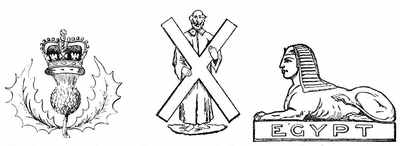
The Thistle and Crown. The St. Andrew's Cross. The Sphinx.
TITLES.
1633-78. Le Régiment de Douglas.
1678-84. Colonel the Earl of Dumbarton's Regiment of Foot.
1684-1751. The Royal Regiment of Foot.
1751-1812. The 1st, or The Royal Regiment of Foot.
1812-21. The 1st, or The Royal Scots Regiment of Foot.
1821-71. The 1st, or The Royal Regiment of Foot.
1871-81. The 1st, the Royal Scots.
1881 (from). The Royal Scots (Lothian Regiment).
PRINCIPAL CAMPAIGNS, BATTLES, &c.
* "Honours" on the Colours.
1673. Maestricht.
1680-83. Tangier.
1689-97. Flanders.
1689. Walcourt.
1692. Steenkirk.
1693. Neer Landen.
1695. Namur.
1701-14. Germany.
1702. Venloo.
1704. Schellenberg.
*1704. Blenheim.
*1706. Ramilies.
*1708. Oudenarde.
1708. Wynendale.
1708. Lisle.
1708. Ghent.
1709. Tournay.
*1709. Malplaquet.
1710. Douay.
1743-49. Flanders.
1745. Fontenoy.
1746. Culloden.
1747. Hulst.
1757-60. Canada.
*1758. Louisbourg.
1758. Ticonderoga.
1759. Guadaloupe.
1761. Dominica.
1762. Martinique.
1762. Havannah.
1793. Toulon.
1794. Corsica.
1799. Helder.
1799. Crabbendam.
*1799. Egmont-op-Zee.
1801. Aboukir.
*1801. Egypt.
1801. Mandora.
1801. Alexandria.
*1803. St. Lucia.
*1809-14. Peninsula.
*1809. Corunna.
1809. Flushing.
1810. Guadaloupe.
*1810. Busaco.
*1812. Salamanca.
*1813. Vittoria.
*1813. St. Sebastian.
*1813. Nive.
1814-15. Netherlands.
1814. Bayonne.
*1814. Niagara.
1814. Bergen-op-Zoom.
1815. Quatre Bras.
*1815. Waterloo.
*1817. Nagpore.
*1817. Maheidpore.
1819. Asseerghur.
*1824-26. Ava.
1838-39. Canada.
*1854. Alma.
*1854. Inkerman.
*1855. Sevastopol.
*1860. Taku Forts.
*1860. Pekin.
1900. South Africa.
Uniform.—Scarlet with White facings (from 1678 probably to 1684); Scarlet and Blue facings (since 1684).
Regimental Badges.—"The Royal Cypher" within the Collar of St. Andrew and the Crown over it. Also "The Thistle and Crown," with the Motto of the Order, "Nemo me impune lacessit." Also, The Sphinx, for Egypt (1801). In 1633 it bore the St. Andrew's Cross, with the Thistle and Crown; and, in 1751, the distinction of the Colours of the 2nd Batt. was a flaming ray of gold from the upper corner of each Colour to the centre.
Nickname.—"Pontius Pilate's Body-guard" (from its antiquity).
Notes.—Traditionally regarded as the ancient body-guard of the Scottish kings, this famous corps was in the service of Sweden, as "Hepburn's Regiment," from 1625 to 1633; and in that of France from 1633 to 1678, when (under Dumbarton) it came to England. It received its title in 1684 in recognition of the capture of a Colour from the Moors at Tangier. At Sedgemoor (1685) it also captured the Duke of Monmouth's Standard.
Bibliography.—Historical Record of the 1st, or Royal Regiment of Foot. To 1838. Illustrated. [London: Longman. 1838.]
The Queen's (Royal West Surrey Regiment),
COMPRISING
1st & 2nd Batts. (formerly) The 2nd (Queen's Royal); with
3rd Batt. The 2nd Royal Surrey Militia.
"Pristinæ virtutis memor." "Vel exuviæ triumphant."
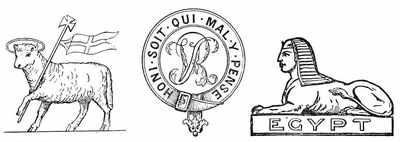
The Royal Cypher within the Garter.
The Sphinx.
The Paschal Lamb.
TITLES.
1661-84. The Tangierenes, or Queen's Own Regiment of Foot.
1684-1703. The Queen Dowager's Regiment of Foot.
1703-15. The Queen's Royal Regiment of Foot.
1715-27. The Princess of Wales's Own Regiment of Foot.
1727-51. The Queen's Own Regiment of Foot.
1751-1881. The 2nd (Queen's Royal) Regiment of Foot.
1881 (from). The Queen's (Royal West Surrey Regiment).
PRINCIPAL CAMPAIGNS, BATTLES, &c.
* "Honours" on the Colours.
1662-83. Tangier.
1690. Boyne.
1691. Aughrim.
1692-5. Flanders.
1693. Neer Landen.
1695. Namur.
1702. Cadiz.
1703-4. Germany.
1703. Tongres.
1704-8. Spain.
1707. Almanza.
1711. Quebec.
1799. Helder.
1799. Bergen.
1799. Egmont-op-Zee.
1801. Mandora.
*1801. Egypt.
1801. Alexandria.
1807. Rosetta.
*1808-14. Peninsula.
*1808. Vimiera.
1809. Flushing.
*1809. Corunna.
1809. Talavera.
*1812. Salamanca.
*1813. Vittoria.
*1813. Pyrenees.
*1813. Nivelle.
*1814. Toulouse.
*1839. Afghanistan.
*1839. Ghuznee.
*1839. Khelat.
1842. Cabool.
*1851-2-3 & 6-7. South Africa.
*1860. Taku Forts.
*1860. Pekin.
*1886-8. Burma.
*1897-8. Tirah.
1900. South Africa.
Uniform.—Scarlet and Sea-Green facings (1661-1768; sea-green was the favourite colour of Queen Catherine; see also "Badges"); Scarlet with Blue facings (from 1768).
Territorial Badges.—"The Paschal Lamb" (the crest of the house of Braganza) with the mottoes, "Pristinæ virtutis memor" and "Vel exuviæ triumphant." Also "The Royal Cypher within the Garter." Also "The Sphinx," for Egypt (1801).
Nicknames.—"Kirke's Lambs" (during the Monmouth Rebellion, 1683, under the Colonelcy of Piercy Kirke the reputation of the regiment was none of the best). "The Sleepy Queen's" (at Almeida, 1810, they carelessly allowed General Brennier to escape). "The Governor's Regiment" (on its formation for service in Tangier).
Notes.—Tangier was part of the dowry of Catherine of Braganza, the Queen of Charles II. "The Paschal Lamb" is the crest of the royal house of Braganza, and the facings (sea-green) on formation were also in honour of the Queen. For gallantry at Tongres it received its title in 1703; also possibly its second motto ("Even the Remnant Triumph"), a most desperate resistance of twenty-eight hours' duration having there been offered to the French attack. The other motto ("Mindful of Ancient Valour") is thought to refer to Marlborough's Spanish campaigns, in which it saw much service, besides having been specially selected for reinforcements.
Bibliography.—Historical Record of the 2nd, or Queen's Royal Regiment of Foot 1661-1837. [London: Clowes. 1837.] History of the 2nd Queen's Royal Regiment, now the Queen's (Royal West Surrey) Regiment. By Colonel John Davis, F.S.A. Maps and Illustrations. Vol. 1, 1661-84. Vols. 2 and 3, 1684-1799. [London: Bentley. 1887-95.]
The Buffs (East Kent Regiment),
COMPRISING
1st & 2nd Batts. (formerly) The 3rd (East Kent—The Buffs) Regiment of Foot; with a
3rd Batt. The East Kent Militia.
"Veteri frondescit honore."
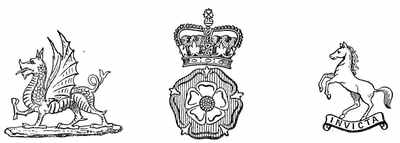
The United Rose and Crown.
The Dragon.
The White Horse of Kent.
TITLES.
1665-89. The Holland Regiment (from 1572—temp. Queen Elizabeth—in service of Holland).
1689-1708. Prince George of Denmark's Regiment.
1708-51. The Buffs.
1751-82. The 3rd (or The Buffs) Regiment of Foot.
1782-1881. The 3rd (East Kent—The Buffs) Regiment of Foot.
1881 (from). The Buffs (East Kent) Regiment of Foot.
PRINCIPAL CAMPAIGNS, BATTLES, &c.
1689-97. Flanders.
1689. Walcourt.
1693. Neer Landen.
1703-13. Germany.
1704. Schellenberg.
*1704. Blenheim.
*1706. Ramilies.
*1708. Oudenarde.
1708. Lisle.
1709. Tournay.
*1709. Malplaquet.
1715. Jacobite rising.
1742-49. Flanders.
*1743. Dettingen.
1745. Fontenoy.
1747. Val.
1759. Guadaloupe.
1761. Belle Isle.
1781. America.
1782. Jamaica.
1794-95. Flanders.
1794. Nimeguen.
1796. Grenada.
*1808-14. Peninsula.
*1809. Douro.
*1809. Talavera.
*1811. Albuera.
*1813. Vittoria.
*1813. Pyrenees.
*1813. Nivelle.
*1813. Nive.
*1814. Orthes.
*1814. Toulouse.
1814. Plattsburg.
*1843. Punniar.
*1855. Sevastopol.
*1860. Taku Forts.
*1879. South Africa.
*1895. Chitral.
1900. South Africa.
Uniform.—Scarlet with Buff facings (from 1665).
Regimental Badges.—"The Dragon" (a badge of Queen Elizabeth). Also "The United Red and White Rose with the Imperial Crown" (also probably dating back to the Virgin Queen). Also "The White Horse of Kent," with "Invicta" (in 1751 "The White Horse" was that of Hanover, but with the territorial classification the change was made). Motto, "Veteri frondescit honore." In 1686 the regiment bore "The Red Cross of St. George," bordered with white on a green ground.
Nicknames, &c.—"The Buff Howards" (1737-49—from its Colonel's name). "The Nutcrackers," and "The Resurrectionists" (at Albuera it is said to have shown despatch in cracking the heads, and to have rallied after dispersal at the hands of the Polish Lancers). "The Old Buffs" (to distinguish it from the 31st, the "Young Buffs").
Notes.—The Regiment of Buffs possesses the privilege of marching unhindered through the City of London with drums beating—a relic of Elizabethan days. At Punniar it captured eleven guns and a standard.
Bibliography.—Historical Record of the 3rd Regiment of Foot, or The Buffs. To 1838. Illustrated with plates. [London: Longman. 1839.]
The King's Own (Royal Lancaster Regiment),
COMPRISING
1st & 2nd Batts. (formerly) The 4th (The King's Own Royal); with
3rd & 4th Batts. The 1st Royal Lancashire Militia.
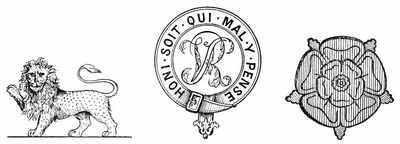
The Royal Cypher within the Garter.
The Lion of England.
The Red Rose of Lancaster.
TITLES.
1680-84. The 2nd Tangier Regiment; also The Tangierenes.
1684-85. The Duchess of York and Albany's Regiment.
1685-88. The Queen's Regiment.
1688-1702. The Queen Consort's Regiment.
1702-15. The Queen's Marines.
1715-51. The King's Own Regiment.
1751-1867. The 4th, or The King's Own Regiment.
1867-1881. The 4th (The King's Own Royal) Regiment.
1881 (from). The King's Own (Royal Lancaster Regiment).
PRINCIPAL CAMPAIGNS, BATTLES, &c.
* "Honours" on the Colours.
1685. Sedgemoor.
1690. Boyne.
1692-95. Flanders.
1692. Steenkirk.
1693. Neer-Landen.
1695. Namur.
1704-9. Spain.
1704. Malaga.
1705. Gibraltar.
1705. Barcelona.
1707. Almanza.
1708. Minorca.
1711. Quebec.
1746. Culloden.
1756. Minorca.
1759. Guadaloupe.
1761. Dominica.
1762. Martinique.
1762. Havannah.
1775-78. America.
1775. Lexington.
1775. Bunker's Hill.
1776. Brooklyn.
1777. Germantown.
1778. St. Lucia.
1799. Egmont-op-Zee.
1799. Alkmaer.
1807. Copenhagen.
*1808-14. Peninsula.
*1809. Corunna.
1809. Flushing.
1812. Cadiz.
*1812. Badajos.
*1812. Salamanca.
1812. Burgos.
1813. Bidassoa.
*1813. Vittoria.
*1813. St. Sebastian.
*1813. Nive.
*1814. Bladensburg.
1814. Washington.
1815. New Orleans.
*1815. Waterloo.
1815. Netherlands.
*1854. Alma.
*1854. Inkerman.
*1855. Sevastopol.
1858. Indian Mutiny.
*1868. Abyssinia.
*1879. South Africa.
1900. South Africa.
Uniform.—Scarlet, with bright Yellow facings (the Stuart livery, 1680-88), Scarlet, with Blue facings (from 1688).
Regimental and other Badges.—"The Lion of England" (conferred by William III.). Also "The Royal Cypher within the Garter. Also "The Red Rose of Lancaster," since its territorial assignment to the County of Lancaster.
Nicknames.—"Barrell's Blues" (from its Colonel's name, circa 1734-9, and long afterwards). "The Lions" (from its badge).
Notes.—This regiment was, like The Queen's, originally raised near London, and in the West of England, for the defence of Tangier. It became a "Royal" regiment in recognition of its devotion to William III. From 1704 to 1710 it served as a Marine corps. The present 2nd Battalion was formed in 1858.
Bibliography.—Historical Record of the 4th, or The King's Own Regiment of Foot. 1680-1839. Illustrated with plates. [London: Longman. 1839.]
The Northumberland Fusiliers,
COMPRISING
1st to 4th Batts. (formerly) The 5th (Northumberland Fusiliers); with
5th Batt. The Northumberland Militia.
"Quo fata vocant."
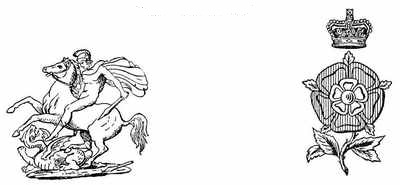
St. George and the Dragon. The United Rose (slipped) and Crown.
TITLES.
1674-88. A "Holland Regiment" (in service of Prince of Orange: previous
to 1684 "The Irish Regiment").
1688-94. Colonel Edmond Lloyd's Regiment of Foot.
1694-1751. (Its Colonel's name) Regiment of Foot.
1751-82. The 5th Regiment of Foot.
1782-1836. The 5th (Northumberland) Regiment of Foot.
1836-81. The 5th (Northumberland Fusiliers) Regiment of Foot.
1881 (from). The Northumberland Fusiliers.
PRINCIPAL CAMPAIGNS, BATTLES, &c.
* "Honours" on the Colours.
1690. Boyne.
1691. Athlone.
1691. Limerick.
1692-97. Flanders.
1695. Namur.
1707-13. Spain.
1709. Caya.
1727. Gibraltar.
1758. Cherbourg.
1760-63. Germany.
1760. Corbach.
1760. Warbourg.
1761. Denkern.
*1762. Wilhelmstahl.
1775-78. America.
1775. Lexington.
1775. Bunker's Hill.
1776. Brooklyn.
1776. Long Island.
1776. White Plains.
1776. Brunx.
1777. Brandywine.
1777. Germantown.
1778. St. Lucia (La Vigie).
1787-97. Canada.
1799. Bergen.
1799. Egmont-op-Zee.
1799. Crabbendam.
1799. Alkmaer.
1806. Buenos Ayres.
*1808-14. Peninsula.
*1808. Roleia.
*1808. Vimiera.
*1809. Corunna.
1809. Flushing.
1809. Talavera.
*1810. Busaco.
1811. El Bodon.
*1812. Ciudad Rodrigo.
*1812. Badajos.
*1812. Salamanca.
*1813. Vittoria.
*1813. Nivelle.
*1814. Orthes.
*1814. Toulouse.
1814. Plattsburg.
1857-58. Indian Mutiny.
*1857. Lucknow.
*1878-80. Afghanistan.
*1898. Khartoum.
1900. South Africa.
Uniform.—Scarlet (since 1688). Facings.—At first Yellow, subsequently changed to Green; in 1832 a "faded-leaf" Green; afterwards White, and now (1900) Gosling-green.
Regimental and other Badges.—"St. George and the Dragon" (adopted when "The Irish Regiment" became English). Also "The United Red and White Rose, with the Royal Crest," and the Motto "Quo fata vocant" (from 1751).
Nicknames.—(1) "The Shiners" (at the time of "The Seven Years' War," from its smart appearance). Also (from Peninsula times) "The Old Bold Fifth" and "The Fighting Fifth." Also known, through being at headquarters in 1811, "Lord Wellington's Body-guard."
Notes.—For defeating a French division of Grenadiers at Wilhelmstahl (1762) it was granted the privilege of wearing Fusilier caps; also a white plume for gallantry at St. Lucia, and when it took the feathers from the caps of their French opponents. The 5th is now the only regiment retaining the distinction by a red and white hackle. At Wilhelmstahl Phœbe Hassell, the notorious "female soldier," served in the ranks. Its investment of Ciudad Rodrigo was specially commended by Lord Wellington. The territorial title was bestowed in 1782 in compliment to its Colonel, Earl Percy.
Bibliography.—Historical Record of the Fifth Regiment of Foot, or Northumberland Fusiliers. 1674 to 1837. [London: Clowes. 1838.] A Short Narrative of the 5th Regiment of Foot, or Northumberland Fusiliers. Printed for Private Circulation. [London: Howard, Jones, and Parkes. 1873.]
The Royal Warwickshire Regiment,
COMPRISING
1st & 2nd Batts. (formerly) The 6th (Royal First Warwickshire)
Regiment of Foot; the 3rd and 4th Batts. have been recently
sanctioned, with two Militia Battalions.
5th Batt. The 1st Warwick Militia.
6th Batt. The 2nd Warwick Militia.
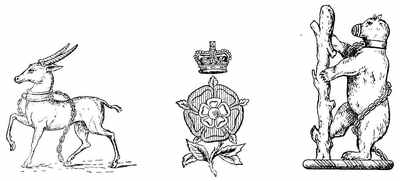
The United Rose and Crown.
The Antelope.
The Bear and Ragged Staff.
TITLES.
1673-88. A "Holland Regiment." Also (when raised) Colonel Sir Walter Vane's Regiment of Foot.
1688-1702. [Its Colonel's name] Regiment of Foot.
1702-[?]. The "Sea Service" Regiment of Foot.
17[?]-1832. The 6th (1st Warwickshire) Regiment of Foot.
1832-81. The 6th (Royal 1st Warwickshire) Regiment of Foot.
1881 (from). The Royal Warwickshire Regiment.
PRINCIPAL CAMPAIGNS, BATTLES, &c.
* "Honours" on the Colours.
1690. Boyne.
1690-96. Flanders.
1702. Cadiz.
1704-10. Spain.
1707. Almanza.
1710. Saragossa.
1741. Carthagena.
1745. Jacobite rising.
1772. St. Vincent.
1776-77. America.
1794. Martinique.
1794. Guadaloupe.
1796-98. Ireland.
1799-1806. Canada.
*1808-14. Peninsula.
*1808. Roleia.
*1808. Vimiera.
*1809. Corunna.
1809. Flushing.
*1813. Vittoria.
*1813. Pyrenees (Eschalar).
*1813. Nivelle.
*1813. Niagara.
*1814. Orthes.
1814. Bordeaux.
1821-7. Kaffraria.
1832. Scinde.
1832. Baloochistan.
1840-41. Aden.
*1846-47. South Africa.
*1851-2-3. South Africa.
1856-57. South Africa.
1857-58. Indian Mutiny.
1860. Thibet.
1865. Jamaica.
1868. Hazara.
1869. Punjaub.
*1898. Atbara.
*1898. Khartoum.
1900. South Africa.
Uniform.—Red and Deep Yellow facings (1673-1832); Scarlet with Blue facings (since 1832).
Regimental and other Badges.—"The Antelope" (an ancient Royal Badge—in Henry VI.'s reign one of the supporters of the Royal Arms). Also "The United Red and White Rose with the Imperial Crown" (the rose is with stalk and leaves—the Tudor rose had none of these appendages—and is thought to have been the badge of all the "Holland regiments.") Also "The Rampant Bear Chained to a Ragged Staff"—"Old Neville's Crest"—borne only since the territorial re-organisation.
Nicknames.—"Guise's Geese," "The Warwickshire Lads," "The Saucy Sixth."
Notes.—As in the case of the Northumberland Fusiliers, this is one of the regiments that returned, after service in Holland, with William of Orange in 1688. Its service has always been distinguished—it was cut up at Almanza in 1707—and the Iron Duke characterised its performance at Eschalar (Pyrenees, 1813) as "the most gallant and finest thing I have ever witnessed." Also at Niagara it won special distinction, since when its general Colonial service has been unique.
Bibliography.—Historical Record of the 6th, or 1st Royal Warwickshire Regiment of Foot. 1674-1838. Illustrated. [London. Longman. 1839.]
The Royal Fusiliers (City of London Regiment),
COMPRISING
1st & 2nd Batts. (formerly) The 7th (Royal Fusiliers) Regiment; Batts. 3 and 4 recently sanctioned; with Militia (three Battalions).
5th Batt. The Royal Westminster Militia.
6th Batt. The Royal London Militia; and
7th Batt. The Royal South Middlesex Militia.
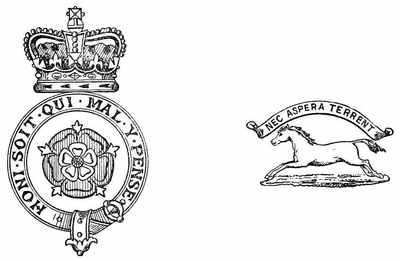
The United Rose and Garter. The White Horse.
TITLES.
1685-89. "Our Royal Regiment of Fusiliers"; also "Our Ordnance Regiment"; formerly "The Tower Guards."
1689-1881. The 7th (Royal Fusiliers).
1881 (from). The Royal Fusiliers (City of London Regiment).
PRINCIPAL CAMPAIGNS, BATTLES, &c.
* "Honours" on the Colours.
1689-90. Flanders.
1690. Cork.
1690. Kinsale.
1692-96. Flanders.
1693. Neer Landen.
1695. Namur.
1702. Cadiz.
1704-9. Spain.
1705-6. Barcelona.
1707. Lerida.
1773-82. America.
1775. Quebec.
1807. Copenhagen.
*1809. Peninsula.
*1809. Talavera.
*1809. Martinique.
1810. Busaco.
*1811. Albuera.
*1812. Badajos.
*1812. Salamanca.
*1813. Vittoria.
*1813. Pyrenees.
1813. Bidassoa.
*1814. Orthes.
*1814. Toulouse.
1814. Bordeaux.
1814. America.
1815. New Orleans.
*1854. Alma.
*1854. Inkerman.
*1855. Sevastopol.
1857-58. Indian Mutiny.
*1879-80. Afghanistan.
*1880. Kandahar.
1900. South Africa.
Uniform.—Red, with Yellow facings (1685); Red and Dark Blue facings (in 1742); now Scarlet and Blue facings.
Regimental and other Badges.—"The United Red and White Rose within the Garter, with the Crown over it." Also "The White Horse."
Nicknames, &c.—"The Hanoverian White Horse." "The Elegant Extracts."
Notes.—Raised at the time of the Monmouth Rebellion.
Bibliography.—Historical Record of the 7th Regiment, or Royal Fusiliers. 1685-1846. Illustrated. [London: Parker. 1847.] Historical Record of the 7th, or Royal Regiment of Fusiliers. Printed for private circulation. By Colonel G. H. Waller, Royal Fusiliers. [Dublin. 1877.]
The King's (Liverpool Regiment),
COMPRISING
1st & 2nd Batts. (formerly) The 8th (The King's) Regiment of Foot; the 3rd and 4th Batts. recently sanctioned; with Militia Battalions.
5th & 6th Batts. The 2nd Lancashire Militia.
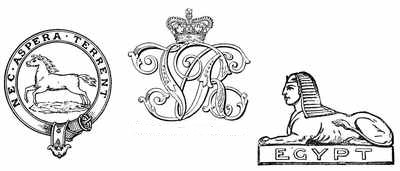
The Cypher and Crown.
The White Horse and Garter.
The Sphinx.
TITLES.
1685-1702. The Princess Anne of Denmark's Regiment.
1702-16. The Queen's Regiment.
1716-51. The King's Regiment; also the King's Hanoverian White Horse.
1751-1881. The 8th (The King's) Regiment.
1881 (from). The King's (Liverpool Regiment).
PRINCIPAL CAMPAIGNS, BATTLES, &c.
* "Honours" on the Colours.
1690. Boyne.
1691. Limerick.
1696-97. Flanders.
1701-14. Germany.
1702. Venloo.
1702. Liége.
1704. Schellenberg.
*1704. Blenheim.
*1706. Ramilies.
*1708. Oudenarde.
1708. Lisle.
1709. Tournay.
*1709. Malplaquet.
1710. Douay.
1715. Jacobite rising.
1715. Dunblane.
1742-48. Flanders.
*1743. Dettingen.
1745. Fontenoy.
1745. Jacobite rising.
1746. Falkirk.
1746. Culloden.
1746. Roucoux.
1747. Val.
1760-63. Germany.
1760. Corbach.
1760. Warbourg.
1760. Zierenberg.
1760. Campen.
1761. Kirch Denkern.
1761. Grafenstein.
1762. Wilhelmstahl.
1768. America.
1794-95. Flanders.
1794. Martinique.
1794. Guadaloupe.
1794. Nimeguen.
1794. St. Lucia.
1796. Grenada.
*1801. Egypt.
1801. Mandora.
1801. Alexandria.
1807. Copenhagen.
*1809. Martinique.
1809. Flushing.
1812-14. America.
1813-14. Quebec.
1814. Plattsburg.
*1814. Niagara.
1857-58. Indian Mutiny.
1857. Cawnpore.
*1857. Delhi.
1857. Pillour.
*1857. Lucknow.
1857. Agra.
*1876-80. Afghanistan.
*1878. Peiwar Kotal.
*1885-87. Burma.
1900. South Africa.
Uniform.—Scarlet and bright Yellow facings (1685 to 1716); Scarlet and Blue facings (from 1716).
Regimental and other Badges.—"The White Horse within the Garter" (for services during the Jacobite rising of 1715, the corps suffering heavily at Dunblane. At the same time and for a similar reason it received its title of "King's"). Also "The Royal Cypher and the Imperial Crown." Also "The Sphinx," for Egypt (1801). Motto, "Nec aspera terrent" ("Nor do difficulties terrify us").
Notes.—Raised chiefly in Derbyshire at the time of the Monmouth Rebellion.
Bibliography.—Historical Record of the 8th, or King's Regiment of Foot. 1685-1844. Illustrated. [London: Parker. 1844.] Historical Record of The King's (Liverpool) Regiment of Foot. 1685-1881. By General Cunningham Robertson. Illustrated. [London: Harrison. 1883.]
The Norfolk Regiment,
COMPRISING
1st & 2nd Batts. (formerly) The 9th (East Norfolk) Regiment of Foot; with Militia Battalions.
3rd Batt. The 1st Norfolk Militia.
4th Batt. The 2nd Norfolk Militia.
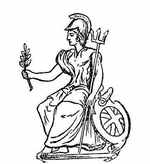
The Figure of Britannia.
TITLES.
1685-88. Colonel Henry Cornwall's Regiment of Foot.
1688-1751. (Its Colonel's name) Regiment of Foot.
1751-82. The 9th Regiment of Foot.
1782-1881. The 9th (East Norfolk) Regiment of Foot.
1881 (from). The Norfolk Regiment.
PRINCIPAL CAMPAIGNS, BATTLES, &c.
* "Honours" on the Colours.
1689. Londonderry.
1690. Boyne.
1691. Aughrim.
1701-4. Germany.
1702. Liége.
1702. Kaiserswerth.
1702. Venloo.
1702. Huy.
1704-10. Spain.
1707. Almanza.
1707. Valencia d'Alcantara.
1707. Albuquerque.
1710. Almanara.
1710. Badajos.
1710. Vellina.
1761. Belle Isle.
1762. Havannah.
1775-81. America.
1777. Stillwater.
1794. Martinique.
1794. St. Lucia.
1796. Guadaloupe.
1796. Grenada.
1799. Bergen.
1799. Egmont-op-Zee.
1799. Alkmaer.
*1808-14. Peninsula.
*1808. Roleia.
*1808. Vimiera.
*1809. Corunna.
1809. Flushing.
1809. Douro.
*1810. Busaco.
1811. Barossa.
1811. Tarifa.
1811. Tarragona.
1811. Fuentes d'Onor.
1812. Badajos.
*1812. Salamanca.
*1813. Vittoria.
*1813. St. Sebastian.
1813. Bidassoa.
*1813. Nive.
1813. Nivelle.
1814. Bayonne.
*1842. Cabool.
*1845. Moodkee.
*1845. Ferozeshah.
*1846. Sobraon.
*1855. Sevastopol.
*1879-80. Afghanistan.
*1879. Cabool.
1889. Burma.
1900. South Africa.
Uniform.—Scarlet with Blue facings (from 1685 to well on in the 18th Century); Scarlet and Yellow facings (in 1751). In Irish Army Lists, circa 1718-46, it is set down as with Orange facings. At present Scarlet and White facings.
Regimental Badge.—"The Figure of Britannia"—"This distinguished badge was given to you for your gallantry at the battle of Almanza, during the War of Succession in Spain, by Queen Anne. On the occasion of that battle it is recorded that you lost 24 officers and had 300 killed and wounded out of 467. In retiring from the field the regiment covered the retreat of General Lord Galway, a most arduous, hazardous, and difficult service. The regiment thus upheld the honour of Great Britain, and was rewarded for it by Queen Anne by allowing them to wear the figure of Britannia on their breastplates."—General Bainbridge, in 1848, when presenting new Colours.
Nicknames, &c.—"The Holy Boys" (tradition says, for selling Bibles for drink in the Peninsula; but tradition likewise says because the Spaniards mistook the figure of Britannia on their belts for the Virgin Mary). "The Fighting Ninth." "The Norfolk Howards."
Notes.—It captured the Colours of the 2nd Hampshire Regiment at Fort Anne in 1777.
Bibliography.—Historical Record of the 9th, or East Norfolk Regiment of Foot. 1685-1847. Illustrated with plates. [London: Parker. 1848.]
The Lincolnshire Regiment,
COMPRISING
1st & 2nd Batts. The 10th (North Lincolnshire) Regiment of Foot; with Militia Battalions.
3rd Batt. The Royal North Lincoln Militia.
4th Batt. The Royal South Lincoln Militia.
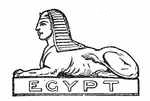
The Sphinx.
TITLES.
1685-95. Colonel Sir John Greville's (The Earl of Bath) Regiment of Foot.
1695-1751. [Its Colonel's name] Regiment of Foot.
1751-82. The 10th Regiment of Foot.
1782-1881. The 10th (North Lincolnshire) Regiment of Foot.
1881 (from). The Lincolnshire Regiment.
PRINCIPAL CAMPAIGNS, BATTLES, &c.
* "Honours" on the Colours.
1690-96. Flanders.
1692. Steenkirk.
1701-13. Germany.
1702. Kaiserswerth.
1702. Liége.
1704. Schellenberg.
*1704. Blenheim.
1705. Neer Hespen.
*1706. Ramilies.
*1708. Oudenarde.
1708. Lisle.
1708. Ghent.
1709. Tournay.
*1709. Malplaquet.
1711. Bouchain.
1712. Quesnoy.
1767-78. America.
1775. Lexington.
1775. Bunker's Hill.
1776. Long Island.
1776. White Plains.
1776. Brunx.
1777. Brandywine.
1777. Germantown.
1778. Freehold.
1798. Grenada.
*1801. Egypt.
1809. Flushing.
1809. Ionian Islands.
*1812-14. Peninsula.
*1846. Sobraon.
*1848-49. Punjaub.
*1849. Mooltan.
*1849. Goojerat.
1857-58. Indian Mutiny.
*1857. Lucknow.
1875-76. Perak.
1888. Burma.
*1898. Atbara.
*1898. Khartoum.
1900. South Africa.
Uniform.—Blue faced with Red (when raised); Scarlet and Yellow facings (subsequently, but when is unknown); Scarlet with White facings (present time).
Regimental Badge.—"The Sphinx," for Egypt (1801).
Nickname.—"The Springers" (during American War: also applied to the 62nd).
Notes.—The 10th were the only regiment of Foot dressed in Blue when raised. Amongst other distinctions this regiment has been wrecked, has lost its way in the Arabian desert, has been attacked by plague, and took part in a gallant dash without the loss of a man. In the Mutiny it did much hard work.
Bibliography.—Historical Record of the 10th (or North Lincolnshire) Regiment of Foot. 1685-1847. Illustrated. [London: Parker. 1847.]
The Devonshire Regiment,
COMPRISING
1st & 2nd Batts. (formerly) The 11th (North Devonshire) Regiment of Foot; with Militia Batts.
3rd Batt. The 2nd Devon Militia.
4th Batt. The 1st Devon Militia.
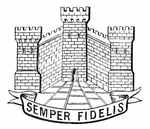
The Castle of Exeter and Motto.
TITLES.
1685-87. Colonel the Duke of Beaufort's Regiment of Foot.
1687-1751. [Its Colonel's name] Regiment of Foot.
1751-82. The 11th Regiment of Foot.
1782-1881. The 11th (North Devonshire) Regiment of Foot.
1881 (from). The Devonshire Regiment.
PRINCIPAL CAMPAIGNS, BATTLES, &c.
* "Honours" on the Colours.
1690. Boyne.
1690. Athlone.
1690. Limerick.
1690-96. Flanders.
1692. Steenkirk.
1703-4. Germany.
1706-8. Spain.
1707. Almanza.
1708-11. Germany.
1709. Malplaquet.
1709. Mons.
1709. Pont-à-Vendin.
1710. Douay.
1710 Bethune.
1710. Aire.
1710. St. Venant.
1711. Quebec.
1715. Jacobite rising.
1715. Dunblane.
1742-8. Flanders.
*1743. Dettingen.
1745. Fontenoy.
1745. Jacobite rising.
1746. Roucoux.
1760-3. Germany.
1760. Corbach.
1760. Warbourg.
1760. Campen.
1762. Wilhelmstahl.
1793. Toulon.
1794. Corsica.
1809. Flushing.
*1809-14. Peninsula.
1810. Busaco.
1811. Sabugal.
*1812. Salamanca.
1812. Burgos.
1813. Vittoria.
*1813. Pyrenees.
*1813. Nivelle.
*1813. Nive.
*1814. Orthes.
*1814. Toulouse.
1837-38. Ionian Islands.
1838-39. Canada.
*1879-80. Afghanistan.
1895. Chitral.
*1897-98. Tirah.
1900. South Africa.
Uniform.—Scarlet and "Tawny" facings (in 1685); Scarlet and Green facings (in 1742); Scarlet and White facings (present time).
Regimental and other Badges.—"The Castle of Exeter." Motto, "Semper fidelis" (an allusion to the Civil Wars).
Nickname.—"The Bloody Eleventh" (from its having been cut to pieces at Salamanca by the French, when capturing a standard).
Notes.—The regiment captured the drums of the 11th French Infantry at Flushing. Its service is fitly and truly described by its motto ("Always faithful").
Bibliography.—Historical Record of the 11th, or North Devon Regiment. 1685-1845. Illustrated. [London: Parker. 1845.]
The Suffolk Regiment,
COMPRISING
1st & 2nd Batts. (formerly) The 12th (East Suffolk) Regiment of Foot; with Militia Batts.
3rd Batt. The West Suffolk Militia; and
4th Batt. The Cambridge Militia.
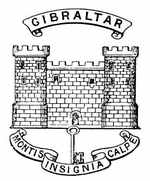
The Castle, the Key, and Motto.
TITLES.
1685 (ante). Colonel The Duke of Norfolk's Regiment of Foot.
1685-86. Colonel The Earl of Lichfield's Regiment of Foot.
1685-1751. [Its Colonel's name] Regiment of Foot.
1751-82. The 12th Regiment of Foot.
1782-1881. The 12th (East Suffolk) Regiment of Foot.
1881 (from). The Suffolk Regiment.
PRINCIPAL CAMPAIGNS, BATTLES, &c.
* "Honours" on the Colours.
1690. Boyne.
1691. Aughrim.
1694-97. Flanders.
1719. Messina.
1742-45. Flanders.
*1743. Dettingen.
1745. Fontenoy.
1758-63. Germany.
*1759. Minden.
1761. Denkern.
1762. Wilhelmstahl.
1779-83. Gibraltar.
1794. Martinique.
1794. Guadaloupe.
1794-95. Flanders.
1794. Nimeguen.
1795. Guildermalsen.
*1798-1807. India.
1799. Mallavelly.
*1799. Seringapatam.
1810. Bourbon.
1810. Mauritius.
*1851-53. South Africa.
*1863-66. New Zealand.
*1878-80. Afghanistan.
1888. Hazara.
1900. South Africa.
Uniform.—Scarlet and White facings (in 1685); Scarlet and Yellow facings (in 1751); Scarlet and White facings (present time).[A]
Regimental and other Badges.—"The Castle and Key" (the arms of Gibraltar, where it served on defensive for many years), and the Motto, "Montis insignia calpe."
Nickname.—"The Old Dozen" (from the late regimental number).
Notes.—This regiment was first raised in Norfolk and Suffolk. At the storming of Seringapatam it captured eight stand of colours.
Bibliography.—Historical Record of The 12th, or East Suffolk Regiment. 1685-1847. Illustrated. [London: Parker. 1847.]
The Prince Albert's (Somersetshire Light Infantry),
COMPRISING
1st & 2nd Batts. (formerly) The 13th (1st Somersetshire) (Prince Albert's Light Infantry) Regiment; with Militia.
3rd Batt. The 1st Somerset Militia; and
4th Batt. The 2nd Somerset Militia.
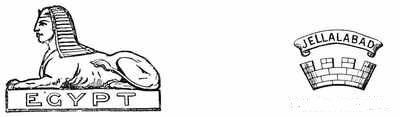
The Mural Crown.
The Sphinx.
TITLES.
1685-88. Colonel The Earl of Huntingdon's Regiment of Foot.
1688-1751. [Its Colonel's name] Regiment of Foot.
1751-82. The 13th Regiment of Foot.
1782-1822. The 13th (First Somersetshire) Regiment of Foot.
1822-42. The 13th (First Somersetshire Light Infantry) Regiment.
1842-1881. The 13th (1st Somersetshire) (Prince Albert's Light
Infantry) Regiment.
1881 (from). The Prince Albert's (Somersetshire Light Infantry).
PRINCIPAL CAMPAIGNS, BATTLES, &c.
* "Honours" on the Colours.
1689. Killicrankie.
1690. Boyne.
1690. Cork.
1690. Kinsale.
1701-3. Flanders.
1702. Kaiserwerth.
1702. Venloo.
1702. Ruremonde.
1702. Huy.
1702. Limberg.
1702. Liége.
1704-11. Spain.
1704-5. Gibraltar.
1705. Barcelona.
1707. Almanza.
1709. Caya.
1711. Tortosa.
1711. St. Matheo.
1727. Gibraltar.
1742-48. Flanders.
*1743. Dettingen.
1745. Fontenoy.
1745. Jacobite rising.
1746. Roucoux.
1747. Val.
1793-95. San Domingo.
*1801. Egypt.
1801. Mandora.
1801. Alexandria.
*1809. Martinique.
1810. Guadaloupe.
1813-15. America.
1814. Plattsburg.
*1824-26. Ava.
1825-27. Burma.
*1839. Afghanistan.
*1839. Ghuznee.
*1842. Jellalabad.
*1842. Cabool.
*1855. Sevastopol.
1858. Indian Mutiny.
*1878-79. South Africa.
*1885-87. Burma.
1900. South Africa.
Uniform.—Scarlet and Yellow facings (1685-1842); Scarlet and Blue facings (from 1842).
Regimental and other Badges.—"A Mural Crown" superscribed "Jellalabad" (where it captured three standards from the Afghans). Also "The Sphinx" for "Egypt" (1801).
Nicknames.—"The Bleeders," "The Illustrious Garrison," "The Jellalabad Heroes."
Notes.—Chiefly raised in Buckinghamshire. For its services at Culloden (1746) it wears the sash knots on the right side.
Bibliography.—Historical Record of The 13th, 1st Somerset, or Prince Albert's Light Infantry. 1685-1848. Illustrated. [London: Parker. 1848.] Historical Record of The 13th, 1st Somersetshire, or Prince Albert's Light Infantry. By Thomas Carter. Illustrated. [London: Mitchell. 1867.]
The Prince of Wales's Own (West Yorkshire Regiment),
COMPRISING
1st & 2nd Batts. (formerly) The 14th (Buckinghamshire—The Prince of Wales's Own) Regiment of Foot; with Militia Batts.
3rd Batt. The 2nd West York Militia; and
4th Batt. The 4th West York Militia.
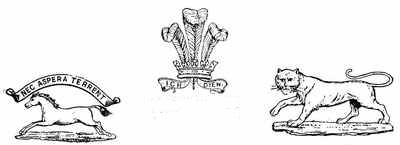
The Plume of the Prince of Wales.
The White Horse and Motto.
The Royal Tiger.
TITLES.
1685-88. Colonel Sir Edward Hales's Regiment of Foot.
1688-1751. [Its Colonel's name] Regiment of Foot.
1751-82. The 14th Regiment of Foot.
1782-1809. The 14th (Bedfordshire) Regiment of Foot.
1809-76. The 14th (Buckinghamshire) Regiment of Foot.
1876-81. The 14th (Buckinghamshire—The Prince of Wales's Own)
Regiment of Foot.
1881 (from). The Prince of Wales's Own (West Yorkshire Regiment).
PRINCIPAL CAMPAIGNS, BATTLES, &c.
* "Honours" on the Colours.
1692-96. Flanders.
1693. Neer-Landen.
1695. Namur.
1727. Gibraltar.
1745. Flanders.
1746. Falkirk.
1746. Culloden.
1766-71. America.
1793-95. Flanders.
1793. Famars.
1793. Valenciennes.
1793. Dunkirk.
1794. Tournay.
1795. Guildermalsen.
1796. St. Lucia.
*1807-31. India.
1808-9. Peninsula.
*1809. Corunna.
1809. Flushing.
1810. Mauritius.
1811. Tarifa.
*1811. Java.
1814. Genoa.
1815. Netherlands.
*1815. Waterloo.
1815. Cambray.
*1826. Bhurtpore.
*1855. Sevastopol.
*1860-66. New Zealand.
*1879-80. Afghanistan.
1900. South Africa.
Uniform.—Red and Yellow facings (in 1685); Scarlet with Buff facings (in 1742); Scarlet with White facings (present time).
Regimental and other Badges.—"The Prince of Wales's Plume" (from 1876). Also "The White Horse," and Motto, "Nec aspera terrent" (from 1765). Also "The Royal Tiger" (for service in India 1807-31).
Nicknames, &c.—"The Old and Bold." "Calvert's Entire" (from 1806 to 1826 its Colonel was Sir Harry Calvert, at whose request the county title was changed in 1809. He had large estates in mid-Buckinghamshire, now represented by the Verneys). "The Powos."
Notes.—This regiment was one of the trio known in the 1793-95 Flanders campaign as "The Fighting Brigade." Characterised by the Earl of Albemarle as "composed of boys, but fine boys," they suffered heavily at Waterloo. The regiment was first raised in Kent.
Bibliography.—Historical Record of The 14th, or the Buckinghamshire Regiment. 1685-1845. Illustrated. [London: Parker. 1845.] Historical Records of the 14th Regiment (now Prince of Wales's Own West Yorkshire). From its formation in 1685 to 1892. By Captain H. O'Donnell. With full-page coloured and other illustrations, and illustrations in the text. [Devonport: Swiss. 1893.]
The East Yorkshire Regiment,
COMPRISING
1st & 2nd Batts. (formerly) The 15th (Yorkshire East Riding) Regiment of Foot; with Militia Batt.
3rd Batt. The East York Militia.
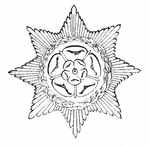
The White Rose and Star.
TITLES.
1685-86. Colonel Sir William Clifton's Regiment.
1686-1751. [Its Colonel's name] Regiment of Foot.
1751-82. The 15th Regiment of Foot.
1782-1881. The 15th (York, East Riding) Regiment of Foot.
1881 (from). The East Yorkshire Regiment.
PRINCIPAL CAMPAIGNS, BATTLES, &c.
* "Honours" on the Colours.
1694-97. Flanders.
1695. Namur.
1702-12. Germany.
1702. Liége.
1704. Schellenberg.
*1704. Blenheim.
*1706. Ramilies.
*1708. Oudenarde.
1708. Lisle.
1709. Tournay.
*1709. Malplaquet.
1709. Mons.
1710. Douai.
1711. Bouchain.
1741. Carthagena.
1745. Jacobite rising.
1758-60. Canada.
*1758. Louisburg.
*1759. Quebec.
1760. Sillery.
1762. Martinique.
1762. Havannah.
1776-78. America.
1776. Brooklyn.
1777. Brandywine.
1777. Germantown.
1778. St. Lucia.
1794. Martinique.
1794. Guadaloupe.
*1809. Martinique.
*1810. Guadaloupe.
1815. Martinique.
*1879-80. Afghanistan.
Uniform.—Scarlet faced with Yellow (in 1685); Scarlet with White facings (present time).
Regimental Badge.—"The White Rose" (of York).
Nicknames.—"The Snappers," "The Poona Guards."
Notes.—This regiment is specially distinguished for West India service—note its repeated capture of Martinique and Guadaloupe during the campaigns against France.
Bibliography.—Historical Record of the 15th (East Yorkshire) Regiment. 1685-1848. Illustrated. [London: Parker. 1848.]
The Bedfordshire Regiment,
COMPRISING
1st & 2nd Batts. (formerly) The 16th (the Bedfordshire) Regiment of Foot; with Militia Batts.
3rd Batt. The Bedford Militia.
4th Batt. The Hertford Militia.
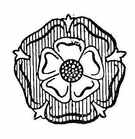
The United Red and White Rose.
TITLES.
1688-1751. Colonel James Douglas's Regiment of Foot (when raised); subsequently by the name of successive Colonels (in 1689 Colonel James Stanley).
1751-82. The 16th Regiment of Foot.
1782-1809. The 16th (Buckinghamshire) Regiment of Foot.
1809-81. The 16th (Bedfordshire) Regiment of Foot (the county title was exchanged with the 14th at the request of the Colonel of that regiment).
1881 (from). The Bedfordshire Regiment.
PRINCIPAL CAMPAIGNS, BATTLES, &c.
* "Honours" on the Colours.
1689-97. Flanders.
1689. Walcourt.
1692. Steenkirk.
1693. Neer Landen.
1695. Namur.
1702-12. Germany.
1702. Liége.
1704. Schellenberg.
*1704. Blenheim.
*1706. Ramilies.
*1708. Oudenarde.
1708. Lisle.
1709. Tournay.
*1709. Malplaquet.
1741. Carthagena.
1742. Cuba.
1778. Baton Rouge.
1779-81. America.
1781. Pensacola.
1793-94. San Domingo.
1795. Jamaica.
*1804. Surinaam.
*1895. Chitral.
1900. South Africa.
Uniform.—Scarlet with White facings (in 1688); Scarlet and deep Yellow facings (in 1742); Scarlet and White facings (present time).
Regimental Badge.—"The United Red and White Rose."
Nicknames.—"The Old Bucks" (before 1809, when the county title was exchanged with the 14th). "The Peacemakers." "The Featherbeds."
Notes.—One of twelve regiments raised in 1688. It and the 17th Foot alone remain (1900).
Bibliography.—Historical Record of the 16th, or Bedfordshire Regiment. 1688-1848. Illustrated. [London: Parker. 1848.]
The Leicestershire Regiment,
COMPRISING
1st & 2nd Batts. (formerly) The 17th (Leicestershire) Regiment of Foot; with Militia Batt.
3rd Batt. The Leicestershire Militia.
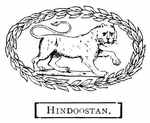
The Royal Tiger.
TITLES.
1688-89. Colonel Solomon Richards' Regiment of Foot.
1689-1751. [Its Colonel's name] Regiment of Foot (in 1702 Colonel Holcroft Blood).
1751-82. The 17th Regiment of Foot.
1782-1881. The 17th (Leicestershire) Regiment of Foot.
1881 (from). The Leicestershire Regiment.
PRINCIPAL CAMPAIGNS, BATTLES, &c.
* "Honours" on the Colours.
1693-97. Flanders.
1693. Neer Landen.
1695. Namur.
1702-4. Germany.
1702. Venloo.
1702. Huy.
1702. Liége.
1704-9. Spain.
1707. Almanza.
1715. Jacobite rising.
1757-60. Canada.
*1758. Louisbourg.
1762. Martinique.
1762. Havannah.
1775-81. America.
1776. Brooklyn.
1777. Brandywine.
1777. Germantown.
1778. Freehold.
1796. San Domingo.
1799. Helder.
1799. Crabbendam.
1799. Bergen.
1799. Egmont-op-Zee.
*1804-23. Hindoostan.
*1839. Afghanistan.
*1839. Ghuznee.
*1839. Khelat.
*1855. Sevastopol.
*1878-79. Afghanistan.
*1878. Ali Masjid.
1900. South Africa.
Uniform.—Scarlet with Greyish-white facings (1688-1790); Scarlet and White facings (from 1790).
Regimental Badge.—"The Royal Tiger within a Wreath," superscribed "Hindoostan" (for services in India from 1804-23).
Nicknames.—(1) "The Bengal Tigers" (from its badge); (2) "The Lily-whites" (from its facings).
Notes.—Mainly raised near London: twelve regiments in all were formed in 1688, but this and The 16th (The Bedfordshire) are alone in commission now.
Bibliography.—Historical Record of The 17th, or Leicestershire Regiment. 1688-1848. [London: Parker. 1848.]
The Royal Irish Regiment,
COMPRISING
1st & 2nd Batts. (formerly) The 18th (The Royal Irish) Regiment of Foot; with Militia Batts.
3rd Batt. The Wexford Militia.
4th Batt. The North Tipperary Militia.
5th Batt. The Kilkenny Militia.
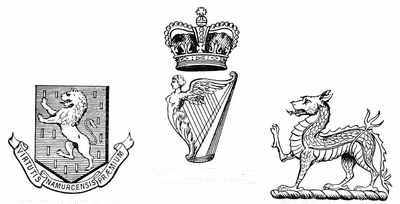
The Harp and Crown.
The Lion of Nassau.
The Dragon of China.

The Sphinx.
TITLES.
1684-86. Colonel the Earl of Granard's Regiment of Foot.
1686-1695. [Its Colonel's name] Regiment of Foot.
1695-1751. The Royal Regiment of Ireland.
1751-1881. The 18th (The Royal Irish) Regiment of Foot.
1881 (from). The Royal Irish Regiment.
PRINCIPAL CAMPAIGNS, BATTLES, &c.
* "Honours" on the Colours.
1690. Boyne.
1691. Limerick.
1691. Aughrim.
1693-97. Flanders.
1695. Namur.
1702-15. Germany.
1702. Venloo.
1702. Liége.
1704. Schellenberg.
*1704. Blenheim.
1705. Neer-Hespen.
*1706. Ramilies.
*1708. Oudenarde.
1708. Lisle.
1709. Tournay.
*1709. Malplaquet.
1711. Bouchain.
1715. Aire.
1727. Gibraltar.
1745. Flanders.
1775-76. America.
1775. Lexington.
1775. Bunker's Hill.
1793. Toulon.
1794. Corsica.
*1801. Egypt.
1801. Mandora.
1801. Alexandria.
1809. San Domingo.
*1840-42. China.
1852. Rangoon.
*1852-53. Pegu.
*1855. Sevastopol.
*1863-66. New Zealand.
*1879-80. Afghanistan.
*1882. Egypt.
1882. Kassassin.
*1882. Tel-el-Kebir.
*1884-85. Nile.
1900. South Africa.
Uniform.—Scarlet with Blue facings (from 1684).
Regimental and other Badges.—"The Harp and Crown." Also "The Lion of Nassau," with Motto, "Virtutis Namurcensis Præmium"—"the reward of valour at Namur"—(both bestowed by William III. for prowess in assault at the siege of Namur). Also "The Sphinx," for Egypt (1801). Also "The Dragon," for China (1840-42). Also (till 1695) "The Cross of St. Patrick."
Notes.—The only regiment now in existence out of nineteen raised in Ireland from the Independent Garrison Companies of the Commonwealth.
Nicknames.—"Paddy's Blackguards," "The Namurs."
Bibliography.—Historical Record of the 18th, or Royal Irish Regiment. 1684-1848. [London: Parker. 1848.]
The Princess of Wales's Own (Yorkshire Regiment),
COMPRISING
1st & 2nd Batts. (formerly) The 19th (1st Yorkshire, North Riding—Princess of Wales's Own) Regiment of Foot; with Militia Batts.
3rd Batt. The 5th West York Militia.
4th Batt. The North York Militia.
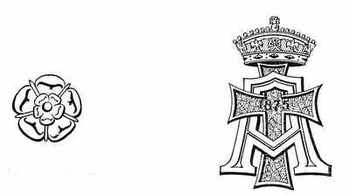
The White Rose.
The Princess of Wales's Cypher with Crown and Coronet.
TITLES.
1688-91. Colonel Francis Luttrell's Regiment of Foot.
1691-1751. [Its Colonel's name] Regiment of Foot (in 1693 Colonel Earl's).
1751-82. The 19th Regiment of Foot.
1782-1875. The 19th (1st Yorkshire, North Riding) Regiment of Foot.
1875-81. The 19th (1st Yorkshire, North Riding—Princess of Wales's Own) Regiment of Foot.
1881 (from). The Princess of Wales's Own (Yorkshire Regiment).
PRINCIPAL CAMPAIGNS, BATTLES, &c.
* "Honours" on the Colours.
1692-96. Flanders.
1692. Steenkirk.
1693. Neer Landen.
1695. Namur.
1709-13. Germany.
*1709. Malplaquet.
1709. Pont-à-Vendin.
1710. Douay.
1711. Bouchain.
1744-48. Flanders.
1745. Fontenoy.
1746. Roucoux.
1747. Val.
1761. Belle Isle.
1781-82. America.
1793. Nieuport.
1794-95. Flanders.
1795. Guildermalsen.
1799. Seringapatam.
1810. Mauritius.
1817-19. Ceylon.
*1854. Alma.
*1854. Inkerman.
*1855. Sevastopol.
1858. Indian Mutiny.
1868. Hazara.
1884-85. Nile.
*1897-98. Tirah.
1900. South Africa.
Uniform.—Scarlet with Grass-Green facings (to 1881); Scarlet and White facings (since 1881). Recently (1900) the grass-green facings have been restored.
Regimental and other Badges.—"The White Rose" (of York) in the Regulations. Also a special device on various appointments—"H.R.H. the Princess of Wales's Cypher and Coronet, combined with a Cross"; on the cross, 1875.
Nicknames.—"The Green Howards," "Howard's Garbage," or "Howard's Greens," from its facings and Colonel's name (1738-48); also "The Bounders."
Notes.—Raised from independent companies of pikemen and musketeers in Devonshire.
Bibliography.—Historical Record of The 19th, or 1st Yorkshire, North Riding Regiment. 1688-1848. Illustrated. [London: Parker. 1848.] The Nineteenth and their Times. By Colonel John Biddulph. [London: Murray. 1900.]
The Lancashire Fusiliers,
COMPRISING
1st and 2nd Batts. (formerly) The 20th (The East Devonshire) Regiment of Foot; two other batts. have been sanctioned; also Militia Batts.
5th and 6th Batts. The 7th Royal Lancashire Militia.
"Omnia audax."
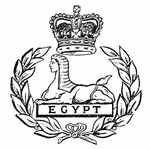
The Sphinx with Wreath and Crown.
TITLES.
1688-89. Colonel Sir Robert Peyton's Regiment of Foot.
1689-1751. [Its Colonel's name] Regiment of Foot (in 1689 Colonel Gustavus Hamilton, afterwards Viscount Boyne).
1751-82. The 20th Regiment of Foot.
1782-1881. The 20th (East Devonshire) Regiment of Foot.
1881 (from). The Lancashire Fusiliers.
PRINCIPAL CAMPAIGNS, BATTLES, &c.
* "Honours" on the Colours.
1690. Boyne.
1691. Athlone.
1691. Aughrim.
1707-12. Spain.
1709. Caya.
1727. Gibraltar.
1742-45. Flanders.
*1743. Dettingen.
1745. Fontenoy.
1745. Culloden.
1758. Cherbourg.
1758-63. Germany.
1759. Minden.
1760. Warbourg.
1760. Campen.
1761. Denkern.
1762. Wilhelmstahl.
1776-81. America.
1777. Stillwater.
1799. Crabbendam.
1799. Bergen.
*1799. Egmont-op-Zee.
1799. Alkmaer.
1800. Quiberon.
*1801. Egypt.
*1806. Maida.
*1808-14. Peninsula.
*1808. Vimiera.
*1809. Corunna.
1809. Flushing.
1813. Vittoria.
*1813. Pyrenees.
1813. St. Sebastien.
*1814. Orthes.
*1814. Toulouse.
*1854. Alma.
*1854. Inkerman.
*1855. Sevastopol.
1857-58. Indian Mutiny.
*1858. Lucknow.
*1898. Khartoum
1900. South Africa.
Uniform.—Scarlet and Pale Yellow (at formation); Scarlet and White (present time).
Regimental Badge.—"The Sphinx" with a laurel wreath surmounted by a Crown for "Egypt" (1801). Also (time uncertain) the Motto, "Omnia audax."
Nicknames.—"The Two Tens" (XXth). "The Minden Boys" (at Minden, in 1759, the regiment sported roses, obtained from a garden close by, in their hats; in memory of distinction then won, a custom still obtains of wearing "Minden Roses" every 1st of August). "Kingsley's Stand" (also from its conduct at Minden and its Colonel's name).
Notes.—Raised in Devonshire on the landing of William of Orange, afterwards William III.
Bibliography.—Historical Record of The 20th, or East Devonshire Regiment. 1688-1848. Illustrated. [London: Parker. 1848.] Orders, Memoirs, &c., connected with The 20th Regiment. By Lieut. F. W. Barlow, 2nd Batt. 20th Regiment. [Minden Press. 1868.] History of The 20th Regiment. 1688-1888. By Lieutenant and Quartermaster B. Smyth, 1st Lancashire Fusiliers. [London: Simpkin Marshall & Co. 1889.]
The Royal Scots Fusiliers,
COMPRISING
1st & 2nd Batts. (formerly) The 21st (Royal Scots Fusiliers) Regiment of Foot; with Militia Batt.
3rd Batt. The Royal Ayr and Wigtown Militia.
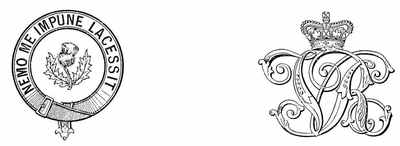
The Thistle within Circle of St. Andrew.
Royal Cypher and Crown.
TITLES.
1678-86. Colonel The Earl of Mar's Regiment of Foot (afterwards Fusiliers).
1686-1707. [Its Colonel's name] Regiment of Fusiliers; also (popularly) The Scots Fusiliers Regiment of Foot.
1707-12. The Scots Fusiliers Regiment of Foot.
1712-51. The Royal North British Fusiliers Regiment of Foot.
1751-1877. The 21st (Royal North British) Fusiliers Regiment of Foot.
1877-81. The 21st (Royal Scots Fusiliers) Regiment of Foot.
1881 (from). The Royal Scots Fusiliers.
PRINCIPAL CAMPAIGNS, BATTLES, &c.
* "Honours" on the Colours.
1689-1697. Flanders.
1689. Walcourt.
1692. Steenkirk.
1693. Neer-Landen.
1702-12. Germany.
1704. Schellenberg.
*1704. Blenheim.
1705. Neer Hespen.
*1706. Ramilies.
*1708. Oudenarde.
1708. Lisle.
*1709. Malplaquet.
1710. Douay.
1711. Bouchain.
1742-48. Flanders.
*1743. Dettingen.
1745. Fontenoy.
1747. Val.
1761. Belle-Isle.
1776-81. America.
1777. Stillwater.
1794. Martinique.
1794. St. Lucia.
1794. Guadaloupe.
1809. Ionian Islands.
1809. Scylla.
1814. Bergen-op-Zoom.
1814. Netherlands.
*1814. Bladensburg.
1814. Baltimore.
1815. New Orleans.
*1854. Alma.
*1854. Inkerman.
*1855. Sevastopol.
*1879. South Africa.
*1885-87. Burma.
*1897-8. Tirah.
1900. South Africa.
Uniform.—Scarlet with Scarlet facings (1678-1712); Scarlet and Blue facings (from 1712).
Regimental and other Badges.—"The Thistle within the Circle of St. Andrew," with the Motto, "Nemo me impune lacessit." Also "The Royal Cypher and Crown."
Nickname.—"The Earl of Mar's Grey-breeks" (from the colour of the breeches and its Colonel's name when raised).
Notes.—Armed, when raised, with fusils instead of muskets—hence its title. Formerly (1751) "The White Horse of Hanover" and Motto appeared on some appointments.
Bibliography.—Historical Record of The 21st, or Royal North British Fusiliers. 1678-1849. Illustrated. [London: Parker. 1849.] Historical Record of The Royal Scots Fusiliers. 1678-1885. By James Clarke, late Sergeant Royal Scots Fusiliers. Illustrated. [Edinburgh: Banks & Co. 1885.]
The Cheshire Regiment,
COMPRISING
1st & 2nd Batts. (formerly) The 22nd (The Cheshire) Regiment of Foot; with Militia Batts.
3rd Batt. The 1st Royal Cheshire Militia.
4th Batt. The 2nd Royal Cheshire Militia.
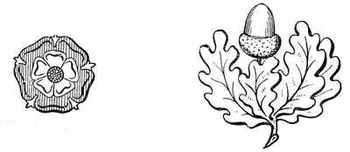
The United Rose.
The Acorn and Leaves.
TITLES.
1689. Colonel the Duke of Norfolk's Regiment of Foot.
1689-1751. [Its Colonel's name] Regiment of Foot.
1751-82. The 22nd Regiment of Foot.
1782-1881. The 22nd (The Cheshire) Regiment of Foot.
1881 (from). The Cheshire Regiment.
PRINCIPAL CAMPAIGNS, BATTLES, &c.
* "Honours" on the Colours.
1690. Boyne.
1691. Athlone.
1691. Limerick.
1691. Aughrim.
1727. Gibraltar.
1757-60. Canada.
*1758. Louisberg.
1759. Quebec.
1761. Dominica.
1762. Martinique.
1762. Havannah.
1775-79. America.
1775. Bunker's Hill.
1776. Brooklyn.
1794. Guadaloupe.
1794. St. Lucia.
1794. San Domingo.
1800. Cape of Good Hope.
1804. Deig.
1805. Bhurtpore.
1810. Mauritius.
*1843. Meanee.
*1843. Hyderabad.
*1843. Scinde.
1887. Burma.
1900. South Africa.
Uniform.—Scarlet with Buff facings (in 1689); Scarlet and White facings (present time).
Regimental and other Badges.—"The United Red and White Rose" (this, though given in Army List, is not worn). Also "An Acorn and Oak Leaves."
Nicknames.—"The Two Twos" (22nd). "The Red Knights" (in 1795 it was served with red jackets, waistcoats, and breeches, instead of the proper uniform).
Notes.—First raised at Chester. At Hyderabad (1743) it captured seventeen standards.
Bibliography.—Historical Record of The 22nd, or Cheshire Regiment of Foot. 1689-1849. Illustrated. [London: Parker. 1849.]
The Royal Welsh Fusiliers,
COMPRISING
1st & 2nd Batts. (formerly) The 23rd (Royal Welsh Fusiliers) Regiment of Foot; with Militia Batts.
3rd Batt. The Royal Denbigh and Flint Militia.
4th Batt. The Royal Carnarvon and Merioneth Militia.
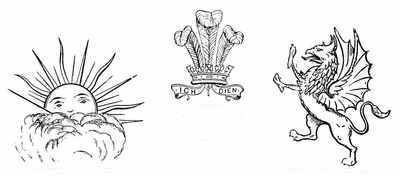
The Plume of the Prince of Wales.
The Rising Sun.
The Red Dragon.
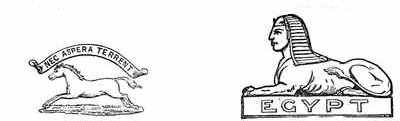
The White Horse.
The Sphinx.
TITLES.
1688-89. Colonel Lord Herbert's Regiment of Foot.
1689-1714. [Its Colonel's name] Regiment of Foot.
1714-27. The Prince of Wales's Own Royal Welsh Fusiliers.
1727-51. The Royal Welsh Fusiliers.
1751-1881. The 23rd (Royal Welsh Fusiliers) Regiment of Foot.
1881 (from). The Royal Welsh Fusiliers.
PRINCIPAL CAMPAIGNS, BATTLES, &c.
* "Honours" on the Colours.
1690. Boyne.
1691. Aughrim.
1692-97. Flanders.
1695. Namur.
1702-12. Germany.
1702. Liége.
1704. Schellenberg.
*1704. Blenheim.
1705. Neer-Hespen.
*1706. Ramilies.
1708. Wynendale.
*1708. Oudenarde.
1708. Lisle.
*1709. Malplaquet.
1710. Douay.
1711. Bouchain.
1742-48. Flanders.
*1743. Dettingen.
1745. Fontenoy.
1747. Val.
1756. Minorca.
1758. Cherbourg.
1758-62. Germany.
*1759. Minden.
1760. Warbourg.
1760. Campen
1775-81. America.
1775. Lexington.
1775. Bunker's Hill.
1776. Brooklyn.
1777. Brandywine.
1778. Freehold.
1780. Camden.
1781. Guildford.
1792. San Domingo.
1799. Helder.
1799. Crabbendam.
1799. Bergen.
1799. Egmont-op-Zee.
1799. Alkmaer.
1801. Aboukir.
*1801. Egypt.
1801. Alexandria.
1807. Copenhagen.
*1808-14. Peninsula.
*1809. Corunna.
1809. Flushing.
*1809. Martinique.
*1811. Albuera.
*1812. Badajos.
*1812. Salamanca.
1812. Burgos.
*1813. Vittoria.
1813. San Sebastian.
*1813. Pyrenees.
*1813. Nivelle.
*1814. Orthes.
*1814. Toulouse.
1815. Quatre-Bras.
*1815. Waterloo.
1815. Netherlands.
*1854. Alma.
*1854. Inkerman.
*1855. Sevastopol.
1857-58. Indian Mutiny.
*1858. Lucknow.
*1874. Ashantee.
*1885-87. Burma.
1900. South Africa.
Uniform.—Scarlet (from 1688, the colour of facings being unknown, but probably Blue); Scarlet and Blue (from 1742).
Regimental and other Badges.—"The Prince of Wales's Plume," with "Ich Dien." "The Rising Sun." "The Red Dragon." (The two last are ancient badges of the Princes of Wales.) Also "The White Horse" (of Hanover), with the Motto, "Nec aspera terrent." Also "The Sphinx" for "Egypt" (1801).
Nicknames.—"The Nanny Goats" and "The Royal Goats" (it has a goat as a regimental pet, which is led with garlanded horns and a shield at the head of the drums—how the custom arose is unknown).
Notes.—Raised in Wales. Its officers wear the "flash," a relic of the old queue. A leek is also worn in the cap on St. David's Day. Its title in 1714 was bestowed in honour of the Prince of Wales.
Bibliography.—Historical Record of The 23rd, or Royal Welsh Fusiliers. 1689-1850. Illustrated. [London: Parker. 1850.] Historical Record of The Royal Welsh Fusiliers. By Major Rowland Broughton Mainwaring, Royal Welsh Fusiliers. Illustrated. [London: Hatchards. 1889.]
The South Wales Borderers,
COMPRISING
1st & 2nd Batts. (formerly) The 24th (The 2nd Warwickshire) Regiment; with Militia Batts.
3rd Batt. The Royal South Wales Borderers Militia.
4th Batt. The Royal Montgomery Militia.
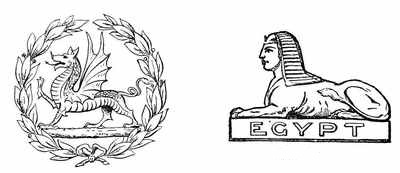
The Sphinx.
The Welsh Dragon and Laurel Wreath.
TITLES.
1689-1751. Col. Sir Edward Dering's [or its Colonel's name] Regiment of Foot (amongst these were Marlborough in 1702 until transferred to the Guards).
1751-82. The 24th Regiment of Foot.
1782-18—. The 24th (2nd Warwickshire) Regiment of Foot.
1881 (from). The South Wales Borderers.
PRINCIPAL CAMPAIGNS, BATTLES, &c.
* "Honours" on the Colours.
1690-1. Ireland.
1694. La Hague.
1694. Brest.
1695. Namur.
1697. Brabant.
1702-10. Germany.
1704. Schellenberg.
*1704. Blenheim.
1705. Neer-Hespen.
*1706. Ramilies.
*1708. Oudenarde.
1708. Menin.
1708. Lisle.
*1709. Malplaquet.
1710. Douay.
1741. Carthagena.
1756. Minorca.
1758. Cherbourg.
1759. Guadaloupe.
1760-62. Germany.
1760. Corbach.
1760. Warburg.
1761. Denkern.
1762. Wilhelmstahl.
1776-81. America.
1777. Stillwater.
*1801. Egypt.
1801. Alexandria.
*1806. Cape of Good Hope.
*1809-14. Peninsula.
*1809. Talavera.
*1811. Fuentes d'Onor.
*1812. Salamanca.
1812. Burgos.
*1813. Vittoria.
1813. St. Sebastian.
*1813. Pyrenees.
*1813. Nivelle.
*1814. Orthes.
1814. Toulouse.
1814-15. Nepaul.
*1848-49. Punjaub.
*1849. Chillianwallah.
*1849. Goojerat.
1857-58. Indian Mutiny.
*1877-79. South Africa.
*1885-87. Burma.
1900. South Africa.
Uniform.—Scarlet and Green facings (till 1881): Scarlet and White facings (from 1881).
Regimental and other Badges.—"The Sphinx," for "Egypt" (1801). Also "The Welsh Dragon" within a Laurel Wreath.
Nickname.—"Howard's Greens" (from 1717 till 1737, during which period its Colonel's name was Howard and its facings Green). Also (as with the Leicestershires—the 17th) "The Bengal Tigers" (having seen much service in India).
Bibliography.—Rambling Reminiscences of the Punjab Campaign, 1848-49; with a brief History of the 24th Regiment from 1689-1889. By Lieutenant-Colonel Andrew John Macpherson. [Chatham: Mackay. 1889.] Historical Records of The 24th Regiment. 1689-1892. With numerous coloured and other illustrations. Edited by Colonel George Paton, late 24th Regimental District; Colonel Farquhar Glennie, late 24th Foot; and Colonel William Penn Symons, late 24th Foot. [Devonport: Swiss. 1892.]
The King's Own Scottish Borderers,
COMPRISING
1st & 2nd Batts. (formerly) The 25th (The King's Own Borderers) Regiment of Foot; with Militia Batt.
3rd Batt. The Scottish Borderers Militia.
"In veritate Religionis confido."
"Nisi Dominus frustra."
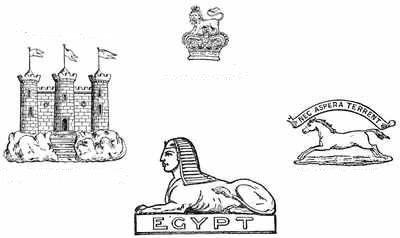
The Castle of Edinburgh. The White Horse.
The Royal Crest. (upper) The Sphinx.
TITLES.
1689-1751. The Edinburgh Regiment of Foot; also Leven's Foot.
1751-82. The 25th (Edinburgh) Regiment of Foot.
1782-1805. The 25th (Sussex) Regiment of Foot.
1805-87. The 25th (The King's Own Borderers) Regiment of Foot.
1887 (from). The King's Own Scottish Borderers.
PRINCIPAL CAMPAIGNS, BATTLES, &c.
* "Honours" on the Colours.
1689. Killiecrankie.
1691. Athlone.
1691. Galway.
1691. Limerick.
1692-97. Flanders.
1692. Steenkirk.
1693. Neer Landen.
1695. Namur.
1715. Jacobite rising.
1727. Gibraltar.
1743-47. Flanders.
1745. Fontenoy.
1745. Jacobite rising.
1746. Roucoux.
1747. Val.
1758. Cherbourg.
1758-63. Germany.
*1759. Minden.
1760. Warbourg.
1760. Campen.
1761. Kirk Denkern.
1762. Wilhelmstahl.
1782-83. Gibraltar.
1794. Toulon.
1794. Corsica.
1799. Helder.
*1799. Egmont-op-Zee.
*1801. Egypt.
1801. Alexandria.
*1809. Martinique.
1815. Martinique.
1815. Guadaloupe.
*1878-80. Afghanistan.
1889. Soudan (Gemazieh).
*1895. Chitral.
*1897-8. Tirah.
1900. South Africa.
Uniform.—Scarlet, with deep Yellow facings (1689-1805); Scarlet and Blue facings (from 1805).
Regimental and other Badges.—"The Royal Crest," with Motto, "In veritate Religionis confido" (conferred in 1805 by George III. on change of Title). Also "The Castle of Edinburgh," with Motto, "Nisi Dominus frustra" (the Regiment was raised to defend the City of Edinburgh). Also "The White Horse" (of Hanover), with Motto, "Nec aspera terrent." Also "The Sphinx," for "Egypt" (1801).
Nickname.—"The K.O.B.s" (its initials); also "The Botherers," and "The Kokky-Olly Birds."
Notes.—Said to have been raised to the number of 800 men in two hours. It captured two standards at Val (1747).
Bibliography.—Records of The King's Own Borderers, or Old Edinburgh Regiment. By Captain R. T. Higgins. [London: Chapman and Hall. 1873.]
The Cameronians (Scottish Rifles),
COMPRISING
1st Batt. (formerly) The 26th (The Cameronians) Regiment of Foot.
2nd Batt. (formerly) The 90th (Perthshire Volunteers—Light Infantry) Regiment; with Militia Batts.
3rd & 4th Batts. The 2nd Royal Lanark Militia.
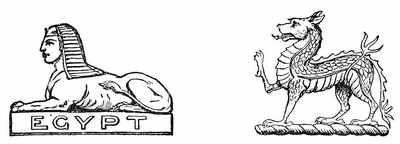
The Sphinx. The Dragon of China.
TITLES.
1st Batt.
1688. The Cameronian Guard.
1689-1751. The Earl of Angus's (or successive Colonels') Regiment of Foot; also for a considerable part of this period, "The Cameronians."
1751-86. The 26th Regiment of Foot.
1786-1881. The 26th (The Cameronians) Regiment of Foot.
2nd Batt.
1759-63. The 90th (Irish Light Infantry) Regiment: disbanded.
1775-83. The 90th Regiment of Foot: disbanded.
1794-18—. The 90th (Perthshire Volunteers—Light Infantry) Regiment.
1881 (from). The Cameronians (Scottish Rifles).
PRINCIPAL CAMPAIGNS, BATTLES, &c.
* "Honours," the figures showing the Battalion concerned.
1689. Dunkeld.
1691-95. Flanders.
1692. Steenkirk.
1693. Neer Landen.
1695. Namur.
1702-13. Germany.
1704. Schellenberg.
*1704. Blenheim (1).
*1706. Ramilies (1).
1707. Dendermonde.
1707. Ath.
1708. Wynendale.
*1708. Oudenarde (1).
1708. Lisle.
1708. Ghent.
*1709. Malplaquet (1).
1709. Pont-à-Vendin.
1710. Douay.
1711. Bouchain.
1715. Jacobite rising.
1727. Gibraltar.
1761. Belleisle.
1762. Havannah.
1775-81. America.
1775. St. John's.
1795. Quiberon.
1798. Minorca.
*1801. Egypt (1 & 2).
*1801. Mandora (2).
1801. Alexandria.
1808-9. Peninsula.
*1809. Corunna (1).
1809. Flushing.
*1809. Martinique (2).
*1810. Guadaloupe (2).
1811-12. Peninsula.
*1840-42. China (1).
*1846-47. South Africa (2).
*1855. Sevastopol (2).
1857-58. Indian Mutiny.
*1857. Lucknow (2).
*1868. Abyssinia (1).
*1877-79. South Africa (2).
1900. South Africa.
Uniform.—1st Batt., Scarlet and White facings (in 1689); Scarlet and Pale Yellow facings (in 1713); 2nd Batt., Scarlet and Buff (in 1794). Now Dark Green and Rifle Green for both Batts.
Regimental and other Badges.—"The Sphinx" with "Egypt" (for 1801). Also "The Dragon" (for China, 1840-42). See "Notes."
Nicknames, &c.—The old 26th (1st Batt.) was familiarly known as "The Scots," circa 1762; while the late 90th, when raised, was dubbed "The Perthshire Grey-breeks" (from the colour of their breeches).
Notes.—The 1st Batt. of The Cameronians trace a direct descent from the old "Cameronian Guard" of the "Lords of Convention," the name itself being derived from Richard Cameron, a famous preacher. The Cameronians, as a rifle corps, carry no colours—its honours are displayed on various appointments.
Bibliography.—Historical Record of The 26th, or Cameronian Regiment. By T. Carter. [London: Byfield, Stanford & Co. 1867.] Records of the 90th Regiment (Perthshire Light Infantry). With Roll of Officers from 1795 to 1800. By Captain A. L. Delavoye, 56th Foot (late 90th Light Infantry). [London: Richardson & Co. 1880.]
The Royal Inniskilling Fusiliers,
COMPRISING
1st Batt. (formerly) The 27th (Inniskilling) Regiment of Foot.
2nd Batt. ( " ) The 108th (Madras Infantry) Regiment of Foot; with Militia Batts.
3rd Batt. The Fermanagh Militia.
4th Batt. The Tyrone Militia.
5th Batt. The Donegal Militia.
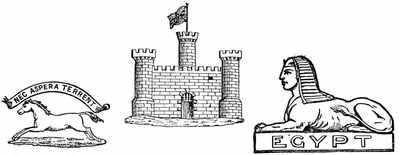
The Castle of Inniskilling. The White Horse.The Sphinx.
TITLES.
1st Batt.
1689-1751. Colonel Zachariah Tiffin's (or successive Colonels' names) Regiment of Foot.
1751-1881. The 27th (Inniskilling) Regiment of Foot.
1881 (from). The Royal Inniskilling Fusiliers.
2nd Batt.
1760-63. The 108th Regiment of Foot: disbanded.
1794-96. The 108th Regiment of Foot: dispersed between 64th and 85th Foot.
1854-58. The Hon. East India Company's 3rd (Madras Infantry) Regiment.
1858-61. The 3rd (Madras) Regiment.
1861-81. The 108th (Madras Infantry) Regiment.
1881 (from). The Royal Inniskilling Fusiliers.
PRINCIPAL CAMPAIGNS, BATTLES, &c.
* "Honours" on the Colours, the figures showing the Battalion concerned.
1690. Boyne.
1691. Aughrim.
1715. Jacobite rising.
1739. Porto Bello.
1741. Carthagena.
1745. Jacobite rising.
1756-60. Canada.
1758. Ticonderoga.
1762. Martinique.
1762. Grenada.
1762. Havannah.
1775-78. America.
1776. Brooklyn.
1776. Long Island.
1776. White Plains.
1777. Germantown.
1778. St. Lucia.
1779. Grenada.
1793. Nieuport.
1794-95. Flanders.
1794. Nimeguen.
1795. Guildermalsen.
1796. Grenada.
*1796. St. Lucia (1).
1799. Helder.
1799. Bergen.
1799. Egmont-op-Zee.
1799. Alkmaer.
*1801. Egypt (1).
1801. Alexandria.
*1806. Maida (1).
*1808-14. Peninsula (1).
1809. Scylla.
1811. Albuera.
*1812. Badajos (1).
*1812. Salamanca (1).
*1813. Vittoria (1).
1813. St. Sebastian.
1813. Bidassoa.
*1813. Pyrenees (1).
*1813. Nivelle (1).
*1814. Orthes (1).
*1814. Toulouse (1).
1814. Plattsburg.
*1815. Waterloo (1).
1815. Netherlands.
*1834-35. South Africa (1).
*1846-47. South Africa (1).
*1857-58. Central India (2).
1857-58. Indian Mutiny.
1900. South Africa.
Uniform.—1st Batt., Scarlet and Buff facings (in 1689). 2nd Batt., Scarlet and Yellow facings (in 1854). Both wear Scarlet and Blue facings at the present time.
Regimental and other Badges.—"The Castle of Inniskilling with St. George's Colours" (in recognition of the defence of the Castle of Inniskilling in 1691). Also "The White Horse" (of Hanover), with the Motto, "Nec aspera terrent" (for services during the Jacobite rising of 1715). Also "The Sphinx" for "Egypt" (1801).
Notes.—Formed from three Companies of the Inniskilling forces. It is unique in using the old Irish war-pipes. While employed on the Isthmus of Darien all but nine of six hundred men succumbed. For distinguished gallantry at St. Lucia, in 1696, it was directed that the French garrison in marching out should lay down their arms to the 27th, other marks of favour being likewise accorded to the officers and men of the regiment.
Nickname.—"The Lumps."
Bibliography.—Historical Record of The 27th Inniskillings. A History of The 27th Regiment, now The 1st Battalion of the Royal Inniskilling Fusiliers. From its formation in 1689 to 1893. Compiled by Lieut.-Col. C. J. Lloyd Davidson. Illustrated with coloured plates of costumes and other illustrations.
The Gloucestershire Regiment,
COMPRISING
1st Batt. (formerly) The 28th (North Gloucestershire) Regiment of Foot.
2nd Batt. ( " ) The 61st (South Gloucestershire) Regiment of Foot; with Militia Batts.
3rd Batt. The Royal South Gloucester Militia; and
4th Batt. The Royal North Gloucester Militia.
The Sphinx.
TITLES.
1st Batt.
1694-1751. Colonel Sir John Gibson's (or successive Colonels' names) Regiment of Foot.
1751-82. The 28th Regiment of Foot.
1782-1881. The 28th (North Gloucestershire) Regiment of Foot.
1881 (from). The Gloucestershire Regiment.
2nd Batt.
1742-48. The 61st Regiment of Foot: disbanded.
1755-59. The 61st Regiment of Foot: re-numbered as The 59th Foot (the present 2nd East Lancashire Regiment).
1758-82. The 61st Regiment of Foot.
1782-1881. The 61st (South Gloucestershire) Regiment of Foot.
1881 (from). The Gloucestershire Regiment.
PRINCIPAL CAMPAIGNS, BATTLES, &c.
* "Honours" on the Colours, the figures showing the Battalion concerned.
1702-6. Flanders.
1702. Huy.
1705. Neer Hespen.
*1706. Ramilies (1).
1706-12. Spain.
1707. Almanza.
1742-47. Flanders.
1745. Fontenoy.
1747. Hulst.
1757-60. Canada.
*1758. Louisberg (1).
1758. Cape Breton.
*1759 Quebec (1).
1759. Martinique.
1760. Salery.
1761. Belle Isle.
1762. Martinique.
1762. Havannah.
1776-78. America.
1776. Brooklyn.
1776. White Plains.
1776. Brunx.
1777. Brandywine.
1777. Germantown.
1778. St. Lucia.
1782. Minorca.
1794-95. Flanders.
1794. Nimeguen.
1795. Guildermalsen.
1796. St. Lucia.
1796. Grenada.
1798. Minorca.
1800. Kaffraria.
*1801. Egypt (1 & 2).
1801. Aboukir.
1801. Mandora.
1801. Alexandria.
*1806. Maida (2).
1807. Copenhagen.
1809. Flushing.
*1809-14. Peninsula (1 & 2).
*1809. Corunna (1).
1809. Douro.
*1809. Talavera (2).
1810. Busaco.
1810. Torres Vedras.
1810. Almeida.
*1811. Barossa (1).
*1811. Albuera (1).
1811. Arroyo-des-Molinos.
1812. Ciudad Rodrigo.
*1812. Salamanca (2).
1812. Almaraj.
1812. Burgos.
1812. Badajos.
*1813. Vittoria (1).
*1813. Pyrenees (1 & 2).
*1813. Nivelle (1 & 2).
*1813. Nive (1 & 2).
*1814. Orthes (1 & 2).
*1814. Toulouse (1 & 2).
1815. Quatre Bras.
*1815. Waterloo (1).
1815. Netherlands.
*1848-49. Punjab (2).
*1849. Chillianwallah (2).
*1849. Goojerat (2).
*1854. Alma (1).
*1854. Inkerman (1).
*1855. Sevastopol (1).
1857-58. Indian Mutiny.
*1857. Delhi (2).
1900. South Africa.
Uniform.—Scarlet and Yellow facings (1st Batt. in 1742), and Scarlet and Buff facings (2nd Batt. in 1758). Now Scarlet with White facings.
Regimental Badge.—"The Sphinx" for "Egypt," 1801. [The unique distinction of wearing the Regimental number both in front and at the back of the cap was bestowed on the old 28th for distinguished conduct at Alexandria (1801), having been then engaged with the enemy front and rear. "The Sphinx" is now so worn.]
Nicknames.—"The Old Braggs" (from its Colonel's name, 1734-51). Also "The Slashers" (the current stories to account for this sobriquet are mythical). "The Whitewashes" (of the 61st). "The Right-abouts."
Notes.—At Almanza the old 28th was all but cut to pieces: at Waterloo it captured a flag of the 25th French Infantry. The old 61st was formerly the 2nd Batt. of The 3rd Buffs, and so retained its Buff facings.
Bibliography.—Narrative of The Campaigns of The 28th Regiment. From 1862. By Lieutenant-Colonel Charles Cadell. [London: Whittaker. 1835.] Historical Records of The 28th, North Gloucestershire Regiment. 1692-1882. By Lieutenant-Colonel F. Brodigan. [London: Blackfriars Publishing Co. 1884.] Historical Record of The 61st or South Gloucestershire Regiment. 1758-1844. [London: Parker. 1844.]
The Worcestershire Regiment,
COMPRISING
1st Batt. (formerly) The 29th (Worcestershire) Regiment of Foot.
2nd Batt. ( " ) The 36th (Herefordshire) Regiment of Foot; the 3rd and 4th Batts. are authorised; with Militia Batts.
5th Batt. The 1st Worcestershire Militia.
6th Batt. The 2nd Worcestershire Militia.
The United Red and White Rose. Firm.
TITLES.
1st Batt.
1694-1751. Colonel Thomas Farington's (or successive Colonels' names) Regiment of Foot.
1751-82. The 29th Regiment of Foot.
1782-1881. The 29th (Worcestershire) Regiment of Foot.
2nd Batt.
1701-51. Colonel Viscount Charlemont's (or successive Colonels' names) Regiment of Foot.
1751-82. The 36th Regiment of Foot.
1782-1881. The 36th (Herefordshire) Regiment of Foot.
1881 (from). The Worcestershire Regiment.
PRINCIPAL CAMPAIGNS, BATTLES, &c.
* "Honours" on the Colours, the figures showing the Battalion concerned.
1704-8. Spain.
1704-6. Germany.
1705. Neer Hespen.
*1706. Ramilies (1)
1706. Barcelona.
1707. Almanza.
1711. Quebec.
1715. Jacobite rising.
1727. Gibraltar.
1744-48. Flanders.
1745. Jacobite rising.
1746. Culloden.
1747. Val.
1758. Cherbourg.
1761. Belle Isle.
1776-81. America.
1776. Quebec.
*1783-98. Hindoostan (2).
1791. Bangalore.
1791. Nundy-Droog.
1792. Seringapatam.
1793. Pondicherry.
1796. Grenada.
1799. Helder.
1799. Oud-Karspel.
1799. Bergen.
1799. Egmont-op-Zee.
*1800-1. Mysore (2).
1800. Quiberon.
1806. Buenos Ayres.
1807. Monte Video.
*1808-14. Peninsula (1 & 2).
*1808. Roleia (1 & 2).
*1808. Vimiera (1 & 2).
1809. Douro.
*1809. Corunna (2).
1809. Flushing.
*1809. Talavera (1).
1811. Badajos.
*1811. Albuera (1).
*1812. Salamanca (2).
*1813. Pyrenees (2).
*1813. Nivelle (2).
*1813. Nive (2).
*1814. Orthes (2).
*1814. Toulouse (2).
*1845. Ferozeshah (1).
*1846. Sobraon (1).
*1848-49. Punjab (1).
1848. Chenab.
1848. Ionian Islands.
*1849. Chillianwallah (1).
*1849. Goojerat (1).
1900. South Africa.
Uniform.—1st Batt., Scarlet with Yellow facings (in 1702); Scarlet with White facings (present time) for both Battalions. The old 36th Foot wore Scarlet with Green facings from 1742 to the time of the territorial re-arrangement, when all non-"Royal" regiments assumed "White" for their facings.
Regimental and other Badges.—"The United Red and White Rose" (since 1881). Also "Firm" (worn by the old 36th since, if not before, 1773, but why is not known).
Nicknames.—"The Ever-Sworded 29th" (supposed to date back to 1746, from a regimental usage that all officers wore their swords at mess; now confined to the Captain and Subaltern of the day). "The Old Bold" (of the 29th). "The Saucy Greens" (of the 36th Foot from their facings). "The Star (or Guard) of the Line." The "Vein-openers."
Notes.—The 29th captured a standard from the French at Talavera (1809). Its quick-step—the Royal Windsor March—was presented by the Princess Augusta.
Bibliography.—History of Thomas Farrington's Regiment; afterwards 29th (Worcestershire) Foot. 1694-1891. By Major H. Everard. [Worcester: Littlebury & Co. 1891.] Historical Records of The 3rd and 4th Battalions Worcestershire Regiment. By Captain R. Holden. Historical Records of The 36th, or Herefordshire Regiment. 1701-1852. Illustrated. [London: Parker. 1853.] Historical Records of The 36th Regiment. 1852-81. [London: Mitchell. 1883.]
The East Lancashire Regiment,
COMPRISING
1st Batt. (formerly) The 30th (Cambridgeshire) Regiment of Foot.
2nd Batt. ( " ) The 59th (2nd Nottinghamshire) Regiment of Foot; with Militia Batt.
3rd Batt. The 5th Lancashire Militia.
The Sphinx. The Red Rose of Lancaster.
TITLES.
1st Batt.
1702-14. Colonel Thomas Sanderson's (or its Colonel's name) Regiment of Marines.
1714-51. Colonel Charles Willis's (or its Colonel's name) Regiment of Foot.
1751-82. The 30th Regiment of Foot.
1782-1881. The 30th (Cambridgeshire) Regiment of Foot.
1881 (from). The East Lancashire Regiment.
2nd Batt.
1741-48. The 59th Regiment of Foot: renumbered The 48th Foot.
1755. The 59th Regiment of Foot: renumbered The 56th Foot.
1755-57. The 61st Regiment of Foot: renumbered The 59th Foot.
1757-82. The 59th Regiment of Foot.
1782-1881. The 59th (2nd Nottinghamshire) Regiment of Foot.
1881 (from). The East Lancashire Regiment.
PRINCIPAL CAMPAIGNS, BATTLES, &c.
* "Honours" on the Colours, the figures showing the Battalion concerned.
1704-5. Gibraltar.
1704. Malaga.
1704-6. Spain.
1705. Barcelona.
1706. Alicante.
1706. Tortosa.
1707. Lerida.
1708. Cagliari.
1758. Cherbourg.
1761. Belle Isle.
1775-76. America.
1775. Bunker's Hill.
1781. Carolina.
1782-83. Gibraltar.
1794. Toulon.
1794. Corsica.
1794-95. Flanders.
1794. Nimeguen.
1796. St. Vincent.
1798. Minorca.
1800. Malta.
1801. Mandora.
*1801. Egypt (1).
1801. Alexandria.
1801. Marabout.
*1806. Cape of Good Hope (2).
1806-7. Madras.
1808-9. Peninsula.
*1809. Corunna (2).
1810. Mauritius.
*1811. Java (2).
*1810-13. Peninsula (1 & 2).
*1812. Badajos (1).
*1812. Salamanca.
*1813. Vittoria (2).
*1813. St. Sebastien (2).
*1813. Nive (2).
1814. Bayonne.
1814-15. Netherlands.
1815. Quatre Bras.
*1815. Waterloo (1).
1815-19. Hindoostan.
1817-19. Mahratta War.
1819. Asseerghur.
*1826. Bhurtpore (2).
*1854. Alma (1).
*1854. Inkerman (1).
*1855. Sevastopol (1).
1857-58. China.
*1857. Canton (2).
1858. Nantow.
*1878-80. Afghanistan (2).
*1879. Ahmed Khel (2).
1879. Ghuznee.
1879. Cabool.
1880. Candahar.
*1895. Chitral.
1900. South Africa.
Uniform.—1st Batt., Red with Yellow facings (the latter probably from formation, but certainly since 1742 till 1881 (?)). 2nd Batt., Red and Purple facings (in 1755); Scarlet and "lily"-White (in 1815). Now Scarlet and White facings for both Batts.
Regimental Badges.—"The Sphinx," for "Egypt" (1801): the honour was won by the 1st Batt. Also (since territorial re-organisation) "The Red Rose of Lancaster."
Nicknames.—1st Batt., "The Triple X's," or "The Three Tens" (the regimental number). 2nd Batt., "The Lily-Whites" (from the facings).
Bibliography.—Historical Records of The XXX Regiment. [London: Clowes. 1887.]
The East Surrey Regiment,
COMPRISING
1st Batt. (formerly) The 31st (The Huntingdonshire) Regiment of Foot.
2nd Batt. ( " ) The 70th (Surrey) Regiment of Foot; with Militia Batts.
3rd Batt. The 1st Royal Surrey Militia.
4th Batt. The 3rd Royal Surrey Militia.
The United Rose. The Star and Arms of Guildford.
TITLES.
1st Batt.
1702-14. Col. George Villiers' (or successive Colonels') Regiment of Marines.
1714-51. Colonel Sir Harry Goring's (or successive Colonels') Regiment of Foot.
1751-82. The 31st Regiment of Foot.
1782-1881. The 31st (Huntingdonshire) Regiment of Foot.
2nd Batt.
1756-58. The 31st Regiment of Foot (2nd Batt.).
1758-82. The 70th Regiment of Foot.
1782-1813. The 70th (Surrey) Regiment of Foot.
1813-25. The 70th (Glasgow Lowland) Regiment of Foot.
1825-81. The 70th (Surrey) Regiment of Foot.
1881 (from). The East Surrey Regiment.
PRINCIPAL CAMPAIGNS, BATTLES, &c.
* "Honours" on the Colours, the figures showing the Battalion concerned.
1702. Cadiz.
1702. Vigo Bay.
1704-6. Spain.
1704-5. Gibraltar
1705. Barcelona.
1706. Carthagena.
1706. Ivica.
1706. Majorca.
1706. Sardinia.
1707. Toulon.
1708. Cagliari.
1708. Minorca.
1742-45. Flanders.
*1743. Dettingen (1).
1745. Fontenoy.
1772. St. Vincent.
1776-81. America.
1794. Martinique.
1794. St. Lucia.
*1794. Guadaloupe (2).
1796. St. Lucia.
1799. Egmont-op-Zee.
1799. Alkmaer.
1800. Isle de Huet.
1807. Egypt.
1807. Rosetta.
*1809-14. Peninsula (1).
*1809. Talavera (1).
1810. Guadaloupe.
*1811. Albuera (1).
1813-14. Canada.
*1813. Vittoria (1).
*1813. Pyrenees (1).
*1813. Nivelle (1).
*1813. Nive (1).
1813. Bayonne.
*1814. Orthes (1).
1814. Plattsburg.
1824-46. Hindoostan.
*1842. Cabool (1).
*1845. Moodkee (1).
*1845. Ferozeshah (1).
*1846. Aliwal (1).
*1846. Sobraon (1).
*1855. Sevastopol (1).
1857-58. Indian Mutiny.
1860. China.
*1860. Taku Forts (1).
*1863-65. New Zealand (2).
*1878-79. Afghanistan (2).
*1885. Suakim (2).
1885. Tamai.
1900. South Africa.
Uniform.—1st Batt., Scarlet with Buff facings (when raised). 2nd Batt., Scarlet with Grey facings (1758-68); Scarlet and Black facings (1768). Both Batts. (from 1881), Scarlet with White facings.
Regimental and other Badges.—"The United Red and White Rose" was suggested for this as for other regiments when territorialised, and, though not used, still retains a place in official papers. Also "A Star and Arms of Guildford"—these are the old badges of the Militia battalions.
Nicknames, &c.—"The Young Buffs" (of the late 31st, King George II. having, through the similarity of the facings, mistaken it at Dettingen for the 3rd (or "Old ") Buffs). "The Glasgow Greys" (of the late 70th), from its facings and many Glasgow men serving in its ranks.
Notes.—On its way to Bengal in 1824, part of the old 31st was on board the East Indiaman Kent when burnt in the Bay of Biscay. It specially distinguished itself in the Sikh War by capturing a colour at Ferozeshah, another at Aliwal, and two more at Sobraon.
Bibliography.—Historical Record of The 31st (or Huntingdonshire) Regiment of Foot. 1702-1850. With Services of the Marine Corps, 1664-1748. Illustrated. [London: Parker. 1850.] Historical Record of The 70th Surrey Regiment of Foot. 1758-1848. Illustrated. [London: Parker. 1849.]
Duke of Cornwall's Light Infantry,
COMPRISING
1st Batt. (formerly) The 32nd (Cornwall—Light Infantry) Regiment.
2nd Batt. ( " ) The 46th (South Devonshire) Regiment of Foot; with Militia Batt.
3rd Batt. The Royal Cornwall Rangers Militia.
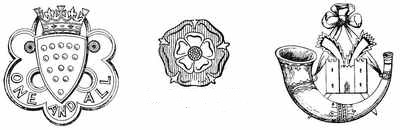
The United Red and White Rose.
The Collar Badge. Ornament on Helmet Plate.
TITLES.
1st Batt.
1702-14. Colonel Edward Fox's (or Jacob Borr's) Regiment of Marines.
1714-51. Colonel Jacob Borr's (or successive Colonels') Regiment of Foot.
1751-82. The 32nd Regiment of Foot.
1782-1858. The 32nd (Cornwall) Regiment of Foot.
1858-81. The 32nd (Cornwall—Light Infantry).
2nd Batt.
1741-51. Colonel James Price (or successive Colonels') Regiment of Foot.
1751-82. The 46th Regiment of Foot.
1782-1881. The 46th (South Devonshire) Regiment of Foot.
1881 (from). Duke of Cornwall's Light Infantry.
PRINCIPAL CAMPAIGNS, BATTLES, &c.
* "Honours" on the Colours, the figures showing the Battalion concerned.
1702. Cadiz.
1702. Vigo.
1704-5. Gibraltar.
1704-6. Spain.
1705. Barcelona.
1742-47. Flanders.
*1743. Dettingen (1).
1745. Fontenoy.
1747. Val.
1757-60. Canada.
1758. Ticonderoga.
1759. Niagara.
1761. Martinique.
1762. Havannah.
1776-78. America.
1776. Brooklyn.
1777. Brandywine.
1778. St. Lucia.
1792. Gibraltar.
1794. Martinique.
1795-96. St. Vincent.
*1805. Dominica (2).
*1808-14. Peninsula (1).
*1808. Roleia (1).
*1808. Vimiera (1).
*1809. Corunna (1).
1809. Martinique.
1809. Flushing.
1810. Guadaloupe.
1812. Badajos.
*1812. Salamanca (1).
1812. Burgos.
*1813. Pyrenees (1).
*1813. Nivelle (1).
*1813. Nive (1).
*1814. Orthes (1).
1815. Quatre-Bras.
*1815. Waterloo (1).
1815. Netherlands.
*1848-49. Punjaub (1).
1848. Soorajkhoond.
*1849. Mooltan (1).
*1849. Goojerat (1).
1854. Alma.
1854. Inkerman.
1854. Balaclava.
*1855. Sevastopol (2).
1857-58. Indian Mutiny.
*1857. Lucknow (1).
1857. Cawnpore.
*1882. Egypt (2).
*1882. Tel-el-Kebir (2).
*1884-85. Nile (2).
1900. South Africa.
Uniform.—1st Batt., Scarlet with White facings (at formation as now). 2nd Batt., Scarlet with Yellow facings (in 1741: the latter now White as with all non-"Royal" regiments).
Regimental and other Badges.—Officially, "The United Red and White Rose," but not worn. On appointments various special devices—combining "A Bugle with Strings," "The Coronet of the Duke of Cornwall," "The County Badge," with Motto, "One and All," "A Turreted Archway," and "Two Feathers" (red). [The "Turreted Archway" commemorates the defence of "Lucknow;" and the "Two Red Feathers" is a distinction of the 46th, a Light company of which, in 1777, with others were brigaded as "The Light Battalion." The Americans were so harassed by the Brigade that they vowed "No Quarter." In derision, to prevent mistakes, The Light Battalion dyed their feathers red: the 46th Foot alone has retained the distinction.]
Nicknames, &c.—These pertain to the late 46th: "Murray's Bucks" (from Colonel's name [1743-64] and its smart appearance on home duty in Scottish Royal livery). "The Surprisers" (from an incident [1777] in the American War). "The Lacedemonians" (its Colonel once, when under heavy fire, made a disciplinarian speech concerning the Lacedemonians). Also, in early days, "The Edinburgh Regiment." "The Red Feathers." "The Docs" (the initials).
Bibliography.—Historical Records of The 32nd (Cornwall) Light Infantry, now 1st Battalion Duke of Cornwall's Light Infantry. 1702-1892. By Colonel G. C. Swiney. [Devonport: Swiss. 1893.]
The Duke of Wellington's (West Riding Regiment),
COMPRISING
1st Batt. (formerly) The 33rd (Duke of Wellington's) Regiment of Foot.
2nd Batt. ( " ) The 76th Regiment of Foot; with Militia Batt.
3rd Batt. The 6th West York Militia.
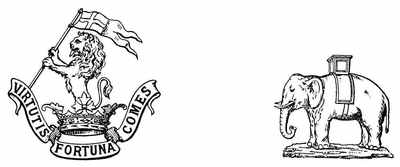
The Crest and Motto of The Duke of Wellington.
The Elephant with Howdah.
TITLES.
1st Batt.
1702-51. Colonel The Earl of Huntingdon's (or successive Colonels') Regiment of Foot.
1751-82. The 33rd Regiment of Foot.
1782-1853. The 33rd (1st York, West Riding) Regiment of Foot.
1853-81. The 33rd (Duke of Wellington's) Regiment.
2nd Batt.
1756-63. The 76th Regiment of Foot: disbanded.
1777-84. The 76th (Macdonald's Highlanders) Regiment of Foot: disbanded.
1787-1812. The 76th (Hindoostan) Regiment of Foot.
1812-81. The 76th Regiment of Foot.
1881 (from). The Duke of Wellington's (West Riding Regiment).
PRINCIPAL CAMPAIGNS, BATTLES, &c.
* "Honours" on the Colours, the figures showing the Battalion concerned.
1702-4. Germany.
1704-10. Spain.
1705. Valentia d'Alcantara.
1707. Almanza.
1742-47. Flanders.
*1743. Dettingen (1).
1745. Fontenoy.
1745. Jacobite rising.
1746. Roucoux.
1746. Tongres.
1747. Val.
1758. Cherbourg.
1760-63. Germany.
1760. Corbach.
1761. Kerk Denkern.
1761. Belle-Isle.
1762. Martinique.
1776-81. America.
1776. Brooklyn.
1777. Brandywine.
1777. Germantown.
1778. Freehold.
1780. Camden.
1781. Guildford.
*1780-1806. Hindoostan (2).
1791. Bangalore.
1791. Savendroog.
1792. Seringapatam.
1794-95. Flanders.
1795. Guildermalsen.
1799. Malvelly.
*1799. Seringapatam (1).
*1800-1. Mysore (2).
*1803. Allyghur (2).
*1803. Delhi (2).
1803. Agra.
*1803. Leswarree (2).
*1804. Deig (2).
1805. Bhurtpore.
*1808-9. Peninsula (2).
1809. Corunna.
1809. Flushing.
1810. Mauritius.
*1813. Nive (2).
1813-14. Peninsula.
1813. Pyrenees.
1813. Bidassoa.
1813. Nive.
1814. Bayonne.
1814-15. Netherlands.
1814. Antwerp.
1814. Bergen-op-Zoom.
1814. Canada.
1814. Plattsburg.
1815. Quatre Bras.
*1815. Waterloo (1).
*1854. Alma (1).
*1854. Inkerman (1).
*1855. Sevastopol (1).
1857-58. Indian Mutiny.
*1868. Abyssinia (1).
1868. Magdala.
1900. South Africa.
Uniform.—Scarlet (or Red) with Scarlet facings for both regiments till the introduction of the territorial system. Now Scarlet, faced with White.
Regimental and other Badges.—(1) "The Crest and Motto of the Duke of Wellington" (the 33rd was the first regiment commanded by "The Hero of Waterloo," and is the only corps in the British Army named after a subject); also (2) "The Elephant" to the 76th for valour in India. In 1808 The East India Company presented it with honorary colours: in conjunction with the 8th Hussars it captured 44 standards and 72 guns at Leswarree (1803).
Nicknames, &c.—1st Batt., "Havercake Lads" (the recruiting sergeants, circa 1782, carried oaten cakes on their sword-points when beating up). 2nd Batt., "The Immortals" (from most of its men having been wounded in Lake's Campaigns). "The Pigs" (from its "Elephant" badge). "The Old Seven and Sixpennies" (from its number, and the amount of a lieutenant's pay).
The Border Regiment,
COMPRISING
1st Batt. (formerly) The 34th (Cumberland) Regiment of Foot.
2nd Batt. ( " ) The 55th (Westmoreland) Regiment of Foot; with Militia Batts.
3rd Batt. The Royal Cumberland Militia.
4th Batt. The Royal Westmoreland Militia.
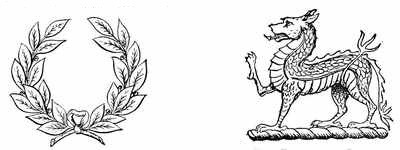
The Laurel Wreath. The Dragon of China.
TITLES.
1st Batt.
1702-51. Colonel Lord Lucas's (or successive Colonels') Regiment of Foot.
1751-82. The 34th Regiment of Foot.
1782-1881. The 34th (Cumberland) Regiment of Foot.
2nd Batt.
1742-48. The 55th Regiment of Foot: now the 1st Essex.
1756-58. The 55th Regiment of Foot: now The 1st Shropshire Light Infantry.
1755-57. The 57th Regiment of Foot: renumbered in
1757-82. The 55th Regiment of Foot.
1782-1881. The 55th (Westmoreland) Regiment of Foot.
1881 (from). The Border Regiment.
PRINCIPAL CAMPAIGNS, BATTLES, &c.
* "Honours" on the Colours, the figures showing the Battalion concerned.
1705-7. Spain.
1705. Barcelona.
1706. Montjuich.
1709-12. Germany.
1710. Douay.
1711. Bouchain.
1718. Vigo.
1727. Gibraltar.
1744. Flanders.
1745. Fontenoy.
1745. Jacobite rising.
174-. Falkirk.
174-. Culloden.
1757. Minorca.
1757-60. Canada.
1758. Ticonderoga.
1759. Niagara.
1758. Louisberg.
1758. Cherbourg.
1762. Havannah.
1775-78. America.
1776. Brooklyn.
1776. Long Island.
1777. Brandywine.
1777. Germantown.
1777. Stillwater.
1778. St. Lucia.
1794-95. Flanders.
1794. Nimeguen.
1794. Martinique.
1794. Guadaloupe.
1796. St. Lucia.
1796. St. Vincent.
1796. Grenada.
1799. Helder.
1799. Crabbendam.
1799. Bergen.
1799. Egmont-op-Zee.
1799. Alkmaer.
1800. Kaffraria.
1800-23. Hindoostan.
1809. San Domingo.
*1809-14. Peninsula (1).
*1811. Albuera.
*1811. Arroyo-dos-Molinos (1).
*1813. Vittoria (1).
1813. Maya.
*1813. Pyrenees (1).
*1813. Nivelle (1).
*1813. Nive (1).
*1814. Orthes (1).
1814. Toulouse.
1814-15. Netherlands.
1814. Bergen-op-Zoom.
1820. Kaffraria.
*1840-2. China (2).
1842. Chusan.
1842. Chinghai.
1842. Ningpoo.
1842. Ching-Kiang-Foo.
*1854. Alma (2).
*1854. Inkerman (2).
*1855. Sevastopol (1 & 2).
1857-58. Indian Mutiny.
1857. Cawnpore.
*1858. Lucknow (1).
1900. South Africa.
Uniform.—1st Batt., Red (or Scarlet) with bright Yellow facings (when raised); the latter changed to White when territorialised in 1881; 2nd Batt., Red and Dark Green facings (1755); Scarlet with White facings (present time).
Regimental and other Badges.—"A Laurel Wreath" (an old 34th Badge for services at Fontenoy: see Notes). Also "The Dragon of China" (to the 55th); the two are variously combined for different appointments.
Nickname.—"The Two Fives" (to the 55th, for its number; cf. "The Two XX's" = the late 20th).
Notes.—A red and white pompon, or tuft, was formerly worn by the 34th in recognition of the capture of the 34th French Infantry at Arroyo-dos-Molinos. The Royal Arms appear in the lace of the drummers' coats in memory of Fontenoy: see Badges.
Bibliography.—Historical Record of The 34th (The Cumberland) Regiment of Foot. 1702-1844. Illustrated. [London: Parker. 1844.] Historical Account of The 34th and 55th Regiments. By George Noakes, Quartermaster-Sergeant, 2nd Brigade Depôt. [Carlisle: Thurnam & Sons. 1875.]
The Royal Sussex Regiment,
COMPRISING
1st Batt. (formerly) The 35th Royal Sussex Regiment of Foot.
2nd Batt. ( " ) The 107th (Bengal Infantry) Regiment; with Militia Batt.
3rd Batt. The Royal Sussex Militia.
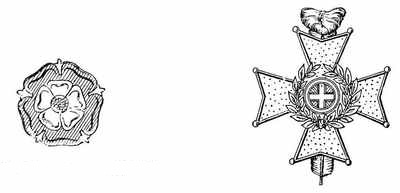
The United Red and White Rose.
The Collar Badge.
TITLES.
1st Batt.
1701-51. Colonel The Earl of Donegal's (or successive Colonels') Regiment of Foot: also popularly "The Belfast Regiment."
1751-82. The 35th Regiment of Foot.
1782-1805. The 35th (Dorsetshire) Regiment of Foot.
1805-32. The 35th (Sussex) Regiment of Foot.
1832-1881. The 35th (Royal Sussex) Regiment of Foot.
2nd Batt.
1854-58. The Hon. East India Company's 3rd (Bengal European Light Infantry) Regiment.
1858-61. The 3rd (Bengal Light Infantry) Regiment.
1861-1881. The 107th Bengal Infantry Regiment.
1881 (from). The Royal Sussex Regiment.
PRINCIPAL CAMPAIGNS, BATTLES, &c.
* "Honours" on the Colours, the figures showing the Battalion concerned.
1702. Cadiz.
1704-5. Gibraltar.
1704-8. Spain.
1706. Barcelona.
1707. Almanza.
1757-60. Canada.
*1758. Louisbourg (1).
*1759. Quebec (1).
1760. Sillery.
1761. Martinique.
1762. Havannah.
1775-78. America.
1775. Bunker's Hill.
1776. Brooklyn.
1776. Brunx.
1778. St. Lucia.
1794. Martinique.
1794. St. Lucia.
1794. Guadaloupe.
1799. Bergen.
1799. Egmont-op-Zee.
1799. Crabbendam.
1799. Alkmaer.
1800. Malta.
*1806. Maida (1).
1807. Rosetta.
1807. Egypt.
1809. Naples.
1809. Flushing.
1810. Ionian Islands.
1814-15. Netherlands.
1814. Antwerp.
1857-58. Indian Mutiny.
*1882. Egypt (1).
*1884-85. Nile (1).
*1885. Abu Klea (1).
1900. South Africa.
Uniform.—1st Batt., Scarlet with Orange facings (1701-1832, the Orange being changed to Blue on proceeding to Ireland). 2nd Batt., Scarlet with White facings. Scarlet with Blue facings for both Batts. (present time).
Regimental and other Badges.—"The United Red and White Rose." Also (though approved not in Army List) "A White Feather" (see Notes), "A Maltese Cross" (see Notes), and "The Centre of The Star of the Garter," combined.
Nickname.—"The Orange Lilies" (from its facings and white plume).
Notes.—"The White Plume," worn till 1800, and now included in the regimental badge, was worn at Quebec, being taken from The Royal Roussillon French Grenadiers; while "The Maltese Cross" is in memory of the capture of Malta. The Regiment was also at one time known as "The Prince of Orange's Own," having received its facings as a mark of favour.
Bibliography.—Historical Memoir of The 35th Royal Sussex Regiment. By Richard Trimen, late Captain 35th Foot. [Southampton. 1873.]
The Hampshire Regiment,
COMPRISING
1st Batt. (formerly) The 37th (North Hampshire) Regiment of Foot.
2nd Batt. ( " ) The 67th (South Hampshire) Regiment of Foot; with Militia.
3rd Batt. The Hampshire Militia.
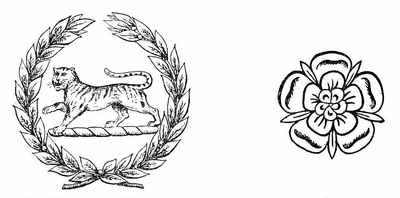
The Hampshire Rose. (As on Collar.)
The Tiger and Wreath. (As on Helmet-plate.)
TITLES.
1st Batt.
1702-51. Colonel Thomas Meredith's (or successive Colonels') Regiment of Foot.
1751-82. The 37th Regiment of Foot.
1782-1881. The 37th (North Hampshire) Regiment.
2nd Batt.
1758-82. The 67th Regiment of Foot.
1782-1881. The 67th (South Hampshire) Regiment of Foot.
1881 (from). The Hampshire Regiment.
PRINCIPAL CAMPAIGNS, BATTLES, &c.
* "Honours" on the Colours, the figures showing the Battalion concerned.
1702-12. Germany.
1704. Schellenberg.
*1704. Blenheim (1).
1705. Helixem.
1705. Neer-Hespen.
*1706. Ramilies (1).
1707. Ath.
1708. Menin.
*1708. Oudenarde (1).
1709. Tournay.
*1709. Malplaquet (1).
1710. Douai.
1742-47. Flanders.
*1743. Dettingen (1).
1745. Jacobite rising.
1746. Culloden.
1747. Val.
1758-62. Germany.
1758. Cherbourg.
*1759. Minden (1).
1761. Kirk-Denkem.
1761. Belle Isle.
1762. Wilhelmstahl.
1776-80. America.
1776. Brooklyn.
1776. Long Island.
1793-95. Flanders.
1793. Famars.
1793. Dunkirk.
*1794. Tournay (1).
1794. Nimeguen.
1795. Guildermalsen.
*1805-26. India (2).
*1810-14. Peninsula (1 & 2)
*1811. Barrossa (2).
1814. Barcelona.
1814-15. Netherlands.
1814. Antwerp.
1814. Bergen-op-Zoom.
1819. Asseerghur.
1857-58. Indian Mutiny.
1860-62. China.
*1860. Taku Forts (2).
*1860. Pekin (2).
*1878-80. Afghanistan (2).
*1879. Charasiah (2).
*1879. Cabool (2).
*1885-87. Burma (2).
1885-87. Mandalay.
1900. South Africa.
Uniform.—Scarlet with Yellow facings (both Batts. till Territorialisation changed the facings, as in all non-"Royal" regiments, to White).
Regimental and other Badges.—"The Royal Tiger in a Laurel-Wreath" (to the 67th for "India"). Also "The Hampshire Rose" on some appointments (Henry V., when en route to Agincourt, conferred the Lancastrian Rose on the City of Winchester).
Bibliography.—Annals of The 37th North Hampshire Regiment. [Winchester: Warren. 1878.] Historical Record of The 67th, or South Hampshire Regiment. 1758-1849. [London: Parker. 1849.] Regimental Orders. By Lieutenant R. W. Barlow. [London: 1868.] Colburn's United Service Magazine. January-February, 1874, and August, 1882.
The South Staffordshire Regiment,
COMPRISING
1st Batt. (formerly) The 38th (1st Staffordshire) Regiment of Foot.
2nd Batt. ( " ) The 80th (Staffordshire Volunteers) Regiment of Foot; with Militia Batts.
3rd & 4th Batts. The 1st (King's Own) Stafford Militia.
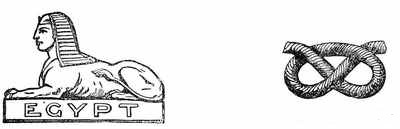
The Staffordshire Knot.
The Sphinx.
TITLES.
1st Batt.
1702-51. Colonel Luke Lillingstone's (or successive Colonels') Regiment of Foot.
1751-82. The 38th Regiment of Foot.
1782-1881. The 38th (1st Staffordshire) Regiment of Foot.
2nd Batt.
1758-64. The 80th (Light-armed) Regiment of Foot: disbanded.
1778-84. The 80th (Royal Edinburgh Volunteers) Regiment of Foot: disbanded.
1793-1881. The 80th (Staffordshire Volunteers) Regiment of Foot.
1881 (from). The South Staffordshire Regiment.
PRINCIPAL CAMPAIGNS, BATTLES, &c.
* "Honours" on the Colours, the figures showing the Battalion concerned.
1759. Guadaloupe.
1762. Martinique.
1775-80. America.
1775. Bunker's Hill.
1776. Brooklyn.
1794-95. Flanders.
1794. Martinique.
1794. Guadaloupe.
*1801. Egypt (2).
1806. Cape of Good Hope.
1806. Buenos Ayres.
*1807. Monte Video (1).
*1808-14. Peninsula (1).
*1808. Roleia (1).
*1808. Vimiera (1).
*1809. Corunna (1).
1809. Flushing.
*1810. Busaco (1).
*1812. Badajos (1).
*1812. Salamanca (1).
1812. Burgos.
*1813. Vittoria (1).
*1813. St. Sebastian (1).
1813. Bidassoa.
*1813. Nive (1).
1813. Nivelle.
1814. Bayonne.
1819. Cape of Good Hope.
*1824-26. Ava (1).
1845. Moodkee (2).
*1845. Ferozeshah (1).
*1846. Sobraon (2).
1852. Rangoon.
*1852-53. Pegu (2).
*1854. Alma (1).
*1854. Inkerman (1).
*1855. Sevastopol (1).
1857-58. Indian Mutiny.
1857. Cawnpore.
*1858. Lucknow (1).
*1858. Central India (2).
*1878-79. South Africa (2).
*1882. Egypt (1).
*1884-85. Nile (1).
*1885. Kirbecan (1)
Uniform.—Both Battalions Scarlet and Yellow facings (on formation); Scarlet with White facings (present time).
Regimental and other Badges.—"The Sphinx," for "Egypt" (1801). Also "The Staffordshire Knot" (an ancient royal borough badge).
Nicknames.—"The Pump and Tortoise" (of the 38th). Also "The Staffordshire Knots" (of the 80th).
Notes.—The late 80th captured a gun at Ferozeshah (1845).
The Dorsetshire Regiment,
COMPRISING
1st Batt. (formerly) The 39th (Dorsetshire) Regiment of Foot.
2nd Batt. ( " ) The 54th (West Norfolk) Regiment of Foot; with Militia.
3rd Batt. The Dorset Militia.
"Primus in Indis."
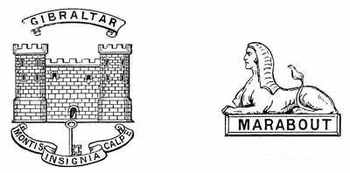
The Marabout Sphinx.
The Castle, Key, and Motto.
TITLES.
1st Batt.
1702-51. Colonel Richard Coote's (or successive Colonels') Regiment of Foot.
1751-82. The 39th Regiment of Foot.
1782-1807. The 39th (East Middlesex) Regiment of Foot.
1807-81. The 39th (Dorsetshire) Regiment of Foot.
2nd Batt.
1755-57. The 56th Regiment of Foot; renumbered.
1757-82. The 54th Regiment of Foot.
1782-1881. The 54th (West Norfolk) Regiment of Foot.
1881 (from). The Dorsetshire Regiment.
PRINCIPAL CAMPAIGNS, BATTLES, &c.
* "Honours" on the Colours, the figures showing the Battalion concerned.
1707-12. Spain.
1707. Almanza (?).
1709. Caya.
1718. Messina.
1727. Gibraltar.
1757. Calcutta.
*1757. Plassey (1).
1776-81. America.
1776. Brooklyn.
1778. Rhode Island.
1778. Connecticut.
*1779-84. Gibraltar (1).
1780. Charlestown.
1794-95. Flanders.
1794. Martinique.
1794. St. Lucia.
1794. Guadaloupe.
1796. St. Vincent.
1800. Isle Houat.
1800. Cadiz.
1800. Minorca.
1800. Malta.
1801. Egypt (2).
1801. Aboukir.
1801. Mandora.
1801. Alexandria.
*1801. Marabout (2).
1806. Buenos Ayres.
1807. Montevideo.
*1809-14. Peninsula (1).
1810. Busaco.
*1811. Albuera (1).
1811. Arroyo-dos-Molinos.
1812-14. Canada.
1812. Badajos.
*1813. Vittoria (1).
*1813. Pyrenees (1).
*1813. Nivelle (1).
*1813. Nive (1).
1814-15. Netherlands.
*1814. Orthes (1).
1814. Tarbes.
1814. Bayonne.
1814. Toulouse.
1814. Plattsburg.
1814. Antwerp.
*1824-26. Ava (1).
*1843. Maharajpore (1).
*1855. Sevastopol (1).
*1858-59. Indian Mutiny.
*1897-98. Tirah.
1900. South Africa.
Uniform.—1st and 2nd Batts., Scarlet with Green facings (at formation); Scarlet with White facings (present time).
Regimental and other Badges, &c.—The motto, "Primus in Indis" (the 39th Foot was the first King's Regiment to serve in India). Also "The Castle, Key, and Motto"—"Mortis Insignia Calpe" (for defence of Gibraltar—1779-83). Also the "Marabout Sphinx" for "Egypt" (1801)—at this battle a gun, now at Woolwich, was captured by the 54th.
Nicknames, &c.—"Sankey's Horse" (of the 39th, 1707, from its Colonel's name, and a tradition that to expedite its march to Almanza it was mounted on mules). Also (circa 1742) "The Green Linnets" (from its pea-green facings).
Notes.—The 39th captured four guns and two standards at Maharajpore in 1843.
Bibliography.—Historical Record of the 39th, or Dorsetshire Regiment of Foot. 1702-1853. Illustrated. [London: Parker. 1853.] Records of the 54th West Norfolk Regiment. [Roorkee: Thomason. 1851.]
The Prince of Wales's Volunteers (South Lancashire Regiment),
COMPRISING
1st Batt. (formerly) The 40th (2nd Somersetshire) Regiment of Foot.
2nd Batt. ( " ) The 82nd (Prince of Wales's Volunteers) Regiment of Foot; with Militia Battalion.
3rd Batt. The 4th Royal Lancashire Militia.
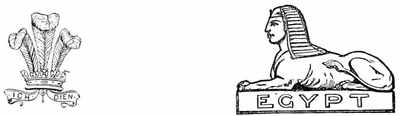
The Prince of Wales's Plume. The Sphinx.
TITLES.
1st Batt.
1717-51. Colonel Richard Philip's Regiment of Foot.
1751-82. The 40th Regiment of Foot.
1782-1881. The 40th (2nd Somersetshire) Regiment of Foot.
2nd Batt.
1793-1881. The 82nd (Prince of Wales's Volunteers) Regiment of Foot.
1881 (from). The Prince of Wales's Volunteers (South Lancashire Regiment).
PRINCIPAL CAMPAIGNS, BATTLES, &c.
* "Honours" on the Colours, the figures showing the Battalion concerned.
1757-60. Canada.
*1758. Louisbourg (1).
1759. Quebec.
1760. Montreal.
1761. Guadaloupe.
1762. Martinique.
1762. Havannah.
1776-78. America.
1776. Brooklyn.
1776. Long Island.
1777. Brandywine.
1777. Germantown.
1778. St. Lucia.
1794-95. Flanders.
1794. Martinique.
1794. Guadaloupe.
1795. St. Vincent.
1796. Grenada.
1798. San Domingo.
1798. Leghorn.
1798. Malta.
1799. Bergen.
1799. Egmont-op-Zee.
*1801. Egypt.
1801. Aboukir.
1801. Mandora.
1801. Rosetta.
1801. Alexandria.
1806. Buenos Ayres
*1807. Monte Video (1).
1807. Copenhagen.
*1808-14. Peninsula (1 & 2).
*1808. Roleia (1 & 2).
*1808. Vimiera (1 & 2).
1809. Corunna.
1809. Flushing.
*1809. Talavera (1).
1810. Busaco.
1811. Albuera.
1811. Barrossa.
1811. Tarifa.
*1812. Badajos (1).
1812. Burgos.
1812. Ciudad Rodrigo.
*1812. Salamanca (1).
1813. Maya.
*1813. Vittoria (1 & 2).
*1813. Pyrenees (1 & 2).
1813. St. Sebastian.
*1813. Nivelle (1 & 2).
1813. Nive.
*1814. Orthes (1 & 2).
*1814. Toulouse (1).
1814. Bordeaux.
*1814. Niagara (2).
*1815. Waterloo (1).
1815. Netherlands.
*1842. Candahar (1).
*1842. Ghuznee (1).
*1842. Cabool (1).
*1843. Maharajpore (1).
*1855. Sevastopol (2).
1857-58. Indian Mutiny.
*1857. Lucknow (2).
1857. Cawnpore.
*1860-65. New Zealand (1).
1900. South Africa.
Uniform.—1st Batt., Scarlet with Buff facings (1717). 2nd Batt., Scarlet and Yellow facings (1793). Both Batts., at present time, Scarlet with White facings.
Regimental and other Badges.—"The Prince of Wales's Plume" (the Colonel of the 82nd when raised was attached to the household of the Prince of Wales). Also "The Sphinx" for "Egypt" (1801—to the 40th Foot).
Nickname.—"The Excellers" (of the 40th (XL.) Foot). "The Fighting Fortieth."
Notes.—The 40th captured four standards at Maharajpore (1843).
Bibliography.—A Short Record of the 1st Battalion Prince of Wales's Volunteers, (South Lancashire Regiment), formerly the 40th (2nd Somersetshire) Regiment. By Captain R. H. Raymond-Smithies, 1st Batt. Prince of Wales's Volunteers (South Lancashire Regiment). [Jersey: 1891.] Historical Records of the 40th (2nd Somersetshire) Regiment, now 1st Battalion Prince of Wales's Volunteers (South Lancashire Regiment), from its formation in 1717 to 1893. With many coloured plates and other illustrations. By Captain R. H. Raymond-Smithies, 1st Batt. Prince of Wales's Volunteers (South Lancashire Regiment). [Devonport: Swiss. 1894.] Historical Record of the 82nd Regiment (or Prince of Wales's Volunteers). By Major Jarvis, 82nd Regiment. [London: Mitchell. 1866.]
The Welsh Regiment,
COMPRISING
1st Batt. (formerly) The 41st (The Welsh) Regiment of Foot.
2nd Batt. ( " ) The 69th (South Lincolnshire) Regiment of Foot; with Militia Battalion.
3rd Batt. The Royal Glamorgan Militia.

The Royal Cypher with the Imperial Crown.
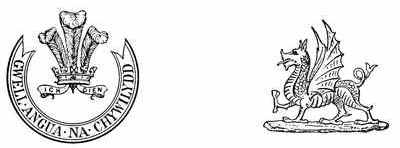
Centre Ornament on Helmet-Plate.
The Dragon of Wales.
TITLES.
1st Batt.
1719-87. Independent Companies of Invalids (at first); subsequently The 41st (Royal Invalids) Regiment.
1787-1822. The 41st Regiment of Foot.
1822-81. The 41st (The Welsh) Regiment of Foot.
2nd Batt.
1756-58. The 24th (2nd Batt.) Regiment of Foot; renumbered.
1758-82. The 69th Regiment of Foot.
1782-1881. The 69th (South Lincolnshire) Regiment of Foot.
1881 (from). The Welsh Regiment.
PRINCIPAL CAMPAIGNS, BATTLES, &c.
* "Honours" on the Colours, the figures showing the Battalion concerned.
1761. Belle Isle.
1778. St. Lucia.
1793. Toulon.
1794. Corsica.
1794. San Domingo.
1795. Hyères.
1796. Genoa.
1796. Porto Ferrajo.
*1797. St. Vincent (2).
1799. Helder.
1799. Bergen.
1806. Vellore.
*1809. Bourbon (2).
1810. Mauritius.
*1811. Java (2).
1812-14. Canada.
*1812. Detroit (1).
*1812. Queenstown (1).
*1813. Miami (1).
*1813. Niagara (1).
1814-15. Netherlands.
1814. Bergen-op-Zoom.
1815. Quatre Bras.
*1815. Waterloo (2).
*1815-26. India (2).
*1824-26. Ava (1).
*1842. Candahar (1).
*1842. Ghuznee (1).
*1842. Cabool (1).
1842. Kohistan.
1842. Istuliff.
*1854. Alma (1).
*1854. Inkerman (1).
*1855. Sevastopol (1).
1900. South Africa.
Uniform.—1st Batt., Scarlet with Blue facings (1719-82); Scarlet with Scarlet facings (1782-1822); Scarlet with White facings (from 1822). 2nd Batt., Scarlet with Green facings (from 1758). 1st and 2nd Batts., Scarlet and White facings (present time).
Regimental and other Badges.—"The Rose and Thistle on the same stalk within the Garter." Also "The Prince of Wales's Plume," with the motto, "Gwell angua na Chywilydd" (received with its title in 1822). Also "The Royal Cypher with the Imperial Crown." The foregoing are recognised in the Army List, but "The Dragon of Wales" also appears on some appointments.
Nicknames.—At St. Vincent (1797) Nelson dubbed the detachment of the 69th, serving as Marines, his "Old Agamemnons." "The Ups and Downs" (of the late 69th)—the number can be read either way. "Wardour's Horse."
Notes.—Since its return from India in 1826 the 69th had been unfortunate enough to miss every chance of active service until sent to South Africa in 1900.
Bibliography.—A Narrative of the Historical Events connected with the 69th Regiment. By W. F. Butler, 69th Regiment. [London: Mitchell. 1870.]
The Black Watch (Royal Highlanders),
COMPRISING
1st Batt. (formerly) The 42nd (Royal Highland—The Black Watch).
2nd Batt. ( " ) The 73rd (Perthshire) Regiment of Foot; with Militia Battalion.
3rd Batt. The Royal Perth Militia.
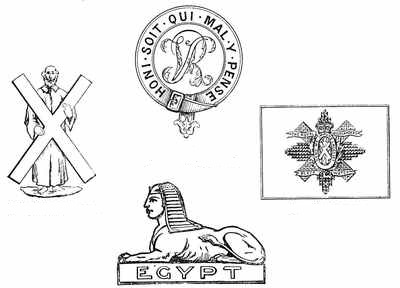
The Collar-Badge.
The Waist belt.
The Royal Cypher within the Garter. (upper) The Sphinx.
TITLES.
1st Batt.
1725-39. The Black Watch (see Notes).
c. 1739-51. The Highland Regiment.
c. 1751-58. The 42nd Highland Regiment.
1758-1861. The 42nd Royal Highland Regiment of Foot.
1861-1881. The 42nd Royal Highland (The Black Watch) Regiment of Foot.
2nd Batt.
1758-86. The 2nd Batt. 42nd Royal Highlanders.
1786-1862. The 73rd Regiment of Foot.
1862-81. The 73rd (Perthshire) Regiment.
1881 (from). The Black Watch (Royal Highlanders).
PRINCIPAL CAMPAIGNS, BATTLES, &c.
* "Honours" on the Colours, the figures showing the Battalion concerned.
1743-47. Flanders.
1745. Fontenoy.
1745. Jacobite rising.
1757-60. Canada.
1758. Ticonderoga.
1759. Guadaloupe.
1762. Martinique.
1762. Havannah.
1762-67. Indian Frontier Service.
1763. Bushy Run.
1775-81. America.
1776. Long Island.
1776. White Plains.
1776. Brooklyn.
1776. Fort Washington.
1777. Pisquata.
1777. Brandywine.
1777. Germantown.
1778. Freehold.
1780. Charlestown.
*1783. Mysore (2).
*1783. Mangalore (2).
1793. Pondicherry.
1793-95. Flanders.
1793. Nieuport.
1794. Nimeguen.
1795. Ceylon.
1795. Guildermalsen.
1796. St. Lucia.
1797. St. Vincent.
1798. Minorca.
*1799. Seringapatam (2).
1799. Genoa.
1799. Cadiz.
1800. Malta.
*1801. Egypt (1).
1801. Alexandria.
1801. Aboukir.
1801. Mandora.
*1808-14. Peninsula (1).
1808. Roleia.
1808. Vimiera.
*1809. Corunna (1).
1810. Busaco.
*1811. Fuentes d'Onor (1).
1812. Ciudad Rodrigo.
1812. Salamanca.
1812. Burgos.
*1813. Pyrenees (1).
1813. Gohrde.
*1813. Nivelle (1).
*1813. Nive (1).
1814. Antwerp.
*1814. Orthes (1).
*1814. Toulouse (1).
1815. Quatre Bras.
*1815. Waterloo (1 & 2).
1815. Netherlands.
*1846-53. South Africa (2).
*1854. Alma (1).
1854. Balaclava.
1854. Kertch.
1855. Yenikale.
*1855. Sevastopol (1).
1857-58. Indian Mutiny.
1857. Cawnpore.
*1858. Lucknow (1).
*1874. Ashantee (1).
*1882-84. Egypt (1).
*1882. Tel-el-Kebir (1).
1884-85. Nile (1).
1884. El-Teb.
1884. Tamai.
*1885. Kirbekan (1).
1900. South Africa.
Uniform.—1st Batt., 1725 to 1739, the Highland dress with the tartans of the respective captains; 1739 to 1758, Red with Buff facings and "the 42nd tartan"; 1758 to present time, Red with Dark Blue facings. 2nd Batt., as the 42nd, and also as the 73rd, the Highland garb and "42nd tartan" were long in wear. Subsequently (circa 1786) Scarlet, with Dark Green facings, was adopted.
Regimental Badges.—"The Royal Cypher within the Garter." The badge and motto of the Order of the Thistle. Also (in each of the four corners) the Royal Cypher ensigned with the Imperial Crown. Also "The Sphinx" (for Egypt, 1801).
Notes.—The 1st Battalion of this famous corps, the oldest Highland regiment in the British army, was raised (circa 1725-29) from six Independent companies of Highlanders. Its sombre dress of black, blue, and green tartan gave rise to its popular name. To enumerate its services is simply to narrate the military history of Great Britain since the early part of the last century. Hardly a campaign has been conducted, or a battle fought, in which the Black Watch—one battalion or the other, or both in company—has not participated; always with bravery, and frequently with conspicuous gallantry. Thereto its record of services abundantly testifies. At Fontenoy, Ticonderoga, and at Bushy Run "extraordinary" and "unexampled" gallantry was shown. It received Royal distinction in its change of title in 1758, and was privileged to wear the red heckle in the bonnet, in recognition of its conduct at the battle of Guildermalsen in 1795. In Egypt (in 1801, for which it bears "The Sphinx"), before Alexandria, it captured the Standard of the French Invincible Legion. Since then it has heaped fame on fame, and added "honour" to "honour" to its Colours. Nor has the 2nd Battalion (raised in Perthshire in 1758 as the 2nd Battalion of the 42nd, but, renumbered, long known as the 73rd prior to the territorial restoration of the ancient status) failed to win fresh laurels as occasion arose. At Mangalore (1783) against Tippoo Sahib, and side by side with the senior battalion at Waterloo, in the Netherlands, in the Indian Mutiny, and in the Kaffir wars of 1846-53, it has worthily sustained the undying fame of the regiment. Recent events in South Africa show that neither the officers nor the men of to-day have lost one iota of that traditional dash, determination, and bravery which have won for the Black Watch so glorious a place in British military annals.
Bibliography.—Historical Record of the 42nd, or Royal Highland Regiment of Foot. 1729-1844. Illustrated. [London: Parker. 1845.] Chronology and Book of Days of the 42nd Royal Highlanders, The Black Watch. 1729-1874. [Edinburgh: Elgin and Son. 1874.] Historical Record of the 73rd Regiment. 1780-1851. Illustrated. [London: Parker. 1851.]
The Oxfordshire Light Infantry,
COMPRISING
1st Batt. (formerly) The 43rd (Monmouthshire Light Infantry) Regiment.
2nd Batt. ( " ) The 52nd (Oxfordshire Light Infantry) Regiment; with Militia Battalions.
3rd Batt. The Royal Bucks Militia.
4th Batt. The Oxford Militia.
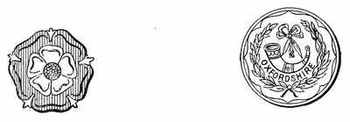
The United Red and White Rose. The Button.
TITLES.
1st Batt.
1741-51. Colonel Thomas Fowkes' (or successive Colonels') Regiment of Foot.
1751-82. The 43rd Regiment of Foot.
1782-1803. The 43rd (Monmouthshire) Regiment of Foot.
1803-81. The 43rd (Monmouthshire Light Infantry) Regiment.
2nd Batt.
1755-57. The 54th Regiment of Foot.
1757-82. The 52nd Regiment of Foot.
1782-1803. The 52nd (Oxfordshire) Regiment of Foot.
1803-81. The 52nd (Oxfordshire Light Infantry) Regiment.
1881 (from). The Oxfordshire Light Infantry.
PRINCIPAL CAMPAIGNS, BATTLES, &c.
* "Honours" on the Colours, the figures showing the Battalion concerned.
1759-60. Canada.
*1759. Quebec (1).
1760. Sillery.
1760. Montreal.
1762. Martinique.
1762. Havannah.
1775-82. America.
1775. Lexington.
1775. Bunker's Hill.
1776. Brooklyn.
1777. Brandywine.
1778. Freehold.
*1783. Mysore (2).
*1790-93. Hindoostan (2).
1791. Bangalore.
1791. Savendroog.
1792. Seringapatam.
1793. Pondicherry.
1794. Martinique.
1794. Guadaloupe.
1794. St. Lucia.
1807. Copenhagen.
*1808-14. Peninsula (1 & 2).
*1808. Vimiera (1 & 2).
*1809. Corunna (1 & 2).
1809. Flushing.
1809. Douro.
1809. Talavera.
*1810. Busaco (1 & 2).
1811. Sabugal.
*1811. Fuentes d'Onor (1 & 2).
*1812. Ciudad Rodrigo (1 & 2).
*1812. Badajos (1 & 2).
*1812. Salamanca (1 & 2).
1813. St. Sebastian.
*1813. Vittoria (1 & 2).
*1813. Nivelle (1 & 2).
*1813. Nive (1 & 2).
*1814. Orthes (2).
*1814. Toulouse (1 & 2).
1814-15. Netherlands.
*1815. Waterloo (2).
1815. New Orleans.
*1850-53. South Africa (1).
1857-58. Indian Mutiny.
*1857. Delhi (2).
*1864-66. New Zealand (1).
1900. South Africa.
Uniform.—1st Batt., Scarlet with White facings (from formation). 2nd Batt., Scarlet with Buff facings (till territorialised in 1881, when it came into line with all non-"Royal" regiments, and the facings were changed to White).
Regimental and other Badges.—"The United Red and White Rose" (in Army List). A special badge on various appointments consists of a combination of "A Bugle with Strings," a "Laurel Wreath," and "A Crown" (see Button).
Nickname.—"The Light Bobs" (of the late 43rd).
Notes.—It will be noticed that the two regiments now linked as The Oxfordshire Light Infantry have frequently fought side by side with distinction.
Bibliography.—Historical Records of The 43rd Regiment (Monmouthshire Light Infantry). To 1867. By Sir Richard J. A. Levinge, Bart. [London: Clowes. 1868.] Historical Record of The 52nd (Oxfordshire Light Infantry). By W. S. Moorsom, late Captain 52nd Light Infantry. [London: Bentley. 1860.]
The Essex Regiment,
COMPRISING
1st Batt. (formerly) The 44th (East Essex) Regiment of Foot.
2nd Batt. ( " ) The 56th (West Essex) Regiment of Foot; with Militia Battalions.
3rd Batt. The Essex Rifles.
4th Batt. The West Essex Militia.
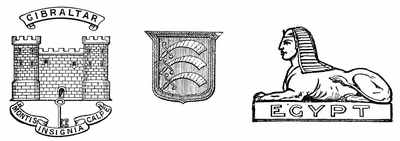
The Castle and Key. The County Arms. The Sphinx.
TITLES.
1st Batt.
1740-48. The 44th (or Wolfe's Marines) Regiment of Foot: disbanded.
1749-51. Colonel James Long's (or successive Colonels') Regiment of Foot.
1751-82. The 44th Regiment of Foot.
1782-1881. The 44th (East Essex) Regiment of Foot.
2nd Batt.
1741-48. The 56th (Sherwood Foresters) Regiment of Foot: renumbered as The 45th.
1755-57. The 58th Regiment of Foot.
1757-82. The 56th Regiment of Foot.
1782-1881. The 56th (West Essex) Regiment of Foot.
1881 (from). The Essex Regiment.
PRINCIPAL CAMPAIGNS, BATTLES, &c.
* "Honours" on the Colours, the figures showing the Battalion concerned.
1741. Carthagena.
1745. Jacobite rising.
1746. Culloden.
1755-60. Canada.
1758. Ticonderoga.
1758. Louisbourg.
1760. Niagara.
*1762. Moro (2).
1762. Havannah.
1763. Montreal.
1775-80. America.
1776. Brooklyn.
1776. Long Island.
1777. Brandywine.
1777. Germantown.
1778. Freehold.
*1779-83. Gibraltar (2).
1794. Martinique.
1794. St. Lucia.
1794. Guadaloupe.
1794-95. Flanders.
1796. St. Lucia.
1796-98. San Domingo.
1799. Bergen.
1799. Egmont-op-Zee.
*1801. Egypt (1).
1801. Mandora.
1801. Alexandria.
1809. Ionian Islands.
1809. Bourbon.
1810. Mauritius.
*1810-13. Peninsula (1).
1810. Matagorda.
1811. Sabugal.
*1812. Badajos (1).
*1812. Salamanca (1).
1812. Burgos.
1814. Antwerp.
*1814. Bladensburg (1).
1814. Baltimore.
1814-15. Netherlands.
1814. Bergen-op-Zoom.
1815. New Orleans.
1815. Quatre Bras.
*1815. Waterloo (1).
*1824-26. Ava (1).
1841-42. Cabool.
*1854. Alma (1).
*1854. Inkerman (1).
*1855. Sevastopol (1 & 2).
1857-58. Indian Mutiny.
1860. China.
*1860. Taku Forts (1).
*1884-85. Nile (2).
1900. South Africa.
Uniform.—1st Batt., Scarlet with Yellow facings (from 1741 till territorialised, when White facings were substituted). 2nd Batt., Scarlet with Crimson facings (from 1741-64); Scarlet with Purple facings (from 1764 to 1881: see Nicknames).
Regimental and other Badges.—"The Castle and Key" and Motto, "Montis Insignia Calpe" (for defence of Gibraltar by the 56th). Also "The Sphinx" for "Egypt" (1801—by the 44th). Also, though not in Army List, "The County Arms."
Nicknames, &c.—"The Two Fours" (of the 44th). "The Little Fighting Fours" (the regiment saw hard service in the Peninsula, and its men were of small average stature). "The Pompadours" and "Saucy Pompeys." (Tradition relates that when the facings were changed in 1764 (the crimson not wearing well) the Colonel desired Blue, but, the authorities objecting, he chose Purple, a favourite colour of Madame de Pompadour, a mistress of Louis XV. of France.)