ACCOUNTS OF SPECIES AND SUBSPECIES (continued 2)
Reading edition
Distribution in Tamaulipas.—State-wide except extreme southwestern and northwestern parts.
Intergradation occurs between L. i. texensis and L. i. pretiosus in southeastern Tamaulipas as noted previously by Hooper (1953:5). Individuals from Altamira and one mile south thereof are small and dark as in pretiosus, but cranial measurements are as in texensis to which they are here assigned. Specimens from the vicinity of Tampico are typical texensis.
Average weight of the specimens from three different localities are as follows: Soto la Marina, seven males, 42.7, 14 females, 36.9; Sierra de Tamaulipas, 12 males, 47.3, 20 females, 40.7; Sierra Madre Oriental, eight males, 45.5, nine females, 37.0 grams.
The specimens reported by Ingles (1959:394) from two miles south of El Mante as L. irroratus are here referred to texensis on geographic grounds.
Records of occurrence.—Specimens examined, 121: 7 km. S, 2 km. W San Fernando, 7; 7 km. SW La Purisima, 1; Rancho Santa Rosa, 25 km. N, 13 km. W Cd. Victoria, 260 m., 2; 36 km. N, 10 km. W Cd. Victoria, 1; 15 mi. N Cd. Victoria, 2; 4 mi. N La Pesca, 5; Soto la Marina, 25; Sierra Madre Oriental, 5 mi. S, 3 mi. W Cd. Victoria, 1900 ft., 18; Sierra de Tamaulipas, 2 mi. S, 10 mi. W Piedra, 1200 ft., 36; Sierra de Tamaulipas, 3 mi. S, 10 mi. W Piedra, 1200 ft., 1; Ejido Santa Isabel, 2 km. W Pan-American Highway, 2000 ft., 3; Rancho Pano Ayuctle, 25 mi. N, 3 km. W El Mante, 300 ft., 1; Rancho Pano Ayuctle, 6 mi. N Gómez Farías, 300 ft., 8; 10 km. N, 8 km. W El Encino, 400 ft., 1; 2 km. W El Carrizo, 6; 53 km. N El Limón, 4; 8 km. NE Antiguo Morelos, 2; Altamira, 1; 1 mi. S Altamira, 3; 10 mi. NW Tampico, 1; 7 km. N Tampico, 2.
Additional records: Hidalgo (Goldman, 1911:59); Matamoros (ibid.); Bagdad (ibid.); Sierra de San Carlos (Hooper and Handley, 1948:20); 3 mi. W Soto la Marina (Hooper, 1953:5); [Cd.] Victoria (Goldman, 1911: 59); Acuña (Hooper and Handley, 1948:20); Mesa de Llera (Hooper, 1953:5); Gómez Farías (Goodwin, 1954:9); 2 mi. S Cd. Mante (Ingles, 1959:394); Antiguo Morelos (Hooper and Handley, 1948:20).
Castor canadensis mexicanus V. Bailey Beaver
1913. Castor canadensis mexicanus V. Bailey, Proc. Biol. Soc. Washington, 26:191, October 23, type from Ruidoso Creek, 6 mi. below Ruidoso, Lincoln Co., New Mexico.
Distribution in Tamaulipas.—Probably in the Río Grande drainage.
The beaver has been reported in Tamaulipas only from Matamoros (Baird, 1858:355—three specimens) and from 12 miles below, south of, Matamoros (V. Bailey, 1905:124). In Tamaulipas the beaver may occur only in the Río Grande drainage.
Oryzomys palustris Marsh Rice Rat
Previous to this report only one subspecies of Oryzomys palustris had been recorded from Tamaulipas. Careful examination of the available material from the state shows that O. p. aquaticus occurs in the east and O. p. peragrus lives in the southwestern part of the state.
In general, specimens examined were trapped in dense brush alongside waterholes as at Altamira, or around cornfields as at the place 36 kilometers north and 10 kilometers west of Ciudad Victoria, where the bushes were mesquite and other kinds of Acacias. There the ground was covered by cat claw, and no grass was seen near the traps in which O. palustris was caught. In the Sierra de Tamaulipas a specimen was caught among rocks and bushes. Ingles (1959:395) reported that his specimens were trapped alive in dense brush and "tules."
A female taken at Jaumave on July 25 had 5 embryos, each 20 mm. in crown-rump length.
Oryzomys palustris aquaticus J. A. Allen
1891. Oryzomys aquaticus J. A. Allen, Bull. Amer. Mus. Nat. Hist., 3:289, June 30, type from Brownsville, Cameron Co., Texas.
1918. Oryzomys couesi aquaticus, Goldman, N. Amer. Fauna, 43:39, September 23.
1960. Oryzomys palustris aquaticus, Hall, The Southwestern Nat., 5:173, November 1.
Distribution in Tamaulipas.—North part of state, and coastal area south to Tampico.
Weights of two males were 80 and 82, and of a female 66 grams.
Oryzomys palustris aquaticus differs from O. p. peragrus in having a rich cinnamon, reddish color and the interorbital region constricted to less than 14.7 per cent of the greatest length of the skull. O. p. peragrus is ochraceous and grayish. The least width of its interorbital region is more than 14.5 per cent of the greatest length of the skull. Individuals studied from the Sierra de Tamaulipas are typical aquaticus. Of those from Altamira, one has the color as in aquaticus, but the color of the other two resembles that of peragrus; nevertheless, all of the mentioned specimens are here assigned to aquaticus.
Records of occurrence.—Specimens examined, 4: Sierra de Tamaulipas, 10 mi. W, 2 mi. S Piedra, 1200 ft., 1; 6 mi. N, 6 mi. W Altamira, 2; 5 mi. N, 5 mi. W Altamira, 1.
Additional records: Camargo (Goldman, 1918:40); Matamoros (ibid.); near Cd. Tampico (Ingles, 1958:395).
Oryzomys palustris peragrus Merriam
1901. Oryzomys mexicanus peragrus Merriam, Proc. Washington Acad. Sci., 3:283, July 26, type from Río Verde, San Luis Potosí.
1918. Oryzomys couesi peragrus, Goldman, N. Amer. Fauna, 43:39, September 23.
1960. Oryzomys palustris peragrus, Hall, The Southwestern Nat., 5:173, November 1.
Distribution in Tamaulipas.—Western part of state, along Sierra Madre Oriental.
Two males from Jaumave weighed 62 and 65 and one pregnant female weighed 67 grams.
Most records of O. p. peragrus are from places along the Sierra Madre Oriental, but Lawrence (1947:103) recorded a specimen from the Río Corona, which is east of, but not far from the mentioned Sierra. Baker (1951:215) reported two specimens from two different localities labeled with reference to Ciudad Victoria (same specimens reported here) as O. p. aquaticus, but pointed out that they tended "toward the darker O. c. peragrus." Examination of more material and taking into consideration the relation between the interorbital constriction and the greatest length of skull, cause me here to refer those specimens to peragrus.
Hooper (1953:8) reported three young specimens from Rancho Pano Ayuctle as of the subspecies aquaticus, but study of two adults from the same locality reveals that this locality should be included within the geographic range of peragrus.
Records of occurrence.—Specimens examined, 9: 36 km. N, 10 km. W Cd. Victoria, 1; Jaumave, 2400 ft., 5; Rancho Pano Ayuctle, 25 mi. N, 3 km. W El Mante, 2; 70 km. S Cd. Victoria (by highway) and 6 km. W of Highway, 1.
Additional records: Río Corana (Lawrence, 1947:103); Pano Ayuctle (Hooper, 1953:8).
Oryzomys melanotis Black-eared Rice Rat
Oryzomys melanotis occurs in Tamaulipas from Soto la Marina southward. Two subspecies are recorded: O. m. carrorum in the north and O. m. rostratus in the tropical area from Rancho Pano Ayuctle to Altamira.
Specimens from the Sierra de Tamaulipas were trapped along a stream, edged with trees, bushes and rocks; at Rancho Pano Ayuctle the animals were in grass between banana groves. The specimen from 70 kilometers south of Ciudad Victoria was taken in tall grass near a field of sugar cane in a line of traps that yielded also Peromyscus leucopus, Sigmodon hispidus, Liomys irroratus, and Oryzomys fulvescens. Hooper (1953:8) and Ingles (1959:395) reported O. melanotis as caught at the edges of cane fields.
Oryzomys melanotis carrorum Lawrence
1947. Oryzomys rostratus carrorum Lawrence, Proc. New England Zool. Club, 24:101, May 29, type from Rancho Santa Ana, about 8 mi. SW Padilla, Río Soto la Marina, Tamaulipas.
1959. Oryzomys melanotis carrorum, Hall and Kelson, The Mammals of North America, 2:560, March 21.
Distribution in Tamaulipas.—Southeast part of state; known only from the type locality and the Sierra de Tamaulipas.
The original description of this subspecies was based on three specimens collected at Rancho Santa Ana. Specimens examined from the Sierra de Tamaulipas extended the known range 45 miles southeast of the type locality, and also extend the previously known altitudinal range of 300-350 feet elevation to 1200 feet.
Specimens examined correspond in color and measurements to those recorded by Lawrence (1947:102-103). Of 12 specimens studied, the tympanic bullae of six touch the surface of the table when the skull rests on the tips of the incisors and the occipital condyles. In the other six the bullae are 0.3 to 1.3 mm. above the table top. The mesopterygoid space in the specimens examined are broad and U-shaped and not V-shaped as in the three specimens examined by Lawrence (op. cit.). Weight of six males was 52.5 (48-63) and of four females 44.7 (40-49) grams.
Measurements.—Average and extreme measurements of six males are as follows: 255.3 (240-269); 135.7 (120-147); 135.7 (120-147); 30.4 (30-31); 21 (20-22); greatest length of skull, 31.6 (30.9-32.5); zygomatic breadth, 15.3 (14.7-16.1); interorbital constriction, 4.8 (4.5-5.1); breadth of skull, 31.6 (30.9-32.5); length of nasals, 12.9 (12.4-13.4); length of anterior palatine foramina, 5.5 (5.2-5.7); length of palatal bridge, 6.1 (5.8-6.4); length of maxillary tooth-row, 4.0 (3.9-4.1). The females average slightly smaller.
Records of occurrence.—Specimens examined, 12 from Sierra de Tamaulipas, 10 mi. W, 2 mi. S Piedra, 1200 ft.
Additional record: Type locality (Lawrence, 1947:102).
Oryzomys melanotis rostratus Merriam
1901. Oryzomys rostratus Merriam, Proc. Washington Acad. Sci., 3:293. July 26, type from Metlatoyuca, Puebla.
1953. Oryzomys melanotis rostratus, Hooper, Occ. Papers Mus. Zool., Univ. Michigan, 544:8, March 25.
Distribution in Tamaulipas.—Extreme southeastern part of state, in tropical area.
Ingles (1959:395) reported one specimen from two miles north of Ciudad Mante as O. melanotis; here it is referred to O. m. rostratus on geographic grounds.
Records of occurrence.—Specimens examined, 2: 2 km. W El Carrizo, 1; Rancho Pano Ayuctle, 25 mi. N El Mante and 3 km. W Highway, 1.
Additional records: 2 mi. N Cd. Mante (Ingles, 1959:395); Altamira (Goldman, 1918:54).
Oryzomys alfaroi huastecae Dalquest
1951. Oryzomys alfaroi huastecae Dalquest, Jour. Washington Acad. Sci., 41:363, November 14, type from 10 km. E Platanito, San Luis Potosí.
Distribution in Tamaulipas.—Known only from Rancho del Cielo (Hooper, 1953:8).
Oryzomys fulvescens Pygmy Rice Rat
The pygmy rice rat in Tamaulipas was collected in grass. Two kilometers west of El Carrizo in grass around a sugar cane field, traps, baited with scraps of deer meat, caught Oryzomys fulvescens, Sigmodon hispidus, Peromyscus leucopus and Liomys irroratus. Seven kilometers north of Tampico, O. fulvescens was taken along with Peromyscus leucopus, Sigmodon hispidus and Baiomys taylori.
A female obtained on March 2, at Rancho Pano Ayuctle, had 4 embryos 16 mm. in crown-rump length.
Oryzomys fulvescens fulvescens (Saussure)
1860. H[esperomys]. fulvescens Saussure, Revue et Mag. Zool., Paris, ser. 2, 12:102, March, type from Veracruz; fixed by Merriam (Proc. Washington Acad. Sci., 3:295, July 26, 1901) at Orizaba.
1897. Oryzomys fulvescens, J. A. Allen and Chapman, Bull. Amer. Mus. Nat. Hist., 9:204, June 16.
Distribution in Tamaulipas.—Reported only from Rancho del Cielo (Goodwin, 1954:10).
Oryzomys fulvescens engracie Osgood
1945. Oryzomys fulvescens engracie Osgood, Jour. Mamm., 26:300, November 14, type from Hacienda Santa Engracia (32 km. N), NW of Cd. Victoria, Tamaulipas.
Distribution in Tamaulipas.—Central and southeast parts of state.
Records of occurrence.—Specimens examined, 13: 2 km. W El Carrizo, 5; Rancho Pano Ayuctle, 25 mi. N, 3 km. W El Mante, 6; 10 km. N, 8 km. W El Encino, 1; 7 km. N Tampico, 1.
Additional record: Altamira (Osgood, 1945:300).
Reithrodontomys megalotis hooperi Goodwin Western Harvest Mouse
1954. Reithrodontomys megalotis hooperi Goodwin, Amer. Mus. Novit., 1660:1, May 25, type from Rancho del Cielo, 5 mi. NW Gómez Farías, 3500 ft., Tamaulipas.
Distribution in Tamaulipas.—Known only from type locality.
Reithrodontomys fulvescens Fulvous Harvest Mouse
This is the most common species of Reithrodontomys in Tamaulipas; it occurs in almost all parts of the state, from sea level to high up in the mountains and from the tropical forest to the desert plain.
The three subspecies in the state are R. f. intermedias in the northern half, R. f. griseoflavus in the high parts of the Sierra Madre Oriental, and R. f. tropicalis in the southeast. The lines between these subspecies are difficult to establish because the zones of intergradation are broad. Characters for separating the three subspecies in Tamaulipas are listed by Hooper (1952).
Reithrodontomys fulvescens griseoflavus Merriam
1901. Reithrodontomys griseoflavus Merriam, Proc. Washington Acad. Sci., 3:553, November 29, type from Ameca, 4000 ft., Jalisco.
1952. Reithrodontomys fulvescens griseoflavus, Hooper, Miscl. Publ. Mus. Zool., Univ. Michigan, 77:98, January 16.
Distribution in Tamaulipas.—Known only from Jaumave.
Only specimens from Jaumave are clearly R. f. griseoflavus; all others east of this locality are intergrades between griseoflavus and tropicalis, under which latter subspecies they are included. In griseoflavus the tail is longer in relation to the head and body, 141.2 (135-153) per cent, than in the other two subspecies that occur in Tamaulipas. The average weight of 14 males was 14 (12-16) grams.
Record of occurrence.—Specimens examined, 15, from Jaumave, 2400 ft.
Reithrodontomys fulvescens intermedius J. A. Allen
1895. Reithrodontomys mexicanus intermedius J. A. Allen, Bull. Amer. Mus. Nat. Hist., 7:136, May 21, type from Brownsville, Cameron Co., Texas.
1914. Reithrodontomys fulvescens intermedius, A. H. Howell, N. Amer. Fauna, 36:47, June 5.
Distribution in Tamaulipas.—Northern half of state.
No specimen of this subspecies has been examined. Jones and Anderson (1958:447) reported specimens from Rancho Pano Ayuctle as R. f. intermedius, but here those same specimens are assigned to R. f. tropicalis. J. A. Allen (1891:223) recorded specimens from Santa Teresa as Ochetodon mexicanus. According to Hooper (1952:142) that name was used by Allen for R. fulvescens. Allen's specimens from Santa Teresa are here referred to R. f. intermedius on geographic grounds.
Records (Hooper, 1952:108): Camargo, 200 ft.; 20 mi. S Reynosa, Charco Escondido; Matamoros, 30 ft.; 7.5 mi. S Matamoros; 29 mi. S Cd. Victoria, 800 ft.; Hacienda Santa Engracia, 800 ft.; Santa Teresa (50 mi. SW Matamoros); Sierra San Carlos (El Mulato, Tamaulipeca, 1500 ft.).
Reithrodontomys fulvescens tropicalis Davis
1944. Reithrodontomys fulvescens tropicalis Davis, Jour. Mamm., 25:393, December 12, type from Boca del Río, 8 km. S city of Veracruz, Veracruz.
Distribution in Tamaulipas.—Tropical area in southeastern part of state.
Most of the specimens examined of R. fulvescens are included in this subspecies, principally because of their reddish coloration that is characteristic of R. f. tropicalis. According to the original description by Davis (1944:393) this subspecies is smaller than griseoflavus and the posterior border of the incisive foramina terminate anterior to the plane of the molars. But, these characteristics are not found in any specimen examined from Tamaulipas and the average of external measurements is more than those given by Hooper (1952:109) for tropicalis. Of all specimens from Tamaulipas, those from the vicinity of Altamira and Tampico are most nearly typical of tropicalis. Weights of seven males and five females, from the Sierra de Tamaulipas, were, respectively, 13 (11-15), and 11 (9-14) grams.
Records of occurrence.—Specimens examined, 51: Rancho Santa Rosa, 25 km. N, 13 km. W Cd. Victoria, 1; Cd. Victoria, 3; Sierra de Tamaulipas, 10 mi. W, 2 mi. S Piedra, 1200 ft., 12; 2 km. W El Carrizo, 1; Ejido Santa Isabel, 2 km. W Pan-American Highway, 2000 ft., 14; Rancho Pano Ayuctle, 25 mi. N, 3 km. W El Mante, 300 ft., 4; Rancho Pano Ayuctle, 6 mi. N Gómez Farías, 300 ft., 4; 6 mi. N, 6 mi. W Altamira, 2; 1 mi. S Altamira, 3; 16 km. N Tampico, 3; 7 km. N Tampico, 4.
Additional records: Hidalgo (Hooper, 1952:110); 5 mi. NE Gómez Farías, 1100 ft. (ibid.); La Azteca, 5 km. NNE Gómez Farías (Goodwin, 1954:11); Gómez Farías (ibid.); Antiguo Morelos (Hooper, 1952:110); 2 mi. W Tampico (Ingles, 1959:396).
Reithrodontomys mexicanus mexicanus (Saussure) Mexican Harvest Mouse
1860. R[eithrodon]. mexicanus Saussure, Revue et Mag. Zool., Paris, ser. 2, 12:109, type from mountains of Veracruz; restricted to Mirador, Veracruz, by Hooper, Miscl. Publ. Mus. Zool., Univ. Michigan, 77:140, January 16.
1914, Reithrodontomys mexicanus mexicanus, A. H. Howell, N. Amer. Fauna, 36:70, June 5. Not Reithrodontomys mexicanus (Saussure), being instead of J. A. Allen, 1895:135, which in part equalled Reithrodontomys fulvescens difficilis.
Distribution in Tamaulipas.—Known from two localities, but probably occurs in all tropical areas in south part of state.
As noted before, J. A. Allen (1891:223) reported specimens from Rancho Santa Rosa as Ochetodon mexicanus, but he used this name for the species now known as R. fulvescens.
The specimen examined, previously reported by Jones and Anderson (1958:447), represents the northernmost occurrence of the species.
Records of occurrence.—One specimen examined from Rancho Pano Ayuctle, 6 mi. N Gómez Farías, 300 ft.
Additional record: Rancho del Cielo, 3500 ft. (Hooper, 1952:144).
Peromyscus maniculatus blandus Osgood Deer Mouse
1904. Peromyscus sonoriensis blandus Osgood, Proc. Biol. Soc. Washington, 17:56, March 21, type from Escalón, Chihuahua.
1909. Peromyscus maniculatus blandus Osgood, N. Amer. Fauna, 28:84, April 17.
Distribution in Tamaulipas.—Reported only from Miquihuana (Osgood, 1909:86).
Peromyscus melanotis J. A. Allen and Chapman Black-eared Mouse
1897. Peromyscus melanotis J. A. Allen and Chapman, Bull. Amer. Mus. Nat. Hist., 9:203, June 16, type from Las Vigas, Veracruz.
Distribution in Tamaulipas.—Known only from Miquihuana (Osgood, 1909:112).
Peromyscus leucopus texanus (Woodhouse) White-footed Mouse
1853. Hesperomys texana Woodhouse, Proc. Acad. Nat. Sci. Philadelphia, 6:242, type probably from vicinity of Mason, Mason Co., Texas.
1909. Peromyscus leucopus texanus, Osgood, N. Amer. Fauna, 28:127, April 17.
Distribution in Tamaulipas.—Over all of state.
This is the most common species of the genus Peromyscus in Tamaulipas. It and Liomys irroratus are the two rodents most easily trapped throughout the state. In general P. l. texanus occurs in forested and brushy areas especially under 1200 feet in elevation, as was noted in the Sierra de Tamaulipas, where P. l. texanus was taken commonly at elevations of up to 1200 feet. Above this elevation the species was rare and P. pectoralis and P. boylii were more abundant than at lower elevations. The three specimens of P. l. texanus from 12 kilometers north and four kilometers west of Ciudad Victoria were trapped in a line of 110 traps set near tree stumps. Small burrows in the ground were noted here. The forest at this locality was composed of mesquite, ebony, acacias, a few yuccas and "nopales" (= cactuses); the ground was covered by cat claw.
Of the many young taken, 15 specimens were saved from Ejido Santa Isabel where P. leucopus was abundant in an area of chaparral consisting of wild "tomate," "zapote," "huizache" and "salvadora." Most of the specimens caught at this locality were taken between 7:30 and 9:30 p. m. in traps baited with a mixture of rolled oats, peanut butter and banana. Specimens from 53 kilometers north of El Limón were taken along with Liomys irroratus; the specimen from two kilometers west of El Carrizo was trapped near a dead mesquite log. Reitrodontomys fulvescens was taken in the same area. Four specimens of P. leucopus were taken at Rancho Pano Ayuctle, around a big pile of old firewood in an abandoned sugar mill. At the locality six miles north and six miles west of Altamira, P. leucopus was found in cultivated fields and along the grassy roadsides; in the vicinity of Tampico specimens were taken in an area of forested cactus-thorn. The specimen from seven kilometers south and two kilometers west of San Fernando was found in a trap set at the base of "nopal" cactus, which was surrounded by bushes and small trees (10-12 feet high).
Breeding records are as follows: Rancho Pano Ayuctle, on February 15, one female carried 2 embryos of 23 mm. in crown-rump length; Jaumave, July 26 to 29, five females, averaging 4.6 (3-6) embryos of 7 (3-15) mm., two females lactating, one on May 25 and the other on July 26; Ejido Santa Isabel, on January 20 to 25, three females lactating; Soto la Marina, on May 16, one female lactating.
Average weights were as follows: from Jaumave four pregnant females, 28.0 (25-33), eight males, 23.4 (21-27); from the Sierra de Tamaulipas, eight females non-pregnant, 21.2 (18-26), 14 males, 22.0 (19-27); from 6 mi. N, 6 mi. W Altamira, six males, 23.5 (21-27).
All specimens examined from Tamaulipas are assigned to P. l. texanus because their coloration is pale. Even so the color varies some according to locality; specimens from Rancho Pano Ayuctle and the Sierra de Tamaulipas have much of the cinnamon color that is characteristic of P. l. incensus from farther south, but even so specimens from the two localities last mentioned are paler than those from Veracruz that are typical incensus.
Goldman (1942:158) reported specimens from Altamira as P. l. incensus, in which subspecies Ingles (1959:397) included specimens from two miles west of Tampico, but specimens examined from the same area do not differ from individuals from far north thereof; for this reason I identify specimens from these localities as texanus. Osgood (1909:131) and Hooper (1953:7) also referred specimens from the southern part of Tamaulipas to texanus. These two authors examined 156 specimens and did not find any intergradation between texanus and incensus, but to me, the cinnamon tones of specimens from Rancho Pano Ayuctle and the Sierra de Tamaulipas, suggest intergradation between the two subspecies.
Osgood's (1909:265) measurements of P. l. texanus, from Brownsville, Texas, and those of 40 specimens from different localities in Tamaulipas are about the same except that the anterior palatine foramina average longer in Tamaulipas. Baker's (1956:262) specimens from Coahuila, averaged larger even than Tamaulipan specimens. Another difference between Osgood's measurements and Baker's was the shorter 3.4 (3.0-3.7) maxillary tooth-row in Tamaulipan specimens.
Hooper (1953:7) recorded specimens from General Terán, as in Tamaulipas; actually this locality is in Nuevo León.
Records of occurrence.—Specimens examined, 149: 4.5 mi. S Nuevo Laredo, 1; 3 mi. SE Reynosa, 2; 7 km. S, 2 km. W San Fernando, 1; Villa Mainero, 1700 ft., 1; Rancho Santa Rosa, 25 km. N, 13 km. W Cd. Victoria, 260 m., 2; 9.5 mi. SW Padilla, 800 ft., 2; 15 mi. N Cd. Victoria, 2; 4 mi. N La Pesca, 1; Soto la Marina, 11; La Pesca, 1; 12 km. N, 4 km. W Cd. Victoria, 3; 7 km. NE Cd. Victoria, 1; Sierra de Tamaulipas, 10 mi. W, and 2 mi. S Piedra, 1200 ft., 31; Ejido Eslabones, 10 mi. W, 2 mi. S Piedra, 1200 ft., 6; Jaumave, 20; Ejido Santa Isabel, 2 km. W Pan-American Highway, 2000 ft., 15; 53 km. N El Limón, 12 km. S Río Guayalejo, 5; Rancho Pano Ayuctle, 25 mi. N El Mante, 3 km. W Highway, 300 ft., 16; Rancho Pano Ayuctle, 6 mi. N Gómez Farías, 300 ft., 7; 8 km. W, 10 km. N El Encino, 400 ft., 3; 8 mi. N Tula, 4500 ft., 2; 2 km. W El Carrizo, 3; 6 mi. N, 6 mi. W Altamira, 9; 16 km. N Tampico, 1; 7 km. N Tampico, 3.
Additional records (Osgood, 1909:131, unless otherwise noted): Nuevo Laredo; Mier; Camargo; near Bagdad; Sierra San Carlos (Hooper, 1953:7); Matamoros-Victoria Highway (ibid.); Charco Escondido (Baird, 1858:464); Hidalgo; Cd. Victoria; 10 mi. NE Zamorina (Hooper, 1953:7); Gómez Farías (Goodwin, 1954:12); Chamal (ibid.); Tula (Hooper, 1953:7); Antiguo Morelos (ibid.); Altamira (Goldman, 1942:158); 2 mi. W Tampico (Ingles, 1959:397); Tampico.
Peromyscus boylii Brush Mouse
Specimens examined were obtained at higher elevations in the oak-tree zone of the Sierras in traps set among rocks, trees and in grassy areas. Peromyscus boylii was trapped in the same area as was P. pectoralis and no habitat distinction between the two was noted. Some behavioral differences, however, are pointed out in the account of P. pectoralis. Morphological differences between these two species in Tamaulipas were reported by Hooper (1952:372).
A female taken on August 5 in the Sierra Madre Oriental carried two embryos 15 mm. in crown-rump length.
For the taxonomic status of P. boylii in Tamaulipas see Alvarez (1961).
Peromyscus boylii ambiguus Alvarez
1961. Peromyscus boylii ambiguus Alvarez, Univ. Kansas Publ. Mus. Nat. Hist., 14:118, December 29, type from Monterrey, Nuevo León.
Distribution in Tamaulipas.—Known only from the Sierra San Carlos.
Record of occurrence.—Specimens examined, 7 (UMMZ), all from La Vegonia, Sierra San Carlos.
Peromyscus boylii levipes Merriam
1898. Peromyscus levipes Merriam, Proc. Biol. Soc. Washington, 12:123, April 30, type from Mt. Malinche, 8400 ft., Tlaxcala.
1909. Peromyscus boylii levipes, Osgood, N. Amer. Fauna, 28:153, April 17.
Distribution in Tamaulipas.—Central and southern parts of state.
Weights of 19 males and 18 females from the Sierra Madre Oriental are, respectively, 25.2 (22-30) and 23.6 (20-29); weights of eight males and five females from the Sierra de Tamaulipas are 24.9 (22-32) and 29.6 (24-31).
Records of occurrence.—Specimens examined, 54: Sierra Madre Oriental, 8 mi. S, 6 mi. W Victoria, 4000 ft., 37; 5 mi. S, 3 mi. W Victoria, 1900 ft., 2; Ejido Eslabones, 10 mi. W, 2 mi. S Piedra, 1200 ft., 1; Sierra de Tamaulipas, 11 mi. W, 8 mi. S Piedra, 2000 ft., 13; 2 km. W El Carrizo, 1.
Additional records: Rancho del Cielo (Hooper, 1953:7); 3 mi. NW Acuña (ibid.); Rancho Viejo (Goodwin, 1954:12); Santa María (ibid.); Joya de Salas (ibid.).
Peromyscus pectoralis White-ankled Mouse
Peromyscus pectoralis and P. boylii are closely related morphologically and seem to occupy the same habitat. In the Sierra Madre Oriental, according to the field notes of the collector (Heinrich, June 6 to August 5, 1953), individuals of P. pectoralis had a pinkish coloration on the mouth and forefeet produced by the juice of the "nopal" cactus fruit, on which obviously the mice feed, whereas only a few specimens of boylii were thus discolored. It was noted that boylii was feeding on acorns. Furthermore, the two species may differ in time of breeding; in August, males of pectoralis had the testes well developed when those organs were small in boylii collected at the same locality.
A specimen from 53 kilometers north of El Limón, was shot at a height of 10 feet on a concrete underpass. Other specimens were taken in a trap line that yielded Peromyscus boylii, P. leucopus and Liomys irroratus.
Two subspecies of P. pectoralis occur in Tamaulipas: P. p. collinus is widely distributed in the central and western parts of the state and P. p. eremicoides occurs only in the western "corner" of the state.
Peromyscus pectoralis collinus Hooper
1952. Peromyscus pectoralis collinus Hooper, Jour. Mamm., 33:372, August 19, type from San José, 2000 ft., Sierra San Carlos, 12 mi. NW San Carlos, Tamaulipas.
Distribution in Tamaulipas.—Along the central and western mountains.
A female obtained on January 21 at a place 53 kilometers north of El Limón, contained three embryos. A lactating female was taken on August 2 in the Sierra Madre Oriental. Males, as previously noted, had well-developed testes in August. The weights of 17 males and 20 females from the Sierra de Tamaulipas were, respectively, 26.6 (24-33), and 25.6 (21-31) grams.
Measurements of specimens from different localities in Tamaulipas averaged about the same, except that those of specimens from Palmillas, averaged smaller. The small size suggests intergradation between the subspecies collinus and eremicoides. The latter occurs to the west and differs from collinus in smaller size, more grayish coloration, completely white tarsal joint and relatively longer tail. Hooper (1952:374) reported specimens from Jaumave as intergrades between the two subspecies before mentioned and Osgood (1909:164) identified two specimens from there as eremicoides. In the present account, individuals from Palmillas and Jaumave are referred to collinus.
Records of occurrence.—Specimens examined, 101: 7 km. SW La Purisima, 1; Sierra Madre Oriental, 5 mi. S, 3 mi. W Victoria, 1900 ft., 12; Sierra Madre Oriental, 8 mi. S, 6 mi. W Victoria, 4000 ft., 16; Sierra de Tamaulipas, 2 mi. S, 10 mi. W Piedra, 1200 ft., 36; Sierra de Tamaulipas, 3 mi. S, 14 mi. W Piedra, 1200 ft., 14; 14 mi. N, 6 mi. W Palmillas, 5500 ft., 1; Palmillas, 4400 ft., 3; 53 km. N El Limón, 12 km. S Río Guayalejo, 5; Joya Verde, 35 km. SW Victoria, 3800 ft., 9; 10 km. N, 8 km. El Encino, 400 ft., 1; 8 km. NE Antiguo Morelos, 500 ft., 3.
Additional records (Hooper, 1952:374, unless otherwise noted): Sierra San Carlos (Marmolejo, 1700 ft., San José, 2000 ft., Tamaulipeca, 1500 ft., La Vegonia, 2900 ft.); Villagran, 1300 ft.; Cd. Victoria; near Jaumave, 2400 ft.; Sierra de Tamaulipas, near Acuña, 1600 ft.; La Joya de Salas (Goodwin, 1954:12).
Peromyscus pectoralis eremicoides Osgood
1904. Peromyscus attwateri eremicoides Osgood, Proc. Biol. Soc. Washington, 17:60, March 21, type from Mapimi, Durango.
1909. Peromyscus pectoralis eremicoides, Lyon and Osgood, Bull. U. S. Nat. Mus., 62:128, January 28.
Distribution in Tamaulipas.—Known only from Miquihuana and vicinity of Tula.
The two specimens from Miquihuana are typical P. pectoralis eremicoides in external and cranial measurements. Specimens from nine miles southwest of Tula are characteristic of eremicoides in cranial measurements but the tail is shorter than usual for this subspecies, in this respect approaching P. p. lacianus.
Measurements.—Average and extreme measurements of 10 specimens from nine miles southwest of Tula and measurements of two males (56169, 56415) from Miquihuana are, respectively, as follows: 181.5 (173-197), 180, 197; 96.2; (87-110), 103, 113; 20.2 (19.0-21.5), 21, 21; 18.1 (16.5-19.0), 18, —; greatest length of skull, 24.8 (24.1-25.6), 25.5, 25.6; length of nasals, 9.0 (8.6-9.3), 9.3, 9.3; zygomatic breadth, 12.2 (11.7-12.8), 12.3, 12.9; interorbital constriction, 3.8 (3.7-4.0), 3.7, 3.9; length of maxillary tooth-row, 3.6 (3.5-3.7), 3.6, 3.8. Weights of the 10 specimens from nine miles southwest of Tula average 17.9 (16-24) grams.
Records of occurrence.—Specimens examined, 28: Miquihuana, 6200 ft., 2; Nicolás, 56 km. NW Tula, 5500 ft., 1; Tajada, 23 mi. NW Tula, 5200 ft., 1; 8 mi. N Tula, 4500 ft., 2; 9 mi. SW Tula, 3900 ft., 19; 17 mi. SW Tula, 3900 ft., 3.
Peromyscus melanophrys consobrinus Osgood Plateau Mouse
1904. Peromyscus melanophrys consobrinus Osgood, Proc. Biol. Soc. Washington, 17:66, March 21, type from Berriozabal, Zacatecas.
Distribution in Tamaulipas.—Mexican Plateau part of state.
A lactating female caught on July 20 and four males from Miquihuana weighed, respectively, 51, and 50.2 (47-54) grams. A female, taken on July 24, 14 miles north and six miles west of Palmillas in a valley covered by mesquite and other bushes, had 3 embryos 10 mm. in crown-rump length, and weighed 60 grams. One specimen from nine miles southwest of Tula was caught in an outcrop of rocks and two others were taken among bushes on the desert. A female on October 10 carried 4 embryos 2 mm. in crown-rump length.
Specimens of P. melanophrys here listed are the first to be reported from Tamaulipas. They are assigned to the subspecies consobrinus on the basis of dark color and because their size closely corresponds to that of the holotype. The specimen from the vicinity of Palmillas and one from Miquihuana (56408) are larger than the others and grayish.
A specimen (56413) from Miquihuana lacks all the molariform teeth. Its alveoli in one maxilla are closed and those in the opposite maxilla are more open than is normal.
Measurements.—Average and extreme measurements of four males, two females (56413, 56408) from Miquihuana, and a female (56414) from 14 miles north and 6 miles west of Palmillas, are, respectively, as follows: total length (two males only), 249, 245, 265, 247, 280; length of tail vertebrae (two males only), 137, 134, 141, 131, 157; length of hind foot, 26.7 (26-27), 27, 27, 27; ear from notch, 23.7 (23-24), 25, 24, 25; greatest length of skull, 30.3 (29.5-31.0), 31.2, 31.8, 32.2; interorbital constriction, 4.8 (4.7-4.9), 4.9, 4.8, 5.0; length of palatine slits, 6.6 (6.2-6.8), 6.9, 6.9, 6.8; length of diastema, 8.1 (8.0-8.3), —, 8.5, 8.5; alveolar length of maxillary tooth-row, 4.5 (4.3-4.7), —, 4.3, 4.6.
Records of occurrence.—Specimens examined, 16: Miquihuana, 6200 ft., 6; 14 mi. N, 6 mi. W Palmillas, 5500 ft., 1; Nicolás, 56 km. NW Tula, 5500 ft., 6; 9 mi. SW Tula, 3900 ft., 3.
Peromyscus difficilis petricola Hoffmeister and de la Torre Zacatecan Deer Mouse
1959. Peromyscus difficilis petricola Hoffmeister and de la Torre, Proc. Biol. Soc. Washington, 72:167, November 4, type from 12 mi. E San Antonio de las Alazanas, 9000 ft., Coahuila.
Distribution in Tamaulipas.—Westernmost part of state.
The three specimens from Miquihuana were collected among rocks and stumps, in an oak forest. The specimens from 20 miles north of Tula were collected after midnight on a hillside covered mainly with juniper brush. A female (October 11) carried 3 embryos 26 mm. in crown-rump length.
Records of occurrence.—Specimens examined, 6: Miquihuana, 8500 ft., 3; 20 mi. N Tula, 5800 ft., 3.
Peromyscus ochraventer Baker El Carrizo Deer Mouse
1951. Peromyscus ochraventer Baker, Univ. Kansas Publ., Mus. Nat. Hist., 5:213, December 15, type from 70 km. (by highway) S Ciudad Victoria, 6 km. W Pan-American Highway at El Carrizo, Tamaulipas.
Distribution in Tamaulipas.—Vicinity of the type locality.
The series of specimens examined was the same used by the original describer of the species. He (1951:214-215) pointed out that the mice were taken in junglelike forest among rocks and adjacent to logs. Burrows extended beneath large blocks of limestone, and each burrow where a mouse was caught was marked by a pile of excavated earth resembling a tiny mound left by a pocket gopher. These burrows were at an elevation of approximately 2800 feet above sea level on the steep sides of a small hill in an area where the vegetation was intermediate between that of the arid and humid subdivisions of the tropical region. Each of two females, captured on January 13, carried five placental scars; one of the females was lactating.
Records of occurrence.—Specimens examined, 24, from the type locality.
Additional records (Goodwin, 1954:12): Gómez Farías; Rancho del Cielo; Joya de Salas.
Baiomys taylori taylori (Thomas) Northern Pygmy Mouse
1887. Hesperomys (Vesperimus) taylori Thomas, Ann. Mag. Nat. Hist., ser. 5, 19:66, January, type from San Diego, Duval Co., Texas.
1907. Baiomys taylori Mearns, U. S. Nat. Mus., Bull. 56:381, April 13.
Distribution in Tamaulipas.—All of state, except southwestern desert part.
The species of this genus have been revised recently by Packard (1960) and the specimens from Tamaulipas are arranged according to his systematic findings. The weight of 35 specimens labeled with reference to Altamira are 7.6 (6.0-9.0) grams; 15 from Jaumave weigh 6.9 (6.0-9.0) grams. Pregnant females were collected as follows: February 22, Ejido Santa Isabel, 3 (embryos x 4 mm. in crown-rump length); March 2, Rancho Pano Ayuctle, 6 x 16; July 9, six miles north and six miles west of Altamira, 1 x 4; July 28 and 29, Jaumave, 2 x 8 and 3 x 9. The average number of embryos was 2.8 (1-5).
Records of occurrence.—Specimens examined, 83: 4 mi. N La Pesca, 1; Cd. Victoria, 3; Jaumave, 2400 ft., 17; Ejido Santa Isabel, 2 km. W Pan-American Highway, 2000 ft., 7; Rancho Pano Ayuctle, 25 mi. N, 3 km. W El Mante, 300 ft., 4; Rancho Pano Ayuctle, 6 mi. N Gómez Farías, 300 ft., 1; Río Sabinas, 8 km. N El Encino, 400 ft., 1; 2 km. W El Carrizo, 2; 6 mi. N, 6 mi. W Altamira, 33; 5 mi. N, 5 mi. W Altamira, 4; 1 mi. S Altamira, 3; 16 km. N Tampico, 4; 10 mi. NW Tampico, 1; 7 mi. S Altamira, 1; 1 km. N Tampico, 1.
Additional records (Packard, 1960:654): Camargo; Charco Escondido, 20 mi. S Reynosa; Matamoras (= Matamoros); Hidalgo; 29 mi. N Cd. Victoria; Antiguo Morelos.
Onychomys leucogaster longipes Merriam Northern Grasshopper Mouse
1889. Onychomys longipes Merriam, N. Amer. Fauna, 2:1, October 30, type from Concho County, Texas.
1913. Onychomys leucogaster longipes, Hollister, Proc. Biol. Soc. Washington, 26:216, December 20.
Distribution in Tamaulipas.—From Ciudad Victoria northward.
Only a young female was examined; she weighed 22 grams and extends the known range 59 miles eastward from Ciudad Victoria.
Record of occurrence.—One specimen examined from Soto la Marina, 500 ft.
Additional records (Hollister, 1914:253): Camargo; Reynosa; [Cd.] Victoria.
Onychomys torridus subrufus Hollister Southern Grasshopper Mouse
1914. Onychomys torridus subrufus Hollister, Proc. U. S. Nat. Mus., 47:472, October 29, type from Miquihuana, Tamaulipas.
Distribution in Tamaulipas.—West of Sierra Madre Oriental.
The six specimens examined were collected in the desert area west of the Sierra Madre Oriental. At Nicolás a trap set in front of a hole held one specimen, and another was trapped beneath a brush fence that inclosed a cornfield. Dipodomys merriami and Perognathus penicillatus also were trapped beneath the fence.
A subadult from Nicolás is slightly larger (see measurements) than either of two subadults from four miles north of Jaumave and an old specimen from eight miles north of Tula, except in the interorbital constriction, which is narrower. Nevertheless measurements of Tamaulipan Onychomys torridus resemble those given by Hollister (1914:483) for O. t. subrufus. A specimen from Nicolás is also darker than other individuals examined.
A female taken on July 15, four miles north of Jaumave, was lactating.
Measurements.—Measurements of a female from Nicolás, a male from eight miles north of Tula, and a female and a male from four miles north of Jaumave are as follows: 158, 147, 145, 144; 59, 58, 55, 55; 22, 21, 22, 22; 21, 20.5, 18, 18; condylobasal length, 24.4, 23.1, 23.9, 23.7; interorbital constriction, 4.1, 4.4, 4.3, 4.5; length of nasals, 10.6, 10.5, 10.5, 10.1; length of maxillary tooth-*row, 3.8, 3.6, 3.7, 3.7; breadth of braincase, 11.8, 11.3, 11.3, 11.0; weight in grams, 32.5, 26.0, 25.0, 25.0.
Records of occurrence.—Specimens examined, 6: 4 mi. N Jaumave, 2; Nicolás, 56 km. NW Tula, 5500 ft., 2; Tajada, 23 mi. NW Tula, 5200 ft., 1; 8 mi. N Tula, 4500 ft., 1.
Additional records (Hollister, 1914:475): Miquihuana; Jaumave.
Sigmodon hispidus Hispid Cotton Rat
This species, as is known, is active by day and by night. It occurs mainly in grassy areas and most of the specimens examined were trapped there. But, one mile east of La Pesca, specimens were taken on a beach having sparse grass. Neotoma micropus and Spermophilus spilosoma, but no smaller rodents, were taken there. Also, many crabs were found in the traps. Possibly only the relatively large rodents are able to compete successfully with the crabs. The specimen from one kilometer east of El Barretal was caught in a rat-trap set in front of small hole in a fence of dead brush that surrounded a cornfield. The area outside the fence supported mesquite and ebony trees (10-12 feet high) and the ground was covered with cat claw. Six miles north and six miles west of Altamira, the two young specimens were taken on a small grassy island surrounded by mud.
According to natives, Sigmodon injures corn and sugar cane. Probably other species of rodents are responsible for some or all of such damage since other kinds of rodents were taken in the same areas.
Dice (1937:245) reported females from the Sierra San Carlos that carried 8 embryos of 18 mm., 5 × 33, 7 embryos very small, and 8 × 20. Females were collected on July 22, 29, and 30.
Sigmodon hispidus berlandieri Baird
1855. Sigmodon berlandieri Baird, Proc. Acad. Nat. Sci. Philadelphia, 7:333, type from Río Nazas, Coahuila.
1902. Sigmodon hispidus berlandieri, V. Bailey, Proc. Biol. Soc. Washington, 15:106, June 2.
Distribution in Tamaulipas.—From Jaumave and Llera to north.
This subspecies is distinguished from S. h. toltecus by larger size and paler, grayish coloration.
Table 3.—Data on Reproduction.
Locality Date Embryos Size in mm.
4 mi. N La Pesca May 26 4 30
Sierra de Tamaulipas June 10 3 10
Sierra de Tamaulipas June 11 4 10
Sierra de Tamaulipas June 20 2 20
Ciudad Victoria July 12 5 5
Jaumave July 28 4 14
Jaumave July 29 6 25
San Fernando August 30 7 20
San Fernando August 31 8 11
Vicinity of Nuevo Laredo November 15 3 5
Vicinity of Nuevo Laredo November 16 5 2
Baker (1951:216) reported a specimen from 35 kilometers north and 10 kilometers west of Ciudad Victoria (= 1 km. E El Barretal) as S. h. toltecus. Comparison of its skull with those from the vicinity of Altamira (S. h. toltecus) and those from Jaumave (S. h. berlandieri) shows that the skull from El Barretal closely resembles those from Jaumave, in having the zygomatic arches more nearly parallel and the braincase more rounded than in skulls from Altamira. Therefore the specimen from the vicinity of El Barretal is here assigned to S. h. berlandieri.
Records of occurrence.—Specimens examined, 64: 4-1/2 mi. S Nuevo Laredo, 600 ft., 1; 10 mi. S, 11 mi. E Nuevo Laredo, 8; San Fernando, 180 ft., 8; 4 mi. N La Pesca, 10; 3 mi. N La Pesca, 1; 1 mi. E La Pesca, 3; Soto la Marina, 500 ft., 1; 36 km. N, 10 km. W Cd. Victoria, 1 km. E El Barretal, Río Purificación, 1; Cd. Victoria, 1; 2 km. W Pan-American Highway (12 km. S Llera), Ejido Santa Isabel, 2000 ft., 1; Jaumave, 2400 ft., 29.
Additional records: Matamoros (Baird, 1858:506); Sierra San Carlos (El Mulato, Tamaulipeca, San Miguel) (Dice, 1937:254); Mesa de Llera (Hooper, 1953:9); Tamaulipas [state?] (Baird, 1858:506).
Sigmodon hispidus solus Hall
1951. Sigmodon hispidus solus Hall, Univ. Kansas Publ., Mus. Nat. Hist., 5:42, October 1, type from island 88 mi. S, 10 mi. W Matamoros, Tamaulipas.
Distribution in Tamaulipas.—Known only from two specimens from the type locality.
Sigmodon hispidus toltecus (Saussure)
1860. [Hesperomys] toltecus Saussure, Revue et Mag. Zool., Paris, ser. 2, 12:98, type from mountains of Veracruz [probably near Mirador, Dalquest, Louisiana State Univ. Studies, Biol. Sci. Series, 1:163, December 28, 1953].
1902. Sigmodon hispidus toltecus, V. Bailey, Proc. Biol. Soc. Washington, 15:110, June 2.
Distribution in Tamaulipas.—Tropical region in southern part of state. The specimen reported by Baker (1951:216) from one mile east of El Barretal is here referred to S. h. berlandieri.
Records of occurrence.—Specimens examined, 69: Sierra de Tamaulipas, 10 mi. W, 2 mi. S Piedra, 1200 ft., 24; Sierra de Tamaulipas, 11 mi. W, 8 mi. S Piedra, 2000 ft., 1; Rancho Pano Ayuctle, 25 mi. N El Mante, 3 km. W highway, 300 ft., 3; Rancho Pano Ayuctle, 6 mi. N Gómez Farías, 300 ft., 3; 8 km. W, 10 km. N El Encino, 400 ft., 2; 2 km. W El Carrizo, 2100 ft., 20; 6 mi. N, 6 mi. W Altamira, 8; 6 mi. N, 4 mi. W Altamira, 1; 5 mi. N, 5 mi. W Altamira, 3; 1 mi. S Altamira, 1; 16 km. N Tampico, 3.
Additional records: Rancho del Cielo, 15 to 20 mi. S Mesa de Llera (Hooper, 1953:9); Cd. Mante (Ingles, 1959:398); Tampico (Booth, 1957:15).
Neotoma albigula subsolana Alvarez White-throated Woodrat
1962. Neotoma albigula subsolana Alvarez, Univ. Kansas Publ. Mus. Nat. Hist., 14:141, April 30, type from Miquihuana, 6400 ft., Tamaulipas.
Distribution in Tamaulipas.—Western side of Sierra Madre Oriental.
At Nicolás specimens were taken in traps set along a thorn fence and at Tajada two specimens were trapped along a rock wall. At other places some specimens were brought in by natives who captured the rats by tearing apart their houses.
Five females taken on October 18 at Nicolás carried embryos (one to two per female), which averaged 22.2 (11-45) mm. in crown-rump length. Another female, taken nine miles southwest of Tula on October 13, carried 2 embryos that were 35 mm. in crown-rump length. The average weight of the five pregnant females was 196.7 (183-207) grams. The average weights of nine adult males and six non-pregnant females from Miquihuana were, respectively, 215.6 (175-250) and 162.5 (155-175) grams.
Records of occurrence.—Specimens examined, 51: Miquihuana, 6400 ft., 22; Joya Verde, 35 km. SW Cd. Victoria (on Jaumave Road) 3800 ft., 2; Nicolás, 56 km. NW Tula, 5500 ft., 10; Tajada, 23 mi. NW Tula, 5200 ft, 2; 9 mi. SW Tula, 3900 ft., 15.
Additional record: Jaumave (Goldman, 1910:37).
Neotoma angustapalata Baker Tamaulipas Wood Rat
1951. Neotoma angustapalata Baker, Univ. Kansas Publ., Mus. Nat. Hist., 5:217, December 15, type from 70 km. by highway S Ciudad Victoria, and 6 km. W Pan-American highway at El Carrizo, Tamaulipas.
Distribution in Tamaulipas.—Southern part of state; presently known from two localities.
Baker (1951:218) reported that specimens from the type locality were taken in crevices among rocks on a small hillside that supported a sparse cover of vegetation growing from a deep layer of humus. The specimen from eight kilometers west and 10 kilometers north of El Encino was shot about 40 yards from the entrance to a large cave, but no sign of wood rats were found there. Hooper (1953:9) reported that N. angustapalata occupied caves at Rancho del Cielo, where a female with two nursing young was taken.
When Baker (op. cit.) described Neotoma angustapalata on the basis of two specimens from El Carrizo, he assigned the species to the N. mexicana group because of the deep anterointernal re-entrant angle of M1. The deep angle found in N. mexicana differs markedly from the typical condition in either N. micropus or N. albigula. Study of the cranial characters and bacula of specimens of N. micropus and N. angustapalata tends to corroborate the statement of Hooper (1953:10), who commented on the taxonomic relationships of N. angustapalata as follows: "It should be pointed out that all characters considered ... the specimens [angustapalata] appear to be large, deeply pigmented examples of the species N. micropus notwithstanding the deep anterior fold in M1. The presence of that deep fold is far from an absolute character in the mexicanus [sic] group."
My study of 48 crania of N. micropus from Tamaulipas reveals that the depth of the re-entrant angle of M1 is extremely variable, from almost absent in some individuals to deep (as in angustapalata) in others. Four specimens, one (56958) from the Sierra de Tamaulipas and three (56960, 56965, 56966) from the vicinity of Altamira, have the re-entrant angle as deep as in the holotype and topotype of angustapalata.
Comparison of the bacula of the holotype and one topotype of angustapalata with 15 bacula of N. micropus reveal that on the average the baculum of angustapalata differs from that of micropus in being longer, and narrower at the base (greatest length, 7.1, width at base, 3.4 mm., in the topotype). One specimen of N. micropus littoralis from the vicinity of Altamira, however, has a baculum of the same shape as in angustapalata (this same specimen is one of the three from there in which the re-entrant angle of the M1 is deep). The shape of the baculum among specimens of micropus is highly variable and bacula of specimens from different localities frequently are slightly different (see Fig. 5).
Fig. 5. Bacula of Neotoma. All × 4. A, Neotoma angustipalata (topotype, 37062). B, Neotoma micropus micropus (4 mi. SW Nuevo Laredo, 89147). C, Neotoma micropus littoralis (Sierra de Tamaulipas, 2 mi. S, 10 mi. W Piedra, 56957).
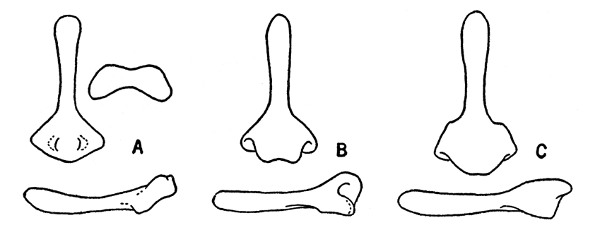
The known distributions of N. micropus and N. angustapalata do not overlap (neither does the distribution of N. albigula overlap with either in Tamaulipas). The four specimens of N. micropus having the deep re-entrant angle in M1 are from localities near where the ranges of angustapalata and micropus probably meet. This could be interpreted in two ways: (1) these four specimens can be regarded as intergrades between angustapalata and micropus, in which case the former species should be placed as a subspecies of the latter. Or the four specimens, which were collected along with other specimens that lack deep re-entrant angles in the M1, can be assigned, on the basis of the deep angle, to angustapalata, in which case the species micropus and angustapalata would be in part sympatric. Until more material from critical areas is available for study, I continue to recognize angustapalata as a monotypic species. I agree with Hooper that it is closely related to N. micropus.
Measurements.—A female (58865) from 8 km. west and 10 km. north of El Encino, measured as follows: 404; 198; 41; 32; greatest length of skull, 49.7; basilar length, 40.8; zygomatic breadth, 25.9; length of nasals, 18.8; length of incisive foramina, 10.8; length of maxillary tooth-row, 9.9; greatest breadth of interpterygoid space, 4.0.
Records of occurrence.—Specimens examined, 3: 8 km. W, 10 km. N El Encino, 400 ft., 1; type locality, 2.
Neotoma micropus Southern Plains Wood Rat
Most of the specimens examined were trapped in brushy areas. On the Sierra de Tamaulipas, wood rats were caught in steel traps set near or between rocks. In the vicinity of La Pesca, specimens were trapped on the beach where Spermophilus spilosoma and Sigmodon hispidus were taken also.
Two females, obtained on May 19 and June 10 at Soto la Marina and on the Sierra de Tamaulipas, respectively, each carried 2 embryos that were 40 mm. in crown-rump length. Dice (1937:254) reported that two females collected on July 24 and August 16 on the Sierra San Carlos each carried 2 embryos that ranged from 34 to 36 mm. in crown-rump length.
Neotoma micropus occurs throughout the Tamaulipan Biotic Province and is represented in Tamaulipas by two subspecies, each of which has its type locality in the state. Intergradation between the two takes place at Soto la Marina.
Neotoma micropus littoralis Goldman
1905. Neotoma micropus littoralis Goldman, Proc. Biol. Soc. Washington, 18:31, February 2, type from Altamira, 100 ft., Tamaulipas.
Distribution in Tamaulipas.—From the Sierra de Tamaulipas southward.
Weight of two males and three non-pregnant females was 248, 254, 185, 210, 240 grams, respectively.
Records of occurrence.—Specimens examined, 14: Sierra de Tamaulipas, 2 mi. S, 10 mi. W Piedra, 1200 ft., 6; 6 mi. N, 6 mi. W Altamira, 8.
Additional record: Altamira (Goldman, 1910:29).
Neotoma micropus micropus Baird
1855. Neotoma micropus Baird, Proc. Acad. Nat. Sci. Philadelphia, 7:333, April, type from Charco Escondido, Tamaulipas.
Distribution in Tamaulipas.—From Soto la Marina northward.
The weight of five males and four females from Soto la Marina averaged, respectively, 256.4 (210-317) and 233.0 (195-274) grams.
A specimen (56924) from La Pesca differs from all other specimens of N. micropus examined in being smaller, having a conspicuously shorter rostrum, broader intraorbital canal, and lower broader braincase. External measurements of this specimen are as follows: 347; 155; 39; —. Its cranial measurements are: greatest length, 44.8; basilar length, 34.3; zygomatic breadth, 23.6; interorbital constriction, 6.2; incisive foramina, 6.5; length of maxillary tooth-row, 8.7; width of mesopterygoid fossa, 4.1.
Records of occurrence.—Specimens examined, 58: 4 mi. SW Nuevo Laredo, 900 ft., 14; 4-1/2 mi. S Nuevo Laredo, 1; 3 mi. SE Reynosa, 1; 3 mi. S Matamoros, 2; 33 mi. S Washington Beach, 1; San Fernando, 180 ft., 1; 7 km. S, 2 km. W San Fernando, 2; 12 mi. NW San Carlos, 1300 ft., 4; 9-1/2 mi. SW Padilla, 800 ft., 3; 3 mi. N Soto la Marina, 3; Soto la Marina, 500 ft., 12; 4 mi. N La Pesca, 3; 1 mi. E La Pesca, 1; La Pesca, 2; 3 mi. NE Guemes, 1; 7 mi. NE Cd. Victoria, 1; Cd. Victoria, 6.
Additional records (Goldman, 1910:28, unless otherwise noted): Nuevo Laredo; 10 mi. S Nuevo Laredo (Booth, 1957:15); Camargo; Matamoros; Bagdad; 40 mi. S Matamoros (Hooper, 1953:9); Sierra San Carlos (El Mulato, Tamaulipeca) (Dice, 1937:254); San Fernando (J. A. Allen, 1891:224); Forlón.
Microtus mexicanus subsimus Goldman Mexican Vole
1938. Microtus mexicanus subsimus Goldman, Jour. Mamm., 19:494, November 14, type from Sierra Guadalupe, southeastern Coahuila.
Distribution in Tamaulipas.—Reported only from mountains near Miquihuana (Goldman, 1938:495).
Canis latrans Coyote
In Tamaulipas two and possibly three subspecies of Canis latrans occur. C. l. texensis is known only from the northwesternmost part of the state, and C. l. microdon occurs from Camargo south to Nicolás. Hall and Kelson (1959:845) guessed that C. l. cagottis would be found in the southern third of the state; as yet specimens from there have not been obtained and the subspecific identity of the coyotes there, if any are present, remains in doubt.
Canis latrans microdon Merriam
1897. Canis microdon Merriam, Proc. Biol. Soc. Washington, 11:29, March 15, type from Mier, on Río Grande, Tamaulipas.
1932. Canis latrans microdon, Nelson, Proc. Biol. Soc. Washington, 45:224, November 26.
Distribution in Tamaulipas.—Probably state-wide, reported only from the northern half of the state.
Three specimens were examined. One is a pup from the vicinity of Padilla which is assigned to this subspecies on geographic grounds. The other two are skins, collected at Nicolás by natives, who deceived the collector by providing dog skulls with the coyote skins. These two specimens are referred to C. l. microdon on the basis of their dark color and dusky shading on the throat and chest. One has a rufous over-all color and the other is ochraceous yellowish. This difference in color suggests intergradation at this place between C. l. microdon that ranged to the northeast, C. l. cagottis to the south, and probably with C. l. impavidus distributed to the west.
Records of occurrence.—Specimens examined, 3: 9-1/2 mi. SW Padilla, 800 ft., 1; Nicolás, 53 km. N Tula, 2.
Additional record: Camargo (Jackson, 1951:305); 20 mi. W Reynosa (Ingles, 1959:401); Matamoros (Jackson, 1951:305); Bagdad (ibid.); Sierra San Carlos (San Miguel, El Mulato) (Dice, 1937:251).
Canis latrans texensis V. Bailey
1905. Canis nebrascensis texensis V. Bailey, N. Amer. Fauna, 25:175, October 24, type from 45 mi. SW Corpus Christi at Santa Gertrudis, Kleberg Co., Texas.
1932. Canis latrans texensis V. Bailey, N. Amer. Fauna, 53:312, March 11.
Distribution in Tamaulipas.—Extreme northwest, known only from Nuevo Laredo (Jackson, 1951:279).
Canis lupus monstrabilis Goldman Gray Wolf
1937. Canis lupus monstrabilis Goldman, Jour. Mamm., 18:42, February 11, type from 10 mi. S Rankin, Upton Co., Texas.
Distribution in Tamaulipas.—Probably extinct, recorded only from Matamoros (Goldman, 1944:468).
On the maps of distribution of C. l. monstrabilis published by Leopold (1959:400) and Baker and Villa (1960:370), Tamaulipas is included in the region in which the wolf is considered to be extinct.
Urocyon cineroargenteus scottii Mearns Gray Fox
1891. Urocyon virginianus scottii Mearns, Bull. Amer. Mus. Nat. Hist., 3:236, June 5, type from Pinal Co., Arizona.
1895. Urocyon cinereo-argenteus scottii, J. A. Allen, Bull. Amer. Mus. Nat. Hist., 7:253, June.
Distribution in Tamaulipas.—All of state in suitable habitats.
The specimen from the Sierra Madre Oriental was obtained by a collector who used a rabbit call. Leopold (1959:408) reported that the highest elevation [about 2800 feet] at which he found gray fox in México was at Hacienda de Acuña, in the Sierra de Tamaulipas, where "dense, brushy draws and oak openings made ideal habitat." At this place Leopold saw, in early August, a family of foxes, four well-grown young and their parents. Dice (1937:250) reported U. c. texensis (a junior synonym of U. c. scottii), as abundant in the Sierra San Carlos.
The six specimens examined do not present any significant difference in size and shape of the skull from specimens of scottii from Arizona, except that one skull from the Sierra de Tamaulipas is smaller than the others, suggesting intergradation between the subspecies scottii and tropicalis from farther south.
Records of occurrence.—Specimens examined, 6: 2 mi. W San Fernando, 180 ft., 1; 15 km. W Rancho Santa Rosa, Sierra Madre Oriental, 4500 ft., 1; Ejido Santa Isabel, 2000 ft., 1; Sierra de Tamaulipas, 2 mi. S, 10 mi. W Piedra, 1200 ft., 2; Joya Verde, 35 km. SW Victoria, 3800 ft., 1.
Additional records: Near Marmolejo, San Carlos Mts. (Dice, 1937:250); Hacienda Acuña, Sierra de Tamaulipas (Leopold, 1959:408, only seen); La Joya de Salas (Goodwin, 1954:14).
Ursus americanus eremicus Merriam Black Bear
1904. Ursus americanus eremicus Merriam, Proc. Biol. Soc. Washington, 17:154, October 6, type from Sierra Guadalupe, Coahuila.
Distribution in Tamaulipas.—Probably in high and remote parts of the Sierra Madre Oriental; recorded only from Agua Linda (Goodwin, 1954:14).
Bassariscus astutus flavus Rhoads Ringtail
1894. Bassariscus astutus flavus Rhoads, Proc. Acad. Nat. Sci. Philadelphia, 45:417, January 30, type from Texas, exact locality unknown.
Distribution in Tamaulipas.—Western half of state.
The two specimens examined provide the second record of this species in Tamaulipas; they were shot in the bottom of an arid canyon. One animal was about 30 feet up from the ground in an oak tree, and the other was along a small arroyo containing pools of water.
From Rhoads' paper (1893:416-417) on the genus Bassariscus it would seem that B. astutus flavus differs from B. a. astutus in smaller size, especially of the skull, shorter tail (shorter than head and body in flavus and longer than head and body in astutus) and the presence of fulvous color. Comparison of 10 specimens of B. a. flavus from Coahuila and Texas with two of B. a. astutus (Distrito Federal, 1; Las Vigas, Veracruz, 1) from central México reveals that the skulls do not differ qualitatively and that the skull of flavus tends to be smaller and relatively wider, but that there is overlap in size. In all flavus that I measured and in the two adults of astutus the tail is shorter than the head and body. The only real difference is the color; ringtails from Texas are deep fulvous instead of grayish as is astutus from the Distrito Federal and Veracruz. But the specimen from Veracruz has much fulvous and on the other hand specimens from Coahuila are more grayish than those from Texas.
The two specimens from Tamaulipas can be assigned to either subspecies astutus or flavus with almost equal propriety. Here they are referred to B. a. flavus on the basis of their relatively small skull, short tail, and presence of some fulvous color.
Measurements.—Measurements of female and male (60239, 60240), both adult, from Joya Verde, are, respectively: 745, 760; 370, 385; 70, 75; 47, 56; greatest length of skull (excluding incisors), 81.9, 83.1; zygomatic breadth, 46.1, 51.9; interorbital constriction, 16.3, 16.3; postorbital constriction, 19.5, 18.5; breadth of braincase, 33.7, 36.6; length of maxillary tooth-row, 31.5, 32.0; breadth across postorbital processes (tip to tip), 25.3, 26.8.
Records of occurrence.—Two specimens examined from Joya Verde, 35 km. SW Victoria, 3800 ft.
Additional record: Joya de Salas (Goodwin, 1954:14).
Procyon lotor Racoon
Racoons occur all through the state. The one specimen examined was shot about 11:00 p. m. in a cypress tree. Its mouth contained fresh corn. The animal was notably fat and weighed 11 pounds. According to the natives the racoons do much damage in cornfields.
Procyon lotor fuscipes Mearns
1914. Procyon lotor fuscipes Mearns, Proc. Biol. Soc. Washington, 27:63, March 20, type from Las Moras Creek, 1011 ft., Fort Clark, Kinney Co., Texas.
Distribution in Tamaulipas.—Practically all of state, except western part.
Records (Goldman, 1950:51, unless otherwise noted): Camargo; Matamoros; Bagdad; Marmolego; Camp 2 (= 73 mi. S Washington Beach, Selander et al., 1962:338, recorded only two species); Gómez Farías (Goodwin, 1954:14); Altamira.
Procyon lotor hernandezii Wagler
1831. Pr[ocyon]. hernandezii Wagler, Isis von Oken, 24:514, type from Tlalpan, Valley of Mexico.
1890. Procyon lotor hernandezi, J. A. Allen, Bull. Amer. Mus. Nat. Hist., 3:176, December 10.
Distribution in Tamaulipas.—Western part of state; known only from Rancho Santa Rosa.
The specimen examined is identified as P. l. hernandezii because the animal differs from specimens of P. l. fuscipes from southern Texas and Coahuila in the same way that Goldman (1950:50) noted that P. l. hernandezii differs from P. l. fuscipes. For example, in the specimen from Rancho Santa Rosa the interorbital region is lower, the braincase is less depressed near the fronto-parietal suture, the postorbital process is longer and more pointed, and the upper carnassial is longer. The color is the same as in specimens of fuscipes from Texas except that the postauricular spot is smaller, and the ground color is slightly more grayish. The median dorsal area is black, forming a longitudinal band about 3 cm. wide.
Record of occurrence.—One specimen examined from Rancho Santa Rosa, 25 km. N, 13 km. W Cd. Victoria.
Nasua narica molaris Merriam Coati
1902. Nasua narica molaris Merriam, Proc. Biol. Soc. Washington, 15:68, March 22, type from Manzanillo, Colima.
Distribution in Tamaulipas.—Over all of state.
A male and female, both adults, from the same locality in the Sierra de Tamaulipas weighed, respectively, 3,150 grams and 4,836 grams. Three young from the same place weighed 2,250, 2,250, and 2,650 grams.
Records of occurrence.—Specimens examined, 7: Sierra de Tamaulipas, 10 mi. W, 2 mi. S Piedra, 1200 ft., 5; Rancho Pano Ayuctle, 25 mi. N El Mante, 3 km. W Pan-American Highway, 2200 ft., 1; 2 km. W El Carrizo, 1.
Additional records: Sierra San Carlos (San José, El Mulato) (Dice, 1937:249); Soto la Marina (Goldman, 1942:81); Cd. Victoria (ibid.); 10 mi. NE Zamorina (Hooper, 1953:3); 3 mi. NW Acuña (ibid.); 19 km. SW Mante (Davis, 1944:381).
Potos flavus aztecus Thomas Kinkajou
1902. Potos flavus aztecus Thomas, Ann. Mag. Nat. Hist., ser. 7, 9:268, April, type from Atoyac, Veracruz.
Distribution in Tamaulipas.—Uncertain; one specimen was seen by Leopold (1959:437) near Acuña.
Mustela frenata Long-tailed Weasel
This species occurs in practically all of the state, but as in most other areas actual records are few; only two specimens, both males, have been examined. One was taken at Jaumave, in a steel-trap baited with fresh egg. It weighed 325 grams. The other was taken in the vicinity of Altamira and weighed 434 grams.
Two subspecies have been reported from Tamaulipas; Mustela frenata frenata that occurs in the central and northern parts of the state and M. f. tropicalis that occurs in the tropical area in the southern part of the state.
Mustela frenata frenata Lichtenstein
1831. Mustela frenata Lichtenstein, Darstellung neuer oder wenig bekannter Säugethiere ..., pl. 42 and corresponding text, unpaged, type from Ciudad México, México.
1877. Putorius mexicanus Coues, Fur-bearing animals, U. S. Geol. Surv. Territories, Misc. Publ., 8:42, a nomen nudum [cited by Coues in synonymy as "Putorius mexicanus, Berlandier, MMS. ic. ined. 4 (Tamaulipas and Matamoras)"].
Distribution in Tamaulipas.—Central and northern parts of state.
The specimen from Jaumave is clearly M. f. frenata, but the other from northwest of Altamira has many characters of the subspecies M. f. tropicalis and is an intergrade between the two subspecies. In cranial features and in measurements the animal is like frenata. For example: least width of palate more than length of P4; distance between anterior border of auditory bulla and foramen ovale equal to the width of four (including I3) upper incisors; depth of tympanic bulla less than distance between it and foramen ovale; length of tail amounting to 82 per cent of length of head and body. The coloration is more nearly like that of tropicalis. For example, the region between the ears and the region behind the ears as far as the shoulders is almost black; hairs of the soles of the forefeet are of the same color as in tropicalis. But, width of the whitish underparts amounts to 53 per cent of the circumference of the body; in this respect the specimen is like frenata. I refer the specimen to frenata because, to me, it is slightly more nearly like it.
Measurements.—The male from 6 mi. N, 6 mi. W Altamira affords measurements as follows: 500; 226; 53; 23; basilar length (Hensel), 49.5; breadth of rostrum, 14.3; interorbital constriction, 11.9; orbitonasal length, 15.2; mastoid breadth, 27.2; zygomatic breadth, 32.4; tympanic bullae, length, 16.8; breadth, 7.5; length of m1, 5.7; P4, lateral length, 5.4, medial, 5.8; M1, breadth, 4.6, length, 2.4; depth of skull at anterior edge of basioccipital, 14.7.
Records of occurrence.—Specimens examined, 2: Jaumave, 2400 ft., 1; 6 mi. N, 6 mi. W Altamira, 1.
Additional records (Hall, 1951:347): Matamoros; Miquihuana.
Mustela frenata tropicalis (Merriam)
1896. Putorius tropicalis Merriam, N. Amer. Fauna, 11:30, June 30, type from Jico, Veracruz.
Distribution in Tamaulipas.—Tropical area in south part of state; reported only from 50 mi. south of Ciudad Victoria (Hall, 1951:366).
Eira barbara senex (Thomas) Tayra
1900. Galictis barbara senex Thomas, Ann. Mag. Nat. Hist., ser. 7, 5:146, January, type from Hacienda Tortugas, approximately 600 ft., Jalapa, Veracruz.
1951. Eira barbara senex, Hershkovitz, Fieldiana-Zool., 31:561, July 10.
Distribution in Tamaulipas.—Known only from Pano Ayuctle (Hooper, 1953:4).
Taxidea taxus Badger
The badger in Tamaulipas is poorly known because only a few specimens have been reported from the state. I have examined only two; one is the skull of a juvenile picked up in the sea along the barrier beach and the other is the skull of an adult male taken in a steel-trap baited with a bird body and rabbit meat. The trap was set in front of a hole in the semidesert area 12 miles south of San Carlos.
On their map 471 Hall and Kelson (1959:927) show a total of five subspecies of Taxidea taxus. They include the northern part of Tamaulipas in the geographic range of T. t. berlandieri. On page 926 Hall and Kelson (op. cit.) list ten additional subspecies described by Schantz. One of them T. t. littoralis (Schantz, 1949:301) was based on specimens from southeastern Texas and Matamoros, Tamaulipas. Of the two specimens examined by me the one from the barrier beach is here assigned to T. l. littoralis on geographic grounds, and the other one from the vicinity of San Carlos to T. l. berlandieri.
Taxidea taxus berlandieri Baird
1858. Taxidea berlandieri Baird, Mammals, in Repts. Expl. Surv. ..., 8(1):205, July 14, type from Llano Estacado, Texas, near boundary of New Mexico.
1895. Taxidea taxus berlandieri, J. A. Allen, Bull. Amer. Mus. Nat. Hist., 7:256, June 29.
Distribution in Tamaulipas.—Reported from only one locality, in northwestern part of state.
The skull examined, of an adult male, differs from Coahuilan and New Mexican skulls in having a broad rostrum, better developed sagittal and lambdoidal crests, and smaller tympanic bullae. The measurements are greater than those given by Schantz (1949:302) for T. l. littoralis and it is for that reason that the skull examined is assigned to T. l. berlandieri.
Measurements.—The adult male measured as follows: 710; 115; 110; 55; condylobasal length, 123.1; zygomatic breadth, 81.1; mastoid breadth, 75.5; interorbital constriction, 29.3; least postorbital constriction, 27.6; length of maxillary tooth-row, 42.7; P4, length, 11.9, width, 10.7; M1, length, 11.7, width, 11.7; tympanic bulla, length, 23.3, depth (from basioccipital), 12.8.
Record of occurrence.—One specimen examined from 12 mi. S San Carlos, 1300 ft.
Taxidea taxus littoralis Schantz
1949. Taxidea taxus littoralis Schantz, Jour. Mamm., 30:301, August 17, type from Corpus Christi, Nueces Co., Texas.
Distribution in Tamaulipas.—Known only from two localities in northeastern part of state.
Records of occurrence.—One specimen examined from 33 mi. S Washington Beach.
Additional record: Matamoros (Schantz, 1949:302).
Spilogale putorius interrupta (Rafinesque) Eastern Spotted Skunk
1820. Mephitis interrupta Rafinesque, Ann. Nat. ..., 1:3. Type locality, Upper Missouri River?.
1952. Spilogale putorious interrupta, McCarley, Texas Jour. Sci., 4:108, March 30.
Distribution in Tamaulipas.—From Sierra de Tamaulipas northward.
The young male from La Pesca weighed 480 grams. In the Sierra de Tamaulipas a lactating female was taken (June 9) in a steel trap. A young male from there weighed 275 grams. The young male from three miles north of La Pesca weighed 520 grams.
Specimens from Tamaulipas are assigned to the subspecies interrupta following Van Gelder (1959:270-279). He regarded specimens from Tamaulipas as intergrades between S. p. interrupta and S. p. leucoparia.
Records of occurrence.—Specimens examined, 6: 9-1/2 mi. SW Padilla, 1; 3 mi. N La Pesca, 1; La Pesca, 1; Rancho Santa Rosa, 2 km. N, 13 km. W Cd. Victoria, 260 m., 1; Sierra de Tamaulipas, 2 mi. S, 10 mi. W Piedra, 1200 ft., 2.
Additional records (Van Gelder, 1959:279): "Tamaulipas"; Cd. Victoria.
Mephitis mephitis varians Gray Striped Skunk
1837. Mephitis varians Gray, Charlesworth's Mag. Nat. Hist., 1:581. Type locality, Texas.
1936. Mephitis mephitis varians, Hall, Carnegie Inst. Washington, Publ., 473:66, November 20.
Distribution in Tamaulipas.—North half of state.
Measurements.—An adult female from San Fernando measured as follows: 710; 360; 70; 30; basilar length, 56.2; condylobasal length, 64.2; zygomatic breadth, 41.3; interorbital constriction, 19.0; length of maxillary tooth-row, 20.7.
Records of occurrence.—One specimen examined from San Fernando, 180 ft.
Additional records: Mier (A. H. Howell, 1901:32); Matamoros (ibid.); 2 mi. up stream from Marmolejo (Dice, 1937:250).
Mephitis macroura macroura Lichtenstein Hooded Skunk
1832. Mephitis macroura Lichtenstein, Darstellung neuer oder wenig bekannter Säugethiere ..., pl. 46, type from mountains northwest of the city of México.
1877. Mephitis edulis Coues, Berlandier Mss., Fur-bearing Animals: ..., U. S. Geol. Surv. Territories, Miscl. Publ., 8:236. Type locality, "Inhabits most of Mexico. I have found it around San Fernando de Bexar...."
Distribution in Tamaulipas.—West of Sierra Madre Oriental.
The two specimens from Jaumave are young; they were taken on different nights but in the same place. Weights of male and female, respectively, are 195 and 290 grams. The other three specimens, two young and an adult male, were brought to the collector (Bodley) by natives.
Records of occurrence.—Specimens examined, 5: San Fernando, 180 ft., 2; Jaumave, 2400 ft., 2; Nicolás, 56 km. NW Tula, 5500 ft., 1.
Conepatus mesoleucus mearnsi Merriam Hog-nosed Skunk
1902. Conepatus mesoleucus mearnsi Merriam, Proc. Biol. Soc. Washington, 15:163, August 6, type from Mason, Mason Co., Texas.
Distribution in Tamaulipas.—Probably western part of state, but presently known only from Nicolás.
The specimens herein assigned to this species, represented by the skull only, differ conspicuously from those assigned to C. leuconotus only in breadth of M1.
Measurements.—Measurements of a skull (sex undetermined) from Nicolás are as follows: condylobasal length, 77.1; zygomatic breadth, 52.9; postorbital constriction, 21.1; mastoid breadth, 43.7; length of maxillary tooth-row, 23.4; breadth of M1, 7.1.
Records of occurrence.—Two specimens examined from Nicolás, 56 km. NW Tula, 5500 ft.
Conepatus leuconotus texensis Merriam Eastern Hog-nosed Skunk
1902. Conepatus leuconotus texensis Merriam, Proc. Biol. Soc. Washington, 15:162, August 6, type from Brownsville, Cameron Co., Texas.
Distribution in Tamaulipas.—State-wide, except western part.
Three specimens are assigned to this species on the basis of the breadth of M1. In comparison with skulls from the type locality, those of Tamaulipan specimens are slightly smaller and narrower.
Measurements.—Some cranial measurements of a male adult (old) from ten miles west and two miles south of Piedra are: condylobasal length, 79.0; zygomatic breadth, 52.3; postorbital constriction, 22.0; mastoid breadth, 44.2; length of maxillary tooth-row, 24.4; breadth of M1, 9.3.
Records of occurrence.—Specimens examined, 2: La Pesca, 1; Ejido Eslabones, 10 mi. W, 2 mi. S Piedra, 1200 ft., 1.
Additional record: Near El Mulato (Dice, 1937:250).
Felis concolor stanleyana Goldman Puma
1938. Felis concolor stanleyana Goldman, Proc. Biol. Soc. Washington, 51:63, March 18 (renaming of F. c. youngi Goldman, Proc. Biol. Soc. Washington, 49:137, August 22, type from Bruni Ranch, near Bruni, Webb Co., Texas).
Distribution in Tamaulipas.—Restricted to mountains of state.
The two specimens examined are skulls only, which were picked up in the field. In general the measurements are like those given by Goldman (1946:233) for the males of Felis concolor stanleyana. But the skull from Miquihuana yielded measurements that suggest intergradation between F. c. stanleyana and F. c. azteca of the western mountains of Tamaulipas.
Measurements.—Two skulls, one from Miquihuana and the second from 9-1/2 mi. SW Padilla, yield measurements as follows: greatest length, 214.0, 213.0; condylobasal length, 195.0, 190.0; zygomatic breadth, 146.0, 140.1; height of skull (frontals to palate), 70.0, 72.4; interorbital constriction, 41.6, 41.4; breadth of nasals (at posterior union between premaxilla and maxilla), 20.1, 17.9; length of maxillary tooth-row, 62.7, 63.3; crown length of P3, 23.3, ——; breadth of P3, 11.9, 12.2; anteroposterior diameter of upper canine, 15.1, 15.3.
Records of occurrence.—Specimens examined, 2: 9-1/2 mi. SW Padilla, 800 ft., 1; Miquihuana, 6400 ft., 1.
Additional records: Matamoros (Goldman, 1946:234); Zamorina (Hooper, 1953:4).
Felis onca veraecrucis Nelson and Goldman Jaguar
1933. Felis onca veraecrucis Nelson and Goldman, Jour. Mamm., 14:236, August 17, type from San Andrés Tuxtla, Veracruz.
Distribution in Tamaulipas.—Originally all of state; now restricted to sparsely populated areas.
Only one cranium, from the Sierra de Tamaulipas, was examined. It is in good condition but lacks all the teeth except P3 and P4 on the right side. The measurements are larger than those given by Goodwin (1954:15) for a skull from five miles north of Gómez Farías.
Measurements.—The cranium, sex undetermined, from the Sierra de Tamaulipas, affords measurements as follows: greatest length, 238.0; condylobasal length, 204.0; zygomatic breadth, 166.0; breadth of rostrum, 66.1; interorbital constriction, 48.2; mastoid breadth, 100.7; crown length of carnassial, 24.1.
Records of occurrence.—One specimen examined from Sierra de Tamaulipas, 2 mi. S, 10 mi. W Piedra.
Additional records: between Aldama and Soto la Marina (Nelson and Goldman, 1933:237); 5 km. N Gómez Farías (Goodwin, 1954:15).
Felis pardalis albescens Pucheran Ocelot
1855. Felis albescens Pucheran, in I. Geoffroy Saint-Hilaire, Mammiferes, in Petit-Thoaurs, Voyage autor du monde sur ... la Venus ..., Zoologie, p. 149, type locality, Arkansas.
1906. Felis pardalis albescens, J. A. Allen, Bull. Amer. Mus. Nat. Hist., 22:219, July 25.
Distribution in Tamaulipas.—All of state, except part west of Sierra Madre Oriental.
Hall and Kelson (1959:961) reported from Tamaulipas two subspecies of Felis pardalis. According to Goldman (1943:379) the more northern of the two, F. p. albescens, is smaller than the more southern one, F. p. pardalis. The skull examined, of a young female, from 10 miles north of Altamira, in southern Tamaulipas, is small, smaller even than skulls of albescens from Texas used in comparison. For this reason I here assign the specimen examined to F. p. albescens instead of F. p. pardalis as did Hall and Kelson (op. cit.). Hooper (1953:4) and Dice (1937:251) report as F. p. pardalis specimens from 10 miles northeast of Zamorina and others from the Sierra San Carlos. I assume that specimens from these two places should be referred to albescens since the specimen from 10 miles north of Altamira, the southernmost locality represented in Tamaulipas, is here referred to albescens.
Measurements.—Skull, from 10 mi. N of Altamira, measured as follows: condylobasal length, 97.3; zygomatic breadth, 77.6; squamosal constriction, 50.5; interorbital constriction, 22.2; postorbital constriction, 32.1; length of maxillary tooth-row, 34.7; length of upper carnassial crown (outer side), 13.6.
Records of occurrence.—One specimen examined, from 10 mi. N Altamira.
Additional records: Matamoros (Goldman, 1943:379); Sierra San Carlos (El Mulato and San José) (Dice, 1937:251); Soto la Marina (Goldman, 1943:379); 10 mi. NE Zamorina (Hooper, 1934:4).
Felis wiedii oaxacensis Nelson and Goldman Margay
1931. Felis glaucula oaxacensis Nelson and Goldman, Jour. Mamm., 12:303, August 24, type from Cerro San Felipe, 10,000 ft., near Oaxaca, Oaxaca.
1943. Felis wiedii oaxacensis, Goldman, Jour. Mamm., 24:383, August 17.
Distribution in Tamaulipas.—Probably along Sierra Madre Oriental; known only from Rancho del Cielo (Goodwin, 1954:15).
Felis yaguaroundi cacomitli Berlandier Yaguaroundi
1895. Felis cacomitli Berlandier, in Baird, Mammals of the boundary, in Emory, Rept. U. S. and Mexican boundary survey 2(2):12, January, type from Matamoros, Tamaulipas.
1905. Felis yaguaroundi cacomitli, Elliot, Field Columb. Mus. Publ. 105, Zool. Ser., 6:370, December 6.
1901. Felis apache Mearns, Proc. Biol. Soc. Washington, 14:150, August 9, type from Matamoros, Tamaulipas.
Distribution in Tamaulipas.—Eastern and northern parts of Sierra Madre Oriental; known only from type locality and near Gómez Farías (Goodwin, 1954:15).
Lynx rufus texensis J. A. Allen Bobcat
1895. Lynx texensis J. A. Allen, Bull. Amer. Mus. Nat. Hist., 7:188, June 20, based on the description of a bobcat by Audubon and Bachman, The viviparous quadrupeds of North America, 2:293, 1851, from "the vicinity of Castroville, on the headwaters of the Medina [River]," Medina Co., Texas.
1897. Lynx rufus texensis, Mearns, Preliminary diagnoses of new mammals ... from the Mexican boundary line, p. 2, January 12 (preprint of Proc. U. S. Nat. Mus., 20:458, December 24).
Distribution in Tamaulipas.—Probably occurs in western half of state; known only from two localities.
The specimen examined was shot at night at about 3:00 a. m. in the beam of a headlight in typical scrub "monte." The native name for this bobcat in Tamaulipas is "gato rabón."
Measurements.—A male, from Rancho Santa Rosa, measured as follows: 885; 170; 172; 71; condylobasal length, 105.2; interorbital constriction, 22.5; postorbital constriction, 34.6; zygomatic breadth, 83.5; squamosal constriction, 51.7; length of maxillary tooth-row (C-P2), 38.2; length of upper carnassial (outer side), 14.5.
Record of occurrence.—One specimen examined from Rancho Santa Rosa, 360 m.
Additional records: Matamoros (Baird, 1858:96); El Mulato (Dice, 1937:251).
Trichechus manatus latirostris (Harlan) Manatee
1823. Manatus latirostris Harlan, Jour. Acad. Nat. Sci. Philadelphia, 3(1):394. Type locality, near the capes of East Florida.
1934. Trichechus manatus latirostris, Hatt, Bull. Amer. Mus. Nat. Hist., 66:538, September 10.
Distribution in Tamaulipas.—Reported from mouth of Río Grande (Miller and Kellogg, 1955:791); probably extirpated in state.
Tayassu tajacu angulatus (Cope) Collared Peccary
1889. Dicotyles angulatus Cope, Amer. Nat., 23:147, February, type from Guadalupe River, Texas.
1953. Tayassu tajacu angulatus, Dalquest, Louisiana State Univ. Studies, Biol. Sci. Ser., 1:207, December 28.
Distribution in Tamaulipas.—All of state, in suitable habitats.
Records: Near El Mulato (Dice, 1937:256); Alta Cima (Goodwin, 1954:15); Rancho del Cielo (ibid.); approx. 10 mi. N Cues (Leopold, 1947:443 map).
Odocoileus hemionus crooki (Mearns) Mule Deer
1897. Dorcelaphus crooki Mearns, Preliminary diagnoses of new mammals of the genera Mephitis, Dorcelaphus and Dicotyles, from the Mexican border ..., p. 2, February 11, type locality summit Dog Mtns., 6129 ft., Hidalgo Co., New Mexico.
1939. Odocoileus hemionus crooki, Goldman and Kellogg, Jour. Mamm., 20:507, November 14.
Distribution in Tamaulipas.—Reported only from Cerro del Tigre (Leopold, 1959:504), but probably throughout western part of state. Now rare in the state.
Odocoileus virginianus White-tailed Deer
This species is relatively abundant in Tamaulipas from where three subspecies have been reported. Two specimens examined were shot at night.
Odocoileus virginianus miquihuanensis Goldman and Kellogg
1940. Odocoileus virginianus miquihuanensis Goldman and Kellogg, Proc. Biol. Soc. Washington, 53:84, June 28, type from Sierra Madre Oriental, 6000 ft., near Miquihuana, Tamaulipas.
Distribution in Tamaulipas.—Throughout Sierra Madre Oriental.
An adult male, having two points on each antler, and a young male were examined and identified as this subspecies because of their small size and dark color.
Measurements.—A male from 15 km. W Rancho Santa Rosa affords measurements as follows: 1385; 245; 330; 154; condylobasal length, 234; length of maxillary tooth-row, 76.3; width across orbits at frontal-jugal suture, 100.9.
Records of occurrence.—Specimens examined, 2: 15 km. W Rancho Santa Rosa, 4500 ft., 1; Ejido Santa Isabel, 2000 ft., 1.
Additional records (Goodwin, 1954:15): San Antonio, 11 km. SW Joya de Salas; Rancho Pano Ayuctle.
Odocoileus virginianus texanus (Mearns)
1898. Dorcelaphus texanus Mearns, Proc. Biol. Soc. Washington, 12:23, January 27, type from Fort Clark [north of Eagle Pass on Big Bend of Rio Grande], Kinney Co., Texas.
1902. Dama v[irginiana]. texensis [sic], J. A. Allen, Bull. Amer. Mus. Nat. Hist., 16:20, February 1.
1901. Odocoileus texensis Miller and Rehn, Proc. Boston Soc. Nat. Hist., 30:17, December 27, an accidental renaming of texanus.
Distribution in Tamaulipas.—Probably all of northern part of state.
Two fragments of lower jaw from the barrier beach were examined and assigned to this subspecies on geographic grounds.
Records of occurrence.—Specimens examined, 2, fragments from 33 mi. S Washington Beach.
Additional records: Sierra San Carlos (El Mulato and Sardinia) (Dice, 1937:256).
Odocoileus virginianus veraecrucis Goldman and Kellogg
1940. Odocoileus virginianus veraecrucis Goldman and Kellogg, Proc. Biol. Soc. Washington, 53:89, June 28, type from Chijol, 200 ft., Veracruz.
Distribution in Tamaulipas.—Tropical area, reported only from Soto la Marina (Miller and Kellogg, 1955:806) and Savinito Tierre [= Tierra] Caliente (J. A. Allen, 1881:184) and Tampico (ibid.) as Cariacus virginianus mexicanus.
Mazama americana temama (Kerr) Red Brocket
1782. Cervus temama Kerr, The Animal kingdom ..., p. 303. Type locality, restricted to Mirador, Veracruz, by Hershkovitz (Fieldiana-Zool., Chicago Nat. Hist. Mus., 31:567, July 10, 1951).
1951. Mazama americana temama, Hershkovitz. Fieldiana-Zool., Chicago Nat. Hist. Mus., 31:567, July 10.
Distribution in Tamaulipas.—Southern part of state in tropical area.
The specimen examined is conspicuously darker than specimens from Veracruz and Chiapas, being especially more brownish and less reddish.
Records of occurrence.—One specimen examined from Rancho Pano Ayuctle (skin only).
Additional records: Alta Cima (Goodwin, 1954:15); Rancho del Cielo (Hooper, 1953:10).
Antilocapra americana mexicana Merriam Pronghorn
1901. Antilocapra americana mexicana Merriam, Proc. Biol. Soc. Washington, 14:31, April 5, type from Sierra en Media, Chihuahua.
Distribution in Tamaulipas.—Originally in the northern part of state; now absent from Tamaulipas.
Antilocapra is here included on the basis of a skull recorded by Baird (1858:669) from Matamoros. J. A. Allen (1881:184) doubted the occurrence of this animal in Tamaulipas because Dr. Palmer found no indications of the presence of Antilocapra in any portion of the area that he traversed, which apparently was only southern Tamaulipas.
I am sure that the pronghorn is extinct in Tamaulipas, but its occurrence in the northern part of the state in relatively recent time (more than 100 years ago) seems possible because the habitat in northern Tamaulipas is suitable for the pronghorn.