CLAIR PRICE (continued 3)
Reading edition
The collapse of Czarist Russia had enabled the British to establish control not only over Asia Minor but over all its approaches from north, south, east and west, and under the British aegis the secret treaties which had been drawn up during the war for its partition (with the exception of Czarist Russia’s share in them) were soon put into application. The French were admitted to Beirut whence they posted detachments to the Syrian and Cilician centers, remaining however under the British high command in Cairo. Italian forces were disembarked at Adalia and rapidly pushed their way into the hinterland as far as Konia, still keeping their eyes on Smyrna, the greatest of the Asia Minor prizes. Smyrna had been made over to Italy in the secret agreement of St. Jean de Maurienne, but the Venizelos Government at Athens had entered the war after that agreement was signed. As for Czarist Russia’s share of the spoils, the United States Government might be persuaded to take the eastern provinces under the supposition that in this twentieth century they still constituted Armenia. As for Czarist Russia’s right to Constantinople, the High Church Party in the Church of England was soon to transfer the venue of its theological disquisitions with Orthodoxy from the Patriarchate at Moscow to the Oecumenical Patriarchate at the Phanar. Old Greeks and Ottoman Greeks are alike traders and British naval command of the Mediterranean served to reinforce the less worldly influences which moved Greece inevitably into the British orbit. The French who had brought Greece into the war as soon as Czarist Russia collapsed, only to be compelled to divide their Constantinople command with the British, quickly cooled toward the Greeks and waited for the great wheel to twirl again.
The Anglo-French command in Pera soon divided the Constantinople area, the British taking over the Galata and Pera suburbs, the French taking Stamboul itself, and the Italians taking the Asiatic suburbs. The Ottoman Navy was quickly disarmed and interned in the Golden Horn. With the French controlling the railways in Europe and the British controlling the Anatolian railways, the Ottoman Armies began demobilizing and disarming under Allied supervision, skeleton forces remaining for gendarmerie purposes. So the Turkish remnant of the Ottoman Empire went back to the pursuits of peace and in the lack of Russian exports the Anatolian peasant enjoyed every prospect of a greater prosperity than he had ever known.
But to Mr. Lloyd George, it was an opportunity to impose alone upon Islam that fate which the British Foreign Office and Czarist Russia had agreed in 1907 to impose together. They were more than Balkan snows which began to melt when the Oecumenical Patriarchate broke off its relations with the Ottoman Government on March 9, 1919.
XIV
SMYRNA, 1919
KEMAL RETURNS TO CONSTANTINOPLE—TURKISH CONFUSION IN THE CAPITAL—THE TURKS ASK FOR AN AMERICAN MANDATE—HOW KEMAL AND RAUF BEY LEFT FOR SAMSUN AND SMYRNA, RESPECTIVELY—THE GREEK PONTUS PROGRAM—THE GREEK OCCUPATION OF SMYRNA—THE TURKS GO BACK TO WAR.
General allenby’s great break-through in Palestine had thrown Mustapha Kemal Pasha back to Adana in Cilicia, where a cypher telegram from Constantinople told him that Rauf Bey was on his way to Mudros to sign an armistice with the British. It was the end of the world for Kemal.
He returned to the capital to find an Anglo-French command quartered in Pera and the entire Constantinople area under effective military occupation. None of the twenty-five clauses of the Mudros armistice seems to have authorized such an occupation. The only mention of Constantinople which occurred in the armistice was a stipulation in clause 4 that Allied prisoners of war and interned Armenians were “to be collected in Constantinople and handed over unconditionally to the Allies.” Allied “use of all ship repair facilities at all Turkish ports and arsenals” was provided in clause 9 and clause 11 stipulated that “wireless telegraphy and cable stations” were “to be controlled by the Allies, Turkish Government messages excepted.” In accordance with these clauses, Allied officers had been assigned to all Turkish ports for control and intelligence purposes. Clause 21 had provided for “an Allied representative to be attached to the Turkish Ministry of Supplies in order to safeguard Allied interests,” but the attachment of an Allied representative would seem to be no more a synonym for military occupation than the use of ship repair facilities or the control of wireless and cable stations.
Allied occupation of Batum was provided in clause 15 and Allied occupation of Baku was mentioned. “Allied occupation of Dardanelles and Bosphorus forts” was specifically stipulated in clause 1, but is the Pera suburb of Constantinople one of the “Dardanelles and Bosphorus forts”? “Secure access to the Black Sea” was stipulated in clause 1 and clause 7 gave the Allies “the right to occupy any strategic points in the event of a situation arising which threatens the security of the Allies.” But no such situation had arisen at Constantinople and it is difficult to imagine how it could have arisen with the capital lying under the guns of as great a fleet of battleships as lay in the Bosphorus. It is true that the mere appearance of Allied men of war off the city so affected its Greek minority as to bring about a most explosive situation, of which Rauf Bey had warned Admiral Calthorpe at Mudros. But a military occupation seems to be quite a different matter from the temporary landing of troops to restrain the Greeks. It is also true that Constantinople was a very useful supply base for Denikin, yet the terms of the Mudros armistice are down in black and white, with Admiral Calthorpe’s signature attached to them, and they do not appear to make an Allied occupation of the capital a legal proceeding.
Rauf Bey had made it plain to Admiral Calthorpe at Mudros that no Ottoman Government could submit to the re-imposition of the Capitulations. Under the occupation, the Allies re-imposed them. None of the Allied Governments had recognized their abrogation, but the Mudros armistice was a military and not a civil instrument. Under military law, occupying Armies are authorized to administer only the existing body of enemy civil law and usage, pending the permanent disposition of their occupied enemy territory in the terms of peace. The Mudros armistice contained no mention of the Capitulations or of any other civil matter at issue between the Allied Governments and the Ottoman Government, and their re-imposition during a state of armistice does not seem to have been a legal proceeding.
When Mustapha Kemal Pasha reached the capital, he discovered that the Parliament had been prorogued, the Izzet Government had fallen, and Damad Ferid Pasha had been sent for by the Sultan to form a new Government. The Sultan had left Dolma Bagtsche for Abdul Hamid’s late home at Yildiz Kiosk, and such sound reforms as the Young Turkish Revolution of 1908 had succeeded in making, the Allies had speedily unmade. In its golden age, the Ottoman Empire had been broadly tolerant, but during its last two centuries of agony the Christian imperialisms of the West had turned its tolerance to poison and since 1908 its own Christian communities had helped to keep the poison circulating in its veins. Its Christian military occupants now re-injected as much of the poison as it had succeeded in throwing out, and this in its capital, the very heart of the country.
With its Parliament prorogued and its press stifled by a military censorship, Turkish opinion was drifting leaderless into confusion. Opposition parties are apt to suffer in time of war and the late Enver Government had so thoroughly broken up its Opposition that the Damad Ferid Government no longer commanded confidence. The intrigues of three Allies, each of them cultivating Turkish support, added to the confusion. Western concession hunters and the Levantinism with which the capital stank, trailed the slime of money over the scene.
Across this unlovely landscape, the Phanar’s break with the Ottoman Government fell like a thunderbolt. Rauf Bey had surrendered at Mudros to an Emperor of India purged of his Russian alliance, but it now became apparent that the Venizelist Government at Athens had succeeded to the place in the Anglo-Russian entente which Russia had vacated. Rauf had applied to Admiral Calthorpe for an Anglo-Turkish alliance, but it now appeared that no such alliance would be granted and it is easy to imagine what effect this desperate situation, if it had really come upon them, had upon the Turks in the capital. The Phanar had now become openly an enemy in Stamboul itself, the Turkish guard in the great mosque of Ayiah Sophia was heavily reinforced, and a French guard stacked its rifles outside the mosque.
The panic-stricken Turks, still thinking in terms of the Empire, still blind to the great fallen columns about them, launched their Wilsonian League as a bid for new friends. The United States had not declared war against them. The Enver Government had severed diplomatic relations when Washington joined the Allies, but the break had gone no further. Rear Admiral Mark L. Bristol, U. S. N., a naval officer on State Department duty, had occupied the American Embassy in Pera as High Commissioner, restricting his communication with the Ottoman Government to the medium of the Swedish Legation pending the resumption of diplomatic relations. A large colony of Americans had followed him into Constantinople, part of them business men who presently became restive under the tardiness of the boom in materializing, part of them relief workers who discovered to their surprise that Turks have the same number of eyes and ears and legs and arms as the rest of us have. Some of the American colony of which Admiral Bristol was the head, afford this somber narrative a lighter aspect. All our American types were represented in Constantinople—deep-breathing bishops: apostolic governors of Kansas: “Y” workers whose given names were Fred and Henry and Dick: business men who knew what they wanted and couldn’t get it: courteous and correct Embassy attaches: old missionaries with broken hearts and tight lips: sailors who blew in from Mersina, oiled up and blew out again to Samsun: young and autobiographical Near East Relief workers: college presidents who had lived long in the land and were vaguely concerned about the Capitulations: young lady missionaries with a sweetly simple reliance on “these darling British”: and stern “commissioners” of the Near East Relief on “tours of inspection” who learned from Greeks and Armenians that the worst they had been told of the Turk was quite true. At the head of them all was Admiral Bristol, equipped with a flotilla of American destroyers and charged with the defense of American interests in the Ottoman Empire. He enjoyed what was probably the most difficult American position in all of Europe and in it he proved himself a very tower of American strength.
The colony of which he was the head was divided into two sorts, American business men who looked to the American Embassy for their leadership, and American missionary, educational and relief workers who looked not only to the American Embassy but to the British from the Foreign Office in London down to the British Army in Pera without reminding themselves as frequently as they might have done that the British Army, while one of our most gallant Armies, interests itself, and quite rightly, in the King’s peace and in no other peace.
In the absence of any Parliament to speak for than, a number of the most influential Turks in the capital formed themselves into a delegation from the Wilsonian League and pledged themselves early in 1919 to accept an American mandate over the entire country, provided a definite term, preferably fifteen or twenty years, was named for it. This pledge was communicated to Admiral Bristol and forwarded by him to Washington. If such a mandate would not apply the Westernism of the Fourteen Points to the case of Turkey, it was reasoned, it would at least afford the Turks the time they needed to consider their position.
With Turkish civilian opinion now casting about for substitutes for the Parliament which the Damad Ferid Government continued to deny it, Turkish military opinion lost no time in facing the radically new situation which the Phanar’s break with the Porte had precipitated. The General Staff had constituted the driving force of reform in 1908 and it did so again in 1919. Inside a ring of British bayonets, the Asia Minor provinces had been turned loose in semi-independence and were being rapidly disarmed. The Third Army, reduced in personnel and equipment, had been permitted by the Allies to base itself on Sivas and to maintain there a skeleton organization for gendarmerie purposes. Similarly the Ninth Army remained in skeleton form at Erzerum in the eastern provinces, and Turkish refugees were moving slowly back into these wasted and silent provinces and resuming the even tenor of their lives. Greek refugees were being returned to Smyrna and Samsun, a proceeding which would have remained meaningless had not the Oecumenical Patriarchate whose communicants these Greeks were, become openly hostile.
The General Staff had already dispatched agents secretly to the eastern provinces for the formation of local defense committees. Under the Allied military occupation, the Armenian Patriarchate at 21 Rue de Brousse in the Pera suburb of the capital, had openly espoused the program of the old independence committees. The old Armenian Parliamentary bloc had not survived the break-up of the Empire and the old Russian annexationist group had come to a similar end with the break-up of Czarist Russia. Independence of Russians and Turks alike had become the Armenian program and the hope of its realization lay in the British and United States Governments. The former had already manifested concern for the Armenians on numerous occasions, and two organizations were at work in the United States, the Armenia-America Society which was related to the Near East Relief, and the Committee for Armenian Independence which represented the extreme wing of Armenian opinion. American relief workers in the Armenian Republic of Erivan in Trans-Caucasia were already urging the repatriation of Armenian refugees into the eastern provinces, where they had long constituted Czarist Russia’s sole claim to intervention and eventual annexation. Against this move the General Staff had prepared the eastern provinces. Kiazim Karabekr Pasha, commander of the Ninth Army at Erzerum, had a large quantity of arms at his disposal, some deposited by the Ottoman Armies retreating from Mesopotamia and some dug up from Russian depots concealed in the mountains.
The Phanar’s break with the Porte was a new development, however, against which the General Staff had made no preparation. Rauf Bey had signed an armistice at Mudros with the Allied Powers, but no armistice had been signed with the Rûm and Ermeni communities. If war was now to develope with the latter, action would have to be taken without delay. Accordingly it was determined to dispatch Mustapha Kemal Pasha and Rauf Bey to Samsun and Smyrna, respectively, to form local defense committees and to meet at Sivas where Kemal was to take over the administration of Asia Minor. On the basis of these defense committees, a new political party was to be built up which should compel the Damad Ferid Government to reassemble Parliament and enable the country to consider its future. The beginning of such a party already existed in the capital, but the new National Liberals naturally led a secret existence under the Allied military occupation and it was not until Kemal began building up the party organization in Asia Minor that they openly became the Nationalists.
The surrender of arms to the Allies continued, and in his report to the British War Office on events in Turkey from the time of the Mudros armistice to the signature of the Sevres Treaty, General Milne testifies to the honesty with which disarmament was carried out up to the time of the Greek occupation of Smyrna. The defense committees were not directed against the Allies. Large and small Allied forces, even Allied officers alone, moved freely about the country. The political program with which Kemal was charged, was directed against the Damad Ferid Government, his military program against any partition of the country in favor of Greeks and Armenians. If the Rûm and Ermeni communities of the old Empire attempted a transfer of their historic community life from a religious to a territorial basis, the defense committees would constitute the Turks’ reply.
This program was developed in the utmost secrecy, since the Allied occupation had loosed more spies in the capital than Abdul Hamid had ever employed in his palmiest days. The Ottoman Navy having been interned in the Golden Horn, it was an easy matter to dispatch Rauf Bey to Smyrna. He left Constantinople early in May, 1919. Kemal Pasha, however, was a senior Army officer and under the orders of the Ottoman War Office. It was assumed that the Damad Ferid Government would not object to having the capital rid of his presence, but his effectiveness in Asia Minor depended on his authority. He was ostensibly to be sent out as Inspector-General with command of the skeleton forces which General Milne had sanctioned for gendarmerie purposes at Sivas and Erzerum, and the instructions which defined his powers were shown him as soon as they had been drawn up by the General Staff. In a room at the War Office, Kemal spent three hours “correcting” them, until they empowered him with authority to act in every contingency which might conceivably arise. As thus “corrected,” they were placed hurriedly before Damad Ferid’s War Minister and signed without having been read. Duplicate copies, destined for subordinate commanders in Asia Minor, were signed by members of the General Staff. Thus equipped, Mustapha Kemal Pasha left Constantinople for Samsun the day after Rauf Bey had left for Smyrna.
Kemal found British craft in Samsun roadstead and a British control officer in the town with a handful of Indian troops. Greeks were being disembarked and were pushing into the villages in the immediate hinterland. A project was under way for the detachment of the Black Sea littoral, including the ports of Samsun and Trebizond, from the remnant of the Empire and its erection as an independent Greek State under the name of the Pontus. If the Pan-Hellenic program at Constantinople proposed to re-write five centuries of history, if the Armenian program in the eastern provinces proposed to undo the work of ten centuries, the Pontus program also proposed to set aside a half-dozen centuries. It would hardly be fair, however, to judge these three programs by the standards of practicability which are customarily applied in politics, for their strength lay outside the realm of politics. In 1919, we stood in the presence of a Christendom, damp with centuries of Byzantinism, which proposed to commit the very errors in Turkey for which it had frequently blamed Islam.
To thoughtful Turks, it had long been plain that the old Empire was doomed unless it could disentangle itself from the grip of religious usage. An attempt had been made in 1908 at this precise task of disentangling religion and politics. It had failed because neither the Old Turks nor the Christian communities would permit it to succeed. Christendom and Islam alike proved immovable. Turks, Greeks and Armenians threshed themselves to pieces in the religious deadlock which the Young Turks failed to break in 1908 and by 1919 Greeks and Armenians were prepared to set up new Christian theocracies on the wreck of an old Moslem theocracy. The Rûm and Ermeni communities had clung immovably to their full community rights after 1908 and by 1919 the break-up of the Empire had made possible the transfer of their communities, with the concurrence of Christendom, from their old religious, to a new territorial, basis.
Kemal rode up into the hills behind Samsun. Under the blue skies of an Anatolian spring, he made his way from village to village. He reached Sivas where Colonel Rafet Bey was in command of the skeleton Third Army, simultaneously with a rumor that Great Britain had given Smyrna to the Greeks and that the greatest sea-port of Asia Minor had been the scene of massacres by Greek troops. Telegrams to Angora where a British control officer was receiving munitions surrendered under the Mudros armistice, brought a prompt denial. But the rumor grew. What purported to be stories of the massacres and of the flight of Turkish civilians from Greek soldiers in the hinterland of Smyrna, accompanied it. The British control officer at Angora denied it again, emphasizing the fact that the armistice had been signed by the British Government and no Greek occupation of Smyrna was possible without British consent. But a telegram soon reached Sivas from the Ottoman War Office in Constantinople, announcing that Smyrna had been occupied by the Greeks and that Admiral Calthorpe had supervised the occupation. British control officers along the railways fled to Constantinople at once and most of them were fortunate enough to reach their destination.
Meanwhile, Rauf Bey had reached Smyrna on May 13. On May 14, Admiral Calthorpe entered the bay with an Allied naval squadron from Constantinople. The Allied control officers ashore were ordered to disarm the Ottoman garrison and confine it to its barracks. At 6:30 o’clock in the evening, Admiral Calthorpe announced that the city would be occupied by Allied troops the next morning. A vague rumor that Greek troops were to be used brought a repetition of the announcement that Allied troops would occupy the city. But the rumor persisted and as night drew on, the population of the Turkish quarter withdrew to a hill-top behind the town and gathered around huge bonfires in an all-night protest meeting.
By 7 o’clock the next morning, the Ottoman garrison had been withdrawn to its barracks. By 10 o’clock, British marines had disembarked onto the quai and had occupied the telegraph offices, and Greek troops were landing from their transports. They marched first to the konak, the seat of the provincial administration, and occupied the building amid scenes of growing confusion which the Greek commander either could not or would not control. From the konak, they marched to the barracks and the firing which had already begun culminated in the raking of the barracks with machine guns. At the barracks and elsewhere, in Smyrna City and deep into its hinterland, the killing continued for days. Twice Rauf Bey was overtaken by the rapid Greek advance and had to flee farther into the hinterland. Events might or might not have turned out differently if Rauf had landed at Smyrna a month before he did, but one reason for the lack of any Turkish defense of Smyrna was the quite simple reason that there had been no time in which to prepare a defense.
It was disastrous news which Rauf conveyed through the interior as he continued on his way to join Kemal at Sivas. It affected the Turks far more than even the Armenian sack of Van had affected them, for in 1915 the Enver Government had at least not been disarmed. Even in Constantinople itself, Turkish opinion became so inflamed against the Damad Ferid Government that machine guns were mounted on Galata Bridge and the Allied High Commissioners were finally compelled to dispatch an inter-Allied Commission, headed by Admiral Bristol, to put a stop to the killing behind Smyrna. The Bristol Commission drew up a lengthy report which fixed immediate responsibility for the Smyrna affair, and Mr. Lloyd George suppressed it at the demand of Mr. Venizelos. By such suppressions has the martyr-legend of Near Eastern Christians grown.
The Greek occupation of Smyrna shook the world, from the back hills of Java to the country towns of the United States. Down in the Turkish cockpit, the Damad Ferid Government became an Allied puppet, Mustapha Kemal Pasha brought the skeleton Third Army down to Amasia to prevent a similar Greek landing at Samsun, a Turkish fighting front was hurriedly extemporized against the Armenians who were gathering under the Anglo-French aegis in Cilicia, and Kiazim Karabekr Pasha hewed out a back door to Central Asia past the Armenian Republic of Erivan in Trans-Caucasia. In the United States, the religious press opened its columns to every atrocity-charge against the Turks which Greek and Armenian minds could devise. In India, pious Moslems began trekking across the north-west frontier into Afghanistan, fleeing the British Government at Delhi with motives similar to those with which the Pilgrim Fathers once fled from England. Down in the hinterland of Smyrna, the West stood with bayonets fixed, confronting an East which had been largely disarmed.
It appears to be unquestioned that no clause of the Mudros armistice authorized the Allies to occupy Smyrna. The only clause which has been advanced as possibly covering the occupation, is clause 7 which gives the Allies “the right to occupy any strategic points in the event of a situation arising which threatens the security of the Allies.” None of the dozen Allied officers who had been posted to Smyrna has ever claimed that a situation existed there which threatened even their own security, to say nothing of the security of the Allies. Mustapha Kemal Pasha at Sivas interpreted the occupation as a violation of the armistice by the Allies themselves and held it accordingly as no longer binding. The surrender of munitions to the Allies ceased immediately. The Anatolian peasant left his growing crops and went angrily back to war.
XV
THE ORTHODOX SCHISM IN ANATOLIA
KEMAL FALLS TO THE STATUS OF A “BANDIT”—TURKISH NATIONALISM BEGINS TO RE-MOBILIZE AND RE-EQUIP ITS FORCES—THE ERZERUM PROGRAM AND THE NATIONALIST VICTORY IN THE OTTOMAN ELECTIONS—HOW PAPA EFTIM EFFENDI BROKE WITH THE OECUMENICAL PATRIARCHATE—THE TURKISH ORTHODOX CHURCH—PAPA EFTIM HIMSELF.
Mr. lloyd george had announced his program at Smyrna. He proposed to build a new Near East on the basis of its Christian minorities, confronting Soviet Russia with a Greek fait accompli across the Straits on a parity with the American mandate in Trans-Caucasia and the eastern provinces, the British Persia and the Afghan-Bokharan business with which it was proposed to confront it elsewhere. As for Islam, he would impose alone upon it that fate which the British Foreign Office and Czarist Russia had agreed in 1907 to impose together.
The reply to this program was Turkish Nationalism. Rid of the burden of the old Empire, freed of sole responsibility for the Caliphate, Mustapha Kemal Pasha proposed to break the religious deadlock in which the Turks had threshed themselves to pieces and to apply the same Westernism to his own nation as the West had long applied to its Greeks and Armenians. Such Old Turkish strongholds as the dervish tekkes at Konia might oppose him, but the Old Turks had no Western backing and Islam in India felt so deeply on the subject of “our brother Turk” that success in maintaining the last of the independent Moslem States would prove its own justification. As for Greeks and Armenians, they could continue to worship in their own way as they had always done under the old Empire, but they would never again be permitted to poison the country with their political reaction.
Inside a ring of British and Greek bayonets, the Turks flocked to the new Nationalist Party, not because the mass of Turkish opinion had any understanding of the meaning of nationalism but because Smyrna had stripped the Damad Ferid Government in Constantinople of the very small Turkish support with which it had entered office. Beginning in the eastern provinces which were farthest from the capital, the defense committees which constituted the framework of the Party, arrested Damad Ferid’s provincial officials and deported them to Constantinople, installing Nationalist administrations in their places. This proceeded so rapidly that Ferid telegraphed Kemal to return to the capital at once. Despite the fact that Ferid’s orders bore all the prestige of the Grand Vizierate, Kemal disregarded them and on July 11, 1919, Ferid dismissed him from the Army. From a senior officer and a military hero, Kemal now fell to the status of a “bandit,” who knew in all probability that it was only a matter of time until he would be caught and shot.
The Nationalist Party had a dual program. Its political objective was to compel the Damad Ferid Government in Constantinople to re-assemble Parliament and permit the country to consider its future. Its military objective was to prevent the further partition of what it believed to be Turkish soil. Under the impetus of Smyrna, it was comparatively easy to take over province after province in Asia Minor and to put the Government in a position in which it would sooner or later be compelled to reckon with its new Opposition. Its military objective was far less easy of attainment. About 20,000 troops had been permitted to remain at Sivas and Erzerum for gendarmerie purposes. A quantity of munitions, particularly in the eastern provinces, had not yet been surrendered. A further quantity was dug up from old Russian depots, concealed during the great Russian advance of 1915-’16. More were smuggled across the Black Sea from Denikin’s rear in South Russia, as soon as it became known that a market for arms had developed in Asia Minor. Still more, particularly artillery, had been dismantled by the Allies and left in Turkish possession; these needed only new breech-blocks and range-finders, the construction of which began at once out of any scrap metal available. Hidden away in the secrecy of Asia Minor, Nationalism began to re-mobilize and re-equip its tattered and frequently bare-footed soldiers.
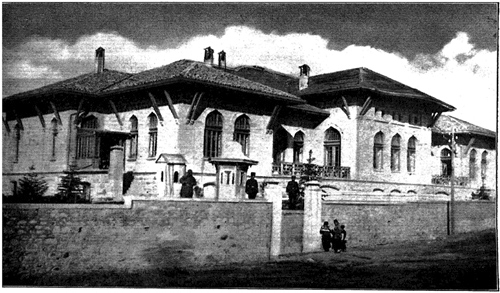
ASSEMBLY BUILDING AT ANGORA
So rapidly did the Party grow that two months after the Smyrna occupation, Kemal and Rauf were able to assemble it in a caucus at Erzerum in the eastern provinces. Kemal’s staff drove up to Erzerum along the crude mountain roads with the rest of the provincial delegates, but Kemal himself rode alone over back trails and through lonely villages. Here in the wrecked mountain town of Erzerum, the Party platform was drawn up, a document which was later to become famous under the name of the National Pact.
This document re-stated and amplified the Izzet Government’s position, as Rauf Bey had conveyed it to Admiral Calthorpe at Mudros. Autonomy for the Arabs under the necessary suzerainty of the Caliph at Constantinople and Allied recognition of the Enver Government’s abrogation of the Capitulations, were its principal planks. The break-up of the old Empire was accepted and in the new map of the Near and Middle East, the Caliphate of Islam was modified to permit the application of the Western tradition of nationalism to Turks and Arabs alike, an application to which the Turks claimed as complete a right as the West had long before acknowledged to Greeks, Bulgarians and Armenians. From the Greeks, the West had never asked Capitulations. It would therefore not ask Capitulations from the Turks. As for the rights of minorities, such rights as the Greeks gave their Moslem minorities, the Turks would give their Christian minorities. The Straits would remain open to world commerce, subject only to the necessary military security of Constantinople, “the seat of the Caliphate of Islam, the capital of the Sultanate, and the headquarters of the Ottoman Government.” In the delineation of the new Turkey’s frontiers, certain border areas were under dispute. Two of these border areas, Cilicia and the Mosul province, “are inhabited by an Ottoman Moslem majority united in religion, in race and in aim, imbued with sentiments of mutual respect for each other and of sacrifice, and wholly respectful of each other’s racial and social rights and surrounding conditions,” and these belonged within the Turkish frontiers. To certain other border areas (Western Thrace and the three districts of Kars, Ardahan and Batum in Trans-Caucasia), the West could, if it wished, apply the device of the plebiscite with which it was accustomed to decide the destinies of populations elsewhere. As for the place of the new Turkey in the family of nations, the Party repeated Rauf Bey’s statements to Admiral Calthorpe at Mudros: “It is a fundamental condition of our life and continued existence that we, like every country, should enjoy complete independence and liberty in the matter of assuring the means of our development, in order that our national and economic development should be rendered possible and that it should be possible to conduct affairs in the form of a more up-to-date regular administration.” On this note, the Party’s platform closed. Three weeks later, a copy of it lay on Lord Curzon’s desk in the Foreign Office in London, and Colonel Alfred Rawlinson, a brother of Lord Rawlinson, Commander-in-Chief in India, was returned to Erzerum to learn what it was that Kemal really wanted.
Having drawn up the Party’s platform, the Erzerum caucus adjourned to meet in September at Sivas, where a standing council of twelve members was chosen to sit continuously at Angora, a provincial capital whose rail and telegraphic communication with Constantinople was more direct than Sivas’s. The Damad Ferid Government’s position with respect to the country had now become so impossible that it fell on October 5 and was replaced by the Ali Riza Government which was authorized by the Sultan to hold a general election. This was a clean-cut victory for the Nationalists and two days after the new Government took office, Kemal telegraphed the Party’s platform to Ali Riza Pasha in Constantinople, as the terms of peace on which the Nationalists appealed to the country.
At this junction, the Oecumenical Patriarchate at the Phanar forbade Ottoman Greeks to participate in the elections on the ground that they were no longer Ottoman subjects. This injunction was of course obeyed in the capital where Allied troops were in occupation, but a considerable portion of the Rûm community lived in Asia Minor and here, already gravely compromised with their Turkish neighbors by the Phanar’s break with the Porte and by the Greek occupation of Smyrna which had followed that break, it only added to their difficulties. Indeed, it is difficult to imagine what move more dangerous to its own communicants in Asia Minor the Phanar could have made. It so increased the suspicion which attached to them in the eyes of the Nationalists that hundreds of them were clapped into Nationalist jails and were not released until a Turkish-speaking Orthodox priest from Kiskin, twelve miles from Angora, announced his intention of breaking with the Phanar and participating in the elections as an Ottoman subject. He immediately undertook to effect a similar break on the part of the Turkish-speaking Orthodox churches in the interior, and the Oecumenical Patriarch summoned him to report at the Phanar at once. He disregarded both the Phanar’s summons and the excommunication which followed it, and continued to align his people with the Nationalists.
Papa Eftim Effendi, acting metropolitan of the Turkish Orthodox Church, is a subject to be approached with all caution for he may yet develope into a phase of the new Turkey more important for Christendom than Kemal himself. Christian solidarity broke down when the Phanar threw its communicants in Asia Minor into a political position which brooked not an instant’s neutrality. As long as Ottoman Christians were given an inferior position under Moslem law, the concern of Western Christians for the Rûm and Ermeni communities of the old Empire had a legitimate basis. The Byzantinism which colored our Western concern for Ottoman Greeks and Armenians may have blinded us at times to the actual position they occupied in the old Empire, but the legal position which Moslem law gave them was certain ultimately to be resented. There came a time when thoughtful Turks agreed with us, not out of concern for non-Moslems but in the belief that the Empire was being slowly strangled by the religious usages which had tightened about it. The Young Turks made an honest attempt in 1908 at reforms designed ultimately to give all races of the Empire an equal position as Ottoman citizens in an Ottoman State. That attempt broke down for several reasons. One was that the Young Turkish program was repugnant to Islam. Another was that the Rûm and Ermeni communities stuck to every jot of their community rights. Whether rightly or wrongly, they would not be given a common position with their Moslem neighbors. To American missionaries on the spot, the failure of the Young Turkish program was a bitter disappointment for they knew what the price of failure would be to Turks, Greeks and Armenians alike. But American Protestantism in the United States generally concurred in the refusal of the Ottoman Christians to make that gesture of confidence without which the Young Turkish program was bound to fail. The missionaries knew that if the religious deadlock which the 1908 Revolution sought to break, had finally to be broken by force, only Western military intervention could save the Christians from defeat. But their tongues were tied in the United States. Churchmen at home stiffened the Greeks and Armenians while refusing to note the very grave problems for which it was essential that the Turks should discover a solution.
Papa Eftim Effendi, however, has made the gesture of confidence. Under his leadership, sixty-eight Orthodox churches in the interior gave up their church schools on March 1, 1922, their pupils being sent thereafter to the Government’s schools. The old Rûm community regarded its schools with considerable pride, for they were centers of Greek nationalism. In the old Empire, they were centers of Orthodox reaction just as the mosque schools were centers of Moslem reaction. These churches in the interior have given up their right to administer Orthodox civil law. Turkish courts, under the Ministry of Justice, now administer Orthodox law for Orthodox litigants, supposedly as British courts administer Moslem law in India. The churches which have formed the new Turkish Orthodox Church under Papa Eftim’s leadership, are as free to worship as they have always been (and that freedom has been possibly greater than Westerners have sometimes attributed to the Ottoman Government). Politically, however, their communicants have thrown in their lot with the Turks. Their clergy wear the black robe and black cylindrical hat of Orthodoxy only while engaged in their clerical duties. At all other times, they wear the Turkish kalpak.
But the wider interest which gathers around Papa Eftim at present lies in the fact that he has destroyed the old basis of Christian solidarity and has opened up the possibility of a quite new basis. The old solidarity, whether rightly or wrongly, has levied a fearful toll upon Turks, Greeks and Armenians alike during these last few years. But it is just possible that Papa Eftim has given us the prospect of a new solidarity upon a purely religious basis. It is a prospect to be approached with all reserve, for it suggests a new Western attitude toward the Near and Middle East whose benefits both to Christendom and to Islam may prove to be incalculable. Time will develope Papa Eftim’s full significance. Unless hostility to the Turk is an article of the Christian creed, his is the most meaningful figure in Turkey today.
A note reached me late one morning during my stay in Angora, to the effect that Papa Eftim Effendi was in the city and was anxious to call. Two hours later, Djelal Noury Bey, a prominent Turkish editor and a deputy in the Grand National Assembly, entered with Papa Eftim following. Eftim was a black-eyed, bushy little man and the figure he presented, a Turkish kalpak resting on his uncut Orthodox hair and his long Orthodox beard flowing over the turned-up collar of a wolfskin coat, is one which may be commended to those who knew the old Ottoman Empire. The following dialogue ensued:
Self (to Papa Eftim): Are you a Turk?
Djelal Noury (smiling): He is of the Turkish race.
Self (to Papa Eftim): Are you of Turkish blood?
Djelal Noury (smiling cordially): The Turkish Orthodox Church was his own idea. He organized it himself.
Self (to Papa Eftim): Do you speak Turkish? Djelal Noury (still smiling cordially): He wants to go to the League of Nations at Geneva. He asks do you think he ought to go?
Self (to Papa Eftim): Are you a Turk?
Djelal Noury (smiling still more cordially): He asks whether you may be a Protestant. He says if you are, you and he are the same for neither of you recognize the Pope.
This sort of thing seemed to be of no profit to any of us and the matter was accordingly allowed to drop, Djelal Noury leaving with Papa Eftim carefully in tow. We Westerners of course are quite superior to this device of the carefully staged interview, since our own politicians in the West are as indifferent to publicity as a cat is to catnip.
A half-hour later, a Turk happened to call and in the most casual fashion asked what opinion I had formed of Papa Eftim. I told him I had formed the highest opinion of his chaperone but had had no opportunity to form any opinion of Eftim himself. Something apparently happened behind the scenes during the next day or two for two evenings later, Papa Eftim unexpectedly knocked at my door and entered stark alone. It was two hours afterward when he left and during those two hours nobody interrupted us. I believe that no lawyer ever put a witness through a more thorough examination than I put Papa Eftim on that evening. When he left, his pale thin hands shook with emotion. As he went out, he stopped in the door-way and this is what he said: “This is our country and the Turks are our own people. How can we forsake our country when it needs us?”
I have no means of knowing who put this strangely Western idea into Papa Eftim’s head originally. Certainly it was not that stronghold of Easternism, the Oecumenical Patriarchate. Wherever it did come from, I believe there is not the slightest question of the sincerity with which Papa Eftim holds it today. His is the almost fanatical sincerity of a minority which feels itself misunderstood.
The morning after I talked with him, a Turk happened to call and in the most casual fashion asked what opinion I had formed of Papa Eftim. I made him a non-committal answer to the effect that he seemed to me to be the merest shadow of a man physically to be cast in such a great role. Fifteen minutes after my Turkish caller left, my door opened and the largest Orthodox priest I have ever seen loomed in the door-way, a vast ignorant mound of a man who announced unctuously that he was one of Papa Eftim’s assistants in the Turkish Orthodox Church. I looked him over slowly from his huge feet all the way up to his uncut Orthodox beard and the Turkish kalpak stuck on top of it, while he watched me with the black ox-like eyes of a people whom no man has ever long succeeded in budging unless they were willing to be budged. Then I thanked him and told him he would do quite nicely. He turned slowly and the stairs creaked beneath his tread as he went ponderously away.
XVI
THE TREATY OF SEVRES
RAUF BEY TAKES THE NATIONALIST DEPUTIES FROM ANGORA TO CONSTANTINOPLE—INDIA COMPELS MR. LLOYD GEORGE TO LEAVE CONSTANTINOPLE TO THE TURK AND GENERAL MILNE BREAKS UP THE PARLIAMENT, DEPORTING RAUF AND MANY OF HIS COLLEAGUES TO MALTA—THE SEVRES TREATY AND HOW DAMAD FERID PASHA SECURED AUTHORITY TO SIGN IT.
The elections which the Ali Riza Government held, resulted in a clean sweep for the Nationalists and a situation of considerable delicacy was now precipitated. It was hardly possible for the new Parliament, charged with the execution of the Erzerum program, to function freely under the enemy occupation in the capital. On the other hand, it was the country’s legally elected Parliament and it was highly desirable that it should be recognized as such. Pending decision as to its course, its deputies assembled at Angora where the Party’s standing council was in session in the gray granite building which had once been the provincial headquarters of the Committee of Union and Progress. Here an intimation reached the deputies that the Allies were prepared to recognize the new Parliament if its session was held in the capital and was opened in a legal fashion by the Sultan’s speech, but that it would not be recognized if it met in Angora. Accordingly a large proportion of the deputies, headed by Rauf Bey, the Parliamentary leader of the Party, left Angora for Constantinople and on Jan. 11, 1920, the new Ottoman Parliament opened its session. Despite the conditions of military occupation under which it met, Rauf Bey discharged his duties with inflexible courage and on January 28, the Erzerum program, now known as the Turkish National Pact, was legally adopted by the legal Parliament sitting in its legal capital.
Trouble was now plainly in the air. Only the day before the adoption of the Pact, the re-mobilizing Nationalist forces in Asia Minor had raided a dump of surrendered munitions on the Gallipoli peninsula. Behind its Asiatic suburbs, their forces had crept into the very outskirts of Constantinople. The Allied occupation was becoming a touch-and-go matter.
Other developments contributed to the gravity of the situation. Mr. Lloyd George who had been striding up and down the Rubicon, had made a dismaying discovery. It seemed that there was a place called India. The British Foreign Office was also having its troubles. Pilgrimage to Mecca had ceased and Islam was not displaying that gratitude at the payment of British subsidies to King Hussein of the Hejaz, which Lord Curzon expected of it. Mr. Lloyd George accordingly ceased striding up and down the Rubicon and seated himself in a waiting posture on its bank. On February 26, he told the House of Commons in London that his statement of Jan. 5, 1918, respecting Constantinople as the Turkish capital, “was specific. It was unqualified and it was very deliberate. It was made with the consent of all parties in the community. It was not opposed by the Labor Party.” Preparations were accordingly made to leave Constantinople to the Turk in the peace settlement, and London editors (who as a rule are not Moslems) began turning over projects for the “Vaticanization” of the Caliphate of Islam.
On the night of March 15-16, during the temporary absence of his French co-commander, General Milne seized the telegraph offices in Constantinople, isolated the capital from Asia Minor, executed a series of lightning raids at midnight, arrested every Nationalist deputy in the Ottoman Parliament whom he could lay his hands on, and embarked them on transports for internment on Malta. By dawn of the 16th, British forces held the city securely in their grip, Rauf Bey and many of his colleagues were en route to barbed wire compounds on Malta, the rest of the Nationalist deputies were clambering up the Asiatic shore of the Bosphorus to begin their long trek back to Angora, General Milne was soon to be recognized as the Allied Commander-in-Chief, and Constantinople was ready to be left to the Turk.
On April 6, the Ali Riza Government gave way to a second Damad Ferid Government. On April 11, Ferid issued a Sultanic edict denouncing Nationalism, and a similar edict was issued by the Sheikh-ul-Islam who had entered his high office upon the arrest and deportation to Malta of his predecessor (the German occupation of Belgium during the war had left Cardinal Mercier unmolested, but no such nice scruples have troubled the British occupants of Constantinople). Meanwhile, military events were moving rapidly. The Circassian leader, Anzavur, who had been launched against the Nationalists, had flickered out after a few local successes along the Asiatic shore of the Straits, and it became evident that serious operations would have to be undertaken if Constantinople was to be held. Every British man of war in the Mediterranean was ordered to Constantinople and, with the second Ferid Government launching its religious thunderbolts at the Nationalists, Allied conferences at Hythe and Boulogne called on the Greeks behind Smyrna to screen the Straits from the “Kemalists.” In conjunction with British naval units, the towns along the Asiatic shore of Marmora were quickly occupied. Thrace was given to the Greeks in Europe to protect the capital from the Nationalists in its rear, and a British Constantinople was now firmly embedded in a Greek setting. The High Contracting Parties were now prepared to “agree that the rights and title of the Turkish Government over Constantinople shall not be affected, and that the said Government and His Majesty the Sultan shall be entitled to reside there and to maintain there the capital of the Turkish State.”
On May 11, the terms of peace were handed to two of Ferid’s appointees at Paris. These terms proposed to close the Greek pincers about Constantinople, to cut it off from Asia Minor permanently with a garrison restricted to 700 men, to isolate the Straits from Asia Minor by the institution of an International Commission on which Russia and Turkey would be represented if and when they became members of the League of Nations, and to place what remained of Turkey in Asia Minor under the permanent military, economic and financial control of Great Britain, France and Italy. As for Smyrna, “the city of Smyrna and the territory in Article 66 will be assimilated, in the application of the present Treaty, to territory detached from Turkey. The city of Smyrna and the territory defined in Article 66 remain under Turkish sovereignty. Turkey however transfers to the Greek Government the exercise of her rights of sovereignty over the city of Smyrna and the said territory. In witness of such sovereignty the Turkish flag shall remain permanently hoisted over an outer fort in the town of Smyrna. The fort will be designated by the Principal Allied Powers…. The Greek Government may establish a Customs boundary along the frontier line defined in Article 66, and may incorporate the city of Smyrna and the territory defined in the said Article in the Greek customs system…. When a period of five years shall have elapsed after the coming into force of the present Treaty the local parliament referred to in Article 72 may, by a majority of votes, ask the Council of the League of Nations for the definitive incorporation in the Kingdom of Greece of the city of Smyrna and the territory defined in Article 66. The Council may require, as a preliminary, a plebiscite under conditions which it will lay down. In the event of such incorporation as a result of the application of the foregoing paragraph, the Turkish sovereignty referred to in Article 69 shall cease. Turkey hereby renounces in that event in favor of Greece all rights and title over the city of Smyrna and the territory defined in Article 66.” As for Constantinople, it remained the Turkish capital, but “in the event of Turkey failing to observe faithfully the provisions of the present Treaty, or of any treaties or conventions supplementary thereto, particularly as regards the protection of the rights of racial, religious or linguistic minorities, the Allied Powers expressly reserve the right to modify the above provisions, and Turkey hereby agrees to accept any dispositions which may be taken in this connection.”
There being no Ottoman Parliament in session, Damad Ferid Pasha summoned eighty prominent Turks to Yildiz Kiosk to authorize signature of the peace terms. Permitting no discussion of it, Ferid ordered those who favored signature to stand and, scenting trouble ahead, he whispered to the Sultan to stand. Considerations of etiquette bade every one present stand, but the late “Topdjeh” Riza Pasha broke into vigorous protest. In a voice trembling with emotion, he told Ferid that the meeting had risen out of respect to the Padishah and not in resignation to the peace terms, that the meeting had no power to authorize their signature and that, even if it had, it could not authorize their signature as long as Anatolia was in open and armed revolt against them. Without further ado, Ferid declared the signature of the peace terms authorized and added audibly that Anatolia could go to the devil.
So the peace terms were signed by three of Ferid’s appointees (one of them a teacher in an American college near Constantinople) on August 11 at Sevres in the suburbs of Paris. Sevres is in Christendom and the year was 1920.
XVII
ANGORA
FEVZI, RAFET AND KIAZIM KARABEKR PASHAS AND THEIR MILITARY DICTATORSHIP UNDER KEMAL PASHA—THE “PONTUS” DEPORTATIONS—MOSUL, THE KURDS AND THE SPLIT IN ISLAM—THE FRANCO-ARMENIAN FRONT IN CILICIA, THE GREEK FRONT BEFORE SMYRNA, AND THE ALLIED FRONT BEFORE CONSTANTINOPLE—HOW THE BROKEN PARLIAMENT WAS RECONSTRUCTED AT ANGORA—FERID’S COUNTER-REVOLUTION AT KONIA.
Angora lies tilted up on its hill, a gray blanket of flat roofs pierced with white minarets and green cypresses, and scarred across its middle with the ruins of 1915. At its foot lies a shallow marsh stretching from the town itself to its railway station, a mile and a half away. Along the rim of the basin up whose southern slope it sprawls, are the summer villas of its wealthier families, secure above the hot-weather malaria of the marsh.
The heart of the town lies along its lower fringes. When the Sivas congress moved the Nationalist Party’s council to Angora late in September, 1919, Kemal himself took up his abode in an upper room at the railway station and a Decauville locomotive was kept fired up night and day beneath his window, in readiness to hurry him farther into the interior on an instant’s warning. The first building one passes upon entering the town from the railway station is the gray granite building once used as the local headquarters of the Committee of Union and Progress, with a wooden theatre lying in the center of a garden across the road. Some distance to the left, as one continues into the town, is the old konak, or Government building, where the provincial administration was formerly housed. Across the square in front of it, is the Post and Telegraph Office. On the right hand as the town is entered, a broad street turns off past the theatre and leads around the foot of the town to the beautiful compound of the Sultana College. Almost opposite the theatre as one turns into this road, is a large school building of stone and some distance farther along is the stone building formerly occupied by the local administration of the Public Debt. Still farther along, far out in the outkirts of the town, the blue and white buildings of the Sultana College stand within the walls of their compound. Here Fevzi Pasha, a towering Anatolian Turk with drooping moustaches, and Rafet Pasha, a dapper little figure, were engaged in re-mobilizing and re-equipping the Army. Fevzi Pasha is a dour giant of a man with a gargantuan appetite for work and a complete aversion from social intercourse of any sort. Rafet Pasha has a similar capacity for work but he combines with it a natural genius for social intercourse. I have seen him in a number of widely varying settings, from his quarters in the Sultana College to the mountain passes of Anatolia in the dead of winter, but he is invariably as immaculate both in manner and appearance as if he had just stepped out of a drawing room.
Under Mustapha Kemal Pasha, Fevzi Pasha and Rafet Pasha ruled Anatolia for the Nationalists, their authority reaching down into the provinces through military governors whom they assigned to the more critical provincial capitals. Kiazim Karabekr Pasha who held the eastern provinces from Erzerum, ought to be mentioned with them. It had been easy enough to take over Anatolia from the Damad Ferid Government, for the Greek occupation of Smyrna undermined Ferid’s hold on the country at a stroke, but to hold Anatolia against Ferid’s efforts to recover it was quite another matter. Fevzi, Rafet and Kiazim were the men who held it, and whatever traditions of personal advantage they inherited from the old Ottoman Government, their personal ambitions were sunk in the common cause of defending the remnant of the country. I believe firmly that this statement holds true of Kemal as well. My impression of him is that he would have joined one of his own labor battalions and dug roads behind his own Army if he thought that by so doing he would be able more effectively to contribute to his country’s defense.
These men constituted a small handful of modern Westerners in control of a vast mediaeval Eastern country, but their task was simplified by the comparative absence of the Levantinism which had poisoned Constantinople. Such as their country was, it was as homogeneous as any between Vienna and Bagdad. There were Turks, Kurds, Circassians, Turcomans, Tartars and Laz in the country, a few remaining Armenians in the interior, an increasing number of Greeks between Samsun and Trebizond along the Black Sea littoral, and a handful of widely scattered Americans, mostly in the employ of the Near East Relief. The large majority of its population, however, was Turkish and most of the non-Turks were bound to the Turks by their acceptance of Islam. The country, while wholly primitive, was far more single-minded than its capital had been for a century. Its handful of Americans were soon represented at Angora by two members of the Near East Relief’s corps, the late Miss Annie T. Allen and Miss Florence Billings. Most of their contact was with Rafet Pasha and, despite the serious delicacy of their position, their relations with Rafet Pasha were generally happy.
The military situation in which the Turks found themselves, was shortly to be simplified by the brief war which Kiazim Karabekr Pasha launched from Erzerum against the Armenian Republic of Erivan. This opened a line of retreat to Trans-Caucasia and Central Asia, and if Kemal, Fevzi and Rafet Pashas had been forced to drop their archives into their kalpaks and flee, a back door would have been available for their escape into the East.
The Pontus project which the Greeks along the Black Sea littoral had launched, was not so simple to handle. The Greek occupation of Smyrna eventually made it necessary to transfer the Third Army from Amasia to the hinterland of Smyrna and the so-called Pontus had to be held with irregulars under the command of the late Osman Agha, the Laz mayor of Kerasund. The crude terrorism he wielded proved to be such an ugly business that Hamid Bey, one of the best men available in Angora, was dispatched to Samsun as mayor. Hamid Bey is a Rhodes Turk with up-standing hair, Kaiser-like moustaches, a mouth full of gold and a booming voice, a combination apt to give one meeting him for the first time a sense of having met some new species of wild man, but a further acquaintance with him reveals beneath his surface eccentricities a character of solid integrity and ripe judgment. He had been a governor of provinces and the fact that the post of mayor in Samsun was thought worthy of being filled by an ex-governor may be taken as an indication of Rafet Pasha’s anxiety to discover some peaceful solution of the Pontus problem. Osman Agha’s terrorism remained as much of a problem at Angora as the Greek terrorism which it sought to overcome, but a solution was finally discovered for it when Osman, having shot down 900 Greeks and Armenians in Marsovan in reprisal for the knifing of 200 Turks by Greek troops at Ismid, marched to Angora to offer himself and his Laz followers to the Army. He entered Angora as the hero of a goaded and angry population and Kemal, after permitting him to enjoy his ovation to the full, incorporated his followers in the Turkish shock troops with whom they were cut to pieces in the Battle of the Sakaria River. Thereafter there were no more Marsovans in the so-called Pontus, but the problem of its Greeks still remained.
There appears to be no doubt that the Pontus program had reached the status of a definite organization determined on independence, an organization which was peculiarly difficult to combat by reason of the fact that any move against it would be disseminated in the Black Books of the Oecumenical Patriarchate in Constantinople as evidence of “persecution of the Christians.” Believing that one of the organization’s centers was a body of Greek students which called itself the Pontus Literary Society in the American college at Marsovan, Angora requested Dr. George E. White, president of the college, to suppress the Society. Possibly forgetting that the country was in a state of war and nowhere more bitterly so than in Marsovan, Dr. White refused to suppress the Society. Angora thereupon suppressed the college, deporting its American teaching staff to the coast whence they were removed to Constantinople. A number of Greeks were then arrested in Marsovan on evidence which Angora believed indicated their activity in the Greek organization; they were removed to Angora, placed on trial before a military court under a charge of treason in time of war, convicted and hung. But the tumult in the so-called Pontus still continued. Greek and Turkish irregulars burned each other’s villages and ambushed each other in the fields. This sort of thing dragged along until 1922, when Angora, having failed to break up the Greek organization, deported into the interior the entire Greek population along the Black Sea, men, women and children alike.
Once these deportations had been ordered at Angora, their execution was of necessity left to the local police chiefs and the manner of their execution varied with the temper of the local police chiefs and the amount of supplies available in each province. Both the police chiefs and the amounts of supplies available varied widely, and the treatment of the deportees on the march varied accordingly. The report which Dr. Mark Ward, the Near East Relief worker who was deported from Kharput, made to the British Foreign Office in London as well as to his own Government in Washington, indicates that their sufferings at Kharput were heavy. Dr. Ward in his report laid the blame for their sufferings on Angora. Whether, once other methods had failed to break up the Greek Pontus organization, Angora possessed the means to make deportation a bearable process for the Greeks, is a question which in the lack of conclusive evidence must remain unanswered here. It seems to me more to the point, however, to point out the original guilt of those who landed the Greeks in Asia Minor without the means of protecting them there. The “Pontus” episode is not the first in which Western Powers have permitted the Greeks to expose their own people to danger in the hope that their sufferings will attract Western assistance. There are minorities in every country between Vienna and Bagdad and their exposure to danger constitutes part of the technique of Balkan statecraft. Greek atrocities at Ismid resulted in Osman Agha’s reprisals at Marsovan. It is not impossible that that was the purpose with which Greek atrocities along the Marmora shore began. Certainly it is difficult to find any other purpose in the conduct of Greek regular troops. Thus it is that Balkan peoples draw their new frontiers. Thus it has been for a century and thus presumably it will continue to be, as long as the West permits.
It seems to me (and I must add in fairness that my knowledge of the “Pontus” deportations, while gleaned at Angora and the Oecumenical Patriarchate alike, is purely second-hand) that it is open to question whether Angora’s deportation of Greek women was justified and whether it made the fullest use of such scanty supplies as it had in caring for the deportees on the march. On the other hand, the action of the British in disembarking the Greeks into the “Pontus” without protest from the Oecumenical Patriarchate, could only be justified if the Turks remained helpless and passive. As soon as Nationalism began to gather strength in the interior, the most elemental sense of humanity on the part of the British and the Oecumenical Patriarchate should have prompted negotiations with Angora looking toward the re-embarkation of the “Pontus” women and the humane internment of the men.
The deportation of the “Pontus” Greeks and Kiazim Karabekr Pasha’s victory over the Armenian Republic of Erivan in Trans-Caucasia kept Angora’s rear open. The British front in the Mosul province of Mesopotamia has never threatened Angora’s rear, for the mountainous nature of the country ahead of them has made impossible any further advance on the part of the British. Here the British have sought to partition the Kurdish population, leaving its northern half to Angora and incorporating its southern half in the Arab State of Iraq. Whether the chiefs of the Kurdish tribes prefer to be under Turkish rule or under Arab rule or independent under the British aegis, is a question to which Angora and Bagdad furnish widely varying answers. It seems probable, however, that Kurdish opinion, such as it is, does not relish partition and if there are Kurdish deputies at Angora, it is because the Turks are the only parties to the Mosul controversy who do not propose to divide the Kurdish country. There is a wider aspect, however, to the Mosul controversy. Turks and Arabs alike are Sunni Moslems and as long as the British can maintain a controversy over Mosul between the new Turkish State and the Arab State of Iraq, Islam remains in a divided condition. It is the desire to abstain from any action over Mosul which might widen that breach, which has prompted Djavid Pasha, the Turkish commander at Diarbekr, to refrain from the use of force in the recovery of Mosul. The sheikh of the Senussi who girded the late Caliph on his accession to the Throne in 1918, and who fled from Brussa to Angora when the Greeks entered Smyrna, has been at Diarbekr for the last three years, attempting to heal the Turco-Arab breach over Mosul. Thus far, the conduct of the Turkish command on the Mosul “front” has been marked by a conspicuous restraint.
As Kemal, Fevzi and Rafet Pashas looked toward the West, they were confronted by three military fronts, the Cilician front on their left, the Greek front behind Smyrna on their center, and the Allied occupation of Constantinople on their right. In the winter of 1919-’20, the British high command in Cairo withdrew its forces from Cilicia in accordance with the secret Sykes-Picot agreement of 1916, to Palestine, leaving the French command at Beirut in sole occupation of the northern end of the Syrian corridor and of Cilicia. Here, under the French aegis in Cilicia, an Armenian enclave was being carved out and the Turkish administration had withdrawn to Bozanti, a town at the top of the Taurus Range. The French front extended from the Taurus east to the Mosul province, but it was in Cilicia that the weight of the French occupation made itself chiefly felt. The Armenians revenged the undoubted wrongs which they had suffered under the Ottoman Sultans in drastic fashion and there were streets even in Adana itself in which it was not safe for a Turk to show himself after dark. The Turkish towns outside the rim of the French area, possibly inflamed by the tales of Turkish refugees from Adana, soon launched a guerilla warfare against the Franco-Armenian regular troops and began isolating out-lying garrisons. Much of this was directed by the Turkish ex-administration at Bozanti, but it was carried on largely by Turkish irregulars with any following which they could impress into service.
As for the Greek front behind Smyrna, the first defense which was used was that of the Circassian bandit leader, Edhem, but the Greek command soon won him over and made a considerable hero of him. This left Kemal, Fevzi and Rafet Pashas without defense and the skeleton Third Army which was hastily transferred from Amasia, covering Samsun, to the Smyrna front was too depleted in strength to offer effective resistance. Nuri Ismet Pasha, a slight deaf man but an able pupil of von der Goltz and the Potsdam War College, was given command on the Smyrna front and the hasty extemporization of munition factories began at Konia in his rear. Until his forces should be built up to an effective strength, however, he restricted himself to keeping in touch with the Greeks, and with all of Asia Minor behind him in which to maneuvre, he traded territory for time whenever the Greeks showed an inclination to move. Luckily for Angora, the Greeks sat waiting on the Allies and attempted little movement after their first rush ended.
Thus hemmed about with enemies, the Nationalist Party had won a clean-cut political victory by installing its Parliamentary majority in Constantinople, and its troops had penetrated into the very suburbs of the capital in search of surrendered munitions with which to re-equip themselves. Although the Mudros armistice had been torn up at the Greek occupation of Smyrna and a state of war again existed, Angora was in close telegraphic communication with Rauf Bey, the leader of its Parliamentary majority in Constantinople. Indeed, with the British Navy commanding those sections of its perimeter which were not in the occupation of enemy Armies, Angora’s wire to Constantinople constituted its only means of communication with the West.
But on the night of March 15-16, 1920, General Milne isolated Constantinople from Anatolia, conducted a series of lightning raids at midnight in Stamboul, arrested Rauf Bey and many of his colleagues for deportation to Malta, and not only cut off Angora from the legal Parliamentary machinery which it had spent eight months in building up, but cut it off from any means of effective communication with the West. This was a staggering blow. Angora immediately ordered the arrest of the few British officers who remained in Asia Minor, chief among them Lord Rawlinson’s brother who was jailed at Erzerum, but with Rauf Bey and his colleagues on their way to Malta as prisoners of the British, the Nationalists lost some of the best brains in the Party. The Italians soon opened their cable from Adalia to Rhodes whence a wireless was in communication with Rome, but Angora’s sole contact with the West was even then at the disposal of a foreign Power.
Within the next few weeks, deputies who had escaped General Milne’s midnight raids in Stamboul, began filtering into Angora and an attempt to reconstruct the shattered Parliament began. A month was allowed for escaped deputies to reach Angora and claim their seats in the new Parliament, and the seats of others who had been interned on Malta were awarded in new “elections,” one of which is said to have been held in the Asiatic suburbs of Constantinople itself where Italian forces were in occupation; Italy has never relished the hurried Greek occupation of Smyrna.
So on April 23, 1920, the reconstructed Parliament, with deputies sitting for constituencies in all the areas covered by the Erzerum program, from Thrace to Mosul, began its session in the old Committee of Union and Progress building in Angora, under the new name of the Grand National Assembly of Turkey. Mustapha Kemal Pasha was made Commander-in-Chief and President, Fevzi Pasha became Chief of the General Staff and Prime Minister, Rafet Pasha became Minister of War and Interior, and the deputies acquiesced in the military dictatorship which they found at Angora. Even in the West, democracy does not thrive in time of war, nor did it in the war-ringed isolation of Angora. Forty percent requisitions, accompanied by ruinously heavy taxation afforded, not enough money to balance the Assembly’s budgets, but enough to enable Fevzi and Rafet Pashas to continue re-mobilizing and re-equipping the Army.
On April 6, Damad Ferid Pasha again became Grand Vizier in Constantinople and began at once a determined effort to regain a foothold in Anatolia. Fevzi and Rafet Pashas replied to him with a series of so-called Military Courts of Independence, before which any late Ottoman subject suspected of anti-Nationalism could be brought, tried under the Army code for treason in time of war, and if convicted summarily hung. In the Nationalist view, the Ottoman Sultanate and the Ottoman Government had alike ceased to exist on the night of March 15-16, 1920, and Damad Ferid Pasha, with the prestige of the Ottoman Caliphate at his disposal, now added himself to the Western enemies who surrounded Angora in a final struggle for the possession of the new Turkish State.
The Greeks were hurriedly flung in front of the Straits, Ismet Pasha making no attempt to oppose them, and from behind them Ferid in Constantinople appealed to Old Turkish opinion at Konia to uphold the conservative usages of Islam and denounce the Nationalists. It was an appeal which had helped to nullify the Young Turkish Revolution in 1908, which had helped to keep the old Empire in the stiff dead grip of religious usage. It was a very powerful appeal and the Greek command at Smyrna lost no time in re-inforcing it by proclaiming its solicitude for the Caliphate of Islam. Moslem and Christian reaction were the rocks on which the 1908 Revolution had come to grief and the Greek command at Smyrna lost no time in dropping them into the channel which the Nationalist Revolution of 1920 would have to thread. Since Greeks and Armenians were then at war with Turkey, Christian reaction had no standing at Angora, but Moslem reaction is a rock which Turkey is to this day still engaged in passing and will be for some years to come. Ferid had no more powerful weapon with which to attack the Nationalist hold on the conservative peasantry of Asia Minor and on the dervish tekkes of Konia. The Nationalists could handle their strong but docile peasantry, but if the worst came to the worst at Konia the Nationalists could make it plain that Indian and Algerian Moslems had fought against the Ottoman Government during the war and that in the new Turkish State the needs of the country took precedence over the letter of Moslem law.
From April 6, 1920, when Damad Ferid Pasha re-entered office in Constantinople, a Nationalist coastguard was instituted on the Mediterranean opposite Konia in order to oppose any attempt at a landing, whether by Ferid’s followers from the capital or by Greeks engaged in the interesting business of proclaiming their solicitude for Islam. Konia itself, a dusty wind-swept provincial capital on the Anatolian plateau, replete with old Seljukian and pre-Seljukian mosques, was linked with Angora by a great semi-circle of railway line which bent westward via Eski-Shehr and Afium-Karahissar, and thrice-a-week trains made the journey in eighteen hours. At the same time, this bend of railway line was identical from Eski-Shehr to Afium with another bend from Constantinople to Smyrna. With Smyrna and its hinterland in Greek hands, the Greek command added to its new interest in Islam a scheme for the revival under Greek auspices of the old Seljukian Empire with its seat at Konia. The Seljukian program is another of the ghosts which became stirred to life when the Ottoman Empire went down in 1918 to join the dead.
Ferid’s agents and Greek agents kept slipping through the Greek lines toward Konia and moving back and forth under the coasts of Asia Minor with their eyes on Konia. In the British view, the Ottoman dynasty had lost the Caliphate in 1914 when it was used to declare a holy war against the British and their Allies. Events at Mecca had since changed the British view, but if the Caliphate were not too serious a matter for light speaking, it might be added that in the Nationalist view the British lost the Caliphate in 1920 when they used it to declare a holy war against the Nationalists. Ferid finally recovered Konia in the counter-revolution of October, 1920, but Rafet Pasha hurried 2,000 men down the railway from Angora, occupied Ala-ed-Din hill in the outskirts of the city and drove out Ferid’s administration in three days of sharp fighting. Rafet Pasha appointed as military governor of Konia, Ghalib Pasha, a tall white-haired Albanian who had defended the Caliphate as Ottoman commander in the Hejaz during the war, and the tchelebi of the Mevlevi dervishes whose historic right it had been to gird each Caliph with the Prophet’s Sword forty days after his accession to the Throne, went to Angora as one of Konia’s eight deputies in the Grand National Assembly. So the Seljukian ghost was laid and the Caliphate came into the Nationalists’ keeping.
The Nationalist hold on the interior of Asia Minor now became indisputable. The munition factories in the rear of Ismet Pasha’s slowly growing forces on the Smyrna front, were quickly enlarged and Konia became a war-center of the first importance in the interior. A considerable number of Armenians who had been returned to Konia after the Mudros armistice and who had voluntarily remained in their homes when the British offered to evacuate them at the time of their own evacuation of the Bagdad Railway, had been compromised anew by the Greek occupation of Smyrna and were placed under increasing military surveillance as the number of Turkish munition factories in the town grew. Armenian “indiscretions,” however, finally led to the deportation of men of military age farther into the interior, and the locking up of their churches in Konia. The juxtaposition of a Turkish munition factory and an Armenian church is one which is possibly apt to produce “indiscretions.” When I was last in Konia, the only Armenians there were women and children. A number of mosques in the town had been taken over for military depots, but no Armenian church in the town had been so taken over. The churches were locked up but otherwise untouched. The Armenian women in the town were permitted to receive no mail from the outside world, for the Nationalist censors were supposed to read Turkish and French only, not Armenian. No Turk ever learns Armenian, and apparently there was no Armenian in whose loyalty the Turks had sufficient confidence to enable them to entrust Armenian mail to him for censorship. The Armenian women were being taxed to the point of robbery, and so were their Turkish neighbors. Ghalib Pasha told me that he was treating Turks and Armenians on a basis of scrupulous equality, and I believe that he meant precisely what he said. If there were enough men like Ghalib Pasha in Turkey to fill all the provincial administrations, Turkey would be a model country. But men like Ghalib Pasha are not appointed chiefs of police in highly delicate places like Konia.
Damad Ferid Pasha did not cease his efforts to regain a foothold in Anatolia, after his brief counter-revolution in Konia. With the Greek advance in the spring and summer of 1921, his agents renewed their activities along the coasts. In Smyrna the Greeks welcomed them and in Mersina, the port of Cilicia, the French and Armenians welcomed them. Their work increased with the 1921 Greek offensive, until Nationalist agents boarded the British steamer Palatina at Adalia, discovered Topal Osman and four confederates hidden in a cargo hold, and shot them down. It was a wholly illegal proceeding but it put an end to Ferid’s efforts to return to Anatolia. Incidentally, it so embarrassed the Italians who were occupying Adalia under the secret war-time agreement of St. Jean de Maurienne, that they evacuated their zone. Technically, they had been hostile to the Turks but actually their hostility was directed to the Greeks in Smyrna. Their departure now afforded the Nationalists their first access to the Mediterranean, and their first representation in the West was soon at Rome.
REAR-ADMIRAL COLBY M. CHESTER, U. S. N. (RETIRED)
To whose associates the First Grand National Assembly granted the huge development program known as the Chester Concession.
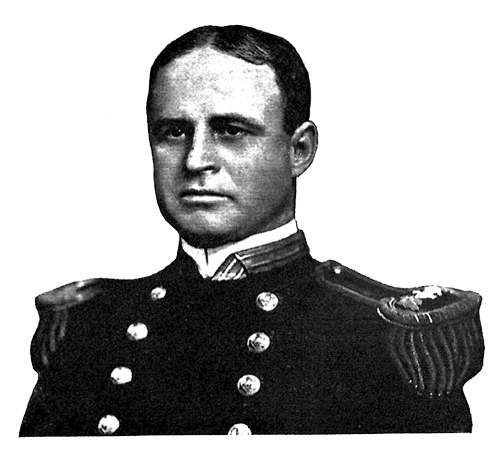
REAR-ADMIRAL MARK L. BRISTOL, U. S. N.
United States High Commissioner at Constantinople from February, 1919, to the resumption of diplomatic relations between the United States and Turkey.
XVIII
TURKISH NATIONALISM
THE WESTERN TRADITION OF GOVERNMENT TO WHICH THE GRAND NATIONAL ASSEMBLY WAS BUILT—HOW NATIONALISM WAS CREATED—GREEK DEFEAT AT THE SAKARIA RIVER—PEACE WITH THE FRENCH IN CILICIA—AMERICAN ARMENIANISM AND CILICIA—HOW A CIVILIAN ADMINISTRATION WAS BEGUN AT ANGORA WHILE FEVZI PASHA WAS RE-MOBILIZING AND RE-EQUIPPING THE TURKISH ARMIES.
When the Grand National Assembly opened its first session on April 23, 1920, in the gray granite building at the foot of Angora, the Crescent and Star went up on the flag-staff atop the building and, although trenches were dug for its military defense if necessary, the Turkish flag has flown there night and day ever since it was first hoisted. At one corner of the grounds, just outside the trenches which encircle the building, a gallows was erected. In a little restaurant near the Assembly building, I have sat at luncheon with that gallows looking in through the window. I have thought several times as I sat there of a number of worthy Americans at home who might have held less simple views on Near and Middle Eastern subjects in days gone by, if they could have sat at luncheon in Angora with the cross-beam and pulley of that gallows looking in upon them.
The Assembly building itself contains a single floor with a corridor down its middle, a row of committee rooms on one side and a comparatively large chamber on the other. The chamber was equipped for the Assembly’s use by the construction of a high desk for “Mr. Speaker” in the center of one wall and a lower desk in front of it to be used by deputies in addressing the Assembly. Grouped in semi-circular fashion around the Speaker’s desk, the small desks to be used by the deputies themselves were crowded upon the floor of the chamber in long rows. Half-way up the side walls, small galleries were built for visitors. The whole equipment was of wood. It looked like a school-room. It was a school-room, possibly as bitter a school-room as any nation has ever attended.
The 342 deputies of the Assembly were in large part, and still are, Easterners engaged in adapting the Western governmental tradition to their own uses, but they have never sold their great Eastern birthright for a mess of Western pottage. When they gathered for their first session at 1 o’clock on April 23, 1920, a small motto, done in Turkish script of white on a blue ground, a quotation from the Koran such as may be found in thousands of devout Moslem homes, was hung on the wall above the Speaker’s desk. A free translation of it into English would be: “Let us meet together in council and discuss.” It was the ground on which the new force of nationalism was carrying the conservative peasantry of Anatolia behind the Caliph in Constantinople to the Koran itself, on which it was wrenching Anatolia away from the Sultan and his Grand Vizier while refraining from any violation of its allegiance to the Ottoman Caliphate.
Beneath that motto, the deputies met at 1 o’clock every day but Friday, which is the Moslem Sabbath. They consisted of men in Western dress and kalpaks, officers in the old great-coats of Ottoman Army days, and hojas in Eastern robes and turbans. They varied in personal appearance from the ample and immaculate figure of Djelal-ed-Din Arif Bey, deputy for Erzerum, to three Kurdish chiefs who could neither read nor write. The din of their conversation, both within the chamber and in the corridor without, was continual and the intermittent tinkle of the Speaker’s hand-bell did little to abate it, for the Assembly at Angora is as noisy as all other Parliaments are.
The military dictatorship which Fevzi Pasha and Rafet Pasha wielded over Anatolia was in the Eastern tradition, but in the institution of the Assembly a Western plant began taking root in the Eastern soil of Anatolia. The military dictatorship would pass with the war but the Assembly was intended to be permanent and it was fashioned in readiness to begin functioning as soon as the war permitted. In its structure, the Western tradition was adapted to what were believed to be the country’s needs. It was necessarily fashioned to a theory at first, for the number of enemies who ringed it about made a dictatorship essential. As the war approached its end, as more men and more money became available, practice might modify it but with the loss of the Parliament at Constantinople it afforded the only attempt at an ultimately civilian administration which the country possessed.
This is the theory to which it was built: Under the Ottoman Constitution, as revived by the 1908 Revolution, the powers of declaring war and peace, of dissolving Parliament, of receiving diplomatic representatives of foreign States, and of appointing the Cabinet and the Senate, had been vested in the Sultan. In the creation of the Grand National Assembly, the Sultan was deposed and his prerogatives were re-distributed. The Assembly itself became the seat of authority and since its sessions were fixed by its fundamental law at two years’ duration, no right of dissolving it was admitted. The power of receiving diplomatic representatives of foreign States was delegated to the President of the Assembly. The power of appointing the Cabinet was taken by the Assembly and since its Ministers were made individually responsible to the Assembly, both the executive and the legislative functions of government were retained in its hands. The Senate disappeared with the Sultan and the Government of the Grand National Assembly became radically republican in structure. Differences of opinion existed in the Nationalist Party respecting its permanent structure, a small school of monarchist opinion holding that a form of government so unreservedly republican would not show itself suited to the country’s peace-time needs, but for the time being domestic controversies were buried deeply beneath the urgencies of the military situation. No differences of opinion have existed among Westerners who know the East, however. It has long been a belief in the West that the East can only be ruled by Sultans. We Westerners may be right or we may be wrong in our views of the East, but Turkish Nationalism has thrown us a most direct challenge in the out-and-out republicanism of its Grand National Assembly. When the war ends, we shall see what we shall see.
The Grand National Assembly speedily set about the elaboration of a fundamental law which may be taken as the Constitution in embryo of the new Turkish State. It was finally adopted on June 17, 1920, and its more important clauses translate from Turkish into English as follows: “Article I. Sovereignty belongs to the nation without reservation. The administration of the nation’s sovereignty is based on the principle of the direct decision of the people.
“Article II. The executive power as well as the legislative power are concentrated in the Grand National Assembly of Turkey which alone represents the nation.
“Article III. Turkey is governed by the Grand National Assembly and its Government is entitled ‘the Government of the Grand National Assembly.’ “Article IV. The Grand National Assembly is composed of members elected by the inhabitants of provinces.
“Article V. The election of members of the Grand National Assembly takes place once in every two years. The duration of membership is two years only. Members may be re-elected. The Assembly continues its session until the new Assembly is convened. In case it is impossible to hold new elections, the session of the Assembly may be prolonged for one year only. Each member of the Grand National Assembly represents not only his province but is also a representative of the nation.
“Article VI. The general session of the Grand National Assembly takes place on the first of November without convocation.
“Article VII. Fundamental rights such as the enactment dispositions of the Sheriat (Moslem law), the making, modification and abrogation of laws, the conclusion of conventions and treaties of peace, and the call for the defense of the country, belong to the Grand National Assembly. The making of laws shall be based on principles of jurisprudence which are most closely adapted to the needs of the nation and to the requirements of its customs and habits. The powers and duties of the council of mandatory Ministers of the nation shall be determined by special laws.
“Article VIII. The Grand National Assembly administers its governmental departments through mandatory Ministers elected by the Assembly, according to rules to be provided in a special law. It is the Grand National Assembly which instructs the mandatory Ministers in executive matters and if necessary changes the Ministers….
“Article XI. In local matters, the province has an autonomous personality. With the exception of internal and external policy, the Sheriat, justice, military affairs, international economic relations, government imposts and inter-provincial matters, the provinces are charged with the administration, under laws to be promulgated by the Grand National Assembly, of the Evkaf (Moslem religious endowments), educational institutions, sanitary services, local economics, agriculture, public works and social services….”
The remaining articles outline the organization of the provincial and sub-provincial administrations. In this fundamental law, the Nationalist Revolution of 1920 undertakes to effect the same decentralization in administration as the Young Turkish Revolution of 1908 failed to effect. It undertakes infinitely more than that. At a single stroke, it lifts the new Turkish State out of the dead grip of ancient religious usage which strangled the 1908 Revolution, which in fact made effective revolution of any sort a traditional and hackneyed impossibility in the old Ottoman Empire. Whether the new Turkish State will succeed in maintaining its new and highly promising freedom from the stiff religious traditions which imprisoned the old Empire, remains to be seen. Christian reaction has been met and defeated on the field of battle, but Moslem reaction is still suppressed by the iron hand of the Assembly’s Treason Law. Hidden away in the bitter loneliness of Anatolia, the Nationalist Party has used drastic methods in laying the foundations of its Western governmental structure in the Eastern soil of Anatolia. If those foundations have been well and firmly laid, we have something new in the East at last.
Westerners who did not penetrate the thick veil of war which screened Anatolia from the world during its years of seige, will not find it easy to realize the suspicion with which it regarded us in the West. Deceived again and again by Mr. Lloyd George, goaded by repeated Greek atrocities unwittingly reinforced by wild atrocity tales to which the hospitable American press opened its columns, only a man of Mustapha Kemal Pasha’s iron patience could have compelled his angry countrymen to persevere in the search for a peaceful escape from the fate which loomed above them on every frontier. Yet amid the suspicion which possessed Anatolia during those hard years, the Nationalist Party created a new and very real human force known as nationalism. Patriotism, love of one’s own soil, is a Western sentiment which would have required a generation under normal circumstances for its transplantation to the Eastern soil of Anatolia, but under the circumstance of a Greek Smyrna, it sprang into existence overnight. The Turkish poet, Mehmed Emin Bey, travelling from village to village in Anatolia with a Turkish officer attached to him, added fuel to the new flame of nationalism with his old cry, “I am a Turk; my race and language are great.” Newspaper plants, smuggled out from Constantinople, pieces of press machinery concealed in travellers’ baggage, handfuls of type dropped into travellers’ pockets, produced new dailies and weeklies in Anatolia which poured more fuel on the new flame. The whole culture of the Turks was moved bit by bit from the old capital to the new center of the nation’s life. Rafet Pasha’s Military Courts of Independence suppressed any attempt to quench the new flame. These Courts were a harsh reminder that there was such a thing as a distinctive Middle Eastern civilization and that it had come to a time when there was no longer any room in Anatolia for natives who were not loyal to their own civilization. The old religious divisions which had split the Anatolian population swiftly melted away in the heat of the new flame. Papa Eftim Effendi gave up his community rights and sixty-eight Orthodox churches in the interior followed him into the new Turkish Orthodox Church, agreeing to appoint no metropolitans except those who could read and write Turkish, who were of Ottoman parentage, who had lived at least five years in the country and who had abstained from “political activity.” They agreed furthermore that metropolitans accused of secular crimes, instead of being immune from arrest without having first been degraded and then being subject to imprisonment only in the Oecumenical Patriarchate, were to be arrested and tried as any other Turkish subject would be. Moslems permitted a new personage called the Minister of Sacred Law to become an ordinary member of the Cabinet at Angora, and the huge wealth which was locked up in the country’s Moslem endowments was opened and placed at the disposition of the provincial administrations. Moslem courts and schools were taken over by the Ministers of Justice and Education, respectively. Although American churchmen still thought in terms of the old Ottoman Empire, still played upon the old religious division between Moslems and Christians which had proved the ruin of them both, the new political force of nationalism was blending them in Turkey as in Syria, in Palestine and in Egypt. Nationalism is a strangely new and Western force in the East today and thus far Anatolia has clung to it in the face of every effort which Mr. Lloyd George and American churchmen could exert to throw the country back into the ruin of its bitter past.
For a year after the Greeks landed at Smyrna on May 15, 1919, they sat in the hinterland of the great port waiting for the Sevres Treaty, while Fevzi Pasha and Rafet Pasha worked like Trojans at Angora. In May, 1920, they threw their screen in front of the Straits, Ismet Pasha making no effort to molest them. In November, 1920, Old Greece finally rid itself of Mr. Venizelos, a wedge was driven between Athens and the Phanar, and the French made Constantine an excuse for disentangling themselves from the Greeks. Royalist officers now took over the front behind Smyrna with no respect for the Allied veto on a drive toward Eski-Shehr and Afium-Karahissar. With these two railway junctions occupied, the Greeks would possess the great semi-circle of railway which runs from Constantinople to Smyrna, and the Turks would be deprived of the interior Angora-Konia line with which they were secretly re-mobilizing and re-equipping their Armies on the Smyrna front. Accordingly in January, 1921, the Royalist Greek command tried its strength from Brussa toward Eski-Shehr and retired without encountering Turkish opposition. The situation was now plain. Eski-Shehr and Afium were theirs whenever they cared to take them. As for Fevzi Pasha and Rafet Pasha at Angora, they had imposed a strict embargo on travellers into the interior of Anatolia and the secrecy they succeeded in preserving was one of their striking successes.
Two months later, in March, 1921, the Royalist Greek command launched its double advance, the Southern Army moving on Afium from Ushak, the Northern Army on Eski-Shehr from Brussa. To their surprise, both advances encountered organized Turkish forces of considerable strength. The Southern Army, against stiff opposition, succeeded in occupying Afium but the Northern Army, following the route it had walked over in January, ran into a murderous battle at Inë-Onü and had to fall back to its old position at Brussa, the Southern Army falling back from Afium to Ushak with it. That battle was the first meeting of Greek and Turkish troops in Asia Minor and is today one of the epics of the new Turkey.