Front matter
Reading edition
Author of “Tangled Trails,” “Ajax for Example,” etc.
The dull hum of conversation in the Thunder County courthouse died down as the door leading to the jury room opened and twelve men filed out. They were all hard-bitted men, wearing the stamp of the range. There was not a hint of the verdict on their impassive faces as they moved into their seats.
From the opposite side of the room, through the door leading to the jail, came the sheriff and a deputy with their prisoner, a tawny-eyed, lithe young man, who walked forward with a half-smile on his thin lips as he looked at the twelve men who had decided his fate.
The judge, portly and gray-haired, came in slowly and sat down behind his desk. The courtroom was filled to suffocation, for the case had caused much local interest and range folks like to sit in court when the case has any interest to their business.
Seated just inside the railing reserved for the principals in the case were four people—two men and two women. One of these men was a giant, with a great shock of grizzled hair and mild blue eyes, which belied the fighting-power revealed by his massive, deep-lined face. He was “Flint” Moore, owner of the Box M cattle outfit, and father of “Wild” Moore, the tawny-eyed prisoner.
Beside him sat his wife and his daughter, Patricia, known as “Pat,” while with them sat “Bud” Deal, the foreman of the Box M. Patricia had the same tawny eyes as her brother, and black hair and a creamy skin which defied tan. Her mouth was full-lipped and her nose was just a trifle tilted. Patricia had been the cause of many a cowboy’s day dreams, but they all grew love-shy under the gaze of her yellow-brown orbs and went away afraid to speak their feelings.
All except Bud Deal, the champion rider and pistol shot of the Thunder Range. Bud’s coal-black eyes clashed with Pat’s tawny ones—and the black eyes won. Bud was thirty years of age, slender, with the face of a Spaniard and the nerve of a wild-cat. Few people loved Bud Deal; but they all respected his ability. He was a first-class cow-man.
Flint Moore’s eyes turned from the jury, flashed to his son and centered on the sheriff, who turned his head. Their eyes met. It was only a flash, yet it was full of bitter hatred. Between Flint Moore and the sheriff, Jeff Garvin, was bad, bad blood. Garvin was nearly as large a man as Moore, with sandy hair and mustache. His eyes were deep set and steel-gray in color.
For several moments there was tense silence in the little courtroom, broken finally by the creak of the judge’s old swivel chair as he faced the jury and said—
“Gentlemen, have you reached a verdict?”
A tall man, with a long, thin face, stood up, hitched nervously at the waist-band of his overalls and said softly:
“Yes, sir, judge, we has. Here is our verdict.”
He held out a sheet of paper to the clerk, who handed it to the judge.
Every one in the courthouse leaned forward, watching the face of the old judge for a hint of the verdict. He glanced down at Flint Moore and handed the paper to the clerk to read aloud.
The drone of several flies, buzzing up and down the dusty windows, was plainly audible.
Then the clerk read—
“We, the jury, find Wild Moore—uh—”
The clerk turned the sheet of paper around to better catch the light from the window.
“We, the jury, find Wild Moore not guilty as charged.”
For an instant there was silence. Then a huge sombrero sailed up from the rear of the room and seemed to skate along the ceiling. Following it came the suppressed yelp of an enthusiastic cowboy—
“Ee-e-e-e-e-yah!”
The judge hammered on his desk, as he got to his feet, but his voice was not heard above the commotion. Flint Moore had got to his feet and stepped closer the sheriff, who had also got up. Patricia and her mother had rushed to Wild and were smothering him in their embrace.
The sheriff was angry, explosively angry, and did not conceal it. Cowboys vaulted the railing to shake hands with Wild Moore and some of them jostled the sheriff nearer Flint Moore. It was like holding a flame near powder for those two men to be near each other.
“That was a —— crooked verdict!” snapped the sheriff, glaring into Flint Moore’s face; and a second later the sheriff went crashing backward into a jumble of loose chairs from a smashing blow to the jaw.
The prosecuting attorney threw himself in front of Flint Moore, trying to stop him, but a huge shoulder crashed into his chest, tossing him aside. The sheriff heaved himself up from the floor, drawing his gun as he came, but Bud Deal sprawled into him, clutching his gun-hand, while other men grasped the sheriff to prevent a killing.
In the middle of the railed space stood Flint Moore, alone, Colt in hand. Jud Frawley, the deputy, was watching him closely, but making no effort to mix into the game. He knew that Flint Moore was in a killing mood.
“Gentlemen! Gentlemen!” cried the judge, trying to elbow his way off his platform; but a number of fight-loving cowboys blocked him from interfering.
The jury had mixed into the quarrel, and it began to look as if the Thunder County court would become a wreck, as far as the interior was concerned. Patricia stepped in and put her hand on her father’s arm.
“Stop it, dad,” she ordered. “Let’s not make things any worse than they are. Nothing can be gained by fighting.”
The boys had managed to take the sheriff’s gun away from him and now the judge was heard above the uproar.
“Clear the courtroom!” he commanded. “This is a disgrace, gentlemen.”
“The whole —— case was a disgrace!” rasped Flint Moore. “Let that star-packin’ coyote loose and fill his arms with guns.”
“Dad!” chided Pat. “Don’t say foolish things. Let’s all go home and call it a day.”
“Good idea,” said Wild Moore, smiling. “Has been quite some day, folks. C’m on, dad. Yuh can’t get no battle out of Jeff Garvin, ’cause he ain’t got no gun—and yore lookin’.”
Jeff Garvin heard the implication, but he did not reply. He was white-hot. His jaw still ached from Flint Moore’s fist, but he knew that the men would not permit him to make any attempt to retaliate. He shifted his glance to Wild Moore, and his eyes clashed with those of irresponsible youth. Then Wild Moore laughed mockingly and turned his back on the sheriff.
Flint Moore turned away and left the courtroom with his family and Bud Deal. Several of the jury shook hands with Wild at the courthouse steps and slapped Flint on the back, telling him to forget Jeff Garvin.
Other men argued with Jeff Garvin, telling him to forget Flint Moore; but Jeff Garvin said nothing. He was a powerful man and jealous of his prestige in the Thunder Range. He had been chief witness against Wild Moore, in which Wild had been accused of rustling cattle. Every one knew that the hard Winter had hit the Box M, and that Flint Moore was pinched for ready cash. Wild was an inveterate gambler—a plunger, and it was reported that he owed some large poker bills. He had suddenly acquired a lot of money. His poker bills were paid and he plunged heavier than usual.
A bunch of seventy steers had disappeared from the ranch in which Jeff Garvin owned half-interest. Garvin knew that several small herds had disappeared prior to his own loss. He wanted to talk with Wild Moore about several things, but Wild was missing. Several days later he showed up and plunged into the gambling-halls. When the sheriff questioned him he merely laughed and told the sheriff to go to a place which, they say, is hotter, on an average, than Fourth of July in Yuma.
Thereupon the sheriff arrested him and tried to build up his case against him, but cattle jurors must be shown something material. In fact, a rustler must almost be found with the stolen animal—to be branded a rustler.
“Whitey” Allen, one of Moore’s punchers, rode out with them from Oxbow, while the crowd from the courthouse watched them go and speculated on what would happen when Flint Moore and Jeff Garvin met again.
Oxbow was the county seat of Thunder County, an unpretentious little cow-city at the terminus of a railroad branch. It had been a stage-station, a trading-post, and the advent of a railroad, the appointment as a county seat, had changed it little.
There was a main street, narrow, dusty, fortified on both sides by unpainted, false-fronted buildings. There was a cross street started, which did not continue beyond a few more buildings of the same type of architecture. There was nothing in Oxbow to attract tourist nor capital. It squeaked in the Winter blizzards and creaked in the Summer heat. Men died with their boots on, and the survivors went on in their own dumb way, talking cattle prices, trading horses and whittling chairs.
When poker, faro and roulette palled, they pitched horseshoes for twenty dollars a corner or spat at a crack for the price of a steer. It was little wonder that Wild Moore’s trial had been of interest.
Whitey Allen was a thin, emaciated, tow-haired cowboy, whose features seemed to blend. He was one of those indescribable individuals who are like a sketchy drawing to which neither shade nor high-light has been added, or a half-tone drawing of a cowboy’s body with the head and face merely indicated.
None of the party had much to say during the ten mile ride to the Box M, which consisted of a rambling old ranch-house in the cottonwoods along Leloo Creek. There were several pole corrals, a long shelter shed and a one-story bunk-house.
Thunder Range was mostly low, rolling hills, which stretched Eastward to the high banks of Bitter River and Westward to the high range of the Thunder Mountains, which circled the big range like a crescent. There was plenty of water, and just now the hills were ablaze with Spring wildflowers and new bunchgrass, which grew up as if nature sought to cover the bones of the stock which she had wiped out with a terrific Winter.
Every ranch on the range had suffered, but none so heavily as the Box M. Magpies chattered over their nest-building in the willows along the stream. Prairie-dogs whistled from the sides of the hills, and overhead, high in the blue haze, flocks of geese and brant honked their way to the Northern lakes.
It was twilight when they rode into the Box M ranch and dismounted beside the rambling old porch. Deal and Whitey took the horses to the sheds, while the family went into the house. Flint Moore seemed to have aged ten years in a week. Wild was silent; but there was a gleam of exultation in his tawny eyes. He faced his father across the center table in the living-room and a defiant look came into his face as he waited for his father to speak.
“Son,” Flint Moore spoke very softly. “Son, where did you get that money yuh was spendin’ so free?”
Wild Moore threw back his head.
“Jeff Garvin asked the same question, dad.”
“I know he did—but you ain’t goin’ to give me the same answer yuh gave him.”
“Ain’t I?”
Flint Moore shook his head.
“No, son.”
“Havin’ money ain’t no crime.”
“No-o-o it ain’t no crime; but after the Winter we had it’s —— noticeable, son.”
Wild laughed.
“Everybody’s so —— poor around this forsaken country that an extra two-bits makes folks suspicious that yo’re a thief.”
“This ain’t no time for jokin’, son. Yo’re goin’ to tell me where yuh got that money, and I’m goin’ to tell the Thunder Range folks where yuh got it. The Box M and the Moore family comes clean with God and man. Now, talk.”
Wild Moore’s eyes narrowed as he looked at his father. He was not a dutiful son; and Flint Moore knew that his question would not be answered. It was with misgivings that Flint Moore had watched the growing-up of his boy. He had never shown affection for any one. There was a queer, wild strain in his blood, which grew into a devil-may-care attitude toward every one and everything. He was a throwback to some remote ancestor, whose eyes were a yellowish brown—probably a laughing, king-hating swashbuckler, who swore allegiance to no power.
Patricia had the same eyes, but Flint Moore knew that Pat was just a sweet, warm-hearted girl, who loved this wild-riding brother, but did not ask his love in return. Perhaps she understood him better than the rest.
For a full minute the two men watched each other. Came the jingle of a spur on the threshold and they turned to see Bud Deal standing in the doorway. Flint Moore had no way of knowing how long he had been there.
“Didja want that roan mare turned into the hills?” asked Deal softly. “Her back’s kinda sore.”
Flint Moore nodded.
“Yeah. Yuh might put a little axlegrease on the spots, Bud.”
Bud nodded in agreement, but made no move to leave. He produced a cigaret paper and tobacco and began leisurely to roll a smoke. Wild relaxed and accepted the “makin’s” from Bud, while Flint Moore studied them closely. Somehow, it seemed to him that the coming of Deal was a bit too opportune. It had saved Wild the clash, which was most surely due between them, when he had refused to explain where the money had come from.
Patricia came into the room, her eyes shining as she threw one arm around her father’s shoulders and patted him on the cheek.
“Just think, dad; this is the first time in three weeks that we have all been able to eat together. Isn’t it fine? I have never had much use for the law; but I was mighty grateful when it spoke up and told us that we didn’t have a thief in our family.”
Wild turned and stared at her.
“Didja have to have the law tell yuh that?”
Bud Deal laughed softly over his cigaret. Patricia did not reply, but her eyes did not waver.
“I hope the law—” began Flint Moore softly, but did not finish.
“I—I think we had better eat supper,” stated Patricia sadly.
“I don’t reckon I’m hungry,” grunted Wild, and turned out of the door, jingling his spurs down the steps and walking away toward the bunk-house.
Bud Deal tossed his cigaret away and turned to Flint.
“Yuh hadn’t ought to try to make him tell——”
“Yo’re only the foreman, Deal,” Flint Moore’s voice was as cold as ice. “Yore business is not connected with my personal affairs. Sabe? You must ’a’ been there quite a while before yuh jingled that spur.”
Deal’s dark face flushed, but he did not reply. Pat looked keenly at him and he tried to smile. Flint Moore turned away and went slowly to the dining-room door, where he turned his head.
“Deal, yuh better give Whitey his time tonight. There ain’t enough work around here for all of us, and I’ve got to cut down expenses. May sell out—I dunno.”
Deal nodded.
“All right, boss. I reckon we’ll get along.”
Flint Moore went into the dining-room, and Deal turned to Pat.
“The old man’s kinda upset, honey.”
“Don’t you think he has a right to be, Bud?”
Bud grinned and shook his head.
“Not a bit. The jury cleared him as clean as a whistle, didn’t they?”
“The jury—yes. Wild refused to testify. There was only the sheriff’s suspicions to pass judgment upon, and you know that no cattle jury will accept suspicions, Bud. That jury knew that Jeff Garvin hates dad.”
“Well, that trial is all over, and your dad ought to forget it. A young feller don’t like to have anybody hornin’ into his business, and I can see why Wild—see how he feels about it.”
“Perhaps you can, Bud,” replied Pat softly, and Bud wondered why she emphasized “you” so strongly.
They went into the dining-room together.
II
It was just at the hour when night fades into the pale shades of the dawn. No. 52 was thirty minutes behind schedule, which accounted for the extra throb and sway of the long string of Pullmans, as the huge compound engine thundered its way around the curves of the Snake Creek hills.
Suddenly there came the screech of brakes and the train ground to a shuddering stop. There was no sign of water-tank, station or signal. The front end of the train was just around a sharp curve.
A man darted back from the engine, running close to the side of the baggage car. He stepped in between the baggage car and the next coach, broke the air-hose, lifted the coupler and swung out, waving his free hand. As the engine started ahead he swung up on the rear of the car and the engine and one car went on around the curve.
In the rear of the engine cab stood a masked man, with a pistol in each hand. Lying half across his seat was the fireman, a bloody welt on his head, while the engineer looked straight ahead and drove according to directions. The fireman had attempted to fight the two masked men, and had paid for his foolishness. A mile farther on the man gave the command to stop, forced the engineer to precede him out of the cab, and the two of them went back to the baggage car.
Under the baggage car, huddled on the precarious rods was a man. His face was covered with a once-clean bandanna handkerchief to protect him from the stinging particles of dust. His clothes were driven full of grit and he was smoke-blackened until it was impossible to tell whether he was a white man or a negro.
The halting of the train had been a godsend to him, as he was nearly exhausted from an all-night grip of the rods, where he had fought against sleep and exhaustion. He could see the lower half of the engineer’s and the masked man’s bodies, as they came to the door of the baggage car. He saw the other man come from the rear of the car and join them.
He strained his ears to hear what was being said, but was unable to get more than an occasional word. He heard some one mention “dynamite” and a little later, “good sense.” Then he heard the door slide back in its grooves.
He relaxed for a moment and reached for his cigaret papers and tobacco. He grinned through the grime on his face at the cigaret he managed to make. It was greasy from his fingers, and his dry tongue had little power to seal the smoke.
Suddenly there came a crash above him—a jerking crash, which almost threw him off the rods. His cigaret fell to the road-bed and he clung with both hands. The three men dropped back to the ground, and he could see that one of them was carrying a canvas sack, which was heavy with its contents. One of the men started toward the engine.
It suddenly struck the man on the rods that this was a train hold-up. One of the men seemed to take a backward step, and from up by the engine came the dull report of a pistol. The man who had staggered went to one knee and the other sprang to him. The man on the rods could see that this kneeling man was completely masked. The other was firing toward the engine.
He stopped and helped the other to his feet, and as he did so he dropped his pistol to the rocky ground. He yanked the other man to his feet, swept up the pistol, and the two of them slid off the grade into the brush, taking the heavy canvas sack with them.
The man on the rods uncoiled swiftly and crawled out the opposite side of the car, and a moment later the engine and car began backing swiftly toward the rest of the train. The man had rolled into the brush and stayed concealed until the engine had disappeared around the curve.
Then he got to his feet and crossed the track, looking curiously in the direction taken by the bandits. It was a heavily wooded slope, and the two men were nowhere in evidence. He glanced down at the ground. A bent and blackened silver dollar lay among the rocks and near it was a small, almost triangular piece of pearl. He picked it up and studied it, and finally put it into his pocket. Then he crossed the track and plunged into the hills, going in the opposite direction to that taken by the bandits. He swore softly at himself for being fool enough to leave the train at that time. He realized that the rods of that train, even if he was discovered at the next stop, would be safer than being found in the hills.
He watched the train pass the spot of the hold-up, roaring its way to the next stop to spread the alarm, which would send mounted men on the trail of the outlaws. In a few hours the hills would be searched by men who knew every inch of them.
The man plunged on over a ridge and down into a ravine, where he found a stream of water. In lieu of soap he used sand, and did not cease scrubbing until he was restored to his normal color. He was wearing a cheap flannel shirt, an old vest, overalls and short boots. His hat was a nondescript sombrero.
When he had laundered himself as well as possible he sprawled at the edge of the stream and drank deeply. The reflection of his own face in the pool seemed to amuse him. All his life Jimmy Devlin had smiled at his own features; for Jimmy Devlin was far from handsome.
Jimmy’s hair was a cross between a roan and a sorrel. It would not part. His eyes were very blue and deepset. His nose was a trifle too generous and had been knocked a bit askew in a fight. His mouth was large and seemed to hold a perpetual smile. He was thirty-two years of age; five feet eleven inches tall and weighed a hundred and seventy-five. He was an expert cow-hand, willing to argue anything from psychoanalysis to the right way to bake a bean—and had just got out of the penitentiary, after fifteen months served on a three-year sentence.
Jimmy had been sent up for doing just what he had seen these two men doing a short time before. According to the records of Red Lodge County, Jimmy Devlin was a bold, bad train-robber.
This was one of the reasons why Jimmy did not want to be picked up by the officers. Inside his vest pocket were his parole papers. He knew that the officers would be very glad to find him, and he also knew that he would have a hard time making them understand that he had nothing to do with it.
If he had been found on the rods of that robbed car he might have been able to convince them that he had nothing to do with it; but a paroled train-robber’s words are of little weight, especially when zealous officers are seeking some one to imprison.
Therefore, Jimmy Devlin headed once more into the land of purple sage and dim trails. He felt that he was many miles removed from the spot where he had been arrested and tried, and there was little danger of any one knowing him. Jimmy hated the parole. He would have to stay within the boundaries of the State, and to report at regular intervals to the sheriff of the county. Just now he felt of the bit of paper sewed inside his vest pocket, and it brought a frown, as he plodded along.
He stopped and looked across the hills, which stretched away to the horizon, an endless sea of hill-waves. As far as he could see there was no hint of a squatter’s cabin nor sign of barbed-wire fences. Thunder Range was still the open land—a land of the dim trails.
Suddenly Jimmy’s serious face broke into a smile and his hand crinkled the paper in his pocket.
“Sure,” he muttered, half-aloud, “I should be glad that the paper says Montana instead of Rhode Island, because I hear they have a small area down there.”
He turned and started through the sage, disturbing the day dreams of a jack rabbit, which darted from in front of him and went spindle-legging its way down the hill, gathering speed at every jump, until it became but a gray blur in the sage.
“You should be glad, too,” chuckled Jimmy, as the rabbit faded from view. “Sure, you’d only get goin’ good and run off the edge into the ocean.”
Jimmy hitched up his pants and started on, hat in hand. Here was a big, free land—an empire of hills and valleys, far from real civilization; yet Jimmy Devlin felt that he could not be a part of it. He could never be a free man, as long as he must report to the law.
“Twelve wise men said I was a train-robber,” he muttered softly, “and who am I to dispute twelve wise men?”
He shaded his eyes with his hand and glanced around, as if challenging some one to dispute the question.
“Three years they gave me to repint of my sins, and in fifteen months they got tired of feedin’ me. Repint on your own meal-ticket, says they. Be a good citizen from now on, lie to the sheriff fluently, and by doin’ so ye may save the State the cost of feedin’ ye slumgullion stew and the wear and tear on large rocks.”
Jimmy grinned and scanned the country.
“Talkin’ to meself like a shepherd. I must take another name, that’s very sure, except with the sheriff—bad luck to him. Still, he may not be a bad sort. I hope I get a job before the hills are full of man-hunters—so I do.”
He topped a rise and stopped. Before him spread the Thunder Range. He could see the great crescent of mountains, the long, sloping foot-hills. He took a deep breath and shook his head in wonderment.
“Sure I’m a lucky devil, so I am. I was in the Thunder country and didn’t know it.”
He scanned the country and looked back, where he could see the dim, green line of Bitter River.
“It’s the place,” he muttered. “I’m too far South yet, though. Sure, I wonder if he did what he said he would? Wish I knew where he was, the poor divil. He wanted to go to Arizony and try to fight the pain in his chest. I was fool enough to cut into the game and let the sheriff chase me. I thought I had a fast horse; but I miscounted me speed per mile.
“Ah, well, it was only fifteen months. I hope that some soft-hearted Mick will help me out in return, if I ever need it. Fifteen months in the penitentiary and further orders not to leave the State. Mebbe it was worth it—I dunno. Talkin’ to meself again! Hm-m-m!”
He shook his head and started toward the North.
III
Jeff Garvin opened his mail, which had collected for several days. It was mostly reward notices, which he scanned and tossed aside. Rewards for yeggs, counterfeiters and even the lowly pickpocket. The sheriff passed them all until he came to a letter which bore the imprint of the State penitentiary. He opened it and frowned over its contents.
Jud Frawley looked up from his newspaper when the sheriff grunted aloud.
“They’ve paroled Jim Devlin,” stated the sheriff.
“Who is he?” asked Frawley. “Oh, yeah. He was sent up before we went into office, wasn’t he, Jeff?”
“Uh-huh. Robbed a train in Silverbend County and they trailed him plumb over here before they got him.”
“And never got the money, did they?”
“Nope. He got away with twenty thousand dollars. Now they let him out on parole and he’ll likely dig it up, thumb his nose at the law and live easy.”
“Did you know him?” asked Frawley.
Garvin shook his head.
“Never even seen him. Heard all about the case. Swore he didn’t know a thing about it, but they sent him up. Why, he was ridin’ a pinto, with a white rump. The sheriff of Silverbend had follered that pinto for a week. They gave him three years. ——! I’d serve fifteen months for twenty thousand dollars.”
Frawley nodded in agreement and folded up his paper.
“Seen anything of any of the Box M outfit lately?”
The sheriff snapped around in his chair.
“None of ’em been here in ten days—not since the trial. Mebbe I made a fool of myself, Frawley; but I was sore. That —— Wild Moore would make anybody sore, and his father——”
The sheriff snapped back to his desk and began writing on some legal papers. Frawley nodded, deep in thought. Then—
“Wasn’t it reported that Devlin was killed in a jail-break?”
“Yeah. A month ago. Newspapers never get things right. It was denied later. Anyway, he wasn’t, or they couldn’t parole him, that’s a cinch.”
The sheriff picked up the letter again and scanned it. He grunted something unintelligible and turned to Frawley.
“Where do yuh reckon this letter has been all this time? Posted two weeks ago.”
Frawley got up and examined the postmark. It was quite true that the letter was two weeks old.
“Likely got shoved aside,” said Frawley, slowly. “It don’t matter none, does it, Jeff?”
“No, but it might ’a’ been somethin’ important.”
Frawley pursed his lips and went back to his chair. He had been carrying that letter in an inside vest pocket ever since the morning it arrived, but he wasn’t going to tell the sheriff. The vest had not been worn since that morning until now. Still, it was not important.
A man, bareheaded and in his shirt-sleeves, came in the door and walked to the sheriff, to whom he handed a telegram, watching the sheriff read it. Frawley got up, as if to get a peek at the message, which had suddenly galvanized Garvin into life.
“Listen to this, Jud,” ordered the sheriff, and read the message aloud:
“NUMBER FIFTY-TWO HELD UP BY TWO MASKED MEN IN SNAKE CREEK HILLS AT DAYLIGHT THIS MORNING. FIREMAN JOHNSON KILLED. BLEW SAFE AND GOT AWAY WITH BIG SHIPMENT OF GOLD. TRAIN WAS STOPPED AT FIRST CURVE NORTH OF SNAKE CREEK BRIDGE. ENGINEER SAW ROBBERS GO EAST FROM RAILROAD.
(signed) SHERIFF FRANKLYN, COTTONWOODS.”
“Snake Creek Bridge,” mused Frawley. “No use goin’ down there, I don’t reckon. They’ll have hours start of us.”
“Cinch,” agreed the sheriff. “Only thing we can do is to go out the Box M road and cut across the hills to Snake Creek. It’s almost a cinch that they won’t try to hide out East of Bitter River. Mebbe we’ll cut their trail some’ers.”
“Take a pack-outfit?” queried Frawley, and the sheriff nodded. “One horse. Throw on enough for about four days, Jud. Better pack the brown mare. She’s got more speed than the rest. I’ll wire to Franklyn and tell him we’ll work the Thunder Range, but for him to watch that they don’t get across into the breaks of Swan River.”
Jud Frawley worked swiftly and in half-an-hour they were ready to hit the trail.
Both men were well mounted and the small pack was diamond-hitched to a rangy brown mare.
Without causing any questions or excitement they rode out of town, heading down the dusty road, which led to the Box M. They covered ground swiftly, with the pack-mare swinging along at a stiff gallop. Both men knew it might be a hard trip, with the odds greatly in favor of the hunted. There were hundreds of places in the east side of the Thunder Range where two men might hide out indefinitely. It was a case of cutting their trail, more by accident than design, because the range was full of loose horses, some shod, some barefooted.
Jeff Garvin did not intend to stop at the Box M ranch. He knew that his presence was not at all desired at that certain place. The enmity between him and Flint Moore was of many years’ standing, and was caused by a horse race and the native truth of an Indian.
It was only a cayuse race, yet much money had been wagered. Flint Moore had a horse in the race as did Jeff Garvin. Both owners were too heavy to ride their own horses, and expect to win; so Garvin suggested that they each hire an Indian boy to ride.
Moore agreed and selected his boy the day before. That night Garvin drank much whisky and made many bets on his horse. Moore took part of the bets, in which Garvin gave foolish odds. Moore’s horse won.
An hour or so after the race Moore found his jockey, almost beaten to death, and doctored him back to life. The Indian boy told Moore that Garvin had tried to kill him. After much questioning Moore found that Garvin had bribed the Indian boy to throw the race. He had given the boy ten dollars to do this, but the boy had not understood the white man’s crooked scheme and had ridden to win.
Moore hunted out Garvin and found him in a gambling hall. Before the crowd, Moore told what the Indian boy had told him and then proceeded to whip Garvin. It was a complete job. Later that night, some one hit Moore over the head with a gun and robbed him of his own money and the winnings of the race. The next day Garvin had plenty of money, but Moore could not prove who hit him. From that time on there was an enmity which grew with the years.
The sheriff and his deputy rode past the sagging gate to the ranch-house, and started into the hills, past the corrals, when they met Patricia, leading her saddle-horse. She watched them ride up to her and made no effort to avoid them.
Garvin eased himself in his saddle and glanced back at the ranch-house before he said—
“Yore dad at home?”
Pat shook her head.
“No.”
“Yore brother?”
“Why do you ask?” Pat looked straight at him, and Garvin smiled.
“Then he ain’t, eh? Where’s Bud Deal and Whitey Allen?”
“Whitey isn’t working here. Hasn’t been here for about ten days.”
“Which don’t tell me where Bud Deal is,” reminded Garvin.
“No?” Pat was not a bit afraid of Jeff Garvin. “Perhaps you had better find Bud Deal and ask him.”
“Yeah,” nodded the sheriff. “Mebbe it would pay me to do just what yuh say. They’re all out in the hills, ain’t they?”
“Are they?” queried Pat interestedly. “Know any more news about our affairs, Mr. Garvin?”
Garvin swore under his breath and spurred ahead. Jud Frawley grinned at Pat and lifted his hat as he followed the sheriff. Down in his heart Frawley applauded Pat Moore, and he was not going to let Garvin’s prejudices against the Moore family change his opinion that Pat was about the finest girl he ever met.
The sheriff led straight into the south, until the broken hills concealed them from the ranch-house; then he turned his horse at right angles and swung up the bottom of a dry ravine. They climbed to where the ravine forked and the sheriff stopped and dismounted.
“What’s the big idea?” queried Frawley, as he watched the sheriff swing his field-glasses over his shoulder.
“We’ll climb up here to the top and watch that —— ranch, Jud. I ain’t takin’ no chances this time. Flint Moore needs money pretty danged bad, I’m tellin’ yuh. Him and that go-devil son of his ain’t home, and I’m goin’ to see when and from which way they do come.”
“How about Bud Deal?” asked Frawley, as they settled down in the rocks, looking down at the distant ranch-house.
“All depends,” grunted Garvin. “I’m lookin’ for two men ridin’ together. Bud Deal is goin’ to marry that yaller-eyed girl, and the Box M needs money pretty danged bad.”
Frawley grunted and stretched out in the shade. As far as he was concerned it was all right. He would rather lie in the shade than to ride in the sun, and if the sheriff wanted to loaf on the job, he was willing to help him.
It was about four o’clock when the sheriff picked up the two riders heading toward the ranch-house. It was Flint Moore and his son, beyond a doubt. Frawley took the glasses and nodded in agreement.
“Still that don’t spell nothin’,” stated Frawley, as he handed the glasses back to Garvin. “Two men ridin’ together don’t mean they robbed a train.”
“Ke-rect!” snapped the sheriff. “But it resembles such to the extent that I’m goin’ to find out where they’ve been. It’s about twenty-five miles from here to where that hold-up was pulled off, Jud. Come on.”
Garvin got to his feet and started down the hill toward their horses.
“Think a little about this, Jeff,” cautioned Jud, angling down the hill, digging his high-heels into the turf. “Flint Moore ain’t no shrinkin’ vi’let, and he hates you a lot. Wild ain’t exactly got any cause to love yuh—and they’re both pretty —— fast with a six-gun.”
Garvin turned at the horses.
“Stay out of it if yo’re scared, pardner; but I’m goin’ down there. Sabe?”
Frawley swung to his saddle and circled the pack-mare.
“I ain’t afraid, Jeff; and you know it. We’ll just be rammin’ ourselves against hot lead, thasall. Lemme go in alone and talk to ’em.”
“Fine chance!” sneered Garvin. “Have folks find out that I was scared of Moore. No, we go in together, or I go in alone.”
“All right, all right,” grunted Frawley. “Statistics shows that most men die before they reach thirty years of age, and I’m ten years over the average right now.”
Flint Moore and his son reached the ranch-house ahead of the sheriff and his deputy. Flint had gone into the house, while Wild had taken the horses to the corral. Garvin and Frawley rode boldly through the gate and up to the porch.
Flint Moore stepped out on the porch, minus his belt and gun and carrying a newspaper. He stared at Garvin steadily, wonderingly. Then he said—
“What do you want here, Garvin?”
“Just a little information, Moore,” replied the sheriff easily, noting with satisfaction that Moore was unarmed.
He eased himself in the saddle and dropped the reins over the saddle-horn.
“Where yuh been, Moore?”
“Where have I been?” Flint Moore repeated the question.
“Uh-huh.”
Moore took several moments to collect his thoughts, and then—
“What business of yours is where I have been?”
“None—mebbe. Saw you and yore son ridin’ in and I’d kinda like to know where you’ve been, thassall.”
Moore frowned. It was inconceivable that the sheriff should ride in and ask where he had been—especially as he and Garvin were sworn enemies.
“I don’t sabe your reasons, Garvin; and it’s none of your —— business where we’ve been.”
Garvin fidgeted with his bridle reins.
“Have you met anybody who could swear where yuh was at a certain time?”
Moore frowned and shook his head.
“Didja leave home today?”
“No, we left yesterday. Now, what in —— is all this about?”
“The train was held up at Snake Creek bridge this mornin’ about daylight,” replied Garvin slowly.
The newspaper slipped from Moore’s hand. For a moment he stared at Garvin and then came straight down the steps and up to the horses. Garvin’s hand slid to his gun. He had felt the weight of Flint Moore’s fist and was not going to take any chances.
“You accuse me of doing that?” Moore’s voice was very low, but distinct.
“Don’t get het up,” advised Garvin. “If yuh didn’t, yuh can prove yuh didn’t, can’t yuh?”
“Can you prove I did, Garvin?”
“I reckon,” said Garvin slowly. “I reckon we’ll let the jury decide that.”
Garvin’s hand came up quickly and his pistol pointed at Flint Moore.
“Yo’re under arrest, Moore. Don’t move,” and then to Frawley, “Go and get the kid, Jud.”
As Frawley turned his horse toward the sheds Pat came out on the front porch. For a moment she stared at her father and the sheriff and then she came down the steps and up to them. She looked at the pistol in the sheriff’s hand and at her father’s tense face.
Wild Moore came out of the stable and saw Frawley riding toward him. He could see his father standing beside the sheriff’s horse, with Pat a few feet away.
He knew that something was wrong and waited for Frawley to come up. Frawley was doing something he did not want to do; but he was only the sheriff’s hired man.
“I reckon yo’re under arrest, Wild.”
Wild Moore looked up at him. He did not dislike Jud.
“What for?”
“Sheriff thinks that you and yore dad held up the train at Snake Creek this mornin’.”
“The —— he does!” exploded Wild, and walked rapidly up to the sheriff, paying no attention to the gun.
“What’s all this fool talk about?” he demanded.
Frawley rode up beside him and waited for the sheriff to speak.
The gun turned slowly to cover Wild, and the sheriff spoke to Frawley—
“Take his gun, Jud.”
The tall deputy dismounted and removed the gun from Wild’s holster.
“Wild, can’t you prove where you were yesterday and today?” asked Pat. “Didn’t you see anybody?”
Wild shook his head.
“Never seen a soul, Pat. We made camp at Dancin’ Flats last night. Why, we wasn’t within eight miles of the railroad.”
“Well,” said the sheriff, “I reckon you can saddle up again and come with me to Oxbow.”
“You mean—” began Flint Moore.
“Jail—sure,” nodded the sheriff. “If yuh can prove yuh didn’t do it—fine. I’m listenin’ for a proof.”
“And while you are listening for innocent men to prove their innocence, the real robbers are making their way to safety,” said Pat.
Garvin laughed aloud and started to drop his pistol back into its holster. His prisoners were unarmed. He looked down at Pat.
“Sister, that sounds real smart; but I’m one hombre that yaller eyes and a smooth tongue never did faze.”
Flint Moore was only a few feet away from the sheriff, and his spring caught the sheriff unawares. His arms circled the sheriff’s body, and a backward heave, with his knees braced against the horse’s side, threw Garvin out of the saddle and sprawling to the ground. Like a flash, Flint Moore tossed aside the sheriff’s gun and waited for him to get up.
Jud Frawley started forward as if to help Garvin, but Wild tripped him with an out-flung foot and he almost fell over the sheriff. Before he could regain his balance Wild dived into him, knocking him sidewise and almost under his frightened horse, where Wild yanked his gun from its holster and secured his own from where it had dropped in the mixup.
Jeff Garvin struggled to his feet, cursing madly, and rushed at Flint Moore. They were nearly equal in size, but Flint Moore had whipped him before and both men knew he could do it again. This knowledge won for Flint, just as it lost for Garvin.
Moore smashed through Garvin’s clumsy guard and drove him across the yard with terrific smashes, which Garvin could not block. Garvin fought back like a tiger for a moment, but a blow to the jaw took all the strength from his muscles, and a second later a haymaker swing crashed against his chin and he went down like a stricken steer.
Flint Moore turned toward the porch, where Wild and Pat were sitting side by side. On the steps sat Frawley, his hands on his knees, a half-smile on his face. Moore noticed that Wild was dangling a pistol in his hand.
“That,” declared Frawley in appreciation, “that was complete and plumb sudden. Fallin’ around thataway caused me to miss a little of it. Kinda like a prizefight I was to in Pendleton once. They rung the bell and I turned m’ head to spit. Missed the fight, by jing! Hope he seen me start to help him.”
Flint Moore leaned against the porch and watched Garvin struggle back to his feet. He was a badly whipped man and did not seem to know just where he was going.
“Busted his rudder!” exclaimed Frawley, and then to Wild, “Mind lettin’ me steer him?”
Wild grinned and shook his head. Frawley got Garvin by the arm and led him back to his horse, where Garvin clung to a stirrup and tried to clear his brain. Frawley turned to Flint Moore.
“I reckon he won’t take yuh with him this evenin’.”
“I reckon he will!” retorted Flint. “If he don’t take us in with him, we’ll take him in with us. He’s made his arrest, now he’s got to make good on it. Go get the horses, Wild.”
Garvin got slowly on his horse. He was sore from his beating and his head ached badly. Flint Moore walked in close to him, and Garvin flinched at the feel of the muscular hand on his knee.
“Garvin, if you ever speak to my daughter or about her, I’ll beat you to death.”
Garvin nodded with evident understanding and caressed his aching jaw. He dreaded having to speak to any one.
Mrs. Moore was busy in the kitchen at the rear of the house and knew nothing of the turn of events until Pat went into the house and told her. They both went outside as Wild rode up leading his father’s horse.
The leavetaking was short. Mrs. Moore, a patient little woman, bowed her head sadly over the inevitable. She knew that they were not guilty, but that the sheriff would try to make them as much trouble as possible.
Pat and her mother stood on the porch and watched them ride away, with Garvin, unarmed, riding in the lead, closely followed by Frawley, also unarmed. Flint Moore and Wild rode side by side. Frawley turned and waved his hat at the two women, as he yelled a good-bye to them. Garvin rode straight ahead, never taking his eyes off the road. He knew that Oxbow would laugh when they heard how he had brought in his prisoners; and Jeff Garvin hated to be laughed at.
Frawley did not mind. In fact he was secretly pleased over the turn of affairs. It had looked to Wild as if Frawley had started ahead to assist the sheriff, when Flint Moore yanked him from his saddle; but the fact of the matter was that Frawley intended to jump Garvin for his words to Patricia.
IV
Jimmy Devlin disliked walking and refused to take it in large doses. In fact, he did not have a definite destination in view. He wanted to get a job on a cattle-ranch. He had been unable to prove his innocence at the time of his trial, but the brand of train-robber sat lightly on his shoulders. He whistled softly to himself and kept to the low ground, taking no chances of being seen and picked up as a suspect.
He had felt sure that he would find a ranch, where he could get a meal; but no ranch could he find, and hunger grew great within him. A well-directed stone secured a small brush-rabbit, which he dressed at a small creek and prepared for broiling.
He was about to light a fire, when he saw a rider cutting along the sky-line, traveling north. It was Bud Deal, heading for the Box M, but Jimmy did not know him.
“Ah-ha!” grunted Jimmy aloud. “That’s either an officer of the law or an innocent man; otherwise he wouldn’t be skylarkin’ along on the top of the hills. I should be wise and crafty, so I should; but eat I must, even if I’m spotted by me firelight and hung at daylight.”
Even a fat, young brush-rabbit is not exactly food for the gods, when salt is conspicuous by its absence; but Jimmy ate it all, loosened his belt and curled up on the ground.
The heat of the day gave way to the chill of night, and Jimmy grew uncomfortable. Finally he got to his feet and gazed off across the hills. A moon was coming up behind the Thunder Range. Far away came the mournful yelp of a coyote.
“Ye have nothin’ to yowl about,” commented Jimmy aloud. “From what I can see, ye have plenty to eat. Old Man Winter sure stocked up your grub-box, ye loafer. I am no —— owl, but I’d rather walk than freeze, and I’ve a hunch I’m goin’ to find a ranch pretty soon.”
He stamped out the remains of his little fire and started climbing the hill. He stopped at the top and scanned the country. A mile away glimmered a tiny light in a window at the Box M.
“There it is,” whispered Jimmy. “Me guidin’ star.”
His voice lifted in a lilting Irish tenor—
“Like a candle that stays in a window at night,
Your fond love has cheered me and guided me right.”
For Jimmy Devlin could sing, and many a crowded bunk-house had remained hushed long after his voice had died away. Jimmy had only sung once in prison. It was not allowed; but one night, long after the corridors were quiet, his voice was lifted in melody and he sang “My Wild Irish Rose.”
A burly guard, with a deep brogue, came to his door and haltingly commanded him to “desist that yowlin’!” But it was only after the last note had died away. Jimmy said nothing, but a prisoner across the corridor swore feelingly at the guard, who made no reply. Even prison guards are human.
Jimmy struck a well-worn cattle-trail, which led him straight to the ranch-house. He could smell the odors of cooking, as Mrs. Moore cooked supper for Bud Deal. He could see two people standing on the front steps, back-lighted by the lamplight from the open door.
Jimmy did not know just what conditions might be found at this particular ranch-house; so, instead of walking boldly to the people on the porch, he stopped and announced his coming with an old cowboy song:
“I’m so goshawful hungry, I’m plumb out of breath;
If some one won’t shoot me, I’ll sure starve to death.”
Jimmy waited a moment, and then a girl’s voice replied—
“Grub-pile!”
“’Tis heaven,” muttered Jimmy and came up to the porch. Pat Moore and Bud Deal looked curiously at him, as the lamplight showed his homely features. Jimmy smiled and removed his hat.
“Friends, it is not me mind that makes me a night intruder; because I have a control over me own brain, but the stummick of me contains nothin’ but a tiny brush-rabbit, half-cooked and unseasoned. Could ye give me a bit to eat and a place to sleep?”
“Yore kinda off the beaten trails, ain’t yuh?” asked Bud Deal.
Jimmy knew that Bud Deal thought he was a common tramp.
“Aye; but the best of us get off wrong, pardner.”
“Come in,” said Pat kindly. “Can you eat ham and eggs?”
“Lord love ye!” gasped Jimmy. “I could that.”
The three of them walked into the dining-room, and Jimmy bowed low to Mrs. Moore, who was just coming in with a platter of food.
“Mother, this man just walked in, and he said he was very hungry,” stated Pat.
Mrs. Moore smiled at Jimmy—
“You are welcome to what we have, I am sure.”
“And who could ask for more, ma’am? The fruit of the beautiful hen and the runnin’ gear of the noble hog is a fit repast for the gods. I thank ye from me heart.”
Bud Deal had studied Jimmy a bit closer in the light. His clothes were of the range—not the kind a tramp would wear. Jimmy had picked them up at a second-hand store.
“Cow-hand?” asked Bud.
Jimmy looked up and reached for the sugar—
“Aye.”
There was something about this glib-tongued, homely young Irishman that appealed to Pat. She was also of Celtic blood, but several generations removed. This man had come out of the night with a smile and a song, just when they needed a smile and a song. He was soft of tongue, ready of wit, and Pat felt that he would fight just for the love of battle.
Jimmy stole occasional glances at Pat. She was a new type to him.
“Irish, except for the eyes,” he reflected to himself. “I wonder now if a heart of gold has anythin’ to do with colorin’ her eyes? Jimmy, you paroled bandit, take your thoughts off the lass.”
He glanced across the table at Bud Deal. Jimmy did not like Bud. The swarthy face, coal-black eyes, the small, pointed mustache, sleek, black hair—none of Bud Deal’s features appealed to Jimmy. Bud was handsome, graceful—a dashing figure of a cowboy; but Jimmy disliked and feared that type.
“You’re a clever divil,” reflected Jimmy. “Slick as silk, and unless I misdoubt ye, my lad, ye wouldn’t be of much value in backin’ up a friend. Ye think too much of your good looks—more than ye would of friendship.”
Jimmy smiled at Pat.
“I was so hungry that I forgot me manners. My name is Jimmy Smith.”
Pat smiled back at him.
“Out here we wait for folks to tell their names. My name is Patricia Moore.”
Jimmy got to his feet and bowed.
“Miss Moore, it is the greatest pleasure of me life.”
He turned to Mrs. Moore, before Pat had a chance to introduce them, and held out his hand.
“Mrs. Moore, I know ye are; and ’tis a pleasure to come out of the night and meet a lady like ye.”
He turned to Bud Deal, who was looking on, a slight sneer on his lips.
“Mr. Smith, this is Mr. Deal,” said Pat.
“How do ye do, Mr. Deal,” said Jimmy, bowing.
Neither of them offered his hand. Pat noticed this and frowned slightly.
“Mr. Smith can share the bunk-house with you tonight, Bud,” said Pat.
Bud grunted and finished his coffee. Pat and her mother went into the living-room and Jimmy sauntered out on the porch to smoke a cigaret. A collie pup came up and nuzzled at him and Jimmy took the woolly little fellow in his arms. The pup squirmed with delight and Jimmy sat down on the steps to play with it.
He could hear Pat and her mother talking and some of the fragments of conversation came plainly to his ears. They were talking about the holdup and the arrest. Bud Deal came out on to the porch and jerked his head toward the bunk-house.
“I’ll show yuh where to sleep, Smith.”
“Sure, that’s a welcome sound, pardner. I’m dead on me feet, and a bed sounds like the tinkling of cymbals to me ears.”
Inside the bunk-house, Bud pointed out a bunk. Jimmy sat down and slowly drew off his boots.
“Not much of a crew around here, eh?” he queried.
Bud Deal shook his head.
“Nope. Sheriff took the boss and his son to jail this afternoon.”
Jimmy looked down at the boot in his hand and then at Bud.
“For what?”
“Holdin’ up a train.”
“Indeed? Holdin’ up a train, eh?”
“This mornin’,” mumbled Bud, as he licked the edge of a cigaret paper.
“So lately?” Jimmy considered the boot closely. “Well, well! Sure, it must be the girl’s father and brother.”
“Yeah,” rather indifferently. “Flint Moore’s her dad. Brother’s name is Wild.”
“Now that’s too bad, so it is,” Jimmy’s voice grew sympathetic. “What proof did the sheriff have?”
“Proof?” Bud shook his head. “I dunno. Seems that he was just lookin’ for two men on horseback.”
“Which proves nothin’,” grinned Jimmy. “Sure they can bail themselves out, can’t they?”
Bud shook his head slowly.
“I don’t think so, Smith. You see, the robbers killed the fireman.”
“That’s right, they—um-m-m!”
Bud turned and looked curiously at Jimmy.
“What did you say?”
“I was just goin’ to say that it comes under the head of murder, which ain’t bailable.”
Bud nodded, although seemingly not satisfied. Finally he said—
“Where did you come from, Smith?”
“Me?” Jimmy grinned slowly. “It would take a lot of tellin’, Deal. All me life I’ve been comin’ from some place. Ask the wind where it comes from. I’m a drifter—a boomer, a man without a home. I was born with an itchin’ foot, and I have neither kith nor kin to say that I may not scratch it where I will.”
“Where are you goin’?” asked Bud.
“The same thing applies,” smiled Jimmy. “If I had a job I might tarry a while right here.”
Bud smoked for a while in silence. Then:
“I dunno what I can do for yuh, Smith. I’m goin’ to Oxbow in the mornin’ and see the old man. Yuh might stay here until I get back, and maybe they’ll want a man to help me, now that the two of them are away. You might as well take the job, if there is a job.”
“Sure. Well, I’ll pound me ear a few, pardner. I ain’t had a real sleep for so long that I’ve began to think that I traded me bed for a lantern. Good-night.”
“Good-night,” grunted Bud.
Jimmy was awakened by the sound of galloping hoofs. He glanced around the bunk-house, trying to remember where he was. Bud Deal was not there, so after a moment’s reflection, Jimmy decided that the galloping horse meant that Bud was on his way to Oxbow.
He got up and dressed quickly. Somehow he was glad that Bud Deal was going to be away for a while. The collie pup was sitting on the low step of the bunk-house, as if waiting for Jimmy to come out, and met him with a yelp of joy. Jimmy’s heels were blistered from his walk of yesterday; but he forgot them and romped with the pup.
Suddenly the pup shot between Jimmy’s legs, tripping him, and Jimmy sprawled ungracefully on his face, while the overjoyed collie yipped with delight.
“Have you no consideration for the cook?”
Jimmy sat up and blinked at Pat, who was standing on the porch of the ranch-house, looking seriously at him. He got to his feet and recovered his hat, which the collie tried to take from him.
“My apologies to the cook, Miss Moore. The blessed pup made me forget that I had overslept. Look at the face of him, Miss. Sure, he’s laughin’ at us both. Has he anythin’ against the cook?”
Pat laughed. Jimmy’s serious expression was irresistible.
“Come in and eat your breakfast, Mr. Smith.”
Jimmy laughed and romped around to the kitchen door, where he knew he would find a wash-basin and cold water. Pat went through the house and came out of the kitchen door, where great masses of hop-vines twined over the porch and half-masked the rear of the building.
Another dog sauntered up from the stables and Jimmy stood, basin in hand, and watched it.
“That is Klooch,” said Pat. “She’s the mother of the pup.”
“Half-wolf, so she is,” smiled Jimmy. “The father of the pup must ’a’ been pure collie, because the pup don’t show any wolf strain, Miss.”
Klooch stopped a few feet from Jimmy, watching him closely with her half-closed, almond-shaped eyes. The wolf blood showed in her every action.
“No one has ever made friends with Klooch,” stated Pat. “She merely tolerates us.”
Jimmy held out his hand to Klooch and started toward her.
“Look out for her,” cautioned Pat. “She’ll snap.”
“She will not,” contradicted Jimmy and placed his hand on the wolf-dog’s head.
Klooch made no move to show fight. Her eyes shut to mere slits and not a muscle of her body moved, while Jimmy rubbed her muzzle and scratched her ruffed neck.
Jimmy turned back to his wash-basin. Pat looked wonderingly at Klooch, who moved in closer and watched Jimmy. Finally the wolf-dog nuzzled at Jimmy’s hand.
“Why, she never did that before in her life!” exclaimed Pat.
Jimmy tossed the basin of water aside and smiled at Pat.
“Ye’ve all been afraid of her, miss. ’Tis the wolf in her, which mistrusts fear.”
Jimmy followed Pat into the kitchen, closing the screen door behind them. Klooch and her pup followed up on the vine-covered porch and sat down in front of the door, looking inside. Pat told her mother of Klooch’s actions and pointed her out, sitting before the door, evidently waiting for Jimmy to come out.
Mrs. Moore smiled and said:
“It is hard to deceive a baby or a dog. I think it would be still harder to deceive Klooch. Animals and babies have an instinct which tells them good from evil in human beings.”
Jimmy blushed at the compliment and bent over his breakfast.
“Sure, ye overrate me, ma’am. I’m just a lazy, wasteful drifter and if there’s any good in me it’s buried deep under a pile of sins.”
“You have never failed to help a friend,” stated Mrs. Moore, with conviction.
“Well, now,” Jimmy frowned thoughtfully, “it seems that I haven’t always been careful to find out who I was helpin’. There’s a wide difference between what is known as friendship, ma’am. Just knowin’ folks and bein’ able to call ’em by their first name don’t mean that they are your friends. Ye may find a friend in a flash, or ye may go all your life without one. Clear skies and fair weather is a poor barometer. ’Tis only when the storms hit ye, that ye need friendship.”
Mrs. Moore sighed and tucked away a stray wisp of gray hair. Pat leaned against the doorway, deep in thought. Jimmy lifted his head and looked at Mrs. Moore’s patient face.
“Mrs. Moore, it comes to me that foul weather has hit the Box M, and that ye are in need of a friend.”
Pat looked up quickly—
“Did Bud tell you?”
“Aye,” softly.
“They are both innocent.”
Jimmy nodded slowly.
“No doubt they are; but bein’ innocent is only personal satisfaction, unless ye can prove it to the judge and jury. Ye’ll find few mind-readers siftin’ evidence in a court of law.”
As Jimmy turned back to his food the collie pup set up a vociferous barking and raced around toward the front of the house. Mrs. Moore walked into the living-room and on to the front porch. Jeff Garvin was just about to dismount from his horse.
When he spoke it was plainly audible to Pat and Jimmy.
“Mrs. Moore, I want your husband’s gun—his pearl-handled six-shooter.”
“Why—I—I don’t know—” faltered Mrs. Moore.
Pat whirled from the doorway and glided softly into the living-room, out of sight of Jimmy.
“He didn’t have a gun on him,” explained Garvin. “I rode out to get his gun.”
Jimmy heard Mrs. Moore turn and come back into the living-room, followed by Garvin, jingling his spurs and walking heavily. Jimmy got to his feet, and as he did he glanced out of the kitchen door and saw Pat dart past the vines and go toward the barns.
Jimmy walked slowly to the living-room door, where he stood and looked at Garvin’s back. Mrs. Moore was evidently searching in a bed-room for the gun, while he looked on. After a few moments Mrs. Moore said:
“I am sure I do not know where it is. When he was not wearing it he kept it hanging in his belt at the head of the bed.”
“Yeah?” Garvin’s query was sarcastic. “Well, now that seems kinda funny, don’t it? Ha, ha, ha!”
“I’m sure that no one has—did Mr. Moore tell you where it was?”
“Didja think he would? I’ll find that gun if I have to take this ranch apart! Sabe?”
Garvin whirled on his heel and started toward the front door, when he happened to see Jimmy. He stopped short and stared at him.
“You spoke of takin’ the ranch apart,” reminded Jimmy seriously.
Garvin stared at him and Jimmy returned the stare with interest. Garvin’s face showed the effects of the fight of the night before and Jimmy smiled at these unmistakable marks of conflict.
“Who in —— are you?” growled Garvin.
“No reply from the defendant,” grinned Jimmy. “The son-of-a-gun refuses to answer.”
Garvin snorted disgustedly. Jimmy’s easy manner and wide grin rasped on his nerves. But Garvin did not want trouble—not physical trouble.
Pat came up to the front door and simulated great surprize at seeing the sheriff.
“I hardly expected to see you today.”
“Mm-yah!” snarled Garvin. “Know where yore dad’s gun is?”
“My dad’s gun? Didn’t he have it on last night?”
“He did not! I’m out here to get it. Sabe?”
“Easy,” cautioned Jimmy. “File the point off your voice, pardner. The lady has nothin’ to do with her father’s gun.”
“Where do you come in on this?” demanded Garvin.
“Right at this point,” replied Jimmy, all trace of his smile vanishing. “You came here to run a bluff on two ladies, didn’t you? You was goin’ to take the ranch apart, wasn’t you? Well, start in.”
“Mebbe you don’t know who I am,” Garvin glowered at Jimmy. “I represent the law in this county, young feller.”
“Oh, ye do, do ye? Represent the law accordin’ to the statutes?”
“I sure do!” snapped Garvin.
“Then go back and git a search warrant. Ye have no right to come into this ranch-house and ransack the place, without a warrant. Now, git out!”
Garvin’s face flushed scarlet and he scratched an itching palm against his holster. He hated to let this outsider tell him his duty. Finally he walked to the door and turned for a parting shot.
“There’s a penalty for withholding evidence in a case like this. I’ll come back with a warrant and enough men to comb every inch of this place. I have a description of Flint Moore’s gun—now, I want the gun.”
Garvin clumped down the steps and got on his horse. Pat and Jimmy watched him ride away and Jimmy noticed that Pat sighed with relief when the sheriff had disappeared.
“I do not understand it at all,” said Mrs. Moore, almost on the verge of tears. “I really thought that they would be back before this. Surely they can furnish bonds.”
Pat shook her head.
“Mother, this is not a case of getting bonds. The robbers killed the fireman.”
“Will they have to stay in jail, Pat?”
“I—I’m afraid they will, mother.”
Jimmy walked out on the porch and sat down. There was nothing he could do to lessen Mrs. Moore’s grief, and he wanted to think a little. Klooch and the puppy came around the house and up to him. The wolf-dog put her chin on his knee and looked up at him with her squinted wolf-like eyes.
Jimmy rubbed her muzzle, absently, thinking about the details of the hold-up—the details he had seen. Why did the sheriff want that gun so badly? Was it of a distinctive type, which might have been noted by the engineer or the express messenger?
He rubbed his nose and squinted down at the wolf-dog—
“Klooch, would any self-respectin’ robber pack a gun which any one might identify?”
The dog peered up at him with her inscrutable eyes. The pup chased a buzz-winged grasshopper toward the barn, but was outwitted. Jimmy smiled at the pup’s antics. Suddenly it looked back toward the porch, hesitated for a moment and then trotted to a small pile of loose lumber beside the bunk-house and began to paw at it.
Jimmy watched it for a while; but the pup finally tired and came back to the porch, where it curled up in the shade. Jimmy could hear the subdued tones of the two women; but was not able to hear what they were talking about.
He got up and walked slowly down to the bunk-house. There was no question in his mind that Pat had hidden the six-shooter. He walked past the bunk-house, stopped at a corral, where several horses were standing in the meager shade, switching their tails at the annoying flies.
Then he came in at the rear of the bunk-house and around to the side where the lumber was piled. He lifted several of the boards aside, knelt down and picked up a heavy Colt gun, which he shoved inside his shirt, replaced the boards and sauntered inside the bunk-house, without being seen from the ranch-house.
The puppy had seen Pat hide the gun, and with the curiosity of a puppy, wanting to investigate, had made the hiding-place plain to Jimmy Devlin, alias Smith.
He examined the gun. It was a .45 Colt, with a six-inch barrel and beautiful pearl handle. A small triangular piece had been broken from the lower inside corner of one of the pieces of pearl.
Jimmy squinted at this closely and then reached in his pocket for the piece of pearl he had picked up at the scene of the hold-up. It fitted exactly.
He dropped the piece of pearl into his pocket and sat down on the edge of a bunk. There was not the slightest doubt that it was Flint Moore’s gun—and it was the gun, or one of the guns, used at the hold-up. It was an easy gun to identify. Few cattlemen carry a pearl-handled gun, especially of that weight and length.
Jimmy examined it closely. The barrel was clean and every chamber loaded.
“The lass will be worried when she finds it’s gone,” reflected Jimmy, “but a lumber-pile is a poor place to hide anythin’. ’Tis a good feel of a gun and I hate to lay it away.”
Jimmy rubbed his chin thoughtfully and looked at the gun. A grin rippled across his lips and he shoved the gun inside his shirt and walked outside. He picked up a piece of a cedar board and examined it, after which he walked down back of the corrals, sat down in the shade of a willow clump and began to whittle.
V
Bud Deal spent the greater part of the forenoon with Flint and Wild Moore, in their quarters at the jail. Flint Moore had not engaged a lawyer, because he did not think there was sufficient evidence against them to demand legal assistance.
Bud had circulated around Oxbow, getting opinions and from what he had heard it seemed likely that both of the Moores would be held for the next term of the superior court. Oxbow was laughing at Jeff Garvin for the way he brought in his prisoners, but Oxbow knew that Flint Moore and his son were hard men to handle.
“Looks kinda like Garvin was set on makin’ us a heap of trouble,” agreed Flint. “There ain’t a bit of evidence against us, except that we rode in from that direction.”
“Where was you that day, Bud?” asked Wild.
“Well,” grinned Bud, “I reckon I was closer to the hold-up than you was, as far as that’s concerned. I slept at Crazy Horse Springs that night and worked kinda northwest to the foot of the range. I never seen a soul. My idea is that them two bandits went straight across Bitter River and into the Silverbend Hills.”
“Leaves the Box M kinda short-handed,” mused Flint.
Then Bud told them of the range-boomer who drifted in the night before and offered to take a job.
“Take him on,” advised Flint. “Yuh can’t work the place alone, Bud.”
They fixed up the details. Bud said he would hitch up the buckboard team the next morning and bring in the women, and also bring in some clean clothes. Frawley locked up the cell after Bud came out, and walked outside with him.
“What do yuh think of the proposition, Jud?” queried Bud.
Frawley considered the question for a moment.
“Bud, I don’t think they can hang the deadwood on them folks, a-tall; but they sure can hand ’em a bunch of grief. Garvin hates Moore and when yuh hate a man it kinda makes yuh blind to right and wrong.”
“I reckon so,” nodded Bud. “Well, I’ve got to go back to the ranch. See yuh tomorrow, Frawley.”
Jud watched him ride up the street. Bud was the best rider in the country—and he knew it. He rode a spindle-legged sorrel, which was famed for its speed at a quarter-mile—a sleek, nervous animal, whose hoofs seemed barely to spat the earth as it fretted against the curb-bit.
Jud shook his head and reached for his cigaret papers.
“I ain’t no free-nol-o-gist,” muttered Jud, “and I ain’t no good at prognosticatin’; but I’ll be teetotally —— if I trust that hombre. ’F a fly lit on him it would skid and bust a leg—and when yuh find a slick cowpuncher—ha’r-oil, per-fume and—aw, shucks!” Jud gave it up in disgust.
Then Bud Deal met Jeff Garvin on the road. They pulled up in the shade of a cottonwood and exchanged views on the weather.
“Didja get it?” asked Bud. Garvin shook his head.
“No. It wasn’t there.”
Bud had started to lick his cigaret paper, but looked up quickly.
“Wasn’t there?”
Garvin shook his head and told Bud what happened at the Box M. He was peeved because Bud hadn’t told him about the new man.
“I never thought about him, Jeff,” assured Bud. “He don’t amount to nothin’. But where is that —— gun, do yuh suppose?”
“You find it,” ordered Garvin. “I need that gun danged bad. Course the engineer can’t exactly identify it, but he said one of ’em had a long, black Colt, with pretty pearl handles, and that he would swear it was a .45.”
Bud nodded.
“I’ll find it, Jeff.” Then as an afterthought: “You better have a talk with Frawley. He talks too much.”
“What about?”
“Says that he don’t think Moore is guilty, and that you just arrested him because yuh hate Moore.”
“Zasso! Well, I’ll talk to him about it. Comin’ in tomorrow?”
“Yeah. I’ve got to bring in the women. Prosecutin’ attorney wouldn’t let ’em out on bail, eh?”
Garvin grinned.
“How could he? Murder charge. See yuh tomorrow—and I want that gun. Adios.”
Bud rode on down the dusty road, a rutty, yellow ribbon, full of chuck-holes from the Spring thaws. Thunder County roads were not built for fast traffic, being used more as the shortest distance between two points than as the easiest line of travel.
It was supper-time when Bud rode up to the gate to the Box M. He sat on his horse and seemed lost in contemplation of the rambling, old, homey-looking ranch-house, lying half in the shade of the cottonwoods. Beyond it he could see the long, low shelters and pole corrals, backed by the tall willows and the green masses of cottonwood foliage. To the right of the ranch-house was the long log bunk-house. From far back in the willows of Leloo Creek a rooster crowed shrilly. The odors of cooking were wafted to his nostrils.
Bud seemed to rouse from his reverie and smiled softly to himself. He could see Bud Deal in sole charge of the Box M, doing as he pleased. It was true that the Box M was in bad shape financially, but....
Pat came to meet him as he rode up toward the house, and asked for the news. Bud had little to tell, except that the prosecuting attorney had refused bail, and that her father and brother were to be held until the next term of court.
“I’ll take you and your ma in to see ’em tomorrow,” said Bud. “Better rustle up some clean clothes to take in with yuh, Pat.”
He started to ride on, but turned back.
“Met Garvin, as I was comin’ out. Said he wanted yore dad’s pistol. Know where it is?”
Pat smiled.
“Garvin threatened to take the ranch apart, but when he saw Mr. Smith he stopped bluffing.”
“Did Smith stop him from searching?”
“Yes. Told him to get a warrant.”
“Oh, he never even looked for the pistol, eh?”
“Started to,” smiled Pat. “Why does he want the thing?”
“I dunno. Suppose he’ll have to have it, Pat. Anyway, a six-gun is only a six-gun, and little good it will do him.”
Bud turned back and rode down to the corral, where he unsaddled, turned the horse into the corral and hung his saddle and bridle under the eaves of a shed.
As he started for the ranch-house, Jimmy cut across from the bunk-house and intercepted him. Jimmy was carrying an old cartridge belt and holster, which he showed to Bud.
“Anybody goin’ to care if I wear this thing?” asked Jimmy.
Bud looked curiously at the belt and shook his head. “No, I don’t reckon so. Don’t even remember who owns it.”
Jimmy buckled the belt around his waist, adjusted it to a fit over his hips. From inside his shirt he took out a big, blued Colt .45, with plain, dark wood handles, and fitted it into the old holster.
“Ye get tired of havin’ a large gun rubbin’ your ribs,” smiled Jimmy, patting the holster.
He twisted the gun to loosen up the harsh leather and dropped it in again.
Suddenly he lifted his hand above his waist, fingers splayed far apart. His hand snapped down and up, almost too fast to follow with the eye, and the big gun was tensed at his hip, with the hammer at full cock.
Bud had smiled at the makeshift belt and old, warped holster; but now the smile left his lips. Bud knew he was fast with a gun—faster than any man in the Thunder Range; but here was a man, working under the handicap of an ill-fitting holster and an extra heavy gun, able to shade the swiftest draw Bud had ever made.
“Sure, I need practise,” smiled Jimmy apologetically.
“Hm-m-m!” grunted Bud seriously. “I reckon we better go and eat supper.”
“If you’re goin’ to town soon, would ye mind gettin’ me some shells for this gun?” asked Jimmy. “Sure, I’ve only got six to me name. It’s a .45.”
“Mebbe there’s some around here,” replied Bud. “Flint Moore uses a .45, and he may have some extra shells.”
Pat looked curiously at the gun hanging to Jimmy’s belt, and Jimmy smiled softly.
“Sure, ma’am, I have to dress accordin’ to the prevailin’ styles. With the sheriff gallivantin’ around arrestin’ men because they ride horses, which are goin’ north, and the innocent trains bein’ held up on the iron highway, I suppose I must burden meself with armament.”
“God forbid that we have any more trouble,” sighed Mrs. Moore.
“Aye,” nodded Jimmy. “’Tis a good wish, ma’am.” Then to Pat, “Mr. Deal tells me that your father has a gun of this same size. Do ye know if he has any shells?”
“I’ll get his belt,” said Pat, and left the room.
Bud frowned at Jimmy.
“Couldn’t you wait? I said I’d get them for you, Smith.”
Jimmy made no reply. He wondered what Bud meant. Pat came into the dining-room and placed a heavy belt and holster on the table beside Jimmy. About one-third of the belt-loops were filled with .41 caliber cartridges.
Jimmy slipped several loose and looked at them closely. He lifted his eyes and glanced across at Bud Deal, who was busily engaged with his meal.
Jimmy put the cartridges back into the loops and handed the belt across the table to Bud, who looked up wonderingly.
“What’s the idea?”
“Would ye look at the size of them shells?”
“Where does the joke come in, Smith?”
“Observe closely that they are .41’s, will ye? The ladies will also examine the caliber numbers.”
Mrs. Moore and Pat looked at the cartridges, and Jimmy handed the belt to Pat.
“Will ye please put this in a safe place, ma’am?”
Pat nodded, with no understanding of the reasons for this, and started for the door.
“Where is the gun?” asked Bud.
Pat turned and looked at him.
“Dad’s gun? Which one, Bud?”
“The pearl-handled one.”
“That’s the one the sheriff was after,” interrupted Jimmy, getting up from the table. “Sure, he was mad as a wet hen. I misdoubt his statement to take the ranch apart to find that gun.”
Jimmy laughed and went out the rear door, going back to the bunk-house. Klooch and her puppy met him at the door and went with him; the puppy vociferous in its admiration for Jimmy, the wolf-dog slow and easy of movement, pacing beside Jimmy and looking up at him through slit eyes, as if wondering deeply why she admired this human being above all.
Pat leaned against the kitchen door and watched Jimmy disappear with the dogs, while Bud finished his meal, frowning at her. He couldn’t afford to let her get away from the fact that he was going to marry her. He must tell this wild Irishman to keep his distance. He got up from the table and went out on the front porch to smoke, while Pat and her mother washed the dishes.
Klooch came up from the bunk-house and walked past him. He spoke to her and snapped his fingers, but she merely turned her head and walked on. Bud had never placed a hand on this dog, and it irritated him to think that this stranger could make friends with her right away.
Klooch sauntered past him, but turned and trotted back to the bunk-house with the long, swinging trot of a wolf and squatted on her haunches in front of the door.
The sun went down behind the big curve of the Thunder Range, tinting the peaks with a glow of gold, and the vast reach of foot-hills and tiny valleys seemed to blot out in a sweep of misty blue. Night-hawks boomed and skirled in the air over the cottonwoods, a pair of magpies flapped their way down the stream, chattering harshly. From afar came the plaintive bawling of a calf.
Pat came softly out on the porch and stood near Bud, leaning against a porch-post, looking off across the hills. Bud moved uneasily and looked up at her.
“Pat, when do we get married?”
Pat did not reply. It seemed as if she had not heard Bud’s question. From down at the bunk-house came Jimmy Devlin’s voice, singing, and a hush seemed to settle over the Box M.
“You may search everywhere,
But none can compare
With my wild Irish Rose.”
Jimmy was putting the love of his Irish soul into his voice—
“... And some day, for my sake,
They may let me take
The bloom from my wild Irish Rose.”
Jimmy’s voice died away, and there was silence for a while before Bud got to his feet and said softly—
“Pat, when do we get married?”
Pat turned her head and looked at him.
“I don’t know, Bud. Sometime—perhaps.”
Pat turned and walked slowly into the house. The tip of the rising moon silvered the Box M, and seemed to throw a direct beam across the ground in front of the bunk-house, where the wolf-dog sat waiting patiently. Bud snapped his cigaret away viciously and muttered to himself—
“That —— range-boomer!”
He got to his feet and started down to the bunk-house. He heard Klooch growl softly and saw a shadowy figure move in between the bunk-house and the corral. The figure stopped in the shadow. Bud glanced quickly around and shifted his direction, as if to go to the corral. The figure fell in behind him, and the two of them stopped out of ear-shot of the bunk-house.
“I told yuh not to come here!” growled Bud. “Whatcha want, Jim?”
Moonlight showed the face of a big Indian of perhaps fifty years of age, dressed in calico shirt and overalls.
“Waum sick,” he grunted. “Waum-sick-cole-sick. All the time cultus wauwau. Mebbyso hyas wauwau.” Which meant that some one had fever and chills, talked deliriously and might shout out loud at any time.
“What do yuh want me to do?” asked Bud. “You want medicine?”
“Whisky. Heap sweat. Mebbyso memaloost.”
“Might not be such a —— bad thing at that,” grunted Bud as he led the Indian down behind the corrals and into the willows along the creek.
From the hollow snag of an old tree he drew out a gallon demijohn, half filled.
“If you get drunk I’ll scalp yuh!” grunted Bud. “No more whisky! You sabe that? No more! Keep away from here after this. Whisky all gone, Jim.”
“Kloshe,” came a sibilant cluck as the Indian glided away in the willows, hugging the demijohn.
“Good, eh?” muttered Bud, and retraced his way back to the corral, where he noisily replaced some bars and carried a coil of rope back to the bunk-house.
The Indian had said, “mebbe memaloost,” which translated means, “might die,” and Bud seemed to derive a certain amount of satisfaction from this thought. The rattling of the bars and the carrying of the rope were merely an alibi, in case any one had seen him go to the corral.
Klooch growled at him as he came up to the door. Klooch hated a rope. She knew it to be a symbol of captivity and an instrument of torture. Neither did Klooch like Indians, and Bud carried the Indian scent from his conversation in the willows. He cursed softly at the dog and went into the bunk-house.
VI
The next morning Bud hitched a team to the buckboard and drove up to the house to get Pat and her mother. Jimmy held the team by the bits, while the women got in.
“I’ll get yuh some shells in town, Smith,” said Bud. “You kinda stick around here and take care of the place today. We’ll be back late, I reckon.”
“Can I get you anything in town?” asked Pat.
Jimmy smiled and shook his head.
“Thankin’ ye very kindly, but I have need of nothin’, miss. All of ye come back safe, which is enough bringin’, I think.”
Pat smiled softly, but Bud scowled and gathered up the lines. Mrs. Moore looked gravely at Jimmy and flashed a sideways glance at Pat. Mrs. Moore knew that Jimmy meant for Pat to come back safely. Bud knew this, too; but his quick glance at Pat’s face gave him no assurance that she had or had not understood Jimmy’s meaning.
Jimmy stepped away from the horses and swept off his hat as the high-spirited broncos yanked the light vehicle past him and headed down the dusty road.
He stood, hat in hand until they disappeared, and then walked swiftly to the corral, where he selected a saddle, blanket and bridle. He took a coiled lariat rope and went over to a corral, where several horses browsed around over a scattering of hay.
“Ignorance of the lot makes me cast at beauty,” grinned Jimmy, shaking out his loop.
The horses whirled and started circling the corral, kicking up a cloud of dust. Jimmy turned slowly, swinging his loop. Suddenly he jerked the rope forward and the loop sailed over the backs of two horses and dropped over the head of a hammer-headed roan.
The roan plunged and reared, shaking its head like a hooked trout trying to loosen the hook. Jimmy went slowly along the rope, talking softly to the animal. The others bunched across the corral and snorted their disfavor of such actions.
The coaxing voice seemed to drive the fear from the roan and it allowed Jimmy to rub its muzzle.
“You’re a fine little animal, so ye are,” soothed Jimmy. “A fine bit o’ a horse; but I’d feel more satisfied if ye had saddle-marks.”
He led the animal outside and held up the saddle for its inspection. The roan snorted in wonderment and Jimmy rubbed his chin. He looked back at the other horses, but none of them showed any saddle-marks.
“Likely none of ye have been ridden,” mused Jimmy. “Well, roan, ye can’t any more than dump me.”
He managed to get the bridle on, after much persuasion and main strength, and then tied a handkerchief across its eyes. The roan only flinched when the saddle was put on, but it arched its back under the pull of the cinch.
Jimmy lost no time in preliminaries. He threw the reins over its neck, swung into the saddle, settled himself and reached over, yanking off the blind.
The removing of that handkerchief seemed to release a mighty power within the roan. It whirled like a flash, sprang into the air and came down, with all four feet bunched together, in a jarring crash, bounding from there like a rabbit, reversing in mid-air and hitting the ground with every muscle tensed.
Jimmy had swung sidewise in the saddle, hooked one foot almost under the roan’s shoulder and threw all of his weight on the other foot, taking the jar off his body to a great extent. The roan’s head seemed fastened between its forelegs, but Jimmy made no effort to draw it up. He was doing an exhibition ride, minus an audience.
The roan bawled like a calf, took several stiff-legged hops and began a weaving buck, known as the “worm-fence.” Up past the ranch-house they went and down along the fence, with the roan using every trick known to outlaw buckers. But the rider still remained.
At the gate it whirled, rearing wildly, but Jimmy slapped it across the head with his hat and it sprang ahead, throwing itself from side to side in a desperate effort to shake the man loose. Jimmy threw himself sidewise to escape smashing his leg against the corral fence, and horse and rider went down in a heap of dust and broken poles.
Jimmy was unhurt and on his feet when the horse got up, and without a moment’s hesitation he mounted again. The roan trembled and heaved from the effort and fall, and Jimmy waited calmly for a continuation, which did not come. He spoke to the roan, spurred it gently with his heels and the animal walked away with him. Jimmy got off and opened the gate. He expected the roan to buck again when he got on, but the roan was no longer a bucker. It had used every trick in its repertoire—why repeat?
Jimmy found the roan hardly bridle-wise but willing to be taught.
“Fifteen months hasn’t hurt me for ridin’,” grinned Jimmy aloud, patting the roan’s neck. “I might do better if I wore spurs; but spurs hurt. Cuttin’ and slashin’ with sharp spurs is no square deal. Ye roan divil, I hope ye appreciate that I gave ye an even chance.”
They crossed Leloo Creek and headed into the hills. Wild flowers carpeted the ground, making the hills look as if they were covered with giant Oriental rugs. The coulées were filled with cottonwood and poplar, which added a fresh note of green, while the green-gray of the mesquite made it a wonderland of color.
Up on the point of a bluff a coyote was busily engaged in remodeling last year’s den and making it habitable for this year’s family. She saw Jimmy and paused in her work to watch him pass. A big, gray badger trundled out of his way and stopped to peer at him from the cover of a granite outcropping.
He rode around the head of a draw, which was filled with trees and brush. The roan pricked up its ears and slackened its pace, as a big, black-tail doe trotted out of the brush and looked at them inquiringly.
“Good-morning, Mrs. Deer,” called Jimmy, and the doe nosed higher in the air, sniffing cautiously for a moment and then moving away like a shadow.
Jimmy rode to the top of the ridge and stopped.
Below him the rolling hills stretched far away to the banks of Bitter River, which was the dividing-line between Thunder County and Silverbend County. To the left, a mile or so away, was a peculiarly shaped rock butte, like a giant platform. It was known as the Devil’s Rostrum, or the Devil’s Pulpit. Jimmy looked at it and a smile of reminiscence came across his face.
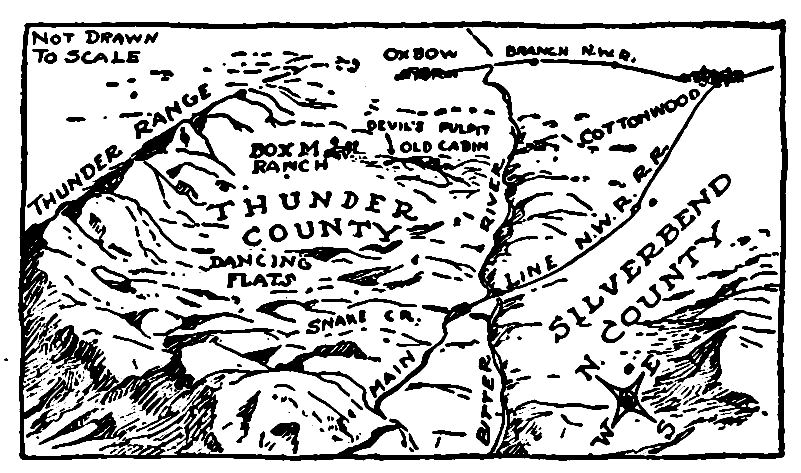
“Sure, that’s the place. Over fifteen months ago and it seems yesterday that I met him on that ridge beyond. He told me he’d leave half the money in a little cabin down the coulée below that tall cliff. I wonder did he?” Jimmy wrinkled his nose from the smoke of his cigaret. “Bedad, I’m no receiver of stolen goods, but I’ve a curiosity to see if the poor divil kept his word.”
He rode straight toward the butte. A number of cattle had been caught on that hillside in a blizzard and their bones, gnawed clean by the wolves and coyotes, looked like clumps of strange plants. Here and there were small bunches of cattle, wearing the Box M brand, their sides already filling out with the luscious grass of Spring.
Jimmy rode past the big butte and swung to the left to the edge of a deep, brush-filled coulée. He followed a deep cattle-track to the bottom and came out into a small clearing, where a tiny cabin was hidden in the trees. A small pole corral was built at the right-hand side of the cabin, using one side of the cabin for part of the enclosure. The corral was empty, but a saddle hung on a peg near the door.
“Somebody livin’ in it, from the looks of things,” reflected Jimmy as he dismounted and tied his roan to the corral fence near the door.
No one answered his knock, but the door creaked at his touch, showing that it was not fastened. He pushed it open and looked inside. It took him some time to get his eyes accustomed to the dim light after the bright sunlight. There was some one moving inside, and he discovered that the somebody was on the floor, about midway of the room. A strong odor of liquor pervaded the place.
He walked inside. The person on the floor appeared to be an Indian and said Indian was just as drunk as a human being could possibly get. One arm was lovingly twined around a demijohn.
A white man was sitting on the bed, braced against an extra roll of bedding—a white man, his face was the color of wet clay, his eyes wild with fever. Jimmy stared at him wonderingly. The wild look seemed to leave the sick man’s eyes and he stared at Jimmy.
“Jimmy Devlin’s ghost!” he exclaimed in a weak whisper.
“Ye poor divil,” grunted Jimmy. “’T’is no ghost I am, Whitey Allen.”