Front matter (continued 3)
Reading edition
Jimmy pulled his hat low over his eyes and spurred the roan to the edge of the coulée. Pat’s horse followed closely, almost crowding the roan off its feet. The side of the coulée was steep and covered with rocks and brush, with an occasional tree.
Straight down the hill, twisting and turning, went the two horses. Around them wind howled, though as yet there had been no rain. Up near the foot of the Pulpit a tall, dead tree snapped off like a match and fell far down across the slide-rock.
Jimmy and Pat fought their way down the hill and reached the bottom some distance below the cabin, just as the first gust of rain struck them. It stung like hail and the horses swung around, with their heads away from it. Another gust of stinging rain and then the downpour.
The world seemed blotted out in the whirl of the elements. Jimmy crowded the roan in beside Pat and quickly knotted a rope around her horse’s neck. He tried to tell her that he was doing that to keep them from being separated, but the wind snatched the words from his mouth and he could not even hear his own shouting.
Came a blinding flash of white light, which lighted the world as bright as sunlight, and then a terrific crash, which fairly staggered the horses. For a few moments the world seemed stilled. It was as if a giant cannon had been fired and the gunners were watching for the effects of the projectile. Then there came a dull roar, like the starting of a giant engine.
Jimmy turned his head and tried to see what it meant. It sounded like water now—the roar of a waterfall. He could hear the splash of it. Then it broke out of the storm pall—a rushing river, white-crested in the dim light.
“A cloudburst!” yelled Jimmy, spurring into Pat’s horse and swinging the animal toward the side of the hill. “Ride like the divil, Pat.”
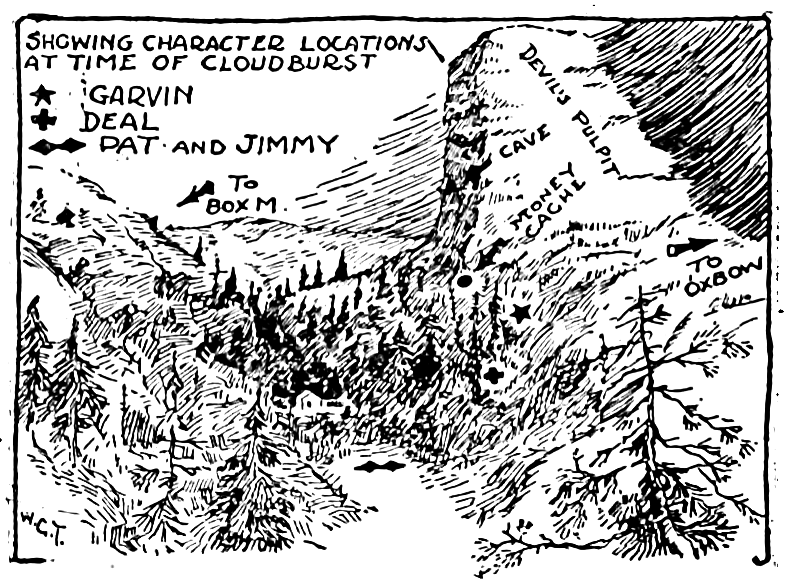
But the water was into them before they could get into action—at least eight feet of it, compressed within the walls of that coulée and running like a mill-race. Brush and trees seemed to rise out of it and fall splashing, like some water animal playing. The horses and riders were swept along with it. Jimmy swung in close to Pat to steady her in the saddle. The only thing to do was to try and ride it out or to fight it until the peak of the flood was past.
There was little left of the storm, which had done its damage and hurried on. The lightning was almost as bright as before, but the thunder showed that the main part of the storm was moving away fast. The water and sky were almost black, and the floating débris made it difficult for a horse to swim safely.
A bunch of connected logs almost drove into them, and Jimmy knew it was part of the little cabin. Whitey must be drowned.
“Anyway,” he reflected, “he had to go soon—and time meant little to him.”
“Jimmy!” cried Pat, leaning closer to him. “We’ve got to get out of this! This cañon breaks off into a deep gorge down here, and if we go over that——”
The wind swept away the rest, but Jimmy knew what she meant. It was a bit lighter now and he could see that they were a little to the right of the center of the flood, but there was quite a distance between them and the higher ground of the side.
He managed to turn both horses almost around and start a fight to get within reach of the bank. They could already hear the heavy roar of water falling a long way and Jimmy knew they were but a short distance above where the coulée dropped off into the deep gorge, which was probably a tributary to Bitter River.
The horses were almost exhausted from their swim and were making little headway toward the bank. Jimmy managed to take the lariat rope off Pat’s saddle. He had snubbed the lead-rope of Pat’s horse to his saddle-horn; and now he quickly knotted the end of the lariat around his own horse’s neck, leaving the loop and the rest of the rope free.
Inch by inch they fought almost against the swiftly running flood, working a trifle closer to the bank all the time. The world seemed filled with roar of falling water. Pat’s wet face showed ashen, but her jaw was set and she never looked back. Jimmy looked at the bank and back at Pat.
“When I swing around, hammer the hide off your horse!” he yelled.
He whirled the Whistler toward the bank, but the current sent them drifting again.
“Swim, ye outlaw divil!” yelped Jimmy, drawing himself up on the saddle, where he knelt, rope in hand.
Fifty feet—forty feet—thirty! They were beginning to swing out again.
“Hold fast!” yelled Jimmy.
He threw out the coils of rope, slipped the loop around his arm and sprang as far as possible toward the shore.
He went out of sight, but came up, fighting his way. His feet touched bottom and he surged forward, half-choked. Out to waist-deep he went before the horses took up the slack on the rope.
The shock threw him into the water, but he came up in shallower water, braced taut against the rope. He could see that both horses had whirled and were trying to face the water again. Foot by foot he fought his way to the shore, straining every muscle. The looped rope cut his muscles until his left arm seemed lifeless.
With a last despairing burst of power he ran knee-deep in water, slackening the pull on the rope, but gaining the shore, where he flung himself around a small tree, snubbing the rope tight.
Slowly the two horses drifted into the shore, swinging on the rope until their feet touched bottom. For a few moments they shook and panted from their efforts.
Jimmy managed to release his numbed arm and tried to stand up; but the effort was too much, and he sat down beside the tree. Pat spurred the horses up to him, leading the Whistler.
He looked up at her wearily and smiled foolishly.
“Little Pat, are ye all right?”
“All except one thing, Jimmy.”
“What’s that?”
“The eggs are all smashed.”
“Oh!” Jimmy looked back across the water and wiped his face with the back of his hand. “Well, it’s just as well they are, Pat. Sure, the poor divil won’t have any use for eggs now, I’m thinkin’.”
The roar of the falls seemed louder now and they looked at each other, knowing what it would have meant.
“You saved my life, Jimmy,” said Pat simply.
“Mine, too,” grinned Jimmy. “I think we better go home and get some dry clothes.”
He unfastened the ropes, climbed stiffly into his saddle and they rode up the side of the coulée. The sun broke out suddenly and the world sparkled again. Up above the Devil’s Pulpit the big eagle was soaring again, and a mist seemed to float out of the depths. They reached the top of the hill and stopped to rest their horses. Jimmy looked at Pat and a smile spread over his homely face.
“Ye look like a drowned kitten, and I suppose I look beautiful meself. There was one unfortunate thing about it, Pat.”
“What was that, Jimmy?”
“It isn’t Saturday night—bad luck to it.”
Garvin hadn’t the slightest idea who had fired the shot that killed his horse, but he knew where the shots had been fired from. After he had ducked into the brush he got a glimpse of a mounted man riding into the brush near the foot of the Pulpit.
He could see that the rider was cutting down the hill, evidently with the intention of intercepting him, in case he went on down toward the cabin. Garvin was no such fool. He knew that the other man had a rifle, and had the odds in his favor.
Garvin crossed back across the coulée, keeping in the deep cover, and climbed up through the brush toward where the man had done the shooting. It was slow, difficult going, as he wanted to keep concealed. He could see the big storm coming and he thought he might stop in the shelter of the Pulpit until it was over.
But when he had reached a point just beyond where Bud had turned from firing the shots, he saw the horse and rider about two hundred yards below him. Bud had dismounted and was working his way farther toward the cabin, but staying up on the side of the hill. He was getting into a position where he could command the clearing around the cabin. He had not tied his horse, but had dropped the reins, which constituted a tether to a range-broken horse.
Garvin chuckled to himself. By working carefully he could sneak down on this man. The noise of the storm would cover his approach. A flash of lightning and a sudden snap of thunder caused Bud’s sorrel to whirl away, ignoring its training. Another crash, and the frightened horse came running up the hill, straight for Garvin. A whirl of rain blotted out the horse for a moment, but Garvin could see it was coming straight to him. Brush and rocks impeded its progress, but Garvin would never have been able to stop it, except for the fact that one of its fore-legs tangled in the reins, almost throwing the animal.
Garvin clutched it by the headstall and succeeded in whirling it around. Rain and wind tore into them and the horse reared and snorted, but Garvin managed to get into the saddle and ride into the shelter of the Pulpit.
A few moments later came the cloudburst. The Pulpit seemed to shake to its very foundations, and small rocks rained off the ledges like hail. Garvin spurred out into the open, braving the storm rather than falling rock, and headed for Oxbow.
He knew this horse belonged to Bud Deal, and that Bud would, in all probability, have to walk back to the Box M; but he needed the horse as badly as Bud did. He felt sure that Bud suspected that he, Garvin, had lifted the cache. He also felt sure that Bud would never dare accuse him openly.
Flint and Wild Moore would get a hearing tomorrow and Garvin did not care which way it went. He hated them both, but his suddenly acquired wealth softened this a trifle. He would serve out his term and quietly disappear. He could dispose of his holdings easily, which would alibi him for having money. Taking it all the way around, Jeff Garvin was very well satisfied with his day’s work.
Bud Deal had not missed his horse until he realized that the storm was out of the ordinary, and went back to get the animal. Rain was blotting out the landscape and he could see only a short distance. Luckily for him he climbed higher, thinking perhaps the horse had gone up the hill, and when the cloudburst came he was just above the rushing torrent.
He climbed still higher, fighting against the storm, until he reached the crest of the hill to the right of the Pulpit. He knew that nothing could live in that mad rush of water, and he laughed aloud to think that the man who had lifted the cache was probably down there. He had shot this man’s horse and had every reason to believe that this man was still down in the bottom of the coulée. He hadn’t the least idea where Whitey had gone. If Whitey was still in the coulée he would be drowned.
Whitey was physically unable to take the money and make a getaway. Bud felt sure that the old Indian was dead, which removed him from any part in the deal. Devlin had not had time to take the money and get away with it. Frawley didn’t, because he was in Oxbow. There remained one possibility—Garvin.
Garvin had done this! Bud clenched his teeth. He had divulged too much to Garvin. Had Garvin found the body of the old Indian and was holding it as a club over him? Bud waited for the storm to break, but could see nothing of his horse.
It made things bad for him, because he would have to walk back to the ranch and lie about the losing of the horse. He looked back toward the coulée and scanned the dripping hills.
“That —— sorrel must ’a’ got caught in the flood!” he exclaimed aloud. “I’ll have to invent a cloudburst in the Squaw Creek country, where I lost my horse and saddle. Then I’ll sneak in here later on, find the wreck of my saddle and plant the —— thing. If I only knew where Pat and that danged boomer were I’d feel a heap easier in my mind.”
It might not be so hard to hoodwink the folks at the Box M, after all. If that was Garvin down there in the coulée, there was a good chance that he was dead now; but if he wasn’t—— Bud shook his head slowly and stared into space from under his dripping hat-brim. He was going to kill Garvin just as soon as possible.
X
Pat and Jimmy reached home several hours before Mrs. Moore and Jud Frawley came back from town, and found dry clothes. Pat supplied Jimmy with some of Wild’s clothes, which fitted a trifle snug. The rest she dried out in a short time beside the bunk-house stove.
Garvin had appointed Pete Havez deputy, and Pete was in charge of the office and jail when Jud and Mrs. Moore arrived. Pete was a saturnine young man, who was ambitious to be known as a gunman.
Pete had been kicked from cow-ranch to cow-ranch until he grew too big to stand for further kicking, and the balance of his education—his post-graduate course, as it were—consisted of learning how to make a hair-brand, mark playing-cards and draw a six-shooter.
Physically, Pete was not a marvel. His face was thin and dark, with close-set black eyes, a nose, which had been classically Roman until a cowpuncher tested its resiliency with a neck-yoke, and a mouth full of very bad teeth. He was of medium height, slightly bowed in the legs and had a peculiar shamble in his walk.
Pete had met them at the office door. Jud Frawley had known Pete for years, and cared less for him every year. In fact, Jud had predicted that Pete would be hanged, as soon as his body got heavy enough to break his neck.
Jud made known their wants. Pete took them under advisement. He was not a rapid thinker and back in his small brain lurked the feeling that Garvin might not care to have Frawley talk to Flint Moore.
“Can’t do it, Jud,” he drawled slowly. “Nobody’s goin’ to talk to m’ prisoners.”
Pete gazed lovingly at his nickel-plated insignia of office, which was placed prominently on his vest. The next instant a strong hand grasped his collar, while another took up the slack of his overall-seat, and he fairly looped the loop, landing upside-down in a corner of the office. His gun flipped out of its holster and skated off across the floor.
“You got the keys to the jail, ain’t yuh?” asked Jud in a conversational tone of voice.
Pete looked up at him and nodded dumbly. He got to his feet, tested himself for possible dislocations and let them into the jail.
Pat and Jimmy laughed at Jud’s serious description of how Pete had acted during the interview. They had told of the missing gun, and both Flint and Wild declared that neither of them wore that .45 on that day. Wild wore a .44 and Flint a .41. Neither of them had any idea where that .41 was now, and they also realized that their oath that neither had the pearl-handled .45 on that day would not help them to any extent, in case the gun was found and identified.
They found out that the hearing was to be held the next day, and unless Garvin already had the gun, there would be no evidence to hold them any longer.
Jimmy had cautioned Pat to make no mention of what they had seen that day. Jimmy felt sure that Whitey was dead, and with him went all hopes of establishing his innocence of the crime for which he had served time in the penitentiary. Jimmy had intended getting a written confession from Whitey, if possible. Now, there was no one in the world to help him prove his innocence.
It was supper-time when Bud Deal arrived. He had circled the ranch to come in from the direction of Squaw Creek. Frawley and Jimmy were sitting on the ranch-house porch, when Bud showed up, limping from blistered heels, a figure of dejection.
“What happened to you?” asked Frawley.
Bud sat down on the porch and eased his aching feet.
“Cloudburst. Caught me in one of them narrow Squaw Creek cañons and drowned my sorrel. Dang near drowned me, too. Had to walk all the way home.”
“Ain’t you been on the range long enough to keep out of cañons when a storm is comin’?” asked Frawley.
“Aw, ——!” snorted Bud, getting to his feet. “How’d I know it was goin’ to bust so quick? Think I went down there to try and drown myself?”
Frawley continued to draw on his pipe, indifferently to Bud’s outburst. Pat came to the door to call the men to supper. Bud stared at her, but she turned and went back into the house. Jimmy was paying no attention to Bud, who noticed that Jimmy was wearing a faded plaid flannel shirt, which had belonged to Wild. It fit tight over Jimmy’s muscular body and threatened to burst across the shoulders as Jimmy folded his arms and looked up at Bud.
“Where did ye say that cloudburst was?”
Bud looked at Jimmy closely. What did this range-boomer know about the cloudburst? Was he trying to catch him in a lie?
“Squaw Creek,” replied Bud and limped down toward the bunk-house.
Jimmy and Frawley watched him go inside and close the door.
“Where did you and Pat go today?” asked Frawley.
Jimmy grinned slowly.
“Would ye mind if I didn’t tell ye—now, Mister Frawley?”
Frawley squinted at Jimmy for a moment and put his hand on Jimmy’s knee.
“Smith, I reckon yore a square-shooter. Yuh ain’t got the face of a mean hombre.” Frawley jerked his head toward the door and leaned closer. “I been watchin’ you and little Pat, and I sabe the fact that she cottons to yuh, Smith—which ain’t yore name, no more than mine’s Goldberg.”
Frawley paused and seemed undecided just how to say what was on his mind.
“You ain’t far enough removed from Ireland to get the name of Smith, but that ain’t nothin’ against yuh. I’m Irish, too. Names don’t count. What I want to know is this: Can yuh come clean to little Pat? Does that borrowed name mean that yuh done somethin’ yuh hadn’t ought to ’a’ done—somethin’ that might hurt her?”
Jimmy was looking at Frawley, but now he turned and stared off across the hills. Frawley noticed that his face was tense, his muscles set—like a man watching a terrific struggle. For a full minute Jimmy did not move. Then his body relaxed and he turned to Frawley with a smile.
“Mister Frawley, I’ll be goin’ away tonight. Between me and you, I can say that I’ve done no wrong; but twelve men have said that I sinned against society. It’s twelve to one, and I—I lose.”
“Can’t yuh prove nothin’?” softly.
“Not now. I’m glad ye spoke as ye did, Mister Frawley. I’ve said no word to Pat that a brother wouldn’t have spoken to her. Me name is not Smith—it’s Devlin.”
Frawley slowly took his pipe from between his lips.
“Devlin? The train-robber?”
“Devlin,” said Jimmy slowly, “the man they say robbed a train.”
For a while neither man spoke. Frawley got to his feet, as Pat came to the door again.
“How many times do I have to call you to supper?” she demanded. “Have you lost your appetites?”
Jimmy got to his feet as Pat turned back inside. Frawley held out his hand to him.
“Devlin, I don’t believe them twelve men had the right dope. I’m pleased to meetcha.”
They shook hands solemnly and went into the house.
Bud did not come to supper until the rest were almost finished. He tried to make light of the loss of his horse and saddle. He would go back there in a day or two and try to recover his saddle. He described in detail the cloudburst and his fight for life, while Pat watched his face closely. She knew that Bud lied about where the flood had happened, but she did not know he had not been in the water. Jimmy was silent through the meal and excused himself before the rest were finished. Frawley and Mrs. Moore left the room and Bud and Pat were together.
“Were you ridin’ with that range-boomer today?” asked Bud.
Pat looked up quickly.
“What makes you think so?”
“Your horse and the Whistler look it,” grunted Bud just a trifle sarcastically.
“Well, suppose we were?” challenged Pat.
Bud leaned across the table and lowered his voice.
“Yuh ought to find out a few things about a feller before yuh go ridin’ in the hills with him.”
“Yes?” Pat’s tawny eyes were half-closed as she looked straight at Bud. “Suppose you tell me about him.”
“Yuh think I can’t?” Bud fingered his mustache nervously. “Mebbe you’d like to know his name ain’t Smith? How would yuh like to know that you’ve been ridin’ the hills with a paroled thief?”
Pat sprang to her feet and leaned across the table.
“I think you lie, Bud Deal!”
Bud laughed mockingly and shook his head.
“No, I don’t lie. That’s what we fought over. I found him out; sabe?”
Pat knew that Bud was telling the truth; but she did not want to believe it.
“His right name is Jim Devlin,” said Bud gloatingly, as he got up from the table. “Ask him if it ain’t.”
Pat had heard of Devlin. She turned slowly and went to her room, passing Frawley, who had come to the door. Bud looked up at him. Frawley had heard Bud expose Jimmy, and his blood boiled. He knew that Bud had deliberately tried to hurt Pat, and that he had succeeded very well.
For a few moments the two men looked at each other. Neither spoke as Bud walked past Frawley and went outside. Frawley crossed the living-room to Pat’s door, which was open. Pat was standing beside her dresser, staring at the wall, but she turned as Frawley came up.
“You heard what Bud said?” asked Pat.
“Uh-huh,” nodded Frawley. “Devlin told me who he was. Bein’ innocent and bein’ able to prove it is two different things. He’s goin’ away tonight.”
“Going away?” whispered Pat. “Tonight?”
“Uh-huh. I been thinkin’—kinda. He broke that Whistler horse to ride. When yuh come right down to it, that horse don’t belong to anybody. My saddle’s gettin’ kinda old, and I need a new one—kinda.”
Frawley scratched his chin.
“Hate to see a feller walkin’—kinda.”
“Jud Frawley,” said Pat softly, her eyes filling, “when God made you he broke the mold. Do just as you please. I need a new saddle-blanket and a bridle—kinda.”
Frawley half-smiled at her imitation of him and patted her on the shoulder.
“Keep grinnin’, little Pat. Mebbe she’ll all come out in the wash.”
Jimmy was leaning on the corral fence, with Klooch and the puppy beside him, as Frawley came out of the house. The Whistler, which had moved in close and was nuzzling at Jimmy, snorted at the approach of Frawley and walked away.
“Pat knows,” said Frawley. “Bud told her who you are.”
“That’s kind of him,” said Jimmy shortly.
“She said to give yuh that Whistler horse. There’s a saddle, a blanket and a bridle yuh can have, Devlin.”
Jimmy looked quickly at Frawley.
“What’s the idea?”
Frawley lit his pipe and puffed violently for a moment.
“I think she expects yuh to come back—kinda. And she don’t want to have yuh walk and get yore feet sore.”
“I hope she’s right,” Jimmy smiled sadly and patted Klooch. “It don’t look very good right now, but ye never can tell. Anyway I’ve a memory of two fine women and one square-shootin’ man. I’ll be goin’ now, I think.”
“Better wait until mornin’.”
“Why prolong it? Deal knows who I am, and if I stay I may not forgive him for the tellin’ of it to—her.”
“Won’t yuh go and tell Pat good-by?”
“I’m thinkin’ it’s better this way, Mister Frawley. I’ll wait and say hello, instead.”
XI
Whitey Allen painfully raised his head and looked at the figure huddled at a tiny fire just beyond the mouth of the short cave. Beyond he could see that twinkle of stars. He sank back and gazed up at the rock roof, as he tried to connect up the events of the day. He knew he was in a cave, but he had no idea where that cave was located.
He remembered that old Indian Jim had returned to the cabin, coming in softly, like a hunting animal. Whitey was powerless for a minute. He felt that Bud had killed the old Indian, but after the shock of seeing him had passed he realized that the bullet had only shocked.
Old Jim was a horrible object. The bullet had struck him almost between the eyes and had plowed its way around the side of his skull. The Indian’s face and upper body was clotted with blood, his clothes nearly all gone. Whitey spoke to him, but the Indian did not hear him. His eyes were wild and he mouthed a language which Whitey had never heard.
He appeared to be hunting for some one. He would go to the door, look out, and come back, searching the room. Suddenly he saw Whitey and pounced upon him like a wild beast. Whitey was weak, but fought desperately to break the clutch of the Indian. They crashed into the wall, knocking down the cupboard and falling into the stove. Whitey remembered little after this.
The Indian had taken him to a cave—but for what? Whitey realized that his wound had broken open again and that he was much weaker than before his fight in the cabin. He called to the Indian, who did not lift his head. Whitey crawled painfully to the mouth of the cave and tried to get to his feet.
“Kopet!” hissed the Indian. Whitey knew that kopet meant “stop!”
“What’s the matter with yuh, Jim?” asked Whitey.
“Mesika sick—Nika kloshe nanitsh.”
“I’m sick, eh?” muttered Whitey. “You take care of me?”
“Kloshe!” grunted the old Indian.
Whitey studied the silent figure for a while. He felt sure that old Jim was crazy from the shock of the bullet. He had known old Jim slightly, but Bud had known him for years. Bud had told him that old Jim never broke his word. Bud had told old Jim to take care of Whitey—told him to stay with him all the time.
Now, the old fellow had been knocked silly from the pistol shot, and the only remaining instinct in his brain was to guard Whitey. This did not please Whitey, who had no desire to live in a cave with a crazy aborigine. He was too weak to stand, so he tried to crawl out and see where he was.
Old Jim pounced upon him like a flash and dragged him back into the cave.
“Kopet!” hissed the old buck.
Whitey was willing to stop. Old Jim was far from gentle in his handling. He went back to hump over his fire, while Whitey sprawled on the floor of the cave and watched the tiny flicker of the fire on the rocky points of the cave roof.
Whitey had gotten to a point where he hardly cared what happened to him. Many things he had forgotten. It took him some time to remember where that money had been hid, and he wondered if it was still there. Somehow, he did not care so much. He was glad that Bud, instead of himself, had killed the fireman. Whitey did not want to die a murderer.
While Whitey dozed and the Old Indian sat humped up over his tiny fire, Jimmy Devlin came across the hills toward the Devil’s Pulpit. It was his intention to cut across into Silverbend County, probably to Cottonwood.
He followed the route taken by Pat and himself and came out to the edge of the coulée almost at the place where they had remained concealed. For a long time he sat on his horse, living over the events of the day. Just a short distance to his left was the hiding-place of enough money to enable him to live comfortably, but he did not want it.
He knew that Pat would see that it was returned to its rightful owners. The Devil’s Pulpit loomed blackly against the stars. Suddenly there came a tiny gleam of light against the side of the cliff, like the light of a candle. Several times it flared up, only to die down again, leaving the side of the cliff a wall of darkness.
“It’s that old Injun’s light,” muttered Jimmy aloud. “I wonder what he’s doin’ up there.”
Whistler moved uneasily, trying to look back. Jimmy turned in his saddle. Between him and the brush a pair of eyes seemed to glow like yellow fire. Jimmy stared at them for quite a while, but they did not move.
“Klooch!” breathed Jimmy softly, and the shape of the wolf-dog trotted out of the dark and up beside the horse, where it stood and peered across the coulée.
“Klooch, why did ye come?” asked Jimmy. “Will I have to take ye back, I wonder?”
He dismounted and sat down on a rock beside Klooch, running his hand through her ruff and over her muzzle.
“I’m thinkin’ I’ll keep ye, Klooch. They’ve no use for you back there. We’ll be a fine three, I’m thinkin’. A wild horse, a wolf-dog and a paroled thief.”
Klooch pulled away from him and looked at the Pulpit, where the light sparkled again. She growled deep in her throat and lay down beside him.
“Ye don’t like it, eh?” grunted Jimmy. “Well, we’ll wait for mornin’ and see about it. None of us three are in any hurry, ’cause we ain’t goin’ no place.”
He loosened the saddle-cinch, tied the Whistler to a scrub snag and sat down to wait for daylight.
At intervals the light flared, as old Jim placed fresh fuel on the flames. When the first hint of dawn came he looked at Whitey, sprawled on the rocks, and slipped silently away.
Whitey had been waiting his chance and as soon as the Indian disappeared he crept to the ledge. He realized that he was over half-way up the Pulpit. Apparently the rock broke sheer below him, and there was no way of going up to the top of the Pulpit. Beyond him, to the left, was a narrow ledge.
He crawled out on this and peered down. Suddenly the old Indian appeared at the foot of the cliff and shambled away into the brush. Whitey crawled around this ledge and in behind a spire of rock, where he found another cavelike place—a sort of chimney, angling downward. It was a place of easy descent for a normal person, but Whitey was far from normal. Every move was torture.
There was a strong possibility that he would fall and perhaps kill himself; but he reasoned that even that was better than being cooped up in a cave with a crazy Indian. He slid his legs over the opening and started down.
It seemed hours until he came to the lower opening, where he came out into daylight. A series of ledges, like giant steps, seemed to lead down a wide crevice, masked with brush and scrubs. Utterly exhausted, he dragged himself over the slide-rock and into the brush just before the old Indian came through the small opening and back up the route to the cave.
Whitey saw old Jim disappear into the crevice, and he knew it would only be a short time until he would be hunted. Whitey’s one idea was to escape the Indian, but he also wanted to take that money—or at least his half of it.
Dragging himself as a wounded animal might, he got to the point of the rock, where Bud had told him the money had been cached. The place was there, as described, but the money was gone. Whitey turned, his back to the rock, and huddled down while the insane Indian, like a hunting-dog, followed him unerringly.
Whitey made no effort to escape. He was half-conscious when the Indian picked him up, as a man might pick up a child, and started back to the cave with him.
Jimmy had seen the Indian leave the cave and go the length of the narrow ledge, where he disappeared. Later he had seen him appear at the foot of the cliff and go into the brush. He had not seen Whitey, because Whitey had crawled instead of walking.
Jimmy was curious to know why the Indian was living up there and keeping a fire burning through the night. He rode down the hill and into the coulée with Klooch leading the way. The cloudburst had swept the coulée clean of down-timber, and not a stick was left of the little cabin. The brush was flattened and mud-filled, which made it look like the bed of a river.
Jimmy rode to the edge of the slide-rock and tied the Whistler to a tree. He climbed up to the clearing where he had seen the Indian. Klooch cast about with her nose to the rocks and growled deep in her throat. The Indian scent was strong, and Klooch hated Indians. Straight to the foot of the broken ledges led the wolf-dog, with Jimmy sliding and slipping behind her.
Klooch stopped only long enough to see Jimmy was coming and started on up the rock. Where an ordinary dog would have balked, Klooch sprang and clawed her way up. She stopped at the mouth of the chimney and sniffed inside, hackles erect. Jimmy panted up to her and they both investigated the thing.
“Sure, we’ve got to play Santa Claus,” grinned Jimmy. “Can ye climb a stovepipe, Klooch?”
Jimmy made a move to go inside, but Klooch sprang in ahead and began clawing her way upward. Jimmy helped her at times, but she needed little help. Twisting and turning they came to the opening behind the spire and beheld the ledge, which extended around the corner. An odor of fire and roasting meat came to their nostrils.
Jimmy tried to make Klooch follow him, but she moved out ahead, where he could not pass her.
“Then take it easy,” whispered Jimmy. “Go slow.”
Klooch seemed to sense the need of caution, for she crept lower along the ledge, ears back as if ready for a rush.
“You’re a he-man’s dog, so ye are,” reflected Jimmy, loosening the gun in his holster. “I’d rather be backed by the likes of you than by many men I know.”
Straight ahead they went, slowly. Klooch fairly crawled on her belly now, and Jimmy hugged the narrow ledge. He could look straight down into the big coulée and it seemed a mile down to the tips of the trees. The circling eagle cast a shadow across the ledge, and Jimmy glanced up at it, high above him.
Suddenly the ledge widened a trifle and Jimmy turned his back from the wall. Just in front of him was the wider part of the ledge in front of the cave, and standing almost within reach of him was the insane Indian.
He was looking at Jimmy, and apparently oblivious of the wolf-dog between them. He had a heavy hunting-knife in his hand, with which he had been cutting up a rabbit, which was sizzling on the small fire.
There was little about the old Indian to make any one believe he was even part human, except his shape. His face seemed entirely animal, and had not been washed since Bud had shot him. The upper part of his body was nude and was streaked with dried blood and yellow dirt from the muddy coulée. His hair seemed to stick out like a roach, except where it was plastered tight to his head.
Only for a moment did he stare at Jimmy, and then, with a grunt, like an enraged animal, he sprang toward him. As the Indian leaped Klooch shot straight into him, fangs bared and without a sound. They seemed to meet in mid-air and lock together. Into them came Jimmy with a rush, grasping the Indian’s knife-hand in time to save the dog, and the three of them went down in a heap, almost off the edge.
The Indian’s head struck the rock and fairly rebounded; but it took all of Jimmy’s strength to hold him down, even after he was knocked half-unconscious. Jimmy managed to turn him over on his face and to tie his hands with the short rope that the Indian used in place of a belt.
Klooch watched the operation closely and only moved back when the Indian was rolled over on his back, helpless. Jimmy stood up and wiped the perspiration from his brow. Klooch was moving into the cave, growling deep in her throat, and Jimmy followed her in to where Whitey lay on his back, looking blankly up at him.
“Whitey!” exclaimed Jimmy wonderingly. “Whitey, I thought ye was dead!”
Whitey’s eyes told him that he was not dead, but his lips barely moved and an unintelligible mumble came from his throat. Jimmy picked him up and carried him to the ledge, where he laid him down near the old Indian.
Whitey revived enough to turn his head and look at the Indian, and a sigh of relief came when he could see that the old man was a captive. Jimmy sat down and rolled a smoke, which he lighted and gave to Whitey, who thanked him with his eyes as he puffed slowly.
The Indian glared at Jimmy like a trapped animal as he strained at his bonds. Klooch watched the Indian closely, ready to throttle him if he attempted to get up. Whitey shifted to an easier position and looked at Jimmy.
“How did yuh find me?” he whispered weakly.
“Trailin’ the Injun,” smiled Jimmy.
“Oh, that —— Injun!” Whitey’s voice seemed thin and querulous, as if he had suffered much. “Jimmy, he’s as crazy as a loon. Picks me up and slams me all around. He carried me up here.”
“How do ye feel, Whitey?”
“I’m all through, Jimmy. Blood poison, I think.”
“Blood poison?” echoed Jimmy. “Did ye get cut?”
“Shot,” whispered Whitey. “Shot in the lungs.”
“The divil ye are! Well, now ye need a doctor, old-timer; but how am I to——”
Whitey shook his head.
“No use, Jimmy. I’m numb all over and I wouldn’t last that long. I want to see the sheriff, though.”
Whitey’s jaw set and he tried to shift his body, but the pain was too great.
“Jimmy, I’ve been double-crossed, and I want to save a man who was awful good to me. I’m afraid—I—can’t—make—it—though.”
“Whitey, I—I want ye to square me with the world, if ye can. It can’t harm ye to let the world know that I did not hold up that train, and it will do me a lot of good.”
“God knows I want to, Jimmy,” whispered Whitey eagerly. “You’re the squarest man I ever knowed. You gave me a chance, pardner—a chance that a saint would never have given me, and—and I lied to you. Jimmy, I lied!”
“Lied to me?”
“Yes. I wasn’t dying from consumption, Jimmy. I lied to yuh, because I knowed you’d help me. You always helped others. I went to work for the Box M outfit, while you was in jail.
“I was afraid to touch that money I had hid under the floor of the old cabin. I heard that you had died in prison, and it almost drove me crazy thinkin’ about it. I—I got drunk and bragged about finding money under the cabin floor.”
Whitey’s voice croaked to a stop and he shut his eyes. Jimmy thought for a moment that Whitey had passed on, but he recovered.
“Wild Moore got the money, Jimmy. He didn’t know who it belonged to. He went to Cottonwood, where he made a killin’ at roulette. I knew he got it, and I told him so. Wild was square about it, and gave me back the original money. It’s cached under the bunk-house floor at the Box M.”
Whitey’s voice drifted to a weak whisper again. “Bud Deal and I stole the cattle that Wild was arrested for. We knew they couldn’t cinch him. Bud Deal shot the Injun and cached the body, but I reckon the bullet was too soft or the old buck’s head was too hard. Gawd, I wish he’d let me alone, Jimmy.”
“Who double-crossed ye, Whitey?” asked Jimmy.
“Bud Deal. We—” Whitey seemed to be groping for words. “We robbed a train. I—I got shot—Bud—shot—fireman. I—I—Jimmy, Bud lifted the cache, —— his sneakin’ soul! Have yuh got a pencil and paper, Jimmy? I—I can’t live long and I—want—to—write—it—out.”
Jimmy searched his pockets, but he knew it was useless. He had paper, but no pencil.
“Have ye no pencil, Whitey?”
Whitey shook his head weakly.
“No, Jimmy.”
He seemed to slide lower in the rocks and his eyes closed wearily. Jimmy shook him, but there was no response. Klooch sniffed at him and turned away.
Jimmy sat down on his heels and considered his next move. Whitey was dying, and with his death would go all hope of clearing the Devlin name. He realized that he could not carry Whitey around that cliff and down to the horse. The old Indian had twisted on his side and was staring at Jimmy, with flat, lack-luster eyes.
“What you talk?” asked Jimmy. “Sabe English?”
The Indian did not even blink. Jimmy was not familiar with the different Indian tongues, but he did know a little of Chinook, the trade-language.
“Kumtuks Chinook?” he asked.
The Indian blinked and hissed—
“Kwish!”
“Ah-ha!” grunted Jimmy. “Kwish, eh? If I ain’t mistaken, that means ye refuse to have anythin’ to do with me. Now, me high-toned laddie-buck, I’m bossin’ this perch, and if ye don’t do me biddin’ ye’ll be shakin’ hands with some of your happy-huntin’ ancestors.”
Jimmy stepped over, picked up the Indian’s knife and cut his bonds. The Indian sat up and flexed his arms, while Jimmy leaned against the rock wall, his .45 set at his hip. He was taking no chances this time. The Indian got to his feet and looked around. Klooch crouched a few feet away, blocking the Indian from the exit.
“Lolo!” snapped Jimmy, pointing at the unconscious Whitey. The Indian stared at Jimmy and at Whitey.
“Lolo,” he clucked. “Lolo?”
Jimmy nodded.
“That means ‘to carry,’ don’t it? Well, go ahead and carry him down out of this.”
“Hyak lolo!” snapped Jimmy impatiently.
Without a word the old Indian picked Whitey up in his arms, slung him across his shoulder and started along the ledge, with Klooch going ahead and Jimmy carefully bringing up the rear.
It was a strange procession around the narrow ledges and down the chimney. Klooch never failed to watch the Indian, who, even with his burden, was able to travel faster than Jimmy. The Indian blocked the light from below so completely that Jimmy was forced almost to feel his way down the chimney, and he had barely got into it before the Indian and Whitey disappeared out the bottom.
Jimmy knew that the Indian had the start of him, and he skinned knee and elbow in his rapid descent. He landed at the bottom in a shower of rubble and jumped out onto a ledge, where he could look down.
The Indian had reached the bottom of the cliff, with Whitey, and now he started to run for the brush, going straight toward Whistler, who was tied in plain sight.
But the Indian made a great mistake when he started running. If he had walked he might have reached the horse, but the minute he started running Klooch knew that something was wrong. She had been undecided what to do, but now she ran angling with the Indian, flashed between his legs and threw him spinning. Before he could get up she was on him, pinning him down, her fangs at his throat.
Whitey was almost flung into the brush and seemed to collapse, like a dummy figure, cast aside. Jimmy hurried down over the stone steps and went to Whitey. He was still alive. In the fall his forehead had come in contact with a sharp rock, which did not improve his condition to any great extent. He was still unconscious.
Jimmy went over to the Indian. Being thrown into the slide-rock had not helped him physically but the sullen glare seemed to have left his eyes and a look of half-intelligence had taken its place.
“Whisky!” he grunted.
Klooch surged forward at the sound of his voice, but Jimmy drew her aside. The Indian got to his feet and felt tenderly of a skinned elbow. He looked at Jimmy and at Whitey and mumbled something under his breath.
“What did ye say?” asked Jimmy.
“Halo kumtuks,” he replied slowly, shaking his head.
“You don’t understand, eh?” grunted Jimmy. “Well, me red-corpuscled friend, I’m glad ye’ve got to a point where ye’ll admit it. Bud Deal came near knockin’ the kumtuks out of ye for good. You sabe Bud Deal mamook poh mesika?”
The old Indian stared at Jimmy for a moment and then slowly touched his hand to his forehead.
“Bud Deal?” he asked, half-clucking, half-hissing the English name.
“Sure he shot ye,” nodded Jimmy, and pointed at the horse and at Whitey. “Put him on the horse. You sabe? Lolo kiuatan.”
The Indian limped over to Whitey, picked him up in his arms and approached Whistler. Jimmy soothed the animal, while the Indian placed Whitey on the saddle.
“Now, that’s the —— of it all!” grunted Jimmy. “He won’t stay on and I’ve no rope.” Jimmy scratched his head for a moment. “The Whistler will likely pitch like the divil, with two on his back; but mebbe I can hold him down until he gets used to it.
“Mesika klatawa kopa kiuatan.” This to the Indian, ordering him to ride on the horse.
Jimmy held Whistler tight while the Indian crawled on behind the saddle, steadying Whitey as he got on. The half-broke outlaw surged and humped its back wickedly, but Jimmy held its head tight, talking soothingly. The nature of the ground precluded any chance for Whistler to buck, and cause serious injury to himself, and after a few moments, Jimmy led the way around the base of the Devil’s Pulpit, leading the horse by the reins, while the old Indian rode behind the saddle with both arms around the unconscious Whitey. Beside the horse paced the wolf-dog. Straight across the hills they went, heading for Oxbow—twelve miles away.
XII
Bud Deal knew nothing about Jimmy’s departure from the Box M, as no one had taken him into his confidence regarding the matter. Bud wondered why Jimmy was not sleeping in the bunk-house. He thought perhaps it was because he had been exposed as a thief and preferred to sleep elsewhere.
The next morning Bud discovered that Whistler was not in the corral and that Jimmy did not show up for breakfast. Pat did not eat breakfast with the rest. Mrs. Moore seemed preoccupied and Frawley ate silently, except to ask Bud to harness the buggy team for them.
Bud’s nerves were getting frayed. He finished his meal and looked up to find Frawley staring at him rather quizzically.
“Where’s Smith?” asked Bud.
Frawley’s eyes did not shift from Bud’s face as he replied.
“Yuh mean Devlin, don’t yuh?”
Bud glanced up at Mrs. Moore. She was not looking at him. He looked back at Frawley.
“Well?”
“Devlin,” said Frawley slowly. “Devlin went away last night.”
“Where to?”
“He didn’t say where he was goin’.”
“Rode Whistler, didn’t he?”
Frawley nodded and shoved back from the table.
“You hitch up the team for the women. Me and you will ride horseback. That hearin’ is today and they’ll likely want us both there. —— shame to keep folks in jail until some poker-playin’ judge gets time to decide whether they’re guilty enough to be tried or not.”
“Aw, they’ll likely get loose,” grunted Bud, as he got up from the table. “If Jeff Garvin had twice as much sense he’d be half-witted.”
Bud went down to the corral and Frawley turned to see Pat standing in the doorway. She was dressed for the trip.
“Did he say anything?” asked Pat, and then added, “Devlin?”
Frawley shook his head.
“No, he said it was better not to, little Pat. Did yuh notice that Klooch is gone?”
“I wonder if she followed him?” mused Pat aloud. “He was the only human being she ever showed affection for, and I—I hope she did go with him, Jud.”
Frawley nodded.
“I sure hope she did. Bud will be here with the team in a minute.”
The ride to Oxbow was uneventful. Pat drove the buggy team, while Frawley and Bud rode behind them over the rough road. Frawley noticed that Bud was wearing a shoulder-holstered gun in addition to the one in the holster at his hip. It looked to Frawley as if Bud was looking for or expecting trouble.
Bud was riding a buckskin horse, a short-coupled animal, and a very plain stock saddle. He missed the feel of his dancing sorrel and the ornate saddle to which he had been accustomed.
Pat drove the team into the livery-stable, but Bud and Frawley dismounted at a hitch-rack, where a number of horses were already tied. There were more than the usual number of saddle-horses and vehicles at the racks, caused no doubt by the trial. A cowboy rode in behind Bud and dismounted.
“How are yuh, Bud,” he called, but Bud did not hear him.
“‘Chuck’ Ames yellin’ at yuh,” said Jud Frawley, and Bud turned his head.
“Howdy, Chuck.”
“Been tradin’ horses with Garvin?” asked Ames.
Bud squinted at the cowboy, who was loosening his saddle-cinch.
“Whatcha mean, Chuck?”
Ames removed his hat and wiped his brow.
“Just wonderin’, thassall. I seen Garvin ridin’ yore sorrel into town yesterday.”
“My sorrel?” Bud looked at Frawley and back at Ames. “Yuh must ’a’ been seein’ things, Chuck.”
“Yeah? Reckon I know that sorrel kinda well, don’t I? The danged thing cost me two months’ wages, when I bet that ‘Blondy’ Woods’ black mare could beat him. Anyway, I’m bettin’ it was yore sorrel, and yore saddle. I’d know that dew-dadded saddle anywhere.”
Bud said nothing. Frawley turned and went toward the sidewalk, while Ames fished out the makings of a cigaret and rolled a smoke.
“I’d sure know that sorrel and saddle,” repeated Ames as he licked the edge of the cigaret paper.
“——!” snapped Bud and started across the street.
Ames looked after him, an amused smile on his lean face.
“Whatcha know about that?” he grunted aloud. “Reckon I kinda rubbed the Box M dude the wrong way. And he’s packin’ two guns, too. Hm-m-m!”
Ames shook his head and turned toward the nearest saloon.
Bud was growing desperate. He had lied about the loss of his horse and saddle never thinking for a moment that Garvin had taken it. The whole thing was plain to Bud now. He had killed Garvin’s horse in the coulée, and Garvin had taken his sorrel. Garvin had taken that money, too.
Bud turned into the nearest saloon and got a drink. He was not a drinker, but he needed bracing. Pete Havez was in the saloon, idly fingering a deck of cards. He watched Bud take several drinks alone, and also got a glimpse of the extra gun inside Bud’s unbuttoned vest. Pete knew that when a man as well acquainted as Bud Deal was drank straight whisky silently and alone, it meant that he was priming himself for trouble.
Therefore Pete slid out of the place and went to find Jeff Garvin. He found Garvin in the Cheyenne saloon, leaning on a bar, talking with some cattlemen. Garvin was slightly intoxicated and in very good spirits. He caught Pete’s signal from the doorway and came out as soon as he could get away.
“Bud Deal’s in town,” said Pete. “He’s drinkin’ whisky all alone and he’s got two guns on him. Got a shoulder-holster on under his vest.”
“Yeah?” Garvin shoved his sombrero back on his head and looked quizzically at his new deputy. “Did he say anythin’, Pete?”
“He ain’t talkin’ to nobody,” declared Pete. “Kinda makes yuh feel that he’s a rattler, without rattles.”
Garvin grinned widely. He had drunk just enough to make him reckless.
“Suppose he’s huntin’ trouble with me, Pete?”
“I dunno, Jeff; what do you reckon?”
“I reckon,” said Garvin, pulling his hat down over his brow, “I reckon I better find out.”
“Better do some thinkin’ first,” advised Pete; “Bud Deal’s —— fast with a gun.”
Garvin seemed to consider this worthwhile advice. He was not sure that Bud knew of the lifted cache or not; but the chances were good that he did. He did not doubt that Bud knew he had taken the sorrel. Taking it all in all, Bud had reasons to hunt trouble with him.
“Deal ain’t gittin’ drunk, but he’s likely gittin’ plum bad,” offered Pete.
“Cinch,” grunted Garvin. “You watch him, Pete. Kinda move around with him, if yuh can, and if he gets too danged ornery we’ll snub him up tight.”
Pete grinned and nodded. He loved a task of this kind. It savored of real detective work, and also might offer him a chance to prove that he was some adept with the short gun himself. Pete got a drink at the next saloon and went hunting for Bud Deal.
He had no desire to face Bud in battle, but—if he could down Bud in a fight it would be the makings of him as a gunman. The “if” loomed large in front of Pete, and he decided to take things easy.
Bud Deal came out of the saloon door as Pete came down the sidewalk. Bud’s hat was pulled low over his eyes and he stood in the middle of the sidewalk, hands on his hips. Pete’s rapid walk slowed down as he neared Bud, and he turned to go into the door. But Bud stepped in front of him.
“Yuh found Garvin, did yuh?” rasped Bud.
“Gug-Garvin?” stammered Pete nervously.
“Yuh went out to find him,” declared Bud, “and yuh wouldn’t ’a’ come back unless yuh found him.”
Pete’s eyes glittered dangerously, but he made no move. They were so close together that the first shot would not save its shooter unless it was instant death.
Suddenly Bud’s left hand shot out and caught Pete by the shoulder, yanking him sidewise, and a fraction of a second later Bud’s right fist hooked into Pete’s jaw, knocking him backward against the building.
Bud stepped into him, yanked Pete’s gun from its holster and tossed it into the middle of the street. Before the dazed deputy knew what was going on he was kicked into the street, where he fell flat on his face in the dust.
Bud turned on his heel, settled his hat more securely over his eyes and went down the street, while Pete sat up in the street and sneezed the dust out of his nose and mouth. He felt of his holster and looked foolishly around. Just beyond him lay his six-shooter.
He limped out to it, put it in its holster and went toward the sheriff’s office, holding his jaw in one hand and caressing the slack of his pants with the other. He knew that his stealthy getaway from the saloon and his sudden return had told Bud where he had been. He decided that Bud was not only a dangerous fighter, but had brains as well.
Whisky seemed to have no effect on Bud, except to make him more cool. He had made up his mind that he was never going back to the Box M ranch. He could not explain the loss of his horse to them, without admitting that he lied. He gazed into an empty glass, eyes half-shut, and pondered the situation. He felt that there was a decided break between himself and Pat. There would not be enough evidence to hold Flint and Wild, and when they got back some one would be let out—and that some one would be he.
He was sure that Whitey was dead, which removed some worry from his mind. Garvin had taken the money. Who had removed the dead Indian? Bud filled his glass again and drank it in a single gulp. Should he kill Garvin? He took out a silver dollar and glanced at both sides. Why not let the dollar decide?
He flipped the dollar with his thumb. It clattered on the bar and rolled off the opposite side. The bartender stepped in close and glanced down.
“See which side’s up!” growled Bud.
The bartender grinned widely.
“Can’t be done, pardner; it fell in the wash-tub.”
Bud whirled on his heel and started for the door.
“Yuh got four-bits comin’,” yelled the bartender, but Bud went on out, while the bartender rolled up his sleeve and searched for the money.
“Every —— thing goes against me!” snarled Bud aloud as he got outside. “Mebbe I better go easy.”
The click of poker-chips, the call of the dealer lured him into the Telluride barroom and gambling-parlor, where he appropriated a seat and bought chips. He lost twenty dollars in two hands and drew out of the game.
He had began to grow irritable. Bud was not naturally an optimist, and he fell an easy prey to extreme pessimism. He had a few more drinks, but whisky only dulled his nerves more and made his outlook a dreary indigo. He imagined that the whole world was against him and he laid his plans accordingly.
He would meet Garvin and force him to tell where that money was. Yes, he would likely kill Garvin after he had all this information, but that was a mere incident. He could take that money and fade out of the country. He wondered why he didn’t do that before.
He went into a restaurant and ordered a meal, but his appetite deserted him and he left after drinking a cup of strong coffee. He met Pat and Mrs. Moore, but did not speak to them. Pat turned and looked curiously at him. A little farther on he met Frawley.
“Time to go up to the courtroom, Bud,” said Frawley.
“Court-room?” queried Bud absently. “Oh, yeah. Funny I forgot about it. When did yuh come in, Jud?”
Frawley half-smiled. He knew that Bud was drunk and had forgotten that they had ridden in together.
“Goin’ up now?” asked Frawley.
Bud stared vacantly at him and nodded. They walked to the courthouse and went upstairs.
Quite a crowd had already gathered in the courtroom. Men spoke to Frawley and Bud, calling them by their first names. Frawley replied to the greetings, but Bud ignored them all. They went to the front of the room and took seats inside the railing, where Bud humped over, elbows on knees, and stared at the blank wall.
The place filled up in a short time. Dave Cleland, the prosecutor, came in and sat down beside Frawley. Bud merely glanced at him. Mrs. Moore and Pat arrived and sat down near. Another man came, a stranger. He was tall and thin, with gray hair and a heavy mustache, and wore “store” clothes. He sat down inside the railing. Bud lifted his eyes and looked at him. It was the engineer of that train.
He merely glanced at Bud, but to Bud it was a glance filled with meaning. Bud set his jaw and humped lower. He reviled himself for being a fool. He should have known that the engineer would be there. Suddenly he almost laughed aloud at the thought of the engineer being able to identify either of the two robbers. They had been heavily masked. Bud shook his head. He must be losing his reason—getting nerves.
Suddenly there came a stir in the room as the big, gray-haired judge came out of his chamber and sat down at his desk. Oxbow had no police judge before whom men might have a hearing; and it required that they be held until the arrival of the circuit judge.
Bud watched the door through which the prisoners would come, and his hand unconsciously loosened the pistol in his belt. The room had grown very quiet. The big clock on the wall tick-tocked loudly. Heavy boots creaked as men leaned forward to whisper to each other, and from here and there came the clink of spurs.
The door opened and Pete Havez stepped in and aside to let Flint and Wild Moore in, followed by Garvin. They took seats at a table. Whether by chance or design, Garvin sat down at the table, with Flint Moore between himself and Bud Deal.
The judge lost no time in opening the investigation. The engineer was sworn and took the stand. His testimony was already known. No, he did not recognize the prisoners as the men who had held up the train. He did not observe whether either of them was as large a man as Flint Moore.
The subject of pistols was brought up, and the engineer stated that one of them had a big pearl-handled Colt pistol, and he was willing to swear that it was a .45 caliber. He was shown the muzzles of three pistols, and was able to pick the .45 from a .38, .44 and .45.
Outside of that about the gun, the engineer’s testimony was vague and useless to the prosecution. Garvin was called to the stand. He seemed reluctant to leave his place behind Flint Moore but went to the witness chair slowly, keeping his eyes on Bud, who did not look directly at him.
Garvin’s testimony drew a laugh from the crowd, as the prosecutor drew out the details of the arrest and what followed. Oxbow knew that Flint and Wild had come to Oxbow, herding the sheriff and deputy unarmed.
Garvin admitted that he had no evidence against them, other than they had ridden in from that direction on the day of the hold-up. He said that he suspected them, from that reason and also from the reason that he knew that the Box M was in bad shape financially. Later on his suspicions were strengthened by learning that one of the robbers used a pearl-handled Colt .45. Flint Moore owned such a gun.
The court asked for the gun as evidence and Garvin stated that the gun had never been found, and intimated that some one had secured it ahead of him and concealed it.
Flint Moore took the stand, after Garvin had gone back to his seat, and told his story. He had no alibi. They had been within a few miles of the railroad. There was nothing further to tell. Wild was not called. Frawley was put on the stand and drew a laugh, with his description of the arrest. He knew nothing about the gun.
“I will put Bud Deal on the stand,” said Cleland.
Bud looked up foolishly. He had not expected to be put on the stand. He got slowly to his feet and walked to the chair, where he took the oath. Cleland’s voice seemed miles away, as Bud looked into the sea of faces. Cleland was saying something about the gun, and Bud heard himself saying that the gun had been hanging at the head of Flint Moore’s bed after the hold-up. He could see Garvin leering at him; but his tongue ran on.
“Somebody stole the gun. Mebbe it was Devlin. He had a .45.”
“What Devlin?” asked Cleland.
“The Devlin, who was sent to the pen. He’s out again. Been working on the Box M, under the name of Smith.”
The courtroom buzzed.
“Who hired him?” asked Cleland.
Bud pointed at Flint Moore.
“He did. I told him——”
Flint Moore surged to his feet.
“I’ve never seen this Devlin. Deal told me that——”
“Order in the court!” roared the judge. “There is only one witness chair!”
“When did this Devlin come to the Box M?” asked Cleland.
“The night of the robbery,” replied Bud.
“Where is he now?”
Bud looked down at Mrs. Moore and Pat, and shook his head.
“I dunno. Frawley gave him an outfit last night and started him out of the country, I reckon.”
Cleland turned and looked at Garvin.
“Did you know that Devlin was in the country?”
Garvin smiled and shook his head.
“I think he’s a —— liar!” snapped Bud, leaning forward in his chair.
Some cowboy in the back of the room cheered and the crowd laughed heartily, while the judge pounded on his desk and roared for order.
“Another outburst like that and I shall clear the court!” roared the judge, and turned to Bud. “You are not up there to give opinions, young man!”
Garvin’s lips were white with wrath and his right hand was clenched around the butt of his gun under the table.
“Where were you on the day of the robbery?” asked Cleland.
Bud jerked up his head at the question and stared at the prosecutor.
“Me? Why, I—I was out on the range.”
“Down near Snake Creek?”
“Say, you can’t put no deadwood on me!” snarled Bud. “I don’t know anythin’ about the robbery.”
Cleland grinned. He was making Bud angry, and an angry witness is easy to tangle.
“What kind of a gun did you carry that day?”
Bud’s face paled and he half-closed his eyes, as he stared at Cleland. This was getting too personal for Bud and he set his nerves to carry it off right.
Suddenly there came a commotion at the door and everyone turned. A voice swore openly, wonderingly, and the crowd at the back of the room parted to let a strange party through.
It was the old Indian, a ghastly caricature of blood, dirt and matted hair, carrying the half-conscious form of Whitey Allen on his back. At the Indian’s heels came the wolf-dog, and limping behind them came Jimmy Devlin.
Every one in the courtroom stared at them as they came up the aisle, straight toward the judge. Bud Deal, white-faced, his eyes wide and staring, got out of his chair like a sleep-walker and moved aside as the Indian came slowly up and placed Whitey in the witness chair. Then the Indian slumped down on the edge of the platform, while Devlin stepped in, facing the court.
Pat started to her feet, but Frawley grasped her arm, drawing her back. Garvin half-sprawled across the table, gawping at them.
“Sure, I think I’ve come to the right place,” said Jimmy slowly. “We had a divil’s own trip, and all for the lack of a pencil.”
Whitey had opened his eyes and looked around. He was so weak that it was only with the greatest effort that he could remain erect in the chair.
“We made it, Whitey,” said Jimmy triumphantly. “This is the place to talk.”
“What is the meaning of this?” demanded the judge.
Bud’s eyes blinked rapidly as he stared at the Indian he thought he had killed and at Whitey, who must have perished in the cloudburst. His arms twitched and he tried to make himself believe that it was only a nightmare.
“Can ye talk, Whitey?” asked Jimmy. “Try it, pardner.”
Whitey moistened his lips and swallowed with difficulty. After a few attempts he said weakly, hoarsely:
“Jimmy Devlin wasn’t guilty. I—robbed—that—train—last—year. He—he—gave—me—a—chance.”
“Eh? What’s that?” questioned Cleland, while every one leaned forward to hear what Whitey was saying.
Pat had gotten out of her chair and was standing with her hands clenched in front of her as she stared at Jimmy.
“Devlin—wasn’t—guilty,” said Whitey weakly. “Don’t—you—believe—me?”
“What does this all mean?” questioned the judge.
Men were getting out of their seats and crowding forward. Bud’s eyes shifted as he tried to see a way out of the room, but all exits were blocked by the curious crowd.
Cleland turned to the judge.
“He means that Devlin wasn’t guilty of the crime he was convicted of, judge.”
Whitey nodded and tried to smile, but the smile faded as his eyes turned and he saw Bud Deal. Whitey did not have an ounce of strength left, but every bit of hate in his dying body flashed to his face and his weak voice shrilled:
“Bud Deal, you’re a dirty thief! You lifted that cache! You——” Whitey slumped, exhausted—arms falling on either side of the chair.
Bud leaned back against the railing, as if bracing himself, one hand clutching the lapel of his unbuttoned vest and the thumb of the other hand hooked over his belt above the holster. Men moved silently and swiftly from behind him. Garvin got half-way to his feet, one hand on the table. Jimmy stood easily beside Whitey’s chair, but his good-natured smile was not in evidence. The big Colt rested in its holster, just in front of his thigh. He was looking at Bud Deal as he spoke directly to him.
“Deal, ye made a bad mistake, when ye didn’t be sure ye killed the Injun.”
Bud’s body tensed, but he made no reply.
“Whitey told me all about it, Bud Deal. The old buck had a hard head and the bullet played ring-around-the-rosie.”
Jimmy looked at Garvin.
“Sheriff, ye may as well turn them folks loose and quit tryin’ to fool the law.”
“Whatcha mean?” snarled Garvin, but his heart sank within him.
Pete Havez had moved out of his chair and was backed against the railing, ready to draw.
“Judge, the Moores are innocent,” stated Jimmy, keeping his eyes on Garvin and Bud. “There’s a showdown comin’ real soon and I want ye to know things. Deal, don’t ye move a finger. Garvin, you’re too nervous to shoot straight. Deputy, ye better keep out of this, ’cause it don’t concern ye.”
Jimmy’s voice seemed to sing-song, without any particular inflexion.
“Will somebody get a doctor for Whitey Allen? He’s got a lot of things to tell yet, and they’re worth hearin’. He was one of the men who held up that train and he got shot. His pardner double-crossed him by liftin’ the cache, and now Whitey wants to clear the Moores and put the deadwood where it belongs.”
“What cache did Bud lift?” asked Frawley.
“That’s a lie!” Bud fairly screamed. “I didn’t lift any cache!”
Jimmy held up his hand for silence as he shook his head in confirmation of Bud’s denial.
“Whitey Allen was wrong there. He thought that Bud had double-crossed him and taken the money, but Bud did not take it.”
Jimmy turned his head slightly and looked at Garvin.
“Do ye want me to tell who did take that money?”
Garvin’s lips barely moved as he said—
“What do yuh mean?”
Jimmy leaned forward a little and his right hand came up a trifle higher than his waist, fingers spread. Bud Deal had seen Jimmy do that before.
“Ye know what I mean!” Jimmy’s voice snapped in the silent room.
Whitey Allen seemed to regain consciousness for a moment at the sound of Jimmy’s voice and his eyes opened.
“I—I’m glad,” he croaked, “I’m glad it was Bud Deal instead of me that killed the fireman. He shot——”
Bud Deal’s move was too swift to follow and Whitey’s confession was never finished. The windows of the little courtroom shook with the concussion of Bud’s heavy pistol and Whitey pitched forward out of his chair.
Garvin’s hand swung up, clutching a pistol, but he was too late.
Jimmy’s hand flashed up holding the big gun, but Frawley had flung himself into Bud and Jimmy could not shoot without danger of hitting Frawley, who seemed to have missed his tackle and was clawing desperately to clutch Bud’s gun.
Bud whirled toward Garvin, whose hand had swung up from beside the table, and the fact that Garvin shot wide-armed and cramped by the table caused him to miss Jimmy by scant inches.
A fraction of a second later Jimmy shot—so close to the report of Garvin’s gun that few people knew that both men had fired. Garvin crumpled back in his chair and his pistol thudded to the floor.
Pete Havez, ignorant of Garvin’s reasons, but thinking it was his duty, was shooting at Jimmy—shooting wildly. Jimmy whirled and shot once more—shot almost over Flint Moore’s head, and Pete Havez spun on his heel, fired a wild shot at the ceiling and draped himself across the railing.
Bud Deal had torn away from Frawley, tripping him as he got away, and had fired twice at Jimmy—twice at a distance of ten feet, and missed—missed because the old Indian was diving at him, arms outstretched.
He swung his pistol and struck the Indian over the head, kicked at him as he fell, and then whirled, vaulted the railing and tore for the rear door, with his two guns driving back the crowd.
But the crowd was willing to get back. Many of them had slid down between the seats, flat on the floor to be safe from flying lead. Bud raced for the door, where he whirled and shot the length of the room at Jimmy, who was vaulting the railing, and the bullet splintered a window back of the jury-box.
Klooch darted past Jimmy as he went out of the door and down the stairs. Bud raced for the hitch-rack, which was across the street from the courtroom, and was half-way to the horses, when Jimmy came out the lower door.
Bud whirled, as the wolf-dog ran into him, and shot almost into her face. The bullet ripped along her head and the flash of powder blinded her; but she had stopped him in his flight.
The crowd had rushed to the windows of the courtroom. Some one threw a chair through one of them, to view the street better, and the chair crashed into the dust near Jimmy.
Bud was standing about half-way across the street, with his feet braced far apart, gun held hip-high. His hat was gone. He had dropped one gun in his flight, and now he had only one cartridge left in that gun, with which he had done all his shooting—five shots.
Klooch was groveling in the street, trying to paw the pain from her burned head. Jimmy was moving slowly toward Bud, his gun swinging easily in his hand, when out of the lower door appeared the Indian, coming in behind Jimmy.
His face was a welter of fresh blood from the blow, which Bud had dealt him with a gun-barrel; but he did not waver, as he came into the street, head held low, his back bent, arms held wide, as if to grasp something.
A voice from one of the windows called a hoarse warning to Jimmy; but the Indian walked past him, giving Jimmy no heed, going straight toward Bud.
Bud lifted his gun and took deliberate aim at the advancing Indian, but the Indian came on unfaltering. Bud’s arm shook with the strain of holding the gun. He could not pull the trigger.
He had only one shot left. The Indian was unarmed. It flashed through Bud’s mind that Jimmy was the one to shoot. He could use the empty gun on the unarmed Indian.
Now the Indian was between Bud and Jimmy, coming slower. Bud sprang aside to fire his last shot, but he had forgotten the wolf-dog. His feet tangled in a squirming snapping bulk and he fell heavily, his gun slipping from his hand as he fell.
As he sprawled in the dust, the Indian dived into him. For a moment they seemed to tangle in a whirl of arms and legs, and then the Indian staggered to his feet, with his arms locked around Bud’s body. They swayed for a moment. Like a flash the Indian shifted his hold, lifted Bud off his feet and threw him upside-down; and before any one could anticipate his next move he picked Bud up in his arms, slung him across his shoulder and ran up the street toward another hitch-rack. Bud was as limp as Whitey had been.
Jimmy watched them go, but made no effort to stop the Indian. He caught Klooch by the scruff of the neck and drew her to him, while he knelt in the street and tried to examine her burns and bruises. The crowd poured out of the courtroom and filled the street. Frawley and Pat were the first ones to reach Jimmy. Men were yelling at each other, running for their horses.
“My ——!” exclaimed Frawley. “Look at the Indian! He’s on Whistler and he’s got Bud in his arms!”
Jimmy glanced up the street. The Indian had mounted the roan outlaw and had Bud draped across the saddle in front of him. Men ran out from across the street and tried to stop them, but the Whistler whirled and came straight down the street, running hog-wild, with reins flying. More men tried to stop them, but Whistler never wavered, while the Indian leaned forward, both arms holding Bud’s limp body, riding out of town like a tornado.
“The Injun wants to pay Bud for that shot in the dark,” panted Jimmy. “The old boy got a nasty bump on the head out at the Pulpit and it kinda cleared his mind. Whitey told him that Bud shot him.”
Men were mounting to give chase, yelling orders, asking questions. Pat turned to Jimmy, her face gray with the horror of it all, and took hold of his arm. Flint Moore came up to them, staring at Jimmy and Pat, who were looking into each other’s faces. Mrs. Moore and Wild came to them.
Horses were passing them, showering the dust and gravel of the street as they started out to follow the Indian and his burden. Klooch sniffed at Jimmy and stood up, putting her paws on his chest, while her burned eyes blinked open and she gave a short bark.
“Glory be!” exclaimed Jimmy. “Look, Pat! The wolf-dog’s eyes are open again. Oh, ye blessed wild divil! Ye came to me in the night, so ye did.”
“A lot of eyes have been opened today, Jimmy,” answered Pat slowly, as she turned to her father and said, “Dad, meet Jimmy Devlin.”
Flint Moore squinted into Jimmy’s eyes, as they gripped hands.
“Son,” said Flint Moore softly, “why didn’t you kill Bud Deal?”
Jimmy shook his head slowly.
“Sure, I’m not clear in me own mind yet. Mister Frawley got before me in the courtroom and I could not shoot. Out here—” Jimmy glanced across the street—“out here I had no fear of his gun. Bedad, I believe I thought it was empty, and—and—” Jimmy smiled wistfully—“and who am I to be shootin’ up train-robbers?”
Wild Moore stepped in and held out his hand just as Dave Cleland bustled into them breathlessly.
“Garvin got it through the shoulder!” he exclaimed. “Pete Havez wasn’t so lucky, but he’ll get well. Whitey Allen must have been almost dead before Bud shot him. Now, I want to shake hands with Devlin. I’ll see that you get complete exoneration, Devlin.”
Cleland bustled away, spilling half a package of flake-cut tobacco over the edge of his pipe-bowl and trying to light the empty pipe.
Frawley turned to Flint Moore.
“I reckon I’ll get my horse and follow the chase, Flint. I’ll drop in to see yuh in a few days.”
“Why—why—” faltered Flint.
“No, I’ve resigned,” grinned Frawley. “The Box M can’t afford to pay wages to more than one man, and I reckon Devlin’s goin’ to quit bein’ a boomer.”
Frawley walked swiftly toward the hitch-rack. Jimmy looked at Pat slyly and a sober expression crossed his homely face as she asked, “Are you, Jimmy?”
“I’m thinkin’,” said Jimmy slowly, “that I’d kinda like to be able to answer folks, when they ask me where I came from—and the Box M is easy to say.”
XIII
It was twilight again at the Box M, and the Thunder Range had flung its long shadows across valley and hill. Questions had been asked and answered, until every one at the ranch understood the things that had come to pass during the past few days. Flint Moore and his wife sat in the little living-room, facing each other across the table in silent contemplation of the future.
Wild stood in the lighted doorway, leaning against the door-sill, looking at Pat, who was sitting on the porch steps. A string of shadowy cattle figures drifted down past the fence, going to water. From somewhere a calf bawled plaintively. High overhead a number of night hawks skirled as they circled swiftly in search of food.
From down at the bunk-house came the voice of Jimmy Devlin singing “The Holy City.” It was a new song to the range-land—sung in a slurring tenor, which seemed to melt away into the night.
“Jerusalem, Jerusalem, lift up your voice and sing.”
“That is he,” said Mrs. Moore, leaning across the table toward her husband. “Could a man who sings like that be bad, Flint?”
Flint Moore shook his head:
“No, mother. If Pat wants to marry him—he can’t be very bad. Listen, Mary.”
Jimmy’s voice came clearly to them—
“The world grew dark with mystery and all around was still, when the shadow of a cross arose upon a lonely hill.”
Pat lifted her head. A man was riding in from down by the gate. He drew rein and listened to the song until it was finished and rode up to the porch. It was Frawley. He dismounted and came up to the porch, calling a soft greeting to Pat and Wild.
Flint Moore and his wife heard him and came outside.
“I just stopped for a minute,” said Frawley. “The rest of the posse went straight back to Oxbow.”
“Did you catch the Indian?” asked Flint.
Frawley shook his head.
“No. We trailed them to the foot of the Devil’s Pulpit, where we found the horse; and a little later we found them both, lying at the foot of the Pulpit—dead. I think the Indian tried to climb the rock with Bud and slipped, or they fought up there.”
“Well,” said Flint Moore softly, “maybe it was best that way, Frawley.”
“Yeah, I reckon. Well, I’ll be goin’ on, folks. Good-night.”
Frawley rode away into the night. The rest of the family went into the house, leaving Pat alone on the porch, as a shadowy figure came from the bunk-house and walked slowly toward her, with the wolf-dog beside him. He stopped a short distance away and appeared to hesitate.
“Who goes there?” challenged Pat softly.
Jimmy chuckled, and replied—
“The ex-range-boomer.”
“Where are you from?”
“The Box M,” said Jimmy quickly, “where I hope to stay so long they’ll assess me as personal property.”
“If they do,” said Pat softly, “I’ll be willing to pay the taxes.”
Then Klooch blinked her sore eyes and wondered in her own dumb way whether she wasn’t a bit fooled into thinking that Jimmy was a one-dog man. He seemed to forget her for so long.
Transcriber’s Note
This story appeared in Adventure Magazine, July 30, 1922. It is believed to be in the public domain in the United States; copyright status may differ in other countries.