THE QUEST OF THE FOUR (continued 3)
Reading edition
"The Comanche goes forth to war,
His arrow and bow he takes,
The shaman's blessing is on his head.
His eye is keen and his arm is strong;
He rides the plain like the wind;
His spirit is hot as the touch of fire.
The foeman fights but his strength fails;
His scalp hangs at the Comanche's belt."
There were four or five verses of this, but as soon as they were all sung, the singers went back to the beginning and sang them again and again in endless repetition, while the twelve little whistles shrilled out their piercing accompaniment. The wind began to blow outside, but Phil did not feel it. Heavy clouds and vapors were drifting past, but he did not notice them, either. Would this incantation, for now it was nothing else, go on forever? Certainly the shaman, naked and hideously painted, presided with undiminished zest at this dance of the imps. He moved now and then about the circle of dancers, noting them sharply, his eye ready for any sign of wavering, whether of the spirit or the body.
Phil observed presently some shifting in the crowd of spectators, and then a new face appeared in the copper-colored mass. It was the face of a white man, and with a little start the boy recognized it as that of Bill Breakstone. It may seem singular, but he felt a certain joy at seeing him there. He had felt sure all the while that Breakstone was a prisoner, and now he had found him. Certainly he was in the midst of enemies. Nevertheless, the boy had gone a step forward in his search.
Breakstone was not bound--there was no need of it, a single white man in such a crowd--and Phil thought he could see pallor showing through his tan, but the captive bore himself bravely. Evidently he was brought forward as a trophy, as the chant was broken for a moment or two, and a great shout went up when he approached, except from the dancers, who circled on and on, blowing their whistles, without ceasing. Okapa walked over to Breakstone and brandished a tomahawk before his face, making the sharp blade whistle in front of his nose and then beside either cheek. Phil held his breath, but Bill Breakstone folded his arms and stood immovable, looking the ferocious shaman squarely in the face. It was at once the best thing and the hardest thing to do, never to flinch while a razor edge of steel flashed so close to one's face that it felt cold as it passed.
Two or three minutes of such amusement satisfied the shaman, and, going back inside the ropes, he turned his attention again to the dancers. It was now much past midnight, and the slenderest and youngest of the warriors was beginning to show some signs of weakness. The shaman watched him keenly. He would last a long time yet, and if he gave up it would not occur until he fell unconscious. Then he would be dragged out, water would be thrown over him, and, when he recovered, he would be compelled to resume dancing if the shaman ordered it. Sometimes the dancers died of exhaustion. It was well to be in the good graces of the shaman.
But Phil was now watching Bill Breakstone, who was pressing back in the crowd, getting as far as possible from the ropes that enclosed the dancers. Once or twice he saw Breakstone's face, and it seemed to him that he read there an intention, a summoning of his faculties and resolution for some great attempt. The mind of a man at such a time could hold only one purpose, and that would be the desire to escape. Yet he could not escape single-handed, despite the absorption of the Comanches in the medicine dance. There was only one door to the great lodge, and it was guarded. But Phil was there. He felt that the hand of Providence itself had sent him at this critical moment, and that Bill Breakstone, with his help, might escape.
He watched for a long time. It must have been three or four o'clock in the morning. The whistling, shrill, penetrating, now and then getting horribly upon his nerves, still went on. The wavering warrior seemed to have got his second wind, and around and around the warriors went, their eyes fixed steadily upon the hideous wooden face of the joss. Phil believed that it must be alive to them now. It was alive to him even with its ghastly cheek of black and its ghastly cheek of white, and its thick, red lips, grinning down at the fearful strain that was put upon men for its sake.
Phil's eyes again sought Breakstone. The captive had now pushed himself back against the buffalo skin wall and stood there, as if he had reached the end of his effort. He, too, was now watching the dancers. Phil noted his position, with his shoulder against one of the wooden pieces that supported the buffalo hide, and the lad now saw the way. Courage, resolution, and endurance had brought him to the second step on the stairway of success.
Phil sat on the bough and stretched his limbs again and again to bring back the circulation. Then he became conscious of something that he had not noticed before in his absorption. It was raining lightly. Drops fell from the boughs and leaves, but his rifle, sheltered against his coat, was dry, and the rain might serve the useful purpose of hiding the traces of footsteps from trailers so skilled as the Comanches.
He dropped to the ground and moved softly by the side of the lodge, which was circular in shape, until he came to the point at which he believed Bill Breakstone rested. There was the wooden scantling, and, unless he had made a great mistake, the shoulder of the captive was pressed against the buffalo hide on the left of it. He deliberated a moment or two, but he knew that he must take a risk, a big risk. No success was possible without it, and he drew forth his hunting-knife. Phil was proud of this hunting-knife. It was long, and large of blade, and keen of edge. He carried it in a leather scabbard, and he had used it but little. He put the sharp point against the buffalo hide at a place about the height of a man, and next to the scantling on the left. Then he pressed upon the blade, and endeavored to cut through the skin. It was no easy task. Buffalo hide is heavy and tough, but he gradually made a small slit, without noise, and then, resting his hand and arm, looked through it.
Phil saw little definite, only a confused mass of heads and bodies, the light of torches gleaming beyond them, and close by, almost against his eyes, a thatch of hair. That hair was brown and curling slightly, such hair as never grew on the head of an Indian. It could clothe the head of Bill Breakstone and none other. Phil's heart throbbed once more. Courage and decision had won again. He put his mouth to the slit and whispered softly:
"Bill! Bill! Don't move! It is I, Phil Bedford!"
The thatch of brown hair, curling slightly at the ends, turned gently, and back came the whisper, so soft that it could not have been heard more than a foot away:
"Phil, good old Phil! You've come for me! I might have known it!"
"Are they still looking at the dance?"
"Yes, they can't keep their eyes off it."
"Then now is your only chance. You must get out of this medicine lodge, and I will help you. I'm going to cut through the buffalo hide low down, then you must stoop and push your way out at the slash, when they're not looking."
"All right," said Bill Breakstone, and Phil detected the thrill of joy in his tone. Phil stooped and bearing hard upon the knife, cut a slash through the hide from the height of his waist to the ground.
"Now, Bill," he whispered, "when you think the time has come, press through."
"All right," again came the answer with that leaping tone in it.
Phil put the knife back in its scabbard, and, pressing closely against the hide beside the slash, waited. Bill did not come. A minute, another, and a third passed. He heard the monotonous whistling, the steady chant, and the ceaseless beat of the dancer's feet, but Breakstone made no sound. Once more he pressed his lips to the slit, and said in the softest of tones:
"Are you coming, Bill?"
No answer, and again he waited interminable minutes. Then the lips of the buffalo skin parted, and a shoulder appeared at the opening. It was thrust farther, and a head and face, the head and face of Bill Breakstone, followed. Then he slipped entirely out, and the tough buffalo hide closed up behind him. Phil seized his hand, and the two palms closed in a strong grasp.
"I had to wait until nobody was looking my way," whispered Breakstone, "and then it was necessary to make it a kind of sleight-of-hand performance. I slipped through so quick that any one looking could only see the place where I had been."
Then he added in tones of irrepressible admiration:
"It was well done, it was nobly done, it was grandly done, Sir Philip of the Night and the Knife."
"Hark to that!" said Phil, "they miss you already!"
A shout, sharp, shrill, wholly different from all the other sounds, came from within the great medicine lodge. It was the signal of alarm. It was not repeated, and the whistling and wailing went on, but Phil and Breakstone knew that warriors would be out in an instant, seeking the lost captive.
"We must run for it," whispered Breakstone, as they stood among the trees.
"It's too late," said Phil. Warriors with torches had already appeared at either end of the grove, but the light did not yet reach where the two stood in the thick darkness, with the gentle rain sifting through the leaves upon them. Phil saw no chance to escape, because the light of the torches reached into the river bed, and then, like lightning, the idea came to him.
"Look over your head, Bill," he said. "You stand under an Indian platform for the dead, and I under another! Jump up on yours and lie down between the mummies, and I'll do the same here. Take this pistol for the last crisis, if it should come!"
He thrust his pistol into his companion's hand, seized a bough, and drew himself up. Bill Breakstone was quick of comprehension, and in an instant he did likewise. Two bodies tightly wrapped in deerskin were about three feet apart, and Phil, not without a shudder, lay down between them. Bill Breakstone on his platform did the same. They were completely hidden, but the soft rain seeped through the trees and fell upon their faces. Phil stretched his rifle by his side and scarcely breathed.
The medicine dance continued unbroken inside. Okapa, greatest shaman of the Comanches, still stood in the ring watching the circling twelve. The symbols and hieroglyphics painted on his naked body gleamed ruddily in the light of the torches, but the war chief, Black Panther, and the other great war chief, Santana, had gone forth with many good warriors. The single cry had warned them. Sharp eyes had quickly detected the slit in the wall of buffalo skin, and even the littlest Indian boy knew that this was the door by which the captive had passed. He knew, too, that he must have had a confederate who had helped from the outside, but the warriors were sure that they could yet retake the captive and his friend also.
Black Panther, Santana, and a dozen warriors, some carrying torches, rushed into the grove. They ran by the side of the medicine lodge until they came to the slit. There they stopped and examined it, pulling it open widely. They noticed the powerful slash of the knife that had cut through the tough buffalo hide four feet to the ground. Then they knelt down and examined the ground for traces of footsteps. But the rain, the beneficent, intervening rain, had done its work. It had pushed down the grass with gentle insistence and flooded the ground until nothing was left from which the keenest Comanche could derive a clue. They ran about like dogs in the brake, seeking the scent, but they found nothing. Warriors from the river had reported, also, that they saw nobody.
It was marvelous, incomprehensible, this sudden vanishing of the captive and his friend, and the two chiefs were troubled. They glanced up at the dark platforms of the dead and shivered a little. Perhaps the spirits of those who had passed were not favorable to them. It was well that Okapa made medicine within to avert disaster from the tribe. But Black Panther and Santana were brave men, else they would not have been great chiefs, and they still searched in this grove, which was more or less sacred, examining behind every tree, prowling among the bushes, and searching the grass again and again for footsteps.
Phil lay flat upon his back, and those moments were as vivid in his memory years afterward as if they were passing again. Either elbow almost touched the shrouded form of some warrior who had lived intensely in his time. They did not inspire any terror in him now. His enemies alive, they had become, through no will of their own, his protectors dead. He did not dare even to turn on his side for fear of making a noise that might be heard by the keen watchers below. He merely looked up at the heavens, which were somber, full of drifting clouds, and without stars or moon. The rain was gradually soaking through his clothing, and now and then drops struck him in the eyes, but he did not notice them.
He heard the Comanches walking about beneath him, and the guttural notes of their words that he did not understand, but he knew that neither he nor Bill Breakstone could expect much mercy if they were found. After one escape they would be lucky if they met quick death and not torture at the hands of the Comanches. He saw now and then the reflection of the torch-lights high up on the walls of the medicine lodge, but generally he saw only the clouds and vapors above him.
Despite the voices and footsteps, Phil felt that they would not be seen. No one would ever think of looking in such places for him and Breakstone. But the wait was terribly long, and the suspense was an acute physical strain. He felt his breath growing shorter, and the strength seemed to depart from his arms and legs. He was glad that he was lying down, as it would have been hard to stand upon one's feet and wait, helpless and in silence, while one's fate was being decided. There was even a fear lest his breathing should turn to a gasp, and be heard by those ruthless searchers, the Comanches. Then he fell to calculating how long it would be until dawn. The night could not last more than two or three hours longer, and if they were compelled to remain there until day, the chance of being seen by the Comanches would become tenfold greater.
He longed, also, to see or hear his comrade who lay not ten feet away, but he dared not try the lowest of whispers. If he turned a little on his side to see, the mummy of some famous Comanche would shut out the view; so he remained perfectly still, which was the wisest thing to do, and waited through interminable time. The rain still dripped through the foliage, and by and by the wind rose, the rain increasing with it. The wet leaves matted together, but above wind and rain came the sound from the medicine lodge, that ceaseless whistling and beating of the dancers' feet. He wondered when it would stop. He did not know that Comanche warriors had been known to go around and around in their dance three days and three nights, without stopping for a moment, and without food or water.
After a long silence without, he heard the Comanches moving again through the grove, and the reflection from the flare of a torch struck high on the wall of the medicine lodge. They had come back for a second search! He felt for a few moments a great apprehension lest they invade the platforms themselves, but this thought was quickly succeeded by confidence in the invisibility of Breakstone and himself, and the superstition of the Indians.
The tread of the Comanches and their occasional talk died away, the lights disappeared from the creek bed, and the regions, outside the medicine lodge and the other lodges, were left to the darkness and the rain. Phil felt deep satisfaction, but he yet remained motionless and silent. He longed to call to Breakstone, but he dreaded lest he might do something rash. Bill Breakstone was older than he, and had spent many years in the wilderness. It was for him to act first. Phil, despite an overwhelming desire to move and to speak, held himself rigid and voiceless. In a half hour came the soft, whispering question:
"Phil, are you there?"
It was Breakstone from the next tree, and never was sound more welcome. He raised himself a little, and drops of rain fell from his face.
"Yes, I'm here, Bill, but I'm mighty anxious to move," he replied in the same low tone.
"I'm tired of having my home in a graveyard, too," said Bill Breakstone, "though I'll own that for the time and circumstances it was about the best home that could be found this wide world over. It won't be more than an hour till day, Phil, and if we make the break at all we must make it now."
"I'm with you," said Phil. "The sooner we start, the better it will please me."
"Better stretch yourself first about twenty times," said Bill Breakstone. "Lying so long in one position with the rain coming down on top of you may stiffen you up quite a lot."
Phil obeyed, flexing himself thoroughly. He sat up and gently touched the mummy on either side of him. He had no awe, no fear of these dead warriors. They had served him well. Then, swinging from a bough, he dropped lightly to the ground, and he heard the soft noise of some one alighting near him. The form of Bill Breakstone showed duskily.
"Back from the tombs," came the cheerful whisper. "Phil, you're the greatest boy that ever was, and you've done a job that the oldest and boldest scout might envy.
"I was a captive,
The Indians had me;
Phil was adaptive,
Now they've lost me.
"I composed that rhyme while I was lying on the death platform up there. I certainly had plenty of time--and now which way did you come, Phil?"
"Under the shelter of the creek bank. The woods run down to it, and it is high enough to hide a man."
"Then that is the way we will go, and we will not linger in the going. Let the Comanches sing and dance if they will. They can enjoy themselves that way, but we can enjoy ourselves more by running down the dark bed of a creek."
They slipped among the wet trees and bushes, and silently lowered themselves down the bank into the sand of the creek bottom. There they took a parting look at the medicine lodge. It showed through a rift in the trees, huge and dark, and on either side of it the two saw faint lights in the village. Above the soft swishing of the rain rose the steady whistling sound from the lodge, which had never been broken for a moment, not even by the escape of the prisoner and the search.
"I was never before so glad to tell a place good-by," whispered Bill Breakstone.
"It's time to go," said Phil. "I'll lead the way, as I've been over it once."
He walked swiftly along the sand, keeping well under cover of the bank, and Bill Breakstone was close behind him. They heard the rain pattering on the surface of the water, and both were wet through and through, but joy thrilled in every vein of the two. Bill Breakstone had escaped death and torture; Phil Bedford, a boy, had rescued him in face of the impossible, and they certainly had full cause for rejoicing.
"How far down the creek bed do you think we ought to go?" asked Breakstone.
"A quarter of a mile anyway," replied Phil, "and then we can cut across the plain and enter the forest."
Everything had been so distinct and vivid that he remembered the very place at which he had dropped down into the creek bed, when he approached the medicine lodge, and when he came to it again, he said: "Here we are," springing up at one bound. Breakstone promptly followed him. Then a figure appeared in the dusk immediately in front of Phil, the figure of a tall man, naked save the breech cloth, a great crown of brightly colored feathers upon his head. It was a Comanche warrior, probably the last of those returning from the fruitless search for the captive.
The Comanche uttered the whoop of alarm, and Phil, acting solely on impulse, struck madly with the butt of his rifle. But he struck true. The fierce cry was suddenly cut short. The boy, with a shuddering effect, felt something crush beneath his rifle stock. Then he and Bill Breakstone leaped over the fallen body and ran with all their might across the plain toward the woods.
"It was well that you hit so quick and hard," breathed Breakstone, "but his single yell has alarmed the warriors. Look back, they are getting ready to pursue."
Phil cast one hurried glance over his shoulder. He saw lights twinkling among the Comanche lodges, and then he heard a long, deep, full-throated cry, uttered by perhaps a hundred throats.
"Hark to them!" exclaimed Breakstone. "They know the direction from which that cry came, and you and I, Phil, will have to make tracks faster than we ever did before in our lives."
"At any rate, we've got a good start," said Phil.
They ran with all speed toward the woods, but behind them and in other directions they heard presently the beat of hoofs, and both felt a thrill of alarm.
"They are on their ponies, and they are galloping all over the plain," said Bill Breakstone. "Some of them are bound to find us, but you've the rifle, and I've the pistol!"
They ran with all their might, but from two or three points the ominous beat of hoofs came closer. They were devoutly glad now of the rain and the shadowed moon that hid them from all eyes except those very near. Both Phil and Breakstone stumbled at intervals, but they would recover quickly, and continue at undiminished, speed for the woods, which were now showing in a blacker line against the black sky.
There was a sudden swift beat of hoofs, and two warriors galloped almost upon them. Both the warriors uttered shouts at sight of the fugitives, and fired. But in the darkness and hurry they missed. Breakstone fired in return, and one of the Indians fell from his pony. Phil was about to fire at the other, but the Comanche made his pony circle so rapidly that in the faint light he could not get any kind of aim. Then he saw something dark shoot out from the warrior's hand and uncoil in the air. A black, snakelike loop fell over Bill Breakstone's head, settled down on his shoulders, and was suddenly drawn taut, as the mustang settled back on his haunches. Bill Breakstone, caught in the lasso, was thrown to the ground by the violent jerk, but with the stopping of the horse came Phil's chance. He fired promptly, and the Comanche fell from the saddle. The frightened mustang ran away, just as Breakstone staggered dizzily to his feet. Phil seized him by the arm.
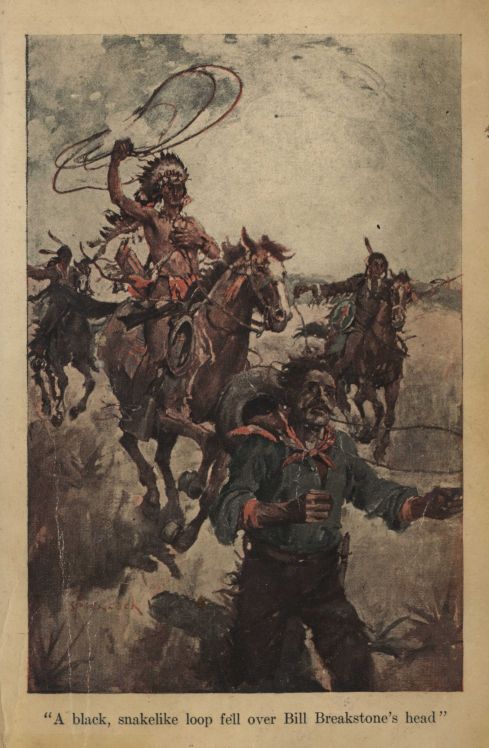
"A black, snakelike loop fell over Bill Breakstone's head"
"Come, Bill, come!" he cried. "The woods are not thirty yards away!"
"Once more unto the breach, or rather the woods!" exclaimed the half-unconscious man. "Lead on, Prince Hal, and I follow! That's mixed, but I mean well!"
They ran for the protecting woods, Breakstone half supported by Phil, and behind them they now heard many cries and the tread of many hoofs. A long, black, snake-like object followed Bill Breakstone, trailing through the grass and weeds. They had gone half way before Phil noticed it. Then he snatched out his knife and severed the lasso. It fell quivering, as if it were a live thing, and lay in a wavy line across the grass. But the fugitives were now at the edge of the woods, and Bill Breakstone's senses came back to him in full.
"Well done again, Sir Philip of the Knife and the Ready Mind," he whispered. "I now owe two lives to you. I suppose that if I were a cat I would in the end owe you nine. But suppose we turn off here at an angle to the right, and then farther on we'll take another angle. I think we're saved. They can't follow us on horses in these dense woods, and in all this darkness."
They stepped lightly now, but drew their breaths in deep gasps, their hearts throbbing painfully, and the blood pounding in their ears. But they thanked God again for the clouds and the moonless, starless sky. It could not be long until day, but it would be long enough to save them.
They went nearly a quarter of a mile to the right, and then they took another angle, all the while bearing deeper into the hills. From time to time they heard the war cries of the Comanches coming from different points, evidently signals to one another, but there was no sound of footsteps near them.
"Let's stop and rest a little," said Bill Breakstone. "These woods are so thick and there is so much undergrowth that they cannot penetrate here with horses, and, as they know that at least one of us is armed, they will be a little wary about coming here on foot. They know we'd fight like tigers to save ourselves. 'Thrice armed is he who hath his quarrel just,' and if a man who is trying to save his life hasn't got a just quarrel, I don't know who has. Here's a good place."
They had come to a great oak which grew by the side of a rock projecting from a hill. The rain had been gentle, and the little alcove, formed by the rock above and the great trunk of the tree on one side, was sheltered and dry. Moreover, it contained many dead leaves of the preceding autumn, which had been caught there when whirled before the winds. It was large enough for two, and they crept into it, not uttering but feeling deep thanks.
CHAPTER VII
THE GREAT SLEEP
When Phil drew the warm leaves about him he felt a mighty sensation of relief, accompanied by a complete mental and physical relaxation. The supreme tension of the spirit that had borne him up so long was gone now, when it was needed no longer, and he uttered a deep sigh of content. Bill Breakstone put a hand upon his shoulder.
"Phil," he said simply, "I owe you so much that I can't ever repay it."
"Your chance will come," replied the boy. "You'll probably do more for me than I've ever done for you."
"We'll see," said Bill Breakstone. "I'm thinking, Phil, that this is about the best hiding place we could have found, so we'll just lie quiet, as we'll see the edge of the day inside of half an hour."
The two remained perfectly still. Yet they could hear for awhile their own strained breathing, and Phil felt his heart constrict painfully after his long flight. But the breathing of both grew easier. In a short while it was normal again. Then they saw a touch of gray in the east, the rain ceased like a dissolving mist, a silver light fell over the forest, turning presently to gold, and it was day in the east.
Some of the sunbeams entered the thick jungle of forest where they lay, touching the leaves and grass here and there with gold, but in most places the shadows still hovered. Phil and Breakstone looked at their surroundings. They had left no trail in coming there, and the bushes about them were so dense that even Indian eyes ten feet away could not have seen them.
The sunlight was deepening. Birds in the trees began to sing. All the beings of the wilderness, little and big, awoke to life. Trees and grass dried swiftly under the strong fresh wind. Bill Breakstone glanced at his youthful comrade.
"Phil," he said, "I'll take the rifle, and you go to sleep. You've had a harder time than I have, and, when you wake up, I'll tell you how I was captured."
"I think I'll do it, Bill," said the boy, putting his. arm under his head and closing his eyes. The strain was gone from his nerves now, and sleep came readily. In three minutes he was oblivious of Comanches and all else that the world contained. Bill Breakstone could have slept if he had tried, but he did not try. Under a manner nearly always light and apparently superficial he concealed a strong nature and much depth of feeling. It seemed to him that at the last moment a hand had been stretched out to save him from the worst of fates. It seemed to him, also, that it must have been a sort of inspiration, the direction of a supreme will, for Phil to have come to him at such a time. It was a brave deed, a wonderful deed, and it had been brilliantly successful.
The light was strong, and Bill Breakstone looked down at the boy who was a younger brother to him now. He saw that the strain upon Phil had been great. Even while he slept his face was very white, except where fatigue and suspense had painted it black beneath the eyes. Phil Bedford had done more than his share, and it was now for him, Bill Breakstone, to do the rest. He slipped the muzzle of the rifle forward in order that it might command the mouth of the hollow, and waited. He would have pulled more leaves and brush before the entrance, but he knew that any disturbance of nature would attract the eye of a passing Comanche, and he allowed everything to remain exactly as it had been.
He lay comfortably among the leaves, and for a long time he did not stir. Phil breathed regularly and easily, and Bill saw that he would be fully restored when he awoke. Bill himself thought neither of hunger nor thirst, the tension was too great for that, but he never ceased to watch the sweep of trees and brush. It was half way toward noon when he saw some bushes about ten yards in front of him trembling slightly. He became at once alert and suspicious. He drew himself up in the attitude of one who is ready for instant action, slipping the muzzle of the rifle a little farther forward.
The bushes moved again, and something came into view. Bill Breakstone sank back, and his apprehension departed. It was a timber wolf, gray and long. A dangerous enough beast, if a man alone and unarmed met a group of them, but Bill, with the rifle, had no fear. The wolf sniffed the odor of flesh, sniffed again, knew that it was the odor of human flesh, and his blood became afraid within him. Bill Breakstone laughed quietly, but the boy slept placidly on. The incident amused Bill, and, therefore, it was welcome. It broke the monotony of the long quiet, and, just when he was laughing noiselessly for the fourth time over the wolf's discomfiture, the bushes moved again. Bill, as before, slipped the muzzle of his rifle farther forward and waited. A slight pungent odor came to his nostrils. The bushes moved more than before, although without noise, and a great yellow body came into view. The eyes were green, the claws sharp and long, and the body lithe and powerful. It was a splendid specimen of the southwestern puma, a great cat that could pull down a deer. But Bill Breakstone was still unafraid. He raised the rifle and aimed it at the puma, although he did not press the trigger.
"I can kill you, my friend, with a single bullet," he murmured, "but the report of that rifle would probably bring the Comanches upon us. Therefore, I will look you down."
The puma paused in doubt and indecision, restlessly moving his tail, and staring with his great green eyes until they met the gray eyes of the human creature, looking down the sights of the rifle barrel. That steady, steel-like gaze troubled the puma. He was large and powerful. He could have struck down the man at a single blow, but the heart within that mass of bone and muscle became afraid. The green eyes looked fearfully into the gray ones, and at last turned aside. The great beast turned stealthily, and slid into the thicket, at first slowly, and then in a run, as the terror that he could not see crowded upon his heels.
Bill Breakstone had laughed several times that morning, but now he laughed with a deep unction.
"I'm proud of myself," he murmured. "It's something to outlook a panther, but I don't know that I'd have looked so straight and hard if I hadn't had the rifle ready, in case the eyes failed. Now I wonder who or what will be the next invader of our premises."
His wonder lasted only until noon, when the sun was poised directly overhead, and the open spaces were full of its rays. Then, as light as the beasts themselves had been, two Comanches walked into full view. Bill Breakstone was as still as ever, but his hand lay upon the trigger of the rifle.
The Comanches were not a pleasant sight to eyes that did not wish to see them. They were powerful men, naked save for the waist cloth, their bodies painted with many strange symbols and figures. Although most of their tribe were yet armed with bows and arrows, each carried a fine rifle. Their faces were wary, cunning, and cruel. They were far more to be dreaded than wolf or panther. Yet Bill Breakstone at that moment felt but little fear of either. He was upheld by a great stimulus. The boy who slept so peacefully by his side had saved him in the face of everything, and, if the time had come, he would do as much for Phil. He felt himself, with the rifle and pistol, a match for both warriors, and his breathing was steady and regular.
The warriors stopped and stood in the bush, talking and pointing toward the east. Bill Breakstone surmised that they were talking about him and Phil, and it was likely from their pointing fingers that they believed the fugitives had gone toward the east. As Bill watched them, his suspense was mingled with a sort of curiosity. Would some instinct warn them that Phil and he lay not ten yards away? The woods were vast, and they and all their comrades could not search every spot. Would this be one of the spots over which they must pass?
It took two minutes to decide the question, and then the warriors walked on toward the east, their brown bodies disappearing in the foliage. Bill drew a mighty breath that came from every crevice and cranny of his lungs. He did not know until then how great his suspense had been. He sank back a little and let the rifle rest softly on the leaves beside him. He glanced at Phil. His face was less drawn now, and much of the color had come back. While Bill awaited the crisis, his finger on the trigger, the sleeping boy had grown stronger. Bill decided that he would let him sleep on.
Bill Breakstone had been through much. He, too, began to feel sleepy. The dangers of animal and man had come and passed, leaving his comrade and him untouched. His nerves were now subdued and relaxed, and he felt a great physical and mental peace. The day, too, was one calculated to soothe. The air was filled with; the mildness of early spring. A gentle wind blew, and the boughs and bushes rustled together, forming a sound that was strangely like a song of peace.
But Bill Breakstone was a man watchful, alert, a sentinel full of strength and resolution. He would not sleep, no, not he, not while so much depended upon him, yet the song among the leaves was growing sweeter and gentler all the time. He had never felt such a soothing quiet in all his life. The complete relaxation after so much danger and tension was at hand, and it was hard for one to watch the forest and be troubled about foes who would no longer come. Yet he would remain awake and keep faithful guard, and, as he murmured his resolution for the fifth time, his drooping eyelids shut down entirely, and he slept as soundly as the boy who lay by his side, his chest rising and falling as he breathed long and regularly.
Phil Bedford and Bill Breakstone slept all that afternoon. It was a mighty sleep, the great sleep following complete mental and physical exhaustion, the sleep that comes at such times to strong, healthy beings, in whom the co-ordination of brain, muscle, and nerve is complete. By some unconscious method of keeping time they breathed in perfect unison, and the gentle wind, which all the while was blowing through the leaves, kept time with them, too. Thus the evening shortened. Hour by hour dropped into the sandglass of time. The two, rivals of the ancient seven of famous memory, slept on. Both the wolf and the puma, driven by curiosity, came back. They crept a little nearer than before, but not too near. They felt instinctively that the mighty sleepers, mightily as they slept, could yet be awakened, and the smell of man contained a quality that was terrifying. So they went away, and, an hour after they were gone, the same two Comanches, naked to the waist, painted hideously in many symbols and decorations, and savage and cruel of countenance, came back in their places. But Bill Breakstone and Phil lay safe in the leaves under the bank, sleeping peacefully without dreams. So far as the Comanches were concerned, they were a thousand miles away, and presently the two warriors disappeared again in the depths of the forest, this time not to return.
Time went on. The two slept the great sleep so quietly that all the normal life of the woods about them was resumed. Woodpeckers drummed upon the sides of the hollow trees, a red bird in a flash of flame shot among the boughs, quail scuttled in the grass, and a rabbit hopped near. Midafternoon of a cloudless day came. The sun shot down its most brilliant beams, the whole forest was luminous with light. The Comanches ceased their search, confident that the fugitives were gone now beyond their overtaking, and returned to their villages and other enterprises, but Breakstone and Phil slept their great sleep.
Twilight came, and they were still sleeping. Neither had stirred an inch from his place. The little animals that hopped about in the thickets believed them dead, they were so quiet, and came nearer. Night came on, thick and dark. An owl in a tree hooted mournfully, and an owl in another tree a half mile away hooted a mournful answer. Phil and his comrade did not hear, because they still lay in their great sleep, and the doings of the world, great or small, did not concern them.
Phil awoke first. It was then about midnight, and so dark in the alcove that he could not see. His eyes still heavy with sleep and his senses confused, he sat up. He shook his head once or twice, and recollection began to come back. Surely the daylight had come when he went to sleep! And where was Bill Breakstone? He heard a regular breathing, and, reaching out his hands, touched the figure of his comrade. Both had slept, and no harm had come to them. That was evident because he also touched the rifle and pistol, and they would have been the first objects taken by a creeping enemy. But surely it could not have been a dream about his going to sleep in the daylight! He remembered very well that the sun was rising and that there were golden beams on the bushes. Now it was so dark that he could see only a few faint stars in the sky, and the bashful rim of a moon. He sat up and gave Bill Breakstone a vigorous shake.
"Bill," he said, "wake up! It's night, but what night I don't know!"
Bill Breakstone yawned tremendously, stretched himself as much as the narrow space would allow, and then slowly and with dignity sat up. He, too, was somewhat confused, but he pretended wisdom while he was trying to collect his senses. The two could barely see each other, and each felt rather than saw the wonder in the other's eyes.
"Well," said Bill Breakstone at last, "I'd have you to know, Sir Philip of the Dream and the Snore, though I can't prove that you've done either any more than I can prove that I haven't done both, that we're the genuine and true Babes in the Wood, only we've waked up. Here we've been asleep, maybe a week, maybe a month, and the pitying little birds have come and covered us up with leaves, and we've been warm and snug, and the wild animals haven't eaten us up, and the bad men, that is to say the Comanches, haven't found us. How do you feel, Phil?"
"Fine, never better in my life."
"That describes me, also, with beautiful accuracy. We'll never know, maybe, how long we've slept, whether one day, two days, or three days, but a good spirit has been watching over us; of that I'm sure.
"Phil and Bill,
To sleep they went;
Phil and Bill
From sleep they came.
Phil and Bill,
They had no tent;
But Phil and Bill,
They are true game.
Phil and Bill,
The leaves, a bed,
Phil and Bill,
They took no ill.
That's Phil and Bill.
"I don't think that's a bad poem, Phil, considering the short time I've had for its composition, and you'll observe that, with a modesty not common among poets, I've put you first."
"It's all right for the time," said Phil, "but don't do it too often. But, Bill, I'd trade a whole slab of poetry for an equal weight in beef or venison. I'm beginning to feel terribly hungry."
"I'd make the trade, too," said Bill Breakstone, "and that's not holding poetry so cheap, either. It's pleasant for the Babes in the Wood to wake up again, but there's a disadvantage; you've got to eat, and to eat you've got to find something that can be eaten. I'm like King Richard, 'A horse! A horse! My kingdom for a horse!' But I wouldn't ride that horse; I'd eat him."
"What time o' night would you say it is, Bill?"
Bill Breakstone attentively studied the few stars to be seen in the extremely dusky heavens.
"I'd say it was somewhere between six o'clock in the evening and six o'clock in the morning, with the emphasis on the 'somewhere.' I wonder what's happened around in these woods since we went to sleep last week, Phil; but I suppose we'll never know."
Bill stood up, and with his fingers combed the leaves out of his hair.
"Phil," he said, "I'll tell you the story of my life for the last day or two. It doesn't make a long narrative, but while it was happening it was tremendously moving to me. When I left you I skipped along through the edge of the woods and came to the plain. Then I saw the Indian village and the Indian horses grazing on the meadows. I looked them over pretty thoroughly, concluded I didn't like 'em, and started back to tell you about 'em. I thought I was mighty smart, but I wasn't smart enough by half."
"What happened?"
"Just as I turned around to start upon my worthy mission, three large, unclothed Comanches laid rude hands upon me. I didn't have much chance, one against three, and surprise on their side, too. They soon had me by the neck and heels, and carried me off to their village, where they gave me the welcome due to a distinguished stranger. Black Panther was especially effusive. He wanted to know all about me and my friends, if any, perchance, were near by. It was the same band that had attacked our wagon train and that was beaten off. Their scouts had warned them that we were on the other side of the big forest, but they were afraid to attack again. I gathered from what Black Panther said--he understands English, and I understand some Comanche--that they believed me to be lost, strayed, or stolen--that is, I had wandered away in some manner, or had been left behind. The chief tried to get all sorts of information out of me, but I didn't have any to tell. Finding that I was born dumb, he began to talk about punishments."
"What were they going to do to you, Bill?"
"There was a lot of lurid talk. I say 'lurid' because I seem to remember something about flames. Anyway, it was to be unpleasant, and I suppose if you hadn't come, Phil, at the right time, I shouldn't ever have had the great sleep that I've enjoyed so much, at least not that particular kind of sleep. Phil, it looks to me as if you came when I called, and I'm not joking, either."
"We'll put that aside," said Phil, "and hunt something to eat."
"Yes, it's our first duty to provision this army of two," said Bill Breakstone, "and I think we can do it. The woods are full of game, but we'll have to wait till morning for a shot. As for the Indians hearing the reports of our rifles, we must take the chance of that, but I don't think they'll roam very far from the village, and we'll spend the rest of the night going toward the point where we left the wagon train, which is directly away from the Comanches. Toward morning we'll sit down by the bank of a stream if we can find one, and wait for the game to come to drink."
"That seems to me to be our best plan," said Phil.
Both had a good idea of direction, and, despite the darkness, they advanced in a fairly straight line toward the point they sought. But they found it rough traveling through the thick undergrowth, among briers and across ravines and gulleys. Meanwhile, old King Hunger, bristling and fearsome, seized them and rent them with his fangs. There was no resisting. They must even suffer and stand it as best they could.
"I think it's at least a thousand hours until day," said Bill Breakstone at last. "Do you know, Phil, I've got to the point where I'd enjoy one of those stage banquets that I've often had. You don't really eat anything. The plates are empty, the glasses are empty, and, empty as they all are, they're generally whisked away before you can get a good long look at them. But there's something soothing and filling about them anyway. Maybe it's an illusion, but if an illusion is of the right kind, it's just the right kind of thing that you ought to have."
"An illusion may be all right for you, Bill," returned Phil, "but what about some of those dinners you can get in New Orleans. Oyster soup, Bill; fish fresh from the gulf, Bill; nice old Virginia ham, Bill; stuffed Louisiana: turkey, Bill; a haunch of venison, Bill; fried chicken, Bill; lamb chops, Bill; and a lot of other things that money can buy in New Orleans, Bill?"
"If you weren't my best friend, Phil, and if you hadn't just saved my life, I might make an attack upon you with the intent of bodily harm. You surely make me sour with your talk about the whole provision train that can be bought in New Orleans with money. Hear that old owl hooting! He's just laughing at us. I'd stop and shoot him if we had light enough for a shot."
"Never mind the owl, Bill," said Phil. "Perhaps when we get that good juicy deer we're looking for we can hoot back at him, if we feel like it."
"That's so," said Bill, although he said it gloomily.
They advanced in silence another hour, and then Phil, who was a little in advance, stopped suddenly. He had seen the gleam of water, and he pointed it out to his comrade.
"A spring," said Bill Breakstone, "and it's been trampled around the edges by many hoofs and paws."
He stooped and tasted the water. Then he uttered a mighty sigh of satisfaction.
"A salt spring, too," he said. "We're in luck, Phil. I see our breakfast coming straight toward us at this spring, walking briskly on four legs. The wild animals always haunt such places, and if we don't have savory steaks before the sun is an hour high, then I'm willing to starve to death. We must find an ambush. Here it is! Luck's a funny thing, Phil. It goes right against you for awhile, and nothing seems able to break it. Then it turns right around and favors you, and no fool thing that you do seems to change it. But I guess it evens up in the long run."
They found a dense clump of bushes about twenty yards from the salt spring, and sat down among them.
"There's no wind at all," whispered Bill Breakstone, "so I don't think that any animal eager for his salt drink will notice us. I've got my heart set on deer, Phil, and deer we must have. Now which of us shall take the rifle and make the shot? The rifle is yours, you know, and you have first choice."
But Phil insisted upon the older and more experienced man taking the weapon, and Breakstone consented. Then they lay quiet, eagerly watching every side of the spring. The darkness soon thinned away, and the bushes and trees became luminous in the early morning light.
"Something will come soon," said Breakstone.
They waited a little longer, and then they heard a rustling among the bushes on the far side of the spring. The bushes moved, and a black-tailed deer, a splendid buck, stepped into the opening. He paused to sniff the air, but nothing strange or hostile came to his nostrils. The deadly figure, crouching in the bushes with the loaded rifle at his cheek, might have been a thousand miles away, for all the deer knew.
Phil and Bill Breakstone might have admired the deer at another time, but now other emotions urged them on. The deer stepped down to the water. Breakstone looked down the sights, and Phil trembled lest he should miss. He tried to look along the barrel himself and see what spot Bill had picked out on the animal's body. Then he watched the marksman's finger curl around the trigger and at last press hard upon it. The flash of flame leaped forth, the report sounded startlingly loud in the clear morning, and the deer jumped high in the air.
But when the big buck came down he ran into the forest as if he had not been touched. Phil uttered a gasp of despair, but Bill Breakstone only laughed.
"Don't you fret, Phil," he said. "My heart was in my mouth, but my bullet didn't miss. He's hit hard, and we've got nothing to do but follow him by the plain trail he'll leave. We'll come to our breakfast in less than ten minutes."
Phil soon saw that Breakstone was right. The trail on the other side of the salt spring was plain and red, and presently they found the great stag in a thicket, lying upon his side, stone dead, Bill Breakstone was an adept at cleaning and dressing, and soon the ugly work was over. They always carried matches, and Phil quickly lighted a fire of dry sticks that burned up rapidly and that soon made a fine heap of glowing coals.
"Now," said Breakstone, "we'll cook and eat, then we'll cook and eat again, then we'll cook and eat once more."
"And I don't care very much whether Comanches heard the rifle shot or not," said Phil. "It seems to me that when I eat as much as I want I can whip the whole Comanche nation."
"I feel that way, too," said Bill Breakstone, "but the Comanches didn't hear. I know it in my bones. Didn't I tell you about that streak of luck? Luck's coming our way now, and the streak will last for awhile."
They cut long twigs, sharpened them at the ends, and fried over the coals strips of the deer, which gave out such a rich aroma as they sputtered that the two could scarcely restrain themselves. Yet they did it, they remained white men and gentlemen, and did not guzzle.
"Phil," said Bill, before he took a single bite, "I remember about that dinner in New Orleans you were talking of so long ago. I remember about those beautiful oysters, those splendid fish from the gulf, the gorgeous Virginia ham, the magnificent Louisiana turkey; yes, I remember all those magnificent fripperies and frummeries, but it seems to me if they were all set down before us, spread on a service of golden plate, they wouldn't be finer than what is now awaiting us."
"Bill," said Phil with deep emphasis and unction, "you never spoke truer words in your life."
"Then lay on, Macduff, and the first who cries 'hold, enough'--well, he won't be much of a trencherman."
They fell to. They did not eat greedily, but they ate long and perseveringly. Strip after strip was fried over the coals, gave out its savory odor, and disappeared. Phil occasionally replenished the fire, adding to the bed of coals, but keeping down the smoke. Bill, stretching his long body on the ground and then propping himself up on his elbow, concluded that it was a beautiful world.
"Didn't I tell you our luck would hold for awhile?" he repeated. "Since we got into the woods, things have come easy. A good bed put itself right in our way, then a deer walked up and asked to be eaten.
"The deer
It was here.
One shot--
In our pot.
"We haven't any pot, but you can use things in a metaphorical sense in order to get your rhyme. That's what poetry is for."
"I'm beginning to feel satiated," said Phil.
"'Satiated' is a good word," said Bill Breakstone, "but it isn't used much on the plains. Still, I'm beginning to feel that way myself, too, and I think we'd better begin to consider the future, which is always so much bigger than the present."
"We must find our horses."
"Of course, and after that we must find the train, which will be our chief problem. It may be where we left it or it may have gone on, thinking that we had been killed by some outlying party of Comanches. But I don't believe Middleton and Arenberg would move without us. They may now be somewhere in these woods looking for us."
"Can you figure out the direction of the valley in which we left our horses?"
Breakstone studied the sun attentively.
"It's southeast from here," he replied, "and I fancy it's not more than three or four miles. Two likely lads like you and me ought to find it pretty soon, and, nine chances out of ten, the horses will be there. We'll take some of the best portions of the deer with us, and start at once."
They chose the choicest pieces of the meat and started, now strong of body and light of heart. Phil's own judgment about the direction agreed with Breakstone's, and in less than an hour they saw familiar ground.
"I'm a good prophet to-day," said Breakstone. "I've got the gift for a few hours at least. I predicted truly about the deer, and now I am going to predict truly about the horses. We'll have them by the bridle inside of half an hour."
In fifteen minutes they were in the little valley, in three minutes they found the horses grazing peacefully, and in two more minutes they caught them.
"We've done the work and with ten minutes to spare," said Bill Breakstone, triumphantly, "and now, Phil, another wonderful change in our fortunes has come. If a camel is the ship of the desert, then a horse is the boat of the plains, the long boat, the jolly boat, the row boat, and all the rest of them. Now for the wagon train!"
"Now for the wagon train!" repeated Phil.
CHAPTER VIII
NEW ENEMIES
The two were in splendid spirits. They had escaped great dangers, and they were on horseback once more. It is true, they were somewhat short on armament, but Breakstone took Phil's pistol, while the latter kept the rifle, and they were confident that they could find game enough on the plains until they overtook the wagon train. The horses themselves seemed glad of the companionship of their old masters, and went forward readily and at an easy pace through the woods. They soon found the path by which they had come, and followed it until they crossed the river and reached the site of the camp. But the trail toward the plain lay before them broad and easy.
"They can't have gone long," said Breakstone. "They may have thought that we were merely loitering behind for some purpose of our own and would soon overtake them. A whole train isn't going to linger about for two fellows well mounted and well armed who are supposed to know how to take care of themselves. But, Sir Philip of the Youthful Countenance, I don't think that Middleton and Arenberg would go ahead without us."
"Neither do I," said Phil with emphasis. "I as good as know that they're looking for us in these woods, and we've got to stay behind and find them, taking the risk of Comanches."
"Wherein I do heartily agree with you, and I'm going to take a chance right now. It is likely that the two, after fruitless searches for us, would return here at intervals, and, in a region like this, the sound of a shot will travel far. Fire the rifle, Phil, and it may bring them. It's often used as a signal. If it brings the Comanches instead, we're on our horses, and they're strong and swift."
Phil fired a shot, but there was no response. He waited half an hour and fired a second time, with the same result. After another half hour, the third shot was fired, and, four or five minutes later, Breakstone announced that he heard the tread of hoofs. It was a faint, distant sound, but Phil, too, heard it, and he was confident that it was made by hoofs. The two looked at each other, and each read the question in the other's eye. Who were coming in reply to the call of that third rifle shot, red men or white?
"We'll just draw back a little behind this clump of bushes," said Breakstone. "We can see a long way through their tops, and not be seen until the riders come very close. Then, if the visitors to this Forest of Arden of ours, Sir Philip, are not those whom we wish to see, it's up and away with us."
They waited in strained eagerness. The sounds grew louder. It was certain, moreover, that the riders were coming straight toward the point at which the rifle had been fired.
"Judging from the hoof beats, how many would you say they are?" asked Phil.
"Not many. Maybe three or four, certainly not more. But I'm hoping that it's two, neither more nor less."
On came the horsemen, the hoofbeats steadily growing louder. Phil rose in his stirrups and gained a further view. He saw the top of a soft hat and then the top of another. In a half minute the faces beneath came into view. He knew them both, and he uttered a cry of joy.
"Middleton and Arenberg!" he exclaimed. "Here they come!"
"Our luck still holds good," said Bill Breakstone. He and Phil galloped from behind the bushes and shouted as warm a welcome as men ever had. They received one equally warm in return, as Middleton and the German urged their horses forward. Then there was a mighty shaking of hands and mutual congratulations.
"The train left yesterday morning," said Middleton, "but we couldn't give you up. We scouted all the way across the forest and saw the Comanches on the other side. There was nothing to indicate anything unusual among them, such as a sacrifice of prisoners, and we hoped that if you had been taken by them you had escaped, and we came back here to see, knowing that if you were able you would return to this place. We were right in one part of our guess, because here you are."
"And mighty glad we are to be here," said Bill Breakstone, "and I want to say to you that I, Bill Breakstone, who may not be of so much importance to the world, but who is of vast importance to himself, would not be here at all, or anywhere else, for that matter, if it were not for this valiant and skillful youth, Sir Philip Bedford, Knight of the Texas plains."
"Stop, Bill," exclaimed Phil blushing. "Don't talk that way."
"Talk that way! Of course I will! And I'll pile it up, too! And after I pile it up and keep on piling it up, it won't be the whole truth. Cap, and you, Hans, old fellow, Phil and I were not taken together, because Phil was never taken at all. It was I alone who sat still, shut my eyes, and closed my ears while I let three of the ugliest Comanche warriors that were ever born walk up, lay violent hands on me, harness me up in all sorts of thongs and withes, and carry me off to their village, where they would have had some red sport with me if Phil hadn't come, when they were all mad with a great dance, and taken me away."
Then he told the story in detail, and Phil, shy and blushing, was compelled to receive their compliments, which were many and sincere. But he insisted that he merely succeeded through good luck, which Bill Breakstone warmly denied.
"Well, between the two of you, you have certainly got out of it well," said Middleton, "and, as we are reunited, we must plan for the next step. We can easily overtake the train by to-morrow, but I'm of the opinion that we'll have to be very careful, and that we must do some scouting, also. Arenberg and I have discovered that the Comanche warriors are on the move again. Their whole force of warriors seemed to be getting ready to leave the village, and they may be planning, after all, a second attack upon the train, a night surprise, or something of that kind. We, too, will have to be careful lest we run into them."
"Then it maybe for the good of the train that we were left back here," said Phil, "because we will return with a warning."
"It may be the hand of Providence," said Arenberg, "since the Comanches did no harm where much was intended."
As both Middleton and Arenberg were firmly convinced that the plain would be thick with Comanche scouts, making their passage by daylight impossible, or at least extremely hazardous, they decided to remain in the woods until nightfall. They rode a couple of miles from the camp, tethered their horses in thick bushes, and, sitting near them, waited placidly. Phil Breakstone, and Arenberg talked in low tones, but Middleton sat silent. Phil noticed presently that "The Cap" was preoccupied. Little lines of thought ran down from his eyes to the corners of his nose.
Phil began to wonder again about the nature of Middleton's mission. Every one of the four was engaged upon some great quest, and none of them knew the secret of any of the others. Nor, in the rush of events, had they been left much time to think about such matters.
Now Phil again studied Middleton more closely. There was something in the unaccustomed lines of his face and his thoughtful eye indicating a belief that for him, at least, the object of the quest might be drawing nigh. At least, it seemed so to the boy. He studied, too, Middleton's clean cut face, and the sharp line of his strong chin. Phil had noticed before that this man was uncommonly neat in his personal appearance. It was a neatness altogether beyond what one usually saw on the plains. His clothing was always clean and in order, he carried a razor, and he shaved every day. Nor did he ever walk with a slovenly, lounging gait.
Phil decided that something very uncommon must have sent him with the Santa Fé train, but he would not ask; he had far too much delicacy to pry into the secret of another, who did not pry into his own.
Middleton and Arenberg had ample food in their saddlebags and Phil and Breakstone combined with it their stock of deer meat. Nothing disturbed them in the thicket, and at nightfall they mounted and rode out into the plain.
"I know something about this country before us," said Breakstone. "It runs on in rolling swells for a march of many days, without any streams except shallow creeks, and without any timber except the fringes of cottonwoods along these creeks."
"And I know which way to go in order to overtake the train," said Middleton. "Woodfall said that they would head straight west, and we are certainly good enough plainsmen to keep our noses pointed that way."
"We are, we surely are," said Bill Breakstone, "but we must keep a good watch for those Comanche scouts. They hide behind the swells on their ponies, and they blend so well with the dusky earth that you'd never notice 'em until they had passed the signal on to others that you were coming and that it was a good time to form an ambush."
There was a fair sky, with a moon and some clear stars, and they could see several hundred yards, but beyond that the whole horizon fused into a dusky wall. They rode at a long, swinging pace, and the hoofs of their horses made little noise on the new spring turf. The wind of the plains, which seldom ceases, blew gently in their faces and brought with it a soft crooning sound. Its note was very pleasant in the ears of Philip Bedford. In the saddle and with his best friends again, he felt that he could defy anything. He felt, too, and perhaps the feeling was due to his physical well-being and recovered safety, that he, also, was coming nearer to the object of his quest. Involuntarily he put his left hand on his coat, where the paper which he had read so often lay securely in a little inside pocket. He knew every word of it by heart, but when the time came, and he was alone, he would take it out and read it again. It was this paper that was always calling to him.
They rode on, crossing swell after swell, and, after the first hour, the four did not talk. It was likely that every one was thinking of his own secret.
They came about midnight to a prairie creek, a stream of water two or three yards wide and a few inches deep, flowing in a bed of sand perhaps fifteen yards across. A thin fringe of low cottonwoods and some willows grew on either shore. They approached warily, knowing that such a place offered a good ambush, and realizing that four would not have much chance against a large Comanche war band.
"But I don't think there is much danger," said Bill Breakstone. "If the Comanches are up to mischief again, they're not looking for stray parties; their mind is on the train, and, by the way, the train has passed along here. Look down, and in this moonlight you can see plainly enough the tracks of a hundred wheels."
"The horses are confident," said Middleton, "and I think we can be so, too."
The horses were advancing without hesitation, and it soon became evident that nothing was concealed among the scanty lines of trees and bushes.
"Look out for quicksands," said Arenberg. "It iss not pleasant to be swallowed up in one of them and feel that you have died such a useless death."
"There is no danger," said Phil, whose quick eye was following the trail of the wagons. "Here is where the train crossed, and if the wagons didn't sink we won't."
The water being cold and entirely free from alkali, the horses drank eagerly, and their riders, also, took the chance to refill their canteens, which they always carried strapped to their saddle bows. They also rested awhile, but, when they remounted and rode on, Middleton noticed a light to the northward. On the plains then, no man would pass a light without giving it particular attention, and the four sat on their horses for some minutes studying it closely. They thought at first that it might be a signal light of the Comanches, but, as it did not waver, they concluded that it must be a camp fire.
"Now I'm thinking," said Bill Breakstone, "that we oughtn't to leave a camp fire burning away here on the plains, and we not knowing anything about it. It won't take us long to ride up and inspect it."
"That is a truth," said Middleton. "It is not a difficult matter for four horsemen to overtake a wagon train, but we'll first see what that fire means."
"It iss our duty to do so," said the phlegmatic German.
They rode straight toward the light, and their belief that it was a camp fire was soon confirmed. They saw the red blaze rising and quivering, and then dusky figures passing and repassing before it.
"We're yet too far away to tell exactly what those figures are," said Bill Breakstone, "but I don't see any sign of long hair or war bonnets, and so I take it that they are not Comanches, nor any other kind of Indians, for that matter. No warriors would build so careless a fire or wander so carelessly about it.
"They are white men," said Middleton with conviction, as he increased his horse's pace. "Ah, I see now! Mexicans! Look at the shadows of their great conical hats as they pass before the fire."
"Now I wonder what they're doing here on Texas soil," said Bill Breakstone.
Middleton did not answer, but Phil noticed that the look in his eyes was singularly tense and eager. As they drew near the fire, which was a large one, and the hoof-beats of their horses were heard, two men in Mexican. dress, tall conical broad-brimmed hats, embroidered coats and trousers and riding boots, bearing great spurs, came forward to meet them. Phil saw another figure, which had been lying on a blanket by the fire, rise and stand at attention. He instantly perceived, even then, something familiar in the figure.
The four rode boldly forward, and Middleton called out:
"We are friends!"
The two Mexicans who were in advance, rifle in hand, stood irresolutely, and glanced at the man behind them, who had just risen from his blanket.
"You are welcome," said this man in good English but with a strong Mexican accent. "We are glad for anybody to share with us our camp fire in this wilderness. Dismount, Señores."
Then Phil knew him well. It was Pedro de Armijo, the young Mexican whom he had seen with the Mexican envoy, Zucorra, in New Orleans, one whom he had instinctively disliked, one whom he was exceedingly astonished to see at such a time and place. Middleton also recognized him, because he raised his cap and said politely:
"This is a pleasant meeting. You are Captain Pedro de Armijo, who came to our capital with His Excellency Don Augustin Xavier Hernando Zucorra on a mission, intended to be of benefit to both our countries. My name is Middleton, George Middleton, and these are my friends, Mr. Breakstone, Mr. Arenberg, and Mr. Bedford."
De Armijo gave every one in turn a quick scrutinizing look, and, with flowing compliment, bade them welcome to his fireside. It seemed that he did not remember Middleton, but that he took for granted their former meeting in Washington. Phil liked him none the more because of the polite words he used. He was not one to hold prejudice because of race, but this Mexican had a manner supercilious and conceited that inspired resentment.
"It seems strange, Señor Middleton," said de Armijo, "that we should meet again in such a place on these vast plains, so far from a house or any other human beings, plains that were once Mexican, but which you now call yours."
De Armijo glided over the last words smoothly, but the blood leaped in Phil's temples. Middleton apparently took no notice, but said that he and his comrades were riding across the plains mainly on an exploring expedition. As there was some danger from Comanches, they were traveling partly by night, and, having seen the camp fire, they had come to investigate it, after the custom of the wilderness.
"And, now that you have found us," said de Armijo with elaborate courtesy, "I have reason to believe that you would run into Comanche horsemen a little farther on. They would not harm us Mexicans, with whom they are at peace, but for you Americans they would have little mercy. Stay with us for the remainder of the night."
He smiled, showing his white teeth, and Middleton smiled back as he replied:
"Your courtesy is appreciated, Captain de Armijo. We shall stay. It is pleasant, too, to welcome a gallant Mexican officer like yourself to American soil."
The eyes of de Armijo snapped in the firelight, and the white teeth were bared again. Phil knew that he resented the expression "American soil." Mexico still maintained a claim to Texas--which it could not make good--and he felt equally confident that Middleton had used it purposely. It seemed to him that some sort of duel was in progress between the two, and he watched it with overwhelming curiosity. But de Armijo quickly returned to his polite manner.
"You speak the truth," he said. "It is I who am your guest, not you who are mine. It was Mexican soil once, and before that Spanish--three centuries under our race--but now gone, I suppose, forever."
Middleton did not reply, but approached the fire and warmed his hands over the blaze. The night was cold and the flames looked cheerful. The others tethered their horses, and all except the two who had met the Americans took their places by the fire. The Mexicans were six in number. Only de Armijo seemed to be a man of any distinction. The others, although stalwart and well armed, were evidently of the peon class. Phil wondered what this little party was doing here, and the conviction grew upon him that the meeting had something to do with Middleton's mission.
"I am sorry," said de Armijo, "that we do not even have a tent to offer you, but doubtless you are accustomed to sleeping under the open sky, and the air of these plains is dry and healthy."
"A blanket and a few coals to warm one's feet are sufficient," said Middleton. "We will avail ourselves of your courtesy and not keep you awake any longer."
Both Breakstone and Arenberg glanced at Middleton, but they said nothing, wrapping themselves in their blankets, and lying down, with their feet to the fire. Phil did the same, but he thought it a strange proceeding, this apparently unguarded camping with Mexicans, who at the best were not friends, with the possibility of Comanches who were, at all times, the bitterest and most dangerous of enemies. Yet Middleton must have some good reason, he was not a man to do anything rash or foolish, and Phil awaited the issue with confidence.
Phil could not sleep. The meeting had stirred him too much, and his nerves would not relax. He lay before the fire, his feet within a yard of the coals, and his head in the crook of his arm. Now and then he heard a horse move or stamp his hoofs, but all the men were silent. De Armijo, lying on a blanket and with a fine blue cavalry cloak spread over him, seemed to be asleep, but as he was on the other side of the fire Phil could not see his eyes. Middleton was nearer, and he saw his chest rising and falling with the regularity of one who sleeps.
It all seemed very peaceful, very restful. Perhaps de Armijo's hospitality was real, and he had wronged him with his suspicions. But reason with himself as he would, Phil could not overcome his dislike and distrust. Something was wrong, and something was going to happen, yet much time passed and nothing happened. De Armijo's eyes were still shaded by his cloak, but his long figure lay motionless. Only a few live coals remained from the fire, and beyond a radius of twenty feet lay the encircling rim of the darkness. At the line where light and dark met, crouched the two peons with their rifles across their knees. It was Phil's opinion that they, too, slept in this sitting posture. Surely de Armijo and his men had great confidence in their security, and must be on the best of terms with the Comanches! If so, it might increase the safety of the little American party, also, but the boy yet wondered why Middleton had stopped when they were all so eager to reach the wagon train and warn it of the new danger.
Phil stirred once or twice, but only to ease his position, and he did it without noise. His eyes were shaded by the brim of his soft hat, but he watched the circle about the fire, and most of all he watched de Armijo. An interminable period of time passed, every second growing to ten times its proper length. Phil was as wakeful as ever, but so much watching made the figures about the fire dim and uncertain. They seemed to shift their places, but the boy was still resolved to keep awake, although everybody else slept through the night. His premonition was yet with him, his heart expanded, and his pulse beat faster.
The remaining coals died one by one. The circle of light, already small, contracted still more, became a point, and then vanished. Everything now lay in the dark, and the figures were merely blacker shapes against the blackness. Then, after that long waiting, with every second and minute drawn out tenfold, Phil's premonition came true. Something happened.
De Armijo moved. He moved ever so slightly, but Phil saw him, and, lying perfectly still himself, he watched him with an absorbed attention, and a heart that had increased its beating still further. De Armijo's body itself had not moved, it was merely one hand that had come slowly from under the covering of the cloak, and that now lay white against the blue cloth. A man might move his hand thus in sleep, but it seemed to Phil that the action was guided by a conscious mind. Intent, he watched, and presently his reward came. The other hand also slid from beneath the cloak, and, like its fellow, lay white against the blue cloth. Now both hands were still, but Phil yet waited, confident that more would come. It was all very quiet and slow, like the craft and cunning of the Indian, but Phil was willing to match it with a patience and craft of his own.
At last the whole figure of de Armijo stirred. Phil saw the blue cloak tremble slightly. Then the man raised his head ever so little and looked about the dark circle. Slowly he let the head fall back, and the figure became still again. But the boy was not deceived. Already every suspicion had been verified in his mind, and his premonition was proved absolutely true.
Pedro de Armijo raised himself again, but a little higher this time, and he did not let his head and body drop back. He looked about the circle with a gaze that Phil knew must be sharp and scrutinizing, although it was too dark for him to see the expression of his eyes. The Mexican seemed satisfied with his second examination, and then, dropping softly on his hands and knees, he crept toward Middleton. It occurred to Phil afterward that this approach toward Middleton did not surprise him. In reality, it was just what he had expected de Armijo to do.
The boy was uncertain about his own course, and, like one under a spell, he waited. The dusky figure of de Armijo creeping toward Middleton had a sinuous motion like that of a great snake, and Phil's hand slipped down to the hammer of his rifle, but he would not fire. He noticed that de Armijo had drawn no weapon, and he did not believe that murder was his intention.
Middleton did not move. He lay easily upon his right side, and Phil judged that he was in a sound sleep. De Armijo, absorbed in his task, did not look back. Hence he did not see the boy who rose slowly to a sitting posture, a ready rifle in his hands.
Phil saw de Armijo reach Middleton's side and pause there a moment or two. He still drew no weapon, and this was further proof that murder was not in the Mexican's mind, but Phil believed that whatever lay between these two was now at the edge of the crisis. He saw de Armijo raise his hand and put it to Middleton's breast with the evident intention of opening his coat. So he was a thief! But the fingers stopped there as Phil leveled his rifle and called sharply:
"Hands up, de Armijo, or I shoot!"
The startled Mexican would have thrown up his hands, but he did not have time. They were seized in the powerful grasp of Middleton, and he was pulled downward upon his face.
"Ah, would you, de Armijo!" cried Middleton in exultant tones. "We have caught you! Good boy, Phil, you were watching, too!"
"All the others were up in an instant, but Breakstone and Arenberg were too quick for the Mexicans. They covered them with their rifle muzzles before their antagonists could raise their weapons.
"Throw down every gun and pistol!" said Breakstone sternly. "There, by the log, and we'll see what's going forward!"
Sullenly the Mexicans complied, and then stood in a little huddled group, looking at their fallen leader, whom Middleton still held upon the ground, but who was pouring out muffled oaths from a face that was in the dirt.
"Take his pistols, Phil," said Middleton, and the boy promptly removed them. Then Middleton released him, and de Armijo sat up, his face black as night, his heart raging with anger, hate, and humiliation.
"How dare you attack me in my own camp! You whom we received as guests!" he cried.
"We did not attack you," replied Middleton calmly. He had risen to his feet, and he towered over the Mexican like an accusing judge. "It is you who attacked us, or me, rather, and you intended, if you did not get what you wanted with smooth fingers, to use violence. You cannot deny that, Captain Pedro de Armijo of the Mexican army; there were at least two witnesses of your act, Philip Bedford and myself."
De Armijo looked down at the ground, and seemed to commune with himself for a few moments. Then he stood at his full height, brushed the traces of dirt from his clothes, and gave Middleton a look of uncompromising defiance and hostility. All at once it struck Phil that this was a man of ability and energy, one who could be a bitter and dangerous enemy.
"You are right in part, Captain Middleton," said de Armijo slowly. "I was seeking to take the maps, letters, and instructions that you carry inside your tunic, next, perhaps, to your very flesh. They would be valuable possessions to us, and it was my duty, as a captain in the Mexican army, to take them if I could, from you, a captain in the American army."
Phil started and looked anew at Middleton. A captain in the American army! This was why he had walked with that upright carriage! This was why he had been so particular about his personal appearance! He began to see a little way.
"We, too, have our channels of information," said de Armijo, "and I knew that you had embarked upon a mission in the West to learn our movements and forces upon the border, and our temper and disposition with regard to great matters that are agitating both Mexico and America."
"It is true, all that you say," replied Middleton tranquilly. "I am Captain George Middleton of the American regular troops, and, at the request of our War Department, I undertook the hazardous mission of which you speak."
"You will go no farther with it," said de Armijo.
"How can you keep me from it?"
"I cannot--perhaps, but events can--events have. You do not know, but I do, Captain Middleton, that there is war between your country and mine."
"Ah!" exclaimed Middleton, and, despite the darkness, Phil saw a sudden flush spring into his face.
"It is not only war," continued de Armijo, "but there has been a heavy battle, two of them, in fact. Your troops met ours at Palo Alto on May eighth, and again on the following day at Resaca de la Palma."
"Ah!" exclaimed Middleton again, the exclamation being drawn up from the very depths of his being, while the flush on his face deepened. "And you know, I suppose, which won?"
It was a peculiar coincidence that the moon's rays made their way at that moment through clouds, and a bright beam fell on the face of Pedro de Armijo. Phil saw the Mexican's face fall a little, despite all his efforts at self-control. De Armijo himself felt this change in his countenance, and, knowing what it indicated to the man who asked the question, he replied without evasion:
"I regret to say that the fortunes of war were against the deserving. Our brave general, Ampudia, and our gallant troops were compelled to retire before your general, Taylor. At least, so say my hasty advices; perhaps they are wrong."
But Phil could see that de Armijo had no such hope. The news was correct, and the boy's heart thrilled with joy because the first victories had fallen to his own people.
"I would not have told you this," continued de Armijo, "had you not caught me in an attempt to take your papers. Had it been peace, 'steal' would have been the word, but since it is war 'steal' turns to enterprise and zeal. Had I not believed you ignorant that the war has begun, and that I might make more profit out of you in our hands than as a fugitive, or at least as one who might have escaped, I should have opened fire upon you as you approached. Perhaps I made a mistake."
"All of us do at times," said Middleton thoughtfully.
"Well spoken," said de Armijo. He lighted a cigarette and took a few easy puffs.
"Well, Captain Middleton," he said at length, "the problem is now yours, not ours. You have taken it out of our hands. What are you going to do with us?"
"It seems to me," said Captain Middleton, "that this problem, like most others, admits of only one solution. You are our prisoners, but we cannot hold you. Our own situation prevents it. We could kill you, but God forbid a single thought of such a crime. We will take your arms and let you go. You will not suffer without your arms, as your Comanche friends are near, a fact which you know very well."
"We accept your terms," said de Armijo, "since we must, and with your permission we will mount our horses and ride away. But it is to be understood, Captain Middleton, and you, young Mr. Bedford, and the rest of you, that we part as enemies and not as friends."
"As you will," said Middleton. "I recognize the fact that you have no cause to love us, and perhaps the sooner we both depart from this spot the better it will be for all."
"But we may meet again on the battlefield; is it not so?" said de Armijo.
"That, I cannot tell," replied Middleton, "but it is not unlikely."
Breakstone and Arenberg still stood by the captured arms, but, without casting a glance at either the arms or their guardians, de Armijo signaled to his men, and they mounted and rode away.
"Adios!" he called back in Spanish, although he did not turn his face.
"Adios!" said Middleton in the same tone.
They did not move or speak until they heard the hoof-beats die away, and then it was Bill Breakstone who first broke the silence.
"That certainly came out well," he said. "The curtain came down on a finer finish than the first act indicated. I confess that I didn't know your plan, Captain--I don't call you Cap any more--but I trusted you, and I confess, also, that I fell asleep. It was you and Sir Philip of the Active Mind and the Watchful Eye who did most of the work.
"It was in Tex.
We met the Mex.
They spoke so high,
But now they cry.
Or, at least, they ought to cry when they think how we turned the tables on them. Now, Captain, I suppose we must be up and doing, for those fellows, as you said, will go straight to the Comanches, and if we linger here our scalps will be of less value to ourselves than to anybody else."
"It is quite true," said Captain Middleton. "We must reach the train as soon as possible, because the danger to it has increased with our own. But even more important than that is the great change that must be made. Woodfall cannot go on now, since the whole Southwest will be swept by bands of Mexican and Indian horsemen."
"What must the train do?" asked Phil in anxiety, because this concerned him very nearly.
"It must turn south and join the American army on the Rio Grande. Most of the things that it carries will be of value to our troops, and Woodfall will clear as much profit there as at Santa Fé, which is now a city in arms against us. In this case the path of comparative safety and honor is also the path of profit. What more could Woodfall ask?"
"He's a brave man, and brave men are with him," said Bill Breakstone. "You won't have to ask him twice."
Phil's heart had throbbed with joy at Middleton's answer. His quest was always in his mind. He had feared that they might turn back, but now it suited him as well to join the American army as to go on toward Santa Fé. The quest was a wide one. But Arenberg suppressed a sigh.
"Let's be starting," said Middleton. "We'll take their arms with us. They're of value, and Bill, moreover, is without a rifle or musket."
Breakstone, who had been examining the weapons, uttered a cry of joy.
"Here is a fine rifle," he said, "one of the best American make. I wonder how that Mexican got it! The rest are not so good."
"Take the fine one, Bill," said Middleton, "and we will pack up the rest and ride."
They were out of the woods in a few minutes, and again rode rapidly toward the west. It was an easy task to pick up the great wagon trail again, even in the dark of the night, as the grass and soil were trodden or pressed down over a width of fully two hundred yards. The country rolled lightly. Bill Breakstone thought that a range of hills lay toward the north, but in the night they could not see.
"I hope that we'll overtake Woodfall before day," said Middleton, "because I've an idea that de Armijo and the little band with him are not the only Mexicans hereabouts. He would not come so far North without a considerable force, and I suspect that it is his intention to capture our train, with the aid of the Comanches."
"We can beat them off," said Breakstone confidently.
"If our people are warned in time," said Middleton.
"Much harm iss meant," said Arenberg, speaking for the first time, "but we may keep much from being done. Our most dangerous enemies before the daylight comes are the Comanches. They have already learned from de Armijo that we are here, and it iss like as not that they are now between us and the train."
Middleton looked at his watch, holding it in the moon's rays.
"It is two hours until day," he said, "and the trail is rapidly growing fresher. We may yet get through before the ring closes. Ah, there they are now!"
A hand's breadth of fire suddenly leaped up in the north, and burned there like a steady torch. Far in the east, another but fainter appeared and burned, and a third leaped up in the south. But when they looked back in the west they saw none.