THE QUEST OF THE FOUR (continued 2)
Reading edition
"That is well spoken," said Middleton. "We are chosen comrades, and we must stand by one another. See how the trees are drawing nearer."
The black line now stood up level with the earth, and the trees became detached from one another. They could also see the thick undergrowth hiding the river, which seemed to flow in a deep gash across the plain. Middleton took from his saddlebags a pair of strong glasses, and, as they rode on, examined the double line of trees with the minutest scrutiny. Then he lowered the glasses, shaking his head.
"I can't make out anything," he said. "Nothing moves that I can see. There is no sign of human life."
"The Comanche iss cunning," said Arenberg. "Harm iss done where harm iss meant, but I for one am willing to meet him."
The mild German spoke in such a tone of passion that Phil was startled and looked at him. Arenberg's blue eyes shone with a sort of blue fire, and he was unconsciously pressing his horse ahead of the others. It was evident, even to one as young as Phil, that he was stirred to his utmost depths. The boy leaned over and whispered to Breakstone:
"He must have some special cause to hate the Comanches. You know he was in that massacre at New Braunfels."
"That's so," said Breakstone,
"When you feel the savage knife,
You remember it all your life."
"These mild men like Arenberg are terrible when they are stirred up, Phil. 'Still waters run deep,' which sounds to me rather Irish, because if they are still they don't run at all. But it's good all the same, and, between you and me, Phil, I'd give a lot if we were on the other side of this river, which has no name in the geographies, which rises I don't know where, which empties into I don't know what, and which belongs to I don't know whom. But, be that as it may, lay on, Macduff, and I won't be the first to cry 'Hold, enough!'"
The train took another curve to the northward, approaching the ford, of which the old scouts told. The swells dipped down, indicating a point at which the banks of the river were low, but they could still see the double line of trees lining either shore, and the masses of bushes and weeds that extended along the stream. But nothing stirred them. No wind blew. The boughs of the cottonwoods, live oaks, and willows hung lifeless under the somber sky. There was still no sign of human presence or of anything that lived.
But the men of the train did not relax their caution. They were approaching now up a sort of shallow trough containing a dry sandy bed, down which water evidently flowed during the wet season into the river. It, also, for the last half mile before it reached the main stream, had trees and bushes on either shore. Middleton suggested that they beat up this narrow strip of forest, lest they walk straight into an ambush. Woodfall thought the idea good, and twenty men scouted the thickets. They found nothing, and many in the train began to feel incredulous. That Comanche had been a mere boaster. He was probably still galloping away over the prairie, putting as much distance as he could between himself and the Santa Fé train. But Middleton yet distrusted. He seemed now to be in every sense the leader of the train, and he did it so quietly and with such indirection that Woodfall took him to be an assistant, and felt no offense. At his prompting, strong bodies of skirmishers were thrown forward on either bank of the dry creek bed, and now, increasing their pace somewhat, they rapidly drew near the river.
It still seemed to Phil that nothing could happen. It was true that the skies were gray and somber, but there was no suggestion of an active and hostile presence, and now the river was only a hundred yards away. From his horse's back he could see the surface of the stream--narrow, muddy, and apparently deep. But on the hither shore there was a gradual slope to its waters, and another of the same kind on the farther bank seemed to lead up among the trees.
"It ain't so deep as it looks," said an old frontiersman. "'Bout four feet, I should say. It'll just 'bout hit the bottoms o' our wagon beds."
The stream itself was not more than twenty yards wide. One could pass it in a few minutes, if nothing was thrown across the way, and Phil now began to feel that the unspoken alarm was false. But just when the feeling became a conviction and the wagons were not more than twenty yards from the river, he saw something gleaming in the brush on the far shore. It was the dyed feather of an eagle, and it made a blood red spot against the green bushes. Looking closely Phil saw beneath the feather the light copper face of an Indian, and then he knew that the Comanches were there.
Scarcely a second after he saw the coppery face, a hurricane of arrows whistled from the covert on the far shore. The short shafts of the Comanches filled the air. Mingled with them was the sharp crashing of rifles, and bullets and arrows whistled together. Then came the long yell of the Comanches, from scores of throats, high pitched, fierce, defiant, like the scream of a savage beast about to leap upon its prey. In spite of all his resolution, Phil felt that strong shiver in every nerve from head to heel. Some of the shafts were buried to the feather in the bodies of the horses and mules, and a terrible tumult arose as the animals uttered their screaming neigh and fought and kicked in pain and terror. Nor did the men escape. One, pierced through the throat by a deadly barb, fell lifeless from his horse. Another was stricken in the breast, and a dozen were wounded by either arrows or bullets.
The train was thrown into confusion, and the drivers pulled back on their lines. Sure death seemed to hover in front of them. The greatest danger arose from the wounded and frightened horses, which plunged and struggled and tried to break from their harness, but the hands on the lines were strong, and gradually they were reduced to order. The wagons, also, were driven back a little, and then the triumphant Comanches sent forth their war whoop again and again. The short shafts once more flew in showers, mingled as before with the whistling of the bullets, but most of the missiles, both arrows and bullets, fell short. Now the Comanches appeared thickly among the bushes, chiefly on foot, their horses left at the edge of the timber, and began to make derisive gestures.
It seemed to Phil that the crossing of the river was impossible in the face of such a fierce and numerous foe, but Middleton and Woodfall had been conferring, and suddenly the Cap, to use his more familiar name among the men, whirled off to the south at the head of a hundred horsemen. He waved his hand to his three partners, and they galloped with the band.
"There must be another crossing, not as good as this, but still a crossing," said Bill Breakstone. "If at first you don't succeed, then try, try again."
This flanking movement was hidden from the Comanches on the other shore by the belt of timber on the side of the train, and the horsemen galloped along rapidly in search of a declivity. Phil's heart was thumping, and specks floated before his eyes, but he was well among the foremost, and he rode with them, stride for stride. Behind him he heard the crackle of rifle shots, the shouts of the Comanches, and the defiant replies of the white men.
"Keep a good hold on your rifle, Phil!" shouted Bill Breakstone in his ear. "If the gods whisper truly to me, we will be in the water soon, and, by my faith, you'll need it."
The Captain uttered a shout of joy. They had come to a place where the bank sloped down to the river and the opposite shore was capable of ascent by horses.
"Into the river, men, into the river!" he shouted. "The horses may have to swim, but we can cross it! We must cross it before the main Indian force comes up!"
The whole troop galloped into the water. Middleton shouted to them to keep their rifles dry, and every man held his above his head or on his shoulder. The muddy water splashed in Phil's face, but he kept by the side of Breakstone, and in a few moments both their horses were swimming.
"Let the horse have his head, Phil," said Breakstone. "He'll make for the nearest land, and you can use both your hands for the work that we now have to do."
Phil dropped the rein, and the horse swam steadily. They were now about the middle of the stream, which was wider here than at the ford. Two or three brown faces suddenly appeared in the brash on the bank in front of them, and the savage cry arose. Comanche skirmishers had discovered the flank movement, but the white troop was already more than half way across. Bullets were fired at the swimming men and horses. Some struck in flesh, but others dashed up jets of yellow foam.
"On! On!" cried Middleton. "We must gain the bank!"
"On! On!" cried Phil, borne on by excitement. "We must gain the bank!"
He was carried away so much by the fire and movement of the moment that he did not feel fear. His blood was tingling in every vein. Myriads of red specks danced before him. The yellow water splashed all about him, but he did not notice it. An arrow whizzed by his cheek, and two bullets struck near, but he continued to urge his horse, which, gallant animal, was already doing his best. Some of the white men, even from the unsteady position of a swimming horse's back, had begun to fire at the Indians in the brush. Phil heard Bill Breakstone utter a deep sigh of satisfaction as he lowered the muzzle of his rifle.
"Got one," said Bill. "It's good to be zealous, but that Comanche ought to have known more than to run square against a rifle bullet."
The feet of Phil's horse touched earth, and he began to wade. Everything now depended upon an instant or two. If they could gallop up the declivity before the Comanches could arrive in force they would secure a great advantage. But the Comanches were coming rapidly, and the fire from their bows and rifles increased. The white men, now that their position was steadier, also fired more rapidly. Phil sent a bullet at a bronze figure that he saw darting about in the undergrowth, but he could not tell whether or not he had hit.
"On!" shouted Middleton. "Give them no chance! Rush the slope!"
They were out of the river now, and in among the bushes and weeds. But they did not stop there. Dripping with the yellow water, streaked sometimes with red, they rode straight at the Comanches, shouting and firing with both rifles and pistols. The Indian skirmishers gave way, and, jumping upon their ponies, galloped down the stream to the main ford. The white men uttered a cry of exultation. They were now on the western bank, and the flank movement was a complete success.
"Follow them!" shouted Middleton. "We must press home the attack upon the main body!"
Ahead of them the Comanches, bent low on their mustangs, were galloping over the plain. Behind came the white men, hot with the fire of battle and urging on their horses. Phil, Bill Breakstone, and Arenberg rode knee to knee, the boy between. He was wet from head to foot with splashed water, but he did not know it. A bullet had touched the tip of one ear, covering it with blood, but he did not know that, either. There was no cruelty in his nature, but just now it thrilled with battle. He sought a shot at the flying Comanches, but they were too far away.
"Hold your fire,"' said Bill Breakstone. "The battle is not over yet by any means. A job that's half finished isn't finished at all."
They heard now the shots at the ford above them and a tremendous shouting. Evidently the two forces were firing at each other across the stream, and the wagons did not yet dare the passage. A few moments later they saw the smoke of the rifles and brown figures darting about the thickets.
"Now, boys!" shouted Middleton. "All together! A great cheer!"
A mighty shout was poured forth from three score throats, and Middleton waved his felt hat about his head. From the eastern bank came an answering cry, and the signal was complete. Woodfall and the others with the train knew that their comrades were across, and now was the time for them to force the passage. Phil saw the white tops of the wagons shake. Then the wagons themselves rolled slowly forward into the water, with horsemen in front of them and on the flanks, firing at the Indians on the bank. The Comanches sent a shower of bullets and arrows upon the advancing line, but in another instant they were compelled to turn and defend themselves. Middleton and his victorious troop were thundering down upon them.
The attack upon their flank came so swiftly that the Comanches were taken by surprise. As their own skirmishers fled, the white force galloped in upon their heels. Yet these bold warriors, kings of the plains, victors in many a battle over other tribes and Mexicans, fought with a courage and tenacity worthy of their race and traditions. They were marshaled, too, by a chief who had returned to his own, the great Black Panther, and by able assistants.
Middleton's daring men met a storm of arrows am bullets, but they charged on, although some saddles were emptied. They were at the edge of the timber now, the mounted white men poured in a deadly fire. The sound of the shots became a steady, incessant crackle Puffs of smoke arose, and, uniting, formed a canopy of vapor. The odor of gunpowder spread and filled the nostrils of the combatants. Shots, the trampling of hoofs, the cries of the wounded and dying rung upon the drums of their ears.
It was a terrific medley, seemingly all confusion, but really fought with order by skilled leaders. Black Panther had one half of his warriors to face the wagons and horsemen in the river and the other half faced south to beat off Middleton's troop, if it could. He himself passed from one to another, encouraging them by every art that he knew, and they were many.
But it was Middleton's men who gave the deathblow. They struck so hard and so often that it was continually necessary for Black Panther to send more of his warriors to the defense of his flank. The firing upon the wagons and horsemen in the river slackened, and they rushed forward. The horsemen gained the bank, and, at the same time, Middleton's men charged with greater fire than ever. Then the horsemen from the ford rushed up the ascent and joined in the attack. Compressed between the two arms of a vise, the Comanches, despite every effort of Black Panther and his chiefs, gave way. Yet they did not break into any panic. Springing on their horses, they retired slowly, sending back flights of arrows and bullets, and now and then uttering the defiant war whoop.
Meanwhile, the last of the wagons emerged from the river, and was dragged up the ascent. Although the Comanches might yet shout in the distance, the crossing was won, and everybody in the train felt a mighty sense of relief.
CHAPTER IV
ON WATCH
The wagons drew up in a great square on the open plain, but just at the edge of the timber, and the men, breathless, perspiring, but victorious, dropped from their horses. The Comanches still galloped to and fro and shouted in the distance, but they kept well out of rifle shot, and Phil, although it was his first battle, knew that they would not attack again, at least not for the present. They had been driven out of an extremely strong position, ground of their own choosing, and nothing remained to them but to retire.
The boy stood by the side of his horse, holding the bridle in one hand and the rifle in the other. He was still trembling from the excitement of forcing the ford and the battle among the trees, but the reddish mist before his eyes was gradually clearing away. He let the bridle rein drop, and put his hand to his face. It came away damp and sticky. He looked at it in an incurious way to see if he were wounded, but it was only dust and the smoke of burned gunpowder, kneaded together by perspiration. Then he felt cautiously of his body. No bullet or arrow had entered.
"Unhurt, Phil?" boomed out the voice of Bill Breakstone beside him. "So am I, and so is Middleton. Arenberg got a scratch, but he's forgotten it already. But, I trow, Sir Philip of the River, that was indeed a combat while it lasted!
"The Comanches shot
With spirit hot,
But now, they're not.
"You can't say anything against that poem, Phil; it's short and to the point. It's true that the Comanches are not entirely gone, but they might as well be. Let 'em shout out there in the plain as much as they choose, they're going to keep out of rifle range. And I congratulate you, Phil, on the way you bore yourself through your first 'baptism of fire.'"
"I thank you, Bill," said Phil, "but the fact is, I don't know just how I bore myself. It's been more like a dream than anything else."
"That's likely to happen to a man the first time under fire, and the second time, too, but here we are on the right side of the river and ready for a breathing spell."
Phil threw the reins over his horse's neck, knowing that the latter would not leave the camp, and set to work, helping to put everything in order, ready for fight or rest, whichever the Comanches chose to make it. The wagons were already in a hollow square, and the wounded, at least twenty in number, laid comfortably in the wagons, were receiving the rude but effective treatment of the border. Seven or eight had been killed, and three or four bodies had been lost in the current of the stream. They were now digging graves for the others. Little was known of the slain. They were wandering, restless spirits, and they may or may not have been buried under their own names. They had fallen in an unknown land beside an unknown river, but their comrades gave all due honor as they put them beneath the earth. Middleton said a few words over the body of each, while others stood by with their hats off. Then they smoothed out the soil above them as completely as possible, in order that their graves might be lost. They took this precaution lest the Comanches come after they had gone, take up the bodies, and mutilate them.
When the solemn task was done, the men turned away to other duties. They were not discouraged; on the contrary, their spirits were sanguine. The gloom of the burial was quickly dispelled, and these wild spirits, their fighting blood fully up, were more than half willing for the Comanches to give them a new battle. It was such as these, really loving adventure and danger more than profit, who steadily pushed forward the southwestern frontier in the face of obstacles seemingly insuperable.
Their position at the edge of the wood, with the strong fortification of the wagons, was excellent, and Middleton and Woodfall, after a short consultation, decided to remain there until morning, for the sake of the wounded men and for rest for all. Phil worked in the timber, gathering up fallen fuel for fires, which were built in the center of the hollow square, and he found the work a relief. Such a familiar task steadied his nerves. Gradually the little pulses ceased to beat so hard, and his head grew cool. When enough dead wood had been brought in, he took another look at the western horizon. Comanches could still be seen there, but they no longer galloped about and shouted. A half dozen sat motionless on their ponies, apparently looking at the white camp, their figures, horse and rider, outlined in black tracery against the blood-red western sun. Phil had a feeling that, although beaten at the ford, they were not beaten for good and all, and that the spirit of Black Panther, far from being crushed, would be influenced to new passions and new attack. But, as he looked, the Comanche horsemen seemed to ride directly into the low sun and disappear. The hard work that had kept him up now over, he felt limp, and sank down near one of the fires.
"Here, Phil, drink this," said Bill Breakstone, handing him a cup of hot coffee. "It has been a pretty hard day on the nerves, and you need a stimulant."
Phil swallowed it all, almost at a draught--never had coffee tasted better--and his strength came back rapidly. Breakstone, also, drank a cup and sat down beside the boy.
"Here comes Arenberg," he said in a low tone to Phil. "That German was a very demon to-day. He got right into the front of the charge, and after his rifle was empty he clubbed it and brought down one of the Comanches."
Phil looked up. Arenberg's face was still set in a stern, pitiless mask, but when his eyes caught the boy's he relaxed.
"It iss a good day well spent," he said, throwing himself down by the side of the two. "We never could have forced the ford if we had not made that flank movement. Harm wass meant by both sides and harm wass done. But it iss over now. How does the young Herr Philip feel?"
"Pretty good now," replied Phil, "but I've had my ups and downs, I can tell you. A little while ago I felt as if there were no backbone in me at all."
Food was now cooked, and, after eating, the three relapsed into silence. Presently Middleton, also, joined them, and told them that very thorough preparations had been made to guard against a surprise. Sentinels on horseback were already far out on the plain, riding a watchful round which would be continued all through the night.
"It is easy to guard against surprise on that side," said Middleton, "but snipers may creep down the river bank in the timber. We must keep our best watch there."
"I'll go on duty," said Philip promptly.
"Not yet," replied Middleton. "You may be needed late in the night, in which case we'll call on you, but our most experienced borderers don't think the Comanches will come back."
"You can never trust them," said Arenberg earnestly.
"We don't mean to," said Middleton. "Now, Phil, I'd advise you to wrap yourself in your blanket and go to sleep. On a campaign it's always advisable to sleep when you're off duty, because you never know when you will get the chance again."
It seemed to Phil that it was impossible to sleep, after so much excitement and danger, but he knew that Middleton was speaking wise words, and he resolved to try. There were yet hours of daylight, but, putting his blanket beneath him, he lay before one of the fires with his arm under his head and closed his eyes. He would open them now and then to see the yellow flames, the figures of the men moving back and forth, and the circle of wagons beyond. He could not make himself feel sleepy, but he knew that his nerves were relaxing. Physically he felt a soothing languor, and with it came a mental satisfaction. He had helped to win his first battle, and, like the older and seasoned men around him, the victory encouraged him to bid further defiance to the Comanches or anything else that threatened.
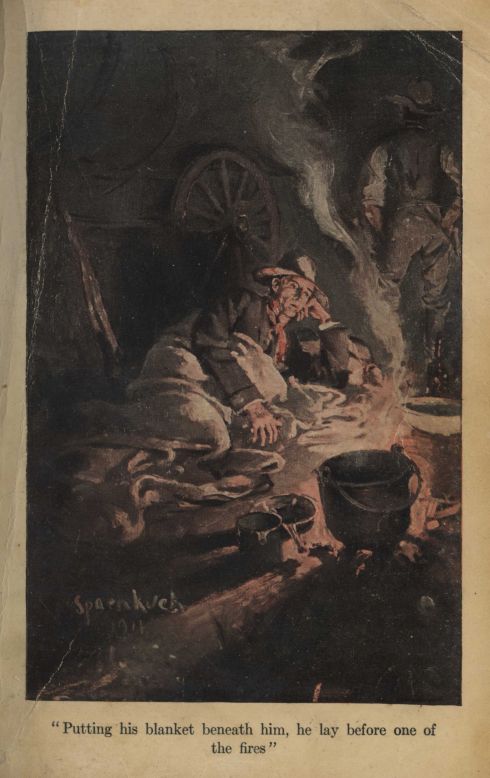
"Putting his blanket beneath him, he lay before one of the fires"
These reflections were so grateful that he found himself able to keep his eyes shut longer. It was not so much of an effort to pull the eyelids down, and when, at intervals steadily growing more distant, he opened his eyes, it was to find the fires and figures of the men becoming dim, while the circling line of the wagons beyond was quite lost. At last the eyelids stayed down of their own accord, and he floated away into a sleep that was deep, sweet, and refreshing.
Others in the camp slept, also, some in the wagons and some on the ground, with saddles for pillows. Those whose duty it was to watch paid no attention to them, but beat up the brush incessantly, and kept up their endless circles on the plains. The somber clouds that had obscured the morning floated away, driven back by a late afternoon sun of uncommon splendor. The gray-green plains turned to a brilliant red and gold; the willows, cottonwoods, and oaks seemed sheathed in gold, every bough and twig; the muddy river took on rich gleaming tints, and then suddenly the sun was gone, leaving all in darkness, save for the smoldering fires.
Phil slept soundly hour after hour. He was so exhausted physically and mentally that the relaxation was complete. No dream good or bad came to trouble him, and Breakstone, who observed his peaceful face, said to Middleton:
"Talk about knitting up the raveled sleeve of care. That boy is knitting up both sleeves at the same time, and he is knitting them fast."
"He is a good lad," said Middleton, "and a brave one, too. It was his first battle, but he certainly bore himself well. Now I wonder what search is bringing him out here into the wilderness."
"And I guess he, too, often wonders the same about us."
"Just as I have wondered it about you, and as you have wondered it about me."
"But we find it best--every one of us--to keep our search to ourselves for the present."
"It is surely best."
The two men looked at each other rather significantly, and then talked of other things.
Phil was awakened at midnight to take his turn at the watch. The night, as it is so often on the plains of Texas, even in summer, was cold, and he shivered a little when he drew himself out of his warm blankets. The fires were nearly out, leaving only a few coals that did not warm, and few figures were moving except outside the circle. His body told Phil that he would much rather sleep on, but his mind told him with greater force that he must go ahead and do his duty with a willing heart, a steady hand, and a quick eye. So he shook himself thoroughly, and was ready for action. His orders were to go in the timber a little to the northward and watch for snipers. Three others were going with him, but they were to separate and take regular beats.
Phil shouldered his rifle and marched with his comrades. They passed outside the circles of wagons, and stood for a few moments on the bare plain. Afar off they saw their own mounted sentinels who watched to the westward, riding back and forth. The moon was cold, and a chill wind swept over the swells, moaning dismally. Phil shivered and was glad that he had a watch on foot in the timber. His comrades were willing to hasten with him to that shelter, and there they arranged their beats. The belt of timber was about a hundred yards wide, with a considerable undergrowth of bushes and tall weeds. They cut the hundred yards into about four equal spaces, and Phil took the quarter next to the river. He walked steadily back and forth over the twenty-five yards, and at the western end of his beat he regularly met the next sentinel, a young Mississippian named Welby, whom Phil liked. They exchanged a few words now and then, but, save their low tones, the monotonous moaning of the wind among the trees, and an occasional sigh made by the current of the river, which here flowed rather swiftly, there was no sound. On the opposite bank the trees and bushes reared themselves, a wall of dark green.
The chill of the night grew, but the steady walking back and forth had increased the circulation and warmed the blood in Phil's veins, and he did not feel it. His long sleep, too, had brought back all his strength, and he was full of courage and zeal. He had suffered a reaction after the battle, but now the second reaction came. The young victor, refreshed in mind and body, feared nothing. Neither was he lonely nor awed by the vast darkness of night in the wilderness. The words that he spoke with Welby every few minutes were enough to keep him in touch with the human race, and he really felt content with himself and the world. He had done his duty under fire, and now he was doing his duty again.
He paused a little longer every time he came to the river, and forcing his mind now to note every detail, he was impressed by the change that the stream had undergone. There was a fine full moon, and the muddy torrent of the day was turned into silver, sparkling more brightly where the bubbles formed and broke. The stream, swollen doubtless by rains about its source, flowed rapidly with a slight swishing noise. Phil looked up and down it, having a straight sweep of several hundred yards either way. Now and then the silver of its surface was broken by pieces of floating debris, brought doubtless from some far point. He watched these fragments as they passed, a bough, a weed, or a stump, or the entire trunk of a tree, wrenched by a swollen current from some caving bank. He was glad that he had the watch next to the river, because it was more interesting. The river was a live thing, changing in color, and moving swiftly. Its surface, with the objects that at times swept by on it, was a panorama of varied interest.
Besides Welby he saw no living creature. The camp was hidden from him completely by the trees and bushes, and they were so quiet within the circle of the wagons that no sound came from them. An hour passed. It became two, then three. Vaporous clouds floated by the moon. The silver light on the river waned. The current became dark yellow again, but flowing as ever with that soft, swishing sound. The change affected Phil. The weird quality of the wilderness, clothed in dark, made itself felt. He was glad when he met Welby, and they lingered a few seconds longer, talking a little. He came back once more to the river, now flowing in a torrent almost black between its high banks.
He took his usual long survey of the river, both up and down stream. Phil was resolved to do his full duty, and already he had some experience, allied with faculties naturally keen. He examined the opposite bank with questioning eyes. At first it had seemed a solid wall of dark green, but attention and the habit of the darkness now enabled him to separate it into individual trees and bushes. Comanches ambushed there could easily shoot across the narrow stream and pick off a white sentinel, but he had always kept himself well back in his own bushes, where he could see and yet be hidden.
His gaze turned to the river. Darker substances, drift from far banks, still floated on its surface. The wind had died. The branches of the trees did not move at all, and, in the absence of all other sound, the slight swishing made by the flowing of the river grew louder. His wandering eyes fastened on a small stump that was coming from the curve above, and that floated easily on the surface. Its motion was so regular that his glance stayed, and he watched it with interested eyes. It was an independent sort of stump, less at the mercy of the current than the others had been. It came on, bearing in toward the western bank, and Phil judged that if it kept its present course it would strike the shore beneath him.
The black stump was certainly interesting. He looked farther. Four feet behind it was floating another stump of about the same size, and preserving the same direction, which was a diagonal line with the current. That was a coincidence. Yet farther was a third stump, showing all the characteristics of the other two. That was remarkable. And lo! when a fourth, and then a fifth, and then a sixth came, a floating line, black and silent, it was a prodigy.
The first black stump struck lightly against the bank. Then a Comanche warrior, immersed hitherto to the chin, rose from the stream. The water ran in black bubbles from his naked body. In his right hand he held a long knife. The face was sinister, savage, and terrible beyond expression. Another of the stumps was just rising from the stream, but Phil fired instantly at the first face, and then sprang back, shouting, "The Comanches." He did not run. He merely sheltered himself behind a tree, and began to reload rapidly. Welby came running through the bushes, and then the others, drawn by the shout. In a minute the timber was filled with armed men.
"What is it? What is it? What did you shoot at?" they cried, although the same thought was in the minds of every one of them.
"The Comanches!" replied Phil. "They came swimming in a line down the river. Their heads looked like black stumps on the water! I fired at the first the moment he rose from the stream! I think it was their plan to ambush and kill the sentinels!"
Bill Breakstone was among those who had come, and he cried:
"Then we must beat them off at once! We must not give them a chance to get a footing on the bank!"
They rushed forward, Phil with them, his rifle now reloaded, and gazed down at the river. They heard no noise, but that slight swishing sound made by the current, and the surface of the stream was bare. The river flowed as if no foreign body had ever vexed its current. Fifty pairs of eyes used to the wilderness studied the stream and the thickets. They saw nothing. Fifty pairs of ears trained to hear the approach of danger listened. They heard nothing but the faint swishing sound that never ceased. A murmur not pleasant to Phil, arose.
"I've no doubt it was a stump, a real stump," one of the older men said.
A deep flush overspread Phil's face.
"I saw a Comanche with long black hair rise from the water," he said.
The man who had spoken grinned a little, but the expression of his face showed that doubt had solidified into certainty.
"A case of nerves," he said, "but I don't blame you so much, bein' only a boy."
Phil felt his blood grow hot, but he tried to restrain his temper.
"I certainly saw a Comanche," he said, "and there were others behind him!"
"Then what's become of all this terrible attack?"! asked the man ironically.
"Come! Come!" said Woodfall. "We can't have such talk. The boy may have made a mistake, but the incident showed that he was watching well, just what we want our sentinels to do."
Phil flushed again. Woodfall's tone was kindly, but he was hurt by the implication of possible doubt and mistake. Yet Woodfall and the others had ample excuse for such doubts. There was not the remotest sign of an enemy. Could he really have been mistaken? Could it have been something like a waking dream? Could his nerves have been so upset that they made his eyes see that which was not? He stared for a full minute at the empty face of the river, and then a voice called:
"Oh, you men, come down here! I've something to show you!"
It was Bill Breakstone, who had slipped away from them and gone down the bank. His voice came from a point at least a hundred yards down the stream, and the men in a group followed the sound of it, descending the slope with the aid of weeds and bushes. Bill was standing at the edge of a little cove which the water had hollowed out of the soft soil, and something dark lay at his feet.
"I dragged this out of the water," he said. "It was floating along, when an eddy brought it into this cove."
They looked down, and Phil shut off a cry with his closed teeth. The body, a Comanche warrior, entirely naked, lay upon its back. There was a bullet hole in the center of the forehead. The features, even in death, were exactly those that the boy had seen rising from the water, sinister, savage, terrible beyond expression. Phil felt a cold horror creeping through all his bones, but it was the look of this dead face more than the fact that he had killed a man. He shuddered to think what so much malignant cruelty could have done had it gained the chance.
"Well, men," said Bill Breakstone quietly, "was the story our young friend here told such stuff as dreams are made on, or did it really happen?"
"The boy told the truth, and he was watching well," said a half dozen together.
The old frontiersman who had so plainly expressed his disbelief in Phil--Gard was his name--extended his hand and said to the lad:
"I take it all back. You've saved us from an ambush that would have cost us a lot of men. I was a fool. Shake hands."
Phil, with a great leap of pride, took the proffered hand and shook it heartily.
"I don't blame you, Mr. Gard," he said. "Things certainly looked against me."
"The Comanches naturally took to flight when their leader was killed," said Woodfall. "They could not carry through such an attempt without surprise, but good eyes stopped them."
Phil's heart leaped again with pride, but he said nothing. They climbed back up the slope, and the guard in the timber was tripled for the short time until day. Phil was told that, as he had already done so much, he might go off duty now.
He was glad enough to seek rest, and so rapidly was he becoming used to danger that he lay down calmly before one of the fires and went to sleep again. He awoke two or three hours later to a crisp fresh morning, and to the news that the train would promptly resume its advance, whether or not Comanches tried to bar the way. With the intoxicating odor of victory still in their nostrils, the hardy frontiersmen were as willing as ever for another combat. But the enemy had disappeared completely. A brilliant sun rose over the gray-green swells, disclosing nothing but a herd of antelope that grazed far to the right.
"The antelope mean that no Comanches are near," said Arenberg. "The warriors will now wait patiently and a long time for a good opportunity. Sometimes much harm iss done where much iss intended."
"That is so," chanted Bill Breakstone.
"Over the plains we go,
Our rifles clear the way.
The Indians would say no.
Our band they cannot stay.
"As I have often remarked before, Phil, my poetry may be defective in meter and some other small technicalities, but it comes to the point. That, I believe, was the characteristic of Shakespeare, also. I agree, too, with Arenberg, that the Comanches will not trouble us again for some time. So, I pray thee, be of good cheer, Sir Philip of the Merry Countenance, Knight of the Battle beside the Unknown River, Slayer of Comanches in the Dark, Guardian of the Public Weal, et cetera, et cetera."
"I am cheerful," said Phil, to whom Breakstone was always a tonic, "and I believe that we can beat off the Comanches any time and every time."
"Jump on your horse," said Breakstone, a little later; "we're all ready."
Phil leaped into the saddle with one bound. The train moved forward, and he and Breakstone joined Middleton and Arenberg at its head. Middleton had powerful glasses, and he swept the plain far ahead, and to right and left. His gaze finally settled on a point to the south-west. The others followed his look with great interest, but the naked eye could see nothing but the rolling gray-green plains and the dim blue horizon beyond. Middleton looked so long that at last Bill Breakstone asked:
"What do you see?"
"I do not see anything that I can really call living," replied Middleton, "but I do see a knoll or slight elevation on the plain--what would be called farther north a butte--and on that knoll is a black blur, shapeless and unnamable at this distance."
"Does the black blur move?" asked Bill Breakstone.
"I cannot tell. It is too far even for that, but from it comes a beam of brilliant light that shifts here and there over the plain. Take a look, Bill."
Breakstone eagerly put the glasses to his eyes, and turned them upon the knoll.
"Ah, I see it!" he exclaimed. "It's like a ball of light! There it goes to the right! There it goes to the left! Now it falls in our direction! What in the name of Shakespeare's thirty-five or forty plays is it, Cap?"
"Let me have the glasses, I want another look," replied Middleton.
His second look was a long one taken in silence. At last he replied:
"It's a signal, lads. I've seen the Comanches talk to one another in this way before. A Comanche chief is sitting on his horse on top of that knoll. He holds a rounded piece of looking-glass in the hollow of his hand, and he turns it in such a way that he catches the very concentrated essence of the sun's rays, throwing a beam a tremendous distance. The beam, like molten gold, now strikes the grass on top of a swell off toward the north. It's a secret just how they do it, for not yet has any white man learned the system of signals which they make with such a glass. Ah!"
The "Ah!" came forth, so deep, so long drawn, and so full of meaning that Phil, Arenberg, and Bill Breakstone exclaimed together:
"What is it?"
"I would not have known that the black blur on top of the knoll was a chief on horseback if I had not been on the Texas plains before," replied Middleton, "but now I can make out the figures of horse and man, as he is riding around and around in a circle and riding very rapidly."
"What does that mean?" asked Phil.
"It means danger, not to us, but to the Comanches. The warrior is probably signaling to a band of his tribe who are meditating attack upon us that we are too strong."
"Then it must be some fresh band," said Bill Breakstone, "because the one that had the little encounter with us yesterday knew that already."
"I take it that you're right," said Middleton, smiling and closing the glasses. "The second band won't molest us--not to-day."
"That seems to be a very effective way of signaling," remarked Phil.
"On the plains, yes," said Middleton. "It is astonishing how far such a vivid beam of light will carry, as the crest of the knoll was too high for it to be intercepted by the swells."
Middleton told Woodfall what they had seen. The leader's chin stiffened a little more, and the wagons went on at the same pace, trailing their brown length across the prairie.
About ten o'clock the march became difficult, as they entered a town, but such a town! Its inhabitants were prairie dogs, queer little animals, which darted down into their burrows at the approach of the horsemen and wagons, often sharing the home with a rattlesnake. But the horsemen were now compelled to proceed with exceeding care, as the horses' feet often sank deep down in the dens. Stumbles were frequent and there were several falls. Wagon wheels, also, sank, and the advance became so difficult that Woodfall halted the train and sent Phil and some others to find a way around the town.
They rode five or six miles to the south, and still the singular town stretched away, apparently endless. Then they came back and rode five or six miles to the north with the same result. Acting upon the advice of Middleton, Woodfall, after hearing these reports, decided to go straight on through the town. It was known that such towns had been found twenty-five miles long, and this might be as large. So they went directly ahead. The riders dismounted and led their horses. Three times Phil killed coiling rattlesnakes with the butt of his rifle, but he did not seek to molest any of the prairie dogs.
They moved very slowly, and it was three hours before they crossed the prairie dog town, leaving behind them some destruction, but not more than they could help.
"Well, Sir Philip of the Prairie Dogs, what name are you going to give to the populous community through which we have just passed?" asked Breakstone.
"I suppose Canine Center will do as well as any other," replied Phil.
"A wise selection, my gay youth," replied Bill Breakstone. "But these animals, properly speaking, are not dogs, they are more like rats. I'm glad we've passed 'em. It isn't pleasant to have your horse put his foot in one of their dens and shoot you over his head. The good hard plain for me."
He cantered forward, and Phil cantered with him, raising his head and breathing the pure air that blew over such vast reaches of clean earth. He felt the blood leaping in his veins again from mere physical happiness. He began to whistle gayly, and then to sing "Open thy lattice, love," a song just coming into favor, written by the man who became yet more famous with "Old Kentucky Home" and "Suwanee River." Phil had a fine, fresh, youthful voice, and Breakstone listened to him as he sang through two verses. Then he held up his hand, and Phil stopped.
"What's the trouble?" asked the boy.
"I don't object to your song, Phil, and I don't object to your singing, but it won't be a good time for love to open the lattice; it will be better to close it tight. Don't you feel a change in the air, Phil? Just turn your face to the northwest, and you'll notice it."
Phil obeyed, and it seemed to him now that the air striking upon his cheek was colder, but he imagined that it was due to the increasing strength of the wind.
"I do not care if the wind is a little cold," he said. "I like it."
"The wind is cold,
And you are bold;
The sky turns gray
You're not so gay;
And by and by
For sun you'll sigh,"
chanted Bill Breakstone, and then he added:
"See that gray mist forming in a circle about the sun, and look at that vapor off there in the northwest. By George, how fast it spreads! The whole sky is becoming overcast! Unroll your blanket, Phil, and have it ready to wrap around you I The whole train must stop and prepare!"
Bill Breakstone turned to give his warning, but others, too, had noticed the signals of danger. The command stop was given. The wagons were drawn rapidly into circle, and just as when the danger was Indians, instead of that which now threatened, all the horses and mules were put inside the circle. But now all the men, also, took their station inside, none remaining outside as guard. The wind meanwhile rose fast, and the temperature fell with startling rapidity. The edge of the blast seemed to be ice itself. Phil, who was helping with the corral of wagons, felt as if it cut him to the bone. He fully appreciated Bill Breakstone's advice about the blanket. The day also was swiftly turning dark. The sun was quite gone out. Heavy clouds and masses of vapor formed an impenetrable veil over all the sky. Now, besides the cold, Phil felt his face struck by fine particles that stung. It was the sand picked up by the wind, perhaps hundreds of miles away, and hurled upon them in an enveloping storm.
Phil pulled down his cap-brim and also sheltered his eyes as much as he could with his left arm.
"It's the Norther," cried Breakstone. "Listen to it!"
The wind was now shrieking and howling over the plains with a voice that was truly human, only it was like the shout of ten thousand human beings combined. But it was a voice full of malice and cruelty, and Phil was glad of the companionship of his kind.
The cold was now becoming intense, and he rapidly drew the blanket about his body. Then he suddenly bent his head lower and completely covered his eyes with his arm. It was hailing fiercely. Showers of white pellets, large enough to be dangerous, pounded him, and, as the darkness had now increased to that of night, he groped for shelter. Bill Breakstone seized him by the arm and cried:
"Jump into the wagon there, Phil! And I'll jump after you!"
Phil obeyed with the quickness of necessity, and Breakstone came in on top of him. Middleton and Arenberg were already there.
"Welcome to our wagon," said Arenberg, as Phil and Breakstone disentangled themselves. "You landed on one of my feet, Phil, and you landed on the other, Bill, but no harm iss done where none iss meant."
Phil cowered down and drew his blanket more closely around him, while the hail beat fiercely on the arched canvas cover, and the cold wind shrieked and moaned more wildly than ever. He peeped out at the front of the wagon and beheld a scene indescribable in its wild and chilling grandeur. The darkness endured. The hail was driven in an almost horizontal line like a sheet of sleet. The wagons showed but dimly in all this dusk. The animals, fortunately, had been tethered close to the wagons, where they were, in a measure, protected, but many of them reared and neighed in terror and suffering. One look satisfied Phil, and he drew back well under cover.
"How often does this sort of thing happen in Texas?" he asked Arenberg.
"Not so often," replied the German, "and this Norther, I think, is the worst I ever saw. The cold wind certainly blows like der Teufel. These storms must start on the great mountains far, far to the north, and I think they get stronger as they come. Iss it not so, Herr Breakstone?"
"Your words sound true to me, Sir Hans of the Beer Barrel," replied Breakstone. "I've seen a few Northers in my time, and I've felt 'em, but this seems to me to be about the most grown-up, all-around, healthy and frisky specimen of the kind that I ever met."
Phil thought that the Norther would blow itself out in an hour or two, but he was mistaken. Several hours passed and the wind was as strong and as cold as ever. The four ate some cold food that was in the wagon, and then settled back into their places. No attempt would be made to cook that day. But Phil grew so warm and snug in his blanket among the baggage, and the beating of the rain on the stout canvas cover was so soothing, that he fell asleep after awhile. He did not know how long he slept, because when he awoke it was still dark, the wind was still shrieking, and the other three, as he could tell by their regular breathing, were asleep, also. He felt so good that he stretched himself a little, turned on the other side, and went to sleep again.
CHAPTER V
THE COMANCHE VILLAGE
The Norther did not blow itself out until noon of the next day. Then it ceased almost as abruptly as it had begun. The wind stopped its shrieking and howling so suddenly that the silence, after so long a period of noise, was for awhile impressive. The clouds fell apart as if cut down the middle by a saber, and the sun poured through the rift.
It was like a fairy transformation scene. The rift widened so fast that soon all the clouds were gone beyond the horizon. The sky was a solid blue, shot through with the gold of the warm sun. The hail melted, and the ground dried. It was spring again, and the world was beautiful. Phil saw, felt, and admired. Bill Breakstone burst into song:
"The Norther came,
The Norther went.
It suits its name,
Its rage is spent.
"From the looks of things now," he continued, "you wouldn't think it had been whistling and groaning around us for about twenty-four hours, trying to shoot us to death with showers of hail, but I'd have you to know, Sir Philip of the Untimely Cold and the Hateful Storm, that I have recorded it upon the tablets of my memory. I wouldn't like to meet such a Norther when I was alone on the plains, on foot, and clad in sandals, a linen suit, and a straw hat."
"Nor I," said Phil with emphasis.
Now they lighted fires of buffalo chips which were abundant everywhere, and ate the first warm food that they had had since the day before at noon. Then they advanced four or five miles and encamped on the banks of a creek, a small stream of water flowing in a broad, sandy bed. Phil and some of the others scouted in a wide circle for Comanches, but saw no signs, and, as he had slept so late that day, the boy remained awake most of the night. There was a good moonlight, and he saw dusky slinking forms on the plain.
"Coyotes," said Bill Breakstone. "At least, most of them are, though I think from their size that two or three of those figures out there must be timber wolves. If I'm right about 'em, it means that we're not far from a belt of forest country."
"I hope you're right," said Phil. "I'm getting tired of plains now, and I'd like to see trees and hills again, and also water that runs faster and that's less muddy than these sluggish and sandy creeks."
Bill Breakstone threw back his head and laughed with unction.
"That's the way with fellows who were born in the hills," he said. "Wherever you go, sooner or later you'll pine for 'em again. I'm one of that lot, too."
"Yes, it's so," admitted Phil. "I like the great plains, the vastness, the mystery, and the wonderful air which must be the purest in the world, that's always blowing over them, but for a real snug, homey feeling give me a little valley in the hills, with a brook of green-white water about six inches deep running down it, and plenty of fine trees--oak, beech, hickory, elm, walnut, and chestnut--growing on the slopes and tops of the hills."
"A pretty picture, Sir Philip of the Brook, the Hill, the Valley, and the Tree," said Bill Breakstone, "and maybe we will see it soon. As I told you, timber wolves indicate trees not far off."
But the chief event that day was buffaloes and not timber. They ran into a vast herd, traveling north with the spring, and killed with ease all they wanted. The bodies were cut up, and the wagons were filled with fresh meat. There was a momentary quandary about the hides, which they wished to save, a process that required immediate curing, but they were unwilling to stop for that purpose on the plain. Two of the scouts came in at sundown with news that the timber was only three or four miles ahead, and the whole train pushed forward, reaching it shortly after nightfall.
The wagons stopped just within the edge of the timber, but Phil, Breakstone, Arenberg, and Middleton rode on, the night being so clear and bright that they could see almost as well as by day. The first range of hills was low, but beyond lay others, rising perhaps two hundred feet above the level of the plain. The timber on all the hills and the valleys between was dense and heavy, embracing many varieties of hard wood, elm, hackberry, overcup, ash, pecan, and wild china. There were also the bushes and vines of the blackberry, gooseberry, raspberry, currant, and of a small fox grape, plentiful throughout the mountains of Texas. The fox grape grew on a little bush like that of the currant, and growing in abundance was another bush, from two to six feet in height, that would produce wild plums in the autumn.
"It's a good country, a fine country," said Bill Breakstone. "A man could live all the year around on the food that he would find in this region, buffalo and antelope on the plains, deer and maybe beaver in here, and all sorts of wild fruits."
Phil nodded. He was reveling in the hills and timber. The moonlight fell in a vast sheet of silver, but the foliage remained a solid mass of dark green beneath it. A tremulous little wind blew, and the soft sound of fresh young leaves rubbing together came pleasantly. A faint noise like a sigh told of a tiny stream somewhere trickling over the pebbles. Phil opened his eyes as wide as he could and drew in great gulps of the scented air. Big bronze birds, roused by the tread of the horsemen, rose from a bough, and flew away among the trees. They were wild turkeys, but the lad and his comrades were not seeking game just then. Bill Breakstone, who was in advance, stopped suddenly.
"Come here, Sir Philip of the Hilly Forest," he cried, "and see what uncle has found for his little boy."
Phil rode up by his side and uttered a little gasp of admiration. As he sat on his horse, he looked into a ravine about two hundred feet deep. Down the center of the ravine dashed a little mountain river of absolutely clear water. It was not more than twenty feet wide, but very deep. As Breakstone said, "it ran on its side," but it ran along with much murmur and splash and laughter of waters. Often as the swift current struck the stony sides of the ravine it threw up little cascades of foam like snow. The banks themselves, although of stone, were covered most of the way with clustering vines and short green bushes. The crest of the farther bank was wooded so heavily with great trees that they were like a wall. Farther down, the stream descended with increased swiftness, and a steady murmuring noise that came to them indicated a waterfall. The brilliant moonlight bathed the river, the hills, and the forest, and the great silence brooded over them all. Middleton and Arenberg also came, and the four side by side on their horses sat for awhile, saying nothing, but rejoicing in a scene so vivid and splendid to them, after coming from the monotony of the great plains.
"I'd like to drop off my horse after a hot day's ride," said Bill Breakstone, "and have some of that river run over me. Wouldn't that be a shower-bath for a tired and dusty man!"
"It's likely to be ice-cold," said Middleton.
"Why so?" asked Phil.
"Because it rises somewhere high up. There must be mountains to the northward, and probably it is fed most of the year by melting snows. I think Bill would have enough of his bath very quickly."
"If I get a chance, and there is any way to get down to that stream, I may try it to-morrow," said Bill threateningly.
"Meanwhile, we'll ride back and tell what we've seen," said Middleton.
"Isn't there any danger of Indian ambush in the timber?" asked Phil.
"I don't think so," replied Middleton. "The Comanches are horse Indians, and keep entirely to the plains. The other tribes are too much afraid of the Comanches to remain near them, and in consequence the edge of a hilly stretch such as this is likely to be deserted."
They rode back to the wagons and found that the cooking fires were already lighted, and their cheerful blaze was gleaming among the trees. Everybody else, also, was delighted at being in the timber, where clear water flowed past, and most of the wounded were able to get out of the wagons and sit on the grass with their comrades. Woodfall decided that it was a good place in which to spend a few days for rest, repairs, and the hunting of game, as they wanted other fresh meat besides that of the buffalo.
The next morning they began to cure the buffalo hides that they had already obtained. A smooth piece of ground, exposed all day to the rays of the sun, was chosen. Upon this the skin was stretched and pegged down. Then every particle of the flesh was scraped off. After that, it was left about three days under the rays of the sun, and then it was cured. Twenty-five skins were saved in this manner, and, also, by the same method of drying in the sun, they jerked great quantities of the buffalo meat.
But Middleton, Arenberg, Breakstone, and Phil turned hunters for the time. They found that the hill region was very extensive, timbered heavily, and abundant in game. They hunted wholly on foot, and found several places where the ravine opened out, at which they could cross the little river by walking, although the water rose to their waists.
They had great luck with the game, shooting a half dozen splendid black-tailed deer, a score of wild turkeys, and many partridges, quail, and grouse. Bill Breakstone, according to his promise, bathed in the river, and he did it more than once. He was also joined by his comrades, and, as Middleton had predicted, they found the water ice-cold. No one could stand it more than five minutes, but the effect was invigorating.
A great deal of work was done at the camp. The axles of wagons were greased, canvas ripped by wind or hail was sewed up again, clothing was patched, and the wounded basked in sun or shade. Two of these had died, but the rest were now nearly well. All except two or three would be fit to resume their duties when they started again.
Woodfall, knowing the benefit of a complete rest, still lingered, and Phil and his friends had much time for exploration. They combined this duty with that of the scouting, and penetrated deep into the hills, watching for any Comanches who might stray in there, or for the mountain tribes. Once they came upon several abandoned lodges, made partly of skins and partly of brush, but they were falling in ruins, and Bill Breakstone reckoned they were at least two years old.
"Wichitas, Wacos, Kechies, and Quapaws live around in the hills and mountains," he said, "and this, I take it, was a little camp of Kechies, from the looks of the lodges. Two or three groups of them may be lingering yet in this region, but we haven't much to fear from them."
Woodfall, intending at first to make the stay only four or five days, decided now to protract it to ten or twelve. The journey to Santa Fé was one of tremendous length and hardship. Moreover, a buffalo hunter, straying in, told them that the Comanches were very active all over the Texas plains. Hence the Santa Fé train would need all its strength, and Woodfall was anxious that every one of the wounded should be in fighting condition when they left the timber. Therefore the delay.
Phil was glad of the added stay in the hills. He was developing great skill as a hunter and a trailer, and he and his comrades wandered farther and farther every day into the broken forest region toward the north. Oftenest he and Bill Breakstone were together. Despite the difference in years, they had become brothers of the wilderness. In their scoutings they found available pathways for horses over the hills and among the great trees, and, starting, one morning, they rode far to the north, covering thirty or forty miles. Phil was interested in some high mountains which showed a dim blue ahead, and Breakstone was carefully examining the rock formations. But as night came on they found that the hills were dropping down, and the mountains seemed to be about as blue and as far ahead as ever.
"I should judge from these signs," said Breakstone, "that there is a valley or narrow plain ahead, between us and the mountains. But we'll look into that to-morrow. It isn't good to be riding around in the dark over hills and through thickets."
They found a little grassy open space, where they tethered their horses, leaving them to graze as long as they wished, and, lighting no fire, they ate jerked buffalo meat. Then they crept into snug coverts under the bushes, wrapped their blankets about them, and fell asleep. Phil opened his eyes at daylight to find Breakstone already awake. The horses were grazing contentedly. The trees and bushes were already tipped with fire by the gorgeous Texas sun.
"Sir Philip of the Bushes," said Bill Breakstone, "you just lie here and chew up a buffalo or two, while I go ahead and take a look. As I said last night, these hills certainly drop down into a plain, and I want to see that plain."
"All right," said Phil, "I'll stay where I am. It's so snug in this blanket on a cool morning that I don't care to move anyhow, and I can eat my breakfast lying down."
He drew out a freshly jerked strip of buffalo meat, and another very tender portion of a black-tailed deer that he himself had shot, and fell to it. Bill Breakstone, his rifle held conveniently at his side, slid away among the bushes. Phil ate contentedly. The sun rose higher. The morning was absolutely still. The horses seemed to have had enough grass, and lay down placidly on their sides. It occurred to Phil that he, too, had eaten enough, and he put the remainder of the food back in his hunter's knapsack. Then he began to get drowsy again. It was so very still. He thought once of rising and walking about, but he remembered Breakstone's advice to lie still, and, against his will, he kept it. Then his drowsiness increased, and, before he was aware of it he was asleep again.
When Phil awoke the second time, he threw off his blanket and sprang to his feet in surprise. The sun was high up in the blue arch. It must be at least ten o'clock in the morning, and Bill Breakstone had not come back. The horses were on their feet and were grazing again. They were proof that nothing had disturbed the glade. But Bill Breakstone was not there. Nor had he come back and gone away again. If he had done so, he would have awakened the boy. He had been absent three or four hours, and Phil was alarmed.
The boy stood up, holding his hand on the hammer of his rifle. This beautiful day, with its blue skies above and its green forest below, oppressed him. It was so still, so silent, and Bill Breakstone had vanished so utterly, just as if he had been turned into thin air by the wave of a magician's wand! The boy was alone in the wilderness for the first time. Moreover, he felt the presence of danger, and the queer little shiver which often comes at such moments ran through his blood. But the shiver passed, and his courage rose. He had no thought of going back to the camp to report that Bill Breakstone was missing. No, he would find him himself. That was his duty to his comrade.
The boy waited a little longer, standing there in the shade with his rifle ready, and eyes and ears intent. He stood thus for a quarter of an hour, scarcely moving. The brilliant sunshine poured down upon him, bringing out every line of the strong young figure, illuminating the face which was thrown a little forward, as the blue eyes, gazing intently through the undergrowth, sought some evidence of a hostile presence. Finally the eyes turned to the horses which were grazing calmly in the full circle of their long lariats. Phil decided that such calm on their part signified the absence of any enemy. If either man or beast came near they would raise their heads.
Then Phil moved forward through the bushes, putting into use all his new skill and caution. The bushes closed softly behind him, and he entered a slope covered with great trees without undergrowth. His eyes could range forward several hundred yards, but he saw nothing. He advanced for a few minutes, steadily descending, and he was tempted to shout his loudest or fire off his rifle as a signal to the derelict Bill Breakstone that it was time for him to come back. But he resisted both temptations, and soon he was glad that he had done so. The slope was very gradual, and he traveled a full two miles before he came to the edge of the woods and saw before him the plain that Bill Breakstone had predicted. He took one look, and then, springing back, sank down in the covert of the bushes.
Before Phil lay a fairly level plain about a mile in width and of unknown length, as in either direction it parsed out of sight among the hills. In the center of it was a shallow but wide creek which perhaps flowed into the nameless river. The valley was very fertile, as the grass was already rich and high, despite the earliness of spring.
At the widest point of the valley stood a large Indian village, two hundred lodges at least, and Phil could not doubt that it was a village of the Comanches. Hundreds of ponies, grazing in the meadows to the north, and guarded by boys, proved that they were horse Indians, and no other tribe dared to ride where the Comanches roamed.
Phil could see far in the dazzling sunlight, and all the normal activities of human life, that is, of wild life, seemed to prevail in the Comanche village. Evidently the warriors had been on a great buffalo hunt. Perhaps they had struck at another point the same herd into which the train had run. Over a wide space buffalo hides were pegged down. Old squaws were scraping the flesh from some with little knives, while others, already cleaned, were drying in the sun. Vast quantities of buffalo meat were being jerked on temporary platforms. Little Indian boys and girls carried in their hand bones of buffalo or deer, from which they ate whenever they felt hungry. Everywhere it was a scene of savage plenty and enjoyment, although signs of industry were not wholly lacking, even among the warriors. Many of these, sitting on the grass, were cleaning their rifles or making new bows and arrows. Now and then one would make a test, sending into the air an arrow which some little boy was glad to run after and bring back. At another point a number of boys were practicing at a target with small bows and blunt-headed arrows. Two warriors on their ponies came up the valley, each carrying before him the body of a black-tailed deer. They were received with shouts, but soon disappeared with their spoils among the lodges, which were made universally of the skin of the buffalo. Down at the end of the village some warriors, naked to the breech cloth, danced monotonously back and forth, while an old man blew an equally monotonous tune on a whistle made of the bone of an eagle.
Phil, lying close in his covert, watched with absorbed eyes, and with mind and vision alike quick and keen, he took in every detail. The warriors were tall men, with intelligent faces, aquiline noses, thin lips, black eyes and hair, and but little beard. The hair grew very long, as they never cut it, and in many cases it was ornamented with bright beads and little pieces of silver. They wore deerskin leggins or moccasins, and a cloth of some bright color, bought from American Mexican traders, wrapped around the loins. The body from the loin cloth upward was naked, but in winter was covered with a buffalo robe. The women were physically very much inferior to the men. They were short and with crooked legs. Moreover, they wore their hair cut close, being compelled to do so by tribal law, the long-haired Comanche men and the short-haired Comanche women thus reversing the custom of civilization. Both men and women wore amulets. The Comanches, like most Indian tribes, were great believers in dreams, and the amulets were supposed to protect them from such as were bad.
Phil's roving eye lighted upon a small frame structure built of slight poles, the only one in the village not of hides. Such a building was always to be found in every Comanche village, but he did not know until later that it was a combined medicine lodge and vapor bath house. It was spherical in shape, and securely covered with buffalo hides. When a warrior fell seriously ill, he was seated in this lodge, beside several heated stone ovens, on which water was thrown in profusion. Then, while a dense, hot vapor arose, the shaman, or medicine man, practiced incantations, while men outside made music on whistles or the Indian drums. The hot bath was often effective, but the Comanche ascribed at least a part of the cure to the medicine man's incantations. Young Comanche men, also, often took a vapor bath before going on the war path, thinking that it had power to protect them from wounds.
Then Philip saw to the right a far larger building than that of the vapor bath, although it was made of dressed skins with just enough poles to support it. This was the medicine lodge of the Comanche village, a building used for important purposes, some of which Phil was to learn soon.
The boy did not doubt that his comrade had been taken, and, unless killed, was even now a captive in the Comanche village. He might be held in that huge medicine lodge, and the boy's resolution strengthened to the temper of steel. He could not go back to the train without Bill Breakstone; so he would rescue him. He did not yet have any idea how, but he would find a way. There were depths of courage in his nature of which he himself did not know, and springing from this courage was the belief that he would succeed.
While he yet lay in the covert he saw a band of Indians, about a dozen in number, riding up the valley. They were apparently visitors, but they were welcomed with loud cries. The leader of the band, a large man with brilliant feathers in his hair, replied with a shout. I Then a horseman rode forth to meet him. Even at the distance Phil recognized the horseman as Black Panther. He, too, was arrayed in his finest, and, as a great crowd gathered, the two chiefs slowly approached each other. When their horses were side by side, Black Panther leaned over in his saddle, put his head on the other's shoulder, clasped his arms around his chest, and gave him a tremendous squeeze. The stranger returned the salute in kind, and then the two, amid great shouts of approval, rode among the lodges, disappearing from Phil's sight.
Phil watched awhile longer, but he saw nothing except the ordinary life of the village. Then he went back to the glen in which the horses were tethered. They were still grazing, and Bill Breakstone had not returned. Phil led them down to a little brook, let them drink, and then, after some thought, took off the lariats, coiled them around the saddles, and turned the animals loose. He believed they would stay in the glen or near it, as the pasturage was good, and the water plentiful, and that they could be found when needed.
Having attended to the horses, he returned to the edge of the forest and sat himself down to think out the plan of his great adventure.
It was his intention to enter the Comanche village without detection, and, hard as such a task seemed to him, it was even harder in reality. No race more wary than the Comanches ever lived. Besides the boys who habitually watched the ponies, they had regular details of warriors as herdsmen. Other details served as sentries about the village, and the adjacent heights were always occupied by scouts. All these guards were maintained night and day. Phil could see some of them now patrolling, and, knowing that any attempt of his would be impossible in the daylight, he waited patiently for night. He had with him enough food to last for a day or two, and, choosing a place in the dense covert, he lay down. He called up now all the wilderness lore of Breakstone, Arenberg, Middleton, and the others in the train. He knew that he must restrain all impulsiveness until the appointed time, and that he must lie without motion lest the keen eyes of wandering warriors should see the bushes above him moving in a direction other than that of the wind. He also laid his rifle parallel with his body, in the position in which it could be used most quickly, and loaded the pistol. It was hardest of all to lie perfectly still. He wished to turn over, to crawl to a new place, and his bones fairly ached, but he restrained himself. Naturally a youth of strength and determination, his mind took the mastery over his body, and held it fast and motionless among the bushes.
It was well that he controlled himself so completely. Indians came near the edge of the woods, and once some boys passed, driving a herd of ponies. But he crouched a little closer, and they went on. The day was fearfully long. The high sun poured down a shower of vertical beams that reached him even in the shelter of the bushes. The perspiration stood out on his brow, and his collar clung to his neck. He envied the freedom of the Comanches in the villages and the easy way in which they went about the pleasure of savage life. More warriors, evidently hunters, came in. Some bore portions of the buffalo, and others were loaded with wild turkeys.
In these hard hours the boy learned much. He had passed safely through battle. But there one was borne up by the thrill and excitement of the charge, the firing and shouting and the comradeship of his fellows. Here he was alone, silent and waiting. Enduring such as that, his will achieved new powers. A single day saw the mental growth of a year or two.
The sun passed the zenith and crept slowly down the western heavens. Welcome shadows appeared in the east, and the far lodges of the Comanches grew misty. Phil thought now that the village would sink into quiet, but he noticed instead a great bustle, and many people going about. Squaws bore torches which made a bright core of flame in the increasing dusk, and Phil was quite sure now that something unusual was going to occur. It seemed to him that the whole population of the village was gathering about the great medicine lodge. It must be the beginning of some important ceremony, and the time to enter the Comanche village was propitious. He inferred that on such an occasion the guard would be relaxed, at least in part, and as he heard the sound of hundreds of voices chanting monotonously he prepared for his great adventure.
The twilight faded, and the night came in its place, thick and dark. The sound of many voices, some singing, some talking, came clearly through the crisp, dry air. The core of light before the medicine lodge increased, and, by its radiance, he saw dusky figures hastening toward it to join the great group gathered there.
Phil took off his cap and hid it in the bushes. He would be bareheaded like the Comanches, wishing to look as much like them as possible. Fortunately his hair had grown somewhat long, and his face was deeply tanned. Once he thought of stripping to the waist in Comanche fashion, but his body, protected from the sun, was white, and he would be detected instantly.
He spent a little time flexing and stretching his muscles, because, when he first rose to his feet, he could scarcely stand, and the blood, choked up in the arteries and veins, tingled for lack of circulation. But the stiffness and pain soon departed, and he felt stronger than ever before in his life. Then he started.
He advanced boldly into the plain, bent very low, stopping at times to look and listen, and, also, to rest himself. More than once he lay flat upon the ground and allowed his muscles to relax. Once he saw upon his right two Indian warriors standing upon a knoll. They were a part of the night guard, and their figures were outlined duskily against the dusky sky. Their faces were not disclosed. But Phil knew that they were watching--watching with all the effectiveness of eye and ear for which the Indian is famous. At this point he crawled, and, in his crawling, he was so nearly flat upon his stomach that his advance was more like a serpent's than that of anything else.
He left the patrol behind, and then he saw another on his left, and much nearer to him, two more warriors, who did not occupy any knoll, but who merely walked back and forth on the flat plain. They were between him and the great fire, and he saw them very distinctly, tall men of light copper color, with high cheek-bones and long black hair. Both were armed with rifles, of which the Comanches were beginning to obtain a supply, and their faces in the glow of the firelight seemed very savage and very cruel to Phil. Now he flattened himself out entirely, and moved forward in a slow series of writhings, until he had passed them. There was an icy rim around his heart until he left these two behind, but when they were gone in the darkness his courage leaped up anew.
He now reached the eastern end of the village and crept among the lodges. They were all deserted. Their occupants had gone to witness the ceremony that was now at hand, whatever it might be. Not a woman, not a child was left. Phil stood up straight, and it was an immense relief to him to do so. It was a relief to the spirit as well as the body. He felt like a human being again, and not some creeping animal, a human being who stands upon his two feet, a human being who has a brain with which he thinks before he acts. It was strange, but this mere physical change gave him a further supply of courage and hope, as if he had already achieved his victory.
He passed between two lodges and saw a gleam beyond. It was the surface of the wide but shallow creek, showing through the dusk. The banks were five or six feet high, and there was a broad bed of sand extending on either side of the water.
Phil glanced up the stream, and saw that it flowed very close to the medicine lodge. An idea sprang up at once in his alert brain. Here was his line of approach. He dropped softly down the bank, taking his chance of quicksand, but finding instead that it was fairly firm to the feet. Then, hugging the bank, he advanced with noiseless tread toward the medicine lodge. Chance and his own quick mind served him well. His feet did not sink more than a few inches in the sand, and the bank continued at its uniform height of about six feet. He continued slowly, pausing on occasion to listen, because he could see nothing in the village. But occasional stray beams from the fires, passing over his head, fell upon the creek, lingering there for a moment or two in a red glow. Above him on the bank, but some distance back, the fires seemed to grow, and the monotonous beat of the singing grew louder. Phil knew that he was now very near the medicine lodge, and he paused a little longer than usual, leaning hard against the sandy bank with a sort of involuntary impulse, as if he would press his body into it to escape observation.
He looked up and saw two or three boughs projecting over the bank. Then the medicine lodge was some distance away, perhaps fifteen or twenty yards, and, therefore, the adventure would increase in peril! Another glance at the boughs reassured him. Perhaps there was a little grove between the creek and the medicine lodge, and it would afford him hiding! The largest of the boughs, amply able to support his weight, was not more than three or four feet above the bank, and, climbing cautiously the sandy slope, he grasped it and drew himself up. Then he slid along it until he came to the crotch of the tree, where he crouched, holding his rifle in one hand.
He was right in his surmise about the grove, although it was narrower than he had supposed, not more than seven or eight yards across at the utmost. But the trees were oak, heavy-limbed and heavy-trunked, and they grew close together. Nevertheless, the light from some of the fires showed through them, and at one side loomed the dark mass of the medicine lodge. As nearly as he could see, it was built directly against some of the trees. He crawled from his tree to the one next to it, and then to a third. There he stopped, and a violent fit of shuddering seized him. The trees were occupied already.
On boughs so near that he could touch them rested a platform of poles about eight feet long and four feet wide. The poles were tied tightly together with rawhide thongs, and over them were spread leaves, grass, and small boughs. Upon these couches rested two long figures wrapped tightly in buffalo hide. They were the bodies of the dead. Farther on were other platforms and other bodies. Phil knew what the dark objects were. He had read and heard too much about Indian life to be mistaken, and, despite his power of will over self, he shuddered again and again. He surmised that these might be temporary burial platforms, as they were usually put in isolated places away from the village, but here they were, and now it occurred to him that their presence would be to his advantage. Superstition is strong among the Comanches, and they would not walk under the trees that supported the burial platforms on their boughs.
He advanced from bough to bough until he came directly against the skin walls of the great medicine lodge. There he lay along a strong and horizontal bough with his body pressed close to the wall, and a human eye ten feet away would not have seen him. Just above Phil's head was a place where two of the buffalo hides had not been sewn closely together, and the light from within shone out. He raised his head, widened the place with his knife, and looked down into the medicine lodge.
The boy beheld an extraordinary scene. From the roof of the lodge hung a joss or image, with the profile of a man, rudely carved from a split log. One side of the face was painted white, and the other black. Beneath it was a circular space about twenty feet in diameter, roped off and surrounded by a great crowd of people. Old squaws held aloft torches of pine or other wood that cast a ruddy light over eager and intense faces.
A great medicine dance was about to be held; and now the shaman, or chief medicine man, an old, dark Indian named Okapa, who for the present took precedence over both Black Panther and his visitor, who was the great chief Santana, was preparing to begin. Phil could see Okapa clearly as he stood alone in the center of the cleared circular space, carrying in his hands a short, carved stick, like a baton. It is hard to judge an Indian's age, but Phil Bedford believed that this man must be at least seventy. Nevertheless, despite his deeply lined and seamed face, he was erect and strong. But it was, a cruel face, with thin, compressed lips, a large hooked nose, and jet black eyes that smoldered with dark fire. It was a face to inspire fear, and it was all the more ominous when the light of many torches fell upon it, tinting it a deeper and darker red.
Okapa raised his hand. Save for the tense breathing of the multitude there was silence in the lodge. Phil, forgetful of all danger, pressed more closely against the buffalo skin to see.
CHAPTER VI
THE MEDICINE LODGE
Okapa uttered a name. A young warrior, bare to the waist, stepped forward, entering the circular space within the ropes. He called a second name, and a second warrior responded in like manner, then a third and fourth, and so on until his list was complete with twelve. These were to be the dancers. One was chosen for every one hundred persons--men, women, and children--in the band. Therefore, this village had a population of twelve hundred.
The dancers, all young men, stood close together, awaiting the signal. They had been taking strange compounds, like drugs, that the Indians make from plants, and their eyes were shining with wild light. Their bodies already moved in short, convulsive jerks. Any dancer who did not respond to his name would have been disgraced for life.
After a few moments Okapa called six more names, with a short delay after every one. Six powerful warriors, fully armed with rifle, tomahawk, and knife, responded, and took their position beside the ropes, but outside the ring. They were the guard, and the guard was always half the number of the dancers.
Now the breathing of the multitude became more intense and heavy, like a great murmur, and Okapa handed to every one of the dancers a small whistle made of wood or bone, in the lower end of which was fastened a single tail feather of the chaparral cock or road runner, known to the Indians as the medicine bird. The dancers put the little whistles in their mouths, then the shaman arranged them in a circle facing the center. The crowd in the medicine lodge now pressed forward, uttering short gasps of excitement, but the guards kept them back from the ropes.
To the boy at the slit between the buffalo skins it was wild, unreal, and fantastic beyond degree, some strange, mysterious ceremony out of an old world that had passed. He saw the bare chests of the warriors rising and falling, the women as eager as the men, a great mass of light coppery faces, all intense and bent forward to see better. He knew that the air in the medicine lodge was heavy, and that its fumes were exciting, like those of gunpowder. Parallel with the dancers, and exactly in the center of their circle, hung the hideously carved and painted joss or wooden image. The twelve looked fixedly at it.
The shaman, standing on one side but within the circle, uttered a short, sharp cry. Instantly the twelve dancers began to blow shrilly and continuously upon their whistles, and they moved slowly in a circle around and around toward the right, their eyes always fixed upon the joss. The multitude broke into a wild chant, keeping time to the whistles, and around and around the dancers went. The shaman, stark naked, his whole body painted in symbols and hieroglyphics, never ceased to watch them. To Philip's eyes he became at once the figure of Mephistopheles.
It was difficult for Phil afterward to account for the influence this scene had over him. He was not within the medicine lodge. Where he lay outside the fresh cool air of the night blew over him. But he was unconscious of it. He saw only the savage phantasmagoria within, and by and by he began to have some touch of the feeling that animated the dancers and the crowd. An hour, two hours went by. Not one of the men had ceased for an instant to blow upon his whistle, nor to move slowly around and around the wooden image, always to the right. The dance, like the music, was monotonous, merely a sort of leaping motion, but no warrior staggered. He kept his even place in the living circle, and on and on they went. Perspiration appeared on their faces and gleamed on their naked bodies. Their eyes, wild and fanatical, showed souls steeped in superstition and the intoxication of the dance.
Many of those in the crowd shared in the fierce paroxysm of the hour, and pressed forward upon the ropes, as if to join the dancers, but the armed guard thrust them back. The dancers, their eyes fixed on the joss, continued, apparently intending to go around the circle forever. The air in the lodge, heavy with dust and the odors of oil and paint and human beings, would have been intolerable to one just coming from the outside, but it only excited those within all the more.
Phil's muscles stiffened as he lay on the bough, but his position against one of the wooden scantlings that held the buffalo skins in place was easy, and he did not stir. His eyes were always at the slit and he became oppressed with a strange curiosity. How long could the men maintain the dancing and singing? He was conscious that quite a long time had passed, three or four hours, but there was yet no faltering. Nor did the chant of the crowd cease. Their song, as Phil learned later, ran something like this: