THE QUEST (continued 6)
Reading edition
"If you mean by classical, Greek," said she, "it wouldn't be square at the neck at all. It would be pointed—V-shaped. And it would be very different in other ways too. You are not an observing person after all."
"For all that," insisted Ste. Marie, "you look classical. You look like some lady one reads about in Greek poems—Helen or Iphigenia or Medea or somebody."
"Helen had yellow hair, hadn't she?" objected Mlle. O'Hara. "I should think I probably look more like Medea: Medea in Colchis before Jason——" She seemed suddenly to realise that she had hit upon an unfortunate example, for she stopped short in the middle of her sentence, and a wave of colour swept up over her throat and face. For a moment Ste. Marie did not understand, then he gave a low exclamation, for Medea certainly had been an unhappy name. He remembered something that Richard Hartley had said about that lady a long time before.
He made another mistake, for to lessen the moment's embarrassment he gave speech to the first thought which entered his mind. He said—
"Some one once remarked that you looked like the young Juno—before marriage. I expect it's true too."
She turned upon him swiftly.
"Who said that?" she demanded. "Who has ever talked to you about me?"
"I beg your pardon!" he said. "I seem to be singularly stupid this morning. A mild lunacy. You must forgive me, if you can. To tell you what you ask would be to enter upon forbidden ground, and I mustn't do that."
"Still, I should like to know," said the girl watching him with sombre eyes.
"Well then," said he, "it was a little Jewish photographer in the Boulevard de la Madeleine." And she said—
"Oh!" in a rather disappointed tone and looked away.
"We seem to be making conversation chiefly about my personal appearance," she said presently. "There must be other topics, if one should try hard to find them. Tell me stories! You told me stories yesterday; tell me more! You seem to be in a classical mood. You shall be Odysseus, and I will be Nausicaa, the interesting laundress. Tell me about wanderings and things! Have you any more islands for me?"
"Yes!" said Ste. Marie, nodding at her slowly. "Yes, Nausicaa, I have more islands for you. The seas are full of islands. What kind do you want?"
"A warm one," said the girl. "Even on a hot day like this I choose a warm one, because I hate the cold." She settled herself more comfortably, with a little sigh of content that was exactly like a child's happy sigh when stories are going to be told before the fire.
"I know an island," said Ste. Marie, "that I think you would like because it is warm and beautiful and very far away from troubles of all kinds. As well as I could make out when I went there nobody on the island had ever even heard of trouble. Oh yes, you'd like it. The people there are brown, and they're as beautiful as their own island. They wear hibiscus flowers stuck in their hair and they very seldom do any work."
"I want to go there!" cried Mlle. Coira O'Hara. "I want to go there now, this afternoon, at once! Where is it?"
"It's in the South Pacific," said he, "not so very far from Samoa and Fiji and other groups that you will have heard about, and its name is Vavau. It's one of the Tongans. It's a high, volcanic island, not a flat, coral one like the southern Tongans. I came to it one evening, sailing north from Nukualofa and Haapai, and it looked to me like a single big mountain jutting up out of the sea, black-green against the sunset. It was very impressive. But it isn't a single mountain, it's a lot of high broken hills covered with a tangle of vegetation and set round a narrow bay, a sort of fjord, three or four miles long, and at the inner end of this are the village and the stores of the few white traders.
"I'm afraid," said Ste. Marie, shaking his head—"I'm afraid I can't tell you about it, after all. I can't seem to find the words. You can't put into language—at least I can't—those slow hot island days that are never too hot because the trades blow fresh and strong, or the island nights that are more like black velvet with pearls sewed on it than anything else. You can't describe the smell of orange-groves and the look of palm-trees against the sky. You can't tell about the sweet simple natural hospitality of the natives. They're like little unsuspicious children.
"In short," said he, "I shall have to give it up, after all, just because it's too big for me. I can only say that it's beautiful and unspeakably remote from the world, and that I think I should like to go back to Vavau and stay a long time, and let the rest of the world go hang."
Mlle. O'Hara stared across the park of La Lierre with wide and shadowy eyes, and her lips trembled a little.
"Oh, I want to go there!" she cried again. "I want to go there—and rest—and forget everything!"
She turned upon him with a sudden bitter resentment.
"Why do you tell me things like that?" she cried. "Oh yes, I know. I asked you, but—— Can't you see?
"To hide oneself away in a place like that!" she said. "To let the sun warm you and the trade winds blow away—all that had ever tortured you! Just to rest and be at peace!"
She turned her eyes to him once more.
"You needn't be afraid that you have failed to make me see your island! I see it. I feel it. It doesn't need many words. I can shut my eyes, and I am there. But it was a little cruel. Oh, I know, I asked for it.
"It's like the garden of the Hesperides, isn't it?"
"Very like it," said Ste. Marie, "because there are oranges—groves of them. (And they were the golden apples, I take it.) Also it is very far away from the world, and the people live in complete and careless ignorance of how the world goes on. Emperors and kings die, wars come and go; but they hear only a little faint echo of it all, long afterwards, and even that doesn't interest them."
"I know," she said. "I understand. Didn't you know I'd understand?"
"Yes," said he, nodding. "I suppose I did. We—feel things rather alike, I suppose. We don't have to say them all out."
"I wonder," she said in a low voice, "if I'm glad or sorry." She stared under her brows at the man beside her.
"For it is very probable that when we have left La Lierre you and I shall never meet again. I wonder if I'm——" For some obscure reason she broke off there and turned her eyes away, and she remained without speaking for a long time. Her mind, as she sat there, seemed to go back to that southern island and to its peace and loveliness, for Ste. Marie, who watched her, saw a little smile come to her lips, and he saw her eyes half close and grow soft and tender, as if what they saw were very sweet to her. He watched many different expressions come upon the girl's face and go again, but at last he seemed to see the old bitterness return there and struggle with something wistful and eager.
"I envy you your wide wanderings," she said presently. "Oh, I envy you more than I can find any words for. Your will is the wind's will. You go where your fancy leads you, and you're free—free.
"We have wandered, you know," said she, "my father and I. I can't remember when we ever had a home to live in. But that is—that is different—a different kind of wandering."
"Yes," said Ste. Marie. "Yes, perhaps." And within himself he said, with sorrow and pity: "Different indeed!"
As if at some sudden thought the girl looked up at him quickly.
"Did that sound regretful?" she asked. "Did what I say sound—disloyal to my father? I didn't mean it to. I don't want you to think that I regret it. I don't. It has meant being with my father. Wherever he has gone I have gone with him, and if anything ever has been—unpleasant, I was willing, oh, I was glad, glad to put up with it for his sake and because I could be with him. If I have made his life a little happier by sharing it, I am glad of everything. I don't regret."
"And yet," said Ste. Marie gently, "it must have been hard sometimes." He pictured to himself that roving existence lived among such people as O'Hara must have known, and it sent a hot wave of anger and distress over him from head to foot. But the girl said—
"I had my father. The rest of it didn't matter in the face of that."
After a little silence she said—
"M. Ste. Marie!" And the man said—
"What is it, mademoiselle?"
"You spoke the other day," she said, hesitating over her words, "about my aunt, Lady Margaret Craith. I suppose I ought not to ask you more about her, for my father quarrelled with his people very long ago, and he broke with them altogether. But—surely it can do no harm—just for a moment—just a very little! Could you tell me a little about her, M. Ste. Marie? What she is like and—and how she lives—and things like that?"
So Ste. Marie told her all that he could of the old Irishwoman who lived alone in her great house and ruled with a slack Irish hand, a sweet Irish heart, over tenants and dependants. And when he had come to an end the girl drew a little sigh and said—
"Thank you! I am so glad to hear of her. I—wish everything were different, so that——I——think I should love her very much if I might."
"Mademoiselle," said Ste. Marie, "will you promise me something?"
She looked at him with her sombre eyes, and after a little she said—
"I am afraid you must tell me first what it is. I cannot promise blindly." He said—
"I want you to promise me that if anything ever should happen—any difficulty, trouble—anything to put you in the position of needing care or help or sympathy——"
But she broke in upon him with a swift alarm, crying—
"What do you mean? You're trying to hint at something that I don't know. What difficulty or trouble could happen to me? Please tell me just what you mean."
"I'm not hinting at any mystery," said Ste. Marie. "I don't know of anything that is going to happen to you, but—will you forgive me for saying it?—your father is, I take it, often exposed to danger of various sorts. I'm afraid I can't quite express myself, only, if any trouble should come to you, mademoiselle, will you promise me to go to Lady Margaret, your aunt, and tell her who you are, and let her care for you?"
"There was an absolute break," she said. "Complete." But the man shook his head, saying—
"Lady Margaret won't think of that. She'll think only of you—that she can mother you, perhaps save you grief—and of herself, that in her old age she has a daughter. It would make a lonely old woman very happy, mademoiselle."
The girl bent her head away from him, and Ste. Marie saw, for the first time since he had known her, tears in her eyes. After a long time she said—
"I promise then.
"But," she said, "it is very unlikely that it should ever come about—for more than one reason. Very unlikely."
"Still, mademoiselle," said he, "I am glad you have promised. This is an uncertain world. One never can tell what will come with the to-morrows."
"I can," the girl said with a little tired smile that Ste. Marie did not understand. "I can tell. I can see all the to-morrows—a long, long row of them. I know just what they're going to be like—to the very end."
But the man rose to his feet and looked down upon her as she sat before him. And he shook his head.
"You are mistaken," he said. "Pardon me, but you are mistaken. No one can see to-morrow—or the end of anything. The end may surprise you very much."
"I wish it would!" cried Mlle. O'Hara. "Oh, I wish it would!"
CHAPTER XXIV
THE JOINT IN THE ARMOUR
Ste. Marie put down a book as O'Hara came into the room and rose to meet his visitor.
"I'm compelled," said the Irishman, "to put you on your honour to-day if you are to go out as usual. Michel has been sent on an errand, and I am busy with letters. I shall have to put you on your honour not to make any effort to escape. Is that agreed to? I shall trust you altogether. You could manage to scramble over the wall somehow, I suppose, and get clean away; but I think you won't try it if you give your word."
"I give my word gladly," said Ste. Marie. "And thanks very much. You've been uncommonly kind to me here. I—regret more than I can say that we—that we find ourselves on opposite sides, as it were. I wish we were fighting for the same cause."
The Irishman looked at the younger man sharply for an instant, and he made as if he would speak, but seemed to think better of it. In the end he said—
"Yes, quite so! Quite so! Of course you understand that any consideration I have used towards you has been by way of making amends for—for an unfortunate occurrence."
Ste. Marie laughed.
"The poison!" said he. "Yes, I know. And, of course, I know who was at the bottom of that. By the way, I met Stewart in the garden the other day. Did he tell you? He was rather nervous and tried to shoot me, but he had left his revolver at the house—at least, it wasn't in his pocket when he reached for it."
O'Hara's hard face twitched suddenly, as if in anger, and he gave an exclamation under his breath, so the younger man inferred that "old Charlie" had not spoken of their encounter. And after that the Irishman once more turned a sharp, frowning glance upon his prisoner as if he were puzzled about something. But, as before, he stopped short of speech and at last turned away.
"Just a moment!" said the younger man. He asked—
"Is it fair to inquire how long I may expect to be confined here? I don't want to presume upon your good nature too far, but if you could tell me I should be glad to know."
The Irishman hesitated a moment, and then said—
"I don't know why I shouldn't answer that. It can't help you, so far as I can see, to do anything which would hinder us. You'll stay until Arthur Benham comes of age, which will be in about two months from now."
"Yes," said the other. "Thanks! I thought so. Until young Arthur comes of age and receives his patrimony, or until old David Stewart dies. Of course, that might happen at any hour."
The Irishman said—
"I don't quite see what—Ah, yes, to be sure! Yes, I see. Well, I should count upon eight weeks, if I were you. In eight weeks the boy will be independent of them all, and we shall go to England for the wedding."
"The wedding?" cried Ste. Marie. "What wedding?—Ah!"
"Arthur Benham and my daughter are to be married," said O'Hara, "so soon as he reaches his majority. I thought you knew that."
In a very vague fashion he realised that he had expected it. And still the definite words came to him with a shock which was like a physical blow, and he turned his back with a man's natural instinct to hide his feeling. Certainly that was the logical conclusion to be drawn from known premises. That was to be the O'Haras' reward for their labour. To Stewart the great fortune, to the O'Haras a good marriage for the girl and an assured future. That was reward enough surely for a few weeks of angling and decoying and luring and lying. That was what she had meant, on the day before, by saying that she could see all the to-morrows. He realised that he must have been expecting something like this, but the thought turned him sick nevertheless. He could not forget the girl as he had come to know her during the past week. He could not face with any calmness the thought of her as the adventuress who had lured poor Arthur Benham on to destruction. It was an impossible thought. He could have laughed at it in scornful anger, and yet—What else was she?
He began to realise that his action in turning his back upon the other man in the middle of a conversation must look very odd, and he faced round again trying to drive from his expression the pain and distress which he knew must be there plain to see. But he need not have troubled himself, for the other man was standing before the sext window and looking out into the morning sunlight, and his hard bony face had so altered that Ste. Marie stared at him with open amazement. He thought O'Hara must be ill.
"I want to see her married!" cried the Irishman suddenly. And it was a new voice, a voice Ste. Marie did not know. It shook a little with an emotion that sat uncouthly upon this grim stern man.
"I want to see her married and safe!" he said. "I want her to be rid of this damnable, roving, cheap existence. I want her to be rid of me and my rotten friends and my rotten life." He chafed his hands together before him, and his tired eyes fixed themselves upon something that he seemed to see out of the window, and glared at it fiercely.
"I should like," said he, "to die on the day after her wedding, and so be out of her way for ever. I don't want her to have any shadows cast over her from the past. I don't want her to open closet doors and find skeletons there. I want her to be free—free to live the sort of life she was born to and has a right to."
He turned sharply upon the younger man.
"You've seen her!" he cried. "You've talked to her, you know her! Think of that girl dragged about Europe with me ever since she was a little child! Think of the people she's had to know, the things she's had to see! Do you wonder that I want to have her free of it all, married and safe and comfortable and in peace? Do you? I tell you it has driven me as nearly mad as a man can be. But I couldn't go mad because I had to take care of her. I couldn't even die because she'd have been left alone, without any one to look out for her.
"She wouldn't leave me! I could have settled her somewhere in some quiet place where she'd have been quit at least of shady rotten people, but she wouldn't have it. She's stuck to me always through good times and bad. She's kept my heart up when I'd have been ready to cut my throat if I'd been alone. She's been the—bravest and faithfullest—Well I—And look at her! Look at her now! Think of what she's had to see and know—the people she's had to live with—and look at her! Has any of it stuck to her? Has it cheapened her in any littlest way? No, by God! She has come through it all like a—like a Sister of Charity through a city slum—like an angel through the dark!"
The Irishman broke off speaking, for his voice was beyond control, but after a moment he went on again more calmly—
"This boy, this young Benham, is a fool, but he's not a mean fool. She'll make a man of him. And, married to him, she'll have the comforts that she ought to have and the care and—freedom. She'll have a chance to live the life that she had a right to, among the sort of people she has a right to know. I'm not afraid for her. She'll do her part and more. She'll hold up her head among duchesses, that girl. I'm not afraid for her."
He said this last sentence over several times, standing before the window and staring out at the sun upon the treetops. "I'm not afraid for her.... I'm not afraid for her." He seemed to have forgotten that the younger man was in the room, for he did not look towards him again or pay him any attention for a long while. He only gazed out of the window into the fresh morning sunlight, and his face worked and quivered and his lean hands chafed restlessly together before him.
But at last he seemed to realise where he was, for he turned with a sudden start, and he stared at Ste. Marie frowning as if the younger man were some one he had never seen before. He said—
"Ah, yes, yes! You were wanting to go out into the garden. Yes, quite so! I—I was thinking of something else. I seem to be absent-minded of late. Don't let me keep you here!" He seemed a little embarrassed and ill at ease, and Ste. Marie said—
"Oh, thanks! There's no hurry. However, I'll go, I think. It's after eleven. I understand that I'm on my honour not to climb over the wall or burrow under it or batter it down. That's understood. I——"
He felt that he ought to say something in acknowledgment of O'Hara's long speech about his daughter; but he could think of nothing to say, and besides, the Irishman seemed not to expect any comment upon his strange outburst. So, in the end, Ste. Marie nodded and went out of the room without further ceremony.
He had been astonished almost beyond words at that sudden and unlooked-for breakdown of the other man's impregnable reserve, and dimly he realised that it must have come out of some very extraordinary nervous strain; but he himself had been in no state to give the Irishman's words the attention and thought that he would have given them at another time. His mind, his whole field of mental vision had been full of one great fact—the girl was to be married to young Arthur Benham. The thing loomed gigantic before him, and, in some strange way, terrifying. He could neither see nor think beyond it. O'Hara's burst of confidence had reached his ears very faintly, as if from a great distance—poignant but only half comprehended words, to be reflected upon later in their own time.
He stumbled down the ill-lighted stair with fixed, wide, unseeing eyes, and he said one sentence over and over aloud—as the Irishman standing beside the window had said another.
"She is going to be married! She is going to be married!"
It would seem that he must have forgotten his previous half knowledge of the fact. It would seem to have remained, as at the first hearing, a great and appalling shock—thunderous out of a blue sky.
Below in the open his feet led him mechanically straight down under the trees, through the tangle of shrubbery beyond, and so to the wall under the cedar. Arrived there he awoke all at once to his task, and with a sort of frowning anger shook off the dream which enveloped him. His eyes sharpened and grew keen and eager. He said—
"The last arrow! God send it reached home!" And so went in under the lilac shrubs.
He was there longer than usual: unhampered now he may have made a larger search, but when at last he emerged Ste. Marie's hands were over his face, and his feet dragged slowly like an old man's feet.
Without knowing that he had stirred he found himself some distance away, standing still beside a chestnut tree. A great wave of depression and fear and hopelessness swept him, and he shivered under it. He had an instant's wild panic, and mad, desperate thoughts surged upon him. He saw utter failure confronting him. He saw himself as helpless as a little child, his feeble efforts already spent for naught, and, like a little child, he was afraid. He would have rushed at that grim encircling wall and fought his way up and over it, but even as the impulse raced to his feet the momentary madness left him and he turned away. He could not do a dishonourable thing even for all he held dearest.
He walked on in the direction which lay before him, but he took no heed of where he went; and Mlle. Coira O'Hara spoke to him twice before he heard or saw her.
CHAPTER XXV
COIRA GOES OVER TO THE ENEMY
They were near the east end of the rond point, in a space where fir trees stood and the ground underfoot was covered with dry needles.
"I was just on my way to—our bench beyond the fountain," said she, and Ste. Marie nodded, looking upon her sombrely. It seemed to him that he looked with new eyes, and after a little time when he did not speak but only gazed in that strange manner the girl said—
"What is it? Something has happened. Please tell me what it is!" Something like the pale foreshadow of fear came over her beautiful face, and shrouded her golden voice as if it had been a veil.
"Your father," said Ste. Marie heavily, "has just been telling me—that you are to marry young Arthur Benham. He has been telling me."
She drew a quick breath, looking at him, but, after a moment, she said—
"Yes, it is true. You knew it before, though. Didn't you? Do you mean that you didn't know it before? I don't quite understand. You must have known that.
"What in Heaven's name did you think?" she cried, as if with a sort of anger at his dulness.
The man rubbed one hand wearily across his eyes.
"I—don't quite know," said he. "Yes, I suppose I had thought of it. I don't know. It came to me with such a—shock! Yes. Oh, I don't know. I expect I didn't think at all. I—just didn't think." Abruptly his eyes sharpened upon her and he moved a step forward.
"Tell me the truth!" he said. "Do you love this boy?"
The girl's cheeks burned with a swift crimson and she set her lips together. She was on the verge of extreme anger just then, but after a little the flush died down again and the dark fire went out of her eyes. She made an odd little gesture with her two hands. It seemed to express fatigue as much as anything—a great weariness.
"I like him," she said. "I like him—enough, I suppose. He is good—and kind—and gentle. He will be good to me. And I shall try very, very hard to make him happy." Quite suddenly and without warning the fire of her anger burnt up again. She flamed defiance in the man's face.
"How dare you question me?" she cried. "What right have you to ask me questions about such a thing? You, what you are!"
Ste. Marie bent his head.
"No right, mademoiselle," said he in a low voice. "I have no right to ask you anything—not even forgiveness. I think I am a little mad to-day. It—this news came to me suddenly. Yes, I think I am a little mad." The girl stared at him and he looked back with sombre eyes. Once more he was stabbed with intolerable pain to think what she was. Yet in an inexplicable fashion it pleased him that she should carry out her trickery to the end with a high head. It was a little less base done proudly. He could not have borne it otherwise.
"Who are you," the girl cried in a bitter resentment, "that you should understand? What do you know of the sort of life I have led—we have led together, my father and I?—Oh, I don't mean that I'm ashamed of it! We have nothing to feel shame for, but you simply do not know what such a life is."
Though he writhed with pain, the man nodded over her. He was so glad that she could carry it through proudly, with a high hand, an erect head.
She spread out her arms before him, a splendid and tragic figure.
"What chance have I ever had?" she demanded. "No, I am not blaming him. I am not blaming my father! I chose to follow him. I chose it! But what chance have I had? Think of the people I have lived among! Would you have me marry one of them—one of those men? I'd rather die! And yet I cannot go on—forever. I am twenty now. What if my father—You yourself said yesterday—Oh, I am afraid! I tell you I have lain awake at night a hundred times and shivered with cold, terrible fear of what would become of me if—if anything should happen—to my father.
"And so," she said, "when I met Arthur Benham last winter and he—began to—he said—when he begged me to marry him.... Ah, can't you see? It meant safety—safety—safety! And I liked him. I like him now—very, very much. He is a sweet boy. I—shall be happy with him—in a peaceful fashion. And my father——
"Oh, I'll be honest with you," said she. "It was my father who decided me. He was—he is—so pathetically pleased with it! He so wants me to be safe! It's all he lives for now. I—couldn't fight against them both. Arthur and my father.
"So I gave in. And then when Arthur had to be hidden we came here with him—to wait."
She became aware that the man was staring at her with something strange and terrible in his gaze, and she broke off in wonder. The air of that warm summer morning turned all at once keen and sharp about them—charged with moment.
"Mademoiselle!" cried Ste. Marie. "Mademoiselle, are you telling me the truth?"
For some obscure reason she was not angry. Again she spread out her hands in that gesture of weariness. She said—
"Oh, why should I lie to you?" And the man began to tremble exceedingly. He stretched out an unsteady hand.
"You—knew Arthur Benham last winter?" he said. "Long before his—before he left his home? Before that?"
"He asked me to marry him last winter," said the girl. "For a long, long time I—wouldn't.... But he never let me alone. He followed me everywhere. And my father——"
Ste. Marie clapped his two hands over his face, and a groan came to her through the straining fingers. He cried in an agony—
"Mademoiselle! mademoiselle!"
He fell upon his knees at her feet, his head bent in what seemed to be an intolerable anguish, his hands over his hidden face. The girl heard hard-wrung, stumbling, incoherent words, wrenched each with an effort out of extreme pain.
"Fool! Fool!" the man cried, groaning. "Oh, fool that I have been! worm, animal! Oh, fool not to see—not to know! Madman; imbecile; thing without a name!"
She stood white-faced, smitten with great fear over this abasement. Not the least and faintest glimmer reached her of what it meant. She stretched down a hand of protest and it touched the man's head. As if the touch were a stroke of magic he sprang upright before her.
"Now at last, mademoiselle," said he, "we two must speak plainly together. Now at last I think I see clear, but I must know beyond doubt or question. Oh, mademoiselle, now I think I know you for what you are, and it seems to me that nothing in this world is of consequence beside that. I have been blind, blind, blind! ... Tell me one thing! Why did Arthur Benham leave his home two months ago?"
"He had to leave it!" she said, wondering. She did not understand yet, but she was aware that her heart was beating in loud and fast throbs, and she knew that some great mystery was to be made plain before her. Her face was very white.
"He had to leave it!" she said again. "You know as well as I. Why do you ask me that? He quarrelled with his grandfather. They had often quarrelled before—over money—always over money! His grandfather is a miser, almost a madman. He tried to make Arthur sign a paper releasing his inheritance—the fortune he is to inherit from his father—and when Arthur wouldn't he drove him away. Arthur went to his uncle—Captain Stewart—and Captain Stewart helped him to hide. He didn't dare go back because they're all against him, all his family. They'd make him give in."
Ste. Marie gave a loud exclamation of amazement. The thing was incredible—childish! It was beyond the maddest possibilities. But even as he said the words to himself a face came before him—Captain Stewart's smiling and benignant face—and he understood everything. As clearly as if he had been present he saw the angry bewildered boy, fresh from David Stewart's berating, mystified over some commonplace legal matter requiring a signature. He saw him appeal for sympathy and counsel to "old Charlie," and he heard "old Charlie's" reply. It was easy enough to understand now. It must have been easy enough to bring about. What absurdities could not such a man as Captain Stewart instil into the already prejudiced mind of that foolish lad?
His thoughts turned from Arthur Benham to the girl before him, and that part of the mystery was clear also. She would believe whatever she was told in the absence of any reason to doubt. What did she know of old David Stewart or of the Benham family? It seemed to Ste. Marie all at once incredible that he could ever have believed ill of her—ever have doubted her honesty. It seemed to him so incredible that he could have laughed aloud in bitterness and self-disdain. But as he looked at the girl's white face and her shadowy, wondering eyes all laughter, all bitterness, all cruel misunderstandings were swallowed up in the golden light of his joy at knowing her, in the end, for what she was.
"Coira! Coira!" he cried, and neither of the two knew that he called her for the first time by her name. "Oh, child," said he, "how they have lied to you and tricked you! I might have known, I might have seen it, but I was a blind fool. I thought—intolerable things. I might have known! They have lied to you most damnably, Coira."
She stared at him in a breathless silence without movement of any sort. Only her face seemed to have turned a little whiter, and her great eyes darker so that they looked almost black, and enormous in that still face.
He told her, briefly, the truth, how young Arthur had had frequent quarrels with his grandfather over his waste of money, how after one of them, not at all unlike the others, he had disappeared, and how Captain Stewart, in desperate need, had set afoot his plot to get the lad's greater inheritance for himself. He described for her old David Stewart and the man's bitter grief, and he told her about the will, about how he had begun to suspect Captain Stewart and of how he had traced the lost boy to La Lierre. He told her all that he knew of the whole matter and he knew almost all there was to know, and he did not spare himself even his misconception of the part she had played, though he softened that as best he could.
Midway of his story Mlle. O'Hara bent her head and covered her face with her hands. She did not cry out or protest or speak at all. She made no more than that one movement, and after it she stood quite still, but the sight of her, bowed and shamed, stripped of pride, as it had been of garments, was more than the man could bear. He cried her name—
"Coira!" And when she did not look up, he called once more upon her. He said—
"Coira, I cannot bear to see you stand so! Look at me! Ah, child, look at me!
"Can you realise," he cried, "can you even begin to think what a great joy it is to me to know at last that you have had no part in all this? Can't you see what it means to me? I can think of nothing else. Coira, look up!"
She raised her white face and there were no tears upon it, but a still anguish too great to be told. It would seem never to have occurred to her to doubt the truth of his words. She said—
"It is I who might have known. Knowing what you have told me now it seems impossible that I could have believed.—And Captain Stewart—I always hated him—loathed him—distrusted him.
"And yet," she cried, wringing her hands, "how could I know? How could I know?"
The girl's face writhed suddenly with her grief and she stared up at Ste. Marie with terror in her eyes. She whispered—
"My father! Oh, Ste. Marie, my father! It is not possible. I will not believe—He cannot have done this, knowing. My father, Ste. Marie!"
The man turned his eyes away, and she gave a sobbing cry.
"Has he," she said slowly, "done even this for me? Has he given—his honour also—when everything else was—gone? Has he given me his honour too?
"Oh!" she said, "why could I not have died when I was a little child? Why could I not have done that? To think that I should have lived to—bring my father to this! I wish I had died.
"Ste. Marie!" she said, pleading with him. "Ste. Marie, do you think—my father—knew?"
"Let me think!" said he. "Let me think! Is it possible that Stewart has lied to you all—to one as to another? Let me think!" His mind ran back over the matter and he began to remember instances which had seemed to him odd but to which he had attached no importance. He remembered O'Hara's puzzled and uncomprehending face when he, Ste. Marie, had spoken of Stewart's villainy. He remembered the man's indignation over the affair of the poison, and his fairness in trying to make amends. He remembered other things, and his face grew lighter and he drew a great breath of relief. He said—
"Coira, I do not believe he knew. Stewart has lied equally to you all—tricked each one of you!" And at that the girl gave a cry of gladness, and began to weep.
As long as men and women continue to stand upon opposite sides of a great gulf—and that will be as long as they exist together in this world—just so long will men continue to be unhappy and ill at ease in the face of women's tears, even though they know vaguely that tears may mean just anything at all, and by no means always grief.
Ste. Marie stood first upon one foot and then upon the other. He looked anxiously about him for succour. He said: "There! there!" or words to that effect, and once he touched the shoulder of the girl who stood weeping before him, and he was very miserable indeed.
But quite suddenly, in the midst of his discomfort, she looked up to him, and she was smiling and flushed, so that Ste. Marie stared at her in utter amazement.
"So now at last," said she, "I have back my Bayard. And I think the rest—doesn't matter very much."
"Bayard?" said he, wondering. "I don't understand," he said.
"Then," said she, "you must just go without understanding. For I shall never, never explain."
The bright flush went from her face and she turned grave once more.
"What is to be done?" she asked. "What must we do now, Ste. Marie?—I mean about Arthur Benham. I suppose he must be told."
"Either he must be told," said the man, "or he must be taken back to his home by force." He told her about the four letters which in four days he had thrown over the wall into the Clamart road.
"It was on the chance," he said, "that some one would pick one of them up and post it, thinking it had been dropped there by accident. What has become of them I don't know. I know only that they never reached Hartley."
The girl nodded thoughtfully.
"Yes," said she, "that was the best thing you could have done. It ought to have succeeded. Of course——" She paused a moment and then nodded again. "Of course," said she, "I can manage to get a letter in the post now. We'll send it to-day if you like. But I was wondering—Would it be better or not to tell Arthur the truth? It all depends upon how he may take it—whether or not he will believe you. He's very stubborn, and he's frightened about this break with his family, and he is quite sure that he has been badly treated. Will he believe you? Of course if he does believe he could escape from here quite easily at any time and there'd be no necessity for a rescue. What do you think?"
"I think he ought to be told," said Ste. Marie. "If we try to carry him away by force there'll be a fight, of course, and—who knows what might happen? That we must leave for a last resort—a last desperate resort. First we must tell the boy."
Abruptly he gave a cry of dismay, and the girl looked up to him, staring.
"But—but you, Coira!" said he, stammering. "But you! I hadn't realised—I hadn't thought—it never occurred to me what this means to you." The full enormity of the thing came upon him slowly. He was asking this girl to help him in robbing her of her lover.
She shook her head with a little wry smile.
"Do you think," said she, "that knowing what I know now I would go on with that until after he has made his peace with his family? Before, it was different. I thought him alone and ill-treated and hunted down. I could help him then, comfort him. Now I should be—all you ever thought me, if I did not send him to his grandfather." She smiled again, a little mirthlessly.
"If his love for me is worth anything," she said, "he will come back—but openly, this time, not in hiding. Then I shall know that he is—what I would have him be. Otherwise——"
Ste. Marie looked away.
"But you must remember, Coira," said he, "that the lad is very young, and that his family—They may try—It may be hard for him. They may say that he is too young to know—Ah, child, I should have thought of this!"
"Ste. Marie!" said the girl, and after a moment he turned to face her.
"What will you say to Arthur's family, Ste. Marie," she demanded very soberly, "when they ask you if I—if Arthur should be allowed to—come back to me?"
A wave of colour flooded the man's face and his eyes shone. He cried—
"I shall tell them, Coira, that if that wretched half-baked lad should search this wide world round, from Paris on to Paris again, and if he should spend a lifetime searching, he would never find the beauty and the sweetness and the tenderness and the true faith that he left behind at La Lierre—nor the hundredth part of them. I should say that you are so much above him that he ought to creep to you on his knees from the Rue de l'Université to this garden, thanking God that you were here at the journey's end, and kissing the ground that he dragged himself over for sheer joy and gratitude. I should tell them—Oh, I have no words! I could tell them so pitifully little of you! I think I should only say: 'Go to her and see!' I think I should just say that."
The girl turned her head away with a little sob, but afterwards she faced him once more, and she looked up to him with sweet, half-shut eyes for a long time. At last she said—
"For love of whom, Ste. Marie, did you undertake this quest—this search for Arthur Benham? It was not in idleness or by way of a whim. It was for love. For love of whom?"
For some strange and inexplicable reason the words struck him like a blow, and he stared whitely.
"I came," he said at last, and his voice was oddly flat, "for his sister's sake. For love of her." Coira O'Hara dropped her eyes. But presently she looked up again with a smile. She said—
"God make you happy, my friend!" And she turned and moved away from him up among the trees. At a little distance she turned, saying—
"Wait where you are! I will fetch Arthur or send him to you. He must be told at once." Then she went on and was lost to sight.
Ste. Marie followed a few steps after her and halted. His face was turned, by chance, towards the east wall, and suddenly he gave a great cry and smothered it with his hands over his mouth. His knees bent under him and he was weak and trembling. Then he began to run. He ran with awkward steps for his leg was not yet entirely recovered, but he ran fast, and his heart beat within him until he thought it must burst.
He was making for that spot which was overhung by the half dead cedar tree.
CHAPTER XXVI
"I WON'T GO!"
Ste. Marie came under the wall breathless and shaking. What he had seen there from a distance was no longer visible, but he pressed in close among the lilac shrubs and called out in an unsteady voice. He said—
"Who is there? Who is it?" And after a moment he called again.
A hand appeared at the top of the high wall. The drooping screen of foliage was thrust aside, and he saw Richard Hartley's face looking down. Ste. Marie held himself by the strong stems of the lilacs, for once more his knees had weakened under him.
"There's no one in sight," Hartley said. "I can see for a long way. No one can see us or hear us." And he said: "I got your letter this morning—an hour ago. When shall we come to get you out—you and the boy? To-night?"
"To-night at two!" said Ste. Marie. He spoke in a loud whisper. "I'm to talk with Arthur here in a few minutes. We must be quick. He may come at any time. I shall try to persuade him to go home willingly, but if he refuses we must take him by force. Bring a couple of good men with you to-night and see that they're armed. Come in a motor and leave it just outside the wall by that small door that you passed. Have you any money in your pockets? I may want to bribe the gardener."
Hartley searched in his pockets, and while he did so the man beneath asked—
"Is old David Stewart alive?"
"Just about!" Hartley said. "He's very low and he suffers a great deal, but he's quite conscious all the time. If we can fetch the boy to him it may give him a turn for the better. Where is Captain Stewart? I had spies on his trail for some time but he has disappeared within the past three or four days. Once I followed him in his motor out past here, but I lost him beyond Clamart."
"He's here, I think," said Ste. Marie. "I saw him a few days ago."
The man on the wall had found two notes of a hundred francs each, and he dropped them down to Ste. Marie's hands. Also he gave him a small revolver which he had in his pocket, one of the little automatic weapons such as Olga Nilssen had brought to the Rue du Faubourg St. Honoré. Afterwards he glanced up and said—
"Two people are coming out of the house, I shall have to go. At two to-night, then!—and at this spot. We shall be in time." He drew back out of sight, and the other man heard the cedar-tree shake slightly as he went down to the ground. Then Ste. Marie turned and walked quickly back to the place where Mlle. O'Hara had left him. His heart was leaping with joy and exultation, for now at last he thought that the end was in sight—the end he had so long laboured and hoped for. He knew that his face must be flushed and his eyes bright, and he made a strong effort to crush down these tokens of his triumph—to make his bearing seem natural and easy. He might have spared himself the pains.
Young Arthur Benham and Coira O'Hara came together down under the trees from the house. They walked swiftly, and the boy was a step in advance, his face white with excitement and anger. He began to speak while he was still some distance away. He cried out in his strident young voice—
"What the devil is all this silly nonsense about old Charlie and lies and misunderstandings and—and all that guff?" he demanded. "What the devil is it? D'you think I'm a fool? D'you think I'm a kid? Well, I'm not!" He came close to Ste. Marie, staring at him with an angry scowl, but the scowl twitched and wavered, and his hands shook a little beside him, and his breath came irregularly. He was frightened.
"There is no nonsense," said Ste. Marie. "There is no nonsense in all this whole sorry business. But there has been a great deal of misunderstanding and a great many lies and not a little cruelty. It's time you knew the truth at last." He turned his eyes to where Coira O'Hara stood near-by.
"How much have you told him?" he asked. And the girl said—
"I told him everything, or almost. But I had to say it very quickly and—he wouldn't believe me. I think you'd best tell him again."
The boy gave a short contemptuous laugh.
"Well, I don't want to hear it," said he. He was looking towards the girl. He said—
"This fellow may be able to hypnotize you, all right, but not Willie. Little Willie's wise to guys like him." And swinging about to Ste. Marie, he cried—
"Forget it! Forget it! I don't want to listen to your little song to-day. Ah, you make me sick! You'd try to make me turn on old Charlie, would you? Why, old Charlie's the only real friend I've got in the world. Old Charlie has always stood up for me against the whole bunch of them. Forget it, George! I'm wise to your graft."
Ste. Marie frowned, for his temper was never of the most patient, and the youth's sneering tone annoyed him. Truth to tell the tone was about all he understood, for the strange words were incomprehensible.
"Look here, Benham!" he said sharply. "You and I have never met, I believe, but we have a good many friends in common, and I think we know something about each other. Have you ever heard anything about me which would give you the right to suspect me of any dishonesty of any sort? Have you?"
"Oh, slush!" said the boy. "Anybody 'll be dishonest if it's worth his while."
"That happens to be untrue," Ste. Marie remarked, "and as you grow older you will know it. Leaving my honesty out of the question if you like, I have the honour to tell you that I am, perhaps not quite formally, engaged to your sister, and it is on her account, for her sake, that I am here. You will hardly presume, I take it, to question your sister's motive in wanting you to return home? Incidentally your grandfather is so overcome by grief over your absence that he is expected to die at any time.
"Come!" said he, "I have said enough to convince you that you must listen to me. Believe what you please, but listen to me for five minutes! After that I have small doubt of what you will do."
The boy looked nervously from Ste. Marie to Mlle. O'Hara, and back again. He thrust his unsteady hands into his pockets, but withdrew them after a moment and clasped them together behind him.
"I tell you!" he burst out at last—"I tell you it's no good, your trying to knock old Charlie to me. I won't stand for it. Old Charlie's my best friend, and I'd believe him before I'd believe anybody in the world. You've got a knife out for old Charlie, that's what's the matter with you."
"And your sister?" suggested Ste. Marie. "Your mother? You'd hardly know your mother if you could see her to-day. It has pretty nearly killed her."
"Ah, they're all—they're all against me!" the lad cried. "They've always stood together against me. Helen too!"
"You wouldn't think they were against you if you could just see them once, now," said Ste. Marie. And Arthur Benham gave a sort of shamefaced sob, saying—
"Ah, cut it out! Cut it out!
"Go on then and talk, if you want to," he said. "I don't care. I don't have to listen. Talk, if you're pining for it." And Ste. Marie, as briefly as he could, told him the truth of the whole affair from the beginning, as he had told it to Coira O'Hara. Only, he laid special stress upon Charles Stewart's present expectations from the new will; and he assured the boy that no document his grandfather might have asked him to sign could have given away his rights in his father's fortune since he was a minor, and had no legal right to sign away anything at all even if he wished to.
"If you will look back as calmly and carefully as you can," he said, "you will find that you didn't begin to suspect your grandfather of anything wrong until you had talked with Captain Stewart. It was your uncle's explanation of the thing that made you do that. Well, remember what he had at stake—I suppose it is a matter of several millions of francs. And he needs them. His affairs are in a bad way."
He told also about the pretended search which Captain Stewart had so long maintained, and of how he had tried to mislead the other searchers whose motives were honest.
"It has been a gigantic gamble, my friend," he said at the last. "A gigantic and desperate gamble to get the money that should be yours. You can end it by the mere trouble of climbing over that wall yonder, and taking the Clamart tram back to Paris. As easily as that you can end it—and, if I am not mistaken, you can at the same time save an old man's life—prolong it at the very least." He took a step forwards.
"I beg you to go!" he said very earnestly. "You know the whole truth now. You must see what danger you have been and are in. You must know that I am telling you the truth. I beg you to go back to Paris."
And from where she stood, a little aside, Coira O'Hara said—
"I beg you too, Arthur. Go back to them!"
The boy dropped down upon a tree stump which was near, and covered his face with his hands. The two who watched him could see that he was trembling violently. Over him their eyes met and they questioned each other with a mute and anxious gravity—
"What will he do?" For everything was in Arthur Benham's weak hands now.
For a little time, which seemed hours to all who were there, the lad sat still hiding his face, but suddenly he sprang to his feet and once more stood staring into Ste. Marie's quiet eyes.
"How do I know you're telling the truth?" he cried, and his voice ran up high and shrill, and wavered and broke. "How do I know that? You'd tell just as smooth a story if—if you were lying—if you'd been sent here to get me back to—to what old Charlie said they wanted me for."
"You have only to go back to them and make sure," said Ste. Marie. "They can't harm you or take anything from you. If they persuaded you to sign anything—which they will not do—it would be valueless to them because you're a minor. You know that as well as I do. Go and make sure!
"Or wait! wait!" He gave a little sharp laugh of excitement.
"Is Captain Stewart in the house?" he demanded. "Call him out here! That's better still! Bring your uncle here to face me without telling him what it's for, without giving him time to make up a story! Then we shall see. Send for him!"
"He's not here," said the boy. "He went away an hour ago. I don't know whether he'll be back to-night or not." Young Arthur stared at the elder man, breathing hard.
"Good God!" he said in a whisper, "if—old Charlie is rotten, who in this world isn't? I—don't know what to believe." Abruptly he turned with a sort of snarl upon Coira O'Hara.
"Have you been in this game too?" he cried out. "I suppose you and your precious father and old Charlie cooked it up together! What? You've been having a fine low-comedy time laughing yourselves to death at me, haven't you! O Lord, what a gang!"
Ste. Marie caught the boy by the shoulder and spun him round.
"That will do!" he said sternly. "You have been a fool; don't make it worse by being a coward and a cad. Mlle. O'Hara knew no more of the truth than you knew. Your uncle lied to you all." But the girl came and touched his arm. She said—
"Don't be hard with him! He is bewildered and nervous, and he doesn't know what he is saying. Think how sudden it has been for him. Don't be hard with him, M. Ste. Marie."
Ste. Marie dropped his hand, and the lad backed a few steps away. His face was crimson. After a moment he said—
"I'm sorry, Coira. I didn't mean that. I didn't mean it. I beg your pardon. I'm about half dippy, I guess. I—don't know what to believe or what to think or what to do." He remained staring at her a little while in silence, and presently his eyes sharpened. He cried out—
"If I should go back there (mind you, I say, 'if'!) d'you know what they'd do? Well, I'll tell you. They'd begin to talk at me one at a time. They'd get me in a corner and cry over me and say I was young and didn't know my mind, and that I owed them something for all that's happened, and not to bring their grey hairs in sorrow to the grave. And the long and short of it would be that they'd make me give you up." He wheeled upon Ste. Marie.
"That's what they'd do!" he said, and his voice began to rise again shrilly. "They're three to one, and they know they can talk me into anything. You know it too." He shook his head.
"I won't go back!" he cried wildly. "That's what will happen if I do. I don't want granddad's money. He can give it to old Charlie or to a gendarme if he wants to. I'm going to have enough of my own. I won't go back, and that's all there is of it. You may be telling the truth or you may not, but I won't go."
Ste. Marie started to speak, but the girl checked him. She moved closer to where Arthur Benham stood, and she said—
"If your love for me, Arthur, is worth having, it is worth fighting for. If it is so weak that your family can persuade you out of it, then—I don't want it at all, for it would never last. Arthur, you must go back to them. I want you to go."
"I won't!" the boy cried. "I won't go. I tell you they could talk me out of anything. You don't know 'em. I do. I can't stand against them. I won't go, and that settles it. Besides, I'm not so sure that this fellow's telling the truth. I've known old Charlie a lot longer than I have him."
Coira O'Hara turned a despairing face over her shoulder towards Ste. Marie.
"Leave me alone with him!" she begged. "Perhaps I can win him over. Leave us alone for a little while!" Ste. Marie hesitated, and in the end went away and left the two together. He went farther down the park to the rond point and crossed it to the familiar stone bench at the west side. He sat down there to wait. He was anxious and alarmed over this new obstacle, for he had the wit to see that it was a very important one. It was quite conceivable that the boy, but half convinced, half yielding before, would balk altogether when he realised, as evidently he did realise, what returning home might mean to him—the loss of the girl he hoped to marry.
Ste. Marie was sufficiently wise in worldly matters to know that the boy's fear was not unfounded. He could imagine the family in the Rue de l'Université taking exactly the view young Arthur said they would take towards an alliance with the daughter of a notorious Irish adventurer. Ste. Marie's cheeks burned hotly with anger when the words said themselves in his brain, but he knew that there could be no doubt of the Benhams' and even of old David Stewart's view of the affair. They would oppose the marriage with all their strength.
He tried to imagine what weight such considerations would have with him if it were he who was to marry Coira O'Hara, and he laughed aloud with scorn of them and with great pride in her. But the lad yonder was very young (too young: his family would be right to that extent). Would he be able to stand against them?
Ste. Marie shook his head with a sigh and gave over unprofitable wonderings, for he was still within the walls of La Lierre, and so was Arthur Benham. And the walls were high and strong. He fell to thinking of the attempt at rescue which was to be made that night, and he began to form plans and think of necessary preparations. To be sure Coira might persuade the boy to escape during the day, and then the night attack would be unnecessary; but in case of her failure it must be prepared for. He rose to his feet and began to walk back and forth under the rows of chestnut trees, where the earth was firm and black and mossy and there was no growth of shrubbery. He thought of that hasty interview with Richard Hartley and he laughed a little. It had been rather like an exchange of telegrams—reduced to the bare bones of necessary question and answer. There had been no time for conversation.
His eyes caught a far-off glimpse of woman's garments, and he saw that Coira O'Hara and Arthur Benham were walking towards the house. So he went a little way after them and waited at a point where he could see any one returning. He had not long to wait, for it seemed that the girl went only as far as the door with her fiancé and then turned back.
Ste. Marie met her with raised eyebrows, and she shook her head.
"I don't know," said she. "He is very stubborn. He is frightened and bewildered. As he said, a while ago, he doesn't know what to think or what to believe. You mustn't blame him. Remember how he trusted his uncle! He's going to think it over, and I shall see him again this afternoon. Perhaps when he has had time to reflect—— I don't know. I truly don't know."
"He won't go to your father and make a scene?" said Ste. Marie, and the girl shook her head.
"I made him promise not to."
"Oh, Bayard," she cried—and in his abstraction he did not notice the name she gave him—"I am afraid, myself! I am horribly afraid about my father."
"I am sure he did not know," said the man. "Stewart lied to him." But Coira O'Hara shook her head, saying—
"I didn't mean that. I'm afraid of what will happen when he finds out how he has been—how we have been played upon, tricked, deceived—what a light we have been placed in. You don't know, you can't even imagine, how he has set his heart on—what he wished to occur. I am afraid he will do something terrible when he knows. I am afraid he will kill Captain Stewart."
"Which," observed Ste. Marie, "would be an excellent solution of the problem. But, of course, we mustn't let it happen. What can be done?"
"We mustn't let him know the truth," said the girl, "until Arthur is gone, and until Captain Stewart is gone too. He is terrible when he's angry. We must keep the truth from him until he can do no harm. It will be bad enough even then, for I think it will break his heart."
Ste. Marie remembered that there was something she did not know, and he told her about his interview with Richard Hartley, and about their arrangement for the rescue—if it should be necessary—on that very night.
She nodded her head over it, but for a long time after he had finished she did not speak. Then she said—
"I am glad, I suppose. Yes, since it has to be done I suppose I am glad that it is to come at once." She looked up at Ste. Marie with shadowy inscrutable eyes.
"And so, monsieur," said she, "it is at an end—all this." She made a little gesture which seemed to sweep the park and gardens.
"So we go out of each other's lives as abruptly as we entered them. Well——" She had continued to look at him, but she saw the man's face turn white, and she saw something come into his eyes which was like intolerable pain. Then she looked away.
Ste. Marie said her name twice, under his breath, in a sort of soundless cry, but he said no more, and after a moment she went on—
"Even so, I am glad that at last we know each other—for what we are.... I should have been sorry to go on thinking you ... what I thought before.... And I could not have borne it, I'm afraid, to have you think ... what you thought of me ... when I came to know.... I'm glad we understand at last."
Ste. Marie tried to speak, but no words would come to him. He was like a man defeated and crushed, not one on the highroad to victory. But it may have been that the look of him was more eloquent than anything he could have said. And it may have been that the girl saw and understood.
So the two remained there for a little while longer in silence, but at last Coira O'Hara said—
"I must go back to the house now. There is nothing more to be done, I suppose—nothing left now but to wait for night to come. I shall see Arthur this afternoon and make one last appeal to him. If that fails you must carry him off. Do you know where he sleeps? It is the room corresponding to yours on the other side of the house—just across that wide landing at the top of the stairs. I will manage that the front door below shall be left unlocked. The rest you and your friends must do. If I can make any impression upon Arthur, I'll slip a note under your door this afternoon or this evening. Perhaps even if he decides to go it would be best for him to wait until night and go with the rest of you. In any case I'll let you know."
She spoke rapidly, as if she were in great haste to be gone, and with averted eyes. And at the end she turned away without any word of farewell, but Ste. Marie started after her. He cried—
"Coira! Coira!" And, when she stopped, he said—
"Coira, I can't let you go like this! Are we to—simply to go our different ways, like this, as if we'd never met at all?"
"What else?" said the girl. And there was no answer to that. Their separate ways were determined for them—marked plain to see.
"But afterwards!" he cried. "Afterwards—after we have got the boy back to his home! What then?"
"Perhaps," she said, "he will return to me." She spoke without any show of feeling. "Perhaps he will return. If not—well, I don't know. I expect my father and I will just go on as we've always gone. We're used to it, you know."
After that she nodded to him and once more turned away. Her face may have been a very little pale, but, as before, it betrayed no feeling of any sort. So she went up under the trees to the house, and Ste. Marie watched her with strained and burning eyes.
When, half an hour later, he followed, he came unexpectedly upon the old Michel, who had entered the park through the little wooden door in the wall, and was on his way round to the kitchen with sundry parcels of supplies. He spoke a civil "bon jour, monsieur," and Ste. Marie stopped him. They were out of sight from the windows. Ste. Marie withdrew from his pocket one of the hundred-franc notes, and the single bead-like eye of the ancient gnome fixed upon it and seemed to shiver with a fascinated delight.
"A hundred francs!" said Ste. Marie unnecessarily, and the old man licked his withered lips. The tempter said—
"My good Michel, would you care to receive this trifling sum? a hundred francs?"
The gnome made a choked croaking sound in his throat. "It is yours," said Ste. Marie, "for a small service—for doing nothing at all." The bead-like eye rose to his and sharpened intelligently.
"I desire only," said he, "that you should sleep well to-night, very well—without waking."
"Monsieur," said the old man, "I do not sleep at all. I watch. I watch monsieur's windows. Monsieur O'ara watches until midnight, and I watch from then until day."
"Oh, I know that," said the other. "I've seen you more than once in the moonlight, but to-night, mon vieux, slumber will overcome you. Exhaustion will have its way and you will sleep. You will sleep like the dead."
"I dare not!" cried the gardener. "Monsieur, I dare not! The old one would kill me. You do not know him. He would cut me into pieces and burn the pieces. Monsieur, it is impossible."
Ste. Marie withdrew the other hundred franc note and held the two together in his hand. Once more the gnome made his strange croaking sound, and the withered face twisted with anguish.
"Monsieur! monsieur!" he groaned.
"I have an idea," said the tempter. "A little earth rubbed upon one side of the head—perhaps a trifling scratch to show a few drops of blood. You have been assaulted, beaten down despite a heroic resistance and left for dead. An hour afterwards you stagger into the house a frightful object. Hein?"
The withered face of the old man expanded slowly into a senile grin.
"Monsieur," said he with admiration in his tone, "it is magnificent. It shall be done. I sleep like the good dead—under the trees, not too near the lilacs, eh? Bien, monsieur, it is done!" Into his trembling claw he took the notes, he made an odd bow, and shambled away about his business. Ste. Marie laughed and went on into the house.
He counted and there were fourteen hours to wait. Fourteen hours, and at the end of them—what? His blood began to warm to the night's work.
CHAPTER XXVII
THE NIGHT'S WORK
The fourteen long hours dragged themselves by. They seemed interminable, but somehow they passed and the appointed time drew near. Ste. Marie spent the greater part of the afternoon reading, but twice he lay down upon the bed and tried to sleep, and once he actually dozed off for a brief space. The old Michel brought his meals. He had thought it possible that Coira might manage to bring the dinner-tray, as she had already done on several occasions, and so make an opportunity for informing him as to young Arthur's state of mind. But she did not come and no word came from her. So evening drew on and the dusk gathered and deepened into darkness.
Ste. Marie walked his floor and prayed for the hours to pass. He had candles and matches, and there was even a lamp in the room so that he could have read if he chose, but he knew that the words would have been meaningless to him, that he was incapable of abstracting his thought from the night's stern work. He began to be anxious over not having heard from Mlle. O'Hara. She had said that she would talk with Arthur Benham during the afternoon, and then slip a note under Ste. Marie's door. Yet no word had come from her, and, to the man pacing his floor in the darkness, the fact took on proportions tremendous and fantastic. Something had happened. The boy had broken his promise, burst out upon O'Hara, or more probably upon his uncle, and the house was by the ears. Coira was watched—even locked in her room. Stewart had fled! A score of such terrible possibilities rushed through Ste. Marie's brain and tortured him. He was in a state of nervous tension that was almost unendurable, and the little noises of the night outside, a wind-stirred rustle of leaves, a bird's flutter among the branches, the sound of a cracking twig, made him start violently and catch his breath.
Then at his utmost need came reassurance and something like ease of mind. He heard a sound of voices at the front of the house, and sprang to his balconied window to listen. Captain Stewart and O'Hara were walking upon the brick-paved terrace and chatting calmly over their cigars. The man above, prone upon the floor, his head pressed against the ivy-masked grille of the balcony, listened, and though he could hear their words only at intervals when they passed beneath him, he knew that they spoke of trivial matters in voices free of strain or concern.
He drew back with a breath of relief, and at that moment a sound across the room arrested him: a soft scraping sound such as a mouse might make. He went where it was, and a little square of paper gleamed white through the darkness just within the door. Ste. Marie caught it up and took it to the far side of the room away from the window. He struck a match, opened the folded paper, and a single line of writing was there—
"He will go with you. Wait by the door in the wall."
The man nearly cried out with joy.
He struck another match and looked at his watch. It was a quarter to ten. Four hours left out of the fourteen.
Once more he lay down upon the bed and closed his eyes. He knew that he could not sleep, but he was tired from long tramping up and down the room and from the strain of over-tried nerves. From hour to hour he looked at his watch by match-light, but he did not leave the bed until half-past one. Then he rose and took a long breath, and the time was at hand.
He stood a little while gazing out into the night. An old moon was high overhead in a cloudless sky, and that would make the night's work both easier and more difficult, but, on the whole, he was glad of it. He looked to the east towards that wall where was the little wooden door, and the way was under cover of trees and shrubbery for the whole distance save a little space beside the house. He listened and the night was very still—no sound from the house below him—no sound anywhere save the barking of a dog from far away, and, after an instant, the whistle of a distant train.
Ste. Marie turned back into the room and pulled the sheets from his bed. He rolled them, corner-wise, into a sort of rope and knotted them together securely. Then he went to one of the east windows. There was no balcony there, but, as in all French upper windows, a wood and iron bar fixed into the stone casing at both ends, with a little grille below it. It crossed the window-space a third of the distance from bottom to top. He bent one end of the improvised rope to this, made it fast, and let the other end hang out. The east side of the house was in shadow, and the rolled sheet, a vague white line, disappeared into the darkness below, but Ste. Marie knew that it must reach nearly to the ground. He had made use of it because he was afraid there would be too much noise if he tried to climb down the ivy. The room directly underneath was the drawing-room, and he knew that it was closed and shuttered and unoccupied both by day and by night. The only danger, he decided, was from the sleeping-room behind his own, with its windows opening close by; but though he did not know it he was safe there also, for the room was Coira O'Hara's.
He felt in his pocket for the pistol and it was ready to hand. Then he buttoned his coat round him and swung himself out of the window. He held his body away from the wall with one knee, and went down, hand under hand. It was so quietly done that it did not even rouse the birds in the near-by trees. Before he realised that he had come to the lower windows his feet touched the earth and he was free.
He stood for a moment where he was, and then slipped rapidly across the open moonlit space into the inky gloom of the trees. He made a half-circle round before the house and looked up at it. It lay grey and black and still in the night. Where the moonlight was upon it it was grey, where there was shadow black as black velvet, and the windows were like open dead eyes. He looked towards Arthur Benham's room, and there was no light, but he knew that the boy was awake and waiting there, shivering probably in the dark. He wondered where Coira O'Hara was, and he pictured her lying in her bed fronting the gloom with sleepless open eyes looking into those to-morrows which she had said she saw so well. He wondered bitterly what the to-morrows were to bring her, but he caught himself up with a stern determination and put her out of his mind. He did not dare think of her in that hour.
He turned and began to make his way silently under the trees towards the appointed meeting place. Once he thought of the old Michel, and wondered where that gnarled and withered watch-dog had betaken himself. Somewhere, within or without the house, he was asleep, or pretended to sleep, and Ste. Marie knew that he could be trusted. The man's cupidity and his hatred of Captain Stewart together would make him faithful—or faithless, as one chose to look upon it.
He came to that place where a row of lilac shrubs stood against the wall and a half-dead cedar stretched gnarled branches above. He was a little before his time, and he settled himself to listen and wait, his sharp ears keenly on the alert, his eyes turned towards the dark and quiet house.
The little noises of the night broke upon him with exaggerated clamour. A crackling twig was a thunderous crash, a bird's sleepy stir was the sound of pursuit and disaster. A hundred times he heard the cautious approach of Richard Hartley's motor-car without the wall, and he fell into a panic of fear lest that machine prove unruly, break down, puncture a tyre, or burst into a series of ear-splitting explosions. But at last—it seemed to him that he had waited untold hours and that the dawn must be nigh—there came an unmistakable rustling from overhead and the sound of hard-drawn breath. The top of the wall, just at that point, was in moonlight, and a man's head appeared over it, then an arm and then a leg. Hartley called down to him in a whisper, and Ste. Marie, from the gloom beneath, whispered a reply. He said—
"The boy has promised to come with us. We shan't have to fight for it." Richard Hartley said—
"Thank God!" He spoke to some one outside and then, turning about, let himself down to arm's length and dropped to the ground.
"Thank God!" he said again. "The two men who were to have come with me didn't show up. I waited as long as I dared, and then came on with only the chauffeur. He's waiting outside by the car ready to crank up when I give the word. The car's just a few yards away headed out for the road. How are we to get back over the wall?"
Ste. Marie explained that Arthur Benham was to come out to join them at the wooden door, and doubtless would bring a key. If not, the three of them could scale fifteen feet easily enough in the way soldiers and firemen are trained to do it. He told his friend all that was necessary for the time, and they went together along the wall to the more open space beside the little door.
They waited there in silence for five minutes, and once Hartley, with his back towards the house, struck a match under his sheltering coat, looked to see what time it was, and it was three minutes past two.
"He ought to be here!" the man growled. "I don't like waiting. Good Lord, you don't think he's funked it, do you? Eh?" Ste. Marie did not answer, but he was breathing very fast and he could not keep his hands still.
The dog which he had heard from his window began barking again very far away in the night, and kept it up incessantly. Perhaps he was barking at the moon.
"I'm going a little way towards the house," said Ste. Marie at last. "We can't see the terrace from here." But before he had started they heard the sound of hurrying feet, and Richard Hartley began to curse under his breath. He said—
"Does the young idiot want to rouse the whole place? Why can't he come quietly?"
Ste. Marie began to run forward, slipping the pistol out of his pocket and holding it ready in his hand, for his quick ears told him that there was more than one pair of feet coming through the night. He went to where he could command the approach from the house and halted there, but all at once he gave a low cry and started forward again, for he saw that Arthur Benham and Coira O'Hara were running together, and that they were in desperate haste. He called out to them and the girl cried—
"Go to the door in the wall! The door in the wall! Oh, be quick!" He fell into step beside her, and, as they ran, he said—
"You're going with him? You're coming with us?" The girl answered him—
"No! no!" and she sprang to the little low door and began to fit the iron key into the lock. The three men stood about her, and young Arthur Benham drew his breath in great shivering gasps that were like sobs.
"They heard us!" he cried in a whisper. "They're after us. They heard us on the stairs. I—stumbled and fell. For God's sake, Coira, be quick!"
The girl fumbled desperately with the clumsy key, and dropped upon her knees to see the better. Once she said in a whisper: "I can't turn it. It won't turn," and at that Richard Hartley pushed her out of the way and lent his greater strength to the task.
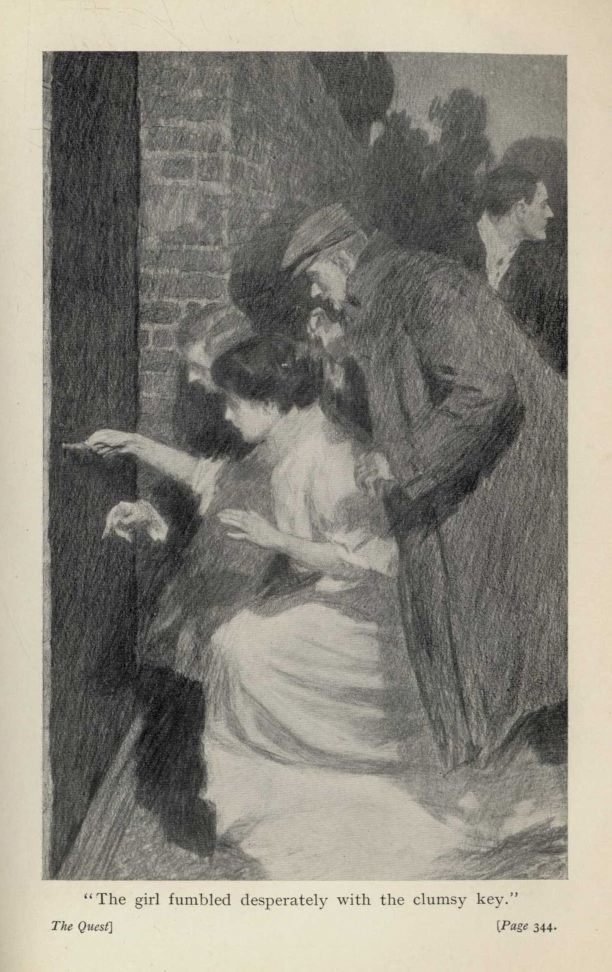
"The girl fumbled desperately with the clumsy key."
A sudden loud cry came from the house, a hoarse screeching cry in a voice which might have been either man's or woman's, but was as mad and as desperate and as horrible in that still night as the screech of a tortured animal—or of a maniac. It came again and again and it was nearer.
"Oh, hurry! hurry!" said the girl. "Can't you be quick? They're coming." And, as she spoke, the little group about the wall heard the engine of the motor-car outside start up with a staccato roar, and knew that the faithful chauffeur was ready for them.
"I'm getting it, I think!" said Richard Hartley between his teeth. "I'm getting it. Turn, you beast! Turn!"
There was a sound of hurrying feet, and Ste. Marie spun about. He cried—
"Don't wait for me! Jump into the car and go! Don't wait anywhere. Come back after you've left Benham at home!" He began to run forward toward those running feet, and he did not know that the girl followed after him. A short distance away there was a little open space of moonlight, and in its midst, at full career, he met the Irishman O'Hara, a gaunt and grotesque figure in his sleeping suit, barefooted, with empty hands. Beyond him still, some one else ran stumbling, and sobbed and uttered mad cries.
Ste. Marie dropped his pistol to the ground and sprang upon the Irishman. He caught him about the body and arms, and the two swayed and staggered under the tremendous impact. At just that moment, from behind, came the crash of the opened door and triumphant shouts. Ste. Marie gave a little gasp of triumph too, and clung the harder to the man with whom he fought. He drove his head into the Irishman's shoulder, and set his muscles with a grip which was like iron. He knew that it could not endure long, for the Irishman was stronger than he; but the grip of a nervous man who is keyed up to a high tension is incredibly powerful for a little while. Trained strength is nothing beside it.
It seemed to Ste. Marie in this desperate moment—it cannot have been more than a minute or two at the most—that a strange and uncanny miracle befel him. It was as if he became two. Soul and body, spirit and straining flesh, seemed to him to separate, to stand apart each from the other. There was a thing of iron flesh and thews which had locked itself about an enemy, and clung there madly with but one purpose, one single thought—to grip and grip and never loosen until flesh should be torn from bones. But apart, the spirit looked on with a complete detachment. It looked beyond—he must have raised his head to glance over O'Hara's shoulder—saw a mad figure staggering forward in the moonlight, and knew the figure for Captain Stewart. It saw an upraised arm and was not afraid, for the work was almost done now. It listened and was glad, hearing the motor-car without the walls leap forward into the night, and its puffing grow fainter and fainter with distance. It knew that the thing of strained sinews received a crashing blow upon back-flung head, and that the iron muscles were slipping away from their grip, but it was still glad, for the work was done.
Only at the last, before red and whirling lights had obscured the view, before consciousness was dissolved in unconsciousness, came horror and agony, for the eyes saw Captain Stewart back away and raise the thing he had struck with, a large revolver, saw Coira O'Hara, a swift and flashing figure in the moonlight, throw herself upon him, before he could fire, heard together a woman's scream and the roar of the pistol's explosion, and so knew no more.
CHAPTER XXVIII
COIRA'S LITTLE HOUR
When Coira O'Hara came to herself from the moment's swoon into which she had fallen she rose to her knees and stared wildly about her. She seemed to be alone in the place, and her first thought was to wonder how long she had lain there. Captain Stewart had disappeared. She remembered her struggle with him to prevent him from firing at Ste. Marie, and she remembered her desperate agony when she realised that she could not hold him much longer. She remembered the accidental discharge of the revolver into the air, she remembered being thrown violently to the ground—and that was all.
Where was her father and where was Ste. Marie? The first question answered itself, for, as she turned her eyes towards the west, she saw O'Hara's tall ungainly figure disappearing in the direction of the house. She called his name twice, but it may be that the man did not hear for he went on without pausing and was lost to sight.
The girl became aware of something which lay on the ground near her, half in and half out of the patch of silver moonlight. For some moments she stared at it uncomprehending. Then she gave a sharp scream and struggled to her feet. She ran to the thing which lay there motionless and fell upon her knees beside it. It was Ste. Marie, his face upturned to the sky, one side of his head black and damp. Stewart had not shot him, but that crashing blow with the clubbed revolver had struck him full and fair and he was very still.
For an instant the girl's strength went out of her and she dropped lax across the body, her face upon Ste. Marie's breast. But after that she tore open coat and waistcoat and felt for a heartbeat. It seemed to her that she found life, and she began to believe that the man had only been stunned.
Once more she rose to her feet and looked about her. There was no one to lend her aid. She bent over the unconscious man and slipped her arms about him. Though Ste. Marie was tall he was slightly built, by no means heavy, and the girl was very strong. She found that she could carry him a little way, dragging his feet after her. When she could go no farther she laid him down, and crouched over him, waiting until her strength should return. And this she did for a score of times; but each time the distance she went was shorter, and her breathing came with deeper gasps, and the trembling in her limbs grew more terrible. At the last she moved in a sort of fever, an evil dream of tortured body and reeling brain. But she had got Ste. Marie up through the park to the terrace and into the house, and, with a last desperate effort, she had laid him upon a couch in a certain little room which opened from the lower hall. Then she fell down before him and lay still for a long time.
When she came to herself again the man was stirring feebly and muttering to himself under his breath. With slow and painful steps she got across the room, and pulled the bell cord. She remained there ringing until the old Justine, blinking and half dressed, appeared with a candle in the doorway. Coira told the woman to make lights and then to bring water and a certain little bottle of aromatic salts which was in her room upstairs. The old Justine exclaimed and cried out, but the girl flew at her in a white fury, and she tottered away as fast as old legs could move, once she had set alight the row of candles on the mantel shelf. Then Coira O'Hara went back to the man who lay outstretched on the low couch, and knelt beside him looking into his face. The man stirred and moved his head slowly. Half articulate words came from his lips and she made out that he was saying her name in a dull monotone—only her name, over and over again. She gave a little cry of grief and gladness, and hid her face against him as she had done once before, out in the night.
The old woman returned with a jug of water, towels and the bottle of aromatic salts. The two of them washed that red stain from Ste. Marie's head and found that he had received a severe bruise, and that the flesh had been cut before and above the ear.
"Thank God!" the girl said, "it is only a flesh wound. If it were a fracture he would be breathing in that horrible loud way they always do. He's breathing naturally. He has only been stunned.
"You may go now!" she said. "Only, bring a glass and some drinking water—cold."
So the old woman went away to do her errand, returned and went away again, and the two were left together. Coira held the salts bottle to Ste. Marie's nostrils, and he gasped and sneezed and tried to turn his head away from it, but it brought him to his senses—and doubtless to a good deal of pain. Once when he could not escape the thing he broke into a fit of weak cursing, and the girl laughed over him tenderly and let him be.
Very slowly Ste. Marie opened his eyes and, in the soft half light, the girl's face was bent above him, dark and sweet and beautiful—near, so near that her breath was warm upon his lips. He said her name again in an incredulous whisper—
"Coira! Coira!" And she said—
"I am here." But the man was in a strange borderland of half consciousness, and his ears were deaf.
He said, gazing up at her—
"Is it—another dream?" And he tried to raise one hand from where it lay beside him, but the hand wavered and fell aslant across his body. It had not the strength yet to obey him.