THE QUEST (continued 3)
Reading edition
"I think I do," the man said, but he looked at her very curiously and a little sadly; for it was the first time he had ever seen her swept from her superb poise by any emotion, and he hardly recognised her. It was very bitter to him to realise that he could never have stirred her to this, never under any conceivable circumstances.
The girl came to him where he stood and touched his arm with her hand.
"He is waiting to hear how I feel about it all, isn't he?" she said. "He is waiting to know that I understand. Will you tell him a little lie for me, Richard? No! You needn't tell a lie; I will tell it. Tell him that I said I understood perfectly. Tell him that I was shocked for a moment, but that afterwards I understood and thought no more about it. Will you tell him I said that? It won't be a lie from you, because I did say it. Oh, I will not grieve him or hamper him now while he is working in my cause! I'll tell him a lie rather than have him grieve."
"Need it be a lie?" said Richard Hartley. "Can't you truly believe what you've said?"
She shook her head slowly.
"I'll try," said she, "but—my golden spell is broken, and I can't mend it alone. I'm sorry."
He turned with a little sigh to leave her, but Miss Benham followed him towards the door of the drawing-room.
"You're a good friend, Richard," she said, when she had come near. "You're a good friend to him."
"He deserves good friends," said the man stoutly. "And besides," said he, "we're brothers in arms nowadays. We've enlisted together to fight for the same cause."
The girl fell back with a little cry. "Do you mean," she said, after a moment, "do you mean that you are working with him—to find Arthur?"
Hartley nodded.
"But," said she stammering, "but, Richard——"
The man checked her. "Oh, I know what I'm doing," said he. "My eyes are open. I know that I'm not—well, in the running. I work for no reward except a desire to help you and Ste. Marie. That's all. It pleases me to be useful."
He went away with that, not waiting for an answer; and the girl stood where he had left her, staring after him.
CHAPTER X
CAPTAIN STEWART ENTERTAINS
Ste. Marie returned, after three days, from Dinard in a depressed and somewhat puzzled frame of mind. He had found no trace whatever of Arthur Benham either at Dinard or at Deauville, and, what was more, he was unable to discover that any one even remotely resembling that youth had been seen at either place. The matter of identification, it seemed to him, should be a rather simple one. In the first place, the boy's appearance was not at all French, nor for that matter English: it was very American. Also he spoke French—so Ste. Marie had been told—very badly, having for the language that scornful contempt peculiar to Anglo-Saxons of a certain type. His speech, it seemed, was, like his appearance, ultra-American, full of strange idioms and oddly pronounced. In short, such a youth would be rather sure to be remembered by any hotel management and staff with which he might have come in contact.
At first Ste. Marie pursued his investigations quietly and, as it were, casually, but, after his initial failure, he went to the managements of the various hotels and lodging-houses and to the cafés and bathing establishments, and told them with all frankness a part of the truth—that he was searching for a young man whose disappearance had caused great distress to his family. He was not long in discovering that no such young man could have been either in Dinard or Deauville.
The thing which puzzled him was that, apart from finding no trace of the missing boy, he also found no trace of Captain Stewart's agent—the man who had been first on the ground. No one seemed able to recollect that such a person had been making inquiries, and Ste. Marie began to suspect that his friend was being imposed upon. He determined to warn Stewart that his agents were earning their fees too easily.
So he returned to Paris more than a little dejected and sore over this waste of time and effort. He arrived by a noon tram, and drove across the city in a fiacre to the Rue d'Assas. But as he was in the midst of unpacking his portmanteau, for he kept no servant (a woman came in once a day to "do" the rooms), the door-bell rang. It was Baron de Vries, and Ste. Marie admitted him with an exclamation of surprise and pleasure.
"You passed me in the street just now," explained the Belgian, "and, as I was a few minutes early for a lunch engagement, I followed you up."
He pointed with his stick at the open bag.
"Ah, you have been on a journey! Detective work?"
Ste. Marie pushed his guest into a chair, gave him cigarettes, and told him about the fruitless expedition to Dinard. He spoke also of his belief that Captain Stewart's agent had never really found a clue at all, and at that Baron de Vries nodded his grey head and said, "Ah!" in a tone of some significance. Afterwards he smoked a little while in silence, but presently he said, as if with some hesitation—
"May I be permitted to offer a word of advice?"
"But surely!" cried Ste. Marie, kicking away the half-empty portmanteau. "Why not?"
"Do whatever you are going to do in this matter according to your own judgment," said the elder man. "Or according to Mr. Hartley's and your combined judgments. Make your investigations without reference to our friend Captain Stewart." He halted there as if that were all he had meant to say, but when he saw Ste. Marie's raised eyebrows, he frowned and went on slowly as if picking his words with some care.
"I should be sorry," he said, "to have Captain Stewart at the head of any investigation of this nature in which I was deeply interested—just now, at any rate. I am afraid—It is difficult to say. I do not wish to say too much—I am afraid he is not quite the man for the position."
Ste. Marie nodded his head with great emphasis.
"Ah!" he cried, "that's just what I have felt, you know, all along. And it's what Hartley felt too, I'm sure. No, Stewart is not the sort for a detective. He's too cock-sure. He won't admit that he might possibly be wrong now and then. He's too——"
"He is too much occupied with other matters," said Baron de Vries. Ste. Marie sat down on the edge of a chair.
"Other matters?" he demanded. "That sounds mysterious. What other matters?"
"Oh, there is nothing very mysterious about it," said the elder man. He frowned down at his cigarette and brushed some fallen ash neatly from his knees.
"Captain Stewart," said he, "is badly worried, and has been for the past year or so—badly worried over money matters and other things. He has lost enormous sums at play, as I happen to know; and he has lost still more enormous sums at Auteuil and at Longchamps. Also the ladies are not without their demands."
Ste. Marie gave a shout of laughter.
"Comment donc!" he cried. "Ce vieillard?"
"Ah well," deprecated the other man, "Vieillard is putting it rather high. He can't be more than fifty, I should think. To be sure he looks older, but then, in his day, he lived a great deal in a short time. Do you happen to remember Olga Nilssen?"
"I do," said Ste. Marie. "I remember her very well indeed; I was a sort of go-between in settling up that affair with Morrison. Morrison's people asked me to do what I could. Yes, I remember her well, and with some pleasure. I felt sorry for her, you know. People didn't quite know the truth of that affair. Morrison behaved very badly to her."
"Yes," said Baron de Vries, "and Captain Stewart has behaved very badly to her also. She is furious with rage or jealousy or both. She goes about, I am told, threatening to kill him, and it would be rather like her to do it one day. Well, I have dragged in all this scandal by way of showing you that Stewart has his hands full of his own affairs just now, and so cannot give the attention he ought to give to hunting out his nephew. As you suggest, his agents may be deceiving him. I don't know, I suppose they could do it easily enough. If I were you I would set to work quite independently of him."
"Yes," said Ste. Marie in an absent tone. "Oh yes, I shall do that, you may be sure." He gave a sudden smile.
"He's a queer type, this Captain Stewart," said Ste. Marie. "He begins to interest me very much. I had never suspected this side of him (though I remember now that I once saw him coming out of a milliner's shop). He looks rather an ascetic, rather donnish, don't you think? I remember that he talked to me one day quite pathetically about feeling his age and about liking young people round him. He's an odd character. Fancy him mixed up in an affair with Olga Nilssen! or, rather, fancy her involved in an affair with him! What can she have seen in him? She's not mercenary, you know. At least she used not to be."
"Ah! there," said Baron de Vries, "you enter upon a terra incognita. No one can say what a woman sees in this man or in that. It's beyond our ken." He rose to take his leave, and Ste. Marie went with him to the door.
"I've been asked to a sort of party at Stewart's rooms this week," Ste. Marie said. "I don't know whether I shall go or not. Probably not. I suppose I shouldn't find Olga Nilssen there?"
"Well, no," said the Belgian, laughing. "No, I hardly think so. Good-bye! Think over what I've told you. Good-bye!" He went away down the stair, and Ste. Marie returned to his unpacking.
Nothing more of consequence occurred in the next few days. Hartley had unearthed a somewhat shabby adventurer, who swore to having seen the Irishman, O'Hara, in Paris within a month, but it was by no means certain that this being did not merely affirm what he believed to be desired of him, and in any case the information was of no especial value, since it was O'Hara's present whereabouts that was the point at issue. So it came to Thursday evening. Ste. Marie received a note from Captain Stewart during the day, reminding him that he was to come to the Rue du Faubourg St. Honoré that evening, and asking him to come early, at ten or thereabouts, so that the two could have a comfortable chat before any one else turned up. Ste. Marie had about decided not to go at all, but the courtesy of this special invitation from Miss Benham's uncle made it rather impossible for him to stay away. He tried to persuade Hartley to follow him later on in the evening, but that gentleman flatly refused, and went away to dine with some English friends at Armenonville.
So Ste. Marie, in a vile temper, dined quite alone at Lavenue's, beside the Gare Montparnasse, and towards ten o'clock drove across the river to the Rue du Faubourg. Captain Stewart's flat was up five stories, at the top of the building in which it was located, and so well above the noises of the street. Ste. Marie went up in the automatic lift, and at the door above his host met him in person, saying that the one servant he kept was busy making preparations in the kitchen beyond. They entered a large room, long but comparatively shallow, in shape not unlike the sitting-room in the Rue d'Assas but very much bigger, and Ste. Marie uttered an exclamation of surprise and pleasure, for he had never before seen an interior anything like this. The room was decorated and furnished entirely in Chinese and Japanese articles of great age and remarkable beauty. Ste. Marie knew little of the hieratic art of these two countries, but he fancied that the place must be an endless delight to the expert.
The general tone of the room was gold, dulled and softened by great age until it had ceased to glitter, and relieved by the dusty Chinese blue, and by old red faded to rose, and by warm ivory tints. The great expanse of the walls was covered by a brownish-yellow cloth, coarse, like burlap, and against it round the room hung sixteen large panels representing the sixteen Rakan. They were early copies—fifteenth century, Captain Stewart said—of those famous originals by the Chinese Sung master Ririomin, which have been for six hundred years or more the treasures of Japan. They were mounted upon Japanese brocade of blue and dull gold, framed in keyaki wood, and, out of their brown time-stained shadows, the great Rakan scowled or grinned or placidly gazed, grotesquely graceful masterpieces of a perished art.
At the far end of the room, under a gilded canopy of intricate wood-carving, stood upon his pedestal of many-petalled lotus a great statue of Amida Buddha in the yogi attitude of contemplation, and at intervals against the other walls other smaller images stood or sat; Buddha in many incarnations; Kwannon, Goddess of Mercy; Jizo Bosatzu; Hotei, pot-bellied, God of Contentment; Jingo-Kano, God of War. In the centre of the place was a Buddhist temple table; and priests' chairs, lacquered and inlaid, stood about the room. The floor was covered by Chinese rugs, dull yellow with blue flowers; and over a doorway which led into another room was fixed a huge rama of Chinese pierced carving, gilded, in which there were trees and rocks and little grouped figures of the hundred immortals.
It was indeed an extraordinary room. Ste. Marie looked about its mellow glow with a half-comprehending wonder, and he looked at the man beside him curiously, for here was another side to this many-sided character. Captain Stewart smiled.
"You like my museum?" he asked. "Few people care much for it except, of course, those who go in for the Oriental arts. Most of my friends think it bizarre—too grotesque and unusual. I have tried to satisfy them by including those comfortable low divan couches (they refuse altogether to sit in the priests' chairs), but still they are unhappy." He called his servant, who came to take Ste. Marie's hat and coat, and returned with smoking things.
"It seems entirely wonderful to me," said the younger man. "I'm not an expert at all—I don't know who the gentlemen in those sixteen panels are, for example; but it is very beautiful. I have never seen anything like it at all." He gave a little laugh.
"Will it sound very impertinent in me, I wonder, if I express surprise—not surprise at finding this magnificent room, but at discovering that this sort of thing is a taste and, very evidently, a serious study of yours? You—I remember your saying once with some feeling that it was youth and beauty and—well, freshness that you liked best to be surrounded by. This," said Ste. Marie, waving an inclusive hand, "was young so many centuries ago! It fairly breathes antiquity and death."
"Yes," said Captain Stewart thoughtfully. "Yes, that is quite true." The two had seated themselves upon one of the broad low benches which had been built into the place to satisfy the philistine.
"I find it hard to explain," he said, "because both things are passions of mine. Youth—I could not exist without it. Since I have it no longer in my own body, I wish to see it about me. It gives me life. It keeps my heart beating. I must have it near. And then this—antiquity and death, beautiful things made by hands dead centuries ago in an alien country! I love this too. I didn't speak too strongly, it is a sort of passion with me—something quite beyond the collector's mania, quite beyond that. Sometimes, do you know, I stay at home in the evening, and I sit here quite alone with the lights half on and, for hours together, I smoke and watch these things—the quiet, sure, patient smile of that Buddha for example. Think how long he has been smiling like that, and waiting! Waiting for what? There is something mysterious beyond all words in that smile of his, that fixed, crudely carved wooden smile. No, I'll be hanged if it's crude! It is beyond our modern art. The dead men carved better than we do. We couldn't manage that with such simple means. We can only reproduce what is before us. We can't carve questions—mysteries—everlasting riddles."
Through the pale blue wreathing smoke of his cigarette Captain Stewart gazed down the room to where Eternal Buddha stood and smiled eternally. And from there the man's eyes moved with slow enjoyment along the opposite wall over those who sat or stood there, over the panels of the ancient Rakan, over carved lotus and gilt contorted dragon for ever in pursuit of the holy pearl. He drew a short breath which seemed to bespeak extreme contentment, the keenest height of pleasure, and he stirred a little where he sat and settled himself among the cushions. Ste. Marie watched him, and the expression of the man's face began to be oddly revolting. It was the face of a voluptuary in the presence of his desire. He was uncomfortable and wished to say something to break the silence, but, as often occurs at such a time, he could think of nothing to say. So there was a brief silence between them. But presently Captain Stewart roused himself with an obvious effort.
"Here! this won't do," said he, in a tone of whimsical apology. "This won't do, you know. I'm floating off on my hobby (and there's a mixed metaphor that would do credit to your own Milesian blood!) I'm boring you to extinction, and I don't want to do that, for I'm anxious that you should come here again—and often. I should like to have you form the habit.
"What was it I had in mind to ask you about? Ah yes! The journey to Dinard and Deauville. I am afraid it turned out to be fruitless or you would have let me know."
"Entirely fruitless," said Ste. Marie. He went on to tell the elder man of his investigation, and of his certainty that no one resembling Arthur Benham had been at either of the two places.
"It's no affair of mine, to be sure," he said; "but I rather suspect that your agent was deceiving you—pretending to have accomplished something by way of making you think he was busy." Ste. Marie was so sure the other would immediately disclaim this that he waited for the word, and gave a little smothered laugh when Captain Stewart said promptly—
"Oh no! No! That is impossible. I have every confidence in that man. He is one of my best. No, you are mistaken there. I am more disappointed than you could possibly be over the failure of your efforts, but I am quite sure my man thought he had something worth working upon.
"By the way, I have received another rather curious communication—from Ostend this time. I will show you the letter, and you may try your luck there if you would care to." He felt in his pockets and then rose. "I've left the thing in another coat," said he; "if you will allow me, I'll fetch it." But before he had turned away the doorbell rang, and he paused.
"Ah well," he said, "another time. Here are some of my guests. They have come earlier than I had expected."
The new arrivals were three very perfectly dressed ladies, one of them an operatic light who chanced not to be singing that evening, and whom Ste. Marie had met before. The two others were rather difficult of classification, but probably, he thought, ornaments of that mysterious borderland between the two worlds which seems to give shelter to so many people against whose characters nothing definite is known, but whose antecedents and connexions are not made topics of conversation. The three ladies seemed to be on very friendly terms with Captain Stewart, and greeted him with much noisy delight. One of the unclassified two, when her host, with a glance towards Ste. Marie, addressed her formally, seemed inordinately amused, and laughed for a long time.
Within the next hour ten or a dozen other guests had arrived, and they all seemed to know each other very well, and proceeded to make themselves quite at home. Ste. Marie regarded them with a reflective and not over-enthusiastic eye, and he wondered a good deal why he had been asked here to meet them. He was as far from a prig or a snob as any man could very well be, and he often went to very Bohemian parties which were given by his painter or musician friends, but these people seemed to him quite different. The men, with the exception of two eminent opera singers, who quite obviously had been asked because of their voices, were the sort of men who abound at such places as Ostend and Monte Carlo, and Baden Baden in the race week. That is not to say that they were ordinary racing touts or the cheaper kind of adventurers: there was a count among them, and a marquis who had recently been divorced by his American wife; but adventurers of a sort they undoubtedly were. There was not one of them, so far as Ste. Marie was aware, who was received anywhere in good society, and he resented very much being compelled to meet them.
Naturally enough he felt much less concern on the score of the ladies. It is an undoubted and wellnigh universal truth that men who would refuse outright to meet certain classes of their own sex show no reluctance whatever over meeting the women of a corresponding circle—that is, if the women are attractive. It is a depressing fact, and inclines one to sighs and head-shakes and some moral indignation, until the reverse truth is brought to light: namely, that women have identically the same point of view; that while they cast looks of loathing and horror upon certain of their sisters, they will meet with pleasure any presentable man whatever his crimes or vices.
Ste. Marie was very much puzzled over all this. It seemed to him so unnecessary that a man who really had some footing in the newer society of Paris should choose to surround himself with people of this type; but, as he looked on and wondered, he became aware of a curious and, in the light of a past conversation, significant fact. All of the people in the room were young, all of them in their varying fashions and degrees very attractive to look upon, all full to overflowing of life and spirits and the determination to have a good time. He saw Captain Stewart moving among them, playing very gracefully his role of host, and the man seemed to have dropped twenty years from his shoulders. A miracle of rejuvenation seemed to have come upon him; his eyes were bright and eager, the colour was high in his cheeks, and the dry pedantic tone had gone from his voice. Ste. Marie watched him, and at last he thought he understood. It was half revolting, half pathetic, he thought, but it certainly was interesting to see.
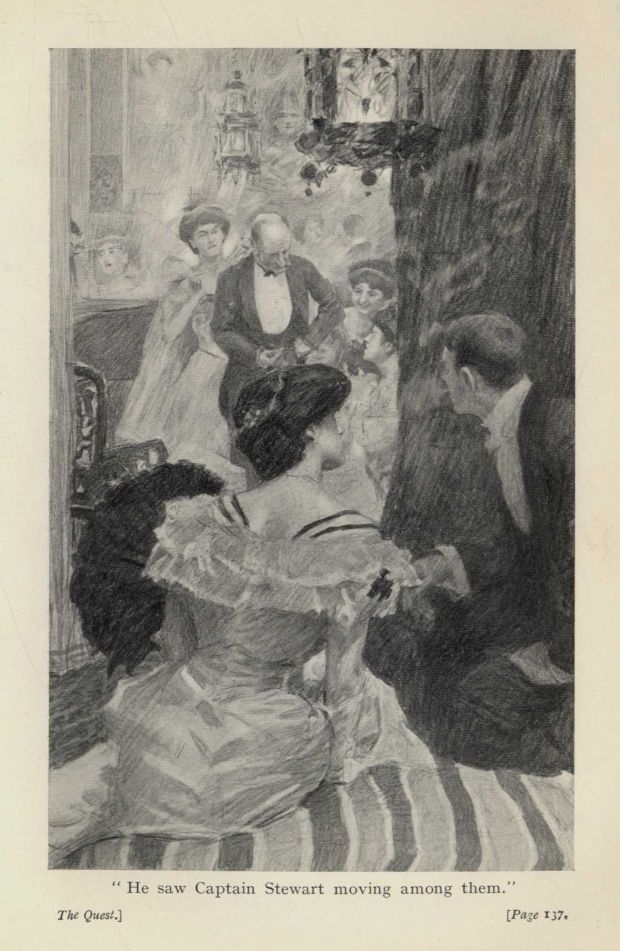
"He saw Captain Stewart moving among them."
Duval, the great basso of the Opéra, accompanied at the piano by one of the unclassified ladies, was just finishing Mefistofele's drinking song out of Faust when the door-bell rang.
CHAPTER XI
A GOLDEN LADY ENTERS: THE EYES AGAIN
The music of voice and piano was very loud just then, so that the little soft whirring sound of the electric bell reached only one or two pairs of ears in the big room. It did not reach the host certainly, and neither he nor most of the others observed the servant make his way among the groups of seated or standing people and go to the outer door, which opened upon a tiny hallway. The song came to an end, and everybody was cheering and applauding and crying bravo or bis, or one of the other things that people shout at such times, when, as if in unexpected answer to the outburst, a lady appeared between the yellow portières, and came forward a little way into the room. She was a tall lady of an extraordinary and immediately noticeable grace of movement, a lady with rather fair hair, but her eyebrows and lashes had been stained darker than it was their nature to be. She had the classic Greek type of face—and figure too—all but the eyes, which were long and narrow, narrow perhaps from a habit of going half closed; and when they were a little more than half closed, they made a straight black line that turned up very slightly at the outer end with an Oriental effect, which went oddly in that classic face. There is a very popular piece of sculpture now in the Luxembourg Gallery for which this lady "sat" as model to a great artist. Sculptors from all over the world go there to dream over its perfect line and contour, and little schoolgirls pretend not to see it, and middle-aged maiden tourists with red Baedeckers in their hands regard it furtively, and pass on, and after awhile come back to look again.
The lady was dressed in some close clinging material, which was not cloth-of-gold but something very like it, only much duller—something which gleamed when she stirred but did not glitter; and over her splendid shoulders was hung an Oriental scarf heavily worked with metallic gold. She made an amazing and dramatic picture in that golden room. It was as if she had known just what her surroundings would be and had dressed expressly for them.
The applause ceased as suddenly as if it had been trained to break off at a signal, and the lady came forward a little way, smiling a quiet assured smile. At each step her knee threw out the golden stuff of her gown an inch or two, and it flashed suddenly a dull subdued flash in the overhead light, and died and flashed again. A few of the people in the room knew who the lady was, and they looked at one another with raised eyebrows and startled faces; but the others stared at her with an eager admiration, thinking that they had seldom seen anything so beautiful or so effective. Ste. Marie sat forward on the edge of his chair. His eyes sparkled, and he gave a little quick sigh of pleasurable excitement. This was drama and very good drama too, and he suspected that it might at any moment turn into a tragedy.
He saw Captain Stewart, who had been among a group of people halfway across the room, turn his head to look, when the cries and the applause ceased so suddenly, and he saw the man's face stiffen by swift degrees, all the joyous buoyant life gone out of it, until it was yellow and rigid like a dead man's face; and Ste. Marie, out of his knowledge of the relations between these two people, nodded, en connaisseur, for he knew that the man was very badly frightened.
So the host of the evening hung back staring for what must have seemed to him a long and terrible time, though in reality it was but an instant; then he came forward quickly to greet the newcomer; and if his face was still yellow-white, there was nothing in his manner but the courtesy habitual with him. He took the lady's hand and she smiled at him; but her eyes did not smile: they were hard. Ste. Marie, who was the nearest of the others, heard Captain Stewart say—
"This is an unexpected pleasure, my dearest Olga!" And to that the lady replied more loudly—
"Yes, I returned to Paris only to-day. You didn't know, of course. I heard you were entertaining this evening and so I came, knowing that I should be welcome."
"Always!" said Captain Stewart. "Always more than welcome!" He nodded to one or two of the men who stood near, and, when they had approached, presented them. Ste. Marie observed that he used the lady's true name—she had, at times, found occasion to employ others—and that he politely called her "Madame Nilssen" instead of "Mademoiselle." But at that moment the lady caught sight of Ste. Marie, and, crying out his name in a tone of delighted astonishment, turned away from the other men, brushing past them as if they had been furniture, and advanced, holding out both her hands in greeting.
"Dear Ste. Marie!" she exclaimed. "Fancy finding you here! I'm so glad! Oh, I'm so very glad! Take me away from these people! Find a corner where we can talk. Ah! there is one with a big seat. Allons-y!" She addressed him for the most part in English, which she spoke perfectly—as perfectly as she spoke French and German and, presumably, her native tongue, which must have been Swedish.
They went to the broad low seat, a sort of hard-cushioned bench, which stood against one of the walls, and made themselves comfortable there by the only possible means, which, owing to the width of the thing, was to sit far back with their feet stuck straight out before them. Captain Stewart had followed them across the room, and showed a strong tendency to remain. Ste. Marie observed that his eyes were hard and bright and very alert, and that there were two bright spots of colour in his yellow cheeks. It occurred to Ste. Marie that the man was afraid to leave him alone with Olga Nilssen, and he smiled to himself, reflecting that the lady, even if indiscreetly inclined, could tell him nothing—save in details—that he did not already know.
But, after a few rather awkward moments, Mlle. Nilssen waved an irritated hand.
"Go away!" she said to her host. "Go away to your other guests! I want to talk to Ste. Marie. We have old times to talk over." And after hesitating awhile uneasily, Captain Stewart turned back into the room; but for some time thereafter Ste. Marie was aware that a vigilant eye was being kept upon them, and that their host was by no means at his ease.
When they were left alone together, the girl turned to him and patted his arm affectionately. She said—
"Ah, but it is very good to see you again, mon cher ami! It has been so long!" She gave an abrupt frown.
"What are you doing here?" she demanded. And she said an unkind thing about her fellow-guests. She called them canaille. She said—
"Why are you wasting your time among these canaille? This is not a place for you. Why did you come?"
"I don't know," said Ste. Marie. He was still a little resentful and he said so. He said—
"I didn't know it was going to be like this. I came because Stewart went rather out of his way to ask me. I'd known him in a very different milieu."
"Ah yes!" she said reflectively. "Yes, he does go into the world also, doesn't he! But this is what he likes, you know." Her lips drew back for an instant and she said—
"He is a pig-dog."
Ste. Marie looked at her gravely. She had used that offensive name with a little too much fierceness. Her face had turned for an instant quite white, and her eyes had flashed out over the room a look that meant a great deal to any one who knew her as well as Ste. Marie did. He sat forward and lowered his voice. He said—
"Look here, Olga! I'm going to be very frank for a moment. May I?"
For just an instant the girl drew away from him with suspicion in her eyes, and something else, alertly defiant. Then she put out her hands to his arm.
"You may be what you like, dear Ste. Marie," she said. "And say what you like. I will take it all—and swallow it alive—good as gold. What are you going to do to me?"
"I've always been fair with you, haven't I?" he urged. "I've had disagreeable things to say or do but—you knew always that I liked you and—where my sympathies were."
"Always! Always, mon cher!" she cried. "I trusted you always in everything. And there is no one else I trust. No one! No one!
"Ste. Marie!"
"What then?" he asked.
"Ste. Marie," she said, "why did you never fall in love with me, as the other men did?"
"I wonder," said he. "I don't know. Upon my word, I really don't know." He was so serious about it that the girl burst into a shriek of laughter. And in the end he laughed too.
"I expect it was because I liked you too well," he said at last. "But come! We're forgetting my lecture. Listen to your grandpère Ste. Marie! I have heard—certain things—rumours—what you will. Perhaps they are foolish lies, and I hope they are. But if not, if the fear I saw in Stewart's face when you came here to-night was—not without cause, let me beg you to have a care. You're much too savage, my dear child. Don't be so foolish as to—well, turn comedy into the other thing. In the first place it's not worth while, and in the second place it recoils, always. Revenge may be sweet. I don't know. But nowadays, with police courts and all that, it entails much more subsequent annoyance that it is worth. Be wise, Olga!"
"Some things, Ste. Marie," said the golden lady, "are worth all the consequences that may follow them." She watched Captain Stewart across the room where he stood chatting with a little group of people, and her beautiful face was as hard as marble, and her eyes were as dark as a stormy night, and her mouth, for an instant, was almost like an animal's mouth, cruel and relentless.
Ste. Marie saw, and he began to be a bit alarmed in good earnest. In his warning he had spoken rather more seriously than he felt the occasion demanded, but he began at last to wonder if the occasion was not in reality very serious indeed. He was sure, of course, that Olga Nilssen had come here on this evening to annoy Captain Stewart in some fashion. As he put it to himself, she probably meant to "make a row," and he would not have been in the least surprised if she had made it in the beginning upon her very dramatic entrance. Nothing more calamitous than that had occurred to him. But when he saw the woman's face, turned a little away and gazing fixedly at Captain Stewart, he began to be aware that there was tragedy very near him, or all the makings of it.
Mlle. Nilssen turned back to him. Her face was still hard, and her eyes dark and narrowed, with their oddly Oriental look. She bent her shoulders together for an instant, and her hands moved slowly in her lap, stretching out before her, in a gesture very like a cat's when it wakens from sleep and yawns and extends its claws, as if to make sure that they are still there and ready for use.
"I feel a little like Samson to-night," she said. "I am tired of almost everything, and I should like very much to pull the world down on top of me and kill everybody in it—except you, Ste. Marie, dear! Except you!—and be crushed under the ruins."
"I think," said Ste. Marie practically—and the speech sounded rather like one of Hartley's speeches—"I think it was not quite the world that Samson pulled down, but a temple—or a palace—something of that kind."
"Well," said the golden lady, "this place is rather like a temple—a Chinese temple, with the pig-dog for high priest."
Ste. Marie frowned at her.
"What are you going to do?" he demanded sharply. "What did you come here to do? Mischief of some kind—bien entendu—but what?"
"Do?" she said, looking at him with her narrowed eyes. "I? Why, what should I do? Nothing, of course! I merely said I should like to pull the place down. Of course I couldn't do that quite literally, now, could I? No. It is merely a mood. I'm not going to do anything."
"You're not being honest with me," he said. And at that her expression changed, and she patted his arm again with a gesture that seemed to beg forgiveness.
"Well then," she said, "if you must know, maybe I did come here for a purpose. I want to have it out with our friend Captain Stewart about something.
"And Ste. Marie, dear," she pleaded, "please, I think you'd better go home first. I don't care about these other animals, but I don't want you dragged into any row of any sort. Please, be a sweet Ste. Marie and go home. Yes?"
"Absolutely, no!" said Ste. Marie. "I shall stay, and I shall try my utmost to prevent you from doing anything foolish. Understand that! If you want to have rows with people, Olga, for Heaven's sake don't pick an occasion like this for the purpose. Have your rows in private!"
"I rather think I enjoy an audience," she said with a reflective air, and Ste. Marie laughed aloud because he knew that the naïve speech was so very true. This lady, with her many good qualities and her bad ones—not a few, alas!—had an undeniable passion for red fire that had amused him very much on more than one past occasion.
"Please, go home!" she said once more. But when the man only shook his head, she raised her hands a little way and dropped them again in her lap in an odd gesture, which seemed to say that she had done all she could do, and that if anything disagreeable should happen now, and he should be involved in it, it would be entirely his fault because she had warned him.
Then quite abruptly a mood of irresponsible gaiety seemed to come upon her. She refused to have anything more to do with serious topics, and when Ste Marie attempted to introduce them she laughed in his face. As she had said in the beginning she wished to do, she harked back to old days—the earlier stages of what might be termed the Morrison régime, and it seemed to afford her great delight to recall the happenings of that epoch. The conversation became a dialogue of reminiscence which would have been entirely unintelligible to a third person, and was indeed so to Captain Stewart, who once came across the room, made a feeble effort to attach himself, and presently wandered away again.
They unearthed from the past an exceedingly foolish song all about one "Little Willie" and a purple monkey climbing up a yellow stick. It was set to a well-known air from Don Giovanni, and when Duval, the basso heard them singing it, he came up and insisted upon knowing what it was about. He laughed immoderately over the English words when he was told what they meant, and made Ste. Marie write them down for him on two visiting cards. So they made a trio out of "Little Willie," the great Duval inventing a bass part quite marvellous in its ingenuity, and they were compelled to sing it over, and over again, until Ste. Marie's falsetto imitation of a tenor voice cracked and gave out altogether, since he was by nature baritone, if anything at all.
The other guests had crowded round to hear the extraordinary song, and when the song was at last finished several of them remained, so that Ste. Marie saw he was to be allowed an uninterrupted tête-à-tête with Olga Nilssen no longer. He therefore drifted away, after a few moments, and went with Duval and one of the other men across the room to look at some small jade objects—snuff-bottles, bracelets, buckles and the like—which were displayed in a cabinet cleverly reconstructed out of a Japanese shrine. It was perhaps ten minutes later when he looked round the place and discovered that neither Mlle. Nilssen nor Captain Stewart were to be seen.
His first thought was of relief, for he said to himself that the two had sensibly gone into one of the other rooms to "have it out" in peace and quiet. But following that came the recollection of the woman's face when she had watched her host across the room. Her words came back to him: "I feel a little like Samson to-night.... I should very much like to pull the world down on top of me and kill everybody in it." Ste. Marie thought of these things and he began to be uncomfortable. He found himself watching the yellow-hung doorway beyond, with its intricate Chinese carving of trees and rocks and little groups of immortals, and he found that unconsciously he was listening for something—he did not know what—above the chatter and laughter of the people in the room. He endured this for possibly five minutes, and all at once found that he could endure it no longer. He began to make his way quietly through the group of people towards the curtained doorway.
As he went one of the women near by complained in a loud tone that the servant had disappeared. She wanted, it seemed, a glass of water having already had many glasses of more interesting things. Ste. Marie said he would get it for her and went on his way. He had an excuse now.
He found himself in a square dimly lighted room, much smaller than the other. There was a round table in the centre so he thought it must be Stewart's dining-room. At the left a doorway opened into a place where there were lights, and at the other side was another door closed. From the room at the left there came a sound of voices, and though they were not loud, one of them, Mlle. Olga Nilssen's voice, was hard and angry and not altogether under control. The man would seem to have been attempting to pacify her, and he would seem not to have been very successful.
The first words that Ste. Marie was able to distinguish were from the woman. She said in a low fierce tone—
"That is a lie, my friend! That is a lie. I know all about the road to Clamart, so you needn't lie to me any longer. It's no good." She paused for just an instant there, and, in the pause, Ste. Marie heard Stewart give a sort of inarticulate exclamation. It seemed to express anger and it seemed also to express fear. But the woman swept on and her voice began to be louder. She said—
"I've given you your chance. You didn't deserve it, but I've given it you—and you've told me nothing but lies. Well, you'll lie no more. This ends it."
Upon that Ste. Marie heard a sudden stumbling shuffle of feet and a low hoarse cry of utter terror—a cry more animal-like than human. He heard the cry break off abruptly in something that was like a cough and a whine together, and he heard the sound of a heavy body falling with a loose rattle upon the floor.
With the sound of that falling body he had already reached the doorway and torn aside the heavy portière. It was a sleeping-room he looked into, a room of medium size, with two windows and an ornate bed of the Empire style set sidewise against the farther wall. There were electric lights upon imitation candles which were grouped in sconces against the walls and these were turned on so that the room was brightly illuminated. Midway between the door and the ornate Empire bed Captain Stewart lay huddled and writhing upon the floor, and Olga Nilssen stood upright beside him, gazing down upon him quite calmly. In her right hand, which hung at her side, she held a little flat black automatic pistol of the type known as Brownings, and they look toys but they are not.
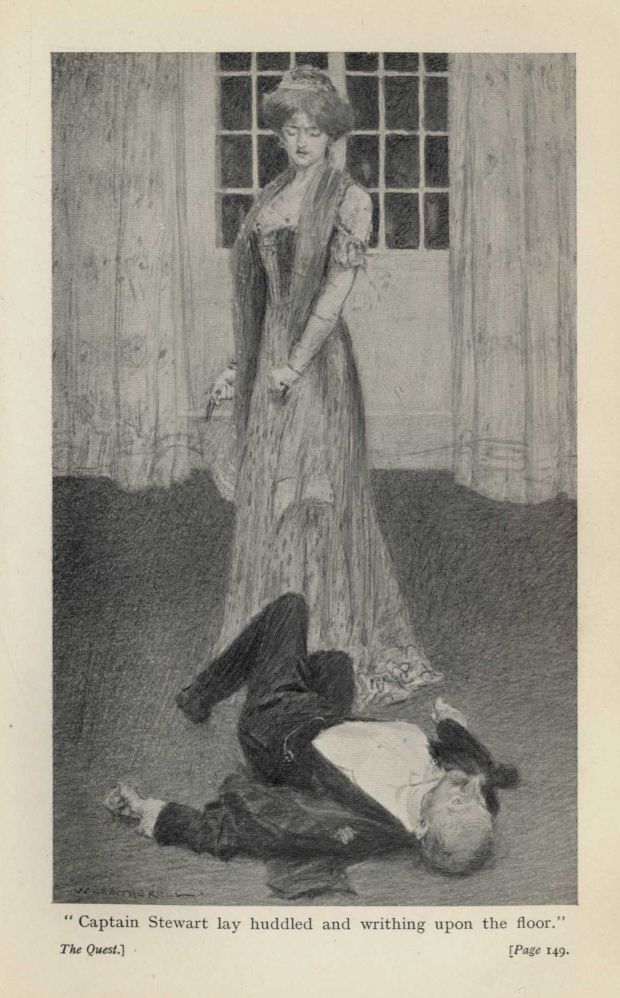
"Captain Stewart lay huddled and writhing upon the floor."
Ste. Marie sprang at her silently and caught her by the arm, twisting the automatic pistol from her grasp, and the woman made no effort whatever to resist him. She looked into his face quite frankly and unmoved, and she shook her head.
"I haven't harmed him," she said. "I was going to, yes. And then myself, but he didn't give me a chance. He fell down in a fit." She nodded down towards the man, who lay writhing at their feet.
"I frightened him," she said, "and he fell in a fit. He's an epileptic, you know. Didn't you know that? Oh yes."
Abruptly she turned away shivering, and put up her hands over her face. And she gave an exclamation of uncontrollable repulsion.
"Ugh!" she cried, "it's horrible. Horrible! I can't bear to look. I saw him in a fit once before—long ago—and I couldn't bear even to speak to him for a month. I thought he had been cured. He said—— Ah, it's horrible!"
Ste. Marie had dropped upon his knees beside the fallen man, and Mlle. Nilssen said over her shoulder—
"Hold his head up from the floor, if you can bear to. He might hurt it." It was not an easy thing to do, for Ste. Marie had the natural sense of repulsion in such matters that most people have, and this man's appearance, as Olga Nilssen had said, was horrible. The face was drawn hideously, and, in the strong clear light of the electrics, it was a deathly yellow. The eyes were half closed, and the eyeballs turned up so that only the whites of them showed between the lids. There was froth upon the distorted mouth, and it clung to the cat-like moustache and to the shallow sunken chin beneath. But Ste. Marie exerted all his will power, and took the jerking trembling head in his hands, holding it clear of the floor.
"You'd better call the servant," he said. "There may be something that can be done." But the woman answered, without looking—
"No, there's nothing that can be done, I believe, except to keep him from bruising himself. Stimulants—that sort of thing, do more harm than good. Could you get him on the bed here?"
"Together we might manage it," said Ste. Marie. "Come and help!"
"I can't!" she cried nervously. "I can't—touch him. Please, I can't do it."
"Come!" said the man in a sharp tone. "It's no time for nerves. I don't like it either, but it's got to be done." The woman began a half-hysterical sobbing, but after a moment she turned and came with slow feet to where Stewart lay.
Ste. Marie slipped his arms under the man's body and began to raise him from the floor.
"You needn't help after all," he said. "He's not heavy." And indeed, under his skilfully shaped and padded clothes, the man was a mere waif of a man—as unbelievably slight as if he were the victim of a wasting disease. Ste. Marie held the body in his arms as if it had been a child, and carried it across and laid it on the bed; but it was many months before he forgot the horror of that awful thing, shaking and twitching in his hold, the head thumping hideously upon his shoulder, the arms and legs beating against him. It was the most difficult task he had ever had to perform.
He laid Captain Stewart upon the bed and straightened the helpless limbs as best he could.
"I suppose," he said, rising again, "I suppose when the man comes out of this he'll be frightfully exhausted and drop off to sleep, won't he? We'll have to——" He halted abruptly there and, for a single swift instant, he felt the black and rushing sensation of one who is going to faint away. The wall behind the ornate Empire bed was covered with photographs, some in frames, others left as they had been received upon the large squares of weird cardboard which are termed "art mounts."
"Come here a moment, quickly!" said Ste. Marie in a sharp voice. Mlle. Nilssen's sobs had died down to a silent spasmodic catching of the breath, but she was still much unnerved, and she approached the bed with obvious unwillingness, dabbing at her eyes with a handkerchief. Ste. Marie pointed to an unframed photograph which was fastened to the wall by thumb tacks, and his outstretched hand shook as he pointed. Beneath them the other man still writhed and tumbled in his epileptic fit.
"Do you know who that woman is?" demanded Ste. Marie, and his tone was such that Olga Nilssen turned slowly and stared at him.
"That woman," said she, "is the reason why I wished to pull the world down upon Charlie Stewart and me to-night. That's who she is."
Ste. Marie gave a sort of cry.
"Who is she?" he insisted. "What is her name? I—have a particularly important reason for wanting to know. I've got to know." Mlle. Nilssen shook her head, still staring at him.
"I can't tell you that," said she. "I don't know the name. I only know that—when he met her, he—— I don't know her name, but I know where she lives and where he goes every day to see her—a house with a big garden and walled park on the road to Clamart. It's on the edge of the wood, not far from Fort d'Issy. The Clamart-Vanves-Issy tram runs past the wall of one side of the park. That's all I know."
Ste. Marie clasped his head with his hands.
"So near to it!" he groaned, "and yet—— Ah!" He bent forward suddenly over the bed and spelled out the name of the photographer, which was pencilled upon the brown cardboard mount.
"There's still a chance," he said. "There's still one chance." He became aware that the woman was watching him curiously, and nodded to her.
"It's something you don't know about," he explained. "I've got to find out who this—girl is. Perhaps the photographer can help me. I used to know him." All at once his eyes sharpened.
"Tell me the simple truth about something!" said he. "If ever we have been friends, if you owe me any good office, tell me this! Do you know anything about young Arthur Benham's disappearance two months ago, or about what has become of him?" Again the woman shook her head.
"No," said she. "Nothing at all. I haven't even heard of it. Young Arthur Benham! I've met him once or twice. I wonder—I wonder Stewart never spoke to me about his disappearance. That's very odd."
"Yes," said Ste. Marie absently, "it is." He gave a little sigh. "I wonder about a good many things," said he. He glanced down upon the bed before them, and Captain Stewart lay still, save for a slight twitching of the hands. Once he moved his head restlessly from side to side, and said something incoherent in a weak murmur.
"He's out of it," said Olga Nilssen. "He'll sleep now, I think. I suppose we must get rid of those people and then leave him to the care of his man. A doctor couldn't do anything for him."
"Yes," said Ste. Marie, nodding. "I'll call the servant and tell the people that Stewart has been taken ill." He looked once more towards the photograph on the wall, and under his breath he said with an odd defiant fierceness—
"I won't believe it!" But he did not explain what he wouldn't believe. He started out of the room, but, halfway, halted and turned back. He looked Olga Nilssen full in the eyes, saying—
"It is safe to leave you here with him while I call the servant? There'll be no more——?" But the woman gave a low cry and a violent shiver with it.
"You need have no fear," she said. "I've no desire now to—harm him. The—reason is gone. This has cured me. I feel as if I could never bear to see him again. Oh, hurry! Please, hurry! I want to get away from here." Ste. Marie nodded and went out of the room.
CHAPTER XII
THE NAME OF THE LADY WITH THE EYES: EVIDENCE HEAPS UP SWIFTLY
Ste. Marie drove home to the Rue d'Assas with his head in a whirl and with a sense of great excitement beating somewhere within him, probably in the place where his heart ought to be. He had a curiously sure feeling that at last his feet were upon the right path. He could not have explained this to himself—indeed, there was nothing to explain, and if there had been, he was in far too great an inner turmoil to manage it. It was a mere feeling—the sort of thing which he had once tried to express to Captain Stewart, and had got laughed at for his pains.
There was, in sober fact, no reason whatever why Captain Stewart's possession of a photograph of the beautiful lady whom Ste. Marie had once seen in company with O'Hara should be taken as significant of anything except an appreciation of beauty on the part of Miss Benham's uncle—not even if, as Mlle. Nilssen believed, Captain Stewart was in love with the lady. But to Ste. Marie, in his whirl of reawakened excitement, the discovery loomed to the skies, and, in a series of ingenious but very vague leaps of the imagination, he saw himself, with the aid of this new evidence (which was no evidence at all, if he had been calm enough to realise it), victorious in his great quest, leading young Arthur Benham back to the arms of an ecstatic family, and kneeling at the feet of that youth's sister to claim his reward. All of which seems a rather startling flight of the imagination to have had its beginning in the sight of one photograph of a young woman. But then Ste. Marie was imaginative if he was anything.
He fell to thinking of this girl whose eyes, after one sight of them, had so long haunted him. He thought of her between those two men, the hard-faced Irish adventurer and the other, Stewart, strange compound of intellectual and voluptuary, and his eyes flashed in the dark and he gripped his hands together upon his knees. He said again—
"I won't believe it! I won't believe it!" Believe what? one wonders.
He slept hardly at all, only, towards morning, falling into an uneasy doze. And in the doze he dreamed once more the dream of the dim waste place and the hill, and the eyes and voice that called him back—because they needed him.
As early as he dared, after his morning coffee, he took a fiacre and drove across the river to the Boulevard de la Madeleine, where he climbed a certain stair, at the foot of which were two glass cases containing photographs of, for the most part, well-known ladies of the Parisian stage. At the top of the stair he entered the reception-room of a young photographer, who is famous now the world over, but who at the beginning of his career, when he had nothing but talent and no acquaintance, owed certain of his most important commissions to M. Ste. Marie.
The man, whose name was Bernstein, came forward eagerly from the studio beyond to greet his visitor, and Ste. Marie complimented him chaffingly upon his very sleek and prosperous appearance, and upon the new decorations of the little salon, which were, in truth, excellently well judged. But after they had talked for a little while of such matters he said—
"I want to know if you keep specimen prints of all the photographs you have made within the last few months, and if so I should like to see them."
The young Jew went to a wooden portfolio holder which stood in a corner and dragged it out into the light.
"I have them all here," said he, "everything that I have made within the past ten or twelve months. If you will let me draw up a chair you can look them over comfortably." He glanced at his former patron with a little polite curiosity as Ste. Marie followed his suggestion, and began to turn over the big portfolio's contents, but he did not show any surprise nor ask questions. Indeed he guessed—to a certain extent—rather near the truth of the matter. It had happened before that young gentlemen, and old ones too, wanted to look over his prints without offering explanations, and they generally picked out all the photographs there were of some particular lady, and bought them if they could be bought.
So he was by no means astonished on this occasion, and he moved about the room putting things to rights, and even went for a few moments into the studio beyond, until he was recalled by a sudden exclamation from his visitor, an exclamation which had a sound of mingled delight and excitement.
Ste. Marie held in his hands a large photograph, and he turned it towards the man who had made it.
"I am going to ask you some questions," said he, "that will sound rather indiscreet and irregular, but I beg you to answer them if you can, because the matter is of great importance to a number of people. Do you remember this lady?"
"Oh yes," said the Jew readily, "I remember her very well. I never forget people who are as beautiful as this lady was." His eyes gleamed with retrospective joy.
"She was splendid!" he declared, "sumptuous! No! I cannot describe her. I have not the words. And I could not photograph her with any justice either. She was all colour—brown skin with a dull red stain under the cheeks, and a great mass of hair that was not black but very nearly black—except in the sun, and then there were red lights in it. She was a goddess, that lady, a queen of goddesses: the young Juno before marriage, the——"
"Yes," interrupted Ste. Marie, "yes, I see. Yes, quite evidently she was beautiful, but what I wanted in particular to know was her name, if you feel that you have a right to give it to me (I remind you again that the matter is very important), and any circumstances that you can remember about her coming here; who came with her, for instance, and things of that sort."
The photographer looked a little disappointed at being cut off in the middle of his rhapsody, but he began turning over the leaves of an order-book which lay upon a table near by.
"Here is the entry!" he said after a few moments. "Yes, I thought so, the date was nearly three months ago—April 5. And the lady's name was Mlle. Coira O'Hara."
"What?" cried the other man sharply. "What did you say?"
"Mlle. Coira O'Hara was the name," repeated the photographer. "I remember the occasion perfectly. The lady came here with three gentlemen, one tall thin gentleman with an eyeglass, an Englishman, I think, though he spoke very excellent French when he spoke to me. Among themselves they spoke, I think, English, though I do not understand it except a few words such as ''ow moch?' and 'sank you' and 'rady pleas' now.'"
"Yes! Yes!" cried Ste. Marie impatiently. And the little Jew could see that he was labouring under some very strong excitement, and he wondered mildly about it, scenting a love affair.
"Then," he pursued, "there was a very young man in strange clothes, a tourist, I should think, like those Americans and English who come in the summer with little red books and sit on the terrace of the Café de la Paix." He heard his visitor draw a swift sharp breath at that, but he hurried on before he could be interrupted—
"This young man seemed to be unable to take his eyes from the lady, and small wonder! He was very much épris, very much épris indeed. Never have I seen a youth more so. Ah, it was something to see, that! A thing to touch the heart."
"What did the young man look like?" demanded Ste. Marie. The photographer described the youth as best he could from memory, and he saw his visitor nod once or twice, and at the end he said: "Yes, yes, I thought so. Thank you."
The Jew did not know what it was the other thought, but he went on—
"Ah, a thing to touch the heart! Such devotion as that! Alas that the lady should seem so cold to it! Still, a goddess! What would you? A queen among goddesses. One would not have them laugh and make little jokes—make eyes at lovesick boys. No indeed!" He shook his head rapidly and sighed.
Ste. Marie was silent for a little space, but at length he looked up as if he had just remembered something.
"And the third man?" he asked.
"Ah yes, the third gentleman," said Bernstein. "I had forgotten him. The third gentleman I knew well. He had often been here. It was he who brought these friends to me. He was M. le Capitaine Stewart. Everybody knows M. le Capitaine Stewart. Everybody in Paris."
Again he observed that his visitor drew a little swift sharp breath, and that he seemed to be labouring under some excitement.
However, Ste. Marie did not question him further, and so he went on to tell the little more he knew of the matter: how the four people had remained for an hour or more, trying many poses; how they had returned, all but the tall gentleman, three days later to see the proofs, and to order certain ones to be printed—the young man paying on the spot in advance—and how the finished prints had been sent to M. le Capitaine Stewart's address.
When he had finished his visitor sat for a long time silent, his head bent a little, frowning upon the floor and chafing his hands together over his knees. But at last he rose rather abruptly. He said—
"Thank you very much indeed. You have done me a great service. If ever I can repay it command me. Thank you!"
The Jew protested, smiling, that he was still too deeply in debt to M. Ste. Marie, and so, politely wrangling, they reached the door, and, with a last expression of gratitude, the visitor departed down the stair. A client came in just then for a sitting and so the little photographer did not have an opportunity to wonder over the rather odd affair as much as he might have done. Indeed, in the press of work, it slipped from his mind altogether.
But down in the busy boulevard Ste. Marie stood hesitating on the curb. There were so many things to be done, in the light of these new developments, that he did not know what to do first.
"Mademoiselle Coira O'Hara!—Mademoiselle!" The thought gave him a sudden sting of inexplicable relief and pleasure. She would be O'Hara's daughter then. And the boy, Arthur Benham (there was no room for doubt in the photographer's description), had seemed to be badly in love with her. This was a new development indeed! It wanted thought, reflection, consultation with Richard Hartley. He signalled to a fiacre, and when it had drawn up before him, sprang into it, and gave Richard Hartley's address in the Avenue de l'Observatoire. But when they had gone a little way he changed his mind and gave another address, one in the Boulevard de la Tour Maubourg. It was where Mlle. Olga Nilssen lived. She had told him when he parted from her the evening before.
On the way he fell to thinking of what he had learnt from the little photographer Bernstein, to setting the facts, as well as he could, in order, endeavouring to make out just how much or how little they signified, by themselves or added to what he had known before. But he was in far too keen a state of excitement to review them at all calmly. As on the previous evening they seemed to him to loom to the skies, and again he saw himself successful in his quest—victorious, triumphant. That this leap to conclusions was but a little less absurd than the first did not occur to him. He was in a fine fever of enthusiasm, and such difficulties as his eye perceived lay in a sort of vague mist, to be dissipated later on, when he should sit quietly down with Hartley, and sift the wheat from the chaff, laying out a definite scheme of action.
It occurred to him that in his interview with the photographer he had forgotten one point, and he determined to go back, later on, and ask about it. He had forgotten to inquire as to Captain Stewart's attitude towards the beautiful lady. Young Arthur Benham's infatuation had filled his mind at the time, and had driven out of it what Olga Nilssen had told him about Stewart. He found himself wondering if this point might not be one of great importance—the rivalry of the two men for O'Hara's daughter. Assuredly that demanded thought and investigation.
He found the prettily furnished apartment in the Avenue de la Tour Maubourg a scene of great disorder, presided over by a maid, who seemed to be packing enormous quantities of garments into large trunks. The maid told him that her mistress, after a sleepless night, had departed from Paris by an early train, quite alone, leaving the servant to follow on when she had telegraphed or written an address. No, Mlle. Nilssen had left no address at all, not even for letters or telegrams. In short the entire proceeding was, so the exasperated woman viewed it, everything that is imbecile.
Ste. Marie sat down on a hamper with his stick between his knees, and wrote a little note to be sent on when Mlle. Nilssen's whereabouts should be known. It was unfortunate, he reflected, that she should have fled away just now, but not of great importance to him, because he did not believe that he could learn very much more from her than he had learnt already. Moreover, he sympathised with her desire to get away from Paris—as far away as possible from the man whom she had seen in so horrible a state on the evening past.
He had kept the fiacre at the door, and he drove at once back to the Rue d'Assas. As he started to mount the stair the concierge came out of her loge to say that Mr. Hartley had called soon after monsieur had left the house that morning, had seemed very much disappointed on not finding monsieur, and before going away again had had himself let into monsieur's apartment with the key of the femme de ménage, and had written a note which monsieur would find, là haut.
Ste. Marie thanked the woman and went on up to his rooms, wondering why Hartley had bothered to leave a note instead of waiting or returning at lunch-time as he usually did. He found the communication on his table and read it at once. Hartley said—
"I have to go across the river to the Bristol to see some relatives who are turning up there to-day, and who will probably keep me until evening, and then I shall have to go back there to dine. So I'm leaving a word for you about some things I discovered last evening. I met Miss Benham at Armenonville, where I dined, and in a tête-à-tête conversation we had after dinner she let fall two facts which seem to me very important. They concern Captain S. In the first place, when he told us that day, some time ago, that he knew nothing about his father's will or any changes that might have been made in it, he lied. It seems that old David, shortly after the boy's disappearance, being very angry at what he considered, and still considers, a bit of spite on the boy's part, cut young Arthur Benham out of his will and transferred that share to Captain S. (Miss Benham learnt this from the old man only yesterday). Also it appears that he did this after talking the matter over with Captain S., who affected unwillingness. So, as the will reads now, Miss B. and Captain S. stand to share equally the bulk of the old man's money, which is several millions (in dols. of course); Miss B.'s mother is to have the interest of half of both shares as long as she lives. Now mark this! Prior to this new arrangement Captain S. was to receive only a small legacy, on the ground that he already had a respectable fortune left him by his mother, old David's first wife. (I've heard, by the way, that he has squandered a good share of what he had.)
"Miss B. is, of course, much cut up over this injustice to the boy, but she can't protest too much as it only excites old David—she says the old man is much weaker.
"You see, of course, the significance of all this. If David Stewart dies, as he's likely to do, before young Arthur's return, Captain S. gets the money.
"The second fact I learnt was that Miss Benham did not tell her uncle about her semi-engagement to you or about your volunteering to search for the boy. She thinks her grandfather must have told him. I didn't say so to her, but that is hardly possible in view of the fact that Stewart came on here to your rooms very soon after you had reached them yourself.
"So that makes two lies for our gentle friend, and serious lies, both of them. To my mind they point unmistakably to a certain conclusion. Captain S. has been responsible for putting his nephew out of the way. He has either hidden him somewhere and is keeping him in confinement, or he has killed him.
"I wish we could talk it over to-day, but, as you see, I'm helpless. Remain in to-night, and I'll come as soon as I can get rid of these confounded people of mine.
"One word more! Be careful! Miss B. is, up to this point, merely puzzled over things. She doesn't suspect her uncle of any crookedness, I'm sure. So we shall have to tread softly where she is concerned.
"I shall see you to-night.—R.H."
Ste. Marie read the closely written pages through twice, and he thought how like his friend it was to take the time and trouble to put what he had learnt into this clear concise form. Another man would have scribbled: "Important facts—tell you all about it to-night," or something of that kind. Hartley must have spent a quarter of an hour over his writing.
Ste. Marie walked up and down the room, with all his strength forcing his brain to quiet reasonable action. Once he said aloud—
"Yes, you're right, of course. Stewart has been at the bottom of it all along." He realised that he had been for some days slowly arriving at that conclusion, and that, since the night before, he had been practically certain of it, though he had not yet found time to put his suspicions into logical order. Hartley's letter had driven the truth concretely home to him, but he would have reached the same truth without it—though that matter of the will was of the greatest importance. It gave him a strong weapon to strike with.
He halted before one of the front windows, and his eyes gazed unseeing across the street into the green shrubbery of the Luxembourg Gardens. The lace curtains had been left by the femme de ménage hanging straight down and not, as usual, looped back at either side, but he could see through them with perfect ease although he could not be seen from outside.
He became aware that a man who was walking slowly up and down a path inside the high iron palings was in some way familiar to him, and his eyes sharpened. The man was very inconspicuously dressed, and looked like almost any other man whom one might pass in the street without taking any notice of him; but Ste. Marie knew that he had seen him often, and he wondered how and where. There was a row of lilac shrubs against the iron palings just inside, and between the palings and the path, but two of the shrubs were dead and leafless, and each time the man passed this spot he came into plain view; each time also he directed an oblique glance towards the house opposite. Presently he turned aside and sat down upon one of the public benches, where he was almost but not quite hidden by the intervening foliage.
Then at last Ste. Marie gave a sudden exclamation and smote his hands together.
"The fellow's a spy!" he cried aloud. "He's watching the house to see when I go out." He began to remember how he had seen the man in the street and in cafés and restaurants, and he remembered that he had once or twice thought it odd but without any second thought of suspicion. So the fellow had been set to spy upon him, watch his goings and comings and report them to—no need of asking to whom!
Ste. Marie stood behind his curtains and looked across into the pleasant expanse of shrubbery and greensward. He was wondering if it would be worth while to do anything. Men and women went up and down the path, hurrying or slowly, at ease with the world—labourers, students, bonnes with market baskets in their hands and long bread loaves under their arms, nursemaids herding small children, bigger children spinning diabolo spools as they walked. A man with a pointed black beard and a soft hat passed once, and returned to seat himself upon the public bench that Ste. Marie was watching. For some minutes he sat there idle, holding the soft felt hat upon his knees for coolness. Then he turned and looked at the other occupant of the bench, and Ste. Marie thought he saw the other man nod, though he could not be sure whether either one spoke or not. Presently the newcomer rose, put on the soft hat again and disappeared down the path, going towards the gate at the head of the Rue de Luxembourg.
Five minutes later the door-bell rang.
CHAPTER XIII
THE ROAD TO CLAMART
Ste. Marie turned away from the window and crossed to the door. The man with the pointed beard removed his soft hat, bowed very politely, and asked if he had the honour to address Monsieur Ste. Marie.
"That is my name," said Ste. Marie. "Entrez, monsieur!" He waved his visitor to a chair and stood waiting.
The man with the beard bowed once more. He said—
"I have not the great honour of monsieur's acquaintance, but circumstances, which I will explain later, have put it in my power—have made it a sacred duty, if I may be permitted to say the word—to place in monsieur's hands a piece of information."
Ste. Marie smiled slightly and sat down. He said—
"I listen with pleasure—and anticipation. Pray go on!"
"I have information," said the visitor, "of the whereabouts of M. Arthur Benham." Ste. Marie waved his hand.
"I feared as much," said he. "I mean to say, I hoped so. Proceed, monsieur!"
"And learning," continued, the other, "that M. Ste. Marie was conducting a search for that young gentleman, I hastened at once to place this information in his hands."
"At a price," suggested his host. "At a price, to be sure."
The man with the beard spread out his hands in a beautiful and eloquent gesture which well accompanied his Marseillais accent.
"Ah, as to that!" he protested. "My circumstances—I am poor, Monsieur. One must gain the livelihood. What would you? A trifle. The merest trifle."
"Where is Arthur Benham?" asked Ste. Marie.
"In Marseille, monsieur, I saw him a week ago—six days. And so far as I could learn he had no intention of leaving there immediately—though it is, to be sure, hot."
St. Marie laughed a laugh of genuine amusement, and the man with the pointed beard stared at him with some wonder. Ste. Marie rose and crossed the room to a writing-desk which stood against the opposite wall. He fumbled in a drawer of this, and returned holding in his hand a pink and blue note of the Banque de France. He said—
"Monsieur——Pardon! I have forgotten to ask the name. You have remarked quite truly that one must gain a livelihood. Therefore I do not presume to criticise the way in which you gain yours. Sometimes one cannot choose. However, I should like to make a little bargain with you, monsieur. I know, of course, being not altogether imbecile, who sent you here with this story and why you were sent—why also your friend who sits upon the bench in the garden across the street follows me about and spies upon me. I know all this and I laugh at it a little. But, monsieur, to amuse myself further I have a desire to hear from your own lips the name of the gentleman who is your employer. Amusement is almost always expensive, and so I am prepared to pay for this. I have here a note of one hundred francs. It is yours in return for the name—the right name. Remember, I know it already."
The man with the pointed beard sprang to his feet, quivering with righteous indignation. All southern Frenchmen like all other Latins, are magnificent actors. He shook one clenched hand in the air, his face was pale and his fine eyes glittered. Richard Hartley would have put himself promptly in an attitude of defence, but Ste. Marie nodded a smiling head in appreciation. He was half a southern Frenchman himself.
"Monsieur!" cried his visitor in a choked voice. "Monsieur, have a care! You insult me. Have a care, monsieur! I am dangerous. My anger when roused is terrible!"
"I am cowed!" observed Ste. Marie, lighting a cigarette. "I quail."
"Never," declaimed the gentleman from Marseille, "have I received an insult without returning blow for blow. My blood boils."
"The hundred francs, monsieur," said Ste. Marie, "will doubtless cool it. Besides, we stray from our sheep. Reflect, my friend! I have not insulted you. I have asked you a simple question. To be sure I have said that I knew your errand here was not—not altogether sincere; but I protest, monsieur, that no blame attaches to yourself. The blame is your employer's. You have performed your mission with the greatest of honesty—the most delicate and faithful sense of honour. That is understood."
The gentleman with the beard strode across to one of the windows and leant his head upon his hand. His shoulders still heaved with emotion, but he no longer trembled. The terrible crisis bade fair to pass. Then abruptly, in the frank and open Latin way, he burst into tears, and wept with copious profusion, while Ste. Marie smoked his cigarette and waited.
When at length the Marseillais turned back into the room he was calm once more, but there remained traces of storm and flood. He made a gesture of indescribable and pathetic resignation.
"Monsieur," he exclaimed, "you have a heart of gold. Of gold, monsieur! You understand. Behold us! two men of honour.
"Monsieur," he said, "I had no choice. I was poor. I saw myself face to face with the misère. What would you? I fell. We are all weak flesh. I accepted the commission of the pig who sent me here to you."
Ste. Marie smoothed the pink and blue banknote in his hands, and the other man's eye clung to it as though he were starving and the banknote food.
"The name?" prompted Ste. Marie.
The gentleman from Marseille tossed up his hands.
"Monsieur already knows it. Why should I hesitate? The name is Ducrot."
"What?" cried Ste. Marie sharply. "What is that? Ducrot?"
"But naturally!" said the other man with some wonder. "Monsieur said he knew. Certainly, Ducrot. A little withered man, bald on the top of the head, creases down the cheeks, a moustache like this,"—he made a descriptive gesture—"a little chin. A man like an elderly cat. M. Ducrot."
Ste. Marie gave a sigh of relief.
"Yes, yes," said he. "Ducrot is as good a name as another. The gentleman has more than one, it appears. Monsieur, the hundred-franc note is yours." The gentleman from Marseille took it with a slightly trembling hand, and began to bow himself towards the door, as if he feared that his host would experience a change of heart, but Ste. Marie checked him, saying—
"One moment.
"I was thinking," said he, "that you would perhaps not care to present yourself to your—employer, M. Ducrot, immediately: not for a few days, at least, in view of the fact that certain actions of mine will show him your mission has—well, miscarried. It would perhaps be well for you not to communicate with M. Ducrot. He might be displeased with you."
"Monsieur," said the gentleman with the beard, "you speak with acumen and wisdom. I shall neglect to report myself to M. Ducrot—who, I repeat, is a pig."
"And," pursued Ste. Marie, "the individual on the bench across the street?"
"It is not necessary that I meet that individual either!" said the Marseillais hastily. "Monsieur, I bid you adieu!" He bowed again, a profound, a scraping bow, and disappeared through the door.
Ste. Marie crossed to the window and looked down upon the pavement below. He saw his visitor emerge from the house and slip rapidly down the street towards the Rue Vavin. He glanced across into the Gardens, and the spy still sat there on his bench, but his head lay back and he slept—the sleep of the unjust. One imagined that he must be snoring, for an incredibly small urchin in a blue apron stood on the path before him, and watched with the open mouth of astonishment.
Ste. Marie turned back into the room and began to tramp up and down, as was his way in a perplexity or in any time of serious thought. He wished very much that Richard Hartley were there to consult with. He considered Hartley to have a judicial mind—a mind to establish, out of confusion, something like logical order, and he was very well aware that he himself had not that sort of mind at all. In action he was sufficiently confident of himself, but to construct a course of action he was afraid, and he knew that a misstep now, at this critical point, might be fatal—turn success into disaster.
He fell to thinking of Captain Stewart (alias M. Ducrot), and he longed most passionately to leap into a fiacre at the corner below, to drive at a gallop across the city to the Rue du Faubourg St. Honoré, to fall upon that smiling hypocrite in his beautiful treasure-house, to seize him by the withered throat and say—
"Tell me what you have done with Arthur Benham before I tear your head from your miserable body!"
Indeed, he was far from sure that this was not what it would come to, in the end; for he reflected that he had not only a tremendous accumulation of evidence with which to face Captain Stewart, but also a very terrible weapon to hold over his head—the threat of exposure to the old man who lay slowly dying in the Rue de l'Université! A few words in old David's ear, a few proofs of their truth, and the great fortune for which the son had sold his soul (if he had any left to sell) must pass for ever out of his reach, like gold seen in a dream.
This is what it might well come to, he said to himself. Indeed, it seemed to him at that moment far the most feasible plan, for to such accusations, such demands as that, Captain Stewart could offer no defence. To save himself from a more complete ruin he would have to give up the boy, or tell what he knew of him. But Ste. Marie was unwilling to risk everything on this throw without seeing Richard Hartley first, and Hartley was not to be had until evening.
He told himself that, after all, there was no immediate hurry, for he was quite sure the man would be compelled to keep to his bed for a day or two. He did not know much about epilepsy, but he knew that its paroxysms were followed by great exhaustion, and he felt sure that Stewart was far too weak in body to recuperate quickly from any severe call upon his strength. He remembered how light that burden had been in his arms the night before, and then an uncontrollable shiver of disgust went over him as he remembered the sight of the horribly twisted and contorted face, felt again the shaking thumping head as it beat against his shoulder. He wondered how much Stewart knew, how much he would be able to remember, of the events of the evening before, and he was at a loss there because of his unfamiliarity with epileptic seizures. Of one thing, however, he was almost certain, and that was that the man could scarcely have been conscious of who were beside him when the fit was over. If he had come at all to his proper senses, before the ensuing slumber of exhaustion, it must have been after Mlle. Nilssen and himself had gone away.
Upon that he fell to wondering about the spy and the gentleman from Marseille (he was a little sorry that Hartley could not have seen the gentleman from Marseille), but he reflected that the two were, without doubt, acting upon old orders, and that the latter had probably been stalking him for some days before he found him at home.
He looked at his watch and it was half-past twelve. There was nothing to be done, he considered, but wait—get through the day somehow; and so, presently, he went out to lunch. He went up the Rue Vavin to the Boulevard Montparnasse, and down that broad thoroughfare to Lavenue's, on the busy Place de Rennes, where the cooking is the best in all this quarter, and can indeed hold up its head without shame in the face of those other more widely famous restaurants, across the river, frequented by the smart world and by the travelling gourmet.
He went through to the inner room, which is built like a raised loggia round two sides of a little garden, and which is always cool and fresh in summer. He ordered a rather elaborate lunch and thought that he sat a very long time at it, but when he looked again at his watch only an hour and a half had gone by. It was a quarter-past two. Ste. Marie was depressed. There remained almost all of the afternoon to be got through, and Heaven alone could say how much of the evening, before he could have his consultation with Richard Hartley. He tried to think of some way of passing the time, but although he was not usually at a loss, he found his mind empty of ideas. None of his common occupations recommended themselves to him. He knew that whatever he tried to do he would interrupt it with pulling out his watch every half-hour or so and cursing the time because it lagged so slowly. He went out to the terrasse for coffee, very low in his mind.
But half an hour later, as he sat behind his little marble-topped table, smoking and sipping a liqueur, his eyes fell upon something across the square which brought him to his feet with a sudden exclamation. One of the big electric trams that ply between the Place St. Germain-des-Prés and Clamart, by way of the Porte de Versailles and Vanves, was dragging its unwieldy bulk round the turn from the Rue de Rennes into the boulevard. He could see the sign-board along the impériale: "Clamart—St. Germain-des-Prés" with "Issy" and "Vanves" in brackets between.
Ste. Marie clinked a franc upon the table, and made off across the place at a run. Omnibuses from Batignolles and Menilmontant got in his way, fiacres tried to run him down, and a motor-car in a hurry pulled up just in time to save his life, but Ste. Marie ran on, and caught the tram before it had completed the negotiation of the long curve and gathered speed for its dash down the boulevard. He sprang upon the step, and the conductor reluctantly unfastened the chain to admit him. So he climbed up to the top and seated himself, panting. The dial high on the façade of the Gare Montparnasse said ten minutes to three.
He had no definite plan of action. He had started off in this headlong fashion upon the spur of a moment's impulse, and because he knew where the tram was going. Now, embarked, he began to wonder if he was not a fool. He knew every foot of the way to Clamart, for it was a favourite half-day's excursion with him to ride there in this fashion, walk thence through the beautiful Meudon wood across to the river, and, from Bellevue or Bas-Meudon, take a Suresnes boat back into the city. He knew, or thought he knew, just where lay the house, surrounded by garden and half-wild park, of which Olga Nilssen had told him; he had often wondered whose it was as the tram rolled along the length of its high wall. But he knew also that he could do nothing there, single-handed and without excuse or preparation. He could not boldly ring the bell, demand speech with Mlle. Coira O'Hara, and ask her if she knew any thing of the whereabouts of young Arthur Benham, whom a photographer had suspected of being in love with her. He certainly could not do that. And there seemed to be nothing else that—— Ste. Marie broke off this somewhat despondent course of reasoning with a sudden little voiceless cry. For the first time it occurred to him to connect the house on the Clamart road and Mlle. Coira O'Hara and young Arthur Benham.— It will be remembered that the man had not yet had time to arrange his suddenly acquired mass of evidence in logical order and to make deductions from it.—For the first time he began to put two and two together. Stewart had hidden away his nephew: this nephew was known to have been much enamoured of the girl Coira O'Hara: Coira O'Hara was said to be living (with her father? probably) in the house on the outskirts of Paris, where she was visited by Captain Stewart. Was not the inference plain enough—sufficiently reasonable? It left, without doubt, many puzzling things to be explained?—perhaps too many; but Ste. Marie sat forward in his seat, his eyes gleaming, his face tense with excitement.
Was young Arthur Benham in the house on the Clamart road?
He said the words almost aloud, and he became aware that the fat woman with a live fowl at her feet, and the butcher's boy on his other side, were looking at him curiously. He realised that he was behaving in an excited manner, and so sat back and lowered his eyes. But over and over within him the words said themselves, over and over, until they made a sort of mad foolish refrain—
"Is Arthur Benham in the house on the Clamart road? Is Arthur Benham in the house on the Clamart road?" He was afraid that he would say it aloud once more, and he tried to keep a firm hold upon himself.
The tram swung into the Rue de Sevres, and rolled smoothly out the long uninteresting stretch of the Rue Lecourbe, far out to where the houses became scattered, where mounds and pyramids of red tiles stood alongside the factory where they had been made, where an acre of little glass hemispheres in long straight rows winked and glistened in the afternoon sun—the forcing beds of some market gardener; out to the Porte de Versailles at the city wall, where a group of customs officers sprawled at ease before their little sentry-box, or loafed over to inspect ah incoming tram.
A bugle sounded and a drum beat from the great fosse under the wall, and a company of piou-pious, red capped, red trousered, shambled through their evolutions in a manner to break the heart of a British or a German drill-sergeant. Then out past level fields to little Vanves, with its steep streets and its old grey church, and past the splendid grounds of the Lycée beyond. The fat woman got down, her live fowl shrieking protest to the movement, and the butcher's boy got down too, so that Ste. Marie was left alone upon the impériale save for a snuffy old gentleman in a pot-hat, who sat in a corner buried behind the day's Droits de l'Homme.
Ste. Marie moved forward once more, and laid his arms upon the iron rail before him. They were coming near. They ran past plum and apple orchards, and past humble little detached villas, each with a bit of garden in front and an acacia or two at the gate posts. But presently, on the right, the way began to be bordered by a high stone wall, very long, behind which showed the trees of a park, and among them, far back from the wall, beyond a little rise of ground, the gables and chimneys of a house could be made out. The wall went on for perhaps a quarter of a mile in a straight sweep, but halfway the road swung apart from it to the left, dipped under a stone rail way bridge, and so presently ended at the village of Clamart.
As the tram approached the beginning of that long stone wall it began to slacken speed, and there was a grating noise from underneath, and presently it came to an abrupt halt. Ste. Marie looked over the guard-rail and saw that the driver had left his place and was kneeling in the dust beside the car, peering at its underworks. The conductor strolled round to him after a moment and stood indifferently by, remarking upon the strange vicissitudes to which electrical propulsion was subject. The driver, without looking up, called his colleague a number of the most surprising and, it is to be hoped, unwarranted names, and suddenly began to burrow under the tram, wriggling his way after the manner of the serpent, until nothing could be seen of him but two unrestful feet. His voice though muffled was still tolerably distinct. It cursed in an unceasing staccato, and with admirable ingenuity, the tram, the conductor, the sacred dog of an impediment which had got itself wedged into one of the trucks, and the world in general.