ILLUSTRATED WITH Numerous Original Designs BY ROBERT CRUIKSHANK. (continued 2)
Reading edition
AN EPITAPH, OR PUNNING RUN MAD.
Here lies old John Magee, late the landlord at the Sun, He never had an ail, unless when all his ale was done: The Sun was on the sign, tho' what sign his sun was on, No studier of the Zodiac could ever hit upon. Some said it was Aquarius, so queerious he'd get; But he declared no soda-hack should ever share his whet. His burnish'd sun was sol-o, soul-heart'ning was his cheer, And quaffing of good porter long kept him from his bier. As draughtsman he'd no equal, his drawings were so good, And many a noble draught has he taken from the wood,— Rare spirited productions, with tasty views near Cork; And then he had a score or two rum characters in chalk. Above the mantel-taillee his tally it was nail'd, And though he had lost one eyesight, his hop-ticks never fail'd. Good ale and cider sold here, oft made the soldier halt, And sailor Jack, his sail aback, would hoist aboard his malt; Most cordially he'd pour out a cordial for the fair, Whose peeper meant to ogle the peppermint so rare; While buxom Jean would toss off the juniper so gay, And swear it was both sweet and nice as any shrub in May. At last John took to drinking, and drank till drunk with drink; His stuffing he would stuff in till stuff began to shrink; Tho' mistress shook her hand high, he suck'd the sugar-candy, And often closed his brand eye by tippling of the brandy. His servants always firking, his firkins ran so fast, And staggering round his bar-rails, his barrels breathed their last; And when he treated all hands his Hollands ran away, Nor reap'd he fruit from any seed for aniseed to pay. And though he drank the bitters, his bitters still increas'd, He puff'd the more parfait au cœur till all his efforts ceas'd. The storm, alas! was brewing, the brewer drew his till, And Mrs. Figg, for 'bacca, to back her brought her bill. Distillers still'd his spirits, but couldn't still his mind; He told the bailiff he would try a bail if he could find; But fumbling round the tap-room, Death tapp'd him on the head, So here he lies quite flat and stale, because, d'ye see, he's dead. Literary Gazette.
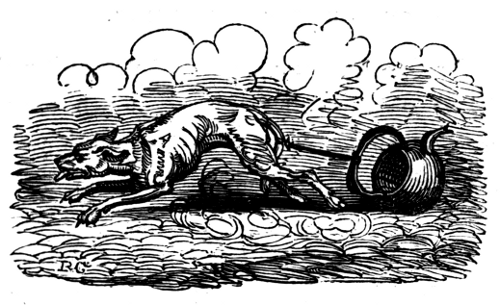
BENJAMIN BASHFUL ON THE VICE OF PUNNING. THE PUNSTER'S FOE.
Who's he, that from our board is running?
He, Sir's an enemy to punning,
A bashful foe, who loves not wit—
Ergo, because he's none of it
Within his cranium; and at table
Sits like the fox in Æsop's fable,
Watching the grapes he'd fain devour,
And disappointed, calls them sour.
A laugh would decompose his metal,
And like a dog, with a tin kettle
Dangling at his tail, he runs
From witty wags who deal in puns.
TO BERNARD BLACKMANTLE, ESQ. Sir,
It has just been communicated to me, that you are about to collect and publish a Punster's Pocket-Book, for the express purpose of promoting that pernicious vice, which is already much too prevalent. As an antidote to the evil, I hope you will not fail to insert this my special protest.
B. BASHFUL.
I am a bashful young man of good fortune, who, to use the phrase of the mode, have just come out, and made my entré into the world with the reputation of being a gentleman and a scholar. I could wish you to notice a minor evil in society which tends to poison the springs of taste and knowledge, by bringing forward the flippant, and throwing back the reflective, speaker. I allude to the vice of punning, which tends to destroy all the profit and pleasure of conversation, and embarrass, in the greatest degree, the young and inexperienced.
It is my fate to mix with a circle of fashionable dilettanti, each of them capable of sustaining a part in rational discourse, and of conducting the intellectual conflict with some share of vigour and learning; who, nevertheless, meet together to fritter away time, patience, and attention, with a series of unconnected quibbles and conundrums. Instead of the rich web of fancy, glowing with the vivid creations of lively, intelligent minds, the conversation presents a motley intermixture of shreds of wit and patches of conceit, a chequer-work of incongruities, the very orts and scraps of the "Feast of Reason," the dozings of science, and dregs of literature. If I relate to this group of punsters the most affecting circumstance, I am heard with impatience and inattention, till I chance unwittingly to utter a word susceptible of a double or triple interpretation. The mischievous spark of folly immediately ignites, the moral interest of my tale is undermined, and a loud report of laughter announces the explosion. The genius of orthography frowns in vain: puns are, by the law of custom, entitled to claim entrance into the sensorium either by the eye or the ear: but when a pseudo pun ("for indeed there are counterfeits abroad") is perceptible to neither sense—when read, its wit is not discoverable; and when heard, it cannot be understood: to avoid the horror of an explanation, I find myself obliged to perjure my senses by laughing in ignorance and very sadness, and thus contribute a sanction to the practice I would fain abolish. The evil is subversive of the first principle of society. Is it little to hunger for the bread of wisdom, and to be fed with the husks of folly? Is it little to thirst for the Castalian fount, and see its waters idly wasted in sport or malice? Is it little to seek for the interchange of souls, and find only the reciprocity of nonsense?
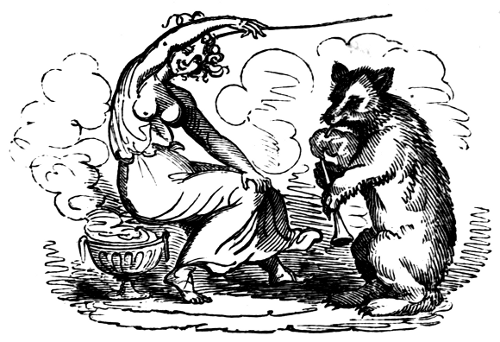
P.S. By BERNARD BLACKMANTLE. To which complaint, I add this note And sketch, by way of antidote, The glorious art can life enhance, A Pun will cause a Bear to dance, And as we here have proof,—provoke A bashful man to stand a joke.
Blank Page
Blank Page
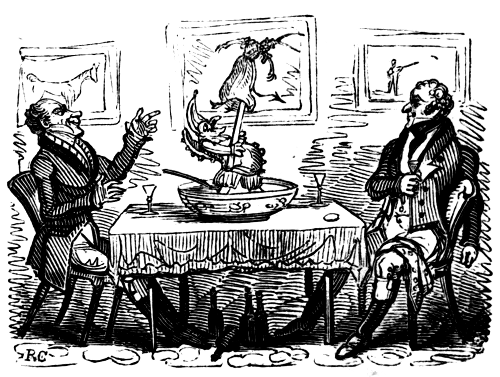
EXAMPLES IN PUNNING, BY ROYAL, NOBLE, AND EMINENT PERSONS. THE PUNSTER'S BOWL.
The sovereign medicine of life, The antidote to care and strife— Is friendship, and the cheerful bowl, When humour meets a kindred soul: Then flows the epigram, and pun, From starry eve, to morning's sun; And Laughter, "holding both his sides," The rubs and jeers of life derides. Then honest hearts, elate with glee, Forget the world, and black ennui; For nought like punch, and puns, can drown, The supercilious rich man's frown, Or free the heart, a prey to care, From fortune's ills and fell despair. Bernard Blackmantle.
Blank Page
EXAMPLES IN PUNNING.
The seeds of punning are in the minds of all men." Addison, Spectator, No. 61.
ROYAL PUNS.
RIGHT DIVINE.
Among the few highly favoured individuals who were included in the select evening parties of his present Majesty, George the Fourth, while at the Pavilion, Brighton, was the facetious Reverend J. Wright. On one occasion the king suggested to his brother, the Duke of York, some intention he had of doing a particular act, to which the duke dissented, and his Majesty referred to the D.D. on which the reverend jocularly observed, "The king can do no wrong." Then, said his Majesty, "Fred. I shall pursue my object, for you hear I have 'Wright Divine' on my side."
COOKE AND KITCHEN.
Sir George C., better known as Col. C., was said to have had an intrigue with a Mrs. Kitchen. When the king was told of it, he said, "It was very natural that a Cooke should be fond of Kitchen stuff, but if he meddles with the Coles he will get out of the frying-pan into the fire." The Coles were cousins to the lady.
A DOWN HILL PUN.
Sir George Hill, the vice-treasurer of Ireland, and a near relative to the Londonderry family, was among the visitors at the Pavilion. Dr. Tierney remarked, that Sir George was getting old and feeble—"If I mistake not," replied the king, "he is going down hill very rapidly."
"Hume and Croker had a sharp contest last night," said the Earl of Liverpool to his Majesty, "but it ended in smoke." "I don't wonder at that," replied the monarch; "The Fire of Croker was sure to smoke like Irish turf beneath the weight of Scotch Hume-i-dity."
Sir Edmund Nagle said he wondered that the king of France did not feel offended at the squibs let off against him in the English newspapers. "Pshaw!" said the king, "he would be a fool indeed to be frightened at a squib in London, when at Paris he is sitting on a barrel of gunpowder."
LORD ELDON'S PUNNING JEU D'ESPRIT.
In an application to his Lordship for an injunction to restrain the proprietors of the "Gazette of Fashion" from selling the song of "We're a' Noddin," the Chancellor perceiving the trifling nature of the cause, after hearing the defendant, observed, "I will dismiss both parties, by granting an injunction against Cease your Funning."
LORD STOWELL,
On a recent occasion, having taken his seat in the Admiralty Court, inquired separately of the advocates, if they had any motion to move; and being answered in the negative, the judge very good humouredly replied, "Then, gentlemen, the best thing we can do will be to move ourselves."
GEORGE CANNING AND EARL BATHURST. Kicking the Bucket.
As the Earl Bathurst and George Canning were walking along Pall Mall, the Earl struck his foot, by accident, against a small pail, (which some careless servant had left at the door), and turned it over; "Why, your lordship has kicked the bucket," said the facetious orator; "No, not so bad as that, George," replied the witty earl, "I've only turned a little pale (i. e. pail)."
LORD ERSKINE.
Few persons ever enjoyed a greater facility of punning upon the ancient languages than his lordship. For instance, on one of the articles of his breakfast apparatus, Lord E. had inscribed Tu doces, literally Thou—Tea—Chest.
THE DUKE OF WELLINGTON IN ACTION.
"Your Grace speaks without reason, and too much in a passion," said a Spanish brunette to whom he had made a proposal, and was pressing it somewhat close. "Ah! my dear little angel," said the great captain, "reason has nothing to do with love; and passion is very desirable when we are on the point of entering into immediate action."
TURN IN AND TURN OUT.
A noble lord who was aide-de-camp to the Duke of Wellington, visited the Duke early on the morning of the battle of Salamanca, and perceiving him lying on a very small camp bedstead, observed that his Grace "had not room to turn himself." The Duke immediately replied, "When you have lived as long as I have, you will know that when a man thinks of turning in his bed, it is time he should turn out of it."
THE DUCHESS OF DEVONSHIRE
Being told that a great public defaulter had married his kept-mistress, observed, "That fellow is always robbing the public."
ROGERS ON TASTE.
When the Marquis of Hertford opened his splendid hotel in Piccadilly, Mrs. Coutts was one of the visitors present—much to the annoyance of certain of our fair nobility. In reply to an observation of hers, upon the splendour and magnificence of the furniture and decorations, Rogers archly remarked, that, "besides splendour, there was so much good taste in the ornaments and society—every thing in the rooms was so chaste and delicate."
LADY HAMILTON.
The beautiful Lady Hamilton having at her table given "Mr. Abraham Goldsmidt" as a toast, and Lord Nelson only half filling his glass, she cried, "Come, come, my Lord, you must not sham Abraham."
JACK BANNISTER AND THE GOUT.
A friend consoling with the comedian during a severe attack of the gout, observed, that the disease prolonged life, and added, "Any body might take a lease of yours." "Then it must be," quoth Jack writhing with pain, "at a rack rent."
HOSPITALITY.
Jack Bannister, praising the hospitalities of the Irish, after his return from a trip to the sister kingdom, was asked if he had ever been at Cork? "No," replied the wit, "but I have seen a great many drawings of it."
LUTTRELL AND ROGERS.
Luttrell and Sam Rogers met together at the Chinese Saloon the other day. "This must be a famous speculation," said Sam; "I think the proprietor of the Anatomie Vivante should take his motto from my favourite epistle in Horace—
'Annonæ prosit— Vir BONUS.'"
"Why," said Luttrell, "I think the man a humbug; you'll find plenty of living skeletons in our hospitals—so I think a better motto may be found for him in the same epistle, which you have quoted so often—
'Vir BONUS est QUIZ.'"
THE RIGHT HONOURABLE CHARLES JAMES FOX.
C.J. Fox, and Mr. Hare, his friend, both much incommoded by duns, were together in a house, when seeing some very shabby men about the door, they were afraid they were bailiffs in search of them. Not knowing which was in danger, and wishing to ascertain it, Fox opened the window, and calling to them, said, "Pray, gentlemen, are you Fox-hunting, or Hare-hunting?"
LORD ROSS.
The witty Lord Ross having spent all his money in London, set out for Ireland in order to recruit his purse. On his way he happened to meet with Sir Murrough O'Brien, driving for the capital in a lofty phaeton, with six fine dun-coloured horses. "Sir Murrough," exclaimed his Lordship, "what a contrast between you and me! I have left my duns behind me; you are driving your duns before you.
DR. JOHNSON.
Early one morning, the Doctor passing by the end of the Old Bailey, observed a great crowd collected, and upon inquiring of Boswell what it meant, was informed that one Vowel was going to be hanged for forgery. "Well," replied the Doctor, "it is very clear, Bozzy, that it is neither U nor I."
AN UNFORTUNATE CELEBRITY. Dr. Johnson.
A pert young fellow who had made some abortive attempts as an author, and notwithstanding the shallowness of his pretensions, was on excellent terms with himself, had long been labouring for an opportunity of being introduced to the Doctor, and at length succeeded in obtaining an invitation to Mr. Thrale's. Having taken proper means to be frequently accosted by his name, which, in his own fond imagination, was "fama super æthera notum," he sat for some time in expectation of being accosted by the Lexicographer. Finding, however, that his hopes were vain, he at length ventured to break the ice. Approaching the Doctor with a smile of self-sufficiency, "My name, Doctor Johnson," said he, "is——; you have probably heard of me as being of some celebrity in the literary world." "Yes, I have indeed," was the sarcastic reply he received, "of very unfortunate celebrity."
DR. PARR ON WANTS.
The Doctor used to say, that a man's happiness was secure in proportion to the small number of his wants; and he added, that, all his life, he had endeavoured to prevent the multiplication of them in himself. A Mr. Ketch, on hearing this, said to him, "Then, Doctor, your secret of happiness is, to cut down your wants." "Suspend your puns, Mr. Ketch," said the Doctor, "and I will drop you the hint: My secret is, not to let them grow up."
GEORGE COLMAN.
George Colman being once asked if he were acquainted with Theodore Hook, replied, "Oh yes; Hook and I (eye) are old associates."
JAMES SMITH, ESQ. ON SPRING AND SUMMER.
"We shall jump into summer all at once," said a friend to James Smith, one very fine day in the early part of the year. "Stop," said the punster, "if it is leap year, you must take a good spring first."
SHIELD AND SIR GEORGE SMART—THE SCORE OF MERIT.
Shield the composer, on the occasion of Sir George Smart being knighted, said, "It must have been on the merit of his score[19], and not on the score of his merit."
MR. WILLIAM SPENCER. Classical Pun.
As William Spencer was contemplating the caricatures at Fores's one day, somebody pointed out to him Cruickshanks's design of the "Ostend packet in a squall;" when the wit, without at all sympathizing with the nausea visible on some of the faces represented in the print, exclaimed,
"Quodcunque Ostendis mihi sic incredulus odi."
REYNOLDS THE DRAMATIST.
The amiable Mrs. W. always insists that her friends who take grog, should mix equal quantities of spirits and water, though she never observes the rule for herself. Reynolds having once made a glass under her directions, was asked by the lady—"Pray, Sir, is it—As You Like It?"—"No, Madam," replied the dramatist, "it is—Measure for Measure."
HENDERSON AND THE TWO GARRICKS. The Tatler, Spectator, and Guardian.
The first time that Henderson, the player, rehearsed a part at Drury Lane, George Garrick came into the boxes, saying as he entered, "I only come as a spectator." Soon after he made some objection to Henderson's playing, when the young actor retorted—"Sir, I thought you were only to be a Spectator; instead of that you are turning Tatler." "Never mind him, Sir," said David Garrick, "never mind him, let him be what he will, I'll be the Guardian."
ANDREW CHERRY THE COMEDIAN.
The late Mr. A. Cherry, comedian, was written to some years since, with an offer for a good engagement from a manager, who, on a former occasion, had not behaved altogether well to him. Cherry sent him word, that he had been bit by him once, and he was resolved, that he should not make two bites of A. Cherry.
MR. JEKYLL'S PUN ON MR. RAINE.
Mr. Jekyll being told the other day, that Mr. Raine, the barrister, was engaged as the opposing counsel for a Mr. Hay, inquired, "If Raine was ever known to do any good to Hay?"
RALPH WEWITZER THE PUNSTER. A Fault in Candles.
Ralph Wewitzer, ordering a box of candles, said he hoped they would be better than the last. The chandler said he was very sorry to hear them complained of, as they were as good as he could make. "Why," says Ralph, "they were very well till about half burnt down, but after that they would not burn any longer."
C.J. FOX AND BURKE ON THE "SUBLIME AND BEAUTIFUL."
Mr. Fox supped one evening with Edmund Burke, at the Thatched House, where they were served with dishes more elegant than substantial. Charles's appetite being rather keen, he was far from relishing the kickshaws that were set before him, and addressing his companion—"These dishes, Burke," said he, "are admirably calculated for your palate—they are both sublime and beautiful."
HORNE TOOKE AND DR. PARR ON "TIT BITS."
Horne Tooke, author of the Epea Pteroenta, was remarkable for the readiness of his repartees in conversation. He once received an invitation to a dinner party to meet the celebrated Dr. Parr. "What!" said Horne Tooke, "go to meet a country schoolmaster, a mere man of Greek and Latin scraps! that will never do." Some time after this, he met Dr. Parr in the street, and addressed him with, "Ah! my dear Parr, is it you? how gratified I am to see you!" "What, me?" replied Parr, "a mere country schoolmaster, a man of Greek and Latin scraps?" "Oh my good friend," rejoined Horne Tooke immediately, "those who told you that never understood me; when I spoke of the scraps I meant the tit-bits."
CURRAN'S CULINARY JOKE.
During Lord Westmoreland's administration, when a number of new corps were raised in Ireland (and given as jobs and political favours), it was observed, that, when inspected there, the establishment of each regiment was nominally reported to be complete at embarkation for England, but when landed at the other side, many of them had not a quarter of their numbers. "No wonder," said Mr. Curran, "for after being mustered, they are afraid of being peppered, and off they fly, not wishing to pay for the roast."
COUNSELLOR DUNNING OVER-DONE.
A gentleman being severely cross-examined by Mr. Dunning, who asked him repeatedly if he did not live within the verge of the court, at length answered that he did. "And pray, sir," said Dunning, "why did you take up your residence in that place?"—"In order to avoid the impertinence of dunning," answered the witness.
LORD CHANCELLOR ELDON AND THE LANCET. Bleeding in Chancery.
On a motion to dissolve the injunction obtained against that useful work the Lancet, the Lord Chancellor sent it to the Vice, and "hoped there would be no more bleeding," to which Mr. Hart replied, not much, as there was only one operator retained by each side. Ay, but, said his lordship, they may stick to their patient like a Leach.
R.B. SHERIDAN AND THE PRINCE OF WALES, OR ONE SWALLOW DOES NOT MAKE A SUMMER.
One wintry day, the Prince of Wales went into the Thatched House Tavern, and ordered a steak: "But (said his Royal Highness), I am devilish cold, bring me a glass of hot brandy and water." He swallowed it, another, and another. "Now, (said he) I am comfortable, bring my steak." On which Mr. Sheridan took out his pencil, and wrote the following impromptu:—
The Prince came in, said it was cold,
Then put to his head the rummer;
Till swallow after swallow came,
When he pronounced it summer.
CHARLES BANNISTER.
Charles meeting a thief-taker with a man in his custody, and asking his offence, was told he had stolen a bridle. "Then (said Charles) he wanted to touch the bit."
WILBERFORCE AND SHERIDAN ON DRINKING.
That very sober pious personage, Mr. Wilberforce, reproved his friend Sheridan thus: "My good Sir, (said he) you have drunk a little too much." "Have I? (hiccupped the other) and you, my good Sir, have drunk much too little."
THE FACETIOUS CALEB WHITFOORD.
The late Caleb Whitfoord, seeing a lady knotting fringe for a petticoat, asked her, what she was doing? "Knotting, Sir, (replied she;) pray Mr. Whitfoord, can you knot?" He answered, "I can-not."
JUDGE JEFFERIES BEARDED.
The judge told an old man with a long beard, who was being examined as a witness, that he "supposed he had a conscience as long as his beard." If, replied the old man, we were all to be judged of by that rule, your lordship would be deemed a most unconscionable judge[20].
LORD CHESTERFIELD AND LORD TYRAWLEY.
"Sic sine Morte Mori," was given by some wag as a toast, when Lord Chesterfield and Lord Tyrawley were both present, at a very advanced age, when Lord Chesterfield said, "Tyrawley and I have been dead these two years; but we don't choose to have it known."
SAM FOOTE ON PLAYING TOO HIGH.
A German baron at a gaming-house, being detected in an odd trick, one of the players fairly threw him out of the one pair of stairs window. On this outrage he took the advice of Foote, who told him "never play so high again."
FELIX M'CARTHY.
Felix M'Carthy passing through Clement's Inn, and receiving abuse from some impudent clerks, was advised to complain to the Principal, which he did thus: "I have been abused here by some of the rascals of this inn, and I come to acquaint you of it, as I understand you are the Principal."
TIERNEY v. FOX.
Mr. Fox, in the course of a speech, said, "If any thing on my part, or on the part of those with whom I acted, was an obstruction to peace, I could not lie on my pillow with ease." George Tierney (then in administration) whispered to his neighbour, "If he could not lie on his pillow with ease, he can lie in this house with ease."
LEE LEWIS ON THE GAME LAWS.
Lee Lewis shooting in a field, the proprietor attacked him: "I allow no person (said he) to kill game on my manor but myself; and I'll shoot you, if I find you here again." "What! (said the comedian) do you mean to make game of me?"
CALEB WHITFOORD AND HIS NEPHEW.
The late Caleb Whitfoord, finding his nephew, Charles Smith, playing the violin, the following bits took place:
W. I fear, Charles, you lose a great deal of time with this fiddling.
S. Sir, I endeavour to keep time.
W. You mean rather to kill time.
S. No, I only beat time.
JOHN KEMBLE MURDERING TIME.
When Kemble was rehearsing the romance sung by Richard Cœur de Lion, Shaw, the leader of the band, called out from the orchestra, "Mr. Kemble, my dear Mr. Kemble, you are murdering time." Kemble, calmly and coolly taking a pinch of snuff, said, "My dear Sir, it is better for me to murder Time at once than be continually beating him as you do."
SHERIDAN ON LOVE FOR LOVE.
Sheridan complained that Congreve's "Love for Love," had been so much altered and modified to suit the delicate ears of modern mawkishness, that it was quite spoiled. It is now (said he) like modern marriages, with very little of "Love for Love" in it. "His plays," said the wit, "are, I own, somewhat licentious, but it is barbarous to mangle them: they are like horses; when you deprive them of their vice, they lose their vigour."
THE MORNING POST ON PREFERMENT.
An auctioneer having turned publican, was soon after thrown into the King's Bench; on which the following paragraph appeared in the Morning Post: "Mr. A., who lately quitted the pulpit for the bar, has been promoted to the bench."
SIR J. PARNELL
Became a general toast in Ireland after the Union, by which he lost his place, or, as he once said, "his bread and butter." When lamenting his loss, he was told, "Ah! but it's amply made up to you in toast."
HORACE TWISS, M.P. A special Pun.
Mr. Twiss being one evening in the boxes of Covent Garden theatre, to see Macbeth: when the hero questions the witches what they are doing, they answer, "a deed without a name." Our counsellor, whose attention was at that moment directed more to Coke upon Littleton than Shakspeare, catching, however, the actor's words, repeated, "A deed without a name! why, 'tis void."
RALPH WEWITZER.
The comedian meeting a young friend, observed how well he looked. "Ay, (says the other) I have a rare good appetite, and I take care that it be well satisfied; in the first place, every morning I eat a great deal to breakfast." "Then (observes the former) I presume you breakfast in a timber-yard."
JOHN BANNISTER NO SHOOTER.
A few years ago, it will be remembered, that Mr. John Bannister nearly lost his arm by the bursting of a fowling-piece. Shortly after he observed to a friend, "I may be an actor, but I will not attempt to be a Shooter."
LORD NELSON'S ARMS.
The master of the Wrestler's Inn, at Yarmouth, having solicited Lord Nelson to permit him to put up his arms, and change the name of the inn to The Nelson Hotel; his lordship returned for answer, that he was perfectly welcome to his name, but he must be sensible that he had no arms to spare.
SOME OF CURRAN'S BEST.
A severe Irish judge, being at dinner among an assemblage of lawyers, Mr. Curran asked his lordship, if he should have the pleasure of helping him to a slice of pickled tongue which stood before him. "If it were hung (said his lordship), I would try it." "If you were to try it (replied Curran), it would be sure to be hung."
CURRAN'S COVENTRY JOKE.
On some one proposing to send an Irish barrister to "Coventry" for refusing to fight a duel, "Sure," said the wit, "that is carrying the joke a little too far."
CAPITAL JOKES.
While a counsellor was pleading at the Irish bar, a louse unluckily peeped from under his wig. Curran, who sat next to him, whispered what he saw. "You joke," said the barrister. "If (replied Mr. Curran) you have many such jokes in your head, the sooner you crack them the better."
ON DISCIPLINE.
MacNally was very lame, and when walking, he had an unfortunate limp. At the time of the Rebellion he was seized with a military ardour, and when the different volunteer corps were forming in Dublin, that of the lawyers was organized. Meeting with Curran, MacNally said, "My dear friend, these are not times for a man to be idle; I am determined to enter the Lawyers' Corps, and follow the camp." "You follow the camp, my little limb of the law!" said the wit, "tut, tut, renounce the idea; you never can be a disciplinarian." "And why not, Mr. Curran?" said MacNally. "For this reason," said Curran, "the moment you were ordered to march you would halt."
LORD NORTH'S PUN CLASSICAL.
A gentleman told Lord North, that from a variety of losses, he had found himself compelled to reduce his establishment. "And what (said his lordship) have you done with the fine mare you used to ride?" "I have sold her." "Then you have not attended to Horace's maxim:
'Equam memento rebus in arduis Servare.'"
MANNERS EARL OF RUTLAND.
Manners Earl of Rutland meeting Sir Thomas More, shortly after their mutual preferment, and thinking he assumed rather a haughty carriage, observed, "Honores mutant Mores." "No, my lord (said Sir Thomas), the pun will be much better in English, Honors change Manners."
LORD BYRON TO ROGERS ON PUNNING.
Lord Byron observed to Rogers, that punning was the lowest species of wit. "True (said the other), it is the foundation."
THE ARCH-BISHOP AND HIS ARCH-CURATE. Pun beneficial.
Sir William Dawes, archbishop of York, delighted in a good pun. His clergy dining with him the first time after the decease of his lady, he said he feared the company would not find things in so good order as they were in the time of poor Mary, adding with a sigh, "Ah! she was indeed Mare Pacificum." A curate, who pretty well knew the truth of the matter, got himself completely into favour by observing, "Ay, my lord, but she was first Mare Mortuum."
DR. GOLDSMITH AND SIR JOSHUA REYNOLDS. A pun spoiled.
At a dinner of wits, a dish of pease was brought in, become almost grey with age. "Carry these pease to Kensington!" said one of the party. "Why to Kensington?" said another. "Because it's the way to Turn'em green." Dr. Goldsmith going home in the evening with Sir Joshua Reynolds, observed, that he would have given five pounds to make so excellent a pun. "You shall have the opportunity (said the knight) on Tuesday, when you are to dine with me, and none of the same company will be present." Tuesday came, and the dinner was served up; amongst the other dishes a plate of pease of the same description. "Carry these peas to Kensington," said Goldie. "Why so?" "Because it's the way to make them green!"
DR. BROWN'S TOAST.
Dr. B. long but unsuccessfully paid his addresses to a young lady, whom he used always to give as a toast. Dining one day with a friend, the latter filling his glass, said, "Come, doctor, I'll give you your favourite toast." He answered, "You may do as you please; but for myself, I have already toasted her too long without being able to make her Brown."
R. PEAKE TO R. MARTIN, M.P.
"Sir," said the humane M.P. to the facetious dramatist (praising his own bill), "instead of the drovers inhumanly beating the poor bastes as formerly, you will shortly see them applying opodeldoc to their wounds." "Ay;" rejoined the punster, "Steer's of Cow-lane."
R. PEAKE AND WINSTON.
The punster, having occasion to call upon the stage manager of Drury Lane, was shown into his room, when the servant remarked, "he feared Mr. Winston had left the theatre." Peake observing a stage screw lying upon the table before him, took it up and replied, "I perceive he has left his card and name behind him."
ARNOLD AND PEAKE.
A person observing that Mr. Arnold, the proprietor of the English Opera, was an ill-tempered man, but a fortunate one, Charles Westmacott replied, "he knew that to be true, for he was indebted for both his cash and success to pique." (Peake his dramatist and treasurer.)
PEAKE'S "STOUT MAN"
Appeared originally during the oppressive heat of the season 1825, at the English Opera House: when Arnold observing that the piece did not run according to his expectations, Peake dryly replied, "How can you expect a stout man to run in such very hot weather?"
CHARLES BANNISTER AND PARSONS.
The late Mr. Charles Bannister going with Mr. Parsons into a shop where there was an electric eel, the latter said, "Charles, what sort of a pie would that eel make?" He answered, "A shock-ing one."
THE RIGHT HON. G. CANNING ON RESOURCES.
Mr. Canning seeing a certain nobleman rowing a wherry on the Thames, with all the power and skill of a waterman, observed, "Your grace is certainly prepared for the worst extremities, for by your skull you could always keep your head above water."
BEN JONSON AND THE COUNTRYMAN. Simplicity v. Wit.
A country booby boasting of the numerous acres he enjoyed, Ben Jonson peevishly told him, "For every acre you have of land, I have an acre of wit." The other, filling his glass, said, "My service to you, Mr. Wise-acre!"
DENNIS THE PUNSTER. Tria juncta in uno.
Mr. Dennis, a gentleman who died about 1764, and was famous for his puns, was once ridiculed for it in a copy of verses by three gentlemen, whose names were Goodwin, Johnstone, and Marshall; he answered them in the following manner: "If Good be the better half of thy name, it is so little in thy nature as not to be perceived, though in conjunction with thy friend John, thou hast helped to make such a noble copy of verses that they ought to be engraven on stone. I would have given steel the preference, if a certain person did not Mar your works, so shall say no more of the matter."
W. R. V.-ANA. THE CONVERSATIONAL PUNSTER. "A fellow of infinite jest, of most excellent fancy."
[There are very few literary persons in London, at least among those connected with the public press, who have not occasionally enjoyed the pleasant, punning, conversational powers of my friend W. R. V. whose whim, wit, and great good nature are not more esteemed, than his unaffected manners, and sincerity of disposition justly entitle him to.]
Some one observed, "Matches are made in Heaven." "Yes," answered he, "and they are very often dipped in the other place."
Two men contending at a tavern upon the point of who wrote that beautiful song on Ingratitude, "Blow, blow, thou wintry wind!" one said Ben Jonson; the other said Shakspeare. R.V. to adjust their differences, observed, "They must have written it between them, for each was a-verse to ingratitude."
A fat gentleman who was at a loss for the name of the nobleman who was shut up in a tower and starved to death, applied to the punster—"You-go-lean-O!" was the reply.
"A tailor is the ninth part of a man," observed a would-be-wit, in the presence of a knight of the sheers: "But," answered R.V. "a fool's no part at all."
"He that will pun will pick a pocket," observed an old cynic. "You speak from experience," was the stopper to this vinegar cruet.
Rhodes, the punning landlord of the Coal Hole tavern, took the Bell Inn at Hammersmith: R.V. hoped that as he had so long answered the bell, the Bell would now answer him.
One asked him what works he had in the press. "Why, the History of the Bank, with notes; the Art of Cookery, with plates; and the Science of Single Stick, with wood cuts."
A person told him that Louis dix-huit, when he entered London, put up at Grillon's hotel. "I am surprised at that," said he; "his father took his chop at Hatchett's."
A barber recommended him his aromatic essence for the improvement of his hair. "No, no; don't waste your fragrance on the desert hair."
A friend remarked of a gentleman with very large curly whiskers, that he said nothing. "Poor fellow; don't you see he's lock-jawed?"
"How well you put on your cravat," said a crony: "that tie's something new."—"Yes; it's a novel-tie."
He pacified a quarrelsome fellow one evening by observing, "I should not like to go up in a balloon with you, for fear of our falling out."
Seeing a porter bring in an edition of a new work of his from the press to his bookseller, "Dear me!" he exclaimed, "what a weight is off my mind."
"What a swell you are in your new frock coat," said a quiz to him one day. "Don't you like it?—I do: indeed I'm quite wrapped up in it."
The same person meeting him one day in the city, observing he had on a new waistcoat, asked if it was a city cut. "No," answered he, "it's a west-cut."
Dining at the Wrekin tavern, he asked for a wine glass: the waiter, in bringing it, inadvertently let it fall—"Zounds! I did not ask you for a tumbler!"
Sitting in company with one of those people who find fault with every thing, good, bad, or indifferent, he could not refrain from quizzing the old fellow. "True, true; we have nothing new or good now-a-days: Waterloo bridge is a catchpenny, Herschell's telescope all my eye, the steam engine a bottle of smoke, and the safety-coach a complete take in."
Bearcroft the classic observed to him, that learning was pabulum animi, food of the mind. "Yes," replied he, "and that's the reason, I suppose, the collegians wear trencher caps."
On George the Fourth landing at Calais in 1820, the wind was so boisterous as to blow off his foraging cap, greatly inconveniencing him: a brave officer, Captain Jones of the Brunswicks, who stood near, presented His Majesty with his own, which the King graciously accepted, and wore until he got to his carriage. This drew from him the following impromptu:
"Whether in peace or war, If hostile dangers frown, It is the soldier's care To guard his Monarch's crown."
He blamed a friend for dedicating a very clever work to a certain nobleman, notorious for his stupidity. "My book wanted a title," was the reply. "Oh!" he observed, "but it might otherwise have been peer-less."
On Sir Robert Wilson's motion for investigating the affair that deprived him of his rank as General being lost, he lamented it as very hard that they should refuse him "even a major-ity."
Being proposed a member of the Phœnix Club, he asked when they met:—"Every Saturday evening during the winter."—"Then," said he, "I shall never make a Phœnix, for I can't rise from the fire."
Blank Page
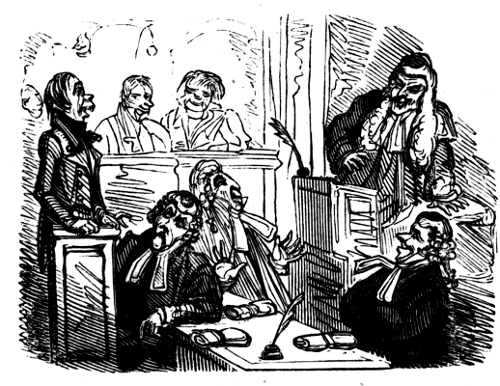
NORBURYANA[21]; CONTAINING A RICH SELECTION OF LORD NORBURY'S BEST PUNS, Pure as Imported. THE PUNNING LAWYERS.
The counsel archly crack their joke On every word the witness spoke; The Jury, laughing, like the fun, And Norbury sums up with a Pun.
A good Pun has, from time immemorial, been quite as admissible in our courts of law, as a good plea; and not unusually has proved successful with the feelings of a jury, when the latter, left entirely to the more weighty arguments of precedents and rejoinder, would only have produced a temporary suspension of the understanding. Lord Norbury's talent as a punster is proverbial, and his wit upon all occasions as clear as his judgments are sound: scarcely a packet of Irish papers arrive in the sister kingdom, but the first inquiry of the humourist is after the last good thing of the Chief Justice's; and, if he fails to encounter a new pun, he retreats homewards like a city sportsman, without game for the morrow; for pun-less, he is quite as miserable as if he was penny-less; and if he cannot crack a new joke at the club, he is like to go cracked himself with vexation in consequence.
It is one of the evils attending eminence in any art, that many loose performances will be attributed to genius, for the sake of notoriety, which would cause a blush upon the cheek of the talented individual under whose cognomen they are surreptitiously launched forth into public life. Every new pun, made by the Emeralders, whether invented in the Four Courts of Dublin, or at the midnight orgies held in the broad and narrow Courts of London, at the Fives Court or the Tennis Court, the King's Court, or the Courts of law and equity, are all heaped upon the great original, Lord Norbury; who has, in consequence, as many sins of this sort to bear with, as any criminal that ever appeared before his legal tribunal. In selecting from an accredited stock, the compiler of this little book has endeavoured to affix to the Noble Punster, only, the legitimate offspring of his own creation; or at least such, if any one has stolen in, as may not disgrace his witty family.
LORD NORBURY'S MOTTO
Is, "Right can never die;" then, said his lordship, punning thereon, "right must be left for ever."
AN AMOROUS PUN.
"Who is that lovely girl?" exclaimed Lord Norbury, riding in company with his friend Counsellor Grahaarty. "Miss Glass," replied the barrister. "Glass!" reiterated the facetious judge; "by the love which man bears to woman, I should often become intoxicated, could I press such a glass to my lips!"
THE JOKER'S RETORT.
The numerous and severe animadversions on Lord Norbury in the Imperial Parliament, only afforded his Lordship an opportunity for a supplemental criticism, viz. "That the English Broom (Brougham) wanted an Irish stick to it;" an appendage which, in the early part of his Lordship's career, he certainly would have been very ready to furnish.
PENCILING WITH A PICKAXE.
The late Counsellor Egan, well known by the appellation of Bully Egan, from his rough courage, got into the Irish parliament during the administration of the late Marquis of Rockingham, and joined with the Whigs of that day in a most outrageous opposition to the administration of the noble Marquis, upon the question of regency, when the opposition succeeded in voting the unlimited regency of Ireland to the Prince of Wales. The Marquis, unable to rally, fled to England without beat of drum, leaving the oppositionists masters of the political field. Not content with this retreat, the Whigs continued to pelt the character of the noble Marquis, by way of post obit, and to heap all those maledictions upon his administration, when defunct, which they had so indefatigably done while living. Amongst the rest, Mr. Egan, in the course of a debate, thought proper to introduce in his speech an episode, in which he proposed, "Now that the Marquis was politically dead, to pencil his epitaph;" and this he did in such coarse and ponderous words, that Mr. Toler, the present Lord Norbury, in his reply, termed this effort of Egan, penciling with a pickaxe.
TIME AND ETERNITY.
On passing sentence of death upon a prisoner who had been convicted of privately stealing a time piece, Lord Norbury, after dwelling upon the enormity of his crime, concluded a very impressive speech by observing, that he had been grasping at time, and caught eternity.
THE CANAL AND LOCKS.
Meeting with a lady in Dublin who was possessed of considerable property in a distant part of the country, and in whose welfare he had taken great interest, particularly during the progress of a bill through parliament for draining her lands, he accosted her, "Ah, my dear Mrs. G——, how d'ye do?—how goes on your water ways?—I must come and take a view of your little canal and locks."
DROPPING THE SUBJECT.
A man having been capitally convicted before Lord Norbury, was, as usual, asked what he had to say why judgment of death should not pass against him—"Say!" replied he, "why, I think the joke has been carried far enough already, and the less that is said about it the better; so if you please, my lord, we'll drop the subject." "The subject may drop," replied his lordship.
JAM SATIS.
A gentleman helping his Lordship to some pie made of raspberry jam, inquired if he would have some more fruit? "Jam satis," replied the punster.
THE CRITICS CURTAILED.
"Lord Byron calls his abusers dogs," said a friend to Lord Norbury; "No doubt he wishes them and their censures cur-tailed," was the reply.
SHAKE-SPEARE.
Riding one day with a friend of the name of Speare, whose horse appeared to jolt him very much, his Lordship could not help observing it. "He is young, and awkward in his paces, but may mend," said Speare. "By the bye, my Lord, I want a name for him." "It must be Shake-speare, then," retorted his Lordship.
KING AND JAMES, THE DUBLIN LORD MAYORS.
Sir Abraham Bradley King, Lord Mayor of Dublin, declined, through prudential motives, from giving, during his mayoralty, the Orange toast, so offensive to the King James's party. James, the next Lord Mayor, was not so particular, but gave it at his first dinner. Lord Norbury, who was present, could not help observing, "You are no friend to King,—James."
CURLED HAIR.
Lord Norbury calling one day on Mrs. O'Connor, the mattrass-maker in Sackville Street, Dublin, who is a very pretty woman, remonstrated with her on having so long delayed sending home his order: "Sure your Lordship," said the good woman, with great naiveté, "there's no curled hair to be had now in Dublin, neither for love nor money." "By the powers above," replied his Lordship, looking amorously, "but it was very plentiful in this city, Mrs. O'Connor, when I was a curly boy."
TRIAL OF A HORSE.
Late on a Saturday evening, as Lord Norbury had concluded charging the jury, after a laborious and long trial, when they retired to make up their verdict, a barrister got up to make a motion respecting a horse, that had been returned to a jockey for not being sound. His lordship complained of his being much tired after the business of the day, and begged they would postpone the business till Monday. The lawyer, anxious to push forward the business, said it would only occupy him a few minutes to try it. His Lordship rising, said in his usual dry way: "Gentlemen, to-morrow is a holiday; you will have time and leisure to try the horse yourselves."
A DRY WIPE.
Lord Norbury being in company with some lawyers, was asked, had he seen a pamphlet that was written by O'Grady, in which he was reflected on? replied, "Yes, yes, I took it to the water-closet with me." When told who was the author, he replied, "Ha! I did not think my friend Grady intended me such a wipe."
HOW TO CUT A FIGURE IN THE TEMPLE.
Lord Norbury, while indisposed, was troubled with a determination of blood to the head. Surgeon Carrol accordingly opened the temporal artery; and whilst attending to the operation, his Lordship said to him, "Carrol, I believe you were never called to the bar?" "No, my Lord, I never was," replied the surgeon.—"Well, I am sure, Doctor, I can safely say you have cut a figure in the Temple."
THE GAME JOKE.
On being informed, last autumn, of the elopement of Mrs. Moore, whose maiden name was Woodcock, Lord Norbury said, "Then we must look out our fleecy hosiery."—"Why so, my Lord?" "Because it is an unerring symptom of a sudden, long, and severe winter to see, so early in the season, the Woodcocks forsake the Moors."
MAJESTICALLY MOUNTED.
Lord Norbury, meeting the Marchioness of Conyngham and Lady Elizabeth riding on horseback in the Phœnix Park, took occasion to admire the beauty of their horses: "The gift of His Majesty," said her Ladyship artlessly: "and Lady Elizabeth's is also a royal present."—"Then I understand," said Lord Norbury, "His Majesty mounts you both."
A SPORTING PUN.
A gentleman on circuit narrating to his Lordship some extravagant feat in sporting, mentioned that he had lately shot thirty-three hares before breakfast.—"Thirty-three hares!" exclaimed Lord Norbury: "Zounds, Sir! then you must have been firing at a wig."
THE FEMALE LINGUIST.
A report having reached his Lordship that a female pedant, who was well known as a blue stocking and linguist, was about to be married, he observed, "He could answer for her disposition to conjugate, but feared she would have no opportunity of declining."
HOPE AND JOY.
At a trial in the Irish Court, Mr. Hope, an eminent attorney, being employed as agent in a certain cause, apologized to the court for the absence of Mr. Joy, his counsel, requesting that it would delay for a few minutes, till Mr. Joy, who was engaged in another court, would return. Some time having elapsed, Lord Norbury addressed the bar, saying, "Gentlemen, I think we had better proceed with the business of the day—although
'Hope told a flattering tale, That Joy would soon return.'"
A RUM WITNESS SENT TO QUOD.
A witness being interrogated by Lord Norbury, in a manner not pleasing to him, turned to an acquaintance, and told him in a half whisper, that he did not come there to be queered by the old one. Lord Norbury heard him, and instantly replied in his own cant, "I'm old, 'tis true, and I'm rum sometimes—and for once I'll be queer, and send you to quod."
A LATE DINNER.
Mr. Curran was to dine with Lord Norbury, when Mr. Toler. His dinner hours were late, which Mr. Curran always disliked. Mr. Toler was going to take his ride, and meeting Mr. Curran walking towards his house, said, "Do not forget, Curran, you dine with me to-day." "I rather fear, my friend," replied Mr. Curran, "it will be so long first, that you may forget it."
CUT AND COME AGAIN.
In a celebrated trial, wherein Mr. Trumble was plaintiff, and Mr. Allpress of Abbey-street, defendant, before Lord Norbury and a special jury, Mr. Serjeant Johnson, Counsellor Leland, and one or two more very fat barristers were employed for the defendant. The opposite bar were remarkably thin spare men, viz. Messrs. Goold, North, Pennyfather, &c. Mr. Johnson, in defending his client from paying a penal rent, in the heat of argument said, "My Lord and gentlemen of the jury, the opposite party stand forth like Shylock in the play, with their knife outstretched to cut from us the very pound of flesh!" Lord Norbury very tritely interrupted the learned serjeant by saying, "Mr. Johnson, the opposite bar perhaps conceive you can spare it better."
A NOTE TAKER TRANSPORTED.
When it was told to Lord Norbury, that sentence of transportation to Botany Bay was passed upon the notorious Mr. Smith, who had been detected in clandestinely pocketing some notes off the vestry-room table, after the collection for the Charity Schools of St. Michael's Church, in November 1819, he jocosely replied, "that he thought it very hard, as it was no uncommon thing to have note takers at all such public meetings."
CLOSE SHAVING.
The Persian Ambassador having, among other public places, visited the Irish Courts of Justice, in November Term of 1819, coming into the Court of Common Pleas whilst it was sitting, the business was suspended for a short time, to view so extraordinary a personage, he being fully dressed in the eastern costume, long beard, &c. After he had retired, one of the Judges asked Lord Norbury what he thought of him, his Lordship wittily replied, "he might be a very clever man, but he was certain he was not a close shaver."
THE RACKET COURT.
The counsel in the Irish courts are not always so decorous and attentive as they should be. During the examination of a witness, Lord Norbury had occasion once or twice to request silence; when the man, in a reply to a question from his lordship relative to his occupation, answered that "he kept a racket court." "Indeed," said the judge, and looking archly at the bar, continued, "and I am very sorry to say that I am Chief Justice of a racket court much too often."
POT LUCK.
A certain Irish musical amateur, who was very irritable, had a party of vocal and instrumental friends on a particular evening in every week at his own house; when some wags, more desirous of promoting discord than harmony, used to assemble under his windows, making the most hideous noises, or in the Irish phraseology, "giving him a shaloo," upon which the amateur dislodged the contents of a certain chamber utensil upon the heads of some passers by, but unfortunately missed his persecutors. For this assault an action was brought and tried before Lord Norbury, who, in summing up the case to the jury, good humouredly observed, "that the plaintiffs must be considered in the light of uninvited guests, and it could not be denied that they had been treated by the defendant with pot-luck."
In a humorous trial between the rival managers, Messrs. Daly and Astley, respecting the right of the latter to perform the farce of "My Grandmother," at the Peter-street theatre, Dublin, Daly's counsel stated, that the penalties recoverable from the defendant, for his infringement of the rights of the patent theatre, would all be given to that excellent charity the Lying-in Hospital. Mr. Toler, in reply, observed, "That it was notorious, no man in Dublin had contributed more largely, in one way, to the Lying-in Hospital than Mr. Daly; and it was therefore but fair, if he recovered in this action, that he should send them the cash. But," continued the facetious counsel, "although Mr. Daly's attachment to good pieces is proverbial, we do not choose that he shall monopolize all the good pieces in Dublin, from 'My Grandmother' down to 'Miss in her Teens.'"
LORD NORBURY'S EPITAPH. SAID TO HAVE BEEN WRITTEN BY HIMSELF
He's dead! alas, facetious punster, Whose jokes made learned wigs with fun stir: From heaven's high court, a tipstaff's sent, To call him to his pun-ishment:— Stand to your ropes! ye sextons, ring! Let all your clappers ding, dong, ding! Nor-bury him without his due, He was himself a Toler[22] too!
Blank Page
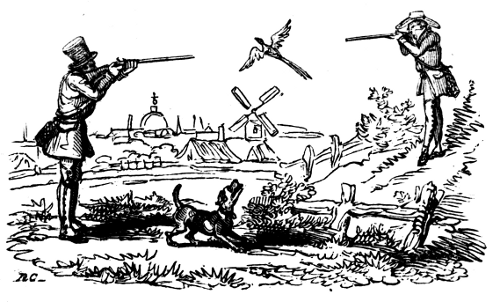
PUNNING EPIGRAMS. THE SPORTING PUNSTERS.
Two merry wags, of Cockney land, Well known at Rhodes's, in the Strand, Where tavern wits choice puns let fly, Resolved their dogs and guns to try. Dress'd cap-a-pee, in sporting suit, With jacket, belt, and net to boot, Away they trudge to Hampstead Rise, To take the pheasants by surprise. And what will strange appear, though true, A poor stray'd cock-bird came in view, Uprising 'tween the punning elves, Who miss'd the bird, but shot themselves. Condoling on their hapless gunning, They yet could not desist from punning: "Ne'er mind, Tom, peasants each we've hit." "Why leave the aitch, Ned, out of it?" "Because," quoth Ned, "I'd fain forget The aitch that frets my body yet." "Still pop for pop," quoth Tom again. Says Ned, "I feel a shooting pain; But then I've heard, those who aspire To be good sportsmen must stand fire." "Agreed," cries Tom, "and in my head 'Tis now engraved in molten lead."
By Bernard Blackmantle.
ON SIR THOMAS MORE, LORD CHANCELLOR OF ENGLAND.
When More had few years Chancellor been, No more suits did remain; The like shall never more be seen, Till More be there again!
R.B. SHERIDAN'S EPIGRAM ON PITT.
The nation is pawn'd! we shall find to our cost, And the minister since has the duplicate lost. We shall all be undone by the politic schemer, Who, though "Heav'n-born[23]," will not prove a Redeemer.
ON "RECOLLECTIONS OF LORD BYRON, BY THE LATE R.C. DALLAS, EDITED BY HIS SON."
A mighty DULL ASS is old prosing Dallas, And quite as dull and prosing is his Son— What! fifteen shillings for the book! Alas! No pleasant "Recollection"——I am done.
DEAN SWIFT'S BARBER.
Dean Swift's barber one day told him that he had taken a public house. "And what's your sign?" said the Dean. "Oh, the pole and bason; and if your worship would just write me a few lines to put upon it, by way of motto, I have no doubt but it would draw me plenty of customers." The Dean took out his pencil, and wrote the following couplet, which long graced the barber's sign:
Rove not from pole to pole, but step in here, Where nought excels the shaving but the beer."
G. COLMAN TO MISS M. TREE, Impromptu, on Miss M. Tree's intended marriage and retirement from the stage.
You bloom and charm us!—still the bosom grieves, When Trees of your description take their leaves.
TO CAPTAIN PARRY, THE POLAR NAVIGATOR, On his giving a Fete on board the Hecla.
Dear Captain Parry, you are right To give the belles a levee; God grant your dancing may be light, For oh! your book is heavy.
SAM ROGERS TO CHARLES LAMB. Elia's Pen.
Says Elia, "Zounds, this pen is hard!" Quoth Samuel Rogers, "Do not huff; But write away, my honey bard, You soon can make it soft enough."
FRI v. DAY.
Good Friday rain'd, Sam Rogers dined On soles, for fish were all the go; And Sam allowed the Fri was good, Although the day was but so so.
TO THE LATE MR. COUTTS. Written at Holly Lodge, Highgate, by the Duke of Gordon, and presented in the Drawing-room by the Marquis of Huntley.
An apple, we know, caused old Adam's disgrace, Who from Paradise quickly was driven; But yours, my dear Tom, is a happier case, For a Melon transports you to heaven.
TO MRS. COUTTS, THE GAY WIDOW.
Her mourning is all make-believe; 'Tis plain there's nothing in it; With weepers she has tipp'd her sleeve, The while she's laughing in it.
IMPROMPTU, BY LORD ERSKINE TO LADY PAYNE, ON BEING TAKEN ILL AT HER HOUSE.
'Tis true I am ill, but I need not complain; For he never knew pleasure who never knew Payne.
TO C.J. FOX, ON HIS MARRIAGE.
God's noblest work's an honest man, Says Pope's instructive line; To make an honest woman, then, Most surely is divine.
TO JOSEPH HUME, ON HIS ORATORY.
You move the people, when you speak, For one by one, away they sneak.
COWPER'S HOMER.
Any-mad-versions when like this I see, Animadversions they will draw from me.
TO LORD NELSON. BY PETER PINDAR. With his Lordship's night-cap, that caught fire on the Poet's head, as he was reading in bed at Merton.
Take your night-cap again, my good lord, I desire, For I wish not to keep it a minute; What belongs to a Nelson, where'er there is fire, Is sure to be instantly in it.
ON THE COUNTESS OF B——, WHO WAS RUINED AT THE GAMING TABLE. Card-table epitaph.
Clarinda reign'd the queen of hearts, Like sparkling diamonds were her eyes; Till by the knave of clubs' false arts, Here bedded by a spade she lies.
ADAM AND MACADAM.
"The Macadamized streets are extremely dusty."— Morning Paper. Adam was made of borrow'd dust; So says the Bible; and, 'tis plain, Macadam, to discharge the trust, To dust turns all the ways of men.
THE INQUEST, BY E. KNIGHT, COMEDIAN. A hint to clever men employed on such occasions.
"Poor Peter Pike is drown'd, and neighbours say The jury mean to sit on him to day." "Know'st thou for what?" said Tom.—Quoth Ned, "no doubt 'Tis merely done to squeeze the water out."
BY HIS ROYAL HIGHNESS THE DUKE OF SUSSEX. Royal Pun-Dit.
Come, lament, all ye Rogers, of punning renown, Whose praises are sung by the[24] Puss sex, For the pun of all puns that enraptures the town Is the last by his big Grace of Sus-sex. In dispensing last week the Dispensary toasts, And telling the names of its Patrons, He stumbled on two, of whom Watling Street boasts, No matter if spinsters or matrons. First came Mrs. Church, and then came Mrs. Bliss: Said his Grace "Were such joys ever given! We enter the first—for the way we can't miss: We enter the second—'tis Heaven!"
TO HOWARD PAYNE, THE COMPILER OF "BRUTUS."
Your prose and verse alike are bad, Methinks you both transpose; Your prose e'en like your verse runs mad, And all your verse is prose.
DR. WALCOT TO SHIELD THE COMPOSER. The following was sent to Shield, the ingenious Composer, for his Ivory Ticket of admission to a Concert, by his friend Peter Pindar.
Son of the string, (I do not mean Jack Ketch, Though Jack, like thee, produceth dying tones,) Oh! yield thy pity to a starving wretch, And for to-morrow's treat, pray send thy bones!
BY LORD BYRON, On Southey's house being on fire.
Pierios vatis Theodori flamma Penates, Abstulit: hoc Musis, hoc tibi, Phœbe, placet? O scelus, ô magnum facinus, crimenque deorum, Non arsit pariter quod domus et dominus. Martial, Lib. xi. Epig. 94. The Laureate's house hath been on fire! the Nine All smiling saw that pleasant bonfire shine: But, cruel fate! Oh damnable disaster! The house—the house is burnt, and not the master!
GEORGE TIERNEY, M.P. The Inclosure Bill.
If 'tis a crime in man or woman, A goose to pilfer from a common; What can a parliament excuse, To steal a common from a goose?
ON THE MARRIAGE OF MISS LITTLE, A lady remarkably short in stature.
Thrice happy Tom—I think him so; For mark the poet's song,— "Man wants but little here below, Nor wants that little long."
ON SIGNOR B. OF THE KING'S THEATRE, WHO RAN AWAY FROM HIS CREDITORS.
His time was quick, his touch was fleet, Our gold he nimbly finger'd; Alike alert with hands and feet, His movements have not linger'd. Where lies the wonder of the case? A moment's thought detects it; His practice has been thorough-bass, A chord will be his exit.
SHERIDAN AND HIS SON TOM.
A father and son much addicted to drink, Sat each quaffing his grog with high glee; Said the parent, "Why, Tom, thou dost drink mighty deep, Though you'll say that you take after me." "No, father," cried Tom, "I will never say so, Nor do so, I hope, by St. Paul; For, 'tis certain, that if I did take after you, I should drink scarcely any at all!"
BY LORD HARBOROUGH.
If Love's a flame, as ancient poets prove, Ah, me! how cold's the fire of my Love.
ON A PAINTED FAIR.
Ye ladies who paint, may most safely declare, With Horace, that dust and a shadow ye are.
CURRAN'S DEFINITION OF AN EPIGRAM.
An epigram, what is it, honey? A little poem, short and funny; About four lines in length,—not more: Then this is one, for here are four.
ON A MISER NAMED MORE.
Iron was his chest, Iron was his door; His hand was iron, And his heart was More.
ON THE LATE JOHN KEMBLE. Written during the O.P. contest.
Actor and Architect, he tries To please the critics, one and all; This bids the private tiers to rise, And that the public tears to fall.
MAIDS AND BACHELORS.
Old maids, in hell, 'tis said, lead apes; It may be true—but, tarry— They're bachelors that fill those shapes Because they did not marry.
ON SEEING A SWAGGERING VICAR AND PHYSICIAN ARM IN ARM.
How D.D. swaggers, M.D. rolls! I dub them both a race of noddies: Old D.D. has the cure of souls, And M.D. has the care of bodies. Between them both, what treatment rare Our souls and bodies must endure! One has the cure without the care, And one the care without the cure.
ONE LAWYER MORE.
"Pray does one More, a lawyer, live hard by?" "I do not know of one," was the reply; "But if one less were living, I am sure, Mankind his absence safely might endure."
PERCY BYSHE SHELLEY TO A SCOTCH CRITIC.
In critics this country is rich; In friendship and love who can match 'em: When writers are plagued with the itch, They hasten most kindly to scratch 'em.
DAVID DOUBLE'S PETITION TO ONE OF THE INNS OF COURT.
The Society of Clement's Inn having had iron bars put up at the entrance to prevent porters, cattle, or other nuisances from coming in,—it called forth the following lines from a "fat single gentleman" to the principal and ancients. Ye principal and ancient men, attend To one of your unfortunate fat lodgers, Whose studies make him lusty;—oh! befriend! Or I shall surely call you ancient codgers. 'Tis true I came here, looking to the bar, And hop'd to have a call some day unto it; But at your entrance now there many are, Indeed so many, that I can't get thro' it. "I can't get out," as Sterne's poor starling said, Unless I ask the porter to unlock it; This must be alter'd, as I'm so well fed, Or 'gainst my corpus you must strike a docket. This may reduce me to a decent size, And let me pass your cursed bars of iron; Put up to keep us from the London cries, Which now your sanctum sanctorum environ. For if I can't be taken in, 'tis clear I cannot be let out; and that gives trouble. Ye principal and ancient men, oh! hear! And let me pass the bar—I'm David Double.
ON A MR. HOMER'S BANKRUPTCY.
That Homer should a bankrupt be Is not so very Odd-d'ye-see; If it be true, as I am instructed, So Ill-he-had his books conducted.
WALKING FOR LIFE. On a Gentleman bringing on a severe fit of illness, by an excess in walking exercise, in order to preserve his health.
Prithee cease, my good friend, to expend thus your breath; 'Tis in vain these exertions you make: And to "walk for your life" against sure-footed death, Is the very "worst step you can take!"
A SPIRIT ABOVE AND A SPIRIT BELOW. On a Methodist Chapel, the vaults under which were used as wine cellars:
There's a spirit above and a spirit below, A spirit of joy and a spirit of woe: The spirit above is a spirit divine; The spirit below is a spirit of wine.
THE UPPER ROOMS AND THE OLD ROOMS, BATH.
Two musical parties to Bladud belong, To delight the old rooms and the upper: One gives to the ladies a supper, no song; The other a song and no supper.
ON A LEFT-HANDED WRITING-MASTER.
Though nature thee of thy right hand bereft, Right well thou writest with the hand that's left.
PRINTER'S KISS.
Print on my lips another kiss, The picture of thy glowing passion— Nay, this wont do—nor this—nor this— But now—Ay, that's a proof impression.
TO A DOUBTFUL MILITARY CHARACTER.
Though much you're scar'd by Mars in arms, At fighting much dejected; Yet Venus, with her naked charms, Has seen you—More-affected.
THE FOUR AGES OF WOMAN. From the French.
Woman is In infancy a tender flower, Cultivate her; A floating bark in girlhood's hour, Softly freight her. A fruitful vine when grown a lass, Prune and please her; Old, she's a heavy charge, alas! Support and ease her.
THE FEMALE CARD PLAYER AND HER GARDENER. On a Lady far advanced in years, who was a great Card-player, having married her Gardener.
Trumps ever rul'd the charming maid, Sure all the world must pardon her; The destinies turned up a spade; She married John the gardener.
THE BENCHERS OF THE TEMPLE. The Lamb and the Horse being their Insignia.
The Lamb, the lawyer's innocence declares; The Horse, their expedition in affairs; Hail, happy men! such emblems well describe The specious cunning of your legal tribe: For say what client can expect a loss From Lamb-like lawyers, fleeter than a Horse? No more let Chancery's ills be endless counted, Since on the Pegasus of Law ye're mounted. And ye, poor suitors! mark your simple fate— The shorn lambs ye—that crowd the Temple gate.
ON SIR ISAAC NEWTON.
"Some demon, sure," says wond'ring Ned, "In Newton's brain has fix'd his station!" "True," Dick replies, "you've rightly said, I know his name,—'tis demon-stration."
TO CERTAIN FAIR MARRIED LIBERTINES.
Ladies! the stags (as wise men say) Change horns but once a-year: Whereas your stags change ev'ry day, As plainly does appear.
ON GRIEVES'S BRUSH.
Some men brush on, and some brush off, And some brush out of sight! While Grieves's[25] brush makes thousands rush To see it every night.
ON THE HYDE PARK ACHILLES.
If on this pedestal we see Our great Achilles and Protector, Why then the inference must be, He whom he vanquished was a Hector.
EPIGRAMS BY W. R. V. On reading that Madame Fodor had endangered her life by drinking vinegar to reduce her shape.
Against Fodor's existence, it may truly be said, That custom has raised an unnatural strife; For if she gets fat—she loses her bread; And if she gets thin—she loses her life.
On seeing Mrs. Siddons at Covent-Garden Theatre, on the first night of the appearance of Miss Dance.
Piozzi, when eighty, at a dance led the first, But she was mirth's votary through life's pleasant trance, And though fame knows not age, yet our wonder is just, Where Melpomene's self comes to welcome the Dance.
On seeing Miss Foote in the part of Ariel, so exquisitely played by Miss Tree.
Where's Ariel? that is, where is Tree? Whose voice and form so truly suit in't; Surely the public must agree, The Manager has put his Foot in't.
On the Commons passing the Catholic Bill one day, and on the next throwing out a Toll for passing Blackfriars Bridge.
England's friendly to all, let folks say what they will, From Gentile, or Jew, she ne'er was a rover; Her Commons first passed the Catholic Bill, And the very next day vote for the Pass over.
On reading that Captain Parry embarked on board the "Fury" Discovery Ship early in Passion Week.
Parry's rage for discovery exceeds all, no doubt, For both captain and crew in a Fury set out; But still some excuse will appear for this freak, When we learn the affair took place in Passion week.
On reading in the Paper a supposition that Shakspeare was lame.
That Shakspeare was lame, from his sonnets you'd gain, But halt ere such men with weakness you're branding; An abler hand never guided a pen, And his works plainly show he'd a strong understanding.
ON THE NEW CROWN-PIECE; The Sovereign's name being cut George IIII. and not as heretofore George IV. with a laurel wreath.
Pistrucci, in thine art divine, Thou never wast more clever; Long may the laurel mark our Sovereign's line, But may the I.V. never!
IMPROMPTU On Captain Fitz-Clarence's life being preserved by the interposition of Serjeant Legge, at the capture of the Conspirators in Cato Street.
When war destruction on the soldier deals, Some seek from death a refuge in their heels; E'en brave Fitz-Clarence, in the deadly strife, We find indebted to his Legge for life!
MATTHEWS'S APOLOGY FOR A BAD COAT.
Jack from his box surveys the house around, Views in the pit a friend with glass erect, Whose rusty coat with many a gaping wound First draws the cut oblique, and then the cut direct. "How now," cries Will! (whilst all around him heard), "Cut an old friend! why, Jack, what are you after? Oh, oh, the coat! 'pon honor that's absurd; Charles is so droll, I've cracked my sides with laughter."
TO A PEDANT WHO WORE A PIGTAIL.
That U follows Q Is not always true; When your pigtail I view, Then queue follows you.
ON THE FILTHY STATE OF THE PAVEMENT DURING THE LATE RAINS.
When British flags triumphant scour'd the main, Trade unrestricted bless'd the industrious swain; But now in vain 'gainst hostile floods he fags. Oh that the main would scour the British flags!
TO THE AUTHOR OF "PEN OWEN."
If wit and elegance combined, With harmless satire glowing, Can gain applause, or charm the mind, It is to your Pen-owing.
ON BOCHSA'S DELUGE, LED BY SMART.
When Apollo appears, vain would Discord oppose; With a "Deluge" of music the house overflows; His (Boxer) Bochsa beats time, who's forced to impart Nought but pleasure arising from Harmony's Smart.
A SNEER ANSWERED.
"Leave off your puns," said Jack to Bill, "Give me a bon mot if you will." "A what? a bon mot! how absurd! Whoever gave you a good word."
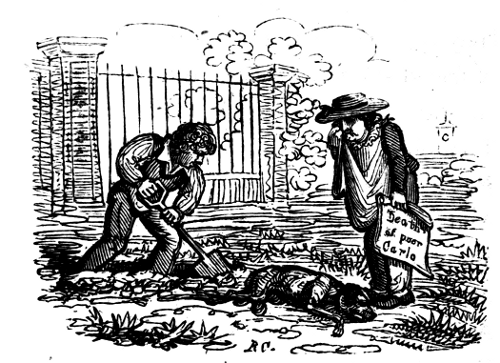
A PUNSTER'S EPITAPH ON HIS DOG.
Here lies, who living never lied, A friend sincere, of courage tried; No slave to wealth, to vice unknown, Though oft reduced to pick a bone. Patch'd was his coat, both red and white, And shaggy too his outward plight; Yet grateful still his master serv'd, And from allegiance never swerv'd. A sportsman true, who at a word Would point, and oft bring down his bird: Or fetch, or carry, hunt, or find, Whate'er was of the feather'd kind. "By no disease—no blast he fell, "But, like to fruit that's mellow'd well, "Dropp'd on the earth, worn out by time, "As clock that can no longer chime:" Here Carlo stopp'd—for want of breath, Outrun at last by Nimrod death.
Bernard Blackmantle.
Blank Page
THE PUNSTER'S COURT; OR, THE CONTEST BETWEEN JANUS AND PAN. VERSIFIED FROM SWIFT. For Illustration, see Vignette to Title.
Great Plato and Homer, and half a score sages, Who flourished as scholars in heathen-like ages, Have all of them prov'd, if their writings you'll seek, That Puns were esteem'd both by Hebrew and Greek: Nay, more, that the gods loved and practised the fun, And their merriment owed to the mirth-making Pun. There's Buxtorf, a learned Chaldean, hath told, That Ptolemæus Philo-punnæus, of old, Sent for six learned priests, for his principal city, To propagate punning and make the folks witty: And so well did the priests with the people succeed, That their Puns were collected, and thus 'twas decreed; "In a temple devoted to punning and wit, "In letters of gold, on the front shall be writ; "'The shop for the physic to gladden the soul,'"— Where the sick, sad, and broken of heart are made whole. Here Janus contended with Pan for the throne, When his double-faced godship unrivalled shone; For no matter how wittily Pan punn'd away, Janus turn'd round his head from the "grave to the gay," Till the audience, fill'd with amazement and wonder, Decided for Janus's double entendre. Bernard Blackmantle.
PUNS FOR ALL PERSONS AND PURPOSES; OR, JOKES FOR EVERY DAY IN THE YEAR.
"Touch but his gunpowder wit with a merry fire, and you shall instantly hear a good report." "A punster's wit, what is it like?" "The electric spark, from Merc'ry ta'en;" "Or gunpowder," says merry Mike, "Touch it, you bid adieu to pain."
PUNNING AT BACKGAMMON.
Two scholars of Brazen Nose College, Oxford, playing at backgammon, a third came in to size, that is, to obtrude for a dinner. The owner of the room throwing the dice, and addressing himself alternately to his visitors, said
"If I bate you an ace, Deuce take me; for it would be-tray a weakness in a man who could not cater for himself. Therefore sink me if you do size."
A NEGATIVE PUN.
"I am happy, Ned, to hear the report that you have succeeded to a large landed property!" "And I am sorry, Tom, to tell you that it is groundless."
A PUN.—THE ORIGIN OF THE PAPAL POWER.
In the Latin version of the Bible there is the following passage:—Tu es Petrus, et super hanc petram ædificabo meam ecclesiam. The French, in rendering these words into their own tongue, convert them into a proof that St. Peter was the corner stone here spoken of—Tu es Pierre, et sur cette pierre j'edifierai mon eglise!!!
A MAN-MILLINER'S PUN.
An amateur, famous for taking a front seat in the pit the first night of a new opera, was dreadfully annoyed one night by the big drum, opposite to whose "loud sounds" he was unfortunately placed. He expressed his uneasiness so frequently, that the performer made use of the word "man-milliner" once or twice, in derision of his tender auriculars. "Man-milliner!" said the gentleman, "I am none, but you're the vilest tambour-worker I ever met with."
A BACKSLIDER'S PUN.
A gentleman asked another if he would have a skait on the Serpentine;—"Most certainly; but I can't trust to my soles and heels: besides, I should lose my character."—"Lose your character!"—"Aye, I should become a back-slider."—"Oh," answered his friend, "come along; you'll do, if you commence on fundamental principles."
AN HERALDIC PUN.
A gentleman employing a porter whose name was Russel, asked him jocularly, "Pray is your coat of arms the same with the duke of Bedford's?" "Our arms (answered the fellow) are, I suppose, pretty much alike; but there is a confounded difference in our coats."
A CANONICAL PUN.
A canon of Exeter Cathedral died a few weeks since; a gentleman, crossing the Cathedral-yard in that city, accidentally met a friend, to whom he said—"So, Canon H—— is dead!"—"Indeed!" replied the other, "I was not aware that cannons went off in that way."—"Yes, they do," rejoined the first, "for I have just heard the report!"
AN APOTHECARY'S PUN.
"Does your husband expectorate?" said an apothecary to a poor Irish woman who had long visited his shop for her sick husband—"Expect to ate, yer honour—no sure, and Paddy does not expect to ate—he's nothing at all to ate!" The humane man sent a large basin of mixture from a tureen of soup then smoking on his table.
A BITTER PUN.
An apothecary asserted that all bitter things were hot. "Pardon me, (said his friend), this is a bitter cold day."
A SMUGGLER'S PUN.
When the Custom-house corps first made their public appearance, it was observed by one, that they looked as formidable as so many Alexanders. "Rather say," said another, "that they appear more like Seizers," (Cæsars.)
COLLEGE PUN UPON PUN.
Two Oxonians dining together, one of them noticing a spot of grease on the neckcloth of his companion, said, "I see you are a Grecian."—"Pooh!" said the other, "that's far-fetched."—"No, indeed," says the punster, "I made it on the spot."
A CRANIOLOGICAL PUN.
A craniologist and a disciple of Lavater disputing the merits of their several professions; says the Skullist, "What we cannot get into their noddles, we get out of them."—"Yes," says the physiognomist, "God help the heads saddled with such a theory! for whilst one galls, t'other spurs 'em."
A CITY PUN.
A wag, upon seeing the name of "Mr. Ledger, conductor of the Albion Library," in the list of deaths, observed, "Ah! poor fellow! his day-book's closed, and he's posted, I suppose, to his long account."—"By no means improbable," said another, "seeing he was engaged in book-keeping all his life!"
A PHYSICAL PUN.
A gentleman dreadfully ill was recommended to a celebrated physician—"Oh," replies he, "I have called several times, but he's always out." "Why then," observes his friend, "try another." "Who?" "Who! why Sir Ever-hard-Home."
A COLLEGE PUN.
A prize was offered in a certain society sacred to the Latin classics, for the best "Carmen" to celebrate Christmas. A jocose tradesman, in the city, sent the meeting two of his carters, saying, he knew no better carmen in the world to celebrate the festive season, as they had been "keeping it up" for the last fortnight.
A LADY'S PUN.
A very agreeable lady of the name of Riggs, being one season at Margate, in the house with six others, her relations, and only one gentleman to attend the whole; when one regretting that they had not more of the male creation, she replied, "If we complain of not being well manned, I am sure we are well rigged."
A COBBLER'S PUN.
A man in the city, amongst many curiosities, exhibited the identical boot worn by Frederick the Great. A gentleman viewing it, asked where the bullet wound was; "Och, (said the fellow from the sister country) it's been healed lately."
A JUDICIAL PUN.
One Hog was to be tried before Judge Bacon, who told him he was his kinsman. "Well (replied the learned judge), no hog can become bacon till he is hanged, and then I'll allow your claim."
A BACCHANALIAN PUN.
A jolly vicar, in a state of inebriety, making a zig-zag course to his house, was asked by a friend who met him, whence he came? He said, "I have been spinning out the evening with my neighbour Freeport."—"And now (replied the other), you are reeling it home."
A GERMAN PUN.
A young man of the name of Cæsar having married a young lady called Rome, a wag wrote upon his door, "Cave, Cæsar, ne tua Roma fiat respublica."
A WHISTLING PUN.
A youth was incurably addicted to the vile sin of punning. His father, who detested a pun not less than old Mr. Shandy himself, imposed a fine of half a crown for each commission of this offence. One day the father and son passing along, saw a man in the pillory. The punster could scarcely refrain from a pun with which he was big. The presence of dad, however, restraining his tongue, he indulged his wit by whistling, "Through the wood, laddie."
A MANAGER'S PUN.
A new comedy, on its third representation, being thinly attended, the author observed that it was all owing to the war. "No (said the manager) I fear it is owing to the piece."
THE ANTIGALLICAN PUN.
A Frenchman in a coffee-house called for a gill of wine, which was brought him in a glass. He said it was the French custom to bring wine in a measure. The waiter answered, "Sir, we wish for no French measures here."
A CLERICAL PUN.
A person asked the minister of his parish what was meant by "He was clothed with curses as with a garment."—"My good friend (said the minister), it means that he had got a habit of swearing."
A SELFISH PUN.
A certain tavern-keeper, who opened an oyster-shop as an appendage to his other establishment, was upbraided by a neighbouring oyster-monger, as being ungenerous and selfish. "And why (said he), would you not have me sell-fish?"
A GAMBLING PUN.
At a ball given lately by a very rich individual, M. de C. found himself vis-à-vis at a table d'écarté, with a valet-de-chambre whom he had turned away some days before. "This time at least," said M. de S. to whom the circumstance was related, "this time, at least, he knew whom he had to deal with!"
A STAYMAKER'S PUN.
A poor corset-maker, out of work, and starving, thus vented his miserable complaint: "Shame that I should be without bread; I that have stayed the stomachs of thousands!"
CLERICAL PUNS.
At a church in Ireland, where there was a popular call for a minister, as it is termed, two candidates offered to preach, whose names were Adam and Low. The latter preached in the morning, and took for his text, "Adam, where art thou?" He made a very excellent discourse, and the congregation were much edified. In the afternoon Mr. Adam preached upon these words, "Lo! here am I." The impromptu and the sermon gained him the appointment.
HORNE TOOKE'S PEDIGREE.
Horne Tooke having, in a political argument, obtained an advantage over his opponent, concluded by saying, "his irritable friend looked as red with vexation as a Turkey Cock." The other, thinking to wound his feelings by a cutting retort to this sarcasm, observed "that he dared to say Mr. Tooke had quite forgotten who his father was?" "Oh! no indeed, I have not," said Tooke, "he was a Turkey Merchant, (i. e. a Poulterer.)"
A JOE MUNDEN.
It being told the comedian, during his stay at Brighton, that Mrs. Coutts had offered five thousand pounds for Byam-House, Munden exclaimed, "My wigs and eyes! five thousand pounds to buy-a-mouse! What the devil will the woman do next?"
PARISIAN PUNS.
1. The Count de Sedan held that little state as a fief of the crown of France, of which he was in other respects a subject. Louis XIV. wishing to put his paw upon this domain, had the Count arrested and clapped into the Bastille, on a supposed charge of treason. The result was, that, in order to save his life, he gave up his possessions; on which the wits of Paris made this pun—"Il donnoit Sedan (ses dents) pour sauver sa tête."
2. Madame de Stael has been much admired for her handsome figure, and particularly her fine arm, but unfortunately disfigured by her deformed foot. Being in a gallery at Paris, where there was an empty pedestal, vain of her person, she mounted, and placed herself in an attitude to display her figure to advantage; but unluckily one of her feet peeped out. A wit approached, and seeming to look only at the pedestal, exclaimed, "O le vilain Pie-de-stal!"
3. Mons. St. Priest, who had been ambassador from the court of France to the Ottoman Porte, was afterwards sent, in a diplomatic capacity, to the Hague; but on account of some ceremonial being neglected, he refused to enter the gates of that place. This gave occasion to the wits of Paris to observe, that he was still "ambassadeur à la Porte."
COMMERCIAL PUNS. FROM "TRAVELLER'S HALL," "English Spy."
"I don't see the bee's wing in this port, Mr. Blackstrap, that you are bouncing about," said a London traveller to a timber merchant. "No, sir," said the humourist, "it is not to be seen until you are a deal higher in spirits; the film of the wing is seldom discernible in such mahogany-coloured wine as this." "Sir, I blush like rose-wood at your impertinence." "Ay, sir, and you'll soon be as red as logwood, or as black as ebony, if you will but do justice to the bottle," was the reply. "There is no being cross-grained with you," said the timber-merchant. "Not unless you cut me," retorted Blackstrap, "and you are not sap enough for that." "Gentlemen," continued the facetious wine-merchant, "if we do not get a little fruit, I shall think we have not met with our dessert; and although there be some among us whose principals are worth a plum, there are very few of their representatives, I suspect, who will offer any objections to my reasons."
A COCKNEY'S PUN.
A Londoner told his friend that he was going to Margate for a change of hair; "You had better," said the other, "go to the wig-maker's shop."
AN IRISH PUN. The two Taymen.
About the time of the issue of the new crown-pieces, Messrs. Bish and Sparrow, the advertising tea-dealers, though strongly opposed to each other, for two of a trade never agree, set about, highly to their credit, a reformation in the price and quality of the "fragrant lymph." An old Irish woman, fond of a cup of "good mixed," thought, what much more sensible people do, that the above worthies were no less than patriots; but she even went further; on being asked by a neighbour the meaning round the edge of the coin of "Decus et Tutamen," said she, "By the powers I suppose Decus means the King, but Bish and Sparrow are the Two Taymen."
A SPORTING PUN. Managing the Pack.
A country gentleman, who was celebrated for taking the lead with some of the first-rate hunts, became so much reduced in circumstances by his attachment to gaming, as to accept the office of dealer at a gambling table. A friend (like Matthews's Dr. Prolix), with infinite promptitude, observed, "that he continued to follow his old predilection, for he still managed the pack."
"BULL'S" PUNS ON THE LATE PANIC AMONG THE BANKERS.
"In the city, while Currie was Raiking together his cash, Sir John Lubbock Fostered his Clarkes; Sir William Kay knew his Price; Rogers felt Toogood to smash; one house in Fleet-street Praed to get through it; and while another chuckled like a Child, the Goslings were looking Sharp after their concerns—poor Hodsoll," added the dunce, "was obliged to give up his Stirling capital; but Stevenson knew his partner was worth his Salt; Dorien, Magens, and Dorien, got Mello with rejoicing, and Jansen was never near being 'done Brown;' Paxton and Cockerell, according to culinary custom, sent their Trail to take care of the long-bills; and though Fry might have been in a Stew for a time, he (like the Smiths of Mansion House-street) soon had his Payne removed.
"At the west end of the town, though Scott Claude up his money at the moment, he soon began to pay again; Kinnaird said he could Ransom his credit whenever he chose; while the other house in Pall-mall declared they had More-land than would settle the claims of all their creditors; and although Marten expected a Call on Arnold, they were equally steady with the house of Cocks (part-Ridges) at Charing-cross, who crowed most lustily at their own stability; every body knows, said the wag, that Green-wood never breaks, and as for Thomas's in Henrietta-street, it was very soon ascertained that there, all was Wright."
A HARROW PUN.
Receiving a youth back who has been expelled for a misdemeanour, upon condition that he be severely flogged, appears to be a very odd mode of healing the breech.
A SOLDIER'S PUN.
The peculiar new mode of drilling the soldiers in St. James's Park, ought, from the variety of their evolutions, to be termed quadrilling.
A PROFESSIONAL PUN.
Speaking of professions, there must be somebody in every way. "Ay," replied Taylor the flute player, "and there is a great number of folks in one another's way."
A MUSICAL PUN.
To make a competent double bass player, it requires a head-piece, while a wind instrument performer wants only a mouth-piece (i. e. a reed).
A BREAD AND MEAT PUN.
A needy adventurer coming to London, who was very thin, observed to S. Taylor, that he only wanted to pick up a little bread among the musical profession; to which the joker replied, "If you can pick up a little flesh at the same time, it will not be amiss."
A PUN UPON MY HONOR!
A person who was addicted to "pledge his honor" upon all occasions, observed, on looking through the window, "It rains, upon my honor." "Yes," said Taylor, "and it will rain upon MY honor if I go out."
CLASSICAL PUN.
"Do you know," said an Oxonian to his friend, "why an acre of land bought on a stipulation to pay the purchase-money a year hence, resembles an ancient lyric song? Because it is An-acre-on-tick.
A WARM PUN.
"You are never witty," said a friend, "until you are well warmed with wine." "That may be," replied the punster: "but it is no reason, good sir, that I am to be well-roasted."
THE EXCISE-OFFICE v. THE STAMP-OFFICE.
Foster, the oboe player, of Drury Lane Theatre (and who also belonged to the Excise Office) happened one day, at a rehearsal, to be playing rout of time. Shaw, the leader, began to stamp violently, and said, "Why don't you play in better time, you member of the Excise Office?" Upon which Foster replied, "None of your jeers to members of the Excise Office: you seem to be a member of the Stamp Office yourself."
HARPING UPON A FIGURE.
A professional harpist (who was a very incompetent performer), one night at Drury Lane Theatre, boasted of the elegant figure upon the head of his harp; observing that it cost him eight guineas the cutting of it. Foster immediately exclaimed, "Sir, if I play'd upon the harp, I would endeavour to cut a figure myself."
A PUNSTER'S REQUISITES FOR AN M.P.
"To get into the gallery of the House of Commons," said a punster, "a man must have the ribs of a rhinoceros; to obtain a good place in the body of the house, the qualities of a camelion; to secure a seat on the treasury bench, he must not fear to tread-a-wry. Opposition he must write thus—'oppo'-site—position; ministerial, men-who-steer-well. Private bills he may quote as examples of private punishment; the speaker's dinners, a speechless banquet, where every guest leaves politics for polite-tricks. To speak well and long, you must display artificial feelings, have leathern lungs, a face of brass, an elephant's sagacity, and a lion's courage; and, with all these qualifications, you may perchance be considered bearable; without them you are certain to come in for a scrape[26]."
A PUNSTER'S APHORISMS.
If you mean to be a domestic animal, never marry a woman of a wild disposition. An ugly helpmate, though she may have the wealth of Plutus, and the virtues of an angel, can never be considered as a lovely wife. If you would live happily, always whistle when your wife whines or scolds. If she should grow furious, take yourself into the cool air, without trying to pacify her. A man who exposes himself to a storm is sure to get pelted. Never offend the ears of a modest woman by a coarse or indelicate expression: the fairest mirror is stained by a passing breath. Never marry a woman for money, lest, obtaining the honey, you are stung by the queen bee. Never lose an opportunity for making a good pun, when you can do it consistent with good nature, and without endangering the esteem of good friends. A pun, to pass current, should bear the stamp of wit, and be struck off in the mint of originality. A genuine bad pun is not always a bad joke. Late hours make lazy servants, a loquacious wife, and end in making a long purse light, a long illness heavy, and long life very uncertain.
Bernard Blackmantle.
TARTANI'S DREAM—A TAIL PIECE.
Blackmantle's labours here, are done, Ye wits, and wags, in mirth who revel; Approve each epigram and pun, And Bernard proves a merry devil.
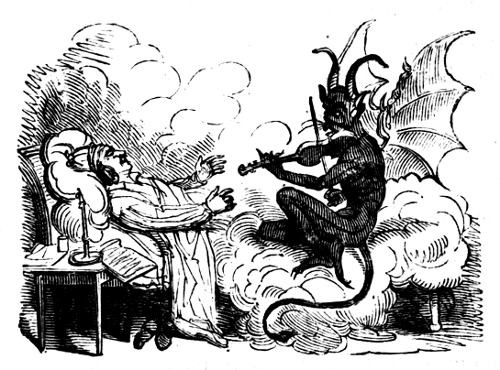
Blank Page
A PUNNING ESSAY ON THE ANTIQUITY OF THE ENGLISH LANGUAGE, BY THE AUTHOR OF 'MY POCKET-BOOK[27];' Originally printed as one of Dean Swift's Three Manuscripts, discovered at St. Patrick's Abbey. A FRAGMENT.
We observe in Homer's Batrachomyomachia, that the instant the frog Calaminthius sees the mouse Pternoglyphus, he is so frightened that he abandons his shield and jumps into the lake: and this confirms our etymology of the mouse's name, Turn ugly face.
In the same poem, also, we find a warrior-mouse called Lichenor, which some, who, like certain commentators on Shakspeare, will always be running to the Greek for interpretations, consider as signifying one addicted to licking, but here we see the imbecility of foreign resources, and the great strength of our own. Their explanation is certainly something near the mark, but for a mouse, how much more germain to the matter is ours—Lick and gnaw? It is true, that I may have mistaken the sense of my opponents' language, but even granting them the full latitude of understanding by their words, as applied to our military mouse, that he was one addicted to licking or conquering, yet is it by no means so full and expressive as it appears in our exposition. Besides, it must be remembered that Lichenor was not so much "addicted to licking" as to being licked, witness the frog Hypsiboas's running him through the body with a rush. See I. 202.
At v. 244, we have the mouse Sitophagus, who like many a soldier of modern times had recourse to his heels and betook himself to a snug dry ditch—[Greek: êlato d'es taphon]. I had always some suspicion that this name was particularly corrupted in the last syllable, and the foregoing circumstance has, fortunately for the literary world, furnished me with a conjecture that seems to place the etymology of this coward's title beyond all doubt:—Set off again—his invariable custom on these occasions, which was perhaps owing to his having studied the art militaire in Hudibras, where he learnt that