Volume 3 / Part 2 — NOTES AND ILLUSTRATIONS.
Reading edition
P. 5. Footnotes: 5a, 'Intake.' Cf. p. 436 (bottom).
P. 6, l. 6. 'Gives one bright glance,' &c. From 'The Seasons,' l. 175, from the end of 'Summer.' Originally (1727) this line ran, 'Gives one faint glimmer, and then disappears.'
P. 17, l. 2. Shelvocke's 'Voyages:' 'A Voyage round the World, by the Way of the Great South Sea.' 1726, 8vo; 2d edition, 1757.
P. 22, l. 27. Milton, History of England, &c. 'The History of Britain, that Part especially now called England; from the first traditional Beginning, continued to the Norman Conquest. In six Books.' Lond. 1670. (Works by Mitford, Prose, iii. pp. 1-301.)
P. 24, l. 28. Hearne's 'Journey,' &c.; viz. Samuel Hearne's 'Journey from the Prince of Wales's Fort in Hudson's Bay to the Northern Ocean.' 1795, 4to.
P. 31, l. 12. Waterton's 'Wanderings,' &c.; viz. Charles Waterton's 'Wanderings in South America, the North-West of the United States, and the Antilles.' 1825, 4to. Many subsequent editions, being a book that has taken its place beside Walton's 'Angler' and White's 'Selborne.'
P. 32, l. 11. James Montgomery's 'Field Flower.' Nothing gratified this 'sweet Singer' so much as these words of Wordsworth. He used to point them out to visitors if the conversation turned, or was directed, to Wordsworth. The particular poem is a daintily-touched one, found in all the editions of his Poems.
P. 32, l. 33. 'Has not Chaucer noticed it [the small Celandine]'? Certainly not under this name, nor apparently under any other.
P. 33, l. 2. 'Frederica Brun.' More exactly Frederike. She was a minor poetess; imitator of Matthison, whose own poems can hardly be called original. (See Gostwick and Harrison's 'Outlines of German Literature,' p. 355, cxxiii., 7th period, 1770-1830.)
P. 36, ll. 13-15. Quotation from Thomson, 'The Seasons,' 'Summer,' l. 980.
P. 44, l. 17. Quotation from Sir John Beaumont, 'The Battle of Bosworth Field,' l. 100. (Poems in the Fuller Worthies' Library, p. 29.) Accurately it is, 'The earth assists thee with the cry of blood.'
P. 47, ll. 17-19. 'The Triad.' Sara Coleridge thus wrote of this poem: 'Look at "The Triad," written by Mr. Wordsworth four-or five-and-twenty years ago. That poem contains a poetical glorification of Edith Southey (now W.), of Dora, and of myself. There is truth in the sketch of Dora, poetic truth, though such as none but a poet-father would have seen. She was unique in her sweetness and goodness. I mean that her character was most peculiar—a compound of vehemence of feeling and gentleness, sharpness and lovingness, which is not often seen' ('Memoirs and Letters of Sara Coleridge, edited by her Daughter,' 2 vols. 8vo, 3d edition, 1873, p. 68). Later: 'I do confess that I have never been able to rank "The Triad" among Mr. Wordsworth's immortal works of genius. It is just what he came into the poetical world to condemn, and both by practice and theory to supplant. It is to my mind artificial and unreal. There is no truth in it as a whole, although bits of truth, glazed and magnified, are embodied in it, as in the lines, "Features to old ideal grace allied"—a most unintelligible allusion to a likeness discovered in dear Dora's contour of countenance to the great Memnon head in the British Museum, with its overflowing lips and width of mouth, which seems to be typical of the ocean. The poem always strikes me as a mongrel,' &c. (p. 352).
P. 56, l. 7. 'Mr. Duppa.' See note in Vol. II. on p. 163, l. 2.
P. 56, l. 27. '179—.' Sic in the MS. He died in January 1795.
P. 60, l. 16. 'Mr. Westall;' viz. William Westall's 'View of the Caves near Ingleton, Gosdale Scar, and Malham Cove, in Yorkshire.' 1818, folio.
P. 62, l. 31. 'The itinerant Eidouranian philosopher,' &c. Query—the Walker of the book on the Lakes noticed in Vol. II. on p. 217?
P. 63, l. 6. 'I have reason,' &c. Cf. Letter to Sir W.R. Hamilton, first herein printed, pp. 310-11.
P. 68, l. 24. Dampier's' Voyages, 'etc.; viz.' Collection of Voyages.' London, 1729, 4 vols. 8vo.
P. 72, l. 29. 'Fulke Greville, Lord Brooke.' His complete Works in Verse and Prose are given in the Fuller Worthies' Library, 4 vols.
P. 76, l. 14. Spenser. An apparent misrecollection of the 'Fairy Queen,' b. iii. c. viii. st. 32, l. 7, 'Had her from so infamous fact assoyld.'
P. 78, l. 6. 'Armstrong;' i.e. Dr. John Armstrong, whose 'Art of Preserving Health,' under an unpromising title, really contains splendid things. His portrait in the 'Castle of Indolence' is his most certain passport to immortality.
P. 80, l. 21. 'The Last Supper of Leonardo da Vinci.' A reproduction of the head of our Blessed Lord, taken from the fresco (photograph), is given in the quarto edition of Southwell's complete Poems in the Fuller Worthies' Library—none the less precious that it pathetically reveals the marks of Time's 'effacing fingers.' No engraving approaches the 'power' of this autotype of the supreme original.
P. 88, l. 32. 'Faber.' Among the treasures (unpublished) of the Wordsworth Correspondence are various remarkable letters of Faber—one, very singular, announcing his going over to the Church of Rome.
P. 90, l. 34. 'Mr. Robinson.' Cf. 'Reminiscences' onward.
P. 97, ll. 9-10, &c. 'Dyer.' Cf. note, Vol. II., on p. 296, l. 35.
P. 97, l. 18. 'Mr. Crowe;' i.e. Rev. William Crowe, Public Orator of Oxford. His poem was originally published in 1786 (4to); reprinted 1804 (12mo).
P. 98, l. 19. 'Armstrong.' See on p. 78, l. 6.
P. 98, l. 20. 'Burns.' Verse-Epistle to William Simpson, st. 13; but for 'nae' read 'na,' and for 'na' read 'no.'
P. 101, l. 9. 'Rev. Joseph Sympson.' This poet, so pleasantly noticed by Wordsworth, appears in none of the usual bibliographical authorities. Curiously enough, his 'Vision of Alfred' was republished in the United States—Philadelphia.
P. 116, ll. 33-34. Quotation, Shakspeare, 'Henry VIII.' iii. 2.
P. 120, l. 22. Quotation from Milton, 'Paradise Lost,' viii. l. 282.
P. 125, l. 4. 'Mr. Hazlitt quoted,' &c. See Index, s.n. for Wordsworth's estimate of Hazlitt; also our Preface.
P. 130, l. 17. Hill at St. Alban's. See 'Eccl. Hist.' s.n.
P. 130, l. 31. 'Germanus.' Bede, 'Eccl. Hist.' b. ii. c. xvi.
P. 131, l. 10. 'Fuller;' viz. his 'Church History.'
P. 131, l. 16. 'Turner.' The late laborious Sharon Turner, whose 'Histories' are still kept in print (apparently).
P. 131, l. 21. 'Paulinus.' Bede, 'Eccl. Hist.' b. ii. c. xvi.
P. 131, l. 26. 'King Edwin.' Bede, 'Eccl. Hist.' b. ii. c. xiii.
P. 136, l. 28. 'An old and much-valued friend in Oxfordshire;' viz. Rev. Robert Jones, as before.
P. 137, l. 10. 'Dyer's History of Cambridge,' 2 vols. 8vo, 1814.
P. 137, l. 14. 'Burnet,' in his 'History of the Reformation;' many editions.
P. 119, ll. 4-5. Latin verse-quotation, Ovid, 'Metam.' viii. 163, 164.
P. 151, l. 11. 'Charlotte Smith.' It seems a pity that the Poems of this genuine Singer should have gone out of sight.
P. 155, l. 31. 'Russel.' Should be Russell. Some very beautiful Sonnets of his appear in Dyce's well-known collection, and to it doubtless Wordsworth was indebted for his knowledge of Russell. He has cruelly passed out of memory.
P. 165, ll. 7-9. 'Is not the first stanza of Gray's,' etc. Gray himself prefixed these lines from Aeschylus, 'Agam.' 181:
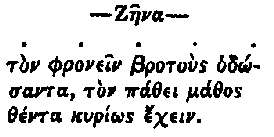
He seems to have been rather indebted to Dionysius' Ode to Nemesis, v. Aratus.
P. 182, l. 9. 'Dr. Darwin's Zoonomia;' i.e. 'The Laws of Organic Life,' 1794-96, 2 vols. 4to.
P. 182, l. 24. 'Peter Henry Bruce ... entertaining Memoirs.' Published 1782, 4to.
P. 185, ll. 2-3. Verse-quotation, from Milton, 'Il Penseroso,' ll. 109-110.
P. 190, l. 27. 'Light will be thrown,' &c. We have still to deplore that the Letters of Lamb are even at this later day either withheld or sorrowfully mutilated; e.g. among the Wordsworth Correspondence (unpublished) is a whole sheaf of letters in their finest vein from Lamb and his sister. Some of the former are written in black and red ink in alternate lines, and overflow with all his deepest and quaintest characteristics. His sister's are charming. The same might be said of nearly all Wordsworth's greatest contemporaries. Surely these MSS. will not much longer be kept in this inexplicable and, I venture to say, scarcely pardonable seclusion?
P. 192, foot-note. This deliciously naïve note of 'Dora' to her venerated father suggests that it is due similarly to demur—with all respect—to the representation given of Mrs. Hemans (pp. 193-4). Three things it must be permitted me to recall: (a) That the 'brevity's sake' hardly condones the fulness of statement of an imagined ignorance of 'housewifery' on the part of Mrs. Hemans. (b) That a visitor for a few days in a family could scarcely be expected to set about using her needle in home duties. (c) That unquestionable testimony, furnished me by those who knew her intimately, warrant me to state that Wordsworth was mistaken in supposing that Mrs. Hemans 'could as easily have managed the spear of Minerva as her needle.' Her brave and beautiful life, and her single-handed upbringing of her many boys worthily, make one deeply regret that such sweeping generalisation from a narrow and hasty observation should have been indulged in. My profound veneration for Wordsworth does not warrant my suppression of the truth in this matter. Be it remembered, too, that other expressions of Wordsworth largely qualify the present ungracious judgment.
P. 209, l. 8. 'Lord Ashley.' Now the illustrious and honoured Earl of Shaftesbury.
P. 212, l. 17. 'Burnet;' i.e. Thomas Burnet, whose Latin treatise was published in 1681 and 1689; in English, 1684 and 1689. Imaginative genius will be found in this uncritical and unscientific book.
P. 214, l. 12. 'The Hurricane,' &c.; viz. 'The Hurricane; a Theosophical and Western Eclogue,' &c. 1797; reprinted 1798.
P. 216, ll. 4-5. Quotation from Coleridge, from 'Sibylline Leaves,' Inscription for a Fountain on a Heath.
P. 216, l. 29. 'Dr. Bell.' Southey edited the bulky Correspondence of this pioneer of our better education, in 3 vols. 8vo.
P. 233, ll. 34-36. 'They have been treated,' &c. ('Evening Walk,' &c., 1794.)
P. 247, foot-note [A]. De Quincey, in his 'Recollections of the Lakes and the Lake Poets, Coleridge, Wordsworth, and Southey' (Works, vol. ii. pp. 151-6), gives a very realistic exposé of the Lonsdales—abating considerably the glow of Wordsworth's recurring praise and homage.
P. 255, l. 31. 'History of Cleveland.' The book is by the Rev. John Graves, and is entitled 'The History of Cleveland in the North Riding of the County of York.' Carlisle, 1808. Wordsworth is unjust: it is a deserving work, if o' times inevitably dry.
P. 285, l.1. 'Francis Edgeworth's "Dramatic Fragment."' This was Francis Beaufort Edgeworth, half-brother of Maria Edgeworth.
P. 285, ll. 29-30. 'Spectator.' From No. 46, April 23, 1711, one of Addison's own charming papers in his lighter vein of raillery.
P. 280, ll. 13-16. 'Mr. Page;' viz. Frederick Page, author of (a) 'The Principle of the English Poor Laws illustrated and defended by an Historical View of Indigence in Civil Society.' Bath, 1822. (b) 'Observations on the State of the Indigent Poor in Ireland, and the existing Institutions for their Relief.' London, 1830.
P. 290, ll. 25-27. Verse-quotation, from Milton, 'Paradise Regained,' b. iii. ll. 337-9.
P. 293, l. 1. Letter to Hamilton. The Rev. R.P. Graves, M.A.—Wordsworth's friend—is engaged in preparing a Life of this preeminent mathematician and many-gifted man of genius, than whom there seems to have been no contemporary who so deeply impressed Wordsworth intellectually, or so won his heart. The 'Poems' of Miss Hamilton (1 vol. 1838) sparkle with beauties, often unexpected as the flash of gems. Space can only be found for one slight specimen of her gift in 'Lines written in Miss Dora Wordsworth's Album,' as follows:
'It is not now that I can speak, while still Thy lakes, thy hills, thyself are in my sight; I would be quiet—for the thoughts that fill My spirit's urn are a confused delight; They must have time to settle to the clear Untroubled calm of memory, ere they show, True as the water-depths around thee here, These images, that then will come and go, An everlasting joy. Far, far away As life, extends the shadow of to-day; And keenlier present from the past will come Thy sweet laugh's freshness pure, with all the poet's home.
'Rydal Mount. 1830.'
'The Boys' School' is the title of Miss Hamilton's poem referred to by Wordsworth. It occurs in the volume, pp. 126-131. Her brother's was one commencing, 'It haunts me yet.' The 'Mr. Nimmo' of this letter was a civil engineer connected with the Ordnance Survey of Ireland.
P. 299, l. 18; 300, l. 8, &c. 'Countess of Winchelsea.' Sad to say, a collection of this remarkable English gentlewoman's Poems remains still an unfurnished desideratum.
P. 306, l. 11. 'The Duchess of Newcastle.' Edward Jenkins, Esq. M.P., has recently collected some of the Poems of this lady and her lord in a pretty little volume, which he entitles, 'The Cavalier and the Lady.'
P. 312, l. 32. 'Eschylus and the eagle. 'The reference doubtless is to Aeschylus' 'Prometheus Vinctus,' l. 1042:
916()#;ιδϛ πτηνδϛ κὑων, δαφοινὑϛ αἱετυϛ.
Compare
'Aischulos' bronze-throat eagle-bark at blood Has somehow spoiled my taste for twitterings.'
Robert Browning, 'Aristophanes' Apology' (1875), p. 94.
P. 321, ll. 32-3. Verse-quotation, from 'Macbeth,' viz. i. 3.
P. 333, l. 2. 'Russell.' Before misspelled 'Russel' (p. 155).
P. 337, ll. 17-18. 'Auld Robin Grey' [= Gray], by Lady Ann Lindsay. 'Lament for the Defeat,' &c., viz. 'The Flowers of the Forest,' by (1) Mrs. Cockburn; 'I've seen the smiling,' &c. (2), Miss Jane Elliot. 'I've heard the lilting,' &c.
P. 342, l. 1. 'Shakspeare.' Quotation from Sonnet lxxiii.
P. 380, ll. 6-7. Horace, Ep. i. l, 8-9.
P. 382, ll. 27-9. Southey's Letters. Admirably done by his son Cuthbert in many volumes. The seeming over-quantity have been reduced (to the look) by the American reproduction in a single handsome volume.
P. 394. Heading of Letter 144. 'Of the' has by misadventure slipped in a second time here. Read, 'Of the Heresiarch Church of Rome.'
P. 449, l. 34 onward. Mrs. Wordsworth. My excellent Correspondent the Rev. R.P. Graves, of Dublin, thus writes me of Mrs. Wordsworth: 'I forget whether it has been put on record, as it certainly deserves to be, that Wordsworth habitually referred to his wife for the help of her judgment on his poems. Mrs. Wordsworth did not indeed possess the creative and colouring power of imagination that belonged to his sister as well as to himself; but her simple truthfulness, her strong good sense (which no sophistry could impose upon), and her delicate feeling for propriety, rendered her judgment a test of utmost value with regard to any subjects of which it could take adequate cognisance. And these were confined within no narrow range—the workings of Nature as it lived and moved around her, social equities and charities, religious and moral truth, tried by the heart as well as by the head, and verbal expression, required by her to avoid the regions of the merely abstract and philosophical, and keep to the lower but more poetical ground of idiomatic strength and transparent logic.'
P. 457, l. 18. 'The (almost) contemporary notice of Milton.' A still more significant contemporary notice of Milton than the well-known one of the text occurs in 'The Censure of the Rota upon Mr. Milton's book entituled The Ready and Easie Way to establish a Free Commonwealth, 1660, by James Harrington,' as comes out at p. 16 ('my Oceana'). As it seems to have escaped the commentators, a short quotation must be given here: 'Though you have scribled your eyes out, your works have never been printed but for the company of Chandlers and Tobacco-Men, who are your Stationers, and the onely men that vend your Labors' (pp. 4-5). 'He [a member of the Rota] said that he himself reprieved the Whole Defence of the People of England for a groat, that was sentenced to vile Mundungus, and had suffer'd inevitably (but for him), though it cost you much oyle and the Rump 300l. a year,' &c. (ibid.). This of the 'Defence'!!!
P. 459, l. 7 onward. Horace, Ode iv. 2, 1; ibid. 2, 27.
P. 462, l. 15. 'Walter Scott is not a careful composer,' &c. This recurs in Mr. Aubrey do Vere's 'Recollections' (p. 487 onward). I venture as a Scot to observe that for this one slight misquotation by Scott, on which so large a conclusion is built, the quotations by Wordsworth from others would furnish twenty-fold. He was singularly inexact in quotation, as even these Notes and Illustrations will satisfy in the places—scarcely in a single instance being verbally accurate. 'Sweet' certainly was a perfectly fitting word for the sequestered lake of St. Mary in its serene summer beauty. Moreover, swans are not usually found singly, but in pairs; and a pair surely differenced not greatly the symbol of loneliness. The latter remark points to Wordsworth's further objection, as stated to Mr. de Vere (as supra).
P. 492, l. 26. 'In the case of a certain poet since dead,' &c. I may record what his own son has not felt free to do, that this was Sir Aubrey de Vere, whose 'Song of Faith, and other Poems,' has not yet gathered its ultimate renown. Wordsworth greatly admired the modest little volume. See one of his Sonnets on page 495. Nor with the Laureate's poem-play of 'Queen Mary' (Tudor) winning inevitable welcome ought it to be forgotten—as even prominent critics of it are sorrowfully forgetting—that Sir Aubrey de Vere, so long ago as 1847, published his drama of 'Mary Tudor.' I venture to affirm that it takes its place—a lofty one—beside 'Philip van Artevelde,' and that it need fear no comparison with 'Queen Mary.' Early and comparatively modern supreme poetry somehow gets out of sight for long.
P. 497, 1. 15. Read 'no angel smiled.' I can only offer the plea of an old Worthy, who said, 'Errata are inevitable, for we are human; and to have none would imply eyes behind as well as before, or the wallet of our errors all in front.' G.