THE PROMISED LAND
Reading edition
BIBLE STORIES RETOLD
BY
CATHARINE SHAW
Author of "Suffer Little Children," "Long Ago in Bible Lands," "Stories from the Book of Books," Etc.
JOHN F. SHAW (1928) & CO. LTD.
3, Pilgrim Street, London, E.C.4.
BRITISH MANUFACTURE.
CONTENTS.
I. THE SLAVE BOY
II. JOSEPH AS A VICTOR
III. THE GOOD LITTLE SISTER
IV. SAMSON
V. THE CHARIOT OF FIRE
VI. IN THE CAVE
VII. MOSES IN THE LAND OF MIDIAN
VIII. A GOOD REPORT OF THE LAND
IX. MOSES HIDDEN IN THE CLEFT OF THE ROCK
X. AARON'S ROD THAT BUDDED
XI. TO THE CITY OF REFUGE
XII. THE LETTER THAT WAS LAID BEFORE THE LORD, AND THE LORD'S ANSWER
XIII. THE QUEEN OF SHEBA
XIV. THREE COMMANDMENTS ABOUT EARTHLY THINGS
XV. THREE COMMANDMENTS ABOUT OUR HANDS—OUR TONGUES—AND OUR HEARTS
XVI. TAKEN FROM THE BROOK
XVII. THE FIRST AND SECOND COMMANDMENTS: AND HOW THEY WERE BROKEN
XVIII. THE NEXT TWO COMMANDMENTS: AND HOW THEY MAY BE KEPT
XIX. THE POTTER'S VESSEL
XX. JEHOSHEBA, THE GOOD AUNT
XXI. GOD FEEDS ELIJAH
XXII. RUTH
XXIII. ON MOUNT GILBOA
XXIV. ABSALOM
XXV. THE DISOBEDIENT PROPHET
XXVI. THE LORD ANSWERS ELIJAH BY FIRE
XXVII. JOSHUA'S COURAGE
XXVIII. THE FIERY FURNACE
XXIX. QUEEN ESTHER'S REQUEST
XXX. A GREAT RAIN, AND A TIRED PROPHET
XXXI. SOLOMON'S WISDOM AND SOLOMON'S TEMPLE
XXXII. JEHU—THE ELEVENTH KING OF ISRAEL
XXXIII. A STORY OF VICTORY
XXXIV. THE GREAT FEAST
XXXV. DANIEL IS A CAPTIVE
XXXVI. THE SECRET IS REVEALED TO DANIEL
THE PROMISED LAND
I. THE SLAVE BOY
GENESIS, CHAPTERS 39 TO 50
GOD prepares wonderful things for those who love Him!
Some of the things we see now, in this life. Some of them we must be content to wait for, till we go to be with God in Heaven.
God says in Isaiah 64 that "Since the beginning of the world, men have not heard . . . neither hath the eye seen, O God, beside Thee, what He hath prepared for him that waiteth for Him."
But even in this life, if we love God, and watch to see the answers to our prayers, we shall see numbers of things which God our Heavenly Father helps us in—numbers of pleasures which He puts in our lives; numbers of dangers that He saves us from; numbers of times when He brings good out of what seemed to us to be only disappointment and trial.
Well! That was how it was with Joseph!
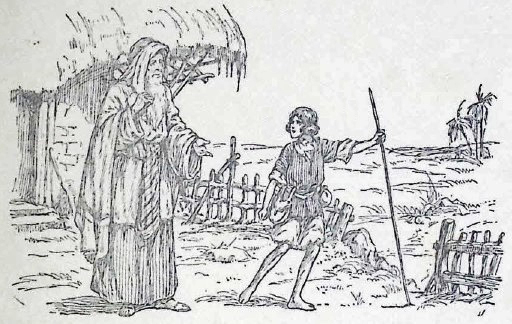
You remember about his dreams and the jealousy of his brothers? You remember how he was sent by his father Jacob, quite a long journey, to carry messages to his brothers, and to bring back word whether they and their flocks were well and in safety.
Joseph was seventeen at this time, and he went, willingly enough, for he did not know that his brothers' hearts were full of hatred towards him.
At last he found the place where they were feeding their flocks; and as they saw him coming, they said to each other, "Behold this dreamer cometh!" And they at once began to plan his death!
Nothing was easier, all that long distance away from his father, in a wild uninhabited country where but few strangers passed, and where there were caves and pits in which evil deeds might easily be hidden.
But all this while, unknown to those cruel brothers, God was watching over Joseph.
When his eldest brother, Reuben, heard the others plotting to kill him, he advised their putting him into a pit, instead of taking away his life, intending to come back himself, and to take him out, and deliver him safely to his father.
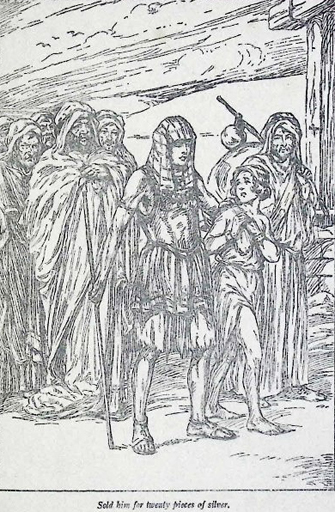
Sold him for twenty pieces of silver.
But while Reuben was away tending his flocks, Joseph came to the rest of his brothers, and they at once stripped him of the beautiful coat his father had made for him, and then they cast him into an empty pit. But they sat down to eat a meal themselves!
Presently they saw a band of Merchants coming towards them on camels, and Judah said to his brothers, "Let us not kill Joseph, but let us sell him to these Ishmaelites!" So they drew Joseph up from the pit, and sold him for twenty pieces of silver.
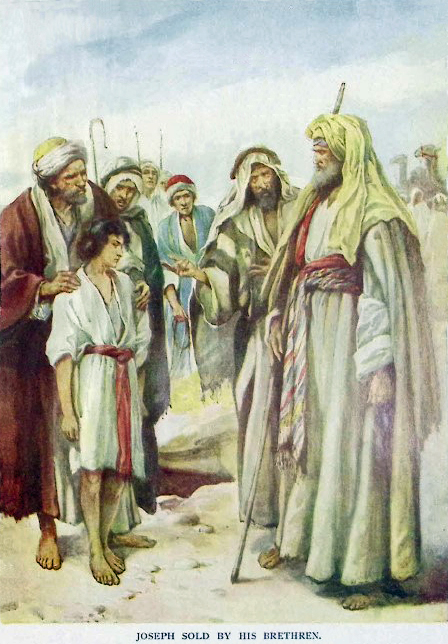
JOSEPH SOLD BY HIS BRETHREN.
Then the Ishmaelites passed on with their camels; but they did not know that they were carrying away one whom the holy God was watching over.
So the brothers were left, and the coat of many colours was left too.
But when Reuben came back, and looked into the pit, and found it empty, his heart failed him.
He tore his clothes, exclaiming, "What shall I do?" For he knew how dearly old Jacob loved this boy of his, and how could he go back to his father and tell him the truth?
But the other brothers killed a kid and dipped Joseph's coat in the blood, and sent it to their father, saying that they had found it like this, and that probably some evil beast had devoured him.
Then Jacob grieved for his son, with bitter grief, and said he should go to his grave mourning for him.
Now God loved Jacob very much; and though He allowed him to pass through this great sorrow, yet He was, in His own way, preparing a great joy for him in the future. For that young lad who was carried away on those camels, down to Egypt, was bought by a kind master, and lived happily in his house for years.
It is true that after a time, troubles came; for Joseph was falsely accused, and was cast into prison for two years.
But God was with him there (as He is always with those who love and serve Him), and Joseph behaved so nicely, that the Keeper of the prison began to trust him, and at length gave him the care of all the other prisoners. Everything that Joseph did was prospered, because God blessed him so much.
By and bye Pharaoh, King of Egypt, had a dream which he could not understand, and as they all knew in the prison, that Joseph could tell the meaning of dreams, Pharaoh was told about him, and the Great King sent for him, and explained his trouble to him.
Then God told Joseph the meaning of Pharaoh's dream, which was, that there would be seven years of rich harvests, and then seven years of very poor harvests.
So Joseph advised Pharaoh to look out a wise man to save up all the corn in the plentiful years, so that the people might have food in the scanty years.
And Pharaoh chose Joseph to be over everything, and to see to the corn, and save it up; and Pharaoh dressed Joseph in beautiful clothes, and put a ring on his hand.
Joseph was very humble, and he loved God very much. He kept on telling Pharaoh that it was God who helped him to do all these wonderful things.
At length the seven years of plenty were over, and the famine came into all the countries round Egypt, and everybody came to Egypt to buy corn of Joseph. And among them his ten brothers came too!
You can read in your Bibles in the 45th and 46th Chapters of Genesis, how Joseph forgave his brothers, and how he told them how God had meant it for good to save much people alive.
Then he gave his brothers food; and sent wagons to Canaan to fetch his dear old father down to Egypt to live near him, and be taken care of.
And this was how God brought it about, that old Jacob saw his beloved son again.
II. JOSEPH AS A VICTOR
You have all heard of Joseph, and remember very well about his being Jacob's favourite son; and how jealous his ten brothers were that their father made him a beautiful coat of many colours.
Joseph was a kindly young fellow of seventeen, and he did not bear any grudge against his brothers, but talked to them and told them his dreams, as any boy would now-a-days.
But these dreams made his brothers even more angry than their father's love for him, and they hated him.
When people begin to cherish hatred in their hearts, it is not long before it comes out in their actions.
So when Jacob sent Joseph a long journey to see if all was well with his brothers and the flocks, they saw him coming from afar, and began to plan how they could get rid of him and his dreams.
But there was one thing those ten brothers did not think of. They had made a clever plan to murder their brother when he was so far away from home, but they did not remember that their father Jacob's God was Joseph's God as well; and that He was watching over that boy of seventeen, and had a glorious work for him to do by and by.
So God put it into Reuben's heart to advise that Joseph should not be killed, but be put into a pit; intending presently to take his brother back to their father.
But while he was away, a company of merchants came by on camels, and the brothers at once decided to take Joseph out of the pit and sell him as a slave.
When Reuben came back, the camels had passed on their way down to Egypt carrying Joseph with them. The pit was empty, Jacob's darling boy was gone!
And when the cruel sons brought the coat of many colours, all stained with the blood of a kid, Jacob felt sure some evil beast had killed Joseph, and that he should go down to the grave mourning for him.
Do you think those brothers ever had a truly happy moment for years and years?
We read afterwards how they said one to another in Egypt, when God brought their sin to their remembrance: "We are verily guilty concerning our brother, in that we saw the anguish of his soul, when he besought us, and we would not hear." And how Reuben had answered them, "Did I not speak to you saying, 'Do not sin against the child,' and ye would not hear?"
So the Midianites and their camels came down to Egypt, and Joseph was sold to Potiphar, an officer of Pharaoh and Captain of the Guard.
It would take too long to tell you here, and you can read it for yourselves in the beautiful account of it in Genesis, chapter xxxix, how God took care of Joseph in every way. How he was raised to favour in his master's house; how he was falsely accused and cast into prison; how again after being put in fetters and irons (as we read in Psalm cv. 18), he was brought into the favour of the keeper of the prison; how he listened to the prisoners' dreams, and told them the meaning of them; how, in consequence of the interpretation of these dreams coming true, he was taken before Pharaoh to explain to the great king his dream; and how God gave Joseph an insight into the future that made him know that there would be seven years of plenty, and then seven years of famine; and how he advised Pharaoh to lay up a store of corn for the scarcity that was coming.
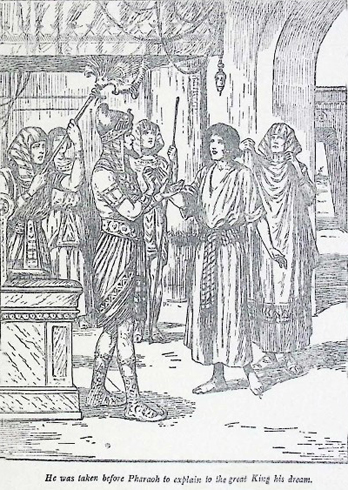
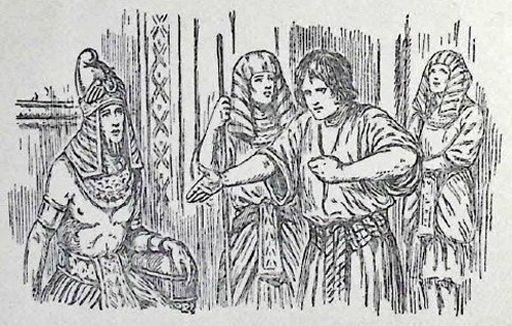
He was taken before Pharaoh to explain to the great King his dream.
Pharaoh was so pleased with Joseph, and found his advice so good, that he raised him to great honour. He put his own ring on Joseph's hand and dressed him in beautiful clothes, and gave him a chariot to ride in, and made him ruler over all the land of Egypt.
What Joseph had predicted surely came to pass; and when the scarcity came, all the nations around came to buy Pharaoh's corn, which Joseph had so carefully stored up; so that Pharaoh became very rich.
Why do you suppose all this happened to Joseph?
It was because God loved Joseph; he had been His faithful servant all his life. Because He had purposes of mercy not only to the brothers who had been so cruel, but to the world, in which a dreadful famine was coming; and also to the sorrowing father, who had lost the light of his eyes when Joseph was taken from him!
Ah! If we only look out for God's ways, and ponder over them, we shall understand more of "the loving-kindness of the Lord."
And now, because there was corn in Egypt, and because there was a fearful famine in the land of Canaan, it came to pass that the shepherd brothers went down to buy corn, and Joseph, the great ruler, instantly recognized them; and he sent them back with corn for their families, and by and by to fetch his dear old father to come to him till the famine was over. And that was how it was God gave His servant Jacob his heart's desire. You can just imagine with what joy Joseph set out in his chariot to meet his father!
Jacob, who was now a hundred and thirty years old, lived near his dear son Joseph for seventeen years, till his death.
Then the brothers were afraid, that now their father was gone, Joseph might requite the wrong which they had done him. So they went to him, and earnestly asked him to forgive them.
And Joseph wept at their words, and freely forgave them; and said that God had turned their thoughts of evil into good, to keep much people from dying of famine.
And this is how "the Children of Israel" came to settle down in Egypt for four hundred and thirty years.
III. THE GOOD LITTLE SISTER
EXODUS 2.1-10
YEARS and years ago, there was a little girl standing by the great River Nile, which as you know, runs through Egypt into the Mediterranean.
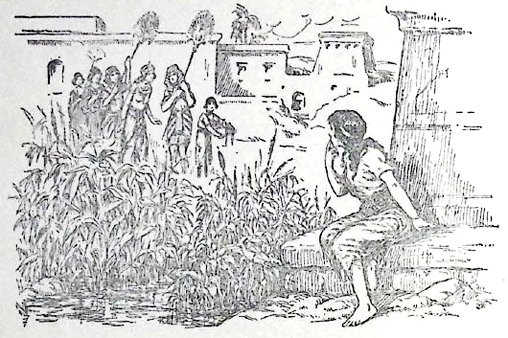
There she stood, quite alone, first glancing back to see if anyone might be coming that way, and then looking earnestly towards the river, fringed at that place with bulrushes, which sometimes grew as high as ten or twelve feet.
Why was the girl looking so earnestly at those bulrushes as they swayed in the breeze? Or why did she again turn anxiously to see if any Egyptian Soldier should be coming down to the River's brink?
Did she know of something which was hidden there? Something very, very precious?
Perhaps, wearied with standing and watching in two directions, Miriam sat down, and resting her elbows on her knees, looked only towards the river; and as she sat so silently and patiently there, her mind went over the past months of anxious fears, which had almost overwhelmed the family of Israelites of whom she was the only daughter.
She knew that about 400 years before, the Children of Israel, whom the Egyptians called the Hebrews, and we now call the Jews, travelled down from the land of Canaan (Palestine) to the land of Egypt.
They were the children of Abraham and of Isaac and of Jacob; and because of a great famine in all the countries round, these Israelites came down to Egypt to buy corn. You have all heard the story of Joseph who was sold into Egypt by his brothers? Well, God had sent this Joseph to Egypt, on purpose, to store up the corn for the famine which was coming.
So Joseph gave his brothers as much corn as they needed, and sent them back to fetch his dear old father Jacob. And that is how the Israelites came down into Egypt, and settled there with their flocks and herds, for they were Shepherds.
But by and bye the Egyptians began to get jealous of them. They increased in numbers so fast, and were so prosperous, because God blessed them abundantly, that the King of Egypt sent out a command that all the little boys who were born to the Israelites must be killed, and only the little girls saved alive.
This was a very cruel command, and the Israelitish women were very sorrowful at having all their baby boys thrown into the river.
At length, one baby boy was born, whom his Mother managed to hide in their little home for three long months; but he was a beautiful, strong child, and soon, his mother found that it was impossible to hide him.
She and her husband loved and served God, and we read in the 11th Chapter of the Epistle to the Hebrews and the 23rd verse, that it was "by faith" that they hid him so long, looking up to God in Heaven to save their darling boy.
Then Jochebed made a sort of basket-cradle of the reeds from the River, and she daubed it with slime and made it water-tight. And then she called her little daughter Miriam to her side, and they laid the beautiful baby in his little bed, and Miriam took the basket and carried it down to the water's edge. And, when no one was looking, she hid it in the thick bulrushes which grew there. Then she sat at a distance and watched.
By and bye Miriam saw Pharaoh's daughter, the Princess, and her maidens, come down the road towards the water, and though her heart beat fast, and she was dreadfully afraid, she found they had only come to bathe in the river.
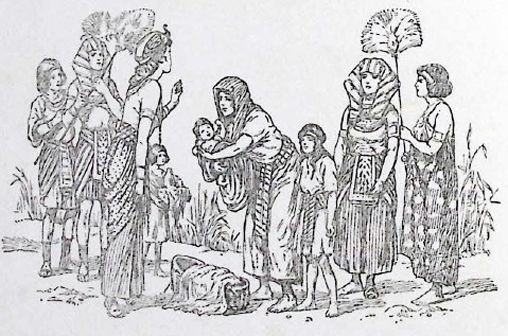
Then she saw as they walked along by the edge, that Pharaoh's daughter noticed something strange among the rushes, and sent her maid to fetch it. And when the Princess opened the basket, there was the beautiful baby crying, and Pharaoh's daughter was grieved to see it cry, and she said: "This is one of the Hebrews' children!" How all the maidens crowded round to gaze at the beautiful baby!
It seems as if Miriam had been coming nearer and nearer, till she stood among the group of maidens who were gazing down at the sweet baby; and she said, looking up into the Princess's face, "Shall I go and call to thee a nurse of the Hebrew women, that she may nurse the child for thee?"
And here I notice two or three things about this young girl. First, I think she loved God, and like her Father and Mother, she trusted Him.
Next, I see that she was a patient little girl, and an obedient girl. She did what her mother had told her most faithfully. She also used the common sense God had given her; and in spite of her awe of the Princess, she bravely did the wisest thing she could have done.
She saw that Pharaoh's daughter had taken a great liking to her baby brother, and I think she thought this might be God's way of saving him from death.
So the Princess said "Go!" And Miriam ran, like an arrow from a bow, straight to her Mother, to tell her to come and see after her own baby!
You can think of that Mother's joy. God had seen the faith of that Hebrew Father and Mother, and had answered their prayers to save their child.
And when Jochebed hurried to the River side, and lifted the baby from its cradle into her safe arms, Pharaoh's daughter said to her, "Take this child away, and nurse it for me, and I will give thee thy wages."
Oh! How thankfully did the mother carry her baby back to their little home!
There she took care of him till he was old enough to be taken to the King's Palace, where he was called "the son of Pharaoh's daughter." It was she who gave him the name of Moses, "Because," she said, "I drew him out of the water."
Long afterwards, when God chose Moses to bring the Children of Israel out of Egypt, his sister Miriam went with him.
IV. SAMSON
AFTER Joshua was dead, the Children of Israel began to be very slack in serving God; and worse than all, they set up other gods, and worshipped them, as the heathen did around them.
God was very longsuffering, and He raised up Judge after Judge who delivered them from their enemies; but soon the people fell into idolatry again.
At length, God was so grieved at their evil ways that He delivered them into the hands of the Philistines for twenty years. And then He raised them up another Judge.
There was a man who served God, whose name was Manoah; and he had a godly wife, but they had no children.
One day, the Angel of the Lord appeared to Manoah's wife, and he told her that she would have the joy of having a little son, who, when he was grown, should deliver Israel from the hands of the Philistines.
But the angel gave Manoah's wife very strict instructions. Neither she, nor her child, were to take any wine or strong drink, and the boy was not to have a razor come on his head from the day of his birth to the day of his death! He was to be what was called "A Nazarite unto God."
And Manoah prayed earnestly that God would send the angel to them again to tell them how to bring up the child who was to come to them.
And God listened to Manoah's prayer; and as the woman was in the field, the Angel came again to her; and she ran hastily to Manoah, and told him.
Then Manoah begged the man to let him dress a kid and offer him food-but the man said he would take no food, but they could offer a sacrifice to God, if they wished it.
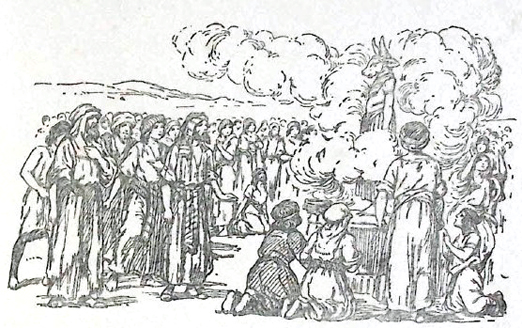
And when the sacrifice was offered, and the smoke arose from the Altar, the Angel of the Lord went up toward heaven, and ascended in the flame from off the Altar.
Then Manoah said, "We shall surely die, because we have seen God!"
But his wife argued from all that had happened, that if the Lord had intended to kill them, He would not have accepted their offering, neither would He have showed them all these things.
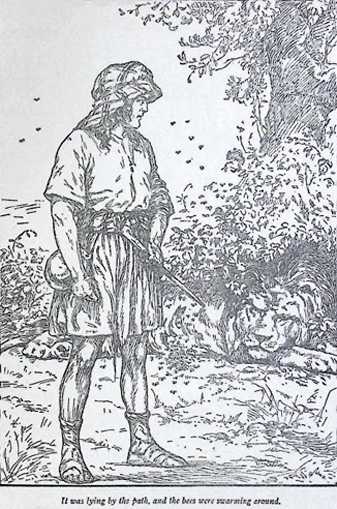
It was lying by the path, and the bees were swarming around.
At length the child came, and they called him Samson. As he grew to manhood, he found that God was giving him wonderful strength.
One day a young lion came out and roared against him. And the Spirit of the Lord came mightily upon him, and he rent the lion, and killed him, just as he might have rent a kid; for he had no weapon in his hand.
When Samson next passed that way, he looked for the carcase of the lion, and there it was lying by the path, and the bees were swarming around, as they had built a honey-comb in the body of the lion.
So he ate some of the honey, and took the rest to his father and mother; but he did not tell them that he had killed the lion.
Then Samson made a great feast for seven days, for he had married a Philistine girl, to the great sorrow of his parents. And while they were feasting, he and the thirty young men who were his companions, Samson gave them a riddle to find out, promising that he would give a large prize if they could discover it; but if not, they were to give him a prize.
This was the riddle: "Out of the eater came forth meat, and out of the strong came forth sweetness."
The young men puzzled for several days, and at last they persuaded Samson's young wife to get the secret from him. And at length she begged so hard that he told her the answer.
Then she went to her people, the Philistines, and told them.
When the seven days were up, the young men gave the answer: "What is sweeter than honey, and what is stronger than a lion?"
But Samson was very angry when he found that they had persuaded his wife; and he went down to Ashkelon and killed thirty Philistines, and brought the spoil and divided it among the young men who had answered his riddle. And then in fierce anger, he returned to his father's house.
But his wife was given to one of the companions who used to be his friend, and Samson never saw her again.
Samson judged Israel for twenty years, and by his great personal strength and courage, he gained many victories over the Philistines.
But he made a great mistake, which resulted in his death.
The Philistines at once took advantage of this, and promised a heathen Philistine woman great riches if she would find out, and tell them, the secret of his wonderful strength. In an evil moment, he told her that it was because he was a Nazarite, and that no razor had ever come upon his head!
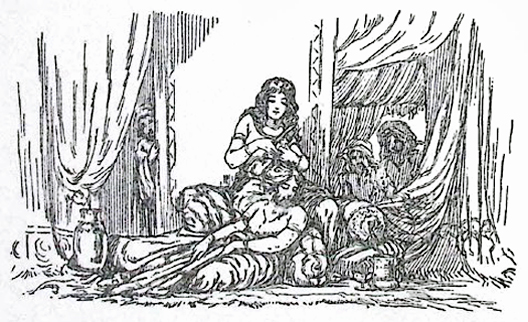
So, when he was asleep, Delilah managed to cut off his hair; and then she sent for the lords of the Philistines, who hurried to the spot. They easily bound Samson because his strength was gone from him; and they put out his eyes, and sent him to grind in the prison-house.
It would take me too long to tell you how his hair began to grow again, and his strength began to return. Or how he was taken out to make sport for the Philistines, and how he begged the boy who led him to let him feel the pillars of the house where three thousand Philistines were watching him from the roof.
Samson asked God to give him strength for this, once more; and then he bowed himself with all his might, clasping the pillars in his arms, and the house fell, and he, and all the three thousand Philistines, were buried beneath the ruins.
What a difference there was between Manoah's godly wife, and Samson's heathen!
V. THE CHARIOT OF FIRE
BUT now the time had come when the Lord was going to take Elijah up to Heaven in a whirlwind.
So Elijah went with Elisha from Gilgal, and as they journeyed, he said to him: "Stay here, I pray thee; for the Lord hath sent me to Bethel."
But Elisha would not allow him to go alone, so they went to Bethel together.
When they reached Bethel, the sons of the prophets who lived there came out to meet Elisha, and they said to him: "Do you know that the Lord is going to take your master away from you to-day?"
And Elisha said: "I know it; but hold your peace."
And so it went on till they reached Jericho, and here again the sons of the prophets came to Elisha with their question: "Do you know that the Lord will take your master from your head to-day?"
And again Elisha sorrowfully answered: "Yes, I know it; hold ye your peace."
Then Elijah said to him: "Stay here, I pray thee; for the Lord hath sent me to Jordan."
But Elisha gave the same answer to him as he had given before, that he would not on any account leave him. So they went on together.
The sons of the prophets evidently knew that something very wonderful was going to happen, and as they saw the two men going towards Jordan, fifty of them gathered together and stood to view from afar.
So they came to the river Jordan, and Elijah wrapped his mantle together and smote the waters, and they were divided hither and thither, and they two passed over on dry ground.
Then Elijah said to Elisha: "Ask what I shall do for thee, before I am taken away from thee."
And Elisha said: "I pray thee, let a double portion of thy spirit be upon me!"
Elijah answered him that was a great thing he had asked, but if Elisha saw him when he was taken away, then he would know that his request was granted.
And as they were talking, there appeared a chariot of fire and horses of fire, and they were parted from each other; and Elijah went up by a whirlwind into Heaven.
And Elisha saw it, and he cried: "My father, my father, the chariot of Israel and the horsemen thereof."
And he took Elijah's mantle that fell from him, and smote the waters of Jordan again, and they were divided before him, and he passed over.
Then the sons of the prophets begged to be allowed to go to search for Elijah, or to find his body, but Elisha was unwilling, and begged them not to go, for he knew it would be useless.
But fifty of them went out and searched for three whole days, but did not find him.
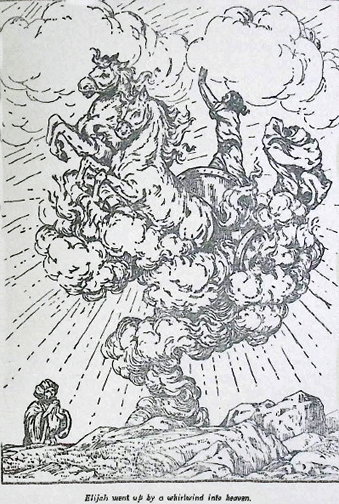
Elijah went up by a whirlwind into heaven.
How could they, when he was gone up to heaven in a chariot of fire?
And now in the New Testament, nine hundred years after that chariot of fire, which took Elijah to Heaven, we read of him again on the top of a mountain talking to Jesus while He was on earth!
It was not long before our Lord's death on Calvary that He took His three disciples, Peter, James, and John, up to a high mountain and was transfigured before them.
You will perhaps ask: "What does transfigured mean?" It means—changed, altered—made exceedingly bright and beautiful.
The Lord Jesus had been on earth for thirty-three years. He had gone about when He was young like an ordinary boy, and afterwards like an ordinary man; except that He did no sin, and was perfectly holy and loving; and was full of mercy and kindness to every one He met.
But now the time had come for Him to suffer on the Cross, to bear the punishment of our sins. And our Heavenly Father wished to give those three disciples a glimpse of the glory which Jesus had left when He came to earth, and to which He was going back, when He had done all the work which His Father had given Him to do.
So when they reached the top of the mountain with Jesus, suddenly they found that His face was changed into a face of glory, and His clothes became white and glistening. And soon they saw that Jesus was talking with two men—Moses and Elijah—who had come down from the glory of Heaven to talk with Him about His death which would soon happen at Jerusalem.
Can we not imagine the joy of Moses and Elijah, and the adoring worship of their hearts, as they talked with their beloved Lord? No wonder that Peter said in one of his Letters afterwards in speaking of this scene:
"We . . . were eyewitnesses of His majesty. For He received from God the Father honour and glory, when there came such a voice from the excellent glory: 'This is My beloved Son, in Whom I am well pleased.' And this Voice which came from Heaven we heard, when we were with Him in the holy mount."
Then a bright cloud overshadowed them, and when it had passed away, Moses and Elijah were no longer there, but Jesus only!
And Jesus came and touched them, and told them not to be afraid.
And then as they went down from the mountain, He explained to them that He would very shortly have to die; but that they were not to tell of the Vision they had seen, till after He was risen from the dead.
Jesus said Himself to two of His friends after His resurrection: "Ought not Christ to have suffered these things and to enter into His glory?" And beginning at Moses and all the Prophets, He explained to them all through the Bible the things which were written there about Himself.
VI. IN THE CAVE
AFTER David had conquered the giant, and had brought his head to the king, Saul for a while was very proud of his young soldier, and made much of him in every way. And David behaved himself wisely; and Saul set him over his men of war, and he became very popular among the people.
Meanwhile Jonathan, Saul's son, thought there was no one in the world like David! He loved him as his own soul.
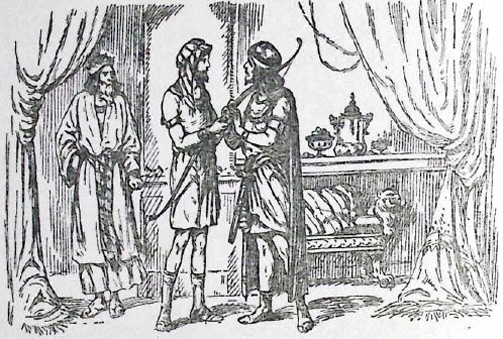
He took off his own beautiful clothes, which belonged to him as the king's son, and put them on David, even presenting him with his sword, his bow and his girdle.
But a jealous feeling began to rankle in the breast of the king.
He heard the women singing who came out to meet him from the cities, after David's slaughter of the giant, and these were the words they sang: "Saul has slain his thousands, but David his ten thousands."
This made the king very angry, and from that day forth, he determined to kill David.
So King Saul hunted David up and down the land. Jonathan was devoted to him, and helped him to escape many times. He endeavoured to be a peacemaker, and assured his father that David had no evil designs against him. But it was all of no use. Jealousy, which the Bible says is "cruel as the grave," had entered into Saul's heart, and it poisoned all his thoughts.
Then David again had a great victory over the Philistines, and Saul was so jealous that he threw his javelin at him. David, however, escaped, and the javelin went into the wall, where he had been sitting playing his harp to Saul.
He fled down to his house, but Saul sent men to watch for him and to kill him in the morning. So Michal, his wife, persuaded him to fly that night, for she was sure he would be slain.
Michal was Saul's daughter, and she loved David. So she let him down through a window, and he escaped.
Then Michal took an image, and laid it in the bed, and put a goat's-hair pillow for a bolster and covered it with a cloth.
And when Saul's messengers came to take David, Michal said: "He is sick."
Then Saul sent back the messengers and ordered them to bring David in his bed!
But when the messengers came in, there was only an image in the bed, and David was far away!
So it went on, till David was hunted from place to place, all over the land, and driven, with the men of war who followed him, to live in the mountains, and among rocks and caves, to get away from Saul's vengeance.
One day, as Saul was pursuing hotly after David, who he heard was in the wilderness of Engedi, he was very weary with travel, and finding a large dark cave, he entered it, and lay down to get some sleep.
Little did Saul guess, that the man he had come to seek was close to him, and that in the darkness of the cave, and hidden by the jutting sides, David and his men were quietly watching him.
When Saul had fallen into a deep sleep, David's men whispered to him that the day had come when the Lord had delivered his enemy into his hand!
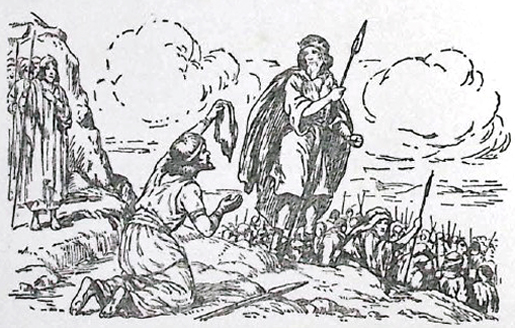
So David went forward, and as he approached Saul, he saw that his robe, with which he had covered his feet, lay partly on the ground. So he softly cut off the skirt of Saul's robe, and went back to his hiding-place.
But David's heart smote him, because he had cut off Saul's robe; and he hastily forbade his men to touch the king, for was he not the Lord's anointed?
Presently Saul awoke from his sleep and went out of the cave, and David followed him and called out to him, "My lord the king!"
And when Saul looked behind him, David stooped and bowed low before him.
And David said to Saul: "Why do you regard men's words, telling you that I seek your hurt? Look, how this very day the Lord has delivered you into my hand in the cave, and some bade me kill you; but my eye has spared you, and I said, 'I will not put forth my hand to hurt the Lord's anointed!' Moreover, see, my father, here is the skirt of your robe in my hand! Surely you know now that I have not tried to hurt you, and yet you have hunted my soul to take it! The Lord is judge between us; He will plead my cause, and will deliver me out of your hand!"
When David had said these gentle and brave words, Saul said: "Is this thy voice, my son David?" and Saul lifted up his voice and wept.
Then he said to David: "You have been more honourable than I have, for you have rewarded me with good, and I have rewarded you with evil. Therefore may the Lord reward you good for what you have done to me this day."
And then he went on to tell David that he knew he would be king one day, and he earnestly begged him to be merciful to his father's house and not let his name perish out of the land.
So David promised him, before the Lord.
Then Saul went to his home, and David returned to his stronghold.
Saul later on again attempted to capture David, taking with him three thousand men.
David heard where Saul was camped, and taking Abishai with him, entered Saul's camp by night.
They found Saul asleep with his captain in a trench, with his men lying all around.
Abishai wished to kill Saul, but David refused, saying, "Destroy him not: for who can stretch out his hand against the Lord's anointed and be guiltless?"
So they took Saul's spear and water-bottle that was against his head and got away without anyone seeing them.
So David again spared the life of the man who for years had tried to kill him.
VII. MOSES IN THE LAND OF MIDIAN
EXODUS 2.13-25
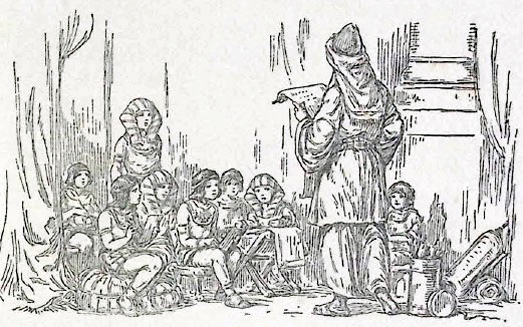
MOSES grew up from that little babe who had been hidden in the flags or reeds of the Nile, and he had been educated in all the learning of the Egyptians, as if he had been the real son of Pharaoh's daughter.
God was watching over Moses all the time, and preparing him for the great and wonderful work he was to do.
Do we all sometimes feel it very hard to learn difficult tasks? Do we, as we grow older, sometimes wonder what work God is getting us ready to do for Him?
I remember when I was young, how I was asked to stay for a fortnight at a lady's house whom I had never seen, or heard of, before. She called on my father, and said she should like to know his two eldest daughters, and would he allow us to come and stay with her?
So we went; we were about nineteen and twenty at that time, and we felt very homesick and strange at first. But do you know? That was one of the best things that ever happened to both of us!
That dear, kind old lady, had a heart full of love to Jesus our Saviour; and she used her money, and her house, and her influence, to help young people to love Him too. And when we got to know her, we had such a happy time, and set to work ourselves to try to bring others to love Jesus. Well, that was God's love in training us for what He wanted us to do afterwards. So, with Moses; he went in and out of Pharaoh's Court, and learned many things which were most useful to him, all his life, in God's Service.
The Children of Israel, or the Hebrews as they were called at this time, were slaves in Egypt, and one day Moses saw an Egyptian using one of the Hebrews very badly. So Moses interfered, and killed the Egyptian who was ill-treating one of God's people.
This made Pharaoh very angry, and he tried to kill Moses.
So Moses fled, and by and bye, he reached the land of Midian, where he sat down by a Well, and rested himself.
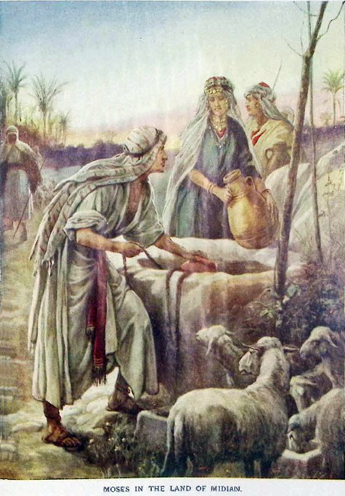
MOSES IN THE LAND OF MIDIAN.
This Well belonged to the Priest, or Prince of Midian; and he had seven daughters, who every day came to the Well, and filled the troughs for their father's flocks to drink.
But some shepherds came and drove the girls away, wishing, I suppose, to use the trough to water their own flocks, without waiting for the maidens to finish their task.
But Moses stood up and helped them, so that they watered their father's flock very quickly.
When they came home, their father asked them how it was that they returned so soon?
And they said: "An Egyptian delivered us out of the hand of the shepherds, and also drew water for us!"
In the East, people are very hospitable, and ready to entertain strangers; and directly Reuel (or Jethro) heard what his daughters said, he exclaimed: "Where is he? How is it that you have left the man? Call him, that he may eat bread."
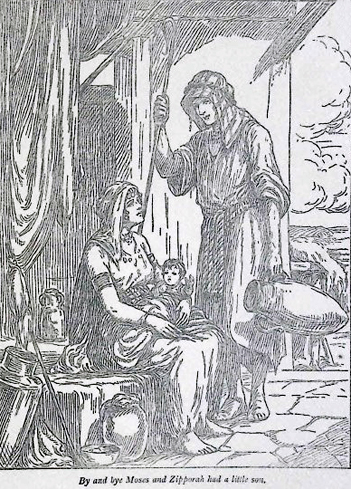
By and by, Moses and Zipporah had a little son.
So Moses was very happy to stay with Jethro, and soon he married one of Jethro's daughters, named Zipporah. And by and bye Moses and Zipporah had a little son, whom Moses named Gershom.
But while all this was going on in Midian, the plight of the Hebrews who were in Egypt grew worse and worse.
The King, who had wanted to kill Moses, had died, and the Children of Israel sighed under the cruel bondage that the Egyptians put upon them.
And their cry came up to God.
And God looked down out of heaven upon the poor, hardly-used slaves, and He came down from heaven and spoke to Moses about them.
And the words He said are full of the tenderest comfort to all who are in trouble. For God sees it, whatever it is. Also He listens to our cry, when things are too hard for us. But best of all, He knows just what is in our hearts, which nobody else can see or hear, and to this sorrow He says, "I, even I, am He that comforteth you."
So God said to Moses, "For I know their sorrows; and I am come down to deliver them out of the hand of the Egyptians, and to bring them up into a good land ... flowing with milk and honey."
And God chose Moses, whom He had so wonderfully trained, to be His Servant, who should deliver the Children of Israel from their hard slavery.
Moses knew all about Egypt. He could speak the language of the Egyptians: he understood all about the Court of Pharaoh, and the customs of the Egyptians. So God sent him straight down to Egypt to deliver His people, and He gave him this great and beautiful promise to cheer his heart:
"Certainly I will be with thee."
Then God explained to Moses that Pharaoh would not let them go, but that He would shew great wonders in Egypt by His Mighty Hand, and after that, Pharaoh would be so frightened, that he would let them go.
All this came to pass; for God sent plague after plague on the Egyptians, until at last, in a marvellous way, God delivered the whole of the Israelites, with all their possessions and flocks and herds, right out of the hand of Pharaoh. And God brought them through the Red Sea on dry land, while the great army of the Egyptians who followed hard after them, with their Chariots and horses, were drowned in the deep waters, so that there was not one left!
And afterwards, God led His people through the wilderness, and did bring them into the Land of Canaan as He had promised.
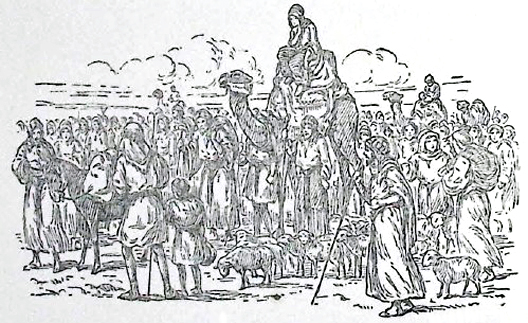
VIII. A GOOD REPORT OF THE LAND
THE Children of Israel—the descendants of Abraham, Isaac and Jacob—had come down to Egypt in consequence of the seven years of famine. Joseph was there, and was great in the eyes of Pharaoh, and the king made old Jacob and his sons, with their families and their flocks, welcome to live in the land of Goshen.
For a time, they were very happy and prosperous, and God blessed them and they increased in numbers and riches.
But by and by, the Egyptians began to look round upon these Children of Israel, and jealousy of their success filled their hearts.
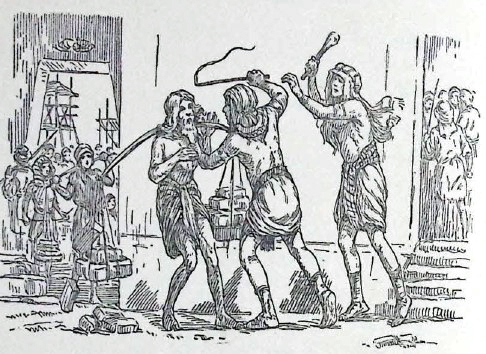
The Pharaoh who had made them so welcome for Joseph's sake, was dead. And another king arose who had forgotten all about Joseph, and he began to lay burdens on the Children of Israel, and to force them to build his palaces and cities.
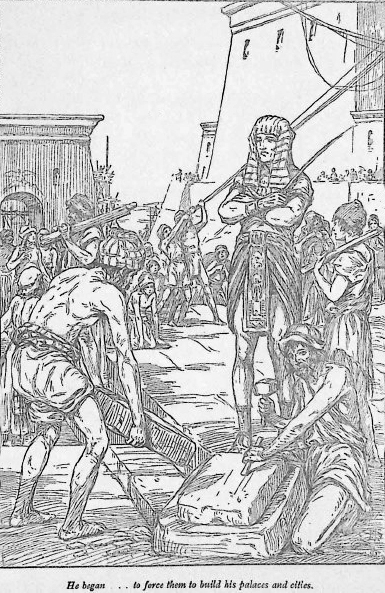
He began . . . to force them to build his palaces and cities.
At length, the cruelty and the burdens became intolerable, and the Lord God in Heaven saw their affliction, heard their groaning, and sent down to deliver them.
Moses was His chosen servant, and under him, after many wonderful deliverances, the people were brought right out and set free, and were taken back to the borders of the land which God had promised to give to Abraham and his children after him.
But the Children of Israel were disobedient, and forgetful of all the wonders that God had shown them, in delivering them from Egypt. He had made a way for them to walk dry-shod through the Red Sea; He brought water out of a rock for their thirst; and He sent down manna every day for their food.
But because of their murmuring, complaining spirit, God told Moses that He could not let them go into the land of Canaan just yet.
So He led them about in the wilderness; spreading His cloud over them in the day to shield them from the sun's scorching rays; and by night He put a pillar of fire to give them light and comfort.
At length, in the second year after they came out of Egypt, they reached the wilderness of Paran. And now God told Moses to take one chief man out of each of the twelve tribes of Israel, and he was to send them into the land of Canaan to bring back a report of what they found there.
There were twelve men chosen, but of these only two, Caleb and Joshua, were faithful to God all through.
The twelve men set out, and at the end of forty days they returned with their report of all they had seen.
They brought with them pomegranates and figs; and the grapes were so plentiful, that from one place called Eshcol they brought a bunch which required two men to carry it on a pole between them.
For God had promised when they left Egypt, that He would bring them to a land flowing with milk and honey, and that He would drive out all their enemies before them.
If only they had remembered this!
So the messengers began to tell their tale. They said that indeed it was a rich land, flowing with milk and honey. "And see," said they, "here is some of the fruit of it."
You can imagine for yourselves how Caleb and Joshua stood by, listening to the eager words of the other ten.
And now came another word, which made those two faithful men tremble—and it was an unbelieving, faithless word!
"Nevertheless," the ten spies went on, "the cities are walled, there are giants there, and numbers of enemies dwell on every side; we are not able to go up against the people, for they are stronger than we are!"
Then you can imagine Caleb and Joshua starting forward to still the people, and they cried: "Let us go up at once and possess the land, for we are well able to overcome it!"
But the ten spies persisted that they could not go up, and all the people mourned and wept, and told Moses that they had better return to Egypt, for they would die in the wilderness, and their wives and their children would be a prey for their enemies.
Oh, how sad is want of faith! They forgot the power of God and the promises of God! They let Satan whisper in their hearts that, after all, God would fail them, and though the land was beautiful and full of food and plenty—"Nevertheless" there were too many enemies to face.
God was very grieved at the unbelief of the people, and He said that none of those who had distrusted Him should enter into the land of Canaan, but their children should in due time enter in and possess it.
This is a solemn lesson for us all. There are right times to say "Nevertheless."
Peter said to Jesus: "Nevertheless at Thy word I will let down the net," and they got a great draught of fishes!
Paul said: Nevertheless the Lord stood by me, "and strengthened me," and he fought a good fight to the end!
God did not forget the faithfulness of Caleb and Joshua; for Joshua was chosen, years afterwards, to lead the people into the land and to fight the Lord's battles; and Caleb, "because he had wholly followed the Lord," entered with his children into the Promised Land, and had a happy possession in it.
It was true of them both: "None of them that trust in Him shall be desolate."
IX. MOSES HIDDEN IN THE CLEFT OF THE ROCK
EXODUS 33.17-23
FOR forty years, Moses, the little boy who had been taken out of the water by Pharaoh's daughter, was brought up in Pharaoh's Palace in Egypt, where he learned the wisdom of the Egyptians, and was mighty in word and deed.
He evidently knew that he belonged to the Israelites or Hebrews, as they were called; but it was not till he had reached forty years of age that he began to look upon the sad plight of his own people.
The Egyptians had gradually made the Hebrews into slaves, and were using them with great cruelty; but at length Moses understood that God was going to deliver the people by his hand.
However, the first effort he made, was that he killed an Egyptian who was hurting a Hebrew man; and this came to the ears of Pharaoh, and he was so angry that Moses fled away, and never stopped till he reached the land of Midian.
Here he remained for another forty years. He married a wife and had two sons, and he tended the flocks of his father-in-law, and lived a very peaceful life.
But one day God came down and spoke to him. He told Moses that in Egypt, the condition of God's people was getting worse and worse, and that He had chosen Moses to be their deliverer.
God said that He would go with him, and help him through; and promised that they should all serve God on this very Mountain in Horeb, where God was now speaking to him.
It would take too long to tell you all the wonders that God had to do to set His people free from their bondage; but at length they escaped from Egypt—every one of them—they went through the Red Sea on dry land, because God kept back the water on each side of them; and as they passed in to the dry pathway God had made for them, He took His Pillar of Cloud, which used to lead them, and He put it behind them, so that it was between them and their enemies. And it was a cloud of darkness to the Egyptians, but it was a bright light to the Israelites, all night.
When they had passed over, God took the cloud away, and the Egyptians followed through the Sea, but God let the waters go back on Pharaoh and his host, and they were all drowned in the sea, and the Israelites were all safe on the other side.
This is a glorious lesson for us, to show us how God will conquer our great enemy, Satan, and will bring us safely through, if we trust Him.
When the Children of Israel came to Horeb, God called Moses up on the Mountain to receive His Commandments, and to listen to all that God wished him to do; but the people began to get restless and disobedient.
Moses had been on the Mountain for forty days, and they said to Aaron, the brother of Moses, who was the High Priest, "Up! Make us gods, which shall go before us, for as for this Moses we know not what is become of him!"
Then Aaron made a Golden Calf for them to worship!
When Moses came down from talking with God, and found what had happened, he threw the slabs of stone on which God had written His law, over the edge of a precipice, and they were broken in pieces beneath the mountain.
The Lord was very grieved and angry at the disobedience of the people. And Moses besought the Lord to forgive them; and he even asked God to blot his name out of the Book where He had written it, sooner than that the whole Congregation should perish.
And God heard his prayer for the forgiveness of the people, and told Moses to go forward and lead them to the Land. And God said, "My Presence shall go with thee, and I will give thee rest."
Now Moses loved God very much, and he answered the Lord, "If Thy Presence go not with me, carry us not up hence, for wherein shall it be known here, that I and Thy people have found grace in Thy sight? Is it not in that Thou goest with us?"
And the Lord said unto Moses, "I will do this thing also that thou hast spoken."
And then Moses, emboldened by God's wonderful kindness in answering his prayer, made a yet further request. "I beseech Thee, show me Thy Glory!" he said.
And the Lord promised to shew Moses all His Goodness, and all His Mercy; but God told him he could not see His face, for the Glory of it would be too much. The Lord pointed out a place on the mountainside where there was a clift, or cleft, in a rock, and He told Moses he might stand within that cleft, and God would put His hand over him, so that the glory of His face should not be seen.
So Moses hastened into that cleft of the rock, and the Glory of the Lord passed by, and after He had passed by, Moses was allowed to see His back, but His face might not be seen.
It is a wonderful story; and I think it should dwell in our hearts, that the Holiness of God is great beyond what any words of ours can picture.
There is a prayer of the Lord Jesus in the Gospel of John, which is very comforting when we think with solemn awe about the Holiness of God.
"Father I will that they also, whom Thou hast given me, be with me where I am: that they may behold my glory, which Thou hast given me; for Thou lovedst me before the foundation of the world."
God gave His own beloved Son, Jesus our Lord, to wash away our sins, and make us fit to see his Glory by and bye.
And in the Book of the Revelation we are told, that in Heaven, God's servants shall serve Him, and they shall see His face.
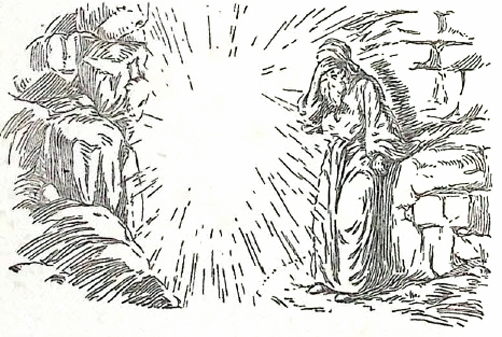
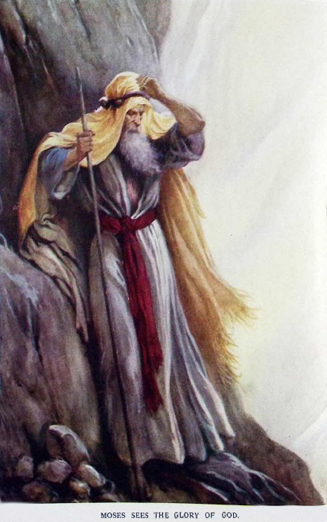
MOSES SEES THE GLORY OF GOD.
X. AARON'S ROD THAT BUDDED
NUMBERS 16 AND 17
BEFORE we begin to talk about the pleasant happy story of Aaron's Rod, and how it came out into buds and flowers, there is a very dark and sorrowful story which we must think of first.
The Lord told Moses to make a beautiful Tabernacle or Tent, where He would speak to him face to face; and He appointed the different Tribes to pitch their tents round it.
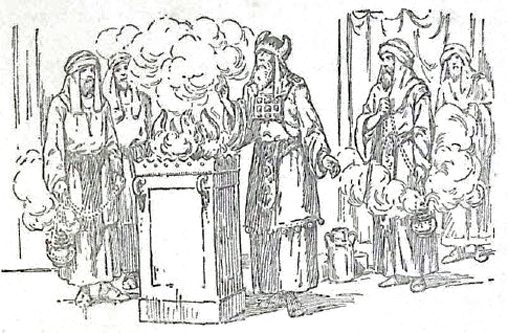
God choose Aaron, the elder brother of Moses, to be the High Priest. Aaron was the head of the tribe of Levi, and his family were the only ones who were allowed to approach God in the offerings which were to be presented for sin; and to offer the sweet Incense on the Golden Altar of Incense, which was in the Holy Place in the Tabernacle.
God said this Incense was to be made in a special way, and no one was to make any like it. And the Lord warns the people that "the stranger that cometh nigh shall be put to death."
Even Aaron's two elder sons, Nadab and Abihu, died before the Lord in the wilderness of Sinai, when they took their censers, "and put fire therein, and put incense thereon, and offered strange fire before the Lord, which he commanded them not."
These things were well known, and understood by the Israelites; but so evil are men's hearts and so easily excited to jealousy, that three men named Korah, Dathan and Abiram, gathered together a number of the Princes of the Congregation, and came to Moses and Aaron with complaints, that Moses and Aaron were taking too much upon themselves, and that all the Congregation were equally fit to draw near to God, and to do those parts of the Holy Service, which God had appointed that only Aaron and his sons should do.
Moses was dreadfully grieved, and he fell on his face in bitter sorrow.
Then he told Korah and the Princes that they were to present themselves at the door of the Tabernacle on the following day.
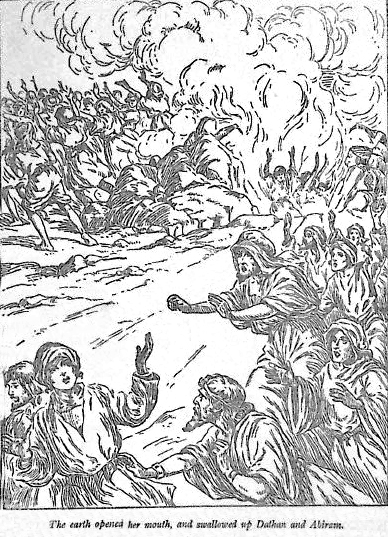
The earth opened her mouth, and swallowed up Dathan and Abiram.
He said to them, "This do: Take you censers, Korah and all his company, and put fire therein, and put incense in them before the Lord to-morrow."
But Moses warned them that the Lord would choose who was holy, and who should draw near to Him.
Korah and his company would not heed the warning. They had time to think over and repent of their sin, for the Lord is a God ready to pardon. But they went on in their proud arrogance, and oh! to what a dreadful end it led them.
So the next day Korah gathered all the Congregation together against Moses and Aaron, at the door of the Tabernacle. But Dathan and Abiram, who specially strove against the authority of Moses, would not come up, but remained in their tents.
Then the Lord told Moses and Aaron to separate themselves quickly from the Congregation that He might consume them all in His anger.
But once more Moses and Aaron fell on their faces, and interceded with the Lord for those people who had not joined in the rebellion; and the Lord heard their prayer, and told Moses to send the people to a distance, lest they should be consumed in the sins of these rebellious men.
So the people fled from round about the tents of Korah, Dathan, and Abiram.
And then God sent an earthquake, and the Earth opened her mouth, and swallowed up Dathan and Abiram, and their families and their tents.
And as the Congregation fled still further from the awful cry of them, a fire came out from the Lord, and destroyed Korah, and the two hundred and fifty Princes, who had offered Incense.
It is an awful thing to risk God's punishment.
This is a very, very sad story; but it is written down in the Bible, to show that we must obey God's commands, and seek Him in the way He has provided.
In the Old Testament times, the way to approach God was by the Priests whom God had appointed to present the Offerings for sin, and to burn the Incense; but now, since God sent His dear Son, Jesus Christ, to make atonement for our sins, Jesus is the Way to God. He is "the Lamb of God which taketh away the sin of the world."
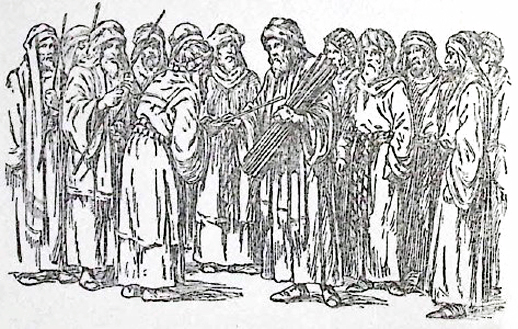
After all these dreadful things happened, the Lord spoke to Moses again. God told him that each of the Princes at the head of the Twelve Tribes, was to bring a rod, with his name clearly marked on it, and Moses was to take the twelve rods and place them in the Tabernacle before the Ark of the Testimony.
Aaron the High Priest was the head of the Tribe of Levi, and his rod, with his name on it, was to be sent in with the others.
And God said, "The man's rod whom I shall choose, shall blossom; and I will make to cease the murmurings of the Children of Israel, whereby they murmur against you."
Moses did this, and went in on the morrow to look at the rods; and "behold the rod of Aaron, for the house of Levi, was budded, and brought forth buds, and bloomed blossoms, and yielded Almonds."
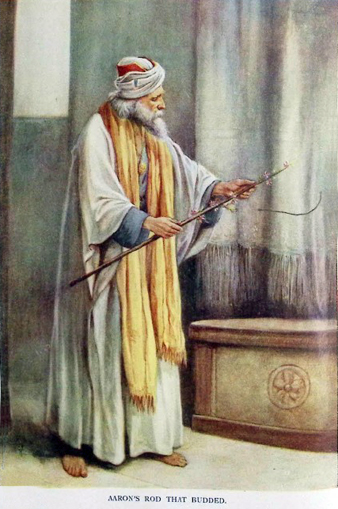
AARON'S ROD THAT BUDDED.
Then Moses carried all the rods out for the children of Israel to see, and the Lord said, "Bring Aaron's rod again before the Testimony, to be kept for a token against the rebels; and thou shalt quite take away their murmurings from me, that they die not."
XI. TO THE CITY OF REFUGE
WEARY and spent, the man ran; traversing the hot desert roads in the daytime; and hurrying on through the night if perchance there were a moon or stars to guide him; or else crouching in some corner behind some rock, till daylight enabled him to hurry forward once more!
Why was the man running over the ground at his topmost speed? Was he carrying a message, or bringing bad news, or what could it be?
No, he was hurrying to a place of safety!
But why? you may ask. Was he being pursued, or what was it?
Yes, he was being pursued by a man who was called "The Avenger of blood."
For God's law was, that a man who had hated his neighbour and had planned to kill him and had carried out his purpose should surely be put to death.
So if any one was killed among the Children of Israel, at once "the Avenger of blood" hurried to the spot and seized the murderer, who was then examined before the priests and the judges; and witnesses were called to give evidence as to whether the prisoner had intended to kill his neighbour, so that the judges might decide whether he were guilty or not. God's law made it necessary that there should be more than one witness before a man could be condemned.
But if a death were caused by an accident, God provided a way of escape for the manslayer, and it is this way of escape that I am going to tell you about.
When the Children of Israel had wandered in the wilderness for forty years—for their murmuring and disobedience, as God had said—they came at length to the land of Canaan; and here God told Moses to divide the land among the different tribes, and instructed him to separate Six Cities in different parts of the land, three on one side of the River Jordan, and three on the other side.
These six cities were to be called "cities of refuge," and God told Moses to make good roads leading to them, so that if any one killed a man by accident or at unawares, he might flee to one of those six cities, at his utmost speed, and not lose his way in his haste; for when once there, he would be sheltered, and in safety, so that the Avenger of blood might not catch him and kill him.
You will find in the 19th chapter of Deuteronomy the wonderful directions which God gave Moses about these cities.
God said, that any one who killed his neighbour ignorantly, and had not intended to hurt him, might flee to the city of refuge, and be safe.
If a man and his neighbour went into a wood to cut down a tree, and the axe-head of one of them flew off and struck the other man, so that he died, then the manslayer as he was called could flee to one of those cities, and live! Or if a man let a stone fall upon his neighbour by accident, and it killed him, he could flee to the city of refuge, and live!
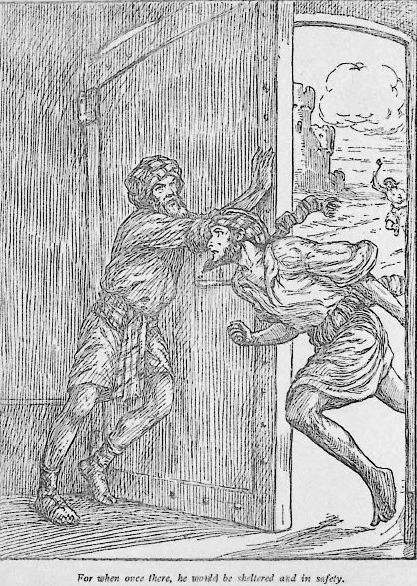
For when once there, he would be sheltered and in safety.
As soon as he entered the city of refuge, the elders of the city came forward and inquired into the circumstances which had made him fly there; and so soon as they were satisfied that the death of his neighbour was an accident, and that he was not worthy of death, they made him welcome to their city, and henceforward the city of refuge was to be his shelter.
But if any man hated his neighbour, and laid in wait for him, and rose up against him, and smote him mortally, so that he died, and were to flee into one of these cities, then the elders of his city should send and fetch him from there, and deliver him unto the hand of the Avenger of blood that he should die. These were the rules which God made.
The man who hurried to that city of refuge knew in his own heart whether he was guilty or not; and if he knew that it was an accident which had happened, then when he reached the city how gladly did he pass the gate, and get safely inside!
You can imagine how he sank down breathless and faint within that portal, and how thankful he was in his own heart that God had provided a way of escape for him!
In this city of refuge, he must stay; nor was he free to leave it for a single moment, till the death of the High Priest who might be living in those days. It might be many years, or it might be only a short time; but whether long or short there was no safety for him outside those walls. If he ventured out, if the Avenger should meet him, he would certainly be killed.
And it seems to me that there are one or two lessons which we may learn from this story, which God has written for our learning.
May we not think of Jesus Christ our Saviour as our City of Refuge?
And if He is, shall we not, beneath the Sheltering Walls of His Salvation, be at rest from all our fears?
We read, in the 6th of Hebrews: "That . . . we might have a strong consolation, who have fled for refuge to lay hold upon the hope set before us."
That man, running from the Avenger, wanted life!
And if we fly to Jesus Christ to get life, we find that He, Himself, is the Way—the plainly marked, loving path to safety.
He is the Truth, for His promises are faithful.
He is the Life, for there is no eternal life apart from Him.
How tenderly He says to us: "Come unto Me, all ye that labour and are heavy laden, and I will give you Rest."
XII. THE LETTER THAT WAS LAID BEFORE THE LORD, AND THE LORD'S ANSWER
HEZEKIAH, King of Judah, did that which was right in the sight of the Lord. He trusted in the Lord God of Israel; so that after him was none like him among all the Kings of Judah, nor any that were before him.
Immediately after he came to the throne, he destroyed all the high places where the people had worshipped false gods, and he broke their images; and he followed the commandments of the Lord with all his heart.
And the Lord was with him, and he prospered in all he set his hand to.
He defeated the Philistines, and rebelled against the yoke of the King of Assyria, and refused to serve him.
Meanwhile, however, Hoshea, who was then King of Israel, was very much harassed by the Assyrians, and God permitted them to come into the land of Israel and besiege Samaria for three years. They took it, and carried numbers of captives into the land of Assyria, because His people had transgressed His commandments.
The Assyrians, having gained these victories, turned their attention to the land of Judah, over which the good King Hezekiah reigned, and they fought against and took some of the fenced cities.
Then Hezekiah sent a present to the King of Assyria, hoping to bribe him not to pursue the war any further.
To make this payment Hezekiah cut off the gold from the doors of the Temple of the Lord, and sent all the money that was in the Treasury.
But the riches which were known to belong to the Kings of Judah and Israel were an immense attraction to their enemies: so that instead of turning back, the King of Assyria sent his greatest generals with a host of soldiers to surround Jerusalem and besiege it.
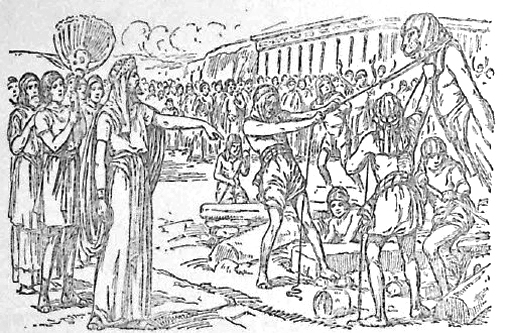
When they reached the conduit of the upper pool, which supplied water to the city, Rabshakeh called to King Hezekiah to come out to them.
Then Hilkiah, and Shebna, and Joah came forward to hear what Rabshakeh had to say.
And Rabshakeh's first words were full of pride and threatening: "Thus saith the great King, the King of Assyria, 'What confidence is this wherein thou trusteth? In whom dost thou trust? If ye say, "We trust in the Lord our God," Hezekiah has broken down His altars and told Judah they are to worship in Jerusalem!'
"Now therefore ... I will deliver thee two thousand horses, if thou canst on thy part put riders upon them!"
Then Hezekiah's messengers begged Rabshakeh to speak in the Assyrian language, and not in Hebrew, which the people understood.
But Rabshakeh was more insulting than ever; and told all who listened to him, that it was vain for Hezekiah to say "The Lord will deliver you!" Sennacherib had conquered other nations, and their gods had not delivered them! And the Lord would not deliver Jerusalem out of his hand.
But Eliakim told the people not to answer a word. Then they returned to the king with their clothes rent, and told him the words of Rabshakeh.
Then Hezekiah rent his clothes and put on sackcloth, and went up into the house of the Lord, and sent his messengers to Isaiah the Prophet, saying that it was indeed a day of trouble, and surely the Lord had heard the words of Rabshakeh.
But the Prophet Isaiah sent this message to Hezekiah: "Thus saith the Lord, Be not afraid of the words which thou hast heard, with which the servants of the King of Assyria have blasphemed Me. Behold, I will send a blast upon him, and he shall hear a rumour, and shall return to his own land; and I will cause him to fall by the sword in his own land."
So Rabshakeh returned, and when he found fresh troubles in his own land, he sent a message by letter to Hezekiah, saying they were not to rejoice that they had escaped their enemy! For they would surely come and fight against them another time!
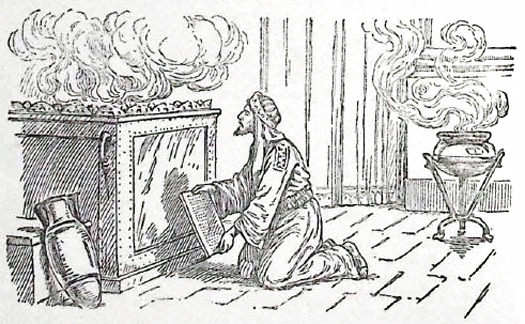
Then Hezekiah received the letter and read it, and carried it up into the House of the Lord and spread it before the Lord. And he prayed to the Lord, and told Him it was quite true that other nations had been defeated by the cruel King of Assyria, but they had not the Lord God of Israel to trust in; and then he ended with these words: "O Lord our God, I beseech Thee, save Thou us out of his hand, that all the kingdoms of the earth may know, that Thou art the Lord God, and Thou only!"
And then the Lord gave His long glorious answer: "Thus saith the Lord concerning the King of Assyria, He shall not come into this city, nor shoot an arrow there, nor come before it with shield, nor cast a bank against it. By the way that he came, by the same shall he return, and shall not come into this city, saith the Lord. For I will defend this city, to save it, for Mine Own Sake, and for My servant David's sake."
"And it came to pass that night, that the angel of the Lord went out, and smote in the camp of the Assyrians an hundred and eighty-five thousand men: and when they arose early in the morning they were all dead corpses."
So Sennacherib, King of Assyria, departed and returned to Nineveh; and as he was worshipping in the house of Nisroch, his god, his two sons smote him and killed him.
God's words had come true.
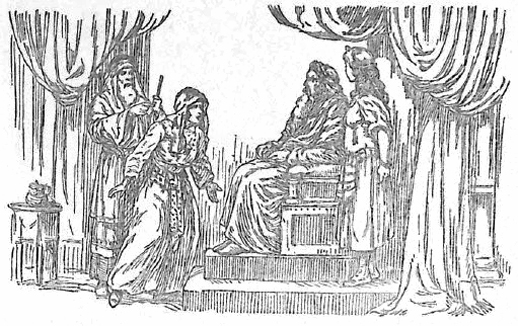
XIII. THE QUEEN OF SHEBA
WHEN David grew old, one of his sons, named Adonijah, exalted himself, to make himself king instead of his father.
He conferred with Joab the captain and with Abiathar the priest, and it was arranged that all the sons of the king should be invited to a great feast; but when the invitations were given, it was found that he had not included his brother Solomon, nor Zadok the priest, nor Benaiah the soldier, nor Nathan the prophet, who were all devoted friends of King David.
So Nathan the prophet spoke to Bathsheba, the mother of Solomon, and begged her to go to King David and tell him that Adonijah had set himself up as king; and to remind David that he had promised her that he would give the kingdom to Solomon his son.
David was very much troubled with what Bathsheba and Nathan told him, and he solemnly assured them that God had promised the throne to Solomon, and to no one else; and he then sent for Zadok, and he told him and Nathan to anoint Solomon King over Israel at once, and to blow with the trumpet and say, "Solomon is King!"
And he told them that Solomon was to ride on the king's own mule, and sit on the king's throne.
So they took a horn of oil out of the Tabernacle and anointed Solomon. And they blew the trumpet, and all the people said: "God save King Solomon!" And the people came up after him, rejoicing with music and great joy, so that the earth rent with the sound of them.
Thus Solomon was established in his kingdom, and reigned over all Israel and Judah.
Now Solomon loved the Lord—and it says "the Lord loved Solomon."
One day he went up to the high place at Gibeon to sacrifice to the Lord there; and he offered a thousand burnt offerings upon the altar. And the Lord appeared to Solomon in a dream; and God said:
"Ask what I shall give thee!"
Then Solomon thanked God for the great kindness which He had shown David his father, in giving him a son to sit on his throne; and acknowledged how David had walked before the Lord in uprightness of heart. And then he added: "O Lord my God . . . I am but a little child . . . give me therefore an understanding heart to judge Thy people; for who is able to judge so great a people?"
And the Lord was pleased with Solomon's request, and He told him that because he had asked this thing, and not asked for himself riches or honour or long life, God would grant his prayer for an understanding heart, and would add besides riches and honour, so that there should be no king like Solomon in all the world, nor ever would be again.
And then, after these gracious and wonderful assurances, the Lord God added this warning—and it seems to me that the warning comes home to every one of us now: "If thou wilt walk in My ways to keep My statutes and My commandments, as thy father David did walk, then I will lengthen thy days."
Then Solomon awoke from his dream, and he came to Jerusalem and offered burnt offerings unto the Lord there.
He at once set about ruling his kingdom and exercising the wonderful wisdom which God had given him.
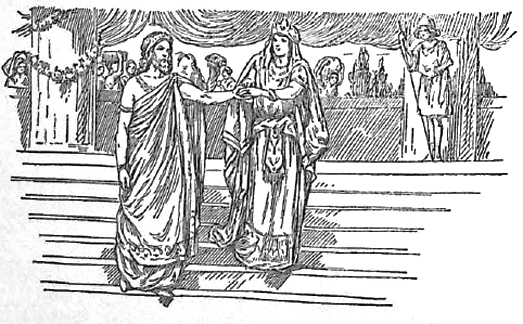
And this was why, when he had built cities and palaces, and gathered gold and silver and spices in abundance; when he had been permitted to build a magnificent Temple for the Lord, the Queen of Sheba heard of his fame, concerning the Name of the Lord, and travelled many hundreds of miles from the south below Egypt, to prove Solomon with hard questions and to see the glories of his kingdom.
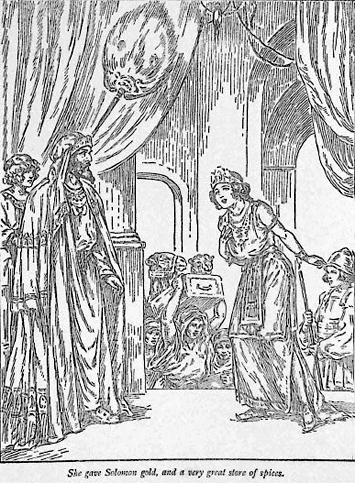
She gave Solomon gold, and a very great store of spices.
And Solomon answered all her questions, and showed her all his work and his riches. When she had seen the house he had built and the food daily spread on his table, and the number of his servants, and the ascent which he had built to go up to the House of the Lord, the queen seemed to have no more strength in her, and she exclaimed:
"It was a true report that I heard in mine own country, but the half was not told me!" "Happy are thy men, happy are these thy servants, which stand continually before thee, and hear thy wisdom." "Blessed be the Lord thy God, which delighteth in thee, to set thee on the throne of Israel . . . to do judgment and justice."
And she gave King Solomon gold, and a very great store of spices and precious stones, which she had brought on her camels from afar.
And Solomon gave her whatever she asked of him, besides the royal presents which, as a great king, he bestowed upon her unasked.
There is a verse in Isaiah and another in the Psalms which I love to read, which seem to remind us not only of the Queen of Sheba, but of that glorious day which is coming by and by for those who are the children of God through faith in our Lord Jesus Christ:—
"For since the beginning of the world men have not heard, nor perceived by the ear, neither hath the eye seen, O God, beside Thee, what He hath prepared for him that waiteth for Him."
"Thou wilt show me the path of life; in Thy presence is fullness of joy: at Thy right hand there are pleasures for evermore."
XIV. THREE COMMANDMENTS ABOUT EARTHLY THINGS
V. "Honour thy father and thy mother: that thy days may be long upon the land which the Lord thy God hath given thee."
OUR best and most beautiful example of this loving, dutiful obedience is given us in the early days of our Lord's life on earth.
We read of it in the second chapter of Luke.
Jesus was twelve years old, and He knew that His Heavenly Father had given Him a great work to do here in this world. One day in Jerusalem He had stayed in the Temple talking to the learned Doctors of the Law, and Joseph and His mother missed Him from among the company who were journeying homewards to Nazareth; and when they found Him in the Temple, His mother said, "Thy father and I have sought Thee, sorrowing!"
And His gentle answer is a pattern to all of us: "Wist ye not—" (Did you not know)—"that I must be about My Father's business?" He was reminding her then of God, Who had sent Him, His only begotten Son, into the world to save sinners.
But with all that in His heart, the Bible goes on to tell us, "Jesus went down with them to Nazareth, and was subject unto them." That means that He was perfectly obedient in His earthly home.
Then we have the sweet example of Ruth the Moabitess.
Her husband was dead. But Ruth was devoted to her mother-in-law, and when Naomi wished to return to the land of Israel, though all Ruth's friends lived in Moab, she entreated to be allowed to take that long journey with Naomi, and to stay with her always.
And as you can read for yourselves in the Book of Ruth, she was wonderfully blessed through her goodness to her mother-in-law. God watched her sweet and dutiful behaviour, and He gave her the great honour of being one of the ancestors of King David, and then, through him, of the Lord Jesus Christ, who was born at David's city, Bethlehem, thirteen hundred years afterwards.
Thus the Commandment that contained a promise of blessing was fulfilled.
VI. "Thou shalt do no murder."
What is murder? It is hatred in the heart, cherished and unpardoned, unconfessed to God, which ends in a cruel deed.
If we find in our own hearts an unforgiving spirit—a grudge against any one—a wish, perhaps, to do them harm or pay them back—let us beware!
Our Lord says: "When ye stand praying, forgive, if ye have aught against any one!"
Now I am going to tell you about a murder, which was a very sad one.
David, as you know, loved God very much; but he had grown very rich and powerful, and he had begun to value earthly things more than God's Commandments.
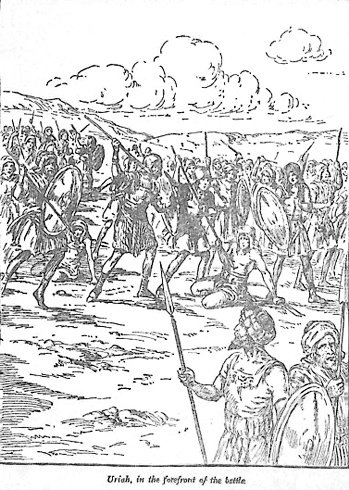
Uriah, in the forefront of the battle.
He wanted to get rid of one of his soldiers, who was at the war fighting for him. Why did he want to get rid of him? Because David had taken from him something which that soldier valued beyond all other things! I will tell you what that thing was afterwards.
So David told his great captain, Joab, to set this soldier, called Uriah, in the forefront of the battle, and then to retire from him, so that he should get killed. So Joab, who was an unscrupulous, untrustworthy man, did as the king commanded him. Then he sent back word to David at Jerusalem about the great battle, and mentioned that Uriah was killed.
"But the thing that David had done displeased the Lord."
The precious possession which David had taken for himself, while Uriah was at the war, was Uriah's dearly loved wife: and David had broken two of God's direct commands—one was, "Thou shalt do no murder," the other was:
VII. "Thou shalt not commit adultery."
—Which is taking another man's wife away from him.
Then there came another messenger to David. Not from the battlefield, where Uriah lay dead, but a message from God Himself, sent by the Prophet Nathan to the king.
And the Prophet told David this story: "There were two men in one city: one was rich, and the other poor."
"The rich man had exceeding many flocks and herds: the poor man had only one little ewe lamb, that he had brought up at home, and that played with his children and drank out of his own cup."
"And a traveller came to see that rich man; and the rich man grudged to take any out of his own flocks to feed the traveller, but took the poor man's ewe lamb!"
When David heard this story he was very angry with the rich man, and told Nathan he ought to be punished.
And then Nathan said to the king: "Thou art the man!"
"Wherefore hast thou despised the commandment of the Lord, to do evil in His sight? Thou hast killed Uriah with the sword, and hast taken his wife to be thy wife."
"Therefore the sword shall never depart from thy house."
Then David was dreadfully sorry. He saw his great sin in the sight of the Lord, and he earnestly asked to be forgiven.
If you read the fifty-first Psalm you will see how sorry he was.
And the Lord did forgive him; but David had to bear the effects of his sin the whole of his life afterwards.
XV. THREE COMMANDMENTS ABOUT OUR HANDS—OUR TONGUES—AND OUR HEARTS
VIII. "Thou shalt not steal."
PERHAPS you draw back, and say, "Steal! Surely no one would think I would steal!"
But when we come to think it over, there are a good many ways of stealing; or being tempted to steal. There are little unfairnesses that many practise, without in the least realizing that they lead to dishonesty. A boy who cheats over his lessons goes very near the mark! A girl who borrows from her class-mate a sixpence to buy a hair ribbon, and does not return it, goes very near the mark too!
Satan is so wary, and we are so un-wary!
I heard of a dear, good woman the other day.
She had a very hard life to make both ends meet. And one day, the person who was lodging with her left her purse on the table.
The woman would never have thought of opening the purse and taking out her neighbour's money! Oh no!
Satan was too wary to suggest that!
The dear woman went to move the purse to a place of safety, and it was very full of money, and fell open, and the contents in a moment lay scattered on the floor: shillings, sixpences, half-crowns!
Then Satan saw his opportunity. As the dear woman stooped to gather the money, the thought crossed her heart: "She would never miss one of these coins! And I do need them so—"
And then the dreadfulness of the temptation came upon her, and she fell on her knees.
"Dear Lord, forgive me!" she murmured, and hurried to gather up the money, and to restore the purse to its owner. God had helped her to be brave!
What made Judas betray his Lord?
Was it not that he was a thief, and had the bag, and carried about with him what was in it?
He thought if the chief priests would give him those thirty pieces of silver, he would be a rich man all his days instead of a poor man!
Did he ever enjoy those thirty pieces of silver?
There was a boy I heard of lately, who was tempted: and he took an orange from a greengrocer's shop. But his heart smote him; and that evening he wrote this letter to the greengrocer's wife in a round, boyish hand:—
"Dear Madam,—I am very sorry for stealing an orange from you yesterday, while in your shop. I must apologize as I am a Christian, but was tempted." Signed . . . "I enclose a penny stamp for the cost of same."
That confession must have cost that boy a great deal to do! But he was "more than conqueror through Him who loved him!"
IX. "Thou shalt not bear false witness against thy neighbour."
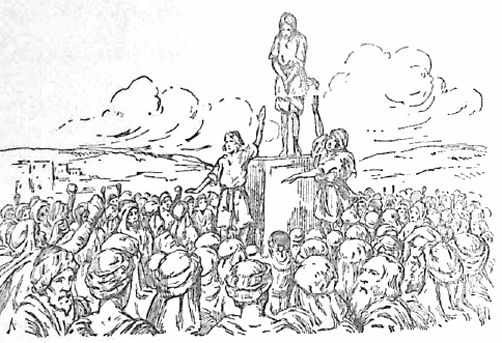
How did the wicked queen Jezebel manage to get Naboth's vineyard for her husband? It was by means of false witnesses!
She sent letters sealed with the king's seal to the nobles and elders who were in the city where Naboth lived, and ordered them to proclaim a fast, to set him up on high where all the people could see him, and to get two wicked men to give false witness against him, to accuse him of blaspheming God and the king. Then he was to be carried out of the city and stoned.
So the elders did as Jezebel told them, and poor Naboth, who had done no wrong, was cruelly killed.
And now I am going to tell you the story of the sin which brought this about.
God said in His Tenth Commandment—
X. "Thou shall not covet thy neighbour's house, thou shall not covet thy neighbour's wife, nor his manservant, nor his maidservant, nor his ox, nor his ass, nor anything that is his."
Covetousness is one of the sins that hides deep in a man's heart, and if given way to may spoil all his happiness.
King Ahab had a palace at Jezreel; and near to the palace was Naboth's vineyard, which was his family possession.
As the king passed to and fro, he began to covet the vineyard of Naboth in order to make himself a garden; and at length he asked Naboth to exchange his vineyard with him for another better one, or offered to buy it from Naboth for money.
This seemed at first sight a reasonable offer; but Ahab knew perfectly well that no Jew would sell his father's inheritance, and that he valued it almost like his own life.
So Naboth refused, and the king went back to his palace heavy and displeased, and went and lay upon his bed and would not eat.
When Jezebel found out what was the matter, she begged Ahab to get up and eat; and she promised that she would get the vineyard for him!
And this was how it came to pass that those false witnesses swore away Naboth's life!
When Ahab knew that Naboth was dead, he went down to take possession of the vineyard.
But the Lord sent this message to the king by Elijah, His Prophet—
"Thus saith the Lord: Hast thou killed, and also taken possession? Thus saith the Lord: In the Place where dogs licked the blood of Naboth, shall dogs lick thy blood, even thine."
It is a very solemn thing to break God's commands. Shall we not pray, as we think of them: "With my whole heart have I sought Thee: O let me not wander from Thy Commandments!"
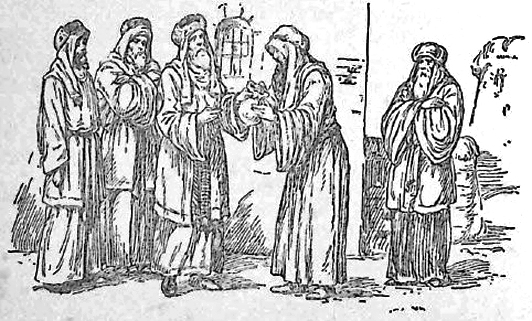
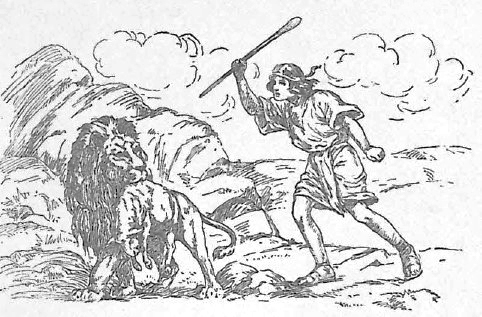
XVI. TAKEN FROM THE BROOK
I SAMUEL 17.12-52
A GREAT Giant had come out of the land of the Philistines to fight against the Israelites.
He was about 11 feet high-that is higher than a tall doorway, and no ordinary man could attempt to fight with him, with any hope of victory, be he ever so brave.
This Giant, Goliath of Gath, appeared every day for forty days, defying the Armies of Israel, and challenging them to send out a man to fight with him.
The Giant struck terror into the hearts of the Armies of Israel.
Now there was a youth named David, ruddy and beautiful, who was on the Mountains of Palestine, tending his father's flocks.
As he sat watching the sheep, the Holy Spirit taught him many of the Psalms we all love, such as, "The Lord is my Shepherd."
One day a lion came out of his lair and took a lamb of the flock, and David, knowing that God was his strong Helper, went out after the lion, and smote him and got the lamb out of his mouth, and when the lion turned on him, David caught him by the beard and killed him. And a bear came in the same way, and he killed him too.
One day David's father, Jesse, sent him to see how his brothers, who were at the war, were getting on; and when he reached the Camp, the first thing that he heard was the news of this dreadful Giant, who was defying the Israelites every morning and every evening.
And David said, "Who is this heathen Philistine, that he should defy the Armies of the Living God?"
David's eldest brother was angry with him for what he said; but David's words were heard by the other soldiers, and they repeated them to King Saul.
And Saul sent for him, and when David came into his presence, he said to the King, "Let no man's heart fail him because of the Giant, I will go and fight with him!"
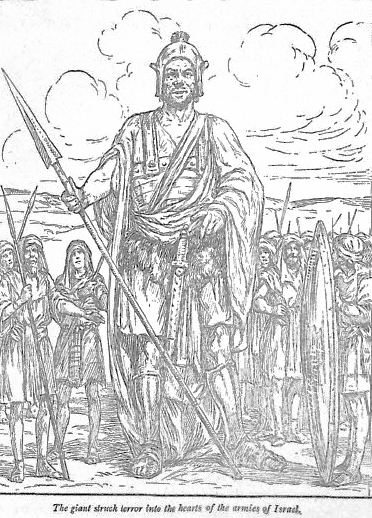
The giant struck terror into the hearts of the armies of Israel.
But Saul looked at David and said, "You are not able to fight with the Giant."
Then David told the King about the lion and bear, and he said, "The Lord that delivered me out of the paw of the lion, and out of the paw of the bear, He will deliver me out of the hand of this Philistine."
So Saul agreed to his going, and put some armour on him; but David told the King he could not go with these, for he was not used to armour.
Then David took his staff in his hand, and went to the brook and chose out five smooth stones, and he put them in his shepherd's bag that hung at his side.
Before we go on to what David did with those stones, there are two or three interesting things in this story which we shall do well to notice; for they will be, if we think of them, a great help to us in our own lives.
We all have, like David, a tremendous enemy to face. This is Satan; and he comes to us every day, like the Giant Goliath, and he tries to make us afraid. He wants us to live without thinking about God; he wants us to forget that there is a great Helper for us in every time of need.
But David truly loved God with his whole heart, and he was very brave; but it was in God's strength that he had determined to meet the Giant.
So he went to the brook, and chose some of the smooth stones that he was accustomed to use.
It was a very simple weapon; and doubtless he had often practised slinging stones, as he sat watching his sheep, and knew how to aim well.
And, if we want to conquer Satan when he tempts us to do wrong, we must take the weapon God has given us to use—which is His own word. Just say, "Lord, help me!" or "Lord, save me!" and Satan will be driven away.
I shall never forget being called to comfort a dear dying girl, who was much worried by Satan's suggestions. I stood by her bedside and quietly repeated these words of God to her, from Isaiah 59.19: "When the enemy shall come in like a flood, the Spirit of the Lord shall lift up a standard against him."
In a moment the cloud of sorrow and fear passed from her face; and God never let Satan worry her again!
So you will find God's words will be just like David's smooth stones, when he went up to meet the Giant!
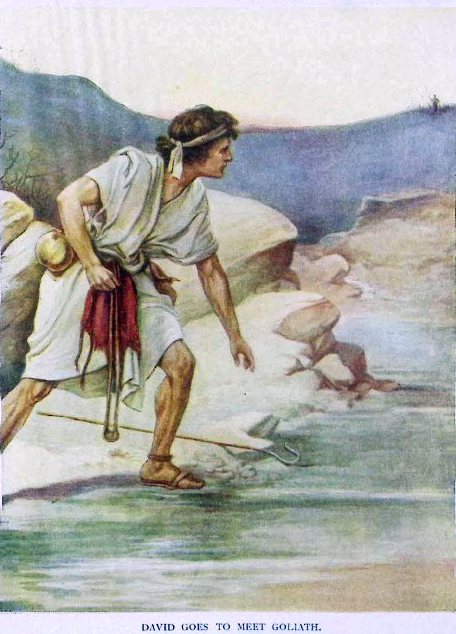
DAVID GOES TO MEET GOLIATH.
And Goliath said, "Am I a dog that thou comest to me with staves? Come to me, and I will give thy flesh to the fowls of the air, and to the beasts of the field!"
Then David answered, "Thou comest to me with a sword and with a shield, but I come to thee in the Name of the Lord of hosts, the God of the armies of Israel whom thou hast defied. This day will the Lord deliver thee into my hand . . . and I will smite thee, and take thy head from thee. For the battle is the Lord's."
So, as the Giant came forward towards David, David ran to meet him, and put his hand into his bag and took a stone, and slang it, and it hit the Giant on his forehead, so that he sank down on the ground on his face. Then David ran, and took Goliath's own sword, and cut off his head with it.