THE PROMISED LAND (continued 2)
Reading edition
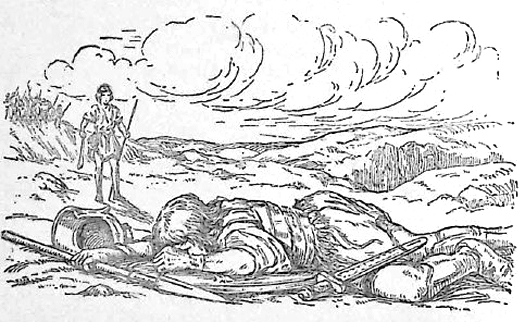
And when the Philistines saw that their Champion was dead, they fled, and the Israelites followed after them and the Victory was won.
XVII. THE FIRST AND SECOND COMMANDMENTS: AND HOW THEY WERE BROKEN
"I am the Lord thy God, Which have brought thee out of the land of Egypt, out of the house of bondage."
I. "Thou shalt have no other gods before Me."
II. "Thou shalt not make unto thee any graven image, or any likeness of any thing that is in heaven above, or that is in the earth beneath, or that is in the water under the earth: thou shalt not bow down thyself to them, nor serve them: for I the Lord thy God am a jealous God."
THE Children of Israel had left Egypt. God had brought them out with a strong hand. They had left their enemies the Egyptians, some of them dead in their houses, for all the firstborn were dead; and some of them overwhelmed in the Red Sea, where they had attempted to follow the Israelites, for whom God had made a way on dry ground, through the midst of the waters.
And now God had led them about in the wilderness, for they were obstinate and disobedient, and He could not let them go into the Promised Land of Blessing, because their hearts were too hard to learn His great lessons.
In the third month after leaving Egypt, they came into the wilderness of Sinai, and the whole congregation camped before the mount.
Then God called Moses to come to Him to the top of the mountain; and here God spoke to him, and sent him down to repeat to the congregation all the words which He had told him.
And God told Moses that it was a very solemn thing for Him to speak in their hearing, so they were to set bounds round the mount, that no one should come too close.
God said that He would come to Moses in a thick cloud; but that the people should hear His Voice when He spoke, and should believe Moses for ever.
While God was telling Moses all these Commandments, on the top of the mountain, there were thunderings and lightnings, and the voice of a trumpet exceeding loud, so that all the people in the camp trembled.
Mount Sinai was covered with smoke, because the Lord Jehovah descended upon it in fire; and even the mountain trembled at the Presence of the Holy God.
And this was the First Commandment—
"Thou shalt have no other gods before ME!"
Nothing else in the world nearer and dearer to us than God!
I heard the other day of a terribly injured soldier, who sent this message to one who had written to sympathize in his great deprivation: "Don't pity me; the sacrifice has been worth it; for I have found God!"
Oh! What it is to learn that!
Now we come to the Second Commandment—"Thou shalt not make unto thee any graven image."
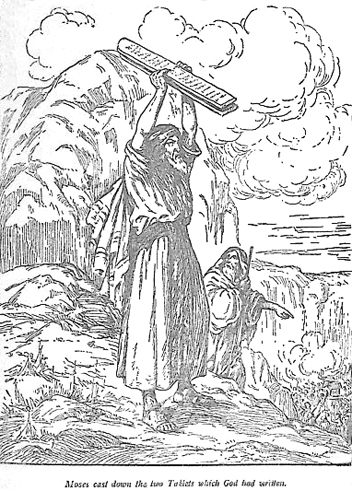
Moses cast down the two Tablets which God had written.
When the Children of Israel stood round that mount, and heard God say that, if they would obey His voice, they should be a peculiar treasure to Him, they promised that they would faithfully keep all that the Lord said.
But I am sorry to tell you that they soon forgot their promises, and did the very thing God had told them not to do. And this was how it all happened.
Moses was up on the mount with God for forty days and forty nights, and God gave Moses the two Tablets of stone, on which God Himself had written His Ten Commandments.
But forty days and forty nights seemed a long time to the thousands of people waiting below on the plains; and they "gathered themselves together unto Aaron, and said, Up! make us gods, which shall go before us; for as for this Moses, the man who brought us out of the land of Egypt, we do not know what has become of him!"
Then Aaron bade them bring him gold from their ornaments, and he cast the gold into the fire, and it melted down into a great piece of gold, which looked like a calf.
Aaron took a tool and moulded it, and the people said, "These be thy gods, O Israel, which brought thee up out of the land of Egypt!"
Then they offered sacrifices to the golden calf, and feasted, and rose up to dance.
"And the Lord said unto Moses, Go, get thee down; for the people have turned aside quickly out of the way that I commanded them. Now, therefore . . . let Me alone, that I may consume them!"
But Moses besought the Lord most earnestly to turn from His anger, and asked Him to remember His servants, Abraham, Isaac and Jacob; and begged Him to forgive the sin of His people.
So Moses went down the mountain with God's Law in his hands. But when he and Joshua, who was with him, saw from the mount what had happened, and that the people had already broken God's two first commandments, Moses cast down the two Tablets which God had written with His own Hand, and they fell beneath the mountain and were broken to pieces.
And the Lord sent a sore punishment to the people who had sinned, and three thousand of them died.
The next day Moses went up to the Lord again, and his words of entreaty are most touching—
"Oh, this people have sinned a great sin, and have made them gods of gold. Yet now, if Thou wilt forgive their sin—; and if not, blot me, I pray thee, out of Thy Book which Thou hast written."
"And the Lord said unto Moses, Whosoever hath sinned against Me, him will I blot out of My Book."
This is an awfully solemn story. We do not read that the people themselves repented—if they had, the Holy God would have forgiven them out and out.
For He says in the 55th of Isaiah—
"Let him return unto the Lord, and He will have mercy upon him; and to our God, for He will abundantly pardon."
XVIII. THE NEXT TWO COMMANDMENTS: AND HOW THEY MAY BE KEPT
III. "Thou shalt not take the Name of the Lord My God in vain; for the Lord will not hold him guiltless that taketh His Name in vain."
THINK of the name of the person whom you love the best in the world, and then think how you would feel if you heard any one speak against that name. Would not you feel grieved? Would you not turn away from the one who spoke against that loved name? And say: "I cannot hear you speak like that—I love that name above any on earth."
Yes; if you think of it, you will see that it is so.
And if we feel so about an earthly love, and an earthly name, what ought we to feel about that "Name which is above every name"?
No wonder God says in His Holy Law: "Thou shalt not take the Name of the Lord thy God in vain!"
And our Lord, in the Prayer which He has told us all to use, says—
"Our Father, which art in Heaven, Hallowed be Thy Name!" It is the first request of that wonderful prayer.
Do you see the baby boy in your home? He has hurt himself, or got into some difficulty. He can just say one single word, and that word is the only name he knows; and you hear him calling out in his distress, "Mother! Mother!" Over and over, till she comes running in, and in a moment he is in her arms!
And this brings me to a text I am very very fond of: "The Name of the Lord is a Strong Tower! The righteous runneth into it and is safe."
A few years ago a sister of mine was walking on a lonely road, and just as she was crossing a railway bridge between two brick walls a man sprang out and seized her watch and chain.
No one was in sight, and she knew she was utterly helpless, and that the man's strength would soon wrench the watch away.
Then she bethought herself of the Name of Jesus! And she called to Him aloud, "Lord, help me!"
In an instant the man relaxed his hold, dropped the watch and chain, and made off as fast as he could, and she saw him no more! Surely to her the Name of the Lord had been a strong tower, she had run into it and was safe!
And this is only one instance of very many that I have known, when the Holy Name of our God, or of our dear Saviour, is all-powerful to help us in our greatest need.
If we hallow the Name of our God in our lives now, there will be a time when we shall see His Face, and His Name shall be in our foreheads, as a token that we are His for ever.
And now we come to another thought, about another Commandment—
IV. "Remember the sabbath day to keep it holy. Six days shalt thou labour and do all thy work: but the seventh day is the sabbath of the Lord thy God . . . For in six days the Lord made heaven and earth . . . and rested the seventh day: wherefore the Lord blessed the sabbath day, and hallowed it."
You will see it begins with the one word—
"REMEMBER!"
What are we to remember? A father goes out in the morning, and as he turns away, he says, "Remember, children, what I have told you to do!"
So our Heavenly Father says to each one of us, about the Sundays that come every week: "Remember! This is My Day—it is the Sunday of the Lord thy God!"
Then let us rejoice that such a day is given us. A rest from our lessons; a rest from our work; a time when we can read a nice book in which we find something to help us about pleasing God.
Sunday is given us to do good in. Think how our Lord, when He was on earth, went about healing and comforting on the Sabbath Day! And He told the people "it was lawful to do good on the Sabbath Day."
If we look out for opportunities, we can think of things to do that will help others. We can paint texts to send to invalids or to cottages; we can put sacred pictures, if we have any, into scrap-books for the Children's Hospital, or we can paste some white paper on a used picture post-card, and write neatly a verse or two of a hymn, and send the cards, when done, to cheer the wounded soldiers! Such a hymn as "Fight the good fight," or "Jesu, Lover of my soul," or "I heard the voice of Jesus say."
An elder sister, perhaps, can show the little ones a Bible picture-book, and tell them some simple stories about Little Samuel or Joseph. Or she can read aloud a Sunday story-book to the others, while they paint or chalk some outlined texts.
In a large family I know, this was a very favourite occupation.
Then singing hymns! Oh, how children love hymns!
As you begin to "remember" to make God's Day a holy, happy one, you will find that there are things to do in it, for His sake, that will make you happy, too.
It is a day for worship, for rest, for peace, and for loving ministrations for others, and you will find that "in keeping His Commandments there is great reward."
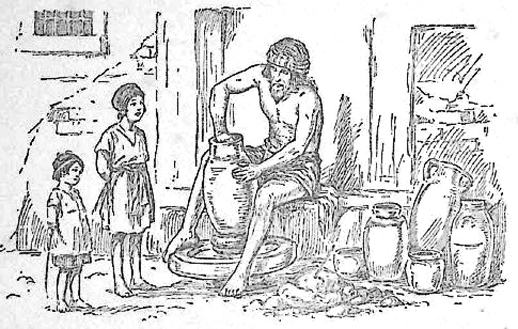
XIX. THE POTTER'S VESSEL
THOSE who have visited the East tell us that even to-day the potter still sits at his work, making jars and jugs to carry the precious water from the wells.
Now we must suppose ourselves entering the little courtyard where the potter sits at work, or bending our heads to enter the shady little building or shed, where the rays of the mid-day sun cannot reach him.
He has just brought a lump of clay, and placed it on the middle of his wheel, and with his feet, he gives the wheel a twist, and begins to mould the great lump of clay into a round sort of mass.
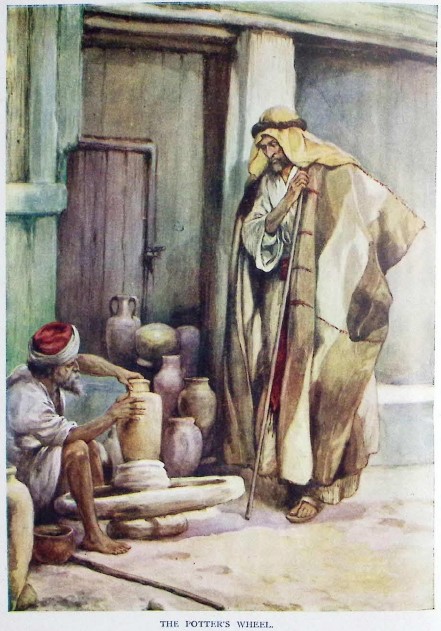
THE POTTER'S WHEEL.
So the visitor ventures to say: "May I ask what you are making, sir?"
And the potter looks up, with a half-smile, as he answers: "I am going to make a lovely jar," and then his feet twist the wheel round and round, and the visitor stands by watching.
The potter puts his thumb into the place where the neck of the jar will be, and as he twists and moulds, the visitor sees before his eyes the ugly bit of clay coming into an elegant shape.
At length the jar is done, and the visitor asks another question. "What will you do, now?" he says.
"I shall paint it with beautiful colours—"
"And then?"
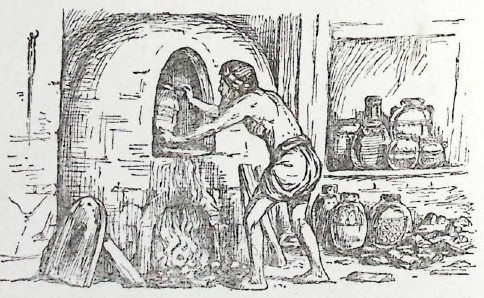
"Then I shall put it into the oven and bake it, so that the shape and the colours will stand fast."
The visitor hesitates. At length, he asks, "You do not make them all alike? Some are plain and homely; some are beautiful, and I suppose costly?"
The potter smiles, as he rises and places his jar on a shelf out of harm's way.
"Well, sir," he says, "it's just as I choose to make them! Some are so precious in my eyes that I love to look at them; some turn out so badly, that I have to mould the clay over again. Just as I like, sir; just as I like! It is my clay, and my work; but I want the pieces that I make, to come out beautiful and lovely."
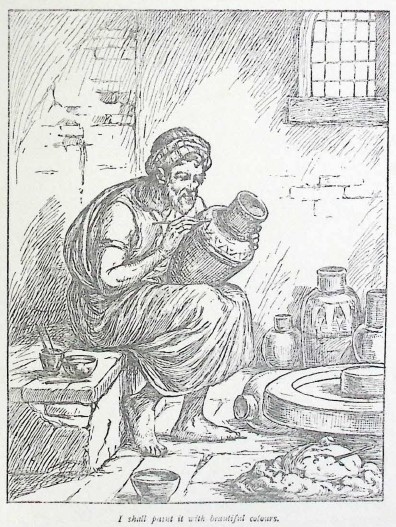
I shall paint it with beautiful colours.
So the potter takes another lump of clay, and goes to his wheel again; and the visitor, thanking him very much for his kindness, turns away thoughtfully.
Had he not read somewhere in his Bible about the Clay and the Potter?
"Yes," he said to himself at length. "It was in Jeremiah, and when I get back to my Hotel, I will look it up."
And he found what he wanted, in the 18th Chapter of Jeremiah, where the Lord told the Prophet to go down to the potter's house, that He might tell him there, what he was to say to the Jewish people, who at that time were sadly disobedient, and had turned away from God.
So Jeremiah went down to the Potter's house; and behold, he was making something on his wheel.
But as he made it, the vessel which he was moulding was marred, or spoilt, under his hand; so he turned, and made the piece of clay into another shape, as it seemed good to the potter to make it.
And the Prophet stood and watched him.
Then the word of the Lord came to Jeremiah, and the Lord told him he was to go to the people of Israel and tell them His message. That if they continued in their evil ways, He would take them out of their own land, and from their beloved City, Jerusalem, and He would send them to be Captives in a distant land.
And God said, "O house of Israel, cannot I do with you, as this potter has done with his clay?"
For God loved the Children of Israel, and He wanted to make them good and beautiful, like the potter wanted to make his jars.
But the Children of Israel rebelled against God; and though He had sent great deliverances many times, and brought them right out of the bondage of Egypt, and into the beautiful land of Canaan, they very quickly forgot Him again.
They forgot all His love towards them, and began to serve other gods, which they made with their own hands; and they even sacrificed and burned their own sons on their altars.
So God sent Jeremiah with His message to them—that if they would turn away from their evil ways and come back to Him, He would forgive them and give them every blessing; but if they refused, then Jerusalem should be destroyed, and God would send those who were left after the battles into a far country where they should be Captives for seventy years.
Yet even with all these solemn warnings, the Children of Israel—the Jews—refused to obey God; and very shortly those things came to pass which Jeremiah had told them.
But God has given great promises to the Jews, and He is very patient and longsuffering.
By and by after seventy years, He brought them back in a wonderful way to their own Land, which they again inhabited, and built cities and lived in them.
But it was not very long before they again began to depart from God's laws; they ceased to obey those things which were plainly written in the Old Testament Scriptures; and at last, when Jesus Christ came to earth to be their Messiah and King, they did not remember all God had said in the Bible about Him, and they rose up against Him, and crucified the Lord of Glory!
And so, again the Heavenly Father, who calls Himself the Potter, has had to send the Jews out of their Land, and He is moulding them now by trials and sorrows, so that by and by they may be purified and restored to His favour.
For when Jesus comes back to Earth, as He surely will, "they will look on Him whom they have pierced," and will turn to Him, and be saved.
XX. JEHOSHEBA, THE GOOD AUNT
2 KINGS 11.1-21. 2 CHRONICLES 22, 23, AND 24
QUEEN ATHALIAH, the daughter of Ahab and Jezebel, was a very wicked woman.
Her son Ahaziah only reigned one year in Jerusalem, and she was his counsellor to do evil. But at the end of the year he was slain by Jehu, and the Throne of Judah became empty.
Then Queen Athaliah determined to destroy all the Royal Princes, and ordered all the sons of Ahaziah to be killed, in order to reign over the Kingdom herself.
But while these terrible scenes were happening, and the Princes of Judah were being killed one after another, there was a Princess, Ahaziah's sister, who made a brave resolve, and carried it out most successfully.
She knew that one of the King's sons, whom Athaliah had intended to kill, was a baby of a year old, and she determined that she would do her utmost to rescue him from the soldiers who were ordered to carry out this wicked scheme. This Princess was called Jehosheba, and she was the wife of the High Priest, and evidently could go into the outer rooms of the Temple.
So while the shouts of the soldiers, and the cries of those who were being murdered, were filling the air with terrible sounds of confusion, Jehosheba stole swiftly to the place where she thought she should find the baby boy, and hiding him under her beautiful robes she bore him into the Temple, far away from the noise and turmoil, and she hid him in a bedchamber, under the care of his trusted Nurse.
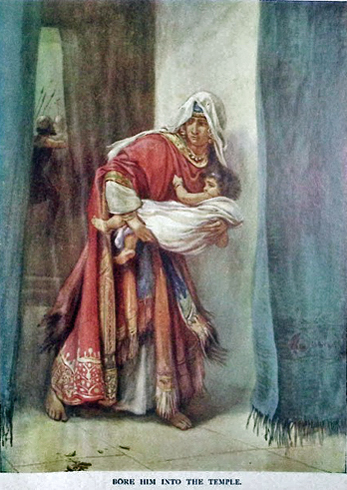
BORE HIM INTO THE TEMPLE.
The bedchamber was probably a little room where the mats and bedding for the priests who lived in the Temple, were kept, and at night they were brought out and laid upon the floor in the larger chambers; for that is the custom in the East.
No one missed the little child, for Athaliah believed that all the Royal Princes were slain. So she immediately put herself on the Throne, and reigned over the kingdom, practising all her wicked ways as before, in defiance of the Commands of God.
You will not wonder that she came to a very sorrowful end, as we shall hear presently.
Meanwhile, Joash, the little heir to the throne, was kept hidden safely in the Temple. You can picture to yourselves how Jehosheba would have often gone to that far-off bedchamber to play with her little nephew, and how she would teach him all she could, to prepare him for the Kingdom.
It is evident also, when we read the accounts, that her husband, Jehoiada, the High Priest, was often with the child: for by and by when six years had passed away, and little Joash was seven years old, Jehoiada determined that he should be crowned King.
So he called the Captains of the army, and they started out all over the land of Judah, and gathered the Levites from all the cities, and the chief fathers of the people, and they all came up to Jerusalem.
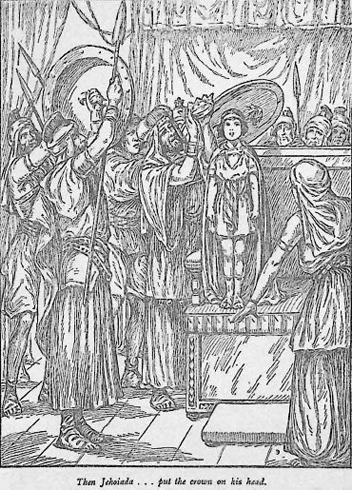
Then Jehoiada . . . put the crown on his head.
Jehoiada shewed them the little King, and made arrangements for their guarding him on the Coronation Day. He also armed them with spears and shields and bucklers which had been King David's, and said to them, "Behold the King's son shall reign, as the Lord hath said of the sons of David."
So the Captains and the Levites did exactly as Jehoiada told them, and stood on guard about the King, with their weapons in their hands.
Then Jehoiada brought forward the little son of King Ahaziah, and put the crown on his head, and the roll of the Testimony in his hand, and they made him King, and Jehoiada and his sons anointed him; and those about him clapped their hands with joy, and said, "God save the King!"
But when Athaliah, the wicked Queen, heard the shouting and rejoicing, she hurried into the House of the Lord, and when she saw the King standing by a pillar, and the Princes and the trumpeters around him, and all the people rejoicing, and sounding the trumpets, she rent her clothes and cried, "Treason! Treason!"
But Jehoiada quickly commanded the Captains to seize Athaliah, and take her out of the Temple, and to kill her with the sword outside the Courts; and there she was slain.
Then Jehoiada made a covenant with the King and all the people, that they should be the Lord's people, and not idolaters any more; and they went into the house of the idol Baal, and broke it down; and they broke up the altars of Baal, and his images into small pieces, and killed the priest of Baal.
So all the people rejoiced greatly, and they brought the King to the King's house, and he sat on the Throne of Judah.
As long as the faithful High Priest lived, Joash was a good King. Jehoiada was his counsellor and friend, and under his advice Joash did much to repair the Temple of God.
But when Jehoiada died, Joash fell into evil company. The Princes of Judah came and persuaded him to go to the Groves and Idols; and the end was, that he brought misery on himself, and also on the Kingdom which he ruled.
God sent Prophet after Prophet to implore the people to return to the Lord, but Joash went on in his wrong-doing, even to killing the son of Jehoiada, his old friend and protector.
Joash fell very sick at this time, whether from wounds or from illness, the Bible does not say; but the servants who waited on him conspired against him, and killed him in his bed.
Oh! What a sorrowful death! No love, no tender pity, but hatred for all the evil he had done to the Kingdom, over which he might have reigned so gloriously, had he only kept close to the Lord God, who would surely have established his throne.
XXI. GOD FEEDS ELIJAH
ELIJAH was a great Prophet of the Lord; and to him were given more wonderful honours than were conferred on any other Prophet.
We talk much now-a-days about deeds of bravery, and about the honours which are given to the men who have thus distinguished themselves; and these honours are given them by our King, and the brave deeds are spoken of from one end of the world to the other!
You will like to know what honours Elijah had?
He was allowed to go to Heaven without dying; and he was allowed long afterwards to come back from the glory to talk with the Lord Jesus on the Mount of Transfiguration.
These wonderful "distinctions" were not given him by any earthly king, but by God Himself; and as we follow out the story of Elijah's life, we shall ourselves, perhaps, have a peep into that glory which Jesus is even now preparing for those who love and follow Him.
I have read that Elijah's name means "My God is Jehovah!" and it seems to me that this is a brave motto for each one of us, "My God is Jehovah!" "For in the Lord JEHOVAH is everlasting strength."
The first mention we have of the Prophet Elijah, who came from the land of Gilead, was in the reign of King Ahab.
God chose Elijah, who was very brave, to rebuke the king for his many acts of wickedness. We read that Ahab did more to provoke the Lord God than any of the other kings before him.
One day Elijah went to Ahab and told him: "As the Lord God of Israel liveth, before Whom I stand, there shall not be dew nor rain these years, but according to my word."
This loss of rain was doubtless sent as a great punishment for the idolatry and sin into which the whole people of Israel had fallen.
Then the Word of the Lord came to Elijah, saying, "Turn thee eastward, and hide thyself by the brook Cherith that is before Jordan."
God did not forget His faithful servant in the famine that was coming; and He told him He had commanded the ravens to feed him, and that he would be able to drink of the brook.
Here, amidst the rocks and fastnesses, he was safe from the wrath of Ahab and of Jezebel, Ahab's wife, who hated Elijah with all her heart.
And the ravens brought him bread and flesh in the morning, and bread and flesh in the evening, and he drank of the brook.
But when the hot days came the brook began to grow less and less, because there had been no rain, and at last the brook dried up; and then the Word of the Lord came to him again: "Arise and go to Zarephath, near Sidon: I have commanded a widow woman to feed thee there."
So Elijah went the long journey to Zarephath, and just outside the gate he saw a woman gathering sticks; and, too thirsty to wait till he reached her side, he called to her: "Fetch me, I pray thee, a little water to drink!"
And as she was going to fetch it, he called again: "And bring me a morsel of bread in thine hand!"
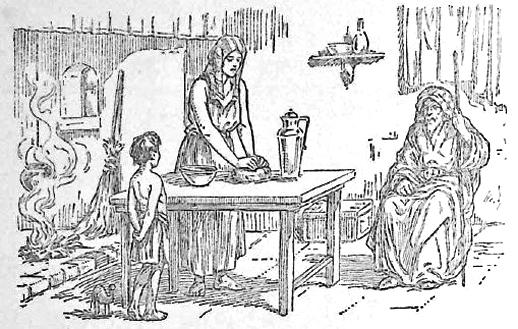
But she quickly answered: "I have not any bread! I have nothing but a little meal in the bottom of the barrel, and a little oil in a cruse; and I was gathering a few sticks to bake a little loaf for me and my son, that we may eat it and die!"
The famine was so bad in the land that this was the last bread that poor widow would be able to get.
But God knew all about it, and He had arranged it all in His loving way.
So Elijah, hungry and thirsty as he was, gave her God's message.
"Fear not," he said; "go and do as thou hast said: but make me thereof a little cake first, and bring it unto me, and after make for thee and for thy son. For thus saith the Lord God of Israel: The barrel of meal shall not waste, neither shall the cruse of oil fail, until the day that the Lord sendeth rain upon the earth."
And she went and did as the Prophet told her, and he, and her house, had enough to eat all the while the famine lasted.
And since then there are many widows, and many distressed and anxious families, who have found the God of Elijah the same loving, providing God that this poor widow did.
But by and by there came a still harder trial to that widow's heart. Her precious little boy, who had been kept alive all through the famine, was very ill, and died.
Then the poor widow was utterly hopeless, and she blamed Elijah and said it was his fault that this dreadful sorrow had come to her.
Doubtless Elijah had told her much about the Holy God who cannot bear sin, and she began to look at her past life, and one particular sin came up before her! She told him that he had come to bring this sin to remembrance, and to slay her son!
But Elijah said, "Give me thy son." And he took him out of her bosom and carried him up to the loft where he lived, and laid the child upon his own bed.
And Elijah cried to the Lord. (You see he was a man who lived in close touch with God!) And he said: "O Lord my God, hast Thou brought evil upon the widow with whom I sojourn, by slaying her son?"
Then he stretched himself upon the child three times. And again he cried to the Lord God, and said: "O Lord my God, I pray Thee, let this child's soul come into him again!"
"And the Lord heard the voice of Elijah, and the soul of the child came into him again, and he revived."
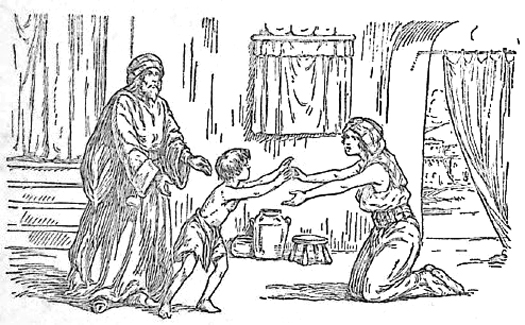
"And Elijah took the child, and brought him down . . . and delivered him unto his mother, and said, 'See! Thy son liveth!'"
"And the woman said to Elijah, 'Now by this I know that thou art a man of God, and that the Word of the Lord in thy mouth is truth.'"
XXII. RUTH
A LONG time ago we read of something most interesting about Bethlehem.
In the time of the Judges of Israel, before Saul or David had been made kings, there was a man living at Bethlehem whose name was Elimelech. He had a wife called Naomi, and two sons called Mahlon and Chilion.
But there came a famine in Bethlehem, and Elimelech and his wife and two sons went out of Canaan and journeyed into the land of Moab.
Here the family of Elimelech settled down for ten years.
But Elimelech died, and Naomi was left with her two sons. These sons married wives in Moab, but both of them died, and Naomi was then left a desolate widow.
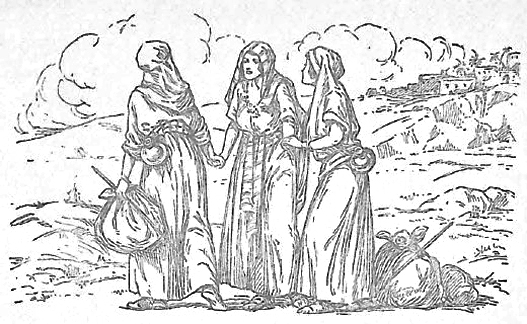
By and by she heard that the famine was over in the land of Canaan, and she started with her two daughters-in-law to return to Bethlehem.
But after they had set out on their journey, Naomi advised Orpah and Ruth to go back to their mothers, and prayed that, as they had been so loving and kind to her sons who had died, God would take care of them, and bless them in Moab.
Then she kissed them, and they all wept together. And they said, "Surely we will go back with thee to thy people!"
But Naomi did everything she could think of to dissuade them, and at last, with many tears, Orpah wished her good-bye; but Ruth clung to her.
Then Naomi used another argument: "Behold, thy sister-in-law is gone back to her people and to her gods—return thou after her."
But Ruth said: "Entreat me not to leave thee or to return from following after thee, for whither thou goest I will go; thy people shall be my people, and thy God shall be my God!"
So Ruth chose the God of Israel to be her God. And that God Whom she had chosen, watched over her all her life long, and gave her great happiness and honour, as I shall tell you by and by.
When Naomi found that Ruth was determined that "naught but death" should part them she left off persuading her, and they two journeyed on till they came to Bethlehem.
So Boaz spoke kindly to Ruth.
The arrival of strangers at a little town in those days was a great event, and all the people flocked out of their houses to see who it could be.
And they said, "Is this Naomi?"
But Naomi's heart failed her. She had gone out with husband and sons, and she had returned desolate; and in her grief she said, "Do not call me 'Naomi'" (that meant pleasant), "but call me 'Mara'" (which means bitter), "for the Almighty hath dealt very bitterly with me!"
Poor Naomi! She forgot her sweet daughter Ruth; she forgot the God of Israel whom they both trusted. For a little while her grief swept over her.
There lived in Bethlehem a rich man, whose name was Boaz, and he was a relation of Naomi's husband, Elimelech.
When they found that the barley harvest had just begun, Ruth said to her mother-in-law, "Let me go into the fields to glean corn!"
And when she reached the fields she happened on a field belonging to Boaz; but Ruth did not know that he was her relative.
When Boaz saw Ruth among the women who had come out to glean, he asked his servant who was set over the reapers whose damsel she was? And the servant told him that she had come from Moab with Naomi, and he had let her glean among the reapers.
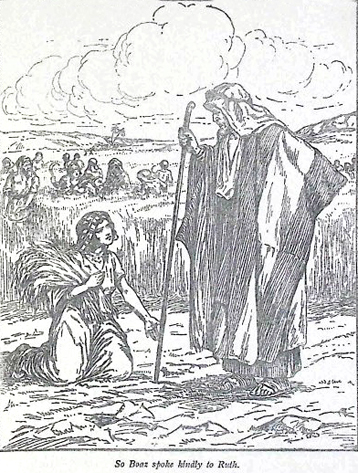
So Boaz spoke kindly to Ruth, and bade her keep near his maidens; and if she were thirsty she was welcome to take some of the water which his young men had drawn.
Then Ruth bowed herself to the ground, and thanked Boaz for his kindness to a stranger.
But Boaz told her that he had heard all about her love to her mother-in-law, and how she had left father and mother to come to a strange land. And then he asked the Lord God of Israel, under Whose wings she had come to trust, to bless her, and to give her a full reward for all she had done.
So Boaz told her to come at meal-times and share the food they had; and he gave her parched corn, some of which she saved to carry to her mother-in-law; and when she had had sufficient, she went back to her gleaning. And Boaz told his young men to let fall handfuls on purpose for her, so that by evening she had gathered quite a good quantity.
When Naomi heard all the kindness of Boaz, she told Ruth that he was a near relation, and she realized that, after all, the Lord had not forsaken her, though in her grief she had almost thought He had!
She told Ruth to keep fast by the maidens of Boaz. So day after day, till the harvest was over, Ruth did as Naomi bade her; and as Boaz went to and fro among the reapers, he saw the modest and sweet behaviour of the young stranger girl, and he determined to ask her to be his wife. So they were married; and by and by a dear little son was given to them.
And the women said to Naomi: "Bless be the Lord, which hath not left thee without a kinsman, that his name should be famous in Israel."
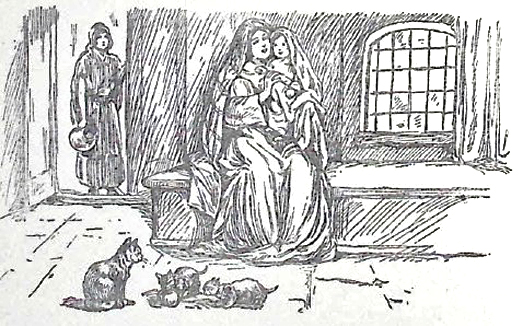
So Naomi was comforted, and became a nurse to the babe who was so precious to her.
And his name was famous! For the child was called Obed, and he was in due time the father of Jesse; and Jesse was the father of David, and through David, years afterwards, came our Blessed Lord!
Do you not remember how the blind man cried out?—"Jesus, Thou son of David, have mercy upon me."
XXIII. ON MOUNT GILBOA
As David left Saul, and went back to his stronghold at Engedi, he said to himself: "I shall one day perish by the hand of Saul! There is nothing better for me than that I should escape into the land of the Philistines, and Saul will cease to look for me."
So he went with the six hundred men who followed him, and dwelt with Achish, the king of Gath, for a year and four months.
But, after a time, the Philistines determined to go to battle against the Israelites, and as David and his men were very friendly with Achish, they marched in the rear of the army which was gathered together against Saul.
But when the princes of the Philistines found David and his men among the warriors, they very much objected, telling Achish that when the battle was joined, David would go over to the other side and fight against the Philistines.
Achish tried to persuade them that David and his men were their friends, but the lords of the Philistines would not consent; and David had to go back to Ziklag. It would take too long to tell you here how he found that other enemies had invaded his home, or how he and his men went after them, and how the Lord helped them to recover their wives and children and all the spoil that those enemies had taken.
But it seems very wonderful that, in the great battle of the Philistines in which Saul was killed, the Lord had sent David far away in another direction!
So the Philistines gathered themselves to the battle, and Saul and his sons and all the men of Israel came out against them.
But the night before the battle Saul had gone to a witch at Endor, and asked her to bring up Samuel to speak to him. Both he and the witch were very frightened when Samuel came up—an old man wrapped in a mantle—and Samuel told Saul that God had given the kingdom to David, and that he and his sons would be killed on the morrow.
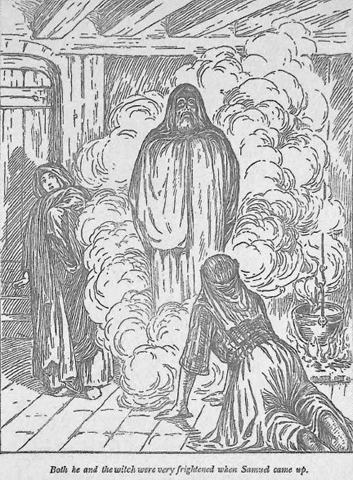
Both he and the witch were very frightened when Samuel came up.
So the battle took place the next day on Mount Gilboa; and the Philistines followed hard upon Saul and his sons, and Saul was sore wounded by the archers.
Then Saul besought his armour-bearer to kill him with his sword lest his enemies should come and mock him. But his armour-bearer would not, for he was sore afraid.
Then King Saul took his own sword and fell upon it and died. And when his armour-bearer saw that he was dead, he fell upon his sword too, and died with him.
So Saul died, and his three sons and all his men, that day together.
When the rest of the army who were on the other side of the valley and on the other side of Jordan saw that Saul and his sons were dead, they fled, and forsook their cities, and the Philistines came and dwelt in them.
On the next day, the Philistines came to the battlefield to strip the slain, and when they found the king and his sons, they cut off Saul's head and stripped off his armour, and sent the news to all the country round; and they published it in the houses of their gods and made a great rejoicing.
They hung the dead bodies of Saul and his sons on the wall of Bethshan; but when the inhabitants of Jabeshgilead heard of what the Philistines had done, all the valiant men arose and travelled all night and took the bodies of Saul and his sons down from the wall; and the men of Jabesh burnt the bodies, and buried their bones under a tree in Jabesh, and made a great mourning for their fallen king for seven days.
This is a very sorrowful story. Saul had set out well, and he had everything in life before him.
He was a great warrior; he had fought many battles against the Philistines and other enemies on every side; but he spoilt all by one great sin. This was the sin of disobedience. He had disobeyed God's direct command.
Not long after Saul was made king, God told him to go and utterly destroy the Amalekites, leaving none behind, not even flocks and herds, or anything that was theirs.
But though Saul went, and gained a great victory over them, he disobeyed God in the end; for he saved alive the king and the best of the flocks and herds, and all that was good, he kept.
Then the Lord sent Samuel to Saul. And Saul hastened to meet him with the words: "Blessed be thou of the Lord! I have performed the commandment of the Lord!"
But Samuel answered: "What meaneth then the bleating of sheep in my ears?"
And Saul answered: "The people spared the best of the flocks to sacrifice to the Lord."
And Samuel said to Saul: "Stay, and I will tell thee what the Lord has said to me this night."
"When thou wast little in thine own sight, wast thou not made head over the tribes of Israel? And the Lord sent thee on a journey, and said, 'Go and utterly destroy the sinners the Amalekites, and fight against them until they be consumed.'"
"Wherefore then didst thou fly upon the spoil, and didst evil in the sight of the Lord?"
"Hath the Lord as great delight in burnt offerings and sacrifices, as in obeying the voice of the Lord?"
"Because thou hast rejected the word of the Lord, He also hath rejected thee from being king."
This is the reason why God gave the kingdom to David, and allowed Saul to be killed on Mount Gilboa.
XXIV. ABSALOM
THE story of Absalom cannot be anything but a sad one.
He was the third son of David, and his mother's name was Maachah, who was the daughter of the King of Geshur.
He inherited great beauty from both his father and his mother, and was evidently the idol of David's heart. But with all his fascinating beauty, he was not a good man.
His mother was a heathen princess, and Absalom had not been taught in her home the justice, the purity, the forbearance, the love, and the fear of God, which ought to be the ruling-spring of our lives.
His one thought was how to please himself, no matter what impediments stood in his way.
By and by he had cause to be angry with his half-brother Amnon, who had acted very wickedly; but instead of bringing him to be judged by the law, Absalom secretly plotted to kill him.
For this purpose, he invited all the king's sons to be present at a great feast; and he gave his servants orders to set upon Amnon and kill him, when he gave a sign to do so after supper.
When the rest of the king's sons saw this dreadful deed, they all fled on their mules in hot haste; but while they were on their way back to Jerusalem, the tidings reached David that all his sons were dead!
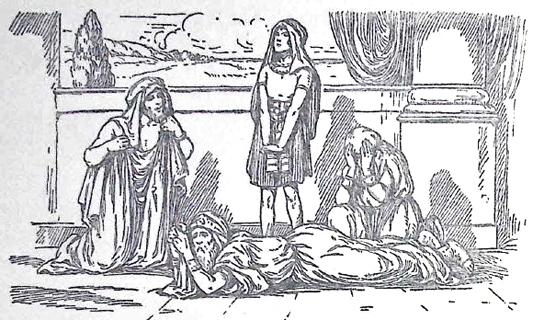
The sorrowful king tore his clothes, and lay upon the earth, and all his servants stood by with their clothes rent.
But Jonadab, David's nephew, tried to comfort the king, by assuring him that only Amnon was dead.
While Jonadab was persuading the king that it was not as bad as had first been told him, they saw a great company coming down the hillside, and Jonadab said to the king:
"See, it is as I said; there are the king's sons!"
Then all David's sons wept for the sad thing which had happened, and David and his servants wept very much.
But Absalom had fled, and had gone to his mother's relatives at Geshur, where he stayed three years. And David mourned for his son every day.
At length Joab, the captain of the host, saw that David's heart was bound up in Absalom, and he persuaded David to send for him to Jerusalem. But though David allowed him to return, he did not see his face for two whole years.
This made Absalom very angry, and because Joab would not carry his messages to the king, Absalom told his servants to set fire to a whole field of Joab's wheat: at last Joab consented to speak to the king, and finally Absalom was allowed to see his father: and David kissed him.
But what do you think Absalom did to that loving, devoted father?
He at once set about trying to seize the kingdom for himself!
He sat in the gate of the city and told the people who passed in and out, that if he were king he would see that every grievance was righted; and he kissed the people as they came and went, and stole their hearts!
Then Absalom asked permission to go to Hebron, and he sent spies all through the land to tell every one that at the sound of the trumpet every one was to say, "Absalom is King in Hebron!"
Thus the conspiracy grew and grew; and I cannot tell you how many sorrowful and wicked things were done while Absalom tried to get the kingdom!
David was indeed at his wits' end; but he remembered that the Lord was his Refuge, and he prayed that the Lord would defeat the counsel of those who were plotting against him.
And God answered his prayer.
At length Absalom came out against his father with a large army. There was a great battle: but the people begged David not to go to the battle himself, but to let them fight for him, and for the kingdom.
So David sat in the gate: and as his armies passed through ready for battle, he said to Joab, and to all the captains of the host: "Deal gently with the young man, even with Absalom!" And the people heard him.
So the soldiers went forth into the country, and by and by the battle was chiefly fought in a large wood, where many of Absalom's army were killed.
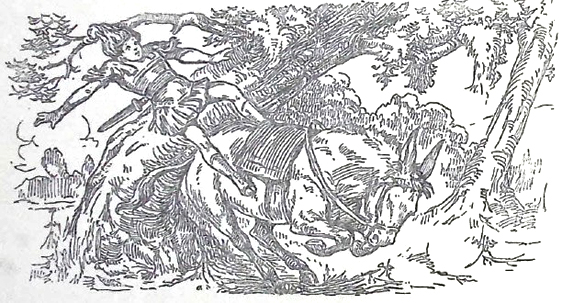
As Absalom was riding quickly in the wood to escape from the soldiers, he went under an overhanging tree in his haste, and his head caught in the boughs and he could not extricate himself. The mule went on and he was left hanging there.
Some one hurried to Joab and told him, and Joab, disregarding the earnest entreaty the king had given him, took three darts and thrust them through Absalom's heart.
So he died, and they put his body in a pit in the wood and threw a great heap of stones upon it.
Absalom had built himself a great tomb in the King's Dale, but he was never laid in it. Oh, the sorrow of that ending!
When the messengers came in from the battle, as David sat near the gate and watched, his first question to each runner was: "Is the young man Absalom safe?" And when they broke it to him, that Absalom had died and the victory had been complete, David turned from them, and made his way up, weeping, to the chamber over the gate, and as he went, he said:
"O my son Absalom, my son, my son Absalom! Would God I had died for thee, O Absalom, my son, my son!"
XXV. THE DISOBEDIENT PROPHET
1 KINGS 13
LONG ago, soon after the Children of Israel came out of Egypt, they asked Aaron to make a Golden Calf for them to worship, which could be carried in front of them, and would, they hoped, lead them into the Promised Land. But we know how dreadfully they sinned in this.
And five hundred years after that, Jeroboam, King of Israel, made two Golden Calves, and built two altars, one in Dan at the North of Palestine, and the other in Bethel at the South of his Kingdom.
He told the people of Israel that it was too far for them to go to worship at Jerusalem, three times in the year, and that they could go instead to worship his Golden Calf, and could offer sacrifices upon the altars he had built.
Now God had told the Jews that Jerusalem was the place He had appointed for Worship; and also that only God's Priests, the sons of Aaron, were to offer either Sacrifices or Incense to Him.
One day, when King Jeroboam was himself offering incense on the altar he had made in Bethel, a Prophet of the Lord was sent to him with a message from God.
And this was the message—That one day, on this; very altar, the priests whom Jeroboam had made from the lowest of the people, should be offered, and their bones should be burnt upon this altar.
God gave a Sign, by which King Jeroboam should know that the Prophet's words were true, and that he had been sent by God.
This was the Sign. This altar of Jeroboam's should be rent—torn in pieces—and the ashes should be scattered on the ground.
King Jeroboam was very angry at the message, and he tried to seize the Prophet, but his hand dried up, and he could not use it.
And the Sign came to pass at once, for the altar fell to pieces and the ashes were scattered.
Jeroboam was very frightened, and begged the Prophet to ask the Lord to restore his hand.
And the Prophet did; and Jeroboam's hand was made quite well again.
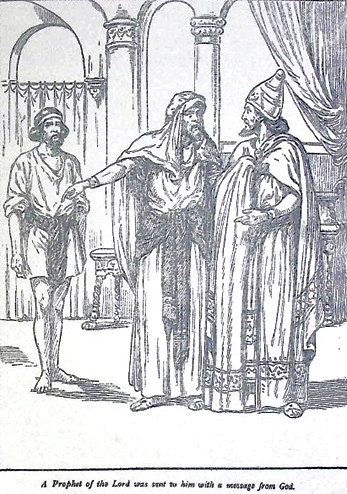
A Prophet of the Lord was sent to him with a message from God.
Then the King pressed the Prophet to come in to refresh himself, and to receive a reward.
But the Prophet answered that the Lord had strictly forbidden him to eat bread or drink water in that place. So he turned away, to go back by another road, as the Lord commanded him.
But now a great temptation met him.
For as the Prophet was turning away from Bethel, an old Prophet who lived there, thought he would ask him to come back and rest at his house. He had heard how the Prophet had cried against the Altar, and he longed to hear all about it.
But the Prophet again explained that the Lord had forbidden him to eat and drink in that place.
Then the Old Prophet lied to him, and said that an Angel had told him he was to ask him home to refresh him.
So the Prophet listened to his fellow-prophet, instead of obeying God, and he turned back and went in, and ate and drank.
But when he had finished the meal, the Word of the Lord came to the Old Prophet, with a terrible message to the disobedient man.
"Forasmuch as thou hast disobeyed the Lord, and hast not kept the Commandment which the Lord thy God commanded thee . . . thy carcase shall not come to be buried in the sepulchre of thy fathers."
So the Old Prophet gave the message, and he sorrowfully saddled the ass of the disobedient Prophet, and sent him forth on his return journey. But very soon a lion met him in the way, and slew him; and his body lay by the roadside, and the lion and the ass stood by, but the lion did not eat either of them.
By and by people passed that way, and they hastened to the city to tell what they had seen.
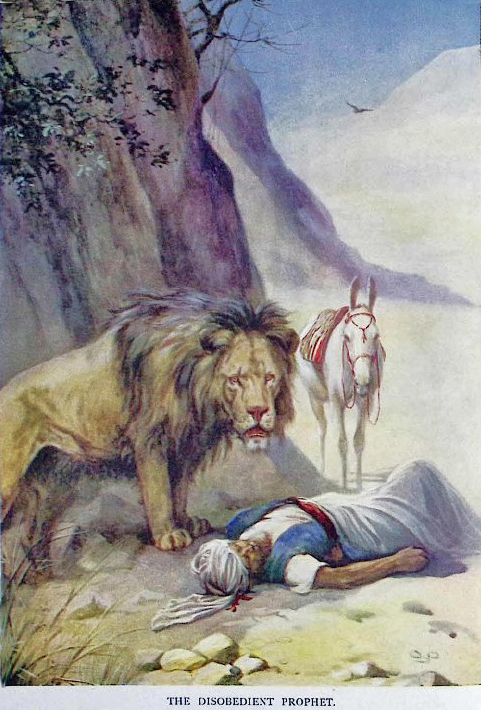
THE DISOBEDIENT PROPHET.
Then the Old Prophet told his sons to saddle his ass, and he hurried along the road until he came to the spot where the dead Prophet lay. And he found all as he had been told, and saw that the Lord had not allowed the lion to touch the dead man, or the ass.
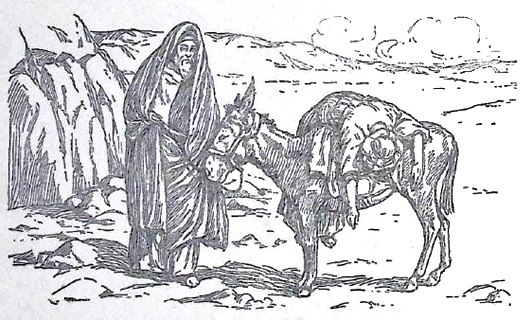
Then the old man laid the body of the Prophet on his ass, and brought him back to bury him in his own grave; and he mourned bitterly for him, for he knew he had tempted him, and had been the cause of his death.
He charged his sons, that when he came to die, they were to bury him in the same grave with the Prophet; and he added a solemn assurance that the words of God which the Prophet had uttered against King Jeroboam's altar in Bethel, and against the other idolatrous places which he had built, should surely come to pass.
All this was literally fulfilled three hundred years after, in the reign of Josiah, the good young King. We read the account of it in three verses in 2 Kings 23.15-18.
But King Jeroboam, knowing of this Prophecy, remembering as he must that his withered hand had been healed by God, did not set his heart to seek God and to find forgiveness.
He went on in his evil ways all his life, until at length we read in the Bible the name by which he was known after his death, "Jeroboam, the son of Nebat, who made Israel to sin."
This long ago story speaks an ever-living lesson.
The God who commands will enable us to obey. Let us seek Him with all our hearts: let us learn His will in the Bible, and then the promise to each one of us will come true—
"To him that soweth righteousness, shall be a sure reward."
XXVI. THE LORD ANSWERS ELIJAH BY FIRE
1 KINGS 18, 19
THEN after a long time, the word of the Lord came to Elijah in the third year of the famine, saying to him, "Go, show thyself to Ahab; and I will send rain upon the earth."
So Elijah went back from Zarephath, and came down to Samaria to show himself to Ahab; and the famine was very sore there.
Ahab had a trusted servant called Obadiah, who was governor of his house; and this man "feared the Lord greatly."
That meant, he did that which would please God, and earnestly obeyed Him in all things. Once, when the wicked queen, Jezebel, tried to kill all the Prophets of the Lord, Obadiah took fifty of them and hid them in a cave, and fed them with bread and water, and so saved their lives.
So because the famine was very terrible in Samaria, Ahab called Obadiah, and told him that they would both go out into the country with the horses and mules and find all the brooks and streams that were left, where a little grass might be growing, to save the horses alive.
Ahab went one way and Obadiah another, and as Obadiah was seeking for water, he met Elijah, who was on his way to Ahab, as the Lord had told him. When Obadiah saw him, he bowed himself to the earth before God's Prophet; and then Elijah said, "Go and tell thy lord that Elijah is here."
Obadiah hesitated very much to carry this message, as he was afraid that the Spirit of the Lord might carry Elijah away, so that he could not be found. He reminded Elijah that he had "feared the Lord" since he was a child, but that Ahab would certainly slay him if he carried such a message to him as that!
Then Elijah promised him, that he would surely show himself to Ahab that very day.
So Obadiah went and told Ahab, and the king came out to meet Elijah.
Then Ahab said to him, "Art thou he that troubleth Israel?"
And Elijah answered, "It is thou and thy father's house that have troubled Israel, because ye have forsaken the Lord's commandments and have worshipped Baal!"
Then he told Ahab to gather together the people, and all the four hundred and fifty prophets of Baal, and the four hundred prophets of the grove, who sat down daily at Jezebel's table, and to take them to Mount Carmel, and meet him there.
So a number of the people, and all the prophets of Baal, came together to Mount Carmel.
And Elijah came to the people, and he said, "How long do you mean to halt between two opinions? If the LORD be God, follow Him! but if Baal, then follow him."
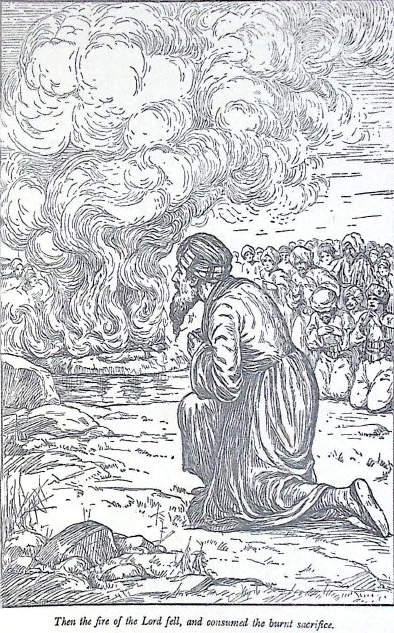
Then the fire of the Lord fell, and consumed the burnt sacrifice.
And the people did not answer a word.
Then Elijah said, "I am the only Prophet of the Lord, and Baal's prophets are four hundred and fifty. Let them therefore give us two bullocks, and let them choose one for themselves and slay it, and dress it, and put it on the altar, with no fire under."
"And I will slay and dress the other bullock, and put it on the altar, and put no fire under. And the God that answereth by fire, let Him be God!"
So the priests of Baal took their bullock and did as Elijah had said; and they cried unto the name of their god from morning until noon, saying, "O Baal, hear us!"
But there was no voice nor any that answered. And they leaped upon the Altar which was made.
Then Elijah mocked them, and told them to cry aloud, as their god was talking, or on a journey, or asleep, and must be awaked! And they cried aloud, and cut themselves with knives. And thus they went on till the time of the evening sacrifice. But there was neither voice, nor any to answer, nor any that regarded.
Then Elijah said to all the people, "Come near unto me."
And he repaired the Altar of the Lord that was broken down, and built it up with twelve stones for the twelve tribes of Israel; and he cut a deep trench round the Altar, and put the wood in order, and cut the bullock in pieces and laid him on the wood.
Then he told the men to fill four barrels with water, and to pour it on the burnt sacrifice and on the wood; and this he ordered to be done three times, so that the water ran all about the Altar; and he filled the trench with water.
Elijah knew what his God, Jehovah, was going to do, and what a glorious ending there would be!
So at the time of the evening sacrifice Elijah drew near to the Altar and prayed: and he said, "Lord God of Abraham, Isaac, and of Israel, let it be known this day that Thou art God . . . and that I am Thy servant, and that I have done all these things at Thy word."
"Then the fire of the Lord fell, and consumed the burnt sacrifice, and the wood, and the stones, and the dust, and licked up the water that was in the trench."
"And when all the people saw it, they fell on their faces: and they said, The Lord, He is the God; the Lord, He is the God!"
"And Elijah said unto them, Take the prophets of Baal, let not one of them escape! And they took them and brought them down to the brook Kishon." And they were all killed. The children of Israel had acknowledged their God at last!
Then Elijah turned to Ahab the king, who, like the people, had cast himself in awe and reverence upon the ground. And he said to Ahab, "Arise, and eat, for there is a sound of abundance of rain!"
XXVII. JOSHUA'S COURAGE
JOSHUA 1.1-18
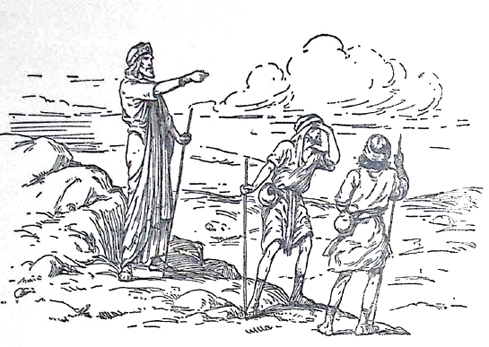
After the death of Moses, when the Lord, Himself, had buried His faithful servant, the Lord came to Joshua and told him that he was to be the one who should lead the Children of Israel into the Promised Land.
We hear of Joshua many times as we read the life of Moses.
He shared the glorious triumph when the Children of Israel were brought out of Egypt; and soon after that, Moses chose Joshua to lead the people to fight against Amalek.
Next we hear of him as the trusted servant (or minister, as it is called in the Bible), who went up with Moses to the Mountain called Sinai, when Moses received the Ten Commandments from God.
Joshua did not go all the way with Moses, but waited somewhere on the mountain till Moses should come down from talking with the Holy God.
And as they went down again, it was he who saw the Children of Israel worshipping the golden calf below.
Next, Joshua was one of the twelve spies who were sent to search out the Land; and you will doubtless remember that ten of these spies brought a bad report, and only two of them, Caleb and Joshua, brought a good report.
We see Joshua's splendid courage through all these circumstances.
He trusted God with all his heart, and the Lord was his sure Refuge and constant Helper.
And it is very wonderful to remember, that among the Israelitish men who came out of Egypt and wandered in the Wilderness for forty years, the only two who entered the Promised Land were Caleb and Joshua, the two faithful spies! All the rest of the Israelitish men who came out of Egypt died in the Wilderness for their disobedience, and only their children entered the Promised Land.
It is a very solemn thing to be disobedient to God.
So as I said, the Lord came and spoke to Joshua, and told him he was to lead the people into the Land of Canaan.
One day soon after this, Joshua sent two spies to bring back word what kind of a land it was which he had to conquer. When they came to Jericho they came to the house of a woman named Rahab, and lodged there.
But the King of Jericho heard of it, and sent to Rahab to give up the men to be killed.
But Rahab had heard of all the wonders that the Lord had done for His people, in bringing them out of Egypt; how He had dried the Red Sea for the people to pass over, and of other great victories; and instead of giving up those two Israelites to the King of Jericho, she quickly hid them on the flat roof of her house, under a lot of flax stalks, and when the messengers from the King came, they did not find them, and Rahab told the King's soldiers that they had better seek the men on the road to Jordan, as quickly as they could.
So the King's men went away to look for them, and the City gates were shut, and all was quiet again.
Then Rahab went up to the roof and told the spies that they must escape at once; and she begged them to promise her faithfully, that when God had given them the Victory, which she was sure He would do, that they would save her life.
So the men told her to bind a scarlet cord in her window which was on the outer wall, that they might recognise the place; and she let them down in the night through this window, and they got away.
All this the men faithfully carried out, and we read in the 11th of Hebrews, written nearly 1500 years after, that it was by faith that Rahab saved the spies, and by this saved her own life too.
God loves for us to have faith in Him! And it was this faith in God which made Joshua courageous all his life.
So Joshua and the people crossed the Jordan and entered into the Land, and came to Jericho; and one day when Joshua was standing viewing the strength of the City, suddenly he found Someone by him with a drawn sword in His hand.
So Joshua went to him at once, and asked "if he were going to fight for the Israelites or for their enemies?"
And the Stranger said: "Nay, but as Captain of the Lord's Host am I now come."
Then Joshua fell on his face and worshipped, for he knew that this was the Lord Who was speaking to him, and Who had taken the Supreme Command!
No wonder that when Joshua was old, and knew he was going to die, that he called all the Israelites together, and rehearsed all the wonderful doings of the Lord; and that he begged them with all his strength to serve and obey the Lord with all their hearts.
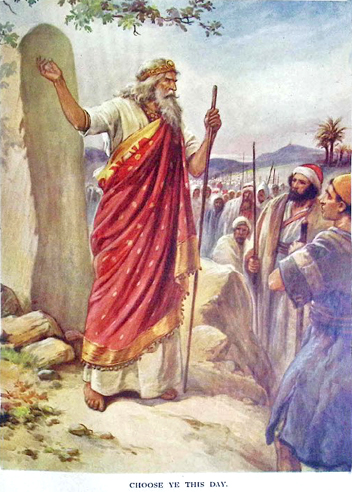
CHOOSE YE THIS DAY.
And Joshua set up a great Stone to be a Witness to them, that they had promised to love and obey God; and he said the Stone would remind them, lest they should forget their promise and turn back from serving God.
So the Israelites promised to be faithful, and while the elders who outlived Joshua were alive, they did follow the Lord. But after a time they began to forget, and this brought a great deal of sorrow upon them.
Perhaps you think within yourselves, "I should like to obey God, and follow Him! I wonder how I could begin?"
Think of Joshua. He followed the Lord wholly—which meant with all his heart. That was the first thing. So you can pray, "Take my heart, Lord Jesus, and help me to follow Thee!"
Then he obeyed whatever God told him to do. And whatever Command you find in the Bible, as shewing you God's Will—do it!
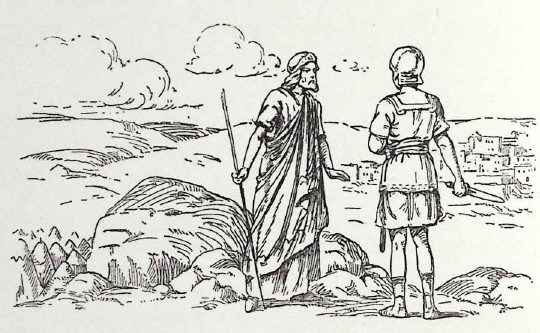
XXVIII. THE FIERY FURNACE
NEBUCHADNEZZAR'S dream of the Great Image had been explained to him by Daniel and his three companions; but the king soon forgot the wonderful interpretation which God had sent him, containing such an unfolding of the future which, in due time, has come to pass.
One great dynasty after another—Babylon, the Medes and Persians, Greece, and Rome, have arisen and passed away, till at length, up to now, only the Feet of the Vision of the Great Image wait to be accomplished.
And when history shows us that all has been fulfilled except the Feet of iron and clay, we know that we must be very near to the coming of the Wonderful Stone, which by and by is to fill the whole earth.
You will some of you understand what I mean when I say that this is Symbolical language. That means, that it is a picture of Heavenly Things which is to teach us about earthly things.
That Stone is a symbol of our Lord Jesus Christ when He comes back from Heaven to reign over the whole earth. We read in the seventh chapter of Daniel these words: "I saw in the night Visions, and behold one like the Son of man came with the clouds of Heaven . . . and there was given Him dominion and glory and a kingdom, that all people, nations and languages should serve Him: His dominion is an everlasting dominion which shall not pass away, and His kingdom that which shall not be destroyed."
King Nebuchadnezzar remembered the part of his dream of the Great Image that applied to himself—he knew he was the head of gold.
This probably made him think of making a real image, and setting it up in the plain of Dura for every one to worship.
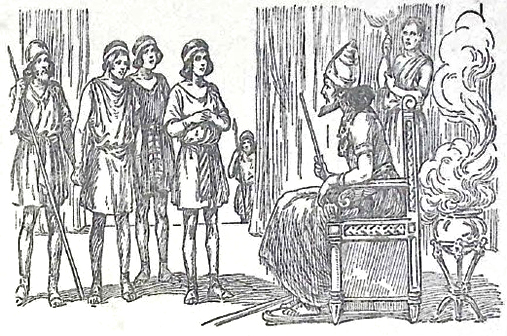
So the heralds went forth and told the people that at the sound of any musical instrument they were instantly to fall down and worship the Golden Image that Nebuchadnezzar had set up.
And in order to force compliance, this mighty king made a terrible threat, that whoever refused to worship it, should be cast into a burning fiery furnace.
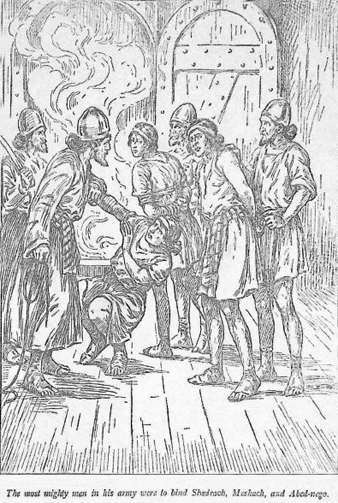
The most mighty men in his army were to bind Shadrach, Meshach, and Abednego.
But the Chaldeans, who were very jealous that Shadrach, Meshach, and Abednego had been set up over the affairs of the kingdom, came near and told Nebuchadnezzar that the Jews refused to bow down and worship the Golden Image which he had set up.
Then Nebuchadnezzar in his rage and fury commanded to bring Shadrach, Meshach, and Abednego before him.
So he asked them: "Is it true that you will not worship the Golden Image which I have set up? If you are ready to worship, well; but if not, you shall be cast the same hour into the midst of the fiery furnace. And who is that God that shall deliver you out of my hand?"
But the three young men were strong in the might of their God, and they answered—
"We are not careful to answer thee in this matter. If it be so, our God whom we serve is able to deliver us from the burning fiery furnace, and He will deliver us out of thine hand, O King. But if not, be it known unto thee, O King, that we will not serve thy gods, nor worship the Golden Image which thou hast set up."
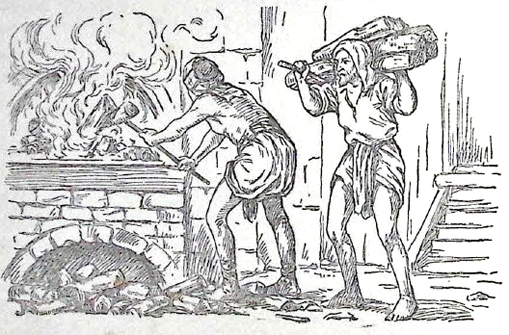
Then Nebuchadnezzar was full of fury, and he ordered that they should heat the furnace seven times hotter than usual, and that the most mighty men in his army were to bind Shadrach, Meshach, and Abednego, and to cast them into the fiery furnace.
And because the king's command was urgent and the furnace exceeding hot, the flames killed the men who had to throw Shadrach, Meshach, and Abednego into the fire.
And the three young men fell down, bound, into the midst of the furnace.
The king was watching the dreadful scene; but suddenly a great fear shook him, and he turned to his counsellors with the question, "Did not we cast three men, bound, into the fire?"
And his counsellors said that it was true, they had.
Then King Nebuchadnezzar said: "Lo! I see four men, loose, walking in the midst of the fire, and they have no hurt; and the form of the fourth is like the Son of God."
Then Nebuchadnezzar came near to the mouth of the furnace, and he said: "Shadrach, Meshach, and Abednego, servants of the Most High God, come forth and come hither!"
Then Shadrach, Meshach, and Abednego came forth of the midst of the fire.
And the Princes, Governors, and Captains, and the King's Counsellors, who were gathered together watching, saw these men upon whom the fire had no power; nor was a hair of their heads singed, neither were their coats changed, nor the smell of fire had passed on them.
Then Nebuchadnezzar spake and said: "Blessed be the God of Shadrach, Meshach, and Abednego, Who hath sent His angel and delivered His servants who trusted in Him, and have changed the king's word, and yielded their bodies, that they might not serve nor worship any god except their own God."
So Nebuchadnezzar made another decree, that if any one said anything against the God of these three young men, he should be cut in pieces and his house destroyed—"because there is no other god that can deliver after this sort."
And the king promoted Shadrach, Meshach, and Abednego in the province of Babylon.
This is a glorious chapter of one of the greatest deliverances of the Bible; and there are plenty more!
XXIX. QUEEN ESTHER'S REQUEST
ESTHER 8.3-6
ESTHER was a very beautiful girl, and Ahasuerus the great King of the Medes and Persians chose her to be his Queen, and he loved her very much.
Esther was not only beautiful in face, but she had a very beautiful character.
She belonged to the people of God, called the Jews, who had been carried away captives from Palestine, and were now living in Persia.
Among these Jews was a man called Mordecai, who was much respected for his goodness, and he sat in the King's Gate.
When Esther's father and mother died, Mordecai took the little girl and brought her up as his own daughter. He taught her about God, and Esther was very obedient, and loved Mordecai very dearly.
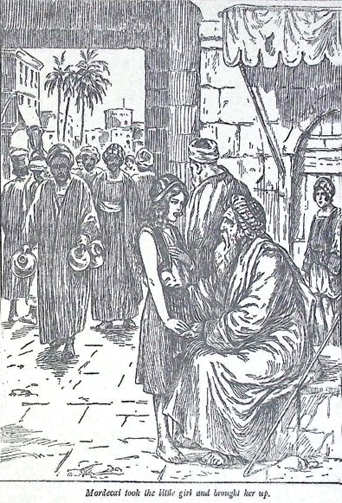
Mordecai took the little girl and brought her up.
Then Esther was made Queen, and things went on peacefully; until one day Mordecai heard that there was a plot forming to kill King Ahasuerus. He at once secretly told Esther, and she told the King; and the two conspirators were both hanged. But the King forgot to thank Mordecai, though it was written down in the Chronicles of the Kingdom.
About that time the King took a great fancy to a man called Haman, who hated the Jews, and especially Mordecai, because he did not bow down to him when he passed.
So Haman obtained leave from the King to fix a day when all the Jews should be killed in the whole Kingdom.
But the City Shushan was much perplexed; for they knew, though the King did not, that his beloved Queen was a Jewess!
When Mordecai found out all that was happening, he was bitterly grieved, and sent an urgent message to Esther, and implored her to go in and tell the King, and beg him to spare her people.
But Queen Esther sent back a message to Mordecai, to remind him that if anyone ventured to go in to the King's inner Court, that person would certainly be put to death unless the King should hold out his Golden Sceptre.
So Mordecai sent another urgent message to tell Esther that perhaps she had come to be Queen, to do this very thing. But if she did nothing, then she and all the Jews would perish!
Then Queen Esther begged Mordecai to gather all the Jews together who were in Shushan, and to bid them fast and pray for three days; and she and her maidens would fast too; and at the end of that time, she said, "I will go in to the King, which is not according to the law, and if I perish, I perish."
Esther was brave because she knew that she had God on her side; and she believed that He would answer the prayers they were all offering up.
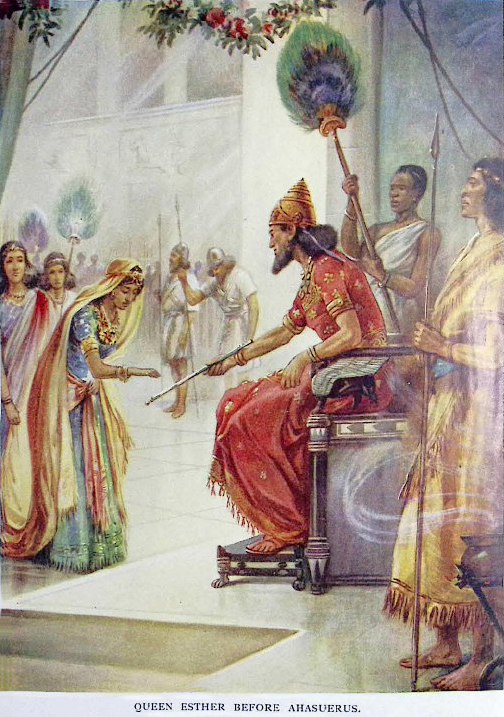
QUEEN ESTHER BEFORE AHASUERUS.
So on the third day Queen Esther put on her Royal robes, and went into the Inner Court and stood before the King.
When King Ahasuerus saw his beautiful young Queen standing there so meekly, he held out the Golden Sceptre which was in his hand. And she drew near and touched the top of the sceptre.
And when he asked her what request she had to make, the King must have been astonished at her reply, for she only asked that the King and Haman should come to a banquet which she had prepared for them. So when they came to the Banquet, the King asked the Queen again what her petition was? And she said if the King and Haman would come to a Banquet with her, again to-morrow, she would then tell the King what her request was.
So Haman went out from Queen Esther's Banquet very proud; and he told his wife and his friends of his second invitation, but he said that nothing was any pleasure to him, so long as Mordecai, the Jew, sat in the King's Gate.
Then his wife and his friends advised him to make a gallows fifty feet high, and to get the King to let him hang Mordecai on it.
But that night the King could not sleep, and one of his servants fetched a roll of the Chronicles of the Kingdom, and he read to him how Mordecai had once saved the King's life.
And in the morning the King asked Haman what would be suitable to do to "the man that the King delighted to honour?"
But Haman little thought that when he proposed to set the man on the King's own horse, dressed in the King's Royal clothes, that it would be Mordecai who was to be honoured, and not himself!
But the King told Haman to lead Mordecai round the town, and to proclaim: "Thus shall it be done to the man whom the King delighteth to honour."
After this Haman went to the Banquet that Esther had prepared. He little knew what the Queen's request was going to be! For Esther told the King that a great plot had been made to destroy her and all her people, and that this wicked Haman was the one who had planned it all!
Then Haman was afraid before the King and Queen.
You can picture the anger of the King, and when he was told of the gallows which Haman had prepared for Mordecai, he ordered that Haman should be hanged there at once.
Then the Queen begged that letters might be sent to stop all the Jews being killed, and Ahasuerus sent urgent posts on mules and horses and swift dromedaries to tell the Jews that they might stand up for their lives, and destroy any enemies who rose up against them.
Thus God answered the prayers of that young Queen and her maidens, and of the Jews who joined with her in fasting and praying, and sent them a great deliverance, the remembrance of which has been handed down from generation to generation ever since.
XXX. A GREAT RAIN, AND A TIRED PROPHET
So Ahab ate and drank—but Elijah went up to the top of Carmel, and cast himself upon the earth with his face between his knees, and he said to his servant: "Go up now and look towards the sea."
And the servant returned, saying he could not see anything.
Then Elijah said: "Go—" seven times. And when he came back the seventh time, he said he could see a little cloud in the sky, no bigger than a man's hand.
So Elijah hurriedly sent a message to the king, to prepare his chariot, and get to his home quickly, or the rain which was coming would stop him!
And as he spoke, the heavens became black with clouds, and there was a great rain. And Ahab rode and went to Jezreel.
And the hand of the Lord was on Elijah, and he ran before Ahab's chariot, right to the entrance of Jezreel.
But when Ahab told his wife, the wicked queen, Jezebel, that all her prophets were dead, Jezebel sent a message to Elijah that she would kill him, as he had done the prophets of Baal, by that time the next day!
And now, Elijah, who had been so wonderfully strong and full of faith for this great scene, fled for his life when he heard the threat of Queen Jezebel!
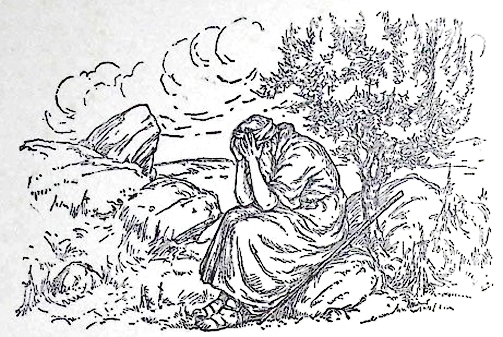
Hungry, thirsty, tired-out, he fled till he had passed Beersheba, and had gone a whole day's journey into the desert, before he felt he might be safe from Jezebel! Here he cast himself under a juniper tree, and asked the Lord to let him die!
Poor Elijah! For one brief moment his faith failed him! If God had answered his prayer, Elijah would have missed the great honour of going up to Heaven in a Chariot of Fire without death at all!
And let us pause here, just to think for a moment about our own prayers.
It seems to me that we are encouraged to tell God everything; and then we are wise to leave the choice with Him: asking Him to do that which, in His wisdom and love, He knows to be best for us.
So the poor wearied Prophet prayed that he might die; and then overpowered with fatigue, he fell asleep. And meanwhile God was preparing for him, while he slept—as He does so often for His faithful, and sometimes faithless, children—and behold! An angel touched him, and said to him: "Arise and eat!"
And when he looked up, there was a little cake of bread, freshly baked, and a cruse of water standing ready by his pillow!
And he ate and drank; and then, still so weary that he could hardly hold up his head, he slept again!
Then the angel of the Lord came the second time and touched him, and said: "Arise and eat; because the journey is too great for thee!"
Oh, the compassion of God, Who knows just how we feel! So Elijah obeyed; and he went in the strength of that food, for forty days and forty nights, till he reached Horeb, the Mount of God, where he found a cave and lodged there.
By and by he heard a Voice from the Lord speaking to him, and it said: "What doest thou here, Elijah?"
Then Elijah said: "I have been very jealous for the Lord, but now the Children of Israel have forsaken my God, and I, even I, am the only one left, and they are going to kill me!"
And the Lord said: "Go out and stand on the mount before the Lord."
Then the Lord passed by, and a great wind tore the rocks and the mountains, and there was a great earthquake; but the Lord was not in the earthquake nor in the fire that came afterwards; and then there was a still, low voice. And when Elijah heard that voice, he wrapped his face in his mantle and went out and stood by the mouth of the cave.
Then the voice spoke to him again: "What doest thou here, Elijah?" And again Elijah said that he was the only Prophet left!
But the Lord told him that He had seven thousand Israelites who had served Him faithfully, and had never bowed down to Baal!
Then the Lord told him to go and anoint two kings; and also to anoint Elisha, the son of Shaphat, as a Prophet instead of himself.
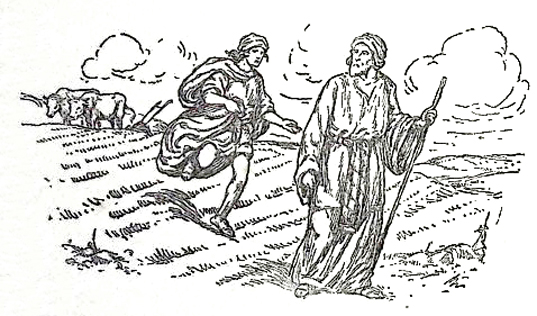
So Elijah went to Abelmeholah, and found Elisha ploughing in the fields; and as he passed by him, he cast his mantle upon him.
Then Elisha left his oxen and ran after him, and said: "Let me go and kiss my father and my mother, and then I will follow thee!"
Elijah said: "What have I done to thee?"
But I think Elisha knew what the Prophet had meant by casting his mantle upon him!
So Elisha took a yoke of oxen, and with the ploughing instruments for his fire, he boiled their flesh, and gave to the famine-stricken people to eat, and then he went after Elijah and became his devoted servant.
Then many years passed on, and there were great wars between Ahab and the King of Syria.
But Ahab did not leave off his wicked ways, and at length God sent Elijah to Samaria to warn him that God's judgment would come upon him in the very spot in which he and Jezebel had sinned against Him.
I have not space to tell you here about Ahab coveting Naboth's vineyard, nor how Jezebel had Naboth killed in order that Ahab might possess it.
But God's judgments always come true, and though Ahab was killed by a chance bow-shot in a great battle, yet, as God had said by Elijah, "dogs licked up his blood" in Naboth's vineyard, which was close by the king's palace in Samaria, where the men were washing out his chariot after the battle!
XXXI. SOLOMON'S WISDOM AND SOLOMON'S TEMPLE
SOLOMON, the son of David, was anointed King, as the Lord had promised David.
Solomon loved the Lord; and when he was made king, the Lord appeared to him in a dream, and told him he might ask for anything he wanted.
And the Lord was very pleased with Solomon's choice; for he asked that God would give him an understanding heart, that he might have wisdom to rule the people over whom he reigned.
So God abundantly answered his prayer, as he was the wisest king who had ever reigned; but God gave him besides, riches and honour and everything that could make him happy. At the same time the Lord warned him to walk in His ways, and keep His commandments that it might be well with him all his days.
Then Solomon awoke from his dream; and he hastened to Jerusalem and stood before the Ark of the Covenant of the Lord, and offered burnt offerings and peace offerings to the Lord, Whom he loved and worshipped.
Very soon the young king had to use the wisdom which God had so freely given him.
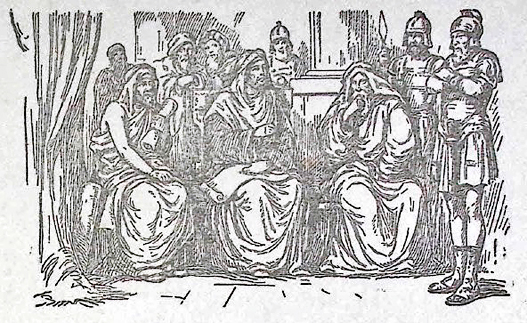
As he sat with his servants and soldiers round him, ready to judge anything that was brought to him, there came two women before him to plead their cause.
"And the one woman said, 'O my Lord, I and this woman dwell in one house, and we were together; there was no stranger with us in the house, save we two in the house. And this woman's child died in the night because she overlaid it.'"
"'And she arose at midnight, and took my son from beside me, while I slept, and laid it in her bosom, and laid her dead child in my bosom. And when I arose in the morning to feed my child, behold it was dead; but when I had considered it in the morning, behold it was not my son!'"
"And the other woman said, 'Nay; but the living is my son, and the dead is thy son.' And this said, 'No; but the dead is thy son, and the living is my son!' Thus they spoke before the king."
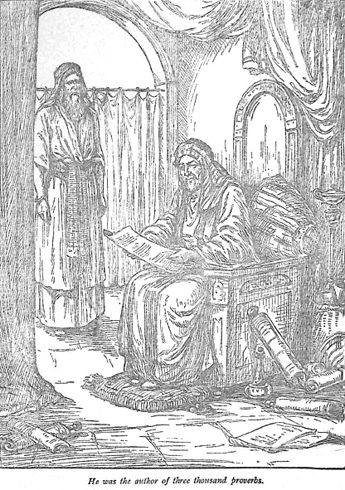
He was the author of three thousand proverbs.
"Then said the king: 'The one saith, This is my son that liveth, and thy son is dead; and the other saith, Nay; but thy son is the dead, and my son is the living.'"
"And the king said, 'Bring me a sword.' And they brought a sword before the king."
"And the king said, 'Divide the living child in two, and give half to the one, and half to the other.'"
Then the woman, who was really the mother of the living baby, said to the king, for she was heart-broken to think that her child should be killed, "O my Lord, give her the living child, and in no wise slay it!"
"'But the other said, Let it be neither mine nor thine, but divide it.'"
Then the king turned to the first woman, and gave his verdict: "Give her the living child," he said, "and in nowise slay it: she is the mother thereof!"
And all Israel heard of the judgment which the king had judged; and they saw that the wisdom of God was with him to do justice among them.
And it was not only in the affairs of the State that Solomon was so wise.
His fame spread to all the nations round about; and his wisdom exceeded all the wisdom of the East. He was the author of three thousand proverbs and many songs. He was learned in trees—from the great cedars of Lebanon to the hyssop that springs out of the wall.
He understood all about beasts and birds and insects and fishes. He knew what those words in the hundred and eleventh Psalm meant: "The works of the Lord are great, sought out of all them that have pleasure therein."
By and by Hiram, King of Tyre, who had always loved David, on hearing that David's son was king, sent his servants to convey his greetings to Solomon.
Then Solomon sent back a message to Hiram, asking him to allow his servants to help him in hewing cedar trees from Lebanon, as he was purposing to build a beautiful Temple for the Lord.
He explained to Hiram that it had been in David's heart to build the Lord's House; but he had been a man of war; and though the Lord accepted the desire of David's heart, He told him that his son Solomon should be a man of peace, and should build Him a House.
But the Lord had allowed David before his death to collect a vast number of materials of all sorts, as we read in the 22nd chapter of the First Book of Chronicles.
David had employed clever masons to hew wrought and polished stones; he had prepared iron in abundance for the gates and hinges, and brass without weight.
Then Hiram sent abundance of cedar and fir trees, for as David had said, "The House that is to be builded for the Lord must be exceeding magnifical."
That is a long and a strange word, and it is only used that once in all the Bible! But it conveys this one lesson to us—that if we want God to dwell in our hearts, we must spare no pains to make them ready for His abode!
Jesus says: "If any man love Me, My Father will love him, and We will come unto him, and make Our abode with him!"
So Solomon began to build with all his heart, and such a Temple as he raised to the Lord was a glory and a joy to all beholders.
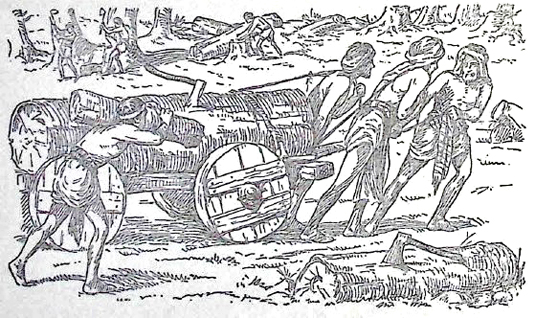
XXXII. JEHU—THE ELEVENTH KING OF ISRAEL
WE read of Jehu first in the time of Elijah, when God commissioned the Prophet to anoint Jehu as a future King of Israel, and announced that he would be used to punish Ahab and the Children of Israel for their idolatry and departure from the Lord.
For some reason which is not told us in the Bible, it was not Elijah, but Elisha, who was in the end sent to anoint Jehu. We read the story of this in the 9th chapter of the Second Book of Kings.
Elisha was now the Lord's Prophet in Israel.
One day he said to one of the younger prophets with whom he lived: "Prepare yourself for a journey, and take this box of oil in your hand, and go to Ramothgilead."
"When you get there, find Jehu, the son of Nimshi, and ask him to come with you into an inner chamber away from the rest of the company, and when you are there, take the box of oil and pour it on his head, and say: 'Thus saith the Lord, I have anointed thee king over Israel.' Then open the door and flee, and do not wait a moment."
So the young man went to Ramothgilead, and when he got there he found all the captains of the host sitting round Jehu.
So he said: "I have an errand to thee, O Captain!"
And when Jehu understood that the secret message was to him, he went into a private room.
So the young prophet did as Elisha bade him, and anointed Jehu king of Israel, telling him that God had appointed him to execute His judgments against the house of Ahab, and that the dogs should eat Jezebel in Jezreel, as the Prophet Elijah had told Ahab years before.
Then the young man opened the door and fled.
So Jehu came back amongst the other captains, and they inquired: "Why did this mad fellow come to you?"
So Jehu said he expected that they knew the errand. But they assured him they did not, and asked what the news was.
Then Jehu told them the young man's solemn message, and that he ended by saying: "Thus saith the Lord, I have anointed thee king over Israel."
Then the soldiers and those around him spread their garments for him to step on, in token that they accepted him as king, and they blew a special blast of the trumpets, saying "Jehu is King!"
So Jehu charged the soldiers that no news should be carried to Jezreel, where King Joram was lying to be healed of his wounds received in battle against Hazael, King of Syria.
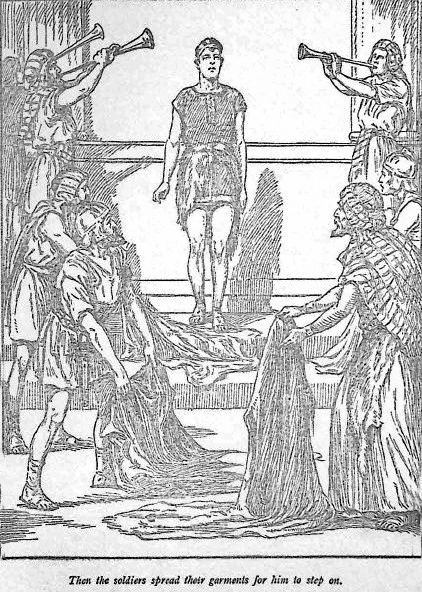
Then the soldiers spread their garments for him to step on.
Then Jehu rode in a chariot, and hastened to Jezreel, and there he found Ahaziah, King of Judah, who had come to visit the wounded king.
Now on the Tower of Jezreel there stood a watchman who told Joram: and as Jehu came fast in his chariot, Joram sent a messenger to meet him with these words: "Is it peace?"
But the watchman said: "The messenger has not returned; he came to them but has not come again. And the driving is like the driving of Jehu the son of Nimshi, for he driveth furiously."
Then Joram got into his chariot, and Ahaziah got into his, and they started to meet Jehu. But they only got as far as the vineyard of Naboth when they met Jehu face to face.
And Joram said: "Is it peace, Jehu?"
And Jehu answered: "What peace can there be so long as thy mother Jezebel and her wickedness remain?"
Then Joram turned and fled, crying out: "There is treachery, O Ahaziah!"
And Jehu took an arrow and drew the bow to its full strength, and aimed it at Joram's heart. So Joram sank down in his chariot.
Then Jehu told Bidkar his captain to throw the king's body into the field of Naboth, "for remember that when I and thou rode with Ahab his father, the Lord laid this burden upon him."
Then Jehu followed after Ahaziah and smote him, and he was carried in his chariot to Jerusalem and died there, and was buried in his own sepulchre.
So Jehu came into Jezreel, where Jezebel lived; and when she heard all that had happened, she painted her face and put ornaments on her head, and came and looked out of a window.
And as Jehu entered in at a gate she tauntingly said: "Had Zimri peace, who slew his master?"
Then Jehu looked up to the window and said: "Who is on my side? Who?"
And two or three of the queen's chamberlains looked out at him.
So he said: "Throw her down!"
And they threw her down, and some of her blood was sprinkled on the wall, and on the horses, and he trode her underfoot.
Then Jehu came in, and he ate and drank; and when he rose up from table he said: "Go, and see now this cursed woman, and bury her; for she is a king's daughter."
And they went to bury her, but found nothing left of her body but the skull and the feet and the palms of her hands.
So they returned to Jehu and told him.
And he answered in these solemn words—
"This is the Word of the Lord, which He spake by His servant Elijah the Tishbite, saying, In the portion of Jezreel shall dogs eat the flesh of Jezebel: and the carcase of Jezebel shall be as dung upon the face of the field in the portion of Jezreel: so that they shall not say, This is Jezebel."
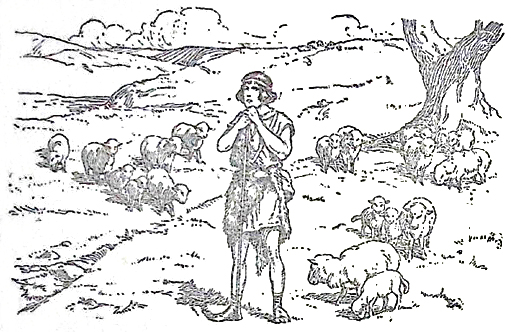
XXXIII. A STORY OF VICTORY
KING SAUL had disobeyed God, and the Lord had rejected him from being king.
The Prophet Samuel had set his heart on this first King of Israel, and he grieved terribly that the Lord had reject him. So he went down to his house and mourned over all that had happened.
But at length the Lord spoke to Samuel and He said words like these: "How long will you mourn for Saul? Take your horn of oil and go to Bethlehem, for I have provided me a king among the sons of Jesse the Bethlehemite."
So Samuel did what the Lord commanded, and took with him a heifer for a sacrifice to the Lord, and called Jesse and his sons to share in the sacrifice.