The Printer in Eighteenth-Century Williamsburg
Reading edition
If you had visited Williamsburg in the year 1743, say, and wanted to post a letter, buy a book, a newspaper, or some writing paper, or talk with an influential townsman, you would have sought out the shop of William Parks on Duke of Gloucester Street. Parks published the Virginia Gazette, the first newspaper in the Virginia colony, and his printing office served also as post office, bookshop, stationery store, and general information center.
It was a place of many sounds and smells, and of much activity. There you would find ink-smudged printer’s devils carefully sorting type under the watchful eye of the journeyman printer, an accomplished craftsman and exacting instructor. There you would also find the bookbinder among his calfskins, marbled papers, glues, and presses. And on the shelves, waiting for buyers, were pamphlets and leatherbound volumes produced in the shop or imported from England.
Perhaps, if you were lucky, you might see a postrider burst in with London papers, rushed from a ship just arrived from England. Then the printing shop was never livelier, for the coming of news from abroad was an exciting event. At such times, Printer Parks probably stopped what he was doing, culled the choicest items from the London journals, and made space for them on the front page of the next 4 issue of the Gazette. In a day or so, “the freshest Advices, Foreign and Domestick,” would be on their way to Parks’s subscribers.
In the small (1,500 people) capital of Williamsburg, this printing office was a nerve center through which news of the vast outer world reached Virginians and, in turn, news of His Majesty’s largest American colony was conveyed to other colonists and their homeland. By modern standards it was a small printing shop. But in its effect on the people of the Virginia colony, it was a powerful civilizing force. As one of eight or nine printers of colonial newspapers, moreover, William Parks, through his paper, kept the people of the other colonies informed of the major events that were taking place in the oldest and largest outpost of Britain in America.
THE PRINTING OFFICE TODAY
For these reasons, Colonial Williamsburg has re-created an eighteenth-century printing office as one of its series of craft shops. Here the twentieth-century visitor will find equipment such as was used two hundred years ago in similar printing establishments on Duke of Gloucester Street operated by Parks and later by William Hunter, Joseph Royle, Alexander Purdie, John Dixon, William Hunter, Jr., William Rind, and their successors. Here a master printer and his apprentice, in the leather aprons and full-cut breeches of the period, set by hand type closely resembling that which Parks used.
To print its pages of hand-set type, the present Printing Office has in operation three so-called “English Common Presses” such as were built in the eighteenth century. One, believed to have been made about 1750, was given to Colonial Williamsburg by American Type Founders, Incorporated, and the Rochester Institute of Technology. Of the other two, one was designed by Ralph Green of Chicago after a careful study of the handful of known eighteenth-century 5 presses in the United States, and both were built by Colonial Williamsburg craftsmen.
In addition to the Gazette, tracts, pamphlets, and books poured from Parks’s press from the time he came to Williamsburg about 1730 until he died on a voyage to England in 1750. Surviving examples of his work reveal that he first used Dutch type, which was followed by the more pleasing face so “friendly to the eye” developed by William Caslon in England. From matrices similar to Caslon’s originals, his successors in the type-founding business have cast the letters used on the restored Williamsburg press. Parks’s neat printing and binding ornaments, so characteristic of the classical-minded eighteenth century, have been similarly reproduced. Eighteenth-century printers’ tools were made from the careful drawings in Diderot’s Encyclopedia and from other sources.
To provide the kind of paper used by eighteenth-century printers, Colonial Williamsburg began research in the 1930s into the history of the town’s only paper mill. Started by Parks about 1743 with the help of his friend Benjamin Franklin, the mill is believed to have outlived him. Examples of its product were identified in 1936 in a German Bible and a song book printed in Pennsylvania in 1763. Paper that simulated the Parks paper was thereupon reproduced, and was used in some of the work of the Printing Office and in some Colonial Williamsburg books designed after examples of Parks’s work. Even the specks and spots of the original Parks paper were imitated by a mixture of ground flaxseed incorporated into the paper to insure the appearance of authenticity.
Visitors to the Printing Office today may not see counterparts of the postriders who brought mail to Parks’s printing shop and post office, but nearly everything else is there. As in colonial days, the central figure is still the printer, bending over his press and producing in a day’s work what one modern, mechanized press can turn out in a few minutes.
6
WILLIAMSBURG’S FIRST PRINTER
Although the colony of Virginia was founded in 1607, it was not until the eighteenth century that printing was established there. This delay was largely due to governmental policy. In seventeenth-century England and her colonies, freedom of the press was yet to be established. Even laws passed by governing bodies could not without official permission be printed and circulated for the benefit of citizens. Until the Licensing Act of 1662 expired in 1695, the printing trade in England was confined to London, the universities of Oxford and Cambridge, and to the English city of York. The governors of the royal colony of Virginia felt empowered to refuse permission for the establishment of printing until the year 1690, after which printers were governed by royal instructions which required a license and permission from the governor as a prerequisite to setting up shop.
Sir William Berkeley, who was governor of Virginia from 1642 to 1652 and again from 1660 to 1677, summarized the attitude of most officials of his day in his famous statement, “But, I thank God, there are no free schools nor printing, and I hope we shall not have these hundred years; for learning has brought disobedience, and heresy, and sects into the world, and printing has divulged them, and libels against the best government. God keep us from both.” (Berkeley was in error: free schools had existed in Virginia, though printing had not.)
In 1682, a few years after Berkeley wrote, a printer named William Nuthead came to Jamestown, then the capital of Virginia, proposing to serve the government by printing the acts of the Assembly. He was ordered by the Governor’s Council to await royal approval. Several months later a new governor arrived with an order from the king that “no person be permitted to use any press for printing upon any occasion whatsoever.” Nuthead moved to Maryland, and printing in Virginia was delayed fifty years.
7
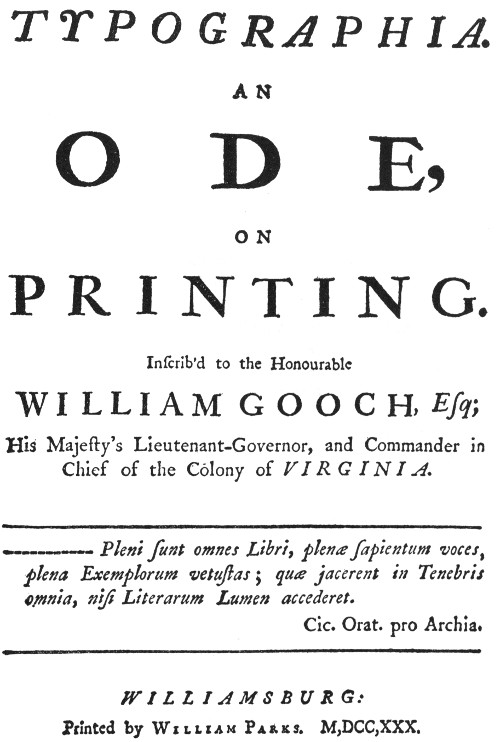
Title page of TYPOGRAPHIA, printed by William Parks upon the establishment of his press in Williamsburg; reproduced from the only surviving copy—in the John Carter Brown Library, Providence, Rhode Island.