AN INQUIRY INTO THE Rights of the BRITISH Colonies,
Reading edition
Intended as an Anſwer to
The Regulations lately made concerning the Colonies, and the Taxes impoſed upon them conſidered.
In a Letter addreſſed to the Author of that Pamphlet.
By RICHARD BLAND, of Virginia.
Dedit omnibus Deus pro virili portione ſapientiam, ut et inaudita inveſtigare poſſent et audita perpendere. Lactantius.
WILLIAMSBURG: Printed by Alexander Purdie, & Co. MDCCLXVI.
27
Here the printer and his helpers set type, pull proofs and correct their galleys, make up pages on the marble imposing stone, prepare paper and ink, run off the job on one or more of the presses, and finally, redistribute the type to the cases. The printed sheets, in the meantime, may have to be hung on ceiling racks to allow both ink and paper to dry out.
In the small back shop, a separate building, the similarly cluttered bookbinding shop may be found. In it the bookbinder of today, working with the tools and methods of his eighteenth-century predecessors, sews together the printed and folded signatures that make a book, binds them in boards, and covers the boards—perhaps in elegantly decorated leather bindings. He may use marbled paper of his own making for end-papers or on the outer covers of smaller books. For tooling and lettering the cover he has a collection of brass dies, some of which are designed from lettering stamps excavated in the vicinity of his—and William Parks’s workshop.
OUR PRINTING HERITAGE
From the crude presses of Williamsburg came an ingredient essential to the movement toward American self-government and independence—the political pamphlet. In the world of the eighteenth century, devoid of radio, television, or the bulky daily paper, the substance of political debate came from such pamphlets. It was also an era which took its political philosophy seriously, and the author of a pamphlet could count on wide readership among the planter-aristocrats who controlled the machinery of government. Williamsburg, as the colony’s capital and its political and intellectual center, was the obvious city to lend its imprint to the speculations of Virginia’s pamphleteers.
One of the most significant early tracts was Richard Bland’s An Inquiry into the Rights of the British Colonies, printed by Alexander Purdie in March 1766. Writing in the aftermath of the previous year’s fiery Stamp Tax debates, Bland vigorously proclaimed his belief in Locke’s doctrines of natural rights and natural law. Reprinted in London, Bland’s tract was evidence of the mounting sentiment for self-rule in the colonies. Bland’s Inquiry was also a memorial to its author, a man who devoted much of his life to public service. An aged delegate to Virginia’s first state legislature in October 1776, Bland collapsed in the Williamsburg streets on his way to a session, and died hours later in the home of his friend, John Tazewell.
28
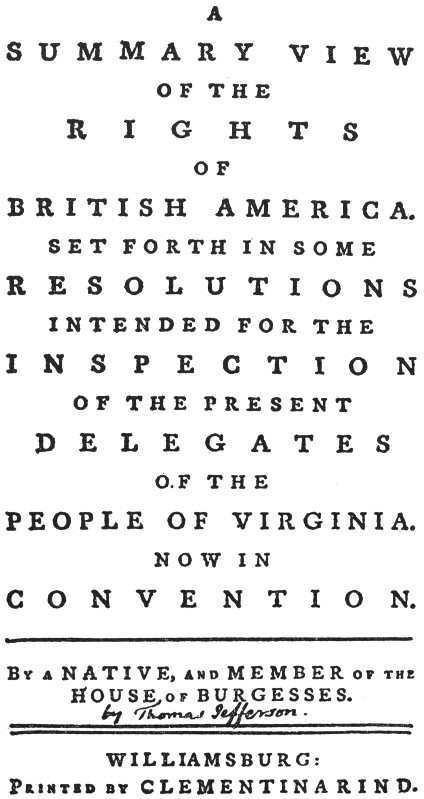
Jefferson’s SUMMARY VIEW, from the press of Williamsburg’s only woman printer. Of all of Jefferson’s writing this has been described as the document second only to the DECLARATION OF INDEPENDENCE in influencing the colonies to break from England. Printed by Clementina Rind, this is an example of the type of document not readily accepted by some Williamsburg printers and for which the Rinds were encouraged to establish themselves in the eighteenth-century Virginia capital.
A SUMMARY VIEW OF THE RIGHTS OF BRITISH AMERICA. SET FORTH IN SOME RESOLUTIONS INTENDED FOR THE INSPECTION OF THE PRESENT DELEGATES OF THE PEOPLE OF VIRGINIA. NOW IN CONVENTION.
By a NATIVE, and MEMBER of the HOUSE of BURGESSES. by Thomas Jefferson.
WILLIAMSBURG: Printed BY CLEMENTINA RIND.
29
The most important pamphlet printed in Williamsburg was A Summary View of the Rights of British America, from the pen of Thomas Jefferson. Lying ill up-country in August of 1774, when Virginia’s legislators were convened in Williamsburg to send off delegates for the First Continental Congress, Jefferson wrote his tract to suggest instructions that might guide these delegates at Philadelphia.
The Summary View was read aloud by Peyton Randolph in his home on Market Square to a room filled with Virginia patriots. It was too radical for some, but moving to all. It was at once set in type by Clementina Rind, Williamsburg’s only woman printer. Among the first to purchase a copy was George Washington, who noted in his diary that it cost him three shillings ninepence. The pamphlet was reprinted in Philadelphia and London and has been described as second only to the Declaration of Independence in charting the American course toward independence. John Adams of Massachusetts testified that the Summary View gave Jefferson “the reputation of a masterly pen” among Congress delegates in 1776 and won for the Virginian his assignment to draft the Declaration.
To the Williamsburg printer we owe a word of thanks for the important part that he has played in the affairs of this early Virginia capital—affairs that had notable influence on the course of American history. Since civilization began, the communication of ideas has largely depended upon the written word. The eighteenth-century printers of Williamsburg—and all America—served that need at a time of great moment, when the destiny of the emerging ideals of political democracy, free speech, a free press, and freedom of conscience 30 was uncertain. They had the privilege of enlisting their craftsmanship in the service of freedom, peace, and plenty, goals that continue to beckon mankind.
To the printer’s art, then, we wholeheartedly render the tribute which J. Markland pronounced in Typographia, in 1730, as he saluted Governor Gooch and Printer Parks for giving Virginia its first press:
“Happy the Art, by which we learn Gloss of Errors to detect, The Vice of Habits to correct, And sacred Truths, from Falsehood to discern! By which we take a far-stretch’d View, And learn our Fathers Vertues to pursue, Their Follies to eschew.” 1730-1780
31
