ARRANGEMENT WITHIN THE HIVE.
Reading edition
CAPACITY OF THE WINTER HIVE.
As has been pointed out, bees need room for breeding in the fall and again in the spring. During the winter season there is no brood-rearing in normal colonies which are adequately protected, and room for breeding therefore is not essential during the winter. If the bees are to have room for the proper development of colony strength, however, they should have two hive bodies each of 10-frame Langstroth size by about the beginning of April in most parts of the country, and earlier in the South. In order that it may be unnecessary to open colonies during a period of such unsettled weather as obtains at this season, it is advised that the room for breeding be provided in the fall and left with the bees all winter. To make this a safe procedure, it is necessary to provide more packing than would be necessary if the colony were provided with only enough room for the cluster and winter stores during the winter. It has been found desirable also to leave more stores with the bees than have been left by many beekeepers, and this is additional reason for the giving of more room during the winter.
It is recommended, therefore, that in all parts of the United States colonies of full strength be wintered in two hive-bodies of 10-frame Langstroth size. They should, of course, be provided with abundant protection and the entrances should be reduced.
SPACE ABOVE THE FRAMES.
Formerly it was commonly recommended that corn cobs, or other objects designed for the purpose, be placed above the top bars of the frames, and then that quilts be placed over these. The purpose of these objects, was to lift the quilts so that the bees could pass over the tops of the frames. In former years it was advised that holes be bored through the combs to permit passage from one space to the other. Of late years these things have been abandoned, to a large degree, for it is known now that if bees are packed as they should be they may pass easily at all times to any part of the hive as need arises. It is often stated that bees die of starvation in the hives when there is abundant honey not many inches away from the cluster. This, of course, never happens in colonies that are well packed. In colonies that are adequately protected there is no better plan than simply to leave the regular wooden cover in place and sealed down by the bees. Quilts directly over the frames are a nuisance at any time, and during the winter they are of no value for upward ventilation in well packed colonies and should be used only as a poor makeshift for good packing.
UPWARD VENTILATION.
A common practice has been to remove the hive cover when the bees are packed for winter and to cover the frames with burlap or some such porous material, the object being to allow the escape of any moisture which may be generated within the hive during the winter. Moisture is being generated constantly as the bees consume the honey stores, but if the bees are adequately packed the amount of moisture will be reduced to the minimum. The chief dancer, of course, is from moisture which condenses, and in an adequately packed hive there is no condensation. The temperature never goes low enough for water vapor to condense. Therefore it is obvious that upward ventilation for the escape of moisture is never needed in hives that are packed as they should be. Any beekeeper who has had trouble in the past with condensed moisture in the hives, or with wet packing over the porous tops, may be sure that he has not provided enough packing material.
Another thing is to be considered in connection with the subject of upward ventilation. The entrances to the hives must be greatly reduced in order that there may not be excessive loss of heat at that point. If upward ventilation is provided, there is opportunity for the wind to blow through even the small entrance, through the hive and out through the porous cover. This current of air will be slight but nevertheless it exists, and serves as an avenue for the escape of considerable heat.
If insufficient packing is provided, upward ventilation becomes almost necessary, unless a large entrance is left. The beekeeper must see to it that he is providing adequate packing material before he gives up the upward ventilation, but he should not count his bees well packed for winter so long as he must provide for the escape of condensed moisture.
THE ENTRANCE.
As has been pointed out, the entrances of hives must be greatly reduced during the winter in order that the efficacy of the bottom packing may be preserved. It is desirable, however, that provision be made for larger entrances during the early fall and again in the spring. To provide conditions suitable at all times while the packing cases are on, the Bureau of Entomology has adopted a type of entrance which to some extent has been used previously in the North. Five 3/8-inch anger holes are bored in the ends of the packing case at a height that will allow for the thickness of the case floor, the bottom packing, and the thickness of the bottom of the hive. This usually is a little over 6 inches from the lower edge of the case ends. No alighting board should be placed at the outer entrance holes, as it is not needed and serves only to collect snow and ice.
To prevent the tunnels from getting out of alignment at the outer edge, a peg of the diameter of the holes is inserted through the outer hole for each hive and into the tunnel (see fig. 2). This peg is usually about 21/2 inches long. This leaves four auger holes, each three-eighths of an inch in diameter, for the bees to use as an entrance during the fall and spring, and during the colder weather a piece of section material or a small board is tacked over three of the holes. (See fig. 3.) This gives in winter a single hole for an entrance, three-eighths of an inch in diameter. This provides a place for the bees to remove their dead, a place for flight on moderately warm days, and also provides adequate ventilation for the hive while the bees are confined without an opportunity for flight. However, the size of entrance should not be discussed without warning beekeepers that unless adequate packing is provided, such a small entrance may result in the death of the colony. Furthermore, a poorly packed colony will not be able to carry out the bees as they die, and the death rate will be higher; and these things combined may result in an accumulation of dead bees at the entrance, which will serve to suffocate the remaining bees. A colony that is well packed, however, is able to remove all dead bees as fast as they die, and there will never be an accumulation on the floor of the hive. Furthermore, a well-packed colony does not need so large an entrance for ventilation as does one that is not packed or which has not enough packing. If snow drifts over the small entrance here described, the beekeeper need have no anxiety, for the bees can still receive adequate ventilation. If a crust of ice closes the entrance it will be well to break it, but usually the escaping heat will melt this ice before any damage is done.
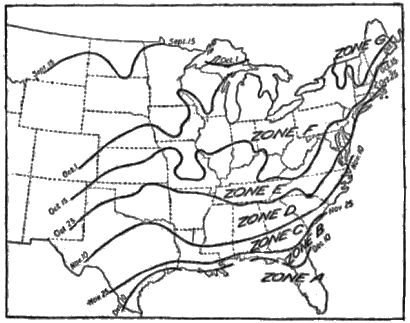
Fig. 5.—Map of the eastern United States indicating average date of first killing frost in autumn. On this the zones for winter packing are based. No packing is recommended in zones A and B.>