ARRANGEMENT OF THE APIARY.
Reading edition
WIND PROTECTION.
It is of the greatest importance that the apiary be located where the wind in winter is virtually eliminated. A grove of trees or an adjacent hill usually offers the best protection, or it is possible to make an artificial windbreak such as a high fence. A natural windbreak usually is better, for it is more extensive in most cases. It has been found by the authors that if a wind of 20 miles an hour blows on the winter packing cases for a few hours the temperature of the inside of the packed hive may be greatly reduced and may even fall as low as that of an unpacked hive. Too much reliance should not be placed in buildings as windbreaks, for they often serve simply to divert the wind slightly and may even make conditions worse. A fence made of close boards usually is unsatisfactory for it causes whirls that may destroy many colonies. A heavy blanket of snow serves to reduce the effect of the wind.
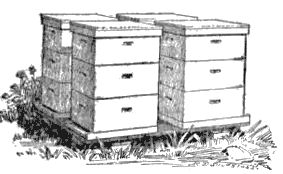
Fig. 1.—Colonies of bees in summer position in groups of four. This arrangement is advantageous whether or not the bees are wintered in four-colony packing cases.
ARRANGEMENT OF THE HIVES.
In arranging the hives in an apiary it is necessary to take into account the method of wintering to be followed. If the bees are to be wintered in the four-colony cases to be described later the hives should be kept in groups of four all the season (fig. 1), for if colonies are moved more than a foot just before packing and then moved again as they are unpacked there is a considerable amount of "drifting"—that is, bees from some colonies join other colonies during flight, and the result is an actual reduction of the number of colonies and of bees in the apiary. A failure to keep the colonies properly arranged for their winter stands during the entire summer is a common cause of failure in using the four-colony cases. Whatever type of case is used for outdoor wintering, the bees should occupy the same place during the entire year.
Since the outside of the winter case is quite different an appearance from the hives the bees often are somewhat confused. To prevent drifting from this cause it is a good plan to set a large stake between the two entrances on each end of the four-colony winter cases; this will serve to help the bees in orienting themselves during flights in winter and especially in spring. If it is possible to plant some shrubbery among the hives it is a good plan to have the plants arranged so that they will act as markers for the bees during these early flights (fig. 3). They will not be amiss during the summer, and, if properly placed, they need not interfere with movement through the apiary during the summer's work, while they add to its attractiveness.