DOMESTIC MANIPULATION.
Reading edition
Under the head of Domestic Manipulation, we propose giving a series of instructions on the numerous and essential manual operations that are constantly being required in every family, and which, whether they are well or ill done, must of necessity be performed. The term Domestic Manipulation, employed in the widest sense, would include all the manual operations required in a house, but we propose to limit it to such as partake in a slight degree of a chemical or other scientific character; thus the operations of Filtering, Decanting, Weighing, Measuring, Bottling, Corking, Unstoppering, Pounding, Heating, Boiling, Distilling, Cementing, &c., &c., will be included; whilst Dusting, Washing, and Scrubbing, though no less, in strictness, manipulations, will be passed over in silence. These general directions will be followed by a number of Receipts and Hints tried and recommended by numerous intelligent Housekeepers.
I. CLEANING, DRYING, CORKING, TYING DOWN, STOPPERING, AND UNSTOPPERING.
Cleaning.—Perhaps no more effectual and easy mode of cleaning wine and beer bottles can be recommended than that commonly adopted, viz., the use of small shot and water; in the case of old port wine bottles, however, it often occurs that the mechanical action of the shot fails to remove the hardened crust from the interior; a small quantity of pearlash or soda, or still better, the washing liquids described in another page, added to the water, will soften the crust sufficiently to permit its easy removal; there is, however, one objection to the use of shot for the purpose of cleaning bottles; unless due care be taken, by the violence of the shaking it often happens that several become firmly wedged between the bottom and sides of the bottles, and are not removed by the subsequent rinsings with clean water, and if the bottles are used for acid wines or other liquids (almost all our home-made wines contain a considerable portion of free acid), the shots are slowly dissolved; and from the metallic arsenic which they contain, as well as from the lead itself, the liquid is rendered poisonous. This effect may be readily guarded against by removing any shots which may have become fixed, by a stiff wire slightly hooked at the end.
Decanters are formed of flint glass, which is much softer and more readily scratched than the common kinds, they require therefore a less rough treatment; in general, warm (not boiling) water, with the addition of a few pieces of coarse brown paper, and if requisite a little soda, will be found effectual; should greater force be required, a small portion of tow wrapped round the notched end of a moderately stiff wire, and used with a little strong soda, will be found sufficient. Sand or ashes should never be employed in cleaning decanters, as they roughen and totally disfigure the brilliant surface of the glass.
Drying.—It is scarcely necessary to speak of the advantages of being able to dry thoroughly both decanters and common bottles; if the former, after having been cleaned, are put away wet, they become musty; and many liquids are much injured by being put into wet bottles. Some of our readers have doubtless experienced the inefficiency of the ordinary means for drying decanters, &c., after draining for some days they still remain damp, and if placed near a fire the warmth merely drives the vapour to the colder part of the vessel; they may, however, be readily and quickly dried after draining, by making them slightly warm and blowing in fresh air with a pair of bellows, which rapidly carries out the damp vapour, and leaves the vessel perfectly dry. If bellows are not at hand, the damp air may be drawn out (not blown) with the mouth, assisted by a tube sufficiently long to reach nearly to the bottom of the decanter; in the laboratory a piece of glass tube is usually taken, being always at hand, but for domestic use a piece of paper may be rolled up so as to form an extemporaneous and effectual substitute.
Corking.—Little can be said with regard to the corking of bottles, beyond stating the fact that cheap bad corks are always dear; the best corks are soft, velvety, and free from large pores; if squeezed they become more elastic and fit more closely. If good corks are used of sufficiently large size to be extracted without the corkscrew, they may be employed many times in succession, especially if they are soaked in boiling water after, which restores them to their original shape, and renews their elasticity.
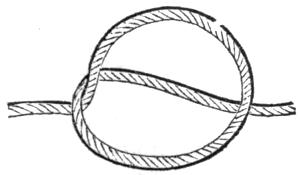
Fig. 1.
Tying down.—The operation of tying down corks merits a longer notice, as without it many effervescent wines and liquids could not be preserved. The most common mode of fastening down corks, is with the ginger beer knot, which is thus made:—First the loop is formed as in Fig. 1, then that part of the string which passes across the loop is placed on the top of the cork, and the loop itself passed down around the neck of the bottle, and by pulling the ends of the cord is made tight beneath the rim; the ends of the string are finally brought up, and tied either in a double knot, or in a bow on the top of the cork. When ginger beer is made at home it will be found most advantageous to use the best corks, and to tie them down with a bow, when both corks and strings may be made use of repeatedly.
Fig. 2. Fig. 3.
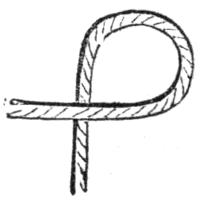
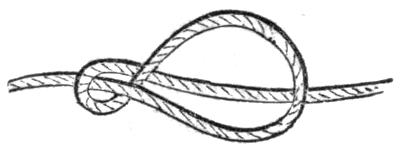
For effervescent wines, such as champagne, gooseberry, &c., which require to be kept a longer time, and are more valuable, a securer knot is desirable, which may be made thus:—A loop as in Fig. 2 is first formed, and the lower end is then turned upwards and carried behind the loop, as shown at Fig. 3; it is then pulled through the loop as in Fig. 4, and in this state is put over the neck of the bottle; the part a being on one side, and the two parts of the loop on the other; on pulling the two ends the whole becomes tight round the neck, and the ends, which should be quite opposite, are to be brought up over the cork, twice twisted, as in Fig. 5, and then tied in a single knot.
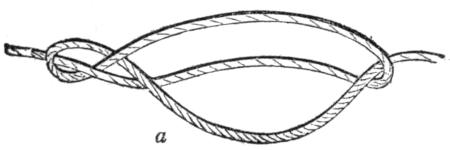
Fig. 4.
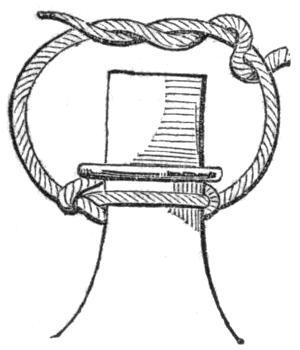
Fig. 5.
Stoppering.—The stoppering of bottles is an operation usually performed by the makers; it may, however, be useful to know that badly fitting stoppers may be readily fitted by re-grinding; this is done by dipping the stopper in a mixture of fine sand, or still better, emery and water, replacing it, and turning it backwards and forwards with a slight pressure; fresh sand must be applied from time to time. When the fitting is exact, so that the stopper turns freely without shaking, the whole may be finished off by using a little fine emery and oil.
Unstoppering.—This operation is much more likely to be required than the one last described, for the stoppers of decanters, smelling-bottles, &c., from various causes, frequently become fixed, and many are the fractures both of bottles and stoppers, caused by the misdirected efforts to remove them. In treating of the various means that may be employed, we will mention them in the order in which they should be tried, beginning with the simpler and more easy, and passing on to those which are more effectual, and at the same time, unfortunately, more dangerous. The first method, then, that should be tried, is to press the stopper upwards with the fore-finger and thumb of the left hand (the other fingers holding the neck of the bottle), and at the same time giving the stopper a succession of short, sharp, light taps, with the wooden handle of a chisel, knife, or small hammer; care must be taken not to strike the stopper with sufficient force to break it, and it should be borne in mind that it is not the force of the blow, but the vibration, or jar, which is effectual in loosening it; should this plan be found ineffectual after a short trial, it may probably be from the stopper being cemented by some substance, such as the dried sugar of a sweet wine. In such cases we should endeavour to dissolve the cement by a suitable solvent, which should be placed in the groove between the stopper and the bottle; thus, if the stopper is cemented with sugar, gum, or salt, water may be used; in many circumstances, oil is advantageous, or spirit, or even strong acid may be used; whatever liquid is employed it should be allowed to remain some days, being renewed if requisite, and the tapping, &c., should be again had recourse to.
Should these methods fail, a piece of cloth may be dipped in very hot water and wrapped round the neck of the bottle, when the heat causes the expansion of the glass, and if the stopper be tapped or twisted before the heat has had time to enlarge it, its removal may be effected; this operation must necessarily be a quick one, for if the stopper is heated and enlarged, as well as the bottle, it is obvious that no benefit will result. In the laboratory it is often customary to heat the bottle, not by a strip of cloth dipped in hot water, but by turning it rapidly over the flame of a lamp; in this way there is more danger of cracking the bottle, and the plan is not to be recommended in general, although employed with considerable success by those who, like operative chemists, are constantly in the habit of applying heat to glass vessels; it will at once be seen that the plan is fraught with great danger if applied to bottles containing inflammable liquids, as spirits, &c.
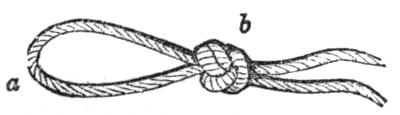
Fig. 6.
The most effectual mode of removing stoppers, especially those of small bottles, such as smelling-bottles, remains to be described. Take a piece of strong cord, about a yard or four feet in length, double it at the middle, and tie a knot (Fig. 6, b) so as to form a loop (a) of about four inches in length at the doubled end, bring the knot close to one side of the stopper, and tie the ends tightly together on the opposite side, as at Fig. 7, e, so as to fasten the string securely round the neck of the stopper; now pass one of the ends through the loop (a), and tie it firmly to the other end; the doubled cord is next to be placed over a bar or other support, then if the bottle is surrounded by a cloth to prevent accidents in case of fracture, and pulled downwards with a jerk, the force of which is gradually increased, it will be found that in a short time the stopper is liberated. Two precautions are requisite: one is, that the strain on both sides of the stopper is equal; the other, that care be taken that when the stopper is liberated, it is not dashed by the rebound against any hard substance, which would cause its fracture.
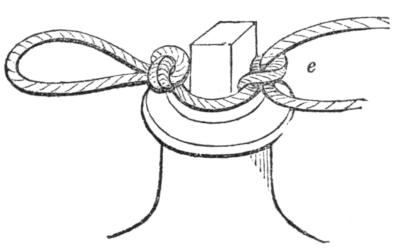
Fig. 7.
II. CUTTING, GRINDING, AND WRITING ON GLASS.
We have described the most advantageous modes of extracting fixed stoppers from decanters, &c. It is possible that some of our readers may have followed our advice sufficiently well to have succeeded in cracking the necks of their decanters. In case any should have been so unfortunate, or rather we would say—if we were quite sure we were not addressing ladies—so clumsy, let them not despair; dexterity in manipulation comes by practice; and as no evil is without a remedy, we will next consider what can be done with the broken decanter. Unless it is cracked down to the bottom, it may be cut off and converted into a handsome sugar basin; or if not high enough for that purpose, will serve for a pickle dish, or a flower-stand, &c.; and in the same way, a tumbler broken at the upper part will furnish an elegant salt-cellar, or serviceable soap dish; and even common bottles, if sufficiently stout, may be made into useful jars, instead of being consigned to the dust-heap.
The operation of cutting glass, consists in leading a crack in the required direction; this is readily done by a hot iron rod, a piece of pointed burning charcoal, or, what is still better, a burning pastile—which is somewhat similar in its composition to those used for fumigation; and which latter, although rather expensive, and inconvenient from their shape, may be applied for the purpose. When the operation of cutting up glass vessels into useful forms is much had recourse to, pastiles are prepared for the purpose, being superior to a heated iron rod, as they continue to burn and retain their heat, whilst the latter requires to be re-heated, if the crack has to be led any considerable distance. Pastiles are readily made by rubbing up half an ounce of powdered gum tragacanth with water, so as to form a mucilage about as thick as ordinary starch; this should be allowed to remain a few hours, and then mixed with a quarter of an ounce of benzoin, previously dissolved in the smallest possible quantity of proof spirit; after mixing them together in a mortar, as much powdered charcoal should be added as will form a stiff paste, and the whole well worked together, rolled into sticks the size of a common black-lead pencil, and dried. As thus prepared, they should be free from cracks, and solid throughout; and on being ignited at the end, they will burn steadily away to a point. If an iron rod is used, it should be nearly as stout as the little finger, and taper at the end for an inch and a half to a blunt point. Before commencing the line along which it is wished to divide the glass, it should be marked with a pen and ink, and allowed to dry, when the iron, heated to dull redness, or the lighted extremity of the pastile, should be brought to the end of a crack, being held in a slanting direction with regard to the glass, as shown in the cut, and slowly moved in an oblique direction towards the line; the crack will be found to follow the heated point, and may be thus led as required, even passing over parts varying very considerably in thickness, as in the case of the flutings on a cut decanter; but it cannot, with certainty, be made to pass suddenly from a very thin to a very stout part, or the reverse: thus it may be led around the sides of a tumbler, but could hardly be made to pass down one side, across the bottom, and up the other. The rapidity with which the operation is performed, depends upon the heat of the iron or pastile; if the former is very hot, or the latter made to burn more vividly by blowing upon it, the operation is quickened, but it is not performed with so much certainty, as the crack may pass on further than is desirable: care should be taken not to lead the crack too near the edge of the vessel, or to another crack, as in that case it is apt to leave the proper course, and fly suddenly to the edge, to which an inexperienced operator should not attempt to go nearer than half an inch.
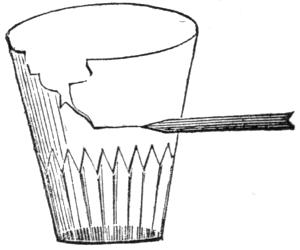
It sometimes occurs that a piece is broken out of a glass, without leaving any crack to commence from; in this case, one must be made, by heating the edge (one formed by the fracture, if possible), with the iron or pastile, and instantly applying the moistened finger. When a crack is formed which may be used as described above, care must be taken not to cause an extensive fracture, which may run across the intended line of division; this may be avoided by commencing the crack at some distance from the line, and by applying the heated point for a very short time, preferring to make two or three unsuccessful attempts rather than to hasten the operation, and risk the destruction of the glass. When a glass vessel has been thus divided, the edges are sufficiently sharp to cut the fingers in handling, and are usually wavy; it is therefore necessary to make them smooth and even. The most ready way of doing this is, by grinding them down on a flat sandstone or ordinary paving-stone, with a little sharp sand or emery, and water, taking care to move the glass in a circular direction, and not merely backwards and forwards; the smoothness of the whole will depend entirely on that of the stone, and on the fineness of the sand or emery employed. If, from any irregularity, there is much glass to grind away, it is preferable to commence with sand, and finish with emery on a smooth stone; if the edges are not thus ground down, they should have the sharp angles, which are really dangerous, removed by a fine file, which should be moistened with oil of turpentine or camphine, as this liquid has an extraordinary effect in increasing the action of the file upon the glass, and at the same time protecting the steel instrument from wear.
Advantageous as cracks are in glass vessels whenever we wish to separate them into two parts, they are by no means desirable under other circumstances; and it is as important to know how to stop their progress, as to lead them forward. This is readily done in stout glass, by drilling a hole about half an inch in advance of the crack, which gradually passes on into it, and then its further progress is arrested. Holes may be drilled in glass with a common drill and bow, the place being first marked with a file or flint, and the drill point kept wet with oil of turpentine. (It is hardly necessary to state, that a crack existing in the neck of a decanter, and liable to be forced apart with the stopper, could not be arrested in its progress by such means.) If necessary, a little emery powder may be used with the oil of turpentine; and after the operation, the hole must be filled up with some cement; if the vessel is to be used for holding liquids, a little fresh slaked lime, moistened with equal parts of white of egg and water, may be used for this purpose.
The grinding of glass on a flat stone with sand or emery, and water, is often useful in making a bottle stand steadily; and by its means a wine-glass with a broken foot may be turned to good account; for if as much of the stem as possible is knocked off, by striking it with the back of a knife, the remainder may be ground away so that the vessel will stand.
One of the most important Domestic Manipulations, although one of the most simple and easy, is the labelling of glass vessels. It is not too much to affirm, that scores of lives might have been saved if this had been attended to; in cases of accidental poisoning, we usually find that the victim has drunk from some bottle which has been put away without a label; and thus some corrosive liquid used for cleaning, or some poisonous lotion, has been inadvertently swallowed. One of the most ready modes of labelling glass, and other objects, consists in having at hand a sheet of paper, which has had spread on one side some gum water, mixed with half its weight of coarse brown sugar, and allowed to dry; this may be cut into labels, written on, and readily attached to glass by moistening with the tongue; the white margin of a sheet of postage stamps answers the purpose very well. If, however, acid liquids are used, or the vessel is placed in a damp situation, as a cellar, other means must be had recourse to. With a little practice it is easy to write in a legible, though not very conspicuous manner, on glass, with a gun-flint, or with the sharp-edged fragments of common flint. In the laboratory what is called a writing diamond is used for this purpose; this should not be confounded with a glazier’s diamond, which is used for dividing, and not scratching glass. We would here caution our reader against writing on glass with a diamond ring, &c., as the practice injures the jewel considerably; in the glazier’s diamond, the natural edges of the crystal are used, which are not liable to injury as are the cut angles of a brilliant.
When glass vessels are exposed to damp, the best mode of writing on them is to prepare an ink for the purpose, by mixing the common cheap varnish, called Brunswick black, with half its weight of oil of turpentine, or what is the same thing, in a purer state, camphine; this should be kept in a closely corked bottle, and used with a broad nibbed quill pen; it soon dries, and though pale, is very distinct, and almost imperishable. If it is required much darker, about a quarter of an hour after it has been done, a little lamp-black should be rubbed over it, with cotton or wadding, when it immediately becomes as black as common ink, and resists damp, and rubbing or wiping with either wet or dry cloths for a very long time; the same ink is equally advantageous for use with white earthenware; and although we have never had occasion to use such a mixture, there is no doubt that a little whiting mixed thin, with any common varnish, would furnish an equally useful ink for writing on black bottles.
III. DECANTING, STRAINING, AND FILTERING OF LIQUIDS.
The decanting of liquids is, under ordinary circumstances, an operation sufficiently simple to require no explanation; but the ease and certainty with which it can be performed, depend entirely upon the form of the vessel from which the liquid is poured; the adhesion existing between liquids and solids giving rise to the tendency in the former to run down the outside of the vessel; and, if the latter is nearly full, or very large in circumference, or the sides approach the perpendicular direction, this accident almost always occurs. The difficulty of returning a glass of wine to the decanter, or of pouring from one full tumbler into another, are well-known examples of this inconvenience.
Advantage may, however, be taken of the adhesion of liquids to solids, and by it the former may be led into the required direction. This cannot be better illustrated than by a description of the means by which a glass of wine may be returned, without spilling, to the decanter. If a tea-spoon is dipped into the wine, so as to become wetted with it, and held perpendicularly with the bowl downwards, and the point over, but not touching the entrance into the decanter, and the edge of the glass be made to touch the back of the spoon, it will be found, on inclining the former, that the wine, having a perpendicular solid body to adhere to and run down, will do so in preference to trickling along the oblique outer surface of the wine-glass; and in this mode a liquid may be poured steadily out of any similar vessel with so little disturbance as not to agitate any sediment that may exist in it. In the laboratory of the chemist, a piece of glass rod is usually employed for this purpose; but a spoon, or pencil, or any similar substance having a surface capable of being wetted by the liquid, answers equally well.
If, however, the vessel out of which it is wished to decant is large, very full, or the sides, on pouring, are nearly perpendicular, the plan is not successful; thus, it could not be employed in aiding the transfer of the liquid from one full tumbler to another. Even this may be accomplished without the aid of a funnel, or without spilling, by preventing the adhesion of the liquid to the edge or side of the vessel out of which it is poured, which may be readily done by greasing the rim, when it will be found quite practicable to pour out of a nearly full tumbler without spilling.
In many instances, the employment of a syphon in decanting will be found very advantageous, particularly when the containing vessel is large, and cannot be readily moved, or when there is any sediment which it is desirable not to disturb. The most simple form of this instrument consists of a tube, bent as in Fig. 1, with one leg shorter than the other; this may be made of glass, pewter, or, in fact, of any kind of stiff tubing that will retain its form—a piece of gutta-percha pipe, carefully bent by a moderate warmth, whilst a piece of stout cord is in the interior to prevent the sides closing together, answers very well. Before use, the syphon must be filled with liquor; this is best accomplished by turning it upside down, with the opening to the short leg raised on a level with that of the long one, when the liquid should be poured into the former. When both legs are filled, they should be closed with the fingers; the shorter leg introduced into the liquid it is wished to draw off; and the opening of the longer leg brought to a lower level than that of the shorter, and on removing the fingers the liquid will flow as in Fig. 1, until it is below the level of the short leg. If the syphon is made of small tubing, or is lessened at the openings so as not to exceed one quarter of an inch in diameter, there will be no occasion to close the end of more than one leg with the finger, as the liquid will not flow when it is brought to the proper position unless both orifices are open; and thus the necessity of plunging the finger into the liquid is obviated, and the syphon can also be used with a narrow-necked bottle, into which the hand could not be passed.
Fig. 1. Fig. 2.
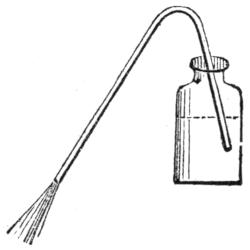
To do away with the necessity of filling the syphon before use, the instrument is usually made with a sucking tube, as in Fig. 2; in this case, all that is requisite is, to introduce the short leg, close the opening to the long one, and, by the action of the mouth, draw up the liquid until both legs are full, when, on removing the finger, the stream will flow. A very ingenious syphon of this kind is described by the German chemist Mohr; it is thus constructed:—Take a long Eau de Cologne bottle, and, with a file and turpentine, make a deep notch across, about an inch and a half from the bottom; then, with a charcoal point or pastile, or hot iron, produce a crack, and cut off the bottom, grinding it smoothly (all these manipulations are described in our last article, page 152); then take a tube bent at an angle of forty-five degrees, and, by means of a good cork, perforated with a rat-tail rasp, fit it tightly in the bottom of the bottle, and add also another piece of tubing for a suction tube; the whole will then have the appearance represented in Fig. 3, and will form an exceedingly useful and very convenient syphon.
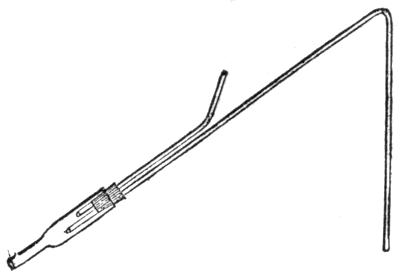
Fig. 3.
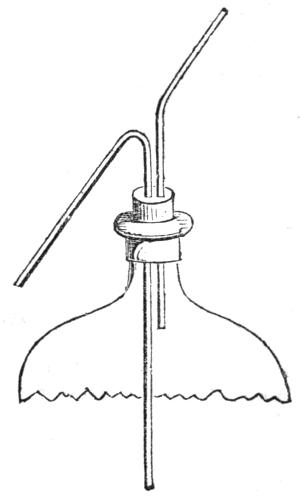
In emptying large stone bottles or carboys, the following plan may be had recourse to:—Perforate a sound cork with two openings by a rat-tail rasp, and fit, air-tight, two tubes bent as in Fig. 4. On blowing through the upper, the liquid will be forced to ascend and run over the bend of the other, which will then act as a syphon. This plan is exceedingly useful in emptying carboys of corrosive liquids as oil of vitriol, &c.; and if all the joints are—as they should be—air-tight, the flow may be arrested by closing the upper tube with the finger. In the figure the outer leg of the syphon is shortened to save space; in practice, it must be of sufficient length to be lower than the inner leg within the vessel.
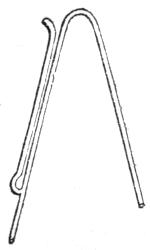
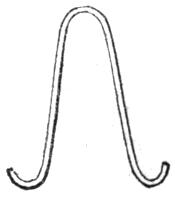
If a syphon is required frequently for decanting the same kind of liquid, it is found troublesome to be constantly filling it before each time of using it; this trouble is obviated by the use of an instrument formed with legs of equal length, which are turned up at the ends, as in Fig. 5; this having been filled, may be hung up in the erect position, and the liquid will not escape, but on plunging one end into a liquid, it will be found immediately to flow from the other, provided that the latter is below the level of the surface of the liquid.
Fig. 4. Fig. 5.
The operations of straining and filtering are frequently required in domestic manipulations, and the apparatus employed usually consists of sieves and a jelly-bag. As in many other instances, it will be found advantageous to import several contrivances from the laboratory to the kitchen; one of the most useful (because most simple) strainers consists of a square frame, formed of four pieces of wood nailed together at the corners, with a piece of calico, linen, or canvas, of suitable fineness, tacked to the four sides; this strainer is particularly useful in separating any solid substance—as the residue in making wines—or if grated potatoes are put on one made of coarse cloth, the starch can be readily washed through, leaving the useless portion on the strainer; the cloth should not be tacked very loosely, as it bags down when any substance is put on it, and the liquid runs away below from the centre. This strainer is a most useful one; it is readily made, of any degree of fineness, and of any size; and it also possesses the great advantage, that, if necessary, the tacks fastening the cloth can easily be withdrawn, when the substance remaining can be rolled up in the cloth, and tightly squeezed to express the last portions of the liquid, which are frequently the most valuable.
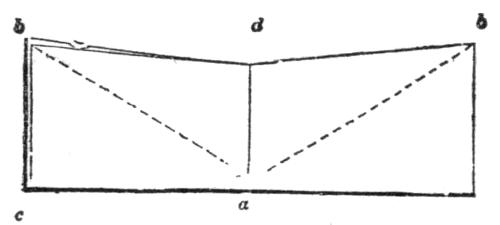
Fig. 6.
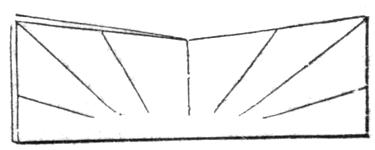
Fig. 7.
In cases where a finer filtration is required than can be obtained by means of a cloth, as in cleaning turbid wine or spirit, the use of filtering-paper is recommended; this paper is merely a stouter kind of blotting-paper, thick varieties of which answer very well for domestic purposes; it is most simply used by taking a square piece, folding it into half—by bringing the two opposite edges together—and then folding the oblong so obtained across its length; by this means a small square is obtained, one quarter the original size, which may be opened into a hollow cup, having three thicknesses of paper on one side, and one on the other; this is to be placed, with the point downwards, in a funnel, and the liquid poured in; and as soon as the pores of the paper are expanded by the moisture, it will be found to flow through perfectly clear; care must be taken in making the filter, not to finger it much where the two foldings cross each other, as a hole is readily made at that part, and the filter spoiled. The objection to this simple contrivance is, that from its flat sides applying themselves closely to those of the funnel, the flow of the liquid is impeded, and is, therefore, slow. This effect may be obviated by the use of the plaited filter, the construction of which we will endeavour to describe. A square piece of filtering, or stout blotting-paper, is to be doubled, and the oblong so obtained is to be again folded in half, when if the last fold is opened, it will have the appearance of Fig. 6. From the corners b b, folds are to be creased in the direction towards a, but not reaching it for half an inch; these are indicated by the dotted lines, which divide the double paper into four triangles, each of which is to be again folded into eighths, and care must be taken that all the folds are made the same way, that is, projecting to the same side of the paper. When complete, the double and creased paper will appear as Fig. 7. Now divide each eighth into half, by a fold in the opposite direction to those previously made, when it will be found that the whole will fold up like a paper fan; the projecting loose ends which are formed by the corners b, should be cut off, and the double sides separated for the first time by blowing them apart, when the whole may be readily opened out as in Fig. 8. In making this filter, which takes a much less time than to follow the description, two precautions are requisite. The folds should be made at once with one firm pressure, and not with a series of rubbings; and all the creases should stop short of the middle, otherwise a hole will be made at that point, long before the filter is completed. The advantages of this filter are, that it exposes a large surface for the liquid to pass through; and from its only being in contact with the funnel where the angles project, the current flows away readily.
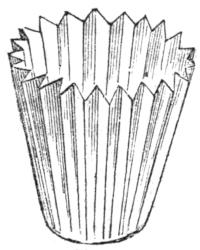
Fig. 8.
The best means for filtration of water, and the construction of water filters will be treated of when we speak of the “domestic manipulation” connected with that liquid.
IV. THE MANUFACTURE AND USE OF CEMENTS.
The term cement, includes all those substances employed for the purpose of causing the adhesion of two or more bodies, whether originally separate, or divided by an accidental fracture. As the substances that are required to be connected together are exceedingly various, and differ very much in their properties as to texture, &c., &c., and as the conditions under which they are placed, with regard to heat and moisture, are also exceedingly variable, a number of cements, possessed of very different properties, are required; for a cement that answers admirably under one set of circumstances, may be perfectly useless in others. A vast number of cements are known and used in the various arts; but they may all be referred to a few classes, and our object in this paper will be to describe the manufacture and use of the best of each class, and also to state what are the general principles upon which the success or failure of cementing usually depends.
The different parts of a solid are held together by an attraction between their several particles, which is termed the attraction of cohesion, or cohesive attraction. The amount of this varies with the substance; thus, the cohesion of the particles of iron to one another is enormously great, whilst that between those of chalk is but small. This attraction acts only when the particles are in the closest possible contact; even air must not be between them. If, after breaking any substance, we could bring the particles into as close contact as before, and remove the air, they would re-unite, and be as strongly connected as ever. But, in general, this is impossible; small particles of grit and dust get between them; the film of interposed air cannot be removed; and thus, however firmly we press the edges of a broken cup together, it remains cracked china still. Perfectly flat, clean surfaces, like those of freshly ground plate-glass, may sometimes be made to cohere, so that the two pieces become one, and cannot be separated without breaking. The attraction of cohesion takes place between the parts of the same substance, and must not be confounded with that of adhesion, which is the attraction of different substances to one another; for example, the particles of a piece of wood are united by cohesive attraction, whilst the union of glue and wood to each other depends on adhesive attraction. And it is important that this distinction be borne in mind, for, in almost all cases, the cohesion between the particles of the cement is very much less than the adhesion of the cement to other bodies; and if torn apart, the connected joint gives way—not by the loosening of the adhesion—but by the layer of cement splitting down the centre. Hence the important rule, that the less cement in a joint, the stronger it is. Domestic manipulators usually reverse this, by letting as much cement as possible remain in the joint, which is, therefore, necessarily a weak one. A thick, nearly solid cement, which cannot be pressed out of the joint, is always inferior to a thinner one, of which merely a connecting film remains between the united surfaces.
Having thus mentioned the general principles that ought always to be borne in mind, we will now proceed to describe the manufacture of some of the more useful cements, and their mode of use.
Mouth Glue affords a very convenient means of uniting papers, and other small light objects; it is made by dissolving by the aid of heat, pure glue, as parchment glue, or gelatine, with about one quarter or one-third of its weight of coarse brown sugar, in as small a quantity of boiling water as possible; this, when perfectly liquid, should be cast into thin cakes on a flat surface very slightly oiled, and as it cools cut up into pieces of a convenient size. When required for use one end may be moistened by the mouth, and is then ready to be rubbed on any substances it may be wished to join; a piece kept in a desk or workbox is exceedingly convenient.
Paste is usually made by rubbing up flour with cold water and boiling; if a little alum is mixed before boiling it is much improved, being less clammy, working more freely in the brush, and thinner, a less quantity is required, and it is therefore stronger. If required in large quantity, as for papering rooms, it may be made by mixing one quartern of flour, one quarter pound of alum, and a little warm water; when mixed, the requisite quantity of boiling water should be poured on whilst the mixture is being stirred. Paste is only adapted to cementing paper; when used it should be spread on one side of the paper, which should then be folded with the pasted side inwards, and allowed to remain a few minutes before being opened and used; this swells the paper, and permits its being more smoothly and securely attached. Kept for a few days, paste becomes mouldy, and after a short time putrid; this inconvenience may be obviated by the use of—
Permanent Paste, made by adding to each half-pint of flour-paste without alum, fifteen grains of corrosive sublimate, previously rubbed to powder in a mortar, the whole is to be well mixed; this, if prevented from drying, by being kept in a covered pot, remains good any length of time, and is therefore convenient; but unfortunately it is extremely poisonous, though its excessively nauseous taste would prevent its being swallowed accidentally; it possesses the great advantage of not being liable to the attacks of insects.
Liquid Glue.—Several preparations under this name have from time to time found their way into use. The liquid glue of the shops, however, is a totally different preparation, being inodorous, and very much cheaper. It is made by dissolving shell-lac in water, by boiling it along with borax, which possesses the peculiar property of causing the solution of the resinous lac. This preparation is convenient for its cheapness and freedom from smell, but it gives way if exposed to long-continued damp, which that made with naphtha resists.
Of the use of common glue, very little need be said; it should always be prepared in a glue-pot or double vessel, to prevent its being burned; which injures it very materially; the objection to the use of this contrivance is, that it renders it impossible to heat the glue in the inner vessel to the boiling point; this inconvenience can be obviated by employing in the outer vessel some liquid, which boils at a higher temperature than pure water, such as saturated solution of salt (made by adding one-third as much salt as water). This boils at 224° Fahr., 12° above the heat of boiling water, and enables the glue in the inner vessel to be heated to a much higher temperature than when pure water is employed. If a saturated solution of nitre is used, the temperature rises still higher.
Waterproof Cements are very numerous; a very good one for uniting china and glass will be found in another page. It should be stated, however, that the gum ammoniac should be also dissolved in a small quantity of spirit. Mastic, used instead of ammoniac, makes a clearer cement. This mixture, under various fanciful titles, is usually sold at a most exorbitant rate.
Lime and Egg Cement is frequently made by moistening the edges to be united, with white of egg, dusting on some lime from a piece of muslin, and bringing the edges into contact. A much better mode is to slake some freshly burned lime with a small quantity of boiling water; this occasions it to fall into a very fine dry powder, if excess of water has not been added. The white of egg used should be intimately and thoroughly mixed, by beating, with an equal bulk of water, and the slaked lime added to the mixture, so as to form a thin paste, which should be used speedily, as it soon sets. This is a valuable cement, possessed of great strength, and capable of withstanding boiling water. Cements made with lime and blood, scraped cheese, or curd, may be regarded as inferior varieties of it. Cracked vessels, of earthenware and glass, may often be usefully, though not ornamentally repaired by white lead spread on strips of calico, and secured with bands of twine. But in point of strength, all ordinary cements yield the palm to Jefferey’s Patented Marine Glue, a compound of India-rubber, shell-lac, and coal-tar naphtha. Small quantities can be purchased at most of the tool warehouses, at cheaper rates than it can be made. When applied to china or glass, the substance should be cautiously made hot enough to cement the glue, which should be then rubbed on the edges so as to become fluid, and the parts brought into contact immediately. When well applied, the mended stem of a common tobacco-pipe will break at any other part in preference to the junction. The colour of the glue unfortunately prevents its being used.
The Red Cement, which is employed by instrument makers for cementing glass to metals, and which is very cheap and exceedingly useful for a variety of purposes, is made by melting five parts of black resin, one part of yellow wax, and then stirring in, gradually, one part of red ochre or Venetian red; in fine powder, and previously well dried. This cement requires to be melted before use, and it adheres better if the objects to which it is applied are warmed. A soft cement, of a somewhat similar character, may be found useful for covering the corks of preserved fruit and other bottles, and it is made by melting yellow wax with an equal quantity of resin, or of common turpentine (not oil of turpentine, but the resin), using the latter for a very soft cement, and stirring in, as before, some dried Venetian red. Bearing in mind our introductory remarks, it will be seen that the uniting broken substances with a thick cement is disadvantageous, the object being to bring the surfaces as closely together as possible. As an illustration of a right and a wrong way of mending, we will suppose a plaster of Paris figure broken; the wrong way to mend it is by a thick plate of plaster, which makes, not a joint, but a botch. The right way to mend it, is by means of some well-made carpenter’s glue, which, being absorbed into the porous plaster, leaves merely a film covering the two surfaces, and, if well done, the figure is stronger than elsewhere.
On carefully reading over our article, we find one useful substance has been omitted, namely, what is termed mastic cement, which is used for making a superior coating to inside walls, and which must not be confounded with the resin mastic. It is made by mixing twenty parts of well-washed and sifted sharp sand, with two parts of litharge, and one of freshly burned and slaked quick-lime, in fine dry powder. This is made into a putty, by mixing with linseed oil; it sets in a few hours, having the appearance of light stone; and we mention it, as it may frequently be employed with advantage in repairing broken stonework (as stairs) by filling up the missing parts. The employment of Roman cement, plaster, &c., for masonry work, hardly comes within the limits of Domestic Manipulation.
V. DIVIDING, POWDERING, GRINDING, ETC.
The operations of chopping, powdering, grinding, &c., are so frequently required in cooking, and the other branches of domestic economy, as to render any description of their utility wholly unnecessary; and we may therefore confine ourselves to describing the best means of accomplishing the object desired. Powdering is usually performed by the aid of the pestle and mortar. Most of the works on Cookery recommend the use of a marble mortar; this material is about one of the worst that could be selected for the purpose. In the first place, it is expensive; secondly, it is rapidly corroded, even by the weak acids used for food; thirdly, it is readily stained by oily substances; fourthly, it is absorptive of strong flavours, imparting them readily to the next substance pounded; and lastly, it is brittle, and even if not broken, is not calculated to withstand much wear. By far the best material for the purpose is the Wedgewood ware; mortars made of it are cheaper, cleaner in use, and stronger than those of marble, and are not corroded by acids or alkalies—their pre-eminence is so great, that they are invariably used by druggists.
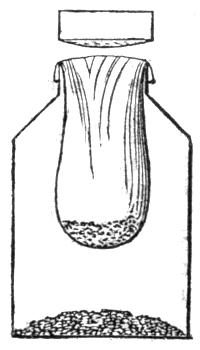
Fig. 9.
The act of powdering requires great tact and practice to perform it neatly and rapidly. After the object has been broken into small pieces by blows from the pestle, a grinding action is required; this should at first be given by striking the fragments, not in the centre of the mortar, but towards the side furthest from the operator; the pestle, by this means, grinds over them in its descent to the centre, and much more rapidly accomplishes their division than if mere blows are given. After the object has been divided to a certain extent, blows are entirely useless, and a grinding in circles becomes requisite; if the circle is confined to one part of the mortar, the same portions get rubbed over and over again, the others escaping; this is avoided by constantly and regularly altering the size of the circles. If they are commenced in the centre, they should gradually increase in size until the sides are reached, and then contract again, and so on. By this means, the whole of the powder is brought under the action of the pestle, and the operation is much quicker than if performed at random. One great fault usually committed in powdering, is the endeavour to operate on too large a quantity of material at one time. The operation is much more rapidly conducted if small portions are taken, and if the material is tough, and contains much fibrous matter, the process may be very much shortened by removing those parts which are sufficiently powdered, by sifting from time to time through a sieve. This may be objectionable, however, from the fine powder escaping into the air; in this case, the following contrivance will be found useful:—A cylindrical tea-canister of the requisite size is taken, with a loosely fitting lid, (or, if tight, the lid may be enlarged by four slits being made partly up the sides); a bag of lawn is dropped into the canister, the top being turned over the edge; the powder to be sifted is put in the bag, the lid put on, and, by tapping and shaking, the finest portions pass into the canister without any escaping into the air—a point of very considerable importance where the powder is irritating or expensive.
Various contrivances are constantly had recourse to, in order to render certain substances more readily pulverisable, the contrivance varying very much with the peculiarities of the substance. We will mention a few of these, as they may afford useful suggestions in cases of difficulty. All vegetable, and many mineral substances, are much more readily powdered after having been thoroughly dried; so far is this process carried, that many drugs are dried so as to lose fifteen per cent. of their weight before powdering. In proof of the utility of the drying, let any person try to powder a piece of whiting as it comes from the oilman’s; it will be found to cake together, and be more readily powdered; if dry, however, it powders with the greatest ease. After drying, substances should not be exposed to the air; but, unless they are of such a nature as to be softened by heat, are better operated on while still warm. Flints are more readily powdered by being heated to redness and quenched in cold water; charcoal, for tooth-powder, while still warm from drying. Gum can only be powdered whilst perfectly dry. Camphor, which is with great difficulty powdered alone, yields readily if a drop or two of spirit is poured on it. Substances which clog together and cake under the pestle, are not uncommon; to these it is sometimes requisite to add sand, which may afterwards be separated—this prevents the clogging; but its use is often impracticable. Lime, if required in very fine powder, for dusting over plants to kill slugs, &c., is readily obtained by slaking it, when fresh burned, with boiling water; when, if too much water is not used, it falls into an exceedingly fine powder.
Sal-ammoniac, and some other saline bodies, are most readily powdered by dissolving them in as small a quantity of boiling water as possible, and stirring the solution rapidly as the water is boiled away, or as the solution cools. Before dismissing the pestle and mortar, we may allude to their use in mixing powders together, although a much more ready mode of doing this is with a sieve. Two or more powders stirred together, and passed two or three times through a sieve, are much more intimately mixed, than if rubbed for a long time in a mortar. Metals cannot be divided in the mortar; the most convenient mode of proceeding, if they are fusible under a white heat, is to melt them, and pour them whilst liquid into a pail of water, which should be full to avoid any spluttering, and the hotter the metal, the more filmy the particles. It is scarcely requisite to state, that the metal should be poured in a circle, so as not to collect at one place.
Chopping is usually performed in the kitchen, with a large common knife; but is more speedily done by some of the improved contrivances similar to the following:—The chopping-board should be made of hard wood, with the grain at right angles to the surface of the board, by which it is rendered much more durable than if they are parallel to it. The chopping-knives should be placed at right angles to the handles, and may be of either the following patterns. If a large quantity of material has to be acted on, we would recommend a board as above, not less than three inches thick, and smooth on both sides, so that either may be used, of the requisite size—say eighteen inches or two feet in diameter. On this should stand a loose bottomless tub, to confine the materials, and the whole resting on the floor, should be used with a knife, sufficiently long in the handle to be employed by a person standing erect, and it would be very convenient to have a small cross-bar for the hands, as shown in Fig. 12.
Fig. 10. Fig. 11.
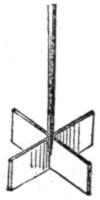
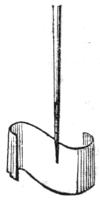
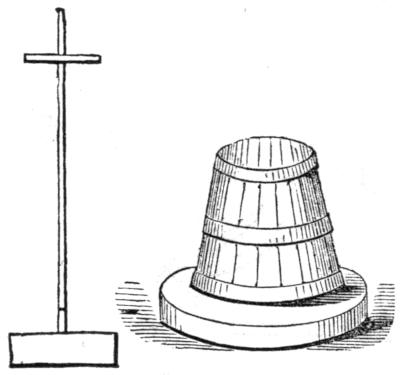
Fig. 12.
Small chopping-knives are sold, consisting of three blades riveted together, and a very convenient one is made by fastening, at convenient distances, a number of flat circular disks, sharpened at the edges, on to a central axis with a handle at each end.
Many substances, such as stale bread, dried herbs, &c., may be very conveniently powdered by rubbing them through a wire sieve, of the requisite degree of fineness. Herbs intended for use in this way, should be dried as rapidly as possible, without being scorched, in small heaps, before the fire; parsley and others done this way, may be powdered, retaining their bright green colour and flavour, both of which are preserved if they are corked tightly in bottles, and kept in a dry, dark cupboard. The use of waxed paper to preserve dried powders in, or for tying them down in jars, or generally as a very good substitute for bladder, will often be found convenient. It is readily made by laying a sheet of smooth stout paper on a warm iron plate, as the top of a kitchen oven; on this place the thin tissue or other paper to be waxed; put a piece of wax on it, and as it melts, rub it over, spreading it evenly. One end of a cork, covered with two thicknesses of linen, answers very well for a rubber. If a hot plate is not at hand, the sheet of paper may be held before the fire, and rubbed over as it warms, with the cut edge of a cake of white wax; but this requires the co-operation of two persons.
VI. KNOTS, PACKAGES, PARCELS, ETC.
The poet Crabbe, speaking of the writing of the rustics, signing his parish register, says—
“’Tis strange that men Who guide the plough should fail to guide the pen! For half a mile the furrows even lie; For half an inch the letters stand awry.”
A parallel remark might with equal justice be made on the gentler sex, who, after exercising a degree of tact, neatness, and tasteful invention, that the self-styled “lords of the creation” might in vain hope to rival, in the formation of a piece of needlework, knitting, netting, or crochet, are for the most part, totally unable, when it is finished, to tie it up so as to make a decent parcel; ladies’ packages are, in fact, the opprobrium of the sex—the annoyance of all carriers, cads, and coachmen, who have anything to do with their conveyance, and the torment of their owners; the cords are certain to become loose, the knots are sure to slip, except when a slip-knot is requisite, and then it is a fixture! It is in the hope that we may be instrumental in improving this state of things, that we are induced to devote this article to Knots, Packages, Parcels, &c., and we shall at once lay before our fair readers a method of tying a parcel neatly and securely, and at the same time affording facilities of releasing the contents without destroying the string by cutting it away—a too ordinary practice, especially where time is an object.
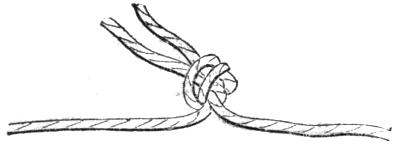
Fig. 13.
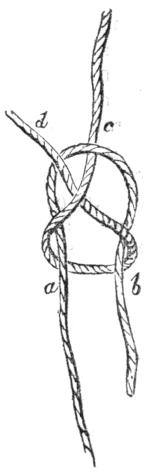
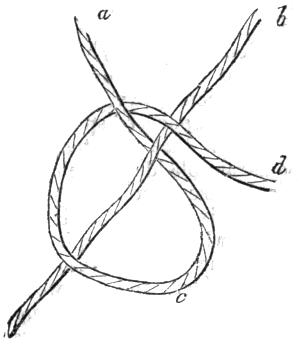
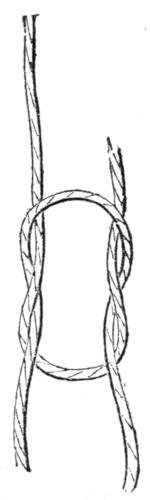
The most simple purpose for which a knot is required, is the fastening together of two pieces of string or cord: the knot selected for this purpose should possess two important properties—it should be secure from slipping, and of small size. Nothing is more common than to see two cords attached together in a manner similar to that shown in Fig. 13. It is scarcely possible to imagine a worse knot; it is large and clumsy, and as the cords do not mutually press each other, it is certain to slip, if pulled with any great force. In striking contrast to this—the worst of all—we place one of the best; namely, the knot usually employed by netters, and which is called by sailors “the sheet-bend.” It is readily made by bending one of the pieces of cord into a loop (a b, Fig. 14), which is to be held between the finger and thumb on the left hand; the other cord c is passed through the loop from the farther side, then round behind the two legs of the loop, and lastly, under itself, the loose end coming out at d. In the smallness of its size, and the firmness with which the various parts grip together, this knot surpasses every other: it can, moreover, be tied readily when one of the pieces, viz., a, b, is exceedingly short; in common stout twine, less than an inch being sufficient to form the loop. The above method of forming it is the simplest to describe, although not the most rapid in practice; as it may be made in much less time by crossing the two ends of the cord (a b, Fig. 15) on the tip of the fore-finger of the left hand, and holding them firmly by the left thumb, which covers the crossing; then the part c is to be wound round the thumb in a loop, as shown in the figure, and passed between the two ends, behind a and before b; the knot is completed by turning the end b downwards in front of d, passing it through the loop, securing it under the left thumb, and tightening the whole by pulling d. As formed in this mode, it is more rapidly made than almost any other knot; and, as before stated, it excels all in security and compactness, so firmly do the various turns grip each other, that after having been tightly pulled, it is very difficult to untie; this is the only drawback to its usefulness, and in this respect it is inferior to the reef-knot, Fig. 16, which is made in precisely the same manner that a shoestring is tied, only pulling out the ends instead of leaving them as bows. The only precaution necessary in making a reef-knot is, to observe that the two parts of each string are on the same side of the loop; if they are not, the ends (and the bows, if any are formed) are at right angles to the cords; the knot is less secure, and is termed by sailors a granny-knot. Other knots are occasionally used to connect two cords, but it is unnecessary to describe them, as every useful purpose may be answered by those above mentioned.
Fig. 14. Fig. 15. Fig. 16.
The binding knot (Figs. 17 and 18) is exceedingly useful in connecting broken sticks, rods, &c., but some difficulty is often experienced in fastening it at the finish; if, however, the string is placed over the part to be united, as shown in Fig. 17, and the long end b, used to bind around the rod, and finally passed through the loop a, as shown in Fig. 18, it is readily secured by pulling d, when the loop is drawn in, and fastens the end of the cord.
For fastening a cord to any cylindrical object, one of the most useful knots is the clove hitch, which, although exceedingly simple and most easily made, is one of the most puzzling knots to the uninitiated. There are several modes of forming it, the most simple being perhaps as follows:—Make two loops, precisely similar in every respect, as a and b, Fig. 19, then bring b in front of a, so as to make both loops correspond, and pass them over the object to be tied, tightening the ends; if this is properly done, the knot will not slip, although surrounding a tolerably smooth cylindrical object, as a pillar, pole, &c. This knot is employed by surgeons in reducing dislocations of the last joint of the thumb, and by sailors in great part of the standing rigging. The loop which is formed when a cable is passed around a post or tree to secure a vessel near shore is fastened by what sailors term two half hitches, which is simply a clove hitch made by the end of the rope which is passed around the post or tree, and then made to describe the clove hitch around that part of itself which is tightly strained.
Fig. 17. Fig. 18.
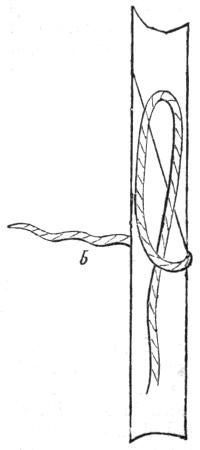
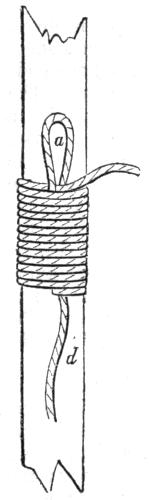
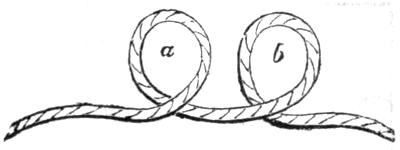
Fig. 19.
From the tying of knots we may pass on to the tying over of bottles, preserves, jars, &c.; the object with which this operation is performed is either to prevent the excess of air or the escape or entrance of moisture; the act itself is so very simple as to require no explanation; but a few words may be said on the choice of material, which should be varied, so as to suit the exigencies of each particular case. When a vessel of spirit is to be tied over, leather is frequently selected—a very erroneous practice, as the vapour of spirit passes readily through that substance, but cannot penetrate bladder, which should be invariably used for the purpose. So effectually is spirit confined by bladder, that when weak spirits are put into bladders or into vessels tied over with bladder, and allowed to remain some time, they are strengthened, as the vapour of the water passes away, that of the spirit being retained.
Bladder, or other animal membranes of the same nature, in a moist and flaccid state, are usually selected for tying over preserves and jams, for which they are well adapted; should it be impracticable to obtain them, the waxed paper described at page 165 is a very good substitute. Many persons place a thin piece of oiled paper in the jar resting on the jam, in addition to tying it down; this assists in excluding air and preventing mouldiness, but we have found a piece of very thin paper moistened with white of egg much more efficacious. The thin sheet-lead used for lining the interior of tea-chests, or stout tin-foil, is very advantageously used in tying down vessels containing specimens of natural history preserved in spirits, as they effectually prevent the escape of the latter for a long series of years. The plan usually pursued is to tie the cork over first with a single bladder, then with the metal, and finally with a second piece of bladder, which is afterwards covered with a coat of black paint.
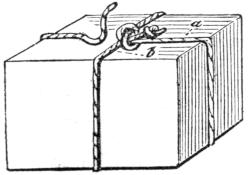
Fig. 20.
The tying up of parcels in paper is an operation which is seldom neatly performed by persons whose occupations have not given them great facilities for constant practice. Whether the paper be wrapped round the objects, as is the case usually when it is much larger than sufficient to enclose them, or merely folded over itself, as is done by druggists, who cut the paper to the required size, it is important that the breadth of the paper should be no more than sufficient to enable it to be folded over the ends of the object enclosed, without passing over the opposite side: it is impossible to make a neat or close parcel with paper which is too broad; excess in length may be readily disposed of by wrapping it round; but excess of breadth should be cut away. With regard to turning in the ends, the mode adopted by grocers is the best. The most common cause of failure in parcels is their being badly corded; we will, therefore (however unnecessary the description of so simple a performance may appear to those already acquainted with it), describe the most readily acquired mode of cording.
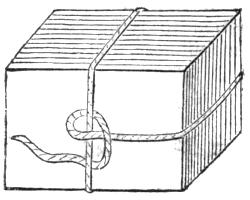
Fig. 21.
Let a single knot be made in the end of the cord, which is then passed round the box or parcel. This knotted end is now tied by a single hitch round the middle of the cord (Fig. 20) and the whole pulled tight. The cord itself is then carried at right angles round the end of the parcel, and where it crosses the transverse cord on the bottom of the box (Fig. 21), it should (if the parcel is heavy, and requires to be firmly secured) be passed over the cross cord, then back underneath it, and pulled tightly, then over itself; lastly, under the cross cord, and on around the other end of the box. When it reaches the top it must be secured by passing it under that part of the cord which runs lengthways (a, Fig. 20) pulling it very tight, and fastening it by two half hitches round itself. The great cause of parcels becoming loose is the fact of the cord being often fastened to one of the transverse parts (as b, Fig. 20) instead of the piece running lengthways, and in this case it invariably becomes loose. The description may perhaps be rendered clearer by the aid of the figures, which exhibit the top and bottom of a box corded as described. The cords, however, are shown in a loose state, to allow their arrangements to be perceived more easily.
VII. ON THE OPERATIONS AFFECTING WATER.
The subject of the Water supply to the Metropolis and other large towns is one of the highest importance to the well-being of the community at large, in whatever point of view it may be regarded—whether as affecting the comfort, the health, or the pocket of the consumer, its influence can scarcely be overrated. To enter, however, into this matter, affecting, as it does, so many varied and conflicting interests, would be to pass beyond the limits set to this series of papers; what remains for us to do is to avail ourselves of the vast amount of scientific knowledge which has been recently brought to bear upon the question, and to cull from it such portions as bear directly upon Domestic Manipulation.
The quantity of water for domestic purposes depends mainly upon its degree of hardness or softness; and this in its turn depends almost entirely upon the quantity of lime dissolved in some form or other in the water. In speaking of the quality of water, the term “degree of hardness” is much used; thus we say that the water of the Thames is of fourteen degrees of hardness, that of the Hampstead springs about ten degrees, &c. &c. In these and most other cases the hardness is owing to a certain amount of chalk (carbonate of lime) dissolved, and the degrees of hardness correspond with the number of grains contained in a gallon of water. Thus the Thames water, of fourteen degrees of hardness, has in each gallon fourteen grains of chalk, and the Hampstead ten grains. It is found, upon experiment, that one gallon (weighing 70,000 grains) of pure water will not dissolve more than two grains of chalk, and so acquire two degrees of hardness; and that whenever more is contained in water, the excess is always owing to the presence of carbonic acid gas, which enables it to dissolve a much larger quantity. The practical part of our subject depends on this fact; for if by any means we can get rid of the carbonic acid, the dissolved chalk is necessarily precipitated, and the hard water, unfit for culinary and domestic purposes, becomes soft, and well adapted to both these uses. Carbonic acid is in part expelled from water by heating it to the boiling point: a still larger quantity is got rid of after boiling for some few minutes, and nearly every trace disappears at the end of half an hour; and just in proportion as the carbonic acid gas is expelled, so does the chalk fall, rendering the water in the first instance turbid, and becoming deposited on the interior surface of kettles, where it forms the well-known rock or fur.
It has been found that water of fourteen degrees of hardness lost two degrees when merely made boil; boiling for five minutes reduced the hardness to six degrees; and for a quarter of an hour, to little more than four degrees. The practical application of this knowledge needs scarcely to be pointed out. Whenever a soft water is required, boil for several minutes before using. In making tea, for instance, the economy and general superiority of soft water is well known. Those, however, who use Thames water, just made to boil, employ a water of upwards of eleven degrees of hardness: those who boil for five minutes, diminish the hardness of the water by nearly one-half; and by boiling for a quarter of an hour, it can be lessened to one-third. This circumstance is one of those that prove how great a substratum of truth there is at the bottom of most popular notions. How many a young gentleman, with a smattering of science just enough to inform him that water gets no hotter however long or violently it is boiled, has laughed at his grandmother’s antiquated notions, because she requested that the water might be made to boil thoroughly before the tea was made: the old lady could give no very satisfactory explanation of her prejudice, yet it was not the less a correct one.
Before going further in this matter, it may be stated that there are some waters in which the lime is dissolved in the form of gypsum (sulphate of lime); in these, which fortunately are rare, the hardness is of a permanent character, and cannot be lessened by boiling. Tea made under such circumstances may be improved, either by the addition of a very small quantity of carbonate of soda, or the tea should be kept soaking for half an hour, under such circumstances as will retain the heat. This latter is the plan followed in Greenwich Hospital, where they use a well water of nineteen degrees of permanent hardness.
In washing, the use of hard water is, as is well known, extremely prejudicial. The explanation is exceedingly simple: every degree of hardness in a gallon of water destroys ten grains of soap; and by following out the calculation, it will be found that 100 gallons of unboiled Thames water waste exactly two pounds of soap before any approach to a lather can be made. Now what is the remedy for this evil? Simply to boil the water some time before use; one quarter of an hour’s boiling will reduce the waste of soap from two pounds to ten ounces; and half an hour’s boiling will still further lessen it to six ounces; but no amount of boiling will make Thames water equal to rain water, which is without hardness.
There is one practical matter of great importance to which we wish to draw the attention of all concerned; it is the effect of boiling linen in hard water. If clothes are put into cold water, and then boiled, the precipitation of chalk (which has been so often alluded to) takes place on the clothes, and whatever colouring matter exists in the water goes down with the chalk, and also becomes attached to the linen, rendering it of that disagreeable and unremovable dirty hue which is so characteristic of certain laundries. If boiling is absolutely requisite for white fabrics, it should be done in water which has been boiled half an hour, allowed to stand, and then poured off from the sediment; otherwise, from the immediate precipitation of the chalk, the dirt is boiled in and thoroughly fixed to the fabric. A moment’s consideration will convince any one that a deposit similar to the fur in a tea-kettle cannot be expected to improve the appearance of white linen. Where clear rain water can be obtained, there is no objection to the boiling of clothes in it, as, being absolutely free from lime, no precipitation can take place. The use of soda in softening water employed in washing, is well known; but the remedy is not without its own evil: it weakens the fibre of the cloth, and unless it is much more thoroughly removed by rinsing than is usually the case, it occasions a very permanent yellow tinge when the cloth is heated.
VIII. BOILING, STEWING, ETC.
From our last article on the properties of hard and soft water, we pass, by a natural transition, to the employment of that liquid in the culinary operations above named. In practice, nothing can at first sight appear more simple than the operation of boiling, whether it be confined to the mere heating of a liquid, or extended to the preparation of an article of food; yet it is one which involves chemical principles of a very high order, and which is by no means so simple a matter as it may be regarded at a cursory glance.
To trace the steps of the process from its commencement, let us imagine a vessel of water placed over the fire, and receiving constantly a supply of heat from that source; the effect is, that its temperature gradually rises from about 50° or 60°, the usual warmth of ordinary water, to 212°, the point at which boiling takes place; but before it reaches that height, a number of bubbles may be observed forming on the sides of the vessel; these gradually increase in size, and when they become sufficiently buoyant, quit their position, rise to the surface, and escape; they consist of air previously dissolved in the water, and which is expelled by the increased heat. Water which has been boiled and allowed to become cold, without much exposure to the air, fails to re-absorb the quantity it previously contained, and consequently has its character somewhat altered. Thus, it freezes more readily than water which has not been boiled, in consequence of the air not having to be expelled in the act of solidifying, as is usually the case: hence, the ice from boiled water is free from those numerous air bubbles which are always to be observed in common ice. It possesses also a mawkish unpleasant taste, and is totally unable to preserve the life of any aquatic animal. The presence of this minute quantity of air in ordinary water, is very essential to its utility. Faraday found that water, totally destitute of air, does not boil in the usual mode, but when heated to the boiling point, it at once, with an instantaneous and violent explosion, passes into the form of steam. This strange fact, which shows upon what small, and, apparently, trivial circumstances, the comfort—nay, we may truly say—the existence of man depends, is strikingly shown by a very ingenious experiment, devised by that most celebrated chemist. He took a piece of Wenham Lake ice (which, from peculiar local causes, such as being formed from spring water, is totally destitute of air), and melted it under a covering of sweet oil; this prevented the absorption of any air during the liquefaction; on continuing the heat, the water rose in temperature, and on reaching the boiling point, suddenly burst into steam, with an explosive power, sufficiently great to scatter the glass vessel in which the experiment was made into fragments; and had it not been for a protecting covering of wire gauze, very serious effects might have ensued.
From the precipitation of the dissolved chalk present in most kinds of water, a cloudiness or slight turbidity is always to be observed in boiled water.
After the escape of the air, bubbles of steam, at first very small in size, are formed at the bottom of the vessel, those formed at first are at once cooled from the whole water not being of an equal temperature, and are condensed before they reach the surface: this very rapid and successive condensation of numerous small bubbles gives rise to that peculiar vibration which occasions what is termed the singing of the tea-kettle, and which, as is well known, is indicative of its approach to the boiling point; when the whole water is uniformly heated, this effect no longer occurs, but the bubbles of steam rise to the surface and escape. After having been heated to 212°, the temperature of water no longer rises; it is not possible, under ordinary circumstances, to increase the temperature in the slightest degree, for all the extra heat that is given to boiling water merely produces an increased quantity of steam, by which it is carried off, without affecting the heat of the remaining water. This is a matter of considerable practical importance in cookery; and it should be always borne in mind, that the most gentle simmer is as efficacious in cooking as the most violent boiling, for the degree of heat in both cases is precisely the same, so that after having once raised the water to the boiling point, the most moderate fire is sufficient in ordinary cases to keep it there; by attention to this point, a most enormous saving may often be effected in the consumption of fuel, although this is a consideration that will be more fully entered into in a subsequent article. Thick liquids, which do not readily permit the escape of steam or the rapid motion between the particles of the fluid, may, however, be readily heated at the part exposed to the fire to a much higher degree, whilst those portions not immediately in contact with the heat are much colder; from this cause they are very apt to be charred, and if articles of food, they are totally spoiled. To avoid this effect, recourse may be had to the bain marie, which is simply the same contrivance that may be observed in a carpenter’s glue-pot, applied to the preparation of articles of food, being merely an inner vessel to contain the substance to be heated; this is placed in an outer one, the space between the two containing water. On placing this on the fire, it is obvious that the substance in the inner vessel, being heated solely by the boiling water, cannot possibly become burnt; this most useful contrivance is adopted in all first-class kitchens, and is equally indispensable in the chemist’s laboratory; by its aid, soups, gravies, &c., can be kept hot any length of time without risk, preserves made without burning, &c.; the chief precautions required in its use are, that the inner vessel should be thin and formed of metal, so as to allow the rapid transmission of heat from the boiling water, and care should be taken that the outer vessel does not boil dry. One serious disadvantage attends its use as ordinarily employed, it is, that it is impossible to heat substances in it to the boiling point, for the water itself is only at that temperature, and the substance in the inner vessel is always a few degrees below. This evil may, however, be entirely obviated, by using a solution in the outer vessel, which boils at a higher temperature than 212°, and which will therefore raise the inner vessel and its contents to that point; thus, if the water be made to dissolve as much common salt as it is capable of doing, it will not boil until it is heated to 224°; or if it is saturated with sal-ammoniac or nitre, the heat will rise 12° or 14° higher. We need scarcely say that the first of these substances will be found a very useful and economical addition to the bain marie. When chemists require a still higher temperature, they have recourse to a bath of olive oil, which is capable of bearing a degree of heat as high as 500°; but its extreme danger over an open fire entirely precludes its use in any culinary operation.
The mode of conducting the operation of boiling should not be uniform, but vary with the different purposes required. Thus, in the case of meat, a temperature of 212° hardens, instead of softening, two of the substances which it contains; namely, the fibrine, or material forming the chief part of the muscular fibre, and the albumen, or portion which is analogous to white of egg; if, on the contrary, meat is cooked by means of water at a lower temperature, the most nutritious parts are dissolved out, and the solid food left comparatively innutritious. The celebrated German chemist, Liebig, proposes the following plan:—he recommends that a piece of meat of considerable size should be taken and plunged into perfectly boiling water, over a good fire; that the water should be kept boiling for a few minutes, and then a portion of cold water, equal in quantity to about one-half of the boiling water, should be thrown in: this will reduce the temperature to about 160°, at which point the meat should be kept until thoroughly done; which, however, takes a much longer time than in the ordinary mode.
The object of this mode of proceeding is, in the first instance, to harden the exterior of the meat, converting it into a sort of crust, which prevents the escape of the nutritious juices into the water, whilst the long continuance of the gentle heat afterwards cooks the interior without hardening either the albumen or the fibrine. Of course, where the object of boiling is to make soup, the opposite plan must be had recourse to; the meat should be in small instead of large pieces, put on in cold water and very slowly heated, so that all the soluble parts may be dissolved before the fibre is hardened by the action of boiling water.
In boiling eggs, the effect of heat in hardening the albumen is well known; by being suddenly plunged into boiling water, the outside is hardened to the greatest degree of which it is capable, and is thereby rendered extremely difficult of digestion, whilst the inside is barely warmed; if, on the contrary, they are placed in cold water, which is then raised to the boiling point, removed from the fire, and allowed to stand about a minute (or two, if required to be well done), it will be found that, instead of having an almost leathery consistence, the white will be uniformly partially hardened, and will furnish a much more pleasant and digestible article of diet; the improvement, in fact, is so great, the common eggs cooked in this manner very nearly approach new-laid ones in quality.
If the operation of boiling has to be performed on any substance containing starchy matters—as potatoes, rice, flour, &c., then the heat must, on the contrary, be raised to a sufficient degree to burst the little grains of which the starch consists, and liberate the interior nutritious portions, before it can become fit food for man; uncooked starch not being readily or easily digested. And even in the case of those vegetable-feeding animals whose power of digesting such substances surpasses that of man, there is the greatest advantage to be derived from the use of cooked food, as the most intelligent and scientific farmers at the present day well know; and we would strongly urge on those of our readers who keep pigs, to try the experiment of baking the potatoes they give them, for this process, like boiling, has the effect of bursting the starch grains; they will find the effect to be that the food will go much further, all of it being digested, and that the quality of the flesh will be very materially improved.
IX. ECONOMY OF HEAT.
Perhaps few of our readers are aware of the extraordinary wastefulness of our usual processes for obtaining artificial heat; at the most moderate computation, seven-eighths of the warmth produced by an open fire, pass up the chimney, and are entirely useless; and according to other estimates, which we regard as being nearer the truth, fourteen parts out of every fifteen are thus uselessly wasted. In no other civilized country in the world, except in England, is such an enormous waste of fuel allowed; nor would it be the case here, were it not that the comparatively low price of fuel, from the abundance of coal, has led to the extravagance. It may be asked, what are the defects of a common fire-place that render it so wasteful, and in what way is the heat carried off? In reply it may be stated, that one-half the heat produced passes away with the smoke and heated air arising from the fire, a quarter is carried up by the draught of cold air from the room, which, flowing around the fire and between it and the mantel-piece, rises with the smoke. Again, the soot which passes away is unburned fuel, and is, therefore, useless; and a large portion of heat is thrown downwards on to the ashes, and is wasted; whilst the iron, of which the grates are generally made, conveys away a very considerable quantity. On the continent of Europe, where the cold in winter is much more intense than in this country, and where fuel is considerably dearer than with us, the production of heat is more economically managed—stoves of very admirable construction being constantly had recourse to, both for the purpose of producing warmth and for cookery. It is to the latter application of heat that we must mainly confine ourselves in this paper, and having been at some considerable pains in examining the various stoves and ranges now to be obtained in this country, we place the results of our experience before our readers.
The cooking-stove common on the continent, consists of an enclosed fire-pan, with a grating below and a lid at the top for the supply of fuel; this is enclosed in an oven, supported on the floor of the room by feet, and which is heated by the warmth thrown out by the sides of the fire-pan, and also by a flue spreading over the top, which is thus heated; whilst the upper surface of the flue forms a hot plate, on which many saucepans, &c., can be kept boiling, and any vessel can also be placed over the fire by the removal of the lid. As the draught is under perfect control, the fuel is slowly consumed; and the stove affords means of baking, boiling, frying, and stewing, at a very small expense.
Some years since, a modification of this contrivance was introduced here, under the title of the Bruges Stove, by Messrs. Cottam & Hallam, Oxford Street. But it had one deficiency, which, in English eyes, overwhelmed all its advantages, viz., that no fire was visible, and also that boiling, toasting, and roasting, were, not to be performed by its means.
Those of our readers who visited Prince Albert’s Model Cottages opposite the Exhibition, may have noticed a stove, looking very much like a long oblong box, standing on four legs, having two doors in the front, one opening into a large-sized oven, the other disclosing the fire-grate, which was fed by the removal of a lid at the top—the draught from the fire passed over the oven, heating it and the hot plate above. This stove combines all the advantages of the continental cooking stoves, with the cheerful appearance of an open fire; at the same time, by closing up the fire-place door, it is converted into a close stove, with an excessively small consumption of fuel. From experience in its use, we can state that it bakes admirably, either bread or large joints of meat; at the same time, it boils a saucepan and steamer over the fire-hole, and also four large or six smaller saucepans on the top of the hot plate; it fries well, and broils before the fire, and this, with less than one-half the fuel that was employed to do a portion of the work in the range which it has deposed. The bain marie, the use of which was described in our last article, and which is so excellent a means of keeping soups, gravies, sauces, &c., hot without burning or drying them up, is readily used with it; and the sauté pan, or deep frying-pan, which is employed as a preliminary operation in most French-made dishes, is conveniently used. This contrivance (which is absurdly termed by our cooks the sooty pan) derives its name from the verb sauter, to jump—the meat being rapidly turned over and browned previous to stewing. The only disadvantage attending the use of the stove is, that it is not calculated for roasting; but every other operation in cooking, it performs infinitely better than a common fire, and that at a consumption of less than half a bushel of coke per day. This stove, which is termed the Cottager’s Stove (Fig. 1), is made by Messrs. Benham, Wigmore Street.
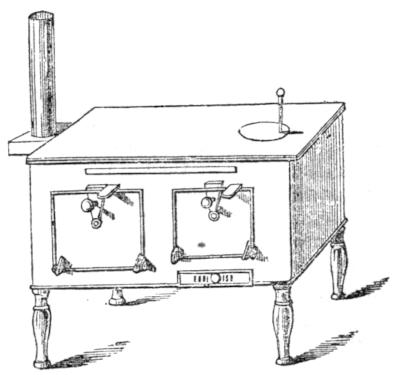
Fig. 1.
Those who object to a stove of this character, preferring a range, even at a greater sacrifice of economy, should still be somewhat guided by correct principles in their selection; a range surrounded by iron is an absurdity, as the metal conducts away the heat rapidly; it should be backed and lined with fire-brick or Welsh lumps, which throw out the heat with great power. In an open fire-place, the active combustion is wanted in front for roasting, and there only should air enter the fire; in most ranges the air enters below, causing the greatest heat to be thrown upon the ashes. It may be thought that closing up the bottom would produce the same effect as allowing it to be choked up with ashes in a common grate, deadening the fire; this is not the case with a properly constructed range, backed with a slanting back of fire-clay; the ashes can be readily removed at the bottom, and from all the draught being in front, there is a bright fire at the place where it is required. The range in the Reform Club, which was erected by Messrs. Benham, under the direction of the late Sir Charles Barry, the architect of the new Houses of Parliament, is of this kind, and it is, perhaps, the finest in the world. Our common ranges are far too deep—the burning of such a mass of coal being useless. One of the best constructed ranges, of a small size, is Nicholson’s Cottage Range, that obtained the prize given by the Royal Agricultural Society; it is free from the objections raised above, and comprises an oven and boiler; is economical in price and efficient in use. Unlike the Cottager’s Stove, it is a fixture, requiring setting, and, therefore, is more a subject for the landlord’s than the tenant’s consideration. It may be seen in London at Pierce’s, in Jermyn Street. The improvements in the use of fuel have mainly arisen from philanthropic individuals directing their attention to improving the comfort of the working classes, and the improvements here made have been copied for the use of the wealthier class, by both the makers above named, as well as by others.
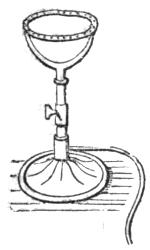
Fig. 2.
In situations where gas is to be obtained, it forms a ready, and, for some purposes, very economical means of obtaining heat; its economy does not arise from its cheapness compared with other means, but from the fact that it need not be lighted till the instant it is required, and can be as quickly extinguished when it has done its required duty; for heating any vessels containing liquids, especially if the heat is required to be only of short continuance, gas will be found extremely advantageous; a ring burner, constructed as shown in Fig. 2, less than three inches in diameter, will quickly boil a gallon of water in a metallic vessel; burners of this description are usually used in the laboratory, surrounded by a case made of sheet-iron or tinned plate, as Fig. 3; this serves to support the vessel to be heated, to steady the jets of flame, and to conduct every portion of hot air against the bottom; the door also gives a ready access to the burner for the purposes of lighting the gas.
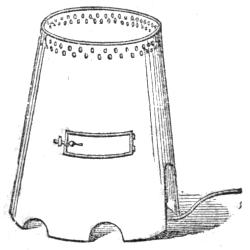
Fig. 3.
For the domestic use of gas in heating, we believe there is no contrivance so useful as the following:—A circular hole, from two to four or more inches in diameter, is cut in the dresser, through which is passed a sheet-iron tube, supported by three little elbows; this tube projects a few inches above the table, and about a foot and a half below; its lower end is open, and into it projects a gas pipe, furnished with a stop-cock; the upper extremity is covered with a sheet of wire gauze, similar to that used for blinds, on which, as shown in Fig. 4, may be placed some pieces of pumice-stone, surrounded and kept together by a broad ring—neither the pumice-stone nor the ring, however, are essential parts of the contrivance. The action of this arrangement is as follows:—When the gas is turned on it escapes from the pipe, rising through the tube, and mixing with the air contained within it; this mixture then escapes through the wire gauze, and may be lighted on its upper side, without passing through it to the gas below; the flame should be perfectly free from smoke, which indicates too much gas—should be pale, colourless, and not soil any bright metal placed in it; if the flame is in the slightest degree yellow it will do this, and then the gas should be partly turned off—on the contrary, if there is not enough gas, the flame will be extinguished. When lighted, the pumice becomes red-hot, and throws out a great heat; when used in boiling, the vessel should be supported a short distance over the flame by a trivet; if it is made to rest on the top of the ring, and is sufficiently large to close it entirely, the current is stopped and the flame extinguished, whilst the unburned gas still escapes below. This contrivance is most useful, it is lighted in an instant, is perfectly free from smoke, no unburned gas escapes, it throws out great heat, and may be employed to heat bright tools with much more convenience than a charcoal fire: the objections to its use are, that in burning it produces, as all gas does, a quantity of carbonic acid gas, deteriorating the air, and that the flame cannot be very much enlarged or diminished, so that if fires of different power are required, two or more of the contrivances must be put in order. Otherwise, the instantaneous action, small cost, great heating power, and cleanliness of the plan, strongly recommend it. In summer weather, in many small families, it can be made to dispense altogether with the use of a fire. By a little variation, the whole contrivance may be made to stand on the table like Fig. 2; in this and other cases, vulcanized India-rubber will be found to form by far the best kind of flexible tube, being quite impervious, very durable, and excessively pliant. Those who wish to try the experiment of heating on this plan, may readily do so by covering the top of the glass chimney of any common burner with a piece of wire gauze, folding it over the sides; the gas may then be turned on, and lighted above the gauze, after it has mingled with the air in the chimney; a small burner, however, does not afford sufficient gas for the purpose, and there is consequently too much air, and the flame is weak and liable to go out.
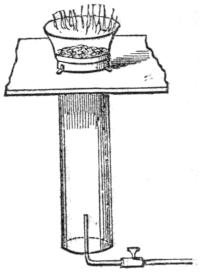
Fig. 4.
We cannot conclude this article on heat, without entering our most earnest protest against all those injurious contrivances for burning charcoal without a flue; the use of charcoal-braziers in a large kitchen is not to be recommended, but a charcoal stove in a dwelling-room is most objectionable. Charcoal, in burning, produces carbonic acid gas, an invisible and therefore insidious poison, which is so deadly in its effects, that if the air of a room contains but one-tenth of its bulk, the breathing of it for a short time is fatal. Every pound of charcoal, in burning, produces more than three pounds and a half of this deadly gas, and the ill effect of charcoal stoves may be readily imagined.