DOMESTIC MANIPULATION. (continued 2)
Reading edition
In Paris, in the years 1834 and 1835, there were 360 cases resulting from the fumes of charcoal, of which more than 260 were fatal. In order to test the effects of these stoves, Mr. Coathupe, of Wraxall, shut himself up in a close room containing eighty cubic yards of air, with one of them in action. In four hours he was seized with giddiness, which, in an hour’s time, became most intense; he then had the desire to vomit, but not the power; this was followed by an utter loss of strength, throbbing at the temples, and agonizing headache, but no sense of suffocation; finding that the experiment was becoming dangerous, he essayed to open the window, but had the greatest difficulty in so doing; and when his wife came into the room, he was found in a speechless state, in which he remained for some time.
In a fatal case, which happened in St. John’s Wood, where two girls were killed by the use of one of these stoves, the writer found, on investigation, that the quantity of carbonic acid produced was capable of rendering poisonous the air of a room ten times the size of the one in which it was used; and yet the maker is guilty, even to the present time, of the moral turpitude of recommending these as fitted for burning in a close room. Men who, knowing the poisonous effects of these stoves, still sell them, recommending them as wholesome, with the deliberate assertion that their prepared fuel, which is merely charcoal disguised, is not deleterious, evince a much more lively interest in the state of their own pockets, than in the lives of their customers.
Let it not be imagined that the case of Mr. Coathupe is only a solitary one; the action of burning charcoal is of the same deleterious nature on all persons. In January, 1836, seventy people suffered the same symptoms, though in a milder degree, in the church at Downham, in Norfolk, where two of these dangerous contrivances had been introduced: and in the Annales d’Hygéine, tome xi., will be found an account of the suicides in the department of the Seine in ten years, these were 4595 in number, of which 1426 deaths were produced by burning charcoal. We would again recommend our readers under no circumstances, however much they may be recommended by false assertions, to admit stoves without flues into their houses. In France, the deaths from charcoal have been mostly suicides, as, from their deadly effects, they are never used in close rooms. But in England, persons are often ignorant of the action of charcoal fumes, and relying on the word of some stove makers, whose “conscience,” as Milton says, “is their maw,” the numerous deaths have been chiefly those of innocent persons, victims to the cupidity of the makers.
X. CLEANING AND DISINFECTING.
In our previous papers on Domestic Manipulation, we have several times given directions as to the best mode of conducting processes for cleaning various articles, such as bottles, glass, &c. What remains, therefore, under this head, is to furnish hints for cleaning miscellaneous articles, which have not been included under previous accounts; and the very important process of disinfecting, which may be regarded as a medical cleaning, falls, naturally, into the same chapter. As the substances to be submitted to the process of cleaning vary greatly from one another, we shall find it more convenient to throw our remarks into the form of miscellaneous hints, than to arrange them in a chapter for consecutive reading.
Iron-Work which is exposed to wet, rusts rapidly; it is usually preserved from the action of moisture either by covering it with two or three coatings of paint, as is customary in large out-door works, or by brushing it over with a varnish termed Brunswick black; this plan is usually followed in the case of smaller substances used in-doors. A very superior plan of protecting small iron goods from the injurious action of wet, is to heat them a little below redness, and whilst hot to brush them over with common linseed oil, which is decomposed by the heat, and forms a thin, very firm coating of varnish, which is quite impervious to water, and unlike paint or Japan-black does not chip off. It is evident that this plan can only be adopted in a limited number of cases, but where it is available we very strongly recommend it.
Floor Boarding and other wood-work is exceedingly apt to be stained by various substances spilt upon it. Ink stains, for instance, are extremely obstinate; they withstand washing many times, and at last turn to a rusty iron colour, from the application of the alkali of the soap. Both the black stain of recent ink and the rusty iron-mould may be removed by the action of oxalic or muriatic acid. As wood is not likely to be injured like cloth or linen, muriatic acid may be used, being the cheaper, and it should be diluted with two or three times its bulk of water, and applied until the stain is removed. Grease which has been trodden in, or has remained a long time, should be first softened by the application of a little turpentine, and then it will be found to yield much more readily than it otherwise would to the action of fuller’s earth and pearlash or soda. Fruit stains are quickly removed by the action of a little chloride of lime, mixed with water, and applied until the desired effect is produced. It should be borne in mind that all vegetable colours are utterly destroyed beyond any restoration, by the energetic action of this agent.
Paint, when soiled, is readily cleaned by soap and water; soda and pearlash are frequently employed, but they act by removing a portion of the paint, and if not thoroughly washed off with clean water afterwards, they will be found to soften the whole. Caustic alkalies, such as the solution for washing on the new plan, will rapidly dissolve paint, and are therefore inapplicable for cleaning; they may, however, be usefully employed in removing paint from wood, where such an operation is requisite.
Plate may be cleaned by rouge, or if this is not readily obtained, by washed whiting; this is readily made by stirring some whiting up with water, then allowing the larger particles and the grit to subside, and pouring off the water charged with the finer powder, which is allowed to settle, and dried for use. When plate is very much stained, it may be cleaned with putty powder, but this preparation would soon wear away the silver if used frequently or unnecessarily. It may be mentioned, that this substance is not made from putty, as its name might seem to imply, but is a rust or oxide of tin, obtained by heating the metal.
Japanned Goods, such as tea-boards, should not have boiling water poured upon them, but should be washed with warm water, and polished with a piece of wash-leather and fine flour.
Knives.—The common wooden knife-board wears out the knives very rapidly, it is therefore much better to employ a piece of buff-leather to cover the board; for very superior cutlery emery powder should be used instead of Bath brick. Whatever the material of the board, it will be rapidly spoiled by cleaning the backs of knives upon the edge of the board; to prevent this evil, a small piece of leather should be fixed at one end to clean the backs upon. We have seen several knife-boards lately, covered with a material formed of India-rubber and powdered cork, which was manufactured as a substitute for floor-cloth, and sold under the name of kamptulicon; but we have had no experience in their use.
Steel Forks are readily cleaned by having a pot of damp moss or hay, with some sand intermixed, into which they may be repeatedly thrust. If knives or forks get an unpleasant taint which cannot be removed readily, they may be plunged into the mould of the garden, which has a very absorptive power, and rapidly removes such odours.
Bedsteads may be freed from vermin by brushing them over in the cracks with a mixture formed of one ounce of corrosive sublimate, dissolved in half a pint of oil of turpentine, and the same quantity of any spirit, such as strong gin or whisky; this effectually prevents their harbouring. But when first applied, it possesses a disagreeable odour from the turpentine, and great care must be taken with it as it is excessively poisonous, although from its disagreeable smell it is not likely to be swallowed accidentally. It has been found that the presence of the odour of creosote (in vessels which have been used in carrying railway sleepers prepared with this substance, to prevent their rotting) has effectually driven away these enemies to our nocturnal peace. Unfortunately, the odour of creosote is very powerful and unpleasant, but there may be cases in which it may be applicable. On the whole, constant and unremitting cleanliness, and the employment of iron bedsteads, which are now manufactured of the most elegant forms, are the best means of getting rid of these pests.
As stated in our first article, the operations of dusting, scrubbing, &c., though in strictness, Domestic Manipulations, hardly come within the limits of this series of papers; we pass on, therefore, to the more important operations of disinfecting. Various means have been proposed of lessening or utterly destroying the infectious emanations that proceed from persons in certain diseases, and which frequently have the power of attaching themselves with greater or less tenacity to such articles as wearing apparel, &c. Generally speaking, the presence of a good system of ventilation is sufficient to prevent taking any infection. When rooms are properly aired, a disease can seldom be caught more than a few feet from a patient; or even in the case of those most infectious disorders, scarlet fever and small-pox, it seldom spreads more than a few yards; but if the air of a room is confined, the infection is concentrated, and becomes much more certain in its action.
Downy and fibrous materials readily receive infection; it may, in fact, in many instances, be folded up in them, and so retained almost any length of time; but if they are thoroughly exposed to a free current of air, it is dissipated in a short time. It should be mentioned, that infectious diseases are more readily received in certain states of the body; thus, fear, timidity, mental anxiety; and such states of mind, by lowering the general tone of the system, render it much more liable to contract infectious or contagious diseases; a state of exhaustion from bodily fatigue, or from hunger, has the same tendency. Infection is also more readily received through the lungs than through the skin; therefore, it is important never to receive the breath of a patient, and, as a sailor would say, always keep to the windward side of him. Amongst the domestic disinfectants, vinegar has a great reputation, but undeservedly so; its only action is to overpower, by its odour, the smell of a sick-room—as a destroyer of the peculiar influences that engender disease, it has no power. Burning substances act in the same manner. Burnt brown paper, fumigating pastiles, tobacco, only act by substituting one smell for another. The ridiculous practice of carrying about a piece of camphor is very common, and is perfectly inefficacious. If it has any action at all, it must be an injurious one; for camphor is a stimulant, and its constant inhalation must tend to lower the system, and so produce the very evil it is supposed to remedy.
The best means of preventing infection, are ventilation and cleanliness in every particular. The best means of destroying it are those powerful chemical agents which have the power of uniting with the hydrogen which is supposed to form part of the infectious substances. Nitric acid gas, formed by pouring oil of vitriol on nitre or saltpetre, has been used; but though efficacious, it possesses several disadvantages, being irritating to the lungs, corrosive to metal-work, and also, when largely employed, very expensive.
The most powerful, easily controlled, and in every sense the best disinfectant, is chlorine gas. This agent at once destroys every trace of infection in all substances submitted to its action. Its formation is perfectly under control, and goes on in a gentle manner for days together, without requiring care or attendance. We consider that the slow liberation of chlorine is far superior to the employment of chloride of lime, which gives forth the gas in a modified form.
In our own experience, we have employed it to destroy various infections, and always with complete success. In one case of a school where scarlet fever had returned after several attempts at purification, and in the last instance with a fatal effect, we used chlorine, and effected the complete removal of every trace of the disease. Various modes of liberating chlorine are known to chemists; but, for such purposes as the present, where a slow, uniform, and constant action is required, there are none equal to the following plan:—One pound of common table-salt is to be intimately mixed by stirring with an equal weight of a substance called manganese, which may be readily obtained from any good chemist. Small portions of this mixture should be placed in shallow pans (the saucers of common flower-pots answer the purpose exceedingly well); and upon them should be poured a mixture of oil of vitriol (sulphuric acid) and water, the quantity required for the above weights, viz., for one pound of each ingredient, being two pounds of oil of vitriol and one of water, both by weight. These should have been previously mixed in a wooden vessel, being stirred by a wooden lath, and allowed to become cool before being poured on the salt and manganese, as the mixing of the acid and water generates great heat. Too much care cannot be taken with the acid, as it is excessively corrosive in its nature, and destroys most substances with which it comes in contact. When these materials are all mixed, chlorine is slowly evolved for a period of three or four days, and in so gentle a manner, that not the slightest irritating or unpleasant effect is produced. If it is wished to cause the more rapid production of gas, the saucer may be placed over a basin of boiling water, or upon a hot brick; but the slow generation for a considerable length of time is what should be more especially aimed at. It is needless to say, that all substances supposed to have been contaminated, should be spread out so as to receive the influence of the gas; the bed linen, and all woollen garments, being exposed by being spread out on chairs, lines, &c.; the drawers and cupboards opened; and whilst the disinfecting is in actual operation, the windows and doors should be kept shut, to prevent the dissipation of the chlorine. It is found that two ounces of manganese, with a proportionate quantity of the other materials, is sufficient for a room twenty feet wide, forty feet long, and twelve feet high, which contains 20 × 40 × 12 = 9600 cubic feet.
It may be mentioned, that breathing chlorine in this highly diluted state is decidedly the reverse of injurious to the general health; although, in a concentrated form, or even unless very much diluted with air, it is irritating in the highest degree; but so very innoxious is it in the very dilute state, that it is occasionally prescribed for the inhalation of consumptive patients.
For the satisfaction of those who rely on the authority of a great name, it may be stated, that chlorine used in the manner here recommended was employed, with complete success, by one of the most illustrious of our English chemists, in the case of the Millbank Penitentiary, when a violent and fatal disease broke out there. The operator in this case was Faraday, than whom there can be no higher authority.
It may occasionally be found more convenient to use another mixture for the liberation of chlorine gas, in which case the following may be employed:—One part of manganese is to be drenched with four parts, by weight, of muriatic acid (the spirits of salts of the shops), mixed with one part of water. The gas is evolved slowly in the cold, and rapidly if assisted by a gentle heat. This process is rather more expensive, and possesses no advantage over the one previously described.
XI. FERMENTING AND DISTILLING.
In ordinary language, the term fermentation is employed to signify the peculiar changes which take place when a solution of sugar, or any vegetable substance containing saccharine matter, is converted into spirit—this, however, is only one of many such kinds of action, which are well known to chemists. The most important fermentations are the saccharine fermentation, when sugar is formed by a change taking place in starch: the vinous, when spirit is formed from sugar; and the acetous, in which vinegar or acetic acid is formed from spirit.
The saccharine fermentation, or the formation of sugar from starch, is interesting, though it does not influence such operations as are included in our Domestic Manipulations. If starch is dissolved in water, a little wheat flour added, and the whole exposed to a moderately warm temperature, it will be found that after a few days, varying in number with the degree of warmth, the starch has disappeared, and the liquid has become sweet, from the formation of sugar. The same change takes place with much greater rapidity, if starch is boiled with a solution of malt, which contains an active principle called diastase, capable of bringing about this fermentation in a short time. The formation of sugar from starch is an operation which constantly occurs in all growing seeds, the effect being to change an insoluble substance such as starch, into one which is capable of being dissolved in the juices of the young plant, and nourishing it during the early stages of its growth. In the operation of malting barley, the change is induced artificially, for the purpose of producing sugar in the malt, which is afterwards made to undergo the second kind of fermentation, namely, the vinous, or that in which spirit is produced.
When sugar, either that which naturally exists in many plants, or as formed from starch as just mentioned, is dissolved in water, so as to form a moderately weak solution, and the whole exposed to a degree of warmth varying from seventy to eighty degrees, it rapidly undergoes a remarkable change, provided a small quantity of any vegetable ferment is present—such as yeast, or the juice of the grape or of many other fruits. The sugar wholly disappears, and is resolved into two substances—one a gas, termed carbonic acid, which escapes giving rise to a slow effervescence; and the other, a portion of spirit, which remains in the liquid. This kind of fermentation is much more difficult to prevent than to establish; in making syrups, it is found specially annoying; for if the quantity of sugar used is too small, the syrup is certain to ferment and spoil; and if too much is added, it crystallizes out in the solid form; as a general rule, however, it is found that two parts, by weight, of sugar, to one part, by weight, of water or other liquid—such as the juice of fruits, made into a syrup by boiling for a short time—neither ferments nor crystallizes.
In the act of fermentation the spirit produced by the process last described is changed into acetic acid, or vinegar. Here, also, the presence of some substance capable of commencing the fermentation is requisite, for pure spirit and water will not undergo the change. The ferment employed may be the vinegar-plant—or it may be a little vinegar, which may have been previously formed.
For the rapid progress of the acetous fermentation, a high temperature is requisite, even as great as about eighty-six degrees, and free exposure to air is essential. The best vinegar is that made from weak wine, at Orleans; the plan followed is to introduce a portion of vinegar into the vessels, adding the wine at intervals, and never quite emptying them. In this country, a weak beer is brewed, without hops, for the purpose of making vinegar, and a small quantity of diluted oil of vitriol is added, after the vinegar is formed, to destroy the mouldiness that is otherwise apt to be present. Vinegar may be formed from any weak spirituous liquid; but it should be borne in mind that two circumstances are essential to success, namely, a high summer temperature, either natural or artificial, and free exposure to air.
The process of distillation is one which is used for separating liquids from each other which boil at different degrees of heat. In domestic economy, it is most frequently employed to obtain spirit, more or less flavoured, or scented, with some volatile essential oil. The apparatus commonly used is the still, for boiling the liquid to generate the vapour, and a long spirally-twisted tube termed the worm, which is placed in a tub of cold water, and through which the steam passes to be condensed. The worm is the most objectionable part of the modern still; its great evil is the difficulty with which it is cleaned, so as to prevent one strong-flavoured substance spoiling those which are distilled afterwards. If the coils of the worm are not very numerous, a bullet, with a string attached, may be passed through it, and a sponge or small bottle-brush, fastened to the string, may be worked backwards and forwards; but if there are several coils, it will be found impossible to do this, from the resistance caused by friction. In this case, the only plan is to close one end of the worm with a cork, and fill it with a solution of caustic alkali, allowing it to remain for some hours, and repeating the application with fresh liquid, if it be required.
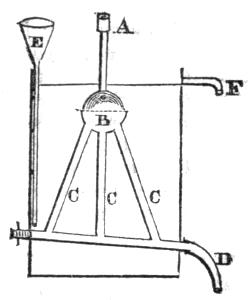
Fig. 1.
In Germany, the worm is being superseded by an excellent condenser, which is so superior that we are induced to give a sketch of it, hoping that it may lead to its adoption in this country. The vapours from the still pass into the tube A (Fig. 1), by which they are conducted into B, a hollow globe, made to unscrew at its centre. The vapours, passing along the tube C, are condensed, and the distilled liquid drops from D. The pipe E should convey a constant stream of cold water to the bottom of the tub, and this, rising as it is warmed by extracting heat from the tubes and globe, should escape by F. All the tubes being straight, it is obvious that they can be readily cleaned from their ends.
In the laboratory, distilling is most frequently performed with vessels termed retorts, or even from flasks; but as these are not very applicable to domestic purposes, we pass them over.
In domestic practice, the still is usually employed to obtain some water or spirit flavoured with essential oil, or the oil itself, and the process should be slightly modified so as to suit each case. The vegetable substance should not be placed on the bottom of the still itself, as in that case it might become burnt, and so give an unpleasant flavour to the whole; but a bottom of wickerwork should be placed in the still in the first instance for it to rest upon, or a perforated board. The substance to be distilled should be placed in the still, covered with water, for some hours before the fire is lighted; no more water being added than sufficient to cover it, if the preparation of oil is the object.
Herbs, for distilling, should be collected on a dry day, and—unless the oil resides in the seeds, as in the case of caraway, anise, &c., or in the flowers, as in the rose, lavender, &c.—just before the flowers have opened, as at that period there is the greatest quantity of essential oil in the plant. All plants cultivated for distillation, should be grown in a situation where they can receive a full amount of sun-light, as shade or darkness very much tend to prevent the formation of essential oil.
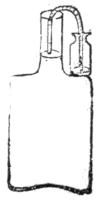
Fig. 2.
The liquid which comes out of the worm, is a mixture of water highly flavoured with the substance, and some undissolved oil; this latter is sometimes heavier and sometimes lighter than water, either sinking or floating; in the latter case, the oil may be readily separated by filling a bottle with the mixture, and when the oil has collected at the top, carrying it off by a few threads of cotton placed as in Fig. 2, taking care that they are moistened with oil before arranging them. The cotton acts as a syphon, and removes the whole of the oil. If the object of the operation is to obtain the oil, and not the distilled water, the latter should be preserved, and used again and again with fresh herbs, because having in the first operation dissolved up as much oil as it is capable of doing, it causes no loss to the subsequent distillations.
It may, perhaps, be thought that our article is incomplete, from our not giving any particular directions as to the manufacture of spirits, both as regards the first fermentation and subsequent distillation; but our readers should bear in mind that the manufacture of spirit is illegal, and the result is most frequently a heavy fine and imprisonment, to which we have no wish that our articles should be introductory.
HOUSEHOLD RECEIPTS.—CLEANING, DYEING, RENOVATING, MENDING, PRESERVING, ETC.
Blacking to Preserve Leather.—Take spermaceti oil, four ounces; molasses, twelve ounces; mix. Add by degrees twelve ounces of ivory-black, mixing it in smoothly, and rubbing it well, so as to leave no lumps; then add gradually a quart of the best white-wine vinegar. If too thick, add more vinegar; stir it hard, and let it stand in the jar three days, stirring frequently with a round stick. Bottle it for use. If still too thick, even when warmed at the fire, dilute with a little more vinegar.—A. S.
Blacking for Dress Boots and Shoes.—Gum arabic, eight ounces; treacle, two ounces; ink, half a pint; vinegar and spirit of wine, of each two ounces. Dissolve the gum and treacle in the ink and vinegar; then strain and add the spirit.
French Polish for Boots, Shoes, and Harness.—Take two pints of the best vinegar and one pint of soft water; stir into the mixture a quarter of a pound of glue broken fine, half a pound of logwood chips, a quarter of an ounce of finely powdered indigo, a quarter of an ounce of the best soft soap, and a quarter of an ounce of isinglass. Boil for ten minutes or longer; then strain the liquid, bottle, and cork. When cold it is fit for use. Remove the dirt from the boots, &c., with a sponge and water. Then lay on the polish with a clean sponge. Should it prove too thick, hold it near the fire to warm a little, and the heat will liquify it sufficiently.—J. M.
To detect Dampness in Beds.—First have the bed well warmed with a warming-pan; then, the moment the pan is taken out, introduce between the sheets an inverted glass tumbler. After it has remained there a few minutes, withdraw it. If the glass is found dry, you may go to bed without any apprehension of chill or rheumatism. If the glass is covered with drops of wet or damp steam, the safest plan is to take off the sheets and sleep between the blankets, as a second pair would probably be no better than the first.
Expelling Insects Generally.—All insects dislike penny-royal; the odour of it destroys some and drives away others. At seasons when fresh green bunches of penny-royal are not to be obtained, get oil of penny-royal, pour some into a saucer, and steep in it small bits of wadding or raw cotton; lay them about in corners, closet-shelves, bureau-drawers, boxes, and all places where you have seen cockroaches or ants, or wherever they are likely to be found. If the insects do not speedily disappear, renew the cotton and penny-royal. It is also well to place some of them about the bedsteads, between the sacking and the mattress. Bunches of penny-royal are excellent for brushing off that very annoying little insect, the seed tick.—H. S. C.
To destroy Bed Bugs effectually.—Take two ounces of quicksilver, and the whites of two eggs, and so on in this ratio for a larger or smaller quantity. Beat the quicksilver and the whites together until they unite and become a froth. With a feather then apply the compound thus formed to the crevices and holes in your bedsteads. This done once or twice in a year will prove effectual.—J. M.
Poison For Bugs.—Spirits of wine and spirits of turpentine, of each four ounces; white mercury and camphor, of each half an ounce: mix. A chemist will make it up; and it must be applied with a brush to the bedstead or box infested by the insects.—J. D.
To make Bottles Air-tight.—This may be done without luting or grinding, and consists in only having a groove round the neck, into which the cap fits, so that the groove may be charged with water or mercury.
To Bottle Porter.—To four gallons of porter take three-quarters of a pound of coarse sugar, boil it in three quarts of water five minutes, when cool, add a tea-cup of fresh yeast. Let it work till it creams over, then put the porter to it, and bottle off.—Mrs. H.
To make Glue that will resist Moisture.—Dissolve gum sandarac and mastic, of each two ounces, in a pint of spirit of wine, adding about an ounce of clear turpentine. Then take equal parts of isinglass and parchment glue, and having beaten the isinglass into small bits, and reduced the glue to the same state, pour the solution of the gums upon them, and melt the whole in a vessel well covered, avoiding so great a heat as that of boiling water. When melted, strain the glue through a coarse linen cloth, and then put it again over the fire, adding about an ounce of powdered glass. This preparation may be best managed by hanging the vessel in boiling water, which will prevent the matter burning the vessel, or the spirit of wine from taking fire; and, indeed, it is better to use the same method for all the evaporations of nicer glues and sizes; but in such cases, less water than the proportion directed should be added to the materials.—J. M.
Cement for Iron Kitchen Utensils.—Take six parts of potter’s clay, and one part of steel filings, mix them together with a sufficient quantity of linseed oil to make a thick paste of the consistence of glazier’s putty; then apply it to the cracked parts, on both sides, and let it stand three or four weeks undisturbed.
Japanese Cement.—This cement is made by mixing rice flour intimately with cold water, and then gently boiling it; it is beautifully white, and dries almost transparent. Papers pasted together by means of this cement, will sooner separate in their own substance than at the joining.
Rice Glue.—Mix rice flour intimately with cold water, and gently simmer over a fire, when it forms a delicate and durable cement, answering all the purposes of common paste, and admirably adapted for joining paper, card, &c., in forming the various ornaments which afford employment and amusement to the ladies. When made of the consistence of plaster or clay, models, busts, &c., may be formed; and the articles, when dry, are susceptible of high polish, and are very durable.—W. C. C.
To Mend Broken Glass.—Get some cloves of garlic, tie them in a rag, and place them in a tin pan, pounding them with a hammer, to get out the juice. Next take the broken glass, and wet and smear each of the broken edges with the garlic-juice; then stick them firmly together, stand the article on a plate, and let it remain undisturbed for a fortnight. The broken lid of a pitcher can also be mended in this manner.—J. W.
Another Method of Uniting Broken Glass or China.—T. S. L. N. communicates the following, which he has tried with great success:—Obtain some slaked lime, and put it in a small muslin bag; next get the white of an egg; rub the pieces that require mending with it, then dust some lime upon it, and hold together till it sticks; let it dry, and it will not be liable to be softened by heat.
Cement for China, Glass, etc.—To a quarter of an ounce of gum mastic, add as much spirits of wine as will dissolve it. Soak a quarter of an ounce of isinglass in water till it is quite soft; then dissolve it in rum or brandy till of the consistency of glue. To this add one drachm of gum ammoniac, well rubbed and mixed. Put now the two mixtures together in a vessel, over a gentle heat, till properly united, and the cement is ready for use. It should be kept in a phial well corked, and when about to be used, to be set in boiling water to soften.
Receipt for Joining Glass.—Melt a little isinglass in spirits of wine, and add a small quantity of water; warm the mixture gently over a moderate fire. When mixed by thoroughly melting, it will form glue perfectly transparent, which will re-unite broken glass so nicely and firmly, that the joining will scarcely be perceptible to the most critical eye. Lime, mixed with the white of an egg, forms a very strong cement for glass, porcelain, &c., but it must be done neatly, as, when hard, the superfluous part cannot easily be smoothed or taken off.—Scientific American.
How to Make Nice Candles.—Candlewick, if steeped in lime and saltpetre, and dried in the sun, will give a clearer light, and be less apt to run. Good candles may be made thus: Melt together ten ounces of mutton tallow, a quarter of an ounce of camphor, four ounces of bees’ wax, and two ounces of alum; then run it into moulds, or dip the candles. These candles furnish a beautiful light.—T. L.
Plain Hints about Candles.—Candles improve by keeping a few months. Those made in winter are the best. The most economical, as well as the most convenient plan, is to purchase them by the box, keeping them always in a cool dry place. If wax candles become discoloured or soiled, they may be restored by rubbing them over with a clean flannel slightly dipped in spirits of wine. Candles are sometimes difficult to light. They will ignite instantly if, when preparing them for the evening, you dip the top in spirits of wine, shortly before they are wanted. Light them always with a match, and do not hold them to the fire, as that will cause the tops to melt and drip. Always hold the match to the side of the wick, and not over the top. If you find the candles too small for the candlesticks, always wrap a small piece of white paper round the bottom end, not allowing the paper to appear above the socket. Cut the wicks to a convenient length for lighting (nearly close); for if the wick is too long at the top, it will be very difficult to ignite, and will also bend down, and set the candle to running. Glass receivers, for the droppings of candles, are very convenient, as well as ornamental. The pieces of candles that are left each evening, should be placed in a tin box kept for that purpose, and used for bed-lights.
Chimneys on Fire may be readily extinguished in several ways, without having recourse to throwing water down them from the top, by which much damage is frequently done to the furniture in the rooms. One of the simplest methods is, to scatter a handful of flour of sulphur over the dullest part of the burning coals, the mephitic vapours arising from which will not support combustion, and consequently extinguish the flames. Another method is to shut the doors and windows, and to stop up the bottom of the chimney with a piece of wet carpet or blanket, throwing a little water or flour of sulphur, or salt, on the fire immediately before doing so. By this means the draught is stopped, and the burning soot must be extinguished for want of air. If the chimney be stopped at top, instead of the bottom, the whole of the smoke must, of course, be driven into the apartment. If every fire-place were provided with a damper or shutter, of sheet-iron or tin-plate, sufficiently large to choke it thoroughly, fires in chimneys would become of little consequence, as it would only be necessary to apply this damper to put them out.
Cure for Smoky Chimneys.—“Some of your readers, Mr. Editor, may probably like to know how I have cured, in my own house, that worst of evils—a smoky chimney. The following is the plan I recommend: Inflate a large ox bladder with air, and tie it by the neck to the middle of a stick, which place across the inside of a chimney, about two feet from the top, or at the foot of the chimney-pot. The buoyancy of the air keeps the bladder continually in a circular motion, and thus prevents the rush of air into the tunnel from descending so low as the fire-place.”—S. W. T.
Excellent Dyes.—A decoction of oak-bark dyes wool a fast brown of various shades, according to the quantity employed; an infusion of walnut-peels will also dye brown. The wool should be previously dipped in a solution of alum and water, which brightens the colour.—For red dye: boil in a bath of madder, previously rinsing the goods in alum; or, if you wish for purple, employ, instead of alum, a bath of acetate of iron. Red dyes are also given by archil, cochineal, Brazil-wood, &c.—For blue dye: boil in a bath of logwood, to which a small quantity of blue vitriol has been added, using the alum bath as in the other cases.—M. C.
To Dye Silk Lilac.—For every pound of silk, take a pound and a half of archil, mix it well with the liquor; make it boil a quarter of an hour, dip the silk quickly, then let it cool, and wash it in river water, and a fine half violet, or lilac, more or less full, will be obtained.
Dyes for Ivory.—Black. Immerse the ivory in a boiling solution of logwood, take it out and wash it in a solution of copperas. Blue. Immerse the ivory in a mixture of sulphate of indigo and water, partly neutralized with potash. Green. Steep blued ivory in a solution of nitro-muriate of tin, and then in a decoction of fustic; or it may be at once dyed green by steeping it in a solution of acetate of copper. Yellow. Steep the ivory in a bath of neutral chromate of potash, and afterwards in a boiling solution of acetate of lead. Red. Steep the ivory for a short time in a solution of tin, then in a decoction of Brazil or cochineal. Violet. Moisten the ivory with a solution of tin, as before, then immerse it in a decoction of logwood.—T. S.
To Dye Hair and Feathers Green.—Take of verdigris or verditer of each one ounce, gum water one pint; mix them well, and dip the hair or feathers into the mixture, shaking them well about.
To Shrink new Flannel.—New flannel should always be shrunk or washed before it is made up, that it may be cut out more accurately, and that the grease which is used in manufacturing it may be extracted. First, cut off the list along the selvage edges of the whole piece. Then put it into warm (not boiling) water, without soap. Begin at one end of the piece, and rub it with both hands till you come to the other end; this is to get out the grease and the blue with which new white flannel is always tinged. Then do the same through another water. Rinse it through a clean lukewarm water; wring it lengthways, and stretch it well. In hanging it out on a line do not suspend it in festoons, but spread it along the line straight and lengthways. If dried in festoons, the edges will be in great scollops, making it very difficult to cut out. It must be dried in the sun. When dry let it be stretched even, clapped with the hands, and rolled up tight and smoothly, till wanted.—H. S. C.
To Pack Glass or China.—Procure some soft straw or hay to pack them in, and if they are to be sent a long way, and are heavy, the hay or straw should be a little damp, which will prevent them slipping about. Let the largest and heaviest things be always put undermost in the box or hamper. Let there be plenty of straw, and pack the articles tight; but never attempt to pack up glass or china which is of much consequence, till it has been seen done by some one used to the job. The expense will be but trifling to have a person to do it who understands it, and the loss may be great if articles of such value are packed up in an improper manner.—S.
Ink.—H. W. begs to recommend the following ink—with which his note is written: Logwood and galls, each four ounces; copperas, two ounces; gum arabic, one ounce; pomegranate bark, half an ounce; cloves, four ounces; cold soft water, two pints: stir frequently, for two weeks or more, and strain.—[The ink is good.—Ed.]
Black Ink.—To one gallon of soft water, add ten ounces of Aleppo galls, and four ounces each of gum arabic and green copperas. Well bruise the galls, and allow the mixture to stand for a fortnight, being well stirred every day. Then add two ounces of white sugar.
Blue Ink.—Prussiate of iron, half an ounce; oxalic acid, one ounce; fine chalk, a quarter of a drachm. All to be powdered, and dissolved with one pint of boiling water.—S.
To make Blue Ink.—Dissolve a small quantity of indigo in a little oil of vitriol, and add a sufficient quantity of water, in which is dissolved some gum arabic.
Indian Ink.—Indian ink, equal in quality to that imported from China, may be made by holding a plate over the flame of a lamp or candle so as to receive the fine soot, and mixing this with size made from parchment or uncoloured leather. The Indian ink is made from fine lamp-black and size, with the addition of a little perfume, which latter is by no means essential to its quality as an ink.—J. W.
Indelible Marking Ink, without Preparation.—One drachm and a half of nitrate of silver (lunar caustic), one ounce of distilled water, half an ounce of strong mucilage of gum arabic, three-quarters of a drachm of liquid ammonia; mix the above in a clean glass bottle, cork tightly and keep in a dark place till dissolved, and ever afterwards. Directions for use:—Shake the bottle, then dip a clean quill pen in the ink, and write or draw what you require on the article; immediately hold it close to the fire (without scorching), or pass a hot iron over it, and it will become a deep and indelible black, indestructible by either time or acids of any description.—R. S.
Incorrodible and Indelible Inks.—Genuine asphaltum, one part; oil of turpentine, four parts; dissolve, and add lamp-black or black-lead to bring it to a proper consistence. Or—Asphaltum, one part; oil of turpentine, four parts; dissolve, and colour with printer’s ink, which any printer will sell by way of favour. These inks supply a cheap and excellent material for marking linen, &c. They are very permanent. They should be employed with stamps or types, or with the thin brass plates with letters cut therein. This method of marking is neater and easier than with the brush or pen.
Sympathetic Inks.—These are preparations used for writing on paper, the marks of which are invisible until acted upon by some re-agent. They are frequently employed in secret or playful correspondence. By heating the paper until it is nearly scorched, they may be rendered visible.
1. Sulphate of copper and sal-ammoniac, equal parts, dissolved in water—writes colourless, but turns yellow when heated.
2. Onion juice, like the last.
3. A weak infusion of galls—turns black when moistened with weak copperas water.
4. A weak solution of sulphate of iron—turns blue when moistened with a weak solution of prussiate of potash—black with infusion of galls.
5. The diluted solutions of nitrate of silver and terchloride of gold—darken when exposed to the sun-light.
6. Aqua-fortis, spirits of salts, oil of vitriol, common salt, or saltpetre, dissolved in a large quantity of water—turn yellow or brown when heated.
7. Solution of nitro-muriate of cobalt—turns green when heated, and disappears again on cooling.
8. Solution of acetate of cobalt, to which a little nitre has been added—becomes rose-coloured when heated, and disappears when cooling.
Stains of Wood.—The most effectual way of removing stains of most descriptions from wood, is to mix a quarter of an ounce of oil of vitriol with two ounces of water, and rub the stained surface with a cork dipped in this liquid, until the stains disappear: then wash with cold water. The colour of the wood is rendered pale for a time by this method, but it is brought up again by rubbing with furniture paste.
To take Oil and Grease out of Boards, Marble, etc.—Make a paste with fuller’s earth and hot water; cover the spots therewith, let it dry on, and the next day scour it off with soft or yellow soap. Or—Make a paste with soft soap, fuller’s earth, and a little pearlash, and use it as above.
For Cleaning Wainscots and other Painted Woods.—Four ounces of potass, and four ounces of powdered quick-lime are to be mixed together, and boiled for half an hour in three quarts of water; this mixture is to stand until it is cold and quite clear; the clear liquid is then poured off, and a painter’s brush dipped into it is to be passed over the surface of the wood, in the same way as for painting, immediately afterwards washing with cold water. This mode of cleaning will frequently render a new coat of paint unnecessary, and it has the advantage of being destructive to the eggs of insects which may be deposited in the interstices of the wood; where there is reason to suspect that there are bugs in the wood, it may be well, as an additional precaution, to add to the mixture two drachms of corrosive sublimate.
Chairs.—The black leather-work of chairs, settees, &c., may be restored by first well washing off the dirt with a little warm water and soap, and afterwards with clean water. The brown and faded portions may now be re-stained by means of a little black ink, or preferably black reviver, and when this has got thoroughly dry, they may be touched over with white of egg, strained and mixed with a little sugar-candy. When the latter is nearly dry, it should be polished off with a clean dry brush.
Washing-Paint.—The best method to wash paint is to rub some Bath brick fine, and when you have rubbed some soap on the flannel, dip it in the brick. This will remove the grease and dirt speedily, without injury.—Mrs. H.
To make Oak Wood Colour.—The basis of this colour is still formed of ceruse. Three-fourths of this oxide, and a fourth of ochre de rue, umber earth, and yellow de Berri; the last three ingredients being employed in proportions which lead to the required tint, give a matter equally proper for distemper, varnish, and oil.—A. S.
To give a fine Colour to Mahogany.—Into a pint of cold-drawn linseed oil put one ounce of alkanet root, and one ounce of rose-pink in an earthen vessel; let it remain all night; then stirring it well, rub some of it over the tables with a linen rag; when it has lain some time rub it with a linen cloth.—R. M.
Artificial Mahogany.—The following method of giving any species of wood of a close grain the appearance of mahogany in texture, density, and polish, is said to be practised in France with success. The surface is planed smooth, and the wood is then rubbed with a solution of nitrous acid; one ounce of dragon’s blood is dissolved in nearly a pint of spirits of wine; this, and one-third of an ounce of carbonate of soda, are then to be mixed together and filtered, and the liquid in this thin state is to be laid on with a soft brush. This process is to be repeated, and in a short interval afterwards the wood possesses the external appearance of mahogany. When the polish diminishes in brilliancy, it may be restored by the use of a little cold-drawn linseed oil.—J. R. C.
To extract Ink from Mahogany.—Dilute half a tea-spoonful of oil of vitriol with a large spoonful of water, and apply to the ink spot with a feather; let it lie for a few minutes and rub it off quickly; repeat if not quite removed. An excellent receipt.—F.
To restore the Colour to Mahogany.—Wash well with soap and water, and then polish daily with the following oil:—Take half an ounce of alkanet root, cut small, and add to a pint of linseed oil: when this has stood for a week, add half an ounce of powdered gum arabic, and an ounce of shell-lac varnish; let these stand in a bottle by the fire for a week, then strain. Rub well in.
Wax for Polishing Furniture.—Melt bees’ wax in spirits of turpentine, with a very small proportion of resin. When it is entirely dissolved, dip in it a sponge, and wash the mahogany lightly over with it. Immediately afterwards, rub it off with a clean soft cloth. For carved furniture, spread the mixture on with a small soft brush, and rub it off with another brush, a very little harder.
Cream Polish for Furniture.—Half an ounce of Castile soap, dissolved in one gill of rain water, two ounces and a half of bees’ wax, one ounce of white wax, one gill of spirit of turpentine; shred the wax, and place the whole by the fire to dissolve; whilst warm add the soap and mix all well together.—J. H. D.
Method of giving a fine Black Colour to Wood.—Steep the wood for two or three days in lukewarm water, in which a little alum has been dissolved; then put a handful of logwood, cut small into a pint of water, and boil it down to less than half a pint. If you then add a little indigo, the colour will be more beautiful. Spread a layer of this liquor quite hot on your wood, with a pencil, which will give it a violet colour. When it is dry, spread on another layer; dry it again, and give it a third; then boil verdigris at discretion, in its own vinegar, and spread a layer of it on the wood; when it is dry, rub it with a brush, and then with oiled chamois skin. This gives a fine black, and imitates perfectly the colour of ebony. Having tried this receipt successfully, I can recommend it to the notice of your numerous readers.—E.
Black Dye for Woods, Veneers, etc.—Steep the wood for two or three days, in water, if possible, keeping it warm all the time, the water having had a little alum dissolved in it so that it tastes rough; then put a handful of logwood, cut small, into a pint of water and boil it down to less than half a pint; if a little indigo is added the colour will be more beautiful. Spread a layer of this liquor quite hot on the wood with a brush, which will give it a violet colour. When dry spread on another layer, dry it again and give it a third, then boil verdigris at discretion in vinegar, and spread a layer of it on the wood; when it is dry, rub with a brush, and then with oiled chamois skin. This forms a good imitation of ebony wood.—W. C.
Hints on Scrubbing Floors.—After the white-washing, paint-cleaning, and window-washing of each room has been completed, let the floor be scrubbed; first seeing that it has been well swept. For this purpose have a small tub or bucket of warm water: an old saucer to hold a piece of brown soap, a large thick tow-linen floor-cloth, and a long-handled scrubbing-brush. Dip the whole of the floor-cloth into the water, and with it wet a portion of the floor. Next, rub some soap on the bristles of the brush, and scrub hard all over the wet place. Then dip your cloth into the water, and with it wash the suds off the floor. Wring the cloth, wet it again, and wipe the floor with it a second time. Lastly, wash the cloth about in the water, wring it as dry as possible, and give the floor a last and hard wiping with it. Afterwards go on to the next part of the floor, wet it, scrub it, wipe it three times, and proceed in the same manner, a piece, at a time, till you have gone over the whole; changing the dirty water for clean, whenever you find it necessary. For a large room, fresh warm water will be required four or five times in the course of the scrubbing. When the floor has been scrubbed, leave the sashes raised while it is drying. For scouring common floors that are very dirty, have by you an old tin pan with some gray sand in it; and after soaping the brush, rub it on some sand also.
Oil-Cloths.—In buying an oil-cloth for a floor, endeavour to obtain one that was manufactured several years before; as the longer it has been made previous to use, the better it will wear, from the paint becoming hard and durable. An oil-cloth that has been made within the year, is scarcely worth buying, as the paint will be defaced in a very little time, it requiring a long while to season. An oil-cloth should never be scrubbed with a brush; but, after being first swept, it should be cleaned by washing with a large soft cloth and lukewarm or cold water. On no account use soap, or take water that is hot; as either of them will certainly bring off the paint. When it has dried, you may sponge it over with milk, which will brighten and preserve the colours; and then wipe it with a soft dry cloth.—J. R.
To Renovate Black Silk.—Slice some uncooked potatoes, pour boiling water on them; when cold sponge the right side of the silk with it, and iron on the wrong.—E. H.
To make Old Silk Gowns look like New.—The best method, and one that is employed by milliners, is to sponge over the outside of the dress with a strong and cold infusion of black tea. The dress should afterwards be ironed on the wrong side.—K.
An excellent Yellow Dye for Silks, Ribbons, etc.—Take a large handful of horse-radish leaves, boil them in two quarts of water for half an hour; then drain it off from the leaves, and soak the articles you have for dyeing in it; when you think the colour deep enough, take it out, rinse it in cold water, and spread it to dry.—B. B.
To Iron Silk.—Silk cannot be ironed smoothly, so as to press out all the creases, without first sprinkling it with water, and rolling it up tightly in a towel, letting it rest for an hour or two. If the iron is in the least too hot, it will injure the colour, and it should first be tried on an old piece of the same silk.—C. C.
To Renovate Silks.—Sponge faded silks with warm water and soap; then rub them with a dry cloth on a flat board; afterwards iron them on the inside with a smoothing-iron. Old black silks may be improved by sponging with spirits. In this case, the ironing may be done on the right side, thin paper being spread over to prevent glazing.
To Dye Silk, etc., Crimson.—Take about a spoonful of cutbear, put it into a small pan, pour boiling water upon it; stir and let it stand a few minutes, then put in the silk, and turn it over in a short time, and when the colour is full enough, take it out; but if it should require more violet or crimson, add a spoonful or two of purple archil to some warm water; steep, and dry it within doors. To finish it, it must be mangled, and ought to be pressed.
Silks Stained by Corrosive or Sharp Liquors.—We often find that lemon-juice, vinegar, oil of vitriol, and other sharp corrosives, stain dyed garments; sometimes by adding a little pearlash to a soap lather, and passing the silks through these, the faded colour will be restored. Pearlash and warm water will sometimes do alone, but it is the most efficacious method to use the soap lather and pearlash together.
Chemical Renovating Balls—for taking out grease, paint, pitch tar, from silks, stuffs, linen, woollen, carpets, hats, coats, &c., without fading the colour or injuring the cloth:—Quarter ounce of fuller’s earth, quarter ounce of pipe-clay, one ounce salt of tartar, one ounce beef gall, one ounce spirits of wine. Pound the hard parts, and mix the ingredients well together. Wet the stain with cold water, rub it well with this ball, then sponge it with a wet sponge, and the stain will disappear.
To Clean Silks, Satins, Coloured Woollen Dresses, etc.—Quarter pound of soft soap, a quarter of a pound of honey, the white of an egg, and a wine-glassful of gin; mix well together, and the article to be scoured with a rather hard brush thoroughly, afterwards rinse it in cold water, leave to drain, and iron whilst quite damp.—Mrs. J. D. R. remarks that she finds this receipt an excellent one, having used it for a length of time, and recommended it to friends, with perfect success.
To Clean White Satin and Flowered Silks.—1. Mix sifted stale bread crumbs with powder blue, and rub it thoroughly all over, then shake it well, and dust it with clean soft cloths. Afterwards, where there are any gold or silver flowers, take a piece of crimson ingrain velvet, rub the flowers with it, which will restore them to their original lustre.—2. Pass them through a solution of fine hard soap, at a hand heat, drawing them through the hand. Rinse in lukewarm water, dry and finish by pinning out. Brush the flossy or bright side with a clean clothes-brush, the way of the nap. Finish them by dipping a sponge into a size, made by boiling isinglass in water, and rub the wrong side. Rinse out a second time, and brush, and dry near a fire, or in a warm room. Silks may be treated in the same way, but not brushed.—M.
To Smooth a Creased or Rumpled Ribbon.—Lay the ribbon evenly on a clean table or board, and, with a very clean sponge, damp it all over, missing no part. Next, roll it, smoothly and tightly, on a ribbon-block that is wider than the ribbon, and let it remain till dry. Afterwards, transfer it to a fresh block (which must be perfectly dry), rolling it round that. Wrap it up closely in coarse brown paper, and keep it thus till you want to use it. Ironing a ribbon is apt to discolour it, and give it a faded look even when new. Ribbons, and other silks, should always be put away in coarse brown paper; the chloride of lime used in manufacturing white paper frequently produces spots and stains. Coarse brown paper, being made of old ropes picked to pieces, the tar still lingering about them, preserves the colours of the silks.—J. T.
To Clean Silk Stockings.—First wash the stockings in the usual manner, to take out the rough dirt. After rinsing them in clean water, wash them well in fresh soap liquor. Then make a third soap liquor, which colour with a little stone-blue; then wash the stockings once more, take them out, wring them, and particularly dry them. Now stove them with brimstone, and draw on a wooden leg two stockings, one upon the other, observing that the two fronts or outsides are face to face. Polish with a glass bottle. The two first liquors should be only lukewarm; but the third as hot as you can bear your hand in. Blondes and gauzes may be whitened in the same manner; but there should be a little gum put in the last liquor before they are stoved.—B. R.
To Keep Silk.—Silk articles should not be kept folded in white paper, as the chloride of lime used in bleaching the paper will probably impair the colour of the silk. Brown or blue paper is better—the yellowish smooth India paper is best of all. Silk intended for a dress, should not be kept in the house long before it is made up, as lying in the folds will have a tendency to impair its durability by causing it to cut or split, particularly if the silk has been thickened by gum. We knew an instance of a very elegant and costly thread lace veil being found, on its arrival from France, cut into squares (and, therefore, destroyed) by being folded over a paste-board card. A white satin dress should be pinned up in blue paper, with coarse brown paper outside, sewn together at the edges.—A. F.
To Wash Silk Lace or Blonde.—Take a black bottle, covered with clean linen or muslin, and wind the blonde round it (securing the ends with a needle and thread), not leaving the edge outward, but covering it as you proceed. Set the bottle upright in a strong cold lather of white soap and very clear soft water, and place it in the sun, having gently, with your hand, rubbed the suds up and down on the lace. Keep it in the sun every day for a week, changing the lather daily, and always rubbing it slightly when you renew the suds. At the end of the week, take the blonde off the bottle, and (without rinsing) pin it backward and forward on a large pillow covered with a clean tight case. Every scallop must have a separate pin, or more, if the scallops are not very small. The plain edge must be pinned down also, so as to make it straight and even. The pins should be of the smallest size. When quite dry, take it off; but do not starch, iron, or press it. Lay it in long loose folds, and put it away in a paste-board box. Thread lace may be washed in the same manner.—A. F.
To Wash Ribbons, Silk Handkerchiefs, etc.—None but ribbons of excellent quality, of one entire colour, and of a plain unfigured surface, will bear washing. A good satin ribbon may be made to look very well by washing it carefully, first in cold water, to which add a few drops of spirits of wine; then make a lather of white soap and lukewarm water, and wash the ribbon through that; afterwards rinse it in cold water, pull it even, and dry it gradually. When dry, stretch out the ribbon on an ironing-table (securing it to the cloth by pins), and sponge it evenly all over with a very weak solution of isinglass, that has been boiled in clear water and strained; or, if you have no isinglass, rice-water will be a tolerable substitute for restoring the stiffness and gloss. To iron the ribbon, lay it within a sheet of clean smooth letter paper (the paper being both under and over it), and press it with a heated iron moved quickly. If the colour is lilac, add a little dissolved pearlash to the rinsing water; if green, a little vinegar; if pink, or blue, a few drops of oil of vitriol; if yellow, a little tincture of saffron. Other colours may be set by stirring a tea-spoonful of ox-gall into the first water. If white, a salt-spoonful of cream of tartar, mixed with the soap-suds. It is seldom worth while to take the trouble of washing ribbon, unless you have a tolerable quantity to do. Unfigured silk handkerchiefs and scarfs may be washed and ironed in the above manner. The proportion of spirits of wine is about a table-spoonful to a gallon of water.—M. D.
To Clean Gold Lace.—Rub it with a soft brush, dipped in roche-alum, burnt and sifted to a very fine powder. I have tried this several times, and always found the lace brightened and improved by the method.—W. J. J.
To Clean Black Lace Veils.—These are cleansed by passing them through a warm liquor of bullock’s gall and water; after which, they must be rinsed in cold water, then cleansed for stiffening, and finished as follows:—Take a small piece of glue, about the size of a bean, pour boiling water upon it, which will dissolve it, and when dissolved, pass the veil through it, then clap it between your hands and frame.
To Wash a White Lace Veil.—Put the veil into a strong lather of white soap and very clear water, and let it simmer slowly for a quarter of an hour. Take it out and squeeze it well, but be sure not to rub it. Rinse it in two cold waters, with a drop or two of liquid blue in the last. Have ready some very clear and weak gum arabic water, or some thin starch, or rice-water. Pass the veil through it, and clear it by clapping. Then stretch it out even, and pin it to dry on a linen cloth, making the edge as straight as possible, opening out all the scallops, and fastening each with pins. When dry, lay a piece of thin muslin smoothly over it, and iron it on the wrong side.—M.
To Clean and Starch Point Lace.—Fix the lace in a prepared tent, draw it straight, make a warm lather of Castile soap, and, with a fine brush dipped in, rub over the point gently; and when it is clean on one side, do the same to the other; then throw some clean water on it, in which a little alum has been dissolved, to take off the suds, and, having some thin starch, go over with the same on the wrong side, and iron it on the same side when dry; then open it with a bodkin, and set it in order. To clean point lace, if not very dirty, without washing, fix it in a tent, as previously mentioned, and go over with fine bread, the crust being pared off; and when it is done, dust out the crumbs, &c.—J. H. M.
Washing Lace.—I have lately used the following method of washing lace, collars, or crochet collars, and find that it not only makes them look well, but saves much of the wear and tear of other washing:—Cover a glass bottle with calico or linen, and then tack the lace or collar smoothly upon it, rub it with soap, and cover it with calico. Boil it for twenty minutes in soft water; let all dry together, and the lace will be found to be ready for use. A long piece of lace must be wound round and round the bottle, the edge of each round a little above the last, and a few stitches to keep it firm at the beginning and end will be found sufficient, but a collar will require more tacking to keep it in its place.—G. N. L.
To Wash a Black Lace Veil.—Mix bullock’s gall with sufficient hot water to make it as warm as you can bear your hand in. Then pass the veil through it. It must be squeezed, and not rubbed. It will be well to perfume the gall with a little musk. Next, rinse the veil through two cold waters, tingeing the last with indigo. Then dry it. Have ready in a pan some stiffening made by pouring boiling water on a very small piece of glue. Put the veil into it, squeeze it out, stretch it, and clap it. Afterwards, pin it out to dry on a linen cloth, making it very straight and even, and taking care to open and pin the edge very nicely. When dry, iron it on the wrong side, having laid a linen cloth over the ironing-blanket. Any article of black lace may be washed in this manner.
To Clean Embroidery and Gold Lace.—For this purpose no alkaline liquors are to be used; for while they clean the gold, they corrode the silk, and change its colour. Soap also alters the shade, and even the species of certain colours. But spirit of wine may be used without any danger of its injuring either colour or quality; and, in many cases, proves as effectual for restoring the lustre of the gold as the corrosive detergents. But, though spirit of wine is the most innocent material employed for this purpose, it is not in all cases proper. The golden covering may be in some parts worn off; or the base metal with which it has been alloyed may be corroded by the air, so as to leave the particles of the gold disunited; while the silver underneath, tarnished to a yellow hue, may continue a tolerable colour to the whole, so it is apparent that the removal of the tarnish would be prejudicial, and make the lace or embroidery less like gold than it was before. It is necessary that care should be taken.—W. J. E.
To Wash Thread Lace.—Rip off the lace, carefully pick out the loose bits of thread, and roll the lace very smoothly and securely round a clean black bottle, previously covered with old white linen, sewn tightly on. Tack each end of the lace with a needle and thread, to keep it smooth; and be careful in wrapping not to crumple or fold in any of the scallops or pearlings. After it is on the bottle, take some of the best sweet oil, and with a clean sponge wet the lace thoroughly to the inmost folds. Have ready in a wash-kettle, a strong cold lather of clear water and white Castile soap. Fill the bottle with cold water, to prevent its bursting, cork it well, and stand it upright in the suds, with a string round the neck secured to the ears or handle of the kettle, to prevent its knocking about and breaking while over the fire. Let it boil in the suds for an hour or more, till the lace is clean and white all through. Drain off the suds, and dry it on the bottle in the sun. When dry, remove the lace from the bottle and roll it round a wide ribbon-block; or lay it in long folds, place it within a sheet of smooth white paper, and press it in a large book for a few days.—W. W. C.
Fruit Stains in Linen.—To remove them, rub the part on each side with yellow soap, then tie up a piece of pearlash in the cloth, &c., and soak well in hot water, or boil; afterwards expose the stained part to the sun and air until removed.—K.
To take the Mildew out of Linen.—Take soap, and rub it well; then scrape some fine chalk, and rub it also on the linen. Lay it on the grass. As it dries, wet it a little, and it will come out in twice doing.—F. E. W.
To take out Iron-moulds from Linen.—Rub the iron-moulds over with sulphuret of potash; then bathe them well in citric acid (lemon acid), and afterwards wash them well in water, and they will be completely restored.
To Bleach a Faded Dress.—Wash the dress in hot suds, and boil it until the colour appears to be gone; then rinse it and dry it in the sun. Should it not be rendered white by these means, lay the dress in the open air, and bleach it for several days. If still not quite white, repeat the boiling.
To Preserve the Colour of a Print Dress.—The body and train to be separated and washed in cold rain water, into which a handful of common salt has been thrown. Instead of spreading, it should be tightly rolled in a coarse cloth, and allowed to remain until dry enough to iron.—E.
To Restore Linen that has long been Stained.—Rub the stains on each side with wet brown soap; mix some starch to a thick paste, with cold water, and spread it over the soaped places; then expose the linen to the air, and if the stains have not disappeared in three or four days, rub off the mixture, and repeat the process with fresh soap and starch. Afterwards dry it, wet it with cold water, and put it in the wash.
To wash Mousseline-de-Laine.—Boil a pound of rice in five quarts of water, and, when cool enough, wash in this, using the rice for soap. Have another quantity ready, but strain the rice from this and use it with warm water, keeping the rice strained off for a third washing, which at the same time stiffens and also brightens the colours.—W.
To prevent Coloured Things from Running.—Boil a quarter of a pound of soap till nearly dissolved, then add a small piece of alum and boil with it. Wash the things in this lather, but do not soap them. If they require a second water, put alum to that also, as well as to the swilling and blue-water. This will preserve them.
Stain Mixture.—Take an ounce of sal-ammoniac (or hartshorn), and an ounce of salt of tartar—mix them well, put them into a pint of soft water, and bottle it for use, keeping it very tightly corked. Pour a little of this liquid into a saucer, and wash in it those parts of a white article that have been stained with ink, mildew, fruit, or red wine. When the stains have by this process been removed, wash the article in the usual manner.—M. C.
To Restore Scorched Linen.—Take two onions, peel and slice them, and extract the juice by squeezing or pounding. Then cut up half an ounce of white soap, and two ounces of fuller’s earth; mix with them the onion juice, and half a pint of vinegar. Boil this composition well, and spread it when cool, over the scorched part of the linen, leaving it to dry thereon. Afterwards wash out the linen.
To Whiten Linen that has turned Yellow.—Cut up a pound of fine white soap into a gallon of milk, and hang it over the fire in a wash-kettle. When the soap has entirely melted, put in the linen, and boil it half an hour. Then take it out; have ready a lather of soap and warm water; wash the linen in it and then rinse it through two cold waters, with a very little blue in the last.—J. W.
To take out Paint from a Dress.—After a paint-spot has dried, it is extremely difficult to remove it. When fresh (having wiped off as much as you can), it may be taken out by repeated applications of spirits of turpentine or of spirits of wine, rubbed with a soft rag or a flannel. Ether also will efface it, if applied immediately. If the paint has been allowed to harden, nothing will take it off but spirits of turpentine, rubbed on with perseverance.
To renew Scorched or Browned Linen.—This is an accident attributable entirely to the ignorance of the laundress, in not knowing how to regulate the heat of her irons. To remedy this:—Add to a quart of vinegar, the juice of half a dozen large onions, about an ounce of soap rasped down, a quarter of a pound of fuller’s earth, one ounce of lime, and one ounce of pearlash, or any other strong alkali. Boil the whole until it is pretty thick, and lay some of it on the scorched part, suffering it to dry. It will be found that, on repeating this process for one or two washings, the scorch will be completely removed from the linen without any additional damage; provided its texture has not been absolutely injured, as well as discoloured.—H. W.
To Remove Stains of Wine Or Fruit from Table-Linen.—A wine stain may sometimes be removed by rubbing it, while wet, with common salt. It is said, also, that sherry wine poured immediately on a place where port wine has been spilled, will prevent its leaving a stain. A certain way of extracting fruit or wine stains from table-linen is to tie up some cream of tartar in the stained part (so as to form a sort of bag), and then to put the linen into a lather of soap and cold water, and boil it awhile. Then transfer it wet to lukewarm suds, wash and rinse it well, and dry and iron it. The stains will disappear during the process. Another way, is to mix, in equal quantities, soft soap, slaked lime, and pearlash. Rub the stain with this preparation, and expose the linen to the sun with the mixture plastered on it. If necessary, repeat the application. As soon as the stain has disappeared, wash out the linen immediately, as it will be injured if the mixture is left in it.—E. D.
To Wash Chintz.—Many ladies will be glad to know how chintz may be washed so as to preserve its gloss and beauty. The following are the directions:—Take two pounds of rice, and boil it in two gallons of water till soft; when done, pour the whole into a tub: let it stand till about the warmth you in general use for coloured linens; then put the chintz in, and use the rice instead of soap; wash it in this till the dirt appears to be out; then boil the same quantity as above, but strain the rice from the water, and mix it in warm clear water. Wash in this till quite clean; afterwards rinse it in the water you have boiled the rice in, and this will answer the end of starch, and no dew will affect it, as it will be stiff as long as you wear it. If a gown, it must be taken to pieces; and when dried, be careful to hang it as smooth as possible; after it is dry, rub it with a sleek stone, but use no iron.
To Preserve the Colour of Dresses.—The colours of merinos, mousselines-de-laine, gingham, chintzes, printed lawns, &c., may be preserved by using water that is only milk-warm; making a lather with white soap, before you put in the dress, instead of rubbing it on the material; and stirring into a first and second tub of water a large table-spoonful of ox-gall. The gall can be obtained from the butcher, and a bottle of it should always be kept in every house. No coloured articles should be allowed to remain long in the water. They must be washed fast, and then rinsed through two cold waters. Into each rinsing water, stir a tea-spoonful of vinegar, which will help to brighten the colours; and after rinsing, hang them out immediately. When ironing-dry, (or still a little damp), bring them in; have irons ready heated, and iron them at once, as it injures the colours to allow them to remain damp too long, or to sprinkle and roll them up in a covering for ironing next day. If they cannot be conveniently ironed immediately, let them hang till they are quite dry; and then damp and fold them on the following day, a quarter of an hour before ironing. The best way is not to do coloured dresses on the day of the general wash, but to give them a morning by themselves. They should only be undertaken in clear bright weather. If allowed to freeze, the colours will be irreparably injured. We need scarcely say that no coloured articles should ever be boiled or scalded. If you get from a shop a slip for testing the durability of colours, give it a fair trial by washing it as above; afterwards pinning it to the edge of a towel, and hanging it to dry. Some colours, (especially pinks and light greens), though they may stand perfectly well in washing, will change as soon as a warm iron is applied to them; the pink turning purplish, and the green bluish. No coloured article should be smoothed with a hot iron.—A. F. H.
To Preserve Furs.—When laying up muffs and tippets for the summer, if a tallow candle be placed on or near them, all danger of caterpillars will be obviated.
To Clean Ermine and Minivar Fur.—Take a piece of soft flannel, and rub the fur well with it (but remember that the rubbing must be always against the grain); then rub the fur with common flour until clean. Shake it well, and rub again with the flannel till all the flour is out of it. I have had a Minivar boa for four years. It has never been cleaned with anything but flour, and is not in the least injured by the rubbing. It was a school companion who told me that her aunt (a Russian lady), always cleaned her white furs with flour, and that they looked quite beautiful. It has one advantage—the lining does not require to be taken out, and it only requires a little trouble. Ermine takes longer than Minivar. The latter is very easily done.—A. B.
On the Method of Making Muffs and Tippets, from the Plumage and Skins of Birds.—We are indebted to a Frenchman for having brought to perfection this useful and ornamental art. Domestic animals of all the feathered kinds afford the materials of which these articles may be made; but those with rich variegated colours, for gay wear, as they are less liable to decay than the sable coverings of birds of prey, would no doubt be preferred. Above all, those animals should be selected whose plumage lies close and smooth upon their backs, for obvious reasons. Diseased birds, or those killed in moulting time, are to be rejected, as the feathers would drop off at no distant period; the birds must therefore be killed in good health, and the skin carefully stripped off soon after their death, especially when the weather is hot; otherwise the same effects would be produced from corruption as from disease. When the skin has been freed from its impurities, it is spread upon a small table, the plumage downwards, the feathers having been previously arranged over each other, according to the natural order. To keep it well stretched, tacks or pins may be driven in, or threads passed down underneath the table. Next clean away the grease or fleshy parts that remain, and close up the rents, if any; the skin is then covered with a size made of glue, in which a small quantity of common salt and a glass of white wine have been mixed up, to bring it to the proper consistency. The skin, thus covered, being exposed to the direct action of the wind, the glue will begin to scale off, and the whole must be scraped away. Should any dampness still remain on the skin, apply the glue once more, dry, and scrape it as before. When well dried, the skin is to be placed away in a box, in which dried wormwood (absynthe), aloes, or some other bitter vegetable is placed. The skins of large, or rank feeding birds, require vinegar and salt to be dissolved in the glue, and the whole to be passed over with a solution of alum. The women of Hudson’s Bay prepare cloaks for their husbands in this way, which naturally resist all kinds of weather, and are an admirable defence against sleet in particular. They constantly boast that “the animals have all been killed by their own hands,” and this is indeed necessary to the preservation of the dress, as the feathers which come away in moulting, or through disease, would decay. A coarse linen shape is stretched out, and the feathers, having the quill part thrust through its meshes, are attached on the wrong side by needle and thread, and then lined with baize. Some sort of pattern, or patchwork, is generally attempted by arranging the feathers, which may be improved upon by our fair countrywomen, especially with the deeply-coloured and variegated tinted plumage of South American or Brazilian birds.—E. A.
To Clean Kid Gloves.—First see that your hands are clean, then put on the gloves, and wash them, as though you were washing your hands, in a basin of spirits of turpentine, until quite clean; then hang them up in a warm place, or where there is a good current of air, which will carry off all smell of the turpentine. This method was brought from Paris, and thousands of pounds have been made by it.
To Clean White Kid Gloves.—Stretch them on a board, and rub the soiled spots with cream of tartar or magnesia. Let them rest an hour. Take a mixture of alum and fuller’s earth, in powder, and rub it all over the gloves with a clean brush, and let them rest for an hour or two. Then sweep it all off, and go over with a flannel dipped in a mixture of bran and finely powdered whiting. Let them rest another hour; brush off the powder, and you will find them clean.—A. F.
To Clean Coloured Kid Gloves.—Have ready on a table a clean towel, folded three or four times, a saucer of new milk, and another saucer with a piece of brown soap. Take one glove at a time, and spread it smoothly on the folded towel. Then dip in the milk a piece of clean flannel, rub it on the soap till you get off a tolerable quantity, and then, with the wet flannel, commence rubbing the glove. Begin at the wrist, and rub lengthways towards the end of the fingers, holding the glove firmly in your right hand. Continue this process until the glove is well cleaned all over with the milk and soap. When done, spread them out, and pin them on a line to dry gradually. When nearly dry, pull them out evenly, the cross-way of the leather. When quite dry, stretch them on your hands. White kid gloves may also be washed in this manner, provided they have never been cleaned with India-rubber.
An excellent Paste for Gloves.—Liquor of ammonia half an ounce, chloride of potash ten ounces, curd soap one pound, water half a pint; dissolve the soap in the water, with a gentle heat, then as the mixture cools, stir in the other ingredients. Use it, by rubbing it over the gloves until the dirt is removed.
To clean White or Coloured Kid Gloves.—Put the glove on your hand, then take a small piece of flannel, dip it in camphine, and well but gently rub it over the glove, taking care not to make it too wet; when the dirt is removed, dip the flannel (or another piece, if that is become dirty) in the pipe-clay and rub it over the glove; take it off, and hang it up in a room to dry, and in a day or two very little smell will remain; and if done carefully they will be almost as good as new. In coloured ones, if yellow, use gamboge after the pipe-clay, and for other colours match it in dry paint. I have tried the other plans recommended in many publications, and have not found them answer at all. Turpentine may do as well, but I have not tried it.—A. S.
To Clean Wash-leather Gloves.—First take out the grease spots with magnesia, or cream of tartar. Then wash and squeeze them through a lather of white soap and lukewarm water; hot water will shrink them. Squeeze them through second suds; rinse them first in lukewarm and then in cold water, and stretch them to dry before the fire or in the sun.
Another.—Having removed the grease spots, take the gloves, one at a time, on your hands, and rub them with a clean sponge wet with lukewarm soap-suds. Wash off the suds with a sponge and clear water, and stretch the gloves to dry. When almost dry, put them on your hands until finished, which will prevent them from shrinking.—A. F.
To Clean Buckskin Gloves.—First wash in warm water and soap, until the dirt is removed; then pull them out into their proper shape, or stretch them on wooden hands. Do not wring them, but place one on the other, and press the water out. Mix a little pipe-clay, or pipe-clay and yellow ochre, according to the colour required, with vinegar or beer. Rub this over the outside of the gloves, and let them dry gradually in the shade; or if in the house, not too near the fire. When about half-dry, rub them well and stretch them on the hand or wooden mould; after they are rubbed and dried, brush them with a soft brush to get out the dust. Finally, iron the gloves with a smoothing-iron moderately heated, taking the precaution to place a cloth or piece of paper over them, and they will look like new. Tanned gloves, commonly called Limerick, are genteel and economical in spring and autumn, as they do not soil so soon as white. The tan colour is made by infusing saffron in boiling water for about twelve hours, and rubbing the stuff over the leather with a brush. The water should be soft, and never applied to leather in any case at more than blood heat.—M.
To Remove Stains from Morning Dresses.—Boil a handful of fig leaves in two quarts of water until reduced to a pint. Squeeze the leaves, and put the liquor into a bottle for use. Bombazines, crape, cloth, &c., need only be rubbed with a sponge dipped in this liquor, and the effect will be instantly produced. If any reason exists to prevent the substance from being wetted, then apply French chalk, which will absorb the grease from the finest texture without injury.
To Remove Water Stains from Black Crape.—When a drop of water falls on a black crape veil or collar, it leaves a conspicuous white mark. To obliterate this, spread the crape on a table (laying on it a large book or a paper-weight to keep it steady), and place underneath the stain a piece of old black silk. With a large camel’s hair brush dipped in common ink, go over the stain; and then wipe off the ink with a little bit of old soft silk. It will dry immediately, and the white mark will be seen no more.—J. G.
To Raise the Pile of Velvet when Pressed Down.—Cover a hot smoothing-iron with a wet cloth, and hold the velvet firmly over it; the vapour arising will raise the pile of the velvet with the assistance of a light whisk.
To Restore Velvet.—When velvet gets plushed from pressure, holding the reverse side over a basin of boiling water will raise the pile, and perhaps it may also succeed in the case of wet from rain.
To Iron Velvet.—Having ripped the velvet apart, damp each piece separately, and holding it tightly in both hands, stretch it before the fire, the wrong side of the velvet being towards the fire. This will remove the creases, and give the surface of the material a fresh and new appearance. Velvet cannot be ironed on a table, for when spread out on a hard substance, the iron will not go smoothly over the pile.
Scouring Balls to remove Grease, etc., from Cloth.—Soft soap and fuller’s earth, of each half a pound; beat them well together in a mortar, and form into cakes. The spot first moistened with water, is rubbed with a cake, and allowed to dry, when it is well rubbed with a little warm water, and afterwards rinsed or rubbed off clean.
To take Fresh Paint out of a Coat.—Take immediately a piece of cloth, and rub the wrong side of it on the paint-spot. If no other cloth is at hand, part of the inside of the coat-skirt will do. This simple application will generally remove the paint when quite fresh. Otherwise, rub some ether on the spot with your finger.
To Renovate a Black Coat.—Boil half a pound of logwood and some copperas chips in three pints of water, until reduced to a quart. When cold, strain it; and add a wine-glass full of gin, and half that quantity of spirits of wine. Mix well; apply it to the cloth with a nail-brush, and when dry, brush with a soft brush.—T. S.
To take care of Beaver Hats.—A hat should be brushed every day with a hat-brush; and twice a day in dusty weather. When a hat gets wet, wipe it as dry as you can with a clean handkerchief, and then brush it with a soft brush, before you put it to dry. When nearly dry, go over it with a harder brush. If it still looks rough, damp it with a sponge dipped in vinegar or stale beer, and brush it with a hard brush till dry.—J. C. H.
Wet Clothes.—Handle a wet hat as lightly as possible. Wipe it as dry as you can with a silk handkerchief; and when nearly dry, use a soft brush. If the fur stick together in any part, damp it lightly with a sponge dipped in beer or vinegar, and then brush it till dry. Put the stick or stretcher into a damp hat, to keep it in proper shape. When a coat gets wet, wipe it down the way of the nap, with a sponge or silk handkerchief. Do not put wet boots or shoes near the fire.
To prevent Moths attacking Clothes.—1. Procure shavings of cedar-wood, and enclose in muslin bags, which should be distributed freely among the clothes.—2. Procure shavings of camphor wood, and enclose in bags.—3. Sprinkle pimento (allspice) berries among the clothes.—4. Sprinkle the clothes with the seeds of the musk plant.—5. To destroy the eggs when deposited in woollen cloth, &c., use a solution of acetate of potash in spirits of rosemary—fifteen grains to the pint.—K.
Clothes Balls.—Take four ounces of fuller’s earth, dried so as to crumble into powder, and mix with it half an ounce of pearlash. Wet it with a sufficiency of lemon-juice to work it into a stiff paste. Then form it into balls, and dry them in the sun, or on the top of a moderately warm stove. When quite dry, put them away for use. They will be found efficacious in removing grease spots and stains from articles of clothing, first wetting the spot with cold water, and then rubbing on the ball; afterwards drying the place in the sun or by the fire, and then washing it off with a sponge and clean water.