LAYING OUT TABLES.
Reading edition
I. BREAKFASTS, LUNCHEONS, AND FOLDING NAPKINS.
The art of laying out a table, whether for breakfast, luncheon, dinner, tea, or supper, consists in arranging the various dishes, plate, glass, &c., methodically, and adhering to the rules we are about to make known.
Much trouble, irregularity, and confusion will be avoided in a house when there is company, if servants are instructed to prepare the table, sideboard, or dinner-waggon, in a similar manner and order daily.
All tables are usually laid out according to the following rules throughout the United Kingdom: yet there are local peculiarities which will necessarily present themselves, and should be adopted or rejected, as may appear proper to the good housewife:—
Breakfasts.—The table should be covered with a clean white cloth: the cups and saucers arranged at one end, if for tea; and at both ends, if for tea and coffee; or the coffee-cups and saucers may be arranged at the right hand side of one end of the table, and the tea-cups and saucers on the left; the tea-pot and coffee-pot occupying the space between in front, and the urn that at the back. Some persons substitute cocoa or chocolate for coffee, in which case they are to be placed the same. The slop-basin and milk-jug should be placed to the left; and the cream, and hot milk jugs, with the sugar basin, to the right.
The remainder of the table should be occupied in the centre by the various dishes to be partaken of; while at the sides must be ranged a large plate for meat, eggs, &c., and a small one for toast, rolls, &c., with a small knife and fork for each person; the carving knife and fork being placed point to handle; the butter and bread knives to the right of their respective dishes, which occupy the centre part, and spoons in front of the hot dishes with gravy. Salt-cellars should occupy the four corners, and, if required, the cruets should be placed in the centre of the table.
Dry toast should never be prepared longer than five minutes before serving, as it becomes tough, and the butter, soppy and greasy, if too long prepared. Hot rolls should be brought to table covered with a napkin.
Every dish should be garnished appropriately, either with sippets, ornamental butter, water cresses, parsley, or some one of the garnishes we shall point out in a future page.
The dishes usually set upon the table are selected from hot, cold, and cured meats; hot, cold, cured, and potted fish; game, poultry, cold or devilled; fruit, ripe, preserved, or candied; dressed and undressed vegetables; meat-pies and patties, cold; eggs; honey-comb; entrées; and savoury morsels—as grilled kidneys, ham-toast, devils, &c.
Dejeuners à la Fourchette are laid the same as suppers, except that tea and coffee are introduced; but in sporting circles not until the solids are removed.
When laid for a marriage or christening breakfast, a bride’s or christening cake should occupy the centre instead of the épergne or plateau.
Luncheons or Noonings.—The luncheon is laid in two ways; one way is to bring in a butler’s tray with let-down sides, on which it is previously arranged upon a tray cloth, and letting down the sides and spreading the cloth upon the dining-table to distribute the things as required. The other is to lay the cloth as for dinner, with the pickle-stand and cruet, opposite each other; and, if in season, a small vase of flowers in the centre; if not, a water-jug and tumblers, which may be placed on a side-table at other times. The sides of the table are occupied by the requisites for each guest, viz., two plates, a large and small fork and knives, and dessert-spoon. A folded napkin, and the bread under, is placed upon the plate of each guest.
Carafes, with the tumblers belonging to and placed over them, are laid at the four corners, with the salt-cellars in front of them, between two table-spoons laid bowl to handle.
If French or light wines are served, they may be placed in the original bottles in ornamental wine vases, between the top and bottom dishes and the vase of flowers, with the corks drawn and partially replaced.
The dishes generally served for luncheons are the remains of cold meat neatly trimmed and garnished; cold game, hashed or plain; hashes of all descriptions; curries; minced meats; cold pies, savoury, fruit, or plain; plainly cooked cutlets, steaks, and chops; omelets; bacon; eggs; devils and grilled bones; potatoes; sweetmeats; butter; cheese; salad and pickles. In fruit, almost anything does for lunch, whether of fish, flesh, fowl, pastry, vegetables, or fruit.
Ale and porter are generally served, but occasionally sherry, marsala, port, or home-made wines, are introduced, with biscuits and ripe fruit.
A good housewife should always have something in the house ready to convert into a neat little luncheon, in case a few friends drop in, to what some are pleased to call a “tiffin;” and it is astonishing how a really handsome-looking affair may be made out of the remains of the dinner served the day before, some handsome glass, a sprinkle of good plate, a few flowers, some good ale, or a little wine, and, above all, a hearty welcome.
Napkins.—Dinner napkins should be about twenty-eight inches broad, and thirty inches long. They may be folded in a variety of ways, which impart a style to a table, without adding much to the expense, and may be readily accomplished with a little practice and attention to the following directions and diagrams.
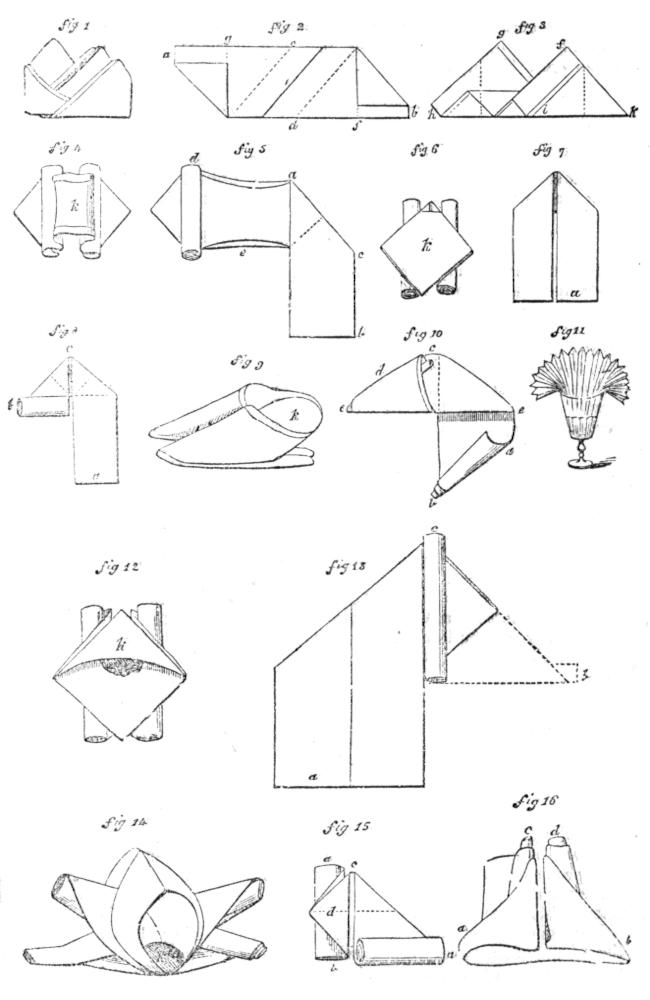
1.—THE MITRE.—(Fig. 1.)
Fold the napkin into three parts longways, then turn down the right hand corner, and turn up the left hand one, as in Fig. 2, A and B. Turn back the point A towards the right, so that it shall lie behind C; and B to the left, so as to be behind D. Double the napkin back at the line E, then turn up F from before and G from behind, when they will appear as in Fig. 3. Bend the corner H towards the right, and tuck it behind I; turn back the corner K towards the left, at the dotted line, and tuck it into a corresponding part at the back. The bread is placed under the mitre, or in the centre at the top.
2.—THE EXQUISITE.—(Fig. 4.)
Fold the napkin into three parts longways, then fold down two-fifths of the length from each side, as in Fig. 5, at A; roll up the part B towards the back, repeat on the other side, then turn up the corner towards the corner A, and it will appear as D. The centre part E is now to be turned up at the bottom, and down at the top, and the two rolls brought under the centre-piece as in Fig. 4. The bread is placed under the centre band, K, Fig. 4.
3.—THE COLLEGIAN.—(Fig. 6.)
Fold the napkin into three parts longways, then turn down the two sides towards you, so that they shall appear as in Fig. 7; then roll up the part A underneath until it looks like B, Fig. 8. Now take the corner B and turn it up towards C, so that the edge of the rolled part shall be even with the central line; repeat the same on the other side, and turn the whole over, when it will appear as in Fig. 6. The bread is placed underneath the part K.
4.—THE CINDERELLA.—(Fig. 9.)
Fold the napkin into three parts longways, then turn down the two sides as in Fig. 7; turn the napkin over, and roll up the lower part as in Fig. 10, A, B. Now turn the corner B upwards towards C, so that it shall appear as in D; repeat on the other side, and then bring the two parts E together so that they shall bend at the dotted line; and the appearance will now be as Fig. 9. The bread is placed under the apron part, K, Fig. 9.
5.—THE FLIRT.—(Fig. 11.)
Fold the napkin into three parts longways, then fold across the breadth, commencing at one extremity, and continuing to fold from and to yourself in folds about two inches broad, until the whole is done: then place in a tumbler, and it will appear as in the illustration.
6.—THE NEAPOLITAN.—(Fig. 12.)
Fold the napkin into three parts longways, then fold one of the upper parts upon itself from you; turn over the cloth with the part having four folds from you, and fold down the two sides so as to appear as in Fig. 7; then roll up the part A underneath, until it appears as in the dotted lines in Fig. 15, at B. Now turn up the corner B towards C, so that the edge of the rolled part shall be even with the central line: repeat the same upon the opposite side, and turn the whole over, when it will appear as in Fig. 14; the bread being placed underneath the part K, as represented in the illustration.
7.—THE “FAVOURITE,” OR OUR OWN.—(Fig. 14.)
Fold the napkin into three parts longways, then turn down the two sides as in Fig. 7, and roll up the part A on both sides, until as represented on the right hand side in Fig. 14; then turn it backwards (as A B) on both sides; now fold down the point C towards you, turn over the napkin, and fold the two other parts from you so that they shall appear as in Fig. 15. Turn the napkin over, thus folded, and raising the centre part with the two thumbs, draw the two ends (A and B) together, and pull out the parts (C and D) until they appear as in Fig. 13. The bread is to be placed as represented in K, Fig. 13.
II. DINNERS.
Dinners.—The appearance a dinner-table presents does not depend so much upon a profuseness of viands, as upon the neatness, cleanliness and well-studied arrangement of the whole. Taste, if well directed, may produce a handsome dinner; whereas three times the amount of money may be expended upon another, and yet not make even a respectable appearance.
We cannot too strongly urge the necessity of having things done in the same manner every day as when there is company. The servants become accustomed to waiting properly, things are always at hand, and they do not appear awkward when visitors drop in; then everything is regular, and goes on smoothly.
To lay the Cloth.—The table should be well polished, and then covered with a green baize cloth, over which a fine white damask one should be spread. If the white cloth is to be kept on after dinner, it is customary to spread a small cloth at either end of the table where the large dishes are placed, to protect the long cloth from accidental spots arising from gravy, &c.; these slips are removed after dinner, and the cloth cleaned with crumb brushes. In some houses an entire upper cloth is placed upon the table instead of slips, and this being removed after dinner, does not require the tedious process of brushing the table-cloth.
When the cloth has been spread, place carafes, with the tumblers belonging to and placed over them, between every four persons, a salt-cellar between every three persons, and a large and small knife, fork, and spoon, to each guest, with two wine-glasses, a champagne glass, and a tumbler, to the right of each, and the bread placed in or under folded napkins, between the knives, forks, and spoons; and at grand entertainments or public dinners, the name and rank of each guest neatly written on a card in front of the napkin, so as to prevent confusion and jealousy. The centre ornament, usually a candelabrum, plateau, an épergne, or a vase of artificial flowers, must now be set on, and the mats for the various dishes arranged; then the wine-coolers or ornamental vases placed between the centre-piece and the top and bottom dishes, with the wines in the original bottles, loosely corked; the spoons for assisting the various dishes, asparagus tongs, fish-knife and fork or slice, and carving knives and forks, are placed in front of the respective dishes to which they belong; and knife-rests opposite to those who have to carve; with a bill of fare, and a pile of soup-plates before those that have to assist the soup.
In arranging or laying out a table, several things require particular attention, and especially the following:—
Plate should be well cleaned, and have a bright polish; few things look worse than a greasy-looking épergne and streaky spoons. Glass should be well rubbed with a wash-leather, dipped in a solution of fine whiting and stone-blue, and then dried; afterwards it should be polished with an old silk handkerchief. Plates and dishes should be hot, otherwise the guests will be disgusted by seeing flakes of fat floating about in the gravy. Bread should be cut in pieces about an inch thick, and each round of a loaf into six parts; or if for a dinner party, dinner rolls should be ordered. The bread is placed under the napkins, or on the left of each guest; if dinner napkins are not used, some of the bread being placed in a bread-tray, covered with a crochet cloth, upon the sideboard. Lights, either at or after the dinner, should be subdued, and above the guests, if possible, so as to be shed upon the table, without intercepting the view. Sauces, either bottle, sweet, or boat; vegetables, and sliced cucumber, or glazed onions for stubble goose, should be placed upon the sideboard; a plate basket, for removing the soiled plates, is usually placed under the sideboard, or some other convenient part of the room; and two knife-trays, covered with napkins, are placed upon a butler’s tray; these are used for removing soiled carvers and forks, and the soiled silver. It is useful to have a large-sized bradawl, a corkscrew, and funnel, with strainer; the former to break the wire of the champagne bottles, and the latter to strain port wine, if required to be opened during dinner.
Fig. 1 & 2. Fig. 3 & 4.
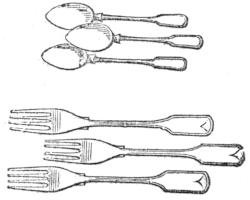
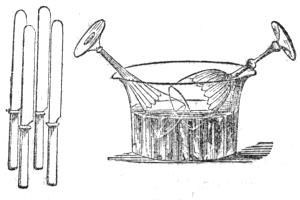
To lay out the Sideboard or Tray.—Little requires to be done, except to arrange the silver, knives, cruets, and various dishes to be placed there. The silver should be arranged on one end of the sideboard, as in figs. 1 and 2, the gravy-spoons being placed bowl to handle, and the cheese-scoop, marrow-spoon, and salad-spoons or scissors, where most convenient. The knives are placed, as in fig. 3, for the convenience of removal, because by this means a single knife can be abstracted without disturbing the others; carving knives and forks should be placed above the others, point to handle. The wine-glasses, tumblers, and finger-glasses, for dessert, are placed where most convenient, but usually in the centre, at the back, with ice-plates near to them, and the wine-glasses placed in the finger-glasses, as in fig. 4; but when only one glass is used, that is placed in the centre, mouth downwards. At very large or fashionable dinners, the finger-glasses are sometimes placed on the dinner-table with the plain and coloured wine-glasses in them, and the same, refilled, are placed on again at dessert. The cruets, sauces, &c., are placed at one end, and the vegetables, &c., in the centre front of the sideboard.
To place the Dishes on the Table.—Each servant should be provided, at large dinners, with a bill of fare, and instructed, at small ones, where the dishes are to be placed. No two dishes resembling each other should be near the same part of the table. Soups or broth should always be placed at the head of the table; if there are two, top and bottom; if four, top, bottom, and two sides, opposite each other, or alternately with fish. Fish should be placed at the head of the table; if there are two sorts, have fried at the bottom and boiled at the top; if four, arrange the same as the soup. We may observe, that a white and a brown, or a mild and high-seasoned soup, should occupy either side of the centre-piece, and that it looks handsomer to have fried and boiled fish opposite each other, but they should never be placed upon the same dish. Fish is generally served upon a napkin, the corners of which are either turned in or thrown over the fish, or upon a piece of simple netting, which is turned in all round; but we recommend our readers to use the elegant serviette, as being more stylish.
The first course generally consists of soups and fish, which are removed by the roasts, stews, &c., of the second course.
The second course, when there are three, consists of roasts and stews for the top and bottom; turkey or fowls, ham garnished, tongue, or fricandeau, for the sides; with small made-dishes for corners, served in covered dishes, as curries, ragouts, fricassees, stews, palates, &c.
When there are two roasts, one should be white, and the other brown. Removes are generally placed upon large dishes, for, as they supply the place of the fish and soups, they constitute the principal part of the dinner. What are termed flancs, are not so large as the removes, nor so small as the entrées, or made-dishes, and are generally served in a differently formed dish. They are seldom used except when there are eighteen or twenty persons.
Entrées, or made-dishes, require great care in placing them upon the table, otherwise the gravy slops over and soils the dish; they are, therefore, usually served with a wall of mashed potatoes, rice, or other vegetables, to keep them in their proper place. They should also be served as hot as possible.
When there is but one principal dish, it should be placed at the head of the table. If three dishes, the principal to the head, and the others opposite each other, near the bottom; if four, the largest to the head, the next size to the foot, and the other two at the sides; if five, place the same as for four, with the smallest in the centre; if six, place the same as for four, with two small dishes on each side; if seven, put three dishes down the centre of the table, and two on each side; if eight, four dishes down the middle, and two on each side, at equal distances; if nine, place them in three equal lines, but with the proper dishes at the top and bottom of the table; if ten, put four down the centre, one at each corner, and one on each side, opposite the vacancy between the two central dishes; or four down the middle, and three on each side, opposite the vacancies of the centre dishes; if twelve, place them in three rows of four each, or six down the middle, and three at equal distances on each side. If more than twelve, they must be arranged on the same principles, but varying according to number.
Oval or circular dining-tables require to have the dishes arranged in a shape corresponding to the table.
The third course consists of game, confectionery, delicate vegetables dressed in the French style, puddings, creams, jellies, &c.
When there are only two courses, the first generally consists of soups and fish, removed by boiled poultry, ham, tongue, stews, roasts, ragouts, curries, or made-dishes generally, with vegetables. The second consists of roasted poultry or game at the top and bottom, with dressed vegetables, maccaroni, jellies, creams, preserved fruit, pastry and general confectionery, salads, &c. It is generally contrived to give as great a variety as possible in these dinners: thus—a jelly, a cream, a compôte, an ornamental cake, a dish of preserved fruit, fritters, a blancmange, a pudding, &c.
After the third course has been removed, cheese, ornamented butter, salad, radishes, celery in a glass bowl or on a dish, sliced cucumber (and at small parties, marrow-bones) are usually served. A marrow-spoon, cheese-scoop, and butter-knife, being required upon the table, are to be placed near to the dishes; a knife and fork near the celery, and a pair of salad-scissors or a fork and spoon in the bowl with the salad.
The cheese may be served in a glass bowl, and handed round from right to left; or if a Stilton, surrounded with the elegant serviette, and placed upon the cheese-cloth. The bread may be served as usual, or the cheese snaps, piled up on a crochet cloth, in a plated bread-basket placed in the centre.
Waiting at Table.—Much confusion is avoided by having an attendant upon each side of the table; or, if the party is large, more than one, according to the number. The usual number required for parties is given below; and if the income admit of it, the scale may be increased according to the second column, which will materially add to the comfort of the guests.
Guests. Servants.
6 1 2
12 2 3
15 3 4
20 4 6
30 6 8
40 9 12
50 12 20, &c.
Every attendant should be neatly attired, have a white neckcloth and white gloves on, should know where all the articles required are, where the dishes are to be placed, and, in fact, be acquainted with the whole routine of the party; and, therefore, it is better to provide each one with a bill of fare.
When every guest is seated, a servant appointed for that purpose should stand by the side of each dish, with the right hand upon the cover; and as soon as grace is said, the cover is to be removed and placed in some convenient part of the room. The plates for soup should then be taken singly from the pile opposite the person assisting it, and carried to those guests that desire that particular soup, observing that ladies are to be assisted before gentlemen, and that these should commence from the head of the table, continuing to assist each until both sides are helped.
Soon after the soup has been served, the servants may pass down each side of the table, and ask each guest what they will take, assisting them to the dish desired as soon as it can be procured. When champagne is given, it is handed round upon a waiter or salver at small parties, commencing at the right hand side of the table from the top and bottom simultaneously, without any distinction as regards ladies or gentlemen. In large parties—and we prefer the arrangement ourselves even in small ones—the bottle being enveloped as far as the neck with a clean dinner-napkin, the wine is assisted in the same order as before; but instead of being handed round on a salver, the servants pour the wine into the glass, at the right hand side of each guest. By these means, there is less danger of the glasses being broken by any awkward collision. The champagne is generally iced in summer, and cool in winter, and is assisted as soon as the soup is finished, or just after the guests have been helped to the second course or removes.
Liqueurs are handed round when sweets are on the table. Sauces are handed round in the sauce-boat, and, when served, placed on the sideboard or dinner-waggon; if only a family party, they are returned to the table. Sweet sauces are handed round in glass dishes, and bottle sauces in a stand or basket made for that purpose.
In removing the dinner-things, one servant goes round the table with a butler’s tray, and the other removes and places the things upon it. The cloth is then brushed with a crumb-brush; or the two sides are turned in, and then the cloth dexterously jerked off the table, the lights replaced, and the dessert set on.
When knives, forks, and spoons, are removed from dishes or plates, they should be placed in proper trays covered with napkins; one being used for the silver, the other for the steel articles.
When plates or dishes are removed from the table, great care is to be observed with respect to holding them horizontally, otherwise the gravy, syrup, or liquid, may injure the dresses of the guests. We remember well to have seen a clumsy servant let some soup fall over the whole of the back of an officer’s new red coat, which was, of course, completely spoiled!
In some circles, the fashion prevails of placing finger-glasses on table immediately preceding dessert; but in others, especially of the highest fashion, cut-glass bowls, partially filled with rose or orange-flower water, iced in summer and lukewarm in winter, are handed down each side of the table, upon salvers: into these each guest dips the corner of the dinner-napkin, and just touches the lips and the tips of the fingers, to afford a refreshing feeling.
III. DESSERTS, TEAS, AND SUPPERS.
The Dessert.—The dessert may consist of merely two dishes of fruit for the top and bottom; dried fruits, biscuits, filberts, &c., for the sides and corners; and a cake for the centre.
When the party is large, and ices are served, the ice-plates are placed round the table, the ice-pails at both ends of the table, and dishes with wafer-biscuits at the sides. Some persons have the ices served in glass dishes, which, together with the wafer-biscuits, are handed round before the usual dessert.
When there is preserved ginger, it follows the ices, as it serves to stimulate the palate, so that the delicious coolness of the wines may be better appreciated.
The side and corner dishes usually put on for dessert, consist of:—Compôtes in glass dishes; frosted fruit served on lace-paper, in small glass dishes; preserved and dried fruits, in glass dishes; biscuits, plain and fancy; fresh fruit, served in dishes surrounded with leaves or with moss; olives, wafer-biscuits, brandy-scrolls, &c.
The centre dishes may consist either of a savoy or an ornamental cake, on an elevated stand—a group of waxen fruit, surrounded with moss—a melon, a pine-apple, grapes, or a vase of flowers.
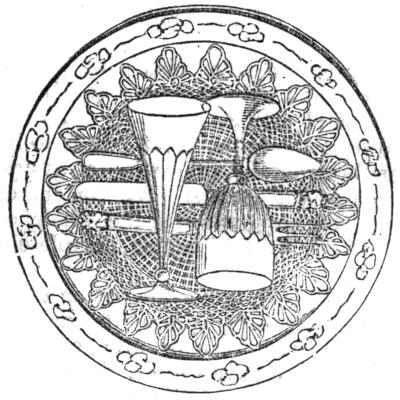
Fig. 5.
Each plate should contain a knife, fork, and spoon, with two wine-glasses, arranged upon a d’oyley, as in Fig. 5. These are to be placed before each guest; and a finger-glass, with cold water in summer, and lukewarm water in winter, on the right of each plate; and grape scissors, and melon knife and fork, before their respective dishes. Glass bowls containing sifted sugar, with pierced ladles, or others filled with cream, are to be placed near to the centre dish, if they are required. A cut-glass jug, with a tumbler on either side, should be placed in a convenient part of the centre of the table.
The wine, either cooled or not, should be placed at both ends of the table, or at the bottom, if only a small party, the decanters being placed in casters, though this fashion is now much abolished.
Zests are put down after the dessert is removed, and consist chiefly of anchovy toasts, devilled poultry and game, and biscuits, gravy, toast, grills, &c.
Coffee is the last thing served, and is generally handed round upon a salver; after this, the gentlemen withdraw to the drawing-room.
Tea.—If after a dinner party, the tea is generally handed round by two servants, the one having tea and coffee, with hot milk, cream, and sugar, upon one tray; the other having thinly-cut and rolled bread and butter, biscuits, and cake, upon another tray.
If served at an evening party or dance, a servant assists the guests, as they arrive, to tea or coffee, which is ranged upon a side-table in a small room. The tea and coffee occupy the two ends of the table, on either side of the urn, which is placed in the centre and back. In front of the urn are ranged the sugar-candy for coffee, sugar, hot milk, cream, bread and butter, cake, and biscuits. When the guests have been assisted, they are ushered into the presence of the host and hostess.
Tea, when only for a small party, may be brought in upon a tray, the tea and coffee pots occupying the centre of the tray; the cups and saucers the front; and the hot milk, cream, slop-basin, and sugar, the ends. The urn is placed at the back of the tray; and the bread and butter, cut or not, with cake, biscuits, muffins, crumpets, or toast, at the sides.
Suppers.—The great secret of laying out a supper consists in arranging the china, glass, silver, linen, lights, confectionery, substantials, trifles, flowers, and other articles, with a due regard to form, colour, size, and material.
A supper table should neither be too much crowded, nor too scanty, nor scattered and broken up with small dishes. Two dishes of the same description should not be placed near to each other: dishes should not be heaped up as if for a ploughman’s repast, but contain sufficient to make them look well, without being over or under-done as regards quantity.
Hot suppers are now seldom served; for people dine later than they did formerly; and besides being more expensive than cold ones, they also give more trouble.
The centre of the table is generally occupied by an épergne, vase of flowers, globe of fish upon an elevated stand, a plateau, or small fountain; around which are arranged:—Dried, preserved, frosted, or candied fruits; custards, jellies, and trifles, in glasses; and small biscuits. The top and bottom of the table are furnished with game, fowls, or meat; the sides have dishes of ham sliced; tongue, collared, potted, hung, and grated; brawn, mock or real; savoury pies; lobsters; oysters; dressed crab or cray-fish; prawn pyramids; sandwiches of ham, beef, tongue, anchovy, or other savoury morsels; tarts, tartlets; cake, biscuits; whipped and other creams; jellies, blancmange; caramel baskets; patties, &c.