THE POTTER AND THE CLAY
Reading edition
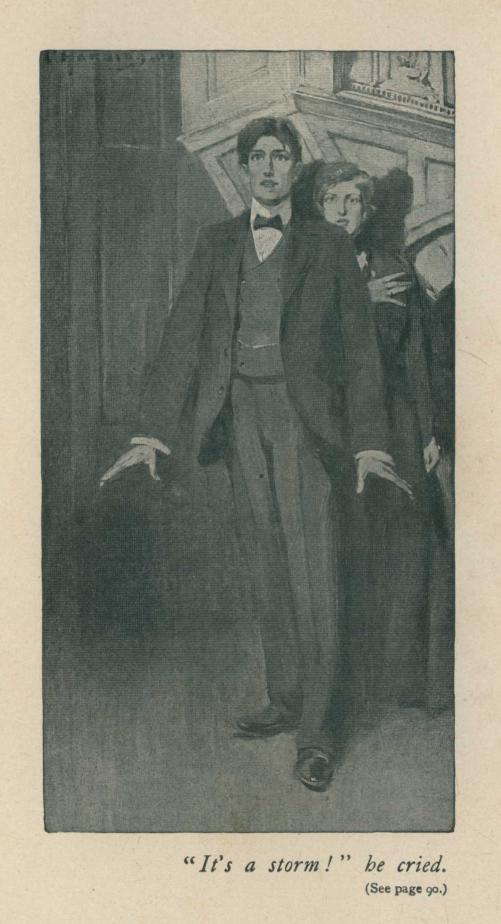
"It's a storm!" he cried. (See page 90.)
The POTTER and The CLAY
A ROMANCE of TODAY
By MAUD HOWARD PETERSON
ILLUSTRATED BY CHARLOTTE HARDING
LOTHROP PUBLISHING COMPANY BOSTON
COPYRIGHT, 1901, By LOTHROP PUBLISHING COMPANY.
ALL RIGHTS RESERVED
ENTERED AT STATIONERS' HALL
Published May 7, 1901. 6th Thousand, June 11, 1901. 10th Thousand, July 19, 1901. 13th Thousand, Aug. 16, 1901.
Norwood Press: Berwick & Smith, Norwood, Mass., U.S.A.
To M. C. P. and M. T. C.
WHOSE LIVES REVEAL THE POTTER'S TOUCH
AUTHOR'S NOTE
The comparatively unknown rendering of the verse from the Rubáiyát of Omar Kháyyám, quoted on the succeeding page, is to be found in the first edition of Fitzgerald's translation of the Persian poem.
"For in the Market-place, one Dusk of Day,
I watch'd the Potter thumping his wet clay:
And with its all-obliterated Tongue
It murmur'd—'Gently, Brother, gently, pray!'"
From the Rubáiyát.
PERMISSION to use the poem, "The Potter's Wheel," which appears on the next page, was granted by the owners of the English copyright of Browning's works through Messrs. Smith, Elder & Co., London, and by the American publishers of Browning, Messrs. Houghton, Mifflin & Co., Boston.
The Potter's Wheel
Ay, note that Potter's wheel,
That metaphor! and feel
Why time spins fast, why passive lies our clay,—
Thou, to whom fools propound,
When the wine makes its round,
"Since life fleets, all is change; the past gone, seize to-day!"
Fool! All that is, at all,
Lasts ever, past recall;
Earth changes, but thy soul and God stand sure:
What entered into thee,
That was, is, and shall be:
Time's wheel runs back or stops: Potter and clay endure.
He fixed thee mid this dance
Of plastic circumstance,
This Present, thou, forsooth, would fain arrest:
Machinery just meant
To give thy soul its bent,
Try thee and turn thee forth, sufficiently impressed.
What though the earlier grooves,
Which ran the laughing loves
Around thy base, no longer pause and press?
What though, about thy rim,
Skull-things in order grim
Grow out, in graver mood, obey the sterner stress?
Look not thou down but up!
To uses of a cup,
The festal board, lamp's flash and trumpet's peal,
The new wine's foaming flow,
The Master's lips aglow!
Thou, heaven's consummate cup, what needst thou with earth's wheel?
But I need, now as then,
Thee, God, who mouldest men;
And since, not even while the whirl was worst,
Did I—to the wheel of life
With shapes and colors rife,
Bound dizzily—mistake my end, to slake Thy thirst:
So, take and use Thy work:
Amend what flaws may lurk,
What strain o' the stuff, what warpings past the aim!
My times be in Thy hand!
Perfect the cup as planned!
Let age approve of youth, and death complete the same!
Robert Browning.
CONTENTS
PROLOGUE
BOOK ONE
The clay takes shape
BOOK TWO
The break in the clay
BOOK THREE
The Potter's touch
LIST of ILLUSTRATIONS
*"It's a storm!" he cried.* (Frontispiece.)
"*You—saw—me—then?*"
"*What right had he to look for a woman's face in the foam?*"
"*Trevelyan lay on the floor.*"
PROLOGUE
The POTTER and the CLAY
PROLOGUE
The Lieutenant's small daughter was swinging on the railing of the drawbridge that spanned the moat.
Her companions, two boys, questioned each other with their eyes.
"She says she won't come," said the elder in what he fondly believed to be an undertone. "She says she won't play—"
"I never did! So there!"
The small girl wheeled about suddenly and descended from her perch and stamped her foot; her long, straight hair of an indefinite brown, shaken by the tempest the boy's words had awakened.
"No; but you won't," said Rob, promptly.
There was an ominous silence; but instead of the tirade the anxious watchers expected, a tear appeared on Cary's little nose and quietly dropped into the waters of the moat. Cary was nothing if she was not a bundle of contradictions. Johnny shuffled nervously from one foot to the other, but Rob grew impatient.
"Well, are you coming?" he asked after the pause in which he had vainly waited for Cary to smile again.
"No, I'm tired. I hate walking, too," said Cary peevishly.
"'Course not—to walk," said Rob, scornfully. "We can steal Lieutenant Burden's boat."
"You wouldn't dare," said Cary, but her voice was tremulous with eagerness, and the tears she had forgotten to wipe away were still shining on her cheeks.
"Wouldn't I, though! Come along and see!"
Cary balanced herself carefully on one foot and considered. It wasn't well to let Rob think she didn't have to be persuaded. He had been so cross too.
"I haven't got my sunbonnet," she began. "And I've forgotten the gun I put it in."
"I'd just as lieve hunt for it," said Johnny, politely.
"That's just like a girl! You don't need the old thing—anyway I thought you hated it," retorted Rob, who did not fill the role of pleader.
"'Course Mammy Amy is 'way—gone for a week to see her grandbaby. I don't s'pose I really need my pinafore either—if I go!" The Lieutenant's small daughter hesitated to watch the effect of the words. Rob apparently was not to be moved, so she buried her pride and backed up to Johnny.
"Please undo me," she said, calmly, and the older boy struggled manfully with the holes and buttons.
"I'll be right back—quick as a wink," and she flew over the drawbridge back to the fort, her long hair and short dress blowing in the wind. She hid the pinafore under her arm, and when she reached the circle of the parade ground, she sidled up to one of the great guns captured in the war, and surreptitiously poked the gingham roll down its mouth. Clothes were a necessary evil, but sunbonnets and pinafores were the worst and most evil things of all—and not to be endured when Mammy Amy was not around, and the big show guns offered such a safe and charming hiding place. It only needed coolness and care to accomplish the feat without detection. Of course, a thing once buried in the heart of one of the big guns was lost forever—which was just as well, thought Cary, being one less to bother her—since it was one thing to force the articles down into the big black mouths and another to extract the sunbonnets and pinafores, even if she could have remembered which particular gun held which particular thing—which she could never do.
She hurried back to the drawbridge, and the sentry, who adored every inch of the "Post Baby," stood at "attention" and saluted her with a twinkle in his eye as she passed him. Cary slowed her walk and inclined her head graciously in greeting.
"Good evenin', Jones," she said, innocently.
Then she rejoined the boys.
"Well, are you really ready?" said Rob, a bit crossly.
The Lieutenant's small daughter did not deign to notice him.
"I think," she said, condescendingly, "if I go, I'll go 'round by the road way—it's shorter."
The "road way" was a good deal longer, but it was out of the reach of Cary's father and the fort.
She wiped her dry eyes on one of Johnny's handkerchiefs—Johnny always had more than one, while Rob and herself frequently went "shares" on a stolen or a borrowed one—and then she raced Rob to the end of the drawbridge.
Cary's conscience was troubling her. She told herself it was her stomach and the lemon pie she had appropriated from the pantry shelf, but it was undoubtedly her conscience, mingled with a fear that papa-lieutenant or some of the other officers might loom in sight and inquiring into the project, carry her off.
Ahead, thirteen-year old Johnny was moralizing.
"Perhaps we oughtn't to take her—she's so little."
"She's seven," said Rob, "and what's going to hurt her?" He kept his eyes away from the over-clouding sky.
"I don't know—" said the cautious Johnny, "but—"
"I guess we can take care of a small girl like her. You're thirteen and I'm eleven."
At the water edge, conscience spoke once more but was overruled when at Johnny's question as to the judiciousness of her going, Rob declared she was afraid.
"I ain't afraid, so there! Robby Trevelyan! My papa never said I couldn't go!"
Cary majestically slipped into the stolen boat, and seated herself in the bow. Johnny took the rudder and Rob the oars.
The boy was as much at home on the sea as he was in his bed at night. Indeed, more so, since he hated the one and loved the other with all the passionate strength of a coast-child's heart. He had been born in inland England, but had lived most of his life in western Scotland where the great rocks rise boldly along the coast—that coast intersected by numerous sea-lochs, bounded by hills and separated from each other by mountainous peninsulas.
The burden of the deep sea's song of eternal restlessness had become the controlling passion of the boy's life. The wild freedom of wild living things appealed to him and fear was a word unknown. Not a nearby cliff he had not climbed; not a nearby, darkened cave, formed by the overhanging rocks, he had not explored. The Scottish folk forgot he was an English lad as his skiff became a familiar feature of the western sea-bound landscape. There was scarcely a Scottish boy of double his age who could outstrip him in swimming, and when the hated books had been laid to one side and the tutor had gone away for the summer months, old Mactier, a retainer of his father's, had taken the child in charge, carrying him over to the moorland country and teaching him the meaning and the use of firearms. His mother had at first protested, but Trevelyan had only laughed. "Let the boy alone," he said, and he gloried with old Mactier at the lad's stocky build, firm muscles and enduring fearlessness, knowing that in her secret heart his wife remembered the traditions of her Scottish clan, and was glad.
Then Trevelyan's wife had died. The home on western, rock-bound Scotland had been closed, until the boy should grow to man's estate and enter on his mother's heritage. Trevelyan sent the boy to his sister—Johnny's mother—living in east Scotland, and then returned to England. The sudden loss, the still more sudden change from the wild free life lived on the western coast to the quietness of the life lived by the Stewarts, told upon the child. Mercifully, his healthy training was stronger than the inroads made by childish grief, but his mind was ill at ease and homesick. He hated the flatness of this new eastern country—the low and shelving coast. This was not Scotland to him. It was not the Scotland he had known. It was not Mactier's Scotland—and his.
His aunt was kind—overkind, her own children sometimes thought when she sat out all their bedtime hour on the foot of Robert's bed, instead of theirs—but "auntie" couldn't understand. All the three children were kind but they couldn't quite understand either. Johnny was undoubtedly the best, but Johnny loved books as passionately as Rob hated them, and would listen to his father discuss politics by the hour, if he only had the chance. Robert loathed politics.
Then one day Johnny's mother had a talk with her husband. It ended in her giving up a London season and starting with Johnny and Trevelyan's boy, for America. A long promised visit to a life friend, who had married a United States officer, was the excuse. It was not until years after, when Trevelyan's little son had grown to manhood that he knew the real reason for that sudden ocean voyage.
The change had the desired effect. He met new people. He saw new things. He watched new customs. He knew Cary.
But the wistfulness for Mactier was in the boy's eyes now as he looked over Johnny's head in front of him, to the long stretch of low sand country he was leaving. He pulled with long, even strokes.
Cary was talkative.
"Is this—" she waved her arms intending to designate the new sweep of coast line and of water, "all this I mean—is it like England or Scotland?"
"Something," said Johnny slowly. "It's really quite like home—my home," he added quickly, seeing that his younger cousin had stopped rowing and was leaning forward with hurt eyes.
Suddenly, the boy drew in his oars, resting on them and allowing the boat to drift. "It isn't like my home," he cried passionately; a wild thrill of homesickness surging over him, "It isn't like my Scotland—one little bit! We have great big rocks rising out of the water—not long beaches like this! And the sea beats and beats and beats against them—it doesn't just lap the sand as it does here—" the boy drew in his breath quickly, hurrying on, "And you haven't got our heather and our bracken, and our country isn't flat—except the moorlands where Mactier used to take me to hunt, and even our moors are not like this!"
He stopped suddenly; and he buttoned and unbuttoned his pea-jacket. He wouldn't for the world have let Johnny see his eyes, but Johnny was looking at Cary. The child was leaning forward with angry face.
"You're a horrid, horrid boy!" she cried, "You haven't a single nice thing to say about us or our flag or—or me! You're impolite and you're dreadfully rude and I'll never play with you again!"
Trevelyan's boy continued to button and unbutton his pea-jacket. He didn't care now if Johnny did see his eyes. Johnny saw them, too, and he was frightened. One day, Rob's eyes had had that look when their tutor had threatened to strike him. He spoke hastily.
"Rob didn't mean to be rude, Cary," he said; "but Rob's home was beautiful—a great deal more beautiful than mine, and—and even more beautiful than your home, and so you mustn't—"
Cary's anger melted like a mist before the sun. She slid to the bottom of the boat and then crept along to Rob on the rower's seat. She pulled at his sleeve.
"Rob—I'm sorry—I didn't mean—really truly mean—"
Trevelyan's boy shook away the child's clinging fingers.
Cary drew back; her lips quivering.
"I'm cold," she said, for Cary never would have admitted that a boy could hurt her so, "I'm cold, and—and tired. Can't we go home, Johnny?"
"Yes," he said.
"No, we won't," said Rob, moodily, "the oars are gone."
The oars were gone—slipped from the locks when he had drawn them in, and in the excitement of the quarrel they had floated away. The two boys knew that the oars were not the only things on the surface of the deep, drifting out to sea.
Behind them a bank of storm clouds was gathering and a sudden stone-color fell upon the face of the waters.
The clouds increased in size and swept toward them, seemingly poised directly overhead. Then they parted and the rain fell in a great straight sheet of water. The oarless boat tossed dangerously, and the rain gathered in the bottom.
Cary, half rose, beside herself with terror. The storm had drenched her to the skin, and her long, straight hair lay, matted with the wet, close to her small head. Her wide gray eyes looked out dark against the pallor of her skin.
"Sit down!"
It was Johnny's voice. Mechanically, the child obeyed.
Once, years later, he so commanded her, and she yielded then as now.
She cowered in the bow and was silent. In the stern the elder boy grasped the rudder, forcing the boat for a time in the direction of the far-off Point. The rough ropes slipped through his hands, in spite of effort, and tore them cruelly.
Trevelyan's boy had crept to the bottom of the boat, the better to balance it. The wind swept across his hair, forcing it back from his forehead, as with a mighty hand. The joy of an unknown danger was in his blood and the color was in his cheeks. The wild spirit of the storm found a challenge in his eyes.
He was a being apart from the other two, and yet sharing their danger. The freedom and the peril were as elixir to his soul, and yet he never lost consciousness of the wind cloud in the distance; and he knew it to be as merciless as it was strong.
"Steer for the Point," he shouted. Johnny nodded.
They neared the shore. Then the wind came upon them and churned the bay into a white foam. It turned the frail boat around as on a pivot, heading it for the open sea, and with the effort the ropes that held the rudder broke.
The boys looked at each other. It was characteristic of both; it was characteristic of their training and their birth, that the sense of personal danger did not touch them and that it was solely for the small girl they thought.
In the face of the older boy was a strong courage that soothed and sustained the frightened child; but in the face of Trevelyan's son was defiance against the might of the storm, and the sea, and death.
He ripped open his pea-jacket; he unlaced his water-soaked boots; he stripped to his shirt.
"Keep the boat steady," cried Trevelyan's son, "I'm going to swim to the Point and get help!"
The older boy caught him by the wrist.
"You'll be drowned. I'll go!"
Trevelyan's son shook him off. He threw back his head.
"I've swum double the distance," he shouted, "Anyhow, we'll all die here."
He balanced himself on the rower's seat. Then he raised his arms above his head before he sprang. The joy of the coming struggle was in the boy's eyes—the joy of testing his strength against the sea's forces.
He dived. The boat, lightened of his weight, rocked, sprang higher in the water and then righted. From the bow came the sob of a girl-child's terror.
Trevelyan's son rose, striking out for shore.
Cary and the elder boy watched him—even as they drifted seaward.
* * * * *
Trevelyan's son was gaining. The fight had been a long one and a hard one. The rain had lessened, but the wind and tide had carried him a quarter of a mile below the landing he had intended to make. His thoughts were growing disconnected. At first, he had only gloried in his own skill; then he thought of Scotland—he could scarcely have told why—and of old Mactier. Then he remembered Cary—and after awhile, he wondered if he had ever drank as much salt water before.
Then the wind changed. That was a help. Once he trod water, looking out over the face of the sea for a sign of the boat. He saw it. It was far away and still drifting seaward, but it was upright and the coast boy knew that unless the storm began again, it could live in spite of the long swells that bore it outward.
His arms began to get numb, and a mist—he supposed it was the rain—got between him and his vision. The low banks of clouds on the horizon, too, assumed strange shapes. They looked like the gray crags at home.
Once his breath seemed to leave him and his arms grew suddenly powerless and he sank. The emersion gave him new energy. The love of life, the wild thrill of fearless conquest, swept right over him anew, and he pulled for shore. After a little he raised his right arm and sounded. The waters were up to his eyes, but he touched land. He rose and struck out again, and again, and—again.
Then he waded in and stood upon the beach, his face turned seaward.
Trevelyan's boy threw back his head and laughed at the waters and the storm.
"I beat you," he shouted passionately, "I beat you!"
* * * * *
The Lieutenant was in his office. It had been a busy day of petty annoyances and he was tired.
He leaned back in his chair and filled his pipe, packing it carefully. Then he lighted a match.
Some one fumbled at the door knob in an uncertain way; hesitated, and tried again.
"Come in!" shouted the Lieutenant. The noise hurt his nerves.
The door opened and Rob entered. His eyes looked shadowy by contrast to the pinched paleness of his face. He walked with difficulty. His short legs got tangled up in the long coat he had gotten from one of the men of the rescuing party, and he stumbled over it.
The Lieutenant rose. The match burned down to his fingers and he mechanically tossed it into the fire. Then he laid down his pipe.
The short odd figure in the long overcoat advanced to the middle of the room, facing Cary's father.
"Cary—" he began, and then stopped a moment and cleared his throat. It seemed still full of salt water. "I stole Lieutenant Burden's boat and I took Cary and Johnny out. The storm came. I knew it was coming, but I didn't care, and I went. And I lost the oars and—" The salt water feeling came back.
"Cary?" asked Cary's father.
Trevelyan's boy shook the long sleeves away from his hands, which he pushed down into the great pockets of the coat, where they hunted around for themselves. The Lieutenant was tall and Trevelyan's boy was short, and he had to look up a long way before he could look him full in the face.
"She's coming," he said, "and so's Johnny. They both feel sort of sick, but I'm all right, and so I've come here. I thought we'd better have it over with."
"What?" asked the Lieutenant.
"Why, the thrashing! Of course, you'll thrash me."
He came forward a step and swayed.
Cary's father caught him as he fell and laid him on the lounge.
* * * * *
That night Cary was ill. The next day she was worse. She complained of a sharp pain in her side and toward evening she began to breathe heavily.
At nine, when the post surgeon came again, she was burning with fever, and he shook his head when he listened to her lungs.
"It looks confoundedly like pneumonia," he told the Lieutenant who was standing anxiously by Cary's little brass bed, and he went off to look up a nurse.
The Lieutenant bent over the child a moment after the surgeon had left, and then he turned hastily away and lowered the lamp and shaded its glare from Cary's eyes. Then he went over to the window and stood looking out. Below him stretched the yard of his quarters. It was Cary's playground. Beyond the garden lay the parade ground and further off the other officers' quarters. He could see Cary now, her long, straight hair flying in the wind as she tore by the flagstaff to meet him on his return from duty. Way off in the distance he could see the dim, dark outline of the Fort's walls, and beyond, the strip of moonlit sea. He had used to carry Cary on his shoulders, when she was a baby, along those walls and she had used to clap her hands at the sunlight dancing on the water. Everything spoke to him of Cary. He turned and went back to the bed and knelt down by it and buried his head close to the child's—so close that he could feel her hot breath on his cheek.
"I was a fool," he told himself, passionately, "to fancy I could care for a little flower, but I couldn't give her up after her mother died."
He rose presently and cautiously heightened the lamp and wrote a hurried line on a scrap of paper.
"Cary is ill. Pneumonia. Mam' Amy is away. Will you come?"
He signed the note and then crept down stairs and gave it to the colored boy. The colored boy carried it across the parade ground to the house where the English children were staying and waited, as he had been bidden, for an answer.
The Lieutenant went back to the window. He could see the house across the parade ground from there, and presently he saw the shadowy figure of a woman accompanied by his colored boy passing the flagstaff.
"Heaven bless her! I knew she'd come."
He went down stairs to open the door for her and it was not until he had closed it and turned to thank her that he saw it was not the wife of his comrade.
"Mary was away," the exquisitely modulated English voice fell on his overwrought nerves like a balm. "I took the liberty of opening the note, fearing something might be wrong with your little girl after yesterday's terrible experience. I have come to nurse her. I know you won't send me away."
John's mother threw off the long cloak she had flung over her shoulders.
"Really, Mrs. Stewart—"
"There—please don't! I am the mother of three children—I once was the mother of four," the English woman looked down steadily at her wedding ring, twisting it on her finger, "I am the adopted mother of another—" She raised her eyes, smiling gravely, "We are all alike—we women; be we American or English. Besides if it hadn't been for my two boys Cary would never be ill now. Come, take me to her."
There was not a nurse to be found, and at midnight the post surgeon returned, discouraged from a fruitless search.
A sense of order and exquisite peace seemed to permeate the child's sick room. It impressed him before he had crossed the threshold. A woman was sitting by the little brass bed and he could hear her speaking soothingly to Cary.
She turned when she heard his step and rose. He took in the situation at a glance.
"You're a trump," he said, concisely, and went over to the bed.
"How is she?"
"Bad—very bad! Where's the child's father?"
"In the next room. He cannot stand seeing her suffer."
"Humph! Shouldn't wonder. She's the apple of his eye. You know we call her the 'Post Baby'—have ever since her mother died."
"How're your young rascals?" he inquired, when he was leaving. "They and the 'Post Baby' here had a pretty time of it yesterday."
"God only knows what saved them."
"Well, I know. It was your two youngsters. They're both game. The Queen will have two good soldiers some day."
The English woman smiled.
"I left Rob in a perfect fury at the foot of his bed. He woke up when I was getting ready to come over, and wanted to come, too. He says Cary belongs to him. I threatened severe punishment, and—left him."
The post surgeon chuckled.
"He'll risk that if he takes it in his head to come."
"I'm afraid he will. I left Johnny consoling him."
"The two of them called seven times this afternoon."
"I know—but I never dreamed Cary was really ill."
"Well—" The post surgeon hesitated, "I'll be back after awhile and if the baby's worse, I'll spend the night with you."
He closed the front door softly; hesitated for an instant before he recrossed the shadowy parade ground, and starting to go on, stumbled over a dark object on the porch.
The dark object turned out to be a boy, who rose and pulled at the surgeon's sleeve.
"How is she? Oh! tell me how she is!" he asked. His thin, high bred face with the delicately chiseled features, showed out sharply in the waning moonlight.
"Great Scott!"
"No, it's only Johnny Stewart," said the boy, a faint flash of humor lighting up his pale face for a moment. "I couldn't sleep—tell me—is she—worse?"
"She's a pretty sick little girl," said the surgeon, amused at the situation. "Your mother has been expecting trouble from your quarter, but she rather looked for it from Rob."
"He's asleep," said the boy, simply, "I sat with him until he went to sleep, but—you know I'm the oldest, and I'm responsible for it all." He looked up gravely, self-accusing, in the post surgeon's weather-beaten face.
"Well, you're a pair of you!" said the surgeon, looking hard at the flagstaff. "Now, what do you propose to do with yourself?"
"You couldn't slip me in, somehow?" pleaded the boy. "I'd stay down stairs and I'd be awfully quiet and I wouldn't trouble a soul. There might be errands—" he broke off, "I'd like to be near her," he said. "Do you think you could manage it?"
The post surgeon thought he could, and the post surgeon did.
Then he started once more to cross the parade grounds.
As he passed the flagstaff and entered the shadows of the trees, a small whirlwind struck him. The whirlwind proved to be Rob. He was only half dressed: his shirt being open at the throat and devoid of tie. One stocking had been forgotten in his haste and he was hatless. The surgeon caught him by his hair and pulled him back.
Then the whirlwind developed into a small tornado.
"Let me go," he cried. "Let me go!"
"I'll take you to the guard house if you don't behave," threatened the surgeon. "Now what in thunderation are you after?"
"Going to see Cary," said Rob, sullenly.
"You are, hey? Well, you're not going to do anything of the kind. You'd scare any little girl into a fit. You're going home."
"No, I'm not," said Rob, rebelliously.
"Yes, you are."
"I'll come out again."
"Not behind locked doors."
"Yes I will, too, through the window."
"I'll see to the window."
"I'll climb through the transom."
He made a dive under the surgeon's arm. The surgeon caught him by the seat of his small trousers.
"Where's Johnny?"
"That's the trouble—is it? Well, Johnny's a different quantity from you. Johnny's safe enough."
"Johnny's at Cary's house. I know it. I'm going, too," cried the younger boy, passionately.
"If you make a sound, I'll thrash you within an inch of your life," said the surgeon, in desperation, retracing his steps across the parade ground.
"I'd scratch your eyes out if you tried to," said the boy, a flood of crimson sweeping his face.
"Well—look out that your noise don't kill Cary," said the surgeon.
Trevelyan's boy caught the surgeon's hand.
"Indeed I'll try to be good," he said, earnestly, "if you'll only take me to Cary."
Mrs. Stewart opened the door.
"Here's one boy," said the surgeon grimly, pushing Trevelyan's son over the threshold, "There's another in the dining-room."
"You're a nice one to leave a chap asleep and then sneak off. I wouldn't have been so mean!"
Rob blinked in the glare of the dining-room lamp, and shifted from the stockingless leg to the covered one, "I didn't think Johnny Stewart—" His voice rose.
Johnny came forward.
"Stop that shouting!" he commanded, "Don't you know Cary's very, very sick?"
Rob blinked again. It was a blink of astonishment. He had never seen Johnny quite so angry before.
"'Course I know she's sick. That's why I've come." He sat down on the extreme edge of a chair.
There was a long, long silence. Johnny sat at the big table, his chin between his hands and looked straight ahead of him. Rob looked moodily into the fire. Once the younger boy rose and went to the foot of the stairs.
"What you suppose is happening up there?" he inquired when he came back.
"I don't know."
"Suppose she's dying?"
"Don't!"
The elder boy turned sharply and lowered the lamp that was smoking.
The long hours crept away. By and by the lamp flickered and went out, and the fire died down, and left only a heap of white ashes on the hearth. Then the gray dawn crept in and after awhile the gray was tinged with gold. Later, the sunrise gun boomed through the stillness, to be followed by the ringing notes of the reveille.
Upstairs, the post surgeon was leaning over the little brass bed.
"I'll spend the night," he had said briefly, on his last visit. There were symptoms about Cary's labored breathing and dry cough that he did not like.
The child's sleepless eyes and flushed face looked wan in the grayness of the early dawn.
As the hours dragged by, Cary became more restless and her mind began to wander.
"Don't let him, Johnny! Don't let him! He'll drown! He'll dro——" the voice rose in a shriek and then trailed off.
The cry had reached the children below stairs. A moment later and Rob, wide-eyed and excited, appeared at the sick-room door. He was confronted by his old foe the post surgeon.
"Can't come in here," said the surgeon briefly. "It—"
"Oh, but tell her I'm not drowned! Let me tell her—"
The surgeon took him by the shoulders and marched him down stairs.
"Is this the way you promise to keep still?"
The post surgeon was skilled in other arts than his own profession. He had appealed to the boy's honor.
Trevelyan's son flung himself face downward on the hearth rug and lay motionless. Johnny went to him and knelt beside him and touched him on the arm. Something of Johnny's childhood had vanished in the night, never to return. He did not say anything to Rob; he just continued to kneel beside him with his hand on his arm.
Presently Rob sat up. His wakeful night had not improved his appearance. His shirt was a crumpled mass; his hair was disheveled, and one of his ill-laced boots was gone.
"She shan't die!" he cried, passionately, "I won't let her die! I won't! I won't!"
Johnny said nothing. Once, long ago, a little brother had died, and Johnny still remembered how vainly he had tried to wake him. Johnny had seen death.
Upstairs Cary tossed in her delirium.
"Johnny, don't make me keep still! I can't keep still any longer! The water looks so cold—"
And so the day wore on. The dry cough stopped and the fever ran higher and the breathing came more labored, and Cary lay wide eyed and sleepless.
The children wandered like little ghosts through the rooms of the lower floor. They pleaded that they might see Cary once. The post surgeon tried an experiment.
"The child's strength is going fast for lack of sleep," he told Mrs. Stewart, "We'll see what your boys can do."
He brought Rob in first, and Trevelyan's son stood at the foot of the bed, and was silent as they had bidden him to be; but they could see that he trembled.
Cary's eyes, bright with delirious fever, rested on him for a moment. Then she started up in bed.
"It's Rob, dear," said Rob's aunt, bending over her.
"No, it isn't!" cried Cary. "No—it—isn't! Take him away; away—a-w-a-y!"
Rob let go of the brass railing and rushed impetuously to the little girl's side and flung himself down by the bed.
"Cary! Cary! Don't you know me? It's me! It's only Rob!"
But Cary shrank back from his touch.
"I'm frightened," she moaned.
The Lieutenant came and lifted the boy and took him from the room. Trevelyan's son was crying passionately.
The excitement proved to be the worst possible thing for Cary. The fever ran higher and sapped and sapped her strength and still she moaned and cried in her delirium and still sleep did not come.
"She can't grow much worse and stay alive," muttered the post surgeon, "And something has got to be done."
He went down stairs in search of Johnny. He found the boy standing by the window, his white face turned toward the sea. Rob, his passion of tears spent, lay sleeping heavily on the lounge. The surgeon touched the elder boy on the arm and motioned him to follow him. Outside in the little square hall, they faced each other—the skilled man of science, and the delicately featured English boy with the firm mouth.
"You're going to take me to Cary?"
The surgeon nodded.
"Yes. She wouldn't see Rob, but perhaps she'll see you. I've an idea she will. She's been calling your name all day. If I take you to her, will you be very quiet?"
"I'll be very quiet," promised the little Briton, gravely.
"And we've got to get her to sleep. Perhaps—"
The boy's firm mouth quivered for an instant.
"Yes," he said.
The post surgeon let him go into Cary's room alone, and he motioned the boy's mother and Cary's father away from the bed.
The boy went directly to the head of the bed and stood there looking down at Cary. For a long while Cary did not notice him. But he waited.
The stillness of the room grew—broken only by Cary's piteous moans. After awhile she became conscious of the boy's slim figure at her side, and she turned her restless, feverish eyes to him.
Then he stroked her long straight hair timidly.
The moans ceased suddenly.
"It's Johnny," said the boy.
He sat down on the edge of the bed and took one of the child's hot hands in his.
Then the terror of the delirium fell on her again. She sat up in bed, flinging out her arms and crying, and still the boy kept that firm pressure on her hand. The sustaining touch won her back from the thraldom of the fever and she threw herself into the boy's arms and lay there, sobbing—sobbing.
The post surgeon nodded.
"I thought so," he muttered from the doorway, and beckoned the others into the adjoining room.
For an hour they sat there. Gradually the child's sobs grew weaker; after awhile they caught their echo at long intervals and by and by they died away altogether.
The shadows of the dying day crept into the sick room and the wanness of its departing struggle was reflected on Cary's small, pinched face. She still lay in the boy's arms, quiet—spent with the effort of her delirium. The boy sat rigidly mute, supporting her.
The day sank into evening and the post surgeon came in quietly from the adjoining room. The boy's eyes met his as he entered. It was his only movement. Otherwise he might have been carved of stone. The boy's eyes smiled and the post surgeon retraced his steps.
"She's sleeping. The boy holds her life in his hands. If he can only remain motionless—"
Another hour slipped by. The post surgeon came in again. Cary was sleeping still, her whole weight resting in the boy's rigid arms. He was growing white with the strain of his enforced position. The surgeon looked down at him.
"Can you hold out?" he asked, below his breath.
The boy nodded.
The post surgeon went down stairs noiselessly to the sideboard where the Lieutenant kept his wines.
Rob sat up as he entered.
"How's Cary? What time is it? Where's Johnny?"
The post surgeon went up and laid his finger on Rob's mouth.
"Cary's sleeping. If you wake her, you'll kill her. Don't speak above a whisper."
He filled a glass with wine and turned to leave the room.
"Where's Johnny?"
"With Cary. He put her to sleep."
Trevelyan's boy clenched his hands convulsively.
"Johnny—with—Cary," he said, slowly, and then something choked him.
He followed the post surgeon to the foot of the stairs and watched him until he disappeared. Then he went back to the dimly lighted, lonely dining-room and hesitated.
Suddenly a passionate cry rose in his throat, which he smothered.
He turned and flung himself on the lounge.
"Dear God," he moaned, "Dear God, be good to a little boy. I want to die! Quick!"
Upstairs the surgeon held the brim of the wine glass to the elder boy's white lips.
The enforced position had become an agony. Once, the surgeon saw the boy bite his under lip until a drop of blood appeared. He got a pillow; two—half a dozen and supported the boy's stiff back.
Three more hours dragged away, and then Cary stirred and woke. Great beads of perspiration stood out on her thin, drawn little face, but the fever had been broken in her sleep.
The boy's grasp suddenly relaxed and Cary sank back on the pillow.
The Lieutenant helped the boy to rise; ending, by picking him up in his arms and carrying him from the room.
He re-entered Cary's room by way of the hall. By the light of the early breaking dawn, he saw something dark lying before Cary's outer door.
He stooped over it.
It was Trevelyan's boy.
BOOK ONE
THE CLAY TAKES SHAPE
BOOK ONE
THE CLAY TAKES SHAPE
I.
The six-foot Englishman, with the military carriage and the rough tweed cap, continued to stare at the back of the girl in the brown tailor suit, leaning over the ship's rail. There was something in the attitude that recalled a child swinging on the railing of a fort's drawbridge. He could not have told exactly why. Perhaps it was because he so often recalled that picture; perhaps it was because he had always held fast to a vague hope that some day he might meet that child again.
The girl in the brown tailor suit remained motionless, her face turned toward the Liberty that was melting into an indistinct blur. The young Englishman came a little nearer. She had not been there when he had come aboard. Of that he was sure. Well, he had probably missed half of his fellow passengers while he was changing to his seafaring clothes, and there had been a couple of letters to be written to be carried back by the pilot. All that had taken time.
The girl turned. The last faint trace of Liberty had faded; she might just as well admit that, and give her attention to the novelties of ship-board life. She looked curiously down the long white deck. Passengers were appearing every moment, clad in ulsters and soft hats; the deck steward was hurrying to and fro adjusting steamer chairs and wraps. The voyage had undoubtedly begun.
Suddenly the line of her vision was interrupted by a tall man in a rough tweed cap. And then she noticed that he had snatched it from his head and was coming toward her with both hands outstretched.
"Isn't it—Cary?" he asked, eagerly.
The girl looked into his eyes. Somewhere in their grave depths a smile was hidden.
"Why, it's Johnny," she cried, delightedly.
"To be sure it's Johnny! And what do you mean by sailing under an English flag?"
She laughed again, showing her perfect teeth.
"Isn't it absurd? But Daddy dragged me into it."
"Which? The Cunarder or the trip?"
"Both. Where in the world have you been all this time, and oh! how's Rob? I declare I've so many questions to ask you I don't know where to begin."
Stewart smiled.
"You're the same old Cary," he said, "Only a bit taller. Let me find your chair for you. You're not crossing alone?"
"Do you think I'd leave my father?"
"Of course not. Where is he?"
"There, forgive me. I was rude. I'm afraid I am as bad as ever." Cary sighed.
"I never said that—"
"Well, Papa's writing a note to be carried back on the pilot. If he does not come up soon, I'll have to hunt him up. I'm his shadow. To tell you a secret; I'm chaperoning him on this trip!"
"Indeed!" Stewart's eyes were smiling.
"To be sure. Now, about yourself—"
"Your eyes say, 'What have you been doing in America that you failed to look me up?" said Stewart.
"That is just what I was thinking, and when we were going to hunt for you, too, when we landed! Come!"
"There isn't much to tell," said Stewart, meeting her eyes squarely. "There have been a good many years—uneventful ones—of a pretty steady 'grind', and rather rigid military training at Woolwich—"
She looked up quickly.
"You are an officer? An engineer?"
He laughed, pleased.
"You know more about our English military schools than the majority of American girls."
"You forget I am an Army woman. Go on!"
"And so I'm a member—a young one—of the Royal Engineers. I was ordered to India, where I served out my sub-lieutenancy. I was in a bit of a row there, and after, I took the jungle fever and got sick leave. They've sent me over the Atlantic for a sea trip. I'm to be transferred later. I was only in New York two days. That's why I couldn't look you up. You see, I didn't know if you were still at the old fort down South, or in Texas or Montana or—any other of your big states." He was rapidly getting off of the subject of "self." "Now, where have you been and why didn't you keep on writing?"
"I did write, but you wouldn't answer—sent the letters to your home in Scotland."
"Ah! We were traveling; the old place has been rented almost steadily for years. They must have miscarried in the forwarding. Father has preferred London political life, and mother wanted to be near us boys when at school and afterwards when we became cadets—"
"How is your mother?"
"Well; thanks. She'll be glad to see you again."
Cary looked seaward.
"I shall never forget," she said, "how she nursed me." She was silent a moment. "How's Rob?" she asked, presently.
"I'm inclined to think he's less changed than any one of the three of us. He's fiery, fierce, affectionate, as ever, with a wonderful talent for getting into scrapes and scrambling out of them again."
"What is he—a sailor?"
"He wanted to go in the navy—bad. Poor Rob. But my uncle had set his heart on the army for him. You know he was a great fighter in his day—retired on a wound that would have killed most men. He wanted him to go to Sandhurst, but Rob kicked on that, and they compromised on Woolwich."
"I didn't know Rob would ever have brains enough for the Engineers." Cary laughed and caught wildly at her hat, which the wind was trying to tear from her head.
"Rob's clever enough—cleverer than most men, if he'd only study. He leaves Woolwich in a couple of months now—graduated. How he has ever stayed there as long as he has is a marvel. Such doings!" Stewart shook his head even as he smiled.
"I believe," he said, after a pause, "It's for his father's sake and my mother's that he has drawn the line where he has! There isn't an officer or an instructor who don't like him, though. He's as straight as a string where honor is concerned, and as brave—Well! You know how brave he could be as a child."
Stewart went on.
"As for the cadets—they swear by him—every last boy of them! Rob will be wild when he hears you are in England, and will probably take 'French leave'!" Stewart laughed again. "There! That's the family history. Now, what about yourself?"
The girl ran her hand thoughtfully along the railing.
"Papa was stationed at the Fort for three years after you left us. Since then we've been moving from pillar to post—in regular Army fashion. You know how it is?" She raised her eyes to Stewart and Stewart nodded. "He was ordered to Florida and then to Arkansas and then to Alaska—" she laughed. "He sent me to boarding school for a year but I couldn't stand not seeing him, and he was even worse about me. After that he taught me himself—dear, old Daddy—he taught me everything from calculus to colt riding. It's been a wild kind of a life, but I've missed the old Fort and the sea. None of the other places was ever much like home—" Cary raised her eyes from the railing and looked soberly toward the receding shore.
Stewart watched her; realizing that while she had not grown pretty she was possessed of an indefinable magnetism.
Cary went on.
"Then Daddy got notions about me—about my lack of advantages, social and—otherwise," Cary was laughing again. "He was retired last month and now he's carrying me off to Europe, to be polished. Am I such a rough specimen?" she asked Stewart, suddenly.
He shook his head so gravely in denial that she smiled.
"There! Of course, I was only fooling! And so I'm going over to your great, beautiful, strange Old World to be 'finished'—as if anyone could ever be 'finished' as long as they live! I'm to see all the celebrated Old Masters and to visit all the old historic places and see the old ruins—" she broke off suddenly, "I think by the time I've finished, I'll be very tired, don't you?"
"And then?" asked Stewart.
"Why, then Daddy and I will return to America and have a little home somewhere—I hope near the Fort where I lived as a child; close by the sea and the capes and the beach."
They were silent a moment. Behind them was the merry hum of voices and the rapid movement of feet hurrying to and fro, but for that moment they were as much alone as though they were in the shadow of the old fort wall.
"My home," said Stewart, looking out over the sea into nothingness. "My home in eastern Scotland is like that. Some day I hope you will see it. If you ever grow very homesick for America let me know, and I'll try to arrange to run up there for a day with you and mother. The long beach will remind you of home."
"Thank you," said the girl, gently.
There was a long quiet between them, and then the young officer's face changed suddenly and he broke into an infectious laugh.
"Oh, the guns—do you remember the guns, and the pinafores and the sunbonnets? Weren't you ever caught?"
The tall girl joined in with his laugh and the two—his deep and hers low—mingled and drifted back to the passers-by who smiled sympathetically at the sound. Cary shook her head.
"No—that is, not until long afterwards. It seems that the Department issued orders that the big show guns should be recast, and when they were taken away and broken up—they were found to be storehouses for a small girl's wardrobe! Lieutenant Burden happened to be on the spot and the story he tells—" she broke off, still laughing.
"Was there anything left of the things?" asked the Briton, amused.
"Yes, indeed—some were pretty well preserved! And how poor old Mammy Amy would worry over the thief who dared to steal her 'chile's clothes!' It's all too funny!"
"And Mam' Amy?"
"Dead. She followed us out to Alaska, but she died. I suppose it must have been the climate."
Stewart's face grew a little grave.
"Lieutenant Burden—wasn't he the officer we stole the boat from?"
The girl nodded, smiling.
"And that row! Wasn't that a row we had that day," he said. "Do you remember the terrible swim Rob took and how he saved us?"
"Yes. And how you comforted me. I went to sleep—didn't I?"
"Yes; and how ill you were afterwards! Do you know I've never forgiven myself for all that. I was thirteen, and the oldest, and should have had more horse sense."
"What children we were!" Cary sighed.
"Are you wishing the time back?"
"I hardly know—" she hesitated, "No, I suppose not."
Then:
"They told me that you saved me in that illness."
"Did they?"
"Do you believe in confessions?" he asked, with an odd smile.
Cary laughed.
"That depends. Well—what have you been doing?"
"Do you know I kissed you that day when you fell asleep in the boat—when we were facing death together—and again when I was fighting death for you that long night?"
"You wretch! Well, it didn't count much then," Cary's eyes were twinkling, "You were thirteen and I was only seven. Rob! Imagine Rob ever kissing me!"
Stewart laughed a little nervously.
"Look out, Rob may yet!"
"Preposterous! Don't you remember when you said you lived in Aberdeen and Rob in Argyll, and I innocently asked whether they were not near together? How indignant Rob was! And then I crossly retorted that they both began with 'a', anyway, and—" she paused for breath, and Stewart laughingly took up the story and finished it.
"And how Rob scornfully answered that so did 'cat' and 'crow'! He's never deigned to tell me which applied to which!"
"That was Rob all over!"
Late that night the quartermaster at his lonely wheel, watched a tall man pacing the decks.
After awhile the figure paused at the ship's railing and leaned against it heavily, looking out over the moonlit sea. The deep throbbing of the mighty engines came up to him and beat and beat against his senses.
"Twice," said the Briton, slowly, speaking to the stillness of the stars and the restlessness of the ocean, "Twice, as a boy, I kissed her, when we fought death together. Some day, in an hour of danger, I shall kiss her again."
II.
Cary was singing. Trevelyan heard her before he had reached the second flight of stairs in the lodgings. The clear contralto voice sifted down into the dark passage as sunlight sifts into a ravine. It rose; swelled higher and filled the entrance way. Trevelyan's pulses kept time to its swinging measure as he came on up the stairs, and quietly opened the door of the little sitting room. The measure died away. Cary finished the running accompaniment and rose from the piano.
"Bravo!" cried Trevelyan from the doorway.
"You have deserted me of late," she said, reproachfully, coming forward to greet him.
"Impossible! Let me explain, and all will be forgiven—" Trevelyan cut his sentence short, "Why, hello, John, where did you come from?"
He nodded indifferently to Stewart standing by the window, walked over to a table and began to idly turn over the pages of a book. It was annoying always to find Stewart hanging around. The fact that Stewart was his cousin, and had shared everything he possessed with him since he had been a child, even down to his mother, did not count for anything in the world, just at this juncture. Stewart's mother was all right; indeed, she was undoubtedly the very best woman who ever lived, excepting his own mother who had been dead so long, and possibly Cary! But against Stewart himself he bore a well-founded grudge. Stewart had been the one to meet Cary on the steamer and bring her and her father to London and help them get settled in lodgings and introduce them to his friends. That was bad enough, in all conscience, but then it had been Stewart, who had constituted himself a combined walking Baedeker, and unfailing friend of the American officer and his daughter. That had been in those last wretched weeks before he had been graduated from Woolwich, and Stewart, with that confounded sick leave, had taken advantage of the opportunity offered. Even when Stewart reported for duty again, his transfer had been to a home regiment, and in the few times that he, Trevelyan, had seen them before his graduation, John had always been with Cary, and Cary had been overflowing with their mutual experiences. Now John had taken the Captain and herself to dine at the Albion, in Russell Street, Covent Garden; and had pointed out the traditional places occupied by Dickens, and Sothern, and Toole, and the rest. Now, it had been a morning ride with John, on Rotten Row, when Maggie, John's sister, had sent around her favorite mount. Again, it had been a trip to Hampstead Heath or Richmond Park, where, from the famous hill, standing with John, she had looked toward the towers of Windsor; or to the left had seen on the horizon, the bold outline of the Surrey Downs. It was John—or if John couldn't possibly manage it—it was John's mother or John's sister who had taken her everywhere. She had been to the Derby on the Stewarts' coach; she had been to Oxford with John's sister, and met Kenneth, John's younger brother; she had visited Stratford and seen Kenilworth, and generally "done" London almost before he had begun to serve his sub-lieutenancy. And if John had been unable to think of some new place to show her, he had walked with her down the Strand or through Fleet street or Cheapside, and the two of them had retraced Dickens's or Charles Lamb's steps, and explored all the little out of the way shops! That was just like John! Trevelyan detested such things, and Trevelyan detested them even more when John and Cary had done them together, and he had been left out!
That sub-lieutenancy was another thing that rankled! Stewart had served his, and Stewart had done good work in that "row" in India, and had even got an honorable mention. Stewart always was a lucky dog. Trevelyan envied Stewart that "mention" more than he envied any man in the world anything. Cary thought so much of that "mention," and now Cary was going away!
A wild throbbing resentment against his own position in the affair; against Cary's leaving England, rose up within him, as the sea rose up and beat against the crags at home. He did not define it, but it possessed him, as did the memory of Cary's face when he was away from her.
He let the book fall back heavily on the table and walked over and leaned his elbows on the mantel, his head in his hands, and looked moodily into the open fire.
Once Cary tried to draw him into the conversation, but Trevelyan refused to be won from the depths of his own depression, to the genial atmosphere pervading the little room, and Cary, used to his ways, let him alone. She had looked at John and shaken her head.
"I can't do a thing with him to-night," it had said, but Stewart, grown wonderfully quick-witted in regard to Cary, fancied that he heard her sigh.
Outside the daylight faded and a heavy fog crept up and fell over the Thames and London like a pall. Here and there a street lamp flickered faintly through the mist, and the rumble of carriage wheels, heard, though unseen, reached them, and Cary lighted the big red lamp, preparatory to afternoon tea and the Captain's return. Once she went to the window to look for her father, pressing her face against the glass, but she could not see through the heavy, yellow mist. Trevelyan could hear her and John talking in the window recess, although he could not distinguish what they were saving. Once Cary laughed. The sound irritated him.
After awhile Cary came back into the room and began to handle the tea-cups absent-mindedly. Her table was close to the fire, and Trevelyan, by turning his head, could watch the ruddy reflection play over her face. He turned back to the glowing logs.
"Sugar?" asked Cary suggestively, a little later of Trevelyan.
"No," said Trevelyan, moodily, "No sugar and no tea!"
Cary shrugged her shoulders.
"You're impossible, to-day," she said, "Bread and butter, John?"
After awhile Stewart prepared to leave. Trevelyan still leaned against the mantel, his face turned to the fire. He knew Stewart was going, but he did not move. From the doorway he could hear Stewart's voice calling out good-bye.
"Good-bye," he called back, shortly.
Cary returned to the tea table, paused and looked at Trevelyan's back in an uncertain way. Trevelyan was acutely conscious of her nearness. She sat down, resting her intertwined fingers on the edge of the table and looked down at them.
"Well?"
Trevelyan turned at the sound of her quiet voice and faced her, still resting one elbow on the mantel.
"Well!" he repeated, a touch of sarcasm in his voice, "It isn't 'well' at all! It's as confoundedly bad as it can be! Here you're going to leave London day after to-morrow, to be gone—"
"Three months," said Cary.
"Exactly!"
"I'll be back before you know it!"
Trevelyan laughed bitterly.
"You think so?" Then: "I can tell you how long two months can be! I learned that at Woolwich before I graduated, and after I had seen you." He stopped abruptly and beat his foot impatiently on the fender.
"Nonsense! You're going to be a British officer. Where's your backbone?"
"I've backbone enough—there's no trouble about that!" Trevelyan laughed oddly. "I could fight all right. I could face danger. I could lead a charge into the mouth of the cannon! I've backbone enough!"
He had turned to her full as he was speaking. His face was aflame with the possibilities his words had awakened. It was transformed back into the face of the boy who conquered the storm and the sea and death, and it was burning with a newer passion still.
Cary's eyes fell before the look in his and rested on her folded hands. After a little she began to trace an intricate pattern on the table with her forefinger. A weight of fear was resting on her breast.
Trevelyan stood silent looking down at her for a moment, and then he turned sharply and went over to the window. The perfume of the violets she wore possessed him. The clock on the mantel struck the half hour, and a log broke noisily on the hearth. Cary looked toward him. The oppressive fear had passed.
"There will be a month in Switzerland! Think of it—the Alps at last! Three weeks of Paris; three more of Ireland, and two in Scotland with the Camerons. Did you know I was going to your Scotland and to Argyll?"
Trevelyan turned away from the window.
"No. Since when?"
"The Camerons asked me last week. They are to have a house party, I think. They asked John, too—"
Trevelyan bit his lip.
"Is John going?"
"Not for the full time, but he hopes to get a three days' leave."
Trevelyan came back to the fire and drummed on the mantel.
"When we were children," he said, suddenly, "down at the Fort, I used to tell you about Scotland. I am glad you are to see it. You will like it! And when you watch the sea beat against the crags, and the breakers tossing their white heads, you can think of me, remembering it used to be my home. I hope you will see a storm," Trevelyan went on, "such a storm as I used to glory in as a little chap! They don't have such storms anywhere else, I think!"
He stopped short, and looked hard at the fire.
"The Camerons' place is within driving distance of my home. If I can get off for a day will you let me take you there? I want you to see it, and to meet old Mactier, and go with me into the caves where I used to play as a boy, and climb the crags, way up to their topmost peaks, and breathe the freedom that is in the air!"
Cary sprang up, flinging out her hands. There was an odd pulsing in her throat.
"Go! of course I'll go!" she cried, and then the pulsing grew and grew, and choked her.
At six Trevelyan left. She did not meet his eyes in parting, and Trevelyan missed her bantering voice, that usually followed him down stairs.
"It's Stewart," he told himself with passionate resentment, and he stumbled over the lower step and swore at the darkness.
Cary went back into the empty room, over to the mantel and looked into the fire, as Trevelyan had done. She could hear the echo of the closing front door. Outside, the fog grew thicker. Inside, the red lamp threw its coloring on the crimson roses Stewart had brought that day, making them more glorious still, and the heat of the fire intensified the odor of the violets on the woman's breast. Stewart had brought the violets too.
Cary turned away from the fire, and moved restlessly about the room, fixing a chair here, straightening a book there, and fingering some familiar object. As she passed the open piano, she hesitated, put out one finger and struck a key. The sound vibrated through the quiet room, deep and full and strong. A bar of an old Scotch song rose in her throat and broke. She closed the piano hastily. Once she leaned over the roses.
"Dear John," she murmured, and her hands touched for a moment the violets on her breast.
Then she went back to the fire, and stood wide-eyed and silent, looking into the heart of it. She was dimly conscious of the violets' perfume, but it was Trevelyan's face she saw in the flames.
III.
There was a storm chill in the air. Trevelyan readjusted the carriage robe that had slipped away from Cary, and turned up the collar of his driving coat. Now and again he glanced at Cary. The girl's face was turned away and she was looking out over the gray crags to the grayer sea beyond. The last three months had wrought an indefinable change in her. Trevelyan had noticed it on his arrival at the Camerons' that morning. He wondered vaguely if it had anything to do with travel and the process of "polishing" to which Cary so often banteringly referred. Well he was not going to worry over it. He had only one day and he meant to make the most of it.
He had written the Camerons he was coming, and had not even waited for an answer. He had announced his intention and it was enough. He had known Tom Cameron since they wore kilts together, and back of their friendship, his mother's family had known the Camerons for generations. Somewhere in the history of the houses, there had been an inter-marriage. That had been the enduring seal on the intimacy. The Scotch are clannish.
It had taken him hours to reach the Camerons'. It would take him hours to return. But this one afternoon, at least, was his. After it, might come the deluge. After it—probably would come the deluge! He wasn't feeling very sure of himself or of his own self power. After a man has been in torment for three months—
Tom Cameron's horse knew the road well—almost as well as Trevelyan did—and kept up a steady pace, and Tom Cameron's cart was comfortable.
John was expected that afternoon for three days. Well; Cary would not be there to welcome him. Cary would be with him. Stewart might have her—undoubtedly would have her, for those three days, but to-day—this afternoon, was his.
The Camerons, learned in the signs of the sky, had demurred at the storm chill in the air and the threatening clouds, when after an early lunch, Trevelyan and the American girl had stepped into the cart. Trevelyan, however, had no intention of having his well laid plans frustrated, and in his masterful way, had over-ruled the objections. The storm was a possibility. His return next morning at daybreak, a necessity. Let the storm come. He defied it.
Cary shivered. Trevelyan noticed it and leaned toward her.
"You are cold?"
Cary turned her eyes away from the gray crags and the gray sea. Trevelyan's were near her own. She shook her head.
"No," she faltered. "It must be Scotland—the Scotland you told me of as a child. Once, long ago I fought you about it. If I had dreamed—if I had known—" her voice faded into the boom of the nearing surf and she turned her eyes away from Trevelyan's, coastward again.
The music of her voice and the roar of the ocean mingled and surged over Trevelyan.
"God!" he said under his breath.
IV.
As Trevelyan and the girl drove up the long entrance way and neared the house, they could distinguish through the faint Scotch mist that had fallen, the outline of Mactier waiting for them at the door.
The old retainer hurried forward to welcome them.
"Ay, sir, but 'tis gude to see ye! My heart's been sore for a sight o' thy face this lang time!" he cried to Trevelyan.
Trevelyan jumped down from the cart.
"Hello, Mactier!" he cried. "Jove! But it's good to see you again!"
Then he turned to Cary and helped her to the ground.
"This is Mactier," he said, as one saying all that is sufficient. "Mactier, I used to tell Miss Cary about you when I was a little shaver."
"Aweel ye were ever a mindful lad o' me!" The old man smiled.
He opened the door for them, and stood to one side to let them enter.
"'Tis a bad day ye have for seeing the old place," he said as they passed him.
"You can bring the horse around in an hour," called Trevelyan as the old man drove away.
Then Trevelyan went back to Cary. The girl was standing at the furthest end of the great hall, looking out of the window. She could hear the beat of the sea on the near-by crags and through the faint mist catch a glimpse of the water.
Mactier had opened the long-closed blinds and the light seemed concentrated around the figure of the girl. Trevelyan tore his riding gloves from his hands and bent and unbent his fingers rapidly. "If I had dreamed—if I had known—" He reached her side.
"I'm afraid it's a gloomy day we've struck," he said quietly, "but I'm in hopes the mist won't last. On clear days from here you can see the highest crag of all. It's where I used to spend half my days, as a little shaver,—up there on the top. It was my eyrie. I used to be a robber king and a shipwrecked mariner and a Viking all rolled in one."
Trevelyan laughed, bending forward and nearer to her and looked out of the window, as though to penetrate the mist. Cary leaned against the frame of the window listening.
"When I got a bit older," Trevelyan's voice fell heavily on the silence of the big lonely hall, "I used to climb up there—to get away from everyone, and where no one could find me; and I would hide up there, and sit by the hour, looking out at the sea and watching the white spray breaking below me. And then later I used to try and think of what love meant—what love could be—if I should ever love—"
He turned away abruptly and walked up and down the hall. After a little he came back to Cary, who had not stirred.
"And sometimes I used to dream of a woman who would some day come into my life—and I used to crawl to the edge of the crag and lean over and look into the white foam below, until I got dizzy—looking for her face. It seemed her face must be in the white foam—foolish, wasn't it?"
Cary ran her finger along the ledge of the window.
"We all have our dreams."
Trevelyan watched her, as she turned her face again to the window. The mist outside increased and seemed to muffle the beat of the sea and all the sounds of nature, and it hung around her and softened her face into wonderful curves. He turned his eyes away from her suddenly. He could have crushed that face in his hands, bringing it up to his own—
"Mactier will be around in an hour," he said after a while in a matter of fact way, "and then I'll drive you about the place a bit before we return. We can easily make it and be back for dinner."
"Yes?" asked Cary, absent-mindedly.
"Come! Wake up! And look around you! Isn't this a fine old hall?" But Trevelyan's voice lacked enthusiasm.
Cary turned and looked around her. Her dream spell had passed. The odd throbbing in her throat, she had felt long ago in London, the evening she had bidden Trevelyan good-bye, returned with triple force. A wave of color swept over the usual pallor of her skin; her eyes were shining. Cary was transformed.
"Fine?" her voice pulsed with the enthusiasm Trevelyan's had lacked. "It's the finest old hall in all the world! The dearest old home! Take me over it—from the top to the bottom, and show me where you and John and Tom Cameron used to play!"
Trevelyan led her from room to room; passing quickly this one, that held memories of his mother; pausing on the threshold of another, to tell the story of the Scotch boy's playtime; to show to her the first stag's head, shot when hunting with Mactier. Trevelyan told the story well, for he loved with all the unyielding strength of an unyielding nature, the memories his words called up. Now it was how Tom and he had slipped out of the window one night and scaled the ivy covered turret wall, that they might investigate the old cave down at the water's edge, by the light of the waning moon. Mactier had told them strange tales of the happenings in the cave when the moon was on the wane. Again it was the day he had stumbled with his gun and the bullet had entered his thigh; how old Mactier had flung him across his shoulders, and borne him home through the darkness of the falling night. Again it was the morning his mother had died; how he had been awakened by the hurrying of many feet, and starting up in bed had found his father bending over him, calling him by name.
Never had the girl known Trevelyan to be so eloquent; never had she seen him as he was to-day. Now Trevelyan's voice was blithe with the blitheness of glad remembered things; now it broke with feeling, or vibrated with the passion of reviving scenes long dead to life. He seemed not to be speaking of himself. He was telling her the story of an English boy, Scottish bred; of his wild escapades; of his love of freedom and unrestricted things; of his dangers and his hopes; of what he meant to be when he became a man!
And Cary, held fast by the magic of the story, felt her pulses throb; her being thrill. An unreasonable regret that she had not been a Scottish child to follow where he led, up the high crags or down into the black caves, took possession of her; and she recalled a picture of a sea churned into foam; of a boat drifting out toward the waste of ocean; and above the gray surface of the stone-hued waters, a boy's head turned landward.
Once, in following Trevelyan from one room to another, she glanced out of the window and noticed vaguely that the heavy rain drops lay upon the glass. Later, she was conscious of the dull booming of thunder, echoing among the nearby crags and losing itself in the beat of the surf. Then a flash of vivid lightning lit up the sudden darkness that had fallen on the room.
Trevelyan rushed to the window. The thralldom of the Scotch boy's story was upon him still.
"It's a storm!" he cried. "It's a storm come to welcome me!"
He turned to Cary.
"Come here!" he commanded, "where you can watch the sea and the storm fight it out together!"
She came instantly.
The darkness increased until they could not distinguish each other's faces. The thunder came and beat itself against the crags and spent itself. Now and again they could see, by the glare of the prolonged lightning, the waters lashed into a white fury. Once, by its light, she looked at Trevelyan's face. It was white and he was breathing deeply. He was looking seaward and seemed unconscious of her presence. Once, he flung out his hand and it touched hers. It was colder than the storm chill in the air. Once, she looked at him again, and he, turning, met her eyes. Some power as mighty as the storm held her look to his, and then above the beating of the thunder on the crags and the booming, of the surf, she heard his voice.
"Just you and I and the storm! You and I in all the world—all that the world holds!" She felt his hand upon her shoulder; she felt its coldness through her heavy dress and she shrank away from him, her voice and her words broken, with a nameless fear.
Above the storm she could hear Trevelyan laugh.
"Let you go, when I've got you at last! Let you go when your face has haunted me through all the days and all the nights of the long months! Let—you—go!"
"Oh, Robert!"
"Oh, you think I'm mad! Well, perhaps I am for love of you. You haunt me. You possess me. It was your face I dreamed of in the foam. There! don't tremble so! I won't hurt you, child!" The thunder drowned his voice.
"Do you dream what you are to me or could make of me? Do you know what it is to hold a man's soul in your hands?"
The spell of his words lifted. The instinct of an unknown danger possessed her. She slipped away in the blackness toward the door. The silence grew and grew.
Gradually the darkness lifted and the thunder and the boom of the surf lessened and the lightning came at long and longer intervals. Cary became acutely conscious of every sound. Somewhere in the distance she heard voices and the echo of men's footfalls. She kept her eyes away from Trevelyan who was standing with his back to her. Danger lay that way.
Then the spell of Trevelyan's nearness crept over her again. She tried to fight it off, trembling. She moved a step toward him, one hand pressed close to her breast. Then she paused, arrested by a voice.
"Robert! Cary! Cary!"
The sound echoed down the great hall, across the still deserted rooms, to the study where they stood.
Trevelyan turned sharply.
"John!"
Cary's hand crept from her breast to her face and she covered her eyes.
"John!"
Trevelyan crossed the space between them.
"Cary!"
The woman shrank back.
"Don't—you frighten me!" she moaned.
Trevelyan caught her by the wrist.
"Cary! Cary! Take that back! How can love frighten? See, I love you—love you!"
She was in his arms and he was leaning over her, his mouth close to her face.
"Cary!" he whispered.
Down the long hall, through the silence of the deserted rooms, came the voice.
"Cary! Where are you? Cary!"
She wrenched herself out of Trevelyan's arms.
"You are a coward!" she said slowly.
A wild tide of passion leaped up in Trevelyan.
"How dare you call me a coward," he said, and his lips could hardly articulate, "If you were not a woman—" he choked and his voice died away.
Cary moved nearer to the door. Once, she turned her pale face and looked at Trevelyan. Trevelyan stood rigid and mute where she had left him, the knuckles of one hand pressed to his mouth. She faltered.
"Cary! Cary! Where are you?"
She turned, her thumb and forefinger pressing her throat.
"Here!" she cried. Then, louder: "Here!"
Trevelyan passed her, and strode through the deserted rooms into the great hall.
"Cary is in the study," he said to the group of men he found there, "Hello Tom!"
"John arrived an hour after you left," said Cameron, regarding Trevelyan's rigid face curiously, "and when the storm came up nothing would do but that he must come for you both in a closed carriage. I knew you'd be safe enough—if necessary find shelter with some of the tenant's wives. But John—"
Trevelyan turned to old Mactier.
"You can close up the house," he said shortly.
Stewart found the girl standing in the study. He went up to her and drew her arm through his and quietly led her down the long dark passage that connected with the great hall. He could feel that she was trembling. He patted her hand soothingly.
"There, there! child. It's all right. I know!"
V.
Instead of returning to London from the Camerons' place in Scotland, Cary and the Captain went to the south of France. Just what it was that had suddenly made Cary so persistent in her desire not to return to England, was not known. Trevelyan, indeed fancied that he knew, when he had finished reading Cary's brief note telling of their change of plans and their intended prolonged absence from England, and he cursed the folly that had separated him from Cary in the long months that lay ahead.
To Stewart, and indeed to the world at large, she gave the old, threadbare excuse—the London climate. If Stewart ever suspected otherwise, he kept it to himself.
The Captain, like Trevelyan, fancied he knew something of the cause, but the Captain was a wise man, and he asked no more than Cary chose to impart—which was next to nothing at all. Still Cary wanted to get away from London and Cary was not given to whims. The climate was a sufficiently good excuse. The fact that it was an excuse made no difference to the Captain, and to the south of France they went.
They were gone all winter, traveling in a desultory way, since there was no call for haste and Cary's pleasure was the chief consideration. And Cary delighted in the quaint old towns and grew enthusiastic again over the trifles of life, as she had done as a child down by the sea-coast fort, or out on the western plains. Now it was a month at Cette, on the Gulf of Naples; then it was down to the Eastern Pyrenees, and over, and a month in Spain, and back again to France and up to Bayonne and Bordeaux, and then to Paris by easy stages, and then on to Calais and to England.
There were letters from Stewart awaiting to welcome her, whenever he knew her next stopping place, and they often enclosed notes of introduction to people who could add either to her comfort or her pleasure. Stewart knew the country like a book. He had toured it on foot after his Eton days. As for London—London was duller than he had ever known it; the fogs were unusually frequent and heavy, and he was glad that she had escaped them. He hoped she was enjoying herself; she must surely see such and such a thing, or take such and such a drive. He had not taken it in years, himself, but she would tell him all about it. He supposed she would be able to brush up his French when she returned. By the way, when was she returning to England?
She returned to England in the late spring and in all that time Trevelyan had not written her a line. He was at the station to meet her though, and it was he who took possession of her while the Captain and Stewart went to see about the luggage.
Indeed, in the weeks that followed, London observed that it was Trevelyan who monopolized the American officer's daughter. It was Trevelyan who dropped in to afternoon tea with unfailing regularity, and fought with her, and scolded her, and laughed with her, and took her driving, or riding on the Row. His superior officer fretted and speculated at the change in the young Engineer, until he passed him one day with Cary.
"There's a brilliant young chap being ruined," he said crossly to his aide. "Served out his sub-lieutenancy finely, and has behaved this winter like an officer and a gentleman. Now the barracks can't hold him, and he shirks like a weak-livered chicken. Who's the girl?"
"An American—the daughter of a retired officer. I fancy you've often seen them together—elderly man with iron gray hair; sat next to you, but one, at the Stewarts' dinner."
The aide broke off and looked fixedly after Trevelyan.
"Some day in danger—" he said, as if to himself.
VI.
Cary was drumming idly on the piano. Her attitude was the personification of listlessness. When the Captain had spoken of it that morning she said it was "the spring feeling in the air."
The Captain smiled as he walked down the stairs of the lodgings.
"It's London climate—fog and rain—in the winter; and it's London sunshine in the spring!"
Cary continued to drum on the piano after he left. Then she let her hands fall from the keys and looked absently about the room. She supposed Trevelyan would drop in later or anyhow in the evening. Trevelyan had been irreproachable since her return—since that day in Scotland.
Presently she dashed into a popular song and sung it with a touch of the old gleeful enthusiasm she had left behind in France. Trevelyan loathed that song.
She broke off suddenly and twirled around on her stool. Someone was knocking.
"Come in," she shouted, not rising, and thinking it was either Robert or John.
The landlady entered bearing a card. Cary held out her hand for it.
"But my father is out. Please tell Captain Trevelyan—"
"But miss, the Captain asked for you."
Cary rose.
"For me?"
Then she laughed.
"Oh, you must be mistaken, but if you'll ask Captain Trevelyan up, I'll explain."
She remained standing by the door of their little sitting room. She could hear the English officer tramping slowly and heavily up the stairs. She remembered Robert telling her of the charge his father had led at Inkerman, and how he had gotten that wound in his hip. After awhile she caught sight of the top of the officer's white head. She went forward to meet him and led him into the room and rolled up a big leather chair.
"It's Papa's favorite," she said, smiling and standing with one hand resting invitingly on the big tufted back.
The English officer smiled back from under his shaggy brows, and sank into the great chair with a sigh of genuine comfort. Cary drew up a chair and sat down near him.
"Papa is out," she said. "He has only just gone, too. I'm so sorry. If you care to wait—and perhaps later let me give you a cup of tea—" she went on with a certain charming spontaneity, "John says my tea is almost like the tea the English girls make—" she questioned Trevelyan's father with her laughing eyes.
"And what does my boy say about your tea?" asked the English officer, watching her curiously.
"Robert? Oh, Robert never says anything nice about it. He never says nice things to me anyway," Cary pouted. "But I notice he nearly always drinks three cups when he comes and after all I believe that counts for a good deal—don't you?"
"Undoubtedly—for a good deal of tea! And does he often come to drink it with you?"
Cary laughed.
"Oh—frequently," she said vaguely.
The old British officer drew patterns on the floor with his cane and was silent.
Cary looked at him stealthily from under her long lashes. She had only met Trevelyan's father when he had called formally on their coming to England, or sometimes when he stopped by to take the Captain to drive, and once at the Stewarts', at dinner. He had always inspired her with a certain awe. It might have been his lameness which Cary was wont to regard as a badge of an honor legion, or simply his brusque manner, not unlike his son's, but lacking much of his son's odd charm. She sometimes had fancied she had seen a physical likeness between them, and once she had caught herself wondering if the father had looked like the son in his youth and if the son would resemble more closely the father in age. She patted thoughtfully the arm of her chair.
"Papa will be so sorry to miss you," she began.
Trevelyan's father leaned forward. He suddenly stopped drawing patterns on the floor with his cane.
"I did not come to see your father," he said, "I came especially when I knew he was out and you were in. I am calling on you." He smiled grimly, forcing the boy's face from his mind.
Cary stared. Then she recovered herself. "Yes?" she said politely.
The old officer sat up very straight grasping his cane, and then he led direct to the object of his visit, as he had led direct his famous charge into the center of the enemy's lines, on the heights of Inkerman, way back in '54.
"I've come to see you about that boy of mine," he said bluntly.
"You mean—Robert?" asked Cary slowly, and for lack of something to say.
"He's a good enough kind of a chap—" Cary suppressed a smile, remembering how the old man adored him, "but he's a bit hot-headed and reckless, and he's—mad over you, and—" he broke off. It seemed to him almost as though he was disloyal to the boy.
Cary leaned forward with burning cheeks.
"And you hope he won't do anything rash—is that it?" There was a trace of indignation in her voice.
"Jove! no, child. I haven't come to plead for him, but to ask you to be careful."
"I don't understand you," said Cary, the hot flush not fading.
"There! You must not be offended. You know the boy is the apple of my eye, but he isn't faultless. He has got good stuff in him if he is only moulded right, but there would be the very devil to pay—I beg your pardon—if he was ever thwarted in anything he'd set his stubborn mind on."
Trevelyan's father rose and crossed over to the window and stood there looking out on the lengthening English twilight. His son's face as it had looked years ago as a baby, rose before him, but the baby had reproachful eyes.
"He's brave and he's strong and he's every inch a soldier; but a woman, child, needs gentleness as well as strength."
The soft dim twilight crept into the room; passed the rigid form of the old soldier at the window and stole onward to the chair in which the girl sat motionless. The outline of her figure and the whiteness of her half averted cheek, showed vaguely through the gloom.
After a long, long time she rose.
"Thank you," she said, and the unconscious dignity in her voice touched the old warrior at the window strangely. "It was good of you to think of me so kindly, even though it is not deserved and—not necessary."
After a little Trevelyan's father turned, and came toward the shadowy standing figure.
"I understand," he said; and then: "Good-bye."
"Good-bye," said Cary, gently, but she did not offer to shake hands.
Half an hour later the Captain came in. The kettle was not singing, nor the curtains drawn, nor his chair rolled up in its accustomed place, with his easy slippers near by, and the red lamp was unlighted.
"Where is she? Where's my baby?"
Cary rose from the big chair that Trevelyan's father had occupied, and came slowly forward.
"Here," she said, simply, her voice quiet as the deepening twilight that surrounded her, and she rubbed her cheek up and down against the Captain's.
The Captain lighted the red lamp, and turned to look at her, arrested by the vague trouble in the voice.
VII.
Trevelyan's father walked slowly down the stairs and out into the long twilight.
"For all the good I've done, for all I've saved her, or learned about her real feelings for the boy, I might have spared myself the call. Gad! but she has pride though, and damn me if I don't like it! The boy hasn't got half bad taste anyway. Heaven bless the boy—and spare the woman he marries!"
Then he pressed his lips together suddenly as though all had been said, and he planted his cane very firmly on the pavement with each step, swinging it very high when he raised it again. But he kept on thinking of Robert, and all the memories he had ever cherished of him, assailed him now, as though charging against the breastworks he had raised of duty. And every memory had those reproachful eyes. He, his father, had gone to plead with the woman he loved. What right had he to do this thing, questioned the eyes.
The old officer walked slower.
She had told him that she thanked him, but that his call had been unnecessary. How dared she tell him so; how dared she be indifferent to his son, or sit in judgment on him!
Yet, hadn't she a right?
The old British officer paused on the corner and stared at the carriages going by, beating his cane on the curb.
But he loved him, as he was, with all his faults; he loved him for his faults; and the whole thing was hard—harder than the charge at Inkerman.
Then he began to think of Cary, and the more he thought of Cary, the more resolved he became on the course to be pursued, and with the strengthening resolve the reproachful eyes retreated. The boy was ruining his life here. His career of which he had once thought so much had become dwarfed by his love for a woman. In India—but there, he could prove the stuff he was made of. An officer who has seen Indian service is always a bit better than he was before, or a bit worse. He was never quite the same again. And Cary—well, that girl was worth saving, even if the boy was his own.
The British officer turned into Grosvenor Square, and went up the broad steps of the house the Stewarts had rented for the past five years. He found the older Stewart in his library, as he knew he would, absorbed in the latest political news. The Scotchman looked up as he entered.
"Well, what do you want? I can see it is something by your face."
"Yes. I want you to use your influence with the Secretary and get Robert transferred to the regiment that sails for India next month."
"What?"
Trevelyan's father flung himself into one of the big chairs, leaned his elbow on the edge of the table and shaded his eyes, "It could be done—I suppose, without his knowing?"
"Why, y-e-s, but—" Stewart broke off doubtfully.
Trevelyan's father leaned forward, still shading his eyes and staring hard at his boots.
"I'm not much of a talker, as you know, Malcolm," he said concisely. "And what I've once done for a man I don't generally remind him of, but at Inkerman, years ago when you were a bit of a boy lieutenant, I did you a slight service—"
"You saved my life," said the Scotchman briefly.
"I suppose I did. Well, you are always harping on that, and a service to me. If you will get the boy ordered off without his suspecting—" the older Trevelyan broke off and then went on, "You're a power in politics and could do it better than I. Politics count three-fourths, now-a-days, even with the army."
"I'll do it, but may I know your reason? I always fancied you liked having Robert stationed in England—"
Trevelyan's father dropped the hand that was shading his eyes, with a dull thud on the table.
"I have. But the boy's ruining himself. He will never make even a tin soldier at this rate. He is throwing his chance of a career to the winds—and he don't care. He was reprimanded a month ago for negligence of duty, and again yesterday," the old soldier flushed, "and he don't care! It is not the easiest thing for a man to talk so about his flesh and blood, but—the boy's whole future depends on what he makes of his life now; and I would not give a penny for what it will turn out to be, if he is not hauled up with a sharp turn and gotten out of England. The boy will do the Queen and the Service honor, where there is danger to be faced and courage needed, but the idleness of barrack life—" he broke off.