THE POTTER AND THE CLAY (continued 2)
Reading edition
The elder Stewart nodded.
"True," he said.
"There is something else that has decided me. I went to call on the little American this afternoon."
"Ah?"
"She's game, and worth the best fellow born."
"Is not your Robert good enough for her?"
"No; but your John is."
There was a long silence. Somewhere outside a carriage drove into the Square, the echo of its wheels deadened by the heavy curtains. Somewhere in the house a door closed noisily.
"I always used to fancy I would want a Scotch lassie, for John," said the Scotchman with a slow smile, "but lately I have not been so sure; not—so—sure!"
Trevelyan's father sat silent.
"Out in India," he said after a while, "there will be something for him to do and think of besides the little American girl—" he rose, "You will see to it then?"
The elder Stewart looked thoughtfully down at the table.
"Since you think it wisest—yes."
* * * * *
"Out in India," said Trevelyan's father, to himself as he paused on the steps of the Grosvenor Square house, and stared hard into the darkness, "But, God, how I'll miss the boy."
VIII.
Trevelyan had been gone a year. His orders for Indian service had been a nine days' wonder to London.
"Of course he will get his uncle to work him back on a home regiment or do something on the strength of his father's gallant action at Inkerman and his wound." Tom Cameron had said. "Of course he won't go."
"Of course not," London had said.
"I'll be hanged if I'll go," Trevelyan had exploded to Stewart, and he spent most of his time between his father's chambers and his uncle's house, relieved by frantic calls to every influential man he knew. But the powers that could have worked in his behalf, remained passive, and for the first time his father and uncle refused to help him. Trevelyan wondered wildly what suddenly possessed them all, and what had become of his own persuasiveness.
"Jove! I should think you would be pleased," his father had said, purposely avoiding his eyes. "As a little chap you were eternally wanting to grow up and get into active service. Here you have only been vegetating in barrack life and now that you have the chance to win your spurs—"
"Damn the spurs," Trevelyan had said.
"Sorry, but I can't help you," his uncle had answered when he had made his sixth and last desperate appeal to him. "I've seen the Secretary. He says the commander of the regiment wants just such a fellow—one of the Engineers. You can't expect to remould the entire military force of the United Kingdom, my boy, when you have just about finished serving your sub-lieutenancy."
"John's an Engineer and has seen Indian service too," Trevelyan had suggested moodily, and the elder Stewart had remained silent.
Trevelyan continued to fight passionately against the orders until the hour of sailing.
Cary went down with the family to see the transport off, and when Trevelyan caught his last glimpse of her she was standing out distinctly from the background of the faint fog that had arisen, with Stewart at her side.
He turned his face away sharply and gripped at the ship's rail. Then a sudden pressure came against his throat and breast as though the strength was being crushed from him. He swallowed hard.
For once, Fate had conquered Trevelyan.
* * * * *
He wrote to Cary just one time that year—on the voyage out—a letter that a man does not often write more than once in his life. In it were the passion and the love; the strength and weakness of his nature. On one page he stripped his heart for her, that she might know its faults, and fairly judge. On the next, he tried to vindicate his failings.
"I would be as clay in your hands," he wrote toward the close, "You could do with me what you would. I love you more than it is generally given to a man to love—more than an English officer should. I would desert for you, for I love you more than England and more than my honor—" and then there came a blot upon the page, that half covered the last word. The letter ended as a child's struggle ends—brokenly: and he asked her in a few disjointed sentences to be his wife.
Weeks later when the letter was delivered, Cary was out with John. On her return she sat far into the night to answer it, that her reply might go back to him by the next Indian mail.
"Your love frightens me," she said in part, "and I cannot bind myself through time and distance. If I loved you as I should—and as I could love a man—I would say 'yes'—as it is, I must say 'no.' It lies with you if my answer ever changes. I do not demand love that would prove disloyal to an officer's vow of courage in the service. I do not want such love. I am an army woman, and army women, all the world over, have one code of allegiance—which is absolute. You cheapen me when you suggest I would be satisfied with anything less. As for moulding you—a man moulds himself into the perfect and complete, or he breaks the clay with his own hands. When I marry it shall be a man whose nature is stronger than my own. It is the way of women."
And Trevelyan had been gone a year.
IX.
At the end of the twelve months Stewart got a letter from Trevelyan.
He smiled a bit curiously as he tore open the travel worn flap. He wondered what Robert had to say for himself or what he wanted. It was the first letter he had received since Robert had been ordered to India, but he laughed genuinely in the silence of the deserted club room, at the opening, and characteristic words:
"This is a damnable hole! It is hot as—well I won't swear any more—but it is hotter than I ever imagined a place could be on the surface of the earth. We are miles from any decent civilization, and how you can talk decently about the natives and the native regiments, staggers me! I don't trust 'em, and what's more I doubt very much if they hold me in any higher regard. But what is the good of writing so to you. You know what Indian service is. Your station was either a good deal better than mine, or you have a lot more back bone than I have. The first idea making me jealous, and the last not being conducive to self-respect, there don't seem to be any choice! To move requires a strenuous effort. The life is stagnation. It is a living death and the death numbness is creeping into my veins. They tell me that the natives have not been so quiet for years, and most of the officers and men wish they'd stir up a bit and give them some trouble. I don't. I don't want trouble. I don't believe I could fight if I had to! Damned odd, isn't it, when my blood used to boil and my head throb queer, when I was a little shaver at home and there was danger around? I guess I wasn't cut out for the Service, after all. Mactier would wonder— * * * I think I'm going mad. As you may have caught on I am writing all this with a purpose; for it is only fair for you to know what this station is, and I'm asking more than one man ought of another, but if you'd get transferred out here— There wouldn't be any trouble about the technical part of it, for the Engineers are needed bad for surveying. Your last letter said something about your getting a commission in the Gordon Highlanders—if you could only come here instead—I suppose I am selfish, but I can't get a grip on things. If—"
Stewart looked up from the letter, toward the window and the street—seriously. Then he went over to the window and sat down in a big chair and leaned forward, still looking out. The noise of the passing carriages and the stir of the passing crowd crept in to meet the silence of the empty reading room. He sat motionless, heedless alike of the noise and the stillness. Once he thought of Cary, and his face changed swiftly.
Then he went back to the letter and finished it, and later he re-read it, and folded it, and put it in his vest pocket. Then he went back to his old occupation of looking out of the window.
The crowd was no longer one big indistinct blur, and he was vaguely conscious that he saw his mother's carriage among the others coming down the street. It came nearer and he could see that his sister was in it. There was a girl sitting beside her. The girl was Cary.
* * * * *
It was a week before Stewart called again at the lodgings. Cary firmly expected him the second day; grew bewildered as the evening of the fourth came and went without bringing him; on the fifth grew anxious and on the sixth wrote to him. Calling on his family just then for news was out of the question. They had gone to Brighton for a week.
He came to her the day her letter reached him.
"I would scold you," the girl said, "if it were not for these. You never forget my violets."
She buried her face in the purple bloom, before she fastened the bunch on her dress.
"I have left the order with the florist," said Stewart quietly. "He will send you the violets every week, and when they are gone, I have told him about your roses. I am going away."
She looked up quickly from the flowers she had just fastened in her dress.
"For long?"
"I think so—yes."
"Where are you going?"
Stewart pulled at his gloves.
"India," he said briefly.
"You have received your orders?"
"Yes. I asked for them."
Cary went up to him and pulled him by the sleeve.
"I—don't—quite—understand," she said. "I—is it the Highlanders?"
He shook his head.
"No, it's Rob. He is just about mad enough to blow his brains out. I'm going to him."
"He's sent for you?"
"He's asked me to come."
Stewart sat with her in the little room all that long afternoon, and they had tea together, and they watched the sunset from the windows together, as they had done almost every day that year. It would seem strange to drink tea alone and watch the sunset by herself, thought Cary.
"If you would sometimes write—" he suggested once.
"Of course, I will write," she retorted quickly.
When the twilight came, he left.
End of Book One.
BOOK TWO
THE BREAK IN THE CLAY
BOOK TWO
THE BREAK IN THE CLAY
I.
Trevelyan's face was the first that greeted Stewart at his journey's end.
Trevelyan had been in the wildest spirits for days before Stewart's arrival, and his fellow officers spoke about the sudden change in him. For the first time in the year that Trevelyan had served with them, he became less moody and unsociable and whimsical, and they grew to think less critically of one who had never been a favorite. It was probably only the Colonel, remembering the stock from whence he sprang, who took the trouble to look beneath the inertia.
"The boy will come around all right in time—he's only a bit homesick and strange to the new life now. When there's an opportunity for fighting he'll show himself up true," he would say. "Why, his father at Inkerman—"
And then the officer or officers of whom he had gotten hold, would be obliged to listen all over again to the story of the charge led by Trevelyan's father in the Crimea.
But the story had its unconscious influence on their treatment of the young Engineer. They never really cared for him but they respected him—for what the Colonel believed he would some day be—which was all that Trevelyan seemed to desire. After their first trial at pleasantries which he had met with ill-concealed indifference, they left him to himself. They rarely saw him except at mess, or on duty, and his ungraciousness then did not help to heal the widening breach of unfavorable opinion.
Toward the end of the year his fellow officers found out that he was cousin to young Stewart—Stewart who had won that honorable mention—and son of Malcolm Stewart of Aberdeen. That helped matters a little. They could pardon a chap's unpardonable moodiness for young Stewart's sake.
Months later they heard that young Stewart himself had re-applied for Indian service, and that he was coming to them. It was Trevelyan who told them in confidence, first, and from then Trevelyan was changed. That night he joked them at mess, in a dry Scotch fashion, fostered long ago in the Argyll years; later he joined them at cards and proposed the toast to Stewart with a dash and a charm that made some of them wonder if they had not misjudged a deuced good chap after all.
As a matter of course Trevelyan formed one of the squad of officers and men who rode over from the Station to meet young Stewart when he came. It was Trevelyan who got them started a needless hour before the time; it was Trevelyan who laughed at the dust and the heat of the long ride and bribed them, with all he possessed from the last cent of his pay, to his helmet and the braid on his uniform, to races which he always won, swinging himself far out of the saddle and stooping low to pick up withered bits of native growth from the ground as he swept past at a gallop.
Trevelyan's two mess companions who had been with Stewart in the "row" where he had won his mention, imbibed something of Trevelyan's spirits, and they laughed at the dust, in their turn, and the heat, as they rode from the military station to welcome back their old comrade.
They saw him long before the train had come to a dead stop and they cheered him now, in the desolate little way-station, remembering how they had cheered him that day, but it was only Trevelyan's bronzed face that Stewart saw as he descended.
"Hello, Bobby," he said, slapping him on the back, "You see I've come."
Trevelyan looked at him queerly for a moment in silence.
"I knew you would. You're a—" he broke off and turned away, and the officers and men wondered what had become of Trevelyan's spirits during the return trip.
Trevelyan sat up late into the night with Stewart, listening while he told of England and the home people. Once or twice Stewart mentioned Cary.
"How is she?" asked the younger man.
He only alluded to her once again.
At midnight he rose to leave.
"Of course there isn't anything to say to you about—your leaving England and—and all that—to come to me out here in this devilish hole—" he began disjointedly, "but it's only fair to try to say something. The fellows and the men can tell you I've been a different chap since I heard of the transfer. When I left England, and for all this year, well—I haven't much cared what happened. Out here—the loneliness without her—"
He turned sharply on his heel and left.
Young Stewart of the Engineers stood still in the middle of his quarters, listening to Trevelyan's footsteps growing fainter. Presently they were lost in the silence of the Indian night. Now and again came sounds from the jungle, but Stewart stood motionless.
Suddenly he flung his right arm across his forehead.
"The loneliness without her—"
And Cary, sleepless in far-away England, watched the sun rise, wondering what made the nights so long.
II.
Trevelyan's excitement over Stewart's coming died away as one monotonous week followed another, and he became more moody than before. Stewart tried to draw him into the life of the station, and the pastimes by which the officers and men helped to kill the long inactive days, but Trevelyan steadily refused to be won from his taciturnity. A few used to laugh at Stewart for his pains, but the majority of the mess, grew, while watching his struggle for Trevelyan, to know him better and to appreciate him more. Before, to a few, young Stewart of the Engineers had been a man with a good name; to the most of them he had been unknown, but, aside from his devotion to Trevelyan, his knowledge of surveying and military niceties, his genial spirit and his unfailing patience, won for him the distinct approval of the officers and the absolute adoration of the rank and file.
He used to try to include Trevelyan in the atmosphere of approbation that surrounded himself, but Trevelyan obstinately refused even his advances.
Once, indeed, one evening, Stewart got him to join a game of cards. Trevelyan did more drinking than he did playing, and three hours later, Stewart carried him to his own quarters and nursed him through the long still night.
When Trevelyan awoke in the dawn of the early morning, he found Stewart still watching, and later as the wan grayness of the dawn turned to deepening gold, Stewart talked to him as an older man talks to a younger one. He spoke to him of self-respect and honor and of self-control. He spoke to him of Cary.
"Take a brace and redeem yourself with the mess and the men," he said, as he finished. "Where's your grit and your hold on things? You don't think you're growing more worthy of her; do you?"
Trevelyan sat up, supporting himself by his rigid arms, on the palms of his hands. The light of the coming sunrise gave to his bronzed face a strange reddish hue.
"Think!" he exclaimed, "I wish to God I could stop thinking! Her face haunts and haunts and haunts me! She says my love frightens her, and that it lies with me and what I make of myself, if her answer changes. I can't change my love—it's all of me; it's the soul of me, and if it frightens her—!" Trevelyan leaned forward, "I can't change myself! I can't see her; I know I'll never win her! How? I can't tell you, but I know I never shall, and I don't care what becomes of me or how soon I go to hell!"
The rigidity of his arms increased and he stared straight in front of him.
Stewart sprang up, his firm mouth quivering with passion.
"If a man had ever dared to tell me that you would talk so, I would have knocked him down. You're not worthy to be born of such a father and it's a blessing that your mother's dead. You're not worthy to have had my mother foster you ever since you were a little shaver. You're not worthy of the worst woman that ever lived. You've lost your manhood. You can be cashiered from the army—and you can go to hell! You're not worth saving!"
Young Stewart of the Engineers turned on his heel and swung out of the room as he would have swung, face forward, at the head of a line, leading into action.
Later when he returned Trevelyan had gone. He stood in the doorway of the deserted room and stared fixedly at where Trevelyan had lain through the night. He was himself again, and a great shame at his lost control swept over him. He had preached of self-control to Trevelyan.
"And I'd give my life for the boy's," he said to himself.
It was remarked at mess that night that Trevelyan did not touch his food, and that he left earlier even than was his wont. Stewart followed him out into the stillness of the evening.
"Trevelyan," he called, following the quickly moving figure up the steps of his quarters.
Trevelyan turned sharply.
"I don't want any more of your talk," he said. "Good-night!" And slammed the door in Stewart's face.
Stewart stood there for a moment tapping his booted foot against the floor of the piazza. Then he went to his own quarters.
"I've come out to this cursed hole to serve the boy, and I've lost him instead! I've made a jolly mess of it all, this time!"
* * * * *
After that Trevelyan spent all of his "off duty" time alone. He used to go on long tramps or wild rides, returning with his horse flecked with foam and himself worn out, and his evenings were passed in his own quarters with no one better than himself for company. He would walk up and down and down and up again until he turned in, or he would take to studying Hindoostanee, or sit idly, staring into nothingness. At first he fastened his door against possible intrusion, but no one ever came, and his solitude was unbroken. Once his strained ears caught the sound of Stewart's familiar step outside and he stealthily crept over to the door and unfastened it and stood by it listening. The even steady steps came nearer, and then without halting, passed on.
Trevelyan wiped his moist face. After all, why should Stewart have tried again? He had been refused so often—
Stewart pushed back his ponderous volume on military engineering and stared ahead of him, his firm lips pressed close together.
If there was only some way to help the boy—
III.
In the spring the natives grew restless.
"They're stretching themselves after a long sleep," said a young subaltern, knowingly.
"They're planning mutiny," said the Colonel to himself, and he ordered out a band of men for investigating the neighborhood.
The little band was delayed seven hours over the extremest limit set for its return.
When it came it bore a dead man back to the Station. The man had been a Briton and of the regiment.
Then the grim spirit of the military station rose, as the gray, still sea rises at the onsweep of the gale.
War had come.
IV.
For an hour the Colonel was closeted. There was a line of attack to be planned. He would talk it over with his older officers presently; for the time being he could think better alone. It was necessary not to be too hasty—to keep a controlling hand on the lever of this engine of war, of which he was in command. It was necessary to strike decisively, when he did strike, and to the heart of it. That was it—to the heart! The natives were on the move, the investigating band had reported. Where to strike? A surveying officer; an engineer could judge. Who was the best man to send. It was like ordering a man into the mouth of death.
The Colonel leaned his head in his hand and beat the end of his pen against the deal of the table. Coolness was wanted; knowledge of surveying; courage. That was it—courage!
Only two faces rose before him and haunted him, to the exclusion of all others. Of the two, Trevelyan's was the most persistent.
True, he was young and he was untried, and he was probably the most unpopular officer at the Station, but in his veins was the blood that endures and slays and conquers!
Properly executed the fulfilling of the orders would mean his proved skill as an officer. If he failed—the Colonel laid down his pen. That blood could not fail.
There was his unusual strength, too, to be taken in his favor, his strength and his endurance. He remembered that Trevelyan had stood intense heat better than any man at the Station; that he could live on less food, and had a nicer knowledge of horsemanship than any officer or trooper in his command; that technically he was brilliant at surveying. The majority of commanders would probably decide between the two in favor of Stewart, but the Colonel had run the gauntlet to success a good deal on instinct. The Colonel prided himself on instinct. It would be Trevelyan!
Two hours later Trevelyan received his orders.
"Very well, sir," "I understand, sir," "Yes, sir," he had replied, and after he had left, the Colonel nodded and smiled grimly at the young engineer's self-control in the face of an order that might mean death.
Trevelyan walked blindly back to his quarters. There was a queer singing in his head and beating at his temples. He stumbled across the threshold and he sat down on the edge of his bunk and pressed his hands hard against his temples to still that mad, incessant beating. His eyes remained wide and fixed at one spot on the floor.
It had come at last; the test and the opportunity for which he had blindly, passionately prayed as a child; for which he had striven and worked as a boy; it had come and it had found him unprepared to meet it!
He thought of the ride—alone, except for a trooper—and on the spot of the floor, he pictured the blackness and the danger, as a man brings forth a likeness on a dark plate. The picture came and went, and went and came again on the spot on the floor and he sprang up with a choked cry. To go out into that stillness and darkness; to face the blackness of death—
They might get back his body—what good would his body do anyone—and they might get it home, but they probably wouldn't. The utter silence in that blackness of death—so great that her voice could never reach him!
He put his foot over the possessed spot on the floor, and his leg shook as he did so. He saw his leg tremble, and he knew it and he did not care! He had turned coward, and—he did not care! What was courage when her voice could not reach him in the blackness of death? He might live through it, and she might care more for him, for it, but the chances were two-thirds for death.
The man they had brought in that morning! What a ghastly sight he had been! The eyes had refused to remain closed and they had stared at him in all the horror of dead sightlessness. And the lips had been drawn back from the teeth and had stiffened so, in the agony of the death struggle. God! And they would bring him back like that—like that—like that!
What vision did those staring eyes see but unutterable, unpenetrable blackness? What speech could that grinning mouth ever form again? What sound could pierce the seal laid on the hearing?
They had told him that the trooper had a sweetheart waiting for him somewhere off in Ireland. Well, even love could not break the bonds of death, and make him speak and hear and caress her as of old.
There was something mightier than love after all—mightier even than the love he had for Cary.
And Trevelyan cowered, afraid.
V.
Mackenzie, the surgeon, lounging in a big wicker chair, his heels higher than his head, lazily rolled cigarettes and winked at the dazzling reflection of the sun on the walls of the barracks. Off in the distance he could see the little subaltern walking energetically down the road. The little subaltern was gotten up regardless in white linen. He was evidently on his way to drink tea with the Colonel's daughter.
"My eyes," said Mackenzie, aloud, "Will nothing interfere with his afternoon tea! The devil only knows if he'll be alive this time to-morrow. Better keep cool when he can. He's a blank little fool! Thinks Jessica Q will tumble when he says good-bye—does he? Tea and love-making now!" and the surgeon fanned himself with his hand. The surgeon had never taken kindly to the little subaltern.
Suddenly his feet came down with a crash and he leaned forward in the wicker chair. Bennett had stopped the little subaltern and the little subaltern was talking back excitedly and kicking up the white dust, regardless of the fresh linen suit.
Mackenzie rose and stretched himself.
"Wonder if the old man has issued orders? Something's up, sure as a gun, when that kid forgets Jessica Q and his clothes."
Three of the mess who had been talking earnestly at the end of the piazza, turned at the sound of voices in the road and joined the two there.
"Not Trevelyan, you say? It isn't Trevelyan?" one of them was saying, as Mackenzie came up.
"Yes, it is, too! Jove! If I only had his chance," sighed the little subaltern, twirling around distractedly on one heel.
"There! There! That'll do, Baby," said Bennett, patting him on the head. The little subaltern squirmed, but he kept listening to what Bennett was saying.
"He's a rum comrade, but I imagine he can do it," said Bennett looking toward the barracks, thoughtfully, "He knows the fine points of surveying from A to Z, and—"
"—He's got more nerve than any chap I ever knew," put in Mackenzie.
"Is the old man going to send an escort with him? I bet if he does, it'll be Sandy McCann," said Pearson.
"What's this? What's this I hear about Robert being sent off to-night?"
Young Stewart of the Engineers joined the group hastily. His uniform was covered with dust and he held his helmet under his arm, wiping the moisture from his face.
"Why, it's almost certain death. I—"
"That's why we're here—to face death, if we have to," said the little subaltern, with an odd new gravity, and Bennett suddenly stopped short in patting his head.
Stewart turned.
"True," he said, briefly, running his right hand up and down the sleeve of his left arm "but—"
"And it probably won't be any worse than what we'll have to face to-morrow or next day," said Bennett, as Stewart paused. "He hasn't been sociable and over decent to us, but we'll call on him and wish him luck. Come along, boys!"
The group laughed a little. "All right," they said.
Stewart followed them up to Trevelyan's quarters.
After all, why should he feel it so! It was Trevelyan's one chance to redeem himself with the regiment and turn the tide of popularity in his favor. Fate was not as cruel as she seemed. And Trevelyan bore a charmed life. And he knew Trevelyan could do it. Trevelyan would do it—well! Trevelyan might have failed in the shaping of the details of life this last year, but in the supreme hour—
For Stewart remembered the climb down the turret tower and the mad scaling of the crags in Scotland, and the storm and the white fury of the waters near the American fort, and the desperate swim, and the child who had done these things because of what he would one day do as a man.
The little subaltern banged on Trevelyan's door.
VI.
Trevelyan, still standing over the spot on the floor, raised his eyes and looked vaguely in the direction of the sound. He remained silent.
The little subaltern banged again, and Trevelyan heard the echo of voices.
He put his hand up to his collar, loosening it, and then he crossed the room and flung open the door.
"Hello, you fellows," he cried, "What d'you want of a chap now?"
The little subaltern tumbled into the room, the other half dozen members of the mess on top of him.
"Hello, yourself," they cried, "How d'you like the job the Colonel's given you?"
"Like it!" Trevelyan threw back his head and his large, well formed throat pulsed as he spoke, "Why, it's the greatest thing that ever happened to a chap of my age!"
His messmates formed a little group around him.
"How's your nerve?"
Trevelyan laughed. It was only Stewart, who stood by silent, listening, who felt vaguely the jar in it.
"Oh, my nerve is all right. How's your own at the prospect of a row? 'I go to prepare a place for you'—" he went on in a deep chant.
"Robert!"
It was Stewart.
"Oh, I suppose that was a bit in bad taste, but when a chap's making his last will and testament, he forgets the teachings of the old kirk—"
"Sure! What time do you start?" from the little subaltern.
"Fire arms in good order?" put in Bennett.
"In an hour. No, I'm not going to trust any of these oily natives to clean them. I'll see to them myself."
Trevelyan moved away from the group.
"We'll have something on the strength of it!" said the little subaltern, "A toast: 'To the Queen—God bless her—and the Queen's courier!' How's that?"
He glanced conceitedly about the room. The men of the mess laughed good naturedly.
"Well, here's my hand on the success of it," said Mackenzie, a little later, at leaving. He suddenly regretted he had not been a bit kinder to the young engineer. A fellow with such nerve, deserved more than they had all given him.
They filed out after awhile. Stewart alone remained. He put his hand on Trevelyan's shoulder, as he had used to do long ago when they were boys, pacing the great library of a rainy afternoon, and he walked with Trevelyan up and down the length of the room.
"It's a risky business, Robert," he said, in his grave voice, "but I believe you're the man for it."
"I suppose," said Trevelyan, "if it hadn't been me it would have been Pearson."
"I suppose so, but Pearson couldn't do it."
"Neither may I."
"You will," said Stewart.
After a little, he went on, speaking as though to himself.
"I wish to God—"
He did not finish his sentence.
Trevelyan shook off the hand on his shoulder.
"I understand, and—I'm grateful, of course, and all that, but if you'd leave me alone for awhile. There is a letter or two and—"
"Of course."
At the door Stewart turned.
"I'll see you before you go," he said.
Trevelyan listened until his footsteps, faded away and then he sat down at his small deal table, his eyes turned away from the spot on the floor. The vision of that dead, ghastly face had come back.
If it wasn't him it would be Pearson, probably, or anyhow, some other man—glad of the chance. Why should he deprive him, whoever he was, of the chance? A grim smile crept around Trevelyan's mouth, and then he let his head fall forward against the edge of the wood; his arms hanging limp between his long legs stretched out straight under the table. The horrible fear had returned, and the darkness and the blackness of death seemed swallowing him up. Never to see her again! Never to touch her hand again, or to hear her footsteps in passing, or the sound of her voice; to die—not with other men in the daylight and in battle—but to be shot down like a dog, alone, in the darkness—
The steady ticking of the watch he had laid in front of him on the table, throbbed feebly like a dying pulse, close to his ear, and he sat, his forehead against the edge of the table, his eyes staring down at the shadowed floor.
After awhile he got up and steadied himself and went over to the door and flung it open and looked out. Far off, the little subaltern was coming his way. He hurried back to the other end of the room and got out his fire arms and examined them, and began to polish them vigorously. The little subaltern looked in.
"Hard at work? Do you want help?"
Trevelyan looked up and nodded.
"No, I guess not," he said, pleasantly.
The little subaltern sighed enviously, hesitated, and then passed on.
Trevelyan drew a deep breath and laid down his polishing cloth and picked up his revolver. His hands played nervously over the trigger a moment. The catch seemed stiff. He tried it again.
There was a sudden glare and a loud report, and Trevelyan sank back, the blood staining the shoulder of his uniform.
After all, if one had nerve, it could be easily done and was soon over!
He turned sharply and leaned against the table, facing the window, one hand to his shoulder. He fancied he heard footsteps receding. After awhile he wiped the sweat from his face and staggered across the floor, out into the gathering dusk, to headquarters.
"I was seeing to my fire arms, sir, preparing for to-night's survey. The revolver was loaded. I didn't know it—it went off." Trevelyan's big frame began to sway a little. "I came to report, sir. If I could have it dressed, I'd be able to go. Of course, I expect to go. You won't—"
The Colonel signaled for his orderly.
"My respects to Dr. Mackenzie, and will he come over at once."
Then to Trevelyan:
"It's a most unfortunate affair, but it would be murder to allow you to undertake the trip. I'll hear the details later."
"But, sir—"
"Don't question my orders, Lieutenant," interrupted the Colonel, briefly.
"Flesh wound," Mackenzie said.
Later, when the dressing was done and Trevelyan was in the hospital, the surgeon looked down at him curiously. "Odd," he said, "that shot! I don't understand how—"
Trevelyan turned his drawn face to the surgeon's, meeting his eyes squarely.
"Confound you! You don't think I shot myself on purpose, do you?"
Mackenzie sat down on the edge of the bed, and rubbed his chin.
"Oh—of course, not," he said slowly.
An hour later he and Vaughan, the assistant surgeon, returned.
"Well, there goes the best officer in the service to his death," the younger man was saying, as he entered, and then as he met Trevelyan's wide, questioning eyes, he broke off.
"Who's that?" asked Trevelyan, sharply.
"Your substitute."
Trevelyan picked at the sheet.
"Who did the old man send—Pearson?"
"Pearson! Not on your life! Stewart, of course."
Trevelyan stopped picking at the sheet. He rose with an effort and sat up in bed, supporting himself on his elbows and leaning forward.
"He has gone?"
The assistant standing at the foot of the bed nodded. Trevelyan sat rigid.
"And I was never told! And he's gone without coming to me!" he said, hoarsely.
"He spoke about it, but he said he wouldn't disturb you—" the assistant broke off.
Suddenly, Trevelyan flung up his arms.
"God! Why couldn't I have gone! I wouldn't have been a loss to anyone—God!" he choked, and fell back, his face buried in the pillow.
The assistant left the room and the surgeon went to the window. Once or twice he glanced at the great, motionless figure on the bed.
"Jove! that's genuine enough! Guess I must have been mistaken about the shot!"
VII.
After awhile the surgeon turned from the window, came back to Trevelyan and stooping over him, listened to his breathing, and felt his pulse. Then he went away.
Trevelyan lifted his head slowly and looked about him. The room was deserted and he sat up in bed again, grasping its sides. It was as if everything was slipping away from him, and the agony in his brain had crept down to his feet, engulfing and making as nothing the throbbing in his shoulder, or the heat of the growing fever.
He stared at the shadows cast by the flickering lamp on the wall opposite. The vision of the trooper's ghastly face had faded for the time, but intenser visions appeared and shifted and reappeared again. First there came the shadow face of his mother, who had been dead for years, and then that of his father—his father who had led that charge at Inkerman. The face seemed turned away. Then there came the face of the aunt who had mothered him so long, and then the shadowy forms haltered as the fever grew and the wall became a glowing blank. Later a face appeared, Stewart's, against the fiery glow. It looked like a dead face—like the dead, ghastly face of the trooper; and then there came Cary's face. It haunted him in a hundred different guises. It came to him as the child-face, as he had known it years ago down at the sea coast fort; and it faded and came again as the face touched with time's maturity, as he had seen it when she first came to England; it shifted again and reappeared as it had been that day of the storm, when he and she had been housed in the old Scottish home together, and the tenderness and the fear were on it; it came again to him as he had seen it last before the receding transport and the oncoming mist had stolen it away from him. And it came once more as he had never seen it—horror-stricken, wide-eyed, and pale—as he would see it, when she looked at him again, knowing the truth.
"Allegiance—which is absolute." So she had written, and so she would say to him. And he had betrayed his allegiance, and he had lied, and he had turned coward, and had sent Stewart off to die!
His fingers gripped at the edges of the bed and he stared fascinated at that face of Cary on the wall—Cary as he had never seen her. It remained fixed. It would not fade.
She had known life's truths better than he. Honor, after all, was a tangible thing—as tangible as the devouring agony in his brain. And he had lost his honor—
She had written that a man moulds himself into the perfect and complete, or he breaks the clay with his own hands, and he had not believed her until now, when the clay lay broken.
It had been coming to this all these months, and he had gone on blindly. Cary had tried to save him by that letter; John had tried to save him, and had come out to this accursed hole to serve him, because he had been a coward and had written for him—not strong enough to serve himself—and he had sent John off to meet the death that he himself deserved. No, he was not worthy of such a death. Death would glorify John. It would have redeemed him.
The irrevocable past that had gone from his keeping haunted him ghost-like through the night watches, as did the agony of the future. If there were but a chance—the shadow of a chance—of winning back the last hours!
If that face would only fade!
And he had thought himself so strong, and he and death had looked each in the face of the other so often!
And the long line of pictures on the wall began again, fading and reappearing, but the face of Cary did not fade.
After awhile the personality of the face lost itself and it became to him but the symbol of that high living, toward the attainment of which he had failed, falling in the dust.
His stiff fingers relaxed on the sides of the bed, and he sank back with a thud like a dead weight. The dead trooper could not have fallen more heavily.
The wound in his shoulder was only a flesh hurt—he had been careful of that—he remembered with a grim, awful self-accusation. If it only had gone deeper than he had planned. Before the thought had died he was searching for his handkerchief and when he had found it he began to knot it feverishly and pull it around his throat—sudden strength coming to his hands. Then, with an oath, he jerked at the linen band and flung it from him to the hospital floor, where it lay—a spot of white in the darkness. The power to move deserted him, and his arms hung over the sides of the bed—limp and motionless.
And then, remembering Stewart, the agony in his brain increased.
He fancied Stewart starting out on the mission, silent, with the silence that comes with the realization of danger—grave with the gravity of its acceptance—the test of courage. Stewart had never been guided by the heedless, passionate impulses that had possessed him, Trevelyan, all his life; but he had held high the standards of life for a man, and he had lived up to the standards.
Trevelyan fancied he saw him riding into the thickness of the black shadows.
He might do it, and come back from the jaws of death. If a man could do it, he would, but was it humanly possible?
Trevelyan beat his hands against his face. No; no man could do it! The Station would wait for Stewart, and wait and wait, and Stewart would not come. They would go to look for him and they would bring him back to him, Trevelyan—dead. But he would not look like the trooper. The vision on the wall had been a mistake.
Long ago, the night that Stewart had saved Cary as a child, by his vigil; he, Trevelyan, had crept into the room where they had carried him, and he was sleeping, exhausted. The peace, born of a great sacrifice and a purpose accomplished, had rested on the boy's face. The peace of it came back to Trevelyan, a gift from that dead year.
When they brought Stewart home to the Station he would look so.
And the minutes turned to hours and the fever increased, and later Trevelyan sank into a doze. The surgeons came in now and again and administered medicines of which he was only dimly conscious, and the fever and the drowsiness grew, and the long night wore away.
In the early dawn he was awakened by the feeling that someone was looking steadily at him. His eyes, free from the fever that had gone, met those of the assistant surgeon.
Before the full consciousness of the night's agony had come back, the young surgeon spoke.
"Stewart has returned," he said, quietly, "but he's been badly hurt and he wants you. If you feel strong enough—"
Trevelyan sprang to the floor. He was trembling with excitement and the weakness left by the fever.
"Thank God, he's safe—" and then as he looked more closely in the assistant's face, "He isn't hurt seriously—" his voice trailed off.
The assistant got Trevelyan's slippers and threw a blanket over him and drew his arm through his, giving him support. It seemed strange to be supporting Trevelyan.
"I'm afraid he is," he said. "He did the job all right and reported like the soldier he is. McCann's game, too, and not hurt. Stewart—" The assistant was killing time.
Trevelyan wiped the moisture from his face.
"Yes?"
Vaughan looked straight ahead of him, to avoid meeting Trevelyan's eyes.
"Mackenzie is with him," he said, slowly. "He's doing everything on earth, but the wound's in the back, and there—isn't the ghost of a chance—and, he's sent for you."
VIII.
The assistant walked slowly, adapting himself to Trevelyan's halting steps, and he braced his arm against the weight Trevelyan had thrown upon it. He did not speak again, and Trevelyan did not question him further.
Trevelyan's big frame reeled across the threshold, when, after what seemed to him an interminable time, the assistant led him into the room where Stewart lay. He caught himself up immediately, however, and stared at the group around the bed. The Colonel was there and one of the older officers, and Mackenzie was leaning over something long and still that lay stretched on the bed. The dead weight suddenly increased on Vaughan's arm and he winced with the pain. The two officers near the foot of the bed turned at the shuffling footsteps and Mackenzie looked up for an instant. Then he went back to feeling Stewart's pulse, and without glancing around again, spoke quietly to his assistant.
"The other syringe—this doesn't work just right."
The assistant went away and returned with the syringe. Trevelyan was left standing alone in the middle of the room. No one noticed him. He waited until the hypodermic stimulant had been administered and Mackenzie had straightened himself from his stooping position over the bed. Then he came forward, and pushed his way past the Colonel and the officer and Vaughan and Mackenzie, and leaned over the bed.
"John," he said.
The head turned on the pillow slowly, and Stewart looked up at him. He made an almost imperceptible motion of recognition with his head.
"You sent for me?"
"Yes," Stewart said, weakly.
Trevelyan remained motionless, and no one spoke. The Colonel, at the foot of the bed, stirred a little.
Stewart's hot hands drew the covering up between his fingers and crushed it with a sudden strength, born of a terrible agony. He turned his eyes to Mackenzie.
"If you could get me more on my side—that's better."
Mackenzie leaned over him.
"Don't try to talk to Trevelyan just yet," he suggested.
"I must. If you'd all leave us for a little—"
"You won't wait?"
Stewart looked straight into Mackenzie's eyes.
"There's no waiting; there's no 'yet'—is there?" he asked.
Mackenzie stared at the covering on the bed.
"You're pretty sick," he said, very slowly, and he tried to say something else, but the words refused to come.
He turned and went out of the room and Vaughan and the officers followed him.
Trevelyan still remained motionless.
"Have they gone?" Stewart asked, looking up at him, "I can't turn my head to see."
"They've gone," said Trevelyan.
"Then sit down on the edge of the bed—carefully, if you can; jars hurt. I've a good deal to say and the time's short—Mackenzie will be back before long."
"You want to give me messages?"
"No," said Stewart, "It's about yourself. Why were you afraid?"
The lump in Trevelyan's throat broke, and something of the old strength came back then.
"It was Cary," he said, hoarsely.
"I thought so. It was a risky thing to have tried, though—that shooting. It might have gone deeper, or someone else might have seen you."
"You—saw—me—then?"
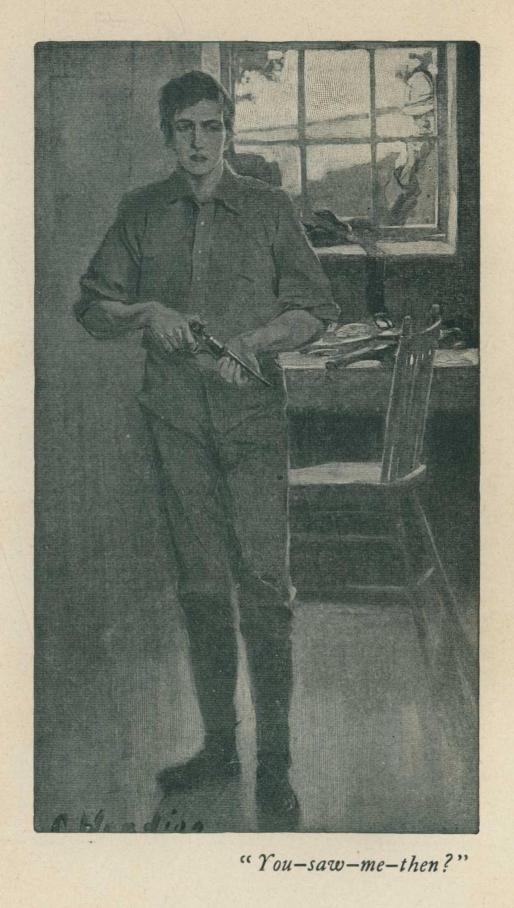
"You—saw—me—then?"
Stewart nodded. Speaking was exquisite torture.
"Do you realize what you've done—that you've broken your life—"
Trevelyan sat motionless on the edge of the bed, his eyes fixed on a point of the pillow. The agony of the night before had been as nothing to this.
"You were an officer and you were afraid of danger—you! And you were coward enough to be willing to send another man to his death—" the young engineer broke off, breathing with labor. "You were willing to let me die. Did you think that would make it easier to win Cary?"
Then Trevelyan spoke.
"It's all true," he said, speaking so slowly that each word fell upon the deathly stillness in the room, like the slow thud of earth upon a coffin, "It's—all—true——but that! I was afraid and I was all you say, coward enough to let another man die or suffer as you are suffering now; and I've dishonored the Service and I've broken my life, but before God, I didn't know that you'd be sent in my place. As for Cary—"
"For Cary," said Stewart, "and for your father and my mother you're to swear to me to hold your tongue over this business. It's like you to go and blurt the whole thing out, but you're to swear you won't open your lips on the subject—ever; and you're to resign your commission in the Service as soon as it's possible without exciting suspicion."
Trevelyan drew back; his throat pulsing. There was the old, odd throbbing in his head, and the dimness of vision, too. After awhile the mist passed.
"God! man, but you're hard!"
"I'm kind to the home people, and I'm just with you—am I not?"
"Yes; oh, yes; but to bear it in silence—never to be able to meet one of the men of the mess without the dead haunting shadow of it on me; to leave the Service—that's the worst of all—never to be able to fight for England again as a soldier, or redeem myself—as a man!"
He rose from the bed and went over to the opposite wall, flinging his bent arm against it and leaning forward, his face hid. Stewart watched him from the bed, his eyes reflecting a great pity. If Trevelyan knew half of what his judgment cost him! If Trevelyan only knew how gladly he was dying in his stead! If only Trevelyan knew that he was more kind than cruel!
Through the window, into the absolute quiet of the room, came the hurrying of feet and the neighing of horses. The Colonel was sending out a squad of armed men to strike to the heart of the native trouble. Somewhere in the distance a bugler was playing.
Trevelyan turned, his back to the wall, his arms flung out.
"Isn't there any other way?"
Stewart struggled to a reclining position, supporting himself on one arm, and he summoned all his love and all his mercy.
"You injured me," he said. "Mackenzie says I can't pull through the day—but if I should, I'm injured for life. I have a right to judge you. There is no other way."
The music of the bugle rose, and swelled, and then melted away.
Trevelyan came back to the bed—passive!
"I'll swear anything you ask."
Then a little later:
"Am I to tell Cary?"
"You are to tell Cary or not, as you want to," said Stewart, looking at him curiously.
"Is there nothing I can say to Cary for you—when—when I—get back to England?"
Stewart shook his head. The weakness he had fought against so long came back, as did the agony.
"Nothing; but that I thought of her—of them all. Can you reach that water? Ah!"
Trevelyan flung himself down by the bed.
"You shan't slip off this way!" he said, tensely, the pain of his own crushed life disappearing before the thought of Stewart's ebbing one.
Stewart did not hear him.
"Call Mackenzie," he said, shortly, "Call Mackenzie—quick!"
IX.
Outside the hurrying and the tramping and the neighing of the horses increased and intensified the silence inside where Stewart lay unconscious, Mackenzie and Vaughan and Trevelyan working over him.
Later in the morning the fighting squad departed, and over the Station fell a stillness as great as that which brooded over the hospital.
After a desperate struggle they brought Stewart to, and then Mackenzie, happening to glance at Trevelyan, saw that the dressing had slipped from his shoulder and that his shirt was stained.
He got him into an adjoining room and redressed the shoulder and insisted on his lying down, in spite of Trevelyan's entreaties to get back to Stewart.
"Everything in the world is being done for him. Keep quiet."
"Keep quiet, while his life's slipping away!" cried Trevelyan, fiercely, "Not while there's a breath left in my own body. I'll pull him through or I'll die!"
"You'll lie still, just where you are," ordered Mackenzie. "He's holding his own just now. He'll need all the strength he's got, and yours, and all he can get—later. I'll call you."
Trevelyan slept for two hours—heavily, exhaustively; then Mackenzie woke him.
"Come," he said, briefly, "Stewart's worse."
Trevelyan sat up on the lounge and flung back his head; through his being thrilled the old lost defiance; the old lost strength. He went into Stewart's room and sat down by the bed.
The long hours crept away and the still shadows of night gathered, and through the hours and the shadows Mackenzie and Trevelyan watched. Stewart continued to sink.
At midnight, Mackenzie went over to the window, turning his back on the bed and Trevelyan.
There was no hope—but Trevelyan wouldn't believe it! Stewart was dying, and Trevelyan obstinately refused to relinquish the fight. Trevelyan didn't know when he was beaten. And Mackenzie, grown prematurely gray in the service of life against death, wondered all over again why human strength is so weak when waged against the great, mute Force of the world.
Trevelyan sat rigid; and he gathered all the strength of his life and his love; and that imperishable part that had been crushed by his crime, but not destroyed, and turned them to the conquering of this hour, and that grim Presence that was drawing nearer.
He had ceased to think of himself and the future for the first time since he had fallen. If it ever once occurred to him, he regarded it vaguely and indifferently. To-morrow, he would wake up to the living death that lay before him, but for the present, he had no thought beyond the still, motionless form stretched on the bed. He concentrated all his passion, all his will strength, and massed them together, as a breastwork, around Stewart's ebbing life.
The grasp of the hand that was clasping his grew weaker.
Trevelyan did not think to call Mackenzie. He had forgotten he was over there by the window; that they three, Stewart and Death and he, Trevelyan, were not alone together. He forced stimulant between Stewart's blue lips. And then he went in search of Stewart's ebbing life, as a swimmer goes down into the depths to bring forth a living man, drowning.
Once the chill of the Shadowy Presence touched him, through the growing chill of Stewart's fingers; and he rubbed them, beating back into the icy veins the heat of his nature, and by and by the Shadowy Presence sullenly drew back, and back, and back.
After a time, Mackenzie, aroused by the oppressive stillness, turned.
He hesitated, and then came to the bed and leaned over Stewart's relaxed form. Stewart's face was turned up to his, drawn and thin and pinched, in the light of the failing lamp, but he was breathing regularly. Mackenzie touched one of his hands. It was moist and warm. And then, dumbly, he turned to Trevelyan.
Trevelyan still sat by the bed, rigid; and his eyes looked back at Mackenzie—dull and spiritless, and his fingers were cold, with the chill of the depths.
Mackenzie touched him on the arm.
Trevelyan struggled to his feet.
"If you could give me a bracer. I'm a bit gone off—"
X.
Trevelyan's hurt shoulder healed rapidly, and two weeks later, Mackenzie discharged him, and he reported for duty again.
"The row's all over, I hear," he said later, to the little subaltern.
The little subaltern nodded ruefully.
"Yes, and holy smoke, didn't the chicken-hearted things run when they caught sight of us. We gave it to 'em hot, though! Guess they'll let off their funny business for a time, and—" the little subaltern grew suddenly sober, "Of course, you've heard about Pearson and Bennett and the men?"
Trevelyan nodded.
"Yes," he said, and the little subaltern never knew how gladly Trevelyan would lay down his life if he could have Pearson's or Bennett's chance—or the chance of the men.
Trevelyan went down the long piazza to his own quarters.
He had been in the hospital having his shoulder dressed and caring for Stewart, who was still ill; when they had brought Pearson and Bennett and the men back to the Station.
And through all the years of his life he would never have Pearson's or Bennett's chance, or the chance of Pearson's or Bennett's burial. He would die as other men died, who had failed in life; he would never be brought back from the front; he would never fall defending the Service and England.
* * * * *
A month later he filed his resignation papers, preparatory to having them endorsed and sent to the War Office.
The Colonel was in a fighting humor when the matter was brought up to him next day! The son of Trevelyan of Inkerman fame! And he sent for Trevelyan and talked to him of his duty to the Service, and the Queen, and the colonial policy of England, and a good deal more; but Trevelyan was firm. The Colonel grew apoplectic; still, Trevelyan was unmoved. Then, the Colonel, who had never lost a battle in his life, retreated ungraciously, trying to think of some reason why the order should not be endorsed and—failed. He had inquired into the shoulder affair, but that was explained by the little subaltern, who testified that he had seen and spoken to Trevelyan the moment before the shot. Trevelyan had been all eagerness to go. He had not paid any attention to the report, thinking some of the men were probably practicing at target. The Colonel had gone over that matter carefully. Then, in spite of the injury, Trevelyan had offered to undertake the survey—the Colonel could not get around that—even though he was not fit. Trevelyan might have been unpopular in the regiment, but he had always done his duty as an officer of the Service. And so the Colonel wrathfully saw the application go off on the next mail to England.
And then Trevelyan waited; waited as a man waits for the warrant that is to close his lease on life; and, as though to make the most of the time remaining, when he was not on duty, or with Stewart in the hospital, he was with the younger officers of the mess. They grew, then, to know a new phase in his character. He no longer closed the door of his quarters on them; it was Trevelyan's room to which they flocked; it was Trevelyan who joked them and teased them and smoked with them, and who played tennis with the garrison girls, and drank tea with the officers' wives; it was Trevelyan, with his great strength and courage, who shared their pastimes and helped to kill the long, inactive days that had settled back over the Station like a pall. Even the little subaltern ceased to dress up regardless in white linen and go and drink tea with Jessica Q, and became Trevelyan's shadow instead.
Weeks later the official acceptance of the resignation came. It was handed to him at mess. He glanced at it indifferently and laid it to one side. Later, he left. He did not join the crowd that evening. He went back to his own quarters and closed the door and drew to the covering at the window, and he sat down in the dark and fought it out alone.
Two hours after he went over to the hospital to make his nightly inquiry for Stewart.
Stewart had had a bad day, they told him. It was a case for time.
He did not go in to see Stewart that night.
He wished that he could have waited and taken Stewart home, he thought, as he retraced his steps to his dark bungalow, but it might be months before Stewart could bear the journey, and Stewart would not hear of his waiting. Perhaps, it was because Stewart was not strong enough to bear the sight of Trevelyan's face, with its imprint of despair; it might have been he fancied something of the despair would lift when Trevelyan was once again in Scotland. At any rate, he had ordered Trevelyan home and Trevelyan had planned to leave—alone.
The next day he dismantled his quarters and made his preparations. He packed his uniforms and his helmets and his sword, and sent them home—to Scotland, to Mactier's care.
In the morning he put on civilian's clothes and left the Station.
* * * * *
The stretch of distant land grew clearer with each throb of the ship engine's heart.
The long voyage was over and Trevelyan was coming back to England.
And he had betrayed his allegiance to England because he had loved! * * *
He leaned over the ship's rail and looked idly at the whirling foam, that beat an angry protest at its birth against the ship's great side, and then grew less and lost itself in the deep waters of the Channel.
Had he loved Cary? he questioned. Had he not mistaken the baser passion for the diviner love that alone is built on honor?
She had told him to mould himself into the divine and he had broken the clay instead.
His eyes rested somberly on the long green line of land. All his honor and allegiance, with which he had broken faith, came back to him and filled him with unspeakable emotion.
He would stoop and he would gather up the broken pieces and remould them for the service of England.
End of Book Two.
BOOK THREE
THE POTTER'S TOUCH
BOOK THREE
THE POTTER'S TOUCH
I.
The long months had swelled into two years and more before Trevelyan came home—to England and to Cary.
Cary and the Captain had spent one winter in Palestine and on the Nile, and the summers in travel. When the Captain mildly suggested Italy or a return to America on the dawning of the second winter, Cary shook her head and begged for London and the old lodgings. Cary, for some reason never spoke of going home now. And so the Captain took her back to London, and Cary seemed to enjoy the great familiar city, better than all the sights and novelties of Egypt and the Holy Land.
The weekly gift of violets or of roses began again with her return to England. Now and then, letters came from John, but they were not frequent, and were, to Cary's critical judgment, unsatisfactory. Of course, she was glad to hear of the life of the Station, and what the men and officers did to pass the off-duty time; and how the army women spent the days in India, and how they all kept cool—or tried to. It was kind of John, too, to think to tell her all the details, and the account of their hunting trip and the "man-eater" Trevelyan had killed,—Cary wondered if the skin was for her—and what their quarters looked like, but somehow Cary wanted more. She wasn't quite sure what she did want; perhaps she told herself it was some more definite mention of Trevelyan. Trevelyan never wrote.
She thought of Trevelyan often, and in the silences of the night she would sometimes recall the blackness and the thunder of that Scottish storm, and the terror of the hour without its charm would come back to her and she would cower among her white pillows and shut, very fast, her eyes.
In the fall the Camerons had asked her to a house party but for some reason she herself could not define, she sent regrets. The Camerons' place was so near his home! She wondered if it were because he would not be there, or if she would be afraid when she saw his home again. When Trevelyan came back—
But she was lonelier in the late afternoon when the Captain had gone to walk, than at any part of the day, and she would sit with idle hands folded in her lap and look at the silent little tea-kettle on the tea-table; or rise and watch the sunset, quite alone. She wasn't ever afraid then, she was only unutterably lonely! Perhaps when Trevelyan came back—
And then Trevelyan did come back. She heard it from the Captain one afternoon, and it was then the Captain told her, gently, of the delayed accounts of Stewart's and Trevelyan's part in the native struggle. There were no details regarding them; it was only known certainly, that both Stewart and Trevelyan had been hurt; that Stewart was still ill at the Station, and that Trevelyan had sent in a resignation. His return was expected. They would have to wait.
They waited; and Cary grew older in the waiting.
Little by little details were added to the story, and she would go around to the Stewarts' and talk it over with John's mother and John's sister, and women-like they would try to fit the ill-formed pieces together.
Then she would go back slowly to the lodgings.
She had waited so long for Trevelyan to come home, and she had thought to welcome him in promotion; she had dreamed that some day Trevelyan would do something great for the Service and for England; she had believed it, and now—Trevelyan was coming home—resigned; and all her dreams and all her faith had not been worth while.
II.
Trevelyan had landed. The Captain saw it in the morning paper and read the item out to Cary. The ship had gotten in a day before it had been looked for.
Cary pushed back her untasted cup of coffee, and she remained in doors all day, unconsciously listening for his footfall on the stairs, and when night came without bringing him, she laughed at herself for fancying that he would come direct to her.
It was three days before he did come and she met him on the stairs. She was about to do some delayed shopping, and as she was going down, she met him coming up. She turned and they went back to the quiet little sitting room together, and she ran over to the window impetuously and flung back the curtains.
"Come here," she said, gaily, "I can scarcely believe it is you, yourself! Come here, and let me see your Indian tan!"
He smiled a little, obeying her, but he did not meet her eyes.
Could he ever tell her? he wondered.
"Why you haven't got half the tan I expected! You're not chocolate at all!" she said like a grieved child.
He forgot the haunting shadow for a moment and he laughed genuinely.
"I'm sorry I don't please you."
"You don't please me at all," Cary pouted. "You're not chocolate, and you haven't returned a captain, and you're not in uniform with a medal on your breast, and what is worse than everything, you've grown chicken-hearted and turned your back on the Service and run away."
He winced.
"And you're as solemn as a funeral, and you haven't told me you're glad to see me, and—you don't please me at all!"
"That's a nice greeting for a chap!"
"Well—you deserve it!" Cary retorted; then she brightened up, "And you really got hurt? Did it come just 'within a shade of a vital spot,' like it always does in the story books?"
"I got a scratch."
"Good boy! How did it happen? You must sit down and tell me all about it. Was it one of those horrid natives?"
Trevelyan sat down near the window in the deep shadow of the curtains. He put his hand to his head and pressed it there tightly for a moment.
"No," he said, "It wasn't one of the natives. It was my own revolver."
"What?"
Trevelyan faltered.
"Must you hear the story to-day? Won't you wait? It's so long since I've seen you—"
If this brief hour could only be his, unspoiled, to remember!
"Don't be aggravating," said Cary, "I'm interested, and I want to hear." She could not have told why a dull weight should suddenly have laid itself upon her.
Trevelyan sat silent.
"First," he said presently, playing with the tassel of the curtain cord, "first, let me tell you about John."
She flushed. She had forgotten John in the dread that lay upon her.
"Yes, please tell me about John. Is he coming home soon?"
"When he is able to bear the journey—and I believe a little before. He is sick for a sight of England." Trevelyan let the last words fall slowly. He had thought to add "of you."
After a moment he went on.
"I had a long talk with Mackenzie—the surgeon, you know—before I left. He says the wound hurt something in the back and went clear through to the lung. He'll have to get out of the Service."
Cary rose quickly. She went over to the piano and stood there pressing her hands against the top and hiding her face on them.
"It's too cruel," she moaned, "both you fellows—out of the Service! It's too cruel!"
Trevelyan knit and unknit his fingers, and was silent.
"He'll be all right—in time," he said slowly, with a dim idea of giving her comfort, "but he just won't be physically strong enough again for the army."
"And you've resigned!"
Trevelyan still sat in the shadows cast by the curtains. He was massing all his courage and his strength against his love.
"Cary!" She raised her head from her arms, and she shivered at the tone of his voice, without knowing why. "Cary, if you'll come over here—I'll tell you why—" he broke off.
She obeyed him mechanically.
"Sit down."
She did as he bade her.
"Shall I light the lamp?" she faltered. "The days are short and—and it's dark—"
"No, not yet. Sit here where I can see your face by the fire. There! Like that!"
And then he began on the cause and the details of the native trouble. She moved restlessly. She did not understand the technicalities very well, and the odd dread and oppression would not lift. She was conscious that Trevelyan's voice filled the room, but she scarcely heeded his words. And then he told her of Stewart and something of what Stewart had tried to do for him, and grew eloquent over it, and she forgot herself and the dread in listening to him. Even on the day of the storm in Scotland, when he had told her the stories of his childhood, he had not been as eloquent as this. Then he halted. After a while he resumed. He did not pause again, but went on rapidly with the old resoluteness born afresh, now that he had once begun. He continued steadily, mercilessly, leading up to the heart of it as he would have aimed at and hit the bull's eye at target practice with an unerring hand.
"And the Colonel ordered me to make the survey. It meant danger and probable death, and—I was afraid. I shot myself to prevent going. I lied about it. I said the revolver had gone off. He sent John."
He leaned forward, grim with the grimness of despair, and the moisture came out on his face and his throbbing throat, but she did not see his face, she only heard the words that fell heavily on the silence.
She rose to her feet; he could see her, in the beauty of her height, silhouetted against the bright firelight. Her breast was rising and falling quickly with emotion.
"I don't believe it," she cried. "There is nothing that will make me believe it! Why, you're not afraid of anything! You to turn coward!"
She paused, waiting for his denial, and remained standing.
He rose too; came from out of the shadows and sat down in the Captain's big chair by the fire, where she could see and read his face.
"I was afraid," he repeated.
It was as if he knew no other word.
She went over to him and dropped down by the chair, and looked up at him.
"Tell me that it isn't true," she said. "If you tell me that it isn't true, I'll believe you against the world."
"It is true," he said.
The girl pressed the palms of her hands against her cheeks and drew them slowly down, away from her face.
Suddenly she rose to her feet and leant over, looking steadily into his face.
The shadowy spaces at the ends of the room grew and came to meet each other.
She looked down into his face searchingly and in silence, and he met her look as a brave man meets death—squarely. Her hand dropped from his shoulder and fell at her side lifelessly. She shrank away.
"Good God," she whispered.
She went over into the shadows, to the window and stood looking out, motionless. It seemed to her that she could never look at him again.
"John saw me," said Trevelyan, over by the fire, "and he swore me to keep quiet about it—except to you; he left that to me to decide—he made me swear to resign. I wasn't fit to serve England."
He spoke without emotion and briefly, stating facts.
After awhile he went over to her in an uncertain manner. She shrank closer to the window.
"Don't come near me," she said in a low voice.
He went back and sat down by the fire. The minutes passed.
"If you would say something to me,—" he began, looking toward her.
She came out of the shadows into the firelight.
"There is nothing to say," she said, and her face looked then like the face on the hospital wall.
"I know it," he answered.
She covered her face with her hands, and turned quickly and fell down by a chair, burying her face in its cushions, and sobbing as though to break her heart.
Trevelyan did not move to go to her; he did not even look at her as she was crying there over his lost honor. Honor was so much to her. He had always known it. Perhaps it was for that he had first loved her.
After awhile she moved and leaned one elbow on the seat of her chair, her cheek in her hand. She turned her face, looking into his.
"I—I didn't mean to be cruel," she said, and her voice caught in sobs as she spoke. "I was—selfish. I—was only thinking of—myself. Of—of how I'd trusted you, and—and that! But oh, I'm—so sorry for—you. I—" she broke off, impatiently brushing the tears away with her hand.
Trevelyan stared into the fire.
"Don't talk that way," he said slowly, "I can bear anything but—that!"
"What—what made you—afraid?"
He left the big chair by the fire and came over to where she was sitting on the floor, and looked down at her.
"I was afraid I should never see you again," he said. "I—" and he put out his hand as though to touch her hair, "I wish—well I wish, I had known there was something besides you in the world!"
She said nothing.
"What are you going to do now?" she asked after awhile.
"I don't know," he said slowly, "I—don't—know!"
He turned abruptly and picked up his coat and hat. He did not offer to shake hands in parting. Cary had used to help him on with his coat and shake hands, but Cary did not move to-night. He walked over to the door, turning to look back at her.
"Good night," he said, in a matter of fact way, "Good-bye."
Cary sat motionless and she looked up at him dumbly.
"Good-bye," he repeated.
"Good-bye," she said slowly.
Trevelyan took the night train home—to Scotland and to old Mactier. Perhaps up there, he would learn "what he was going to do now."
Cary sat motionless, in the shadows, by the big chair. After awhile she crept over to the dead fire and stared at the white ashes. It seemed to her that all her faith was dead.
III.
After Trevelyan had come and gone, each day seemed to Cary like the one before; and they all stretched out, crushed and dead and lifeless, as a string of pearls from which the luster has disappeared.
After awhile there were rumors that Stewart was coming home; that Stewart was making a desperate effort to come home—to England. London was agog—Stewart's part of London. Everyone by this time had gotten a pretty clear idea of affairs, and because Stewart had come up to what they had expected of him, and had faced danger and death like the soldier he was, and had generally conducted himself like a gentleman,—London was pleased. London, like a woman, derived satisfaction in saying, "I always knew it. I told you so."
Little by little the excitement penetrated Cary's inertia. After all, it was not quite fair that because one man had broken her faith and his honor, she should judge all men by him. John had not failed her. Perhaps John would pull things straight again for her, and make her see life as she ought.
The warm days of early spring came—the English spring and the sunshine, and there was no need any longer for a fire on the hearth, and every day brought the ship nearer, and every fair breeze helped to bring him into port quicker—John, coming back, sick and wounded for life, from battle.
After all, she had forgotten that part of it—his part; and his burden that was heavier than her own, and Trevelyan's burden, that was heavier than all.
After awhile she brought a pity, wholly womanly and half divine, out of the ashes that had seemed so dead, and on the awful truth of these men's lives, broken by the failure of one, she built the mercy that is stronger than justice, and the faith that is stronger than doubt.
Something, though, remained in the ashes, dead, never to be rekindled, and woman-like she used to cry a little over the dead part of it; not because she could not relight it, but because it was so dead.
She grew into a woman in those weeks lapsing between Trevelyan's call and Stewart's return—gradually, as clay is moulded in the hands of a potter, who cuts it on his wheel, to give to it the finer tracings and the smoothness of completion.
And every day and every fair breeze brought Stewart nearer, and Cary turned from the ashes to the sunsets again. Fires would go out, even with careful tending, but the sunsets were God's, Cary told herself, and, therefore, eternal.
IV.
Malcolm Stewart went down to Southampton to meet the ship and bring John back to London.
"No excitement," the doctor had said, and so he had gone alone.
Now that young Stewart had really accomplished the task of getting back to England, his false strength deserted him and he became weaker than before. The two men, the sturdy father and the wasted son, made the journey to town, John being carried to and from the railway carriages.
For a moment, when he reached London, and the carriage was turning into Grosvenor Square, he rallied a little and insisted on getting out of the carriage himself, and walking up the steps, leaning heavily on his father's arm.
"We won't frighten the Little Madre," he had said.
The tall, womanly figure of the Little Madre. who had been standing by the window for the last hour, appeared at the door, silently holding out her arms.
After awhile they got him up to his own room and to bed, and all day the Little Madre sat by him, tending to his few wants. Once he fell asleep, and when he awoke the room was full of flowers.
"What is it?" he asked his mother feebly, "Where did they come from?"
"From friends," she said, rising and moving from one great bunch to another. "The white and pink roses are from Cousin Kenneth's wife," and so she went on. "The heather and the bracken came without a name. I think they must be from Rob—don't you?"
She paused, turning to him questioningly. Stewart swallowed.
"Probably," he said, in a low voice.
"The Camerons sent the lilies, and those red roses are from the old Major of the Department—you should read the card," she smiled proudly, coming back to his bed.
He smiled at her eagerness, and laid the card down.
"That's pretty nice, isn't it?" he asked.
And then he looked up at her.
"But the violets?" he asked slowly. "Who left the violets?"
"The violets are from Cary," she replied, meeting his look.
A slow flush mounted over his pale face.
"Please bring them here."
She did so, holding them close to his face that he might smell of them before she put the little vase on the table by him. He took them out of the water, feebly, and laid them on the bed.
"Everyone is awfully kind," he said, "and I don't deserve the fuss. Have—many inquired—to-day?"
"All my visiting list," she replied, laughingly, "and a good many more besides. Why the officers—" she paused, shaking her head.
"Has—Cary called?" he asked, looking hard at the foot board of the bed.
"Yes, and left the flowers herself. You are to see her—" she broke off, anxiously watching the haggard face that he turned quickly to her own.
"When?"
"In three or four days—if you are stronger. She shall be the first."
His mother leaned over him, stroking his hair from his forehead. He met her eyes gravely.
The late sunlight sifted through the drawn curtains and touched the flowers; their exquisite odor crept through the stillness of the room as the sweet memory of an old song steals through the silent chambers of the heart.
"I love her," he said simply. "I have loved her always," he said, still looking into her eyes.
She smiled.
"I have known it always," she answered.
But the four days lengthened into four weeks before he saw Cary. That night the half healed wound reopened, and he had a sinking spell.
The next morning before the news had had time to become generally known, Trevelyan mysteriously appeared at the house on Grosvenor Square, and went straight to Stewart's room.
"You go and lie down," he said briefly to his aunt, who had been up all night, "I guess I ought to know how to take care of him. I did it once before in India. I won't leave you until I've pulled him through."
And then Trevelyan and Death fought it out again, and Trevelyan beat back the Shadowy Presence in the great still London house, as he had done weeks before in the government hospital in India. He hardly left the sick room, and he seemed scarcely ever to sleep. He would sit for hours at a time, his finger on Stewart's pulse; quieting his ravings and forcing back the fever by the might of his own will.
Except in the dim sick room where Stewart lived again in delirium the night of the perilous ride, over the great Grosvenor Square house rested the hush of grave sickness and impending death. The servant stationed at the door, guarded against the possible ringing of the muffled bell, and answered inquiries, and received the cards left, and the offerings of flowers. None ever reached Stewart's darkened room except the small bunch of violets that came daily, and which his mother would bring up and place on the table by his bed, hoping in woman-fashion that the perfume might attract and hold his wandering faculties, or arouse him from the stupor into which he would fall from time to time; but it never did. If she had ever dreamed of the exquisite torture the flowers and their scent were to Trevelyan, she would have placed them with the others down stairs, but Trevelyan never told, and she never knew the moments in which the perfume seemed to drive him mad.
Once she suggested getting a professional nurse to relieve him, but catching sight of Trevelyan's face she had stopped short.
"There! Forgive me," she said. "It is not that I don't trust you, or am ungrateful or believe that anyone else could do so well, but I am afraid for you."
"I'm all right," Trevelyan had answered shortly.
"You are unselfish; you are only thinking of us and of John. You are always thinking and doing for John."
"Don't!" he interrupted, and through the dimness of the room she could see that his face quivered, and she wondered.
"I could not get along without you," she went on. "None of us could, and it has been you who have pulled him through so far."
She looked toward the long, motionless figure on the bed.
"I shall pull him through to-night and to-morrow, and to-morrow again, and next week—until he is out of danger," said Trevleyan.
That was the day the two doctors had given Stewart up.
The crisis came and passed, and Stewart lived.
When the thralldom and the stupor of the fever had partly lifted, and before Stewart came to himself, Trevelyan left and went back to Scotland and to old Mactier, nor could anyone persuade him to remain.
Days later, when Stewart was sitting up, he saw Cary for the first time.
"There is some one waiting outside whom you will be glad to see," his mother had said.
"It is Cary? You are going to let me see Cary?" he cried.
"If you will be good and not talk," she answered, leaving the door ajar.
Stewart turned his face to the door, pressing his long, thin fingers resting on his knee, close together.
She came in carrying a bunch of violets, and stood by his chair, looking down at him. He looked up at her, and it seemed to him that she was beautiful, and her voice the sweetest he had ever heard.
"I have waited and wanted so to give you these myself," she said, "and you have frightened us all so."
She spoke with the simplicity of a little girl, but there was a quality in her voice that Stewart had not heard before, and he knew that Cary had become a woman.
He clung to her hand in parting with that pathetic bodily weakness that makes a man, in illness, like a child.
"Don't go yet," he pleaded, "You've been here such a little while. Oh, please don't go!"
She patted his hand.
"I will come again," she said, and on her way to the door, she kept looking back at him and smiling. He sat motionless until her light footstep was lost in the distance, and all day he sat quiet, scarcely speaking, dreaming of her.
The next day he waited, expecting her, but she did not come; nor the next.
"What's become of Cary?" he asked on the third day of his mother. "Why don't she come any more?"
"I suppose she thinks you're out of danger now, and she may have other things to do."
"If that isn't just the way of women! Coming all the time when a chap don't know anything or anybody, and then just when he needs cheering—" he broke off, pulling viciously at the shawl over his feet.
His mother smiled, knowing better "the way of women."
But two days later, when Cary called again, she spoke to her of his loneliness.
"He gets tired of the home faces," she said, "and he isn't strong enough yet to see the men or strangers. Perhaps if you could read aloud to him now and then——"
"Why, of course I could," said Cary, and after that she came oftener. They would carry Stewart down to his mother's cheerful little sitting room, and there one or more of the family would gather and Cary would talk or read aloud. At such times Stewart would lean back in his chair among his pillows and remain silent, content to look at her and to listen to her voice. One day they were left alone together. He remained quiet, his eyes fixed on her. Presently she finished the chapter and turned the page.
"I think that was a pretty strong scene, don't you?" she asked, pausing for a moment before she went on, and peering at him gravely over the top of the book.
"Yes—it was," he answered absently.
"You weren't listening to a word of it," she exclaimed reproachfully.
He laughed.
"To tell you the truth—no. Put the wretched old thing down and talk to me."
She laid the book down as he had bidden, but she played nervously with the leaves.
"What shall I talk about?"
"Oh, anything—yourself."
"Upon my word, but you're polite. There isn't an earthly thing to tell about myself," she added, "And I don't know any topic that would interest you. There's that House of Commons speech, of course, but——"
"Then I'll talk to you."
"Oh, you mustn't!" She looked up startled, "Sir Archibald said you were not to exert yourself."
"Confound the old codger, anyway! Does he expect to keep me tongue-tied the rest of my life?"
Cary laughed.
"You're cross to-day," she said. "You're getting better. It's a sure sign."
Stewart leaned forward suddenly; then he leaned back and traced an outline of a sword on the leather arm of the chair.
"Did you know," he asked her slowly, "that as far as the Service is concerned, I'm done for—that I'll never be well enough for it again; that I've been injured beyond hope for the Service; that I've had to resign?"
"Yes," said Cary gently, looking hard at the book in her lap.
"Thirty and—done for," he said bitterly, "All the Woolwich years to count for nothing; all the study; all the ambition, all the—hope, to count for nothing!" His finger paused in tracing the outline of the sword.
"Oh, you mustn't say that," cried Cary, "you must remember what you've done already—more than many older officers do in their whole lives. And then—"
He interrupted her.
"That sounds well," he said. "But life isn't worth much to a man when he's laid on the shelf just when he's beginning to live— But the wasted years and the inactive life ahead!" He went on rapidly, beating the fist of one hand against the palm of the other. "Oh, think what inactivity will mean after the life I've been trained to, and worked for, and loved!"
She sat silent, her heart throbbing with a great pity.
"To have to think of myself—to look out for draughts like a sickly, nervous old man!" Something rose in Stewart's throat, and he coughed. "Can't ever command the men again! Can't lead them to battle, or ever feel the soft earth under me, or see the stars and the night through the flap of my tent! To have to give up trying to be something, or do something—at thirty!"
He stopped short.
The book fell from Cary's lap to the floor, and she stooped to pick it up with swimming eyes. He caught sight of her face and he leaned forward; all the anger and all the resentment gone from his voice—melted by her tears.
"Bah!" he said, "That's just about the fate I'm fit for if I haven't got any more grit than that! Of course I didn't mean it, and you must try and forget it. Of course the Service is out of the question, but I will make something of my life! And I'm awfully glad, too, for what I've had of it, and—been allowed to do. I'm glad for the Woolwich years and—and the training—and—all that! Of course it hasn't been lost. And I'm glad I've done something for the Service—even in a little way, and saved—" he caught himself up suddenly.
Cary rose, her tears dried by the burning fever in her eyes. She finished the sentence.
"Saved Robert from exposure!"
He looked up quickly.
"I—I don't understand you."
"Oh, yes, you do too," said Cary, breathing hard. "You think I don't know all about it! I do, though!"
"How?"
"Robert told me himself."
Stewart drew a deep breath and looked away. There was a long silence in the room. After awhile she went up to the big leather chair and laid one hand on the back of it and bent her head, looking down at him.
"Johnny?"
He looked up, his firm mouth working.
"Johnny, you're the best man that ever lived!"
"Oh, Cary!" he said, and he tried to laugh.
She nodded decidedly.
"But I know. Robert told me what you'd been to him, and—he didn't spare himself."