NOTES TO VOLUME I. (continued 2)
Reading edition
v. 418.
The woodhacke, that syngeth chur Horsly, as he had the mur]
—woodhacke, i. e. woodpecker. “Wodehac or nothac byrde. Picus.” Prompt. Parv. ed. 1499: mur, i. e. a severe cold with hoarseness. Compare Lydgate;
“And at his feete lay a prykeryd curre He rateled in the throte as he had the murre.” Le Assemble de dyeus, sig. b i. n. d. 4to.
v. 420. lusty] i. e. pleasant.
v. 421. The popyngay] i. e. The parrot.
Page 64. v. 422. toteth] Or tooteth; see note on v. 411.
v. 424. The mauys] Is properly the song-thrush, as distinguished from the missel-thrush: see note on v. 460, p. 131.
v. 425. the pystell] i. e. the Epistle.
v. 426. a large and a longe] See note, p. 95. v. 49.
Page 64. v. 427.
To kepe iust playne songe, Our chaunters shalbe the cuckoue]
See note, p. 95. v. 48. So Shakespeare mentions “the plain-song cuckoo gray.” Mids. Night’s Dream, act iii. sc. 1.
v. 430. puwyt the lapwyng] In some parts of England, the lapwing is called pewit from its peculiar cry.
v. 432. The bitter with his bumpe] “The Bitter, or Bitterne, Bumpeth, when he puts his Bill in the reeds.” R. Holme’s Ac. of Armory, 1688. B. ii. p. 310.
v. 434. Menander] Means here Mæander: but I have not altered the text; because our early poets took great liberties with classical names; because all the eds. of Skelton’s Speke, Parrot, have
“Alexander, a gander of Menanders pole.” v. 178. vol. ii. 9.
and because the following passage occurs in a poem by some imitator of Skelton, which is appended to the present edition;
“Wotes not wher to wander, Whether to Meander, Or vnto Menander.” The Image of Ipocrisy, Part Third.
v. 437. wake] i. e. watching of the dead body during the night.
v. 441. He shall syng the grayle]—grayle, says Warton (correcting an explanation he had formerly given), signifies here “Graduale, or the Responsorium, or Antiphonarium, in the Romish service.... He shall sing that part of the service which is called the Grayle, or graduale.” Obs. on the F. Queen, ii. 244. ed. 1762. See too Du Cange in v. Gradale, and Roquefort in v. Gréel.
v. 442. The owle, that is so foule]—foule, i. e. ugly. The Houlate, (in the poem so called, by Holland), says,
“Thus all the foulis, for my filth, hes me at feid.” Pinkerton’s Scot. Poems, iii. 149.
v. 444. gaunce] i. e. gaunt.
v. 445. the cormoraunce] i. e. the cormorant.
v. 447. the gaglynge gaunte] In Prompt. Parv. is “Gant birde. Bistarda.” ed. 1499. Palsgrave gives “Gant byrde,” without a corresponding French term. Lesclar. de la Lang. Fr., 1530. fol. xxxv. (Table of Subst.). Our author in his Elynour Rummyng has—
“In came another dant, Wyth a gose and a gant.” v. 515. vol. i. 111;
where gant is plainly used for gander. In the present passage, however, gaunte must have a different signification (“The gose and the gander” being mentioned v. 435), and means, I apprehend,—wild-goose: Du Cange has “Gantæ, Anseres silvestres,” &c.; and see Roquefort in v. Gans. But Nares, MS. note on Skelton, explains gaunte—gannet.
Page 64. v. 449. The route and the kowgh] The Rev. J. Mitford suggests that the right reading is “The knout and the rowgh,”—i. e. the knot and the ruff.
v. 450. The barnacle] i. e. The goose-barnacle,—concerning the production of which the most absurd fables were told and credited: some asserted that it was originally the shell-fish called barnacle, others that it grew on trees, &c.
v. 451. the wilde mallarde] i. e. the wild-drake.
Page 65. v. 452. The dyuendop] i. e. The dabchick or didapper.
v. 454. The puffin] A water-fowl with a singular bill.
v. 455. Money they shall dele, &c.] According to the ancient custom at funerals.
v. 458. the tytmose] i. e. the titmouse.
v. 460. The threstyl] Or throstle, is properly the missel-thrush: see note on v. 424. p. 129.
v. 461. brablyng] i. e. clamour, noise—properly, quarrel, squabble.
v. 462. The roke] i. e. The rook.
—— the ospraye That putteth fysshes to a fraye]
—fraye, i. e. fright. It was said that when the osprey, which feeds on fish, hovered over the water, they became fascinated and turned up their bellies.
v. 464. denty] i. e. dainty.
v. 468. The countrynge of the coe]—countrynge; see note, p. 92: coe, i. e. jack-daw; “Coo birde. Monedula. Nodula.” Prompt. Parv. ed. 1499.
v. 469.
The storke also, That maketh his nest In chymneyes to rest; Within those walles No broken galles May there abyde Of cokoldry syde]
The stork breeds in chimney-tops, and was fabled to forsake the place, if the man or wife of the house committed adultery. The following lines of Lydgate will illustrate the rest of the passage:
“a certaine knight Gyges called, thinge shameful to be tolde, To speke plaine englishe, made him [i. e. Candaules] cokolde. Alas I was not auised wel beforne, Vnkonnyngly to speake such langage, I should haue sayde how that he had an horne, Or sought some terme wyth a fayre vysage, To excuse my rudenesse of thys gret outrage: And in some land Cornodo men do them cal, And some affirme that such folke haue no gal.” Fall of Prynces, B. ii. leaf lvi. ed. Wayland.
Page 65. v. 478.
The estryge, that wyll eate An horshowe so great]
—estryge, i. e. ostrich: horshowe, i. e. horse-shoe.—In Struthiocamelus, a portion of that strange book Philomythie, &c., by Tho. Scot., 1616, a merchant seeing an ostrich, in the desert, eating iron, asks—
“What nourishment can from those mettals grow? The Ostrich answers; Sir, I do not eate This iron, as you thinke I do, for meate. I only keepe it, lay it vp in store, To helpe my needy friends, the friendlesse poore. I often meete (as farre and neere I goe) Many a fowndred horse that wants a shooe, Seruing a Master that is monylesse: Such I releiue and helpe in their distresse.” Sig. E 7.
v. 482. freat] i. e. gnaw, devour.
Page 66. v. 485. at a brayde] Has occurred before in our author’s Bowge of Courte; see note, p. 109. v. 181; but here it seems to have a somewhat different meaning, and to signify—at an effort, at a push. “At a brayde, Faysant mon effort, ton effort, son effort, &c.” Palsgrave’s Lesclar. de la Lang. Fr., 1530. fol. ccccxxxviii. (Table of Aduerbes). “I Abrayde, I inforce me to do a thynge.” ... “I Breyde I make a brayde to do a thing sodaynly.” Id. fols. cxxxvi. clxxii. (Table of Verbes).
v. 487. To solfe aboue ela]—solfe, i. e. solfa: ela, i. e. the highest note in the scale of music.
v. 488. lorell] i. e. good-for-nothing fellow (see Tyrwhitt’s Gloss. to Chaucer’s Cant. Tales): used here as a sportive term of reproach.
v. 491.
The best that we can, To make hym our belman, And let hym ryng the bellys; He can do nothyng ellys]
“Sit campanista, qui non vult esse sophista, Let him bee a bellringer, that will bee no good Singer.” Withals’s Dict. p. 178. ed. 1634.
Page 66. v. 495.
Chaunteclere, our coke, ... By the astrology That he hath naturally, &c.]
So Chaucer;
“But when the cocke, commune Astrologer, Gan on his brest to beate,” &c. Troilus and Creseide, B. iii. fol. 164.—Workes, ed. 1602.
See also Lydgate’s Warres of Troy, B. i. sig. D v. ed. 1555; and his copy of verses (entitled in the Catalogue Advices for people to keep a guard over their tongues), MS. Harl. 2255. fol. 132.
v. 499. cought] i. e. caught: compare the first of our author’s Balettys, v. 19. vol. i. 22.
v. 500. tought] i. e. taught. “Musyke hath me tought.” Hawes’s Pastime of pleasure, sig. G iiii. ed. 1555.
v. 501. Albumazer] A famous Arabian, of the ninth century.
v. 503.
—— Ptholomy Prince of astronomy]
The celebrated Claudius Ptolemy, an Egyptian: “Il fleurit vers l’an 125 et jusqu’à l’an 139 de l’ère vulgaire.” Biog. Univ.—In The Shepherds Kalendar (a work popular in the days of Skelton) a chapter is entitled “To know the fortunes and destinies of man born under the xii signs, after Ptolomie, prince of astronomy [i. e. astrology].” “Astronomy, and Astronomer, is the Art of, and the foreteller of things done and past, and what shall happen to any person, &c.” R. Holme’s Ac. of Armory, 1688. B. ii. p. 438.
v. 505. Haly] Another famous Arabian: “claruit circa A. C. 1100.” Fabr. Bibl. Gr. xiii. 17.
v. 507. tydes] i. e. times, seasons.
v. 509. Partlot his hen] So in Chaucer’s Nonnes Preestes Tale; Lydgate’s copy of verses (entitled in the Catalogue Advices for people to keep a guard over their tongues), MS. Harl. 2255. fol. 132; and G. Douglas’s Prol. to the xii Booke of his Eneados, p. 401. l. 54. ed. Ruddiman, who conjectures that the name was applied to a hen in reference to the ruff (the partlet), or ring of feathers about her neck.
Page 67. v. 522. thurifycation] i. e. burning incense.
Page 67. v. 524. reflary] As I have already noticed, should probably be “reflayre,”—i. e. odour. See Roquefort’s Gloss. de la Lang. Rom. in v. Flareur, and Suppl. in v. Fleror; and Cotgrave’s Dict. in v. Reflairer. In The Garlande of Laurell our author calls a lady “reflaring rosabell.” v. 977. vol. i. 401.
v. 525. eyre] i. e. air, scent.
“Strowed wyth floures, of all goodly ayre.” Hawes’s Pastime of pleasure, sig. D iiii. ed. 1555.
See too The Pistill of Susan, st. viii.—Laing’s Early Pop. Poetry of Scot.
v. 534. bemole] i. e. in B molle, soft or flat. So in the last stanza of a poem by W. Cornishe, printed in Marshe’s ed. of Skelton’s Workes, 1568;
“I kepe be rounde and he by square The one is bemole and the other bequare.”
v. 536.
Plinni sheweth all In his story naturall]
See Historia Naturalis, lib. x. sect. 2.
v. 540. incyneracyon] i. e. burning to ashes.
v. 545. corage] i. e. heart,—feelings.
Page 68. v. 552. the sedeane] Does it mean subdean, or subdeacon?
v. 553. The quere to demeane] i. e. to conduct, direct the choir.
v. 555. ordynall] i. e. ritual.
v. 556. the noble fawcon] “There are seuen kinds of Falcons, and among them all for her noblenesse and hardy courage, and withal the francknes of her mettell, I may, and doe meane to place the Falcon gentle in chiefe,” Turbervile’s Booke of Falconrie, &c. p. 25. ed. 1611.
v. 557. the gerfawcon] “Is a gallant Hawke to behold, more huge then any other kinde of Falcon, &c.” Id. p. 42.
v. 558. The tarsell gentyll] Is properly the male of the gosshawk; but Skelton probably did not use the term in its exact meaning, for in the fifth line after this he mentions “the goshauke.” It is commonly said (see Steevens’s note on Romeo and Juliet, act ii. sc. 2.) to be called tiercel because it is a tierce or third less than the female. But, according to Turbervile, “he is termed a Tyercelet, for that there are most commonly disclosed three birds in one selfe eyree, two Hawkes and one Tiercell.” Booke of Falconrie, &c. p. 59. ed. 1611.
v. 560. amysse] i. e. amice—properly the first of the six vestments common to the bishop and presbyters. “Fyrst do on the amys, than the albe, than the gyrdell, than the manyple, than the stoole, than the chesyble.” Hormanni Vulgaria, sig. E iiii. ed. 1530.
Page 68. v. 561. The sacre] A hawk “much like the Falcon Gentle for largenesse, and the Haggart for hardines.” Turbervile’s Booke of Falconrie, &c. p. 45. ed. 1611.
v. 563. role] i. e. roll.
v. 565. The lanners] “They are more blancke Hawkes then any other, they haue lesse beakes then the rest, and are lesse armed and pounced then other Falcons be.” Turbervile’s Booke of Falconrie, &c. p. 47. ed. 1611.
—— the marlyons] Or merlins,—the smallest of the hawks used by falconers.
v. 566. morning gounes] i. e. mourning-gowns.
v. 567. The hobby] “Of all birdes of prey that belong to the Falconers vse, I know none lesse then the Hobby, unles it be the Merlyn.” Turbervile’s Booke of Falconrie, &c. p. 53. ed. 1611.
—— the muskette] i. e. the male sparrow-hawk. “You must note, that all these kind of hawkes haue their male birdes and cockes of euerie sort and gender, as the Eagle his Earne ... and the Sparrow-hawke his Musket.” Id. p. 3. “The male sparrow hawke is called a musket.” The Countrie Farme, p. 877. ed. 1600.
v. 568. sensers] i. e. censers.
—— fet] i. e. fetch.
v. 569. The kestrell] A sort of base-bred hawk.
—— warke] i. e. work, business.
v. 570. holy water clarke] See note, p. 94. v. 21.
Page 69. v. 590. And wrapt in a maidenes smocke] Spenser seems to have recollected this passage: he says, that when Cupid was stung by a bee, Venus
—— “tooke him streight full pitiously lamenting, And wrapt him in her smock.”
See a little poem in his Works, viii. 185. ed. Todd.
v. 595. Lenger] i. e. Longer.
v. 600.
—— the prety wren, That is our Ladyes hen]
So in a poem (attributed, on no authority, to Skelton) entitled Armony of Byrdes, n. d., and reprinted entire in Typogr. Antiq. iv. 380. ed. Dibdin;
“Than sayd the wren I am called the hen Of our lady most cumly.” p. 382.
Wilbraham, in his Cheshire Gloss., p. 105, gives the following metrical adage as common in that county;
“The Robin and the Wren Are God’s cock and hen, The Martin and the Swallow Are God’s mate and marrow.”
In the Ballad of Kynd Kittok, attributed to Dunbar, we are told that after death she “wes our Ledyis henwyfe,” Poems, ii. 36. ed. Laing.—An Elysium, very different from that described in the somewhat profane passage of our text, is assigned by the delicate fancy of Ovid to the parrot of his mistress, in the poem to which (as I have before observed, p. 120,) Skelton seems to have had an eye;
“Colle sub Elysio nigra nemus illice frondens,” &c. Amor. ii. 6. 49.
Page 69. v. 609. asayde] i. e. tried—tasted: compare our author’s Elynour Rummyng, v. 397. vol. i. 108.
v. 610. Elyconys] i. e. Helicon’s.
Page 70. v. 616.
As Palamon and Arcet, Duke Theseus, and Partelet]
See Chaucer’s Knightes Tale, and Nonnes Preestes Tale.
v. 618.
—— of the Wyfe of Bath, That worketh moch scath, &c.]
See Chaucer’s Wif of Bathes Prologue.—scath, i. e. harm, mischief.
v. 629. Of Gawen] Son of King Lot and nephew of King Arthur. Concerning him, see the Morte d’Arthur (of which some account is given in note on v. 634),—Syr Gawayn and the Grene Knyȝt, in MS. Cott. Nero A. x. fol. 91,—Ywaine and Gawin, in Ritson’s Met. Rom. vol. i.,—the fragment of The Marriage of Sir Gawaine, at the end of Percy’s Rel. of A. E. P.,—The Awntyrs of Arthure at the Terne Wathelyn, in Laing’s Early Pop. Poetry of Scot., (the same romance, from a different MS., under the title of Sir Gawan and Sir Galaron of Galloway, in Pinkerton’s Scot. Poems, vol. iii.),—The Knightly Tale of Golagrus and Gawane, reprinted at Edinburgh in 1827 from the ed. of 1508, (the same romance, under the title of Gawan and Gologras, in Pinkerton’s Scot. Poems, vol. iii.),—and the romance of Arthour and Merlin, from the Auchinleck MS., published by the Abbotsford Club, 1838.
I had written the above note before the appearance of a valuable volume put forth by the Bannatyne Club, entitled Syr Gawayne; A collection of Ancient Romance-Poems, by Scotish and English Authors, relating to that celebrated Knight of the Round Table, with an Introduction, &c., by Sir F. Madden, 1839.
—— syr Guy] In The Rime of Sire Thopas, Chaucer mentions “Sire Guy” as one of the “romaunces of pris.” For an account of, extracts from, and an analysis of, the English romance on the subject of this renowned hero of Warwick, see Ritson’s Met. Rom. (Dissert.) i. xcii., Warton’s Hist. of E. P. i. 169. ed. 4to., and Ellis’s Spec. of Met. Rom. ii. I must also refer the reader to a volume, issued by the Abbotsford Club (while the present sheet was passing through the press), entitled The Romances of Sir Guy of Warwich, and Rembrun his son. Now first edited from the Auchinleck MS. 1840.
Page 70. v. 631.
—— the Golden Flece, How Jason it wan]
A boke of the hoole lyf of Jason was printed by Caxton in folio, n. d. (about 1475), being a translation by that venerable typographer from the French of Raoul le Fevre. A copy of it (now before me) in the King’s Library, though apparently perfect, has no title of any sort. Specimens of this prose-romance, which is not without merit, may be found in Dibdin’s Biblioth. Spenc. iv. 199.—The story of Jason is also told by Chaucer, Legend of Hipsiphile and Medea; by Gower, Conf. Am. Lib. v.; and, at considerable length, by Lydgate, Warres of Troy, B. i.
v. 634.
Of Arturs rounde table, With his knightes commendable, And dame Gaynour, his quene, Was somwhat wanton, I wene; How syr Launcelote de Lake Many a spere brake For his ladyes sake; Of Trystram, and kynge Marke, And al the hole warke Of Bele Isold his wyfe]
—warke, i. e. work, affair.—Concerning the various romances on the subject of Arthur, Lancelot, Tristram, &c. see Sir F. Madden’s Introduction to the volume already mentioned, Syr Gawayne, &c.—In this passage, however, Skelton seems to allude more particularly to a celebrated compilation from the French—the prose romance of The Byrth, Lyf, and Actes of Kyng Arthur, &c., commonly known by the name of Morte d’Arthur. At the conclusion of the first edition printed in folio by Caxton (and reprinted in 1817 with an Introd. and Notes by Southey) we are told “this booke was ended the ix. yere of the reygne of kyng Edward the Fourth by syr Thomas Maleore, knyght”.... “Whiche booke was reduced in to Englysshe by Syr Thomas Malory knyght as afore is sayd and by me [Caxton] deuyded in to xxi bookes chaptyred and emprynted and fynysshed in thabbey Westmestre the last day of July the yere of our lord MCCCCLXXXV.”
In the Morte d’Arthur, the gallant and courteous Sir Launcelot du Lake, son of King Ban of Benwyck, figures as the devoted lover of Arthur’s queen, Gueneuer (Skelton’s “Gaynour”), daughter of King Lodegreans of Camelard. On several occasions, Gueneuer, after being condemned to be burnt, is saved by the valour of her knight. But their criminal intercourse proves in the end the destruction of Arthur and of the fellowship of the Round Table. Gueneuer becomes a nun, Launcelot a priest. The last meeting of the guilty pair,—the interment of Gueneuer’s body by her paramour,—and the death of Launcelot, are related with no ordinary pathos and simplicity.
The same work treats fully of the loves of Sir Trystram, son of King Melyodas of Lyones, and La Beale Isoud (Skelton’s “Bele Isold”), daughter of King Anguysshe of Ireland, and wife of King Marke of Cornwall, Trystram’s uncle.—(Trystram’s wife, Isoud La Blaunche Maynys, was daughter of King Howel of Bretagne).—The excuse for the intrigue between Trystram and his uncle’s spouse is, that their mutual passion was the consequence of a love-potion, which they both drank without being aware of its nature.
“In our forefathers time,” observes Ascham, somewhat severely, “when Papistrie, as a standing poole, couered and ouerflowed all England, fewe bookes were red in our tonge, sauing certayne bookes of Chiualrie, as they sayd for pastime and pleasure, which, as some say, were made in Monasteries, by idle Monkes, or wanton Chanons: as one for example Morte Arthur: the whole pleasure of which booke standeth in two speciall pointes, in open mans slaughter, and bolde bawdrye: in which booke, those bee counted the noblest knights, that doe kill most men without any quarell, and commit fowlest aduoulteries by sutlest shifts: as Sir Launcelote, with the wife of king Arthure his maister: Sir Tristram, with the wife of King Marke his uncle: Syr Lamerocke, with the wife of king Lote, that was his own aunte. This is good stuffe, for wise men to laugh at, or honest men to take pleasure at. Yet I knowe, when Gods Bible was banished the Court, and Morte Arthure receaued into the Princes chamber.” The Schole Master, fol. 27. ed. 1571.
Page 71. v. 649.
—— of syr Lybius, Named Dysconius]
See the romance of Lybeaus Disconus (Le beau desconnu), in Ritson’s Met. Rom. ii.; also Sir F. Madden’s note in the volume entitled Syr Gawayne, &c. p. 346.
v. 651.
Of Quater Fylz Amund, ... ... how they rode eche one On Bayarde Mountalbon; Men se hym now and then In the forest of Arden]
The English prose romance on the subject of these worthies came originally from the press of Caxton, an imperfect copy of his edition n. d. folio, being in Lord Spencer’s library; see Dibdin’s Ædes Althorp. ii. 298: and that it was also translated from the French by Caxton himself, there is every reason to believe; see Dibdin’s Bibliog. Decam. ii. 438. According to the colophon of Copland’s ed., this romance was reprinted in 1504 by Wynkyn de Worde; see Typ. Antiq. ii. 116. ed. Dibdin. Copland’s edition has the following title: The right plesaunt and goodly Historie of the foure sonnes of Aimon the which for the excellent endytyng of it, and for the notable Prowes and great vertues that were in them: is no les pleasaunt to rede, then worthy to be knowen of all estates bothe hyghe and lowe, M.CCCCC.LIIII. folio.
The names of the brothers were “Reynawde, Alarde, Guycharde, and Rycharde, that were wonderfull fayre, wytty, great, mightye, and valyaunte, specyally Reynawde whiche was the greatest and the tallest manne that was founde at that tyme in al the worlde. For he had xvi. feete of length and more.” fol. i. ed. Copl. The father of this hopeful family was Duke of Ardeyne.
Bayarde—(properly a bay horse, but used for a horse in general)—“was suche a horse, that neuer was his like in all the world nor neuer shall be except Busifal the horse of the great Kinge Alexander. For as for to haue ronne. xxx. myle together he wolde neuer haue sweted. The sayd Bayard thys horse was growen in the Isle of Boruscan, and Mawgys the sonne of the duke Benes of Aygremount had gyuen to his cosin Reynawde, that after made the Kynge Charlemayne full wrothe and sory.” fol. v. Reynawde had a castle in Gascoigne called Mountawban; hence Skelton’s expression, “Bayarde Mountalbon.” A wood-cut on the title-page represents the four brothers riding “eche one” upon the poor animal. “I,” says Reynawde, relating a certain adventure, “mounted vpon Bayarde and my brethern I made to mount also thone before and the two other behynde me, and thus rode we al foure vpon my horse bayarde.” fol. lxxxii.
Charlemagne, we are told, made peace with Reynawde on condition that he should go as a pilgrim, poorly clothed and begging his bread, to the holy land, and that he should deliver up Bayard to him. When Charlemagne had got possession of the horse,—“Ha Bayarde, bayarde,” said he, “thou hast often angred me, but I am come to the poynt, god gramercy, for to auenge me;” and accordingly he caused Bayarde to be thrown from a bridge into the river Meuse, with a great millstone fastened to his neck. “Now ye ought to know that after that bayarde was caste in the riuer of meuze: he wente vnto the botom as ye haue herde, and might not come vp for bicause of the great stone that was at his necke whiche was horryble heuye, and whan bayarde sawe he myghte none otherwise scape: he smote so longe and so harde with his feete vpon the mylle stone: that he brast it, and came agayne aboue the water and began to swym, so that he passed it all ouer at the other syde, and whan he was come to londe: he shaked hymselfe for to make falle the water fro him and began to crie hie, and made a merueyllous noyse, and after beganne to renne so swyftlye as the tempest had borne him awaie, and entred in to the great forest of Ardeyn ... and wit it for very certayn that the folke of the countrey saien, that he is yet alyue within the wood of Ardeyn. But wyt it whan he seeth man or woman: he renneth anon awaye, so that no bodye maye come neere hym.” fol. cxlv.
Page 71. v. 661. Of Judas Machabeus] “Gaultier de Belleperche Arbalestrier, ou Gaultier Arbalestrier de Belleperche, commença le Romans de Judas Machabee, qu’il poursuiuit jusques à sa mort.... Pierre du Riez le coutinua jusques à la fin.” Fauchet’s Recveil de l’origine de la langue et poesie Françoise, &c., p. 197.
v. 662.—of Cesar Julious] In the prologue to an ancient MS. poem, The boke of Stories called Cursor Mundi, translated from the French, mention is made of the romance
“Of Julius Cesar the emperour.” Warton’s Hist. of E. P. i. 123, note, ed. 4to.
v. 663.
—— of the loue betwene Paris and Vyene]
This prose romance was printed by Caxton in folio: Here begynneth thystorye of the noble ryght valyaunt and worthy knyght Parys, and of the fayr Vyēne the daulphyns doughter of Vyennoys, the whyche suffred many aduersytees bycause of theyr true loue or they coude enioye the effect therof of eche other. Colophon: Thus endeth thystorye of the noble, &c. &c., translated out of frensshe in to englysshe by Wylliam Caxton at Westmestre fynysshed the last day of August the yere of our lord MCCCCLXXXV, and enprynted the xix day of decembre the same yere, and the fyrst yere of the regne of kyng Harry the seuenth.
Gawin Douglas tells us in his Palice of Honour, that, among the attendants on Venus,
“Of France I saw thair Paris and Veane.” p. 16. Bann. ed.
Page 71. v. 665. duke Hannyball]—duke, i. e. leader, lord.—So Lydgate;
“Which brother was vnto duke Haniball.” Fall of Prynces, B. ii. leaf xlv. ed. Wayland;
and in a copy of verses entitled Thonke God of alle, he applies the word to our Saviour;
“The dereworth duke that deme vs shalle.” MS. Cott. Calig. A ii. fol. 66.
v. 667. Fordrede] i. e. utterly, much afraid.
“To wretthe the king thai were for dred [sic].” Seynt Katerine, p. 170,—Turnbull’s Legendæ Catholicæ (from the Auchinleck MS.).
v. 668. wake] i. e. watch,—besiege.
v. 673.
Of Hector of Troye That was all theyr ioye]
See the Warres of Troy by Lydgate, a paraphrastical translation of Guido de Colonna’s Historia Trojana: it was first printed in 1513. See too the Recuyel of the Historyes of Troy. Compare Hawes;
“Of the worthy Hector that was all theyr ioye.” The Pastime of pleasure, sig. P iii. ed. 1555.
v. 677.
—— of the loue so hote That made Troylus to dote Vpon fayre Cressyde, &c.]
See Chaucer’s Troilus and Creseide.
Page 72. v. 682. Pandaer] Or Pandare as Chaucer occasionally calls Pandarus.
—— bylles] i. e. letters: see Chaucer’s Troilus and Creseide.
v. 686. An ouche, or els a ryng] “Nouche. Monile.” Prompt. Parv. ed. 1499. “Ouche for a bonnet afficquet.” Palsgrave’s Lesclar. de la Lang. Fr., 1530. fol. li. (Table of Subst.). “He gaue her an ouche couched with perles, &c.... monile.” Hormanni Vulgaria, sig. k iii. ed. 1530.—Concerning ouche (jewel, ornament, &c.), a word whose etymology and primary signification are uncertain, see Tyrwhitt’s Gloss., to Chaucer’s Cant. Tales, v. Nouches, and Richardson’s Dict. in v. Ouch.—Here, perhaps, it means a brooch: for in the third book of Chaucer’s Troilus and Creseide, Cressid proposes that Pandarus should bear a “blew ring” from her to Troilus; and (ibid.) afterwards the lovers
“enterchaungeden her ringes, Of which I can not tellen no scripture, But well I wot, a broche of gold and azure, In which a Rubbie set was like an herte, Creseide him yaue, and stacke it on his sherte.” Chaucer’s Workes, fol. 164. ed. 1602.
After Cressid becomes acquainted with Diomede, she gives him a brooch, which she had received from Troilus on the day of her departure from Troy. Id. fols. 179, 181. In Henrysoun’s Testament of Creseide (a poem of no mean beauty), Cressid, stricken with leprosy, bequeathes to Troilus a ring which he had given her. Id. fol. 184.
Page 72. v. 700. That made the male to wryng] So Skelton elsewhere;
“That ye can not espye Howe the male dothe wrye.” Colyn Cloute, v. 687. vol. i. 337.
“The countrynge at Cales Wrang vs on the males.” Why come ye nat to Courte, v. 74. vol. ii. 29,
and so Lydgate;
“Now al so mot I thryue and the, saide he than, I can nat se for alle wittes and espyes, And craft and kunnyng, but that the male so wryes That no kunnyng may preuayl and appere Ayens a womans wytt and hir answere.” The prohemy of a mariage, &c.,—MS. Harl. 372. fol. 50.
I do not understand the expression. In Palsgrave’s Lesclar. de la Lang. Fr., 1530, besides “Male or wallet to putte geare in,” we find “Mayle that receyueth the claspe of a gowne in to it ... porte,” fol. xlvi. (Table of Subst.).
v. 702. The song of louers lay]—lay seems here to mean—law.
“Of louers lawe he toke no cure.” Harpalus (from pieces by uncertain authors printed with the poems of Surrey),—Percy’s Rel. of A. E. P. ii. 68. ed. 1794.
Page 73. v. 716. kys the post] So Barclay;
“Yet from beginning absent if thou be, Eyther shalt thou lose thy meat and kisse the post,” &c. Egloge ii. sig. B iiii. ed. 1570.
The expression is found in much later writers: see, for instance, Heywood’s Woman Kilde with Kindnesse, sig. E 2. ed. 1617.
v. 717. Pandara] So in Chaucer (according to some copies);
“Aha (quod Pandara) here beginneth game.” Troilus and Creseide, B. i. fol. 147,—Workes, ed. 1602.
Page 73. v. 719. But lyght for somer grene] See note, p. 115. v. 355.
v. 727. ne knew] i. e. knew not.
v. 728. on lyue] i. e. alive.
v. 732. make] i. e. mate.
v. 735. proces] i. e. story, account. So again in this poem “relation” and “prosses” are used as synonymous, vv. 961, 969; and in our author’s Magnyfycence we find
“Vnto this processe brefly compylyd.” v. 2534. vol. i. 308.
and presently after,
“This treatyse, deuysyd to make you dysporte.” v. 2562. p. 309.
The 15th chap. of the first book of Lydgate’s Fall of Prynces is headed “A processe of Narcissus, Byblis, Myrra,” &c.
v. 736.—of Anteocus] Whom Chaucer calls “the cursed king Antiochus.” The Man of Lawes Prol. v. 4502. ed. Tyr. His story may be found in Gower’s Confessio Amantis, lib. viii. fol. clxxv. sqq. ed. 1554.
v. 739.
—— of Mardocheus, And of great Assuerus, &c.]
“Even scripture-history was turned into romance. The story of Esther and Ahasuerus, or of Amon or Hamon, and Mardocheus or Mordecai, was formed into a fabulous poem.” Warton, note on Hist. of E. P. ii. 178. (where some lines of the romance are quoted from a MS.) ed. 4to.
v. 741. Vesca] i. e. Vashti.
v. 742. teene] i. e. wrath: see the Book of Esther.
v. 745. Of kyng Alexander] See Weber’s Introduction, p. xx. sqq., and the romance of Kyng Alisaunder in his Met. Rom. i.; also The Buik of the most noble and vailȝeand Conquerour Alexander the Great, reprinted by the Bannatyne Club, 1831.
v. 746.—of kyng Euander] As the lady declares (v. 756) that she was slightly acquainted with Virgil, we may suppose that her knowledge of this personage was derived from The Recuyel of the Historyes of Troy, and Caxton’s Boke of Eneydos.
Page 74. v. 751. historious] i. e. historical.
v. 752. bougets and males] i. e. budgets and bags.
v. 754. sped] i. e. versed in.
v. 760. mo] i. e. more.
v. 766. Phorocides] i. e. Pherecydes.
v. 767. auncyente] i. e. antiquity.
Page 74. v. 768. to diffuse for me] i. e. too difficult for me to understand. “Dyffuse harde to be vnderstande, diffuse.” Palsgrave’s Lesclar. de la Lang. Fr., 1530. fol. lxxxvi. (Table of Adiect.).
“What quoth Doctryne where is he now That meued this mater straunge and dyffuse.” Lydgate’s Assemble de dyeus, sig. f ii. n. d. 4to.
“Whyche is defuse, and right fallacyous.” Hawes’s Pastime of pleasure, sig. H i. ed. 1555.
“But oft yet by it [logick] a thing playne, bright and pure, Is made diffuse, vnknowen, harde and obscure.” Barclay’s Ship of Fooles, fol. 53. ed. 1570.
v. 775. enneude] “I Ennewe I set the laste and fresshest coloure vpon a thyng as paynters do whan their worke shall remayne to declare their connyng, Je renouuelle. Your ymage is in maner done, so sone as I haue ennewed it I wyl sende it you home,” &c. Palsgrave’s Lesclar. de la Lang. Fr., 1530. fol. ccxxvi. (Table of Verbes).
“Ylike enewed with quickenes of coloure, Both of the rose and the lyly floure.” Lydgate’s Warres of Troy, B. ii. sig. I ii. ed. 1555.
“And the one shylde was enewed with whyte, and the other shelde was reed.” Morte d’Arthur, B. iii. c. ix. vol. i. 81. ed. Southey.
v. 776. pullysshed] i. e. polished.
—— lusty] i. e. pleasant, beautiful.
v. 779. frowardes] i. e. frowardness.
Page 75. v. 788. sped] i. e. versed.
v. 791. Solacious] i. e. affording amusement.
v. 792. alowed] i. e. approved.
v. 793. enprowed] In the Glossary to Fry’s Pieces of Ancient Poetry, 1814, where a portion of the present poem is given, enprowed is rendered “profited of:” the whole passage is very obscure.
v. 799. warke] i. e. work.
v. 804.
—— Johnn Lydgate Wryteth after an hyer rate]
Lydgate, however, disclaims all elevation of style: see his Fall of Prynces, Prol. sig. A iii. ed. Wayland; his Warres of Troy, B. ii. sigs. F ii, K. ii, B. v. sigs. E e i. ii. iii. ed. 1555.
v. 806. dyffuse] i. e. difficult: see note on v. 768, supra.
v. 807. sentence] i. e. meaning.
v. 809. No man that can amend, &c.] So Hawes, speaking of the works of Chaucer, Gower, and Lydgate;
“Whose famous draughtes no man can amende.” The Pastime of pleasure, sig. G iiii. ed. 1555.
Page 75. v. 811. faute] i. e. fault.
v. 812. to haute] i. e. too high, too loftily.
Page 76. v. 817. In worth] See note, p. 95. v. 68.
v. 841. Joanna] See note, p. 122.
Page 77, v. 860.
If Arethusa wyll send Me enfluence to endyte]
Skelton recollected that Virgil had invoked this nymph as a Muse;
“Extremum hunc, Arethusa, mihi concede laborem.” Ecl. x. 1.
v. 869. lust] i. e. pleasure.
v. 872. enbybed] i. e. made wet.
v. 873. aureat] i. e. golden.
v. 875. Thagus] i. e. Tagus.
Page 78. v. 882. remes] i. e. realms.
v. 886. Perce and Mede] i. e. Persia and Media.
v. 896.
She floryssheth new and new In bewte and vertew]
So Lydgate:
“And euer encrecyng in vertue new and newe.” The Temple of Glas., sig. b vii. n. d. 4to.
See also his Warres of Troy, B. ii. sig. II i. B. iii. sig. S i. ed. 1555; and Chaucer, The Pardoneres Tale, v. 12863. ed. Tyr.
v. 903. askry] i. e. call out against, raise a shout against: see note on v. 1358, p. 152.
v. 905. odyous Enui, &c.] Here Skelton has an eye to Ovid’s picture of Envy:
“Pallor in ore sedet; macies in corpore toto: Nusquam recta acies: livent rubigine dentes: Pectora felle virent: lingua est suffusa veneno. Risus abest, nisi quem visi movere dolores. Nec fruitur somno, vigilacibus excita curis: Sed videt ingratos, intabescitque videndo, Successus hominum: carpitque et carpitur una: Suppliciumque suum est.” Met. ii. 775.
See too the description of Envy in Pierce Plowman, sig. F ii. ed. 1561.
v. 908. ledder] i. e. leather, leathern.
Page 79. v. 912. crake] i. e. creak.
v. 913. Leane as a rake] From Chaucer;
“As lene was his hors as is a rake.” Prol. to Cant. Tales, v. 289. ed. Tyr.
Browne has the expression,—Britannia’s Pastorals, B. ii. S. 1. p. 18. ed. 1625.
Page 79. v. 915. vnlusty] i. e. unpleasant, unseemly.
v. 919. wronge] i. e. wrung.
v. 930. bete] i. e. agitated; or, perhaps, inflamed (the expression to bete a fire, to mend it, to make it burn, is a common one).
v. 931. frete] i. e. eaten, gnawed.
v. 936. semblaunt] i. e. semblance, appearance.
Page 80. v. 947. slo] i. e. slay.
v. 963. agayne] i. e. against.
v. 968. dres] i. e. address, apply.
v. 969. prosses] Equivalent to “relation” in v. 961: see note on v. 735, p. 143.
v. 970. ken] i. e. instruct.
v. 973. As hym best lyst] i. e. As best pleases him.
Page 81. v. 980. bedell] i. e., I apprehend, servitor: but Nares, MS. note on Skelton, explains it—beadsman.
v. 999. sort] i. e. set, assemblage.
v. 1002. fauour] i. e. appearance, look—or, perhaps, beauty,—in which sense the word occurs v. 1048.
v. 1003. Ennewed] See note on v. 775, p. 144.
Page 82. v. 1014.
Her eyen gray and stepe ... With her browes bent]
“Gray coloured as ones eyes be vair.” Palsgrave’s Lesclar. de la Lang. Fr., 1530. fol. lxxxviii. (Table of Adiect.):—bent, i. e. arched. Compare Hawes;
“Her forehead stepe with fayre browes ybent Her eyen gray.” The Pastime of pleasure, sig. S i. ed. 1555.
I may just observe that these passages (and many others which might be cited) shew how unnecessarily Ritson substituted “brent” for “bent” in The Squyr of Lowe Degre; see his note, Met. Rom. iii. 351.
v. 1019. Polexene] i. e. Polyxena, the daughter of Priam,—celebrated by Lydgate in his Warres of Troy, and by others.
v. 1031. The Indy saphyre blew] Indy may perhaps be used here for—Indian; but I believe the expression is equivalent to—the azure blue sapphire (Skelton in his Garlande of Laurell has “saphiris indy blew,” v. 478, vol. i. 381); see note, p. 101. v. 17.
v. 1032. ennew] See note on v. 775. p. 144.
Page 82. v. 1034. lere] i. e. skin.
v. 1035. lusty] i. e. pleasant, beautiful.
—— ruddes] i. e. ruddy tints of the cheek, complexion.
Page 83. v. 1048. with fauour fret]—fauour, i. e. beauty; so Skelton has “feturs fauorable,” in the second of his Balettys, v. 8, vol. i. 23: fret, I believe, does not here mean fraught (see Tyrwhitt’s Gloss. to Chaucer’s Cant. Tales), but is equivalent to—wrought, adorned,—in allusion to fret-work; so in our author’s Garlande of Laurell,—
“Fret all with orient perlys of Garnate.” v. 485, vol. i. 381.
v. 1052.
The columbine commendable, The ielofer amyable]
Ielofer is perhaps what we now call gillyflower; but it was formerly the name for the whole class of carnations, pinks, and sweetwilliams. So Graunde Amoure terms La Bell Pucell;
“The gentyll gyllofer the goodly columbyne.” Hawes’s Pastime of pleasure, sig. N i. ed. 1555.
v. 1065. denayd] i. e. denied.
v. 1069. conuenyently] i. e. fittingly, suitably.
Page 84. v. 1077. sker] i. e. scar: see v. 1045.
v. 1078. Enhached] i. e. Inlaid: our author has the word again in his Garlande of Laurell;
“Enhachyde with perle and stones preciously.” v. 40. vol. i. 363.
v. 1081. To forget deadly syn] Compare the first of our author’s Balettys, v. 11. vol. i. 22.
v. 1096. pastaunce] i. e. pastime.
v. 1097. So sad and so demure]—sad, i. e. serious, grave, sober: so afterwards, “Sobre, demure Dyane.” v. 1224.
v. 1100. make to the lure] A metaphor from falconry: “Lure is that whereto Faulconers call their young Hawks, by casting it up in the aire, being made of feathers and leather, in such wise that in the motion it looks not unlike a fowl.” Latham’s Faulconry (Explan. of Words of Art), 1658.
v. 1102. hole] i. e. whole.
Page 85. v. 1105. crased] i. e. crushed, enfeebled.
v. 1106. dased] i. e. dazzled.
v. 1116.
And to amende her tale, Whan she lyst to auale]
—auale is generally—to let down, to lower: but I know not how to explain the present passage, which appears to be defective.
Page 85. v. 1118.
And with her fyngers smale, And handes soft as sylke, Whyter than the mylke, That are so quyckely vayned]
—quyckely vayned, i. e. lively veined. Compare Hawes;
“By her propre hande, soft as any sylke.” The Pastime of pleasure, sig. H iiii. ed. 1555.
“Her fingers small, and therto right longe, White as the milke, with blew vaynes among.” Id. sig. S i.
v. 1124. Vnneth] i. e. Scarcely, not without difficulty. Here again the text seems to be defective.
v. 1125. reclaymed] A metaphor from falconry. “Reclaming is to tame, make gentle, or to bring a Hawk to familiarity with the man.” Latham’s Faulconry (Explan. of Words of Art), 1658.
Page 86. v. 1146. tote] i. e. look, gaze: see note on v. 411, p. 129.
v. 1147. fote] i. e. foot.
v. 1148. hert rote] i. e. heart-root.
v. 1151.
She is playnly expresse Egeria, the goddesse, And lyke to her image, Emportured with corage, A louers pilgrimage]
I must leave the reader to form his own idea of the meaning of the last two lines, which are beyond my comprehension.
v. 1157. Ne] i. e. Nor.
—— wood] i. e. mad, furious.
Page 87. v. 1170.
So goodly as she dresses, So properly she presses The bryght golden tresses Of her heer so fyne, Lyke Phebus beames shyne. Wherto shuld I disclose The garterynge of her hose?]
—Phebus beames shyne, i. e. the shine of Phœbus’ beams. Compare Hawes;
“Her shining here so properly she dresses Alofe her forehed with fayre golden tresses ... Her fete proper, she gartered well her hose.” The Pastime of pleasure, sig. S i. ed. 1555.
v. 1177. to suppose] i. e. to be supposed.
Page 87. v. 1178. were] i. e. wear.
v. 1179. gere] i. e. dress, clothes.
v. 1180. fresshe] i. e. gay.
v. 1184. lusty somer] i. e. pleasant summer.
v. 1194. kyrtell] “Kyrtell a garment corpset, surcot, cotelle.” Palsgrave’s Lesclar. de la Lang. Fr., 1530. fol. xliii. (Table of Subst.). It has been variously explained (see notes on Henry IV. Part ii. act ii. sc. 4, Shakespeare by Malone and Boswell, xvii. 98, 99, Todd’s Johnson’s Dict., and Nares’s Gloss.), petticoat,—safe-guard or riding-hood,—long cloak,—long mantle, reaching to the ground, with a head to it that entirely covered the face, and usually red,—apron,—jacket,—and loose gown!!! The following note by Gifford on Cynthia’s Revels (Jonson’s Works, ii. 260) gives the most satisfactory account of a kirtle: “Few words have occasioned such controversy among the commentators on our old plays as this; and all for want of knowing that it is used in a two-fold sense, sometimes for the jacket merely, and sometimes for the train or upper petticoat attached to it. A full kirtle was always a jacket and petticoat, a half kirtle (a term which frequently occurs) was either the one or the other: but our ancestors, who wrote when this article of dress was everywhere in use, and when there was little danger of being misunderstood, most commonly contented themselves with the simple term (kirtle), leaving the sense to be gathered from the context.”
v. 1199. let] i. e. hinder.
Page 88. v. 1205. pullysshed] i. e. polished.
v. 1223. Jane] See note, p. 122.
v. 1225. hyght] i. e. called.
Page 89. v. 1242. saynt Jamys] i. e. Saint James of Compostella: see note on Elynour Rummyng, v. 354.
v. 1243. pranys] i. e. prawns.
v. 1244. cranys] i. e. cranes.
v. 1250. sadly] i. e. seriously, soberly.
v. 1251. gyse] i. e. guise, fashion.
Page 90. —— an adicyon] Though found in all the eds. of Phyllyp Sparowe which I have seen, it was not, I apprehend, originally published with the poem. It is inserted (and perhaps first appeared) in our author’s Garlande of Laurell, v. 1261. vol. i. 412, where he tells us that some persons “take greuaunce, and grudge with frownyng countenaunce,” at his poem on Philip Sparrow,—alluding probably more particularly to Barclay; see note, p. 120, and Account of Skelton and his Writings.
v. 1269. ianglynge iayes] See note on v. 396, p. 128.
Page 90. v. 1274. depraue] i. e. vilify, defame. “Thus was syr Arthur depraued and euyl sayd of.” Morte d’Arthur, B. xxi. c. i. vol. ii. 433. ed. Southey.
v. 1289. estate] i. e. high rank, dignity.
Page 91. v. 1291. Hercules that hell dyd harow]—harow, i. e. lay waste, plunder, spoil,—overpower, subdue,—Hercules having carried away from it his friends Theseus and Pirithous, as well as the dog Cerberus. The harrowing of hell was an expression properly and constantly applied to our Lord’s descent into hell, as related in the Gospel of Nicodemus. There were several early miracle-plays on this favourite subject; and Lydgate strangely enough says that Christ
“Took out of helle soulys many a peyre Mawgre Cerberus and al his cruelte.” Testamentum,—MS. Harl. 2255. fol. 49.
I may add, that Warner, speaking of Hercules, uses the words “harrowed hell.” Albion’s England, p. 23. ed. 1612.
v. 1293. Slew of the Epidaures, &c.] Qy. is not the text corrupted here?
v. 1295. Onocentaures] i. e. Centaurs, half human, half asses. See Ælian De Nat. Anim. lib. xvii. c. 9. ed. Gron., and Phile De Anim. Prop. c. 44. ed. Pauw. Both these writers describe the onocentaur as having the bosom of a woman. R. Holme says it “is a Monster, being the Head and Breasts of a Woman set upon the Shoulders of a Bull.” Ac. of Armory, 1688. B. ii. p. 208.
v. 1296. Hipocentaures] i. e. Centaurs, half human, half horses.
v. 1302. Of Hesperides withhold] i. e. Withheld by the Hesperides.
v. 1314. rounses] i. e. common hackney-horses (though the word is frequently used for horses in general).
v. 1318.
He plucked the bull By the horned skull, And offred to Cornucopia]
The “bull” means Achelous, who, during his combat with Hercules, assumed that shape:
“rigidum fera dextera cornu Dum tenet, infregit; truncaque a fronte revellit. Näides hoc, pomis et odoro flore repletum, Sacrarunt; divesque meo bona Copia cornu est.” Ovid. Met. ix. 85.
Page 92. v. 1322. Ecates] i. e. Hecate’s.
Page 92. v. 1326.
—— the venemous serpent, That in hell is neuer brent]
—brent, i. e. burned. A somewhat profane allusion to the scriptural expression “the worm dieth not;”—(worm and serpent were formerly synonymous).
v. 1332. infernall posty]—posty, i. e. power. So Lydgate;
“Of heuene and erthe and infernal pooste.” Testamentum,—MS. Harl. 2255. fol. 47.
v. 1333. rosty] i. e. roast.
v. 1335. wood] i. e. mad, wild.
v. 1340. frounsid] i. e. wrinkled.
v. 1344. Primo Regum] i. e. The First Book of Kings, or, as it is now called, The First Book of Samuel, chap, xxviii.
“Primo regum as ye may playnly reade.” Lydgate’s Fall of Prynces, B. ii. leaf xxxix. ed. Wayland.
v. 1345.
He bad the Phitonesse ... But whether it were so, He were idem in numero, The selfe same Samuell, &c.]
—Phitonesse, i. e. Pythoness, witch,—the witch of Endor.
“And speke as renably, and faire, and wel, As to the Phitonesse did Samuel: And yet wol som men say it was not he,” &c. Chaucer’s Freres Tale, v. 7091. ed. Tyr.;
and see his House of Fame, B. iii. fol. 267, Workes, ed. 1602.
“And of Phyton that Phebus made thus fine Came Phetonysses that can so deuyne,” &c. Lydgate’s Warres of Troy, B. ii. sig. K vi. ed. 1555.
“And secretelye this Saule is forth gone To a woman that should him rede and wisse, In Israell called a phytonesse. ... To diuines this matter I commit, ... Whether it was the soule of Samuell,” &c. Lydgate’s Fall of Prynces, B. ii. leaf xl. ed. Wayland.
See also Gower’s Conf. Am. B. iv. fol. lxxiii. ed. 1554; Barbour’s Bruce, B. iii. v. 982. ed. Jam.; G. Douglas’s Preface to his Virgil’s Æneados, p. 6, 1. 51. ed. Rudd.; and Sir D. Lyndsay’s Monarchie, B. iv. Works, iii. 151. ed. Chalmers.
Page 92. v. 1346. dresse] i. e. address, apply.
v. 1351. condityons] i. e. qualities. But in our author’s Garlande of Laurell, where this “adicyon” is given, the passage according to Fake’s ed., and rightly perhaps (compare the preceding lines), stands thus;
“And by her supersticiouns Of wonderfull condiciouns.” v. 1343. vol. i. 414.
Page 93. v. 1352. stede] i. e. place.
v. 1358. ascry] Has occurred before in this poem, see note on v. 903. p. 145. Palsgrave has “I Askry as fore riders of an armye do their enemyes whan they make reporte where they haue sene them: Je descouures.... Whose company dyd askry them first .... les descouuryt.” Lesclar. de la Lang. Fr., 1530. fol. cliii. (Table of Verbes). But in the present passage “ascry” seems to mean assail (with a shout). In Langtoft’s Chronicle we find,
“Edward was hardie, the Londres gan he ascrie.” p. 217. ed. Hearne,—
(who in Gloss. renders “ascrie”—cry to). The original French has,
“Sir Eduuard fiz le rays, les loundrays escrye.” MS. Cott. Jul. A v. fol. 122.
Roquefort gives “Escrier: Faire entendre son cri d’armes dans une bataille ... marcher à l’ennemi, l’attaquer,” &c. Gloss. de la Lang. Rom. (Sup.).
v. 1360. my selfe dyscharge] i. e. unburden myself,—open my mind.
v. 1365. shene] i. e. shine.
v. 1371. Scroupe pulchra Joanna] See note, p. 122. I ought to have observed ad loc. that “Scroupe” is to be considered here as a monosyllable; unless we read “Scrope” as two short syllables.
ELYNOUR RUMMYNGE.
On the title-page and also on the last leaf of Rand’s edition of this poem, 1624, 4to, (reprinted, not with perfect accuracy, in the Harleian Miscellany; see vol. i. 415. ed. Park,) is an imaginary portrait, of which the subjoined is a fac-simile:
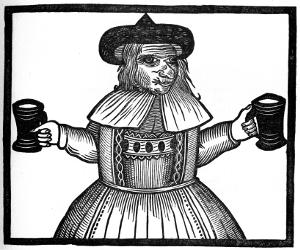
“When Skelton wore the Laurell Crowne, My Ale put all the Ale-wiues downe.”
George Steevens having heard that a copy of Rand’s edition was in the Library of Lincoln Cathedral, prevailed on the Dean to bring it to London; and having made a drawing of the title-page, gave it to Richardson the printseller, who engraved and published it. Steevens, soon after, contributed to the European Magazine for May, 1794, vol. xxv. 334,—
“Verses meant to have been subjoined (with the following Motto) to a Copy from a scarce Portrait of Elinour Rumming, lately published by Mr. Richardson, of Castle-street, Leicester-square.
Ne sit ancillæ tibi amor pudori Xanthia Phoceu! prius insolentem Serva Briseis niveo colore Movit Achillem. Movit Ajacem Telamone natum Forma captivæ dominum Tecmessæ; Arsit Atrides medio in triumpho Virgine rapta. Horace.
“Eleonora Rediviva. To seek this nymph among the glorious dead, Tir’d with his search on earth, is Gulston fled:— Still for these charms enamour’d Musgrave sighs; To clasp these beauties ardent Bindley dies;— For these (while yet unstag’d to public view) Impatient Brand o’er half the kingdom flew;— These, while their bright ideas round him play, From classic Weston force the Roman lay:— Oft too, my Storer! heaven has heard thee swear, Not Gallia’s murder’d Queen was half so fair:— ‘A new Europa!’ cries the exulting Bull, ‘My Granger now (I thank the gods) is full:’— Even Cracherode’s self, whom passions rarely move, At this soft shrine has deign’d to whisper love.— Haste then, ye swains, who Rumming’s form adore, Possess your Elinour, and sigh no more. W. R.”
The Marquis of Bute told Dallaway that he gave twenty guineas for the original engraving of Elinour: see Dallaway’s Letheræum, 1821, p. 6.
Rand’s edition opens with the following lines, which, I need hardly observe, are by some rhymer of the day:
“Skeltons Ghost. To all tapsters and tiplers, And all ale house vitlers, Inne-keepers and cookes, That for pot-sale lookes, And will not giue measure, But at your owne pleasure, Contrary to law, Scant measure will draw In pot and in canne, To cozen a man Of his full quart a penny, Of you there’s to many: For in King Harry’s time, When I made this rime Of Elynor Rumming With her good ale tunning, Our pots were full quarted, We were not thus thwarted With froth-canne and nick-pot And such nimble quick shot, That a dowzen will score For twelue pints and no more. Full Winchester gage We had in that age; The Dutchmans strong beere Was not hopt ouer heere, To vs t’was unknowne: Bare ale of our owne In a bowle we might bring To welcome the king, And his grace to beseech, With, Wassall my Leigh.[270] Nor did that time know To puffe and to blow In a peece of white clay, As you doe at this day, With fier and coale, And a leafe in a hole; As my ghost hath late seene, As I walked betweene Westminster Hall And the church of Saint Paul, And so thorow the citie, Where I saw and did pitty My countrymen’s cases, With fiery-smoke faces, Sucking and drinking A filthie weede stinking, Was ne’re knowne before Till the deuill and the More In th’ Indies did meete, And each other there greete With a health they desire Of stinke, smoake, and fier. But who e’re doth abhorre it, The citie smoakes for it; Now full of fier-shops And fowle spitting chops, So neesing and coughing, That my ghost fell to scoffing, And to myselfe said, Here’s fylthie fumes made; Good physicke of force To cure a sicke horse. Nor had we such slops, And shagge-haire on our tops: At wearing long haire King Harry would sweare, And gaue a command With speede out of hand All heads should be powl’d, As well young as old, And his owne was first so, Good ensample to show. Y’are so out of fashion, I know not our nation; Your ruffes and your bands, And your cuffes at your hands; Your pipes and your smokes, And your short curtall clokes; Scarfes, feathers, and swerds, And thin bodkin beards; Your wastes a span long, Your knees with points hung, Like morrice-daunce bels; And many toyes els, Which much I distaste: But Skelton’s in haste. My masters, farewell; Reade ouer my Nell, And tell what you thinke Of her and her drinke: If shee had brew’d amisse, I had neuer wrote this.”
At the end of the poem is, from the same hand,
“Skelton’s Ghost to the Reader.[271] Thus, countrymen kinde, I pray let me finde, For this merry glee, No hard censure to be. King Henry the Eight Had a good conceit Of my merry vaine, Though duncicall plaine It now nothing fits The time’s nimble wits: My lawrell and I Are both wither’d dry, And you flourish greene In your workes daily seene, That come from the presse, Well writ I confesse; But time will devouer Your poets as our, And make them as dull As my empty scull.”
Concerning Elynour Rummyng and the poem by which Skelton has rendered her famous, Dallaway has the following remarks,—his account of the circumstances which introduced Skelton to her acquaintance being a mere hypothesis!! “When the Court of Henry viii was frequently kept at the palace of Nonsuch (about six miles distant), the laureate, with other courtiers, sometimes came to Leatherhead for the amusement of fishing, in the river Mole; and were made welcome at the cabaret of Elinor Rummyng, whom Skelton celebrated in an equivocal encomium, in a short [?—it consists of 623 lines—] poem, remarkable only for a very coarse jest, after a manner peculiar to the author and the times in which he lived, but which has been more frequently reprinted than his other works. The gist or point of this satire had a noble origin, or there must be an extraordinary coincidence of thought in the Beoni, or Topers, a ludicrous effusion of the great Lorenzo de Medici, when a young man.... Her domicile, near the bridge, still exists. The annexed etching was made from a drawing taken previously to late repairs, but it still retains its first distinction as an ale-house.”
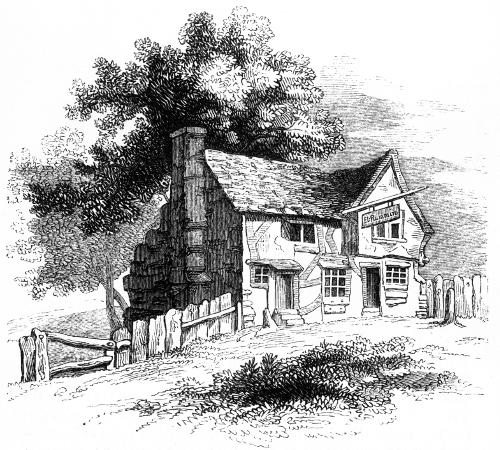
“Some of her descendants occur in the parish register in the early part of the last century.” Letheræum, 1821, pp. 4-6.
The Tunnyng of Elynour Rummyng] Besides “I Tonne ale or wyne I put lycour in to tonnes, Je entöne,” Palsgrave has “I Tonne I masshe ale, Je brasse.... Whan tonne you and god wyll: Quant brasserez vous,” &c. Lesclar. de la Lang. Fr., 1530. fol. ccclxxxxi. (Table of Verbes); and here Tunnyng means—Brewing.
P. 95. v. 1.
Tell you I chyll, If that ye wyll A whyle be styll]
—I chyll, i. e. Ich wyll, I will. Compare Syr Gawayn and the Grene Knyȝt;
“And ȝe wyl a whyle be stylle, I schal telle yow how thay wroȝt.” p. 74. Bann. ed.
and the Prol. to Kyng Alisaunder;
“Yef ye wolen sitte stille, Ful feole Y wol yow telle.” Weber’s Met. Rom. i. 5.
Page 95. v. 4. gyll] Equivalent here to girl—a familiar name for a female; as in the proverb, “Every Jack must have his Gill:” supposed by some etymologists to be an abbreviation of Julia, Juliana, or Gillian; by Richardson (Dict. in v.) to be a corruption of giglot.
v. 6. gryll] “Grymm gryl and horryble ... horridus ... horribilis.” Prompt. Parv.,—MS. Harl. 221. (Ed. 1499 of that work omits “gryl..”) The word is of frequent occurrence; but its exact meaning here seems to be doubtful.
v. 12. lere] i. e. complexion, skin.
v. 14. chere] i. e. look, countenance.
v. 17. bowsy] i. e. bloated by drinking.
v. 21. here] i. e. hair.
v. 22. lewde] i. e. vile, nasty.
v. 23. sayne] i. e. say.
v. 25. glayre] i. e. viscous matter.
Page 96. v. 27.
Her nose somdele hoked, And camously croked]
—somdele hoked, i. e. somewhat hooked. “Camed or short nosed. Simus.” Prompt. Parv. ed. 1499. “A Camoise nose, that is to saie crooked vpward as the Morians [Moors].” Baret’s Alvearie. “Camuse. Flat.” Tyrwhitt’s Gloss. to Chaucer’s Cant. Tales. “Camused. Flat, broad and crooked; as applied to a nose, what we popularly call a snub-nose.” Nares’s Gloss. Todd, quoting this passage of Skelton, explains camously, awry. Johnson’s Dict. in v.
v. 34. gowndy] So Lydgate;
“A goundy eye is deceyued soone, That any colour cheseth by the moone.” Warres of Troy, B. ii. sig. H iii. ed. 1555.
“Gownde of the eye. Ridda, Albugo.” Prompt. Parv.,—MS. Harl. 221.
v. 35. vnsowndy] i. e. unsound.
v. 38. jetty] i. e. that part of a building which projects beyond the rest.
Page 96. v. 40.
—— how she is gumbed, Fyngered and thumbed]
i. e. what gums, fingers, and thumbs she has.
v. 45. huckels] i. e. hips.
v. 49. Foted] i. e. Footed.
v. 51. iet] i. e. strut: see note, p. 94. v. 43.
v. 52. fet] Means, perhaps, feat,—neat, handsome one.
v. 53. flocket] “Is described as a loose garment with large sleeves:” see Strutt’s Dress and Habits, &c. ii. 373.
v. 54. rocket] i. e. a garment, worn often without, and sometimes with sleeves; sometimes it was made to reach the ground, and sometimes much shorter and open at the sides. See Id. ibid.
v. 55. With symper the cocket] So Heywood in his Dialogue;
“Vpright as a candell standth in a socket, Stoode she that day, so simper decocket.” Sig. F,—Workes, ed. 1598.
and Jonson in his Masque, The Gipsies Metamorphosed;
“Lay by your wimbles, Your boring for thimbles, Or using your nimbles, In diving the pockets, And sounding the sockets Of simper-the-cockets.” Works (by Gifford), vii. 376.
In a note on the latter passage, Whalley quotes from Cotgrave’s Dict.: “Coquine, a beggar-woman, also a cockney, simper de cockit, nice thing.” Gifford (ibid.) remarks, “Cocket was a fine species of bread, as distinguished from common bread; hence, perhaps, the name was given to an overstrained affectation of delicacy. To simper at, or over, a thing, is to touch it as in scorn.” Nares (Gloss. in v.) doubts (justly, I think) the connexion of simper-the-cocket with cocket bread, and explains it, “quasi simpering coquette,” observing, that “one of Cotgrave’s words in rendering ‘coquette’ is cocket.” I may add, that in Gloss. of Prov. and Loc. Words by Grose and Pegge, ed. 1839, is, “Cocket, brisk, apish, pert,” and “Simper, to mince one’s words.”
Page 97. v. 56.
Her huke of Lyncole grene, It had ben hers, I wene, More then fourty yere]
“Huke surquanie, froc.” Palsgrave’s Lesclar. de la Lang. Fr., 1530. fol. xli. (Table of Subst.). “A loose kind of garment, of the cloak or mantle kind.” Strutt’s Dress and Habits, &c. ii. 364. “Lyncolne anciently dyed the best greene of England.” Marg. note in Drayton’s Polyolbion, Song 25. p. 111. ed. 1622.—Compare a celebrated ballad;
“My cloake it was a verry good cloake, Itt hath been alwayes true to the weare, But now it is not worth a groat; I have had it four and forty yeere.” Take thy old cloak about thee,—Percy’s Rel. of A. E. P. i. 206. ed. 1794.
Page 97. v. 63. woll] i. e. wool.
v. 68. gytes] i. e. clothes. Gite is properly a gown:
“And she came after in a gite of red.” Chaucer’s Reves Tale, v. 3952. ed. Tyr.
v. 69. pranked with pletes]—pletes, i. e. plaits. “I Pranke ones gowne I set the plyghtes in order.” Palsgrave’s Lesclar. de la Lang. Fr., 1530. fol. cccxxi. (Table of Verbes).
v. 70. Her kyrtel Brystow red]—kyrtel; see note, p. 149. v. 1194.
“London hath scarlet, and Bristowe pleasaunt red.” Barclay’s Fourth Egloge, sig. C iiii. ed. 1570.
“At Brystowe is the best water to dye reed.” Hormanni Vulgaria, sig. V ii. ed. 1530.
v. 74. gyse] i. e. guise, fashion.
v. 75. whym wham] i. e. something whimsically, fantastically devised. The word is frequently applied to articles of female finery by our early dramatists. In Ane Interlude of the Laying of a Gaist, we are told that the Gaist (ghost)
“stall fra peteouss Abrahame An quhorle and ane quhum quhame.” v. 74,—Laing’s An. Pop. Poetry of Scotland.
Whim-wham is used by Gray, Works, iii. 123. ed. Mitford, and by Lamb, Prose Works, ii. 142.
v. 76. trym tram] i. e. some trim, neat ornament, or pretty trifle. In Weaver’s Lusty Juuentus, Hipocrisie, after enumerating a variety of popish trumpery, adds
“And a hundred trim trams mo.” Sig. B iiii. ed. Copland.
v. 77. brayne pan] i. e. skull, head. See note, p. 100. v. 31.
v. 78. Egyptian] i. e. gipsy.
Page 98. v. 85. gose] i. e. goose.
v. 88. shone] i. e. shoes.
v. 90. baudeth] i. e. fouls. “I Baudy or fyle or soyle with any filthe, Ie souylle.” Palsgrave’s Lesclar. de la Lang. Fr., 1530. fol. clviii. (Table of Verbes). “The auter clothes, and the vestementes shulde be very clene, not baudy, nor torne,” &c. Hormanni Vulgaria, sig. E iiii.
Page 98. v. 94. wonnynge] i. e. dwelling.
v. 96. Sothray] i. e. Surrey.
v. 97. stede] i. e. place.
v. 98. Lederhede] i. e. Leatherhead; see p. 157.
v. 99. tonnysh gyb] The epithet tonnysh is perhaps derived from her occupation of tunning (see note, p. 158), or perhaps it may allude to her shape: gyb is properly a male cat (see note, p. 122. v. 27); but the term, as here, is sometimes applied to a woman;
“And give a thousand by-words to my name, And call me Beldam, Gib, Witch, Night-mare, Trot.” Drayton’s Epistle from Elinor Cobham to Duke Humphrey,—Poems, p. 175. ed. 1619. fol.
v. 100. syb] i. e. related, akin.
v. 102. noppy] i. e. nappy.
v. 103. port sale] If the right reading, must be used here for—sale in general. “Port-sale, The Sale of Fish as soon as it is brought into the Harbour; also an Out-cry or Publick Sale of any Commodity.” Kersey’s Dict.
v. 105. To sweters, to swynkers] i. e. to those who sweat and labour hard,—to labourers of various kinds.
“For we can neyther swyncke nor sweate.” Pierce Plowman, sig. I ii. ed. 1561.
v. 110. Now away the mare] Skelton has the same expression in his Magnyfycence, v. 1342. vol. i. 268. Compare The Frere and the Boye;
“Of no man he had no care, But sung, hey howe, awaye the mare.” Ritson’s An. Pop. Poetry, p. 37.
and Jyl of Braintfords Testament, n. d.;
“Ah sira, mary away the mare, The deuil giue thee sorow and care.” sig. B ii.
and A new Commodye &c. of the bewte & good propertes of women, &c. n. d.
“Tush syr be mery let pas awey the mare.” sig. A ii.
The words are doubtless a portion of some song or ballad. In Ravenscroft’s Melismata, Musicall Phansies, &c. 1611, is a song (No. 6) supposed to be sung by “Seruants out of Seruice” who “are going to the Citie to looke for new;”
“Heigh ho, away the Mare, Let vs set aside all care, If any man be disposed to trie, Loe here comes a lustie crew, That are enforced to crie A new Master, a new,” &c.
Page 99. v. 111. sley] i. e. slay.
v. 115. Wyth, Fyll the cup, fyll] So in The Hye Way to the Spyttell Hous, by Copland, n. d.;
“With fyll the pot, fyll, and go fyll me the can.” Utterson’s Early Pop. Poet. ii. 15.
v. 122. Hardely] i. e. Assuredly.
v. 123. heles dagged] In Prompt. Parv. ed. 1499. is “Daggyd. Fractillosus,”—a sense in which Skelton certainly has the word elsewhere (Garlande of Laurell, v. 630. vol. i. 386); but here perhaps dagged may mean—be-mired: “I Daggyll or I dagge a thing with myer.” Palsgrave’s Lesclar. de la Lang. Fr., 1530. fol. cciii. (Table of Verbes).
v. 124. kyrtelles] See note, p. 149. v. 1194.
—— all to-iagged] See note, p. 100. v. 32: “I Cutte or iagge a garment.” Palsgrave’s Lesclar. de la Lang. Fr., 1530. fol. cciii. (Table of Verbes).
v. 130. tunnynge] i. e. brewing; see note, p. 158.
v. 131. leneth ... on] i. e. lendeth, furnisheth ... of: compare v. 491.
v. 139. sorte] i. e. set, company.
v. 142. skewed] Does it mean—distorted? or walking obliquely? or squinting? see Todd’s Johnson’s Dict. in v. Skew. A friend suggests that this epithet, as well as that in the preceding line, may be applied to colour,—the words being still used as terms of the stable.
Page 100. v. 143. sho clout] i. e. shoe-cloth.
v. 145. herelace] i. e. hair-band.
v. 147. tresses vntrust] So Lydgate;—“With heyr vntrussed.” Warres of Troy, B. iii. sig. S i. ed. 1555.
v. 148. vnlust] i. e. unpleasantness, unseemliness.
v. 149.
Some loke strawry, Some cawry mawry]
—loke, i. e. look: strawry I do not remember to have met with elsewhere: cawry mawry (as a substantive) occurs in Pierce Plowman;
“[Envy] was as pale as a pellet, in the palsey he semed And clothed in Caurymaury,” &c. sig. F ii. ed. 1561.
Page 100. v. 151. vntydy] i. e. sluttish.
—— tegges] A term found again in our author’s first poem Against Garnesche;
“Your wynde schakyn shankkes, your longe lothy legges ... Bryngges yow out of fauyr with alle femall teggys.” v. 29. vol. i. 117.
In what sense Skelton uses tegge, I cannot pretend to determine. In Warwickshire and Leicestershire, a teg means a sheep of a year old; and Ray gives, “A Tagge, a Sheep of the first Year, Suss.” Coll. of Words, &c., p. 88, appended to Proverbs, ed. 1768.
v. 152. Lyke rotten egges] Lydgate in a satirical description of a lady has—
“Colowryd lyche a rotyn eey [i. e. egg].” MS. Harl. 2255. fol. 156.
v. 153. lewde sorte] i. e. vile set, low rabble.
v. 155. tyde] i. e. time, season.
v. 161. commy] i. e. come.
v. 163. shreud aray]—shreud, i. e. evil, bad. “Araye condicion or case poynt.” Palsgrave’s Lesclar. de la Lang. Fr., 1530. fol. xviii. (Table of Subst.); which, however, may not be the sense of aray in the present passage. We find:—“Soo with this rumoure came in syr launcelot and fond them al at a grete araye.” Morte d’Arthur, B. xix. c. vi. vol. ii. 374. ed. Southey; the next chapter beginning “What araye is this sayd sir Launcelot,” &c. “For al this foule araye, for al this great frai.” Mery Tales, Wittie Questions, &c., 1567. p. 18, reprint. See also our author’s sacred poem, Wofully araid, vol. i. 141, and note on it.
v. 171. draffe] i. e. hog-wash—either the coarse liquor, or brewers’ grains, with which swine are fed.
v. 173. swyllynge tubbe] i. e. tub in which swillings (hog-wash) are preserved for swine.
v. 174.
For, be there neuer so much prese, These swyne go to the hye dese]
—prese, i. e. press, throng: dese, or dais, a word of doubtful etymology, generally means—a table of estate,—the upper table raised on a platform more elevated than the others. See Tyrwhitt’s note on Cant. Tales, v. 372; and Richardson’s Dict. in v. Dais. It sometimes signifies a long bench (see Jamieson’s Et. Dict. of Scot. Lang. in v. Deis); and such seems to be its meaning here, as in the fourth line after this “the hye benche” is mentioned.—Roy in his satire against Wolsey, Rede me, and be nott wrothe, &c., has imitated the present passage of Skelton;
“For, be there never so grett prease, They are set up at the hy dease.” Harl. Miscell. ix. 51. ed. Park.
Page 101. v. 185.
God gyue it yll preuynge, Clenly as yuell cheuynge]
—preuynge, i. e. proving.
“And prechest on thy benche, with evil prefe:” (i. e. evil may it prove!) Chaucer’s Wif of Bathes Prol. v. 5829. ed. Tyr.
—yuell cheuynge, i. e. evil ending, bad success.
“God geve it yvell chevynge.” Roy’s Rede me, &c., Harl. Miscell. ix. 79. ed. Park.
See also Cocke Lorelles bote, sig. B i., Towneley Myst. p. 108, and Chaucer’s Chanones Yemannes Tale, v. 16693. ed. Tyr.
v. 189. patch] I know not how to explain.
v. 190. ron] i. e. run.
v. 192. ioust] i. e. joist.
v. 196. bolle] i. e. bowl.
v. 198. skommeth] i. e. skimmeth.
v. 199. Whereas] i. e. Where.
v. 201. blennes] i. e. blends.
Page 102. v. 212. And ye may it broke] i. e. If you may brook it.
v. 213. loke] i. e. look.
v. 218. ble] i. e. colour, complexion.
v. 219. Ich am] i. e. I am.
v. 222. In lust and in lykyng] See note, p. 98. v. 23.
v. 223. whytyng] So in our early dramas, whiting-mop (young whiting) is a cant term for a nice young woman, a tender creature: see Puttenham’s Arte of E. P., 1589. p. 184., and note in my ed. of Webster’s Works, in. 37.
v. 224. mullyng] This term of endearment occurs in the Coventry Mysteries, applied by one of the shepherds to the infant Saviour;
“Thow I be the last that take my leve ȝit fayre mullynge take it nat at no greve.” MS. Cott. Vesp.. D viii. fol. 91.
Compare also Hormanni Vulgaria: “This is a fayre and swete mullynge. Blandus est puerulus insigni festiuitate.” Sig. dd vii. ed. 1530.
—— mytyng] In the Towneley Mysteries, one of the shepherds says to the infant Saviour,
“Haylle, so as I can, haylle, praty mytyng!” p. 96.
and Jamieson gives myting as a fondling designation for a child, Et. Dict. of Scot. Lang.—In our author’s third poem Against Garnesche, v. 115. vol. i. 123, “myteyng”—(but used as a term of contempt)—is, as here, the rhyme to “wyteyng.”
Since writing the above note, I have met with a passage in the comedy called Wily Beguilde, which might be adduced in support of the reading, “nytyng;” but I still think that “mytyng” is the true one: the dramatist evidently recollected Skelton’s poem, in the ed. of which he had found “nytyng,” “nittinge,” or “nittine:”—“Comely Pegge, my nutting, my sweeting, my Loue, my doue, my honnie, my bonnie, my ducke, my deare and my deareling.” Sig. C 4. ed. 1606.
Page 102. v. 225. His nobbes and his conny] So in a song in The Triall of Treasure, 1567;
“My mouse my nobs and cony swete.” Sig. E.
conny, i. e. rabbit.
v. 227. Bas] i. e. Kiss.
—— bonny] i. e. precious one (rather than—beautiful one,—for it has the epithet “prety”).
v. 229. This make I my falyre fonny] This, i. e. Thus; see note, p. 86. v. 38: it has been suggested that falyre means fellow; which I doubt: fonny is, I suppose, foolishly amorous; compare—
“As freshly then thou shalt begin to fonne And dote in loue.” Chaucer’s Court of Loue,—Workes, fol. 329. ed. 1602.
“With kissing, and with clapping, I gert the carill fon.” Dunbar’s Tua Maryit Wemen and The Wedo, Poems, i. 71. ed. Laing.
v. 230. dronny] i. e. drone.
v. 232. rout] i. e. snore.
Page 103. v. 245. conny] i. e. rabbit.
v. 247. a salt] i. e. a salt-cellar.
—— spone] i. e. spoon.
v. 248. shone] i. e. shoon, shoes.
v. 250. a skellet] i. e. a skillet, a small kettle: in Suffolk it means a brass perforated implement for skimming the cream off milk; see Moor’s Suff. Words.
v. 251.
Some fyll theyr pot full Of good Lemster woll]
The meaning is—in the pot which was to hold the ale they brought wool “instede of monny” (v. 244).
Page 103. v. 254. athrust] i. e. a-thirst.
v. 258. slaty or slyder] i. e. miry or slippery.
Page 104. v. 266. renne] i. e. run.
v. 269. byrle] The word birl—to pour out, furnish for, or part drink among guests—(see Jamieson’s Et. Dict. of Scot. Lang. in v., and Leyden’s Gloss. to The Comp. of Scotland in v. Beir)—is not very common in English literature: “the olde God of wyne called Baccus birlyng the wyne.” Hall’s Chronicle, (Hen. viii.) fol. lxxiii. ed. 1548.
v. 270. gest] i. e. guest.
v. 271. She swered by the rode of rest]—rode, i. e. rood,—cross: see note on Ware the Hauke, v. 69.
“That is hardly saide, man, by the roode of rest.” Barclay’s First Egloge, sig. A iii. ed. 1570.
v. 280. haruest gyrdle] i. e. perhaps, a girdle worn at the feast after the gathering in of the corn.
v. 286. To offer to the ale tap] So in Jak Hare, a poem attributed to Lydgate;
“And with his wynnynges he makith his offrynge At the ale stakis.” MS. Harl. 2251. fol. 14.
v. 288. sowre dowe]—dowe, i. e. dough. “Sower dough leuayn.” Palsgrave’s Lesclar. de la Lang. Fr., 1530. fol. lxv. (Table of Subst.).
v. 289. howe] i. e. ho.
v. 292. And pype tyrly tyrlowe] Compare a Song belonging to the Tailors’ and Shearmen’s Pageant;
“Thé sange terly terlow.” Sharp’s Diss. on Coventry Pag. and Myst., p. 114.
v. 295. hekell] i. e. comb for dressing flax.
v. 296. rocke] i. e. distaff.—In a poem entitled Cryste Crosse me Spede. A. B. C. Imprynted at London in Fletestrete at the sygne of the Sonne, by me Wynkyn de Worde, 4to. (which I know only from the account of it in Typog. Antiq. ii. 367. ed. Dibdin) are the following lines;
“A grete company of gossyps gadred on a route Went to besyege an ale hous rounde aboute Some brought a distaffe & some a rele Some brought a shouell & some a pele Some brought drynke & some a tankarde And a galon potte faste they drewe thederward,” &c.
Though no edition of Elynour Rummyng has come down to us printed anterior to Cryste Crosse me Spede, the evident imitation of the former in the passage just quoted, shews that it must have existed.
Page 104. v. 298. wharrowe] i. e. whirl, or wharve, for a spindle. “A spyndell with a wharowe—fusus cum spondulo, siue verticillo siue harpage.” Hormanni Vulg. sig. t i. ed. 1530.
v. 299. rybskyn] In Prompt. Parv., ed. 1499, “Rybskyn” stands without a Latin term; but in the copy of that work, MS. Harl. 221, is “Rybbe skynn. Melotula.” In a MS. Catholicon in Lingua materna, dated 1483, I find “Rybbynge skyn. nebrida. pellicudia.” I may add that in Palsgrave’s Lesclar. de la Lang. Fr., 1530, “Rybbe skynne” occurs without the corresponding French, fol. lix. (Table of Subst.).—Does it mean (as Albert Way, Esq. has obligingly suggested to me) a leather apron, used during the operation of flax-dressing?
Page 105. v. 303. thrust] i. e. thirst.
v. 305.
But drynke, styll drynke, And let the cat wynke]
So in The Worlde and the Chylde, 1522;
“Manhode. Now let vs drynke at this comnaunt For that is curtesy. Folye. Mary mayster ye shall haue in hast A ha syrs let the catte wyncke,” &c. Sig. C ii.
See also three epigrams by Heywood Of the winking Cat,—Workes, sig. P 4. ed. 1598.
v. 307. gommes] i. e. gums.
v. 308. crommes] i. e. crums.
v. 314. chaffer] i. e. merchandise.
v. 319. in all the hast] Compare: “Bulwarkes were made in all the haste.” Hormanni Vulgaria, sig. z iii. ed. 1530.
“the ryght way To London they tooke in all the haste.” Smith’s xii Mery Jests of the wyddow Edyth, ed. 1573. sig. H iiii.
v. 320. vnlast] i. e. unlaced.
v. 323. all hallow] i. e. all saints,—perhaps, All-saints’ day.
v. 324.
It was a stale to take The deuyll in a brake]
For “stare,” which is the reading of all the eds., I have substituted “stale”—i. e. lure, decoy. “Stale of fowlys takinge.” Prompt. Parv. ed. 1499. So in Marmyon’s Hollands Leaguer, 1632;
“And if my skill not failes me, her I’ll make A Stale, to take this Courtier in a brake.” Act ii. sc. 1. sig. D 3.
Compare too an epigram by Heywood;
“Take time when time commeth: are we set time to take? Beware time, in meane time, take not vs in brake.” Workes, sig. Q 3. ed. 1598.
and Cavendish’s Life of Wolsey; “At last, as ye have heard here before, how divers of the great estates and lords of the council lay in a-wait with my Lady Anne Boleyn, to espy a convenient time and occasion to take the cardinal in a brake.” p. 147. ed. 1827.—In our text, and in the passages just quoted, brake seems to be used for trap: among its various significations, it means a strong wooden frame for confining the feet of horses, preparatory to their being shod; see Gifford’s note on Jonson’s Works, iii. 463.
Page 105. v. 327. gambone] i. e. gammon.
v. 328. resty] i. e. reasty, rancid.
v. 330. Angry as a waspy]—waspy, i. e. wasp. So Heywood;
“Now mery as a cricket, and by and by, Angry as a waspe.” Dialogue, sig. C 4,—Workes, ed. 1598.
v. 331. yane] “I yane I gaspe or gape.” Palsgrave’s Lesclar. de la Lang. Fr., 1530. fol. ccccxi. (Table of Verbes).
—— gaspy] i. e. gasp.
Page 106. v. 332. go bet] Compare;
“Arondel, queth Beues tho, For me loue go bet, go.” Sir Beues of Hamtoun, p. 129. Maitl. ed.
“Go bet, quod he, and axe redily, What corps is this,” &c. Chaucer’s Pardoneres Tale, v. 12601. ed. Tyrwhitt,—
who observes that in the following lines of Chaucer’s Legend of Dido (288), go bet seems to be a term of the chase;
“The herd of hartes founden is anon, With hey, go bet, pricke thou, let gon, let gon.” “He hath made me daunce, maugre my hede, Amonge the thornes, hey go bette.” The Frere and the Boye,—An. Pop. Poetry, p. 46. ed. Ritson,—
who supposes the words to be the name of some old dance.
Page 106. v. 333. met] i. e. measure.
v. 334. fet] i. e. fetched.
v. 335. spycke] “Spyk of flesshe. Popa.” Prompt. Parv. ed. 1499. The copy of that work, MS. Harl. 221, has “Spyk or fet flesche,” &c.
v. 336. flycke] i. e. flitch.
v. 339. stut] i. e. stutter.
v. 343. sayne] i. e. says.
—— a fyest] So Hawes;
“She let no ferte nor yet fyste truelye.” The Pastime of pleasure, sig. Q viii. ed. 1555.
“A fiest, Tacitus flatus.” Withals’s Dict. p. 343. ed. 1634.
v. 346. wyth shamfull deth] Equivalent to—may you die with a shameful death! see Tyrwhitt’s Gloss. to Chaucer’s Cant. Tales, in v. With.
v. 347. callettes] i. e. trulls, drabs, jades.
v. 348. I shall breake your palettes]—palettes, i. e. crowns, pates. So in a poem by Sir R. Maitland;
“For your rewarde now I sall brek your pallat.” Anc. Scot. Poems from. Maitl. MSS., ii. 317. ed. Pinkerton,—
who, in the Gloss., wrongly explains it “cut your throat.”
v. 350. And so was made the peace] In confirmation of the reading which I have given, compare Reynard the Fox; “Thus was the pees made by fyrapel the lupaerd frendly and wel.” Sig. e 5. ed. 1481; and see note on v. 319. p. 168.
v. 354. sainct James in Gales] The body of Saint James the Great having, according to the legend, been buried at Compostella in Galicia (Gales), a church was built over it. Pilgrims flocked to the spot; several popes having granted the same indulgences to those who repaired to Compostella, as to those who visited Jerusalem. In The foure P. P. by Heywood, the Palmer informs us that he has been
“At saynt Cornelys at saynt James in Gales And at saynt Wynefrydes well in Walles,” &c. Sig. A ii. ed. n. d.
v. 355. Portyngales] i. e. Portuguese.
v. 356. I wys] i. e. truly, certainly (i-wis, adv.).
v. 360. the Crosse in Chepe] Was originally erected in 1290 by Edward I. at one of the resting places of the body of his beloved Eleanor, in its progress from Herdeby, where she died, to Westminster Abbey, where she was buried; and was adorned with her image and arms. Of its being afterwards rebuilt,—of the conduits that were added to it, &c. &c. an account will be found in Stow’s Survey, B. iii. 35. ed. 1720, and Sup. to Gent. Mag. for 1764, vol. 34. 607. This structure was barbarously demolished in 1643, as a monument of Popish superstition.
Page 106. v. 362. route] i. e. disorderly crowd.
Page 107. v. 364.
Sneuelyng in her nose, As thoughe she had the pose]
—pose, i. e. a rheum in the head. So Chaucer;
“he speketh in his nose, And sneseth fast, and eke he hath the pose.” The Manciples Prol. v. 17010. ed. Tyr.
See also Reves Tale, v. 4149.
v. 371. fyll] i. e. fell.
v. 372. barlyhood] Or barlikhood, is said to mean a fit of obstinacy or violent ill-humour produced by drunkenness: see Jamieson’s Et. Dict. of Scot. Lang. and Supp. in v.; also Stevenson’s addition to Boucher’s Gloss. in v. Barlic.
v. 378. newe ale in cornes] So in Thersytes, n. d.;
“I will make the drincke worse than good ale in the cornes.” p. 56. Rox. ed.
“New ale in cornes. Ceruisia cum recrementis.” Baret’s Alvearie, in v. Ale.
v. 386. fabell] i. e. talking.
v. 387. babell] i. e. babbling.
v. 388.
—— folys fylly That had a fole wyth wylly]
Whether folys fylly means a foolish young jade (a filly,—compare what follows), or foolish Philly (Phillis,—compare our author’s Bowge of Court, v. 370. vol. i. 44); and whether or not wylly is meant for a proper name (as it is given in the comparatively recent ed. of Rand), let the reader judge.
v. 390. Iast you, and, gup, gylly] See note, p. 99. v. 17. “What gyppe gyll with a galde backe, begynne you to kycke nowe: Hey de par le diable gilotte,” &c. Palsgrave’s Lesclar. de la Lang. Fr., 1530. fol. cclxxii. (Table of Verbes). So Dunbar uses gillot for a young mare; see his Poems, i. 65, ii. 459 (note), ed. Laing.
v. 394. sennet] i. e. sennight, week.
Page 108. v. 395. pay] i. e. satisfaction, content.
v. 397. Of thyne ale let vs assay]—assay, i. e. try, taste. So in Pierce Plowman;
“I haue good ale goship said he, gloton wold thou assai.” Sig. G ii. ed. 1561.
Page 108. v. 398. pylche] i. e. cloak of skins.
v. 399. conny] i. e. rabbit.
v. 490. loke] i. e. look.
—— donny] Richardson, Dict. in vv. Dun, Dunny, cites this line as containing an example of the latter word,—rightly, perhaps, for donne (dun) occurs in Skelton’s Magnyfycence, v. 1102. vol. i. 257.—The common people of Ireland employ donny in the sense of—poor, mean-looking, as “a donny creature;” also in the sense of—poorly, as “How are you to-day?”—“Och! but donny, very donny.” For this information I am indebted to the kindness of Miss Edgeworth, who has used the word in one of her excellent tales.
v. 407. blommer] i. e., perhaps, noise, uproar.
v. 408. a skommer] i. e. a skimmer.
v. 409. a slyce] “Sclyce to tourne meate tournoire.” Palsgrave’s Lesclar. de la Lang. Fr., 1530. fol. lxii. (Table of Subst.).
v. 412. sterte] i. e. started, rushed.
v. 414. somdele seke] i. e. somewhat sick.
v. 415. a peny cheke] Does it mean—a puny chick?
v. 418. Margery Mylkeducke] So again in our author’s Magnyfycence;
“What, Margery Mylke Ducke, mermoset!” v. 462. vol. i. 240.
Compare one of the Coventry Mysteries;
“Malkyn Mylkedoke and fayr Mabyle.” MS. Cott. Vesp. D viii. fol. 74.
v. 419.
Her kyrtell she did vptucke An ynche aboue her kne]
—kyrtell; see note, p. 149. v. 1194.—So in our old ballad poetry;
“Then you must cut your gowne of greene, An inch above your knee.” Child Waters,—Percy’s Rel. of A. E. P. iii. 56. ed. 1794.
v. 422. stubbed] i. e. short and thick.
v. 423. pestels] i. e. legs,—so called, perhaps, because the leg-bone resembles a pestle used in a mortar. The expression “pestle of pork” frequently occurs in our early writers; as in the following passage concerning the tremendous appetite of Charlemagne; “Whan he took hys repaast he was contente wyth lytel brede, but as touchyng the pytaunce, he ete at his repaast a quarter of moton, or ii hennes, or a grete ghoos, or a grete pestel of porke, or a pecok, or a crane, or an hare all hool.” Caxton’s Lyf of Charles the Grete, &c., 1485. sig. b iii.
Page 108. v. 423. clubbed] i. e. like clubs.
v. 425. fote] i. e. foot.
v. 426. foule] i. e. ugly: see note, p. 130. v. 442.
Page 109. v. 429. cantell] i. e. corner, piece, fragment.
v. 431. quycke] i. e. live.
v. 435. punyete] i. e. pungent.
v. 436. sorte] i. e. set, company.
v. 441. I wote nere] i. e. I know never, not.
v. 443. podynges and lynkes] “Links, a kind of Pudding, the skin being filled with Pork Flesh, and seasoned with diverse Spices, minced, and tied up at distances.” R. Holme’s Ac. of Armory, 1688. B. iii. p. 83. In Scotland the terms puddings and links are applied to various intestines of animals.
v. 447. leche] i. e. physician, doctor.—Dunbar makes a distinction, which I do not understand;
“In Medicyne the most Practicianis, Leichis, Surrigianis, and Phisicianis.” Poems, i. 213. ed. Laing.
v. 450. keke] i. e. kick.
v. 451. the vertue of an vnset leke] “Vnsette lekes be of more vertue than they that be sette ... præstant in medicina.” Hormanni Vulgaria, sig. f ii. ed. 1530.
v. 452. breke] i. e. breeches.
v. 453. feders] i. e. feathers.
v. 460. noughty froslynges] i. e. worthless things, stunted by frost. In Suffolk, froslin is applied to any thing—a lamb, a goslin, a chicken, an apple, &c., nipped, or pinched, or injured by frost: see Moor’s Suffolk Words, Appendix.
Page 110. v. 462. callet] i. e. trull, drab, jade.
v. 465. wretchockes] “The famous imp yet grew a wretchock; and though for seven years together he was carefully carried at his mother’s back, rocked in a cradle of Welsh cheese, like a maggot, and there fed with broken beer, and blown wine of the best daily, yet looks as if he never saw his quinquennium.” Jonson’s Masque, The Gipsies Metamorphosed,—Workes, vii. 371. ed. Gifford, who thus comments on the passage in his authoritative style: “i. e. pined away, instead of thriving. Whalley appears to have puzzled himself sorely in this page, about a matter of very little difficulty. In every large breed of domestic fowls, there is usually a miserable little stunted creature, that forms a perfect contrast to the growth and vivacity of the rest. This unfortunate abortive, the goodwives, with whom it is an object of tenderness, call a wrethcock; and this is all the mystery. Was Whalley ignorant that what we now term chick, was once chocke and chooke?” The fol. ed. of the Masque of Gipsies has “wretch-cock,” which Nares, who does not know what to make of the word, observes “would admit of an easy derivation from wretch and cock, meaning a poor wretched fowl.” Gloss. in v.
Page 110. v. 466. shyre shakyng nought] i. e. sheer worthless. So again our author in his Magnyfycence;
“From qui fuit aliquid to shyre shakynge nought.” v. 1319. vol. i. 267.
v. 475. fall] i. e. fallen.
v. 483. foggy] “Foggy, to full of waste flesshe.” Palsgrave’s Lesclar. de la Lang. Fr., 1530. fol. lxxxviii. (Table of Adiect.).
v. 489. craw] i. e. crop, stomach.
v. 491. on] i. e. of: compare v. 131.
Page 111. v. 492. an old rybibe] Chaucer, in The Freres Tale, says,
“This Sompnour, waiting ever on his pray, Rode forth to sompne a widewe, an olde ribibe.” v. 6958. ed. Tyrwhitt,—
who says he cannot guess how this musical instrument came to be put for an old woman, “unless perhaps from its shrillness.” The word so applied occurs also in Jonson’s Devil is an Ass, act i. sc. 1, where Gifford observes, “Ribibe, together with its synonym rebeck, is merely a cant expression for an old woman. A ribibe, the reader knows, is a rude kind of fiddle, and the allusion is probably to the inharmonious nature of its sounds.” Works, v. 8.
v. 493. She halted of a kybe] i. e. She limped from a chap in the heel. The following remedy is seriously proposed in The Countrie Farme, and was no doubt applied by our ancestors: “For kibes on the heeles, make powder of old shooe soles burned, and of them with oile of roses annoint the kibes; or else lay vnto the kibes the rinde of a pomegranat boiled in wine.” p. 83. ed. 1600.
v. 496.
And fell so wyde open That one myght se her token]
Compare The foure P. P. by Heywood;
“So was thys castell layd wyde open That euery man myght se the token.” Sig. D i. ed. n. d.
v. 498. wroken] i. e. wreaked.
v. 501. on Gods halfe] i. e. “on God’s part, with God’s favour.” Tyrwhitt’s Gloss. to Chaucer’s Cant. Tales. “A goddes halfe: De par dieu.” Palsgrave’s Lesclar. de la Lang. Fr., 1530. fol. ccccxxxvi. (Table of Aduerbes).
Page 111. v. 503. beshrew] i. e. curse.
v. 506. lampatrams] A word which I am unable to explain.
v. 507. shap] i. e. pudendum: see Palsgrave’s Lesclar. de la Lang. Fr., 1530. fol. xxvi. (Table of Subst.). So in a description of purgatory-punishments in the metrical legend of Owayne Myles;
“And some were yn to shappus And some were vp to the pappus.” MS. Cott. Calig. A ii. fol. 91.
v. 512. stert] i. e. started.
v. 515. dant] In Kilian’s Dict. is “Dante. Ambubaia, mulier ignaua.” ed. 1605; and in Gloss. to West. and Cumb. Dialect, “Dannet, a ... woman of disreputable character:” but, for aught I know, the word in the text may have some very different signification.
v. 516. a gose and a gant] Must mean here,—a goose and a gander: yet Skelton in Phyllyp Sparowe mentions first “the gose and the gander,” and afterwards “the gaglynge gaunte:” see note, p. 130. v. 447.
v. 517. wesant] i. e. weasand.
v. 519. olyfant] i. e. elephant.
v. 520. bullyfant] Another word which I do not understand.
v. 522. hedes] i. e. heads.
Page 112. v. 525. ale pole] i. e. pole, or stake, set up before an ale-house by way of sign.
v. 535. A strawe, sayde Bele, stande vtter]—stande vtter, i. e. stand more out, back.
“Straw, quod the thridde, ye ben lewed and nice.” Chaucer’s Chanones Yemannes Tale, v. 16393. ed. Tyr.
“Stonde vtter felowe where doest thou thy curtesy preue?” The Worlde and the Chylde, 1522. sig. B iv.
v. 538. sterte] i. e. started.
—— fysgygge] “Trotiere: A raumpe, fisgig, fisking huswife, raunging damsell, gadding or wandring flirt.” Cotgrave’s Dict. “Fiz-gig, a wild flirting wench.” Dialect of Craven, &c.
v. 543. gat] i. e. got.
v. 549. quod] i. e. quoth.
—— hyght] i. e. called.
v. 550. bybyll] i. e. drink, tipple.
v. 553. Wheywormed] i. e. covered with whey-worms,—pimples from which a whey-like moisture exudes.
Page 113. v. 555. puscull] i. e. pustule.
v. 556. muscull] i. e. muscle,—the shell of which is frequently “scabbyd.”
Page 113. v. 557. noppy] i. e. nappy.
v. 558. soppy] i. e. sop.
v. 560. mote I hoppy] i. e. may I have good hap.
v. 561. coleth] i. e. cooleth.
—— croppy] i. e. crop, stomach.
v. 563. Haue here is for me] See note, p. 118. v. 413.
v. 573. defoyled] i. e. defiled.
v. 575. sorte] i. e. set, company.
v. 582. a pryckemedenty] i. e. one affectedly nice, finical.
v. 583.
Sat lyke a seynty, And began to paynty As thoughe she would faynty]
—seynty, i. e. saint: paynty, i. e. paint,—feign: faynty, i. e. faint. Compare our author’s Colyn Cloute;
“That counterfaytes and payntes As they were very sayntes.” v. 922. vol. i. 347.
v. 587. a lege de moy] So again in our author’s Colyn Cloute;
“And howe Parys of Troy Daunced a lege de moy, Made lusty sporte and ioy With dame Helyn the quene.” v. 952. vol. i. 348.
I have not found elsewhere the term lege de moy. Mace, in his Musick’s Monument, 1676, mentions a Tattle de Moy,—“a New Fashion’d Thing, much like a Seraband; only It has more of Conceit in It, as (in a manner) speaking the word (Tattle de Moy),” &c. p. 129.
Page 114. v. 594. I wys] i. e. truly, certainly (i-wis, adv.).
v. 598. spence] i. e. store-room, for drink, or victuals: “Spens a buttrye despencier.” Palsgrave’s Lesclar. de la Lang. Fr., 1530. fol. lxvi. (Table of Subst.).
v. 609. awne] i. e. own.
v. 610. Neyther gelt nor pawne] i. e. Neither money nor pledge.
v. 615. balke] i. e. beam, post: “Balke of an house pouste.” Palsgrave’s Lesclar. de la Lang. Fr., 1530. fol. xix. (Table of Subst.).
v. 616. tayle] i. e. tally. “A payre of taylles, suche as folke vse to score vpon for rekennyng.” Palsgrave’s Lesclar. de la Lang. Fr., 1530. fol. xiii. (Thirde Boke).