PART II.
Reading edition
High on a mountain of enamelled head— Such as the drowsy shepherd on his bed Of giant pasturage lying at his ease, Raising his heavy eyelid, starts and sees With many a muttered “hope to be forgiven” What time the moon is quadrated in heaven— Of rosy head, that towering far away Into the sunlit ether, caught the ray Of sunken suns at eve—at noon of night, While the moon danced with the fair stranger light— Upreared upon such height arose a pile Of gorgeous columns on th’ unburthened air, Flashing from Parian marble that twin smile Far down upon the wave that sparkled there, And nursled the young mountain in its lair. Of molten stars[17] their pavement, such as fall Thro’ the ebon air, besilvering the pall Of their own dissolution, while they die— Adorning then the dwellings of the sky. A dome, by linked light from heaven let down, Sat gently on these columns as a crown— A window of one circular diamond, there, Looked out above into the purple air, And rays from God shot down that meteor chain And hallowed all the beauty twice again, Save when, between th’ Empyrean and that ring, Some eager spirit flapped his dusky wing. But on the pillars seraph eyes have seen The dimness of this world: that greyish green That Nature loves the best for Beauty’s grave Lurked in each cornice, round each architrave— And every sculptured cherub thereabout, That from his marble dwelling peerèd out, Seemed earthly in the shadow of his niche— Achaian statues in a world so rich? Friezes from Tadmor and Persepolis[18]— From Balbec, and the stilly, clear abyss Of beautiful Gomorrah! O, the wave[19] Is now upon thee—but too late to save! Sound loves to revel in a summer night: Witness the murmur of the grey twilight That stole upon the ear, in Eyraco,[20] Of many a wild star-gazer long ago— That stealeth ever on the ear of him Who, musing, gazeth on the distance dim, And sees the darkness coming as a cloud— Is not its form—its voice—most palpable and loud?[21] But what is this?—it cometh—and it brings A music with it—’tis the rush of wings— A pause—and then a sweeping, falling strain, And Nesace is in her halls again. From the wild energy of wanton haste Her cheeks were flushing, and her lips apart; And zone that clung around her gentle waist Had burst beneath the heaving of her heart. Within the centre of that hall to breathe She paused and panted, Zanthe! all beneath, The fairy light that kissed her golden hair And longed to rest, yet could but sparkle there! Young flowers were whispering in melody[22] To happy flowers that night—and tree to tree; Fountains were gushing music as they fell In many a star-lit grove, or moon-lit dell; Yet silence came upon material things— Fair flowers, bright waterfalls and angel wings— And sound alone that from the spirit sprang Bore burthen to the charm the maiden sang: “’Neath blue-bell or streamer— Or tufted wild spray That keeps, from the dreamer, The moonbeam away[23]— Bright beings! that ponder, With half-closing eyes, On the stars, which your wonder Hath drawn from the skies, Till they glance thro’ the shade, and Come down to your brow Like——eyes of the maiden Who calls on you now— Arise! from your dreaming In violet bowers, To duty beseeming These star-litten hours— And shake from your tresses Encumbered with dew The breath of those kisses That cumber them too— (O! how, without you, Love! Could angels be blest?) Those kisses of true love That lulled ye to rest! Up!—shake from your wing Each hindering thing: The dew of the night— It would weigh down your flight And true love caresses— O! leave them apart! They are light on the tresses, But lead on the heart. “Ligeia! Ligeia! My beautiful one! Whose harshest idea Will to melody run, Oh! is it thy will On the breezes to toss? Or, capriciously still, Like the lone Albatross,[24] Incumbent on night (As she on the air) To keep watch with delight On the harmony there? “Ligeia! wherever Thy image may be, No magic shall sever Thy music from thee. Thou hast bound many eyes In a dreamy sleep— But the strains still arise Which thy vigilance keep— The sound of the rain Which leaps down to the flower, And dances again In the rhythm of the shower— The murmur that springs[25] From the growing of grass Are the music of things— But are modelled, alas!— Away, then, my dearest, Oh! hie thee away To springs that lie clearest Beneath the moon-ray— To lone lake that smiles, In its dream of deep rest, At the many star-isles That enjewel its breast— Where wild flowers, creeping, Have mingled their shade, On its margin is sleeping Full many a maid— Some have left the cool glade, and Have slept with the bee[26]— Arouse them, my maiden, On moorland and lea— Go! breathe on their slumber, All softly in ear, The musical number They slumbered to hear— For what can awaken An angel so soon Whose sleep hath been taken Beneath the cold moon, As the spell which no slumber Of witchery may test, The rhythmical number Which lulled him to rest?”
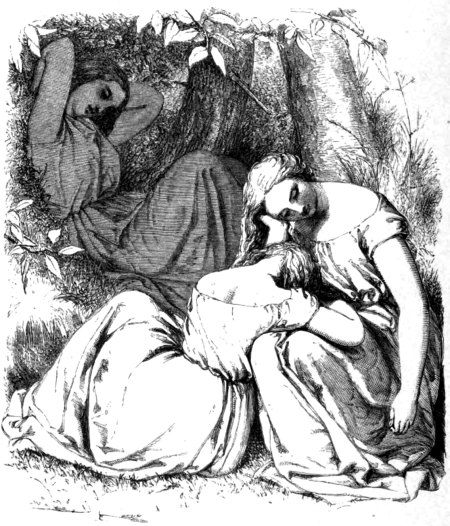
Spirits in wing, and angels to the view, A thousand seraphs burst th’ Empyrean thro’, Young dreams still hovering on their drowsy flight— Seraphs in all but “Knowledge,” the keen light That fell, refracted, thro’ thy bounds, afar, O Death! from eye of God upon that star: Sweet was that error—sweeter still that death— Sweet was that error—e’en with us the breath Of Science dims the mirror of our joy— To them ’twere the Simoom, and would destroy— For what (to them) availeth it to know That Truth is Falsehood—or that Bliss is Woe? Sweet was their death—with them to die was rife With the last ecstasy of satiate life— Beyond that death no immortality— But sleep that pondereth and is not “to be”— And there—oh! may my weary spirit dwell— Apart from Heaven’s Eternity—and yet how far from Hell![27] What guilty spirit, in what shrubbery dim, Heard not the stirring summons of that hymn? But two: they fell: for Heaven no grace imparts To those who hear not for their beating hearts. A maiden-angel and her seraph-lover— O! where (and ye may seek the wide skies over) Was Love, the blind, near sober Duty known? Unguided Love hath fallen—’mid “tears of perfect moan.”[28] He was a goodly spirit—he who fell: A wanderer by mossy-mantled well— A gazer on the lights that shine above— A dreamer in the moonbeam by his love: What wonder? for each star is eye-like there, And looks so sweetly down on Beauty’s hair— And they and ev’ry mossy spring were holy To his love-haunted heart and melancholy. The night had found (to him a night of woe) Upon a mountain crag, young Angelo— Beetling it bends athwart the solemn sky, And scowls on starry worlds that down beneath it lie. Here sat he with his love—his dark eye bent With eagle gaze along the firmament: Now turned it upon her—but ever then It trembled to the orb of Earth again. “Ianthe, dearest, see! how dim that ray! How lovely ’tis to look so far away! She seemed not thus upon that autumn eve I left her gorgeous halls—nor mourned to leave. That eve—that eve—I should remember well— The sun-ray dropped, in Lemnos, with a spell On th’ arabesque carving of a gilded hall Wherein I sat, and on the draperied wall— And on my eyelids—O the heavy light! How drowsily it weighed them into night! On flowers, before, and mist, and love they ran With Persian Saadi in his Gulistan: But O that light!—I slumber’d—Death, the while, Stole o’er my senses in that lovely isle, So softly that no single silken hair Awoke that slept—or knew that he was there.
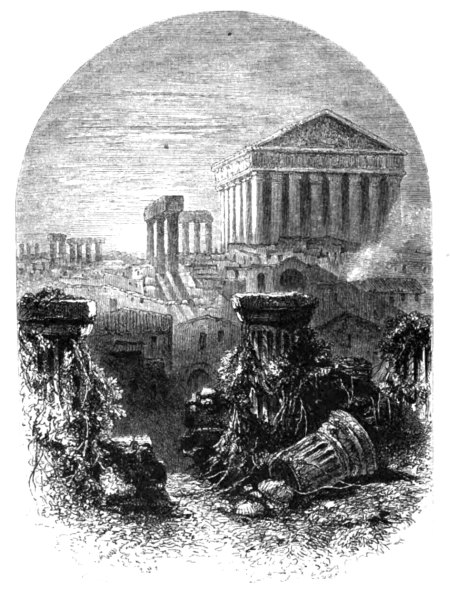
“The last spot of Earth’s orb I trod upon Was a proud temple called the Parthenon[29]— More beauty clung around her column’d wall Than e’en thy glowing bosom beats withal;”[30] And when old Time my wing did disenthral, Thence sprang I—as the eagle from his tower, And years I left behind me in an hour. What time upon her airy bounds I hung One half the garden of her globe was flung, Unrolling as a chart unto my view— Tenantless cities of the desert too! Ianthe, beauty crowded on me then, And half I wished to be again of men.” “My Angelo! and why of them to be? A brighter dwelling-place is here for thee— And greener fields than in yon world above, And woman’s loveliness—and passionate love.” “But, list, Ianthe! when the air so soft Failed, as my pennon’d spirit leapt aloft,[31] Perhaps my brain grew dizzy—but the world I left so late was into chaos hurled— Sprang from her station, on the winds apart, And rolled, a flame, the fiery heaven athwart. Methought, my sweet one, then I ceased to soar, And fell—not swiftly as I rose before, But with a downward, tremulous motion thro’ Light, brazen rays, this golden star unto! Nor long the measure of my falling hours, For nearest of all stars was thine to ours— Dread star! that came, amid a night of mirth, A red Dædalion on the timid Earth. “We came—and to thy Earth—but not to us Be given our lady’s bidding to discuss: We came, my love; around, above, below, Gay fire-fly of the night we come and go, Nor ask a reason save the angel-nod She grants to us, as granted by her God— But, Angelo, than thine grey Time unfurled Never his fairy wing o’er fairier world! Dim was its little disk, and angel eyes Alone could see the phantom in the skies, When first Al Aaraaf knew her course to be Headlong thitherward o’er the starry sea— But when its glory swelled upon the sky, As glowing Beauty’s bust beneath man’s eye, We paused before the heritage of men, And thy star trembled—as doth Beauty then!” Thus, in discourse, the lovers whiled away The night that waned and waned and brought no day. They fell: for Heaven to them no hope imparts Who hear not for the beating of their hearts.
SONNET—TO SCIENCE.
cience! true daughter of Old Time thou art! Who alterest all things with thy peering eyes. Why preyest thou thus upon the poet’s heart, Vulture, whose wings are dull realities? How should he love thee? or how deem thee wise, Who wouldst not leave him in his wandering To seek for treasure in the jewelled skies, Albeit he soared with an undaunted wing? Hast thou not dragged Diana from her car? And driven the Hamadryad from the wood To seek a shelter in some happier star? Hast thou not torn the Naiad from her flood, The Elfin from the green grass, and from me The summer dream beneath the tamarind tree?
TO THE RIVER ——.
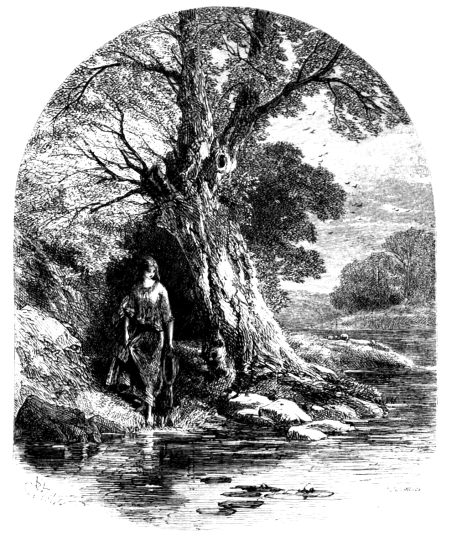
Fair river! in thy bright, clear flow Of crystal, wandering water, Thou art an emblem of the glow Of beauty—the unhidden heart— The playful maziness of art In old Alberto’s daughter; But when within thy wave she looks— Which glistens then, and trembles— Why, then, the prettiest of brooks Her worshipper resembles; For in his heart, as in thy stream, Her image deeply lies— His heart which trembles at the beam Of her soul-searching eyes.


TAMERLANE.
I. Kind solace in a dying hour! Such, father, is not (now) my theme— I will not madly deem that power Of Earth may shrive me of the sin Unearthly pride hath revelled in— I have no time to dote or dream: You call it hope—that fire of fire! It is but agony of desire: If I can hope—Oh God! I can— Its fount is holier—more divine— I would not call thee fool, old man, But such is not a gift of thine. II. Know thou the secret of a spirit Bowed from its wild pride into shame. O yearning heart! I did inherit Thy withering portion with the fame, The searing glory which hath shone Amid the Jewels of my throne, Halo of Hell! and with a pain Not Hell shall make me fear again— O craving heart, for the lost flowers And sunshine of my summer hours! The undying voice of that dead time, With its interminable chime, Rings, in the spirit of a spell, Upon thy emptiness—a knell. III. I have not always been as now: The fevered diadem on my brow I claimed and won usurpingly—— Hath not the same fierce heirdom given Rome to the Cæsar—this to me? The heritage of a kingly mind, And a proud spirit which hath striven Triumphantly with human kind. IV. On mountain soil I first drew life: The mists of the Taglay have shed Nightly their dews upon my head, And, I believe, the winged strife And tumult of the headlong air Have nestled in my very hair. V. So late from Heaven—that dew—it fell (’Mid dreams of an unholy night) Upon me with the touch of Hell, While the red flashing of the light From clouds that hung, like banners, o’er, Appeared to my half-closing eye The pageantry of monarchy, And the deep trumpet-thunder’s roar Came hurriedly upon me, telling Of human battle, where my voice— My own voice, silly child!—was swelling (O! how my spirit would rejoice, And leap within me at the cry) The battle-cry of Victory! VI. The rain came down upon my head Unsheltered—and the heavy wind Rendered me mad and deaf and blind. It was but man, I thought, who shed Laurels upon me: and the rush— The torrent of the chilly air Gurgled within my ear the crush Of empires—with the captive’s prayer— The hum of suitors—and the tone Of flattery round a sovereign’s throne. VII. My passions, from that hapless hour, Usurped a tyranny which men Have deemed, since I have reached to power, My innate nature—be it so: But, father, there lived one who, then, Then—in my boyhood—when their fire Burned with a still intenser glow (For passion must, with youth, expire), E’en then who knew this iron heart In woman’s weakness had a part. VIII. I have no words—alas!—to tell The loveliness of loving well! Nor would I now attempt to trace The more than beauty of a face Whose lineaments, upon my mind, Are——shadows on th’ unstable wind; Thus I remember having dwelt Some page of early lore upon, With loitering eye, till I have felt The letters—with their meaning—melt To fantasies—with none. IX. O, she was worthy of all love! Love as in infancy was mine— ’Twas such as angel minds above Might envy; her young heart the shrine On which my every hope and thought Were incense—then a goodly gift, For they were childish and upright— Pure——as her young example taught: Why did I leave it, and, adrift, Trust to the fire within, for light?
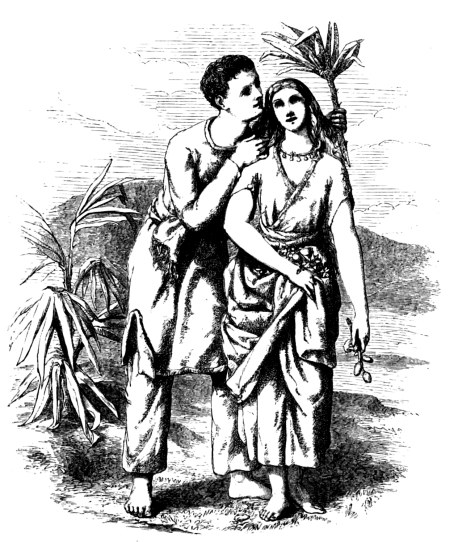
X. We grew in age—and love—together— Roaming the forest, and the wild; My breast her shield in wintry weather— And, when the friendly sunshine smiled, And she would mark the opening skies, I saw no Heaven—but in her eyes. XI. Young Love’s first lesson is——the heart: For ’mid that sunshine, and those smiles, When, from our little cares apart, And laughing at her girlish wiles, I’d throw me on her throbbing breast, And pour my spirit out in tears— There was no need to speak the rest— No need to quiet any fears Of her—who asked no reason why, But turned on me her quiet eye! XII. Yet more than worthy of the love My spirit struggled with, and strove, When, on the mountain peak, alone, Ambition lent it a new tone— I had no being—but in thee: The world, and all it did contain In the earth—the air—the sea— Its joy—its little lot of pain That was new pleasure——the ideal, Dim, vanities of dreams by night— And dimmer nothings which were real— (Shadows—and a more shadowy light!) Parted upon their misty wings, And so, confusedly, became Thine image and—a name—a name! Two separate—yet most intimate things. XIII. I was ambitious—have you known The passion, father? You have not: A cottager, I marked a throne Of half the world as all my own, And murmured at such lowly lot— But, just like any other dream, Upon the vapour of the dew My own had past, did not the beam Of beauty which did while it thro’ The minute—the hour—the day—oppress My mind with double loveliness. XIV. We walked together on the crown Of a high mountain which looked down Afar from its proud natural towers Of rock and forest, on the hills— The dwindled hills! begirt with bowers And shouting with a thousand rills. XV. I spoke to her of power and pride, But mystically—is such guise That she might deem it nought beside The moment’s converse; in her eyes I read, perhaps too carelessly— A mingled feeling with my own— The flush on her bright cheek to me Seemed to become a queenly throne, Too well that I should let it be Light in the wilderness alone.
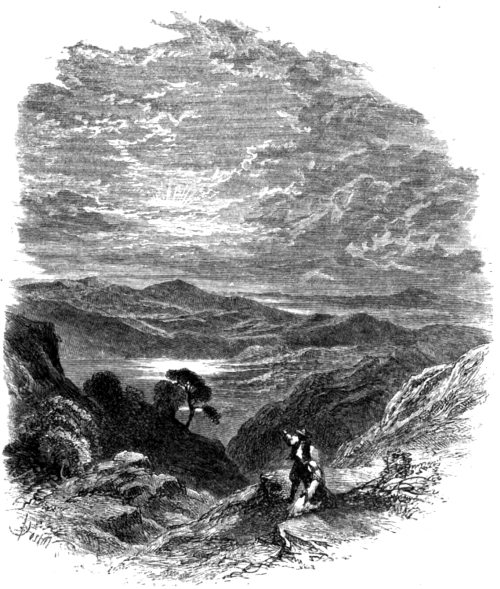
XVI. I wrapped myself in grandeur then, And donned a visionary crown—— Yet it was not that Fantasy Had thrown her mantle over me— But that, among the rabble—men, Lion ambition is chained down— And crouches to a keeper’s hand— Not so in deserts where the grand— The wild—the terrible conspire With their own breath to fan his fire. XVII. Look round thee now on Samarcand!— Is she not queen of Earth? her pride Above all cities? in her hand Their destinies? in all beside Of glory which the world hath known Stands she not nobly and alone? Falling—her veriest stepping-stone Shall form the pedestal of a throne— And who her sovereign? Timour—he Whom the astonished people saw Striding o’er empires haughtily A diademed outlaw! XVIII. O human love! thou spirit given, On Earth, of all we hope in Heaven! Which fall’st into the soul like rain Upon the Siroc-withered plain, And, failing in thy power to bless, But leav’st the heart a wilderness! Idea! which bindest life around With music of so strange a sound And beauty of so wild a birth— Farewell! for I have won the Earth. XIX. When Hope, the eagle that towered, could see No cliff beyond him in the sky, His pinions were bent droopingly— And homeward turned his softened eye. ’Twas sunset: when the sun will part There comes a sullenness of heart To him who still would look upon The glory of the summer sun. That soul will hate the ev’ning mist So often lovely, and will list To the sound of the coming darkness (known To those whose spirits hearken) as one Who, in a dream of night, would fly, But cannot, from a danger nigh. XX. What tho’ the moon—the white moon Shed all the splendour of her noon, Her smile is chilly—and her beam, In that time of dreariness, will seem (So like you gather in your breath) A portrait taken after death. And boyhood is a summer sun Whose waning is the dreariest one— For all we live to know is known, And all we seek to keep hath flown— Let life, then, as the day-flower, fall With the noon-day beauty—which is all. XXI. I reached my home—my home no more— For all had flown who made it so. I passed from out its mossy door, And, tho’ my tread was soft and low, A voice came from the threshold stone Of one whom I had earlier known— O, I defy thee, Hell, to show On beds of fire that burn below, An humbler heart—a deeper woe.
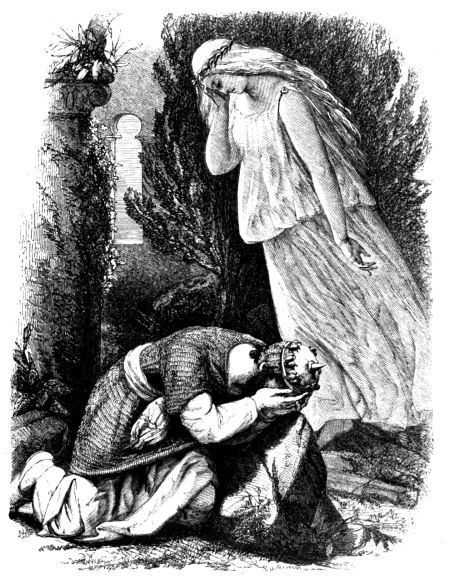
XXII. Father, I firmly do believe— I know—for Death who comes for me From regions of the blest afar, Where there is nothing to deceive, Hath left his iron gate ajar, And rays of truth you cannot see Are flashing thro’ Eternity—— I do believe that Eblis hath A snare in every human path— Else how, when in the holy grove I wandered of the idol, Love, Who daily scents his snowy wings With incense of burnt offerings From the most unpolluted things, Whose pleasant bowers are yet so riven Above with trelliced rays from Heaven No mote may shun—no tiniest fly— The lightning of his eagle eye— How was it that Ambition crept, Unseen, amid the revels there, Till growing bold, he laughed and leapt In the tangles of Love’s very hair?

TO ——.
The bowers whereat, in dreams, I see The wantonest singing birds, Are lips—and all thy melody Of lip-begotten words— Thine eyes, in Heaven of heart enshrined Then desolately fall, O God! on my funereal mind Like starlight on a pall— Thy heart—thy heart!—I wake and sigh, And sleep to dream till day Of the truth that gold can never buy— Of the baubles that it may.
A DREAM.
n visions of the dark night I have dreamed of joy departed— But a waking dream of life and light Hath left me broken-hearted. Ah! what is not a dream by day To him whose eyes are cast On things around him with a ray Turned back upon the past? That holy dream—that holy dream, While all the world were chiding, Hath cheered me as a lovely beam A lonely spirit guiding. What though that light, thro’ storm and night, So trembled from afar— What could there be more purely bright In Truth’s day-star?
ROMANCE.
omance, who loves to nod and sing, With drowsy head and folded wing, Among the green leaves as they shake Far down within some shadowy lake, To me a painted paroquet Hath been—a most familiar bird— Taught me my alphabet to say— To lisp my very earliest word While in the wild wood I did lie, A child—with a most knowing eye. Of late, eternal Condor years So shake the very heaven on high With tumult as they thunder by, I have no time for idle cares Through gazing on the unquiet sky. And when an hour with calmer wings Its down upon my spirit flings— That little time with lyre and rhyme To while away—forbidden things! My heart would feel to be a crime Unless it trembled with the strings.

FAIRY-LAND.
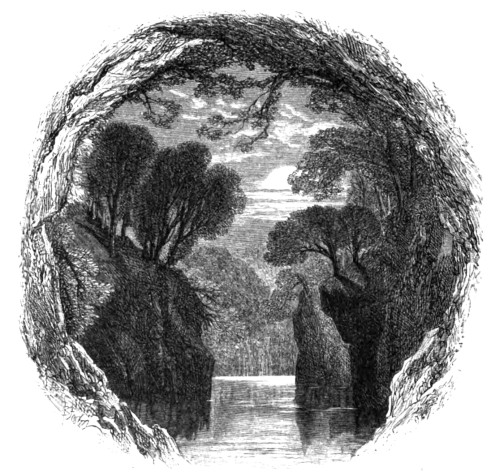
Dim vales—and shadowy floods— And cloudy-looking woods, Whose forms we can’t discover For the tears that drip all over— Huge moons there wax and wane— Again—again—again— Every moment of the night— For ever changing places— And they put out the starlight With the breath from their pale faces. About twelve by the moon-dial One more filmy than the rest (A kind which, upon trial, They have found to be the best) Comes down—still down—and down With its centre on the crown Of a mountain’s eminence, While its wide circumference In easy drapery falls Over hamlets, over halls, Wherever they may be— O’er the strange woods—o’er the sea— Over spirits on the wing— Over every drowsy thing— And buries them up quite In a labyrinth of light— And then, how deep!—O, deep! Is the passion of their sleep. In the morning they arise, And their moony covering Is soaring in the skies, With the tempests as they toss, Like——almost any thing— Or a yellow Albatross. They use that moon no more For the same end as before— Videlicet a tent— Which I think extravagant: Its atomies, however, Into a shower dissever, Of which those butterflies, Of Earth, who seek the skies, And so come down again, (Never-contented things!) Have brought a specimen Upon their quivering wings.
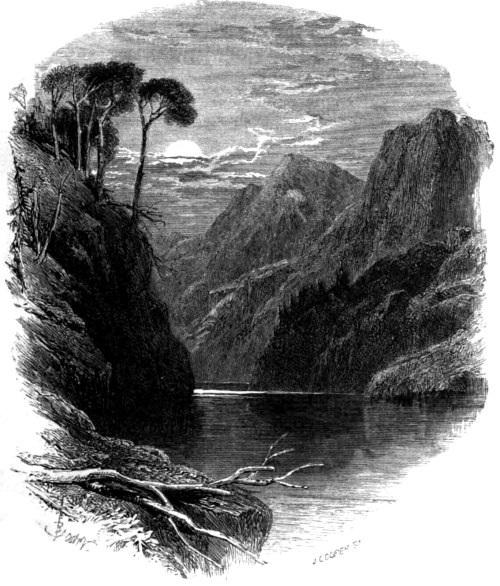
THE LAKE.
TO ——.
In spring of youth it was my lot To haunt of the wide world a spot The which I could not love the less— So lovely was the loneliness Of a wild lake, with black rock bound, And the tall pines that towered around. But when the Night had thrown her pall Upon that spot, as upon all, And the mystic wind went by Murmuring in melody— Then—ah then I would awake To the terror of the lone lake. Yet that terror was not fright, But a tremulous delight— A feeling not the jewelled mine Could teach or bribe me to define— Nor Love—although the Love were thine. Death was in that poisonous wave, And in its gulf a fitting grave For him who thence could solace bring To his lone imagining— Whose solitary soul could make An Eden of that dim lake.
SONG.
saw thee on thy bridal day— When a burning blush came o’er thee, Though happiness around thee lay, The world all love before thee: And in thine eye a kindling light (Whatever it might be) Was all on Earth my aching sight Of Loveliness could see. That blush, perhaps, was maiden shame— As such it well may pass— Though its glow hath raised a fiercer flame In the breast of him, alas! Who saw thee on that bridal day, When that deep blush would come o’er thee, Though happiness around thee lay, The world all love before thee.
TO M. L. S——.
f all who hail thy presence as the morning— Of all to whom thine absence is the night— The blotting utterly from out high heaven The sacred sun—of all who, weeping, bless thee Hourly for hope—for life—ah! above all, For the resurrection of deep-buried faith In Truth—in Virtue—in Humanity— Of all who, on Despair’s unhallowed bed Lying down to die, have suddenly arisen At thy soft-murmured words, “Let there be light!” At the soft-murmured words that were fulfilled In the seraphic glancing of thine eyes— Of all who owe thee most—whose gratitude Nearest resembles worship—oh, remember The truest—the most fervently devoted, And think that these weak lines are written by him— By him who, as he pens them, thrills to think His spirit is communing with an angel’s.
TO HELEN.
elen, thy beauty is to me Like those Nicéan barks of yore That gently, o’er a perfumed sea, The weary way-worn wanderer bore To his own native shore. On desperate seas long wont to roam, Thy hyacinth hair, thy classic face, Thy Naiad airs have brought me home To the glory that was Greece, And the grandeur that was Rome. Lo, in yon brilliant window-niche How statue-like I see thee stand, The agate lamp within thy hand! Ah, Psyche, from the regions which Are holy-land!