Volume 3 — TANSY AND SWEET-ALYSSUM
Reading edition
A FLOWER OF THE FIELDS
Bee-bitten in the orchard hung The peach; or, fallen in the weeds, Lay rotting, where still sucked and sung The gray bee, boring to the seed’s Pink pulp and honey blackly stung. The orchard-path, which wound around The garden,—with its heat one twinge Of dinning locusts,—picket-bound And ragged, brought me where one hinge Held up the gate that scraped the ground. All seemed the same: the martin-box— Sun-warped, with pygmy balconies— Still stood, with all its twittering flocks, Perched on its pole above the peas And silvery-seeded onion-stocks. The clove-pink and the rose; the clump Of coppery sunflowers, with the heat Sick to the heart: the garden stump, Red with geranium-pots, and sweet With moss and ferns, this side the pump. I rested with one hesitant hand Upon the gate. The lonesome day, Droning with insects, made the land One dry stagnation. Soaked with hay And scents of weeds the hot wind fanned. I breathed the sultry scents, my eyes Parched as my lips. And yet I felt My limbs were ice.—As one who flies To some wild woe.—How sleepy smelt The hay-hot heat that soaked the skies! Noon nodded; dreamier, lonesomer For one long, plaintive, forest-side Bird-quaver.—And I knew me near Some heartbreak anguish.... She had died. I felt it, and no need to hear. I passed the quince-and pear-tree; where, All up the porch, a grape-vine trails.— How strange that fruit, whatever air Or earth it grows in, never fails To find its native flavor there! And she was as a flower, too, That grows its proper bloom and scent No matter what the soil: she, who, Born better than her place, still lent Grace to the lowliness she knew.... They met me at the porch and were Gaunt-eyed with weeping.—Then the room Shut out the country’s heat and purr, And left light stricken into gloom— So love and I might look on her.
ON STONY-RUN
O cheerly, cheerly by the road, And merrily down the hillet, And where the bottom-lands are sowed With bristle-bearded millet; Then o’er a pebbled path it goes Through woodland dale and dingle, Unto a farmstead’s windowed rose, And roof of moss and shingle. Then darkly, darkly through the brush, And dimly round the boulder, Where cane and water-weeds grow lush, Its current clear flows colder. Then by the cedared way that leads, Through burr and bramble-thickets, Unto a burial-ground of weeds Fenced in with broken pickets. Then slowly, slowly down the vale, And wearily through the rushes, Where sunlight of the noon is pale, Its shadowy water hushes. For oft her young face smiled upon Its deeps here, willow-shaded; And oft with bare feet in the sun Its shallows there she waded. No more beneath the twinkling leaves Shall stand the farmer’s daughter!— softly past the cottage eaves, O memory-haunted water! No more shall bend her laughing face Above it where the rose is!— Sigh softly past the burial-place Where all her youth reposes.
HOME
Among the fields the camomile Seems blown mist in the lightning’s glare: Cool, rainy odors drench the air; Night speaks above; the angry smile Of storm within her stare. The way that I shall take to-night Is through the wood whose branches fill The road with double darkness, till, Between the boughs, a window’s light Shines out upon the hill. The fence; and then the path that goes Around a trailer-tangled rock, Through puckered pink and hollyhock, Unto a latch-gate’s unkempt rose, And door whereat I knock. Bright on the old-time flower-place The lamp streams through the foggy pane The door is opened to the rain: And in the door—her happy face And outstretched hands again.
DUSK IN THE WOODS
Three miles of trees it is: and I Came through the woods that waited, dumb, For the cool summer dusk to come; And lingered there to watch the sky Up which the gradual sunset clomb. A tree-toad quavered in a tree; And then a sudden whippoorwill Called overhead, so wildly shrill The sleeping wood, it seemed to me, Cried out and then again was still. Then through dark boughs its stealthy flight An owl took; and, at drowsy strife, The cricket tuned its fairy fife; And like a ghostflower, silent white, The wood-moth glimmered into life. And in the punk-wood everywhere The insects ticked, or bored below The rotted bark; and, glow on glow, The lambent fireflies here and there Lit up their jack-o’-lantern show. I heard a vesper-sparrow sing, Withdrawn, it seemed, into the far Slow sunset’s tranquil cinnabar; The crimson, softly smouldering Behind gaunt trunks, with its one star. A dog barked: and down ways that gleamed, Through dew and clover, faint the noise Of cow-bells moved. And then a voice, That sang a-milking, so it seemed, Made glad my heart as some glad boy’s. And then the lane: and, full in view, A farm-house with a rose-grown gate, And honeysuckle paths, await For night, the moon, and love and you— These are the things that made me late.
COMRADES
Down through the woods, along the way That fords the stream; by rock and tree, Where in the bramble-bell the bee Swings; and through twilights green and gray The red-bird flashes suddenly, My thoughts went wandering to-day. I found the fields where, row on row, The blackberries hang black their fruit; Where, nesting at the elder’s root, The partridge whistles soft and low; The fields, that billow to the foot Of those old hills we used to know. There lay the pond, still willow-bound, On whose bright surface, when the hot Noon burnt above, we chased the knot Of water-striders; while around Our heads, like bits of rainbow, shot The dragon-flies without a sound. The pond, above which evening bent To gaze upon her gypsy face; Wherein the twinkling night would trace A vague, inverted firmament; In which the green frogs tuned their bass, And firefly sparkles came and went. The old-time woods we often ranged, When we were playmates, you and I; The old-time fields, with boyhood’s sky Still blue above them!—Naught was changed! Nothing!—Alas! then tell me why Should we be? whom the years estranged.
THE ROCK
Here, at its base, in dingled deeps Of spice-bush, where the ivy creeps, The cold spring scoops its hollow; And there, three mossy stepping-stones Make ripple murmurs; undertones Of foam, whose low falls follow A voice far in the wood that drones. The quail pipes here when noons are hot; And here, in coolness sunlight-shot, Beneath a roof of briers, The red fox skulks at close of day; And here, at night, the shadows gray Stand like Franciscan friars, With moonbeam beads whereon they pray. Here yawns the woodchuck’s dark-dug hole; And there the tunnel of the mole Heaves under weed and flower; A sandy pit-fall here and there The ant-lion digs and lies a-lair And here, for sun and shower, The spider weaves a silvery snare. The poison-oak’s rank tendrils twine The rock’s south side; the trumpet-vine, With crimson bugles sprinkled, Makes green its eastern side; the west Is rough with lichens; and, gray-pressed Into an angle wrinkled, The hornets hang an oblong nest. The north is hid from sun and star, And here,—like an Inquisitor Of Faëry Inquisition, Who roots out Elfland heresy,— Deep in the rock, cowled shadowy And grave as his commission, The owl sits magisterially.
STANDING-STONE CREEK
A weed-grown slope, whereon the rain Has washed the brown rocks bare, Leads tangled from a lonely lane Down to a creek’s broad stair Of stone, that, through the solitude, Winds onward to a quiet wood. An intermittent roof of shade The beech above it throws; Along its steps a balustrade Of beauty builds the rose; In which, a stately lamp of green, At intervals, the cedar’s seen. The water, carpeting each ledge Of rock that runs across, Glints ’twixt a flow’r-embroidered edge Of ferns and grass and moss; And in its deeps the wood and sky Seem patterns of the softest dye. Long corridors of pleasant dusk Within the house of leaves It reaches; where, on looms of musk, The ceaseless locust weaves A web of summer; and perfume Trails a sweet gown from room to room. Green windows of the boughs, that swing, It passes, where the notes Of birds are glad thoughts entering, And butterflies are motes; And now a vista where the day Opens a door of wind and ray. It is a stairway for all sounds That haunt the woodland sides; On which, boy-like, the Southwind bounds, Girl-like, the sunbeam glides; And, like fond parents, following these, The old-time dreams of rest and peace.
“CLOUDS OF THE AUTUMN NIGHT”
Clouds of the autumn night, Under the hunter’s-moon,— Ghostly and windy white,— Whither, like leaves wild strewn, Take ye your stormy flight? Out of the west, where dusk, From her red window-sill, Leaned with a wand of tusk, Witch-like, and wood and hill Phantomed with mist and musk Into the east, where morn Sleeps in a shadowy close, Shut with a gate of horn, Round which the dreams she knows Flutter with rose and thorn. Blow from the west! oh, blow, Clouds that the tempest steers! And with your rain and snow Bear of my heart the tears, And of my soul the woe. Into the east then pass, Clouds that the night-winds sweep! And on her grave’s sere grass, There where she lies asleep, There let them fall, alas!
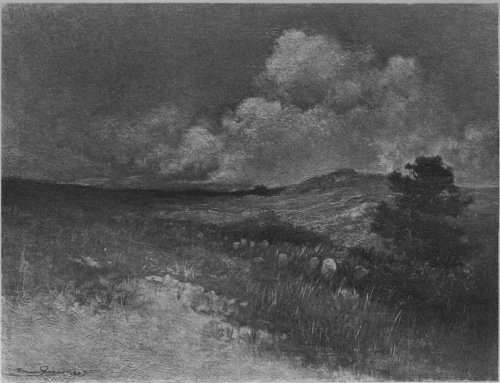
Ghostly and windy white Page 168 Clouds of the Autumn Night
THEN AND NOW
When my old heart was young, my dear, The earth and heaven were so near That in my dreams I oft could hear The steps of airy races; In woodlands, where bright waters ran, On hills, God’s rainbows used to span, I followed voices not of man, And smiled in spirit faces. Now my old heart is old, my sweet, No longer earth and heaven meet; All life is grown to one dull street Where fact with fancy clashes; The voices now that speak to me Are prose instead of poetry; And in the faces now I see Is less of flame than ashes.
BY THE TRYSTING-BEECH
Deep in the west a berry-colored bar Of sunset gleams; against which one tall fir Stands outlined dark; above which—courier Of dew and dreams—burns dusk’s appointed star. And flash on flash, as when the elves wage war In Goblinland, the fireflies bombard The silence; and, like spirits, o’er the sward The twilight winds bring fragrance from afar. And now, withdrawn into the hill-wood belts, A whippoorwill; while, with attendant states Of pearl and silver, slow the great moon melts Into the night—to show me where she waits,— Like some slim moonbeam,—by the old beech-tree, Who keeps her lips, fresh as a flower, for me.
AFTER LONG GRIEF AND PAIN
There is a place hung o’er of summer boughs And dreamy skies wherein the gray hawk sleeps; Where waters flow, within whose lazy deeps, Like silvery prisms where the sunbeams drowse, The minnows twinkle; where the bells of cows Tinkle the stillness; and the bob-white keeps Calling from meadows where the reaper reaps, And children’s laughter haunts an old-time house: A place where life wears ever an honest smell Of hay and honey, sun and elder-bloom— Like some sweet, modest girl—within her hair; Where, with our love for comrade, we may dwell Far from the city’s strife, whose cares consume— Oh, take my hand and let me lead you there.
THE HAUNTED WOODLAND
Here in the golden darkness And green night of the woods, A flitting form I follow, A shadow that eludes— Or is it but the phantom Of former forest moods? The phantom of some fancy I knew when I was young, And in my dreaming boyhood, The wildwood flow’rs among, Young face to face with Faëry Spoke in no unknown tongue. Blue were her eyes, and golden The nimbus of her hair; And scarlet as a flower Her mouth that kissed me there; That kissed and bade me follow, And smiled away my care. A magic and a marvel Lived in her word and look, As down among the blossoms She sate me by the brook, And read me wonder-legends In Nature’s Story Book. Loved fairy-tales forgotten, She never reads again, Of beautiful enchantments That haunt the sun and rain, And, in the wind and water, Chant a mysterious strain. And so I search the forest, Wherein my spirit feels, In stream, or tree, or flower Herself she still conceals— But now she flies who followed, Whom Earth no more reveals.
COMRADERY
With eyes hand-arched he looks into The morning’s face, then turns away With school-boy feet, all wet with dew, Out for a holiday. The hill brook sings; incessant stars, Foam-fashioned, on its restless breast; And where he wades its water-bars Its song is happiest. A comrade of the chinquapin, He looks into its knotty eyes And sees its heart; and, deep within, Its soul that makes him wise. The wood-thrush knows and follows him, Who whistles up the birds and bees; And round him all the perfumes swim Of woodland loam and trees. Where’er he pass the supple springs’ Foam-people sing the flowers awake; And sappy lips of bark-clad things Laugh ripe each fruited brake. His touch is a companionship; His word, an old authority: He comes, a lyric on his lip, Unstudied Poesy.
OCCULT
Unto the soul’s companionship Of things that only seem to be, Earth points with magic finger-tip And bids thee see How Fancy keeps thee company. For oft at dawn hast not beheld A spirit of prismatic hue Blow wide the buds, which night hath swelled? And stain them through With heav’n’s ethereal gold and blue? While at her side another went With gleams of enigmatic white? A spirit who distributes scent, To vale and height, In footsteps of the rosy light? And oft at dusk hast thou not seen The star-fays bring their caravans Of dew, and glitter all the green, Night’s shadow tans, With drops the rain-hung cobweb spans? Nor watched with these the elfins go Who tune faint instruments—that sound Like that moon-music insects blow?— Then haunted ground Thou hast not trodden, never found!
WOOD-WORDS
I
The spirits of the forest, That to the winds give voice— I lie the livelong April day And wonder what it is they say That makes the leaves rejoice. The spirits of the forest, That breathe in bud and bloom— I walk within the haw-tree brake And wonder how it is they make The bubbles of perfume. The spirits of the forest, That dwell in every spring— I lean above the brook’s bright blue And wonder what it is they do That makes the water sing. The spirits of the forest, That haunt the sun’s green glow— Down fungus ways of fern I steal And would surprise what they conceal, In dew, that twinkles so. O spirits of the forest, Here are my heart and hand!— Oh, send a gleam or glow-worm ray To guide my soul the firefly way That leads to Fairyland.
II
The time when dog-tooth violets Hold up inverted horns of gold,— The elvish cups that Spring upsets With dripping feet, when April wets The sun-and-shadow-marbled wold,— Is come. And by each leafing way The sorrel drops pale blots of pink; And, like an angled star a fay Sets on her forehead’s pallid day, The blossoms of the trillium wink. Within the vale, by rock and stream,— A fragile, fairy porcelain,— Blue as a baby’s eyes a-dream, The bluets blow; and gleam in gleam The sun-shot dogwoods flash with rain. It is the time to cast off care; To make glad intimates of these:— The frank-faced sunbeam laughing there: The great-heart wind, that bids us share The optimism of the trees.
III
The white ghosts of the flowers, The gray ghosts of the trees, Rise when the April showers, And haunt the wildwood bowers, And trail along the breeze: The white ghosts of the flowers, The gray ghosts of the trees. Oft in the woodless places I feel their dim control; The wildflowers’ perished faces, The great trees’ vanished races, That meet me soul to soul: Oft in the woodless places I feel their dim control.
IV
Crab-apple buds, whose bells The mouth of April kissed; That hang,—like rosy shells Around a Naiad’s wrist,— Pink as dawn-tinted mist. And paw-paw buds, whose dark Deep auburn blossoms shake On boughs,—as ’neath the bark A dryad’s eyes awake,— Brown as a midnight lake. These, with symbolic blooms Of wind-flower and wild-phlox, I found among the glooms Of hill-lost woods and rocks, Lairs of the hare and fox. The beetle in the brush, The bird about the creek, The bee within the hush, And I, whose love was meek, Stood still to hear these speak The language that records, In flower-syllables, The hieroglyphic words Of beauty, who enspells The world and aye compels.
THE WIND AT NIGHT
I
Not till the wildman wind is shrill, Howling upon the hill In every wolfish tree, whose boisterous boughs, Like desperate arms, gesture and beat the night, And down huge clouds, in chasms of stormy white, The frightened moon hurries above the house, Shall I lie down; and, deep,— Letting the mad wind keep Its shouting revel round me,—fall asleep.
II
Not till its dark halloo is hushed, And where wild waters rushed,— Like some hoof’d terror underneath its whip And spur of foam,—remains A ghostly glass, hill-framed; whereover stains Of moony mists and rains, And stealthy starbeams, still as spectres, slip; Shall I—with thoughts that take Unto themselves the ache Of silence as a sound—from sleep awake.
AIRY TONGUES
I
There is a song the wet leaves lisp When Morn comes down the woodland way; And misty as a thistle-wisp Her gown gleams, windy gray: A song that seems to say, “Awake! ’tis day!” There is a sigh when Day sits down Beside the sunlight-lulled lagoon; While on her glistening hair and gown The rose of rest is strew: A sigh, that seems to croon, “Come rest! ’tis noon!” There is a whisper when the stars, Above an evening-purpled height, Crown the dead Day with nenuphars Of fire, gold and white: A voice, that seems t’ invite, “Come love! ’tis night!”
II
Before the rathe song-sparrow sings Among the haw-trees in the lane, And to the wind the locust flings Its early clusters fresh with rain; Beyond the morning-star, that swings Its rose of fire above the spire, Between the morning’s watchet wings, A wild voice rings o’er brooks and boughs— “Arouse! arouse!” Before the first brown owlet cries Among the grape-vines on the hill, And in the dam with half-shut eyes The lilies rock above the mill; Beyond the oblong moon, that flies, A pearly flower, above the tower, Between the twilight’s primrose skies, A soft voice sighs, from east to west— “To rest! to rest!”
RAIN AND WIND
I hear the hoofs of horses Galloping over the hill, Galloping on and galloping on, When all the night is shrill With wind and rain that beats the pane— And my soul with awe is still. For every dripping window Their headlong rush makes bound, Galloping up, and galloping by, Then back again and around, Till the gusty roofs ring with their hoofs, And the draughty cellars sound. And then I hear black horsemen Hallooing in the night; Hallooing and hallooing, They ride o’er vale and height, And the branches snap and the shutters clap With the fury of their flight. Then at each door a horseman,— With burly bearded lip Hallooing through the keyhole,— Pauses with cloak a-drip; And the door-knob shakes and the panel quakes ’Neath the anger of his whip. All night I hear their gallop, And their wild halloo’s alarm; The tree-tops sound and the vanes go round In forest and on farm; But never a hair of a thing is there— Only the wind and storm.
UNDER ARCTURUS
I
“I belt the morn with ribboned mist; With baldricked blue I gird the noon, And dusk with purple, crimson-kissed, White-buckled with the hunter’s-moon. “These follow me,” the Season says: “Mine is the frost-pale hand that packs Their scrips, and speeds them on their ways, With gipsy gold that weighs their backs.”
II
A daybreak horn the Autumn blows, As with a sun-tanned hand he parts Wet boughs whereon the berry glows; And at his feet the red fox starts. The leafy leash that holds his hounds Is loosed; and all the noonday hush Is startled; and the hillside sounds Behind the fox’s bounding brush. When red dusk makes the western sky A fire-lit window through the firs, He stoops to see the red fox die Among the chestnut’s broken burrs. Then fanfaree and fanfaree, His bugle sounds; the world below Grows hushed to hear; and two or three Soft stars dream through the afterglow.
III
Like some black host the shadows fall, And blackness camps among the trees; Each wildwood road, a Goblin Hall, Grows populous with mysteries. Night comes with brows of ragged storm, And limbs of writhen cloud and mist; The rain-wind hangs upon his arm Like some wild girl who cries unkissed. By his gaunt hands the leaves are shed In headlong troops and nightmare herds; And, like a witch who calls the dead, The hill-stream whirls with foaming words. Then all is sudden silence and Dark fear—like his who can not see, Yet hears, lost in a haunted land, Death rattling on a gallow’s-tree.
IV
The days approach again; the days Whose mantles stream, whose sandals drag When in the haze by puddled ways The gnarled thorn seems a crookéd hag. When rotting orchards reek with rain; And woodlands crumble, leaf and log; And in the drizzling yard again The gourd is tagged with points of fog. Now let me seat my soul among The woods’ dim dreams, and come in touch With melancholy, sad of tongue And sweet, who says so much, so much.
BARE BOUGHS
O heart,—that beat the bird’s blithe blood, The blithe bird’s strain, and understood The song it sang to leaf and bud,— What dost thou in the wood? O soul,—that kept the brook’s glad flow, The glad brook’s word to sun and moon,— What dost thou here where song lies low, Dead as the dreams of June? Where once was heard a voice of song, The hautboys of the mad winds sing; Where once a music flowed along, The rain’s wild bugles ring. The weedy water frets and ails, And moans in many a sunless fall; And, o’er the melancholy, trails The black crow’s eldritch call. Unhappy brook! O withered wood! O days, whom death makes comrades of! Where are the birds that thrilled the blood When Life struck hands with Love? A song, one soared against the blue; A song, one bubbled in the leaves: A song, one threw where orchards grew Red-appled to the eaves. The birds are flown; the flowers are dead; And sky and earth are bleak and gray; The wild winds hang i’ the boughs instead, And wild leaves strew the way.
A THRENODY
I
The rainy smell of a ferny dell, Whose shadow no sun-ray flaws, When Autumn sits in the wayside weeds Telling her beads Of haws.
II
The phantom mist, that is moonbeam-kissed, On hills where the trees are thinned, When Autumn leans at the oak-root’s scarp, Touching a harp Of wind.
III
The cricket’s chirr ’neath brier and burr, By leaf-strewn pools and streams, When Autumn stands ’mid the dropping nuts, With the book, she shuts, Of dreams.
IV
The gray “Alas” of the days that pass, And the hope that says “Adieu,” A parting sorrow, a shriveled flower, And one ghost’s hour With you.
SNOW
The moon, like a round device On a shadowy shield of war, Hangs white in a heaven of ice With a solitary star. The wind is sunk to a sigh, And the waters are steeled with frost; And gray in the eastern sky The last snow-cloud is lost. White fields, that are winter-starved; Black woods, that are winter-fraught; And Earth like a face death-carved With the iron of some black thought.
AN OLD SONG
I
It’s, Oh, for the hills, where the wind’s some one With a vagabond foot that follows! And a cheer-up hand that he claps upon Your arm with the hearty words, “Come on! We’ll soon be out of the hollows, My heart! We’ll soon be out of the hollows!”
II
It’s, Oh, for the songs, where the hope’s some one With a renegade foot that doubles! And a kindly look that he turns upon Your face with the friendly laugh, “Come on! We’ll soon be out of the troubles, My heart! We’ll soon be out of the troubles!”
BABY MARY
Deep in baby Mary’s eyes, Baby Mary’s sweet blue eyes, Dwell the golden memories Of the music once her ears Heard in far-off Paradise: So she has no time for tears,— Baby Mary,— Listening to the songs she hears. Soft in baby Mary’s face, Baby Mary’s lovely face, If you watch, you, too, may trace Dreams her spirit-self hath seen In some far-off Eden-place, Whence her soul she can not wean,— Baby Mary,— Dreaming in a world between.
A SUNSET FANCY
Wide in the west a lake Of flame that seems to shake As if the Midgard snake Deep down did breathe: An isle of purple glow, Where rosy rivers flow Down peaks of cloudy snow With fire beneath. And there the Tower-of-Night, With windows all a-light, Frowns on a burning height, Wherein she sleeps,— Young through the years of doom,— Veiled with her hair’s gold gloom, She, the Valkyrie, whom Enchantment keeps.
THE FEN-FIRE
The misty rain makes dim my face, The night’s black cloak is o’er me; I tread the dripping cypress-place, A flickering light before me. Out of the death of leaves that rot And ooze and weedy water, My form was breathed to haunt this spot, Death’s immaterial daughter. The owl that whoops upon the yew, The snake that lairs within it, Have seen my wild face flashing blue For one fantastic minute. But should you follow where my eyes Like some pale lamp decoy you, Beware! lest suddenly I rise With love that shall destroy you.
THE WOOD
Witch-hazel, dogwood, and the maple here; And there the oak and hickory; Linn, poplar, and the beech-tree, far and near As the eased eye can see. Wild-ginger; wahoo, with its flat balloons; And brakes of briers of a twilight green; And fox-grapes plumed with summer; and strung moons Of mandrake flowers between. Deep gold-green ferns, and mosses green and gray,— Mats for what naked myth’s white feet?— And, cool and calm, a cascade far away With ever-even beat. Old logs, made sweet with death; rough bits of bark; And tangled twig and knotted root; And sunshine splashes and great pools of dark; And many a wild-bird’s flute. Here let me sit until the Indian, Dusk, With copper-colored face, comes down; Sowing the wildwood with star-fire and musk, And shadows blue and brown. Then side by side with some magician Dream, I’ll take the owlet-haunted lane,— Half-roofed with vines,—led by a firefly gleam, That brings me home again.
WOOD NOTES
I
There is a flute that follows me From tree to tree: A water flute a spirit sets To silver lips in waterfalls, And through the breath of violets A sparkling music calls:— “Hither! halloo! Oh, follow! Down leafy hill and hollow, Where, through clear swirls, With feet like pearls, Wade down the blue-eyed country girls. Hither! halloo! Oh, follow!”
II
There is a pipe that plays to me From tree to tree: A bramble pipe an elfin holds To golden lips in berry brakes, And, swinging o’er the elder wolds, A flickering music makes:— “Come over! Come over The new-mown clover! Come over the fresh-cut hay! Where, there by the berries, With cheeks like cherries, And locks with which the warm wind merries, Brown girls are hilling the hay, All day! Come over the fields and away!— Come over! Come over!”
HILLS OF THE WEST
Hills of the west, that gird Forest and farm, Home of the nesting bird, Housing from harm, When, on your tops, is heard Storm. Hills of the west, that bar Belts of the gloam, Under the twilight’s star, Where the mists roam, Take ye the wanderer Home. Hills of the west, that dream Under the moon, Making of wind and stream, Late heard and soon, Parts of your lives that seem Tune. Hills of the west, that take Silence to ye, Be it for sorrow’s sake Or memory, Part of such silence make Me.
THE WIND OF SPRING
The wind that breathes of columbines And celandines that crowd the rocks; That shakes the balsam of the pines With music from his airy locks, Stops at my city door and knocks. He calls me far a-forest, where The twin-leaf and the blood-root bloom; And, circled by the amber air, Life sits with beauty and perfume Weaving the new web of her loom. He calls me where the waters run Through fronding fern where wades the hern; And, sparkling in the equal sun, Song leans beside her brimming urn, And dreams the dreams that love shall learn. The wind has summoned, and I go: To con God’s meaning in each line The wildflow’rs write; and, walking slow, God’s purpose, of which song is sign,— The wind’s great, gusty hand in mine.
THE WILLOW BOTTOM
Lush green the grass that grows between The willows of the bottom-land; Edged by the careless water, tall and green The brown-topped cat-tails stand. The cows come gently here to browse, Slow through the great-leafed sycamores: You hear a dog bark from a low-roofed house With cedars round its doors. Then all is quiet as the wings Of the one buzzard floating there: Anon a woman’s high-pitched voice that sings An old camp-meeting air. A cock that flaps and crows; and then— Heard drowsy through the rustling corn— A flutter, and the cackling of a hen Within a hay-sweet barn. How still again! no water stirs: No wind is heard: although the weeds Are waved a little: and from silk-filled burrs Drift by a few soft seeds. So drugged with dreams the place, that you Expect to see her gliding by,— Hummed round of bees, through blossoms spilling dew,— The Spirit of July.
THE RED-BIRD
Red clouds and reddest flowers, And now two redder wings Swim through the rosy hours; Red wings among the flowers; And now the red-bird sings. God makes the red clouds ripples Of flame that seem to split In rubies and in dripples Of rose where rills and ripples The singing flame that lit. Red clouds of sundered splendor; God whispered one small word, Rich, sweet, and wild and tender— Straight, in the vibrant splendor, The word became a bird. He flies beneath the garnet Of clouds that flame and float,— When summer hears the hornet Hum round the plum, turned garnet,— Heaven’s music in his throat.
CLEARING
Before the wind, with rain-drowned stocks, The pleated, crimson hollyhocks Are bending; And, smouldering in the breaking brown, Above the hills that rim the town, The day is ending. The air is heavy with the damp; And, one by one, each cottage lamp Is lighted; Infrequent passers of the street Stroll on or stop to talk or greet, Benighted. I look beyond my city yard, And watch the white moon struggling hard, Cloud-buried; The wind is driving toward the east, A wreck of pearl, all cracked and creased And serried. At times the moon, erupting, streaks Some long cloud, raised in mountain peaks Of shadow,— That, seamed with silver, vein on vein, Grows to a far volcano chain Of Eldorado. The wind, that blows from out the hills, Is like a woman’s touch that stills A sorrow: The moon sits high with many a star In the deep calm: and fair and far Abides to-morrow.
AUTUMN SORROW
Ah me! too soon the Autumn comes Among these purple-plaintive hills! Too soon among the forest gums Premonitory flame she spills, Bleak, melancholy flame that kills. Her white fogs veil the morn, that rims With wet the moon-flow’r’s elfin moons; And, like exhausted starlight, dims The last slim lily-disk; and swoons With scents of hazy afternoons. Her gray mists haunt the sunset skies, And build the west’s cadaverous fire, Where Sorrow sits with lonely eyes, And hands that wake her ancient lyre, Beside the ghost of dead Desire.
A DARK DAY OF SUMMER
Though Summer walks the world to-day With corn-crowned hours for her guard, Her thoughts have clad themselves in gray, And wait in Autumn’s weedy yard. And where the larkspur and the phlox Spread carpets for her feet to pass, She stands with sombre, dripping locks Bound bleak with fog-washed zinnias. Sad terra-cotta-colored flowers, Whose disks the trickling wet has tinged With dingy lustre, like the bowers, Flame-flecked with leaves, the frost has singed. She, with slow feet,—’mid gaunt gold blooms Of marigolds her fingers twist,— Passes, dim-swathed in Fall’s perfumes And dreams of sullen rain and mist.
DAYS AND DAYS
The days that clothed white limbs with heat, And rocked the red rose on their breast, Have passed with amber-sandaled feet, Into the ruby-gated west. These were the days that filled the heart With overflowing riches of Life; in whose soul no dream shall start But hath its origin in love. Now come the days gray-huddled in The haze; whose foggy footsteps drip; Who pin beneath a gypsy chin The frosty marigold and hip.— The days, whose forms fall shadowy Athwart the heart; whose misty breath Shapes saddest sweets of memory Out of the bitterness of death.
DROUTH IN AUTUMN
Gnarled acorn-oaks against a west Of copper, cavernous with fire; A wind of frost that gives no rest To such lean leaves as haunt the brier, And hide the cricket’s vibrant wire. Sere, shivering shocks, and stubble blurred With bramble-blots of dull maroon; And creekless hills whereon no herd Finds pasture, and whereo’er the loon Flies, haggard as the rainless moon.
IN SUMMER
When in dry hollows, hilled with hay, The vesper-sparrow sings afar; And golden gray dusk dies away Beneath the amber evening-star: There, where a warm and shadowy arm The woodland lays around the farm, I’ll meet you at the tryst, the tryst! And kiss your lips no man hath kissed! I’ll meet you at the twilight tryst,— With a hey and a ho!— Sweetheart! I’ll kiss you at the tryst! When clover fields smell cool with dew, And crickets cry, and roads are still; And faint and few the fireflies strew The dark where calls the whippoorwill; There, in the lane, where sweet again The petals of the wild-rose rain, I’ll take in mine your hand, your hand! And say the words you’ll understand! Your soft hand nestling in my hand,— With a hey and a ho!— Sweetheart! All loving hand in hand!
IN WINTER
I
When black frosts pluck the acorns down, And in the lane the waters freeze; And ’thwart red skies the wild-fowl flies, And death sits grimly in the trees; When home-lights glitter through the brown Of dusk like shaggy eyes,— Before the door his feet, sweetheart, And two white arms that greet, sweetheart, And two white arms that greet.
II
When ways are drifted with the leaves, And winds make music in the thorns; And lone and lost above the frost The new-moon shows its silver horns; When underneath the lamplit eaves The opened door is crossed,— A happy heart and light, sweetheart, And lips that kiss good night, sweetheart, And lips that kiss good night.
ON THE FARM
I
He sang a song as he sowed the field, Sowed the field at break of day: “When the pursed-up leaves are as lips that yield Balm and balsam, and Spring,—concealed In the odorous green,—is so revealed, Halloo and oh! Hallo for the woods and the far away!”
II
He trilled a song as he mowed the mead, Mowed the mead as noon begun: “When the hills are gold with the ripened seed, As the sunset stairs of the clouds that lead To the sky where Summer knows naught of need, Halloo and oh! Hallo for the hills and the harvest sun!”
III
He hummed a song as he swung the flail, Swung the flail in the afternoon: “When the idle fields are a wrecker’s tale, That the Autumn tells to the twilight pale, As the Year turns seaward a crimson sail, Halloo and oh! Hallo for the fields and the hunter’s-moon!”
IV
He whistled a song as he shouldered his axe, Shouldered his axe in the evening storm: “When the snow of the road shows the rabbit’s tracks, And the wind is a whip that the Winter cracks, With a herdsman’s cry, o’er the clouds black backs, Halloo and oh! Hallo for home and a fire to warm!”
PATHS
I
What words of mine can tell the spell Of garden ways I know so well?— The path that takes me, in the spring, Past quince-trees where the bluebirds sing, Where peonies are blossoming, Unto a porch, wistaria-hung, Around whose steps May-lilies blow, A fair girl reaches down among, Her arm more white than their sweet snow.
II
What words of mine can tell the spell Of garden ways I know so well?— Another path that leads me, when The summer-time is here again, Past hollyhocks that shame the west When the red sun has sunk to rest; To roses bowering a nest, A lattice, ’neath which mignonette And deep geraniums surge and sough, Where, in the twilight, starless yet, A fair girl’s eyes are stars enough.
III
What words of mine can tell the spell Of garden ways I know so well?— A path that takes me, when the days Of autumn wrap the hills in haze, Beneath the pippin-pelting tree, ’Mid flitting butterfly and bee; Unto a door where, fiery, The creeper climbs; and, garnet-hued, The cock’s-comb and the dahlia flare, And in the door, where shades intrude, Gleams bright a fair girl’s sunbeam hair.
IV
What words of mine can tell the spell Of garden ways I know so well?— A path that brings me through the frost Of winter, when the moon is tossed In clouds; beneath great cedars, weak With shaggy snow; past shrubs blown bleak With shivering leaves; to eaves that leak The tattered ice, whereunder is A fire-flickering window-space; And in the light, with lips to kiss, A fair girl’s welcome-giving face.
A SONG IN SEASON
I
When in the wind the vane turns round, And round, and round; And in his kennel whines the hound: When all the gable eaves are bound With icicles of ragged gray, A tattered gray; There is little to do, and much to say, And you hug your fire and pass the day With a thought of the springtime, dearie.
II
When late at night the owlet hoots, And hoots, and hoots; And wild winds make of keyholes flutes: When to the door the goodman’s boots Stamp through the snow the light strains red, The firelight’s red; There is nothing to do, and all is said, And you quaff your cider and go to bed And dream of the summer, dearie.
III
When, nearing dawn, the black cock crows, And crows, and crows; And from the barn the milch-cow lows: And the milkmaid’s cheeks have each a rose, And the still skies show a star or two, Or one or two; There is little to say, and much to do, And the heartier done the happier you, With a song of the winter, dearie.
BEFORE THE END
How does the Autumn in her mind conclude The tragic masque her frosty pencil writes, Broad on the pages of the days and nights, In burning lines of orchard, wold, and wood? What lonelier forms—that at the year’s door stood At spectral wait—with wildly wasted lights Shall enter? and with melancholy rites Inaugurate their sadder sisterhood?— Sorrow, who lifts a signal hand, and slow The green leaf fevers, falling ere it dies; Regret, whose pale lips summon: and gaunt Woe Wakes the wild wind-harps with sonorous sighs; And Sleep, who sits with poppied eyes and sees The earth and sky grow dream-accessories.
HOAR-FROST
The frail eidolons of all blossoms Spring, Year after year, about the forest tossed, The magic touch of the enchanter, Frost, Back from the Heaven of the Flow’rs doth bring; Each branch and bush in silence visiting With phantom beauty of its blooms long lost: Each dead weed bends, white-haunted of its ghost, Each dead flower stands ghostly with blossoming. This is the wonder-legend Nature tells To the gray moon and mist a winter’s night; The fairy-tale which from her fancy wells With all the glamour of her soul’s delight: Before the summoning sorcery of her eyes Rising, as might a dream materialize.
COLD
A mist that froze beneath the moon and shook Minutest frosty crystals in the air. All night the wind was still as lonely Care Who sighs before her shivering inglenook. The face of Winter wore a cruder look Than when he shakes the icicles from his hair, And, in the boisterous pauses, lets his stare Freeze through the forest, fettering bough and brook. He is the despot now who sits and dreams Of desolation and despair, and smiles At poverty, who hath no place to rest, Who wanders o’er Life’s snow-made-pathless miles, And sees the Home-of-Comfort’s window gleams, Hugging her rag-wrapped baby to her breast.
THE WINTER MOON
Deep in the dell I watched her as she rose, A face of icy fire, o’er the hills; With snow-sad eyes that froze the forest rills, And snow-sad feet that bleached the meadow snows: Pale as some young witch who, a-listening, goes To her first meeting with the Fiend; whose fears Fix demon eyes behind each bush she nears; Stops, yet must on, fearful of following foes. And so I chased her, startled in the wood Like a discovered oread, who flies The faun who found her sleeping, each nude limb Glittering betrayal through the solitude; Till in a frosty cloud I saw her swim Like a drowned face, a blur beneath the ice.
THE HILLSIDE GRAVE
Ten-thousand deep the drifted daisies break Here at the hill’s foot; on its top, the wheat Hangs meagre-bearded; and, in vague retreat, The wisp-like blooms of the moth-mulleins shake. And where the wild-pink drops a crimson flake, And morning-glories, like young lips, make sweet The shadowed hush, low in the honeyed heat, The wild-bees hum—as if afraid to wake One sleeping here, with no white stone to tell If it be youth or maiden. Just the stem Of one wild rose, towering o’er brier and weed, Where all the day the wild-birds requiem; Within whose shade the timid violets spell An epitaph, the stars alone can read.
THE COVERED BRIDGE
There, from its entrance, lost in matted vines,— Where in the valley foams a waterfall,— Is glimpsed a ruined mill’s remaining wall; Here, by the road, the black-eyed Susan mines Hot brass and bronze; the trumpet-trailer shines Red as the plumage of the cardinal. Faint from the forest comes the rain-crow’s call Where dusty Summer dreams among the pines. This is the spot where Spring writes wildflower verses In primrose pink, while, drowsing o’er his reins, The ploughman, all unnoticing, plods along: And where the Autumn opens weedy purses Of sleepy silver, while the corn-piled wains Rumble the bridge like some deep throat of song.
THE CREEK-ROAD
Calling, the heron flies athwart the blue That sleeps above it; reach on rocky reach Of water sings by sycamore and beech, In whose warm shade bloom lilies not a few. It is a page whereon the sun and dew Scrawl sparkling words in dawn’s delicious speech; A laboratory where the wood-winds teach, Dissect each scent and analyze each hue. Not otherwise than beautiful, doth it Record the happenings of each summer day; Where we may read, as in a catalogue, When passed a thresher; when a load of hay; Or when a rabbit; or a bird, that lit; And now a barefoot truant and his dog.
ABANDONED
The hornets build in plaster dropping rooms, And on its mossy porch the lizard lies; Around its chimneys slow the swallow flies, And on its roof the locusts snow their blooms. Like some sad thought that broods here, old perfumes Haunt its dim stairs; the cautious zephyr tries Each gusty door, like some dead hand, then sighs With ghostly lips among the attic glooms. And now a heron, now a kingfisher, Flits in the willows where the riffle seems At each faint fall to hesitate to leap, Fluttering the silence with a little stir. Here Summer seems a placid face asleep, And the near world a figment of her dreams.
OMENS
Sad on the hills the poppied sunset died. Slow as a fungus breaking through the crusts Of forest leaves, the waning half-moon thrusts Through gray-brown clouds one milky silver side; In her vague light the dogwoods, dim-descried, Seem dying torches flourished by the gusts; The apple-orchards seem the restless dusts Of wind-thinned mists upon the hills they hide. It is a night of omens whom late May Meets, like a wraith, among her train of hours; An apparition with appealing eye And hesitant foot, that walks a willowed way, And, speaking through the fading moon and flowers, Bids her prepare her gentle soul to die.
IMPERFECTION
Not as the eye hath seen shall we behold Romance and beauty when we’ve passed away; That robed the dull facts of the intimate day In life’s wild raiment of unusual gold: Not as the ear hath heard shall we be told, Hereafter, myth and legend once that lay Warm at the heart of Nature, clothing clay In attributes of no material mold. These were imperfect of necessity, That wrought through imperfection for far ends Of perfectness—as calm philosophy, Teaching a child, from his high heaven descends To earth’s familiar things; informingly Vesting his thoughts in that it comprehends.
ARCANA
Earth hath her images of utterance, Her hieroglyphic meanings which elude; A symbol language of similitude, Into whose secrets science may not glance; In which the Mind-in-Nature doth romance In miracles that baffle if pursued— No guess shall search them and no thought intrude Beyond the limits of her sufferance. So doth the great Intelligence above Hide His own thought’s creations; and attire Forms in the dream’s ideal, which He dowers With immaterial loveliness and love— As essences of fragrance and of fire— Preaching th’ evangels of the stars and flowers.
FULFILLMENT
There are some souls who may look in on these Essential peoples of the earth and air— That have the stars and flowers in their care— And read their soul-suggestive secrecies: Heart-intimates and comrades of the trees, Who from them learn, what no known schools declare, God’s knowledge; and from winds, that, singing, fare, God’s gospel, filled with mighty harmonies. Souls, unto whom the waves impart a word Of fuller faith; the sunset and the dawn Preach sermons more inspired even than The tongues of Pentecost; as, distant heard In forms of change, through Nature upward drawn, God doth address th’ immortal part of Man.
TOO LATE
I looked upon a dead girl’s face and heard What seemed the voice of Death cry out to me, Deep in her heart, all of the agony Of her lost dreams, complaining word on word:— How on her soul no soul had touched, or stirred Her life’s sad depths to rippling melody, Or made the imaged longing, there, to be The realization of a hope deferred. So in her life had Love behaved to her. Between the lonely chapters of her years And her young eyes making no golden blur With god-bright face and hair; who led me to Her side at last, and bade me, through my tears, With Death’s dumb lips, too late, to see and know.
THE WITCH
She gropes and hobbles, where the dropsied rocks Are hairy with the lichens and the twist Of knotted wolf’s-bane, mumbling in the mist, Hawk-nosed and wrinkle-eyed with scrawny locks. At her bent back the moon, slow-sinking, mocks, Like some lewd evil whom the Fiend hath kissed; Once at her feet the slipping serpent hissed, And once the owl called to the forest fox.— What Sabboth brew does she intend? What root Now seek for, seal for what satanic spell Of incantations and demonic fire?— From her rude hut, hill-huddled in the brier, What dark Familiar points her sure pursuit, There, with gaunt eyes, red with the glow of Hell?
THE SOMNAMBULIST
Oaks and a water. By the water—eyes, Ice-green and steadfast as still stars; and hair Yellow as eyes deep in a she-wolf’s lair; And limbs—like mist the lightning’s flicker dyes. The humped oaks huddle under iron skies; The dry wind whirls the dead leaves everywhere; White on the water falls a vulture-glare Of moon, and black the circling raven flies. Again the power of this thing hath laid Compulsion on me: and I seem to hear A sweet voice calling me beyond the gates To longed-for love: I come: each forest glade Seems reaching out white arms to draw me near— Nearer and nearer to the death that waits.
OPIUM
On reading De Quincey’s “Confessions of an Opium Eater.”
I seemed to stand before a temple walled From shadows and night’s unrealities; Filled with dark music of dead memories, And voices,—lost in darkness,—deep that called. I entered. And beneath the dome’s high-halled Immensity one forced me to my knees Before a blackness—throned ’mid semblances And spectres—crowned with flames of emerald. Then, lo! two shapes that thundered at mine ears The names of Horror and Oblivion,— Priests of this god,—and bade me die and dream. Then, in the heart of Hell, a thousand years Meseemed I lay—dead! while the iron stream Of Time beat out the seconds, one by one.
MUSIC AND SLEEP
These have a life that hath no part in death: These circumscribe the soul and make it strong: Between the breathing of a dream and song, Building a world of beauty in a breath. Unto the heart the voice of this one saith Ideals, its emotions live among; Unto the mind the other speaks a tongue Of visions, where the guess,—men christen Faith,— May face the fact of immortality— As may a rose its unembodied scent, Or star its own reflected radiance. We do not know these save subconsciously, To whose mysterious shadows God hath lent No certain shape, no certain countenance.
AMBITION
Now to my lips lift thou some opiate Of dull forgetfulness! while in thy gaze Still lures the loveless beauty that betrays, And in thy mouth the music that is hate. No promise more hast thou to make me wait; No smile to cozen my sick heart with praise! Far, far behind thee stretch laborious days, And far before thee, labors soon and late. Thine is the fen-fire that we deem a star, Flying before us, ever fugitive, Thy mocking policy still holds afar: And thine the voice to which our longings give Hope’s siren face, that speaks us sweet and fair, Only at last to whelm us with despair.
DESPONDENCY
Not all the bravery that day puts on Of gold and azure, ardent or austere, Shall ease my soul of sorrow; grief, more dear Than all the joy that heavenly hope may don. Far up the skies the rumor of the dawn May run, and eve like some wild torch appear; These shall not change the darkness, gathered here, Of thought that rusts like an old sword undrawn. Oh, for a place far-sunken from the sun! A wildwood cave of primitive rocks and moss! Where Sleep and Silence—breast to married breast— Lie with their child, night-eyed Oblivion; Where, freed from all the burden of my cross, I might forget, I might forget—and rest!
DESPAIR
Shut in with phantoms of life’s hollow hopes, And shadows of old sins satiety slew, And the young ghosts of the dead dreams love knew, Out of the day into the night she gropes. Behind her, high the silvered summit slopes Of hope and faith, she will not turn to view; But towards the cave of heartbreak, harsh of hue, She goes, where all the dropsied horror ropes. There is a voice of waters in her ears, And on her brow a wind that never dies: One is the anguish of desired tears; One is the sorrow of unuttered sighs; And, burdened with the immemorial years, Downward she goes with never lifted eyes.
QUATRAINS
I Penury
Above his misered embers, gaunt and gray, With toil-gnarled limbs he stoops: around his hut, Want, like a hobbling hag, goes, night and day, Trying the windows and the doors tight-shut.
II Strategy
Craft’s silent sister and the daughter deep Of Contemplation, she, who spreads below A hostile tent soft comfort for her foe, With eyes of Jael watching till he sleep.
III Tempest
With helms of lightning, glittering in the skies, On steeds of thunder, form on cloudy form, Terrific beauty in their hair and eyes, Sweep down the wild Valkyries of the storm.
IV The Locust Blossom
The spirit Spring, in rainy raiment, met The spirit Summer for a moonlit hour: Sweet from their greeting kisses, warm and wet, Was born the fragrant beauty of this flower.
V Melancholy
With shadowy immortelles of memory About her brow, she sits with eyes that look Upon the stream of Lethe wearily, In hesitant hands Death’s partly-opened book.
VI Content
Among the meadows of Life’s sad unease— In labor still renewing her soul’s youth— With trust, for patience, and with love, for peace, Singing she goes with the calm face of Ruth.
VII Life and Death
Of our own selves God makes a glass, wherein Two shades are imaged, passing like a breath: And one is Life, whose other name is Sin; And one is Love, whose other name is Death.
VIII Sorrow
Death takes her hand and leads her through the waste Of her own soul, wherein she hears the voice Of lost Love’s tears, and, famishing, can but taste The dead-sea fruit of Life’s remembered joys.
A LAST WORD
Not for myself, but for the sake of Song, Would I succeed as others have who gave Their lives unto her, shaping sure and strong Her lovely limbs that made them god and slave. Not for myself, but for the sake of Art, Would I advance beyond the others’ best, Winning a deeper secret from her heart To hang it moonlike ’mid the starry rest.