Volume 3 — A VOICE ON THE WIND
Reading edition
PROEM
Oh, for a soul that fulfills Music like that of a bird! Thrilling with rapture the hills, Heedless if any one heard. Or, like the flower that blooms Lone in the midst of the trees, Filling the woods with perfumes, Careless if any one sees. Or, like the wandering wind, Over the meadows that swings, Bringing wild sweets to mankind, Knowing not that which it brings. Oh, for a way to impart Beauty, no matter how hard! Like unto Nature, whose art Never once dreams of reward.
A VOICE ON THE WIND
I
She walks with the wind on the windy height When the rocks are loud and the waves are white, And all night long she calls through the night, “O my children, come home!” Her bleak gown, torn as a tattered cloud, Tosses around her like a shroud, While over the deep her voice rings loud,— “O my children, come home, come home! O my children, come home!”
II
Who is she who wanders alone, When the wind drives sheer and the rain is blown? Who walks all night and makes her moan, “O my children, come home!” Whose face is raised to the blinding gale; Whose hair blows black and whose eyes are pale, While over the world goes by her wail,— “O my children, come home, come home! O my children, come home!”
III
She walks with the wind in the windy wood; The dark rain drips from her hair and hood, And her cry sobs by, like a ghost pursued, “O my children, come home!” Where the trees loom gaunt and the rocks stretch drear, The owl and the fox crouch back in fear, As wild through the wood her voice they hear,— “O my children, come home, come home! O my children, come home!”
IV
Who is she who shudders by When the boughs blow bare and the dead leaves fly? Who walks all night with her wailing cry, “O my children, come home!” Who, strange of look, and wild of tongue, With wan feet wounded and hands wild-wrung, Sweeps on and on with her cry, far-flung,— “O my children, come home, come home! O my children, come home!”
V
’Tis the Spirit of Autumn, no man sees, The mother of Death and of Mysteries, Who cries on the wind all night to these, “O my children, come home!” The Spirit of Autumn, pierced with pain, Calling her children home again, Death and Dreams, through ruin and rain,— “O my children, come home, come home! O my children, come home!”
THE LAND OF HEARTS MADE WHOLE
Do you know the way that goes Over fields of rue and rose,— Warm of scent and hot of hue, Roofed with heaven’s bluest blue,— To the Vale of Dreams Come True? Do you know the path that twines, Banked with elder bosks and vines, Under boughs that shade a stream, Hurrying, crystal as a gleam, To the Hills of Love a-Dream? Tell me, tell me, have you gone Through the fields and woods of dawn, Meadowlands and trees that roll, Great of grass and huge of bole, To the Land of Hearts Made Whole? On the way, among the fields, Poppies lift vermilion shields, In whose hearts the golden Noon, Murmuring her drowsy tune, Rocks the sleepy bees that croon. On the way, amid the woods, Mandrakes muster multitudes, ’Mid whose blossoms, white as tusk, Glides the glimmering Forest-Dusk, With her moths of fluttering musk. Here you hear the stealthy stir Of shy lives of hoof and fur; Harmless things that hide and peer, Hearts that sucked the milk of fear— Fox and rabbit, squirrel and deer. Here you see the mossy flight Of faint forms that love the night— Whippoorwill and owlet-things, Whose weird call before you brings Wonder-worlds of happenings. Now in sunlight, now in shade, Water, like a brandished blade, Foaming forward, wild of flight, Startles, then arrests the sight, Whirling steely loops of light. Through the tree-tops, down the vale, Breezes roam, and leave a trail Of cool music that the birds,— Following in happy herds,— Gather up in twittering words. Blossoms, frail and manifold, Shower the way with pearl and gold; Blurs, that seem the darling print Of the Springtime’s feet, or glint Of her twinkling gown’s torn tint. There the Myths of old endure: Dreams that are the world-soul’s cure; Things that have no place or play In the facts of Everyday Round your presence smile and sway. Suddenly your eyes may see, Stepping softly from a tree,— Slim of form and wet with dew,— The brown Dryad; lips the hue Of a berry bit into. You may mark the Naiad rise From her pool’s reflected skies; In her gaze the heaven that dreams, Starred, in twilight-haunted streams, Mixed with water’s grayer gleams. You may see the laurel’s girth, Big with bloom, give fragrant birth To the Oread whose hair,— Musk and darkness, light and air,— Fills the hush with wonder there. You may mark the rocks divide, And the Faun before you glide, Piping on a magic reed, Sowing many a music-seed, From which bloom and mushroom bead. Of the rain and sunlight born, Young of beard and young of horn, You may see the Satyr lie, With a very knowing eye, Teaching fledgeling birds to fly. These shall cheer and follow you Through the Vale of Dreams Come True: Wind-like voices, leaf-like feet; Forms of mist and hazy heat, In whose pulses sunbeams beat. Lo! you tread enchanted ground! From the hollows all around Elf and spirit, gnome and fay, Guide your feet along the way Till the dewy close of day. Then beside you, jet on jet, Emerald-hued and violet, Flickering, floats a firefly light, Aye to guide your steps aright From the valley to the height. Steep the way is; when at last, Vale and wood and stream are passed, From the heights you shall behold Panther heavens of spotted gold Tiger-tawny deeps unfold. You shall see on stocks and stones Sunset’s bell-deep color tones Fallen; and the valleys filled With dusk’s purple music, spilled On the silence, rapture-thrilled. Then, as answering bell greets bell, Night ring in her miracle Of the doméd dark, o’er-rolled, Note on note, with starlight cold, ’Twixt the moon’s broad peal of gold. On the hill-top Love-a-Dream Shows you then her window-gleam; Brings you home and folds your soul In the peace of vale and knoll, In the Land of Hearts Made Whole.
THE WIND OF SUMMER
From the hills and far away All the long, warm summer day Comes the Wind and seems to say: “Come, oh, come! and let us go Where the meadows bend and blow, Waving with the white-tops’ snow. “’Neath the hyssop-colored sky ’Mid the meadows we will lie Watching the white clouds roll by; “While your hair my hands shall press With a cooling tenderness Till your grief grows less and less: “Come, oh, come! and let us roam Where the rock-cut waters comb Flowing crystal into foam. “Under trees whose trunks are brown, On the banks that violets crown, We will watch the fish flash down; “While my voice your ear shall soothe With a whisper soft and smooth Till your care shall wax uncouth. “Come! where forests, line on line,— Armies of the oak and pine,— Scale the hills and shout and shine. “We will wander, hand in hand, Ways where tall the toadstools stand, Mile-stones white of Fairyland. “While your eyes my lips shall kiss, Dewy as a wild-rose is, Till they gaze on naught but bliss. “On the meadows you will hear, Leaning low your spirit ear, Cautious footsteps drawing near. “You will deem it but a bee, Murmuring soft and sleepily, Till your inner sight shall see “’Tis a presence passing slow, All its shining hair ablow, Through the white-tops’ tossing snow. “By the waters, if you will, And your inmost soul is still, Melody your ears shall fill. “You will deem it but the stream Rippling onward in a dream, Till upon your gaze shall gleam “Arm of spray and throat of foam— ’Tis a spirit there a-roam Where the radiant waters comb. “In the forest, if you heed, You shall hear a magic reed Sow sweet notes like silver seed. “You will deem your ears have heard Stir of tree or song of bird, Till your startled eyes are blurred “By a vision, instant seen, Naked gold and naked green, Glimmering the boughs between. “Follow me! and you shall see Wonder-worlds of mystery That are only known to me!” Thus outside my city door Speaks the Wind its wildwood lore, Speaks, and lo! I go once more.
THE WIND OF WINTER
The Winter Wind, the wind of death, Who knocked upon my door, Now through the key-hole entereth, Invisible and hoar: He breathes around his icy breath And treads the flickering floor. I heard him, wandering in the night, Tap at my window pane, With ghostly fingers, snowy white, I heard him tug in vain, Until the shuddering candle-light Did cringe with fear and strain. The fire, awakened by his voice, Leapt up with frantic arms, Like some wild babe that greets, with noise, Its father home who storms, With rosy gestures that rejoice And crimson kiss that warms. Now in the hearth he sits and, drowned Among the ashes, blows; Or through the room goes stealing round On cautious-stepping toes, Deep-mantled in the drowsy sound Of night that sleets and snows. And oft, like some thin fairy-thing, The stormy hush amid, I hear his captive trebles ring Beneath the kettle’s lid; Or now a harp of elfland string In some dark cranny hid. Again I hear him, imp-like, whine, Cramped in the gusty flue; Or knotted in the resinous pine Raise goblin cry and hue, While through the smoke his eyeballs shine, A sooty red and blue. At last I hear him, nearing dawn, Take up his roaring broom, And sweep wild leaves from wood and lawn, And from the heavens the gloom, To show the gaunt world lying wan, And morn’s cold rose a-bloom.
THE LEAF-CRICKET
I
Small twilight singer Of dew and mist: thou ghost-gray, gossamer winger Of dusk’s dim glimmer, How cool thy note sounds; how thy wings of shimmer Vibrate, soft-sighing, Meseems, for Summer that is dead or dying. I stand and listen, And at thy song the garden-beds, that glisten With rose and lily, Seem touched with sadness; and the tuberose chilly, Breathing around its cold and colorless breath, Fills the pale evening with wan hints of death.
II
I see thee quaintly Beneath the leaf; thy shell-shaped winglets faintly— As thin as spangle Of cobwebbed rain—held up at airy angle; I hear thy tinkle, Thy fairy notes, the silvery stillness sprinkle; Investing wholly The moonlight with divinest melancholy: Until, in seeming, I see the Spirit of the Summer dreaming Amid her ripened orchards, apple-strewn, Her great, grave eyes fixed on the harvest-moon.
III
As dewdrops beady, As mist minute, thy notes ring low and reedy: The vaguest vapor Of melody, now near; now, like some taper Of sound, far fading— Thou will-o’-wisp of music aye evading. Among the bowers, The fog-washed stalks of Autumn’s weeds and flowers, By hill and hollow, I hear thy murmur and in vain I follow— Thou jack-o’-lantern voice, thou elfin cry, Thou dirge, that tellest Beauty she must die.
IV
And when the frantic Wild winds of Autumn with the dead leaves antic; And walnuts scatter The mire of lanes; and dropping acorns patter In grove and forest, Like some frail grief, with the rude blast thou warrest, Sending thy slender Far cry against the gale, that, rough, untender, Untouched of sorrow, Sweeps thee aside, where, haply, I to-morrow Shall find thee lying, tiny, cold and crushed, Thy weak wings folded and thy music hushed.
THE OWLET
I
When dusk is drowned in drowsy dreams, And slow the hues of sunset die; When firefly and moth go by, And in still streams the new-moon gleams, A sickle in the sky: Then from the hills there comes a cry, The owlet’s cry: A shivering voice that sobs and screams, That, frightened, screams:— “Who is it, who is it, who? Who rides through the dusk and dew, With a pair of horns, As thin as thorns, And face a bubble-blue? Who, who, who! Who is it, who is it, who?”
II
When night has dulled the lily’s white, And opened wide the moonflower’s eyes, When pale mists rise and veil the skies, And round the height in whispering flight The night wind sounds and sighs: Then in the woods again it cries, The owlet cries: A shivering voice that calls in fright, In maundering fright:— “Who is it, who is it, who? Who walks with a shuffling shoe, ’Mid the gusty trees, With a face none sees, And a form as ghostly too? Who, who, who! Who is it, who is it, who?”
III
When midnight leans a listening ear And tinkles on her insect lutes; When ’mid the roots the cricket flutes, And marsh and mere, now far, now near, A jack-o’-lantern foots: Then o’er the pool again it hoots, The owlet hoots: A voice that shivers as with fear, That cries in fear:— “Who is it, who is it, who? Who creeps with his glow-worm crew Above the mire With a corpse-light fire, As only dead men do? Who, who, who! Who is it, who is it, who?”
THE POET
He stands above all worldly schism, And, gazing over life’s abysm, Beholds, within the starry range Of heaven, laws of death and change, That, through his soul’s prophetic prism, Are turned to rainbows wild and strange. Through nature is his hope made surer Of that ideal, his allurer, By whom his life is upward drawn To mount pale pinnacles of dawn, ’Mid which all that is fairer, purer Of love and lore it comes upon. An alkahest, that makes gold metal Of dross, his mind is—where one petal Of one wild-rose will well outweigh The piled-up facts of every-day— Where commonplaces, there that settle, Are changed to things of heavenly ray. He climbs by steps of stars and flowers, Companioned of the spirit Hours, And sets his feet in pastures where No merely mortal feet may fare; And higher than the stars he towers Though lowly as the flowers there. His comrades are his own high fancies And thoughts in which his soul romances; And every part of heaven or earth He visits, lo, assumes new worth; And touched with loftier traits and trances Reshines as with a lovelier birth. He is the play, also the player; The word that’s said, likewise the sayer; And in the books of heart and head There is no thing he has not read; Of time and tears he is the weigher, And mouthpiece ’twixt the quick and dead. He dies: but, mounting ever higher, Wings Phœnix-like from out his pyre Above our mortal day and night, Clothed on with sempiternal light; And raimented in thought’s fine fire Flames on in everlasting flight. Unseen, yet seen, on heights of visions, Above all praise and world derisions, His spirit and his deathless brood Of dreams fare on, a multitude, While on the pillar of great missions His name and place are granite-hewed.
SUMMER NOONTIDE
The slender snail clings to the leaf Gray on its silvered underside; And slowly, slowlier than the snail, with brief Bright steps, whose ripening touch foretells the sheaf, Her warm hands berry-dyed, Comes down the tanned Noontide. The pungent fragrance of the mint And pennyroyal drench her gown, That leaves long shreds of trumpet-blossom tint Among the thorns, and everywhere the glint Of gold and white and brown Her flowery steps waft down. The leaves, like hands with emerald veined, Along her way try their wild best To reach the jewel—whose hot hue was drained From some rich rose that all the June contained— The butterfly, soft pressed Upon her sunny breast. Her shawl, the lace-like elder bloom, She hangs upon the hillside brake, Smelling of warmth and of her breast’s perfume, And, lying in the citron-colored gloom Beside the lilied lake, She stares the buds awake. Or, with a smile, through watery deeps She leads the oaring turtle’s legs; Or guides the crimson fin, that swims and sleeps, From pad to pad, from which the young frog leaps; And to its nest’s green eggs The reed-bird there that begs. Then ’mid the fields of unmown hay She shows the bees where sweets are found; And points the butterflies, at airy play, And dragon-flies, along the water-way, Where honeyed flowers abound For them to flicker round. Or where ripe apples pelt with gold Some barn—around which, coned with snow, The wild-potato blooms—she mounts its old Mossed roof, and through warped sides, the knots have holed, Lets her long glances glow Into the loft below. To show the mud-wasp at its cell Slenderly busy: swallows, too, Packing against a beam their nest’s clay shell; And crouching in the dark the owl as well With all her downy crew Of owlets gray of hue. These are her joys; and until dusk Lounging she walks where reapers reap, From sultry raiment shaking scents of musk, Rustling the corn within its silken husk, And driving down heav’n’s deep White herds of clouds like sheep.
TO THE LOCUST
Thou pulse of hotness, who, with reed-like breast, Makest meridian music, long and loud, Accentuating summer!—dost thy best To make the sunbeams fiercer, and to crowd With lonesomeness the long, close afternoon— When Labor leans, swart-faced and beady-browed, Upon his sultry scythe—thou tangible tune Of heat, whose waves incessantly arise Quivering and clear beneath the cloudless skies. Thou singest, and upon his haggard hills Drouth yawns and rubs his heavy eyes and wakes; Brushes the hot hair from his face; and fills The land with death as sullenly he takes Downward his dusty way: ’midst woods and fields At every pool his burning thirst he slakes; No grove so deep, no bank so high it shields A spring from him; no creek evades his eye; He needs but look and they are withered dry. Thou singest, and thy song is as a spell Of somnolence to charm the land with sleep; A thorn of sound that pierces dale and dell, Diffusing slumber over vale and steep. Sleepy the forest, nodding sleepy boughs; Sleepy the pastures with their sleepy sheep; Sleepy the creek where sleepily the cows Stand knee-deep, and the very heaven seems Sleepy and lost in undetermined dreams. Art thou a rattle that Monotony, Summer’s dull nurse, old sister of slow Time, Shakes for Day’s peevish pleasure, who in glee Takes its discordant music for sweet rhyme? Or oboe that the Summer Noontide plays, Sitting with Ripeness ’neath the orchard-tree, Trying repeatedly the same shrill phrase, Until the musky peach with weariness Drops, and the hum of murmuring bees grows less?
JULY
Now ’tis the time when, tall, The long blue torches of the bellflower gleam Among the trees; and, by the wooded stream, In many a fragrant ball, Blooms of the button-bush fall. Let us go forth and seek Woods where the wild plums redden and the beech Plumps its stout burrs; and, swelling, just in reach, The pawpaw, emerald-sleek, Ripens along the creek. Now ’tis the time when ways Of glimmering green flaunt white the giant plumes Of the black-cohosh; and through bramble glooms,— A blur of orange rays,— The butterfly-blossoms blaze. Let us go forth and hear The spiral music that the locusts beat, And that small spray of sound, so grassy sweet, Dear to a country ear, The cricket’s summer cheer. Now golden celandine Is hairy hung with silvery sacs of seeds, And bugled o’er with freckled gold, like beads, Beneath the fox-grape vine, The jewel-weed’s blossoms shine. Let us go forth and see The dragon-and the butterfly, like gems, Spangling the sunbeams; and the clover stems, Weighed down with many a bee, Nodding mellifluously. Now morns are full of song; The cat-bird and the red-bird and the jay Upon the hilltops rouse the ruddy day, Who, dewy, blithe, and strong, Lures their wild wings along. Now noons are full of dreams; The clouds of heaven and the wandering breeze Follow a vision; and the flowers and trees, The hills and fields and streams, Are lapped in mystic gleams. The nights are full of love; The stars and moon take up the golden tale Of the sunk sun, and passionate and pale, Mixing their fires above, Grow eloquent thereof. Such days are like a sigh That beauty heaves from a full heart of bliss: Such nights are like the sweetness of a kiss On lips that half deny— The warm lips of July.
EVENING ON THE FARM
From out the hills where twilight stands, Above the shadowy pasture-lands, With strained and strident cry, Beneath pale skies that sunset bands, The bull-bats fly. A cloud hangs over, strange of shape, And, colored like the half-ripe grape, Seems some uneven stain On heaven’s azure, thin as crape, And blue as rain. By ways, that sunset’s sardonyx O’erflares, and gates the farm-boy clicks, Through which the cattle came, The mullein stalks seem giant wicks Of downy flame. From woods no glimmer enters in, Above the streams that, wandering, win From out the violet hills, Those haunters of the dusk begin, The whippoorwills. Adown the dark the firefly marks Its flight in golden-emerald sparks; And, loosened from his chain, The shaggy watch-dog bounds and barks, And barks again. Each breeze brings scents of hill-heaped hay; And now an owlet, far away, Cries twice or thrice, “T-o-o-w-h-o-o”; And cool dim moths of mottled gray Flit through the dew. The silence sounds its frog-bassoon, Where, on the woodland creek’s lagoon, Pale as a ghostly girl Lost ’mid the trees, looks down the moon With face of pearl. Within the shed where logs, late hewed, Smell forest-sweet, and chips of wood Make blurs of white and brown, The brood-hen cuddles her warm brood Of teetering down. The clattering guineas in the tree Din for a time; and quietly The hen-house, near the fence, Sleeps, save for some brief rivalry Of cocks and hens. A cow-bell tinkles by the rails, Where, streaming white in foaming pails, Milk makes an uddery sound; While overhead the black bat trails Around and round. The night is still. The slow cows chew A drowsy cud. The bird that flew And sang is in its nest. It is the time of falling dew, Of dreams and rest. The brown bees sleep; and round the walk, The garden path, from stalk to stalk The bungling beetle booms, Where two soft shadows stand and talk Among the blooms. The stars are thick: the light is dead That dyed the west: and Drowsyhead, Tuning his cricket-pipe, Nods, and some apple, round and red, Drops over-ripe. Now down the road, that shambles by, A window, shining like an eye Through climbing rose and gourd, Shows where Toil sups and these things lie— His heart and hoard.
UNDER THE HUNTER’S MOON
White from her chrysalis of cloud, The moth-like moon swings upward through the night; And all the bee-like stars that crowd Heav’n’s hollow hive wane in her silvery light. Along the distance folds of mist Hang frost-pale, ridging all the dark with gray; Tinting the trees with amethyst, Touching with pearl and purple every spray. All night the stealthy frost and fog Conspire to slay the rich-robed weeds and flowers; To strip the woods of wealth, and clog With piled-up gold of leaves the creek that cowers. I seem to see their Spirits stand, Molded of moonlight, faint of form and face, Now reaching high a chilly hand To pluck some walnut from its spicy place: Now with fine fingers, phantom-cold, Splitting the wahoo’s pods of rose, and thin The bittersweet’s globes of gold, To show the coal-red berries packed within: Now on frail threads of gossamer Stringing slim pearls of moisture; necklacing The flow’rs; and spreading cobweb fur, Crystalled with stardew, over everything; While ’neath the moon, with moon-white feet, They wander and a moon-chill music draw From thin leaf-cricket flutes—the sweet, Dim dirge of Autumn dying in the shaw.
IN THE LANE
When the hornet hangs in the hollyhock, And the brown bee drones i’ the rose, And the west is a red-streaked four-o’-clock, And summer is near its close— It’s—Oh, for the gate and the locust lane And dusk and dew and home again! When the katydid sings and the cricket cries, And ghosts of the mists ascend, And the evening-star is a lamp i’ the skies, And summer is near its end— It’s—Oh, for the fence and the leafy lane, And the twilight peace and the tryst again! When the owlet hoots in the dogwood-tree, That leans to the rippling Run, And the wind is a wildwood melody, And summer is almost done— It’s—Oh, for the bridge and the bramble lane, And the fragrant hush and her hands again! When fields smell moist with the dewy hay, And woods are cool and wan, And a path for dreams is the Milky-way, And summer is nearly gone— It’s—Oh, for the rock and the woodland lane, And the silence and stars and her lips again! When the weight of the apples breaks down the limbs, And musk-melons split with sweet, And the moon’s broad boat in the heaven swims, And summer has spent its heat— It’s—Oh, for the lane, the trysting lane, And the deep-mooned night and her love again!
EPIPHANY
There is nothing that eases my heart so much As the wind that blows from the great green hills; ’Tis a hand of balsam whose healing touch Unburdens my bosom of ills. There is nothing that maketh my soul to rejoice Like the sunset flaming without a flaw: ’Tis a burning bush whence God’s own voice Addresses my spirit with awe. There is nothing that hallows my mind, meseems, Like the night with its moon and its starry slope: ’Tis a mystical lily whose golden gleams Fulfill my being with hope. There is nothing, no, nothing, we see and feel, That speaks to our souls some beautiful thought, That was not created to help us and heal Our lives that are overwrought.
LIFE
I Pessimist
There is never a thing we dream or do But was dreamed and done in the ages gone; Everything’s old; there is nothing that’s new, And so it will be while the world goes on. The thoughts we think have been thought before; The deeds we do have long been done; We pride ourselves on our love and lore And both are as old as the moon and sun. We strive and struggle and swink and sweat, And the end for each is one and the same; Time and the sun and the frost and wet Will wear from its pillar the greatest name. No answer comes for our prayer or curse, No word replies though we shriek in air; Ever the taciturn universe Stretches unchanged for our curse or prayer. With our mind’s small light in the dark we crawl,— Glow-worm glimmers that creep about,— Till the Power that made us, over us all Poises His foot and treads us out. Unasked He fashions us out of clay, A little water, a little dust, And then in our holes He thrusts us away, With never a word, to rot and rust. ’Tis a sorry play with a sorry plot, This life of hate and of lust and pain, Where we play our parts and are soon forgot, And all that we do is done in vain.
II Optimist
There is never a dream but it shall come true, And never a deed but was wrought by plan; And life is filled with the strange and new, And ever has been since the world began. As mind develops and soul matures These two shall parent Earth’s mightier acts; Love is a fact, and ’tis love endures ‘Though the world make wreck of all other facts. Through thought alone shall our age obtain Above all ages gone before; The tribes of sloth, of brawn, not brain, Are the tribes that perish, are known no more. Within ourselves is a voice of Awe, And a hand that points to balanced Scales; The one is Love, and the other, Law, And their presence alone it is avails. For every shadow about our way There is a glory of moon and sun; But the hope within us hath more of ray Than the light of the sun and the moon made one. Behind all being a purpose lies, Undeviating as God hath willed; And he alone it is who dies, Who leaves that purpose unfulfilled. Life is an epic the Master sings, Whose theme is Man, and whose music, Soul, Where each is a word in the Song of Things, That shall roll on while the ages roll.
MEETING IN THE WOODS
Through ferns and moss the path wound to A hollow where the touch-me-nots Swung horns of honey filled with dew; And where—like footprints—violets blue And bluets made sweet sapphire blots, ’Twas there that she had passed I knew. The grass, the very wilderness On either side, breathed rapture of Her passage: ’twas her hand or dress That touched some tree—a slight caress— That made the wood-birds sing above; Her step that woke the flowers, I guess. I hurried, till across my way, Foam-footed, bounding through the wood, A brook, like some wild child at play, Went laughing loud its roundelay; And there upon its bank she stood, A sunbeam clad in forest gray. And when she saw me, all her face Bloomed like a wild-rose by the stream; And to my breast a moment’s space I gathered her; and all the place Seemed conscious of some happy dream Come true to add to Earth its grace: Some union, that was Heav’n’s intent— For which God made the world—the bliss, The love, that raised her innocent Young face to mine that, smiling, bent And sealed her first words with a kiss— As Love might close his testament.
ROSE AND RUE
Mamie Dean, ah, Mamie Dean, Do you remember where The willows used to screen The water flowing fair? The mill-stream’s banks of green Where first our love begun, When you were seventeen, And I was twenty-one? Mamie Dean, ah, Mamie Dean, Do you remember how From th’ old bridge we would lean— The bridge that’s broken now— To watch the minnows sheen Through ripples of the Run, When you were seventeen, And I was twenty-one? Mamie Dean, ah, Mamie Dean, Do you remember, too, The old beech-tree, between Whose roots the windflowers grew? Where oft we sat at E’en, When stars were few or none, When you were seventeen, And I was twenty-one? Mamie Dean, ah, Mamie Dean, The bark is grown around The names I cut therein, And the true-love knot that bound; The love-knot, clear and clean, I carved when our love begun, When you were seventeen, And I was twenty-one. Mamie Dean, ah, Mamie Dean, The roof of the farm-house gray Is fallen and mossy green; Its rafters rot away: The old path scarce is seen Where oft our feet would run, When you were seventeen, And I was twenty-one. Mamie Dean, ah, Mamie Dean, Through each old tree and bough The lone winds cry and keen— The place is haunted now With ghosts of what-has-been, And dreams of love-long-done, When you were seventeen, And I was twenty-one. Mamie Dean, ah, Mamie Dean, There, in your world of wealth, There, where you move a queen, Broken in heart and health, Does there ever rise a scene Of days, your thought would shun, When you were seventeen, And I was twenty-one? Mamie Dean, ah, Mamie Dean, Here, ’mid the rose and rue, Would God that your grave were green, And I were lying, too! Here on the hill, I mean, Where oft we laughed in the sun, When you were seventeen, And I was twenty-one.
A MAID WHO DIED OLD
Frail, shrunken face, so pinched and worn, That life has carved with care and doubt! So weary waiting, night and morn, For that which never came about! Pale lamp, so utterly forlorn, In which God’s light at last is out. Gray hair, that lies so thin and prim On either side the sunken brows! And soldered eyes, so deep and dim, No word of man could now arouse! And hollow hands, so virgin slim, Forever clasped in silent vows! Poor breasts! that God designed for love, For baby lips to kiss and press! That never felt, yet dreamed thereof, The human touch, the child caress— That lie like shriveled blooms above The heart’s long-perished happiness. O withered body, Nature gave For purposes of death and birth, That never knew, and could but crave Those things perhaps that make life worth— Rest now, alas! within the grave, Sad shell that served no end of Earth.
COMMUNICANTS
Who knows the things they dream, alas! Or feel, who lie beneath the ground? Perhaps the flowers, the leaves and grass That close them round. In spring the violets may spell The moods of them we know not of; Or lilies sweetly syllable Their thoughts of love. Haply, in summer, dew and scent Of all they feel may be a part; Each red rose be the testament Of some rich heart. The winds of fall be utterance, Perhaps, of saddest things they say; Wild leaves may word some dead romance In some dim way. In winter all their sleep profound Through frost may speak to grass and stream, Stilling them with the silent sound Of all they dream.
THE DEAD DAY
The west builds high a sepulchre Of cloudy granite and of gold, Where twilight’s priestly hours inter The day like some great king of old. A censer, rimmed with silver fire, The new moon swings above his tomb; While, organ-stops of God’s own choir, Star after star throbs in the gloom. And night draws near, the sadly sweet— A nun whose face is calm and fair— And kneeling at the dead day’s feet Her soul goes up in silent prayer. In prayer, we feel through dewy gleam And flowery fragrance, and—above All Earth—the ecstasy and dream That haunt the mystic heart of love.
ALLUREMENT
Across the world she sends me word, From gardens fair as Falerina’s, Now by a blossom, now a bird, To come to her, who long has lured With magic sweeter than Alcina’s. I know not what her word may mean, I know not what may mean the voices She sends as messengers unseen, That through the hush around me lean, And whisper till my heart rejoices. Soon must I go. I must away. Must take the path that is appointed. God grant I reach her realm some day, Where by her love, as by a ray, My soul shall be anointed.
AUGUST
I
Clad on with glowing beauty and the peace, Benign, of calm maturity, she stands Among her meadows and her orchard-lands, And on her mellowing gardens and her trees, Out of the ripe abundance of her hands Bestows increase And fruitfulness, as, wrapped in sunny ease, Blue-eyed and blonde she goes, Upon her bosom Summer’s richest rose.
II
And he who follows where her footsteps lead, By hill and rock, by forest-side and stream, May glimpse the glory of her visible dream, In flower and fruit, in rounded nut and seed: She, in whose path the very shadows gleam; Whose humblest weed Seems lovelier than June’s loveliest flower, indeed, And sweeter to the smell Than April’s self within a rainy dell.
III
Hers is a sumptuous simplicity Within the fair Republic of her flowers, Where you may see her standing hours on hours, Breast-deep in gold, soft-holding up a bee To her hushed ear; or sitting under bowers Of greenery, A butterfly a-tilt upon her knee; Or lounging on her hip, Dancing a cricket on her finger-tip.
IV
Ay, let me breathe hot scents that tell of you: The hoary catnip and the meadow-mint, On which the honor of your touch doth print Itself as odor. Let me drink the hue Of ironweed and mist-flower here that hint With purple and blue, The rapture that your presence doth imbue Their inmost essence with, Immortal, though as transient as a myth.
V
Yea, let me feed on sounds that still assure Me where you hide: the brooks’, whose happy din Tells where, the deep, retired woods within, Disrobed, you bathe; the birds’, whose drowsy lure Tells where you slumber, your warm, nestling chin Soft on the pure, Pink cushion of your palm.... What better cure For care and memory’s ache Than to behold you thus, and watch you wake.
THE BUSH-SPARROW
I
Ere wild-haws, looming in the glooms, Build bolted drifts of breezy blooms; And in the whistling hollow there The red-bud bends, as brown and bare As buxom Roxy’s up-stripped arm; From some gray hickory or larch, Sighed o’er the sodden meads of March, The sad heart thrills and reddens warm To hear you braving the rough storm, Frail courier of green-gathering powers; Rebelling sap in trees and flowers; Love’s minister come heralding— O sweet saint-voice among bleak bowers! O brown-red pursuivant of Spring!
II
“Moan,” sob the woodland waters still Down bloomless ledges of the hill; And gray, gaunt clouds like harpies hang In harpy heavens, and swoop and clang Sharp beaks and talons of the wind: Black scowl the forests, and unkind The far fields as the near: while song Seems murdered and all beauty wrong. One weak frog only in the thaw Of spawny pools wakes cold and raw, Expires a melancholy bass And stops as if bewildered: then Along the frowning wood again, Flung in the thin wind’s vulture face, From woolly tassels of the proud, Red-bannered maples, long and loud, “The Spring is come! is here! her Grace! her Grace!
III
“Her Grace, the Spring! her Grace! her Grace! Climbs, beautiful and sunny browed, Up, up the kindling hills and wakes Blue berries in the berry brakes: With fragrant flakes, that blow and bleach, Deep-powders smothered quince and peach: Eyes dogwoods with a thousand eyes: Teaches each sod how to be wise With twenty wildflowers to one weed, And kisses germs that they may seed. In purest purple and sweet white Treads up the happier hills of light, Bloom-, cloudy-borne, song in her hair And balm and beam of odorous air. Winds, her retainers; and the rains Her yeomen strong who sweep the plains: Her scarlet knights of dawn, and gold Of eve, her panoply unfold: Her herald tabarded behold! Awake to greet! prepare to sing! She comes, the darling Duchess, Spring!”
QUIET
A log-hut in the solitude, A clapboard roof to rest beneath! This side, the shadow-haunted wood; That side, the sunlight-haunted heath. At daybreak Morn will come to me In raiment of the white winds spun; Slim in her rosy hand the key That opes the gateway of the sun. Her smile will help my heart enough With love to labor all the day, And cheer the road, whose rocks are rough, With her smooth footprints, each a ray. At dusk a voice will call afar, A lone voice like the whippoorwill’s; And, on her shimmering brow one star, Night will descend the western hills. She at my door till dawn will stand, With gothic eyes, that, dark and deep, Are mirrors of a mystic land, Fantastic with the towns of sleep.
MUSIC
Thou, oh, thou! Thou of the chorded shell and golden plectrum, thou Of the dark eyes and pale pacific brow! Music, who by the plangent waves, Or in the echoing night of labyrinthine caves, Or on God’s mountains, lonely as the stars, Touchest reverberant bars Of immemorial sorrow and amaze;— Keeping regret and memory awake, And all the immortal ache Of love that leans upon the past’s sweet days In retrospection!—now, oh, now, Interpreter and heart-physician, thou Who gazest on the heaven and the hell Of life, and singest each as well, Touch with thy all-mellifluous finger-tips Or thy melodious lips, This sickness named my soul, Making it whole As is an echo of a chord, Or some symphonic word, Or sweet vibrating sigh, That deep, resurgent, still doth rise and die On thy voluminous roll; Part of the beauty and the mystery That axles Earth with music; as a slave, Swinging it round and round on each sonorous pole, ’Mid spheric harmony, And choral majesty, And diapasoning of wind and wave; Speeding it on its far elliptic way ’Mid vasty anthemings of night and day.— O cosmic cry Of two eternities, wherein we see The phantasms, Death and Life, At endless strife Above the silence of a monster grave.
A DREAM SHAPE
With moon-white hearts that held a gleam I gathered wildflowers in a dream, And shaped a woman, whose sweet blood Was odor of the wildwood bud. From dew, the starlight arrowed through, I wrought a woman’s eyes of blue; The lids that on her eyeballs lay Were rose-pale petals of the May. Out of a rosebud’s veins I drew The fragrant crimson beating through The languid lips of her, whose kiss Was as a poppy’s drowsiness. Out of the moonlight and the air I wrought the glory of her hair, That o’er her eyes’ blue heaven lay Like some gold cloud o’er dawn of day.
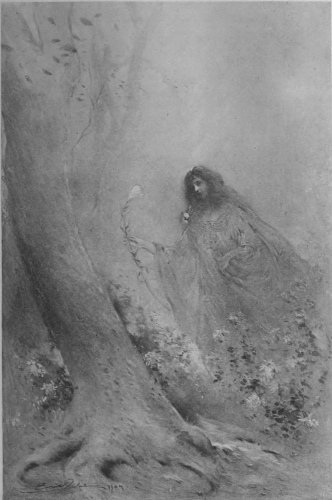
My spirit saw her pass Page 432 A Dream Shape
I took the music of the breeze And water, whispering in the trees, And shaped the soul that breathed below A woman’s blossom breasts of snow. A shadow’s shadow in the glass Of sleep, my spirit saw her pass: And thinking of it now, meseems We only live within our dreams. For in that time she was to me More real than our reality; More real than Earth, more real than I— The unreal things that pass and die.
THE OLD BARN
Low, swallow-swept and gray, Between the orchard and the spring, All its wide windows overflowing hay, And crannied doors a-swing, The old barn stands to-day. Deep in its hay the Leghorn hides A round white nest; and, humming soft On roof and rafter, or its log-rude sides, Black in the sun-shot loft, The building hornet glides. Along its corn-crib, cautiously As thieving fingers, skulks the rat; Or in warped stalls of fragrant timothy, Gnaws at some loosened slat, Or passes shadowy. A dream of drouth made audible Before its door, hot, harsh, and shrill All day the locust sings.... What other spell Shall hold it, lazier still Than the long day’s, now tell:— Dusk and the cricket and the strain Of tree-toad and of frog; and stars That burn above the rich west’s ribbéd stain; And dropping pasture bars, And cowbells up the lane. Night and the moon and katydid, And leaf-lisp of the wind-touched boughs; And mazy shadows that the fireflies thrid; And sweet breath of the cows, And the lone owl here hid.
THE WOOD WITCH
There is a woodland witch who lies With bloom-bright limbs and beam-bright eyes, Among the water-flags that rank The slow brook’s heron-haunted bank. The dragonflies, in brass and blue, Are signs she works her sorcery through; Weird, wizard characters she weaves Her spells with under forest leaves,— These wait her word, like imps, upon The gray flag-pods; their wings, of lawn And gauze; their bodies, gleaming green. While o’er the wet sand,—left between The running water and the still,— In pansy hues and daffodil, The fancies that she doth devise Assume the forms of butterflies, Rich-colored.—And ’tis she you hear, Whose sleepy rune, hummed in the ear Of silence, bees and beetles purr, And the dry-droning locusts whirr; Till, where the wood is very lone, Vague monotone meets monotone, And Slumber is begot and born, A faery child beneath the thorn. There is no mortal who may scorn The witchery she spreads around Her dim demesne, wherein is bound The beauty of abandoned time, As some sweet thought ’twixt rhyme and rhyme. And through her spells you shall behold The blue turn gray, the gray turn gold Of hollow heaven; and the brown Of twilight vistas twinkled down With fireflies; and in the gloom Feel the cool vowels of perfume Slow-syllabled of weed and bloom. But, in the night, at languid rest,— When like a spirit’s naked breast The moon slips from a silver mist,— With star-bound brow, and star-wreathed wrist, If you should see her rise and wave You welcome—ah! what thing could save You then? forevermore her slave!
MAY
The golden discs of the rattlesnake-weed, That spangle the woods and dance— No gleam of gold that the twilights hold Is strong as their necromance: For, under the oaks where the woodpaths lead, The golden discs of the rattlesnake-weed Are the May’s own utterance. The azure stars of the bluet bloom, That sprinkle the woodland’s trance— No blink of blue that a cloud lets through Is sweet as their countenance: For, over the knolls that the woods perfume, The azure stars of the bluet bloom Are the light of the May’s own glance. With her wondering words and her looks she comes, In a sunbeam of a gown; She needs but think and the blossoms wink, But look, and they shower down. By orchard ways, where the wild bee hums, With her wondering words and her looks she comes Like a little maid to town.
RAIN
I
Around, the stillness deepened; then the grain Went wild with wind; and every briery lane Was swept with dust; and then, tempestuous black, Hillward the tempest heaved a monster back, That on the thunder leaned as on a cane; And on huge shoulders bore a cloudy pack, That gullied gold from many a lightning crack: One great drop splashed and wrinkled down the pane, And then field, hill, and wood were lost in rain.
II
At last, through clouds,—as from a cavern hewn Into night’s heart,—the sun burst, angry roon; And every cedar, with its weight of wet, Against the sunset’s fiery splendor set, Startled to beauty, seemed with rubies strewn: Then in drenched gardens, like sweet phantoms met, Dim odors rose of pink and mignonette; And in the east a confidence, that soon Grew to the calm assurance of the moon.
FALL
Sad-hearted Spirit of the solitudes, Who comest through the ruin-wedded woods! Gray-gowned in fog, gold-girdled with the gloom Of tawny sunsets; burdened with perfume Of rain-wet uplands, chilly with the mist; And all the beauty of the fire-kissed Cold forests crimsoning thy indolent way, Odorous of death and drowsy with decay. I think of thee as seated ’mid the showers Of languid leaves that cover up the flowers,— The little flower-sisterhoods, whom June Once gave wild sweetness to, as to a tune A singer gives her soul’s wild melody,— Watching the squirrel store his granary. Or, ’mid old orchards, I have pictured thee: Thy hair’s profusion blown about thy back; One lovely shoulder bathed with gypsy black; Upon thy palm one nestling cheek, and sweet The rosy russets tumbled at thy feet. Was it a voice lamenting for the flowers? Or heart-sick bird that sang of happier hours? A cricket dirging days that soon must die? Or did the ghost of Summer wander by?
SUNSET IN AUTUMN
Blood-colored oaks, that stand against a sky of gold and brass; Gaunt slopes, on which the bleak leaves glow of brier and sassafras, And broom-sedge strips of smoky pink and pearl-gray clumps of grass In which, beneath the ragged sky, the rain pools gleam like glass. From west to east, from wood to wood, along the forest-side, The winds,—the sowers of the Lord,—with thunderous footsteps stride; Their stormy hands rain acorns down; and mad leaves, wildly dyed, Like tatters of their rushing cloaks, stream round them far and wide. The frail leaf-cricket in the weeds sounds its far fairy-bell; And like a torch of phantom ray the milkweed’s windy shell Glimmers; while, wrapped in withered dreams, the wet, autumnal smell Of loam and leaf, like Fall’s own ghost, steals over field and dell. The oaks, against a copper sky—o’er which, like some black lake Of Dis, bronze clouds, (like surges fringed with sullen fire) break— Loom sombre as Doom’s citadel above the vales that make A pathway to a land of mist the moon’s pale feet shall take. Now, dyed with burning carbuncle, a limbo-litten pane, Red in wild walls of storm, the west opens to hill and plain, On which the wild-geese ink themselves, a far triangled train; And then the shuttering clouds close down—and night it comes again.
CONTENT
When I behold how some pursue Fame that is Care’s embodiment, Or fortune, whose false face looks true,— An humble home with sweet content Is all I ask for me and you. An humble home, where pigeons coo, Whose path leads under breezy lines Of frosty-berried cedars to A gate, one mass of trumpet-vines, Is all I ask for me and you. A garden, which, all summer through, The roses old make redolent, And morning-glories, gay of hue, And tansy with its homely scent, Is all I ask for me and you. An orchard, that the pippins strew, From whose bruised gold the juices spring; A vineyard, where the grapes hang blue, Wine-big and ripe for vintaging, Is all I ask for me and you. A lane, that leads to some far view Of forest or of fallow-land, Bloomed o’er of rose and meadow-rue, Each with a bee in its hot hand, Is all I ask for me and you. At morn, a pathway deep with dew, And birds that vary time and tune; At eve, a sunset avenue, And whippoorwills that haunt the moon, Is all I ask for me and you. Dear heart, with wants so small and few, And faith, that’s better far than gold, A lowly friend; a child or two, To care for us when we are old, Is all I ask for me and you.
OCTOBER
Long hosts of sunlight, and the bright wind blows A tourney-trumpet on the listed hill; Past is the splendor of the royal rose And duchess daffodil. Crowned queen of beauty, in the garden’s space, Strong daughter of a bitter race and bold, A ragged beggar with a lovely face, Reigns the sad marigold. And I, who sought June’s butterfly for days, Now find it—like a coreopsis bloom— Amber and seal, rain-murdered ’neath the blaze Of this sunflower’s plume. Here drones the bee; and there, sky-voyaging wings Dare the blue gulfs of heaven: the last song The red-bird flings me as adieu, still rings Upon that pear-tree’s prong. No angry sunset brims with rubier red The bowl of heaven than the days, indeed, Pour in the blossoms of this salvia-bed Where each leaf seems to bleed. And where the wood-gnats dance, a little mist, Above the efforts of the weedy stream, The girl, October, tired of the tryst, Dreams a diviner dream. One foot just dipping the caressing wave, One knee at languid angle; locks that drown Hands nut-stained; hazel-eyed, she lies, and grave, Watching the leaves drift down.
DISCOVERY
What is it now that I shall seek Where woods dip downward, in the hills?— A mossy nook, a ferny creek, And May among the daffodils. Or in the valley’s vistaed glow, Past rocks of terraced trumpet-vines, Shall I behold her coming slow, Sweet May, among the columbines? With red-bud cheeks and bluet eyes, Big eyes, the homes of happiness, To meet me with the old surprise, Her hoiden hair all bonnetless. Who waits for me, where, note for note, The birds make glad the forest trees? A dogwood blossom at her throat, My May among th’ anemones. As sweetheart breezes kiss the blooms, And dewdrops drink the moon’s bright beams, My soul shall kiss her lips’ perfumes, And drain the magic of her dreams.
THE OLD SPRING
I
Under rocks whereon the rose Like a strip of morning glows; Where the azure-throated newt Drowses on the twisted root; And the brown bees, humming homeward, Stop to suck the honeydew; Fern and leaf-hid gleaming gloamward, Drips the wildwood spring I knew, Drips the spring my boyhood knew.
II
Myrrh and music everywhere Haunt its cascades—like the hair That a Naiad tosses cool, Swimming strangely beautiful, With white fragrance for her bosom, And her mouth a breath of song:— Under leaf and branch and blossom Flows the woodland spring along, Sparkling, singing flows along.
III
Still the wet wan mornings touch Its gray rocks, perhaps; and such Slender stars as dusk may have Pierce the rose that roofs its wave; Still the thrush may call at noontide And the whippoorwill at night; Nevermore, by sun or moontide, Shall I see it gliding white, Falling, flowing, wild and white.
THE FOREST SPRING
Push back the brambles, berry-blue; The hollowed spring is full in view: Deep-tangled with luxuriant fern Ripples its rock-embedded urn. Not for the loneliness that keeps The coigne wherein its crystal sleeps; Not for wild butterflies that sway Their pansy pinions all the day Above its mirror; nor the bee, Nor dragon-fly, that, passing, see Themselves reflected in its spar; Not for the one white liquid star That twinkles in its firmament; Nor moon-shot clouds, so slowly sent Athwart it when the kindly night Beads its long grasses with the light Small jewels of the dimpled dew: Not for the day’s inverted blue, Nor the quaint, dimly colored stones That dance within it where it moans; Not for all these I love to sit In silence and to gaze in it. But, lo! a nymph with merry eyes Greets mine within its laughing skies; A glimmering, shimmering nymph who plays All the long fragrant summer days With instant sights of bees and birds, And talks with them in water-words; And for whose nakedness the air Weaves moony mists; and on whose hair, Unfilleted, the night will set That lone star as a coronet.
THE HILLS
There is no joy of earth that thrills My bosom like the far-off hills! Th’ unchanging hills, that, shadowy, Beckon our mutability To follow and to gaze upon Foundations of the dusk and dawn. Meseems the very heavens are massed Upon their shoulders, vague and vast With all the skyey burden of The winds and clouds and stars above. Lo, how they sit before us, seeing The laws that give all Beauty being! Behold! to them, when dawn draws near, The nomads of the air appear, Unfolding crimson camps of day In brilliant bands; then march away; And under burning battlements Of evening plant their tinted tents. The truth of olden myths, that brood By haunted stream and haunted wood, They see; and feel the happiness Of old at which we only guess: The dreams, the ancients loved and knew, Still as their rocks and trees are true: Not otherwise than presences The tempest and the calm to these: One, shouting on them all the night, Black-limbed and veined with lambent light: The other, with the ministry Of all soft things that company With music—whose embodied form Fills all the solitude with charm Of leaves and waters and the peace Of bird-begotten melodies— And who at night doth still confer With the mild moon, that telleth her Pale tale of lonely love, until Wan shadows of her passion fill The heights with shapes that glimmer by Clad on with sleep and memory.
THE SONG OF THE THRUSH
Overhead, overhead a wood thrush flutes, And it seems to me All the sweet words in the world, Married to melody, could not express What its few, wild notes, Inspired, and simple, and free, express, Say to me Of expectation and woodland mystery, Dreams, and wonder-visions never appearing, Remote and unattainably beautiful— O indescribable song! Song of the wild brown thrush! O June! O love! O youth! Of you, of you it speaks to me! Of the lost, the irremediable, The indescribably fair and far and yet to be found; The mysteriously hidden, too: The lure of the undiscoverable calling, calling, Bidding me on and on, In the voice of all my longings, Down the dim, the deep, the cadenced aisles of the forest.
TRANSMUTATION
To me all beauty that I see Is melody made visible: An earth-translated state, may be, Of music heard in Heaven or Hell. Out of some love-impassioned strain Of saints, the rose evolved its bloom; And, dreaming of it here again, Perhaps relives it as perfume. Out of some chant, that demons sing Of hate and pain, the sunset grew; And, haply, still remembering, Relives it here as some wild hue.
FROST
Magician he, who, autumn nights, Down from the starry darkness whirls; Heav’n’s harlequin, whose spangled tights And wand are powdered thick with pearls. Through him each pane presents a scene, A Lilliputian landscape, where The world is white instead of green, And trees and houses hang in air. Where Elfins gambol and delight, And bow the jewelled bells of flowers; Where upside-down we see the night With many moons and meteor showers. And surely in his wand and hand Lies Midas magic, for, behold, Some morn we wake and find the land, Both field and forest, turned to gold.
ADVENTURERS
Seemingly over the hilltops, Possibly under the hills, A tireless wing that never drops, And a song that never stills. Epics heard on the stars’ lips? Lyrics read in the dew?— To sing the song at our finger-tips, And live the world anew! Cavaliers of the Cortés kind, Bold and free and strong,— And, oh, for a fine and muscular mind To sing a New-World’s song! Sailing seas of the silver morn, Blown of its balm and spice, To put the Old-World art to scorn At the price of any price! Danger, death, but the hope high! God’s, though the purpose fail!— Into the deeds of a vaster sky Sailing a dauntless sail.
INVOCATION
I
O Life! O Death; O God! Have we not striven? Have we not known Thee, God, As Thy stars know Heaven? Have we not held Thee true, True as Thy deepest, Sweet and immaculate blue Heaven whence rains Thy dew! Have we not known Thee true, O God who keepest!
II
O God, our Father, God!— Who gav’st us fire, To rise above the sod, To soar, aspire— What though we strive and strive, And all our soul says “live”? Will not the scorn of men, Like some wild bird, again Falcon it down with sneers, As often in past years? And, O sun-centered high, Thou, too, who ’rt Poet, Beneath Thy seeing sky Each day new Keatses die, Crying, “Why should we try! That which we seek ’s a lie!”— Why is this so?—O why?— Thou who dost know it!
III
We know Thee beautiful, We know Thee bitter! Help Thou!—Men’s eyes are dull, O God most beautiful! Make Thou their souls less full Of things mere glitter. Dost Thou not see our tears? Dost Thou not hear the years Treading our hearts to shards, O Lord of all the Lords?— Give heed, O God of Hosts, There ’mid Thy glorious ghosts, Most high and holy! Have mercy on our tears! Have mercy on our years! Our strivings and our fears, O Lord of lordly peers, On us, so lowly!
IV
On us, so fondly fain To tell what mother-pain Of Nature haunts the rain. On us, so glad to show What sorrow wings the snow, And her wild winds that blow. Us, who interpret right Her mystic rose of light, Her moony rune of night. Us, who have utterance for Each warm, flame-hearted star That stammers from afar. Who hear the tears and sighs Of every bud that dies While heav’n’s dew on it lies. Who see the power that dowers The wildwood bosks and bowers With musk and sap of flowers. Who see what no man sees In water, earth and breeze, And in the hearts of trees. Turn not away Thy light, O God!—Our strength is slight! Help us who breast the height! Have mercy, Infinite! Have mercy!
THE DEATH OF LOVE
So Love is dead, the Love we knew of old! And in the sorrow of our heart’s hushed halls A lute lies broken and a rose-flower falls; Love’s house stands empty and his hearth lies cold. Lone in dim places, where sweet vows were told, In walks grown desolate, by ruined walls Beauty decays; and on their pedestals Dreams crumble, and th’ immortal gods are mold. Music is slain or sleeps; one voice alone, One voice awakes, and like a wandering ghost Haunts all the echoing chambers of the Past— The voice of Memory, that stills to stone The soul that hears; the mind, that, utterly lost, Before its beautiful presence stands aghast.
UNANSWERED
How long ago it is since we went Maying! Since she and I went Maying long ago! The years have left my forehead lined, I know, Have thinned my hair around the temples graying. Ah, time will change us: yea, I hear it saying— “She, too, grows old: the face of rose and snow Has lost its freshness: in the hair’s brown glow Some strands of silver sadly, too, are straying. The form you knew, whose beauty so enspelled, Has lost the litheness of its loveliness: And all the gladness that her blue eyes held Tears and the world have hardened with distress.”— “True! true!” I answer, “O ye years that part! These things are changed—but is her heart, her heart?”
LOVE, THE INTERPRETER
Thou art the music that I hear in sleep, The poetry that lures me on in dreams; The magic, thou, that holds my thought with themes Of young romance in revery’s mystic keep.— The lily’s aura, and the damask deep That clothes the rose; the whispering soul that seems To haunt the wind; the rainbow light that streams, Like some wild spirit, ’thwart the cataract’s leap— Are glimmerings of thee and thy loveliness, Pervading all my world; interpreting The marvel and the wonder these disclose: For, lacking thee, to me were meaningless Life, love, and hope, the joy of everything, And all the beauty that the wide world knows.
LOVE DESPISED
Why not resolve and hunt it from one’s heart? This love, this god and fiend, that makes a hell Of all one’s life, in ways no tongue can tell, No mind divine, nor any word impart. Would not one think the slights that make hearts smart, The ice of love’s disdain, the wintry well Of love’s disfavor, otherwise would quell? Or school one’s nature, too, to its own art? Why will men cringe and cry forever here For that which, once obtained, may prove a curse? Why not remember that, however fair, Decay is wed to Beauty? that each year Robs somewhat from the riches of her purse, Until at last her house of pride stands bare?
PEARLS
Baroque, but beautiful, between the lunes, The valves of nacre of a mussel-shell, Behold, a pearl! shaped like the burnished bell Of some strange blossom that long afternoons Of summer coax to open: all the moon’s Chaste lustre in it; hues that only dwell With purity.... It takes me, like a spell, Back to a day when, whistling truant tunes, A barefoot boy I waded ’mid the rocks, Searching for shells strewn in the creek’s slow swirl, Unconscious of the pearls that round me lay: While, ’mid wild-roses,—all her tomboy locks Blond-blowing,—stood, unnoticed then, a girl, My sweetheart once, the pearl I flung away.
THE WOMAN SPEAKS
Why have you come?—To see me in my shame? A thing to spit upon, despise and scorn?— You, you who ask me! You, by whom was torn, Then cast aside, like some vile rag, my name! What shelter could you give me, now, that blame And loathing would not share? that wolves of vice Would not besiege with eyes of glaring ice? Wherein Sin sat not with her face of flame? “You love me”?—God!—If yours be love, for lust Hell must invent another synonym! If yours be love, then whoredom is the way To Heaven and God! and not with soul but dust Must burn the faces of the Cherubim,— O beast of beasts, if yours be love, I say!
OF THE SLUMS
Red-faced as old carousal, and with eyes A hard, hot blue; her hair a frowsy flame, Bold, dowdy bosomed, from her window-frame She leans, her mouth all insult and all lies. Or slattern-slippered and in sluttish gown, With ribald mirth and words too vile to name, A new Doll Tearsheet, glorying in her shame, Armed with her Falstaff now she takes the town. The flaring lights of alley-way saloons, The reek of hideous gutters and black oaths Of drunkenness from vice-infested dens, Are to her senses what the silvery moon’s Chaste splendor is, and what the blossoming growths Of Earth and bird-song are to Innocence.
LIGHT AND WIND
Where, through the myriad leaves of many trees, The daylight falls, beryl and chrysoprase, The glamour and the glimmer of its rays Seem visible music, tangible melodies: Light that is music; music that one sees— Wagnerian music—where forever sways The spirit of romance, and gods and fays Take form, clad on with dreams and mysteries. And now the wind’s transmuting necromance Touches the light and makes it fall and rise, Vocal, a harp of multitudinous waves That speaks as ocean speaks—an utterance Of far-off whispers, mermaid-murmuring sighs— Pelagian, vast, deep down in coral caves.
THE WINDS
Those hewers of the clouds, the Winds,—that lair At the four compass-points,—are out to-night; I hear their sandals trample on the height, I hear their voices trumpet through the air: Builders of Storm, God’s workmen, now they bear, Up the steep stair of sky, on backs of might, Huge tempest bulks, while,—sweat that blinds their sight,— The rain is shaken from tumultuous hair: Now, sweepers of the firmament, they broom, Like gathered dust, the rolling mists along Heaven’s floors of sapphire; all the beautiful blue Of skyey corridor and aëry room Preparing, with large laughter and loud song, For the white moon and stars to wander through.
TOUCHES
In heavens of rivered blue, that sunset dyes With glaucous flame, deep in the west the day Stands Midas-like; or, wading on his way, Touches with splendor all the twilight skies. Each cloud that, like a stepping-stone, he tries With rosy foot, transforms its sober gray To blazing gold; while, ray on crystal ray, Within his wake the stars like bubbles rise. So should the artist in his work accord All things with beauty, and communicate His soul’s high magic and divinity To all he does; and, hoping no reward, Toil onward, making darkness aureate With light of worlds that be and are to be.
EARTH AND MOON
I saw the day like some great monarch die, Gold-couched, behind the clouds’ rich tapestries. Then, purple-sandaled, clothed in silences Of sleep, through halls of skyey lazuli, The twilight, like a mourning queen, trailed by, Dim-paged of dreams and shadowy mysteries; And now the night, the star-robed child of these, In meditative loveliness draws nigh. Earth,—like to Romeo,—deep in dew and scent, Beneath Heaven’s window, watching till a light, Like some white blossom, in its square be set,— Lifts a faint face unto the firmament, That, with the moon, grows gradually bright, Bidding him climb and clasp his Juliet.
DUSK
Corn-colored clouds upon a sky of gold, And ’mid their sheaves,—where, like a daisy-bloom Left by the reapers to the gathering gloom, The star of twilight flames,—as Ruth, ’tis told, Dreamed homesick ’mid the harvest fields of old, The Dusk goes gleaning color and perfume From Bible slopes of heaven, that illume Her pensive beauty deep in shadows stoled. Hushed is the forest; and blue vale and hill Are still, save for the brooklet, sleepily Stumbling the stone with one foam-fluttering foot: Save for the note of one far whippoorwill, And in my heart her name,—like some sweet bee Within a rose,—blowing a fairy flute.
SEPTEMBER
The bubbled blue of morning-glory spires, Balloon-blown foam of moonflowers, and sweet snows Of clematis, through which September goes, Song-hearted, rich in realized desires, Are flanked with hotter hues: with tawny fires Of acrid marigolds,—that light long rows Of lamps,—and salvias, red as day’s red close,— That torches seem,—by which the Month attires Barbaric beauty; like some Asian queen, Towering imperial in her two-fold crown Of harvest and of vintage; all her form Gold and majestic purple: in her mien The might of motherhood; her baby brown, Abundance, high on one exultant arm.
THE END OF SUMMER
Pods are the poppies, and slim spires of pods The hollyhocks; the balsam’s pearly bredes Of rose-stained snow are little sacs of seeds Collapsing at a touch; the lote, that sods The pond with green, has changed its flowers to rods And discs of vesicles; and all the weeds, Around the sleepy water and its reeds, Are one white smoke of seeded silk that nods. Summer is dead, ay me! sweet Summer’s dead! The sunset clouds have built her funeral pyre, Through which, e’en now, runs subterranean fire: While from the East, as from a garden-bed, Mist-vined, the Dusk lifts her broad moon—like some Great golden melon—saying, “Fall has come.”
THE PASSING GLORY
Slow sinks the sun,—a great carbuncle ball Red in the cavern of a sombre cloud,— And in her garden, where the dense weeds crowd, Among her dying asters stands the Fall, Like some lone woman in a ruined hall, Dreaming of desolation and the shroud; Or through decaying woodlands goes, down-bowed, Hugging the tatters of her gipsy shawl. The gaunt wind rises, like an angry hand, And sweeps the sprawling spider from its web, Smites frantic music in the twilight’s ear; And all around, like melancholy sand, Rains dead leaves down—wild leaves, that mark the ebb, In Earth’s dark hour-glass, of another year.
PROTOTYPES
Whether it be that we in letters trace The pure exactness of a woodbird’s strain, And name it song; or with the brush attain The high perfection of a wildflower’s face; Or mold in difficult marble all the grace We know as man; or from the wind and rain Catch elemental rapture of refrain And mark in music to due time and place: The aim of art is Nature; to unfold Her truth and beauty to the souls of men In close suggestions; in whose forms is cast Nothing so new but ’tis long eons old; Nothing so old but ’tis as young as when The mind conceived it in the ages past.
SUPERSTITION
In the waste places, in the sinister night, When the wood whispers like a wandering mind, And silence sits and listens to the wind, Or, ’mid the rocks, to some wild torrent’s flight; Bat-browed thou wadest with thy wisp of light Among black pools the moon can never find; Or, owlet-eyed, thou hootest to the blind Deep darkness from some cave or haunted height. He who beholds but once thy fearsome face, Never again shall walk alone! but wan And terrible attendants shall be his— Unutterable things that have no place In God or Beauty—that compel him on, Against all hope, where endless horror is.
A. D. NINETEEN HUNDRED
War and Disaster, Famine and Pestilence, Vaunt-couriers of the Century that comes, Behold them shaking their tremendous plumes Above the world! Lo, all the air grows dense With rumors of destruction and a sense, Cadaverous, of corpses and of tombs Predestined; while,—like monsters in the glooms,— Bristling with battle, shadowy and immense, The Nations rise in dread apocalypse.— Where now the boast Earth makes of civilization? Its brag of Christianity?—In vain We seek to see them in the wild eclipse Of hell and horror and the devastation Of Death triumphant on his hills of slain.
UNCALLED
As one, who, journeying westward with the sun, Beholds at length from the up-towering hills, Far-off, a land unspeakable beauty fills, Circeän peaks and vales of Avalon: And, sinking weary, watches, one by one, The big seas beat between; and knows it skills No more to try; that now, as Heaven wills, This is the helpless end, that all is done: So ’tis with him, whom long a vision led In quest of Beauty—and who finds at last, She lies beyond his effort; all the waves Of all the world between them: while the dead, The myriad dead, who populate the Past With failure, hail him from forgotten graves.
QUATRAINS
I Moths and Fireflies
Since Fancy taught me in her school of spells I know her tricks: These are not moths at all, Nor fireflies; but masking Elfland belles Whose link-boys torch them to Titania’s ball.
II Autumn Wildflowers
Like colored lanterns swung in Elfin towers, Wild morning-glories light the tangled ways, And, like the rosy rockets of the Fays, Burns the sloped crimson of the cardinal-flowers.
III The Wind in the Pines
When winds go organing through the pines On hill and headland, darkly gleaming, Meseems I hear sonorous lines Of Iliads that the woods are dreaming.
IV Opportunity
Behold a hag whom Life denies a kiss As he rides questward in knighterrant-wise; Only when he hath passed her is it his To know, too late, the Fairy in disguise.
V Dreams
They mock the present and they haunt the past, And in the future there is naught agleam With hope, the soul desires, that at last The heart, pursuing, does not find a dream.
AFTERWORD
What vague traditions do the golden eves, What legends do the dawns Inscribe in fire on Heaven’s azure leaves, The red sun colophons? What ancient stories do the waters verse? What tales of war and love Do winds within the Earth’s vast house rehearse, God’s stars stand guard above? Would I could know them as they are expressed In hue and melody! And say, in words, the beauties they suggest, Language their mystery! And in one song magnificently rise, The music of the spheres, That more than marble should immortalize My name in after years.