Volume 1 — SONGS AND SONETS. (continued 2)
Reading edition
T'affections, and to faculties, Which sense may reach and apprehend.
ll. 57-8. On man heavens influence workes not so, But that it first imprints the ayre.
'Aucuns ont escrit que l'air a aussi cette vertu de faire decouler avec le feu elementaire les influences et proprietez secrettes des estoilles et planettes: alleguans que l'efficace des corps celestes ne peut s'estendre aux inferieurs et terrestres, que par les moyens et elemens qui sont entre deux. Mais cela soit au iugement des lecteurs que nous renvoyons aux disputes de ceux qui ont escrit sur la philosophie naturelle. Voyez aussi Pline au 5 ch. du 2 liu., Plutarque au 5 & 2 liu. des opinions des Philosophes, Platon en son Timee, Aristote en ses disputes de physique, specialement au i. liu. de la generation et corruption, et ceux qui ont escrit depuis luy touchant les elemens.' Du Bartas, La Sepmaine, &c. (1581), Indice. Air.
l. 59. Soe soule into the soule may flow. The 'Soe' of the MSS. must, I think, be right rather than the 'For' of D, H49, Lec, and the editions. It corresponds to the 'So' in l. 65, and it expresses the simpler and more intelligible thought. In references to the heavenly bodies and their influence on men one must remember certain aspects of older thought which have become unfamiliar to us. They were bodies of great dignity, 'aeterna corpora,' not composed of any of the four elements, and subject to no change in time but movement, change of position. If not as the older philosophers and some of the Fathers had held, 'animata corpora,' having a soul united to the body, yet each was guided by an Intelligence operating by contact: 'Ad hoc autem quod moveat, non opportet quod uniatur ei ut forma, sed per contactum virtutis, sicut motor unitur mobili.' Aquinas, Summa I. lxx. 3. Such bodies, it was claimed, influence human actions: 'Corpora enim coelestia, cum moveantur a spiritualibus substantiis ... agunt in virtute earum quasi instrumenta. Sed illae substantiae spirituales sunt superiores animabus nostris. Ergo videtur quod possint imprimere in animas nostras, et sic causare actus humanos.' Aquinas, however, disputes this, as Plotinus had before him, and distinguishes: As bodies, the stars affect us only indirectly, in so far namely as the mind and will of man are subject to the influence of physical and corporeal disturbances. But man's will remains free. 'Sapiens homo dominatur astris in quantum scilicet dominatur suis passionibus.' As Intelligences, the stars do not operate on man thus mediately and controllingly: 'sed in intellectum humanum agunt immediate illuminando: voluntatem autem immutare non possunt.' Aquinas, Summa I. cxv. 4.
Now if 'Soe' be the right reading here then Donne is thinking of the heavenly bodies without distinguishing in them between soul or intelligence and body. 'As these high bodies or beings operate on man's soul through the comparatively low intermediary of air, so lovers' souls must interact through the medium of body.'
If 'For' be the right reading, then Donne is giving as an example of soul operating on soul through the medium of body the influence of the heavenly intelligences on our souls. But this is not the orthodox view of their interaction. I feel sure that 'Soe' is the right reading. The thought and construction are simpler, and 'Soe' and 'For' are easily interchanged.
Of noblemen Donne says: 'They are Intelligences that move great Spheares.' Sermon, Judges xv. 20, p. 20 (1622).
ll. 61-4. As our blood labours to beget Spirits, as like soules as it can, Because such fingers need to knit That subtile knot, which makes us man.
'Spirit is a most subtile vapour, which is expressed from the Bloud, and the instrument of the soule, to perform all his actions; a common tye or medium betwixt the body and the soule, as some will have it; or as Paracelsus, a fourth soule of itselfe. Melancthon holds the fountaine of these spirits to be the Heart, begotten there; and afterward convayed to the Braine, they take another nature to them. Of these spirits there be three kindes, according to the three principall parts, Braine, Heart, Liver; Naturall, Vitall, Animall. The Naturall are begotten in the Liver, and thence dispersed through the Veines, to performe those naturall actions. The Vitall Spirits are made in the Heart, of the Naturall, which by the Arteries are transported to all the other parts: if these Spirits cease, then life ceaseth, as in a Syncope or Swowning. The Animall spirits formed of the Vitall, brought up to the Braine, and diffused by the Nerves, to the subordinate Members, give sense and motion to them all.' Burton, Anatomy of Melancholy (1638), p. 15. 'The spirits in a man which are the thin and active part of the blood, and so are of a kind of middle nature, between soul and body, those spirits are able to doe, and they doe the office, to unite and apply the faculties of the soul to the organs of the body, and so there is a man.' Sermons 26. 20. 291.
Page 55. Loves Diet.
ll. 19-24. This stanza, carefully and correctly printed in the 1633 edition, which I have followed, was mangled in that of 1635, and has remained in this condition, despite conjectural emendations, in subsequent editions, including those of Grosart and Chambers. What Donne says is obvious: 'Whatever Love dictated I wrote, but burned the letters. When she wrote to me, and when (correctly resumed by 'that') that favour made him (i.e. Love) fat, I said,' &c. The 1650-54 'Whate'er might him distaste,' &c. is obviously an attempt to put right what has gone wrong. No reading but that of the 1633 edition gives any sense to 'that favour' and 'convey'd by this'.
ll. 25-7. reclaim'd ... sport. In 1633 'reclaim'd' became 'redeem'd', probably owing to the frequent misreading of 'cl' as 'd'. The mistake here increases the probability that 'sports' is an error for 'sport' or 'sporte'. It is doubtful if 'sports' was used as now.
Page 56. The Will.
ll. 19-27. This verse is omitted in most of the MSS. Probably in James's reign its references to religion were thought too outspoken and flippant. Charles admired in Donne not only the preacher but also the poet, as Huyghens testifies.
The first three lines turn on a contrast that Donne is fond of elaborating between the extreme Protestant doctrine of justification by faith only and the Catholic, especially Jesuit, doctrine of co-operant works. It divided the Jesuits and the Jansenists. The Jansenists had not yet emerged, but their precursors in the quarrel (as readers of Les Provinciales will recall) were the Dominicans, to whom Donne refers: 'So also when in the beginning of S. Augustines time, Grace had been so much advanced that mans Nature was scarce admitted to be so much as any means or instrument (not only no kind of cause) of his own good works: And soon after in S. Augustines time also mans free will (by fierce opposition and arguing against the former error) was too much overvalued, and admitted into too near degrees of fellowship with Grace; those times admitted a doctrine and form of reconciliation, which though for reverence to the time, both the Dominicans and Jesuits at this day in their great quarrell about Grace and Free Will would yet seem to maintaine, yet indifferent and dispassioned men of that Church see there is no possibility in it, and therefore accuse it of absurdity, and almost of heresie.' Letters (1651), pp. 15-16. As an Anglican preacher Donne upheld James's point of view, that the doctrine of grace and free-will was better left undiscussed: 'Resistibility, and Irresistibility of Grace, which is every Artificers wearing now, was a stuff that our Fathers wore not, a language that pure antiquity spake not.... They knew Gods law, and his Chancery: But for Gods prerogative, what he could do of his absolute power, they knew Gods pleasure, Nolumus disputari: It should scarce be disputed of in Schools, much less serv'd in every popular pulpit to curious and itching ears; least of all made table-talke, and houshold-discourse.' Sermons 26. 1. 4.
The 'Schismaticks of Amsterdam' were the extreme Puritans. See Jonson's The Alchemist for Tribulation Wholesome and 'We of the separation'.
Page 58. The Funerall.
l. 3. That subtile wreath of haire, which crowns my arme; 'And Theagenes presented her with a diamond ring which he used to wear, entreating her, whensoever she did cast her eyes upon it, to conceive that it told her in his behalf, that his heart would prove as hard as that stone in the admittance of any new affection; and that his to her should be as void of end as that circular figure was;' (compare A Ieat Ring sent, p. 65) 'and she desired him to wear for her sake a lock of hair which she gave him; the splendour of which can be expressed by no earthly thing, but it seemed as though a stream of the sun's beams had been gathered together and converted into a solid substance. With this precious relique about his arm,' (compare The Relique, p. 62) 'whose least hair was sufficient' (compare Aire and Angels, p. 22, 'Ev'ry thy hair' and note) 'to bind in bonds of love the greatest heart that ever was informed with life, Theagenes took his journey into Attica.' Kenelm Digby's Private Memoirs (1827), pp. 80-1. When later Theagenes heard that Stelliana (believing Theagenes to be dead) was to wed Mardonius, 'he tore from his arm the bracelet of her hair ... and threw it into the fire that was in his chamber; when that glorious relic burning shewed by the wan and blue colour of the flame that it had sense and took his words unkindly in her behalf.'
Theagenes was Sir Kenelm Digby himself, Stelliana being Lady Venetia Stanley, afterwards his wife. Mardonius was probably Edward, Earl of Dorset, the brother of Donne's friend and patron.
It is probable that this sequence of poems, The Funerall, The Blossome, The Primrose and The Relique, was addressed to Mrs. Herbert in the earlier days of Donne's intimacy with her in Oxford or London.
l. 24. That since you would save none of me, I bury some of you. I have hesitated a good deal over this line. The reading of the editions is 'have none of me'; and in the group of MSS. D, H49, Lec, while H49 reads 'save', D has corrected 'have' to what may be 'save', and Lec reads 'have'. The reading of the editions is the full form of the construction, which is more common without the 'have'. 'It's four to one she'll none of me,' Twelfth Night, I. iii. 113; 'She will none of him,' Ibid. II. ii. 9, are among Schmidt's examples (Shakespeare Lexicon), in none of which 'have' occurs. The reading of the MSS., 'save none of me,' is also quite idiomatic, resembling the 'fear none of this' (i.e. 'do not fear this') of Winter's Tale, IV. iv. 601; and I have preferred it because: (1) It seems difficult to understand how it could have arisen if 'have none' was the original. (2) It gives a sharper antithesis, 'You would not save me, keep me alive. Therefore I will bury, not you indeed, but a part of you.' (3) To be saved is the lover's usual prayer; and the idea of the poem is that his death is due to the lady's cruelty.
Come not, when I am dead, To drop thy foolish tears upon my grave, To trample round my fallen head, And vex the unhappy dust thou wouldst not save. There let the wind sweep and the plover cry; But thou go by.
Compare also the Letter To Mrs M. H. (pp. 216-8), where the same idea recurs:
When thou art there, if any, whom we know, Were sav'd before, and did that heaven partake, &c.
Page 59. The Blossome.
l. 10. labour'st. The form with 't' occurs in most of the MSS., and 't' is restored in 1635. The 'labours' of 1633 represents a common dropping of the 't' for ease of pronunciation. See Franz, Shakespeare-Grammatik, § 152. It is colloquial, and I doubt if Donne would have preserved it if he had printed the poem, supposing that he wrote the word so, and not some copyist.
ll. 21-4. You goe to friends, whose love and meanes present Various content To your eyes, eares, and tongue, and every part: If then your body goe, what need you a heart?
I have adopted the MS. readings 'tongue' and 'what need you a heart?' because they seem to me more certainly what Donne wrote. He may have altered them, but so may an editor. 'Tongue' is more exactly parallel to eyes and ears, and the whole talk is of organs. 'What need you a heart?' is more pointed. 'With these organs of sense, what need have you of a heart?' The idiom was not uncommon, the verb being used impersonally. The O.E.D. gives among others:
What need us so many instances abroad. Andros Tracts, 1691.
'What need your heart go' is of course also idiomatic. The latest example the O.E.D. gives is from Hall's Satires, 1597: 'What needs me care for any bookish skill?'
Page 61. The Primrose, &c.
It is noteworthy that the addition 'being at Montgomery Castle', &c. was made in 1635. It is unknown to 1633 and the MSS. It may be unwarranted. If it be accurate, then the poem is probably addressed to Mrs. Herbert and is a half mystical, half cynical description of Platonic passion. The perfect primrose has apparently five petals, but more or less may be found. Seeking for one to symbolize his love, he fears to find either more or less. What can be less than woman? But if more than woman she becomes that unreal thing, the object of Platonic affection and Petrarchian adoration: but, as he says elsewhere,
Love's not so pure and abstract as they use To say, which have no Mistresse but their Muse.
Let woman be content to be herself. Since five is half ten, united with man she will be half of a perfect life; or (and the cynical humour breaks out again) if she is not content with that, since five is the first number which includes an even number (2) and an odd (3), it may claim to be the perfect number, and she to be the whole in which we men are included and absorbed. We have no will of our own.
'From Sarai's name He took a letter which expressed the number ten, and reposed one which made but five; so that she contributed that five which man wanted before, to show a mutual indigence and support.' Essays in Divinity (Jessop, 1855), p. 118.
'Even for this, he will visite to the third, and fourth generation; and three and foure are seven, and seven is infinite. Sermons 50. 47. 440.
l. 30. this, five, I have introduced a comma after 'this' to show what, I think, must be the relation of the words. The later editions drop 'this', and it seems to me probable that an original reading and a correction have survived side by side. Donne may have written 'this' alone, referring back to 'five', and then, thinking the reference too remote, he may have substituted 'five' in the margin, whence it crept into the text without completely displacing 'this'. The support which the MSS. lend to 1633 make it dangerous to remove either word now, but I have thought it well to show that 'this' is 'five'. In the MSS. when a word is erased a line is drawn under it and the substituted word placed in the margin.
Page 62. The Relique.
l. 13. Where mis-devotion doth command. The unanimity of the earlier editions and the MSS. shows clearly that 'Mass-devotion' (which Chambers adopts) is merely an ingenious conjecture of the 1669 editor. Donne uses the word frequently, e.g.:
Here in a place, where miss-devotion frames A thousand Prayers to Saints, whose very names The ancient Church knew not, &c. Of the Progresse of the Soule, p. 266, ll. 511-13.
and: 'This mis-devotion, and left-handed piety, of praying for the dead.' Sermons 80. 77. 780.
l. 17. You shalbe. I have recorded this reading of several MSS. because the poem is probably addressed to Mrs. Herbert and Donne may have so written. His discrimination of 'thou' and 'you' is very marked throughout the poems. 'Thou' is the pronoun of feeling and intimacy, 'you' of respect. Compare 'To Mrs. M. H.', and remember that Mrs. Herbert's name was Magdalen.
ll. 27-8. Comming and going, wee Perchance might kisse, but not between those meales: i.e. the kiss of salutation and parting. In a sermon on the text 'Kisse the Son, lest he be angry', Donne enumerates the uses of kissing sanctioned by the Bible, and this among them: 'Now by this we are slid into our fourth and last branch of our first part, The perswasion to come to this holy kisse, though defamed by treachery, though depraved by licentiousnesse, since God invites us to it, by so many good uses thereof in his Word. It is an imputation laid upon Nero, that Neque adveniens neque proficiscens, That whether comming or going he never kissed any: And Christ himself imputes it to Simon, as a neglect of him, That when he came into his house he did not kisse him. This then was in use', &c. Sermons 80. 41. 407.
The kiss of salutation lasted in some countries till the later eighteenth century, perhaps still lasts. See Rousseau's Confessions, Bk. 9, and Byron's Childe Harold, III. lxxix.
But Erasmus, in 1499, speaks as though it were a specially English custom: 'Est praeterea mos nunquam satis laudatus. Sive quo venis, omnium osculis exciperis; sive discedis aliquo, osculis dimitteris; redis, redduntur suavia; venitur ad te, propinantur suavia; disceditur abs te, dividuntur basia; occurritur alicubi, basiatur affatim; denique quocunque te moves, suaviorum plena sunt omnia.'
Page 64. The Dissolution.
l. 10. earthly sad despaire. Cf. O.E.D.: 'Earthly. 3. Partaking of the nature of earth, resembling earth as a substance, consisting of earth as an element; = Earthy, archaic or obsolete.' The form was used as late as 1843, but the change in the later editions of Donne indicates that it was growing rare in this sense. Compare, 'A young man of a softly disposition.' Camden's Reign of Elizabeth (English transl.).
Page 66. Negative Love.
l. 15. What we know not, our selves. 'All creatures were brought to Adam, and, because he understood the natures of all those creatures, he gave them names accordingly. In that he gave no name to himselfe it may be by some perhaps argued, that he understood himselfe lesse then he did other creatures.' Sermons 80. 50. 563.
Page 67. The Prohibition.
l. 18. So, these extreames shall neithers office doe. The 'neithers' of D, H40, JC, supported by 'neyther' in O'F and 'neyther their' in Cy, is much more characteristic than 'ne'er their', and more likely to have been altered than to have been substituted for 'ne'er their'. The reading of Cy shows how the phrase puzzled an ordinary copyist. 'These extremes shall by counteracting each other prevent either from fulfilling his function.' Compare, 'As two yoke-devils sworn to either's purpose' (i.e. each to the other's purpose). Shakespeare, Hen. V, II. ii. 107.
l. 22. So shall I, live, thy stage not triumph bee. I have placed a comma after I to make quite clear that 'live' is the adjective, not the verb. The 'stay' of 1633 is defensible, but the 1633 editor was somewhat at sea about this poem, witness the variations introduced while the edition was printing in ll. 20 and 24 and the misprinting of l. 5. All the MSS. I have consulted support 'stage'; and this gives the best meaning: 'Alive, I shall continue to be the stage on which your victories are daily set forth; dead, I shall be but your triumph, a thing achieved once, never to be repeated.' Compare:
And cause her leave to triumph in this wise Upon the prostrate spoil of that poor heart! That serves a Trophy to her conquering eyes, And must their glory to the world impart. Daniel, Delia, x.
ll. 23, 24. There are obviously two versions of these lines which the later editions have confounded. The first is that of the text, from 1633. The second is that of the MSS. and runs, properly pointed:
Then lest thy love, hate, and mee thou undoe, O let me live, O love and hate me too.
The punctuation of the MSS. is very careless, but the lines as printed are quite intelligible. As given in the editions 1635-69 they are nonsensical.
Page 68. The Expiration.
l. 5. We ask'd. The past tense of the MSS. makes the antithesis and sense more pointed. 'It was with no one's leave we lov'd to begin with, and we will owe to no one the death that comes with parting.'
ll. 7 f. Goe: and if that word have not quite kil'd thee, Ease mee with death, by bidding mee goe too.
Compare:
Val. No more: unless the next word that thou speak'st Have some malignant power upon my life: If so, I pray thee, breathe it in mine ear, As ending anthem of my endless dolour. Two Gentlemen of Verona, III. i. 236 f.
Page 70. The Paradox.
l. 14. lights life. The MSS. correct the obvious mistake of the editions, 'lifes light.' The 'lights life' is, of course, the sun. In the same way at 21 'lye' is surely better suited than 'dye' to an epitaph. This poem is not in D, H49, Lec, and 1633 has printed it from A18, N, TC.
In the latter group of MSS. this poem is followed immediately by another of the same kind, which is found also in H40, RP31, and O'F, as well as several more miscellaneous MSS. I print from TCC:
A Paradox.
Whosoe termes Love a fire, may like a poet Faine what he will, for certaine cannot showe it. For Fire nere burnes, but when the fuell's neare But Love doth at most distance most appeare. Yet out of fire water did never goe, But teares from Love abundantly doe flowe. Fire still mounts upward; but Love oft descendeth. Fire leaves the midst: Love to the Center tendeth. Fire dryes and hardens: Love doth mollifie. Fire doth consume, but Love doth fructifie. The powerful Queene of Love (faire Venus) came Descended from the Sea, not from the flame, Whence passions ebbe and flowe, and from the braine Run to the hart like streames, and back againe. Yea Love oft fills mens breasts with melting snow Drowning their Love-sick minds in flouds of woe. What is Love, water then? it may be soe; But hee saith trueth, that saith hee doth not knowe.
FINIS.
Page 71. Farewell to Love.
l. 12. His highnesse &c. 'Presumably his highness was made of gilt gingerbread.' Chambers. See Jonson, Bartholomew Fair, III. i.
ll. 28-30. As these lines stand in the old editions they are unintelligible:
Because that other curse of being short, And only for a minute made to be Eager, desires to raise posterity.
Grosart prints:
Because that other curse of being short And—only-for-a-minute-made-to-be— Eager desires to raise posterity.
This and the note which he appends I find more incomprehensible than the old text. This is his note: 'The whole sense then is: Unless Nature decreed this in order that man should despise it, (just) as she made it short, that man might for that reason also despise a sport that was only for a minute made to be eager desires to raise posterity.' Surely this is Abracadabra!
What has happened is, I believe, this: Donne here, as elsewhere, used an obsolescent word, viz. 'eagers', the verb, meaning 'sharpens'. The copyist did not recognize the form, took 'desire' for the verb, and made 'eager' the adjectival complement to 'be', changing 'desire' to 'desires' as predicate to 'curse'. What Donne had in mind was the Aristotelian doctrine that the desire to beget children is an expression of man's craving for immortality. The most natural function, according to Aristotle, of every living thing which is not maimed in any way is to beget another living thing like itself, that so it may partake of what is eternal and divine. This participation is the goal of all desire, and of all natural activity. But perishable individuals cannot partake of the immortal and divine by continuous existence. Nothing that is perishable can continue always one and the same individual. Each, therefore, participates as best he may, some more, some less; remaining the same in a way, i.e. in the species, not in the individual.' (De Anima, B. 4. 415 A-B.) Donne's argument then is this: 'Why of all animals have we alone this feeling of depression and remorse after the act of love? Is it a device of nature to restrain us from an act which shortens the life of the individual (he refers here to a prevalent belief as to the deleterious effect of the act of love), needed because that other curse which Adam brought upon man, the curse of mortality,
of being short, And only for a minute made to be, Eagers [i.e. whets or provokes] desire to raise posterity.'
The latest use of 'eager' as a verb quoted by the O.E.D. is from Mulcaster's Positions (1581), where the sense is that of imitating physically: 'They that be gawled ... may neither runne nor wrastle for eagering the inward'. The Middle English use is closer to Donne's: 'The nature of som men is so ... unconvenable that ... poverte myhte rather egren hym to don felonies.' Chaucer, Boëth. De Consol. Phil. In the Burley MS. (seventeenth century) the following epigram on Bancroft appears:
A learned Bishop of this land Thinking to make religion stand, In equall poise on every syde The mixture of them thus he tryde: An ounce of protestants he singles And a dramme of papists mingles, Then adds a scruple of a puritan And melts them down in his brayne pan, But where hee lookes they should digest The scruple eagers all the rest.
In Harl. MS. 4908 f. 83 the last line reads:
That scruple troubles all the rest.
Page 71. A Lecture upon the Shadow.
The text of this poem in the editions is that of A18, N, TC among the MSS. A slightly different recension is found in most of the other MSS. The chief difference is that the latter read 'love' for 'loves' at ll. 9, 14, and 19. They also, however, read 'least' for 'high'st' at l. 12. In l. 19 they vacillate between 'once' and 'our'. It would not be difficult to defend either version. The only variation from the printed text which I have admitted is that on which all the MSS. are unanimous, viz. 'first' for 'short' in l. 26; 'short' is an obvious blunder.
Note on the music to which certain of Donne's songs were set.
A song meant for the Elizabethans a poem intended to be sung, generally to the accompaniment of the lute. Donne had clearly no thought of his songs being an exception to this rule:
But when I have done so, Some man his art and voice to show Doth set and sing my paine.
Yet it is difficult to think of some, perhaps the majority, of Donne's Songs and Sonets as being written to be sung. Their sonorous and rhetorical rhythm, the elaborate stanzas which, like the prolonged periods of the Elegies, seem to give us a foretaste of the Miltonic verse-paragraph, suggest speech,—impassioned, rhythmical speech rather than the melody of song. We are not haunted by a sense of the tune to which the song should go, as we are in reading the lyrics of the Elizabethan Anthologies or of Robert Burns. Yet some of Donne's songs were set to music. A note in one group of MSS. describes three of them as 'Songs which were made to certain ayres which were made before'. One of these is The Baite, which must have been set to the same air as Marlowe's song. I reproduce here a lute-accompaniment found in William Corkine's Second Book of Ayres (1612). The airs of the other two (see p. 18 (note)) I have not been able to find, nor are they known to Mr. Barclay Squire, who has kindly helped and guided me in this matter of the music. With his aid I have reproduced here the music of two other songs, and, at another place, that of one of Donne's great Hymns.
Page 8. Song.
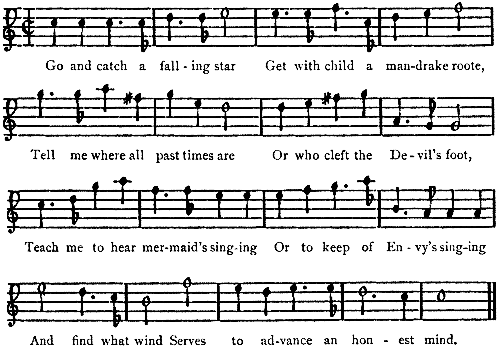
The following air is found in Egerton MS. 2013. As given here it has been conjecturally corrected by Mr. Barclay Squire:
midi file .pdf file
G O, and catch a falling star, Get with child a mandrake roote, Tell me where all past times are, Or who cleft the Devils foot, 5Teach me to hear mermaid's singing, Or to keep of Envy's singing, And find What wind Serves to advance an honest mind.
Page 23. Breake of Day.
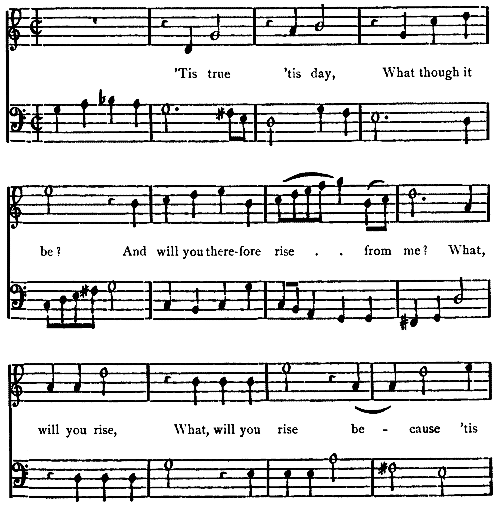
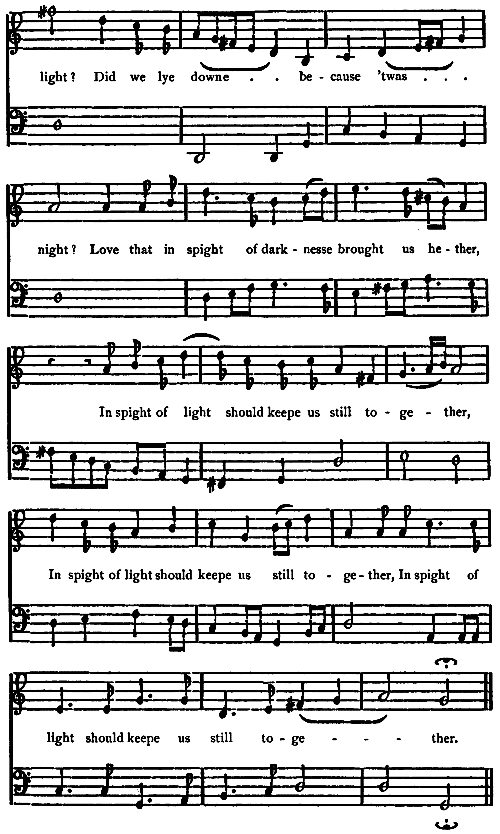
This is set to the following air in Corkine's Second Book of Ayres (1612). As given here it has been transcribed by Mr. Barclay Squire, omitting the lute accompaniment:
midi file .pdf file
'T IS true, 'tis day; What though it be? And wilt thou therefore rise from me? What, will you rise, What, will you rise, because 'tis light? Did we lie downe, because 'twas night? Love which in spight of darknesse brought us hether, In spight of light should keepe us still together. In spight of light should keepe us still together. In spight of light should keepe us still together.
Page 46. The Baite.
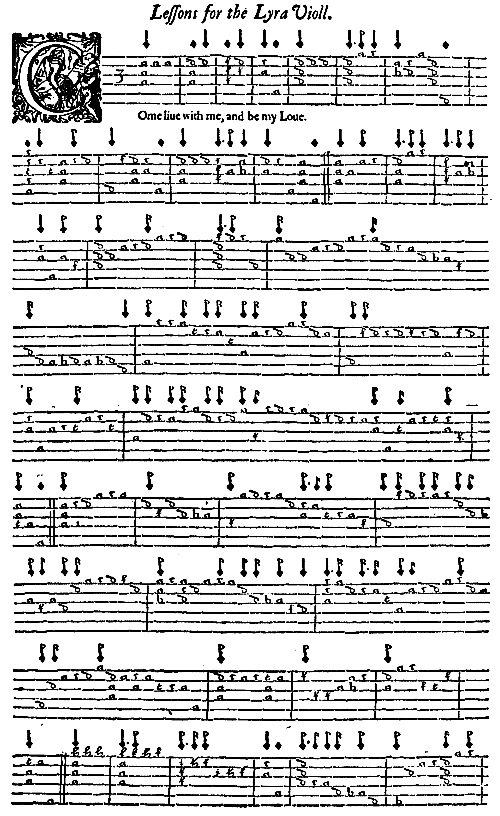
From Corkine's Second Book of Ayres (1612).
midi file .pdf file
C OME live with mee, and bee my love, And wee will some new pleasures prove Of golden sands, and christall brookes, With silken lines, and silver hookes.