Volume 1 — APPENDIX B. POEMS WHICH HAVE BEEN ATTRIBUTED TO DONNE.
Reading edition
For a full discussion of the authorship of these poems see Text and Canon of Donne's Poems, pp. cxxix et seq.
Page 401. To Sr Nicholas Smyth.
Chambers points out that a Nicholas Smyth has a set of verses in Coryats Crudities, 1611.
In the Visitation of the County of Devon, 1620, a long genealogy is given, the closing portion of which shows who this Nicholas Smith or Smyth of Exeter (l. 15) and his father were:
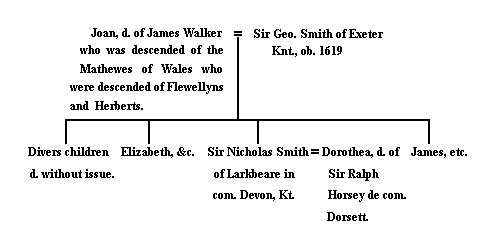
Seven children of Sir Nicholas are given, including another Nicholas (aet. 14), and the whole is signed 'Nich Smith'.
This is doubtless Roe's friend. With Roe as a Falstaff he had probably 'heard the chimes at midnight' in London before he settled down to raise a family in Devonshire.
l. 7. sleeps House, &c. Ovid xi; Ariosto, Orlando Furioso, Canto xiv; Spenser, Faerie Queene, I. i.
Page 402, l. 26. Epps. 'This afternoon a servingman of the Earl of Northumberland fought with swaggering Eps, and ran him through the ear.' Manninghams Diary, 8th April, 1603 (Camden Club, p. 165). This is the only certain reference to Epps I have been able to find, but Grosart declares he is the soldier described in Dekker's Knights Conjuring as behaving with great courage at the siege of Ostend (1601-4), where he was killed. I can find no name in Dekker's work.
ll. 27-31. As printed in 1669 these lines are not very intelligible, and neither Grosart nor Chambers has corrected them. As given in the MSS. (e.g. TCD) they are a little clearer:
For his Body and State The Physick and Counsel (which came too late) 'Gainst whores and dice, hee nowe on mee bestowes Most superficially: hee speakes of those, (I found by him) least soundly whoe most knows:
The purpose of bracketing 'which came too late' is obviously to keep it from being taken with ''Gainst whores and dice'—the very mistake that 1669 has fallen into and Grosart and Chambers have preserved. The drawback to this use of the bracket is that it disguises, at least to modern readers, that 'which came too late' must be taken with 'For his Body and State'. I have therefore dropped it and placed a comma after 'late'. The meaning I take to be as follows: 'The physic and counsel against whores and dice, which came too late for his own body and estate, he now bestows on me in a superficial fashion; for I found by him that of whores and dice those speak least soundly who know most from personal experience.' A rather shrewd remark. There are some spheres where experience does not teach, but corrupt.
l. 40. in that or those: 'that' the Duello, 'those' the laws of the Duello. There is not much to choose between 'these' and 'those'.
ll. 41-3. Though sober; but so never fought. I know What made his Valour, undubb'd, Windmill go, Within a Pint at most:
The MSS. improve both the metre and the sense of the first of these lines, which in 1669 and Chambers runs:
Though sober; but nere fought. I know ...
It is when he is sober that he never fights, though he may quarrel. Roe knows exactly how much drink it would take to make this undubb'd Don Quixote charge a windmill, or like a windmill. But the poem is too early for an actual reference to Don Quixote.
Page 403, ll. 67-8. and he is braver now Than his captain.
By 'braver' the poet means, not more courageous, but more splendidly attired, more 'braw'.
Page 404, l. 88. Abraham France—who wrote English hexameters. His chief works are The Countess of Pembrokes Ivy Church (1591) and The Countess of Pembrokes Emmanuel (1591). He was alive in 1633.
Page 405, l. 113. So they their weakness hide, and greatness show. Grosart refused the reading 'weakness', which he found in his favourite MS. S, and Chambers ignored it. It has, however, the support of B, O'F, and L74 (which is strong in Roe's poetry), and seems to me to give the right edge to the sarcasm. 'By giving to flatterers what they owe to worth, Kings and Lords think to hide their weakness of character, and to display the greatness of their wealth and station.' They make a double revelation of their weakness in their credulity and their love of display.
l. 128. Cuff. Henry Cuff (1563-1601), secretary to Essex and an abettor of the conspiracy.
l. 131. that Scot. It is incredible that Donne wrote these lines. He found some of his best friends among the Scotch—Hay, Sir Robert Ker, Essex, and Hamilton, to say nothing of the King.
Page 406. Satyre.
Page 407, ll. 32-3. A time to come, &c. I have adopted Grosart's punctuation and think his interpretation of 'beg' must be the right one—'beg thee as an idiot or natural.' The O.E.D. gives: '†5a. To beg a person: to petition the Court of Wards (established by Henry VIII and suppressed under Charles II) for the custody of a minor, an heiress, or an idiot, as feudal superior or as having interest in the matter: hence also fig. To beg (any one) for a fool or idiot: to take him for, set him down as. Obs.' Among other examples is, 'He proved a wiser man by much than he that begged him. Harington, Met. Ajax 46.' What the satirist says is, 'The time will come when she will beg to have wardship of thee as an idiot. If you continue she will take you for one now.'
l. 35. Besides, her〈s〉. My reading combines the variants. I think 'here' must be wrong.
Page 407. An Elegie.
Page 408, l. 5. Else, if you were, and just, in equitie &c. This is the punctuation of H39, and is obviously right, 'in equitie' going with what follows. He has denied the existence or, at least, the influence of the Fates, and now continues, 'For if you existed or had power, and if you were just, then, according to all equity I should have vanquish'd her as you did me.' Grosart and the Grolier Club editor follow 1635-54, and read:
Else, if you were, and just in equity, &c.
Chambers accepts the attempt of 1669 to amend this, and prints:
True if you were, and just in equity, &c.
But 'just in equity' is not a phrase to which any meaning can be attached.
Page 412. An Elegie.
Grosart prints this very incorrectly. He does not even reproduce correctly the MS. S, which he professes to follow. Chambers follows Grosart, adopting some of the variants of the Haslewood-Kingsborough MS. reported by Grosart. They both have the strange reading 'cut in bands' in l. 11, which as a fact is not even in S, from which Grosart professes to derive it. The reading of all the MSS., 'but in his handes,' makes quite good sense. The Scot wants matter, except in his hands, i.e. dirt, which is 'matter out of place'. The reading, 'writ in his hands', which Chambers reports after Grosart, is probably a mistake of the latter's. Indeed his own note suggests that the reading of H-K is 'but in's hands'.
Page 417. To the Countesse of Huntington.
It looks as if some lines of this poem had been lost. The first sentence has no subject unless 'That' in the second line be a demonstrative—a very awkward construction.
If written by Donne this poem must have been composed about the same time as The Storme and The Calme. He is writing apparently from the New World, from the Azores. But it is as impossible to recover the circumstances in which the poem was written as to be sure who wrote it.
Page 422. Elegie.
ll. 5-6. denounce ... pronounce. The reading of the MSS. seems to me plainly the correct one. 'In others, terror, anguish and grief announce the approach of death. Her courage, ease and joy in dying pronounce the happiness of her state.' The reading of the printed texts is due to the error by which 1635 and 1639 took 'comming' as an epithet to 'terror' as 'happy' is to 'state'. Some MSS. read 'terrors' and 'joyes'.
l. 22. Their spoyles, &c. I have adopted the MS. reading here, though with some hesitation, because (1) it is the more difficult reading: 'Soules to thy conquest beare' seems more like a conjectural emendation than the other reading, (2) The construction of the line in the printed texts is harsh—one does not bear anything 'to a conquest', (3) the meaning suits the context better. It is not souls that are spoken of, but bodies. The bodies of the wicked become the spoil of death, trophies of his victory over Adam; not so those of the good, which shall rise again. See 1 Cor. xv. 54-5.
Page 424. Psalme 137.
This Psalm is found in a MS. collection of metrical psalms (Rawlinson Poetical 161), in the Bodleian Library, transcribed by a certain R. Crane. The list of authors is Fr. Dav., Jos. Be., Rich. Cripps, Chr. Dav., Th. Carry. That Davison is the author of this particular Psalm is strongly suggested by the poetical Induction which in style and verse resembles the psalm. The induction is signed 'Fr. Dav.' The first verse runs:
Come Urania, heavenly Muse, and infuse Sacred flame to my invention; Sing so loud that Angells may heare thy lay, Lending to thy note attention.
Page 429. Song.
Soules joy, now I am gone, &c. George Herbert, in the Temple, gives A Parodie of this poem, opening:
Soul's joy, when thou art gone, And I alone, Which cannot be, Because Thou dost abide with me, And I depend on Thee.
The parody does not extend beyond the first verse.
It was one of the aims of Herbert to turn the Muse from profane love verses to sacred purposes. Mr. Chambers points to another reference to this poem in some very bad verses by Sir Kenelm Digby in Bright's edition of Digby's Poems (p. 8), The Roxburghe Club.