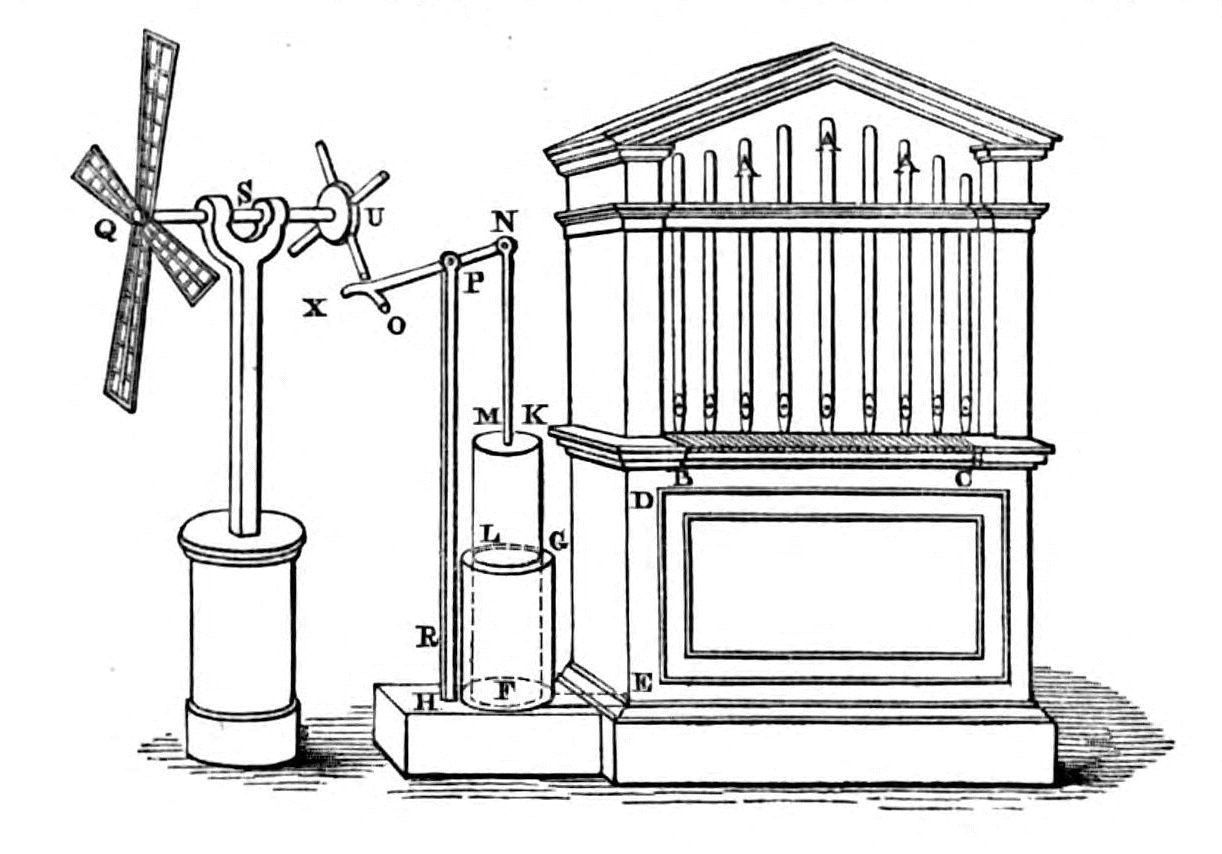
77. An Altar Organ blown by the agency of a Wind-mill.
Joseph George Greenwood translation

The construction of an organ from which, when the wind blows, the sound of a flute shall be produced. Let A, A, A, (fig. 77), be the pipes, B C the transverse tube communicating with them, D E the vertical tube, and E F another transverse tube leading from D E into a box G H, the inner surface of which is made level to fit a piston. Into this box fit the piston K L, which is capable of descending into it freely. To the piston attach a rod, M N, and to this another, N X, working on the rod P R. At N let there be a pin moving readily, and to the extremity X fasten a small plate, X O, near which a rod, S, is to be placed, moving on iron pivots placed in a frame which admits of being shifted. To the rod S attach two small wheels, U and Q, of which U is furnished with pegs placed close to the plate X O, and Q with broad arms like the sails of a wind-mill. When all of these arms, urged by the wind, drive round the wheel Q, the rod S will be driven round, so that the wheel U and the pegs attached to it will strike the plate X O at intervals and raise the piston; when the peg recedes, the piston, descending, will force out the air in the box G H into the tubes and pipes, and produce the sound. We may always move the frame which contains the rod S towards the prevailing wind, that the revolution may be more rapid and uniform.