29. An Automaton which may be made to drink at any time, on a Liquid being presented to it.
Joseph George Greenwood translation
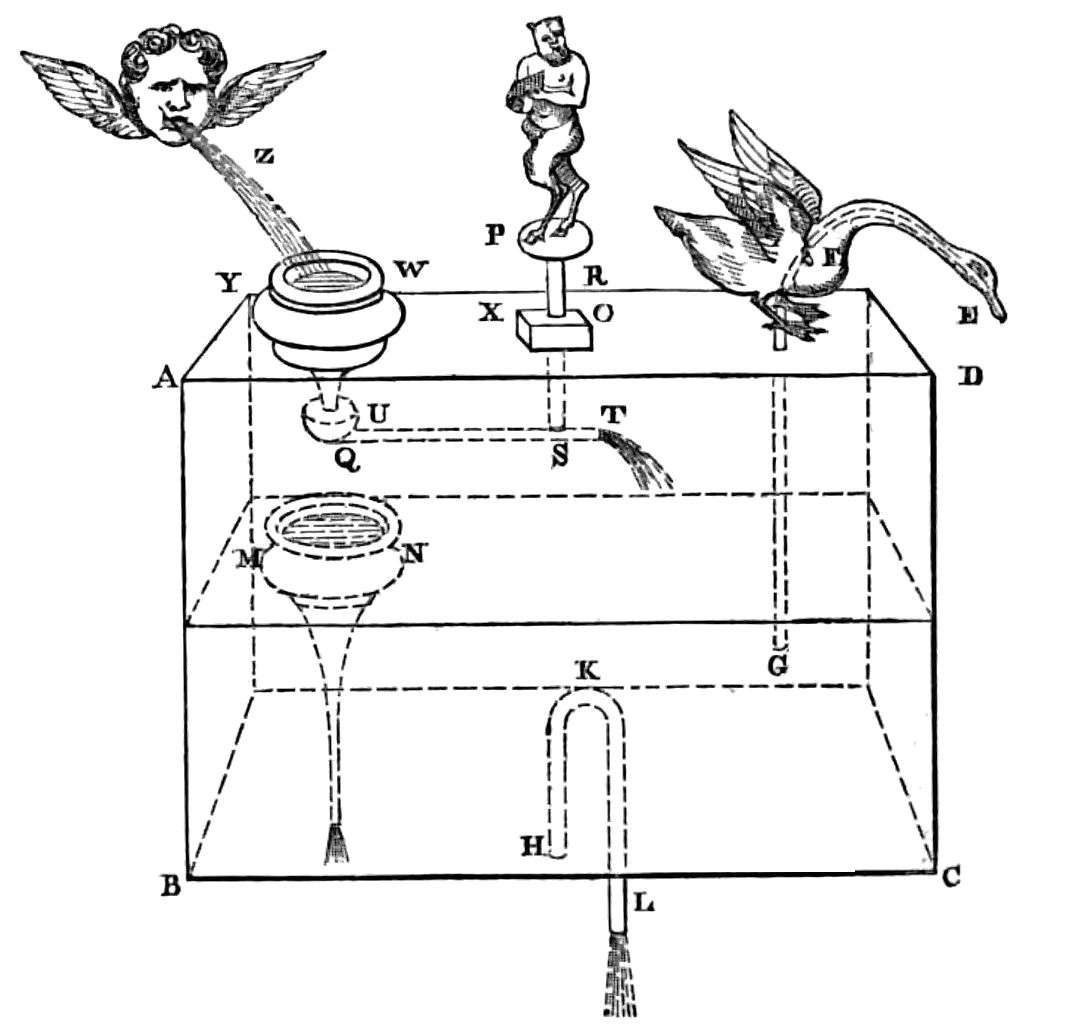
There is another way in which, by the aid of running water, the animal may be made to drink on the revolution of a carved figure of Pan. Let A B C D (fig. 29) be a pedestal, air-tight on every side, and divided into two chambers by a partition. On the surface place the animal, and let the tube E F G pass through its mouth. Within the pedestal, in the lower chamber, let there be a bent siphon, H K L, the lower leg projecting from the bottom: and let a funnel, M N, pass through the middle of the partition, its tube reaching nearly to the bottom. On the pedestal A B C D place another pedestal, O X, on which the figure of Pan, P R, is to stand, having attached to it the rod S which projects below into the pedestal. To S let the tube T U be fastened, at the end of which is the cup U Q, attached to and communicating with the tube. Let the tube be of such a length that, when the figure P R turns round, the cup U Q will be directly above the funnel M N. On the pedestal, and communicating with it, and directly above the funnel M N, place the cup W Y. Let the stream Z, (which must be greater than the discharge through the siphon H K L), flow into W Y: the liquid will pass through M N into the lower part of the pedestal, the contained air passing out through E F G: and now the pedestal will continue full as the influx is greater than the discharge. But, when we turn the figure P R round, the cup U Q will intercept the stream Z, which will pass elsewhere through the tube T U, and, as the water no longer flows into the lower chamber of the pedestal, the siphon H K L will empty it, and the air will enter through E F G. Thus, when the cup is applied, the animal will drink as before.