"The Pirate of the Mediterranean" (continued 8)
Reading edition
All this party having been embarked, Linton advised that the cutter should return to the ship, and begged that four more hands should be sent him, with a good supply of rope-yarns. While the boats were absent, he tried to calm and conciliate the unhappy beings on the rock; but, although they no longer attempted to injure him, it was evident that they abstained from doing so more from fear than good will.
They were in all, remaining alive, twelve persons; and, when the dinghy returned, he found his party to amount to eight men, with whom he considered he should easily be able to master the others. The unfortunate Frenchmen had not sense to perceive what he was about, and he had captured and bound three before they attempted to escape from him. Then commenced the most extraordinary chase round and round the rock. In a short time three more were bound, and these Linton sent off before he made any further attempt to take the rest. There were still six at large, fierce, powerful men, who evaded every means he could devise to get hold of them without using actual force. He was still unwilling to pull away, and leave them to their fate; at length he ordered his men to make a simultaneous rush at them, and to endeavour to trip them up, or to knock them over with the flats of their cutlasses. Pour of them were secured, though they had their knives in their hands, and made a desperate resistance; the others, they were two, who appeared to be the maddest of the party, darted from them, and, before they could be stopped, leaped off, on the weather side, when they were quickly swallowed up among the breakers. Linton and his companions shuddered as they left the fatal spot.
The Ione, with her new passengers on board, kept on her course, and the wind still continuing foul, Captain Fleetwood steered for Athens, off which place, the French commander said he was certain to find a ship of his own country to receive him and his crew.
A French frigate was fallen in with, as was expected, and the French captain and his surviving officers and crew were transferred to her. They were all full of the deepest expressions of gratitude for the service which had been rendered them, and all united in complimenting Bowse for his behaviour during the trying time of the shipwreck, which had been the chief means of preserving their lives.
I will not describe Fleetwood’s feelings on seeing Colonel Gauntlett, and on hearing that Ada had, to a certainty, been carried off by Zappa. He had been prepared for the account; for he believed, from the first, that it was for that purpose he had attacked the Zodiac.
Such, however, was a conjecture a lover would naturally form, as he considered her the most valuable thing on board; but, perhaps, the more worldly reader may consider that the rich cargo had greater attractions, as well as the prospect of a large sum for her ransom. He was not aware that, at that very time, Zappa had sent to Aaron Bannech, the old Jew of Malta, to negotiate with her friends for that very purpose. The colonel, of course, remained on board to assist in the search for his niece, while Bowse begged that he might be allowed to remain also for the same object, and his men entered on board the Ione, which was some hands short.
A few words must explain the appearance of Captain Bowse and his crew and passengers on the rock. When Zappa had left the Zodiac he had bored holes in her, for the purpose of sending her to the bottom; she, however, did not sink as soon as expected; and Bowse, with some of his people who were unhurt, were able to put a boat to rights, and to launch her. The boat carried them all, and they were making for the nearest coast when they were picked up by a French man-of-war. The French ship was soon after wrecked on a barren rock, on which they existed without food for many days, and where many of the Frenchmen went mad. Here they remained till the Ione took them off.
Fleetwood had been very unhappy at having been compelled to go so much out of his way to get rid of the Frenchmen; but he was well rewarded for the delay, by falling in, when just off the mouth of the Gulf of Egina, with the very brig he had chased before touching at Cephalonia, the Ypsilante. Captain Teodoro Vassilato came on board, and expressed his delight at meeting him again, insisting on being allowed to accompany him on his search.
“I was once taken prisoner by the rascals myself, and narrowly escaped with my life, and I may have some little expectation of satisfaction in punishing them,” he observed. “Indeed, without my assistance, I do not think you have much chance of success.”
This last argument prevailed, and Fleetwood, warmly pressing his new friend’s hand, assured him of his gratitude for his promised assistance. The two brigs, therefore, sailed in company to search for the pirate’s island.
Chapter Twenty Seven.
Captain Fleetwood followed his unknown guide into the open air without a word having been exchanged between them. He felt no fear, and scarcely any doubt as to the object of the summons he had received; for he had, from the first, persuaded himself that it was in some way or other connected with Ada Garden, and that he was either to hear of her, or to be conducted into her presence. The guide stopped at the door of the building to conceal the light, and looked cautiously around to ascertain, apparently, that no unwelcome eyes were near to watch their proceedings. Having convinced himself that he was unobserved, he again beckoned the English officer to advance, leading him round close to the line of ruins, which at one time formed the outer walls of the castle, and the shadow of which now served to aid in concealing them from any person who might; by chance, be crossing the more open ground.
As Fleetwood was passing beneath Nina’s tower he looked up at her casement under the vague impression that he should there find her whom he was so eager to meet; but no light was visible, either there or in any part of the building; and he had little time for observation, for his guide led him on with a step so light and rapid that he had to do his best to keep up with him. The night was one of the most perfect with which that eastern clime is blessed. The air though warm was pure and fresh after the storm—the golden stars were shining forth with a brilliant lustre, from the intense blue of the sky, on the dark tranquil sea, which lay in calm majesty at their feet, the gentle hush of its slumbering waves being the only sound to break the tranquil silence of the hour.
It was a night formed for the holy meeting of those whose hearts, though bound together, had long been parted, a night for pure happiness and love. Fleetwood felt its benign influence, and had he before been inclined to despair, it would have reassured him. A moon reduced to a thin crescent was sinking towards the horizon, and casting a bright shining line across the ocean, its light being just sufficient to throw the tall shadows of the towers and ruins along the open ground, and to tinge their summits with a silvery hue.
The guide every now and then stopped and listened, as if apprehensive that some one might be abroad, and interrupt their proceedings; and then hearing nothing, on he went again as rapidly as before; Fleetwood each time imitating his example, and stopping also. He had scarcely before remarked his conductor’s appearance; but he now observed, while thus stopping, that his figure was small and light, and that he wore a dark capote, with the hood drawn over his head, so as completely to conceal his features and to envelope his form. They went on till they got close to the tower in which Ada resided, when the guide once more came to a stop, and beckoned Fleetwood to approach.
“Zitto, hush!” said the guide, in the softest Italian. “I have risked much to serve you, and her you love—my life—and even more than my life—yours also, perhaps—and, therefore be cautious. I can allow you only a short time to say all you long to utter; but remember what might happen were you discovered. I will remain below to watch and warn you of danger, and afterwards to conduct you back to your lodging, as I must lock you in there. No one yet suspects you; but when our chief returns I know not how that may be—therefore be advised by me; what you have to do, do quickly. Now go—a short half-hour is all the time I can allow you.”
Fleetwood, as he listened, was certain that he knew the accents of the voice, and that the speaker could be no other than the Signora Nina; but he did not stay to utter empty thanks. He thought he could do that as well on his return, but sprang towards the door, which she opened for him, as she spoke; and again taking the lantern from beneath her cloak showed him some steps by which he might ascend the tower.
“Be cautious,” she whispered, seeing that he was about to leap up them at the rate his impatience would have urged him to proceed. “Tread lightly, and speak not loud, lest any one passing may hear you. Now, go.”
She held the light to show him the turnings in the stairs. He stepped up two or three at a time, with the light tread of a seaman; and on the summit a door stood open, a bright gleam of light streaming through it. A female figure stood in the centre of the apartment. He would have known her among a thousand. She sprang forward to meet him, and in another instant Ada Garden was clasped in her lover’s arms. For some minutes the hearts of both were too full to allow them to speak, and joy such as is experienced but seldom in the life of any, and by many never, was their predominant feeling. How much of the precious time allowed them to be together they had thus spent, I do not know, when Marianna, who had been standing retired in a corner of the room, thought it incumbent on her to make her appearance, and embracing Fleetwood’s knees in her delight, she poured out a torrent of thanks to him for his having come to rescue them. However much they might have wished the good little girl anywhere but where she was, her presence was very useful to them, as it sobered Fleetwood down to the things of this world; and reminded him that he had all his plans and arrangements to explain to his mistress, and numerous directions to give her for her guidance. Ada also was recalled to her present position, and as the first ecstasies of her joy subsided, fears for her lover’s safety took possession of her mind.
“Oh! Fleetwood,” she exclaimed; “you have risked your liberty and your life for my sake; and I fear the treacherous and fierce man who brought me here will wreak his vengeance on your head, when he finds himself disappointed in obtaining a large ransom for me—his object, I expect, in carrying me off.”
“But, my sweet Ada, I do not intend to give him the power of so doing,” returned Fleetwood. “We have stanch friends to assist us, and our arrangements are excellent, so that provided we are not suspected we have every chance of success.”
“I will not then, Fleetwood, damp your generous energy with my own, perhaps too weak, fears,” answered Ada. “But I am ready to do whatever you think best.”
“That is my own brave girl,” said Fleetwood, pressing her to his heart. “We must succeed; and now, Ada, listen to what I have to tell you.”
“I will—but first tell me, for I have been undutiful in not asking before, have any tidings been received of my poor uncle, and the brave crew of the Zodiac?”
“Your uncle is safe on board the Ione, and our good friend Bowse is one of the companions of my adventure,” replied Fleetwood. “The gallant fellow insisted that, as you had been in a manner under his charge, when you were carried off, it was his duty to come in search of you; and I was too glad to have his assistance.”
“Thank Heaven for my uncle’s safety! And I trust, Fleetwood, that he has conquered the prejudices he entertained against you since he has been on board your ship,” said Ada, smiling. “Indeed, his nature is generous, and I know that he must.”
“I trust that he has, dearest,” returned Fleetwood. “I have treated him as I believe I should any other person in a similar position; and I may, recollecting that he was your uncle, have shown him more respect and tenderness than I might otherwise have done; but, at all events, he appears well disposed towards me. However, in two days, I hope you will have the means of judging for yourself.”
“So soon!” exclaimed Ada. “Is your ship so near?”
“But a few hours’ sail from hence; and I would, this very night, have put our plan in execution to carry you away, had we been at liberty; but first, the kindness of the pirate’s young wife prevented our examining the harbour and the boats in it; and we afterwards found ourselves locked up in the room allotted us to sleep in. I do not, in consequence, think we are suspected; for it is very natural that the gruff old pirate, who seems to act as lieutenant-governor, or major-domo, of the castle—I scarcely know what to call him—should not think fit to leave a party of strangers at liberty to wander about and examine into the state of his defences. I have now to thank the Signora Nina for the happiness I enjoy of seeing you. But, tell me, Ada, do you think she is to be thoroughly trusted?”
“Poor girl, I believe so,” said Ada. “Intentionally, I feel sure she would not betray us, but will do her very utmost to aid us.”
Ada did not give the reasons for her confidence. Her maiden modesty made her unwilling to tell her lover that she believed that Nina, besides her wish to do what was right, was also influenced by her anxiety to get her out of her husband’s way.
“She has already given proof of her willingness to serve us; but, in her brother I have not the same confidence, and you must be cautious not to let him discover who you are. I may wrong the unhappy youth, for he appears to have many generous and good qualities—and his devotion to his sister, the original cause of his misfortunes, is extraordinary. However, he, at times, appears to wander in his mind; and, except in a case of urgent necessity, do not trust him; and, if you have occasion to do so, appeal to his generosity and honour, and he is more likely to serve you.”
“I will do as you advise, Ada; and I confess that I would rather trust to that beautiful Italian girl, than to the sort of person you describe her brother to be;” said Fleetwood. “But our time is short; and I have not told you one word of our plan. You must know that I was fortunate enough to fall in with a Greek captain, who knows the island, and entertains a laudable hatred for Signor Zappa; and he undertook to pilot us here, either in the Ione, or in any way I proposed; but strongly urged me to employ stratagem to recover you. I accordingly resolved to pretend to be a Maltese seaman, as the character I could best personate, and to be unfortunately wrecked on the island. Once here, I felt sure I should find means to communicate with you; and I then proposed to cut out a boat from the harbour, and to carry you off in her. I directed our pinnace and jollyboat to wait every night just out of sight of land, to the windward of the harbour, with the men well armed, all the time I am here, to assist us should we be followed when escaping. I, at first, intended to have come alone; but my Greek friend first insisted on coming, then so did Bowse, in a manner I could not refuse; and I was glad when a real Maltese volunteered, as he could act as spokesman if necessary. Young Jack Raby also begged very hard to be allowed to accompany me; and, as he can speak Maltese and looks his character, I felt that he would be of great use; as, if it were necessary, while he remained hid away in the bottom of the boat, you might make your escape in his dress. The party I have mentioned left the ship yesterday morning in a mistico I bought for the purpose; and we agreed to pretend to have lost our own ship, and to be endeavouring to find our way back to Malta. Though we wished for a strong breeze to give a plausibility to our being wrecked, we did not bargain for quite so much wind as we had, and we were fortunate in having so good a pilot as the Greek. I have not much hope of getting the mistico off—and scarcely intend to use her if we do—but she will be very useful in turning suspicion aside; and if the pirates think fit to watch us, they will keep their eyes in that direction while we are taking our departure in another. By the by, as I felt sure Marianna would be with you, from the account Bowse gave of having seen you both carried off together, it was arranged that young Raby should pretend to be her brother, that we might the more easily make the necessary arrangements: so the moment he sees her, if they meet by chance, she is to rush into his arms and cover him with kisses. What do you say to the arrangement, Marianna?”
“Me no mind it,” answered the little Maltese, laughing. “But, signor, say which the brother is, that me no kiss the wrong person. No do well to have brother who won’t say me is his sister.”
“He is a little dark fellow, with a face as brown as mine, for we painted from the same pot,” said Fleetwood. “But if I know Master Jack Raby well, he will not leave you long in doubt. He has seen you with Miss Garden, and you will very soon have proof of his fraternal affection, so pray remember to acknowledge him.”
“Me take great care to kiss very much,” said Marianna, simpering.
“I shall trust to you; but be careful not to recognise any of the rest of us; and now, my sweet Ada, I must bid you farewell. Be prepared to-morrow night for our exploit. Somewhere about midnight I hope to be with you. Put on some dark, close-fitting dress, which is less likely to be seen in the dusk than a light-coloured one; and if you could procure capotes from Signora Nina, such as she now wears, it will be still better. Should we be met by any of the islanders we may be mistaken for their friends. Our present purpose is to escape from the harbour, and to leave the mistico in lieu of the boat we take. Young Raby and I will come up for you and Marianna, while the rest prepare the boat. Once outside, I have little fear of what may happen, for we shall soon be under shelter of the Ione’s boats, and they will be a match for all the craft of this place, with the exception of the brig, which they will scarcely think of taking out after us. I must keep the Signora Nina no longer waiting. Again, dearest, farewell!”
They parted as lovers under such circumstances would part; and when he reached the foot of the tower he found that nearly an hour had elapsed since he left the Italian lady.
She had remained outside the tower, under the deep shadow in the angle formed by it and the ruined wall, which ran off towards the other tower.
“I fortunately calculated on your want of punctuality,” she whispered. “But delay might be dangerous, so you must hasten back to your dormitory, and breathe not, even to your companions, that you have quitted it this night. They sleep soundly, and will not awake.”
“I forgot to watch how time passed, and I thought not it had flown so rapidly by,” said Fleetwood. “I should deeply grieve were I to cause you greater risk than you have already run for Ada Garden’s sake.”
“No harm is yet done,” replied Nina. “I took care, thanks to my brother’s knowledge of drugs, that all who were likely to interfere should sleep soundly to-night. I tried it as an experiment, that, on another occasion, I might be able to assist you in the same way. Now let us hasten back.”
“Stay, lady, for one moment,” exclaimed Fleetwood, who had the natural horror of all right-minded Englishmen to the employment of any but open and fair means to obtain even the most important object, and an especial disgust at the thoughts of having drugs used to send his enemies to sleep; though, whether, in that respect he was over particular, we will not stop to discuss; at all events, being very certain that if there was a doubt, he kept on the right side of the question. “Stay,” he said; “you risk too much for our sake. Give us but our liberty. Take care that we are not locked up again, as to-night, and we will manage every other arrangement. The means you hint at employing are dangerous; and, I believe, we have no right to use them. I again repeat my promise, that I will not use force nor injure any one for whom you have regard, unless driven to it by the most dire necessity.”
“You act, signor, nobly, according to the dictates of your conscience,” answered Nina. “Perhaps you are right, and I will follow your wishes, unless absolutely obliged to encounter force and injustice by stratagem and fraud, the only resource of the weak. It is agreed then. To-morrow I will manage that you and your companions shall be allowed to range at will over the island. I need not counsel you to make use of your time. And now we must delay no longer, or the morning light will be breaking in the sky before I have returned to my tower.”
Saying this she hurried back, followed closely by Fleetwood, towards the other part of the ruins. She observed the same precautions as before on approaching the building.
On a sudden she stopped, and drew back close to him, beneath the shade of the wall. A footfall was heard; and he saw that she trembled in every limb. Presently a figure emerged from behind the tower, and stood, for some minutes, gazing up in the sky, as if contemplating the glorious galaxy of stars, which shone down from it. At length it advanced towards the spot where they were standing, and Fleetwood felt that they were about to be discovered, and prepared for the emergency.
“I must save this poor girl at every cost,” he thought. “Whatever be her motive, she has placed herself in peril on my account.”
Just as the person came close to them, he turned round, evidently not observing them, and walked forward in the very direction from whence they had come.
As soon as he was out of sight, Fleetwood heard the Italian lady whisper,—“It is poor Paolo. He would rather aid than betray us; but, for his sake, while I have other means, I would not willingly employ him. He has suffered much for me, and I would not bring further vengeance on his head. Now go in and sleep till the morning.”
The door was carefully closed, and Fleetwood heard it locked after he entered the room, where his companions slept soundly.
Nina, mean time, hurried back to her tower, where she found little Mila sleeping on her couch. She awoke her with a kiss.
“Your task is nearly over for to-night,” she whispered, putting, at the same time, two keys into her hand. “Go, now, and lock me in, and return those keys whence you took them. I am grateful for your zeal, and you shall have your reward. Keep your own counsel as before; and no one will suspect you.”
Mila nodded, took up the keys, and slipped noiselessly back to the house tenanted by her grandfather.
Fleetwood tried to follow the example of his friends, but it was not till daylight broke that he closed his eyes in a deep slumber.
“Humph,” muttered old Vlacco, as he came into the room in the morning rubbing his eyes. “There was little use locking up these lazy Maltese, unless they are addicted to walking in their sleep. At all events they are honest, or they would not snore so loudly.”
Chapter Twenty Eight.
The greater part of the population of the island residing near the harbour were assembled on the shores of the bay to enjoy, under the shade of the high cliffs, the deliriously cool air of the evening, and to welcome the return of their chief, whose mistico was seen approaching from the westward.
There were old men and women, the elders and parents, as well as the young men and maidens, who had come with happy hearts, to amuse themselves with various light sports, but chiefly to dance their favourite Romaika, which has been handed down to them from the earliest days of their heroic ancestors, when it was known under the more classic name of the Cretan or Doedalian dance.
Century after century has seen it danced by the youths and maidens of successive generations, on the self-same spots—always the most beautiful in the neighbourhood—both on the islands and on the main, since the time when Greece was young and strong—the fit cradle of the arts and sciences; when that literature was produced which will last as long as the world exists; when those temples arose, and those statues came forth from their native rock, which subsequent ages have never been able to equal; when all that the human mind could conceive most elegant had its birth; when her ships traversed all known seas, and her colonies went forth to civilise the earth; when her sages gave laws to the world, and a handful of her sons were sufficient to drive back thousands upon thousands of the vaunted armies of the East; from those glorious epochs to the time when, sunk in effeminacy and vice, despising the wisdom of her ancestors, she fell under the sway of the most savage of the tribes she had once despised—yet still, in abject slavery, while all that man cared for was destroyed, the sports of their youth were not forgotten; and what was learned in youth, the parents taught their children to revive, as their only consolation in their misery and degradation.
Thus, Homer’s description of the dance in his days would answer perfectly, even to the very costume, for that danced in a remote island of the Archipelago:—
“A figure dance succeeds: A comely band Of youths and maidens, bounding hand-in-hand; The maids in soft cymars of linen drest; The youths all graceful in the glossy waistcoat.
“Now all at once they rise—at once descend, With well-taught feet, now shaped in oblique ways, Confusedly regular, the moving maze: Now forth, at once, too swift for sight they spring, And undistinguish’d blend the flying ring. So whirls a wheel in giddy circle tost, And rapid as it runs the single spokes are lost.”
Among the spectators was Nina, and after much persuasion she had induced Ada Garden to accompany her, with Marianna. Ada had done so after due consideration, from believing that it would be better to appear as much as possible at her ease; and by meeting the strangers, without appearing in any way to recognise them, or to take interest in them, to disarm any suspicions she thought it probable old Vlacco might entertain.
The veteran pirate had at first grumbled at allowing her to leave her tower; but Nina silenced him by asserting that, during her lord’s absence, she had the chief command; and that if he would not obey, she would complain of his cruelty and tyranny, and declare that he was no better than a Turk.
Marianna was delighted at once more finding herself looking at a crowd, and sadly wanted to go and join the dancers, though her mistress would not allow her to do so; and even Ada herself felt her spirits rise under the genial influence of others’ happiness. She forgot that the handsome, spirited youths she saw before her were beings brought up to become robbers and murderers; and that the lovely maidens she gazed on were taught to consider such deeds as justifiable and praiseworthy. She saw in them, for the moment, only the descendants of the ancient Greeks; and in form and feature, and even in dress, how slight the change. Alas! that their own indolence and effeminacy should have reduced them so low that they should become the slaves of despots, and thus have all the vices inherent in a state of slavery. Nina and Ada did not venture down into the bay among the crowd, but stood apart on a ledge, raised some thirty or forty feet above the sands, at the entrance of the ravine, where they could overlook the whole scene. The old fishermen and their wives were seated in groups, either on the rocks under the cliffs, or on seats formed of the spars and planks of the boats ranged along the sands. The youths wore their gayest sashes, and their red fezzes set jauntily on one side; and the maids their best cymars, with their beautiful hair adorned with garlands of wild flowers, in rich profusion, streaming down their backs.
Many of the girls were very lovely, with tall, graceful figures, and their hair of auburn hue, which is as much prized now as of yore. The music was primitive, consisting of pipes, such as Pan might have played on, and stringed instruments like the guitar or violin. The musicians were in appearance like the bards of old, ancient men, with white locks and flowing beards; but they appeared, nevertheless, to reap as much pleasure from the scene as the rest.
They had just begun to play as Nina and Ada reached the spot, and the dancers had formed in line to commence their amusement. A pretty and graceful girl, with a chaplet composed of flowers and shells, the spoils of the sea and land, and a garland of the same nature hung like a scarf across her shoulders, led off the dance; a handsome youth, with one hand holding hers, and the other another girl’s, came next, and so a chain was formed of alternately a young man and a maiden. At first the leader advanced with a slow and seemingly sedate pace, all following, in a measured time, to the musician’s solemn strain. By degrees, as the music became more lively and animated, so did the movement of the dancers increase in rapidity. First, the foremost girl led her chain of dancers along the smooth sand at a rapid rate; then she suddenly turned, and setting to her partner, flew off, and darted under the upraised arms of those at the furthest extremity, dragging the rest after her; then she twisted among the rocks, on the shore, and when weary of that movement, joined her hand to that of the youth at the other end, and commenced circling round and round at as rapid a rate as the feet of the dancers could more. When all were panting and dizzy, suddenly she broke the circle, and led off again in a line towards the sea, till she reached the very brink, where the sparkling wavelets washed the shining pebbles and many-tinted shells; and watching till the water receded, she darted after it, and flew back before it caught her; though many who were in honour bound to follow her, in vain hurried their steps before the returning wave overtook them, amid the shouts of laughter of their more fortunate companions. Nothing would, however, induce them to break the indissoluble chain. Then she led them smiling and shaking their heads as they went in review before their older friends, who were seated as spectators, and the rest expected they were thus to visit all the groups; off again she darted to chase the retreating wave, and then once more to join hands in the lively wheel, and at last, overcome with their exertion, they sank on the sands exhausted, though they quickly again sprang up to renew their sport. Several other similar sets were formed at the same time; one of which, composed of the younger people, was led by little Mila; nor was it the least lively or joyous of them all.
Ada Garden looked anxiously around to discover whether Fleetwood and his companions were there, and she soon perceived him and several other persons in the costume of Maltese seamen, mixed among a number of the islanders, who considered themselves too old to dance and too young to sit quiet as spectators. Fleetwood descried her; he was afraid almost to look towards her, lest any one might suspect him. Jack Raby was near him, and he whispered to him to be prepared, should the people they were with move in that direction, to recognise Marianna, and to rush up to where she was standing. Ada watched them as they moved from place to place, now talking with some of the old people, now with others, till at last they reached a group below her. The moment was not lost. Master Jack uttered an admirable imitation of a cry of joy, and commenced scrambling directly up the cliff, in a way only a midshipman or a monkey can scramble, towards Marianna. She also played her part exceedingly well. She shrieked with joy, and bent over the cliffs, exclaiming in Maltese,—
“My dear brother, my dear brother, where have you come from? Oh, I am so delighted to see you!”
Jack answered in return with his choicest gibberish, which did perfectly well to express all the sentiments of fraternal affection he was at that moment experiencing; indeed, no one could have understood him had he spoken Maltese, and few were listening even to what was said, they were all too much occupied either with watching the dance, or the approach of their chief’s mistico, which was now seen just at the opening of the mouth of the bay, and adding not a little to the picturesque beauty of the scene. Raby had no little difficulty in getting up the cliff—he had chosen so steep a place—and he was very nearly slipping all the way down again, just as he had reached the edge of the ledge, but all served to show the ardour of his affection. By a desperate effort he sprang up and rushed into Marianna’s arms, and she had no reason to complain of his neglecting the promise his captain had made for him; and to do Marianna full justice, she played the part of an affectionate sister to admiration. No one would have suspected that they were not delighted to meet after a long separation, and yet they had never, to their knowledge, seen each other till that moment.
“Oh, my sister, I am so delighted to see you,” exclaimed Raby. “And now, Miss Garden, pray listen to me,” and he gave Marianna another kiss and a hug. “The captain has fixed on a boat to run off with, and we shall easily be able to launch her, and will have her ready near those rocks to the left there exactly at midnight, when he and I will be waiting for you under your tower. He wants to know if that old rascal of a pirate locks you up every night as he did us. Pretend to be speaking to my sister here.”
Marianna got another kiss. Perhaps, in that respect, Master Raby rather overdid his part; but he was a young actor, and as his captain had ordered him to do so, he was not to blame.
“I fear so,” answered Ada. “Lady Nina will give him the key.”
“If not, we must go the whole hog, as the Yankees say, and pick the lock, or we shall have to lower you out of the window. We are not going to be stopped by anything. You must prepare a line of some sort to haul up a rope by, which we will bring in case of necessity. No one will suspect us; for we have been working away at the mistico all day, and she isn’t off yet; in fact, we took care she shouldn’t be, for there is every prospect of a calm, and a pulling-boat will answer our purpose much better. The pirates, if they trouble their heads about us, think we are going to try and get away in the mistico; though my belief is, they don’t intend to let us; and I should not be at all surprised but what they’ll go this evening and rip off a few planks, or bore holes in her bottom, to prevent our escaping, lest we should betray the position of this island. However, Miss Garden, be of good cheer, whatever our skipper—I beg pardon, Captain Fleetwood—undertakes is sure to be right in the end.”
“Tell your captain, Mr Raby, that I will be prepared,” whispered Ada, looking away from where he was standing. “Tell him, that I have no fear for myself; but do try and caution him to be careful of himself; and allow me also to thank you for your generous zeal in my service, and to entreat you to be cautious.”
“Oh, as for me, Miss Garden, I like the fun of the business,” replied the midshipman bluntly. “I would do anything, too, to serve the captain; and as for him, he’s never rash, and you must not think that he, or any of us, wouldn’t gladly risk ten times the danger we now run to serve you. So now I must be off again, to tell my companions that I have found my sister. There, Miss Marianna, I think I’ve kissed you as much as the most affectionate of brothers would be expected to do—I’ll give you a few more when I come back.”
And away sprang the light-hearted youth down the hill, and, getting back to his companions, he appeared to be pointing out to them his newly-found sister, and to be expressing, with animated gestures, his delight at the discovery.
“It’s all right, sir,” he whispered to his captain; “Miss Garden isn’t a bit afraid, and will have a line ready to haul up a rope to her window, if she cannot get out any other way. What shall I do now, sir?”
“Go back to your sister and try and learn where the chief pirate has been, and gain any other information which may be useful,” replied Fleetwood. “Perhaps you will be allowed to remain altogether with her, and if you can, do so; for you will be of the greatest service in assisting Miss Garden to escape from the tower.”
“With all my heart, sir. Would it be proper to give Miss Smaitch any more kisses? It seems to please her,” said the midshipman, with apparent innocence, just as he was running off.
“Perfectly unnecessary, I should think,” replied Fleetwood, almost laughing at the mid’s pretended simplicity, which, having held the same irresponsible rank himself, he could fully appreciate. “You may overact your part.”
“No fear, sir—I’ll be decorous in the extreme, and if you don’t see me again, suppose all goes right; I’ll get shut up in Miss Garden’s tower, if I possibly can.”
He did not wait for further directions, but scrambled up the cliff again to where Marianna was standing, who, supposing that she was to receive him as before, threw her arms round his neck and paid him off in his own coin.
Nina, whether she believed in the relationship or not, took good care to explain to the bystanders that the Maltese attendant had found a brother among the shipwrecked crew of the mistico, and it all seemed so natural, that no one doubted the statement. Even old Vlacco, who was generally so wide awake that, in his own opinion, no one could take him in, was completely deceived, and threw no difficulties in the way of Jack Raby’s accompanying Ada to the tower, when Nina requested that the brother and sister might not be parted.
As Jack was very small for his age, he looked much younger than he really was, and the old pirate, considering him a mere child, thought he could do no harm, at all events; and should it be necessary to cut the throats of the rest of the party, to ensure their not escaping, it might be as well to save him, to make him a servant to the English lady. This circumstance was of great advantage to Ada, as the lively conversation of the young midshipman, whose buoyancy of spirit nothing could damp, served to divert her mind from dwelling on the dangers of the attempt about to be made to rescue her; and she was also able to learn from him many of the events with which the reader is acquainted but of which she had hitherto, of course, remained in ignorance.
While what we have been describing took place, the Zoe was drawing rapidly in with the land. The breeze was fair to carry her close to the harbour’s mouth, and then, having sufficient way on her, down came her two tapering lateen sails, and she glided up to her well-known anchorage. She was instantly surrounded with boats full of people, anxious to know what adventures she had met with during her brief cruise, and how she had weathered the storm the previous day. They soon came back, and it was speedily noised abroad that some event of importance had occurred, and much bustle and discussion took place in consequence. Two wounded men were conveyed on shore to their own cottages, or rather huts, and messengers were forthwith despatched in search of Signor Paolo, to bring him to attend on them, for he was nowhere to be found among the crowd on the shores of the bay.
Zappa himself was next seen to step into his boat, when the musicians began to play their most lively airs, the dancers to dance their best, and those who had firearms, to discharge them in his honour; the sharp report, for they were all loaded with ball, echoing from cliff to cliff around the bay. He stepped on shore with a brow less calm and a smile less sweet than usual, and returned the salutations of his followers in a manner less courteous than his wont, as he hurried on towards the entrance of the ravine leading up to his abode. He stopped short on his way, for his eye fell on Nina and Ada standing close together, and talking like two friends long acquainted. He was much puzzled. He had only been absent two days, and he was not aware that either of them knew of the other’s existence; though as it was no longer important, according to his present policy, to keep them apart, the meeting did not matter; and he little knew how soon similarity of misfortune makes brothers and sisters of us all. He looked up, and made a bow to them as he passed; but he paid them no further attention, and taking Vlacco’s arm, he led him up the ravine.
Poor Nina’s heart sank within her. It was the first time he had treated her with cold neglect and indifference. Ada Garden saw also that something was wrong: she had observed the two wounded men landed from the mistico, and she remarked the angry brow of the pirate; so she came to the conclusion that he had been defeated in some skirmish or other, and that, very probably, he was expecting the island to be attacked by the Turks, as had been the case with others, when most of the population had been put to the sword. She mentioned her fears to Jack Raby.
“I don’t think it’s anything very bad, for the young pirates and piratesses are still dancing away as merrily as before,” he answered. “But I’ll soon know all about it.”
And once more he rejoined his friends, and exchanging a few words with them, ran back to Marianna.
“It’s a warmer matter than I thought; but still there is nothing to be alarmed about, Miss Garden,” he said, as soon as he had recovered his breath. “The Greek officer, who is with us, hears from the people that their chief had the impudence to go on board an English brig-of-war—that he was pursued by her boats, and very nearly captured. I wish to goodness he had been—but nothing more is known on the subject. There is no doubt he has visited the Ione, and I only hope he has got no inkling of what she is there for, and what we are about. If he has, you see, why that is only a still greater reason for not letting the grass grow under our feet.”
The news brought by the midshipman of course alarmed Ada very much, as she saw all the dreadful consequences which would too probably ensue, should Zappa discover who he had in his power. He had the reputation of being treacherous, vindictive, and cruel; and he was not likely to grow merciful towards men who had ventured into his island in disguise, for the purpose, he would naturally suspect, not only of rescuing her, but of observing his means of defence, in order afterwards to attack him.
The evening was drawing to a close—the dancers had grown weary, and the elders had begun to retire to their homes; so Ada gladly acceded to Nina’s wish to turn their steps up the ravine.
They parted at the foot of Nina’s tower; and, as Ada bade her new friend farewell—as she believed, for the last time—her heart bled for her unhappy position and too probable fate. Ada hurried to her tower, followed by Jack Raby and Marianna, fearful of meeting with the pirate, lest he should stop to question the young midshipman; but, luckily, he did not appear; and as soon as they reached her chamber, they set themselves to work to prepare for their flight.
Chapter Twenty Nine.
Captain Fleetwood and his companions had carefully kept out of the way of Zappa when they saw him land, lest, by any unfortunate chance, he should recognise them; and, when they heard of the expedition on which he had been engaged, they had reason to rejoice that they had taken this precaution. As soon as the islanders had returned to their homes to feast and make merry, and to indulge in the juice of the grape—which, on such occasions, is the great resource of the men, as it was in the days of their ancestors—they set themselves down on the rocks to consult as to their future proceedings, taking care that no eavesdropper was within hearing to discover that they were not talking Maltese. They were well aware that the risk they ran was much increased by the pirate’s knowledge that the Ione was in the vicinity—for it was natural he should suspect that she was there with some design against him, even though he might not have gained any information respecting their expedition. They hesitated, therefore, about returning to the castle; and the Greek, Captain Vassilato, gave it as his opinion, that it would be more prudent to seek for food in the village, and to pretend to be anxious to procure lodgings for the night; that instead, however, of entering any house, they should, as soon as the inhabitants were retiring to rest, slip out and return to the bay; and that, while they were engaged in getting the boat ready, Captain Fleetwood should go up to the tower and bring down Miss Garden.
“We could not have selected a better night for our attempt,” he observed; “for, fortunately for us, the greater portion, if not the whole, of the male population will be drunk, and are not likely to interfere with us. Had it not been for this, we might have found much difficulty in getting away unperceived out of the bay.”
“What is your opinion, Mr Bowse?” said Fleetwood.
“I am inclined to agree with Captain Vassilato,” answered Bowse, “who seems to know the habits of the people, unless you have any reason to offer against it.”
“I should prefer facing the lion in his den; or, hearing that there are strangers in the island, he may suspect, and send for us, if we avoid him. Besides, I fear we may have difficulty in enabling Miss Garden to escape from the tower; and I should wish to visit the mistico to procure a rope and block to lower her, if necessary, from the window. The bay is not more than two miles from the tower, and it will excite less suspicion if we are seen going there, as if with the intention of sleeping on board the mistico; and the old pirate knows, perfectly well, that we cannot get her off without his assistance. I propose that we remain on board the mistico till an hour before midnight, and while you go on to prepare the boat, I will remain to assist Miss Garden in escaping from the tower, and we will then follow directly after you.”
“Well, sir, I think your plan is the safest and best, because we shall then be independent of everybody,” said Bowse. “It will be somewhat more fatiguing, perhaps, for it will give us a long walk over very rough ground; but that is not a matter to be thought of with the object we have in view. But, by Heavens, sir! here comes that rascally old pirate, and I should not be surprised if his object is to tell us that we must all go and be locked up again, as we were yesterday night, and then we are regularly done for, I fear.”
As Bowse spoke, old Vlacco was seen at the mouth of the ravine, at least, as well as they could distinguish in the dark, whence he began descending the rocks to the sands.
“I trust that, even if we are locked up, everything is not lost,” said Fleetwood. “At all events, he is coming towards us, and it is our best policy to exhibit no unwillingness to accompany him if he desires it.”
The others agreed that such was certainly their only resource; and directly afterwards old Vlacco came up to them.
“I have been directed by our chief to desire the presence of you Maltese, forthwith, at the castle. He wishes to examine you as to certain things, about which you can give him information, and if you satisfy him, he will probably allow you to depart hence to-morrow. Tell this to your comrades,” he said, looking at Captain Vassilato, who forthwith translated it into English, carefully making the words sound as much like Maltese as possible.
“We will gladly give him any information in our power,” returned the Greek captain. “We were contemplating paying our respects to him; and if you lead on, we will follow you.”
“Humph,” muttered Vlacco, as he began to climb the ravine, “the fellow gives a ready answer, and I suspect we have got the wrong sow by the ear.” Or at least he made use of an equally elegant expression answering to the above in the Romaic.
“We must adhere firmly to our story,” said Captain Vassilato, as they followed the pirate. “But I wonder whether, among his other accomplishments, our friend Zappa understands Maltese; if so, you, Pietro, must act as spokesman, and remember, the more dull and stupid you appear, the better. If, however, we find he does not, I must continue to play the interpreter. It will be dangerous, however, to speak English in his presence, for depend upon it he knows the sound of the language too well to be deceived.”
“Your caution is very important,” observed Fleetwood. “Mr Bowse and I will keep in the back ground, and be silent; and do you, Pietro, put yourself forward, and answer all questions put to us, if he speaks your native tongue; but if he talks Greek, Captain Vassilato will do so.”
It would be absurd to say that the whole party did not feel the full danger of their position; but they were brave men, and had strung up their nerves to encounter whatever might happen; the expected interview they saw would prove as critical as any part of their adventure, and they were accordingly proportionately anxious for the result. It was, fortunately, perfectly dark by the time they reached the summit of the cliff, and old Vlacco led them to the building they had inhabited on the previous night.
“There, go in, and I will inform our chief that you are come,” he said, pointing to their room. “In the mean time, some supper, I suppose, won’t come amiss; and if he should not wish to see you this evening, the eating it will do to pass the time till you go to sleep.”
They were agreeably surprised to see little Mila and an old woman, who had before attended on them, enter with a supply of provisions, to which they did as much justice as they were able, and while they were discussing them, Vlacco returned.
“Well, I told our chief that I believed you were as honest as most men, and I don’t think he’ll trouble himself about you till to-morrow,” he observed, as he sat down at the table, and helped himself to a cup of wine. “Let me tell you, if you were the rogues he first thought you might be, he would have sent every one of you flying over the cliffs, without the slightest ceremony.”
The old pirate seemed in a facetious mood, and laughed, and drank, and talked, in a way very different to what appeared to be his usual habit; but it struck his guests that it was assumed to throw them off their guard, and that he was eyeing them all the time, much in the way that a hungry cat does a trapful of mice, which she knows will shortly be thrown to her to torment. After some time, he took his departure, and they heard him lock and bolt the doors behind him. There they were, then, once more prisoners, at the very moment it was all important to them to be free.
Fleetwood at first was in hopes that the Signora Nina might come to liberate them; but he then recollected that, her lord being returned, she would scarcely be able to escape from the tower without being observed; and felt that they must depend on their own exertions to free themselves. To open the door was out of the question, so they commenced operations by examining the window. A small lamp had been left there, which they had not on the previous night, and Pietro observed that Mila had placed it on the table, at the moment her grandfather’s back had been turned to quit the room, and he suspected that she had done so by the direction of the Italian lady.
The window was a mere aperture in the highest part of the building; but it was secured with strong iron bars, so firmly fixed in the wall, that they soon found it would be impossible to remove them without files or tools to work with. They next tried the roof. On examination, they saw that it was very rudely put together, and that a great part of it was formed simply of the rough planks torn from the sides of a vessel—probably some unfortunate craft cast on their shore, or brought there as a prize. This they judged would be easily removed, if they could raise a scaffolding to work from.
“Before we do anything, let us put a screen before the window, lest any one from without should observe our proceedings,” said Fleetwood, who was the chief suggester of what should be done, though his companions were not behind-hand in conceiving as well as executing the details of their plan.
They waited for upwards of an hour, till they hoped old Vlacco would be fast asleep; occupying themselves meantime in cutting up a small wooden bench into wedges and levers, to rip open the boards. They then hung a cloak across the window, and placed the table against the wall which they calculated formed the outer side of the building. On it, they piled two empty casks, which were ordinarily used as seats, and thus, with the remaining bench, they were able, without difficulty, to reach the ceiling. This platform was only sufficiently large to allow two to work at a time; so while Captain Fleetwood and Bowse mounted on it, the other two held it firm, and handed up the wedges and cross bars they had manufactured. As they were, of course, afraid to make any noise by hammering in the wedges, they first worked away with their knives, till they had formed grooves to insert the edge of several; they then placed the ends of the handspikes against them, and pressing those with all their force, they had the satisfaction of seeing that the planking began to separate. They persevered in their efforts, and the planks being fortunately old and rotten, and exceedingly dry, from the heat of summer, the nails easily drew out, and they were soon able to insert their cross bars. They had begun making the hole in the roof, some little way from the wall, and it was fortunate they had done so. In a quarter of an hour they had removed enough of the planking to enable Fleetwood to draw himself through, when he found that heavy stones were placed on the outer edges to keep them down on the wall, and that they had had a narrow escape of their coming tumbling through upon their heads; or of having sent them crashing over, with a loud noise, on the ground on the outside. As it was, a quantity of rubbish had fallen through, and they found that the whole roof was covered with it, and that they had by chances selected the spot where it lay the thinnest.
Bowse followed Captain Fleetwood to the roof, and they then assisted their Greek friend and Pietro to ascend, after the latter had extinguished the light, replaced the table bench and casks as before, and swept the rubbish under the straw. As he was a light, active man, by stretching down their hands as he stood on one of the casks, they were able to drag him through on the roof. They then carefully closed down the planking, and swept some rubbish over it, so that it would require a little examination, to discover by what means they had made their escape.
So far, they were once more in the open air and at liberty to proceed, if they could reach the ground. The night was like the previous one, with a clear sky and the stars shining brightly, while the moon had become much too small to give more light than just sufficient to enable them to find their way.
The hazard now was to descend without making a noise, for the night was so serene that the slightest sound would, they feared, be heard; though the distance did not appear more than an active man could leap without danger. But the walls were broken and crumbling, and it was difficult to find a spot on which they could depend, to take their last hold of before dropping off. After proceeding a few paces to the right, however, the wall appeared more even.
“Now, my friends,” whispered Fleetwood, “I will lead the way, and try the depth—the ground below seems free from stone—and, by grasping the ends of your handkerchiefs, I may fall without the fear of breaking my legs.”
On this, the other three, as proposed, formed a rope with their handkerchiefs; and all of them leaning over the wall.
Fleetwood threw himself off; and, grasping the handkerchiefs, lowered himself till he reached the end, and then dropped. The fall was considerably greater than he expected—for the ground sloped away on that side of the ruin, in a manner on which they had not calculated; and he had great reason to congratulate himself on the precaution he had taken. The other two adventurers insisted on Bowse, who was the heaviest man of the party, following next. He could now better judge of the depth; and Fleetwood, having rolled away all the loose stones, he fell without injury. The Greek came next, and was caught in the arms of his companions; and Pietro, in like manner, dropped down, the rest saving him as he fell. This feat accomplished, they all breathed more freely; and crouching down on the ground to avoid being seen, they listened attentively to ascertain if any one was moving, before they again put themselves in motion. Not a sound disturbed the silence of the night; and, satisfied that they were not discovered, they crept cautiously on towards the eastward, under the shadow of the wall, in the manner Nina had led Fleetwood on the previous night. It still wanted an hour and a half to the time he had desired Ada to be prepared; and he resolved to employ the interval in ascertaining whether the door of her tower was locked; and, if he found it so, to proceed to the mistico, and procure the cordage which might be required. Leaving his companions, therefore, seated on the ground, in a sheltered rock, he walked to the tower alone.
He first looked carefully on every side; and, having ascertained that no one was near, he approached the door. It was locked—as he feared it might be—and, after the most minute examination, he could discover no means by which he could open it. He then went under the window, and, in vain, tried to attract the attention of the inmates. They were, apparently, too busily employed within. At last, he threw up some small stones, and after numerous efforts, one entered the casement.
“Who’s there?” said a voice, which he recognised as Raby’s.
“Ione” replied the captain, in a loud whisper.
“Is it you, sir?” exclaimed the midshipman, to whom the answer was familiar. “I’ll be down at the door directly.”
And Fleetwood heard him hurriedly descending the steps.
“You are much sooner than we expected, sir,” said the lad through the chinks of the door. “Can you open the door from the outside?”
“No; can you open it from within?” asked Fleetwood on return.
“No, sir,” said the midshipman; “I tried for a whole hour to pick the lock, but could not do it; so I have fitted a chair, strengthened with some ropes which came with Miss Garden’s baggage, and there will be no more difficulty in getting down from the tower than from the deck of a frigate.”
“You have done admirably,” replied Fleetwood. “I will not stop to thank you,—but tell Miss Garden everything is going on well—and I will return in an hour.”
The adventurers had some difficulty in picking their way among the rocks to the little bay where the mistico lay on the sand; but they succeeded in reaching it without encountering any one; and, as they had discovered the means of descending to it in the morning by the secret path I mentioned, leading through the cavern, they easily got down. They found that the vessel had not been disturbed—indeed, old Vlacco, having claimed her for their chief, no one would have ventured to take anything from her. They were thus not only able to procure the rope and blocks, but to provide themselves with some arms they had stowed away where they had not been discovered; and some provisions which, should they miss the Ione’s boats, might be very important. Although, from the peculiar rig of the mistico, her halyards were too short to be of any service, and her sheets too thick, a coil of small rope was found of sufficient length for the purpose; and, loaded with their treasures, they bade farewell to the little craft which had served them in such good stead.
“I should like to burn her, to prevent the rascals benefiting by her,” said Captain Vassilato, as they walked along the sand to the entrance of the cave. “But, as the so doing would probably betray us to them, we must leave her to them as a gift; and may she drown some of them before they have done with her.”
“I would rather we could catch her again with a few of them in her,” observed Bowse. “I never like to wish an enemy worse luck than a good thrashing, if I can meet him in fair fight; but, to be sure, from what we hear of these fellows, they don’t deserve much mercy from civilised men, though we have no reason to complain of the way they have treated us.”
“Stay till they discover what we are about, and they would cut our throats without ceremony,” replied Captain Vassilato. “We shall do wisely not to trust them.”
Fleetwood walked on ahead without speaking. His mind was too much occupied with the importance of the undertaking, and the risk to her he loved, to allow him to enter into conversation; and, indeed, he wished his friends would be silent, for, though it was not probable any of the islanders were within hearing, it was possible that some one might be out, and they might betray themselves. The same thing struck them at last, and they followed in silence. The most difficult part of the journey was where they had to mount the rude steps cut in the cliff, and where the slightest slip might have proved fatal. They, however, reached the open door in safety, and then proceeded more briskly on their way. Wherever they could, they kept as much as possible under shelter; but they had several open spaces to pass, where they could not avoid exposing themselves to view; though, as there were no habitations in the neighbourhood, they did not fear any danger from this circumstance.
Any one who has been engaged in an undertaking, on which not only their own life and safety depends, but also that of others, and among them of one dearer than life itself, will understand the feelings which animated Fleetwood’s bosom, as the most difficult and dangerous part of the work was about to be accomplished. The happiness, the pride, the joy unspeakable which would be his, should he succeed in placing her in safety, urged him dauntlessly on; at the same time the thought of what would be the result of failure made him grave and serious; his own speedy death, but that he set at naught; her misery and continued captivity, and, perhaps, even a fate too horrible for him to contemplate; and he did not forget that he had companions also, who had generously risked their lives to assist him, and that they also would be involved in his destruction. Fortunately the difficulties of the road, the necessity of looking out for the best path among the rocks, and of watching for the approach of any person who might interrupt them, prevented him from dwelling so deeply on the subject as to unfit him for the work.
His heart beat quick as he approached the tower; and, wringing his friends’ hands as they hurried on to prepare the boat they had fixed on, he remained under Ada’s window with the coil of rope, promising to follow, as soon as possible, with Miss Garden and her companions. Jack Raby was on the watch, and appeared at the window as he got under it. So well had the midshipman arranged everything, that not a word was spoken. He let a line down, which he had made by unstranding a piece of rope, and twisting up some bits of the carpet; and, though composed of so many materials, it was sufficiently strong for the purpose; and with it he hauled up the end of the rope and the block through which it was to run. The block he at once, with a sailor’s quickness, securely fastened on to the iron bar; and, reeving the rope through it, he fastened one end to the chair he had arranged, and then, putting the chair out of the window, he jumped into it, holding on by the other part of the rope, and lowered himself down to Fleetwood’s feet.
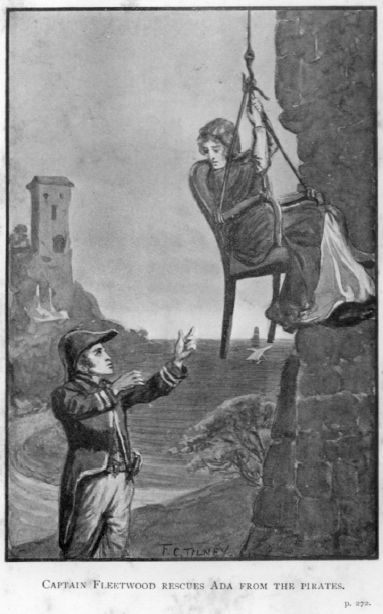
“All right, sir,” he whispered. “I thought it better to try the length of the rope and the strength of my chair, before we trusted Miss Garden in it. She is in capital heart, sir, and so is my new sister. Now, sir, if you will stand by the end, I’ll go up again to help her into the chair, and bear it off the wall. I can’t ask you to haul me up, sir.”
“No, no, jump in, my lad, and be careful, in Heaven’s name, that you secure Miss Garden properly,” said Fleetwood, pressing his hand; and he quickly hauled him up again to the window, and the chair once more appeared, with Ada seated in it, a shawl thrown round her, in true man-of-war fashion. Raby had taken care to have everything properly prepared.
“Now, sir, lower away gently, if you please,” he whispered, as he leaned out of the window; and Ada Garden safely descended into Fleetwood’s arms. A silent embrace was all he would allow himself, before he hauled up the chair to lower down Marianna, who accomplished the transit with the same speed as her mistress. Jack Raby did not immediately descend, but, hauling up the rope, he cast off the block, and then passed the rope over the bar, and descended by it.
“I won’t delay you a moment, Captain Fleetwood,” he said. “But I am determined the pirates shall not find out how we escaped, and, as there is a cliff close here, which overhangs the sea, I will, with your leave, heave the chair, and rope, and block, over it, and they will never discover them there; or if they do, they will think that we got over the cliffs.”
As Fleetwood considered the delay would not be of consequence, and that no harm could arise from allowing the midshipman to have his way, he gave him leave to do as he proposed, and in two minutes he returned, having accomplished his object.
“There, sir,” he said, laughing quietly. “If the pirates miss one of the chairs, they may look for it long enough before they find it or the rope, and in the mean time they will fancy English young ladies can jump forty feet to the ground without hurting themselves. When they try to open the door, too, they’ll think we are inside, for I barricadoed it with everything I could find, and there’ll be a pretty smash when they shove it open.”
“You have done admirably, and now take Marianna’s arm, and follow me,” said Fleetwood, leading the way with Ada.
When Ada Garden found herself once more by Fleetwood’s side, she returned her grateful thanks to Heaven for having thus restored her to liberty; for so strong was her confidence in her lover’s courage and judgment, that she felt as if all difficulty and danger were over, and that success must await them.
Fleetwood also uttered a silent thanksgiving to Heaven, and a prayer for protection during the still greater danger he knew they must encounter in their endeavour to get out of the harbour; but, of course, he did not tell her this. Neither spoke; they both were confident of the sentiments of each other’s heart, and Ada felt it would be useless at that moment to express her gratitude, when she hoped to prove it during the remainder of her life; and he in like manner knew that there would be no necessity to tell her of his love and joy at finding her, when his acts were giving her such convincing evidence of it. They walked on under the shadow of the wall, as noiselessly and rapidly as they could move, towards the commencement of the steep path leading down the ravine. In doing so they had to pass close to Nina’s tower. Fleetwood looked up; no light was seen streaming from the casement, nor was any one heard stirring within.
On they went, and, Fleetwood tenderly supporting Ada, they commenced descending the path. They had got about a quarter of the way down, when Fleetwood fancied he heard the sound of a distant footfall. Could it be the echo of their own feet? he thought, then made a sign to Raby to stop while they listened. There could be no mistake about it. Footsteps were rapidly approaching, and, on looking back, they saw, to their dismay, a dark figure on the cliff above them. Fleetwood drew back under the shadow of an overhanging rock, and he could feel Ada, who had also seen the figure, as she clung closer to his arm, tremble with alarm, which she in vain endeavoured to overcome. Marianna uttered a faint shriek, and was going to repeat it, when Jack Raby gave her a pinch, which effectually recalled her to her senses, and, in a whisper, he threatened to give her another if she made the slightest noise. A minute or two of the most intense anxiety passed away, which, under the circumstances, appeared nearly an hour, and no one appeared.
“If we emerge from where we are, we cannot escape being seen, should the person remain where he was,” replied Fleetwood. “It will be better to confront him boldly, and learn his intention in following us, than to allow him to go back and to give information of our attempt. I will leave you, Ada, in charge of Mr Raby, and will return instantly.”
“Oh, do not quit me!” exclaimed Ada. “I will go with you—indeed, I am not alarmed for myself; but I know not what may happen to you. They may kill you, Fleetwood—oh, do not go.”
“It is absolutely necessary that something should be done, dearest, and there is no greater danger to be feared in going than remaining,” answered Fleetwood. “Ada, I must force myself from you—it must be done.”
“You are right, Charles, I was weak. Go, and I will remain as you wish,” she whispered, relinquishing his arm, and he sprang up the path.
Jack did his best to comfort Ada, by assuring her that his captain could easily manage to thrash a dozen Greeks, and that he was not likely to suffer any harm from a single pirate, at all events. Every moment Ada expected to hear the noise of a struggle, a pistol-shot, or the clash of swords. She listened with breathless eagerness, trembling in every limb, and she would have followed her lover, had she not known that her so doing would be against his wish, and could be of no advantage to him, but might cause great harm. It appeared to her an age since he left her, and her anxiety became almost too great to be borne.
“Oh, Mr Raby, cannot you go up and see what has become of Captain Fleetwood? Some accident has happened to him, I am certain,” she whispered to the midshipman.
“I must obey orders, Miss Garden, and wait for the captain’s return,” was the answer, in the same low tone. “You need not be alarmed, I can assure you—he has not been gone two minutes.”
He had scarcely spoken when Ada’s quick ear caught the sound of footsteps, and she could scarcely restrain her cry of joy, as she sprang forward to meet him. He placed his arm tenderly round her to support her, as he led her on.
“It is very extraordinary,” he said; “I could find no one, though I searched the very spot where I had seen him standing. But, come on, dearest, we have time to reach the boat, and to get outside the harbour before the spy, if such he was, can send people to pursue us.”
“I am able to walk much faster,” said Ada, hastening her steps, “I dread any delay in this dreadful place.”
They had not, however, proceeded many paces, when, on turning one of the many angles of the winding path, a person, the same, they fancied, whom they had before seen, appeared suddenly before them, and laid a hand on Fleetwood’s arm.
“Stay, signor,” he said in a low, deep voice, speaking in the Italian language. “You are already suspected by one who knows not mercy, and if he were to discover your wild attempt to carry off that lady, your death would be the consequence. Return and abandon it; for ere you can get beyond the sound of the waves, as they dash on the cliffs below, you will be pursued and overtaken.”
“I know not who you are, signor,” said Fleetwood; “but, as I believe your warning is given in kindness, I thank you. To follow your advice is impossible, and I must beg you, as a favour, not to detain us—I need not ask you, I trust, not to betray us.”
“I feel sure that Signor Montifalcone will not do so,” exclaimed Ada, recognising at once the voice of the young Italian. “He will rather exert himself to assist us—I am not mistaken in his generosity.”
Paolo was silent a minute, when, releasing his grasp of Fleetwood’s arm, he sighed as if his heart would break, and took Ada’s hand. “Lady,” he said, in a tone of deep melancholy, “you sign my death-warrant; but it shall not prevent me from obeying your wishes. I will accompany you to your boat, if you have one prepared, and, when you have gone, I will endeavour to deceive those who attempt to follow you. Further, I know not how to aid you.”
“We are grateful to you for your promised aid,” said Fleetwood; “and now, lead on, we can ill afford further delay.”
“It is for the lady’s sake I act,” muttered Paolo, beginning to move onward down the path.
Ada overheard him. “It is because you are generous, and would preserve the lives of others, even though you risk your own,” she said, in a low tone, touching his arm. “But if there is danger in remaining here, come with us. You can be conveyed in safety to your native country, and can ascertain if your father yet lives.”
“What! and leave my unhappy sister to her fate?” said the young man, turning round his countenance towards her, which, even with the faint light afforded by the moon, she observed wore an expression of the deepest grief. “I have but one object to live for,—for her sake alone I consent to endure existence. Do not ask me to quit her.”
“Oh that she would have come too,” said Ada. “She might yet be saved.”
“She would not accompany you, lady,” answered Paolo. “Pirate though he is, Zappa is still her husband, and no power would now make her quit him. But I delay you, and increase the risk of discovery, already sufficiently great, by speaking. I will say no more, but that I pray, when in safety in your native land, you will not forget the unhappy exile whom once you knew, and who would gladly have died to serve you.”
He spoke as they walked on, and a few minutes more brought them to the mouth of the ravine, whence a full view of the moonlit bay lay before them.
The Sea Hawk and two misticos were at their anchors. No light appeared on board either of them, nor was there any one moving, that Fleetwood could discover, on their decks; nor was the slightest noise heard, except the low, gentle ripple of the untiring water on the sands; yet so smooth and glass-like was the sea, that every star in the heavens seemed reflected on its surface. He could distinguish, also, the dark boats drawn up on the beach; but he looked in vain for the one his friends were to secure, in which to make their escape.
“They have, with due caution, carefully concealed her,” he said to himself. “When we get more to the left, we shall doubtlessly see her.”
On descending to the sands, they turned, therefore, sharp round to the left under the cliffs, which, it must be remembered, was the direction of the spot agreed on where the boat was to be in readiness. At length they reached the black rock, alongside of which Fleetwood expected to find her, and, to his great satisfaction, he saw that she was there; and his friends directly after rose from her bottom, where they had concealed themselves while waiting for his coming.
“We were alarmed for your safety, Captain Fleetwood,” said Bowse, leaping out to meet them. “We waited so long for you; but everything is in readiness. If you will assist Miss Garden on board, I will take care of Marianna. But who is this stranger with you?”
“One to whom I owe much,” said Ada, stretching out her hand. “Farewell, Signor Montifalcone, may Heaven reward you for what you have done for me.”
“Farewell, lady, and may you never know the grief I am doomed to bear,” returned the Italian; and before Fleetwood, who would have thanked him, could speak, he had retired to a distance; and as they quickly embarked, and urged the boat from the shore, they could see him standing watching them, still as a marble statue.
Chapter Thirty.
“Thank Heaven, you are so far safe, dearest,” said Fleetwood, as he placed Ada in the stern sheets of the boat, by the side of Jack Raby, who, it was arranged, should steer, while he took the stroke oar, his companions pulling the others.
With heartfelt gratitude did Ada thank Heaven, for having thus far conducted them in safety through the perils which surrounded them, and implored protection for herself, and for the gallant men, her deliverers, through those they had still to encounter.
They had well employed the time spent in waiting, by carefully muffling the oars, so that they should make no noise as they worked in the rullocks, and it was now only necessary to take care to let the blades fall into the water, and to draw them out again with as little splash as possible.
Marianna sat opposite to her mistress; and if not the most delighted of the party at the success which had hitherto attended them, she, at all events, gave more vehement expression to her feelings; and Raby had to apply his former remedy to keep her quiet.
At a sign from Fleetwood, the boat was sent gliding off from the rock; but instead of at once steering out into the bay, she was kept close in shore, under the shadow of the cliffs: the blades of the oars just clearing the sand as they went along.
The boat was a very rough specimen of naval architecture, and wore they to have depended on her speed, the chance of escape would have been small indeed. She was built to pull six oars, with a high bow and stern, and though well suited to serve as a fishing-boat, or to live in the short seas of the Archipelago, was not intended to be used when rapid progress was important. The adventurers had, indeed, selected her, not on account of the qualities she possessed adapted for their purpose, but because she happened to be moored close into the shore, near the east side of the bay, and, what was very important, had her oars left on board her. Pietro, who was a good swimmer, had, it appeared, gone off with his knife in his mouth, and cutting her cable, towed her close enough in for the other two to step into her. They had then brought her round, with the same cautious silence, to where Fleetwood had found her.
The hearts of all beat quick with hope, not unmixed, however, with apprehension, as the boat glided along the shore close to the cliffs.
Fleetwood’s glance was roving watchfully round, to notice the first sign of their being discovered, and of any preparations made for their pursuit. The figure of the unhappy Paolo Montifalcone was the only one discernible, as he stood at the end of the rock, to catch a last glimpse of the faint outline of her on whom he had so devotedly set the affection of his ardent nature, without a prospect of return, and his figure soon faded away in the obscurity.
From the shore, the adventurers had now, they thought, less cause to fear; but they looked with suspicious eyes towards the brig, and the two misticos, on the decks of which, at least, one person ought to have been on the watch; but neither of them gave any signs of having life on board.
“If we had suspected the sort of watch there rascals keep, we should have had little difficulty in taking them by surprise,” thought Fleetwood. “We may profit by our knowledge on another occasion, but I am afraid they will not forget the lesson I hope we shall give them, to be more vigilant in future.”
Of course, it is difficult to describe the sensations which alternately filled Ada’s bosom, as the boat progressed round the harbour; hope, joy, gratitude, love, and fear, all were there; and those who would understand what they were, must either have been placed in a similar position, or must endeavour to fancy themselves so placed. At length the eastern point of the harbour was passed, and with the towering cliffs of the entrance rising above them on either side, the clear boundless sea appeared ahead. Jack Raby, with the natural impulse of his age, forgetting his own lessons to Marianna, was very nearly giving way to a shout of joy as he found the boat floating freely on the ocean he had learned to love and to confide in; but he recollected himself in time, and merely uttered a whispered “hurra,” which could not have been heard above the splash of the water on the rocks close above them.
“Port your helm, Raby, and let us shut out the bay as fast as we can,” whispered his captain. “We shall still keep under the shadow of the cliffs for a short distance, to avoid the risk of being seen from the eastern towers. That will do, steady.
“Keep up your courage, my sweet Ada, for a few minutes more,” he said, turning his eyes to her countenance, from which, indeed, his glance had never been absent longer than was necessary to watch for their safety. “We may now congratulate ourselves on having every chance of escape. In less than half an hour we shall fall in with the Ione’s boats, and then we may defy the whole nest of pirates to stop us.”
“I shall have no further fear when we have lost sight of that dreadful vessel, which looks even now like some slumbering monster about to awake and rush after us,” she answered, pointing to the Sea Hawk, which lay still open inside the harbour’s mouth.
She had scarcely uttered these words when a loud shout was heard, which seemed to proceed from some one on board her, and a musket was discharged at them. The shouting was repeated, and words were clearly distinguished.
“We are discovered,” exclaimed the Greek captain. “Pull, pull, as hard as we can, the watch on deck is calling on us to come into the harbour. He has evidently just woke up, and is yet uncertain what we are, though he suspects us. He threatens to fire the guns at us if we do not obey him, and that will have the effect, though we escape the shot, of waking up the rascals in all quarters, and we shall have a whole fleet of boats after us: stay, I will hail in return, and pretend we are fishermen.”
On this he stood boldly up in the boat, and cried out in Romaic, at the top of his voice—
“What fool is that on board the Sea Hawk, who has been sleeping on his watch these four hours past, and now makes so much noise, because others more industrious get up early in the morning to follow their avocations? We should have little fish to eat if we were to trust to you for the supply.”
“Who is it?” exclaimed the same voice. “Is it you, Balbo?”
“Yes, yes,” answered Captain Vassilato; “I should have thought you would have known my voice.”
“Who is it?” hailed another person, apparently on shore.
“Gerasimo Listi,” answered the watch on the Sea Hawk’s deck.
“No, no, the old fellow lies drunk at home!” exclaimed the second speaker. “Treachery, treachery. They are the spies endeavouring to escape.”
“It is hopeless to deceive them,” said Captain Vassilato, when he heard these words, which he translated to his companions as he resumed his seat and oar. “We must pull for our lives; we have a good start, and it may be some time before any boats’ crews can be collected to pursue us.”
It is needless to say with what energy all hands bent to their oars—concealment was of no further use, and they were able to put their whole strength into their strokes. There was no time to be lost. The brig was swinging with her broadside across the mouth of the harbour, and as soon as those on her deck could procure matches, they rushed to the guns, and discharged them in quick succession; and Ada could scarcely restrain a shriek of terror as she saw their bright flashes lighting up the mouth of the harbour—the sides and rigging of the vessel now crowded with people—and heard their loud report echoing among the cliffs, as also the rushing noise of the shot as they came flying by—some over their heads, some close astern, and others ahead of them; for though the pirates’ aim was very uncertain, yet, as from the narrow entrance of the bay, the only shot which could reach them must come between the cliffs, they could not go far distant from them. One or two, apparently, from the peculiar noise they made, hit the cliffs, and rebounded back into the bay. Marianna, whose fears had completely overcome her, crouched down at the bottom of the boat, where she thought she should be more secure; and Fleetwood entreated Ada in that respect to follow her example, desiring Jack Raby to place her as low down as possible, where a shot was less likely to strike the boat. Though she was unwilling to be more sheltered from danger than he was, yet she saw that her so doing would relieve him from some of his fear for her safety, and she complied with his wishes; reclining on some jackets and cloaks which Jack Raby spread out for her, she saw no more of what took place, though the noise of the firing soon ceasing told her that they had shut in the brig by the western cliffs.
“Remain where you are, dearest,” said Fleetwood, as she was about to rise. “We may still have some shot sent after us, when the boats, which will probably pursue us, get outside; and though, with the start we have, they are not likely to take good aim, a fatal one may come on board; and think, Ada, of how little use would be the risk we have run, if you were to be the victim. But do not be alarmed; no enemy has yet approached.”
I do not know if I have explained clearly the position of the boat: she was at this time about an eighth of a mile from the lofty cliffs which formed the western side of the bay, with her head to the west, going at the rate of between four and five knots an hour, which was the utmost speed with which, with all their exertions, they could urge her through the water. The cleft in the rock, as now the entrance of the harbour appeared to be, was seen over their starboard quarter, and in that direction their eyes were anxiously turned for the appearance of the boats they fully expected would follow them. A new danger also appeared from a quarter they had not expected, for along the summit of the cliffs, as seen against the bright blue sky, they could discern some figures running at full speed, and they were not left long in doubt as to their intentions. The persons halted, and the bright barrels of their guns gleamed in the moonlight, as they brought them to their shoulders and fired. Several balls flew by them, and one struck the gunnel of the boat, though, fortunately, no other damage was done. The pirates kept shouting out their threats of vengeance, and firing away, apparently to intimidate the fugitives, little understanding the character of the people with whom they had to deal.
Here, of course, Ada was exposed to as much danger as the rest; and though Fleetwood would have joyfully interposed his own person to preserve her, it was impossible for him to do so, and all he could do was to entreat her to remain down as much as possible under the seat, and to redouble his efforts at the oar.
“We shall soon be beyond the range of those fellows’ guns!” he exclaimed. “But ah, there’s a boat’s bow creeping out from between the rocks. We’ve a good start of her, however. Give way, gentlemen. We’ll lead her a long chase, and find her a warm reception at the end of it, I hope.”
“She’s not alone, though!” exclaimed Bowse, whose eyesight was remarkably keen. “There’s another close astern of her, and, by heaven, there’s another just rounding the point. We shall have enough of them to look after us, at all events.”
“It matters little how many, provided we keep ahead of the leading one,” said Captain Fleetwood, in a cheerful tone, not as much for the object of encouraging his rude companions, as for the sake of keeping up Ada’s spirits. “I don’t think any of them are likely to pull much faster than we do.”