"The Pirate of the Mediterranean" (continued 10)
Reading edition
Nina spoke with firmness and energy, as she said this, for she fancied that her arguments were so good, she could not fail to gain her object.
“Ah! have you been consulting with the English signora and her lover, that you plead their cause so well?” he exclaimed, with the bitter tone in which he often spoke. “Well, I will see to it, and now come to the fair lady’s palace, she will afford us lodging there, since ours is burnt down; which, Nina, it appears, troubles you but little. Know you not, girl, that I have there lost property to the value of many thousand piastres? That is alone enough to sour a man’s temper, till he can replace them, which, were I to follow your wishes, it would be long enough before I could do.”
“My mind was too much occupied with the object I have spoken to you about, to think of the loss, even though everything I possessed was destroyed,” she replied, quietly. “But I still felt thankful that I was preserved from the dreadful fate which would have been mine had I remained in the building; and if you also feel gratitude to Heaven for this, show it by granting life and liberty to the English captain and his friends. You accuse me of being influenced by them to plead their cause; but it is not they who influence me,—it is honour, justice, right, and oh! my husband, remember that their fate may soon be yours, and that if you show not mercy to them, you can expect none in return.”
“I know that, Nina, I expect none,” he answered, fiercely. “Were I to fall into the power of my enemies, they would tear me limb from limb, and mock my dying agonies with their laughter, ere they showed me mercy or gave me liberty. I do, Nina, as I expect to be done by; I hope for nothing else. But why do I stand prating here? My house is burnt to the ground, and my property destroyed, so we must go and crave shelter of the Signora Ada, for you and I have many things to do before I again close my eyes in sleep.”
When they arrived at the Stranger’s Tower, as the Greeks had called the building inhabited by Ada, they found that she and Marianna had already arrived there, and returned to their former quarters, according to Nina’s advice, as if nothing had happened to disturb them. She had, indeed, seen them safe lodged there before she sought her husband; and she now returned to them by his directions, to take some rest, which she much required, while he occupied the lower and still unfurnished chamber as a sort of council-hall, where he summoned Vlacco and some of his chief officers to consult what, under the present circumstances, it would be necessary for them to do.
As soon as old Vlacco and one or two others had arrived, he sent to have all the prisoners brought before him, that he might examine them respecting their object in venturing on his island, and their motive for leaving it. His visit to the Ione must be remembered, and that he there only learned that her captain had gone on a secret expedition, and he naturally concluded that he was accompanied by his own crew. His surprise was, therefore, very great, when Captain Vassilato, Bowse, and the Maltese, Pietro, were dragged rudely into his presence.
“What!” he muttered, as he saw the honest skipper. “Have my people again done their work so clumsily, that another vessel has floated to bear evidence against me? It must be he, and yet he looks so unconscious of having seen me before, that I must be deceived. There were five prisoners,” he remarked, aloud. “Where are the other two?”
“We cannot find them, chief,” was the answer. “We have looked in every direction, we have inquired of all, but no one has seen them or heard of them.”
“How is this?” exclaimed Zappa. “I left one of them, whom I knew to be no other than the captain of an English ship of war, sent here to watch the Sea Hawk, wounded and dying in old Listi’s boat, with the stranger lady and her attendant watching him, and as they, I hear, have already returned here, I suppose they would not have deserted him. Let them and the Lady Nina be summoned.”
In two minutes the two ladies and Marianna stood before him; but he neither rose nor showed them any courtesy.
“Can you inform me, signora, where Captain Fleetwood is to be found?” he exclaimed, with vehemence, addressing Miss Garden, in Italian. “Ah, you thought I was so blind as not to recognise him; you thought I did not observe the fond affection with which you bent over him as he lay wounded in the boat; indeed, you fancied that we keep so careless a watch in this island, that any strangers may come without our discovering them; but let that hope desert you for the future, and now answer me truly, madam.”
This was the first intimation that Ada had received that the disguise of Fleetwood had been seen through, and horror at what the consequences might be almost made her sink fainting on the ground; but by a strenuous effort, she recovered sufficiently to answer with apparent calmness—
“The person, whom you state to be Captain Fleetwood, was removed from the boat to the hut of a fisherman on the beach, as he was in no condition to be carried up here.”
“By whom—by whom was he removed?” asked the pirate, impatiently. “You could not have carried him.”
“By a man habited as a Maltese, and by your own surgeon, whom I had summoned to attend on him,” replied Ada, firmly.
“Why, that must be Salamonsi’s cottage,” remarked Zappa, turning to Vlacco. “Send down forthwith, and let the boy and Signor Paolo be brought up here; and mark you, if the English captain has recovered the use of his tongue, let him be conveyed here also—he shall answer for himself.” He said this in Romaic, so Ada did not understand the cruel order; but Nina did, and, with an imploring look, she stepped to his side, and besought him to revoke the command; but he roughly repulsed her, and, turning to the other three prisoners, he asked, in the lingua Franca, often used by him,—“By what right have you, who were hospitably entertained in this island, attempted to run off with persons whom you knew were my prisoners?”
On this the Maltese seaman, Pietro, stepped forward, and, with the volubility for which the islanders are celebrated, made the long statement which had been previously agreed on, finishing by stating that he and his two companions had been engaged by the lady to convey her on board an English ship, and that they had no reason to suppose they were injuring any one by so doing. As this was all said in Maltese, scarcely a word of which language Zappa understood, he was not a little puzzled, and was insisting on having it repeated in some more intelligible tongue, when Marianna, who was highly delighted with it, not the less so that she knew it contained scarcely a word of truth, volunteered to translate it into Italian, and immediately began with such little additions and touches of her own as she thought would increase the force and probability of the story.
“That will do,” said Zappa, who was not very easily imposed upon, as she was continuing her own commentaries on what had occurred; then turning to Captain Vassilato, “What defence have you to make?”
“As you do not understand my language, and I speak but little lingua Franca, I can say no more than my shipmate,” he replied between his teeth, in the language he mentioned.
“And you,” said Zappa, in the same patois, turning to Bowse. “What have you to say for yourself.”
Poor Bowse, who knew but little of any language except his mother-tongue, his accent undeniably betraying him whenever he did attempt to express himself, thought silence would be his best course, so shaking his head he pointed to his tongue and gave forth some inarticulate sounds, unlike any known dialect.
“You have spoken loud enough before, accursed spy,” exclaimed the pirate, in Italian, starting up, and menacing him with his dagger. “So you thought I did not know you either; you thought I should not remember the man with whom I once have crossed blades, even though I fancied he was food for the fish of the sea. Fools that you were to venture into the lion’s den; or, venturing in, to attempt to carry off his prey. But enough of this, your guilt is clear; you came as spies, and you shall meet their reward. Over the cliffs with the three; we will quickly send their companions after them.”
He said this in Italian, and then repeated it in Romaic.
Old Vlacco, who was now in his element, and delighted at the decision of his chief—indeed, he longed to propose that Ada and Marianna should be made to bear them company—seized the unfortunate men, and was dragging them off with the aid of others of the pirates, when Nina flew to the door to bar their exit.
“No, this must not, this shall not be!” she exclaimed, in a voice hoarse and trembling with agitation, so unlike her own usual sweet tone. “Wretch, pirate, robber, murderer! You have crimes enough already on your head, without adding others of yet blacker dye, to drag me and all who witness them down to destruction with yourself. If you murder them, you murder me, for I will not live to be the wife of a wretch so accursed; and, think you that yon fair girl would yield to your wishes—would, forsooth, become your bride, even were I gone, and her brave lover also dead, and no one even on earth to protect her? I tell you, monster, no! You have seen, that meek and delicate as she appears, how much she can endure without complaining; you have yet to learn that she has an unconquerable spirit, and a reliance on the God of Heaven, which would enable her to defend herself from you. Now, do your worst! Murder me if you will. It will but be a fair return for what I have lost for you. Murder those men. Insist on your followers executing your vile commands, and, from that moment, you lose my love, valueless it may be, and you lose all hopes of gaining that of any other human creature whose love is worth the winning, and who knows of your misdeeds; and you bring down the sure and rapid vengeance of an outraged Heaven on your defenceless head.”
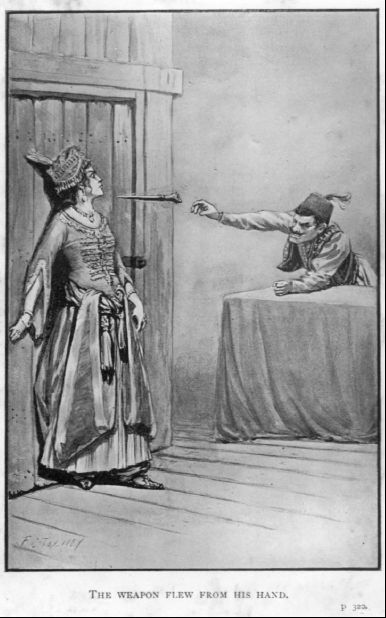
The pirate at first heard her thus boldly speak with astonishment, and then with rage, which increased till it passed his control. His hand had been clutching his dagger; and, as she uttered these last words, almost, it is to be hoped, before he himself was aware of what he was about, he hurled it with terrific violence at her, uttering a howl like that of a tiger. The weapon flew from his hand; it wounded her delicate neck, and stuck quivering in the rough planking of the door. She neither screamed nor sank to the ground, but stood, as before, unmoved as a marble statue, though her cheek blanched to a yet more pallid hue than before, while the red stream issued from the wound, and ran down her bosom. Ada sprang forward to support her, but she waved her off.
“Stay,” she said, “I must yet speak again. That unmanly blow has done more than pierce the frail body, it has cut asunder ties which I thought would have endured till life became extinct; it has unriveted links which I believed would have survived, in strength and beauty, the decay even of the cold grave; but I have been taught this night to abhor the false idol I once worshipped so devotedly; and now I shall welcome death, come when it may, as my only release from misery. Ah! that wound would have been less unkind had it ended at once the bitter mockery of life!”
Even the callous pirate, as he saw the blood flowing from the pure neck which had been so often bent in fondness over him, felt a pang of regret, and a dread of the consequences, not unmixed with admiration of a spirit so determined as she exhibited.
“Pardon me, Nina!” he exclaimed, springing towards her. “I knew not what I was about. I would not injure you, girl, for worlds! Say you forgive me—say you are not hurt, and I will do all you desire with regard to these men.”
“The wound is but a scratch, as you may see,” she answered, calmly, keeping him off with her hands, and still standing before the door. “That will quickly heal. My forgiveness can be but of little value to you, but you have it, and my petition is, that you do not injure these men.”
“You have preserved their lives for this night, at all events; but I cannot let them go free to betray me and my followers to our enemies,” he answered. “Vlacco, there are, I think, some chambers beneath this tower, and formerly used as dungeons, which may again serve the purpose when cleared out of rubbish. They will not be able easily to escape from thence; and, meantime, place a strong guard upon them in the basement story, and see that they hold communication with no one.”
The old pirate, with an angry look, showed the disappointment he felt at not being allowed to dispense summary justice to the prisoners, signified to his chief that his orders should be strictly obeyed; and, just as matters had been brought into this state, the messenger, who had been sent to bring up the prisoners and Signor Paolo, returned with the announcement that none of them were to be found. The old fisherman accompanied them, with great dismay in his looks, asserting that he had nothing at all to do with the matter. He had but one instant returned to his cottage, after having assisted in the endeavours to extinguish the fire; he found the door open, and some one had apparently been placed on the mats, which served as his bed, for there was some blood on them, and some pieces of linen and lint lying about, and that was all he knew. He had not spoken to, nor seen Signor Paolo that night. Zappa’s anger was very great at hearing this, and he was very nearly revoking the reprieve he had granted to the other prisoners. He believed that treachery had been practised, though, except Paolo and Nina, he knew not whom to suspect; and, while she denied all knowledge of the event, her brother was nowhere to be found; so, weary as he was, he set off with Vlacco and his officers to investigate the matter at the bay.
Chapter Thirty Four.
Left at liberty, Nina and Ada returned to the upper chamber of the tower, where the latter entreated the unhappy Italian girl to allow her to dress the wound in her shoulder, which was far deeper and more serious than she had acknowledged to Zappa; but she refused all assistance.
“No,” she said; “no hand but mine shall tend the wound which he has given; and it matters but little, for I feel that the clouds of my destiny are gathering over me, and that very soon the storm will burst to overwhelm me.”
But her will was more powerful than her frame, and as she spoke she sank down on the divan, and would have fallen to the ground, had not Ada and Marianna ran to support her. Overcome with agitation and loss of blood, she had fainted, and taking advantage of the opportunity, they placed her on a couch, and while they applied restoratives, they bathed the wound, and tried to staunch the blood. She gave signs at length of life; but hers was no ordinary faint, and for hours did she continue in that state, wavering on the verge of death. As Ada herself, fevered and weary, sat by the side of her friend, she felt almost equally overcome with alarm and anxiety for the fate of her lover. What could have become of him? Had Paolo proved treacherous, and, afraid of his recovery, spirited him away, and cast him over the cliffs? or was she wronging the young Italian, and had he not, mistrusting the mercy of the pirate chief, concealed him in some secret place till his anger had worn off? This she owned to herself was the most probable cause; but love, even on ordinary occasions, is full of doubt and fears, much more so then had she reason for dread under the circumstances in which he was placed. While she believed Zappa was ignorant of who he was, she trusted he was in no other danger than that resulting from his wound; but now that he was discovered, after the dreadful exhibition she had witnessed of the pirate’s temper, she trembled at what might be his fate. Why had she quitted him? she thought. Why had she not boldly avowed who he was, and her love for him, and dared the pirate to injure him? She had seen the successful effects Nina had produced by such behaviour on the daring outlaw—why had she not acted in the same manner? She bitterly accused herself of having deserted him, of having trusted him to strangers, and, more than all, of being the cause of his death. This thought gave her the most poignant grief, and she prayed that if Heaven had ordained that he must thus die, she might be spared the misery of knowing it. Daylight surprised her still sitting by the couch whereon lay the yet more unhappy Nina.
“And yet, compared to that poor girl’s fate, mine is blessed indeed,” she thought, as she, watched those pallid features, on which an expression of acute pain still rested. “She staked all for love, and has found the idol she madly worshipped turned into a demon, who she feels will destroy her. She, too, has an accusing conscience to keep happiness at a distance. She remembers that she burst asunder the bonds of duty, that she caused the death of a fond parent; while I, through Heaven’s mercy, have never been subject to the temptation to create for myself a retrospect so dreadful.”
It would be well, indeed, if all in a position likely to read these pages would remember, as did Ada Garden, when they are subjected to misfortune or suffering, that there are thousands around them in a far, far worse condition, deprived of all that can make life of value, without hope in this world or the next, and men they would never dare to arraign the dispensation of Providence, by which they receive the infliction from which they suffer, and would feel that even thus they are blessed above their fellows. Poor Ada saw that Marianna still slept, and, fearful lest Nina should require assistance, she was herself afraid of retiring to rest, though weariness made her head fall frequently on her bosom. At length she was aroused by a gentle knock at the door, and little Mila entered the room. She was evidently full of something which she wished to communicate, and told a long story, not a word of which Ada could understand. So eager had she been, that she did not perceive the condition to which Nina was reduced, believing that she was still asleep from simple fatigue, but her eye falling on her, she burst into loud lamentations of grief, which very nearly awoke her from the lethargy into which she had fallen. It was the means, however, of awaking Marianna, by whose aid she was able to make the little girl comprehend the importance of seeking out Paolo, and bringing him to attend on his sister. She was absent nearly two hours, but at length returned, accompanied by the Italian. Eager as Ada was to gain tidings of Fleetwood, she forbore to ask him any questions till he had recovered from the state of agitation into which he was thrown by seeing the condition of his unhappy sister.
“You need not tell me who has done this deed,” he muttered, in a hoarse voice, as he bent over her. “I knew it would come to this—I knew, when weary of her, he would cast her aside as a child its broken toy, or would thus destroy her in his mad passion. Yet it would have been kinder had he struck deeper, and thus ended her misery with a blow. I have remained near her—I have watched over her, ill-treated and despised as I have been,—that, when this should be her fate, though I could not shield her from it, I might yet avenge her death. Yes, my sweet Nina, indifferent as you may deem me, I love you deeply.”
“But, Signor Paolo,” said Ada, not knowing how long he might continue in this strain, “your sister is still alive, and I trust that by the aid of your skill, her wound may neither be mortal nor of much consequence.”
“Not mortal, lady,” he said, bitterly; “and yet, I tell you, it would have killed her had it but scratched the skin. It is the spirit with which that dagger was cast will destroy her far quicker than the wound.”
Ada now entreated him to examine into his sister’s condition; and at length, grown more calm, he set skilfully about his office, and he confessed that, if fever did not set in, the wound was of slight importance.
When he was at liberty, Ada at last asked him to give her tidings of Fleetwood; but he denied all knowledge of him, saying, that he had left him, with Raby watching him, at the fisherman’s hut, and that on his return, both were gone, and that he could nowhere discover them.
Mila, now having an interpreter, came forward with her version of the story. She said she had heard that their chief had, on quitting the tower, come down to the bay in a state of passion, in which he had never before been seen, at the non-appearance of the two other prisoners, whom he vowed he would execute the moment they were discovered; that he had caused diligent search to be made for them in every direction, with the same want of success, till, at last a small boat belonging to the Zoe was found to be missing, in which it was, consequently, supposed they had escaped.
“Thank Heaven!” ejaculated Ada, with a gleam of joy on her countenance, which showed how much her heart was relieved. “Oh, Signor Paolo, you know not how grateful I am to you for your generous assistance in the matter.”
“Do not thank me, lady, nor believe that I knew of, or had any hand in the escape of your countrymen, if indeed they have escaped, of which I would entreat you not to be too sanguine,” he replied; but, seeing the reaction his words were producing, he added, “and yet, remember, I have no reason to suppose that they are not in a place of safety. More I cannot say—and I beseech you not to ask me.”
“But I have not told you all,” interrupted little Mila, who guessed that he was no longer translating what she had said. “The moment the chief found that the boat was gone, he ordered as many men as she can carry to go on board the Zoe, and he himself accompanied them. She immediately set sail in pursuit, and they say that there is no doubt of the little boat being overtaken; and that even were he to meet the larger boats which made the attack on the island, the mistico will, without doubt, sink them all, and destroy everybody in them.”
Paolo translated to Ada what Mila said, and the account again renewed her fears for Fleetwood’s safety, though still she did not allow hope to abandon her.
It may seem that the Italian would have acted a more judicious part, had he not given the latter information; but he was unhappily himself influenced by two motives; the one right, and good, and generous—the spontaneous result of his better nature; the other arising from his yielding to temptation, which was selfish, mad, and wicked. The first prompted him to run every personal risk to save his rival from the pirate’s anger; the other made him wish for his death, and eager to deprive him of the love of the fair English girl, whom, he still fancied he might save from Zappa’s power, and win her for himself.
For the present, Paolo had a holy and absorbing employment for his mind, in tending his unhappy sister, who, under his judicious care, recovered, sooner than Ada had expected, from the effect of her wound, though she saw, too truly, that her words were verified, and that the weapon had struck deeper than the eye could reach.
Ada was now confined completely to the upper room of the tower, both because she would not quit her friend, and that she might avoid any risk of encountering Zappa, who had taken up his abode in the lower part of it. Paolo was her only means of knowing what was going forward in the world without, and she felt an unwillingness to hold more communication with him than was absolutely necessary; indeed, nothing he said could dispel her fears.
The Zoe, it appeared, had been out all day; but an ominous silence had been kept as to the result of her expedition. Some said she had overtaken the boat, and brought back the prisoners; others, that the pirate had, in his rage, ordered the guns to be pointed down on her, and sunk her, with them on board; while, again, some asserted that the prisoners had not escaped from the island at all, and that they were concealed somewhere in it.
This conflicting evidence was little calculated to alleviate her anxiety; but her heart was fresh and young—her health and spirits were unbroken, and the air which was wafted through her casement was bright and pure, and she still hoped on for the best. Meantime the pirates were not idle; and she observed from her window, that they were engaged all day long in strengthening and improving the fortification of the castle, as well as those on the other side of the harbour. They threw up embankments, also, across the neck of land which joined the rock on which the castle stood, to the right of the island, and planted guns to defend the approach to it, as also a whole line along the cliff, which overlooked the entrance to the harbour.
Provisions of all sorts were got in from every part of the island, and huts were erected, in which to store them; for the men, themselves accustomed from their youth to the roughest life, cared not for shelter, so that there was little chance of their being compelled, by famine, to yield.
Nothing, indeed, was neglected, which might enable them to defend their stronghold against any force sent against it.
The Sea Hawk was also carefully refitted, and the two misticoes made ready for defence or flight.
The Zoe was again sent out to reconnoitre. She had been absent for two days, and the pirate began to be alarmed for her safety, and to argue that the enemy were probably approaching, and that she had fallen into her hands. All was, consequently, activity and excitement. The crew of the Sea Hawk went on board to man her, and those of the islanders destined to garrison the castle hurried up there with their arms ready for action. At length, a sail was discerned approaching the island, and she was soon pronounced to be the Zoe. Nearer and nearer she drew to the land, till there was no doubt of her identity, and as she entered the harbour, she was warmly greeted by those on shore, who hurried down to learn the news she brought. Her crew reported that they had visited the island when the English brig-of-war had last been seen, but she was not there, nor could they gain any tidings of her; but that they had, on the following day, when standing to the southward, made out three sails, which, from the squareness of their yards, they conjectured to be men-of-war, and that they were standing on a bowline to the eastward, with the wind at north, but that they deemed it imprudent to approach nearer to ascertain further particulars.
This information prevented Zappa from taking a cruise in the Sea Hawk, as he had been intending, both to gain further intelligence of the enemy, and to pick up a few prizes to satisfy the impatience of his people, who began to murmur at the length of time which had passed since they had been engaged in what they considered useful activity, as well as to replace the property he had lost by the burning of his tower.
Ada had not neglected to inquire for the prisoners who had so severely suffered in her cause, and, though not allowed to communicate with them, she learned from Paolo that they were not treated with any unusual severity, farther than being confined in a chamber under ground, where very little light or air could penetrate, and that he believed their lives were in no danger.
Nina never spoke of the dreadful night when she had first felt the fierceness of her husband’s anger; but her sunken eye, her hollow voice, and faded cheek, showed what the effect had been, though, when she met him, she tried to smile as of yore, and to attempt to win him to his better mood.
His followers, however, remarked that an ominous change had come over him, and that his mind at times seemed wavering on its throne.
The unhappy Paolo still nourished in silence his love for Ada, and day by day he allowed it to increase, till he could scarcely conceal his feelings in her presence.
It was night, and he stood where he had spent many an hour, on the cliff beneath her window. No moon was in the sky, and the stars were concealed by a canopy of clouds which hung over the sea, and the wind moaned amid the rocks and ruined buildings with a melancholy tone well consonant to his feelings.
Suddenly the perfect silence which had existed was broken by loud, terrific cries; the roar of cannon—the rattle of musketry—the cheers, and shrieks, and fierce imprecations of men striving in deadly combat; where had lately reigned silence and darkness, all was now the wildest confusion and uproar, and lighted up with the blaze of the death-dealing musketry.
The pirate rushed by, and entered Ada’s tower, giving orders to his followers, the meaning of which no sooner did Paolo understand, than exclaiming, “Now is the time, or she is lost to me for ever,” he hurried after him.
Chapter Thirty Five.
We left the Ione, at the dawn of a fine morning, beating up towards a small boat, which had been observed running to the westward, while a mistico was seen off the island, directly before the wind, apparently in chase of her. The boat, it was judged, was about half way between the two vessels; but then the Ione was nearly dead to leeward, while the mistico was directly to windward, though it was a question how far she would venture to chase the boat, or whether she would attempt to carry her off within range of the brig’s guns.
As long as the mistico could keep well to windward, and out of gun-shot, from the closeness with which she could lay to the wind, and her fast sailing, she might carry off her prey, if such was her object, even before the eyes of those on board the English ship, without their being able to employ any means to prevent her so doing.
“Ah, the rascals know what they are about,” said the master, as he watched the Greek vessel through his glass. “She is one of those piratical craft belonging to the nest of scoundrels on the island there, depend upon it; and they were trying to get hold of the boat, or to run her down, which they are just as likely to do as not, and then they’ll be off again in the wind’s eye, like a shot, before we can get up to them, and snug inside their rocks.”
“I suspect you are right, master,” said Saltwell. “And I cannot help thinking, also, that the boat has some of our friends on board. Would to Heaven the breeze would veer a few more points to the southward, and enable us to lay up to her before the mistico reaches her.”
“I don’t see what more we can do to go along faster,” said the master. “Our canvas never stood better, nor did the brig ever make more way through the water with the same wind.”
“The mistico draws very fast on the boat, and, by Jove, the villains are firing at her,” exclaimed Saltwell, who had been again eagerly watching the chase through his glass. “Still she bravely holds her own. Oh, there’s no doubt of her having our friends on board. See that the guns are ready, and cover her as soon as we get near enough; but we must take care not to hit the boat instead of the mistico.”
The boat was now about two miles off, and the mistico threes. The former had only a sort of lug set; and, as well as could be seen at that distance, there was but the one person on board, who steered. If there were any others, they had wisely stowed themselves away at the bottom of the boat, to be more out of the reach of the enemy’s shot. The breeze, though fresh, was not too strong to permit of her carrying her whole sail, and she flew rapidly before it; but the mistico went still faster, and, as Bill Hawkins, the captain of the fore-top, observed—
“The little one looks for all the world like a small bird trying to escape from a hawk just ready to pounce down on it, and I hope we shall just come in to play the big eagle, and save her out of its claws.”
“She’s the very same craft as we chased into harbour this blessed night, I shouldn’t wonder,” remarked Tom Derrick, who had been one of the cutter’s crew. “It would be a real pleasure to get hold of her, to string up every one of the villains at the yard-arm, for wounding poor Mr Linton; I should be sorry, indeed, if he was to lose the number of his mess.”
“So should I, old ship, and if ever we get an opportunity, won’t we just pay off the murdering rascals for what they have done,” said Hawkins. “My eyes, look there, how the big one is peppering the little chap; one would think she hadn’t a whole plank left in her, and yet she stands on as bravely as if there warn’t such a thing as a round-shot within a hundred miles of her.”
Such was truly the case; the shot from the long guns of the mistico must have flown close over her, and on either side; and, probably, several had gone through her sail, but seemingly none had touched her hull. The Ione had now opened the mistico free of the boat to the northward.
“Stand by with the foremost starboard gun,” cried Mr Saltwell, as they did so. This was a long nine of brass, while the other guns were carronades. “Fire!”
The gunner, who considered himself a first-rate marksman, pointed the gun, and the shot going well clear of the boat, struck the mistico on the quarter, and those who were watching her with their glasses declared that they could see the splinters flying from her. Still, so eager was she in the pursuit, that she would not haul her wind, seemingly determined not to do so till she had sunk the chase. This there appeared every chance that she would do, for she had now got awfully near her, and it was surprising that her small-arm men had not contrived to pick off the helmsman, when the boat would, of course, have broached to, and have been her own. Mr Saltwell again gave the order to fire as fast as the gun could be loaded and run out, but the skill of Mr Black did not shine so brilliantly as at the first attempt he made, though they went near enough to show the pirates what they were to expect if they persisted in their attempt.
“Have the larboard gun ready there. Hands about ship,” cried the first lieutenant.
Bound came the brig, and the gun was let fly. The shot struck the mistico amidships, tearing away her gunnel, and creating the greatest confusion on board, if not destruction of life. She found that, in her eagerness, she had gone rather too far, and putting down her helm, she gave a last revengeful broadside at her tiny chase, as she hauled her wind, and away she stood on a bowline towards the island.
No sooner had she done so, than up sprung a figure in the stern sheets of the boat; and waving a cap round in his hand, seemed to be giving a cheer of derision. The incautious action was returned by the pirates with a discharge of their swivel guns, and a shower of musketry, and he dropped into the bottom of the boat.
“Poor fellow! the villains have killed him,” exclaimed Mr Saltwell.
“Yes, sir; and I’m sorry to say I think from the figure it is Jack Raby. It is just the thing he would do, too,” said Tompion, whose glass had been fixed on the boat at the time. “No—hurrah! the boat is standing on steadily with some one at the helm.”
“Thank Heaven! so she is,” exclaimed Saltwell. “Be ready there to heave the ship to, to let the boat come alongside.”
In five minutes more the brig was close up to the boat, and, to the surprise of all, the person in the stern sheets, who had been so long visible, was found to be a stuffed figure, covered with a capote, and a Greek cap on the top of it, while the head of Jack Raby was seen cautiously peering above the gunnel. He very soon brought the boat alongside, when a couple of hands jumped in to assist him.
“What, Raby, my good fellow, who have you there?” exclaimed the master, who was standing at the gangway with several of the midshipmen, eager to welcome their messmate.
“I am sorry to say it is the captain, who is very badly hurt; but I was glad to get him off at any rate, for we’ve had a narrow escape of our lives,” replied Raby, from the boat.
This announcement was received with an expression of grief from all on board. Saltwell, on hearing it, sprang to the gangway, to superintend the transfer of the captain to the deck, which was managed by lowering his own cot into the boat, and hoisting him up in it. He was somewhat revived, though he was scarcely sensible of what was occurring; and when he was carried below, all waited anxiously to hear the surgeon’s report. In this anxiety about getting the captain on board, the mistico was for the time entirely forgotten; and when at last Saltwell thought of her, and ordered the foretop-sail to be again filled in chase, she had got so far to windward as to be again almost out of gun-shot. A few guns were fired after her, but the shot did not succeed in cutting away any of her spars or rigging, and she drew so fast ahead, that it was seen to be useless following her further.
The brig’s helm was accordingly put up, and she stood away to the southward, towing after her Raby’s boat, which was kept in case she should be required for a future occasion.
Everybody now crowded round Jack Raby, to learn from him all the events which had taken place; but Mr Saltwell summoned him, and made him go circumstantially over them to him, and he afterwards had to repeat them to all his messmates, and to the surgeon and purser, who had not heard them.
As the reader is already well acquainted with most of them, I need only commence when he began his account of his successful escape from the bay, in which it appeared that he was assisted by no other person than Paolo Montifalcone.
“You must know,” he said, “that while the young Italian doctor was dressing the wounds, a fire broke out on the hill, above the bay, and the whole population rushed off to see the fire. No sooner was the coast clear, than Paolo, as they called him, said to me—
“‘Now would be your time to escape, if you had anybody with you to manage a boat.’
“Of course, I told him that I could do that perfectly well by myself.
“‘Well then,’ he replied, ‘Hasten down to the beach, you will there find a small boat which we passed on our way here. She has a sail in her, and oars, and if you are quick about it, you may get out of the harbour and join your friends before you are missed; and if you remain, you will be knocked on the head and thrown over the cliff, to a certainty.’
“‘You don’t mean to say that you expect me to run away and leave my captain to die hereby himself,’ I exclaimed, ready to knock him down, for I saw that he was in earnest in his proposal, though the idea had only just occurred to him. ‘A pretty blackguard I shall be, indeed.’
“‘But I tell you he cannot live, and you will be sacrificed if you remain,’ he argued.
“‘I tell you what it is, Signor Paolo,’ I replied; ‘a midshipman’s life is not reckoned of much value at the best, and I am not going to do a dirty action to save mine, I can tell you. I’m much obliged to you for what you have done, and for your good intentions; but if the captain is to die, why it will be a consolation to him to die under the British flag, on board his own ship, and if you will lend me a hand to carry him down to the boat, why I can just as easy escape with him on board as by myself. I’ll trouble you also for some of your physic, and some lint and bandages, to doctor him with, and I hope he may yet do well.’
“The Italian was silent for a few moments, when a sudden thought seemed to strike him, and he replied that he would do as I wished, though he warned me of the risk to which I was exposing the captain’s life by so doing; but as he had just told me he would die on shore, I did not listen to him—in fact, I had no great confidence in the honesty of Signor Paolo. There was something in his eye, as he looked at the captain, which I did not like, and besides, I should like to know how any respectable man came to be herding with such a set of cut-throat rascals. I accordingly went outside the hut, to see how the coast lay, and I found that all was silent round us, for every man, woman, and child had gone up to the fire; and had it not been for the glare of the conflagration, the night would have been pitchy dark; so, lifting the captain up in a cloak on which he had been laid, Paolo taking the head and I the feet, we bore him, as well as we were able, down to the boat, though I was afraid every moment of letting him fall, and hurting him; indeed, nothing but the anxiety I felt would have enabled me to succeed. At length we reached the boat, and placing the captain at the bottom, I again thanked the Italian for the service he had rendered us; indeed, after all, I was afraid I was wronging him by my suspicions. Then, with a lighter heart than I had felt for some hours, I got him to assist me in shoving the boat off the beach, and with the impetus he had given her I let her drift out into the harbour. I then, as silently as I could, paddled round by the west shore, keeping clear of the brig and the two misticoes, for the one which chased us had just come in; but I had not much fear of any of them, for I knew that the few hands left on board them would be looking up at the fire, and would not observe me: though, had any one turned, they might have done so, for the bright glare from the flames fell on the boat, and would have showed her distinctly, even right across the bay. Anxious as I was to get out of the harbour, I was afraid of pulling hard, lest any one should hear the splash of the oars; and so near was I to the vessels, that every instant I expected that the alarm would be given, and that a shot would be sent right into the boat. Fortunately, no one saw me, and it was indeed a pleasant moment to me, when finding the chain lowered, I rounded the west side of the harbour, and pulled fairly out to sea. I had not hitherto been perceived; but still it was necessary to be very cautious, for, of course, I thought the pirates would be keeping a lookout, lest any of our boats might again attempt to approach the harbour, so I pulled on as hard as I could, for I no longer feared making a noise, till my arms ached so much that I could pull no longer. I then laid in my oars, and though I fancied I could still hear the voice of the people on shore, I was so far to westward that I did not think the light would be reflected on the sail, even were I to set it. I therefore stepped the mast, not without some difficulty—fortunately, the sea was smooth, or I could not have done it at all—and got the sail ready for hoisting. Before doing so, I stooped down to examine how the captain was going on, and tried to place him in a somewhat more comfortable position. His heart seemed to beat regularly, and though he was still unconscious, from the wound in his head, he did not seem to have any fever about him. This raised my spirits, and I began to hope for the best. I did not much like to give him any of Signor Paolo’s doctor stuff, for at the best I have not much faith in it, and I have heard that those Italian chaps are much given to poisonous practices, so I hove it overboard, to be out of the way, and then hoisted my sail, and went aft to the helm. The breeze was still from the eastward, and I thought by keeping dead before it, I should make the island, where I expected to find you brought up. I considered that the boat was going about three knots an hour through the water; and when I had been out, as I calculated, about that time, I heard three guns fired, somewhere from the island, or near it. This did not give me any concern, and I steered steadily on, wishing for daylight, that I might see the island or you, in case you were off here, till at last, just as it came, and I was looking astern to see it, the first streaks had appeared in the sky, I beheld, to my dismay, a sail, which I was certain must be one of the pirate misticoes, running right down for me. Well, thought I to myself, it’s all up with the captain and me; but never say die, while there’s a shot in the locker, so I held on my course. It was not long, however, before my eyes fell on your topsails, rising out of the sea, and glad enough I was, you may be sure, when you made sail and stood towards me, for then I knew that I was seen. The rascally mistico was overhauling me fast, though, and as I feared she would get me within range of her guns before you could reach me, I thought I would give them something to shoot at instead of my head, so I rigged up a figure with a capote and cap, which I found in the boat, and stuck it up in the stern, and there fitting some lines on to the tiller, I made a berth for myself at the bottom of the boat to stow myself away in, as soon as they began to fire. It’s lucky I did so, for if I had had nine lives, like a cat, I should have lost them all; and what would have been worse, the captain would have been retaken. My eyes, how the blackguards peppered at me; but you know all about that, and now, to my mind, the sooner we set to work to pay them off, and to get Miss Garden out of their hands, the better.”
This account was given by Jack Raby in his berth to his messmates, that narrated to the first lieutenant was more concise, without his own remarks on the subjects; for instance, he left out how often he had kissed Marianna—and how often he had tried to learn Romaic of little Mila, and made love on the strength of it—though, to his messmates, he enlarged much on these points, and hinted that he had completely won the heart of the old pirate’s granddaughter, whom he described as a perfect angel in a red cap.
It was with almost a cheer of joy, and many a sincere thanksgiving to Heaven, and a glistening of many a manly eye, that, some days afterwards, the news flew along the decks that the surgeon had positively declared that the captain was out of danger, and would soon again be fit for duty.
Mr Linton had, notwithstanding his own prognostications, very much improved; and, though still confined to his berth, there was every probability of his soon recovering.
The Ypsilante had in the mean time been dispatched to summon any British ships she could meet, to the assistance of Captain Fleetwood; who, to strengthen his claim for their cooperation—for, as a junior officer, of course he could not order them to come to him—sent by her an account of the atrocities committed by the Sea Hawk; and a statement that an English lady and her attendant were held in durance vile by the pirates, which he justly calculated would excite all the chivalric feelings of his brother-captains, for which the British navy are so justly celebrated.
He, meantime, cruised in the neighbourhood of the island, in the hope, should she attempt to make her escape, of falling in with and capturing the Sea Hawk.
Chapter Thirty Six.
Captain Fleetwood once more trod the deck of the Ione; and though his cheek was pale, and his step had not regained its usual firmness, nor his voice its strength, his health was almost re-established, and grief, more than any other cause, prevented him from entirely recovering. Linton had also returned to his duty, and had produced several poetical effusions on the subject of the fate he had anticipated for himself, productions which he threatened to inflict on his brother-officers; but, as they earnestly entreated him to keep them fresh for those who could better appreciate them, he locked the papers up again in his desk—the purser, however, who did not intend to pay him a compliment at the expense of the rest, assuring him that it would be like casting pearls before swine.
The officers had just come up on deck from breakfast, and the captain was pacing the poop with his first-lieutenant by his side, the sea was smooth, with a light air from the westward, and the brig, under her topsails, was standing to the northward—in which direction lay the pirates’ island, appearing in the distant horizon like a blue hillock rising out of the water.
“Sail, ho!” was the welcome sound which reached the deck from the mast-head.
The usual question of “Where away?” was put by Mr Saltwell, in return.
“On the larboard quarter, sir,” was the answer.
“What does she look like?”
“A ship right before the wind, sir.”
“I trust she is a friend come to our assistance,” said Captain Fleetwood. “We’ll stand down to meet her. Put the ship about, Mr Saltwell.”
The brig having tacked, now stood under the same easy sail as before, to the southward, so as to cut off the stranger; a bright look-out being still kept astern, lest the Sea Hawk, or either of her tenders, should appear on the northern board.
It may easily be supposed how anxiously Captain Fleetwood had been expecting the arrival of some other cruiser to assist him in making the attack he contemplated on the island. Had he consulted his own inclinations, he would, as soon as he was able to grasp his sword, have attempted the exploit with his own ship’s company, whom he well knew would be ready to follow him; but he was unwilling to risk the lives of his gallant fellows on so very hazardous an expedition—especially after the sad lesson he had lately experienced—and the suffering, if not the destruction, to which he had subjected his brave companions.
Were he to make the attack and fail, he also thought the result would be too dreadful to contemplate; so he curbed his impatience as he was best able, till he could collect a sufficient force to enable him to undertake it with a certainty of success. He tried also to console himself with the hopes that the Signora Nina and her brother would protect Ada to the utmost of their power. Raby, wisely, had not told him his suspicions of Paolo—and, of course, he was ignorant of the events which had occurred in the island after he had been carried off, or he would certainly have been even less at his ease than he endeavoured to make himself.
“What do you make her out to be?” he inquired of Mr Saltwell, who had just descended from aloft, with his spy-glass over his shoulder.
“English, I think, sir. I could see to the head of her courses, and, I should not be surprised, from the look of her canvas, that she is the Vesta frigate, which was to be cruising somewhere off the Gulf of Egina.”
“I trust she may be. Captain Grantham is an old friend of mine, and I know that if he received my letter he would come, if he possibly could; and welcome he will be; for, though the Vesta is but an eight-and-twenty, we may do without further aid.”
Sail after sail of the stranger rose out of the blue water, till a towering mass of snow-white canvas floated above it, shining brilliantly in the rays of the forenoon sun, which fell directly on it. At last, the dark hull and bow ports, and even the thin line of glowing copper below the bends, could be perceived, and little doubt remained of the identity of the ship in sight; though, from her position, her signals could not be perceived. Had it been war time, the Ione would not have allowed a ship, so far her superior in size, to approach, without greater caution in ascertaining her nation; but, as it was, there was no danger of her proving an enemy, and, at the worst, she could be but a neutral.
While the matter was still in doubt, another sail was seen astern of her, standing in the same direction; and, in a little time afterwards, the frigate took in her studden sails, clewed up her courses, and bracing up her yards, rounded to, when the Vesta’s number blew out clearly to view.
The brig, now close to her, also backed her main topsail, when the captain’s gig was piped away, and Fleetwood, with a heart less depressed than he had long felt, went on board the frigate.
He was warmly received by Captain Grantham, who exclaimed, “I am delighted to see you, Fleetwood. From the accounts we received we thought it was all up with you; and I came more with the hope of avenging you, than of seeing you alive; but now you shall have that satisfaction yourself. By Jove! we must blow up the hornet’s nest without delay. When did you propose to make the attempt?”
“The very moment a sufficient force was collected,” replied Fleetwood, highly gratified at his friend’s zeal.
“Well, what do you say to this very night?” asked Grantham. “There is the Venus coming up after me, and your Greek friend cannot be far off. I am afraid she is not likely to meet any other ship of the squadron; but we are enough, as it is, to drive every one of the rascals into the sea.”
“To-night, by all means,” exclaimed Fleetwood. “I could not have hoped for anything better. We shall have a sufficient force to ensure success; and as there is no moon till a late hour, we shall have less risk of discovery before we are upon them.”
“Then to-night let it be; and I suppose there’s no use insisting on your remaining on board, on account of your illness, and letting Rawson, of the Venus, lead the attack,” said Captain Grantham. “He is a gallant fellow, and will do it well.”
“I trust, Grantham, that you will give the command of the expedition to me. I shall, indeed esteem it a most especial favour if you will do so,” pleaded Fleetwood. “I would, on no account, if I can help it, lose that post.”
“Well, I suppose, under the circumstances of the case, we must persuade Rawson to keep the ship, though, indeed, Fleetwood, I do not think you are yet strong enough for the exertion you must go through.”
“I have a Hercules of a coxswain, and I must make him carry me, if my legs fail me,” said Fleetwood, smiling sadly. “But you know, Grantham, I have motives enough to carry me through anything.”
“Yes, indeed, I know, and feel for you. I suppose the fellows will show fight.”
“Not a doubt of it, from the specimen we have had of them. They know that they have no mercy to expect at our hands, and that they fight with ropes round their necks.”
“We must give them enough of it, then; but I suppose, with the force we have collected, we shall have no great difficulty in forcing our way into the harbour I understand they have got there, though it seems to be well fortified.”
“We should be blown to atoms if we attempted it in the boats,” said Fleetwood. “You have no idea how strong the place is.”
“How, in the name of goodness, are we to get at them, then?” exclaimed Captain Grantham, who was more celebrated for his dash at an enemy, when once he saw him, than for originating any plan where stratagem was required. “But let me hear what you propose to do.”
“I have, as you may suppose, thought much on the subject, so I may claim for it more attention than I might otherwise venture to do,” said Fleetwood. “I would on no account attempt to enter the harbour; but there is at the east end of the island a small cove, with an entrance so narrow that one boat can alone pass at a time.”
He spoke of the one into which the Greek captain had steered the mistico, all the circumstances of which he explained.
“Now, I propose,” he continued, “that the three English ships should stand towards the place, as soon as it is dark, and there is no chance of our being seen from the shore, while the Ypsilante I will employ in another way. We will bring up close in shore, and have all the boats ready to drop into the water, at the same moment. I will lead in the Tone’s cutter, and, with my men, will mount by the concealed passage, and secure the approach to the summit of the cliff. When this important point is gained, the other boats can enter; and Raby, who knows the passage, will lead the main body through it. We will then proceed, as silently as we can, to the causeway, across which we must make a dash, and, I hope, may take the pirates by surprise. I would send the Ypsilante, meantime, to approach the harbour; and when we reach the causeway, we will throw up a rocket, and she must commence a feigned attack on the mouth of the harbour, blazing away as hard as she can. This will distract the attention of the pirates, and make them fancy that they have most to fear from their enemies on that side. As soon as she opens her fire, we will rush on; and as the Greeks will have hurried to the defences of the fort towards the harbour, I hope that we may have an easy victory.”
“I like your plan very much, and it has my hearty concurrence, as I have no doubt it will have Rawson’s,” said Captain Grantham. “We shall soon have him up with us, and when he comes on board you can explain your proposal. The Venus should be near us by this time.” He rang his bell, and the steward appeared. “Mason, learn from the officer of the watch how soon the Venus will be up with us, and beg him to signalise her captain to come on board.”
“She’s close to us now, sir,” said Mason, as he went to fulfil the rest of the order.
In about a quarter of an hour, Captain Rawson was ushered into the cabin. He was a short, fat man, with a large, round, red, good-natured countenance, and if he was a fire-eater, as he had the character of being, he certainly did not look like one, except it might be supposed that the ruddy hue on his cheeks could have arisen from that cause. He shook the hands of his brother-captains, as if he would have wrung them off, and then threw himself into a chair to recover from his exertions; but, when he began to speak, instead of the rough voice one might have expected, a soft, mellifluous tone was heard, which might better win a woman’s ear than vie with the howling of the tempest. He at once waived all the right he might claim to lead the attack on the island, and cordially agreed to the plan proposed by Captain Fleetwood.
“In fact,” he said, laughing, “there is no great credit due to me, Fleetwood; for I would much rather fight a ship twice the size of my own with the deck under my feet, than have to scramble up such a place as you describe, on a pitch-dark night, to thrash a few scoundrels of pirates.”
“If I don’t mistake, you tried the first, and with no little success,” observed Grantham.
“Oh, yes! that was when I was first lieutenant of the Pan, eighteen-gun sloop, and the captain being ill below, we fell in with the French thirty-gun frigate, Liberté, and instead of her taking us, as she expected, we not only beat her off, but gave her such a drubbing, that if we had carried as long guns as she did, we should have made her our prize. But I’m afraid, Grantham, neither you nor I will see any more of that fun. Well, we’ve had a good deal of it in our day, and have no right to complain.”
The friends, in talking over the adventures of the past, would very likely have forgotten what Fleetwood considered the much more important present, when they were interrupted by the entrance of a midshipman, who brought the agreeable intelligence that a sail, supposed to be the Ypsilante, was in sight to windward.
“Huzza, then!” exclaimed Rawson. “We shall have all your plan complete, Fleetwood,—and you think those fellows will fight? Well, on my word, I should much like to bear you company if it was not for the hill—mind, only as a volunteer though—I will keep alongside your friend, Colonel Gauntlett.”
Seldom had an expedition been undertaken under better auspices than that to rescue Ada Garden and her companions, and to punish the pirate. The night was very dark, and the breeze was just sufficient to enable the ships of war to get up to their anchorage at the proper time, while being from the west, or rather from the northward of it, the sea was perfectly smooth, which would enable the boats to enter the little bay without danger.
As the dusk came on the little squadron hauled up for the island, the Greek brig standing for the port, the others keeping more to the eastward; the former had, however, sent two of her boats to accompany the Ione, and to assist in landing the men, thus rendering herself rather short handed; but, as she had only to make a feint of attacking, this was not considered of any importance, nor was it supposed for a moment that the Sea Hawk would, or even could, make an attempt to quit the harbour in face of so superior a force.
It was so dark that it was scarcely possible to distinguish the shore; but Fleetwood, who led in the Ione, as she was the smallest vessel, kept the lead going, and, as he knew the coast, he had no fears. As he thought of the certain result of the expedition, and the unspeakable joy of releasing Ada, and bearing her off in triumph from the pirates’ island, the depression of spirits, from which he had so long suffered, wore off entirely, and every moment which intervened seemed an age in his sight.
“I am delighted to see you looking so well, my dear sir,” said Colonel Gauntlett, as, before getting close in with the land, they sat at table with some refreshment before them, of which, by the by, the captain took but little, though his guest did ample justice to it. “I must claim a post next to you, with Mitchell as my body-guard, and we must make it our business to find out my poor niece as soon as we get into the port. You will have to attend to the business of thrashing the pirates, and taking possession of the place, you must remember, so it is fortunate you have some one to assist you in rescuing the prisoners.”
“I shall be glad, indeed, to have some one with whom to place Miss Garden, as soon as she is released; but I expect that I shall be called on to perform that grateful duty at the head of my men, for round her tower, probably, the greatest resistance will be made by the pirates.”
“Well, then, my boy, we’ll keep together—we’ll keep together, and you’ll find, I hope, that an old soldier is no bad ally!” exclaimed the colonel with animation. “And now, Mitchell,” (he was standing behind his master’s chair, his head pressed against the deck above, and the tip of his nose just appearing from under a beam, which entirely concealed his eyes), “let me have another look at my arms. There’s nothing like having one’s weapons in order on an expedition of this kind, depend upon it, Captain Fleetwood. A good general always takes care that his army is well supplied with munitions of war.”
While he was speaking, Mitchell brought forth from his cabin his sword and two brace of pistols, which he placed on the table. The old soldier drew his sword from its scabbard, and regarded it with a look of the greatest affection. He turned it round to the light, to see that no rust had rested on it, and then pressed its point on the deck, and let it spring up again, to assure himself that it had not lost its pliancy.
“Ah!” he said, “this and my pistols were the only things I saved from the wreck of the Zodiac and the Frenchman; for I hold that no soldier should part with his sword till the last extremity. An old friend, too, and served with me right through the campaigns in the Peninsula, till the crowning fight of Waterloo. I have reason to be proud of it, Captain Fleetwood.”
“Indeed you have, sir; and I have no doubt that it will do good service to-night,” said the captain.
“I hope so; and, Mitchell, recollect the same orders as I have often before given you—never let this sword be left behind, should my arm lose the power of using it.”
“Yes, your honour,” said Mitchell, with all the gravity of a mute, putting his hand to the beam, as he could not reach his forehead. “I’ll not forget.”
The captain, followed by his guest, went on deck, and, in about half an hour, the brig he considered was near enough in to anchor. A light shown over the taffrail was the signal of what he was about to do, and as he clewed up his sails, his consorts followed his example, and all three dropped their anchors within a short distance of each other—the frigate being on the outside. Not a light was allowed to be shown, lest it might be observed by any sleepless eye on shore—and as little noise as possible was made, lest any ear might hear it.
The moment the anchors were let go, the boats were got out and manned, and rapidly collected round the Ione.
Fleetwood then summoned the officers, commanding them, into his cabin, where, on the table, was spread out a rough sketch of the part of the island across which they would have to proceed, and of the port and harbour; and he then repeated briefly the plan of the attack, and assigned to each his particular duties.
The frigate and corvette had each sent two lieutenants; and Linton insisted on being as well able to undergo the fatigue as his captain; the rest of the boats were commanded by the mates and midshipmen. Tompion had the jolly boat, and Jack Raby the gig, while the frigate sent also her lieutenant of marines to command those of the other messes.
“Now, gentlemen, you clearly understand my wishes. I will go in first, and climb to the top of the cliffs, and five minutes afterwards, Mr Raby, who knows the place well, will lead in the Tone’s gig, and show you the way to follow me, unless I should be attacked; and even then, do not come to my assistance till I call you. I need scarcely caution you to preserve the strictest silence among your men to the last moment—indeed, till we are actually upon the enemy; and could we surround, and take possession of the tower you see marked there, it would be of the most vital importance, though I fear the pirates will keep too brisk a watch to allow us to get thus far without discovery; and now, the quicker we set about the work the better.”
Everybody expressed their full comprehension of Captain Fleetwood’s directions, and he led the way on deck, followed by Colonel Gauntlett and Mitchell, and descended to his boat. There his big coxswain, Tommy Small, was waiting for him. Small had charge of the signal rocket, which the captain had, however, determined not to let off, unless they were first discovered by the pirates.
One by one the other officers stepped silently into their boats as they dropped alongside, and, with muffled oars, shoved off after the gig; and no one, two cables’ length off the ships, would have supposed that nearly two hundred armed men were about to land on the coast.
Fleetwood’s heart beat quick as he approached the shore, he felt sure that he could not have mistaken the spot; but still very great caution was necessary; and the entrance between the rocks was so narrow, that, even in the day time, it was difficult to find. Twice he pulled up to the black towering rocks, and was obliged to back off again disappointed in finding the passage. High above their heads they rose, looking like some impenetrable wall, the confines to a world.
“Give way again, my lads,” he whispered. “Port the helm a little, Small. That will do; I see it on the starboard bow. Now, give way gently, my men. In with your oars.”
And the boat was seen to disappear, as it were, into the very rocks. She glided, however, between them, and slid with a slight grating noise on to the soft sand, close to where still lay the mistico, which it seemed the pirates had not got off. All hands jumped out, with the exception of the boat-keepers, and Captain Fleetwood lost not a moment in leading the way to the cavern, which he feared to find blocked up. With cautious steps he groped his way to it, and to his great satisfaction discovered that it was open, and feeling for the steps he ascended them.
“Pass the word along for all hands to keep their left shoulders against the cliff, and there is no fear,” he whispered to Small, who followed him closely with his drawn cutlass, ready to guard him from any who might attack him.
This was, perhaps, the most hazardous part of the undertaking, for two or three resolute men stationed at the top might have kept the whole party at bay, or, indeed, have tumbled them all headlong down the cliffs. He well knew the cunning of the Greeks, and should they have discovered the ship by any chance, this was the point they would defend, in the hopes of destroying all those engaged in the expedition together. Darkness was around them, the rugged cliff on one side, a precipice on the other, and beneath their feet a steep path or rough steps, and yet no one hesitated to follow where he led. The most perfect silence reigned over the scene, except the sound of their tread, which could just be heard above the dash of the water on the rocks below, and the scream of some wild sea-bird as it winged its flight at a distance through the calm night-air. On he went—a few more steps would place him on the summit of the cliff, in comparative safety. His hand touched the grass at the very edge of the upper step—he sprang upwards and gained a footing on the top—he breathed more freely, and his followers, one by one, ascended and took their place by him. He then advanced a little distance to defend the position and to allow the rest of the party space to assemble as they came up. The five minutes passed away, and Raby led on, followed in a line by the other boats, for there was no room for two to pass abreast, and as they entered they all ran up side by side on the beach. Raby led them with the same good success as his captain, though the marines with their muskets had some difficulty in getting up, and ran no little risk of falling over again; but no casualty occurred. It was, however, a long business, thus getting up in a single file at so slow a pace, but at last the whole body were drawn up together. Captain Fleetwood, for greater convenience, separated them into two divisions, he leading the first, and Jack Raby, who was delighted with his own importance, acting at; guide to the second. It wanted just half an hour to midnight when they were put in motion. He found the greatest difficulty in passing over the rough ground, and keeping the direct path near the cliff, without the risk of some of his followers slipping from the precipice to their left. He had, it must be remembered, gone over the same path several times in the day, and once on the night of his attempted escape, when he and his friends went to get the rope, and the arms, and provisions, or it would have been almost impossible for him to find the way. On the party went, silent as the dead, and though the sound of the marines’ heavy and regular tread might have been heard at a distance, had any one been on the watch for them, the footsteps of the blue-jackets, as they sprang from rock to rock, were light almost as those of Indian warriors on any similar exploit. The weather, which had hitherto been serene, with a gentle and balmy breeze blowing from the west, now gave symptoms of being about to undergo a change. A low moaning sound was heard as the night wind blew among the pointed rocks, and it struck with the chilly feel of the north on the right cheeks of the adventurers. It served, however, rather to raise their spirits and strengthen their muscles; they knew that their ships were in safety, if the anchorage was tolerable on the lee side of the island, so they thought or cared little about the matter.
Two miles had thus to be travelled, every instant expecting discovery; for it was scarcely to be supposed that the pirates, after their late deeds, would not be on their guard against an attack. Now Fleetwood halted and listened, now he had literally to feel his way with the point of his sword, lest he should have inadvertently gone too close to the edge of the cliff, and in this manner upwards of an hour had passed away, slowly, indeed, to those eager to know the result. At length, with a beating heart, he stood on the causeway, while a tower, the one in which he believed Ada was to be found, was faintly perceptible, rising, like some tall spectre, in the gloom before him. A light for an instant glimmered through a casement of the story in which she resided—it was to him the beacon of his hopes, and served to confirm him in the belief that he had reached the approach to the castle, of which, otherwise, he was somewhat uncertain.
“Shall I let off the rocket, sir?” whispered Tommy Small, who had kept close to him all the time, ready to support him had he stumbled. They were the first words which had been spoken since the heights had been gained.
“Not till the enemy discovers us,” answered his captain—“then fire.”
He had been careful not to halt his men; for he had often observed, that while the actual tread, from breaking gradually on the ear, might not be noticed, the stop and the fresh start were nearly always heard. On a sudden, however, he met with an impediment he had not expected—a high embankment ran directly across the causeway, with a ditch before it. To slip down the side of the ditch, and to climb the opposite bank, was, to seamen, the work of a moment, and, without being discovered, the first few stood on the summit. Some noise, however, scarcely to be heard, was made, and as Captain Fleetwood, with Small on one side, closely followed by the gallant old colonel, was on the point of leaping down into the ramparts, they found themselves confronted by a number of the islanders, who started up from between the guns, where they had been sleeping.
To fire the pistols was the first impulse of the pirates, and the flash aroused their comrades, as well as showed them to their assailants, who dashed down among them before they had time to unsheath their swords, and cut them down without mercy.
“Now, Small, off with the rocket,” exclaimed Captain Fleetwood, as their first opponents were disposed of.
At the word, the coxswain, who had been expecting the order, let the beautiful firework fly into the air. Up it soared, making a curve towards the sea, into which it sent down a shower of glittering sparks, which had scarcely been extinguished before the Ypsilante, in gallant style, opened her fire on the harbour, making as much blaze and noise as she could. The British seamen, believing that all necessity for further silence was at an end, gave three hearty, soul-stirring cheers, which rung among the rocks, even above the roar of the artillery, and they then rushed on into the fosse after their companions. The sound, though it struck a panic into the hearts of the more timid of the pirates, at the same time showed them where the most imminent danger lay. The chain was across the harbour, and they knew no vessel could enter, and that their guns on that side would sink her when she attempted it, so many of the bravest hurried to the causeway, to defend the approach to the fort, while others manned the guns above the harbour, and began to return with interest the fire of the Greek brig.
All was now uproar, confusion, fire, smoke, shrieks, shouts, and curses—the roar of the brig’s guns, and the sharp reports of fire-arms. The latter, however, were but little used by the English, who trusted more to their cutlasses and the points of their bayonets.
The defenders of the causeway fought with the greatest bravery, the voice of their chief encouraging them to persevere, and none gave way till they were cut down or slain. The British poured on in overwhelming force, but still the pirates struggled obstinately, strengthened by the arrival of their comrades from other parts.
Fleetwood and Colonel Gauntlett both knew the voice of Zappa.
“On, on,” they exclaimed, trying to cut their way up to the spot, where at intervals, as pistols were flashing near him, they could see him flying from spot to spot, and encouraging his men, “Seize that man, their chief—take him alive!”
The seamen did their best to come at him, but his followers, with a devotion worthy of a better object, rallying round him, kept them at bay. At last the voice which had been heard so loud was silent, and though fire-arms flashed on each side, his figure was not to be seen. Yet the pirates did not give way, they even seemed to fight with more desperation than before, as if to make amends for his absence, or to revenge his loss. Nothing, however, could withstand the determined courage of the English; though, had not the pirates incautiously lost the post which Zappa had so judiciously formed, they might, perhaps, have been kept at bay till daylight, and, at all events, must have suffered a severe loss.
Fleetwood and the other officers encouraged their men to fresh exertions, and led the way. The pirates could no longer withstand the onset, and, within five minutes after they had leaped the ramparts, the British had gained the open space under the fort, and the enemy were flying in all directions before them, some to conceal themselves among the ruins, others throwing themselves over the cliffs, to avoid, as they supposed, another death; and the greater number, still facing round, retreating by the path down the ravine. A small, but more desperate, band, under old Vlacco, not active enough to run, and too brave to yield, had entrenched themselves among the ruins, on the point directly above the harbour; and while some of them were firing away on the Ypsilante, and thus defending to the last the entrance to their port, the rest had slewed round some of the smaller guns towards the interior of the fort, prepared to fire the moment they could distinguish their enemies from their friends.
Meantime, Charles Fleetwood, eager in pursuit of the great object which had at first brought him to the island, the rescue of Ada Garden, led on his men to the tower. He heard the scream of a female,—the gate was open—he rushed up the steps, followed by the colonel and several others—he reached the chamber she had inhabited, a light burnt on the table—it showed the confusion around; a slight form was on one of the couches—Fleetwood flew to it. Could it be his Ada?
There he beheld a sight to sicken his heart—it was the body of poor little Mila: a ball had entered her forehead, and, as in too many cases, the innocent life had been taken. What might be the fate of her he loved best? His eye fell on Marianna, who was kneeling on the ground in an agony of terror. She lifted her head with alarm, expecting that some of the pirates had entered to wreak their vengeance on her; but when she saw who it was, she gave a shriek of delight, exclaiming—
“Oh! save my mistress, signor captain,—save my poor mistress. They have carried her away—the traitor, the false man, Signor Paolo—he and the chief. You will never see her more.”
“Where, where! which way, girl, speak?” cried Fleetwood, with feelings which no words can in any degree express.
“Oh! I don’t know, signor,” answered the Maltese girl, weeping with fright and agitation, increased by the tone of his voice. “Down through the door, signor, she and Signora Nina.”
“But, my girl, did they neither speak nor say where they were going?” asked Fleetwood.
“Oh! yes, yes. They said the Sea Hawk,—the Sea Hawk. They will escape. Oh, Mother of Heaven! have mercy on us,” replied Marianna, through her tears.
“Enough. Down the ravine, my men. Follow me,” shouted Fleetwood, as he rushed down the steps. “Colonel, do you remain at this tower, and prevent the pirates entering, if any rally.”
At the bottom he fortunately met Dawson, the first lieutenant of the Vesta, and second in command.
“Dawson,” he exclaimed, “take charge of the high ground with half our men, and clear the point there of those fellows firing down on the harbour. The first division follow me: on, my men!”
Uttering these words, he led the way to the path winding down the ravine, followed eagerly by seventy or eighty of the blue jackets. As may be supposed, he flew rather than ran, and even Tommy Small could scarcely keep up with him. He had too good a cause to know the path, every turning of which he had noted with the greatest care, so he had no fear of missing his way. As he went on, he found the wind blowing strongly down the ravine; and this circumstance showed him, to his sorrow, that the Sea Hawk would have no difficulty in running out of the harbour, if the Ypsilante did not prevent her. Still the pirate could only have had a short start of him. All he could do was to shout, “On, on,” and to wish, though in vain, that he could move faster.
He might yet reach the shore, even before the boats could shove off, and Ada might be rescued. This thought supported him. The wind rapidly increased, and its howl was heard even above the shouts of his followers. At length he reached the shores of the bay; he rushed to the edge; he could distinguish some boats floating on the surface of the water, and further on, there was a sound as if men were engaged in shoving others into it; yet he dared not allow any one to fire, for he could not tell what boat might contain his Ada. He led on his party in that direction. The pirates had seen him, and defended themselves bravely. Some sacrificed themselves while their comrades were escaping, and, by the time they were overpowered, only three boats remained on the shore. Into these, Fleetwood did not for a moment hesitate to throw himself as soon as they were launched, with as many of his men as they could contain, but the oars of two only could be found, and in vain were those of the other hunted for. With a hearty cheer the gallant fellows gave way after the enemy. The retreating pirates fired on them as they advanced out into the bay. He could just distinguish, by the flashes of the guns, the brig, and the two misticoes in the centre of it. As he looked, their sails were loosened and swelled to the gale; the pirates waited not to secure their boats, as they leaped on board. The cables were cut, and the two misticos darted out through the narrow passage into the open sea. Old Vlacco must have known what they were about, for the fire from the fort towards the Ypsilante seemed to be redoubled in warmth, preventing her from aiming at them as well as she might have done.
The Sea Hawk had still several boats round her, and towards her Fleetwood now steered. His men urged on the boat to their utmost strength; he felt a hope that he might reach her, when her fore-topsail was let fall, and sheeted home. A spring was on her cable, her head turned rapidly round, her yards were squared away, the cable cut, and she darted out from among a crowd of boats, among which she left the English entangled, just as they were on the point of running alongside her, and following her tenders out to sea, discharging her broadside full at the Ypsilante, as she passed her. The Greek behaved gallantly, and instantly put up her helm, and bore away in chase.
Fleetwood, his heart almost broker with agony at his disappointment, saw that it would be in vain for him to pursue, and he also remembered that the Ypsilante, with her reduced crew, and severely handled as she had been by the fort, was in no way a match for the Sea Hawk, though her shot might injure her, who was, he feared, on board.
There was, however, a doubt, on board which of the vessels Ada had been carried, if she really had again been torn, almost as it were, from his arms, and he dared not entertain a hope to the contrary.
Quick in action as in thought, these ideas passed through his mind as he returned to the shore, with the purpose of hastening back to the ships, and getting them to start in chase of the pirates.
At least, he thought, the Ypsilante will know what direction the Sea Hawk has taken, and be able to direct us in the pursuit. Before, however, he could return to his ship, he had numerous important duties to perform as leader of the expedition, and, indeed, from the firing which still continued on the heights, he saw that even the fort was not yet entirely their own.
For him the great object of the enterprise had failed, totally, miserably failed. Not only was Ada Garden again lost, but she would certainly be placed in a position infinitely worse than that in which she had hitherto been. He scarcely dared to think what act the pirate might commit, now that he was driven to desperation; she had no longer her attendant with her, and the Signora Nina might have lost the little influence over him she had before possessed. He bitterly cursed the mistake he had made in not dispatching one at least of the British ships round to assist the Ypsilante in blockading the entrance; but he checked himself, as it occurred to him that, had he done so, Ada might have been placed in still greater peril, as Zappa might still have attempted to carry her off, and, on finding himself completely entrapped, without a hope of escape, might have blown up the Sea Hawk, with all on board her, and he remembered the principle which had often sustained him through adversity and sorrow, though he could not accuse himself of having, through his own conduct, brought on the misfortune, or the cause of grief, that Heaven ordains everything for the best, and that it is impious to repine at its decrees. With a far different feeling did he climb up the path than that with which he had rushed down it, and though his spirits, disappointed and agitated as he was, did not fail him, his bodily strength almost did, and, had it not been for Small, he would scarcely have accomplished the undertaking against the fierce gale which was blowing down the ravine.
As they climbed up, the occasional roar of the big guns, and the rattle of musketry, was still heard, and on the summit a sight met his view which he had scarcely expected, and which grieved him sorely. Some of the huts I mentioned as having been built to contain the pirates’ provisions and other stores, had caught fire, and lighted up the whole scene. Hedged up on the outer promontory were the band of islanders, under old Vlacco, who, without the remotest prospect of victory or escape, yet refused to yield or ask for quarter. The old pirate had saved his chief; he had enabled him to escape by the gallant way he had held the post. He was now fighting on his own account for revenge, and to sell his life as dearly as he could. He was determined the victory the British had obtained should not be bought cheaply; he and his men worked the guns with the greatest courage; while one party were engaged in loading them, the others would rush forward and defend them, and then retire at the moment they were fired, and be at their posts again before the British could reach them.
Their numbers were being gradually thinned; but, in the meantime, they were committing great havoc; and the ground in front of their entrenchment was strewed with the dead and dying marines and seamen, who had, with equal gallantry and true courage, ventured to attack them. The numbers of the British seemed, to Fleetwood, to be awfully decreased; the marines and a few seamen only appearing to keep the pirates in check, when a loud shout proclaimed the cause of it; and he saw Colonel Gauntlett at the head of a large party, dragging forward one of the guns from another part of the fort. They halted, and, opening on either side, the gun was fired directly at the centre of the gang of pirates.
“Now, on, my friends!” shouted the colonel.
“On, on!” cried the lieutenant; and, at the same moment, Fleetwood led on his party towards the devoted desperadoes. Not one cried for quarter; but they could not, for an instant, withstand such an attack; every one was cut down or driven towards the edge of the cliff, where, still inspired by their desire of revenge, they seized their opponents, and endeavoured to drag them over with themselves. Almost the last survivor was old Vlacco; and exerting all the remaining strength which age had left him, for he was still unwounded, he fixed his death grasp on the arm of one of the foremost of his assailants; slowly he stepped back, as he was forced to retreat, enticing his antagonist on, till, feeling his left foot over the edge, he sprang forward to grasp him.