THE PIPES IN THE WAR, 1914-1918 (continued 2)
Reading edition
569 Piper G. Gamack, 10th Argyll and Sutherland Highlanders.
Received the Military Medal for great gallantry in evacuating casualties during the storming of the St. Quentin Canal, Sept., 1918.
Pipe Major Donald Macfarlane, 11th Argyll and Sutherland Highlanders.
In the action of Loos the Pipe Major was employed as a despatch runner carrying messages back from Hill 70. He continued doing this though severely wounded in the arm. He was recommended for the Distinguished Conduct Medal.
PiperCharles Hoey,}
PiperJ. Barnett,}11th Argyll and Sutherland Highlanders.
PiperT. Wallace,}
In the attack at Loos these men all played their companies into action. Piper Barnett was killed while doing so.
Piper Charles Cameron, 11th Argyll and Sutherland Highlanders.
When the battalion attacked Hill 70 on 25th September, 1915, the pipers led their companies and suffered heavy casualties. The 15th Division hung on to the slope of the hill until next day, but ultimately had to fall back, being heavily counter-attacked. The men of different units got mixed up in the hand to hand fighting which ensued, and it was necessary to rally them in their own units. Piper Cameron stood under heavy fire playing, and rallied the men of the 11th. His bravery resulted in his being known in the division as "The Piper of Loos."
598 Corpl. Piper R. Stevenson, 12th Argyll and Sutherland Highlanders.
Many of the pipers of this battalion were employed as scouts, and Corpl. Stevenson rendered particularly good service in this capacity, especially in August, 1918, when, in spite of heavy enemy fire, he went forward and carried out a successful reconnaissance of the wire on the enemy's trenches. For this he got the Military Medal.
139 Corpl. Piper H. G. Latham, 1st London Scottish.
On account of heavy losses at Messines the pipers of this battalion during the early part of the war were employed in the ranks. Corpl. Latham was a crack shot and had got into the final stage of the King's Hundred at the Bisley Camp in 1914. He was accordingly employed as a sniper with much success. He took a prominent part in the bayonet attack at Messines. He was killed at Zillebeke 16th November, 1914. Was awarded a mention in despatches.
Piper Sydney Wilson, Liverpool Scottish.
This man served in the ranks. He was awarded the certificate for gallantry on three separate occasions.
290Pipe Major John Wilson,}1st Tyneside Scottish.
1525Piper George Taylor,}
Both these men received the Military Medal for bravery in playing their battalion into action at La Boiselle on 1st July, 1916. The whole of the pipers of this and the 2nd Battalion took part in this, one of the most spectacular attacks on the Somme; and their behaviour was an inspiration to the men. They were exposed to very heavy fire and to every sort of obstacle on the ground, but went on playing after ten pipers had been killed and five wounded. 1525 Piper James Phillips of the 2nd Battalion, after having his pipes shattered, started bombing the German trenches. He was mentioned in despatches.
Sergt. John Macdonald, Princess Patricia's Canadian Light Infantry.
At Hooge on 8th May, 1915, after a front trench had been obliterated by shell fire, Sergt. Macdonald dug out two wounded men who had been buried, and carried one on his back and assisted the other to a place of safety under very heavy shell and rifle fire. He was awarded the Distinguished Conduct Medal. In Sept., 1916, he died of wounds.
24011 Lance Corpl. J. Dyce, 13th Royal Highlanders of Canada.
During the Ypres fighting in April, 1915, Corporal Dyce was employed as a despatch runner and had to cross ground heavily bombarded by the enemy. While doing so he was shot through the chest, and became unconscious; on coming to, knowing the importance of the despatch he was carrying, he started crawling in to deliver it at battalion headquarters, collapsing when he arrived there. He was mentioned in despatches.
29327 Pipe Major James Groat, 16th Canadian Scottish.
In the attack on the Vimy Ridge Pipe Major Groat and the pipers of the battalion played them to the attack, Groat accompanying the commanding officer. They had to advance over a mile under terrific fire. On this occasion he received the Military Medal.
Subsequently, in the attack on Hill 70 on 15th August, 1918, he again led the battalion and was awarded a bar to the Medal; and on 2nd September, 1918, at Arras, he got the Distinguished Conduct Medal for a similar action. He had played the battalion through five successful attacks when he was finally wounded.
28930 Piper James Richardson, V.C., 16th Canadian Scottish.
At Festubert in May, 1915, he showed the greatest gallantry in carrying despatches, and also saved a wounded comrade's life. In the attack on the Regina trench on 8th October, 1916, he played his company to the attack. When they got near the enemy's position very heavy wire entanglements were encountered, which took a considerable time to cut through; while this was being carried out Piper Richardson marched up and down outside the wire playing, while the men were falling all round him. When the wire had been cut he continued at the head of his company, and played the "Reel of Tulloch" on the German parapet, followed by the "Deil in the Kitchen" as the battalion started bombing the dugouts. At this moment the Company Sergeant Major was dangerously wounded and Richardson volunteered to take him out. He successfully accomplished this and then said he must go back to fetch his pipes which he had left behind in the captured trench. He never returned and must have been killed. The Commanding Officer[13] writes of him: "I really think his V.C. performance was one of the great deeds of the war. The conditions were those of indescribable peril and terror. The lad's whole soul was bound up in the glory of piping, and he was only taken into action after imploring his colonel with tears in his eyes. Altogether a most wonderful example of high souled courage and enthusiasm."
A year after Piper Richardson's death he was awarded a posthumous Victoria Cross.
28557PiperAlexander M'Gillivray,}
29048PiperAllan Cameron M'Nab,}
429603PiperGeorge Paul,}
466703PiperJohn M'Allister,}
603174PiperGordon Cruickshank,}16th Canadian Scottish.
467573PiperAlexander Robertson,}
737176PiperJohn M'Lean,}
633179PiperArchibald M'Dowell.}
The whole of these men received the Military Medal for playing their companies into action on different occasions. No man was ever recommended for reward unless he had played into action on three different occasions, and every man had to volunteer for the duty. As a matter of fact so keen was the competition that lots had to be drawn to decide who should play.
429603 Piper George Paul, 16th Canadian Scottish.
After winning the Military Medal for his gallantry in playing his company to the attack on Hill 70 on 15th August, 1918, Piper Paul went into action at Amiens playing on top of the tank "Dominion." While doing so he was killed. His action on this occasion roused the wildest enthusiasm among his comrades and contributed greatly to the success of the operation.
59224 Corpl. William Currie, 21st Canadians.
On several occasions Corpl. Currie showed extraordinary gallantry in bringing in wounded men from positions in which any attempt at rescue appeared hopeless, on account of the heavy fire brought to bear on any one trying to approach. The last man rescued by Corpl. Currie had been shot by a sniper and was lying in a trench only a foot deep. Currie succeeded in getting him away although he was badly wounded in the process. He was several times complimented officially and was finally specially promoted and awarded the Military Medal. He subsequently got a Commission and won the Military Cross for gallantry.
60115 Piper Hugh Mackenzie, 21st Canadians.
At Hill 70 volunteers were called for to bring in a man who was lying wounded in No Man's Land. Mackenzie was one of three who volunteered to get him; two of these men were killed. Mackenzie was given the Military Medal.
PiperW. Brand,}25th Canadians.
PiperWalter Telfer,}
In the attack on the Vimy Ridge 9th April, 1917, these two pipers played their companies into action. Telfer was so badly wounded that his leg had subsequently to be amputated, but continued playing, until he fell. Both of them were awarded the Military Medal.
1246 Piper John Macdonald, 1st Canadian Machine Gun Corps.
During an action the attack was held up and most of the teams of the machine guns were killed. Piper Macdonald succeeded in pushing forward to the objective with a gun and held on until dark. He was the last to leave, carrying the gun on his shoulders. For this he was promoted Quartermaster Sergeant, and was awarded the Military Medal.
Pipe Major Alexander Grieve,}
Piper J. Waterhouse,}South African Scottish.
Piper A. Gray,}
When the Germans advanced on the Cambrai front in March, 1918, the pipers were frequently called upon to serve in the ranks in various capacities. At Houdincourt they were suddenly required to reinforce a position and piled their pipes on the ground. A shell burst destroyed the whole of the pipes. For gallantry when acting as despatch runners Pipe Major Grieve got the D.C.M. and Pipers Waterhouse and Gray the Military Medal.
Pipe Major J. Robertson, 2nd Auckland Regiment.
The pipers served in the ranks. Pipe Major Robertson received the D.C.M. for conspicuous gallantry at Bapaume.
PiperA. Aitken,}42nd Australians.
PiperR. Gillespie,}
These men were employed as scouts and both received the Military Medal for valuable observation work prior to the action at Messines in June, 1917.
FOREIGNERS AND THE PIPES
Brought in contact as Scottish troops have been with those of our Allies it is not surprising that military pipers have attracted the attention of observers and writers who, before the war, knew nothing of their existence. From the early days of the war the pipes, the tartan and the kilt aroused the liveliest interest in France; and perhaps the sincerest tribute to them is the fact that, in their caricatures of the nations, the Germans usually depicted the British soldier as a particularly unattractive Highlander.
At first the French writers were mildly sarcastic about the players of the "cornemuse," and regarded them as an amiable weakness of the comrades of the "auld alliance"; but gradually they discovered that pipes and tartan were the outward and visible signs of a spirit which won their whole-hearted admiration, and then their attitude changed.
Describing an attack by the 51st Division a French observer wrote:
"Resolutely they crossed what seemed to be impossible ground ... they charged to the shrill sounds of the bagpipes ... they charged like heroes of Walter Scott—leurs bonnets à rubans et leur jupes de danseuses."
Though the Breton bignon, the cornemuse, the German dudelsackpfeife are no longer—if they ever were—instruments of war, the instinctive admiration for the pipes remains in the most unexpected quarters; and in France, Flanders, Italy, the Balkans, and even the occupied portions of Germany, "piob mhor" has aroused race memories long dormant. One effect of this is the demand which has recently arisen in Italy for pipes from this country; another is the fact that the French Government have added a painting of a piper by a French artist to the official collection of war pictures.
American observers were often very ignorant of the mysteries of the bagpipe. A writer in the Boston Evening Transcript, after eulogising the piper as a military institution, informs his readers that in the hands of a really skilled performer the strains of the pipes can be heard for a distance of six miles against the wind or ten miles if the conditions are favourable. The writer may have been of M'Crimmon descent, but his enthusiasm exceeded his powers of observation.
One thing is quite certain, viz., whatever their inmost feelings regarding the musical qualities of the pipes, foreigners generally appreciate their military value in war and share the opinion of the court-martial in 1746 that they must be regarded as an "instrument of war."
The Germans certainly were not slow in forming an estimate of the military value of the piper. From a very early stage in the war they learned to associate the instrument with a type of troops for whose mentality, as exhibited in the attack, they had more respect than sympathy, and the piper at once became a marked man whenever he went over the top. The casualties among pipers while playing would of themselves suggest that this was the case; but the statements of officer prisoners show that orders were given to pick off pipers for precisely the same reason as officers commanding platoons or companies.
THE PIPES IN CAPTIVITY
Even pipers fall into the hands of the enemy occasionally, but they were never allowed to take their instruments with them into captivity. Gradually, as "comforts," pipes were sent out to individual officers and men; and the following letter from an officer of the Gordon Highlanders who was at Friedberg Camp, indicates how popular pipe music became among his fellow-prisoners of the Allied armies.
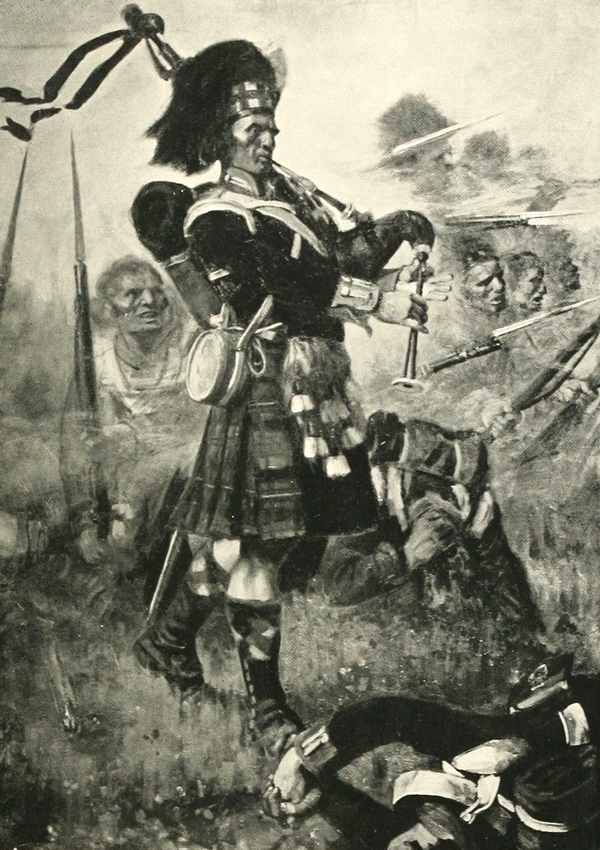
PIPER KENNETH MACKAY, CAMERON HIGHLANDERS At Quatre-Bras From the Painting by Lockhart Bogle, by kind permission of the Officers of the 1st Cameron Highlanders
"Friedberg, 11/1/1917.
Though only a young player I play here every day and do not find people too hostile to me. The Russians, French and even the Germans greet me with great interest and seem to find pleasure in listening to me—though as I said I am no great player; the most unsympathetic are always to be found among the ranks of the "Sassenach." I learnt to play in 1911, on joining my Regiment, under George MacLennan, who was Pipe-Major at that time. While on leave in Edinburgh I used to have lessons with his father—Jno. MacLennan. Up till now I have only attempted "The Glen is mine" and "Struan Robertson" in Piobaireachd, but having been thoroughly taught by the MacLennans I naturally follow their way of thinking. Yesterday I played to a Russian who is a very good player of the piano. He was delighted with the Pipes and I could not play too many tunes for him. Strathspeys and Reels are greatly appreciated by all our Russian friends. Last St. Andrew's Day we organized an Exhibition of dancing which was a complete success. As the Scottish Colony here is so small we asked the Russians to come and help us. This they did right well with dances and songs, the music being provided, in both cases, by "Balalaika," or Russian national instrument. For our part we danced two foursome Reels (dancing two different sets of steps), a Sword Dance and a Highland Schottische. In the latter dance we each took a Russian as a partner, they having been trained up for the event. We sang "Bonnie Dundee," "Lassies of Scotland," "MacPherson," and finished up with "Auld Lang Syne." For the Reels my Russian friend provided the music on the piano. Our costume was of course improvised. Kilt, shoes and hose we had, we wore white shirts with lace cuffs, a strip of tartan fastened with a brooch at the shoulder to do duty as a plaid and a black velvet band with a lace ruffle, falling down in front, round our necks. Our sporrans, with the exception of one which was made out of a local rabbit, all came from home. I had several pretty compliments paid to me by the Russians and French, both on our costume and dancing. Five of us took part altogether. I wonder if it would be too much to ask you to send me instructions for dancing the "Lochaber Broadswords" and the "Seann Triubhas," in case we have the misfortune to pass another St. Andrew's Day here in Germany. If we do we shall give another Exhibition and I would like to be able to vary it. I only know 12 Strathspey steps and 8 Reel steps. Since I have been a prisoner I have taught over 30 people to dance the Reel—including two Frenchmen and one Russian, and at present I have five pupils on the chanter. We are 16 Scots here, so can you say we are losing our national distinctions? I have only told you this because I thought it would interest you."
In Holland, in the internment camps, an organised pipe band was instituted by the writer of the above letter, and consisted of thirteen pipers of whom two were pipe majors.