Volume 2 — Introductory material (continued 4)
George Burnham Ives translation
But the unfortunate man was not familiar with women; and, because he had loved so long in silence and sorrow, he had no conception of the delicate and mysterious problems of requited love. He was over-modest. He took Mila's cruel pleasantness too seriously, and scolded her for being so unkind to him when he ought to have thanked her on his knees.
Moreover, to tell the whole truth, that Nicolosi affair was stamped with the seal of fatality, like everything else that was connected, though it were by the tiniest thread, with the Piccinino's mysterious existence. Without touching upon the details which demanded secrecy, they had told Magnani everything that could set his mind at rest concerning that adventure of Mila's. Fra Angelo, always loyal to his secret predilection for the bandit, had vouched for his chivalrous and honorable conduct under such circumstances. The princess, loving Mila with a maternal love, had spoken with heartfelt eloquence of the girl's devotion and courage. Pier-Angelo had arranged everything for the best, in his happy and unsuspecting brain. Michel alone had shuddered upon learning of the episode, and he thanked Providence for performing a miracle in behalf of his charming and noble-hearted sister.
But despite his grandeur of soul, Magnani had been unable to look upon Mila's performance as the result of a worthy impulse; and, although he never mentioned the subject, he suffered intensely, as may be imagined.
As for Mila, the consequences of her adventure were more serious, although she did not suspect it as yet. That romantic chapter in her life had left an ineffaceable impression on her brain. After trembling and weeping bitterly when she learned that she had recklessly surrendered herself as a hostage to the redoubtable Piccinino, she had made the best of her mistake, and had secretly become reconciled to the thought of that alarming personage, who had bequeathed to her, instead of shame, remorse and despair, naught but poetic memories, increased esteem for herself, and a bouquet of spotless flowers, which an undefinable instinct had led her to preserve carefully among her sentimental relics, after drying them with the greatest care.
Mila was no coquette; we have proved it by telling how coquettish she was with the man whom she looked upon as her fiancé. Nor was she fickle; she would have been faithful to him until death, with a fidelity proof against every trial. But there are mysteries in a woman's heart, deeper and more incomprehensible in proportion to the woman's mental endowment and the exquisite charm of her nature. Moreover, there is something sweet and glorious to a young girl in the thought that she has succeeded in taming a terrible lion and has come forth safe and sound from a perilous adventure, solely by the power of her charm, her innocence and her courage. Mila realized now how brave and adroit she had been, quite unconsciously, in that great danger, and the man who had submitted so completely to the influence of her merit could not seem to her a contemptible or ordinary man.
Thus a feeling of romantic gratitude enchained her to the memory of Captain Piccinino, and, despite all the evil people might say of him, it would have been impossible to shake her confidence in him. She had taken him for a prince; was he not a prince's son and Michel's brother? She had taken him for a hero, for the future liberator of his country; might he not become so, had he not that ambition? His soft speech, his charming manners had fascinated her; and why not? Had she not an even more intense infatuation for Princess Agatha, and was the one less legitimate and less pure than the other?
All this did not prevent Mila from loving Magnani so fervently that she was always on the point of confessing her love in spite of herself; but a week had passed since their first quarrel, and the modest and timid Magnani had not as yet succeeded in extorting that confession.
He would have obtained that victory a little later doubtless, perhaps on the very next day; but an unforeseen event brought confusion into Mila's existence and gravely compromised the welfare of all the characters of this narrative.
One evening, as Michel was walking with his mother and the marquis in the garden of the villa, engaged all three in forming projects of mutual devotion and dreaming dreams of happiness, Fra Angelo joined them, and Michel concluded, from his strange expression and his excited manner, that he wished to speak to him in secret. They walked away from the others, as if by chance, and the Capuchin, taking from his breast a soiled and crumpled paper, handed it to Michel. It contained only these few words: "I am wounded and a prisoner; help, brother! Malacarne will tell you the rest. In twenty-four hours it will be too late."
Michel recognized the Piccinino's fine, nervous handwriting. The note was written in blood.
"I know all that has to be done," said the monk. "I received the letter six hours ago. Everything is ready. I came to say good-bye to you, for it may well be that I shall never return."
He paused, as if afraid to say something that was in his mind.
"I understand you, uncle; you relied upon my help," said Michel; "I am ready. Let me embrace my mother." "If you do that, she will see that you are going away and will detain you."
"No, but she will be anxious. I will not say good-bye to her: let us go. On the way we will think up some excuse for my absence, and send her a messenger."
"That would be very dangerous for her and for us. Leave it to me; it means five minutes delay, but it can't be helped."
He went back to the princess and said to her in the marquis's presence:
"Carmelo is in hiding in our convent; his sentiments toward your highness and Michel are all that can be desired. He desires to make his peace with him before starting on a long journey necessitated by the Ninfo affair and the suspicious and rigorous measures of the police since it happened. He also has certain favors to ask at his brother's hands. Permit us to go away together therefore, and if we are watched, which is quite possible, I will keep Michel at the convent until he can safely return. Rely upon the prudence of a man who is well used to affairs of this sort. It may be that Michel will pass the night at the convent, and even if he should stay longer do not be alarmed, and above all things do not send for him; do not send us any message which might be intercepted and lead to the discovery that we are giving shelter and protection to the outlaw. I beg your highness to forgive me for being unable to say anything further to reassure you. Time presses!"
Although greatly alarmed, Agatha concealed her emotion, kissed Michel, and walked with them to the gate of the park; there she paused.
"You have no money with you," she said; "Carmelo may need some for his journey. I will go and fetch some."
"Women think of everything," said Fra Angelo; "I had forgotten the most essential thing of all."
Agatha returned with some gold and a blank draft bearing her signature, which Michel could fill up as he chose for his brother's use. Magnani had just arrived. He divined from the princess's agitation and the leave-taking between her and Michel, accompanied by encouraging words from the latter, that there was some real danger which they were concealing from that loving mother.
"Should I be in your way if I accompanied you?" he asked the monk.
"On the contrary," was the reply, "you may be of the greatest service to us. Come!"
Agatha thanked Magnani with one of those glances laden with maternal love, which are more eloquent than any words.
The marquis would have joined them, but Michel objected.
"We are dreaming of imaginary dangers," he said with a laugh; "but if I were in any danger, my mother would be also. Your place is with her, my friend. I entrust to you what I hold dearest on earth! Is not this rather a solemn leave-taking for a walk to Bel Passo by moonlight?"
L A NOCTURNAL JOURNEY
When they were a hundred yards from the park, Michel, who was ready to risk his own life, but not that of Mila's betrothed, in an affair in which he had no concern and no duty to his conscience or his family to fulfil, begged the young artisan to return to Catania. Fra Angelo thought differently. Fanatical in his friendships as in his patriotism, he looked upon Magnani as a providential ally. He was one stout and fearless champion more, and their party was so small! Magnani alone was worth three men; Heaven had sent him to their assistance, and they must make the most of his zeal and his devotion to the good cause.
As they walked rapidly along they maintained a hot discussion. Michel rebuked the monk for his pitiless proselytism under such circumstances; the monk rebuked Michel for rejecting the means while seeking the end. Magnani put an end to the dispute by his invincible determination.
"I understood perfectly well at the outset," he said, "that Michel was engaging in some affair of more serious importance than he chose to admit to his mother. I made up my mind at once. Some time ago I made Princess Agatha a sacred promise: that I would never leave her son to face alone any peril which I could share with him. I am keeping my promise, and whether Michel is willing or not, I shall follow him wherever he goes. I know of no other way to prevent me than to blow out my brains here. Choose whether you will put up with my company or kill me, Michel."
"All right! all right!" said the monk; "but stop talking, my sons. This is a thickly settled spot, and we mustn't talk as we pass the houses. Besides, we can't walk so fast when we are quarrelling. Ah! Magnani, you are a man!"
Magnani marched to meet danger with cold and melancholy courage. He did not feel perfectly happy in love; a craving for violent emotions drove him forward at random toward some extreme goal which appeared to him vaguely as an entire transformation of his present existence and a definitive rupture with the hesitations and languor of his heart.
Michel was determined rather than calm. He knew that he was being led by a fanatic to the succor of a man who was probably no less dangerous than useful to the good cause. He knew that he himself was staking a happier and broader existence than that of his companions; but he did not hesitate to play a manly part under the circumstances. The Piccinino was his brother, and although the sympathy he felt for him was blended with suspicion and sadness, he understood his duty. Perhaps too he had become enough of a prince to be unable to endure the thought that his father's son might die at the end of a rope, with a sentence of degradation nailed to his gallows. Still, his heart was sore when he thought of his mother's grief if he should fall in such a reckless undertaking; but he resolutely closed his heart to all human weakness, and walked like the wind, as if he had hoped to wipe out, by forgetting it, the distance that he made haste to put between Agatha and himself.
The convent was not under suspicion or surveillance, as the Piccinino was not there, and the police of the Val were well aware that he had crossed the Garreta and gone into hiding in the interior of the island. Fra Angelo had invented danger near at hand to prevent the princess from suspecting the existence of distant but more real dangers. He led his young companions into his cell and assisted them to disguise themselves as monks. They divided the money, the sinews of war, as Fra Angelo said, in order that no one of them might be impeded by the weight of all the coin. They concealed beneath their frocks weapons, powder and ball. Their disguise and their outfitting consumed some time; and Fra Angelo, whose former experience of dangerous undertakings had taught him the evils of precipitation, examined everything with great care and perfect self-possession. In truth their freedom of action depended entirely upon their external aspect. The Capuchin trimmed Magnani's beard, colored Michel's eyebrows and hands, changed the tint of their cheeks and their lips by processes learned in his former profession, and with pigments so prepared as to withstand the action of rain, perspiration, and the compulsory baths to which the police resort in vain attempts to identify their prisoners.
So far as he himself was concerned, the Capuchin took no pains to deceive the eye as to his identity. It mattered little to him whether he was captured and hanged, provided that he had first saved his former captain's son. And since, in order to succeed in their undertaking, it was necessary to travel in the guise of peaceably disposed persons, nothing could be better suited to the rôle he had assigned to himself than his genuine features and costume.
When the two young men were all equipped, they gazed at each other in amazement. They were hardly recognizable, and they realized how the Piccinino, who was much more expert than Fra Angelo in the art of disguise, had been able thus far to conceal his real identity throughout his adventurous life.
And when they found themselves astride two tall mules, gaunt but willing, of wretched aspect, but of unlimited strength and endurance, they admired the monk's genius and complimented him upon it.
"I have not done all these things so rapidly without assistance," he replied, modestly; "I have been energetically and skilfully seconded, for we are not alone in our expedition. We shall meet pilgrims of divers sorts on the road we are about to take. Salute most courteously, my sons, all those persons who salute you; but be careful not to speak a word to anybody until you have looked at me. If any unforeseen accident should separate us, you will find other guides and other companions. The countersign is: Friends, isn't this the road to Tre-Castagne? I need not tell you that it is the road that leads in the opposite direction, and that nobody but one of your confederates would ask you such an absurd question. You will answer, however, as a matter of prudence, and in a jesting tone: All roads lead to Rome. And you will not place absolute confidence in your interlocutor until he has answered: By the grace of God the Father. Don't forget; don't fall asleep on your mules; and don't spare them. We have relays on the road; not a word except in whispers to one another."
As soon as they were fairly on the mountains, they urged their mules forward at a rapid pace, and rode several miles in a very short time. As Fra Angelo had said, they met various persons with whom they exchanged the sentences agreed upon. Then the Capuchin would ride up to them and talk with them in undertones, and they would resume their journey in company, sufficiently far apart not to seem to be travelling together, but always within sight and call.
The weather was exceedingly mild and the night superbly bright when they started up the mountain. The moon lighted up huge masses of rock and romantic precipices; but as they ascended through that wild country the cold made itself felt, and the mist veiled the splendor of the stars. Magnani was lost in his thoughts, but the young prince abandoned himself to a childlike delight in adventures, and, far from nourishing and fondling any presentiment of evil, as his friend was doing, he rode forward overflowing with confidence in his lucky star.
As for the monk, he abstained from thinking of anything whatsoever unconnected with the enterprise he was directing. With watchful, penetrating eye, his ear on the alert for the faintest sound, he also watched closely every movement, every change of position on the part of his companions. At the slightest sign of relaxation of their hold upon the reins, at the slightest suspicious swaying of their hooded heads, he would have rescued them from the danger of dozing and falling from their mules.
After riding fifteen miles, they changed mounts at a sort of hermitage which seemed to be deserted, but where they were received in the darkness by pretended muleteers, of whom they inquired as to the road leading to the famous village of Tre-Castagne, and who answered, as they grasped their hands and held their stirrups, that all roads led to Rome. Fra Angelo distributed money, powder and bullets, which he carried in his mendicant's wallet, to all those persons whom he met and who were provided with that eloquent countersign; and, when they approached the end of their journey, Michel had counted a score or more of men, muleteers and peddlers, monks and peasants, who belonged to their party. There were even three in woman's dress,—young fellows whose beards had not yet grown nor their voices changed. They were very well made up, and played their parts to perfection. They were ready to serve as messengers or scouts at need.
The Piccinino's situation and the circumstances of his capture were as follows. The murder of Abbé Ninfo had been executed and proclaimed with an insane audacity altogether contrary to the young chief's habitual prudence. To kill a man, and to boast of it by an inscription left upon the very spot where the crime was committed, instead of concealing his body and removing every trace of the deed—a very simple matter in a region like that of Ætna—was certainly a desperate performance, a sort of challenge hurled at destiny in a moment of frantic excitement. But Carmelo, wishing not to shut himself out forever from his cherished retreat at Nicolosi, had left it in perfect order, in case of an investigation which should result in domiciliary visits. He had hastily stripped his luxurious boudoir and hidden all his treasures in an excavation under the house, of which it was almost impossible to find the entrance or to suspect the existence. And about sunrise he had shown himself in the village of Nicolosi, perfectly placid and in excellent spirits, thus laying a foundation for an alibi, if the police, taking for true the declaration written on the base of the Destatore's cross, should conceive suspicions of him and make inquiries as to what he was doing at that time. The murder of Abbé Ninfo had been committed at least two hours earlier.
Having taken these precautions, Carmelo had ridden through the village, making some purchases for a journey of several days, and informing his acquaintances that he was going to look at some farming lands in the interior of the island.
He had started for the Nebrodes mountains in the northern part of Sicily, having determined to pass some days with certain brigands affiliated to his own band, until the investigations and searching about Catania had probably come to an end. He knew the methods of the police of the province; they were zealous and fierce at first, then timid and knavish, and, finally, tired and slothful.
But the affair at the Destatore's cross had made a deeper impression on the ruling powers than an ordinary murder. This had a political bearing, and seemed to be related to the great sensation of the moment, Agatha's declaration and her son's appearance on the world's stage. Severe orders were sent out rapidly in all directions. Carmelo was not safe in the mountains, especially as his acolyte, the false Piccinino, had joined him, and thus drew upon him all the danger of pursuit. Carmelo did not choose to abandon that savage, bloodthirsty man, who had given him abundant proofs of boundless devotion and blind submission, and who continued to play his part to the end with proud and unwearying courage.
He determined, therefore, to arrange for his escape before providing for his own safety. The false Piccinino, whose real name was Massari, and who was called Verbum Caro because he was a native of the village of that name, was endowed with a brute courage that nothing could daunt, but was as stupid as a buffalo in a frenzy. Carmelo went to the seashore with him, and tried to find a boat to take him to Sardinia. But, despite the precautions with which he surrounded that step, the owner of the boat betrayed them as smugglers to the revenue officers on the coast. Verbum Caro fought like a lion, and was half dead when he finally fell into the hands of his enemies. Carmelo was slightly wounded, and both were taken to the nearest fort, to be turned over to a squad of campieri, in which were two men who recognized the false Piccinino from having seen him during a skirmish at another part of the island. They so testified before the magistrate at Cefalù, and there was great rejoicing because the famous chief of the dreaded band was in custody. The real Piccinino was supposed to be one of his confederates, although Verbum Caro insisted that he had known him only three days, and that he was a young fisherman who proposed going to Sardinia with him as he had business there.
Carmelo replied to the questions that were asked him with a presence of mind and a talent for deception which would have secured his release at any other moment; but the country was intensely excited; so they decided to send him to Catania with his dangerous companion, for further proceedings, and they were placed in charge of the campieri, who decided to take them to Catania by the road leading through the mountains to the centre of the island, deeming it the safer way.
But they were attacked in the outskirts of Sperlinga by a few brigands who had already learned of the arrest of the two Piccininos; but, just as the prisoners were about to be set free, an unexpected reinforcement came to the aid of the campieri and put the brigands to flight. It was during this action that the Piccinino was adroit enough to throw among the assailants a paper wrapped around a stone, which he had in his hand ready for the first opportunity. Malacarne, whom he had recognized among his would-be rescuers, was an active, intelligent man, a former member of his father's band and a loyal friend to Fra Angelo. He had picked up the note and carried it to its address with valuable additional information.
In the fear, well-founded as we have seen, of an attack in the Nebrodes mountains and an attempted rescue of the Piccinino, the authorities at Cefalù had tried to conceal the importance of this capture, and the escort of the prisoners made no display when they set forth. But the same authorities had despatched an express to Catania to ask that a detachment of Swiss troops be sent to Sperlinga to meet the escort, and to say that they would halt there and wait for them. The brigands of the mountain, who were on the alert, had waylaid and killed the messenger; and, having ascertained beyond question, by reading his despatches, that the prisoner was their leader, they had tried, as we have seen, to rescue him from the hands of his escort.
The ill success of this attempt did not discourage them. Carmelo was the soul of their lives. His shrewd leadership, his activity, the spirit of justice, now savage, now chivalrous in its manifestations, which governed his decisions with respect to them, and the immense prestige attached to his name and his person, made him no less sacred than necessary to them. It was the unanimous opinion among them, and among a great number of mountaineers, who, while they did not know him and were not immediately under his orders, were very glad to exchange favors with him and his troop, that when the Piccinino was dead, the bandit's profession would become impossible, and that there would be no other resource for the heroes of the mountain than to become beggars.
So Malacarne assembled a few of his comrades near Sperlinga, and succeeded in sending word to the two Piccininos that they must represent themselves as being very ill, in order to remain there as long as possible. It was by no means difficult to act upon the suggestion, for Verbum Caro was dangerously wounded, and in the desperate efforts he had made to burst his bonds during the engagement on the mountain, he had reopened his wound and lost so much blood that they had had to carry him to Sperlinga. Moreover, the campieri knew that it was of the utmost importance to take him to Catania alive, so that they might try to extort from him some information concerning Ninfo's murder and the whereabouts of his band.
As soon as Malacarne had made his arrangements, he bade his comrades, who were as yet only eight in number, to be ready for action, mounted the murdered messenger's horse, after clipping him so as to make him unrecognizable, and rode across the country in a straight line to Bel Passo, notifying all those persons upon whom he could rely, to take arms and await his return. Seconded by Fra Angelo, he passed six hours on Ætna, collecting other brigands, and at last, on the second night after the arrival of the prisoners at Sperlinga, a score or more of determined men, trained to daring enterprises of this sort, encamped at the foot of the cliff on which it stands.
Fra Angelo, the young Prince of Castro-Reale, and the faithful Magnani also arrived, to direct the expedition, the first as leader, for he knew the country generally and the particular locality better than anyone, having once before carried the paltry stronghold by assault under the Destatore, in better days; the other two as lieutenants, young noblemen of the patriotic party, forced to conceal their identity, but rich and powerful. So said Fra Angelo, who knew well that both poetry and prose are essential to stimulate men who are fighting against the laws.
When Fra Angelo and his friends left their mules, to plunge in among the steep cliffs of Sperlinga, they were able to count their men, and found that there were about twenty peasants posted here and there at some little distance—prudent auxiliaries who would come to their assistance as soon as the chances of war seemed to favor them; revengeful and bloodthirsty men, who had suffered many and grievous wrongs which they longed to avenge upon their enemies, and who knew how to do justice speedily and pitilessly when there was not too great a risk to be run.
Nevertheless, a part of the band was beginning to show signs of demoralization when the monk arrived. The lieutenant of the campieri, who had charge of the prisoners, had sent to Castro-Giovanni during the day to request reinforcements, which were likely to arrive with the dawn. This officer was disturbed by the non-appearance of the Swiss, whom he was awaiting with great impatience. The spirit manifested by the surrounding population did not tend to allay his fears. Perhaps he had detected some signs of activity among the brigands in the mountain, and of their evident understanding with certain people in the village. However that may be, he was afraid—which fact the monk looked upon as a pledge of victory—and he issued orders for departure on the following day, preferring, he said to see a miserable wretch like the Piccinino die on the highroad, rather than expose brave troops to the risk of being murdered in a fortress without gates or walls.
Perhaps the officer knew enough Latin to read, over the gateway of the ancient Norman castle in which he was intrenched, the famous motto which French tourists go thither to contemplate with love and gratitude:
Quod Sicilis placuit, Sperlinga sola negavit.[1] We know that Sperlinga was the only place which refused to surrender the Angevins at the time of the Sicilian Vespers. It is well enough for our compatriots to take pride therein; but it is certain that Sperlinga performed no act of patriotism; and that, if the officer of campieri looked upon the then government as existing in compliance with the popular desire of Sicily, he must have seen, in the negavit of Sperlinga, a constant threat which might well arouse a superstitious terror in his mind.[2]
The reinforcements from Castro-Giovanni were expected at any moment. The assailants would find themselves between two fires. The imaginations of some pictured the arrival of the Swiss also, and the Swiss soldier is the terror of the Sicilians. Hardened and implacable, those children of Helvetia, whose mercenary service under despotic governments is the shame of their fatherland, strike without distinction at everything they meet, and the campiere who hesitates to display less courage and ferocity than they, is the first to fall under their bullets.
Thus there was fear on both sides; but Fra Angelo triumphed over the hesitation of the brigands by a few words of rough eloquence and unparalleled temerity. After vehemently rebuking those who talked of waiting, he declared that he and his two princes would go alone to meet their death under the walls of the fort, so that it might be said throughout all Sicily: "Two patricians and a monk alone tried to effect the rescue of the Piccinino. The children of the mountain looked on and did not stir. Tyranny triumphs, the people of Sicily have become dastards!"
Malacarne seconded him, declaring that he too would go and be shot down. "And then," he said, "you can hunt up a leader and do what you choose." There was no further hesitation, and such men know no middle course between discouragement and unbridled frenzy. Fra Angelo had no sooner seen them start forward than he exclaimed: "The Piccinino is saved!" Michel was amazed that he could place so much confidence in courage that was so weak-kneed a moment before; but he soon found out that the Capuchin knew them better than he did.
LI CATASTROPHE
The fortress of Sperlinga, formerly considered impregnable, was at this time nothing more than a majestic ruin, incapable of being defended. The town, or more properly the hamlet, below it, was inhabited by a few wretched creatures wasted by fever and poverty. Fortress and village were perched upon a cliff of grayish sandstone, and the upper works of the fortress were hollowed out of the rock.
The besiegers climbed the cliff on the side farthest from the village. It seemed inaccessible; but the brigands were so well used to assaults of that sort that they were very soon under the walls of the fort. Half of them, under Malacarne, climbed still higher, and posted themselves in an abandoned bastion on the highest point of the mountain. This crenelated bastion afforded a safe position from which to fire down almost perpendicularly upon the castle. It was agreed that Fra Angelo and his men should station themselves at the entrance to the fortress, where there was only a huge, worm-eaten, disjointed gate, which it was not considered necessary to destroy, as that operation might take sufficient time to give the garrison an opportunity to organize an effective resistance. Malacarne's party was to fire on the castle from above, while Fra Angelo held himself in readiness to fall upon those who should come out. Then he would pretend to retreat, and, while they pursued him, Malacarne would come down, attack the enemy in the rear, and place him between two fires.
The little garrison temporarily quartered in the castle consisted of about thirty men, a larger number than the assailants anticipated, the reinforcements from Castro-Giovanni having arrived secretly at nightfall and climbed up the road, or rather the staircase, from the village, unseen by the bandits who were busily occupied in making their preparations and taking great pains to keep out of sight. That part of the escort which had kept watch throughout the preceding night was sleeping, wrapped in their cloaks, on the floors of the great dismantled halls. The late arrivals had lighted an enormous fire of fir branches in the courtyard, and were playing mora to keep awake.
The prisoners occupied the great square tower: Verbum Caro, exhausted and gasping for breath, stretched on a pile of rushes; the Piccinino, gloomy but calm, sitting on a stone bench, much wider awake than his keepers. He had heard a little bird whistling in the ravine, and had recognized that designedly inaccurate melody as a signal from Malacarne. He was patiently rubbing against a projecting stone the cord with which his hands were bound.
The officer in command of the campieri was seated on the only chair in an adjoining room, with his elbows resting on the only table in the castle, which he had obtained by requisitioning it in the village. He was an energetic, surly young man, accustomed to keep his temper at the boiling point by the constant use of wine and tobacco, having to fight against a lingering remnant of love for his country and hatred of the Swiss. He had not slept an hour since the Piccinino was placed in his custody, so that he was literally falling under the assaults of drowsiness. The lighted cigar which he held in his hand burned the ends of his fingers from time to time. Then he would rouse himself with a start, puff at his cigar, look out through a great crack in the wall in front of him to see if there were any signs of dawn, and, feeling acutely the sharpness of the air on that elevated spot, would wrap his cloak about him with a shudder, cursing the false Piccinino, who was breathing stertorously in the adjoining room, and in a moment would let his head fall forward on the table once more.
A sentinel was on guard at each end of the castle, but, whether because of fatigue or of the heedlessness that takes possession of the most disturbed mind when a dangerous situation is nearing its end, they had not detected the swift and silent approach of the brigands. A third sentinel was on duty at the isolated bastion which Malacarne was about to seize, and that circumstance came very near causing the failure of the whole plan of attack.
As he was climbing through a breach, Malacarne saw the man sitting under his feet, almost between his legs. He had not anticipated that obstacle, and he had neither his dagger nor his pistol in his hand. An opportune dagger thrust cuts a man's life short without giving him time to cry out. The pistol shot is less certain, nor did Malacarne wish to fire until all his men were posted so that they could pour a deadly volley into the fort. Meanwhile the sentinel would surely give the alarm, even if the bandit should retreat, for his footing was precarious, and the stones, uncemented, were beginning to crumble all about him. The campiere was not asleep. He was paralyzed with cold, and had pulled his cloak over his head as a protection against the piercing wind which stiffened his limbs.
But while this precaution deadened the sound of the wind and made it easier for him to hear sounds in the distance, it prevented him from hearing any noise at his side, and the hood which he had pulled over his eyes had made him blind for the last quarter of an hour. However, he was a brave soldier, incapable of sleeping at his post. But there is nothing more difficult than to keep a sharp lookout. An active and alert mind is necessary for that, and the campiere's mind was wholly devoid of thought. He fancied that he was watching because he was not moving. And yet the mere falling of a pebble at his feet would have caused him to fire his gun. He had his finger on the trigger.
Inspired by his desperate situation, Malacarne grasped the unfortunate sentinel's throat in his iron hands, rolled down into the bastion with him, and held him thus, unable to utter a sound, until one of his comrades stabbed him in his arms.
In another moment they were crouching behind the battlements, protected from the fire of the enemy. The fire blazing in the courtyard enabled them to see the campieri unsuspectingly intent on their game, and they took plenty of time to aim. The weapons were hurriedly reloaded while the besieged were seeking theirs; but before they had thought of using them—before they had discovered from what direction they were attacked—a second volley was poured in upon them, and several were severely wounded. Two did not rise again; a third fell head-foremost into the fire, and was burned to death for lack of help.
From the tower the officer had seen where the attack had come from. He rushed out, roaring with rage. He did not arrive in time to prevent his men from wasting a volley on the wall.
"Stupid dolts!" he cried, "you waste your ammunition firing at random! You have lost your wits! Leave the fort! Leave the fort! We must fight outside!"
But he discovered that he himself had lost his wits, for he had left his sword on the table on which he had fallen asleep. A flight of six steps separated him from the room. He ascended them at a single leap, for he knew that in a moment he would have to fight with cold steel.
But, during the fusillade, the Piccinino had succeeded in breaking his bonds, and had taken advantage of the tumult to break down the ill-secured door of his prison. He had pounced on the lieutenant's sword and extinguished the pitch-pine torch that was stuck in a crack of the table. When the officer returned, and was feeling about in the darkness for his weapon, he received a terrific cut across the face, and fell backward. Carmelo rushed upon him and finished him. Then he cut Verbum Caro's bonds and handed him the lieutenant's sword, saying: "Do what you can!"
The false Piccinino forgot in an instant his weakness and his suffering. He dragged himself on his knees to the door, and there he succeeded in rising and standing on his feet. But the real Piccinino, seeing that he could not walk except by clinging to the walls, threw the officer's cloak over him, put the military cap on his head, and told him to go out at his leisure. Thereupon he himself went down into the deserted courtyard, took the cloak from one of the campieri who had been killed, disguised himself as best he could, and, always faithful to his comrade, took him by the arm and led him toward the gateway of the fort.
Everybody had gone out except the two men who had been left behind to prevent the prisoners from escaping in the confusion, and who were returning to guard the tower. The fire in the courtyard was dying out, and gave only a feeble light.
"The lieutenant is wounded!" cried one of them, as he saw Verbum Caro leaning on Carmelo, who was himself disguised.
Verbum Caro did not reply, but motioned to them to go on and guard the tower. Then he went out as rapidly as he could, with his chief, whom he implored to fly without him, but who refused to abandon him under any consideration.
If this was generous conduct on the Piccinino's part, it was no less judicious; for, by giving his men such proofs of affection, he made sure of their loyalty forever. The false Piccinino might have been recaptured the next moment; but if he had been, no amount of torture could have made him admit that his companion was the real Piccinino.
They were already fighting on the narrow platform in front of the castle, and the brigands commanded by Fra Angelo pretended to give way. But the campieri, deprived of their leader, did not act together or in good order. When Malacarne's detachment, rushing down from the bastion like a thunderbolt, took possession of the gateway and showed them that retreat was impossible, they felt that they were lost, and halted as if dazed by terror. At that moment Fra Angelo, Michel, Magnani and their men turned upon them and pressed them so close that their plight seemed desperate indeed. Thereupon the campieri, knowing that the brigands gave no quarter, fought with the frenzy of despair. Crowded between two walls, they had the advantage of position over the brigands, who were obliged to avoid the precipice behind them. Moreover, Malacarne's band had been struck with dismay.
As the two Piccininos crossed the drawbridge, the brigands, deceived by their disguise, had fired on them. Verbum Caro was not touched, but Carmelo, struck by a bullet in the shoulder, had fallen. Malacarne had rushed at him to finish him, but, on recognizing his chief, had fairly roared with grief, and his men, crowding about him, no longer thought of fighting.
For a few moments Fra Angelo and Michel, who were fighting in the front rank, hand-to-hand with the campieri, were in grave danger. Magnani was even farther to the front; he tried to turn aside all the blows aimed at Michel, for they had no time to reload their weapons and were fighting with swords and knives, and the noble-hearted Magnani sought to make his body a rampart to protect Agatha's son.
Suddenly Michel, who was constantly pushing him aside and begging him to think of his own safety, missed him from his side. Michel thereupon attacked the enemy fiercely. The first horror of bloodshed having passed away, he was urged onward by a strange and terrifying nervous excitement. He was not wounded. Fra Angelo, who had a superstitious faith in the grandeur of the young prince's destiny, had prophesied that he would not be. But if he had been wounded twenty times over, he would not have been conscious of it, his vital forces were so concentrated in his brain. He was, as it were, intoxicated by danger, and excited to frenzy by the battle. It was a ghastly but intense pleasure; the blood of Castro-Reale awoke and began to boil fiercely in the veins of the lion's whelp. When the victory was won, and they were able to join forces with Malacarne, walking over dead bodies, it seemed to Michel that the contest had been too short and too easily decided. And yet it had been so desperate that almost every man among the victors was more or less severely wounded. The campieri had sold their lives dearly, and if Malacarne had not recovered his energy when he saw that the Piccinino was reviving and was able to fight, Fra Angelo's band would have been forced back into the yawning ravine behind them.
The dull gray dawn was beginning to whiten the misty peaks on the horizon when the assailants entered the conquered fortress. They had to pass through it in order to retire into the mountains unseen by the inhabitants of the village, who had left their horses and were timidly climbing their steep rocky street to ascertain the result of the engagement. Their anxious eyes could hardly distinguish the moving mass of the combatants, lighted only by the flashing of their fire-arms. While they were fighting hand-to-hand the pale-faced citizens of Sperlinga stood frozen with terror, listening to the shouts and imprecations of that incomprehensible struggle. They had no inclination to assist the garrison, and most of them longed for the success of the brigands. But the dread of reprisals restrained them from going to their aid. At daybreak they could be seen, almost naked, standing in groups here and there like trembling ghosts, manifesting an ill-defined purpose to go to the assistance of the victors.
Fra Angelo and the Piccinino had no idea of waiting for them. They rushed hurriedly into the fortress, each brigand dragging a body to give it the coup de grace. They collected their wounded, and disfigured those of their own number who were dead. But this ghastly scene, which acted upon Verbum Caro like a tonic, disgusted the Piccinino beyond measure. He instantly ordered his men to disperse, and to return to their homes or places of refuge as speedily as possible. Then he took Fra Angelo's arm, and entrusting Verbum Caro to the care of Malacarne and his party, tried to induce the monk to fly with him.
But Fra Angelo was in a terrible state of anxiety concerning Michel and Magnani, and went about from one to another, without mentioning any names, asking for the two young monks who had accompanied him. He was not willing to leave the place until he had found them, and his desperate persistence threatened to expose him to grave danger.
At last the Piccinino spied two frocks at the bottom of the ravine.
"There are your companions," he said to the monk, leading him in that direction. "They have gone ahead; and I can well imagine that they fled from the sickening spectacle of our victory. But their delicacy doesn't interfere with their being gallant fellows. Who are they, pray? I saw them fighting like lions. They wear the dress of your order; but I cannot understand how two such heroes can have been living in your convent and I not know them."
Fra Angelo did not reply; with his bloodshot eyes he was trying to make out the two monks. He recognized the frocks he had given Michel and Magnani, but he could not understand their inaction, and the indifference with which they held themselves aloof from the others. One of them seemed to be seated, the other kneeling by his side. Fra Angelo hurried down into the ravine so eagerly and recklessly that again and again he nearly fell over the precipice.
The Piccinino, who was severely wounded, but strong of will and stoical in his suffering, followed him, careless of his own safety, and they soon reached the foot of the precipice, a spot shut in on all sides, and terribly solitary, with a mountain torrent flowing at their feet. As they had been compelled to make a detour about several steep cliffs, they had lost sight of the two monks, and the darkness that still prevailed in the depths of the gorge made it difficult for them to find their way.
They dared not call; but at last they discovered the men they were seeking. One was sitting on the ground, supported by the arms of the other. Fra Angelo rushed forward and pushed back the hood that first met his hand. He saw Magnani's handsome face, darkened by the shadow of death; his blood was pouring out upon the ground; Michel was drenched with it and felt that his strength was giving way, although he had no other wound than that caused by his intense and intolerable sorrow at his inability to help his friend, and at the feeling that he was dying in his arms.
Fra Angelo tried to assist the noble-hearted artisan, but Magnani gently put away the hand with which he would have touched his wound.
"Let me die in peace, padre," he said, in a voice so faint that the monk was obliged to put his ear to the dying man's lips to hear what he said. "I am happy that I am able to bid you good-bye. You will tell Michel's mother and sister that I died defending him; but do not let Michel know it! He will take care of my family, and you will console them. We won the victory, did we not," he said to the Piccinino, glancing at him with a lifeless eye and not recognizing him.
"O Mila!" exclaimed the Piccinino involuntarily, "you would have been a brave man's wife!"
"Where are you, Michel? I cannot see you any more," said Magnani, feeling for his friend with trembling hands. "We are safe here, aren't we? at the gates of Catania, of course? You will soon embrace your mother! Ah! yes, I hear the murmur of the naiad; the sound revives me; the water flows into my wound—cold as ice, but very soothing."
"Live to see my mother and sister!" cried Michel. "Ah! you shall live, we will never part!"
"Alas! I know what that smile means," said the Piccinino in an undertone, examining Magnani's blue distorted lips; "do not let him talk any more."
"But I am perfectly well!" exclaimed Magnani in a loud voice, putting out his arms. "I do not feel ill at all. Let us go, my friends!"
He struggled to his feet with a convulsive movement, stood for an instant swaying to and fro, then fell dead on the moist sand on the edge of the stream.
Michel was utterly overwhelmed. Fra Angelo did not lose his presence of mind, although from his breast, heaving with violent sobs, there issued hoarse, heartrending groans. He lifted an enormous stone at the entrance to one of the innumerable caves hollowed out of the sandstone long before, to obtain material for building the fortress; he carefully covered Magnani's body with the ample folds of the frock he wore, and, having thus provided a temporary shroud, closed the cave once more with the stone and left the body there.
Then he took Michel's arm, and walked with him and the Piccinino to a more extensive excavation a hundred yards away, which was occupied as a dwelling by a wretchedly destitute family. In the man who joined them there a few moments later, Michel might have recognized one of the peasants who were on friendly terms with the brigands, but Michel knew nothing of what was going on, and recognized nobody.
The peasant assisted the monk to dress the Piccinino's wound, which was deep and beginning to cause him much pain, so much that it required all his strength of will to conceal it.
Fra Angelo was a better surgeon than most of his countrymen who held diplomas. He performed a painful but rapid operation on the Piccinino, and extracted the bullet. The patient did not utter a groan, and Michel did not recover consciousness of his surroundings until he saw him turn pale and grind his teeth.
"Are you going to die too, brother?" he said, taking his clenched hand.
"Would to God that I had died instead of your friend!" Carmelo replied, in an outburst of fierce anger with himself. "I should no longer suffer, and I should be mourned; whereas now I shall suffer all my life and nobody will mourn for me!"
"Is this your gratitude for your brother's self-sacrificing devotion, my friend?" said the monk, throwing the bullet on the ground.
"Brother," rejoined the Piccinino, putting Michel's hand to his lips, "you did not do it from affection for me, I know; you did it for your own honor. But you are revenged for my hatred; for you continue to hate me, and I am doomed to love you!"
Two tears rolled down the brigand's pale cheeks. Were they a manifestation of genuine emotion, or were they caused by the nervous reaction that follows the violent strain of physical suffering? Doubtless they were due in some measure to both causes.
The peasant suggested a strange remedy, which Fra Angelo accepted with great eagerness: the application of a bituminous ooze which was found at the bottom of a spring of brackish water heavily charged with sulphur. The country people collect it and keep it in earthen jars to use in making poultices; it is their panacea. Fra Angelo made a poultice of it and placed it on the brigand's wound; then, having washed him and covered him with some wretched clothes which they bought from the peasant; having also washed off the blood with which Michel and himself were covered, he gave his companions a few swallows of wine, placed Carmelo on their host's mule, gave the man a round sum in gold, to prove to him that there were advantages in serving the good cause, and left him, having first made him swear that he would go the following night and get Magnani's body, and bury it with as much respect as if it were his own son's.
"My own son!" said the peasant in a hollow voice: "do you mean the one the Swiss killed last year?"
This question gave Michel more confidence in the man than any promises or oaths could have done. He looked at him for the first time, and noticed an expression of extraordinary vigor and fanatical enthusiasm on that wasted, earth-colored face. He was more than a brigand, he was a wolf, a vulture, always ready to fall upon a bleeding quarry, to tear it to pieces and glut his rage in its entrails. One could see that his whole life would be too short to avenge his son's death. He did not suggest to his guests that he should guide them in their flight. He was in haste to have done with his duty to them, so that he could go up to the castle to see if any campiere were still breathing and to insult him in his death agony.
LII CONCLUSION
The three fugitives occupied twice the time in returning to Catania that it had taken them to go to Sperlinga. The Piccinino could not travel long without falling forward on his mule's neck, prostrated by fever. Then they would halt in some cave or deserted ruin, and the monk was obliged to give him wine to drink to keep up his strength, although he realized that it increased the fever.
They had to follow steep and difficult roads, or rather to avoid every sort of road, in order not to expose themselves to the risk of inopportune encounters. Fra Angelo expected to find, halfway to Catania, a poor family upon whom he could rely as upon himself, to shelter his patient and nurse him; but he found only a deserted house, already half in ruins. Poverty had driven the poor creatures from their home. They could not pay the tax assessed on the house. Perhaps they were in prison.
It was a serious disappointment to the monk and his companion. They had purposely kept at a distance from the region overrun by the brigands, because the absence of danger made the police less active in the southern part of the island. But when they found the only place of refuge upon which they could rely in that part of the mountains entirely deserted, they were really alarmed. In vain did the Piccinino urge the monk and Michel to leave him to his fate, declaring that, as soon as he was alone, necessity would endow him with superhuman strength. They refused, as the reader will imagine, and, having discussed all possible expedients, they decided upon the safest and most certain of all, although it seemed the boldest; it was to take Carmelo to the Palmarosa palace and keep him in hiding there until he was in a condition to fly. The princess would simply have to treat certain persons with the faintest suggestion of deference to avert any possible suspicion of her conduct; and in such an emergency, when Michel might be suspected of having assisted in the rescue of the Piccinino, she would not hesitate to deceive the court party as to her political sentiments.
This idea of the monk's would have been most repellent to Michel a few days earlier; but each succeeding event made him more and more of a Sicilian, by impressing upon him more strongly the necessity of cunning. So he acquiesced, and they had nothing further to do except to smuggle the wounded man into the palace unseen. That was the only important point, for the seclusion in which Agatha lived, the small number and blind devotion of her servants, the fidelity and prudence of her maid Nunziata, who alone was allowed to enter certain rooms in the Casino, to say nothing of a thousand other details of the princess's mysterious existence, made that place of refuge as secure as could be desired. Moreover, there was the Serra palace a few steps away, to which the patient could be transported in case the Villa Palmarosa should become untenable. It was decided that Michel should go ahead and steal into the villa at nightfall; that he should warn his mother of the wounded man's arrival, and assist her to make the necessary arrangements to receive him and to admit him secretly a few hours later.
Agatha was in a state of anxiety impossible to describe when Nunziata told her that some one was waiting for her in her oratory. She hastened thither, and, catching sight of a monk's frock, nearly fainted, for she thought that one of the brethren of Bel Passo had come to bring some fatal news. But well disguised as Michel was, the mother's eye was not deceived for long, and she embraced him passionately, bursting into tears.
Michel said nothing of the dangers to which he had been exposed; she would divine them soon enough when the news of the Piccinino's rescue should spread through the country. He simply told her that he had been to a wild, out-of-the-way spot in the mountains, where his brother lay helpless and dying; that he had brought him to her to place him in her care; and that his new hiding-place must be made ready for him.
In the middle of the night the wounded man arrived unhindered; but he did not climb the stairs in the lava with the same haughty bearing as on the last occasion. His strength was failing more and more. Fra Angelo was obliged to carry him from the first stair to the last. He hardly recognized Agatha, and for several days he hovered between life and death.
Mila's anxiety was temporarily allayed when Michel told her that Magnani had gone to Palermo to do him a service. But many days passed, and, as Magnani did not return, his family was surprised and alarmed. Michel pretended that he had had news. He had gone to Rome, still in his service, and, later, he said that the important and secret business which the Palmarosa family had entrusted to the young artisan required him to go to Milan, Venice, Vienna—where you please. They kept him travelling for several years, and, to allay the anxiety and grief of his parents, read to them—for they did not know how to read—passages from pretended letters, and gave them large sums of money which he was supposed to send them.
The Magnani family grew rich, and marvelled at poor Antonio's good fortune. They lived in sadness and hope. His old mother died, sorely afflicted to have had no opportunity to embrace him, but bidding Michel send him her blessing.
As for Mila, it would have been more difficult to deceive her, had not the princess, in order to spare her a much greater sorrow, suggested a catastrophe to which she could more readily become reconciled. She hinted more and more definitely, and, finally, told her outright that Magnani, torn between his former passion and his new love for her, had feared that he could not make her happy, and so had gone away, resolved not to return until he was completely cured of the past.
Mila looked upon this as a noble and honorable proceeding; but she was piqued to find that she had not been able, unaided, to efface the memory of so persistent a passion. She strove to cure herself, for she was told that her lover's cure was not certain, and her unbounded pride came to her aid. Magnani's prolonged absence made her stronger and braver day by day. When he was supposed to have gone to Rome, she was told that he could not triumph over the old affection, and that he renounced the new. Mila did not weep; she prayed, without a shade of bitterness, for the happiness of an ingrate, and gradually recovered her former serenity.
Michel suffered terribly, of course, when, as occasionally happened, he heard her slighting references to the absent one, who deserved to be enshrined forever in her memory. But he sacrificed everything to the peace of mind of his adopted sister. He went secretly, with Fra Angelo, to see his friend's grave. The peasant who had buried him conducted them to the cemetery of a convent near by. Worthy monks, patriots like most of the monks in Sicily, had borne the body thither by night, and had inscribed these words in Latin on a stone which served as his monument, among the white roses and flowering broom:
Here reposes an unknown martyr.
The Piccinino's convalescence was longer than they had anticipated. The wound healed quickly enough; but a nervous fever of some gravity detained him three months in Agatha's boudoir, which was transformed into his bedroom, and which was guarded with religious care.
A moral revolution was taking place in that headstrong and distrustful young man. Michel's and the princess's solicitude, the extreme delicacy of their consoling words, the innumerable joys of kindly treatment, which he had lost with his mother and had never hoped to find again in other hearts, gradually made an impression upon the pride and indifference in which he had encased himself, as in a coat of mail. He had always felt an ardent craving to be loved, although he was not himself capable of being moved so powerfully and persistently by affection as by hatred. At first he was, as it were, wounded and humiliated by being compelled to be grateful. But it happened that Agatha's heart, which had wrought a miracle upon Michel, did the same for Carmelo. Agatha, although outwardly cold and fastidious in her feelings, had such a vast and generous heart that she always ended by loving those whom she pitied. There were many times still when the patient's cold-blooded ideas horrified her; but pity gained the upper hand when she realized how unhappy he was made by that determination to harden his heart against everything. In his moments of physical suffering and of nervous excitement, the Piccinino, after vaunting and demonstrating his unerring keenness of vision in the matter of human affections, deplored that unhappy faculty with a bitterness which made a profound impression upon Agatha.
One evening, when she was talking about him with Michel, and he confessed that he had no sympathetic feeling for his brother, she said to him:
"Duty impels you to care for him, to incur danger for him, to overwhelm him with favors and consideration. Very good; one must love one's duty, and this brother of yours is a terrible trial. Duty would be easier if you could love him. Try, Michel; perhaps, if you succeed, that warlike heart of his will soften too, for he has the keen faculties of a sibyl. It may be that he feels that you do not love him, and so he continues cold to you. The instant that you have a feeling of sincere affection for him, even though you do not manifest it, he will divine it and perhaps will love you in his turn. I will try to set you the example. I will strive to persuade myself that he is my son—a very different son from you, Michel—and that his faults do not prevent my loving him."
Agatha kept her word, and Michel tried to second her. The Piccinino was conscious of a genuine interest in his mental suffering amid all the tender care bestowed upon his physical ills; he softened little by little, and one day put Agatha's hand to his lips for the first time, saying to her:
"You are good, like my mother. Oh! why am I not your son? Then I would love Michel, because the same womb would have borne us both. Men are really brothers only through the mother. She alone can make us understand what is called the voice of blood, the cry of nature."
Another day he said to Michel: "I do not love you, because you are my father's son. A man who mingled his pure blood with that of so many women of diverse ranks and natures, must have had an unstable, complicated character, lacking unity; so that his sons are as different from one another as day is from night. If I should ever love you, whom I already esteem and admire, it will be because you have a mother whom I love, and who, I sometimes persuade myself, is my mother too."
When the Piccinino was in condition to resume his adventurous life, which he had regretted so bitterly during the languorous days of his illness, he was suddenly appalled at the idea of putting an end to an existence which had become so sweet to him. He tried to assume a careless air, and refused the offers of a happier lot which Agatha and Michel made him; but it was evident that he was consumed by dismay and regret.
"My dear boy," said the marquis, "you should accept the means of increasing the scope and effectiveness of the mission to which you have devoted yourself. It has never occurred to us to introduce you in a puerile and cowardly way into the society which you despise and for which you are not adapted. But, without submitting to any constraint, without changing in any way your independent principles, you can make a veritable alliance, over the heads of established laws, with veritable humanity. Hitherto you have gone astray because you have forced yourself to hate your fellowmen. It is their false and mischievous institutions against which you protest. In the bottom of your heart, you love your fellows, for you suffer by reason of their aversion and your own isolation. So change your notion of your functions as justicier d'aventure. Hitherto your aversion has usurped that title, for you have used it only for your personal vengeance and for the gratification of your instincts. What you have lacked for playing a nobler part and serving our country more effectively is a larger stage and resources proportioned to your ambition. Your brother offers you these resources; he is ready to share his income with you; and such a division will make you more powerful for your chosen work, without binding you to society in any way. You could not, to be sure, become a noble and a landed proprietor without entering into engagements to be sanctioned by law; but, by accepting secretly, from brotherly affection, the strength which you must have, you will remain a stranger to the world we live in, while you will become capable of working to correct its vices. You will be able to leave this unhappy island, where your efforts are too cramped to have their due effect. You can seek elsewhere companions and neophytes, enter into relations with the enemies of the public misery, work for the cause of slaves everywhere, study the means of putting an end to slavery, and return to us with knowledge and reinforcements which will accomplish more in one year than expeditions against wretched campieri would do in your whole life. Your faculties place you far above the trade of brigand. Your penetration, your prudence, your varied and extensive knowledge—everything even to the beauty of your face and the charm of your speech—stamps you as a typical man of action, prudent as well as daring, adroit as well as fearless. Yes, you are a born conspirator. The hazard of birth started you upon that path, and your character fits you to cut a most brilliant figure therein. But there are great conspiracies which, even when they prove abortive in one part of the world, forward the cause of universal liberty: and there are paltry ones which come to an end on a scaffold, with the unknown hero who organizes them. If you fall to-morrow in an ambuscade, your band is scattered, and national independence breathes its last in your breast. But conspire in the bright sunlight of humanity, instead of lurking in the shadow of our precipices, and some day you may be the liberator of our brothers instead of the terror of our old women."
These words were at once harsh and flattering to the Piccinino's sensitive self-love. The criticism of his past life cut him to the quick, but the favorable judgment concerning his capacity for usefulness in the future healed the wound. He blushed, turned pale, reflected and understood. He was too intelligent to contend against the truth. Agatha and Michel affectionately took his hands, and begged him on their knees to accept half of a fortune the whole of which they owed to him. Tears of pride, hope, joy, and perhaps of gratitude as well, started from his glistening eyes, and he accepted.
We must not forget to say that another miracle had taken place, unknown to all, in that strange man's heart. Love, true love, had vanquished him. Mila had been his nurse, and Mila had chained the tiger. She was proud of it, with good reason, and she was naturally very proud. The love of Captain Piccinino relieved her in her own eyes from the blemish upon her pride due to Magnani's desertion. She was brave too. She felt that she was born for a more difficult and more brilliant destiny than spinning silk. Her heroic and poetic instincts were exceedingly well adapted to a life full of danger and excitement. Carmelo, who had expressed his regret at their first interview that she was not a boy, whom, like Lara, he could take for his page, changed his mind, saying to himself that the beauty of a woman and the brave heart of a heroine added immensely to the charm of the young comrade of whom he had dreamed.
He did not obtain Mila at once, however. She voluntarily made herself the pledge and reward of his docility in following the advice of the princess and the marquis. I fancy that the day for the redemption of the pledge will soon come, if it has not come already.—But here ends the novel, which might last much longer, if I chose; for I persist in saying that no novel can end.
THE LAST OF THE ALDINIS
INTRODUCTION
Novels are always works of the fancy to some extent, and some of the fanciful conceits of the imagination are like clouds that pass over our heads. Whence come the clouds, and whither do they go?
Walking through the forest of Fontainebleau one day, with my son, I dreamed about something very different from this book, which I wrote that same evening in a tavern, and forgot the next morning, to think only of flowers and butterflies. I could describe minutely all our walks and all our amusements, but it is impossible for me to say why my mind flitted to Venice that evening. I might look about for a good reason, but it is more honest to confess that I remember nothing about it. It was some fifteen or sixteen years ago.
GEORGE SAND
Nohant, August 23, 1853
To SIGNORA CARLOTTA MARLIANI
CONSULESSA DI SPAGNA
The sailors of the Adriatic do not launch a new vessel until it is embellished with the image of the Virgin. May your name, written upon this page, O my dear and lovely friend, be like the effigy of the divine patron saint, which protects a fragile bark abandoned to the capricious waves.
GEORGE SAND
FIRST PART
At the time of this story, Signor Lelio was no longer in the first bloom of youth; whether because his lungs, by dint of performing their duty with generous zeal, had developed in such a way as to distend the muscles of his chest, or because of the great care with which singers look after the preservation of the organ of melody, his body, which he jocosely called the casket of his voice, had acquired a reasonable degree of embonpoint. His leg, however, had retained all the elegance of its shape, and the habitual grace of all his movements made him still what the ladies, under the empire, called a beau cavalier.
But if Lelio was still able to fill the post of leading man on the boards of La Fenice and La Scala, without offending good taste or the probabilities; if his still beautiful voice and his great talent maintained him in the first rank of Italian artists; if his abundant locks, of a beautiful pearl-gray, and his great black eye, still full of fire, continued to attract the glances of the gentler sex, in salons as well as upon the stage, it is none the less true that Lelio was a prudent man, most reserved and grave on occasion. A fact that will seem strange to us is that, with all the charms which heaven had bestowed upon him, with the brilliant triumphs of his honorable career, he was not and had never been a libertine. He had, it was said, inspired great passions; but whether because he had never shared them, or because he had buried his romantic experiences in the oblivion of a generous conscience, no one could say what the result had been of any of those mysterious episodes in his life. The fact was that he had never compromised any woman. The wealthiest and most illustrious houses of Italy and Germany welcomed him cordially; he had never introduced scandal or discord into any one of them. Everywhere he enjoyed the reputation of a loyal, good-hearted man, whose virtue was beyond reproach.
To us artists, too, his friends and companions, he was the best and most lovable of men. But that serene cheerfulness, that kindly charm which characterized him in his intercourse with society, did not altogether conceal from us a background of melancholy and the existence of a secret sorrow of long standing. One evening, after supper, as we were smoking under our fragrant arbor at Sainte-Marguerite, Abbé Panorio talked to us of himself, and described the poetic impulses and heroic combats of his own heart with a touching candor worthy of all respect. Lelio, led on by his example and infected by the generally effusive spirit of the party, pressed also in some degree by the abbé's questions and Beppa's glances, confessed to us at last that his art was not the only noble passion he had known.
"Ed io anchè!" he exclaimed, with a sigh; "I too have loved, and fought, and triumphed!"
"Had you taken a vow of chastity, pray, as he had?" queried Beppa, with a smile, touching the abbé's arm with the end of her black fan.
"I never took any vow," replied Lelio; "but I have always been irresistibly guided by a natural feeling of justice and truth. I have never understood how one could be truly happy for a single day while compromising another person's future. I will tell you, if you please, the story of two periods of my life in which love played the leading rôle, and you will understand that it cost me a little something to be, I do not say a hero, but a man."
"That is a very solemn beginning," said Beppa, "and I fear that your story will resemble a French sonata! You require a musical introduction, so wait a moment! Does this key suit you?"
As she spoke she struck a chord or two on her lute, and played the first measures of an andante maestoso by Dusseck.
"That is not the thing," said Lelio, stifling the notes of the lute with Beppa's fan. "Play me rather one of those German waltzes in which Joy and Sorrow, in a voluptuous embrace, seem to turn slowly round and round, and to display in turn a pale tear-stained face and a radiant brow crowned with flowers."
"Very good!" said Beppa. "Meanwhile Cupid plays the kit, and marks time falsely, exactly like a master of the ballet; Joy impatiently stamps her foot to incite the torpid musician who restrains her impetuosity; Sorrow, utterly exhausted, turns her moist eyes upon the pitiless fiddler to urge him to slacken that incessant whirling about, and the audience, uncertain whether to laugh or cry, concludes to go to sleep."
And Beppa began the ritornello of a sentimental waltz, playing the measures fast and slow alternately, making the expression of her charming face, now glistening with joy, now doleful beyond words, conform to that ironical mode of execution, and putting forth in that musical mockery all the energy of her artistic patriotism.
"You are a narrow-minded creature!" said Lelio, passing his fingers over the strings, whose vibration died away in a shrill, ear-piercing wail.
"No German organ!" cried the fair Venetian, laughing heartily and abandoning the instrument to him.
"The artist's fatherland," said Lelio, "is the whole world, the great Bohemia, as we say. Per Dio! make war if you please on Austrian despotism, but let us respect the German waltz! Weber's waltzes, O my friends! Beethoven's waltzes and Schubert's! Oh! listen, listen to this poem, this drama, this scene of despair, of passion and delirious joy!"
As he spoke, the artist touched the chords of the lute, and began to sing with all the force of his voice and soul Beethoven's sublime Desire; then, abruptly breaking off and throwing the still vibrating instrument on the grass, he said:
"No song ever stirred my heart like that one. We may as well confess that our Italian music appeals only to the senses or to the over-heated imagination; that music speaks to the heart, to the most profound and most exquisite sentiments. I was once like you, Beppa. I resisted the power of German genius; for a long time I closed my bodily ears and the ears of my intelligence to these Northern melodies, which I neither could nor would understand. But the time has come when divine inspiration is no longer called upon to halt on the frontiers of states by reason of the color of its uniform or the pattern of its standards. There are in the air I know not what angels or sylphs, invisible messengers of progress, who bring us melody and poetic thoughts from all points of the compass. Let us not bury ourselves under our own ruins; but let our genius spread its wings and open its arms to espouse all the contemporaneous geniuses beyond the Alps."
"Listen to him! how he raves!" cried Beppa, wiping her lute which was already wet with dew; "and I took him for a reasonable man!"
"For a cold, perhaps a selfish man, eh, Beppa?" rejoined the artist with a melancholy air, as he sat down. "Well, I myself have at times believed that I was such a man; for I have done some reasonable things, and I have made some sacrifices to the demands of society. But when in the evening the bands of the Austrian regiments wake the echoes of our great squares and our placid canals, with airs from Der Freischutz and fragments of Beethoven's symphonies, then I find that I have tears in abundance, and that my sacrifices have been worth but little. A new sense seems to awake within me: the sadness of regret and a longing for reverie, elements which seldom enter into our southern character, find their way into my system through every pore, and I see clearly enough that our music is incomplete, and that the art which I serve is insufficient to express the impulses of my heart; that is why I am, as you see, disgusted with the stage, surfeited with the excitement of triumph, and in nowise desirous to win fresh applause by the old methods; I would like to plunge into a life full of new emotions, and find in the lyric drama an image of the drama of my whole life; but in that case I should perhaps become as gloomy and despondent as a Hamburger, and you would laugh at me without pity, Beppa! That must not be. Let us drink, my good friends! viva merry Italy and Venice the fair!"
He put his glass to his lips, then absent-mindedly replaced it on the table without swallowing a drop of wine. The abbé answered him with a sigh, Beppa pressed his hand, and after a few moments of melancholy silence, Lelio, being urged to fulfil his promise, began his narrative in these words:
I am, as you know, the son of a fisherman of Chioggia. Almost all the people along that shore have a well developed thorax and a powerful voice. Their voices would be beautiful if they did not ruin them early in life on their boats by trying to drown the roar of the sea and the wind, and by drinking and smoking beyond all reason, to avoid drowsiness and fatigue. We Chioggiotes are a fine race. It is said that a great French painter, Leopoldo Roberto, is even now engaged in commemorating our type of beauty in a picture which he allows nobody to see.
Although I am of a reasonably robust organization, as you see, my father, on comparing me with my brothers, deemed me so frail and sickly that he would not teach me either to cast the net or to sail a boat. He simply showed me how to handle the oar with both hands, to row a small boat, and sent me to Venice to earn my living as an assistant gondolier for hire. It was a great sorrow and humiliation to me, thus to go into bondage, to leave my father's house, the seashore and the honorable and perilous trade of my ancestors. But I had a fine voice, I knew a goodly number of fragments of Ariosto and Tasso. I had in me the making of an excellent gondolier, and with time and patience, I might earn fifty francs a month in the service of artists and strangers.
You do not know, Zorzi—at this point Lelio broke off his narrative and turned to me—you have no idea how rapidly the taste and appreciation of music and poetry develop among us common people. We had then and we still have—although the custom threatens to die out—our troubadours and poets, whom we call cupids; itinerant rhapsodists they are, and they bring us from the central provinces inaccurate notions of the mother-tongue, modified, I might more properly say enriched, by all the genius of the dialects of the north and south. Men of the people, like ourselves, endowed at once with memory and imaginative power, do not hesitate at all to blend their curious improvisations with the creations of the poets. Forever picking up and dropping as they pass some novel turn of phrase, they embellish their speech and the text of their authors with a most extraordinary confusion of idioms. We might say that they preserve the instability of the language in the frontier provinces and along the coast. In our ignorance we accept as decisive the decisions of this itinerant academy; and you have often had occasion to admire, sometimes the energy, sometimes the grotesqueness of the Italian of our ports as rendered by the singers of the lagoons.
On a Sunday at noon, after high mass, in the public square of Chioggia, or in the evening, in the wine-shops on the shore, these rhapsodists, by their recitations interspersed with bits of singing and declamation, hold spellbound large and enthusiastic audiences. Ordinarily the cupid stands on a table, and from time to time plays a prelude or a finale of his own composition on some sort of an instrument; one on the Calabrian bagpipe, another on the Bergamo viol, others on the violin, flute or guitar. The Chioggians, outwardly phlegmatic and cold, listen at first with an impassive and almost contemptuous air, smoking vigorously; but at the mighty lance-thrusts of Ariosto's heroes, at the death of the paladins, at the adventures of damsels delivered and giants run through, the audience is roused, takes fire, shouts and works itself into such a frenzy that glasses and pipes are shivered, tables and chairs smashed, and often the cupid, on the point of falling a victim to the excitement aroused by himself, is forced to fly, while the enthusiasts scatter through the fields, in pursuit of an imaginary ravisher, shouting: "Amazza! amazza! kill the monster! kill the rascal! death to the brigand! bravo, Astolphe! courage, my good fellow! forward! forward! kill! kill!"—And so the Chioggians, drunk with tobacco smoke, wine and poetry, rush aboard their boats and declaim to the waves and the winds scattered fragments of those soul-stirring epics.
I was the least noisy and the most attentive of these enthusiasts. As I was very regular in my attendance at the performances, and as I always went away silent and thoughtful, my parents concluded that I was a docile, simple-minded youth, desirous but incapable of learning the noble arts. They considered my voice pleasant to hear; but, as my tendency was toward purer accentuation and less frenzied declamation than the cupids and their imitators, they decreed that, as a singer no less than as a boatman, I was good for the city—thus reversing your French saying with respect to things of small value: good for the country.
I promised to tell you of two episodes only, not the whole story of my life. So I will not detail all the sufferings through which I passed before attaining the age of fifteen years and a very moderate degree of skill as a gondolier, having subsisted meanwhile on rice and water and blows of the oar across my shoulders. The only pleasure I had was in listening to the serenaders; and, when I had a moment's leisure, I would run after the musicians and follow them all over the city. That pleasure was so intense that, even if it did not prevent my sighing for my father's house, it would have prevented me from returning to it. However, my passion for music had reached the point of sympathetic enjoyment only, not of a personal inclination; for my voice was just changing and seemed to me so unpleasant when I ventured timidly to try it, that I looked forward to no other future than that of beating the water of the lagoons all my life, at the service of the first comer.
My master and I often occupied the traghetto, or gondola stand, on the Grand Canal in front of the Aldini Palace, near the image of Saint Zandegola—a patois contraction of San Giovanni Decollato. While we were waiting for customers, my master always slept, and it was my duty to watch and offer to passers-by the service of our oars. Those hours, which were often most uncomfortable in the scorching days of summer, were delightful to me under the walls of the Aldini palace, because of a superb female voice, accompanied by a harp, which I could hear distinctly. The window through which those divine sounds came forth was directly over my head, and the protruding balcony served me as a protection against the heat of the sun. That little nook was my Eden, and I never pass the place without a thrill at my heart as I remember those modest joys of my boyhood. A silk curtain shaded the square balcony of white marble, darkened by centuries and covered with convolvulus and climbing plants, carefully tended by the fair hostess of that palatial abode. For she was fair; I had caught a glimpse of her sometimes on the balcony, and I had heard other gondoliers say that she was the most amiable and most courted woman in Venice. I was then hardly sensible of her beauty, although in Venice men of the lower classes have eyes for women of the highest rank, and vice versa, so I am told. For my own part, I was all ears; and when she appeared my heart beat fast with joy, because her presence led me to hope that I might soon hear her sing.
I had also heard the gondoliers on that stand say that the instrument with which she accompanied herself was a harp, but their descriptions were so confused that it was impossible for me to form a clear idea of that instrument. Its tones enchanted me, and I was consumed with the longing to see it rather than her. I drew a fanciful picture of it in my mind, for I had been told that it was of pure gold and larger than I was, and my master Masino had seen one decorated with the bust of a beautiful woman who seemed about to fly away, for she had wings. So I saw the harp in my dreams, sometimes in the shape of a siren, sometimes in that of a bird; sometimes I fancied that I saw a beautiful boat decked out with flags pass by, its silk cordage giving forth melodious sounds. Once I dreamed that I found a harp among the reeds and the seaweed; but, just as I put them aside to seize it, I woke with a start and could never remember its shape distinctly.
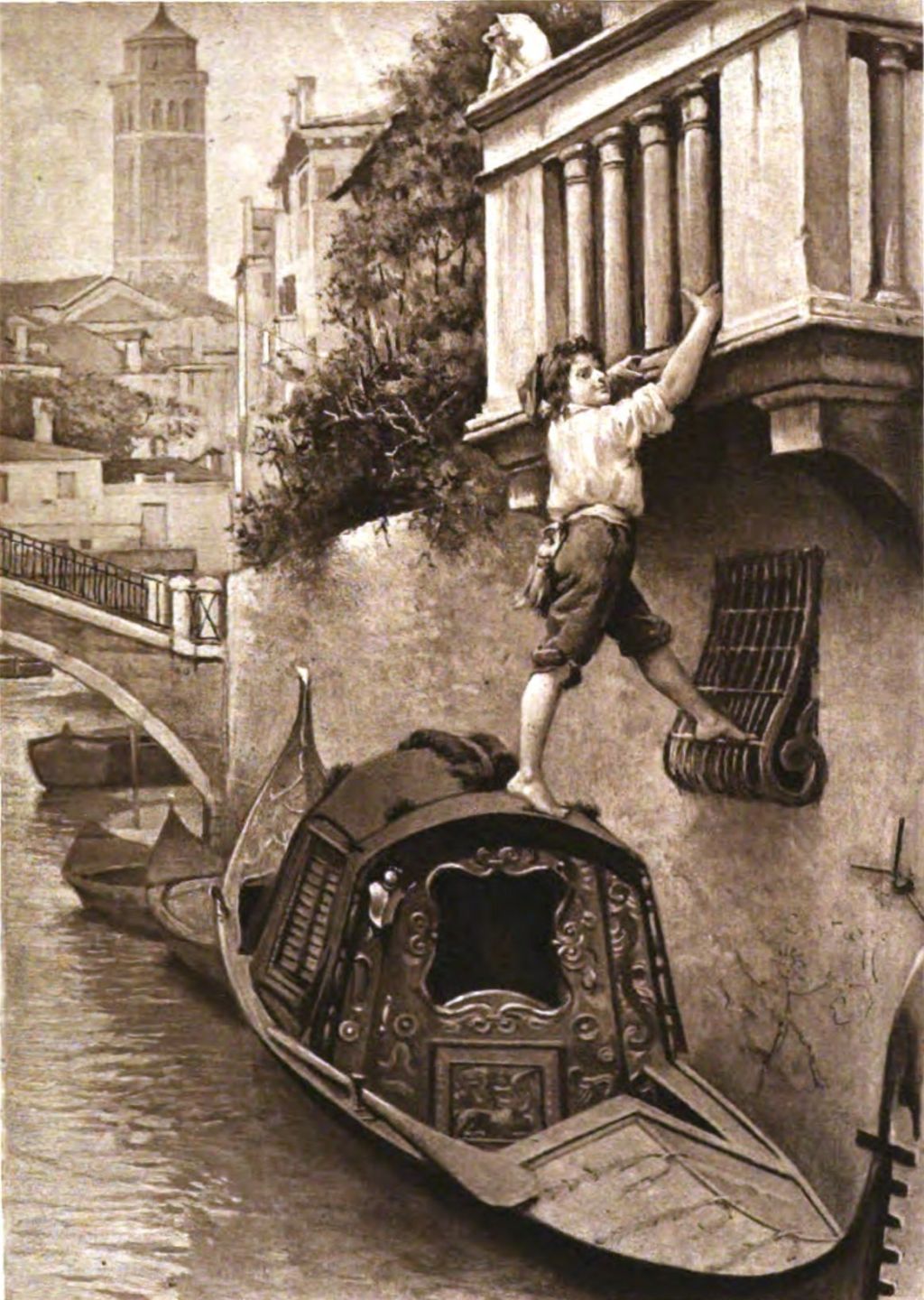
NELLO ENTERS THE ALDINI PALACE.
While my master was at the wineshop, I climbed on the awning of my gondola, and thence to the sill of a window on the lower floor; then I grasped the balcony rail, drew myself up, climbed over it and found myself behind the curtain.
My curiosity on this subject took such complete possession of my young brain that one day I yielded to a temptation I had conquered many times. While my master was at the wineshop, I climbed on the awning of my gondola, and thence to the sill of a window on the lower floor; then I grasped the balcony rail, drew myself up, climbed over it and found myself behind the curtain.
I had before me the interior of a sumptuously furnished cabinet; but the only object that struck my eye was the harp, standing silent amid the rest of the furniture, above which it towered proudly. The ray of sunlight which shone into the cabinet when I drew the curtain partly aside fell upon the gilding of the instrument, and made the beautiful carved swan that surmounted it gleam brightly. I stood motionless with admiration, never wearying of examining its slightest details, the graceful frame, which reminded me of the prow of a gondola, the slender chords, which seemed to be of spun gold, the gleaming copper, and the satin-lined wooden case, whereon were painted birds, flowers, and butterflies, richly colored and of an exquisite workmanship.
However, amid all those superb objects, the shape and uses of which were quite unfamiliar to me, my mind was still beset by doubt. Was I not mistaken? Was it really the harp that I was looking at? I determined to make sure of it; I entered the cabinet and placed an awkward, trembling hand on the strings. O rapture! they answered to my touch. Impelled by indescribable excitement, I made all those resonant voices speak, at random and in a sort of frenzy, and I do not believe that the most skilful and most skilfully led orchestra has ever, since that day, afforded me so much pleasure as the horrible confusion of sounds with which I filled Signora Aldini's apartment.
But my joy was not of long duration. A servant who was at work in the adjoining rooms ran to investigate the noise, and was so enraged to find that a little clodhopper in rags had stolen in that way and was abandoning himself to the love of art with such shocking disregard of the proprieties, that he set about expelling me by beating me out with his broom. I did not care to be dismissed in that way, and prudently retired to the balcony, intending to go away as I had come. But before I could climb over the balustrade, the servant pounced upon me, and I found myself confronted by the alternative of being beaten or turning a ridiculous somersault. I adopted a violent course, namely, to avoid the blow by stooping quickly, grasping my adversary by the legs, and thus throwing him forward with his breast against the balcony rail. Then to lift him up and throw him into the canal was the affair of a moment. That is the game that the children practise on one another at Chioggia. But I had no time to reflect that the balcony was twenty feet above the water, and that the poor devil of a footman might not know how to swim.
Luckily for him and for me he came to the surface at once and clung to the boats at the traghetto. I was horribly frightened when I tossed him over; but, as soon as I saw that he was safe, I began to think about making my escape; for he was roaring with rage and would surely set all the pack of servants in the Aldini Palace upon me. I passed through the first door I saw, and, hurrying through the corridors, was about to go downstairs, when I heard indistinct voices apparently coming toward me. I ran upstairs again in hot haste, and took refuge under the eaves, where I hid in a garret among old worm-eaten pictures and discarded furniture.
I remained there two days and two nights, without a mouthful of food, afraid to venture forth into the midst of my enemies. There were so many people and so much going and coming in that house that one could not take a step without meeting some one. Through the little round windows in the garret I heard the remarks of the servants in the corridors of the floor below. They talked about me almost continuously, indulged in a thousand conjectures concerning my disappearance, and promised to give me a sound thrashing if they succeeded in catching me. I also heard my master on his gondola expressing surprise at my absence, and exulting at the thought of my return, with no less kindly designs. I was brave and strong; but I realized that I should be overborne by numbers. The prospect of being beaten by my master troubled me but little; that was one of the hazards of being an apprentice, which involved no disgrace. But the idea of being chastised by servants was so horrifying to me that I preferred to die of hunger. And my adventure came very near ending in that way. At fifteen years one does not readily endure starvation diet. An old lady's-maid, who came to the garret in search of a runaway pigeon, found instead of her fugitive the poor barcarolino, unconscious and almost dead, at the foot of an old canvas representing a Saint Cecilia. The point that impressed me most profoundly in my distress was that the saint had in her arms a harp of antique shape, which I had abundance of leisure to contemplate amid the torments of hunger, and the sight of which became so hateful to me that for a long time thereafter I could not endure the sight or sound of that fatal instrument.