Volume 2 — Introductory material (continued 2)
George Burnham Ives translation
Mila being thus comforted and reconciled with herself, the princess, in an outburst of childlike merriment, proposed to her that she should change her dress to assist her to recover from the fatigue of her expedition, and that then they should go and surprise her father and brother at the marquis's villa.
"We will go on foot," she said, "for it is close by if we go by way of the garden; and we will dine together first. Then we shall have the darkness and cool breeze of early evening, and in addition a travelling companion whom you do not expect perhaps, but whom you will not be sorry to see, for he is a friend of yours."
"I wonder who it can be," said Mila, with a smile; she guessed shrewdly enough, but with respect to her heart's secret, and to that alone, she recovered all the prudence of the feminine mind.
The dinner and the preparations of the two friends occupied about an hour; after which the maid came and whispered to the princess: "The young man of last evening, at the end of the garden, by the eastern gate."
"That is right," said the princess, leading Mila away; "that is our road." And they hurried across the park, joyous and light of heart; for both were born again to the hope of happiness.
Magnani was walking back and forth, melancholy and distraught, waiting to be sent for to go to the palace, when two veiled women, issuing from the clumps of myrtle and orange, ran to him, and grasping each an arm, hurried him along with them without speaking. He recognized them perfectly, the princess better than Mila, who seemed to him to be dressed more elaborately than usual under her light cape; but he was too deeply moved to speak, and he pretended to accept this gracious jest gayly. A smile played about his lips, but his heart was troubled; and, while he sought relief from the perturbation caused by Agatha's presence, he derived but little assistance from feeling Mila's arm in his.
As they passed into the marquis's park, the princess put aside her veil and said to him:
"My dear friend, I intended to talk with you at my house; but my impatience to announce some good news to our friends, who are visiting the marquis, led me to bring you here with us. The whole evening belongs to us, and I can talk with you here as well as elsewhere. But let us go forward noiselessly; we are not expected and I want to surprise them."
The marquis and his guests, after conversing a long time, were still on the terrace looking out upon the sea, where the horizon was ablaze with the last rays of the sun, while the stars appeared one by one in the zenith. Michel was listening with deep interest to the marquis, whose conversation was instructive, albeit always affable and unaffected. What was his surprise when, on raising his head, he saw three persons seated about the table, laden with refreshments, which he had just left to walk to the balustrade, and when, in those three persons, he recognized Agatha, Mila, and Magnani!
At first he had no eyes except for Agatha, and hardly recognized his sister and his friend. The princess was dressed, however, with the utmost simplicity, in a dress of pearl-gray silk, with a guardaspalle of black lace thrown over her head and shoulders. She seemed to him a little less fresh and youthful than she had appeared under the bright lights. But, in a moment, the charm of her manner, her frank smile, her pure and sincere glance, made her seem even younger and more attractive than on the first day.
"Are you surprised to see your dear daughter here?" she asked Pier-Angelo. "But she told you, did she not, that she should not dine alone? And you see! you left her at home, and like Cinderella, she appears in the midst of the fête, resplendent in costume and beauty. As for Master Magnani, he is the enchanter who attends her; but as we are not dealing with Don Magnifico on this occasion, the enchanter will not dazzle the father's eyes so that he will not recognize his cherished daughter. Cinderella therefore can challenge the glances of all present."
As she spoke Agatha raised Mila's veil, and disclosed her radiant as a sun; such is the expression of the legend.
Michel looked at his sister. She was fairly beaming with confidence and joy. The princess had arrayed her in a gown of bright pink silk, with several strings of beautiful great pearls about her neck and arms. A wreath of natural flowers, wonderfully beautiful and arranged with consummate art, crowned her dark face without concealing the abundant treasures of her hair. Her little feet were daintily shod, and her pretty fingers opened and closed Agatha's splendid fan with as much grace and dignity as any marchesina. She was a muse of the Renaissance, a patrician maiden, and a lovely damsel of the South, radiant with health, nobility, and poetic charm.
Agatha looked at her with an air of motherly pride, and smiled lovingly as she talked of her in Pier-Angelo's ear.
Michel then turned his eyes upon Magnani. He was gazing alternately at the modest princess and the lovely silk-spinner of the Catanian suburb with extraordinary emotion. He was no better able than Michel to understand the strange and bewildering dream in which he seemed to be moving. But it is certain that he saw Mila only through a cloud of gold and fire, which emanated from Agatha and was projected upon her young friend as if by magic.
XLI JEALOUSY AND GRATITUDE
The princess led the marquis and Pier-Angelo aside to tell them that Ninfo was in the Piccinino's hands, and that she had been so informed by an eye-witness of his capture whom she was not at liberty to name.
More ices were brought, and the conversation was renewed. Despite Magnani's perturbation and timidity, despite Michel's excitement and preoccupation, the princess and the marquis speedily tranquillized the two young men, thanks to the judicious courtesy and the great art of being simple, which well-bred people possess when the foundation of their character corresponds with the external charm due to exquisite tact. Thus Agatha questioned Michel concerning subjects with which he was familiar, and on which he felt deeply. The young artist was overjoyed by her perfect comprehension of art, and he stored away in his memory several far-reaching definitions which she let fall, her mode of expressing herself was so simple and natural. When she spoke to him she seemed to be consulting rather than instructing him, and her glance, alight with penetrating sympathy, seemed to seek in Michel's eyes confirmation of her own opinions and ideas.
Magnani understood all that was said, and, although he seldom ventured to speak, it was easy to read on his intelligent face that none of the ideas advanced were beyond the reach of his intellect. That young man had unusual faculties which would never have been cultivated, perhaps, but for his romantic passion. From the day that he first became enamored of the princess he had constantly devoted a portion of his leisure to reading and to the study of such works of art as he had been privileged to see. He had employed his vacations—what mechanics call the dead season—in travelling about Sicily on foot, viewing the treasures of antiquity with which that island, so beautiful in itself, is thickly strewn. While saying to himself that he was determined to remain humble and obscure, and persuading himself that he had no desire to depart from the rough simplicity of his class, he had been impelled by an irresistible instinct to improve his mind.
The conversation having become general, was pleasant, unconstrained, and even merry, thanks to Pier-Angelo's sallies and Mila's artless remarks. But her artlessness was so touching that, far from wounding Michel's self-esteem in the princess's presence, it displayed his young sister's fifteen years to him in a new light. It is certain that he had paid too little heed to the very great change which a year had caused in the ideas of a girl of her age, when, thinking that he still had to do with a heedless and timid child, he had undertaken to blast all the hopes of her heart with a word. In every word that Mila said she manifested immense progress in respect to intelligence and decision of character, and the contrast between that development of her mind, and the inexperience, innocence and simplicity of her heart, presented a spectacle at once charming and affecting. The princess, with the delicate tact which women alone possess, caused Mila's charm to stand out in bolder relief by her replies, and neither Michel, nor Magnani, nor Pier-Angelo himself, had ever before imagined how much enjoyment might be derived from talking with that maiden.
The moon rose, silvery white, in the cloudless sky. Agatha suggested a walk in the garden. They started together; but the princess soon strolled away from the others with Magnani, whose arm she took familiarly; and for half an hour they remained so far away from their friends that they were often out of sight.
We will not divulge at this point what the princess had to say in confidence to the young mechanic during that tête-à-tête, which seemed to Michel so long and so extraordinary; indeed, we shall not divulge it at all. The reader will divine it at the proper time.
But Michel was unable to form the faintest idea of it, and he was on the rack. He ceased to listen to the marquis; he was much more inclined to tease and contradict Mila. He laughed at her costume and picked flaws in it under his breath, and almost made her cry; so that she finally whispered to him: "Michel, you always were jealous, and you are jealous at this moment."
"Jealous of what, pray?" he retorted bitterly; "of your pink dress and your pearl necklace?"
"No," she said, "but of the princess's friendship for your friend and her confidence in him. Oh! I remember how you used to sulk when we were children, if mamma kissed me more than you."
When the princess and Magnani joined them again, Agatha seemed calm and Magnani deeply moved. But his noble face was even graver than usual, and Michel noticed that his manner had undergone a remarkable change. He no longer seemed to be at all confused by Agatha's presence. When she spoke to him, the reply no longer trembled on his lips; he no longer turned his eyes away in dismay, and, instead of the terrible suffering he had previously displayed, he was calm, attentive and thoughtful. They talked a few moments longer, then the princess turned to go. The marquis offered his carriage. She declined it. "I prefer to walk back through the gardens as I came," she said; "and, as I must have an escort, although we no longer have any enemies to fear, I will take Michelangelo's arm—unless he refuses!"—she added, with a quiet smile, observing the young man's confusion.
Michel could find no words for a reply; he bowed and offered her his arm. An hour earlier he would have been beside himself with joy. Now it wounded his pride to receive in public a favor which Magnani had received privately and as it were in secret.
Pier-Angelo took his leave with his daughter, to whom Magnani did not offer his arm. So much ceremonious courtesy was not in his line. He affected to be ignorant of the rules of politeness because he detested imitation, but in reality his manners were always gentle and amiable. After a few steps he found himself so near Mila that he naturally took her round elbow in his hand to guide her through the narrow lanes of the suburb, and walked with her, supporting her thus, to her door.
Michel had started off encased in his pride as in a cuirass, mentally accusing the princess of caprice and coquetry, and firmly resolved not to allow himself to be dazzled by her advances. And yet he confessed to himself that he was entirely unable to understand the irritation that he felt. He was forced to say to himself that she was immeasurably kind, and that if she was, in fact, indebted to old Pier-Angelo, she paid her debt with all the treasures of delicacy and refinement which a woman's heart can contain.
But Michel could not forget all the problems which he had been trying for two days to solve; and the way in which the princess pressed his arm at that moment, as they walked, like a woman passionately in love or a nervous person unaccustomed to walking, was a fresh problem which the idea of a service rendered the signora by his father did not sufficiently explain.
He strode forward at first in silence, saying to himself that he would not speak first, that he would not give way to emotion, that he would not forget that Magnani's arm had probably been pressed in the same way; in a word, that he would be on his guard: for either Princess Agatha was mad, or she concealed the most insane coquetry beneath a virtuous and downcast exterior.
But all his fine plans came to naught. The shady paths that they trod, with plots of land carefully tilled and planted on each side, led through a succession of small gardens belonging to well-to-do mechanics or middle-class citizens of the town. The paths were separated from the plots only by shrubs, rose-bushes, or beds of aromatic herbs. Here and there vine-clad arbors cast a dense shadow about them. The moon's rays were oblique and uncertain. Innumerable perfumes arose from the flower-strewn fields, and the sea, behind the hills in the distance, murmured in amorous tones. Nightingales sang among the jasmines. Some human voices sang in the distance, gayly challenging the echo; but there was no one on the path which Michel and Agatha were following. The little gardens were deserted. Michel felt oppressed; his pace slackened, his arm trembled convulsively. A faint breeze blew the princess's veil near his face, and he fancied that he heard mysterious voices whispering in his ear. He dared not turn to see whether it was a woman's breath or the breath of night that caressed him so near at hand.
"My dear Michel," said the princess, in a calm tone, which brought him abruptly from the sky to the earth, "I ask your pardon, but I really must stop to take breath. I am not much accustomed to walking, and I feel very tired. Here is a bench under this arbor which invites me to sit down for five minutes, and I fancy that the owners of this little garden, if they should see me, would not accuse me of committing a crime if I take advantage of it."
Michel led her to the bench to which she pointed, and, restored to reason once more, walked a few steps away to look at a little fountain whose soft gurgling failed to divert him from his reverie.
"Yes, yes, it was a dream, or else it was my little sister Mila who gave me that kiss. She is a mocking madcap! she would have explained the great mystery of the locket to me if I had questioned her frankly and earnestly. Doubtless there is some perfectly natural cause for all this which does not occur to me. Isn't it always so with natural causes? The only one that one does not divine is always the simplest. Ah! if Mila knew what danger she is playing with, and what pain she might spare me by telling me the truth! I will press her so to-morrow that she will tell me everything!"
While Michel reflected thus, the crystal water murmured in its narrow basin, wherein quivered the spectre of the moon. The fountain was a small terra-cotta affair, of classic simplicity; an aquatic cupid grasping a huge carp from whose mouth the stream of water fell about a foot into the reservoir. The artist who had executed the figure had attempted to give it a mischievous expression, but he had succeeded only in imparting to the carp's great eyes a glare of grotesque ferocity. Michel looked at the group without seeing it, and to no purpose was the night soft and fragrant; he, passionate lover of nature that he was, absorbed by his own thoughts, denied to nature his accustomed homage on that evening.
And yet the murmur of the water acted upon his imagination without his realizing it. He remembered a similar melodious sound, the timid and melancholy murmur with which the marble Naiad filled the grotto of the Palmarosa palace as she emptied her urn into the basin; the blissful sensations of his dream passed before his mind once more, and he would fain have fallen asleep where he stood, hoping for a repetition of his hallucination.
"But what am I thinking of!" he suddenly said to himself; "am I not a most absurd novice? Did she not stop here in order to invite me to prolong an ardent tête-à-tête? I took that sudden fatigue, that fancy to sit in the first garden that we came to, for an honest explanation of the confusion she felt—was it not intended as an encouragement to my uncouth timidity?"
He eagerly approached the princess, feeling emboldened by the shadow of the arbor. The bench was so small that, unless he asked her to make room for him, he could not sit beside her. He sat down on the grass, not precisely at her feet, but near enough to be nearer still ere long.
"Well, Michel," she said to him, with an indescribable sweetness in her voice, "are you also tired, pray?"
"I am worn out," he replied, in a tone of deep emotion which made the princess start.
"What do you mean? you are not ill, my child?" she said, putting out her hand, which came in contact with the young man's silky hair in the darkness.
With one bound he was at her knees, his head bent, as it were fascinated beneath that hand which did not repel him, his lips pressed to the hem of that floating silk dress which could not betray his transports; uncertain, beside himself, lacking courage to declare his passion, lacking strength to resist it.
"Michel," cried the princess, letting her hand fall again upon the young madman's burning brow, "you are feverish, my child! your head is burning! Yes, yes," she added, stroking his cheeks with affectionate solicitude, "you have had too much fatigue these last few days; you have been awake two nights in succession, and although you threw yourself on your bed for a few hours this morning, I doubt if you slept much. And I have led you on to talk too much to-night. You must go home. Let us walk on; you can leave me at the gate of my park and go home at once. I intended to say something to you to-night; but I am afraid that you are going to be sick; when you are thoroughly rested, perhaps I will speak to you."
She attempted to rise; but Michel was kneeling on the edge of her dress. He held against his cheeks, he put to his lips that lovely hand which did not seek to avoid his caresses.
"No, no," cried Michel, impetuously, "let me die here. I know very well that you will drive me from your presence forever to-morrow; I know that I shall never see you again, now that you see what is taking place within me. But it is too late, and I am going mad! Oh! do not pretend to believe that I am ill because I have worked by day and been awake all night! Do not be afraid to discover the truth; it is your own fault, signora, you would have it so! Could I resist so many temptations? Spurn me, Agatha, curse me; but to-morrow, to-night, give me the kiss I dreamed of in the Naiad's grotto!"
"Ah! Michel," cried the princess, in a tone impossible to describe, "did you feel it? did you see me? do you know all? Did somebody tell you, or did you divine it? It is God's will. And you fear that I will spurn you? you fear that I will curse you? O my God! is it possible? Pray, does not what is taking place in your heart reveal to you the love with which mine is overflowing?"
As she spoke the lovely Agatha threw her arms around Michel's neck, and, drawing his head to her breast, covered it with ineffable kisses.
Michel was eighteen years old, he had a fiery heart, a restless, all-devouring temperament, vast pride, and an enterprising spirit. But his heart was as pure as his age, and his happiness found him chaste and prostrate in religious adoration. All his jealousy, all his insulting suspicions vanished. It no longer occurred to him to wonder how a person so austere in her morals, who was supposed never to have had a lover, could suddenly fall in love at first sight with a child like him, and tell him so with such absolute candor. He was conscious of nothing save the joy of being loved, an enthusiastic and unbounded gratitude, a fervent, blind adoration. From Agatha's arms he fell at her feet, and covered them with passionate, almost pious kisses.
"No, no, not at my feet, on my heart!" cried the princess; and she held him there a long while in a fervent embrace, weeping freely.
Her tears were so sincere—they had such a sacred eloquence of their own—that Michel felt a great wave of sympathy. His heart swelled and he burst into sobs; a divine joy banished all thought of earthly joy. He found that that woman aroused in him no profane desire; that he was happy and not excited in her arms; that to mingle his tears with hers, and to feel that he was loved by her, was happiness greater than all the transports of which his youth had dreamed; in a word, that he respected her even to dread, as he held her pressed against his heart, and that there never could be a thought between her and him which the angels might not read with a smile on their lips.
He felt all this, confusedly without doubt, but so deeply, and with such a thrill of triumph, that Agatha never suspected the evil impulse of fatuous conceit which had brought him to her feet a few moments before.
Thereupon Agatha, raising her lovely glistening eyes to heaven, her face pale in the moonlight, and as it were rapt in a divine ecstasy, cried, in a transport of joy: "O my God! how I thank Thee! This is the first moment of happiness that Thou hast given me; but I do not complain of having had to wait so long, for it is so great, so pure, so complete, that it effaces and redeems all the sorrows of my life!"
She was so lovely, she spoke with such sincere enthusiasm, that Michel fancied that he had before him a saint of ancient days. "O my God! my God!" he exclaimed in a voice stifled by emotion, "I, too, bless Thee! What have I done to deserve such happiness? To be loved by her! Oh! it is a dream; I dread to wake!"
"No, it is not a dream, Michel," rejoined the princess, turning her inspired glance upon him once more; "it is the only reality of my life, and it will be the one great reality of your whole life. Tell me, what other being than you I could love on this earth? Hitherto I have done nothing but suffer and languish; but now that you are here, it seems to me that I was born for the greatest human felicity. My child, my beloved, my sovereign consolation, my only love! Oh! I cannot speak any more, I do not know what to say to you; joy overwhelms and crushes me!"
"No, no, let us not talk," cried Michel. "No words can describe what I feel; and, thank heaven, I do not yet grasp the whole extent of my happiness; for, if I did, it seems to me that I should die of it!"
XLII AN EMBARRASSING CONJUNCTURE
The sound of footsteps not far away aroused them both from their delirious excitement. The princess rose, somewhat alarmed by the approach of strangers, and, seizing Michel's arm, hurried on toward her villa with him. She walked more rapidly than before, carefully veiled, but leaning upon him with a sacred joy. And he, with wildly-beating heart, bewildered with happiness, but penetrated with the most profound respect, hardly dared to raise to his lips from time to time the hand that he held in his.
Not until he saw the gate of the princess's garden before him did he recover the power of speech.
"What! leave you already?" he said anxiously; "part so soon? It is impossible! I shall die of excitement and despair."
"We must part here," said the princess. "The time has not come when we shall not part at all. But that happy day will come soon. Have no fear; leave everything to me. Rely upon me and my boundless love to see to it that we are united forever."
"Is it possible? Do these words that I hear really come from your mouth? That day will come, you say? We shall be united? we shall never part? Oh! do not trifle with my simplicity! I dare not believe in such happiness; and yet, when it is you who say it, I cannot doubt!"
"Doubt the permanence of the stars that shine above us, doubt your own existence rather than the power of my heart to overcome the obstacles which seem to you so immense, but which now seem to me so trifling! Ah! on the day when I shall no longer have aught except the world to fear, I shall be very strong, I promise you!" "The world?" said Michel. "Ah! yes, I remember; I had forgotten everything except you and myself. The world will deny you, the world will be offended with you, all because of me! O God, forgive the impulses of my pride! I abhor them now. Oh! let my happiness be shrouded in mystery, and let no one know of it! I insist that it shall be so; I will never suffer you to ruin yourself for love of me."
"Noble-hearted child!" cried the princess, "let your mind be at rest; we will triumph together; but I thank you for this generous impulse of your heart. Ah! yes, all your impulses are generous, I know. I am not happy simply, I am proud of you!"
And she took the young man's head in both hands and kissed him again.
But Michel thought that he heard footsteps a short distance away, and the fear of compromising that courageous woman triumphed over his happiness.
"We may be watched or surprised," he said to her; "I am sure that someone is coming this way. Fly! I will stay hidden in the bushes here until these people, whether spies or mere passers-by, are out of hearing. But we shall meet to-morrow, shall we not?"
"Oh! surely," she replied. "Come here in the morning, as if to work, and go up to my Casino."
She pressed him to her heart once more, then entered the park and disappeared among the trees.
The noise he had heard had ceased, as if the persons who were approaching had gone in another direction.
Michel stood for a long time, motionless as a statue, and as it were bereft of reason. After so many fascinating illusions, after such mighty efforts not to believe in them, he was falling back once more under the empire of dreams—at least he feared so. He dared not believe that he was awake; he was afraid to take a step—to move a muscle—lest he might thereby dispel the illusion once more, as in the Naiad's grotto. He could not decide to question reality. Even the probabilities frightened him. How could Agatha love him? Why did she love him? He could find no answers to those questions, whereupon he cast them aside as blasphemous. "She loves me! she told me so!" he exclaimed mentally. "To doubt it would be a crime. If I distrusted her word, I should be unworthy of her love."
And he plunged into an ocean of blissful reveries. He lifted up his thoughts toward heaven, which had caused him to be born to so happy a fate. He felt capable of the greatest deeds, since he was deemed worthy of the greatest joys. Never had he believed so fervently in the divine mercy, never had he felt so proud and so humble, so devout and so brave.
"O my God!" he said in his heart, "forgive me; until this day I believed myself to be a creature of some importance. I was proud, I abandoned myself to self-love; and yet I was not loved. Not until to-day have I really lived. I have received life, I have received a heart, I am a man! But I shall never forget that of myself I am nothing, and that the enthusiasm which possesses me, the strength which overflows within me, the virtue of which I realize the full worth to-day, were born under that woman's breath, and live in me only through her. O day of boundless bliss! O sovereign tranquillity, ambition satisfied without selfishness and without remorse! O blessed victory which leaves the heart modest and overflowing with generous sentiments! Love is all this and more. How kind Thou art, O God, not to have allowed me to divine it beforehand, and how vastly this surprise enhances the ecstasy of a heart just coming forth from its utter insignificance!"
He was about to walk slowly away when he saw a dark figure glide along the wall and disappear among the branches. He drew back still farther into the shadow to watch, and soon he recognized the Piccinino, as he removed his cloak and tossed it over the wall, so that he might scale it more readily.
All Michel's blood flowed back toward his heart. Was Carmelo expected? Had the princess authorized him to come and confer with her, at any hour of the night, and to introduce himself into her villa by any means he might choose? It is true that there were important secrets between them, and that, it being more natural, as he said, for him to travel as the crow flies, scaling a wall by night was a natural method of procedure for him. He had warned Agatha that he might ring the bell at the gate of her flower-garden when she least expected him. But was it not unwise on her part to give him permission? Who could be sure of the intentions of such a man as the Piccinino? Agatha was alone; would she be imprudent enough to admit him and listen to him? If she carried her confidence to that point, Michel could not make up his mind to share it. Did she realize that that man was in love with her, or that he pretended to be? What had they said to each other in the flower-garden, while Michel and the marquis looked on but could not hear?
Michel fell headlong from the sky to the earth. A violent paroxysm of jealousy took possession of him, and, to delude himself, he tried to make up his mind that he feared nothing but the danger of insult for the lady of his thoughts. Was it not his duty to watch over her safety and to protect her against the whole world?
He noiselessly opened the gate, the key of which he had retained as well as that of the flower-garden, and glided into the park, resolved to watch the enemy. But, after the Piccinino had agilely scaled the wall, he could find no trace of him.
He walked toward the cliff, and, being perfectly certain that there was nobody in front of him, he decided to ascend the staircase cut in the lava, turning every moment to see if the Piccinino were following him. His heart beat very fast, for a conflict with him upon that staircase would have been decisive. On seeing him there, the brigand would have realized that he had been deceived, that Michel was Agatha's lover—and to what extremities would his rage not have impelled him? Michel did not fear a bloody struggle on his own account; but how could he prevent Carmelo from wreaking vengeance upon Agatha, if he should come forth alive from that struggle?
Nevertheless, Michel kept on to the top, and, having made sure that he was not followed, entered the flower-garden, locked the gate, and approached Agatha's boudoir. The room was lighted, but empty. A moment later a maid came and extinguished the candles, then went away. All was silence and darkness.
Michel had never been more intensely disturbed. His heart beat as if it would burst, as the silence and uncertainty continued. What was taking place in Agatha's apartments? Her bedroom was behind the boudoir; it could be entered from the flower-garden through a short passage where a lamp was still burning. Michel could see it by looking through the key-hole of the carved door. Perhaps that door was not locked on the inside. Michel tried it, and, meeting with no resistance, entered the Casino.
Where was he going and what did he intend to do? He had no very clear idea himself. He said to himself that he was going to the assistance of Agatha, whose security was threatened by the Piccinino. He did not choose to admit that he was spurred on by the demon of jealousy.
He fancied that he could hear voices in Agatha's bedroom. They were two women's voices: they might be Agatha's and her maid's, or the second one might be Carmelo's soft and almost feminine voice.
Michel stood irresolute, trembling from head to foot. If he should go back into the flower-garden, the door of the passage-way would doubtless soon be locked by the maid; and in that case how was he to get in again unless by breaking a pane of glass in the boudoir—an expedient suited to the genius of the Piccinino, but naturally repugnant to Michel.
It seemed to him that centuries had passed since he saw the bandit climb the wall; but it was less than a quarter of an hour. However, one can live years in a minute, and he said to himself that the Piccinino had evidently preceded him, as he was so slow about following him.
Suddenly the door of Agatha's bedroom opened, and Michel had barely time to step behind the pedestal of the statue which held the lamp. "Lock the garden door," said Agatha to her maid, who came out of the bedroom, "but leave this one open; it is horribly hot in my room."
The girl returned after obeying her mistress's orders. Michel was comforted, Agatha was alone with her maid. But he was locked in, and how could he get out? or how could he explain his presence if he were discovered hiding there at the princess's door?
"I will tell the truth," he thought, not admitting to himself that it was only half of the truth. "I will say that I saw the Piccinino climb the park wall, and that I came to defend her whom I adore against a man whom I do not trust."
But he determined to wait until the maid had been dismissed, for he did not know whether she possessed her mistress's entire confidence, and whether she would not attribute a criminal meaning to that mark of their intimacy.
A few moments later, Agatha did dismiss her. There was a sound of footsteps and of doors, as if the maid closed them all behind her as she withdrew. Determined not to delay showing himself, Michel resolutely entered Agatha's bedroom, but found himself alone there. The princess had gone into her oratory before retiring, and Michel saw her kneeling on a velvet cushion. She was dressed in a long, floating white robe. Her black hair fell to her feet in two great braids, the weight of which would have disturbed her sleep if she had kept them about her head at night. The faint light of a lamp under a bluish globe cast a melancholy, transparent reflection upon her, which made her resemble a ghost. Michel paused, overcome with respect and dread.
But, as he was hesitating whether he should interrupt her prayer, and wondering how he could attract her attention without frightening her, he heard the door of the little passageway open, and steps, so light that none but a jealous lover's ear could distinguish them, approach Agatha's bedroom. Michel had just time to jump behind the bedstead of carved ebony, decorated with small ivory figures. It did not stand against the wall, as our beds do, but some little distance away, as is customary in hot countries, with its foot near the centre of the room. Between the wall and the high headboard of that ancient piece of furniture there was sufficient room for Michel to hide. He did not stoop for fear of moving the white satin curtains. He had no time to take many precautions. Chance favored him, for, despite the swift and inquisitive glance which the Piccinino cast about the room, he saw no disorder, no movement to betray the presence of a man who had arrived before him.
Nevertheless, he was about to take the prudent course of making a thorough search, when the princess, hearing his light footsteps, half rose, saying:
"Is that you, Nunziata?"
Receiving no reply, she put aside the portière which half concealed the interior of her bedroom, and saw the Piccinino standing in front of her. She rose to her feet and stood motionless with surprise and terror.
But, realizing that she must not betray her painful emotion in the presence of a man of that character, she kept silent so that her altered voice might reveal nothing, and walked toward him as if expecting him to explain his audacious visit.
The Piccinino knelt on one knee, and said, handing her a folded parchment:
"Signora, I knew that you must be extremely anxious concerning this important document, and I did not wish to postpone its delivery until to-morrow. I came here during the evening, but you were absent, and I was obliged to wait until you had returned. Forgive me if my visit is somewhat opposed to the proprieties of the society in which you live, but your highness is aware that I am compelled to act on all occasions, and especially in this matter, with the greatest secrecy."
"Signor captain," replied Agatha, after opening and glancing at the parchment, "I knew that my uncle's will had been stolen from Doctor Recuperati this morning. The poor doctor came here this afternoon, quite beside himself, to tell me of his misadventure. He could not imagine how his wallet had been taken from his pocket, and he accused Abbé Ninfo. I was not alarmed, because I felt sure that Abbé Ninfo would have to account to you for his theft in the course of the day. So I comforted the doctor, bidding him not mention the incident, and promising him that the will would soon be recovered. You can well believe that I could give him no hint as to how it would be done and by whom. Now, captain, it is not proper for me to have in my hands a document which I should have the appearance of having seized because I was distrustful of my uncle's intentions or the doctor's good faith. I will ask you, therefore, when the moment to produce it shall have come, to restore it by some means, indirect but sure, to the depositary who previously had it in charge. You are too ingenious not to discover such a means without betraying yourself in any way."
"You wish me to take charge of this again? can you think of such a thing, signora?" said the Piccinino, who was still standing and waiting impatiently an invitation to sit; but Agatha stood as she spoke to him, as if she anticipated his speedy withdrawal, while he was determined to prolong the interview at any price. He suggested difficulties.
"It is impossible," he said; "the cardinal is in the habit of signifying with his eyes that he wants his will to be shown to him, and he thinks of it every day. To be sure," he added, to gain time, resting his hand on the back of a chair as if he were very tired, "to be sure, the cardinal, being deprived of his interpreter, Abbé Ninfo, it would be easy for the doctor to pretend that he did not understand his eminence's eloquent glances.—Especially," continued the brigand, moving his chair a little and resting his elbow on it, "especially as the doctor's usual stupidity would make his failure to understand very probable. But," he added, respectfully offering the chair to the princess so that she might set him the example of sitting down, "the cardinal's meaning may be understood by some other trusty servitor, who would force the excellent doctor to the wall by saying to him: 'You see, his eminence wants to look at his will!'"
And the Piccinino made a graceful gesture to indicate that it pained him to see her standing before him.
But Agatha did not choose to understand, nor was she willing to keep the will, in order to avoid having to thank the Piccinino at such a moment in terms which should offend him by too great reserve, or encourage him by too great warmth. She was determined to maintain her proud attitude, while overwhelming him with manifestations of a confidence without bounds so far as her material interests were concerned.
"No, captain," she said, still standing and in perfect control of herself, "the cardinal will not ask again to see the will, for his condition has grown much worse in twenty-four hours. It seems that that wretched Ninfo kept him in a state of excitement which prolonged his life; for, since he disappeared this morning, my uncle has been in a sort of lethargic state, bordering closely, I doubt not, on the repose of the grave. His eyes are dull; he no longer seems to pay any heed to what is going on about him. He does not notice the absence of his familiar, and the doctor is compelled to resort to all the expedients of his profession to combat a drowsiness from which he fears that there will be no awakening."
"Doctor Recuperati has always lacked common sense," rejoined the Piccinino, seating himself on the edge of a console, and letting his cloak fall at his feet as if by inadvertence. "I ask your highness," he added, folding his arms across his breast, "if the so-called laws of humanity are not absurd and false in such cases, like almost all the laws of human respect and hypocritical propriety? What benefit do we confer on a dying man when we try to recall him to life, with the certainty that we shall not succeed, and that we are simply prolonging his torture in the world? If I were in Doctor Recuperati's place, I would say to myself that his eminence has lived quite long enough. It is the opinion of all respectable people, and of your highness yourself, that that man has lived too long. It is high time to allow him to repose from the fatiguing journey of this life, since he seems to desire it, so far as he himself is concerned, and to arrange his head comfortably on his pillow for his last sleep. I ask your highness's pardon for leaning on this console; my legs are giving way under me, I have run about so much to-day in your interest; and if I do not rest for a moment, it will be impossible for me to return to Nicolosi to-night."
Agatha made a gesture which invited the brigand to occupy the chair that stood between them; but she remained standing herself, to signify that she did not propose that he should abuse the privilege.
XLIII A CRISIS
"It seems to me," said the princess, as she placed the will on the console at the Piccinino's elbow, "that we are digressing a little from the real question. I will remind your lordship of the facts. My uncle has a few moments to live, and he will not think of his will again. Thus the day when the document must be produced is near at hand. Now, I am very desirous that when that day comes it shall be in the doctor's hands and not in mine."
"That is a very noble scruple on your part," rejoined the Piccinino, in a firm tone which concealed his irritation; "but I have the same scruple on my own account, and, as everything strange and mysterious that happens on this island is attributed to the fabulous Captain Piccinino, I do not wish to have any hand in this restitution. Your ladyship will be kind enough, therefore, to arrange it in whatever way you may deem best. It was not I who stole the will. I found it on the thief. I bring it back; and I consider that I have done enough not to deserve the charge of lukewarmness in your service. Doubtless Abbé Ninfo's disappearance will soon be noticed, and the name of the Piccinino will occur at once to the popular imagination as well as to the crafty brains of the police authorities. Result, fresh investigations on the heels of those of which my humble personality is already the object, and which I have escaped thus far only by a miracle. I have accepted the risks of this affair; I have the monster in my power. Your highness's mind is at rest concerning the safety of your friends and your own freedom of action. You are in possession of the document that entitles you to great wealth. Do you wish my life? I am ready to lay it down for you a hundred times; but bid me to do it, and do not drive me to my destruction by subterfuges, without giving me the consolation of knowing that I die for you."
The Piccinino uttered these last words in a tone that made it impossible for Agatha longer to avoid entering upon a delicate subject.
"Captain," she said, forcing herself to smile, "you judge me ill if you think that I wish to rid myself of my burden of gratitude to you. My disinclination to take this paper, which represents to me the title to great wealth, should prove my confidence in you and my purpose to allow you to dispose absolutely of everything that belongs to me."
"I do not understand, signora," replied the bandit, moving restlessly on his chair. "Did you think that I came to your assistance merely to do a profitable stroke of business, and for no other purpose?"
"Captain," replied Agatha, outwardly unmoved by the Piccinino's real or pretended indignation, "you style yourself, and justly, the justicier d'aventure. That is to say, you do justice according to your heart and your conscience, without regard to formal laws, which are very often contrary to those of natural and divine justice. You assist the weak, you rescue victims, you protect those whose feelings and opinions seem to you to deserve your esteem against those whom you regard as the enemies of your country and of mankind. You punish cowards and you prevent the execution of their base designs. All this is a mission which legally constituted society does not always understand, but of which I appreciate the real merit and heroism. Need I say more to convince you of my esteem for you, and do you think that I have failed to manifest it? But since society denies the propriety of your intervention, and since, in order to continue it, you are forced to provide yourself with abundant resources, it would be insane—it would be impertinent—to seek your protection without offering you the means of putting it forth and of extending its scope. I thought of that—I could not fail to think of it; and I determined not to deal with you as with an ordinary advocate, but to allow you to fix yourself the price of your loyal and generous services. I should have considered that I insulted you by putting a price upon them. In my eyes they are beyond price. That is why, while I invite you to draw at your discretion upon a princely fortune, I am still forced to rely upon your modesty and generosity to consider that I have paid my debt to you."
"These are very flattering words, and your highness's soft speech would fascinate me, if my ideas were such as you attribute to me. But if you will deign to be seated a moment and listen to me, I shall be able to explain my ideas without fear of abusing the patience with which you honor me."
"On my word!" thought Agatha, as she took a seat at some distance from the Piccinino, "this man's persistence is like destiny, inevitable."
"I shall soon have finished," continued the Piccinino, with a crafty smile, when he saw that she was seated at last. "I look after my own interests while looking after other people's, that is true; but every man understands the advantages of life as circumstances impel him to do. Some people want nothing but gold. Those are vulgar instances,—the market price, as they say, I believe. But with certain others, who are more wealthy in charms and in noble qualities than in ducats, the intelligent man aspires to a less vulgar recompense. The material wealth of a person like Princess Agatha is a mere trifle compared with the treasures of generosity and delicacy which her heart contains. And if the man of action, who has devoted himself to her service, has done so with a certain degree of promptitude and zeal, is he not at liberty to aspire to some nobler gratification than that of putting his hand in her purse? Ah! yes, there are moral joys far more exalted, and the offer of your fortune as a substitute for them is so far from satisfying me, that it wounds my heart and my mind like an insult."
Agatha began to be really terrified, for the Piccinino had risen and drawn nearer to her. She dared not change her position, she feared that she should tremble and turn pale; and yet, brave as she was, that young man's face and voice caused her a frightful shock. His dress, his features, his manners, his voice awoke a whole world of memories within her, and, strive as she would to raise him to a level where she could esteem him and be truly grateful to him, an unconquerable aversion closed her heart to such sentiments. She had so long refused Fra Angelo's suggestions that this man's assistance should be procured, that she would assuredly have persisted in not having recourse to him, had it not been certain that Abbé Ninfo had tried to hire him to procure the assassination or abduction of Michel, pointing to the will as a means of rewarding his services.
But it was too late. The noble-hearted and ingenuous Capuchin of Bel Passo had not foreseen that his former ward, whom he had accustomed himself to look upon as a child, might fall in love with a woman several years older than himself. And yet what was more natural? The persons for whom one has much respect have no age. To Fra Angelo the Princess of Palmarosa, Saint Agatha of Catania, and the Madonna, had no sex even. If anyone had interrupted his sleep to tell him that at that moment Agatha was in imminent danger from his ward, he would have exclaimed: "Ah! the wretched boy must have seen her diamonds!" And, as he started to go to the princess's assistance, he would have said to himself that she had but a word to say to keep the brigand at a distance; but Agatha felt an invincible repugnance to say that word, and she still hoped that she would not be forced to that expedient.
"I understand very well, signor captain," she said with increasing coldness, "that you ask for no other reward but my esteem; but I repeat that I have proved it to you on this very occasion, and I think that your pride should be satisfied."
"Yes, signora, my pride; but it is not a question of my pride alone. Nor are you sufficiently well acquainted with it to measure its extent and to know whether it is not superior to any pecuniary sacrifice that you could make in my favor. I do not want your will, I want no part of your fortune, now or ever, do you understand?"
And he knelt at her feet and took her hand with savage vehemence.
Agatha rose, and yielding to an indignant, perhaps injudicious impulse, she took the will from the console.
"Since that is so," she said, trying to tear it, "it is as well that this fortune should be neither mine nor yours, for the recovery of this paper is the least important service you have rendered me, captain; and had it not been connected with another of much greater importance, I should never have asked you to do it. Let me destroy this will, and then you can ask me for a legitimate share of my affection, without my blushing to listen to you."
But the parchment resisted the efforts of her weak hands, and the Piccinino had time to take it from her and place it under a large piece of Roman mosaic, which lay on the console, and which she would have had even more difficulty in lifting.
"Let us put this aside," he said, with a smile, "and think no more about it. Let us suppose even that it never existed; we are well aware that it cannot be a bond between us, and that you owe me nothing in exchange for your fortune. I know that you are already rich enough to do without these millions; I know too that, if you were penniless, you would not give your friendship as the reward of a mere pecuniary service which you expected to pay for with money. I admire your pride, signora; I appreciate it, and I am proud to appreciate it. Ah! now that we have put that prosaic thought out of our hearts, I feel much happier, for I hope! I feel much bolder, too, for the friendship of such a woman as you seems to me so desirable that I would risk everything to obtain it."
"Do not speak of friendship," said Agatha, pushing him away, for he was beginning to handle her long tresses and to wind them about his arm as if to chain himself to her; "speak of the gratitude I owe you; it is very great, I shall never deny it, and I will prove it to you when occasion offers, against your will if I must. The service you have rendered me entitles you to services from me, and some day we shall be quits! But friendship implies mutual sympathy, and, in order to obtain mine, you must earn it and deserve it."
"What must I do?" cried the Piccinino, vehemently. "Speak! oh! I implore you, tell me what I must do to win your love!"
"Respect me in the depths of your heart," she replied, "and do not approach me with those bold eyes and that self-satisfied smile, which are an insult to me."
Seeing her cold and lofty bearing, the Piccinino was angry; but he knew that anger is an unwise counsellor. He desired to please her, and he controlled his temper.
"You do not understand me," he said, leading her back to her chair and sitting down beside her. "Oh! no, you fail utterly to understand a heart like mine! You are too much the woman of the world, too politic, and I am too ingenuous, too rough, too uncivilized! You are afraid of wild outbreaks on my part, because you see that I love you madly; but you are not afraid of causing me pain, because you have no conception of the pain your indifference may cause me. You think that a mountaineer of Ætna, a brigand and adventurer, can know only sensual transports; and when I ask you for your heart, you think that you have to defend your person. If I were a duke or marquis, you would listen to me without alarm, you would console me for my grief; and, pointing out to me that your love was out of the question, you would offer me your friendship. And I should be gentle, patient, prostrate at your feet in melancholy and affectionate gratitude. It is because I am of the common people, a peasant, that you deny me even your sympathy! Your pride takes fright because you think that I demand something as a right acquired by my services, and you continue to throw my services at my head as if I relied upon them as entitling me to a recompense from you, as if I remembered them when I am looking at you and talking with you! Alas! I do not know how to express myself; I simply say what I think, without torturing my mind to find a way to convince you of it without saying it. I know nothing of the art of your flatterers; I am no more a courtier of beauty than of power, and the curse that rests upon my life makes it impossible for me to play the attendant cavalier like the Marquis della Serra. I have but an hour at night to come, at the risk of my life, to tell you that I am your slave, and you answer that you do not choose to be my sovereign, but my debtor, my customer, who will pay me handsomely! Fie, fie, signora! you place an ice-cold hand upon a burning heart!"
"If you have in your mind nothing more than friendship," said Agatha, "if you really aspire to be one of my friends simply, I will promise you that that may come about——"
"Let me speak!" rejoined the Piccinino, with renewed animation, his face lighting up with the beauty which was his when he was really moved. "At first I dared not ask you for anything more than your friendship, and it was your childish fright that forced the word love from my lips. Very good! what more can a man say to a woman to restore her courage? I love you, therefore you should not tremble when I take your hand. I respect you, as you see, for we are alone, and I am in perfect control of my passions; but I cannot control my thoughts and the outbursts of my love. I have not my whole life in which to prove it to you. I have but this instant in which to tell you of it, so listen. If I could pass six hours of every day at your feet, like the marquis, I might perhaps be satisfied with the feeling that you have for him; but, as I have only this hour which is passing before me like a vision, I must have your love, or else a despair which I dare not imagine. So let me speak of love; listen to me and do not be afraid. If you say no, it shall be no, but if you would listen to me without thinking of protecting yourself, if you would deign to understand me once for all, if you would forget the world you live in, and the pride which is out of place here, and which has no existence in the sphere in which I live, you would be touched because you would be convinced. Oh! yes. If you were a simple soul, and if you did not put prejudices in the place of the pure inspirations of nature and of truth, you would feel that there is one heart more youthful and more ardent than all those you have spurned, the heart of a lion or tiger with men, but a man's heart with women, a child's heart with you! You would pity me at least. You would see my life as it is: constantly tormented and threatened, a never-ending nightmare! And solitude! Ah! it is solitude of the heart above all else which is killing me, because my heart is even harder to please than my senses. You know how I bore myself with Mila this morning, do you not? She is beautiful, surely, and neither in character nor in mind is she one of the common herd. If I had chosen to love her, and if I had felt for a single moment that I did love her, she would have loved me, she would have been mine all her life. But with her I thought only of you. You are the one whom I love, and you are the only woman I have ever loved, although I have been the lover of many women! Love me then, though it be but for a moment, just long enough to tell me so, or else, when I return to-night by a certain spot called the Destatore's Cross, I shall go mad! I shall dig into the earth with my nails, to insult and cast to the winds the ashes of the man who gave me life."
At these last words Agatha lost all her strength; she turned pale; a shudder ran through her every limb, and she threw herself back in her chair as if a blood-stained spectre had passed before her eyes.
"Oh! hush, hush!" she cried; "you do not know the pain you cause me!"
The Piccinino could not understand the cause of this sudden and intense emotion; he misunderstood it utterly. He had spoken with a vehemence of voice and expression which would have persuaded any other woman than the princess. He had fascinated her with his gleaming eyes; he had intoxicated her with his breath, at all events he thought so. He had been so often justified in thinking so, even when he had not felt a tithe of the desire this woman inspired in him! He believed that she was vanquished, and, putting his arms about her, seeking her lips, he felt sure that her passions, taken by surprise, would do the rest. But Agatha eluded his caresses with unexpected vigor, and as she rushed toward a bell-cord, Michel darted between her and the Piccinino, with blazing eyes and with a dagger in his hand.
XLIV REVELATIONS
The Piccinino was so taken aback by this unexpected apparition that he stood perfectly still, without a thought of attacking or of defending himself. So that Michel, as he was about to strike him, held his hand, bewildered by his own precipitation; but, with a movement so swift and adroit that it was invisible, the Piccinino's hand was armed when Michel withdrew his.
But the brigand, after a single furious gleam had shot from his eyes, recovered his cold and disdainful attitude.
"Excellent," he said; "I understand everything now, and rather than bring about so absurd a scene, Signora Palmarosa should have carried her confidence so far as to say to me: 'Leave me, I cannot listen to you; I have a lover hidden behind my bed.' I would have retired discreetly, whereas now I must needs administer a lesson to Master Lavoratori, to punish him for having seen me play an absurd rôle. So much the worse for you, signora; the lesson will be a bloody one!"
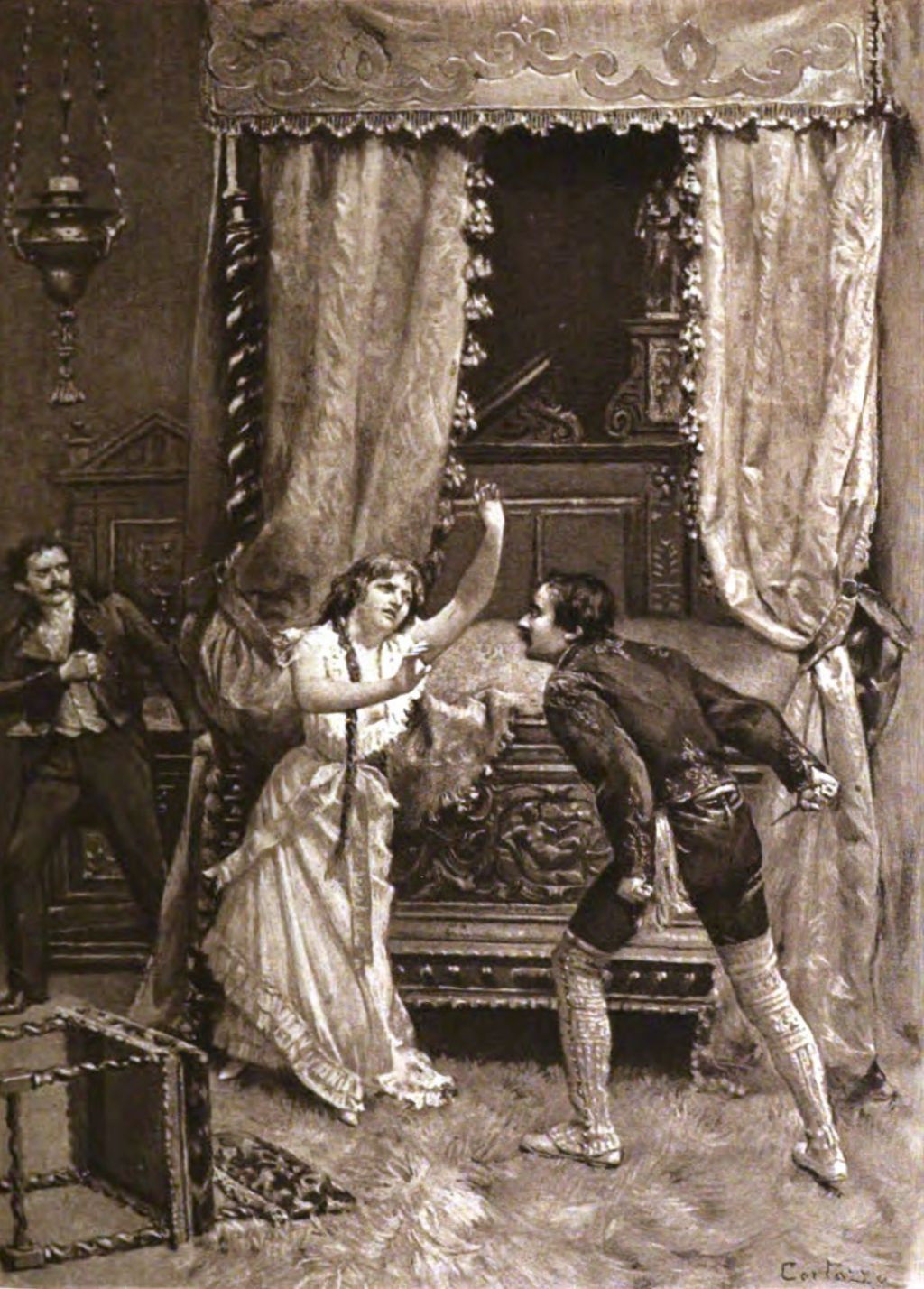
AGATHA PROTECTS MICHELANGELO.
He leaped at Michel with the agility of a wild animal. But, quick and nimble as his movement was, the miraculous power of love made Agatha even quicker than he.
He leaped at Michel with the agility of a wild animal. But, quick and nimble as his movement was, the miraculous power of love made Agatha even quicker than he. She rushed to intercept the blow, and would have received it in her breast had not the Piccinino thrust the dagger into his sleeve so swiftly that it seemed as if his hand had always been empty.
"What are you doing, signora?" he said. "I do not propose to murder your lover but to fight with him. You do not wish it? Very good! You protect him with your breast! I will not insult such a rampart, but I will find him at another time—mark my words!"
"Stay!" cried Agatha, seizing his arm as he walked, toward the door. "You will renounce this insane purpose of revenge and give your hand to this alleged lover of mine. He will gladly do the same, for which of you two desires to kill or curse his brother?"
"My brother?" said Michel, in utter bewilderment, dropping his dagger.
"He, my brother?" said the Piccinino, his weapon still within his grasp. "This extemporized relationship is most improbable, signora. I have always heard that Pier-Angelo's wife was very ugly, and I doubt if my father ever played tricks upon husbands who had no reason to be jealous. Your expedient is not at all ingenious! Farewell for the present, Michelangelo Lavoratori!"
"I tell you that he is your brother!" repeated the princess, earnestly; "your father's son and not Pier-Angelo's; the son of a woman whom you cannot insult by your contempt, and who could not have listened to you without committing a crime and an act of madness. Do you not understand me?"
"No, signora," said the Piccinino, with a shrug; "I cannot understand the fables that come to your mind at this moment to save your lover's life. If this poor boy is my father's son, so much the worse for him; for he has many other brothers beside myself, who do not amount to much, and whom I do not hesitate to strike over the head with the butt of my pistol when they fail in the obedience and respect they owe me. So, too, this new member of my family—the youngest of all, I am inclined to think—will be punished by my hand as he deserves; not in your presence, for I am not fond of seeing women in convulsions. But this pretty darling will not always be hidden in your bosom, signora, and I know where I shall find him at need!"
"Have done with insulting me," rejoined Agatha, in a firm tone; "you cannot wound me, and, unless you are a coward, you should not speak thus to your father's wife."
"My father's wife!" exclaimed the bandit, beginning to listen and to desire to hear. "My father was never married, signora! Do not make sport of me."
"Your father was married to me, Carmelo, and, if you doubt it, you will find the authentic evidence in the archives of the convent of Mal Passo. Go and ask Fra Angelo. This young man's name is not Lavoratori; his name is Castro-Reale. He is the son—the only legitimate son—of Prince Cæsar de Castro-Reale."
"Then you are my mother?" cried Michel, falling on his knees and embracing Agatha, with a sensation of terror, remorse and adoration all in one.
"You know it," she said, pressing his face against her heaving breast. "Now, Carmelo, come and kill him in my arms; we will die together! But, after seeking to commit incest, you will commit fratricide!"
The Piccinino, torn by a thousand conflicting sensations, folded his arms across his breast, and, leaning against the wall, gazed in silence at his brother and stepmother, as if he were still inclined to doubt the truth. Michel rose, walked toward him, and held out his hand.
"Your ignorance was the cause of your crime," he said, "and I must needs forgive you, for I too loved her not knowing that I was fortunate enough to be her son. Oh! do not cast a shadow on my joy by your resentment! Be my brother, as I long to be yours! In the name of God, who orders us to love each other, put your hand in mine and come to my mother's feet, so that she may forgive and bless us both."
At these words, uttered with the effusive warmth of a noble and sincere heart, the Piccinino came very near being moved. His bosom heaved as if he were about to burst into tears; but pride was stronger than the voice of nature, and he blushed at the emotion which had threatened to overcome him.
"Away from me," he said to Michel. "I do not know you; I have no sympathy with all this mawkish family sentimentality. I loved my mother, too, but all my affection died with her. I never had any feeling for my father,—whom I hardly knew and who cared very little for me,—unless it may be that I was a little vain of being the only acknowledged son of a prince and a hero. I thought that my mother was the only woman he ever loved, but I learn now that he deceived my mother; that he was another woman's husband; and I cannot be overjoyed by that discovery. You are a legitimate son, and I am only a bastard. I have been accustomed to believe that I was the only one who was really entitled, if I chose, to adorn myself with the name which you will bear in the world, and which no one will dispute your right to bear. And you expect me to love you, who are of patrician blood on both sides, by your father and by your mother? you who are rich, and will soon be powerful in the land where I am a wanderer and an outlaw? You who, whether you are a true or false Sicilian, will be flattered and handled gently by the Court of Naples, and who, perhaps, will not consider that you can afford to refuse favors and offices forever? You who will, perhaps, command hostile armies and lay waste the homes of your countrymen? You who, as general, minister or magistrate, may order my head cut off and a sentence of degradation nailed to the scaffold on which that head is fastened, to serve as an example and a menace to our other brothers of the mountain? You expect me to love you? On the contrary, I hate you and curse you!
"And this woman," continued the Piccinino, with intense bitterness,—"this false, cold-blooded woman, who fooled me to the end with infernal cunning,—you expect me to prostrate myself before her, and ask a blessing from her hand which, for aught I know, is stained with my father's blood! for now I understand more than she intended, I fancy. I will never believe that she married with a good grace the ruined, outlawed, hounded brigand, depraved by misfortune, who had then no other name than the Destatore! He must have abducted her and outraged her.—Ah! yes, now I remember! There is a tale of that sort to which Fra Angelo refers vaguely at times. A child, surprised by the brigands when out walking with her governess, carried off with the governess to the chief's lair, and dismissed two hours later, outraged and half dead! Ah! father, you were a villain as well as a hero! I know it; and I am a better man than you, for I detest such deeds of violence, and Fra Angelo's tale has preserved me forever from seeking enjoyment by such means. So it was you, Agatha, who were Castro-Reale's victim! I understand now why you consented to marry him secretly at the convent of Mal Passo; for that marriage is a secret—probably the only secret of that sort that never transpired! You have been very adroit, but the rest of your story is clear to me. I know now why your parents kept you secluded for a year, so carefully that you were supposed to be dead or to have turned nun. I know now why my father was murdered, and I would not swear that you were innocent of his death!"
"Wretch!" cried the princess, indignantly; "to dare to suspect me of the murder of the man I had accepted for my husband!"
"If it was not you, then it was your father or someone of your kindred!" retorted the Piccinino, in French, with a bitter laugh. "My father did not kill himself," he continued in the Sicilian language, and with a wild expression. "He was capable of a crime, but not of a dastardly act, and the pistol that was found in his hand at the Destatore's cross never belonged to him. He was not reduced, by the partial defection of his followers, to the necessity of committing suicide in order to escape from his enemies, and the piety which Fra Angelo tried to inspire in his heart had not yet disturbed his mind to the point where he thought it his duty to punish himself for his sins. He was murdered, and to have been surprised so easily—so near the town—he must have been lured into a trap. Abbé Ninfo had something to do with that bloody drama. I shall find out, for I have him in my clutches; and, although I am not cruel, I will torture him with my own hands until he confesses! For it is my mission to avenge my father's death, as it is yours, Michel, to make common cause with those who ordered it."
"Great God!" said Agatha, paying no attention to the Piccinino's accusations against herself, "it seems that each day must bring with it the discovery of some new deed of rage and vengeance in my family! O blood of the Atrides, may the Furies never rouse you to life in my son's veins! Ah! Michel, what duties your birth imposes on you! By what great virtues must you redeem so many crimes committed both before and since your birth! Carmelo, you think that your brother will turn against his country and against you some day! If it could be so, I would ask you to kill him to-day, while he is pure and honorable; for I know too well, alas! what becomes of the men who renounce love of country and the respect due to the vanquished!"
"Kill him at once?" said the Piccinino; "I am strongly tempted to take that metaphor literally; it would take but a moment, for this Sicilian of recent date knows no more about handling a knife than I about handling a brush. But I didn't do it yesterday, when the thought came to my mind by our father's grave, and I will wait until my present anger has subsided; for one should kill only in cold blood and in accordance with the dictates of logic and conscience.—Ah! Michel de Castro-Reale, I did not know you yesterday, although Abbé Ninfo had already pointed you out to my vengeance. I was jealous of you because I believed you to be the lover of this woman who says to-day that she is your mother; but I had a presentiment that she did not deserve the love which was beginning to set my blood on fire for her, and when I saw how bravely you faced me, I said to myself: 'Why kill a brave man for the sake of a woman who may be a coward?'"
"Hush, Carmelo!" cried Michel, picking up his dagger; "whether I know how to handle a knife or not, if you add another word to your insults to my mother, I will have your life or you shall have mine."
"Hush, yourself, boy!" said the Piccinino, presenting his half-naked breast to Michel with an air of contempt; "the virtue of legitimate society makes men cowards, and you are a coward too, for you have been reared on the ideas of that society; you would not dare to scratch my lion's skin, because in my person you respect your brother. But I have no such prejudices, and I will prove it to you some day when I am calmer. To-day I am angry, I admit, and I will tell you why: it is because I have been deceived, and I did not believe that any human being was capable of playing on my credulity; it is because I put faith in this woman's words when she said to me last night, in yonder flower-garden where I can hear the fountains plashing at this moment, under the eyes of the moon, which seemed less pure and tranquil than her face: 'What can there be in common between that child and myself?' What can there be in common? and you her son! and you knew it, and you deceived me too!"
"No, I did not know it, and as for my mother——"
"You and your mother are two cold-blooded serpents, two venomous Palmarosas! Ah! I hate that family which has persecuted me and my family so cruelly, and some day I will make a bloody example, even of those members of it who claim to be good patriots and nobles who sympathize with the people. I hate all nobles for my part! and you whose mouths blow hot and cold in turn may well tremble before my frank declaration! I have hated the nobles for the last few moments, since I have found that I am not noble, because I have a legitimate brother and am only a bastard. I hate the name of Castro-Reale, since I can no longer bear it. I am envious, revengeful, and ambitious as well! my intelligence and my adroitness were a stronger justification of that claim on my part than the art of painting on the part of the nursling of the Muses and of Pier-Angelo! I should have made a greater name than he if our conditions had remained unchanged. And the thing that makes my vanity more endurable, Prince Michel, is that I proclaim it proudly, while you conceal it shamefacedly, on the pretext of modesty. In short, I am the child of uncivilized nature and of unshackled liberty, while you are the slave of custom and of fear. I practise cunning after the manner of wolves, and my cunning leads me to my goal. You play with falsehood, after the manner of men, and you will always miss your goal, without having had the merit of sincerity. Our lives are before us. If yours annoys me overmuch, I shall rid myself of you as of any other obstacle, do you understand? Woe to you if you irritate me! Farewell; do not try to see me again; this is my brotherly greeting!
"And as for you, Princess of Castro-Reale," he said, bowing ironically to Agatha, "who might well have refrained from making me crawl at your feet, whose share in the catastrophe by the Destatore's Cross is now very clear in my mind, who did not deem me worthy to be informed of the mischance of your youth, but preferred to pose before my eyes as a spotless virgin, caring not whether you caused me to pine away in frenzied anticipation of your priceless favors—I wish that you may be happy and forget what has taken place between us; but I shall remember it, and I warn you, signora, that you gave a ball over a volcano, in reality as well as figuratively."
As he spoke, the Piccinino threw his cloak over his head and shoulders, walked into the boudoir, and not deigning to wait for the door to be opened, leaped through one of the large panes of glass into the flower-garden. Then he returned to the door leading into the passage, which he had not chosen to pass through, and, after the manner of the authors of the Sicilian Vespers, cut with his dagger a cross over the crest of the Palmarosas, which was carved on that door. A few moments later he was on the mountain, flying like an arrow.
"O mother!" cried Michel, passionately embracing the horrified Agatha, "you have made an implacable enemy in order to preserve me from enemies who, if not imaginary, are powerless! Dear, adored mother, I will never leave you again, by day or night. I will sleep across your door, and if your son's love is helpless to preserve you, it will be because Providence abandons mankind altogether!"
"My child," said Agatha, pressing him to her heart, "have no fear. I am sorely distressed by all that that man has brought back to my mind, but not alarmed by his unreasonable anger. The secret of your birth could not safely have been revealed to him any sooner, for you see the effect that revelation produced upon him. But the time has come when I have nothing to fear, so far as you are concerned, save his personal resentment, and that we will find a way to disarm. The vengeance of the Palmarosas will die out with Cardinal Hieronimo's last breath, which it may be that he is breathing at this very moment. If it was an error to turn that vengeance aside by the help of Carmelo, that error is chargeable to Fra Angelo, who thinks that he knows mankind because he has always lived with men outside the pale of society, brigands and monks. But I trust still to his marvellous instinct. This man, who has just shown himself to us in such an evil light, and whom I cannot look upon without the most intense suffering, because he reminds me of the author of all my misfortunes, is not unworthy perhaps of the generous impulse which led you to call him brother. He is a tiger in his wrath, a fox in his reflections; but between his hours of rage and his hours of treachery, there may be intervals of prostration when human feelings resume their sway and extort from him tears of regret and longing; we shall be able to reform him, I trust! Kindness and loyal dealing should find the weak spot in his armor. At the moment that he cursed you, I saw that he hesitated, forced back his tears. His father—your father, Michel!—had a profound and intense susceptibility even amid his wild and wicked habits; I saw him sob at my feet after he had almost strangled me to stifle my shrieks. Later I saw him at the altar, ashamed and penitent, when he married me; and despite the abhorrence and terror with which he always inspired me, I was sorry myself, when he died, that I had not forgiven him. I trembled at the thought of him, but I never dared to curse his memory; and since I have had you with me once more, O my beloved son! I have tried to rehabilitate him in my own eyes, so that I might not have to condemn him before you. Do not blush, therefore, to bear the name of a man, whose life was fatal to none but me, and who did great things for his country. But retain for him who brought you up, and whose son you have believed yourself to be until this day, the same love, the same respect which you felt for him this morning, noble-hearted boy, when you handed him Mila's marriage portion and told him that you would remain a workman in his service all your life, rather than abandon him!"
"O Pier-Angelo, father!" cried Michel, with a vehemence which caused his heart to overflow in sobs, "nothing has changed between us, and on the day when my entrails no longer quiver for you with filial affection, I think that I shall have ceased to live!"
XLV MEMORIES
Agatha was completely shattered by so much agitation and fatigue. Her health was delicate although her spirit was strong, and when Michel saw how pale she was, and that her voice had become almost inaudible, he was terrified. He began to be conscious of the loving and poignant anxiety born of a sentiment that was altogether new to him. He had hardly known the love that a child feels for its mother. Pier-Angelo's wife had been kind to him, to be sure, but he had lost her when he was very young, and she had left on his memory the impression of a robust and domineering virago, irreproachable in her conduct, but somewhat violent, and, although devoted to her little ones, inclined to talk loud and strike hard. What a contrast to that exquisite disposition, that soft beauty, that poetic creature who was called Agatha, and whom Michel could admire as the ideal of an artist while adoring her as a mother!
He begged her to lie down and to try to obtain an hour's rest.
"I will stay with you," he said; "I will sit by your pillow, I shall be perfectly happy, just looking at you, and you will find me here when you open your eyes."
"But this will be the third night that you will have passed almost without sleep," she said. "Ah! how it pains me on your account to think of the life we have been leading for several days past!"
"Do not worry about me, darling mother," replied the young man, covering her hands with kisses. "I have slept a good deal in the morning these three days; and now I am so happy, notwithstanding what we have just gone through, that it seems to me that I shall never sleep again. I tried to sleep in order to see you again in my dreams: now that the dream has become reality, I should be afraid of losing it if I slept. But you must rest, mother.—Ah! how sweet that name mother is!"
"I am no more inclined to sleep than you are," she said; "I would like not to leave you for an instant. And as the thought of the Piccinino still makes me tremble for your life, you shall remain with me until daylight, whatever the consequences. I will lie down on the bed, as you insist upon it; sit in this easy chair, with your hand in mine, and if I haven't the strength to talk to you, I can at all events listen to you; we have so many things to say to each other! I want to know about your life from the first day that you can remember down to this moment."
They passed in this way two hours, which seemed to them like two minutes; Michel told her the whole story of his life, and did not conceal even his recent emotions. The passionate attachment which he had felt for his mother before he knew her no longer raised in his mind any question too delicate to be translated by words befitting the sanctity of their new relations. The words he had used to himself had assumed a new meaning, and whatever impropriety there might have been in them had vanished like the incoherent words one utters in fever, which leave no trace when health and reason have returned.
Moreover, except for a few outbursts of vanity, Michel had had no thoughts for which he need blush now upon searching his conscience. He had believed that she loved him, and therein he was hardly in error! He had been assailed by an ardent passion, and he felt that he loved Agatha, now that she had become his mother, with no less warmth, gratitude, even jealousy, than an hour earlier. He could understand now why he had never seen her without feeling that his heart went out to her with irresistible force, without an all-powerful attraction, a secret thrill of pride which had its echo in himself. He remembered that, when he first saw her, it seemed to him that her face had always been familiar to him; and when he asked her to explain that miracle, she replied: "Look in the mirror, and you will see that my features placed your own image before you; this resemblance, which Pier-Angelo constantly observed with delight, and which filled my heart with pride, made me tremble for you. Luckily nobody has noticed it, unless possibly the cardinal, who ordered his bearers to stop so that he could look at you, on the day that you arrived in the neighborhood, and, as if guided by an invisible hand, paused at the gate of your ancestor's palace. My uncle was formerly the most suspicious and most keen-eyed of persecutors and despots. Certainly, if he had seen you before he was stricken with paralysis, he would have recognized you and have had you cast into prison, then exiled—perhaps assassinated!—without putting a single question to you. Enfeebled as he was ten days ago, he fastened upon you a glance which aroused the suspicions of Abbé Ninfo, and his memory revived so far as to lead him to inquire your age. Who knows what fatal light might have found its way into his brain, if Providence had not inspired you to answer that you were twenty-one years old instead of eighteen!"
"I am eighteen," said Michel, "and you, mother? You seem to me as young as I am."
"I am thirty-two," replied Agatha; "didn't you know?"
"No! if I had been told that you were my sister, I should have believed it when I saw you. Oh! what good fortune that you are still so young and so lovely! You will live as long as I do, won't you? I shall not have the misfortune to lose you! Lose you!—Ah! now that my life is bound to yours, the thought of death frightens me, I would like to die neither before nor after you. But is this the first time that we have ever been together? I am searching the vague memories of my infancy in the hope of finding some trace of you."
"My poor child," said the princess, "I never saw you before the day when, as I looked at you through a window of the gallery where you were sleeping, I could not restrain a cry of love and of agonizing joy, which woke you. Three months ago I did not even know of your existence. I believed that you died on the day you were born. Otherwise, do you suppose that I would not have come to Rome, in some disguise or other, to take you in my arms and rescue you from the dangers of a solitary life? On the day that Pier-Angelo told me that he had rescued you from the hands of a villainous midwife, who was about to put you in a hospital, by order of my parents, that he had fled with you to a foreign country, and had brought you up as his son, I insisted upon starting for Rome. I would have done it too, but for the prudence of Fra Angelo, who pointed out to me that your life would be in danger as long as the cardinal lived, and that it was better to await his death than to expose us all to suspicions and investigations. Ah! my son, how horribly I suffered while I lived alone with the ghastly memories of my youth! Branded from my girlhood, maltreated, secluded and persecuted by my family, because I would not disclose the name of the man whom I had consented to marry as soon as the first symptoms of pregnancy appeared; parted from my child, and cursed for the tears which his alleged death caused me to shed; threatened with the horror of seeing him killed before my eyes, when I yielded to the hope that they had deceived me—the best years of my life passed amid tears of despair and shudders of horror.
"I gave birth to you in this room, Michel on this very spot. It was then a sort of garret, long unused, which had been transformed into a prison, in order to conceal the shame of my condition. Nobody knew what had happened to me! I could hardly have described it, I had hardly understood it, I was so young and my imagination was so pure. I foresaw that the truth would bring fresh disasters upon the child I was carrying within me, and on his father. My governess had died on the day after our catastrophe, without saying a word, whether because she could not or did not choose to. No one could extort my secret from me, even during the pains of childbirth; and when my father and my uncle, standing by my bed, as pitiless as inquisitors, threatened me with death if I did not confess what they called my sin, I replied simply that I was innocent before God, and that it was for Him alone to punish or save the culprit. Whether or not they ever discovered that I was the wife of Castro-Reale, I could never find out; his name was never mentioned to me, I was never questioned concerning him. Nor do I know whether they procured his assassination, or whether Abbé Ninfo assisted them to surprise him; but unfortunately I do not think them incapable of it. I know only this, that at the time of his death, when I had barely recovered from my confinement, they tried to compel me to marry. Hitherto they had held up before me as an everlasting punishment, the impossibility of finding a husband. They took me from my prison, where I had been secluded so carefully that everyone supposed that I was in the convent at Palermo, and nothing had transpired out-of-doors. I was rich, fair, and of noble birth. Twenty suitors came forward. I repelled with horror the idea of deceiving an honest man, or of confessing my misfortune to a man who was mean-spirited enough to accept me because of my wealth. My resistance irritated my father to frenzy. He pretended to take me back to Palermo. But he brought me back to this room at night, and kept me imprisoned here for another whole year.
"It was a ghastly prison, as stifling as the leads of Venice; for the sun beat down upon a thin covering of metal, this part of the palace having never been finished and being roofed over temporarily. I endured thirst, mosquitoes, neglect, solitude, and lack of the fresh air and exercise which are so essential to the young. But I did not die, I contracted no disease, the vital principle was so strong within me. My father, unwilling to entrust the duty of guarding me to any other person, fearing that the compassion of his servants would lessen my sufferings, brought me my food himself; and when his political schemes kept him away from home for days at a time, I underwent the tortures of hunger. But I had acquired a stoical firmness of will, and I did not stoop to complain. I also acquired a certain amount of courage and of faith during that trial, and I do not rebuke God for having inflicted it on me. Consciousness of duty and regard for justice are great blessings for which one cannot pay too high a price!"