CHILDHOOD. (continued 2)
Reading edition
Girls, at the present time, are made clever simpletons; their brains are worked with useless knowledge, which totally unfits them for everyday duties. Their muscles are allowed to be idle, which makes them limp and flabby. The want of proper exercise ruins the complexion, and their faces become of the color of a tallow candle! And precious wives and mothers they make when they do grow up! Grow up, did I say. They grow all manner of ways, and are as crooked as crooked sticks!
What an unnatural thing it is to confine a child several 158hours a day to his lessons; why, you might as well put a colt in harness, and make him work for his living! A child is made for play; his roguish little eye, his lithe figure, his antics, and his drollery, all point out that he is cut out for play—that it is as necessary to his existence as the food he eats, and as the air he breathes!
A child ought not to be allowed to have playthings with which he can injure either himself or others, such as toy-swords, toy-cannons, toy-paint-boxes, knives, bows and arrows, hammers, chisels, saws, etc. He will not only be likely to injure himself and others, but will make sad havoc on furniture, house, and other property. Fun, frolic, and play ought, in all innocent ways, to be encouraged; but willful mischief and dangerous games ought, by every means, to be discountenanced. This advice is frequently much needed, as children prefer to have and delight in dangerous toys, and often coax and persuade weak and indulgent mothers to gratify their wishes.
Painted toys are, many of them, highly dangerous, those painted green especially, as the color generally consists of Scheele’s green—arsenite of copper.
Children’s paint-boxes are very dangerous toys for a child to play with: many of the paints are poisonous, containing arsenic, lead, gamboge, etc., and a child, when painting, is apt to put the brush into his mouth, to absorb the superabundant fluid. Of all the colors, the green paint is the most dangerous, as it is frequently composed of arsenite of copper—arsenic and copper—two deadly poisons.
There are some paint-boxes warranted not to contain a particle of poison of any kind: these ought, for a child, to be chosen by a mother.
But, remember, although he ought not to be allowed to have poison paint-boxes and poison-painted toys, he must 159have an abundance of toys, such as the white-wood toys—brewers’ drays, millers’ wagons, boxes of wooden bricks, etc. The Noah’s Ark is one of the most amusing and instructive toys for a child. “Those fashioned out of brown, unpainted pine-wood by the clever carvers of Nuremberg or the Black Forest are the best, I think, not only because they are the most spirited, but because they will survive a good deal of knocking about, and can be sucked with impunity. From the first dawn of recollection, children are thus familiarized with the forms of natural objects, and may be well up in natural history before they have mastered the A B C.”
Parents often make Sunday a day of gloom: to this I much object. Of all the days in the week, Sunday should be the most cheerful and pleasant. It is considered by our Church a festival; and a glorious festival it ought to be made, and one on which our Heavenly Father wishes to see all His children happy and full of innocent joy! Let Sunday, then, be made a cheerful, joyous, innocently happy day, and not, as it frequently is, the most miserable and dismal in the week. It is my firm conviction that many men have been made irreligious by the ridiculously strict and dismal way they were compelled, as children, to spend their Sundays. You can no more make children religious by gloomy asceticism, than you can make people good by Act of Parliament!
One of the great follies of the present age is, children’s parties, where they are allowed to be dressed like grown-up women, stuck out in crinoline, and encouraged to eat rich cake and pastry, and to drink wine, and to sit up late at night! There is something disgusting and demoralizing in all this. Their pure minds are blighted by it. Do not let me be misunderstood: there is not the least objection, but, on the contrary, great advantage, for friends’ children to meet friends’ children; but then let them be treated as children, and not as men and women!
160178. Do you approve of public play-grounds for children?
It would be well, in every village, and in the outskirts of every town, if a large plot of ground were set apart for children to play in, and to go through regular gymnastic exercises. Play is absolutely necessary to a child’s very existence, as much as food and sleep; but in many parts of England where is he to have it? Play-grounds and play are the best schools we have; they teach a great deal not taught elsewhere; they give lessons in health, which is the grandest wealth that can be bestowed—“for health is wealth;” they prepare the soil for the future school-master; they clear the brain, and thus the intellect; they strengthen the muscles; they make the blood course merrily through the arteries; they bestow healthy food for the lungs; they give an appetite; they make a child, in due time, become every inch a man! Play-grounds and play are one of the finest Institutions we possess. What would our large public schools be without their play and cricket-grounds? The would be shorn of half their splendor and usefulness.
There is so much talk nowadays about useful knowledge, that the importance of play and play-grounds is likely to be forgotten. I cannot help thinking, however, that a better state of things is dawning. “It seems to be found out that in our zeal for useful knowledge, that knowledge is found to be not the least useful which treats boys as active, stirring, aspiring, and ready.”
EDUCATION.
179. Do you approve of infant schools?
I do, if the arrangements be such that health is preferred before learning. “According to Aristotle, more care should be taken of the body than of the mind for the first seven years; strict attention to diet be enforced, 161etc.... The eye and ear of the child be most watchfully and severely guarded against contamination of every kind, and unrestrained communication with servants be strictly prevented. Even his amusements should be under due regulation, and rendered as interesting and intellectual as possible.” Let children be only confined for three or four hours a day, and let what little they learn be taught as an amusement rather than as a labor. A play-ground ought to be attached to an infants’ school: where in fine weather, for every half hour they spend in-doors, they should spend one in the open air; and, in wet weather, they ought to have, in lieu of the play-ground, a large room to romp, and shout, and riot in. To develop the different organs, muscles, and other parts of the body, children require fresh air, a free use of their lungs, active exercise, and their bodies to be thrown into all manner of attitudes. Let a child mope in a corner, and he will become stupid and sickly. The march of intellect, as it is called, or rather the double quick march of intellect, as it should be called, has stolen a march upon health. Only allow the march of intellect and the march of health to take equal strides, and then we shall have “mens sana in corpore sano” (a sound mind in a sound body).
In the education of a young child, it is better to instruct him by illustration and by encouraging observation on things around and about him, than by books. It is surprising how much, without endangering the health, may be taught in this way. In educating your child, be careful to instill and to form good habits—they will then stick to him for life.
Children at the present day are too highly educated—their brains are overtaxed, and thus weakened. The consequence is, that as they grow up to manhood, if they grow up at all, they become fools! Children are now 162taught what formerly youths were taught. The chord of a child’s life is ofttimes snapped asunder in consequence of overeducation:
“Screw not the chord too sharply, lest it snap.”
You should treat a child as you would a young colt. Think only at first of strengthening his body. Let him have a perfectly free, happy life, plenty of food to eat, abundance of air to breathe, and no work to do; there is plenty of time to think of his learning—of giving him brain work. It will come sadly too soon; but do not make him old before his time.
180. At what age do you advise my child to begin his course of education—to have his regular lessons?
In the name of the prophet,—Figs! Fiddlesticks! about courses of education and regular lessons for a child! You may as well ask me when he, a child, is to begin Hebrew, the Sanscrit, and Mathematics! Let him have a course of education in play; let him go through regular lessons in football, bandy, playing at tic, hares and hounds, and such like excellent and really useful and health-giving lessons. Begin his lessons! Begin brain-work, and make an idiot of him! Oh! for shame, ye mothers! You who pretend to love your children so much, and to tax, otherwise to injure, irreparably to injure their brains, and thus their intellects and their health, and to shorten their very days. And all for what? To make prodigies of them! Forsooth! to make fools of them in the end.
181. Well, then, as you have such a great objection to a child commencing his education early in life, at what age may he, with safety, commence his lessons? and which do you prefer—home or school education?
Home is far preferable to a school education for a child. If at home, he is under your own immediate observation, and is not liable to be contaminated by naughty children; 163for, in every school, there is necessarily a great mixture of the good and of the bad; and a child, unfortunately, is more likely to be led by a bad than by a good child.
Moreover, if the child be educated at home, the mother can see that his brain be not overworked. At school the brain is apt to be overworked, and the stomach, and the muscles to be underworked.
Remember, as above stated, the brain must have but very little work until the child be seven years old: impress this advice upon your memory, and let no foolish ambition to make your child a clever child allow you, for one moment, to swerve from this advice.
Build up a strong, healthy body, and in due time the brain will bear a moderate amount of intellectual labor.
As I have given you so much advice, permit me, for one moment, to address a word to the father of your child:
Let me advise you, then, Mr. Paterfamilias, to be careful how you converse, what language you use, while in the company of your child. Bear in mind, a child is very observant, and thinks much, weighs well, and seldom forgets all you say and all you do! Let no hasty word, then, and more especially no oath, or no impious language, ever pass your lips, if your child is within hearing. It is, of course, at all times wicked to swear; but it is heinously and unpardonably sinful to swear in the presence of your child! “Childhood is like a mirror, catching and reflecting images. One impious or profane thought, uttered by a parent’s lip, may operate upon the young heart like a careless spray of water thrown upon polished steel, staining it with rust, which no after-scouring can efface.”
Never talk secrets before a child—“little pitchers have long ears;” if you do, and he discloses your secrets,—as most likely he will,—and thus make mischief, it will be cruel to scold him; you will, for your imprudence, have yourself only to blame. Be most careful, then, in the 164presence of your child, of what you say and of whom you speak. This advice, if followed, might save a great deal of annoyance and vexation.
182. Are you an advocate for a child being taught singing?
I am; I consider singing a part of a child’s education. Singing expands the walls of the chest, strengthens and invigorates the lungs, gives sweetness to the voice, improves the pronunciation, and is a great pleasure and amusement to a child.
SLEEP.
183. Do you approve of a child sleeping on a FEATHER bed?
A feather bed enervates his body, and, if he be so predisposed, causes rickets, and makes him crooked. A horse-hair mattress is the best for a child to lie on. The pillow, too, should be made of horse-hair. A feather pillow often causes the head to be bathed in perspiration, thus enervating the child and making him liable to catch cold. If he be at all rickety, if he be weak in the neck, if he be inclined to stoop, or if he be at all crooked, let him, by all means, lie without a pillow.
184. Do you recommend a child, in the middle of the day, to be put to sleep?
Let him be put on his mattress awake at twelve o’clock, that he may sleep for an hour or two before dinner, then he will rise both refreshed and strengthened for the remainder of the day. I said, let him be put down awake. He might, for the first few times, cry; but, by perseverance, he will without any difficulty fall to sleep. The practice of sleeping before dinner ought to be continued until he be two years old, and if he can be prevailed upon, even longer. For if he do not have sleep in the middle of the day, he will all the afternoon and the evening be cross; and when 165he does go to bed, he will probably be too tired to sleep, or his nerves, having been exhausted by the long wakefulness, he will fall into a troubled, broken slumber, and not into that sweet, soft, gentle repose, so characteristic of healthy, happy childhood!
185. At what hour ought a child to be put to bed in the evening?
At six in the winter, and at seven o’clock in the summer. Regularity ought to be observed, as regularity is very conducive to health. It is a reprehensible practice to keep a child up until nine or ten o’clock at night. If this be done, he will, before his time, become old, and the seeds of disease will be sown.
As soon as he can run, let him be encouraged, for half an hour before he goes to bed, to race either about the hall, or the landing, or a large room, which will be the best means of warming his feet, of preventing chilblains, and of making him sleep soundly.
186. Have you any directions to give me as to the placing of my child in his bed?
If a child lie alone, place him fairly on his side in the middle of the bed; if it be winter time, see that his arms and hands be covered with the bedclothes; if it be summer, his hands might be allowed to be outside the clothes.
In putting him down to sleep, you should ascertain that his face be not covered with the bedclothes; if it be, he will be poisoned with his own breath—the breath constantly giving off carbonic acid gas; which gas must, if his face be smothered in the clothes, be breathed—carbonic acid gas being highly poisonous.
You can readily prove the existence of carbonic acid gas in the breathing, by simply breathing into a little lime-water; after breathing for a few seconds into it, a white film will form on the top; the carbonic acid gas 166from the breath unites with the lime of the lime-water, and the product of the white film is carbonate of lime.
187. Do you advise a bed-room to be darkened at night?
Certainly. A child sleeps sounder and sweeter in a dark than in a light room. There is nothing better, for the purpose of darkening a bed-room, than Venetian blinds.
Remember, then, a well-ventilated, but a darkened chamber at night. The cot or the crib ought not to face the window, “as the light is best behind.” [Sir Charles Locock in a Letter to the Author.]
188. Which is the best position for a child when sleeping—on his back, or on his side?
His side. He ought to be accustomed to change about—on the right side one night, on the left another; and occasionally, for a change, he should lie on his back. By adopting this plan you will not only improve his figure, but likewise his health. Lying, night after night, in one position, would be likely to make him crooked.
189. Do you advise, in the winter time, that there should be a fire in the night nursery?
Certainly not, unless the weather be intensely cold. I dislike fires in bed-rooms, especially for children; they are very enervating, and make a child liable to catch cold. Cold weather is very bracing, particularly at night. “Generally speaking,” says the Siecle, “during winter, apartments are too much heated. The temperature in them ought not to exceed 16° Centigrade (59° Fahrenheit); and even in periods of great cold, scientific men declare that 12° or 14° had better not be exceeded. In the wards of hospitals, and in the chambers of the sick, care is taken not to have greater heat than 15°. Clerks in offices, and other persons of sedentary occupations, when the rooms in which they sit are too much heated, are liable to cerebral [brain] congestion and to pulmonary [lung] 167complaints. In bed-rooms, and particularly those of children, the temperature ought to be maintained rather low; it is even prudent only rarely to make fires in them, especially during the night.”
“If a cold stable make a healthy horse,” I am quite sure that a moderately cold and well-ventilated bed-room helps to make a healthy child. But still, in the winter time, if the weather be biting cold, a little fire in the bed-room grate is desirable. In bringing up children, we must never run into extremes—the coddling system and the hardening system are both to be deprecated; the coddling system will make a strong child weakly, while the hardening system will probably kill a delicate one.
A child’s bed ought, of course, to be comfortably clothed with blankets—I say blankets, as they are much superior to coverlids; the perspiration will more readily pass through a blanket than a coverlid. A thick coverlid ought never to be used; there is nothing better for a child’s bed than the old-fashioned patch-work coverlid, as the perspiration will easily escape through it.
190. Should a child be washed and dressed AS SOON AS HE AWAKES in the morning?
He ought, if he awakes in anything like reasonable time; for if he doze after he be once awake, such slumber does him more harm than good. He should be up every morning as soon as it is light. If, as a child, he be taught to rise early, it will make him an early riser for life, and will tend greatly to prolong both his existence and his happiness.
Never awake a child from his sleep to dress him, to give him medicine, or for any other purpose; let him always sleep as long as he can; but the moment he awakes let him be held out, and then let him be washed and dressed, and do not wait, as many a silly nurse does, until he has wet his bed, until his blood be chilled, and until he be cross, 168miserable, and uncomfortable! How many babies are made ill by such foolish practices!
The moment he leaves his bed, turn back to the fullest extent the clothes, in order that they may be thoroughly ventilated and sweetened. They ought to be exposed to the air for at least an hour before the bed be made. As soon as he leaves his room, be it winter or summer, throw open the windows.
191. Ought a child to lie alone?
He should after he is weaned. He will rest more comfortably, and his sleep will be more refreshing.
192. Supposing a child should not sleep well, what ought to be done? Would you give him a dose of composing medicine?
Certainly not. Try the effect of exercise. Exercise in the open air is the best composing medicine in the world. Let the little fellow be well tired out, and there will be little fear of his not sleeping.
193. Have you any further observations to make on the subject of sleep?
Send a child joyful to bed. Do not, if you can possibly help it, let him go to bed crying. Let the last impressions he has at night be of his happy home, and of his loving father and mother, and let his last thoughts be those of joy and gladness. He will sleep all the sounder if he be sent to bed in such a frame of mind, and he will be more refreshed and nourished in the morning by his sleep.
194. What is the usual cause of a child walking in his sleep, and what measures, during such times, ought to be adopted to prevent his injuring himself?
A disordered stomach in a child of nervous temperament is usually the cause. The means to be adopted to prevent his throwing himself out of the window are to have bars to his chamber casement, and if that be not practicable, to have either nails or screws driven into the 169window-sash to allow the window to open only for a sufficient space for ventilation, and to have a screw window-fastening, in order that he cannot, without difficulty, open the window; to have a trusty person to sleep in his room, who should have directions given not to rouse him from his sleep, but to gently lead him back to his bed, which may frequently be done without awaking him; and to consult a medical man, who will adopt means to put his stomach into order, to brace his nerves, and to strengthen his general system. A trip to the coast and sea bathing, in such a case, is often of great service.
SECOND DENTITION.
195. When does a child begin to cut his SECOND set of teeth?
Generally at seven years old. He begins to cut them at about that time; but it should be borne in mind (so wonderful are the works of God) that the second crop of teeth in embryo is actually bred and formed from the very commencement of his life, under the first tier of teeth, but which remain in abeyance for years, and do not come into play until the first teeth, having done their duty, loosen and fall out, and thus make room for the more numerous, larger, stronger, and more permanent teeth, which latter have to last for the remainder of his existence. The first set is sometimes cut with a great deal of difficulty, and produces various disease; the second, or permanent teeth, come easily, and are unaccompanied with any disorder. The following is the process: one after another of the first set gradually loosen, and either drop out, or with little pain are readily pulled out; under these, the second—the permanent teeth—make their appearance, and fill up the vacant spaces. The fang of the tooth that has 170dropped out is nearly all absorbed or eaten away, leaving little more than the crown. The first set consists of twenty; the second (including the wise teeth, which are not generally cut until after the age of twenty-seven) consists of thirty-two.
I would recommend you to pay particular attention to the teeth of your children; for, besides their being ornamental, their regularity and soundness are of great importance to the present as well as to the future health of your offspring. If there be any irregularity in the appearance of the second set, lose no time in consulting an experienced and respectable dentist.
DISEASE, Etc.
196. Do you think it important that I should be made acquainted with the symptoms of the SERIOUS diseases of children?
Certainly. I am not advocating the doctrine of a mother treating serious diseases; far from it; it is not her province, except in certain cases of extreme urgency where a medical man cannot be procured, and where delay might be death; but I do insist upon the necessity of her knowing the symptoms of disease. My belief is, that if parents were better informed on such subjects, many children’s lives might be saved, much suffering might be averted, and much sorrow might be spared. The fact is, the knowledge of the symptoms of disease is, to a mother, almost a sealed book. If she were better acquainted with these matters, how much more useful would she be in a sick-room, and how much more readily would she enter into the plans and views of the medical man! By her knowledge of the symptoms, and by having his advice in time, she would nip 171disease in the bud, and the fight might end in favor of life, for “sickness is just a fight between life and death.”
It is really lamentable to contemplate the amount of ignorance that still exists among mothers in all that appertains to the diseases of children; although, fortunately, they are beginning to see and to feel the importance of gaining instruction on such subjects; but the light is only dawning. A writer of the present day makes the following remarks, which somewhat bear on the subject in question. He observes: “In spite of the knowledge and clear views possessed by the profession on all that concerns the management of children, no fact is more palpable than that the most grievous ignorance and incompetency prevail respecting it among the public. We want some means of making popular the knowledge which is now almost restricted to medical men, or at most, to the well-educated classes.”
In the earlier editions of this work, I did not give the treatment of any serious diseases, however urgent. In the three last editions I have been induced, for reasons I will presently state, to give the treatment of some of the more urgent serious diseases, when a medical man cannot instantly be procured, and where delay might be death.
Sir Charles Locock, who has taken a kind interest in this little work, has given me valid reasons why a mother should be so enlightened. The following extracts are from a letter which I received from Sir Charles on the subject, and which he has courteously allowed me to publish. He says: “As an old physician of some experience in complaints of infants and children, I may perhaps be allowed to suggest that in a future edition you should add a few words on the actual treatment of some of the more urgent infantile diseases. It is very right to caution parents against superseding the doctor, and attempting to manage serious illness themselves; but your advice, with very small 172exceptions, always being to ‘to lose no time in sending for a medical man,’ much valuable and often irremediable time may be lost when a medical man is not to be had. Take, for instance, a case of croup: there are no directions given at all, except to send for a medical man, and always to keep medicines in the house which he may have directed. But how can this apply to a first attack? You state that a first attack is generally the worst. But why is it so? Simply because it often occurs when the parents do not recognize it, and it is allowed to get to a worse point than in subsequent attacks, when they are thoroughly alive to it. As the very best remedy, and often the only essential one, if given early, is a full emetic, surely it is better that you should give some directions as to this in a future edition, and I can speak from my own experience when I say that an emetic, given in time, and repeated to free vomiting, will cut short any case of croup. In nine cases out of ten the attack takes place in the evening or early night, and when vomiting is effected the dinner of that day is brought up nearly undigested, and the severity of the symptoms at once cut short. Whenever any remedy is valuable, the more by its being administered in time, it is surely wiser to give directions as to its use, although, as a general rule, it is much better to advise the sending for medical advice.”
The above reasons, coming from such a learned and experienced physician as Sir Charles Locock, are conclusive, and have decided me to comply with his advice, to enlighten a mother on the treatment of some of the more urgent diseases of infants and of children.
In a subsequent letter addressed to myself, Sir Charles has given me the names of those urgent diseases which he considers may be treated by a mother, “where a medical man cannot be procured quickly, or not at all;” they are—Croup; Inflammation of the Lungs; Diphtheria; Dysentery; 173Diarrhœa; Hooping-Cough, in its various stages; and Shivering Fit. Sir Charles sums up his letter to me by saying: “Such a book ought to be made as complete as possible, and the objections to medical treatment being so explained as to induce mothers to try to avoid medical men is not so serious as that of leaving them without any guide in those instances where every delay is dangerous, and yet where medical assistance is not to be obtained or not to be had quickly.”
In addition to the above, I shall give you the treatment of Bronchitis, Measles, and Scarlet Fever. Bronchitis is one of the most common diseases incidental to childhood, and, with judicious treatment, is, in the absence of the medical man, readily managed by a sensible mother. Measles is very submissive to treatment. Scarlet Fever, if it be not malignant, and if certain rules be strictly followed, is also equally amenable to treatment.
I have been fortunate in treating Scarlet Fever, and therefore think it desirable to enter fully into the treatment of a disease, which is looked upon by many parents, and according to the usual mode of treatment, with just cause, with great consternation and dread. By giving my plan of treatment fully and simply, and without the slightest reservation, I am fully persuaded, through God’s blessing, that I may be the humble means of saving the lives of numbers of children.
The diseases that might be treated by a mother, in the absence of a medical man, will form the subject of future Conversations.
197. At what age does Water on the Brain usually occur, and how is a mother to know that her child is about to labor under that disease?
Water on the brain is, as a rule, a disease of childhood; after a child is seven years old it is comparatively rare. It more frequently attacks delicate children—children 174who have been dry-nursed (especially if they have been improperly fed), or who have been suckled too long, or who have had consumptive mothers, or who have suffered severely from teething, or who are naturally of a feeble constitution. Water on the brain sometimes follows an attack of inflammation of the lungs, more especially if depressing measures (such as excessive leeching and the administration of emetic tartar) have been adopted. It occasionally follows in the train of contagious eruptive diseases, such as either small-pox or scarlatina. We may divide the symptoms of water on the brain into two stages. The first—the premonitory stage—which lasts four or five days, in which medical aid might be of great avail; the second—the stage of drowsiness and of coma—which usually ends in death.
I shall dwell on the first—the premonitory stage—in order that a mother may see the importance without loss of time of calling in a medical man:
If her child be feverish and irritable, if his stomach be disordered, if he have urgent vomitings, if he have a foul breath, if his appetite be capricious and bad, if his nights be disturbed (screaming out in his sleep), if his bowels be disordered, more especially if they be constipated, if he be more than usually excited, if his eye gleam with unusual brilliancy, if his tongue run faster than it is wont, if his cheek be flushed and his head be hot, and if he be constantly putting his hand to his head, there is cause for suspicion. If to these symptoms be added, a more than usual carelessness in tumbling about, in hitching his foot in the carpet, or in dragging one foot after the other; if, too, he has complained of darting, shooting, lancinating pains in his head, it may then be known that the first stage of inflammation (the forerunner of water on the brain) either has taken or is about taking place. Remember, no time ought to be lost in obtaining medical aid; for the 175commencement of the disease is the golden opportunity, when life might probably be saved.
198. At what age, and in what neighborhood, is a child most liable to Croup, and when is a mother to know that it is about to take place?
It is unusual for a child until he be twelve months old to have croup; but, from that time until the age of two years, he is more liable to it than at any other period. The liability after two years gradually, until he be ten years old, lessens, after which time it is rare.
A child is more liable to croup in a low and damp, than in a high and dry neighborhood; indeed, in some situations, croup is almost an unknown disease; while in others it is only too well understood. Croup is more likely to prevail when the wind is either easterly or northeasterly.
There is no disease that requires more prompt treatment than croup, and none that creeps on more insidiously. The child at first seems to be laboring under a slight cold, and is troubled with a little dry cough; he is hot and fretful, and hoarse when he cries. Hoarseness is one of the earliest symptoms of croup; and it should be borne in mind that a young child, unless he be going to have croup, is seldom hoarse; if, therefore, your child be hoarse, he should be carefully watched, in order that, as soon as croup be detected, not a moment be lost in applying the proper remedies.
His voice at length becomes gruff, he breathes as though it were through muslin, and the cough becomes crowing. These three symptoms prove that the disease is now fully formed. These latter symptoms sometimes come on without any previous warning, the little fellow going to bed apparently quite well, until the mother is awakened, perplexed, and frightened, in the middle of the night, by finding him laboring under the characteristic cough and the other symptoms of croup. If she delay either to send 176for assistance, or if proper medicines be not instantly given, in a few hours it will probably be of no avail, and in a day or two the little sufferer will be a corpse!
When once a child has had croup the after-attacks are generally milder. If he has once had an attack of croup, I should advise you always to have in the house medicine—a 4 oz. bottle of ipecacuanha wine, to fly to at a moment’s notice; but never omit, where practicable, in a case of croup, whether the attack be severe or mild, to send immediately for medical aid. In case of a sudden attack of croup, instantly give a teaspoonful of ipecacuanha wine, and repeat it every five minutes until free vomiting be excited. There is no disease in which time is more precious than in croup, and where the delay of an hour may decide either for life or for death.
199. But suppose a medical man is not IMMEDIATELY to be procured, what then am I to do? more especially, as you say, that delay might be death.
What to do.—I never in my life lost a child with croup where I was called in at the commencement of the disease, and where my plans were carried out to the very letter. Let me begin by saying, Look well to the goodness and purity of the medicine, for the life of your child may depend upon the medicine being genuine. What medicine? Ipecacuanha wine! At the earliest dawn of the disease give a teaspoonful of ipecacuanha wine every five minutes, until free vomiting be excited. In croup, before he is safe, free vomiting must be established, and that without loss of time. If, after the expiration of an hour, the ipecacuanha wine (having given during that hour a teaspoonful of it every five minutes) is not sufficiently powerful for the purpose—although it generally is so (if the ipecacuanha wine be good)—then let the following mixture be substituted:
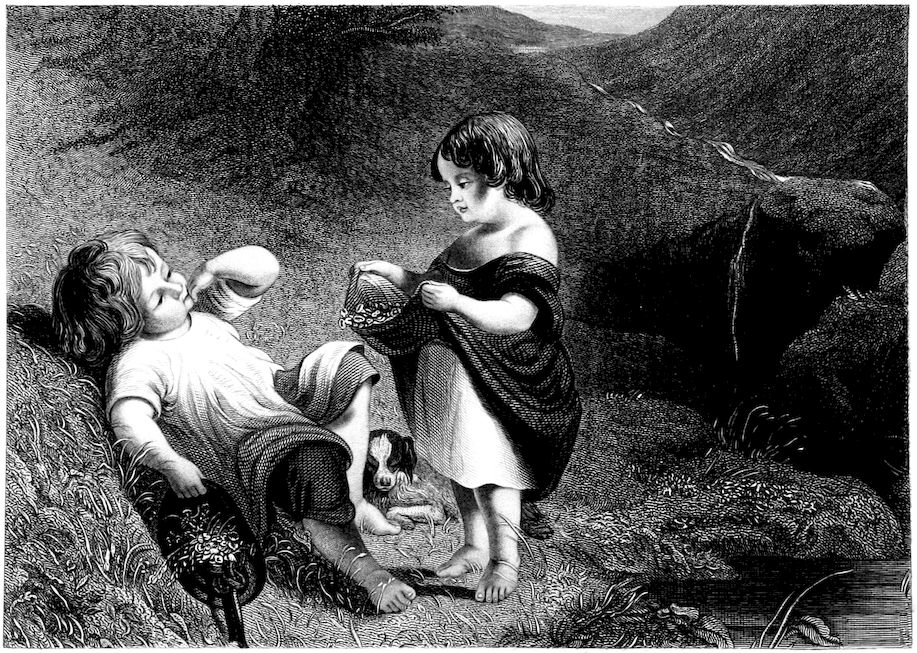
CHILDHOOD—STRAYED FROM HOME.
177Take of—Powdered Ipecacuanha, one scruple;
Wine of Ipecacuanha, one ounce and a half:
Make a Mixture. A teaspoonful to be given every five minutes, until free vomiting be excited, first well shaking the bottle.
After the vomiting, place the child for a quarter of an hour in a warm bath. (See “Warm baths”—directions and precautions to be observed.) When out of the bath give him small doses of ipecacuanha wine every two or three hours. The following is a palatable form for the mixture:
Take of—Wine of Ipecacuanha, three drachms;
Simple Syrup, three drachms;
Water, six drachms:
Make a Mixture. A teaspoonful to be taken every two or three hours.
But remember, the emetic which is given at first is pure ipecacuanha wine, without a drop of either water or of syrup.
A large sponge dipped out of very hot water, and applied to the throat, and frequently renewed, oftentimes affords great relief in croup, and ought during the time the emetic is being administered in all cases to be adopted.
If it be a severe case of croup, and does not in the course of two hours yield to the free exhibition of the ipecacuanha emetic, apply a narrow strip of Smith’s tela vesicatoria to the throat, prepared in the same way as for a case of inflammation of the lungs (see the Conversation on the treatment of inflammation of the lungs). With this only difference, let it be a narrower strip, only one-half the width there recommended, and apply it to the throat instead of to the chest. If a child has a very short, fat neck, there may not be room for the tela, then you ought to apply it to the upper part of the chest—just under the collar-bones.
Let it be understood that the tela vesicatoria is not a 178severe remedy, that the tela produces very little pain—not nearly so much as the application of leeches; although, in its action, it is much more beneficial, and is not nearly so weakening to the system.
Keep the child from all stimulants; let him live on a low diet, such as milk and water, toast and water, arrow-root, etc.; and let the room be, if practicable, at a temperate heat—60° Fahrenheit, and be well ventilated.
So you see that the treatment of croup is very simple, and that the plan might be carried out by an intelligent mother. Notwithstanding which, it is your duty, where practicable, to send at the very onset of the disease for a medical man.
Let me again reiterate that if your child is to be saved the ipecacuanha wine must be genuine and good. This can only be effected by having the medicine from a highly respectable chemist. Again, if ever your child has had croup, let me again urge you always to have in the house a 4 oz. bottle of ipecacuanha wine, that you may resort to at a moment’s notice in case there be the slightest return of the disease.
Ipecacuanha wine, unfortunately, is not a medicine that keeps well; therefore, every three or four months a fresh bottle ought to be procured either from a medical man or from a chemist. As long as the ipecacuanha wine remains clear, it is good; but as soon as it becomes turbid it is bad, and ought to be replaced by a fresh supply.
An intelligent correspondent of mine makes the following valuable remarks on the preservation of ipecacuanha wine: “Now, I know that there are some medicines and chemical preparations which, though they spoil rapidly when at all exposed to the air, yet will keep perfectly good for an indefinite time if hermetically sealed up in a perfectly full bottle. If so, would it not be a valuable suggestion if the Apothecaries’ Hall, or some other London 179firm of undoubted reliability, would put up 1 oz. phials of ipecacuanha wine of guaranteed purity, sealed up so as to keep good so long as unopened, and sent out in sealed packages, with the guarantee of their name. By keeping a few such ounce bottles in an unopened state in one’s house, one might rely on being ready for any emergency. If you think this suggestion worth notice, and could induce some first-rate house to carry it out, and mention the fact in a subsequent edition of your book, you would, I think, be adding another most valuable item to an already invaluable book.”
The above suggestion of preserving ipecacuanha wine in ounce bottles, quite full, and hermetically sealed, is a very good one. The best way of hermetically sealing the bottle would be to cut the cork level with the lip of the bottle, and to cover the cork with sealing-wax, in the same manner wine merchants serve some kinds of their wines, and then to lay the bottles on their sides in sawdust in the cellar. I have no doubt, if such a plan were adopted, the ipecacuanha wine would for a length of time keep good. Of course, if the wine of ipecacuanha be procured from the Apothecaries’ Hall Company, London (as suggested by my correspondent), there can be no question as to the genuineness of the article.
What NOT to do.—Do not give emetic tartar; do not apply leeches; do not keep the room very warm; do not give stimulants; do not omit to have always in the house either a 4 oz. bottle, or three or four 1 oz. bottles of ipecacuanha wine.
200. I have heard Child-crowing mentioned as a formidable disease; would you describe the symptoms?
Child-crowing, or spurious croup, as it is sometimes called, is occasionally mistaken for genuine croup. It is a more frequent disorder than the latter, and requires a different plan of treatment. Child-crowing is a disease 180that almost invariably occurs only during dentition, and is most perilous. But if a child laboring under it can fortunately escape suffocation until he has cut the whole of his first set of teeth—twenty—he is then, as a rule, safe.
Child-crowing comes on in paroxysms. The breathing during the intervals is quite natural—indeed, the child appears perfectly well; hence the dangerous nature of the disease is either overlooked, or is lightly thought of, until perhaps a paroxysm worse than common takes place, and the little patient dies of suffocation, overwhelming the mother with terror, with confusion, and dismay.
The symptoms in a paroxysm of child-crowing are as follows: The child suddenly loses and fights for his breath, and in doing so makes a noise very much like that of crowing; hence the name child-crowing. The face during the paroxysm becomes bluish or livid. In a favorable case, after either a few seconds, or even, in some instances, a minute, and a frightful struggle to breathe, he regains his breath, and is, until another paroxysm occurs, perfectly well. In an unfavorable case, the upper part (chink) of the windpipe remains for a minute or two closed, and the child, not being able to breath, drops a corpse in his nurse’s arms. Many children, who are said to have died of fits, have really died of child-crowing.
I have entered thus rather fully into the subject, as many lives might be saved if a mother knew the nature of the complaint, and the great necessity, during the paroxysms, of prompt and proper measures. For, too frequently, before a medical man has had time to arrive, the child has breathed his last, the parent herself being perfectly ignorant of the necessary treatment; hence the vital importance of the subject, and the paramount necessity of imparting information, in a popular style, in a work of this kind.
181201. What treatment, then, during a paroxysm of Child-crowing should you advise?
The first thing, of course, to be done is to send immediately for a medical man. Have a plentiful supply of cold and of hot water always at hand, ready at a moment’s notice for use. The instant the paroxysm is upon the child, plentifully and perseveringly dash cold water upon his head and face. Put his feet and legs in hot salt, mustard, and water; and, if necessary, place him up to his neck in a hot bath, still dashing water upon his face and head. If he does not quickly come round, sharply smack his back and buttocks.
As soon as a medical man arrives, he will lose no time in thoroughly lancing the gums and in applying other appropriate remedies.
Great care and attention ought, during the intervals, to be paid to the diet. If the child is breathing a smoky, close atmosphere, he should be immediately removed to a pure one. In this disease, indeed, there is no remedy equal to a change of air—to a dry, bracing neighborhood. Change of air, even if it be winter, is the best remedy, either to the coast or to a healthy farm-house. I am indebted to Mr. Roberton, of Manchester (who has paid great attention to this disease, and who has written a valuable essay on the subject), for the knowledge of this fact. Where, in a case of this kind, it is not practicable to send a child from home, then let him be sent out of doors the greater part of every day; let him, in point of fact, almost live in the open air. I am quite sure, from an extensive experience, that in this disease, fresh air, and plenty of it, is the best and principal remedy.
202. When is a mother to know that a cough is not a “tooth-cough,” but one of the symptoms of Inflammation of the Lungs?
If the child has had a shivering fit; if his skin be very hot and very dry; if his lips be parched; if there be great 182thirst; if his cheeks be flushed; if he be dull and heavy, wishing to be quiet in his cot or crib; if his appetite be diminished; if his tongue be furred; if his mouth be burning hot and dry; if his urine be scanty and high-colored, staining the napkin or the linen; if his breathing be short, panting, hurried, and oppressed; if there be a hard, dry cough; and if his skin be burning hot; then there is no doubt that inflammation of the lungs has taken place. If you put your finger into the mouth of a child laboring under inflammation of the lungs, it is like putting your finger into a hot apple-pie, the heat is so great.
No time should be lost in sending for medical aid; indeed, the hot, dry mouth and skin, and short hurried breathing would be sufficient cause for your procuring immediate assistance. If inflammation of the lungs were properly treated at the onset, a child would scarcely ever be lost by that disease. I say this advisedly, for in my own practice, provided I am called in early, and if my plans are strictly carried out, I scarcely ever lose a child from inflammation of the lungs.
You may ask—What are your plans? I will tell you, in case you cannot promptly obtain medical advice, as delay might be death.
The treatment of Inflammation of the Lungs, what to do.—Keep the child to one room, to his bed-room, and to his bed. Let the chamber be properly ventilated. If the weather be cool, let a small fire be in the grate; otherwise, he is better without a fire. Let him live on low diet, such as weak black tea, milk and water, and toast and water, thin oatmeal gruel, arrow-root, and such like simple beverages, and give him the following mixture:
Take of—Wine of Ipecacuanha, three drachms;
Simple Syrup, three drachms;
Water, six drachms:
Make a Mixture. A teaspoonful of the mixture to be taken every four hours.
183Be careful that you go to a respectable chemist, in order that the quality of the ipecacuanha wine may be good, as the child’s life may depend upon it.
If the medicine produces sickness, so much the better; continue it regularly until the short, oppressed, and hurried breathing has subsided, and has become natural.
If the attack be very severe, in addition to the above medicine, at once apply a blister, not the common blister, but Smith’s tela vesicatoria—a quarter of a sheet, which ought to be fastened on to a piece of sticking-plaster, taking care to apply the tela vesicatoria (which is on paper) to the warmed plaster, so as to securely fasten the tela vesicatoria on the sticking-plaster. The plaster should be rather larger than the blister, so as to leave a margin. Any respectable chemist will understand the above directions, and will prepare the tela ready for use. If the child be a year old, the blister ought to be kept on for three hours, and then a piece of dry, soft linen rag should be applied for another three hours. At the end of which time—six hours—there will be a beautiful blister, which must then, with a pair of scissors, be cut, to let out the water; and then let the blister be dressed, night and morning, with simple cerate spread on lint.
If the little patient be more than one year, say two years old, let the tela remain on for five hours, and the dry linen rag for five hours more, before the blister, as above recommended, be cut and dressed.
If in a day or two the inflammation still continue violent, let another tela vesicatoria be applied, not over the old blister, but let a narrow slip of it, on sticking-plaster, be applied on each side of the old blister, and managed in the same manner as before directed.
I cannot speak too highly of Smith’s tela vesicatoria. It has, in my hands, through God’s blessing, saved the lives of scores of children. It is far, very far superior to the 184old-fashioned blistering plaster. It seldom, if the above rules be strictly observed, fails to rise; it gives much less pain than the common blister; when it has had the desired effect, it readily heals, which cannot always be said of the common fly-blister, more especially with children.
My sheet-anchors, then, in the inflammation of the lungs of children, are, ipecacuanha wine and Smith’s tela vesicatoria. Let the greatest care, as I before advised, be observed in obtaining the ipecacuanha wine genuine and good. This can only be depended upon by having the medicine from a highly respectable chemist. Ipecacuanha wine, when genuine and good, is, in many children’s diseases, one of the most valuable of medicines.
What, in a case of Inflammation of the Lungs NOT to do.—Do not, on any account, apply leeches. They draw out the life of the child, but not his disease. Avoid—emphatically let me say so—giving emetic tartar. It is one of the most lowering and death-dealing medicines that can be administered either to an infant or to a child! If you wish to try the effect of it, take a dose yourself, and I am quite sure that you will then never be inclined to poison a baby with such an abominable preparation! In olden times—many, many years ago—I myself gave it in inflammation of the lungs, and lost many children! Since leaving it off, the recoveries of patients by the ipecacuanha treatment, combined with the external application of Smith’s tela vesicatoria, have been in many cases marvelous. Avoid broths and wine, and all stimulants. Do not put the child into a warm bath, it only oppresses the already oppressed breathing. Moreover, after he is out of the bath, it causes a larger quantity of blood to rush back to the lungs and to the bronchial tubes, and thus feeds the inflammation. Do not, by a large fire, keep the temperature of the room high. A small fire, in the winter time, encourages ventilation, and in such a case does good. 185When the little patient is on the mother’s or on the nurse’s lap, do not burden him either with a heavy blanket or with a thick shawl. Either a child’s thin blanket, or a thin woolen shawl, in addition to his usual night-gown, is all the clothing necessary.
203. Is Bronchitis a more frequent disease than Inflammation of the Lungs? Which is the most dangerous? What are the symptoms of Bronchitis?
Bronchitis is a much more frequent disease than inflammation of the lungs; indeed, it is one of the most common complaints both of infants and of children, while inflammation of the lungs is comparatively a rare disease. Bronchitis is not nearly such a dangerous disease as inflammation of the lungs.
The symptoms.—The child for the first few days labors under symptoms of a heavy cold; he has not his usual spirits. In two or three days, instead of the cold leaving him, it becomes more confirmed; he is now really poorly, fretful, and feverish; his breathing becomes rather hurried and oppressed; his cough is hard and dry and loud; he wheezes, and if you put your ear to his naked back, between his shoulder-blades, you will hear the wheezing more distinctly. If at the breast, he does not suck with his usual avidity; the cough, notwithstanding the breast is a great comfort to him, compels him frequently to loose the nipple; his urine is scanty, and rather high-colored, staining the napkin, and smelling strongly. He is generally worse at night.
Well, then, remember if the child be feverish, if he have symptoms of a heavy cold, or he have an oppression of breathing, if he wheeze, and if he have a tight, dry, noisy cough, you may be satisfied that he has an attack of bronchitis.
204. How can I distinguish between Bronchitis and Inflammation of the Lungs?
186In bronchitis the skin is warm but moist; in inflammation of the lungs it is hot and dry: in bronchitis the mouth is warmer than usual, but moist; in inflammation of the lungs it is burning hot: in bronchitis the breathing is rather hurried, and attended with wheezing; in inflammation of the lungs it is very short and panting, and is unaccompanied with wheezing, although occasionally a very slight crackling sound might be heard: in bronchitis the cough is long and noisy; in inflammation of the lungs it is short and feeble: in bronchitis the child is cross and fretful; in inflammation of the lungs he is dull and heavy, and his countenance denotes distress.
We have sometimes a combination of bronchitis and of inflammation of the lungs, an attack of the latter following the former. Then the symptoms will be modified, and will partake of the character of the two diseases.
205. How would you treat a case of Bronchitis?
If a medical man cannot be procured, I will tell you what to do: Confine the child to his bed-room, and if very ill, to his bed. If it be winter time, have a little fire in the grate, but be sure that the temperature of the chamber is not above 60° Fahrenheit, and let the room be properly ventilated, which may be effected by occasionally leaving the door a little ajar.
Let him lie either outside the bed or on a sofa; if he be very ill, inside the bed, with a sheet and a blanket only to cover him, but no thick coverlid. If he be allowed to lie on the lap, it only heats him and makes him restless. If he will not lie on the bed, let him rest on a pillow placed on the lap; the pillow will cause him to lie cooler, and will more comfortably rest his wearied body. If he be at the breast, keep him to it; let him have no artificial food, unless, if he be thirsty, a little toast and water. If he be weaned, let him have either milk and water, arrow-root made with equal parts of milk and water, toast and water, 187barley-water, or weak black tea, with plenty of new milk in it, etc.; but, until the inflammation has subsided, neither broth nor beef-tea.
Now, with regard to medicine, the best medicine is ipecacuanha wine, given in large doses, so as to produce constant nausea. The ipecacuanha abates fever, acts on the skin, loosens the cough, and, in point of fact, in the majority of cases will rapidly effect a cure. I have in a preceding Conversation given you a prescription for the ipecacuanha wine mixture. Let a teaspoonful of the mixture be taken every four hours.
If in a day or two he be no better, but worse, by all means continue the mixture, whether it produce sickness or otherwise; and put on the chest a tela vesicatoria, prepared and applied as I recommended when treating of inflammation of the lungs.
The ipecacuanha wine and the tela vesicatoria are my sheet-anchors in the bronchitis, both of infants and of children. They rarely, even in very severe cases, fail to effect a cure, provided the tela vesicatoria be properly applied, and the ipecacuanha wine be genuine and of good quality.
If there be any difficulty in procuring good ipecacuanha wine, the ipecacuanha may be given in powder instead of the wine. The following is a pleasant form:
Take of—Powder of Ipecacuanha, twelve grains;
White Sugar, thirty-six grains:
Mix well together, and divide into twelve powders. One of the powders to be put dry on the tongue every four hours.
The ipecacuanha powder will keep better than the wine, an important consideration to those living in country places; nevertheless, if the wine can be procured fresh and good, I far prefer the wine to the powder.
When the bronchitis has disappeared, the diet ought 188gradually to be improved—rice, sago, tapioca, and light batter-pudding, etc.; and in a few days, either a little chicken or a mutton-chop, mixed with a well-mashed potato and crumb of bread, should be given. But let the improvement in his diet be gradual, or the inflammation might return.
What NOT to do.—Do not apply leeches. Do not give either emetic tartar, or antimonial wine, which is emetic tartar dissolved in wine. Do not administer either paregoric or syrup of poppies, either of which would stop the cough, and would thus prevent the expulsion of the phlegm. Any fool can stop a cough, but it requires a wise man to rectify the mischief. A cough is an effort of nature to bring up the phlegm, which would otherwise accumulate, and in the end cause death. Again, therefore, let me urge upon you the immense importance of not stopping the cough of a child. The ipecacuanha wine will, by loosening the phlegm, loosen the cough, which is the only right way to get rid of a cough. Let what I have now said be impressed deeply upon your memory, as thousands of children in England are annually destroyed by having their coughs stopped. Avoid, until the bronchitis be relieved, giving him broths, and meat, and stimulants of all kinds. For further observations on what NOT to do in bronchitis, I beg to refer you to a previous Conversation we had on what NOT to do in inflammation of the lungs. That which is injurious in the one case is equally so in the other.
206. What are the symptoms of Diphtheria, or, as it is sometimes called, Boulogne sore throat?
This terrible disease, although by many considered to be a new complaint, is, in point of fact, of very ancient origin. Homer, and Hippocrates, the father of physic, have both described it. Diphtheria first appeared in 189England in the beginning of the year 1857, since which time it has never totally left our shores.
The symptoms.—The little patient, before the disease really shows itself, feels poorly, and is “out of sorts.” A shivering fit, though not severe, may generally be noticed. There is heaviness, and slight headache, principally over the eyes. Sometimes, but not always, there is a mild attack of delirium at night. The next day he complains of slight difficulty of swallowing. If old enough, he will complain of constriction about the swallow. On examining the throat the tonsils will be found to be swollen and redder—more darkly red than usual. Slight specks will be noticed on the tonsils. In a day or two an exudation will cover them, the back of the swallow, the palate, the tongue, and sometimes the inside of the cheeks and the nostrils. The exudation of lymph gradually increases until it becomes a regular membrane, which puts on the appearance of leather; hence its name diphtheria. This membrane peels off in pieces; and if the child be old and strong enough he will sometimes spit it up in quantities, the membrane again and again rapidly forming as before. The discharges from the throat are occasionally, but not always offensive. There is danger of croup from the extension of the membrane into the windpipe. The glands about the neck and under the jaw are generally much swollen; the skin is rather cold and clammy; the urine is scanty and usually pale; the bowels at first are frequently relaxed. This diarrhœa may or may not cease as the disease advances.
The child is now in a perilous condition, and it becomes a battle between his constitution and the disease. If, unfortunately, as is too often the case—diphtheria being more likely to attack the weakly—the child be very delicate, there is but slight hope of recovery. The danger of the disease is not always to be measured by the state 190of the throat. Sometimes, when the patient appears to be getting well, a sudden change for the worse rapidly carries him off. Hence the importance of great caution, in such cases, in giving an opinion as to ultimate recovery. I have said enough to prove the terrible nature of the disease, and to show the necessity of calling in, at the earliest period of the symptoms, an experienced and skillful medical man.
207. Is Diphtheria contagious?
Decidedly. Therefore, when practicable, the rest of the children ought instantly to be removed to a distance. I say children, for it is emphatically a disease of childhood. When adults have it, it is the exception, and not the rule. “Thus it will be seen, in the account given of the Boulogne epidemic, that of 366 deaths from this cause, 341 occurred among children under ten years of age. In the Lincolnshire epidemic, in the autumn of 1858, all the deaths at Horncastle, 25 in number, occurred among children under twelve years of age.”
208. What are the causes of Diphtheria?
Bad and imperfect drainage; want of ventilation; overflowing privies; low neighborhoods in the vicinity of rivers; stagnant waters; indeed, every thing that vitiates the air and thus depresses the system, more especially if the weather be close and muggy; poor and improper food; and last, though not least, contagion. “Now all my carefully conducted inquiries induce me to believe that the disease comes from drain-poison. All the cases into which I could fully inquire have brought conviction to my mind that there is a direct law of sequence in some peculiar conditions of atmosphere between diphtheria and bad drainage; and if this be proved by subsequent investigations, we may be able to prevent a disease which, in too many cases, our known remedies cannot cure.”—W. Carr, Esq., Blackheath. British Medical Journal. Bear in mind, 191too, that a delicate child is much more predisposed to the disease than a strong one.
209. What is the treatment of Diphtheria?
What to do.—Examine well into the ventilation, for as diphtheria is frequently caused by deficient ventilation, the best remedy is thorough ventilation. Look well both to the drains and to the privies, and see that the drains from the water-closets and from the privies do not in any way contaminate the pump water. If the drains be defective or the privies be full, the disease in your child will be generated, fed, and fostered. Not only so, but the disease will spread in your family and all around you.
Keep the child to his bed-room and to his bed. For the first two or three days, while the fever runs high, put him on a low diet, such as milk, tea, arrow-root, etc.
Apply to his throat every four hours a warm barm and oatmeal poultice. If he be old enough to have the knowledge to use a gargle, the following will be found serviceable:
Take of—Powdered Alum, one drachm;
Simple Syrup, one ounce;
Water, seven ounces:
To make a Gargle.
The best medicine for the first few days of the attack, is one of the following mixtures:
Take of—Chlorate of Potash, two drachms;
Boiling Water, seven ounces and a half;
Syrup of Red Poppy, half an ounce:
To make a Mixture. A tablespoonful to be taken every four hours.
Or,
Take of—Diluted Sulphuric Acid, one drachm;
Simple Syrup, one ounce and a half;
Infusion of Roses, four ounces and a half;
192To make a Mixture. A tablespoonful to be given every four hours.
Let the infusion of roses be made merely with the rose-leaves and boiling water.
As soon as the skin has lost its preternatural heat, beef-tea and chicken broth ought to be given. Or if great prostration should supervene, in addition to the beef-tea, port wine, a tablespoonful every four hours, should be administered. If the child be cold, and there be great sinking of the vital powers, brandy and water should be substituted for the port wine. Remember, in ordinary cases, port wine and brandy are not necessary, but in cases of extreme exhaustion they are most valuable.
As soon as the great heat of the skin has abated and the debility has set in, one of the following mixtures will be found useful:
Take of—Wine of Iron, one ounce and a half;
Simple Syrup, one ounce;
Water, three ounces and a half:
To make a Mixture. A tablespoonful to be taken every four hours.
Or,
Take of—Muriated Tincture of Iron, half a drachm;
Simple Syrup, one ounce;
Water, three ounces:
To make a Mixture. A tablespoonful to be taken three times a day.
If the disease should travel downward, it will cause all the symptoms of croup, then it must be treated as croup; with this only difference, that a blister (tela vesicatoria) must not be applied, or the blistered surface may be attacked by the membrane of diphtheria, which may either cause death or hasten that catastrophe. In every other respect treat the case as croup, by giving an emetic, a teaspoonful of ipecacuanha wine every five minutes, until free vomiting be excited, and then administer 193smaller doses of ipecacuanha wine every two or three hours, as I recommended when conversing with you on the treatment of croup.
What NOT to do.—Do not, on any account, apply either leeches or a blister. If the latter be applied, it is almost sure to be covered with the membrane of diphtheria, similar to that inside of the mouth and of the throat, which would be a serious complication. Do not give either calomel or emetic tartar. Do not depress the system by aperients, for diphtheria is an awfully depressing complaint of itself; the patient, in point of fact, is laboring under the depressing effects of poison, for the blood has been poisoned either by the drinking water being contaminated by fecal matter from either a privy or from a water-closet; by some horrid drain; by proximity to a pig-sty; by an overflowing privy, especially if vegetable matter be rotting at the same time in it; by bad ventilation, or by contagion. Diphtheria may generally be traced either to the one or to the other of the above causes; therefore let me urgently entreat you to look well into all these matters, and thus to stay the pestilence! Diphtheria might long remain in a neighborhood if active measures be not used to exterminate it.
210. Have the goodness to describe the symptoms of Measles?
Measles commences with symptoms of a common cold; the patient is at first chilly, then hot and feverish; he has a running at the nose, sneezing, watering and redness of the eyes, headache, drowsiness, a hoarse and peculiar ringing cough, which nurses call “measle-cough,” and difficulty of breathing. These symptoms usually last three days before the eruption appears; on the fourth it (the eruption) generally makes its appearance, and continues for four days and then disappears, lasting altogether, from the commencement of the symptoms of cold to the decline of the eruption, seven days. It is important to bear in 194mind that the eruption consists of crescent-shaped—half-moon-shaped—patches; that they usually appear first about the face and the neck, in which places they are the best marked; then on the body and on the arms; and, lastly, on the legs, and that they are slightly raised above the surface of the skin. The face is swollen, more especially the eyelids, which are sometimes for a few days closed.
Well, then, remember, the running at the nose, the sneezing, the peculiar hoarse cough, and the half-moon-shaped patches, are the leading features of the disease, and point out for a certainty that it is measles.
211. What constitutes the principal danger in Measles?
The affection of the chest. The mucous or lining membrane of the bronchial tubes is always more or less inflamed, and the lungs themselves are sometimes affected.
212. Do you recommend “surfeit water” and saffron tea to throw out the eruption in Measles?
Certainly not. The only way to throw out the eruption, as it is called, is to keep the body comfortably warm, and to give the beverages ordered by the medical man, with the chill off. “Surfeit water,” saffron tea, and remedies of that class, are hot and stimulating. The only effect they can have, will be to increase the fever and the inflammation—to add fuel to the fire.
213. What is the treatment of Measles?
What to do.—The child ought to be confined both to his room and to his bed, the room being kept comfortably warm; therefore, if it be winter time, there should be a small fire in the grate; in the summer time, a fire would be improper. The child must not be exposed to draughts; notwithstanding, from time to time, the door ought to be left a little ajar in order to change the air of the apartment; for proper ventilation, let the disease be what it may, is absolutely necessary.
Let the child, for the first few days, be kept on a low 195diet, such as on milk and water, arrow-root, bread and butter, etc.
If the attack be mild, that is to say, if the breathing be not much affected (for in measles it always is more or less affected), and if there be not much wheezing, the acidulated infusion of roses’ mixture will be all that is necessary. (See question 209.)
But suppose that the breathing is short, and that there is a great wheezing, then, instead of giving him the mixture just advised, give him a teaspoonful of a mixture composed of ipecacuanha wine, syrup, and water, every four hours. (See question 202.) And if, on the following day, the breathing and the wheezing be not relieved, in addition to the ipecacuanha mixture, apply a tela vesicatoria, as advised under the head of inflammation of the lungs.
When the child is convalescing, batter puddings, rice, and sago puddings, in addition to the milk, bread and butter, etc., should be given; and, a few days later, chicken, mutton-chops, etc.
The child ought not, even in a mild case of measles, and in favorable weather, to be allowed to leave the house under a fortnight, or it might bring on an attack of bronchitis.
What NOT to do.—Do not give either “surfeit water” or wine. Do not apply leeches to the chest. Do not expose the child to the cold air. Do not keep the bed-room very hot, but comfortably warm. Do not let the child leave the house, even under favorable circumstances, under a fortnight. Do not, while the eruption is out, give aperients. Do not, “to ease the cough,” administer either emetic tartar or paregoric—the former drug is awfully depressing; the latter will stop the cough, and will thus prevent the expulsion of the phlegm.
196214. What is the difference between Scarlatina and Scarlet Fever?
They are, indeed, one and the same disease, scarlatina being the Latin for scarlet fever. But, in a popular sense, when the disease is mild, it is usually called scarlatina. The latter term does not sound so formidable to the ears either of patients or of parents.
215. Will you describe the symptoms of Scarlet Fever?
The patient is generally chilly, languid, drowsy, feverish, and poorly for two days before the eruption appears. At the end of the second day, the characteristic, bright scarlet efflorescence, somewhat similar to the color of a boiled lobster, usually first shows itself. The scarlet appearance is not confined to the skin; but the tongue, the throat, and the whites of the eyes put on the same appearance; with this only difference, that on the tongue and on the throat the scarlet is much darker; and, as Dr. Elliotson accurately describes it,—“the tongue looks as if it had been slightly sprinkled with Cayenne pepper.” The eruption usually declines on the fifth, and is generally indistinct on the sixth day; on the seventh it has completely faded away. There is usually, after the first few days, great itching on the surface of the body. The skin, at the end of the week, begins to peel and to dust off, making it look as though meal had been sprinkled upon it.
There are three forms of scarlet fever,—the one where the throat is little, if at all affected, and this is a mild form of the disease; the second, which is generally, especially at night, attended with delirium, where the throat is much affected, being often greatly inflamed and ulcerated; and the third (which is, except in certain unhealthy districts, comparatively rare, and which is VERY dangerous), the malignant form.
216. Would it be well to give a little cooling, opening physic as soon as a child begins to sicken for Scarlet Fever?
197On no account whatever. Aperient medicines are, in my opinion, highly improper and dangerous both before and during the period of the eruption. It is my firm conviction that the administration of opening medicine, at such times, is one of the principal causes of scarlet fever being so frequently fatal. This is, of course, more applicable to the poor, and to those who are unable to procure a skillful medical man.
217. What constitutes the principal danger in Scarlet Fever?
The affection of the throat, the administration of opening medicine during the first ten days, and a peculiar disease of the kidneys ending in anasarca (dropsy), on which account, the medical man ought, when practicable, to be sent for at the onset, that no time may be lost in applying proper remedies.
218. How would you distinguish between Scarlet Fever and Measles?
Measles commences with symptoms of a common cold; scarlet fever does not. Measles has a peculiar hoarse cough; scarlet fever has not. The eruption of measles is in patches of a half-moon shape, and is slightly raised above the skin; the eruption of scarlet fever is not raised above the skin at all, and is one continued mass. The color of the eruption is much more vivid in scarlet fever than in measles. The chest is the part principally affected in measles, and the throat in scarlet fever.
There is an excellent method of determining, for a certainty, whether the eruption be that of scarlatina or otherwise. I myself have, in several instances, ascertained the truth of it: “For several years M. Bouchut has remarked in the eruption of scarlatina a curious phenomenon, which serves to distinguish this eruption from that of measles, erythema, erysipelas, etc., a phenomenon essentially vital, and which is connected with the excessive 198contractability of the capillaries. The phenomenon in question is a white line, which can be produced at pleasure by drawing the back of the nail along the skin where the eruption is situated. On drawing the nail, or the extremity of a hard body (such as a pen-holder), along the eruption, the skin is observed to grow pale, and to present a white trace, which remains for one or two minutes, or longer, and then disappears. In this way the diagnosis of the disease may be very distinctly written on the skin; the word ‘Scarlatina’ disappears as the eruption regains its uniform tint.”—Edinburgh Medical Journal.
219. Is it of so much importance, then, to distinguish between Scarlet Fever and Measles?
It is of great importance, as in measles the patient ought to be kept moderately warm, and the drinks should be given with the chill off; while in scarlet fever the patient ought to be kept cool—indeed, for the first few days, cold; and the beverages, such as spring water, toast and water, etc., should be administered quite cold.
I had the honor to read a Paper on the Treatment of Scarlet Fever before the members of Queen’s College Medico-Chirurgical Society, Birmingham,—which Paper was afterwards published in the Association Journal; and in Braithwaite’s Retrospect of Medicine; and in Ranking’s Half-Yearly Abstract of the Medical Sciences; besides in other publications. Moreover, the Paper was translated into German, and published in Canstatt’s Jahresbericht, iv. 456.
220. What is the treatment of Scarlet Fever?
What to do.—Pray pay particular attention to my rules, and carry out my directions to the very letter—as I can then promise you that if the scarlet fever be not malignant, the plan I am about to recommend will, with God’s blessing, be generally successful.
What is the first thing to be done? Send the child to 199bed; throw open the windows, be it winter or summer, and have a thorough ventilation; for the bed-room must be kept cool, I may say cold. Do not be afraid of fresh air, for fresh air, for the first few days is essential to recovery. Fresh air, and plenty of it, in scarlet fever, is the best doctor a child can have: let these words be written legibly on your mind. In the Times, is the following, copied from the Bridgewater Mercury:—
“Gross Superstition.—In one of the streets of Taunton there resides a man and his wife who have the care of a child. This child was attacked with scarlatina, and to all appearance death was inevitable. A jury of matrons was, as it were, impaneled, and, to prevent the child ‘dying hard,’ all the doors in the house, all the drawers, all the boxes, all the cupboards were thrown wide open, the keys taken out, and the body of the child placed under a beam, whereby a sure, certain, and easy passage into eternity could be secured. Watchers held their vigils throughout the weary night, and in the morning the child, to the surprise of all, did not die, and is now gradually recovering.”
These old women—this jury of matrons—stumbled on the right remedy, “all the doors in the house ... were thrown wide open,” and thus they thoroughly ventilated the apartment. What was the consequence? The child who, just before the opening of the doors, had all the appearances “that death was inevitable,” as soon as fresh air was let in, showed symptoms of recovery, “and in the morning the child, to the surprise of all, did not die, and is now gradually recovering.” There is nothing wonderful—there is nothing surprising to my mind—in all this. Ventilation—thorough ventilation—is the grand remedy for scarlatina! Oh, that there were in scarlet fever cases a good many such old women’s—such a “jury of matrons”—remedies! We should not then be horrified, 200as we now are, at the fearful records of death, which the Returns of the Registrar-General disclose!
Take down the curtains of the bed; remove the valances. If it be summer time, let the child be only covered with a sheet: if it be winter time, in addition to the sheet, he should have one blanket over him.
Now for the throat.—The best external application is a barm and oatmeal poultice. How ought it to be made, and how applied? Put half a teacupful of barm into a saucepan, put it on the fire to boil; as soon as it boils take it off the fire, and stir oatmeal into it, until it is of the consistence of a nice soft poultice; then place it on a rag, and apply it to the throat; carefully fasten it on with bandage, two or three turns of the bandage going round the throat, and two or three over the crown of the head, so as nicely to apply the poultice where it is wanted—that is to say, to cover the tonsils. Tack the bandage: do not pin it. Let the poultice be changed three times a day. The best medicine is the acidulated infusion of roses, sweetened with syrup. [For the prescription of the acidulated infusion of roses with syrup, see question 209.] It is grateful and refreshing, it is pleasant to take, it abates fever and thirst, it cleans the throat and tongue of mucus, and is peculiarly efficacious in scarlet fever; as soon as the fever is abated it gives an appetite. My belief is that the sulphuric acid in the mixture is a specific in scarlet fever, as much as quinine is in ague, and sulphur in itch. I have reason to say so, for, in numerous cases, I have seen its immense value.
Now, with regard to food.—If the child be at the breast, keep him entirely to it. If he be weaned, and under two years old, give him milk and water, and cold water to drink. If he be older, give him toast and water, and plain water from the pump, as much as he chooses; let it be quite cold—the colder the better. Weak black tea, or 201thin gruel, may be given, but not caring, unless he be an infant at the breast, if he take nothing but cold water. If the child be two years old and upwards, roasted apples with sugar, and grapes will be very refreshing, and will tend to cleanse both the mouth and the throat. Avoid broths and stimulants of every kind.
When the appetite returns, you may consider the patient to be safe. The diet ought now to be gradually improved. Bread and butter, milk and water, and arrow-root made with equal parts of new milk and water, should for the first two or three days be given. Then a light batter or rice pudding may be added, and in a few days afterward, either a little chicken or a mutton-chop.
The essential remedies, then, in scarlet fever, are, for the first few days—(1) plenty of fresh air and ventilation, (2) plenty of cold water to drink, (3) barm poultices to the throat, and (4) the acidulated infusion of roses’ mixture as a medicine.
Now, then, comes very important advice. After the first few days, probably five or six, sometimes as early as the fourth day, watch carefully and warily, and note the time, the skin will suddenly become cool, the child will say that he feels chilly; then is the time you must now change your tactics—instantly close the windows, and put extra clothing, a blanket or two on his bed. A flannel night-gown should, until the dead skin has peeled off, be now worn next to the skin, when the flannel night-gown should be discontinued. The patient ought ever after to wear, in the daytime, a flannel waistcoat. On the importance, the vital importance, of the wearing of flannel next to the skin, see Flannel Waistcoats. His drinks must now be given with the chill off; he ought to have a warm cup of tea, and gradually his diet should, as I have previously recommended, be improved.
There is one important caution I wish to impress upon 202you,—do not give opening medicine during the time the eruption is out. In all probability the bowels will be opened: if so, all well and good; but do not, on any account, for the first ten days, use artificial means to open them. It is my firm conviction that the administration of purgatives in scarlet fever is a fruitful source of dropsy, of disease and death. When we take into consideration the sympathy there is between the skin and the mucous membrane, I think that we should pause before giving irritating medicines, such as purgatives. The irritation of aperients on the mucous membrane may cause the poison of the skin disease (for scarlet fever is a blood poison) to be driven internally to the kidneys, to the throat, to the pericardium (bag of the heart), or to the brain. You may say, Do you not purge if the bowels be not open for a week? I say emphatically, No!
I consider my great success in the treatment of scarlet fever to be partly owing to my avoidance of aperients during the first ten days of the child’s illness.
If the bowels, after the ten days, are not properly opened, a dose or two of the following mixture should be given:
Take of—Simple Syrup, three drachms;
Essence of Senna, nine drachms:
To make a Mixture. Two teaspoonfuls to be given early in the morning occasionally, and to be repeated in four hours, if the first dose should not operate.
In a subsequent Conversation, I shall strongly urge you not to allow your child, when convalescent, to leave the house under at least a month from the commencement of the illness; I therefore beg to refer you to that Conversation, and hope that you will give it your best and earnest consideration! During the last seventeen years I have never had dropsy from scarlet fever, and I attribute it 203entirely to the plan I have just recommended, and in not allowing my patients to leave the house under the month—until, in fact, the skin that has peeled off has been renewed.
Let us now sum up the plan I adopt:
1. Thorough ventilation, a cool room, and scant clothes on the bed, for the first five or six days.
2. A change of temperature of the skin to be carefully regarded. As soon as the skin is cool, closing the windows, and putting additional clothing on the bed.
3. The acidulated infusion of roses with syrup is the medicine for scarlet fever.
4. Purgatives to be religiously avoided for the first ten days at least, and even afterward, unless there be absolute necessity.
5. Leeches, blisters, emetics, cold and tepid spongings, and painting the tonsils with caustic, inadmissible in scarlet fever.
6. A strict antiphlogistic (low) diet for the first few days, during which time cold water to be given ad libitum.
7. The patient not to leave the house in the summer under the month; in the winter, under six weeks.
What NOT to do.—Do not, then, apply either leeches or blisters to the throat; do not paint the tonsils with caustic; do not give aperients; do not, on any account, give either calomel or emetic tartar; do not, for the first few days of the illness, be afraid of cold air to the skin, and of cold water as a beverage; do not, emphatically let me say, do not let the child leave the house for at least a month from the commencement of the illness.
My firm conviction is, that purgatives, emetics, and blisters, by depressing the patient, sometimes cause ordinary scarlet fever to degenerate into malignant scarlet fever.
I am aware that some of our first authorities advocate 204a different plan to mine. They recommend purgatives, which I may say, in scarlet fever, are my dread and abhorrence. They advise cold and tepid spongings—a plan which I think dangerous, as it will probably drive the disease internally. Blisters, too, have been prescribed; these I consider weakening, injurious, and barbarous, and likely still more to inflame the already inflamed skin. They recommend leeches to the throat, which I am convinced, by depressing the patient, will lessen the chance of his battling against the disease, and will increase the ulceration of the tonsils. Again, the patient has not too much blood; the blood is only poisoned. I look upon scarlet fever as a specific poison of the blood, and one which will be eliminated from the system, not by bleeding, not by purgatives, not by emetics, but by a constant supply of fresh and cool air, by the acid treatment, by cold water as a beverage, and for the first few days by a strict antiphlogistic (low) diet.
Sydenham says that scarlet fever is oftentimes “fatal through the officiousness of the doctor.” I conscientiously believe that a truer remark was never made; and that under a different system to the usual one adopted, scarlet fever would not be so much dreaded.
If any of my medical brethren should do me the honor to read these pages, let me entreat them to try my plan of treating scarlet fever, as my success has been great. I have given full and minute particulars, in order that they and mothers (if mothers cannot obtain medical advice) may give my plan a fair and impartial trial. My only stipulations are that they must begin with my treatment, and not mix any other with it, and carry out my plan to the very letter. I then, with God’s blessing, shall not fear the result; but shall rejoice that I have been of some little service in my generation.
205221. How soon ought a child to be allowed to leave the house after an attack of Scarlet Fever?
He must not be allowed to go out for at least a month from the commencement of the attack, in the summer, and six weeks in the winter; and not even then without the express permission of a medical man. It might be said that this is an unreasonable recommendation: but when it is considered that the whole of the skin generally desquamates, or peels off, and consequently leaves the surface of the body exposed to cold, which cold flies to the kidneys, producing a peculiar and serious disease in them, ending in dropsy, this warning will not be deemed unreasonable.
Scarlet fever dropsy, which is really a formidable disease, generally arises from the carelessness, the ignorance, and the thoughtlessness of parents in allowing a child to leave the house before the new skin is properly formed and hardened. Prevention is always better than cure.
Thus far with regard to the danger to the child himself. Now, if you please, let me show you the risk of contagion that you inflict upon families, in allowing your child to mix with others before a month at least has elapsed. Bear in mind, a case is quite as contagious, if not more so, while the skin is peeling off, as it was before. Thus, in ten days or a fortnight, there is as much risk of contagion as at the beginning of the disease, and when the fever is at its height. At the conclusion of the month the old skin has generally all peeled off, and the new skin has taken its place; consequently there will then be less fear of contagion to others. But the contagion of scarlet fever is so subtle and so uncertain in its duration, that it is impossible to fix the exact time when it ceases.
Let me most earnestly implore you to ponder well on the above important facts. If these remarks should be 206the means of saving only one child from death, or from broken health, my labor will not have been in vain.
222. What means do you advise to purify a house from the contagion of Scarlet Fever?
Let every room be lime-washed and then be whitewashed; if the contagion has been virulent, let every bed-room be freshly papered (the walls having been previously stripped of the old paper and then lime-washed); let the bed, the bolsters, the pillows, and the mattresses be cleansed and purified; let the blankets and coverlids be thoroughly washed, and then let them be exposed to the open air—if taken into a field so much the better; let the rooms be well scoured; let the windows, top and bottom, be thrown wide open; let the drains be carefully examined; let the pump water be scrutinized, to see that it be not contaminated by fecal matter, either from the water-closet or from the privy; let privies be emptied of their contents—remember this is most important advice—then put into the empty places lime and powdered charcoal, for it is a well-ascertained fact that it is frequently impossible to rid a house of the infection of scarlet fever without adopting such a course. “It would be well if we were to use whitewash in many cases where great cleanliness of surface cannot be obtained. We remove in this way, by an easy method, much of the dullness and still more of the unwholesomeness of dirt.”—Dr. Angus Smith. “In St. George’s, Southwark, the medical officer reports that scarlatina ‘has raged fatally, almost exclusively where privy or drain smells are to be perceived in the houses.’” Let the children who have not had, or who do not appear to be sickening for scarlet fever, be sent away from home—if to a farm-house so much the better. Indeed, leave no stone unturned, no means untried, to exterminate the disease from the house and from the neighborhood.
207223. Will you describe the symptoms of Chicken-pox?
It is occasionally, but not always, ushered in with a slight shivering fit; the eruption shows itself in about twenty-four hours from the child first appearing poorly. It is a vesicular disease. Vesicles. Small elevations of the cuticle, covering a fluid which is generally clear and colorless at first, but becomes afterward whitish and opaque, or pearly.—Watson. The eruption comes out in the form of small pimples, and principally attacks the scalp, the neck, the back, the chest, and the shoulders, but rarely the face; while in small-pox the face is generally the part most affected. The next day these pimples fill with water, and thus become vesicles; on the third day they are at maturity. The vesicles are quite separate and distinct from each other. There is a slight redness around each of them. Fresh ones, while the others are dying away, make their appearance. Chicken-pox is usually attended with a slight itching of the skin; when the vesicles are scratched the fluid escapes, and leaves hard pearl-like substances; which, in a few days, disappear. Chicken-pox never leaves pit-marks behind. It is a child’s complaint; adults scarcely, if ever, have it.