THE WEEK.
Reading edition
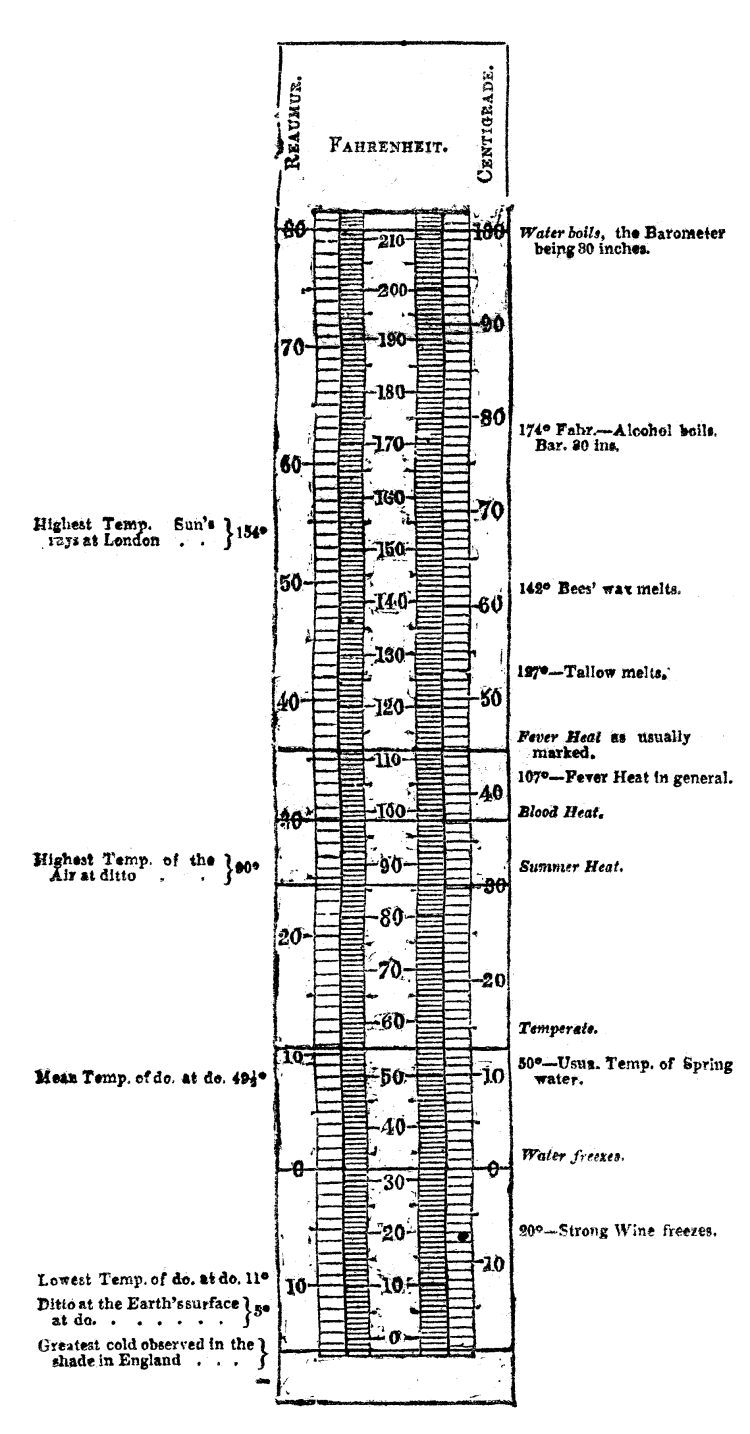
May 14.—This is the birth-day of Gabriel Daniel Fahrenheit, usually regarded as the inventor of the common mercurial thermometer, and certainly the first person by whom the instrument was accurately constructed. Fahrenheit was born at Dantzic, in 1686. His business was that of a merchant, but he was fond of spending his leisure in philosophical inquiries and experiments; and at last he settled at Amsterdam, and devoted himself almost entirely to the fabrication of the instrument which bears his name, and which still continues to be the thermometer principally used in Britain, North America, and Holland. He is supposed to have begun to make these thermometers about the year 1720, and he died in 611736. It was Fahrenheit, also, who first noticed the fact that water boils at different degrees of temperature, according to the weight of the atmospheric column resting upon it—that it requires, for instance, less heat to make it boil on the summit than at the foot of a high mountain. We shall, in some future number, explain the construction and principle of the thermometer. In the mean time we extract from ‘the Companion to the Almanac’ for 1830, a comparison of the various scales of the thermometer which are in general use:—
“A fertile cause of error in estimating and comparing the statements of temperature, is the very different manner in which they are recorded by scientific men of different nations. Wherever the English language prevails, the graduation of Fahrenheit is generally preferred. By the German authors, Römer (Reaumur) is used; and the French have, within a few years, decided to adopt that of Celsius, a Swedish philosopher, calling it ‘Thermomètre Centigrade.’ To diminish this evil, in some degree, the annexed diagram has been constructed, which shows by inspection, the expression of any point of temperature in the degrees of either or of all the above-mentioned scales; and the comparison of any degree of one with the equivalent degrees of the others.”
May 16.—On this day, in the year 1623, was born at Rumsey, in Hampshire, the celebrated Sir William Petty, a memorable and animating example of the elevation and distinction which real talent, accompanied by activity and perseverance, has always in this country been able to command for its possessor. Petty’s father was a clothier, and he appears to have given his son little to set out in life with but a good education. It is said that Petty, when quite a boy, took great delight in spending his time among smiths, carpenters, and other artificers, so that at twelve years old he knew how to work at their trades. He made so great progress at the grammar-school, that at fifteen he had made himself master of French, Latin, and Greek, and understood something of mathematics and physical science. On entering the world, he went to Caen in Normandy with a little stock of merchandize, which he there improved; and on his return to England, having obtained some employment connected with the navy, he managed to save about sixty pounds before he was twenty years of age; and with this sum he repaired to the Continent, to study medicine at the foreign universities. He accordingly attended the requisite classes successively at Leyden, Utrecht, and Paris; and in about three years came home well qualified to commence practising as a physician. Having taken up his residence in this capacity at Oxford, he soon acquired for himself a distinguished reputation, and, young as he was, was appointed assistant professor of anatomy in the University. He had already also become known in the scientific world by some mechanical inventions of considerable ingenuity; and he was one of the club of inquirers who, about the year 1649, began to assemble weekly at Oxford, for philosophical investigations and experiments, and out of whose meetings eventually arose the present Royal Society. Indeed, Dr. Wallis, one of the members, in a letter, in which he has given an account of the association, tells us that their meetings were first held “at Dr. Petty’s lodgings, in an apothecary’s house, because of the convenience of inspecting drugs, and the like, as there was occasion.” Petty’s reputation, however, rose so rapidly that, after having succeeded first to the professorship of anatomy in the University, and then to that of music in Gresham College, he was, in 1652, appointed physician to the forces in Ireland. This carried him over to that country—and eventually introduced him to a new career. In 1655 we find him appointed secretary to the Lord Lieutenant, and three years afterwards a member of the House of Commons. He was, however, soon after removed from his public employments by the Parliament which met after the death of the Protector. On the Restoration, which took place the following year, he was made a commissioner of the Court of Claims. The remainder of his life was as busy as the portion of it already passed had been; but we have no room to enumerate the books he wrote, the ingenious schemes and inventions with which his mind was constantly teeming, and the lucrative speculations in mining, the manufacture of iron, and various other great undertakings, in which he engaged. Suffice it to say, that, after accumulating a large property, he died in London, on the 16th of December, 1687, full of honours, if not of years. The first Marquis of Lansdowne (the father of the present Marquis) was the great-grandson of Sir William Petty.