THE CATHEDRAL OF ST. PAUL’S.
Reading edition
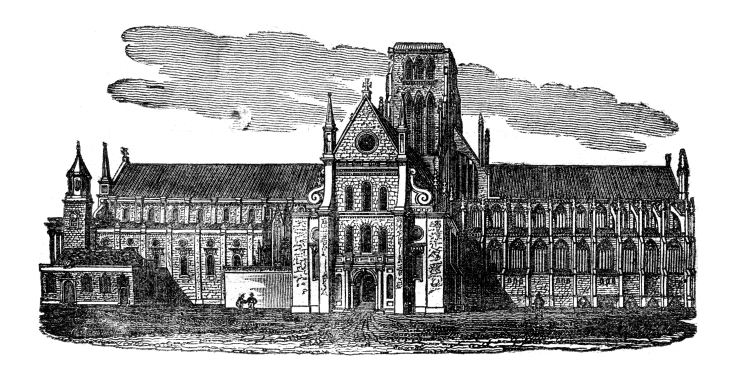
[Old St. Paul’s Cathedral—South View.]
The elevated situation of the spot on which St. Paul’s is built, seems to have pointed it out from very ancient times for religious or other public purposes. Without adopting the very doubtful opinion of some antiquaries, that the Romans during their occupation of the island had erected a temple to Diana upon this eminence—an opinion which has not even the support of tradition, and which Sir Christopher Wren, when he dug the foundations of the present church, became convinced had no other support—it seems to be clear that these foreigners used it for a cemetery or burial place, if not for anything more sacred. On the erection of the present building many Roman funeral vases, lacrymatories, and other articles used in sepulture, were found at a considerable depth under the surface. Next to these lay in rows skeletons of the ancient Britons; and immediately above them, Saxons in stone coffins, or in graves lined with chalk, together with pins of ivory and box wood which had fastened their grave clothes. The earliest building which is actually recorded to have stood on this site was a Christian church, built about the year 610, by Ethelbert, King of Kent, the first of the Saxon princes who was converted by St. Augustine. It was dedicated to St. Paul, and the old historians tell us was indebted for the latest improvements which it received to the liberality of St. Erkenwald, the bishop of the diocese, who died in 681. However, it could scarcely have been a very magnificent or extensive edifice, if it be true, as is related, that upon its being accidentally burned down in 961, it was rebuilt the same year. After this it was again destroyed by fire in the year 1087; when the Norman bishop, Maurice, who had just been appointed to the see, resolved to undertake its restoration, on a much larger and more splendid scale, at his own expense. Both he and his successor De Belmeis, each of whom presided twenty years over the diocese, are said to have devoted all their revenues to this great work; but it was not finished till the time of Bishop Niger, the fourth after De Belmeis, in the year 1240. In 1135, indeed, the uncompleted building had again caught fire, and been nearly burned to the ground. When the fabric, which might thus be called ancient, even while it was yet new, at last stood ready for consecration, it exhibited a mass 690 feet in length by 130 in breadth, surmounted by a spire 520 feet in height. Some additions, which were made to it after this, were not completed till 1315, in the reign of Edward II., the ninth king after him in whose reign the first stone of the pile had been laid.
This was the building we now call old St. Paul’s, the immediate predecessor of the present cathedral. It was one of the largest edifices in the world, and in its best days, before it was deformed by the successive repairs to which it was subjected, and the various foreign incumbrances under which it was long buried, it was no doubt a grand and imposing structure. But, from the causes we have mentioned, its form in the course of time underwent so many changes that at last it presented the appearance of little else than a heap of incongruity and confusion. The spire was of timber; but in 1315 it was found to be so much decayed that the upper part of it had to be taken down and replaced. It was upon this occasion that a ball, surmounted by a cross, was first fixed upon the termination of the spire.
The first accident which befel the church was the consequence of a violent tempest of thunder and wind which burst over the metropolis on the 1st of February, 1444. The lightning having struck the spire set it on fire; and although a priest succeeded in extinguishing the flames, a good deal of damage was done, so that it was not till the year 1462 that the gilded ball with the cross again made its appearance on the summit of the building. A much more serious disaster than this, however, happened about a century afterwards. On the 4th of June, 1561, a plumber who was employed in making some repairs, thoughtlessly left a pan of coals burning within the spire while he went to dinner; the flames from which caught the adjacent wooden work, and in no long time set the whole building in a blaze. In spite of every thing that could be done, the conflagration continued to rage till it had consumed every thing about the church that was combustible, and reduced it to a mere skeleton of bare and blackened walls.
With such ardour, however, did the Queen (Elizabeth), and, it may be said indeed, the whole nation, promote the scheme of restoring the sacred edifice, all ranks contributing to the pious and patriotic work, that in the space of about five years it was again opened for worship. But it never recovered its ancient splendour: the spire, in particular, was not rebuilt at all; and from the shortness 58of the time spent in the restoration altogether, it is probable that other parts of the work were hurried over without much attention either to strength or beauty. By the end of the reign of Elizabeth accordingly, the structure had fallen into sad decay; so that it was found in 1608 that it could not be repaired under a cost of considerably more than twenty thousand pounds. It was not, however, till 1633, in the reign of Charles I., that the repairs were actually begun, the interval having been spent in attempts to collect the necessary funds by subscription. Meanwhile the cathedral was every year becoming more ruinous. The money subscribed at last amounted to above a hundred thousand pounds, and then the celebrated Inigo Jones having been appointed to superintend the work, it was, as we have said, proceeded with.
We shall now mention some particulars to show the extraordinary state of neglect and ruin into which this once proud edifice had been by this time allowed to fall. Towards the close of the sixteenth century it is stated, that the benches at the door of the choir were commonly used by beggars and drunkards for sleeping on, and that a large dunghill lay within one of the doors of the church. The place indeed was the common resort of idlers of all descriptions, who used to walk about in the most irreverent manner with their hats on even during the performance of divine service. More than twenty private houses were built against the walls of the church, the owners of several of which had cut closets out of the sacred edifice, while in other instances doors had been made into the vaults which were converted into cellars. At one of the visitations the verger presented that “the shrouds and cloisters under the convocation-house are made a common lay-stall for boards, trunks, and chests, being let out unto trunk-makers; where, by means of their daily knocking and noise, the church is greatly disturbed.” One house, partly formed of the church, is stated to have been “lately used as a play-house;” the owner of another, which was built upon the foundation of the church, had contrived a way through a window into a part of the steeple, which he had turned into a ware-room; and a third person had excavated an oven in one of the buttresses, in which he baked his bread and pies.
The first thing which Jones did was to clear away these obstructions, after which the work of restoration proceeded slowly but with tolerable regularity till the commencement of the civil wars in 1642. In 1643, not only all the revenues of the cathedral, but the funds which had been collected for repairing it, together with all the unused building materials, were seized by the Parliament. The scaffolding was given to the soldiers of Colonel Jephson’s regiment for arrears of pay; on which, no man hindering them, they dug pits in the middle of the church to saw the timber in. Another part of the building was converted into a barrack for dragoons and a stable. Public worship, nevertheless, was still celebrated in the east end and a part of the choir, which was separated from the rest by a brick wall, the congregation entering through one of the north windows which was converted into a door. At the west end Inigo Jones had erected a portico of great beauty, consisting of fourteen columns, each rising to the lofty height of forty-six feet, and the whole supporting an entablature crowned with statues. These statues were thrown down and broken in pieces; and shops were built within the portico, in which commodities of all sorts were sold. The wood-cut, at the head of this article, represents the cathedral as it was drawn by Hollar in 1656.
In this state things continued till the restoration. Soon after that event, the repairing of St. Paul’s again engaged the thoughts of the king and the public; and subscriptions to a considerable amount having been once more obtained, the work was recommenced on the 1st of August, 1663. Three years afterwards, however, (in September, 1666,) before it had been nearly completed, the great fire, which consumed half the metropolis, seized in its progress westward upon the scaffolding by which the cathedral was surrounded, and after an awful conflagration, left it a mere mass of ruins. History has recorded no finer instance of national spirit than the noble courage and alacrity with which the citizens of London, and the English government, and people generally, rose from this terrible calamity and applied themselves to restore all that it had destroyed. In the plans which were immediately taken into consideration for rebuilding the city, St. Paul’s was not forgotten. Sir Christopher Wren, who had been employed in superintending the previous repairs, was ordered to examine and report upon the state in which the foundations of the building were, and so much of the walls as was left standing. At first it was thought that a considerable portion of the old church might still be found available; but this idea was eventually given up; and on the 21st of June, 1675, the foundation-stone of the present building was laid. From this time the work proceeded without interruption till its completion in 1710. The same great architect, Sir Christopher Wren, presided over and directed the work from its commencement to its close. For this, all that he received was £200 a-year; and the commissioners had even the spite and meanness, after the building was considerably advanced, to suspend the payment of one half of this pittance till the edifice should be finished, under the pretence of thereby better securing the diligence and expedition of the architect. In fact, it was with no small difficulty that Sir Christopher at last got his money at all. The whole expense of rebuilding the cathedral was £736,000, which was raised almost entirely by a small tax on coals. The church of St. Peter’s at Rome, which is indeed a building of greater dimensions, but to which St. Paul’s ranks next even in that respect among the sacred edifices of Christendom, took one hundred and forty-five years to build, was the work of twelve successive architects, and exhausted the revenues of nineteen successive popes. It is worthy of remark, that St. Paul’s was begun and completed not only by one architect, and one master mason, Mr. Thomas Strong, but also while one bishop, Dr. Henry Compton, presided over the diocese.