THE WEEK.
Reading edition
October 27.—The birth-day of Captain Cook. James Cook was born in 1728 at the village of Marton in the North Riding of Yorkshire. His parents were of the class of labourers. All the education he received amounted only to English reading, writing and the elements of arithmetic. He was then, at the age of thirteen, bound apprentice to a small shopkeeper in the neighbouring town of Snaith, which is on the sea-coast. Here he became so smitten with the love of a sea-life that he could not rest till his wish was gratified; and his master was at last induced to let him off, when he entered himself as one of the crew of a vessel engaged in the coal trade. In this humble and laborious line of life he continued till the breaking out of the war of 1755. He then entered the navy, as a common seaman, of course. But now the native superiority of the man began to assert itself; and in four years he rose to be Master of the Mercury, one of the ships belonging to an expedition sent against Quebec. Thus by far the most formidable of the difficulties were overcome which he had to encounter in emerging from obscurity; he was now on the direct road to preferment, and in a position in which his good conduct and perseverance were sure to meet with their reward. While stationed in this command on the coast of North America, he greatly distinguished himself both by his skill and intrepidity as a seaman; and he also made use of his leisure to rectify the defects of his original education by studying mathematics and astronomy. He eventually made himself in this way one of the most scientific naval officers of that time. His reputation rose accordingly; and in 1768, when Government resolved to send out the Endeavour to the South Sea to obtain an observation of the approaching transit of Venus, Cook was selected to command the ship. He conducted this expedition with admirable ability, and so entirely to the public satisfaction, that, having returned home in 1771, he was the following year appointed to proceed again to the same regions with two ships, the Resolution and the Adventure, with the object of endeavouring to settle the long-disputed question as to the existence of a southern polar continent. On this voyage, in which he circumnavigated the world, he was absent nearly three years; and notwithstanding all the vicissitudes of climate and weather, and the other dangers which he had encountered, he brought home, with the exception of one, every man of the crew he had taken out with him. He communicated to the Royal Society an account of the methods he had adopted on this occasion for preserving the health of his men; and that body in return elected him into their number, and voted him the Copley gold medal as a testimony of their sense of his merits. To crown his achievement, Captain Cook wrote the history of this expedition himself, and wrote it admirably. In little more than a year after his return, he sailed on his third and last voyage of discovery; the principal object of which was to ascertain the practicability of a passage between the Atlantic and Pacific Oceans along the northern coast of America. After having been out on this expedition nearly three years, and having explored a vast extent of sea and coast, the great circumnavigator put in at the island of Owhyhee on his return home; and he was there killed in a sudden and accidental rencontre with some of the natives on the 14th of February, 1779. The late Admiral Burney, who was present on this occasion, mentions, in a note to his History of Discoveries in the South Sea, an anecdote which deserves to be remembered. Of the party of marines, by whom Captain Cook was accompanied when he met his death, four were killed along with him; “and in the hasty retreat made,” says Burney, “after the boats had put off, one man still remained on shore, who could not swim. His officer, Lieutenant (now Colonel) Molesworth Phillips, of the Marines, though himself wounded at the time, seeing his situation, jumped out of the boat, swam back to the shore, and brought him off safe.” The author proceeds to compare this conduct of Lieutenant Phillips with a similar act performed in 1624 by a Dutch Captain, Cornelys de Witte, who, when a boat’s crew which he commanded was surprised in a port on the coast of America by an ambuscade of Spaniards, and driven to sea after four of them had been killed, seeing one of his men left behind on the beach, boldly returned to the shore in the face of the enemy, and took him into his boat. “This was an act of generosity,” observes the French translator of the account of the Dutch voyage, “worth a wound which he received in his side, and of which he was afterwards cured.” The news of the death of Cook was received by his countrymen, and it may be said by the world, with the feeling that one of the great men of the age was lost; and both in his own and in foreign nations public honours 288were liberally paid to his memory. In the half century of busy and enterprising exertion in every field of activity which has elapsed since his death, no newer name in the same department has yet eclipsed the lustre of his, and with reference to the peculiar character of his fame, as contrasted with that of our other renowned seamen, it has been well and justly remarked that, “while numberless have been our naval heroes who have sought and gained reputation at the cannon’s mouth, and amidst the din of war, it has been the lot of Cook to derive celebrity from less imposing, but not less important exploits, as they tended to promote the intercourse of distant nations, and increase the stock of useful science.”[1]
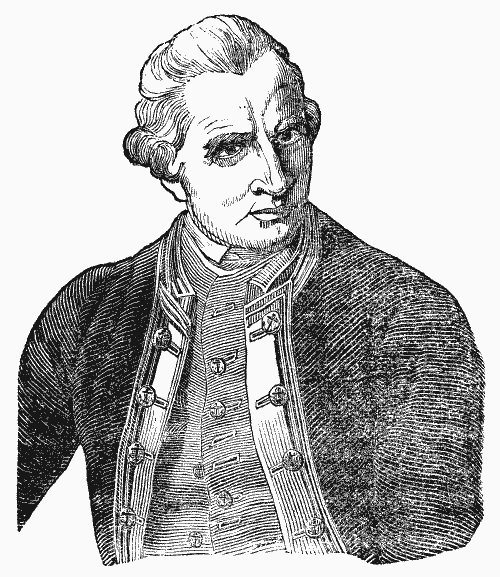
[Portrait of Captain Cook.]