NAPLES.
Reading edition
In a preceding number we endeavoured to give our readers a notion of the situation and main features of Naples. We shall now devote a page to a few of the interesting objects contained within that city.
The first in importance is the Studj or Museo Borbonico, or, what we may better call, the National Museum. In many respects this magnificent establishment is unrivalled in the world. Besides a rich statue gallery which boasts the Farnesian Hercules, the all perfect Aristides, the Farnesian Toro, a Venus perhaps superior in loveliness to the Medicean, and other masterpieces of ancient Greek art, the Museum contains a gallery of pictures with two of Raphael’s best works, and splendid specimens of Titian, Correggio, Claude, Salvator Rosa, and other great masters; and, moreover, a library, a collection of Etruscan vases, a cabinet of ancient coins and medals, and rooms filled with the ancient relics of Herculaneum and Pompeii.
The collection of vases, which have nearly all been discovered and dug up in the kingdom, is the richest in existence; but it is more especially the collection of the objects rescued from the two interred cities, that gives the Museum of Naples its superiority to others.
In this collection are found some of the most perfect works of ancient art in bronze, domestic implements of nearly every sort, mechanical tools, surgical and mathematical instruments, rings, necklaces, and other specimens of jewellery, and even the entire apparatus of a woman’s toilet. The attentive visitor, by studying these objects, may in a few hours obtain a better insight into the domestic manners of the ancients, than whole years devoted to books can give him. One of the most interesting departments of this unique collection, is that of the papyri, or manuscripts, discovered in the excavations of Herculaneum. The ancients did not bind their books (which, of course, were all manuscripts) like us, but rolled them up in scrolls. When these of Herculaneum were discovered, they presented, as they still do, the appearance of burnt sticks, or cylindrical pieces of charcoal, which they had acquired from the action of the heat contained in the lava that buried the whole city. They seem quite solid both to the eye and touch, yet an ingenious monk discovered a process of detaching leaf from leaf and unrolling them, by which they could be read without much difficulty. When these manuscripts were first exposed to the air a considerable 285number of them crumbled to dust. Our countryman, the late Sir Humphry Davy, destroyed the integrity of a few by making unsuccessful experiments, which he fancied might produce a result that would supersede the slow and laborious process now adopted; but about eighteen hundred still remain. Four of them have been unrolled, and fac-similies of them, with translations, published by the Neapolitan government.
To pass to a very different object. One of the singularities of Naples is its Campo Santo, or cemetery for the poor. This is situated on the skirts of the town, looking towards Mount Vesuvius. A wall of inconsiderable elevation encloses a quadrangular space, whose surface is cut into three hundred and sixty-five holes, like the mouths of wells or cisterns. One of these holes is opened every day; the dead bodies of the poor of that day—without coffins—without so much as a rag about them—are thrown one upon another, as they arrive, through the mouth into a deep cave below cut in the tufa rock, and at night a stone is laid over the horrid sepulchre and secured by cement. The next day the cave next in order of date is opened, and so on through the year. At the end of the year, the first cave is again opened, by which time its contents, the decomposition of which is assisted by quick-lime, are reduced to little more than bones.
The catacombs of Naples, whose entrance is under the hill of Capo-di-Monte, and the grotto of Posilippo, at the extremity of the western suburb of the city, are also remarkable objects. The first are of great extent, and contain many curious specimens of painting and subterranean architecture by the early Christians, and an appalling mass of human skulls and bones, the relics of the victims of a plague that depopulated Naples some two centuries back. The second is a subterranean passage cut through the hill of Posilippo in remote antiquity, but enlarged and improved as a road in modern times. It is considerably more than half a mile long by twenty-four feet broad; its height is unequal, varying from twenty-five to sixty feet: it is well paved with large flags of lava. By night, it is now tolerably well illuminated by lamps suspended from its rugged roof, but by day the “darkness visible” that reigns through the passage renders it always solemn and sometimes embarrassing. Being the only frequented road to and from the town of Pozzuoli, Baia, Cuma, and other places, there is seldom a lack of passengers; and their voices, as they cry to each other in the dark, and the noise of their horses’ tread and of the wheels of their waggons, carriages, and gigs, echoing through the grotto and the deep vaults which in many places branch off from it laterally, produce to the ear of the stranger an effect that is almost terrific. Immediately above the entrance to the grotto, coming from the city, stands on a romantic cliff, which has been in part cut away to widen the approach to the subterranean road, an ancient Roman tomb in almost perfect preservation. This tomb is supposed to have been that of the great poet Virgil, and is visited as such by every traveller. Its claim has been questioned in vain; mankind are attached to such pleasant illusions, (if this be one, which we by no means decide,) and continue from age to age to crowd to the spot. A laurel once flourished by the side of the venerable sepulchre and covered its roof; but the successive thousands and thousands of visitors, each anxious for a memorial gathered in such a spot, have not left leaf, branch, stem, or root of the sacred tree.
In the old part of the city, among some Roman ruins called the “Anticaglia,” are supposed to exist part of the walls of the theatre where the Emperor Nero sang and played on the lyre like a common actor. The Neapolitans care little about this; but their great boast, that which they fancy renders them the envy of the world, is their Opera-house of San Carlo, which in truth, must be acknowledged as the most spacious and most splendid theatre in Europe.
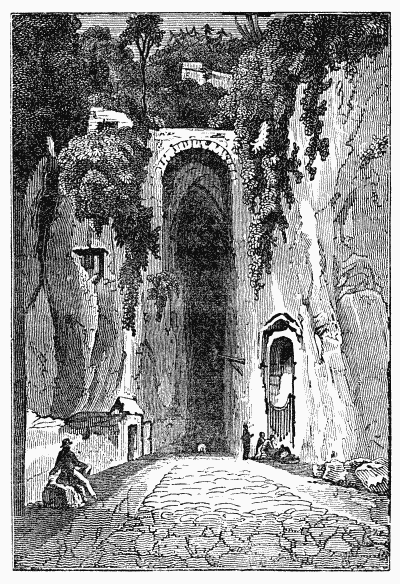
[The Grotto of Posilippo and Tomb of Virgil.]